If you haven't heard about the Amazon Echo, you've surely heard about
Google Home by now. Essentially, both devices are voice controlled AI
personal assistants. The idea of taking a Siri-like feature and integrating
into your home for both entertainment and efficiency makes sense.
However, the story of why these devices are coming to fruition now is a
bit deeper than you might think.Understanding that background
provides insight into who I think the winner is (read "will be") and why.
Additionally, it provides a further glimpse into the future.
Essentially, the internet as we have known it for the past 20+ years has been
people-centric. The internet of people if you will. Everything is about the
individual, people connecting to people, to information, to products, etc... The
idea behind the Internet of Things is inanimate objects connected together for
the sake of autonomy, data-collection, and more. By connecting ideally every
valuable data point, we can gather vast amounts of data; operate with more
efficiency and even have fully self-controlled processes.
It all comes down to data. The hardware,
software, and human interface are all
important, but from start to finish the
effectiveness of any IoT-based platform is
data. Big data is the core to making a fully
integrated smart home a reality, of course,
AI is necessary as well, but data is the map
that AI plots its' course upon. This
background is important to understanding
why we cast our vote with one Smart
Home assistant over the other.
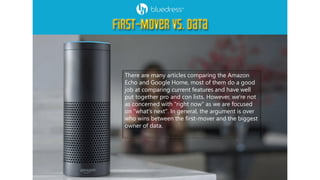
There are many articles comparing the Amazon
Echo and Google Home, most of them do a good
job at comparing current features and have well
put together pro and con lists. However, we're not
as concerned with "right now" as we are focused
on "what's next". In general, the argument is over
who wins between the first-mover and the biggest
owner of data.
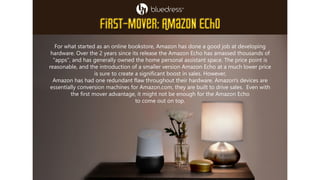
For what started as an online bookstore, Amazon has done a good job at developing
hardware. Over the 2 years since its release the Amazon Echo has amassed thousands of
"apps", and has generally owned the home personal assistant space. The price point is
reasonable, and the introduction of a smaller version Amazon Echo at a much lower price
is sure to create a significant boost in sales. However,
Amazon has had one redundant flaw throughout their hardware. Amazon's devices are
essentially conversion machines for Amazon.com, they are built to drive sales. Even with
the first mover advantage, it might not be enough for the Amazon Echo
to come out on top.
Ok, so if you haven't figured it out by now, our pick for the winner is the
Google Home...at least eventually. It's no coincidence that within a relatively
close timeframe Google released their first phone as well as the Google Home;
however, we're willing to bet that both of these devices initial versions are
more about real-world beta testing and data collection than about trying to
make a land-grab. While it makes sense that Google, like any business, would
want to own as much of a certain market share as possible, taking a long-term
approach will pay off far greater in the end.
There are a few main reasons why we think Google Home will eventually win and it all comes
back to data. The main aspects to consider are: how much data do you have access to, what
can you do with it, and how easy is it to access. Let's take a look at how this applies to the
Google Home:
Amount of Data - Google started as a
search engine, and over the years they have
continued to use the data they have received
from queries to refine your results. For Google
it is not simply about understanding how to
provide you the answers you want, it is also
about understanding how to further develop
their own machine learning functionality.
Data in Action - Because of Google's
immense data capture and brilliant artificial
intelligence programming, they are continually
able to provide you with an improved
experience. With the implementation of Pixel,
the phone by Google, their ability to map and
act upon even more data will only improve.
Their goal as a search engine is to provide you
with the most relevant results possible, and
that same goal of relevance and intuitiveness is
seen throughout their software and products.
Data Access - With Google Home, the goal is
for the most seamless integration and already
their voice command function has proven to be
far more intuitive than Amazon Echo. We
communicate vocally, we have become
accustomed to touch screens, but voice control is
simply a step further toward reducing inefficiency
and improving the user experience. Over time
the need for key terms will continue to decrease
and Google Home will be able to understand
your intentions based on context and history
alone.
It is possible that Google will end up with a much bigger piece of the phone market
as well as the leader in Smart Home hubs. The amount of access that Google has to
so many different parts of our daily lives is staggering, and their ability to refine and
simplify organizing all of these different pieces continues to improve. Because of that,
it is likely that eventually, people will eagerly leave their existing, comfortable OS
platforms for an all-things-Google lifestyle. As Google continues to aggregate data
and make it both actionable and autonomous, switching to a Google based lifestyle
could become the easiest change you ever make.
Ingrid Gee, Internet Marketing
Consultant. Blue Dress® Marketing,
an Internet Marketing Company
headquartered in Knoxville, TN.
Internet Marketing Developed,
Implemented and Managed to Full
Circle! Organic Internet Search Engine
Guru. Turn Key Internet Optimization
Programs Placing You Everywhere and
Anywhere You Need to Be Online®
ingrid@bluedressinc.com
865-951-5887

Amazon Echo vs Google Home: The Smart Home Begins

  • 1.
    If you haven'theard about the Amazon Echo, you've surely heard about Google Home by now. Essentially, both devices are voice controlled AI personal assistants. The idea of taking a Siri-like feature and integrating into your home for both entertainment and efficiency makes sense. However, the story of why these devices are coming to fruition now is a bit deeper than you might think.Understanding that background provides insight into who I think the winner is (read "will be") and why. Additionally, it provides a further glimpse into the future.
  • 2.
    Essentially, the internetas we have known it for the past 20+ years has been people-centric. The internet of people if you will. Everything is about the individual, people connecting to people, to information, to products, etc... The idea behind the Internet of Things is inanimate objects connected together for the sake of autonomy, data-collection, and more. By connecting ideally every valuable data point, we can gather vast amounts of data; operate with more efficiency and even have fully self-controlled processes.
  • 3.
    It all comesdown to data. The hardware, software, and human interface are all important, but from start to finish the effectiveness of any IoT-based platform is data. Big data is the core to making a fully integrated smart home a reality, of course, AI is necessary as well, but data is the map that AI plots its' course upon. This background is important to understanding why we cast our vote with one Smart Home assistant over the other.
  • 4.
    There are manyarticles comparing the Amazon Echo and Google Home, most of them do a good job at comparing current features and have well put together pro and con lists. However, we're not as concerned with "right now" as we are focused on "what's next". In general, the argument is over who wins between the first-mover and the biggest owner of data.
  • 5.
    For what startedas an online bookstore, Amazon has done a good job at developing hardware. Over the 2 years since its release the Amazon Echo has amassed thousands of "apps", and has generally owned the home personal assistant space. The price point is reasonable, and the introduction of a smaller version Amazon Echo at a much lower price is sure to create a significant boost in sales. However, Amazon has had one redundant flaw throughout their hardware. Amazon's devices are essentially conversion machines for Amazon.com, they are built to drive sales. Even with the first mover advantage, it might not be enough for the Amazon Echo to come out on top.
  • 6.
    Ok, so ifyou haven't figured it out by now, our pick for the winner is the Google Home...at least eventually. It's no coincidence that within a relatively close timeframe Google released their first phone as well as the Google Home; however, we're willing to bet that both of these devices initial versions are more about real-world beta testing and data collection than about trying to make a land-grab. While it makes sense that Google, like any business, would want to own as much of a certain market share as possible, taking a long-term approach will pay off far greater in the end.
  • 7.
    There are afew main reasons why we think Google Home will eventually win and it all comes back to data. The main aspects to consider are: how much data do you have access to, what can you do with it, and how easy is it to access. Let's take a look at how this applies to the Google Home: Amount of Data - Google started as a search engine, and over the years they have continued to use the data they have received from queries to refine your results. For Google it is not simply about understanding how to provide you the answers you want, it is also about understanding how to further develop their own machine learning functionality.
  • 8.
    Data in Action- Because of Google's immense data capture and brilliant artificial intelligence programming, they are continually able to provide you with an improved experience. With the implementation of Pixel, the phone by Google, their ability to map and act upon even more data will only improve. Their goal as a search engine is to provide you with the most relevant results possible, and that same goal of relevance and intuitiveness is seen throughout their software and products.
  • 9.
    Data Access -With Google Home, the goal is for the most seamless integration and already their voice command function has proven to be far more intuitive than Amazon Echo. We communicate vocally, we have become accustomed to touch screens, but voice control is simply a step further toward reducing inefficiency and improving the user experience. Over time the need for key terms will continue to decrease and Google Home will be able to understand your intentions based on context and history alone.
  • 10.
    It is possiblethat Google will end up with a much bigger piece of the phone market as well as the leader in Smart Home hubs. The amount of access that Google has to so many different parts of our daily lives is staggering, and their ability to refine and simplify organizing all of these different pieces continues to improve. Because of that, it is likely that eventually, people will eagerly leave their existing, comfortable OS platforms for an all-things-Google lifestyle. As Google continues to aggregate data and make it both actionable and autonomous, switching to a Google based lifestyle could become the easiest change you ever make.
  • 11.
    Ingrid Gee, InternetMarketing Consultant. Blue Dress® Marketing, an Internet Marketing Company headquartered in Knoxville, TN. Internet Marketing Developed, Implemented and Managed to Full Circle! Organic Internet Search Engine Guru. Turn Key Internet Optimization Programs Placing You Everywhere and Anywhere You Need to Be Online® ingrid@bluedressinc.com 865-951-5887