



HELLO!
I am Ashok, M. T.
I am here to present about this
amazing personality.
AMARTYA SEN
Ashutosh Sen &
Amita Sen
In 3, Nov 1933
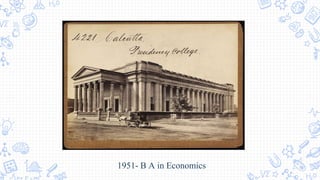
1951- B A in Economics
1955-Trinity College, Cambridge
Sen explained: “The broadening of my studies
into philosophy was important for me not just because some of
my main areas of interest in economics relate quite
closely to philosophical disciplines but also because I found
philosophical studies very rewarding on their own”.
Know for….
Welfare Economics
Social Choice Theory
Economics and Social Justice
Economics Theories of Famine
Indexes for measure of well-being of developing countries
Social Choice Theory
• Social choice theory or social choice is
a theoretical framework for analysis of combining
individual opinions, preferences, interests, or welfares to
reach a collective decision or social welfare in some sense.
• Social choice blends elements of welfare
economics and voting theory. It is methodologically
individualistic, in that it aggregates preferences and
behaviours of individual members of society. Using
elements of formal logic for generality, analysis proceeds
from a set of seemingly reasonable axioms of social choice
to form a social welfare function (or constitution).
Contd…
• Sen proposes, that comparability of interpersonal utility
need not be partial. Under Sen's theory of informational
broadening, even complete interpersonal comparison of
utility would lead to socially suboptimal choices because
mental states are malleable. A starving peasant may have
a particularly sunny disposition and thereby derive high
utility from a small income. This fact should not nullify,
however, his claim to compensation or equality in the
realm of social choice.
Contd…
• Social decisions should accordingly be based on
immalleable factors. Sen proposes interpersonal utility
comparisons based on a wide range of data. His theory is
concerned with access to advantage, viewed as an
individual's access to goods that satisfy basic needs (e.g.,
food), freedoms (in the labour market, for instance),
and capabilities. We can proceed to make social choices
based on real variables, and thereby address actual position,
and access to advantage.
• Sen’s revolutionary contribution to development economics and
social indicators is the concept of "capability" developed in his
article “Equality of What”.
• He argues that governments should be measured against the
concrete capabilities of their citizens. This is because top-down
development will always trump human rights as long as the
definition of terms remains in doubt.
• In order for citizens to have a capacity to vote, they first must have
“functionings”. These “functionings” can range from the very
broad, such as the availability of education, to the very specific,
such as transportation to the polls. Only when such barriers are
removed can the citizen truly be said to act out of personal choice.
Research Work
• Sen’s work on 'Choice of Technique' complemented
that of Maurice Dobb. In a Developing country, the
Dobb-Sen strategy relied on maximising investible
surpluses, maintaining constant real wages and using
the entire increase in labour productivity, due to
technological change, to raise the rate of accumulation.
In other words, workers were expected to demand no
improvement in their standard of living despite having
become more productive
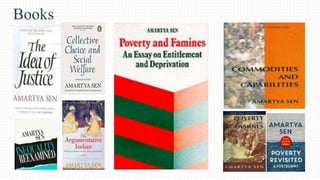
Books
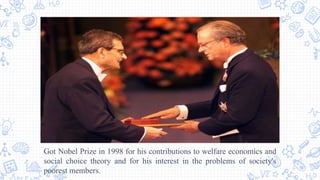
Got Nobel Prize in 1998 for his contributions to welfare economics and
social choice theory and for his interest in the problems of society's
poorest members.
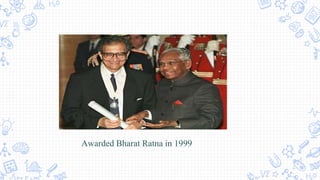
Awarded Bharat Ratna in 1999
• He has served as president of the Econometric Society
(1984), the International Economic Association (1986–
1989),the Indian Economic Association (1989) and the
American Economic Association (1994).
• He has also served as President of the Development
Studies Association and the Human Development and
Capability Association.
• He serves as the honorary director of the Academic
Advisory Committee of the Center for Human and
Economic Development
• Studies at Peking University in China.[28]
“The Conscience of the
Profession” &
“The Mother Teresa of Economics”
Amartya Sen
has received over 90 honorary
degrees from universities around
the world and many other awards
THANKS!
Any questions?
Credits
• https://www.britannica.com/biography/Amartya-Sen
• https://en.wikipedia.org/wiki/Amartya_Sen

Amartya sen

  • 1.
    HELLO! I am Ashok,M. T. I am here to present about this amazing personality.
  • 2.
  • 4.
    Ashutosh Sen & AmitaSen In 3, Nov 1933
  • 5.
    1951- B Ain Economics
  • 6.
  • 7.
    Sen explained: “Thebroadening of my studies into philosophy was important for me not just because some of my main areas of interest in economics relate quite closely to philosophical disciplines but also because I found philosophical studies very rewarding on their own”.
  • 8.
    Know for…. Welfare Economics SocialChoice Theory Economics and Social Justice Economics Theories of Famine Indexes for measure of well-being of developing countries
  • 9.
    Social Choice Theory •Social choice theory or social choice is a theoretical framework for analysis of combining individual opinions, preferences, interests, or welfares to reach a collective decision or social welfare in some sense. • Social choice blends elements of welfare economics and voting theory. It is methodologically individualistic, in that it aggregates preferences and behaviours of individual members of society. Using elements of formal logic for generality, analysis proceeds from a set of seemingly reasonable axioms of social choice to form a social welfare function (or constitution).
  • 10.
    Contd… • Sen proposes,that comparability of interpersonal utility need not be partial. Under Sen's theory of informational broadening, even complete interpersonal comparison of utility would lead to socially suboptimal choices because mental states are malleable. A starving peasant may have a particularly sunny disposition and thereby derive high utility from a small income. This fact should not nullify, however, his claim to compensation or equality in the realm of social choice.
  • 11.
    Contd… • Social decisionsshould accordingly be based on immalleable factors. Sen proposes interpersonal utility comparisons based on a wide range of data. His theory is concerned with access to advantage, viewed as an individual's access to goods that satisfy basic needs (e.g., food), freedoms (in the labour market, for instance), and capabilities. We can proceed to make social choices based on real variables, and thereby address actual position, and access to advantage.
  • 12.
    • Sen’s revolutionarycontribution to development economics and social indicators is the concept of "capability" developed in his article “Equality of What”. • He argues that governments should be measured against the concrete capabilities of their citizens. This is because top-down development will always trump human rights as long as the definition of terms remains in doubt. • In order for citizens to have a capacity to vote, they first must have “functionings”. These “functionings” can range from the very broad, such as the availability of education, to the very specific, such as transportation to the polls. Only when such barriers are removed can the citizen truly be said to act out of personal choice.
  • 13.
    Research Work • Sen’swork on 'Choice of Technique' complemented that of Maurice Dobb. In a Developing country, the Dobb-Sen strategy relied on maximising investible surpluses, maintaining constant real wages and using the entire increase in labour productivity, due to technological change, to raise the rate of accumulation. In other words, workers were expected to demand no improvement in their standard of living despite having become more productive
  • 14.
  • 15.
    Got Nobel Prizein 1998 for his contributions to welfare economics and social choice theory and for his interest in the problems of society's poorest members.
  • 16.
  • 17.
    • He hasserved as president of the Econometric Society (1984), the International Economic Association (1986– 1989),the Indian Economic Association (1989) and the American Economic Association (1994). • He has also served as President of the Development Studies Association and the Human Development and Capability Association. • He serves as the honorary director of the Academic Advisory Committee of the Center for Human and Economic Development • Studies at Peking University in China.[28]
  • 18.
    “The Conscience ofthe Profession” & “The Mother Teresa of Economics”
  • 19.
    Amartya Sen has receivedover 90 honorary degrees from universities around the world and many other awards
  • 20.
  • 21.