Title: Mobile Phone Based Remote Monitoring and Control System for Individualized Healthcare Authors: Mohammed  Osman, Mohamed Nasor, Ahmed Imran  Affiliation: Ajman University of Science and Technology, United Arab Emirates Presented to:   AMA-IEEE Medical Technology Conference on Individualized  Healthcare; 21-23 March 2010; Washington D.C. Ajman University of Science and Technology, UAE.
Introduction Wireless solutions for healthcare improve patient-care and reduce costs. Development of a wireless electronic healthcare system for real-time monitoring and control of individuals requiring continuous care. Mobile phones are used for communication and data transfer  Ajman University of Science and Technology, UAE.
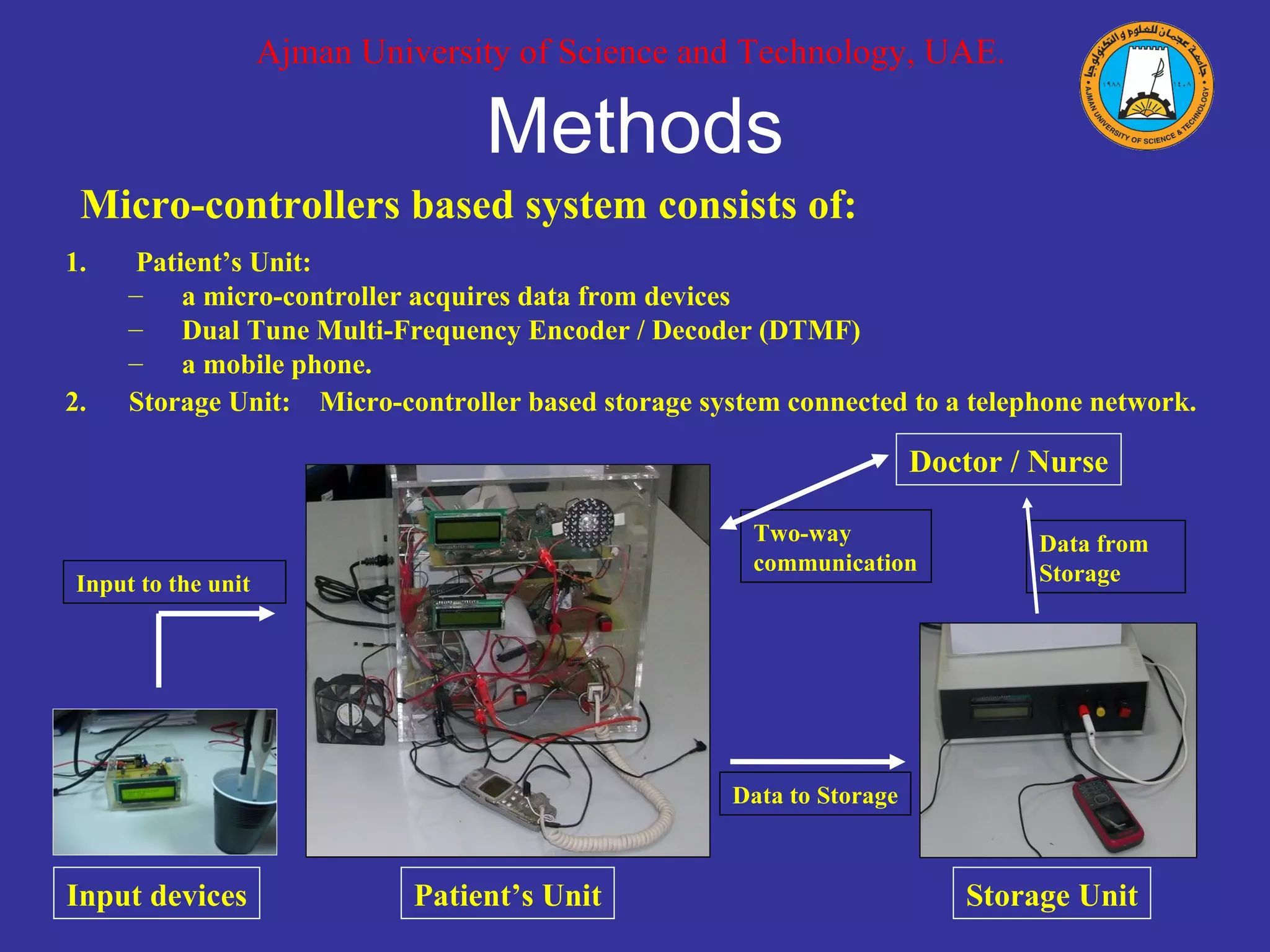
Methods 1.  Patient’s Unit: a micro-controller acquires data from devices Dual Tune Multi-Frequency Encoder / Decoder (DTMF) a mobile phone.  2. Storage Unit:  Micro-controller based storage system connected to a telephone network. Micro-controllers based system consists of: Patient’s Unit Storage Unit Doctor / Nurse Data from Storage Data to Storage Two-way communication Input devices Input to the unit Ajman University of Science and Technology, UAE.
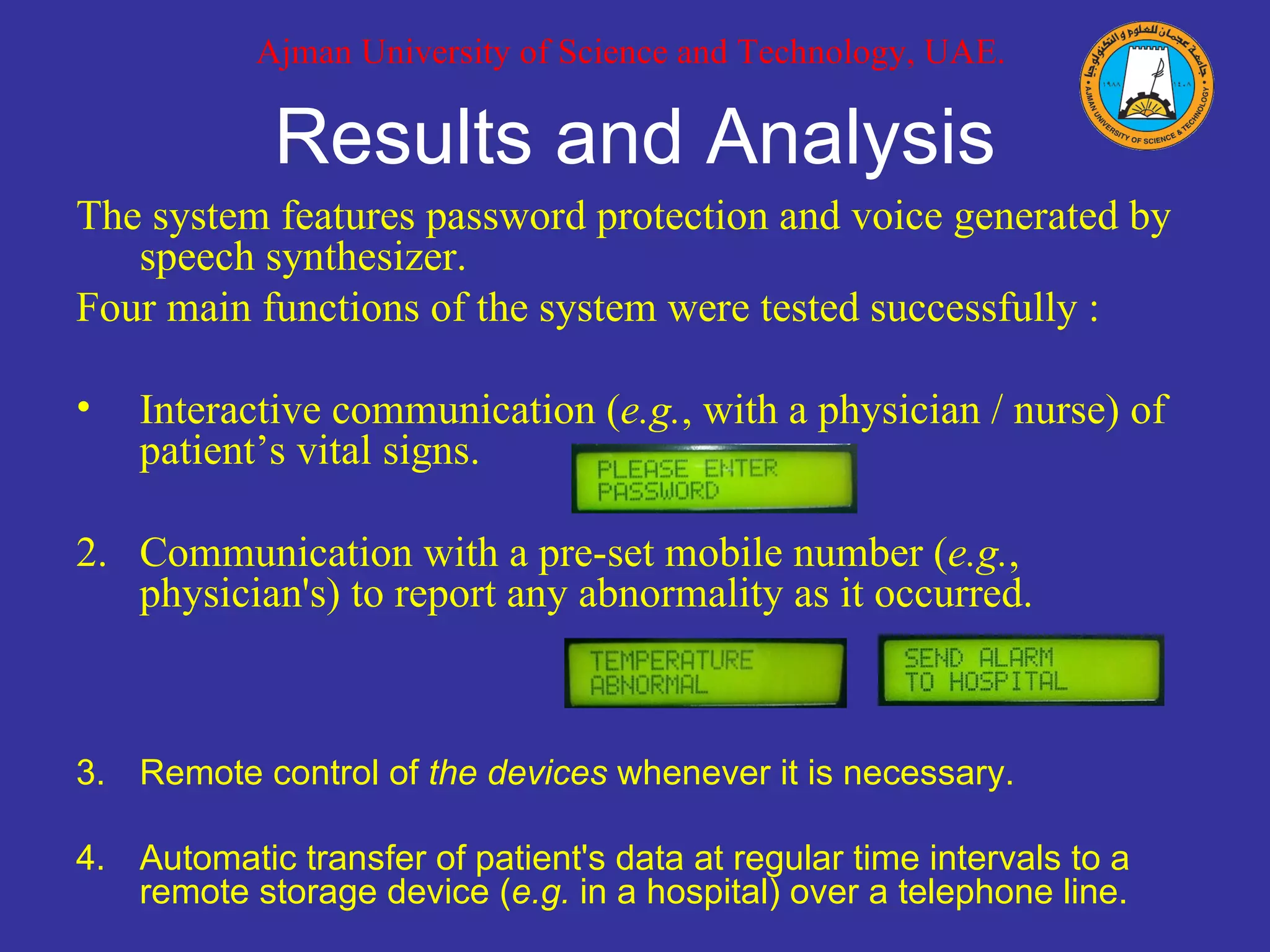
Results and Analysis The system features password protection and voice generated by speech synthesizer.  Four main functions of the system were tested successfully : Interactive communication ( e.g. , with a physician / nurse) of patient’s vital signs. 2. Communication with a pre-set mobile number ( e.g. , physician's) to report any abnormality as it occurred. 3. Remote control of  the devices  whenever it is necessary. 4. Automatic transfer of patient's data at regular time intervals to a remote storage device ( e.g.  in a hospital) over a telephone line. Ajman University of Science and Technology, UAE.
Conclusion Mobile Phone Based System can be used for Remote Monitoring and Control of individuals requiring continuous care. Several additional options are being added to the system.  Acknowledgements: Thanks are due to all colleagues and students for contributing to the development and testing of the system. Ajman University of Science and Technology, UAE.

mobile phone based patient care

  • 1.
    Title: Mobile PhoneBased Remote Monitoring and Control System for Individualized Healthcare Authors: Mohammed Osman, Mohamed Nasor, Ahmed Imran Affiliation: Ajman University of Science and Technology, United Arab Emirates Presented to: AMA-IEEE Medical Technology Conference on Individualized Healthcare; 21-23 March 2010; Washington D.C. Ajman University of Science and Technology, UAE.
  • 2.
    Introduction Wireless solutionsfor healthcare improve patient-care and reduce costs. Development of a wireless electronic healthcare system for real-time monitoring and control of individuals requiring continuous care. Mobile phones are used for communication and data transfer Ajman University of Science and Technology, UAE.
  • 3.
    Methods 1. Patient’s Unit: a micro-controller acquires data from devices Dual Tune Multi-Frequency Encoder / Decoder (DTMF) a mobile phone. 2. Storage Unit: Micro-controller based storage system connected to a telephone network. Micro-controllers based system consists of: Patient’s Unit Storage Unit Doctor / Nurse Data from Storage Data to Storage Two-way communication Input devices Input to the unit Ajman University of Science and Technology, UAE.
  • 4.
    Results and AnalysisThe system features password protection and voice generated by speech synthesizer. Four main functions of the system were tested successfully : Interactive communication ( e.g. , with a physician / nurse) of patient’s vital signs. 2. Communication with a pre-set mobile number ( e.g. , physician's) to report any abnormality as it occurred. 3. Remote control of the devices whenever it is necessary. 4. Automatic transfer of patient's data at regular time intervals to a remote storage device ( e.g. in a hospital) over a telephone line. Ajman University of Science and Technology, UAE.
  • 5.
    Conclusion Mobile PhoneBased System can be used for Remote Monitoring and Control of individuals requiring continuous care. Several additional options are being added to the system. Acknowledgements: Thanks are due to all colleagues and students for contributing to the development and testing of the system. Ajman University of Science and Technology, UAE.