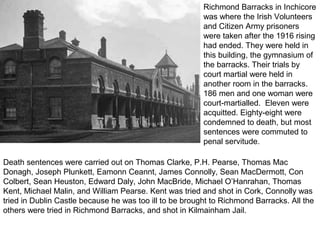
Richmond Barracks in Inchicore
was where the Irish Volunteers
and Citizen Army prisoners
were taken after the 1916 rising
had ended. They were held in
this building, the gymnasium of
the barracks. Their trials by
court martial were held in
another room in the barracks.
186 men and one woman were
court-martialled. Eleven were
acquitted. Eighty-eight were
condemned to death, but most
sentences were commuted to
penal servitude.
Death sentences were carried out on Thomas Clarke, P.H. Pearse, Thomas Mac
Donagh, Joseph Plunkett, Eamonn Ceannt, James Connolly, Sean MacDermott, Con
Colbert, Sean Heuston, Edward Daly, John MacBride, Michael O’Hanrahan, Thomas
Kent, Michael Malin, and William Pearse. Kent was tried and shot in Cork, Connolly was
tried in Dublin Castle because he was too ill to be brought to Richmond Barracks. All the
others were tried in Richmond Barracks, and shot in Kilmainham Jail.
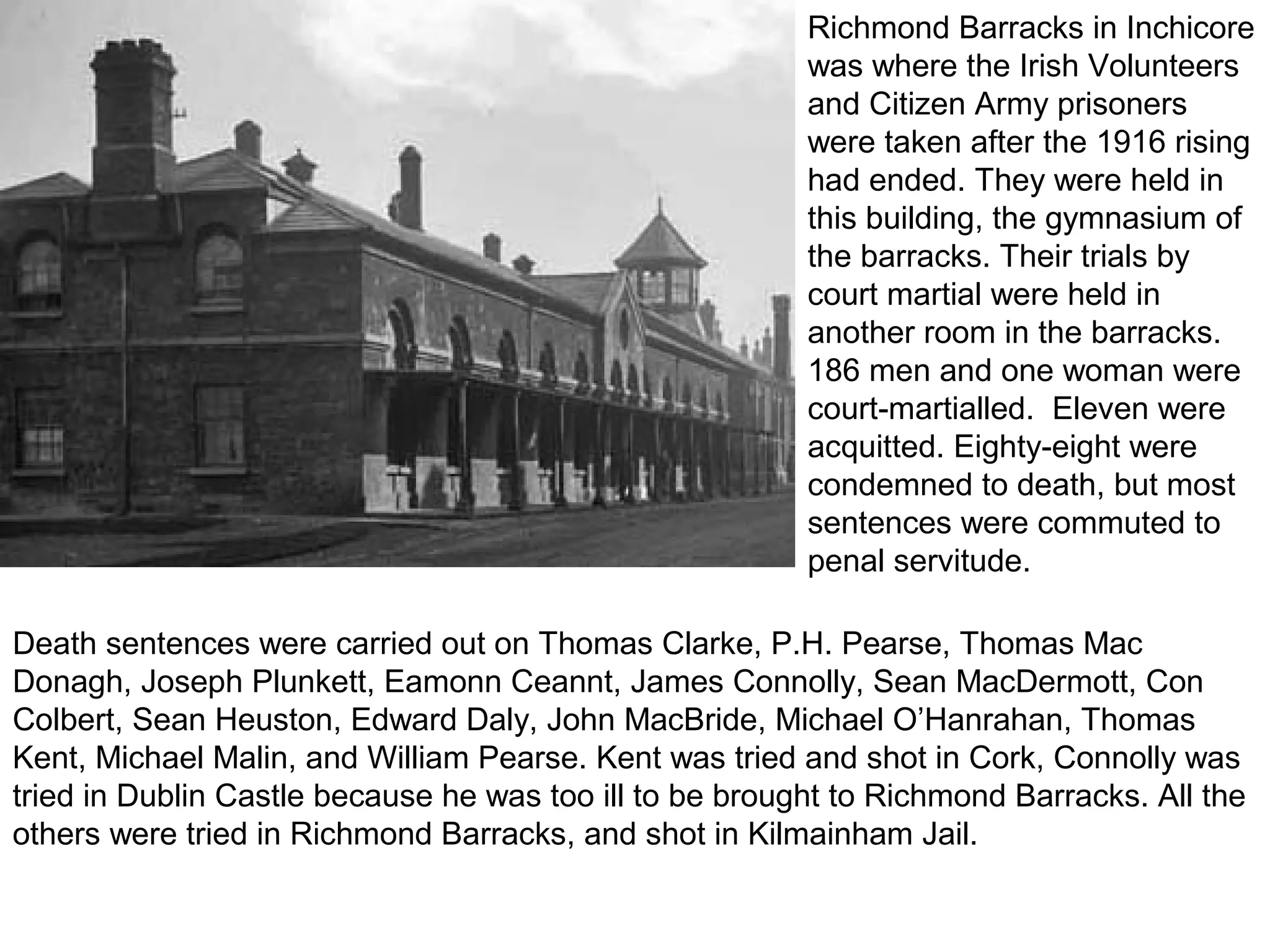
Most of Richmond Barracks was knocked
down in the 1920s. The building on the left
was the gymnasium where the prisoners
were held in 1916. The near part is now
owned by the HSE and houses a medical
centre. Farther along the rest of the
building is part of a secondary school, with
most of the school buildings occupying
what was a square in the old barracks.
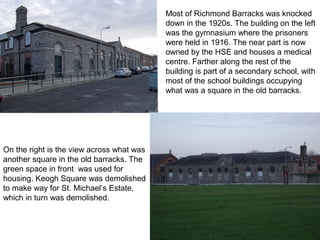
On the right is the view across what was
another square in the old barracks. The
green space in front was used for
housing. Keogh Square was demolished
to make way for St. Michael’s Estate,
which in turn was demolished.
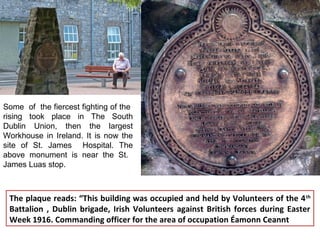
Some of the fiercest fighting of the
rising took place in The South
Dublin Union, then the largest
Workhouse in Ireland. It is now the
site of St. James Hospital. The
above monument is near the St.
James Luas stop.
The plaque reads: “This building was occupied and held by Volunteers of the 4th
Battalion , Dublin brigade, Irish Volunteers against British forces during Easter
Week 1916. Commanding officer for the area of occupation Éamonn Ceannt
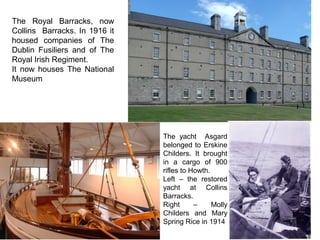
The Royal Barracks, now
Collins Barracks. In 1916 it
housed companies of The
Dublin Fusiliers and of The
Royal Irish Regiment.
It now houses The National
Museum
The yacht Asgard
belonged to Erskine
Childers. It brought
in a cargo of 900
rifles to Howth.
Left – the restored
yacht at Collins
Barracks.
Right – Molly
Childers and Mary
Spring Rice in 1914
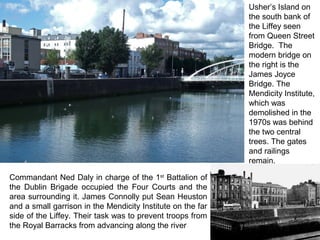
Usher’s Island on
the south bank of
the Liffey seen
from Queen Street
Bridge. The
modern bridge on
the right is the
James Joyce
Bridge. The
Mendicity Institute,
which was
demolished in the
1970s was behind
the two central
trees. The gates
and railings
remain.
Commandant Ned Daly in charge of the 1st
Battalion of
the Dublin Brigade occupied the Four Courts and the
area surrounding it. James Connolly put Sean Heuston
and a small garrison in the Mendicity Institute on the far
side of the Liffey. Their task was to prevent troops from
the Royal Barracks from advancing along the river
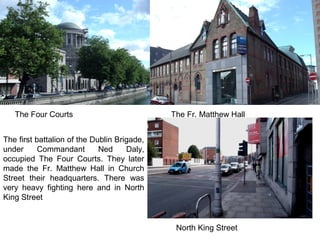
The first battalion of the Dublin Brigade,
under Commandant Ned Daly,
occupied The Four Courts. They later
made the Fr. Matthew Hall in Church
Street their headquarters. There was
very heavy fighting here and in North
King Street
The Four Courts The Fr. Matthew Hall
North King Street
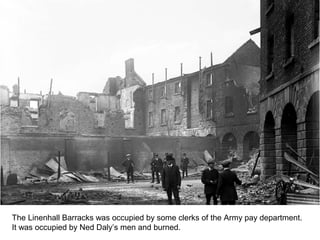
The Linenhall Barracks was occupied by some clerks of the Army pay department.
It was occupied by Ned Daly’s men and burned.
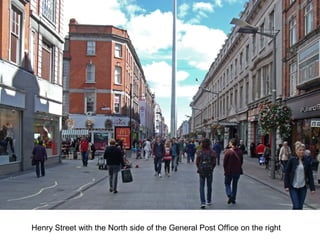
Henry Street with the North side of the General Post Office on the right
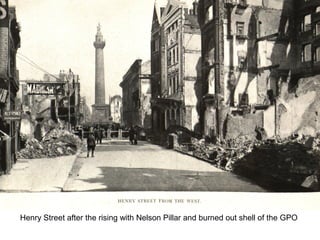
Henry Street after the rising with Nelson Pillar and burned out shell of the GPO
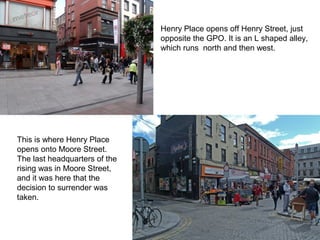
Henry Place opens off Henry Street, just
opposite the GPO. It is an L shaped alley,
which runs north and then west.
This is where Henry Place
opens onto Moore Street.
The last headquarters of the
rising was in Moore Street,
and it was here that the
decision to surrender was
taken.
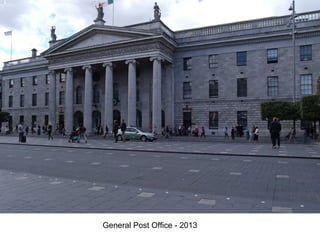
General Post Office - 2013
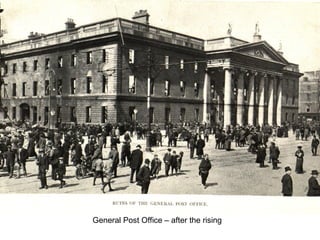
General Post Office – after the rising
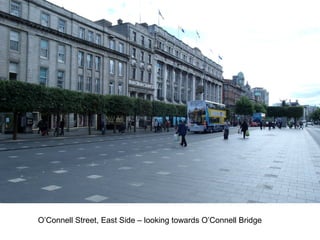
O’Connell Street, East Side – looking towards O’Connell Bridge
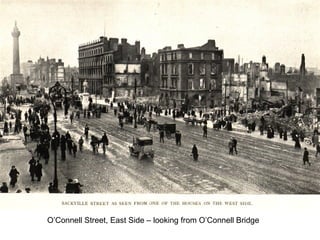
O’Connell Street, East Side – looking from O’Connell Bridge
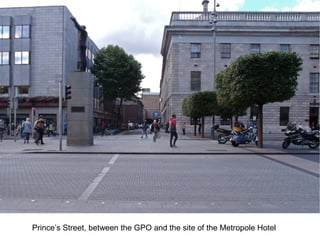
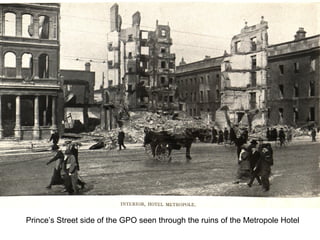
Prince’s Street, between the GPO and the site of the Metropole Hotel
Prince’s Street side of the GPO seen through the ruins of the Metropole Hotel
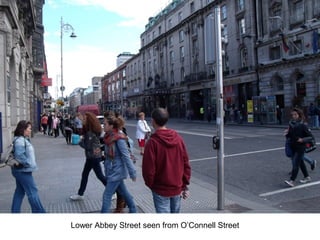
Lower Abbey Street seen from O’Connell Street
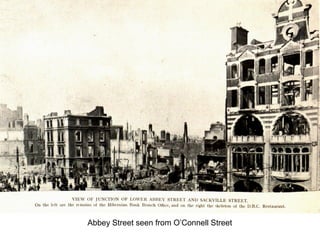
Abbey Street seen from O’Connell Street
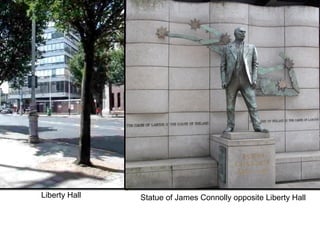
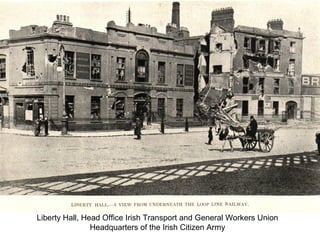
Liberty Hall Statue of James Connolly opposite Liberty Hall
Liberty Hall, Head Office Irish Transport and General Workers Union
Headquarters of the Irish Citizen Army

Easter risingsites

  • 1.
    Richmond Barracks inInchicore was where the Irish Volunteers and Citizen Army prisoners were taken after the 1916 rising had ended. They were held in this building, the gymnasium of the barracks. Their trials by court martial were held in another room in the barracks. 186 men and one woman were court-martialled. Eleven were acquitted. Eighty-eight were condemned to death, but most sentences were commuted to penal servitude. Death sentences were carried out on Thomas Clarke, P.H. Pearse, Thomas Mac Donagh, Joseph Plunkett, Eamonn Ceannt, James Connolly, Sean MacDermott, Con Colbert, Sean Heuston, Edward Daly, John MacBride, Michael O’Hanrahan, Thomas Kent, Michael Malin, and William Pearse. Kent was tried and shot in Cork, Connolly was tried in Dublin Castle because he was too ill to be brought to Richmond Barracks. All the others were tried in Richmond Barracks, and shot in Kilmainham Jail.
  • 2.
    Most of RichmondBarracks was knocked down in the 1920s. The building on the left was the gymnasium where the prisoners were held in 1916. The near part is now owned by the HSE and houses a medical centre. Farther along the rest of the building is part of a secondary school, with most of the school buildings occupying what was a square in the old barracks. On the right is the view across what was another square in the old barracks. The green space in front was used for housing. Keogh Square was demolished to make way for St. Michael’s Estate, which in turn was demolished.
  • 3.
    Some of thefiercest fighting of the rising took place in The South Dublin Union, then the largest Workhouse in Ireland. It is now the site of St. James Hospital. The above monument is near the St. James Luas stop. The plaque reads: “This building was occupied and held by Volunteers of the 4th Battalion , Dublin brigade, Irish Volunteers against British forces during Easter Week 1916. Commanding officer for the area of occupation Éamonn Ceannt
  • 4.
    The Royal Barracks,now Collins Barracks. In 1916 it housed companies of The Dublin Fusiliers and of The Royal Irish Regiment. It now houses The National Museum The yacht Asgard belonged to Erskine Childers. It brought in a cargo of 900 rifles to Howth. Left – the restored yacht at Collins Barracks. Right – Molly Childers and Mary Spring Rice in 1914
  • 5.
    Usher’s Island on thesouth bank of the Liffey seen from Queen Street Bridge. The modern bridge on the right is the James Joyce Bridge. The Mendicity Institute, which was demolished in the 1970s was behind the two central trees. The gates and railings remain. Commandant Ned Daly in charge of the 1st Battalion of the Dublin Brigade occupied the Four Courts and the area surrounding it. James Connolly put Sean Heuston and a small garrison in the Mendicity Institute on the far side of the Liffey. Their task was to prevent troops from the Royal Barracks from advancing along the river
  • 6.
    The first battalionof the Dublin Brigade, under Commandant Ned Daly, occupied The Four Courts. They later made the Fr. Matthew Hall in Church Street their headquarters. There was very heavy fighting here and in North King Street The Four Courts The Fr. Matthew Hall North King Street
  • 7.
    The Linenhall Barrackswas occupied by some clerks of the Army pay department. It was occupied by Ned Daly’s men and burned.
  • 8.
    Henry Street withthe North side of the General Post Office on the right
  • 9.
    Henry Street afterthe rising with Nelson Pillar and burned out shell of the GPO
  • 10.
    Henry Place opensoff Henry Street, just opposite the GPO. It is an L shaped alley, which runs north and then west. This is where Henry Place opens onto Moore Street. The last headquarters of the rising was in Moore Street, and it was here that the decision to surrender was taken.
  • 11.
  • 12.
    General Post Office– after the rising
  • 13.
    O’Connell Street, EastSide – looking towards O’Connell Bridge
  • 14.
    O’Connell Street, EastSide – looking from O’Connell Bridge
  • 15.
    Prince’s Street, betweenthe GPO and the site of the Metropole Hotel
  • 16.
    Prince’s Street sideof the GPO seen through the ruins of the Metropole Hotel
  • 17.
    Lower Abbey Streetseen from O’Connell Street
  • 18.
    Abbey Street seenfrom O’Connell Street
  • 19.
    Liberty Hall Statueof James Connolly opposite Liberty Hall
  • 20.
    Liberty Hall, HeadOffice Irish Transport and General Workers Union Headquarters of the Irish Citizen Army

Editor's Notes

  • #4 I took the Luas from Heuston Station out of town, and the next stop is St. James. About a hundred metres away is the plaque commemorating the 4th battalion men under Eamon Ceannt who held the South Dublin Union during the rising. There was very heavy fighting here as British troops fought their way in, building by building and room by room. Ceannt’s second in command, Cathal Brugha was so badly wounded that he escaped court martial after the surrender. Ceannt was condemned to death and shot in Kilmainham jail. The most senior officer to give a witness statement was William Cosgrave, afterwards MP for Kilkenny and president of the Executive Council of The Irish Free State.
  • #5 The next stop after Heuston station in the city centre direction is Museum. Part of the National Museum is housed here in Collins Barracks, formerly the Royal Barracks. In 1916 it housed soldiers of two Irish regiments, the Royal Dublin Fusiliers, recruited from the Dubllin area, and the Royal Irish Regiment, which normally recruited in Tipperary, Kilkenny and Carlow but which had many Dublin recruits during the First World War. The solkiers in the Royal Barracks were due to go to France, but were used instead to help suppress the Easter rising. In the grounds of the barracks is a museum commemorating the Howth gun-running, with the restored Asgard on display.
  • #6 There were several military barracks on or near the Liffey to the west of the city, and James Connolly put a small garrison under Sean Heuston into the Mendicity Institute on the quays. They were very quickly attacked by Dublin Fusiliers from the Royal Barracks, and held out for some days until on Wednesday British reinforcements forced their surrender. This was the first post to surrender.
  • #7 Ned Daly’s first battallion occupied the Four Courts on the quays. They moved their headquarters to the Fr. Matthew Hall in Church Street, because of its more central location, but as fighting intensified in North King Street and Church Street, they moved back to the Four Courts building. The fighting in this area was particularly heavy. After the rising it became known that British soldiers had shot a number of civilians in the area. The discovery of two corpses buried in a cellar caused a sensation at the time.
  • #8 Most of the destruction of central Dublin was the work of the British forces, firing incendiary shells. The Linenhall barracks was seized by the Volunteers and burned to prevent its being used as a British outpost. The fire spread to neighbouring buildings, one of which was a wholesale druggist’s. There was a huge explosion of the stocks there. The clerks from the pay department were kept as prisoners in the Fr. Matthew Hall.
  • #9 At the end of the week, the garrison from the GPO crossed Henry Street under fire and went through Henry Place into Moore Street.
  • #10 When it became impossible to stay in the GPO with fires raging and the roof about to collapse, the garrison crossed Henry Street under fire, trying to get to Moore Street.
  • #13 British incendiary rounds fired from the Trinity College area had a devastating effect. The GPO was left a roofless shell.
  • #14 Millions of pounds worth of damage to the O’Connell Street area, Henry Street, Abbey Street, Talbot Street and the Quays left central Dublin looking like the devastated Belgian and French cities that people were used to seeing in cinemas during the war years.
  • #15 The crowds of onlookers were drawn to the ruins. Curiosity wasn’t confined to Dublin: Excursion to Dublin.—Under the auspices of the Graiguenamanagh Division A.O.H., an excursion to Dublin will take place on Sunday, June 11th. The excursion, which will leave Borris at 10 o’clock a.m., will stop at Goresbridge and Bagenalstown, and as the return fare is only 3s. a large crowd should avail of this unique opportunity of viewing the ruins of Dublin consequent on the recent disturbances. The return journey will be made from Kingsbridge at 8 o’clock. Tickets can be obtained at the Commercial, Abbey and Anchor Hotels, Graigue, or at the different Railway stations, on Sunday morning.