Alumni Strategy 2013-16
Photo:RileyBrandt
University of Calgary Alumni Strategy 2013-16
1
the 100,000 who still call Calgary home — as partners in this
transformational milestone, and as lifelong stewards of the University
of Calgary, will be an important legacy of that celebration.
In order to leverage this vision and convergence of opportunities, the
university must now undertake a new, strategic, university-wide effort
to nurture relationships with our alumni so that they see themselves as
valued institutional stakeholders, both contributing to and benefiting
from the university’s success into the future.
Unfortunately, market research to date indicates quite clearly that we
have some significant work to do to build long-term, loyal relationships
with alumni. Years of insufficient and inconsistent efforts to engage
alumni have yielded a difficult starting place. Our graduates are often
disengaged from the institution and look back with mixed opinions on
their student years. However, there remains a tremendous opportunity.
Set in the strategic vision of Eyes High, the University of Calgary’s
aspiration to become one of Canada’s top research universities
by 2016 drives the considerable pace of change at the institution.
Operationalized through the Academic and Strategic Research Plans,
this vision marks a significant turning point in the institution’s history.
It also explicitly calls for us to “fully integrate the university with the
community” and makes special note of the role of alumni in leading
this charge.
Similarly, two other important milestones afford opportunities to
raise the bar of alumni engagement at the University of Calgary.
The 50th anniversary in 2016, which provides a focal point for much
of the university’s transformation efforts, will undoubtedly require the
strength of alumni in building a sense of pride and connection with
the community. Engaging the university’s 155,000 alumni — including
Strengthening our Alumni Community
The University of Calgary will be a global intellectual hub located in Canada’s most
enterprising city. In this spirited, high-quality learning environment, students will
thrive in programs made rich by research and hands-on experiences. By our 50th
anniversary in 2016, we will be one of Canada’s top five research universities, fully
engaging the communities we both serve and lead.
2
University of Calgary Alumni Strategy 2013-16
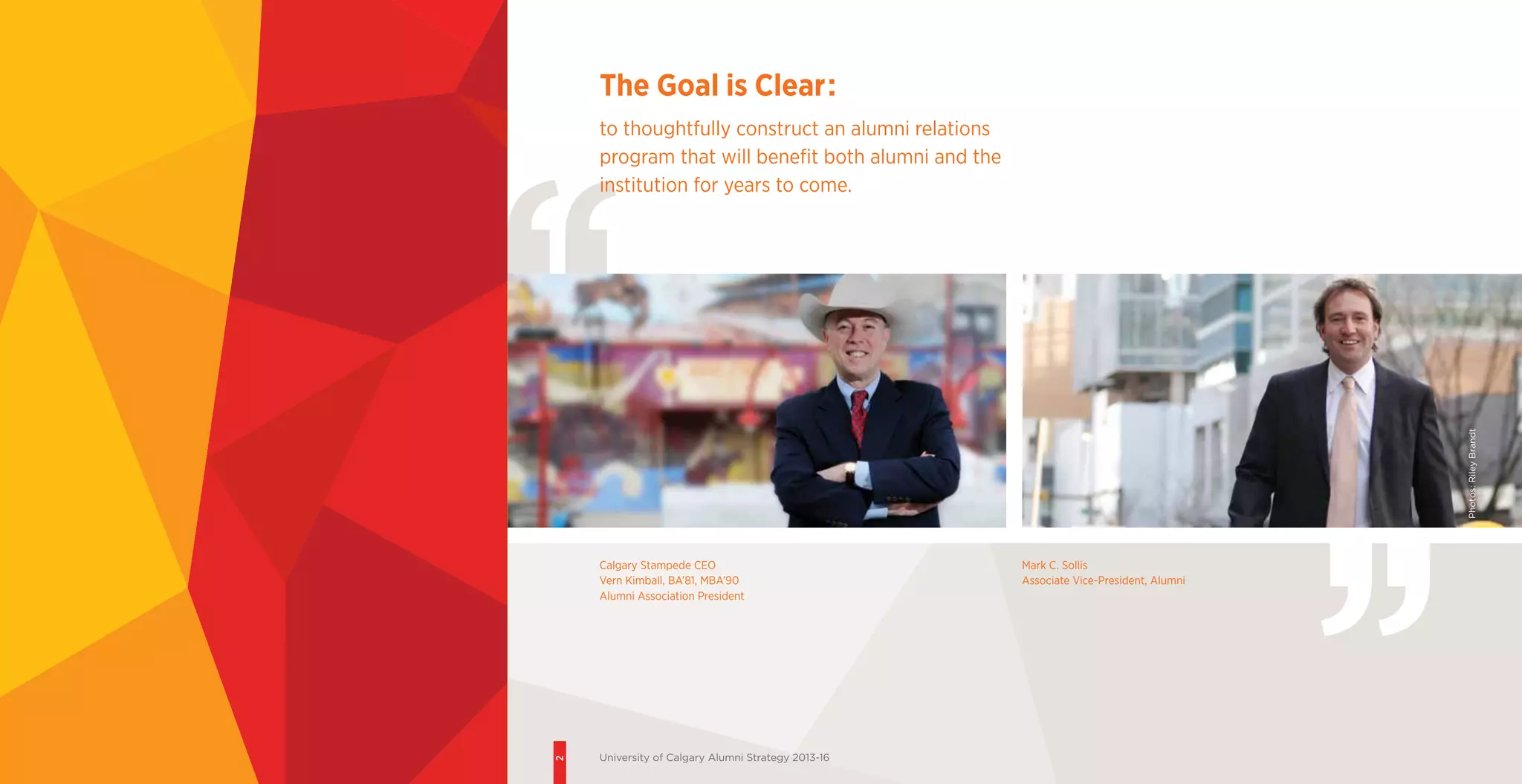
Calgary Stampede CEO
Vern Kimball, BA’81, MBA’90
Alumni Association President
Mark C. Sollis
Associate Vice-President, Alumni
The Goal is Clear:
to thoughtfully construct an alumni relations
program that will benefit both alumni and the
institution for years to come.
Photos:RileyBrandt
2
University of Calgary Alumni Strategy 2013-16
3
Although they do not feel they have been well served to date, alumni
remain favourably disposed to the University of Calgary, and there
is a sense they will engage if we can capture their attention and
steward their interest and time well. In order to turn the tide, we
will need to better understand the feelings, needs and behaviours
of the alumni body as a whole, of various segments of alumni, and
particularly those of individual alumni, in order to better serve them.
And we need to ensure that we continue to measure impact and
interests to inform our offerings.
It must also be noted that the way forward does not rest with
the alumni department alone. Only by working together across
the institution will the promise of alumni engagement be realized,
as alumni come to us through all manner of services or relationships.
Affinities are sometimes strongest with a particular faculty,
department or student group, or alumni might access the campus
through one of our many tremendous facilities or community
programs. Fortunately, a collaborative spirit prevails in terms of
institutional commitment to relationship building, offering joint
programming, and sharing our learning, as well as to working on
infrastructural elements that are foundational to alumni relations,
such as building effective communications with alumni and
coordinating data management.
In balancing the need to move as quickly as possible in building
relationships with alumni and making judicious use of limited resources,
a significant focus will be placed on creating a university-wide and
faculty-based partnership framework that leverages existing strengths
with the aim of creating more high-value opportunities for alumni to be
involved with the university. Improving our communication with alumni
will be an immediate priority, especially as this allows the university to
reach alumni broadly and relatively inexpensively. And, an investment
in digital media will permit us to provide more tailored and timely
The University of Calgary Alumni's new office — Alumni on 8th — is in the heart
of one of the busiest pedestrian corridors in downtown Calgary, occupying a
street-front space at the university’s downtown campus. It is a great place to
work, meet and learn.
Alumni on 8th is the main office for University of Calgary alumni programs and
services, serving our alumni community in the downtown core. Alumni at TFDL
[Taylor Family Digital Library] on our main campus serves both alumni and
future alumni.
communications, as well as enable alumni to make the most of
alumni networks on their own. The programming will take advantage
of Calgary’s unique community spirit and the very best of what the
university has to offer — its intellectual riches.
Building carefully, the alumni program will invest in facilitating
opportunities for alumni to make a difference in their local
community and in partnering across campus to enrich access to
some of the institution’s abundance of lectures, panels, debates, etc.
In addition, there will be continued focus on improving our regional
programming in selected target markets. Already, a more tightly
coordinated regional alumni relations strategy has begun to yield
benefits as volunteer leaders and regional alumni communities have
started to emerge.
The goal is clear: to thoughtfully construct an alumni relations
program that will benefit both alumni and the institution for years to
come. Hallmarks of this program will include effectively stewarding
resources, making commitments to alumni that we can sustain over
time, being responsive to both alumni and to university partners, and
regularly measuring and reporting out results.
This strategic plan demonstrates an intent to “relaunch” the
university’s alumni program and make explicit our commitment to
fully engaging alumni in the life of the university. By moving alumni to
become champions of the University of Calgary, the institution stands
to gain not only their financial support, but contributions in the form
of social capital — alumni recommending the institution to others,
opening doors and making connections for the university, sharing
their stories and wisdom with students, sponsoring research, and
much more. In turn, the university will offer alumni a much broader
and more personalized array of opportunities that will enrich their
lives in ways they find meaningful.
4
University of Calgary Alumni Strategy 2013-16
In mid-2012, the University of Calgary signalled its commitment to
step up engagement of alumni by hiring the university’s first associate
vice-president alumni relations. As part of this promise, under new
alumni leadership, the university set out to initiate ongoing market
research of the undergraduate alumni population, complete an audit
of the current alumni engagement activity across the institution,
benchmark against peers across the continent, stabilize existing
activities and rebalance the resources invested in the program, and,
ultimately develop a new strategy that would be consistent with the
overarching Eyes High vision and strategy, as well as University of
Calgary’s Academic and Strategic Research Plans.
During this process, there has been broad consultation to garner
the views of key stakeholders through formal interviews, one-on-one
meetings, local small-group discussions and regional events. Peer
institutions considered to be “best in class” in particular dimensions
of alumni relations have been solicited to provide advice to the
University of Calgary Alumni Team. In addition, staff has worked to
identify current and potential strategic partners, and incorporate
partnerships and more clearly defined outcomes into all of the
planning for existing work.
Research and Benchmarking
As part of the development of the strategic plan, a major study
of alumni was conducted in the fall 2012. In addition, internal
assessments of the existing alumni program were gathered from key
institutional leaders, as well as conducted by the new associate vice-
president. Benchmarking occurred along with a best practice review
of peer institutions. Consistent themes were found throughout.
Alumni Omnibus Survey
Regular market research will be part of evaluating the overall
program, learning more about alumni interests and expectations,
and understanding the impact of individual program elements.
Setting the foundation for future work, in addition to informing the
plan, this first large-scale study was intended to measure:
•	 attitudes towards the university and its alumni engagement;
•	 self-reported alumni behaviours related to the university and
its alumni program; and
•	 performance and expectations across alumni programming
and communications.
Creating the Plan
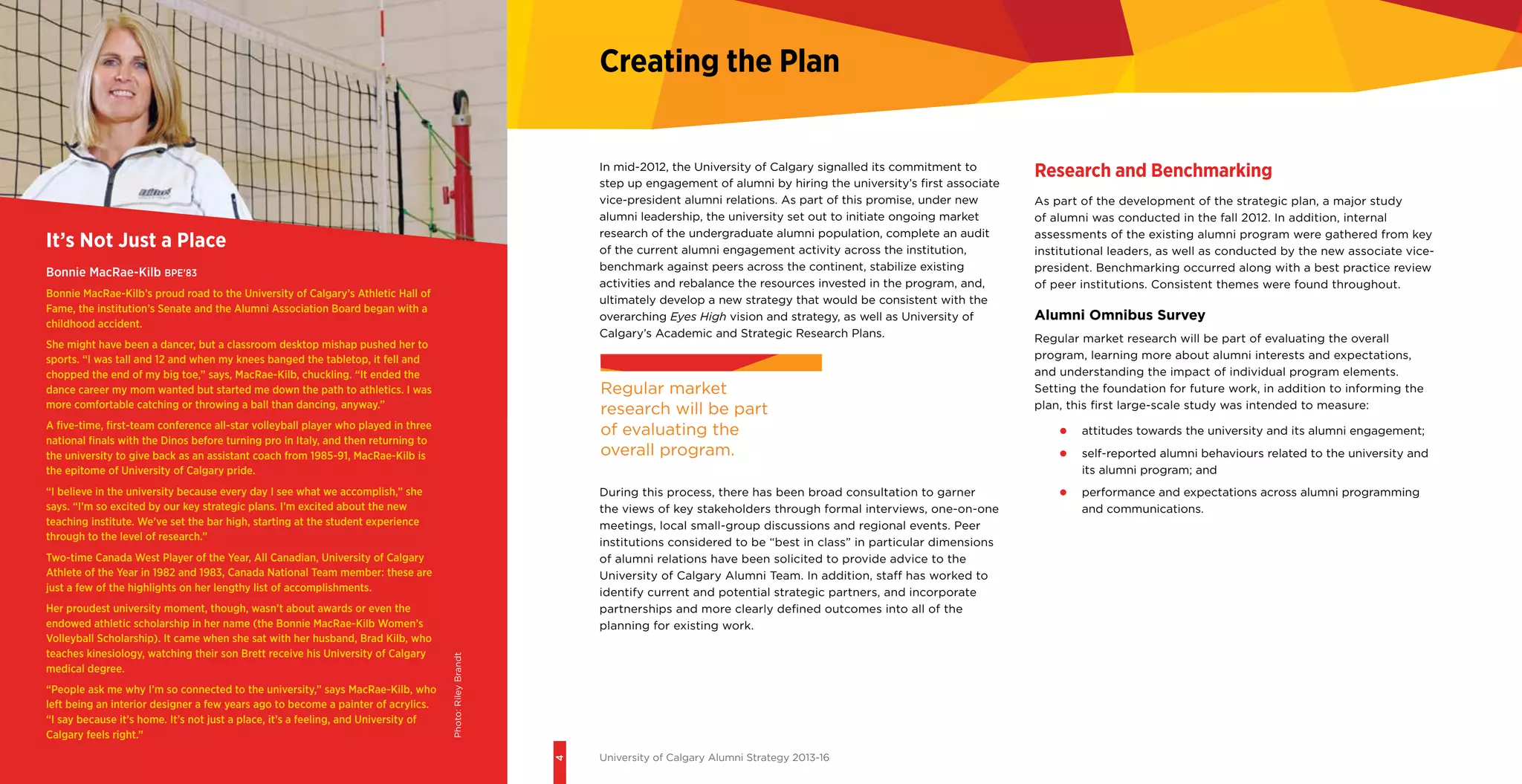
It’s Not Just a Place
Bonnie MacRae-Kilb BPE’83
Bonnie MacRae-Kilb’s proud road to the University of Calgary’s Athletic Hall of
Fame, the institution’s Senate and the Alumni Association Board began with a
childhood accident.
She might have been a dancer, but a classroom desktop mishap pushed her to
sports. “I was tall and 12 and when my knees banged the tabletop, it fell and
chopped the end of my big toe,” says, MacRae-Kilb, chuckling. “It ended the
dance career my mom wanted but started me down the path to athletics. I was
more comfortable catching or throwing a ball than dancing, anyway.”
A five-time, first-team conference all-star volleyball player who played in three
national finals with the Dinos before turning pro in Italy, and then returning to
the university to give back as an assistant coach from 1985-91, MacRae-Kilb is
the epitome of University of Calgary pride.
“I believe in the university because every day I see what we accomplish,” she
says. “I’m so excited by our key strategic plans. I’m excited about the new
teaching institute. We’ve set the bar high, starting at the student experience
through to the level of research.”
Two-time Canada West Player of the Year, All Canadian, University of Calgary
Athlete of the Year in 1982 and 1983, Canada National Team member: these are
just a few of the highlights on her lengthy list of accomplishments.
Her proudest university moment, though, wasn’t about awards or even the
endowed athletic scholarship in her name (the Bonnie MacRae-Kilb Women’s
Volleyball Scholarship). It came when she sat with her husband, Brad Kilb, who
teaches kinesiology, watching their son Brett receive his University of Calgary
medical degree.
“People ask me why I’m so connected to the university,” says MacRae-Kilb, who
left being an interior designer a few years ago to become a painter of acrylics.
“I say because it’s home. It’s not just a place, it’s a feeling, and University of
Calgary feels right.”
Regular market
research will be part
of evaluating the
overall program.Photo:RileyBrandt
University of Calgary Alumni Strategy 2013-16
5
2
	 Alumni are favourably disposed towards the University of
Calgary, but disengaged from it.
Eighty-one per cent of the university’s alumni take pride in their degree;
61 per cent believe the institution values its alumni; and 58 per cent feel
the University of Calgary makes a difference in the world. However, only
15 per cent feel part of the university community, and only 25 per cent
believe they have a stake in the institution’s success and achievements.
In addition, two key findings provide direction for alumni communications,
alumni programming and other alumni engagement with the university:
i.	 Alumni who feel part of the university community are far more
likely to have favourable feelings towards the university
ii.	 Alumni who feel they are still part of the university community
are more likely to express interest in staying involved in
every way possible (e.g. receiving information, volunteering,
attending sports and university events).
In the University of Calgary’s case, the data reinforced there is strong
quantitative corroboration to support focus on addressing an intuitive
virtuous cycle in alumni programming: “just as those who feel part of a
community are most likely to express interest in staying involved, prior
research has consistently shown that participation and involvement
engender feelings of community.”
Representative of the alumni population, the following three key findings emerged:
3
	 Alumni have limited knowledge of the institution
and Eyes High.
More than half of our alumni were “not informed enough” to comment
on four tested goals of the university’s strategic vision:
•	 integrate research and teaching to produce graduates adept at
analysis and problem solving;
•	 be one of the top-five research universities in Canada;
•	 contribute to Calgary’s emergence as a world-class city by
playing a more active role in the civic, intellectual and cultural
life of the city; and
•	 elevate Alberta voices and ideas to the world stage.
However, more positively, 55-70 per cent of those who are aware
believed the university was “ahead of” or “on-target” to meet these
goals. Similarly, in almost all categories tested, such as opportunities
to volunteer, or information about professors and research, alumni
indicated they did not receive enough information from the university
rather than too much (in some cases this variance was 25 per cent
or greater).
Moving forward, a similar study of graduate and other post-
baccalaureate alumni has been undertaken to support program
development for this unique group of alumni. Also, further market
research (surveys, focus groups, interviews) will be initiated, including
testing the impact of individual programs and communications.
All of the studies will continue to inform the direction of university-
wide and faculty-based programming, and the results will be
purposefully integrated to support continuous improvement in
alumni programming.
1
	 The university’s alumni are not active supporters
of the institution.
The “net promoter” score — active promoters minus detractors —
amongst University of Calgary alumni is significantly below standard.
Also, in no age demographic tested, no faculty, nor in local versus non-
local alumni, does the institution achieve an acceptable net promoter
score university-wide amongst its undergraduate alumni. However,
a growth opportunity exists with a significant number of our alumni
identified as passive supporters of the institution.
6
University of Calgary Alumni Strategy 2013-16
Important to set ambitious goals, and to maintain focus on the long-term as well as
the immediate deliverables;
Reporting clear results is critical to long-term success;
Previous alumni efforts were hit or miss, not sustained or not scaled such that they were high impact;
There is a need to build beyond event-based programming into other areas of alumni engagement;
Opportunity to build broad-based alumni engagement initiatives to seize Calgary’s position as one of the world’s
most desirable locations;
Effective partnerships across the university, and amongst faculties, essential for success; and
Strong potential to use communications to recognize institutional excellence and alumni
contributions to economic and social vitality.
Internal Review
In addition to external research, an internal assessment of the program was conducted to
better understand the current state and the way forward. Among tremendous feedback
on the state of the program, and the way forward, the following represents themes from
that internal review:
University of Calgary Alumni Strategy 2013-16
7
Sets and maintains focus on clearly defined outcomes;
Peer Benchmarking
The following benchmarks of a best-in-class
alumni program in North America were identified:
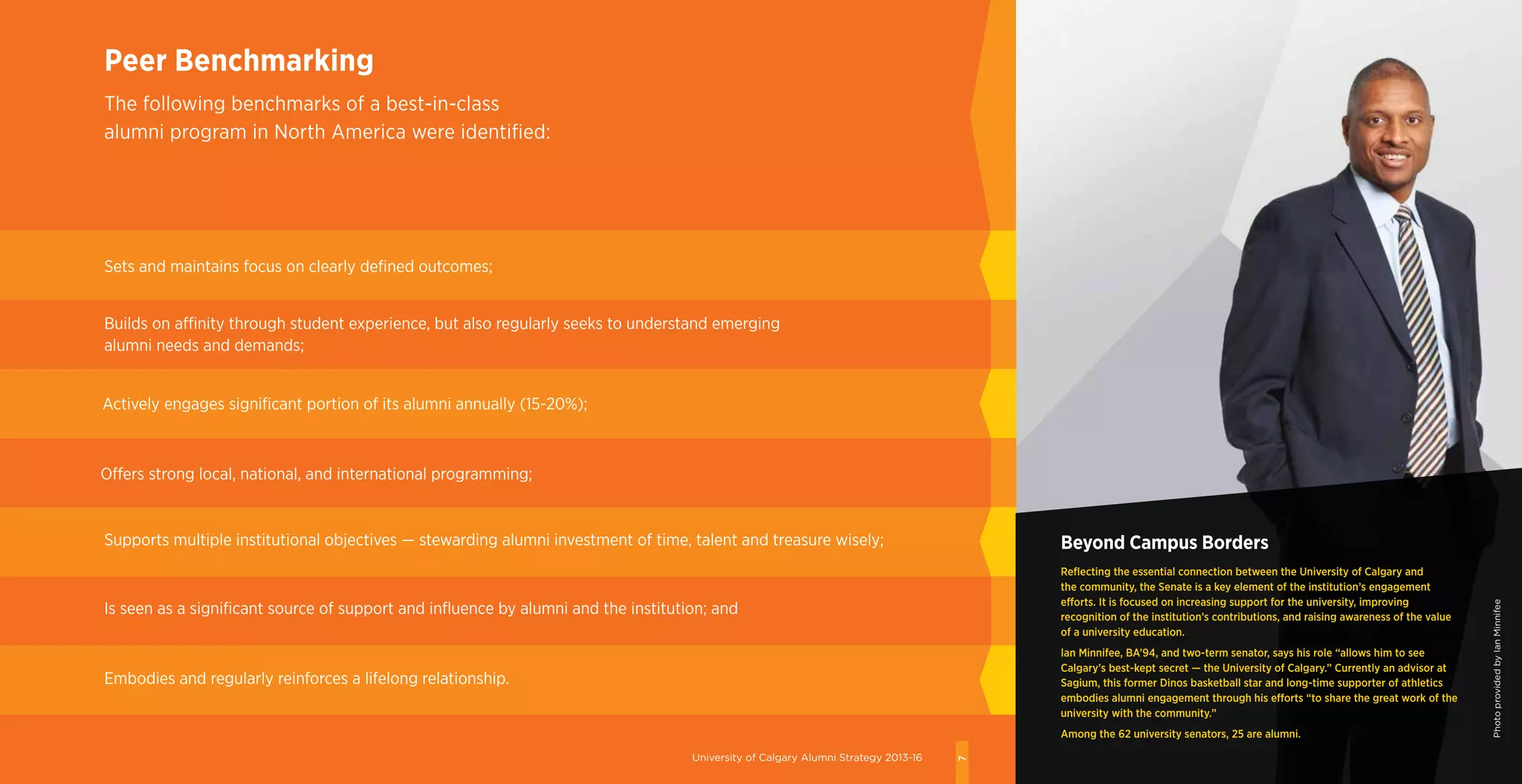
Beyond Campus Borders
Reflecting the essential connection between the University of Calgary and
the community, the Senate is a key element of the institution’s engagement
efforts. It is focused on increasing support for the university, improving
recognition of the institution’s contributions, and raising awareness of the value
of a university education.
Ian Minnifee, BA’94, and two-term senator, says his role “allows him to see
Calgary’s best-kept secret — the University of Calgary.” Currently an advisor at
Sagium, this former Dinos basketball star and long-time supporter of athletics
embodies alumni engagement through his efforts “to share the great work of the
university with the community.”
Among the 62 university senators, 25 are alumni.
Builds on affinity through student experience, but also regularly seeks to understand emerging
alumni needs and demands;
Actively engages significant portion of its alumni annually (15-20%);
Offers strong local, national, and international programming;
Supports multiple institutional objectives — stewarding alumni investment of time, talent and treasure wisely;
Is seen as a significant source of support and influence by alumni and the institution; and
Embodies and regularly reinforces a lifelong relationship.
PhotoprovidedbyIanMinnifee
University of Calgary Alumni Strategy 2013-16
7
8
University of Calgary Alumni Strategy 2013-16
A Wealth of Intellectual Riches
When the University of Calgary was established in 1966, it was understood that
the intellectual riches of a university education could live on, long after students
completed their formal education. That vision has not changed.
Numerous programs and events are constantly being designed where mind,
body and spirit can be nurtured among friends and family. Through several
distinguished speaker series — from the Schulich School of Engineering’s
latest Distinguished Speakers Panel that addressed the key drivers behind
moving Canadian oil to market, to the Haskayne Business Research Sessions
— many faculties and departments host programs that marry fellowship and
entertainment with the vigorous and continuous development of the mind.
Alumni already learn more about the changing nature of education through
Engaging Ideas in Education, or trends in industrial or environmental design by
engaging in Design Matters.
Increasing access for our alumni to the tremendous discourse throughout the
campus reinforces the special bond this community has with its alma mater, and
will shape the university moving forward.
As the University of Calgary has done for almost a half-century, ground-breaking
research will continue, remarkable students will register by the thousands, and
talented professors will tackle tough challenges. The shaping of a world-class
university will continue to take hard work, creativity and vision.
Many opportunities for alumni to be part of the discussion exist, and many
more will be highlighted in the years to come.
A Changing Environment and Expected Outcomes
Under new leadership, the institutional environment has changed
dramatically over the past three years and a shift in perspective
on broader alumni and community involvement — entrenched in
Eyes High — is evident. In fact, a key pillar of this strategic direction,
“integrate the university with the community,” sets an expectation of
the university to increase and improve its efforts to build an ongoing
relationship with its alumni. Also, with the upcoming 50th anniversary
in 2016, there is some urgency to create a new level of sustainable
alumni engagement at the University of Calgary.
Keen to leverage this new focus on alumni, the advisory group and
work team embarked on a mission to define the program’s starting
place and the intended outcomes. Discussions covered the program’s
success and challenges, beliefs and values that exist across the
university, the importance and potential impact of a successful alumni
program, and the development of a shared understanding of the
importance of alumni. From this exercise, a collection of core beliefs
about alumni engagement and a value proposition were developed.
Reflecting the aspirations of Eyes High, the following captures the
University of Calgary’s purpose for engaging alumni.
We believe alumni are valued, lifelong stakeholders, and that
when they are informed and engaged they will become our
strongest ambassadors all the while reflecting our achievements
through their own.
We also believe the university offers value to alumni through
connecting them to activities and services of the university,
supporting an active network of peers, and building the profile of
institutional and alumni successes.
Lastly, together, we can support and lead important contributions
to the broader community.
Valued and engaged effectively, alumni become “net promoters,”
defined as alumni who actively promote the University of Calgary in
the community — often at times independent of the presence or direct
efforts of the institution.
Photo:MadelineHardy
University of Calgary Alumni Strategy 2013-16
9
University Of Calgary Alumni Value Proposition
Benefits to the University Benefits for the Institution’s Alumni
Significantly improve the reputation of the university
Cause alumni to feel pride in their affiliation with the
university and its direction
Secure greater investment of support — time, talent, and treasure —
from alumni, and those whom they influence
Secure meaningful opportunities for alumni to be engaged —
and foster an appreciation for being part of an institution making
a difference in the world
Support and enhance core academic and research activities of an
institution leading positive change in the community
Ensure alumni ongoing access to the intellectual riches of
the university they desire
Outcome
A deliberate and focused effort to increase alumni satisfaction and engagement will lead to a greater alumni presence in university life,
and improved pride in the university noticeably — and measurably — by 2016
Value Proposition
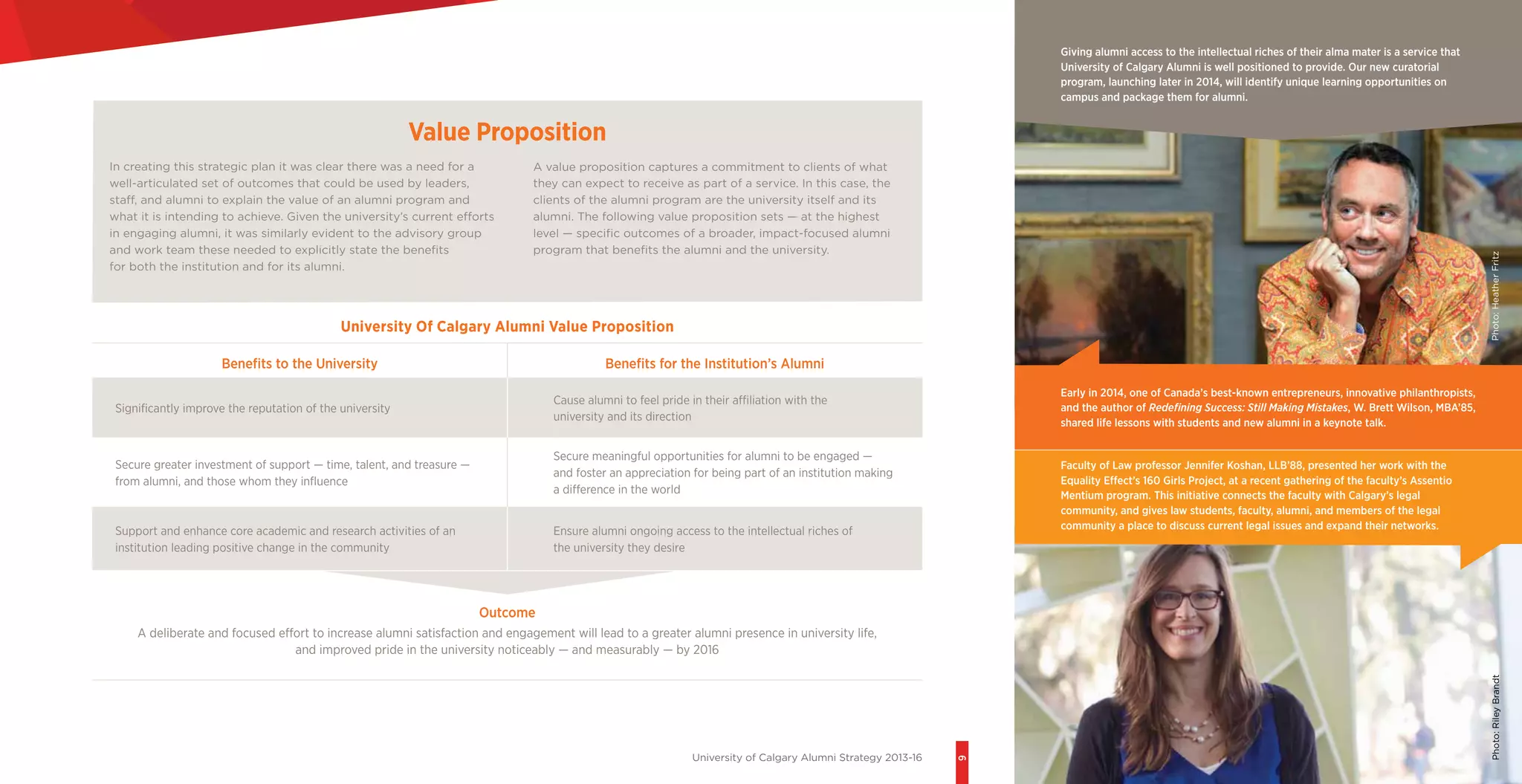
Early in 2014, one of Canada’s best-known entrepreneurs, innovative philanthropists,
and the author of Redefining Success: Still Making Mistakes, W. Brett Wilson, MBA’85,
shared life lessons with students and new alumni in a keynote talk.
Giving alumni access to the intellectual riches of their alma mater is a service that
University of Calgary Alumni is well positioned to provide. Our new curatorial
program, launching later in 2014, will identify unique learning opportunities on
campus and package them for alumni.
A value proposition captures a commitment to clients of what
they can expect to receive as part of a service. In this case, the
clients of the alumni program are the university itself and its
alumni. The following value proposition sets — at the highest
level — specific outcomes of a broader, impact-focused alumni
program that benefits the alumni and the university.
In creating this strategic plan it was clear there was a need for a
well-articulated set of outcomes that could be used by leaders,
staff, and alumni to explain the value of an alumni program and
what it is intending to achieve. Given the university’s current efforts
in engaging alumni, it was similarly evident to the advisory group
and work team these needed to explicitly state the benefits
for both the institution and for its alumni.
Photo:HeatherFritzPhoto:RileyBrandt
Faculty of Law professor Jennifer Koshan, LLB’88, presented her work with the
Equality Effect’s 160 Girls Project, at a recent gathering of the faculty’s Assentio
Mentium program. This initiative connects the faculty with Calgary’s legal
community, and gives law students, faculty, alumni, and members of the legal
community a place to discuss current legal issues and expand their networks.
10
University of Calgary Alumni Strategy 2013-16
Strategic Objectives and Priorities
Strategic objectives emerged from the planning and consultation
process, providing a roadmap for the period leading up to the
University of Calgary’s 50th anniversary in 2016:
•	 Create a partnership framework that leverages existing
strengths at the University of Calgary and generates a
substantial increase in opportunities for alumni to be involved
with the university in ways that benefit alumni, the University
of Calgary, and the community;
•	 Establish an alumni relations service-delivery model for
university-wide and faculty-based programming that facilitates
alumni engaging with each other and with the university;
•	 Improve institutional knowledge of alumni feelings, needs, and
behaviours to better serve alumni and the university;
•	 Make strategic use of communications as an alumni
engagement tool; and
•	 Build strong alumni communities to foster support for the
university and to nurture valued relationships for alumni.
Staying focused, regularly assessing our progress, remaining
nimble in order to incorporate discoveries along the way or address
changes in environment, and meeting key deliverables will afford the
greatest chance of meeting the strategic objectives. To achieve these
objectives, the following strategic priorities and annual goals for
2013-16 were identified.
Programs and Services
1.0 	 Establish the University of Calgary as a recognized
force in serving the community through alumni
community-impact programming
Calgary has long been known as a city with tremendous community
spirit, and one in which people are eager to take an active role in
meeting the city’s needs. The university’s alumni are no different.
With more than two-thirds of alumni remaining in Calgary, there is a
tremendous opportunity to reach out into Calgary and engage our
alumni through “community-impact programming.” Programming in
this area may include taking on a particular cause, such as building a
home through Habitat for Humanity, or through facilitating multiple
efforts within a set timeframe, such as a widespread day of service.
Efforts would be coordinated through the university-wide alumni
office, however, a strong emphasis would be placed on engaging the
broader university community, including partners in the faculties,
alumni within the faculty and staff, and alumni connectors throughout
the city. Building this program slowly and with the correct supporting
infrastructure will be key to its success. Also, as local successes are
achieved, there will be opportunities to expand the program into some
of the key regional markets.
Year One (2013-14)
1.1.1.	 Develop community impact program plan
1.1.2.	 Launch community impact pilot through strategic partnership
Year Two (2014-15)
1.2.1.	 Launch community impact program with focus on local activity
(Phase 1)
Year Three (2015-16)
1.3.1.	 Expand community impact program to select regional markets
(Phase 2)
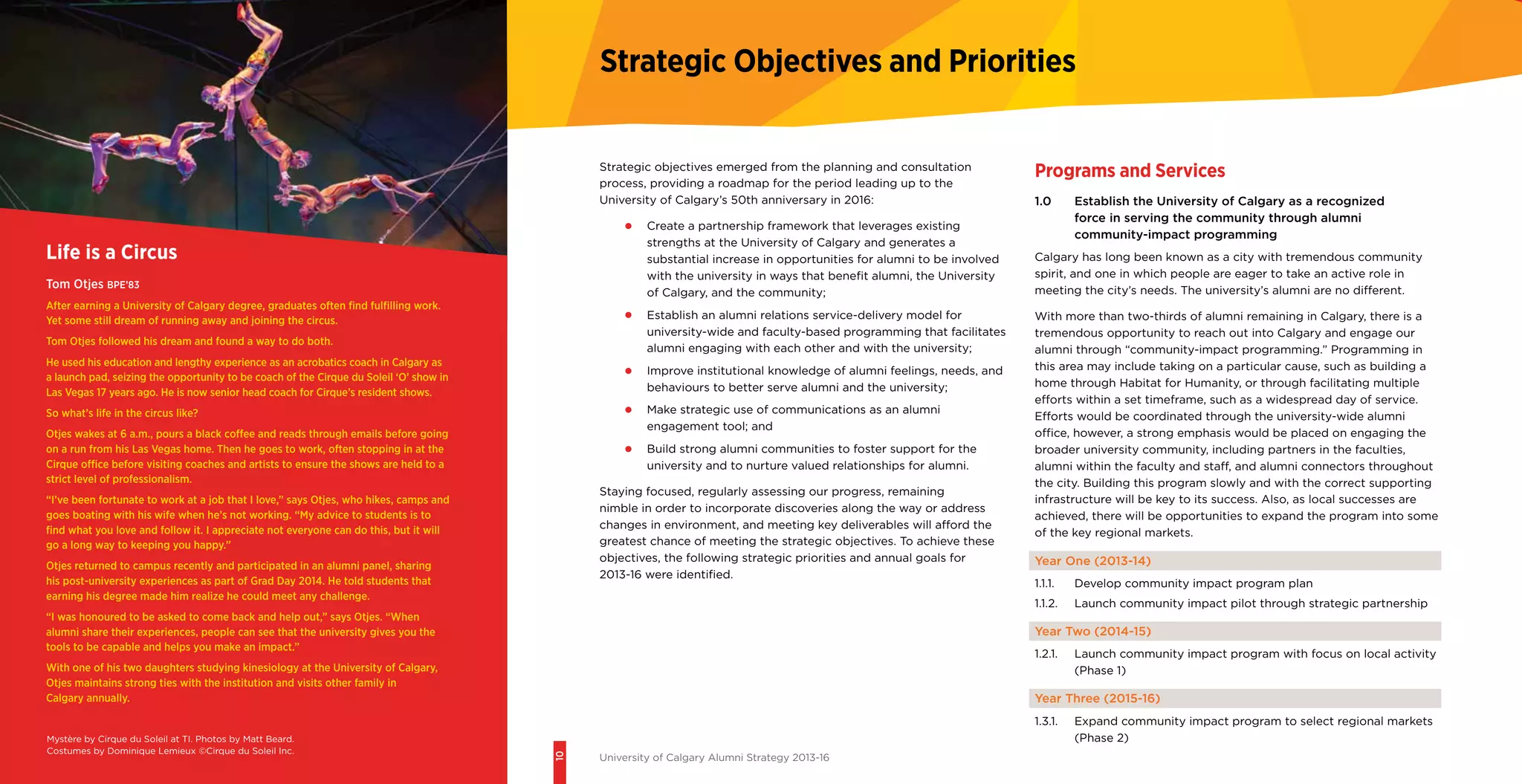
Life is a Circus
Tom Otjes BPE’83
After earning a University of Calgary degree, graduates often find fulfilling work.
Yet some still dream of running away and joining the circus.
Tom Otjes followed his dream and found a way to do both.
He used his education and lengthy experience as an acrobatics coach in Calgary as
a launch pad, seizing the opportunity to be coach of the Cirque du Soleil ‘O’ show in
Las Vegas 17 years ago. He is now senior head coach for Cirque’s resident shows.
So what’s life in the circus like?
Otjes wakes at 6 a.m., pours a black coffee and reads through emails before going
on a run from his Las Vegas home. Then he goes to work, often stopping in at the
Cirque office before visiting coaches and artists to ensure the shows are held to a
strict level of professionalism.
“I’ve been fortunate to work at a job that I love,” says Otjes, who hikes, camps and
goes boating with his wife when he’s not working. “My advice to students is to
find what you love and follow it. I appreciate not everyone can do this, but it will
go a long way to keeping you happy.”
Otjes returned to campus recently and participated in an alumni panel, sharing
his post-university experiences as part of Grad Day 2014. He told students that
earning his degree made him realize he could meet any challenge.
“I was honoured to be asked to come back and help out,” says Otjes. “When
alumni share their experiences, people can see that the university gives you the
tools to be capable and helps you make an impact.”
With one of his two daughters studying kinesiology at the University of Calgary,
Otjes maintains strong ties with the institution and visits other family in
Calgary annually.
Mystère by Cirque du Soleil at TI. Photos by Matt Beard.
Costumes by Dominique Lemieux ©Cirque du Soleil Inc.
University of Calgary Alumni Strategy 2013-16
11
2.0 	 Strengthen alumni connections to the university through
high-quality, high-impact alumni programs
The university’s alumni program already has some of the core
elements of a national-class operation. Programs such as the Arch
Awards, Graduating this Year, or Skate with Santa offer a positive
engagement experience through recognizing alumni, offering access
to professional development, or sharing campus services with
alumni. However, with increased focus, greater resources, and more
emphasis on partnership, there is significant opportunity for growth.
Traditionally, an alumni program is evaluated solely on its ability
to draw people together through events and by the success of its
services, such as affinity programs. More recently, this has evolved,
and it is increasingly essential to measure the true and sustainable
impact of the program, and to focus efforts on programs and services
that better reflect alumni expectations and the university’s strengths.
Over the next three years, the emphasis of the alumni program will
be on activities that provide access to the wealth of talent within the
alumni community, students, faculty, and staff. Programs and services
will be regularly evaluated to better understand the full impact and to
ensure offerings are of the highest quality. This will occur regardless
of whether programming is local or in the key regional markets, or
whether offered by the university-wide team or by one of the faculty-
based alumni operations. What the alumni team does, it will do well.
Year One (2013-14)
2.1.1.	 Identify suite of marquee programs to be offered by university-
wide alumni team
2.1.2.	 Implement regional program strategy
2.1.3.	 Review alumni recognition programs across campus, including
Arch Awards
2.1.4.	 Conduct review of business services
2.1.5.	 Complete cost-impact analysis of programs and eliminate low-
impact programs
2.1.6.	 Develop and implement customer service standards for alumni
programs and staff
Year Two (2014-15)
2.2.1.	 Implement recommendations from alumni recognition review
into 2014 Arch Awards
2.2.2.	 Implement recommendations from business services review,
including introduction of at least one revenue-generating and/
or high-impact service
2.2.3.	 Initiate small-scale program with core elements of a large-scale
“alumni weekend”
2.2.4.	 Introduce higher-value alumni card with enhanced service and
data-collection capabilities
2.2.5	 Develop plan for alumni engagement campaign launch
Year Three (2015-16)
2.3.1.	 Implement recommendations for alumni recognition review
across faculties
2.3.2.	 Continue implementation of recommendations from business
services review, including at least one campus service
2.3.3.	 Launch alumni weekend
2.3.4.	 Finalize plan and execute alumni engagement campaign launch
12
University of Calgary Alumni Strategy 2013-16
Year One (2013-14)
3.1.1.	 Conduct audit of existing university “intellectual programming”
3.1.2.	 Launch curatorial programming pilot
Year Two (2014-15)
3.2.1.	 Develop and implement full-scale curatorial program
3.2.2.	 Improve at least one campus service to alumni through
strategic partnership
Year Three (2015-16)
3.3.1.	 Develop and begin implementation of alumni career
programming — in partnership with other campus services
3.3.2.	 Continue improvements to campus services for alumni
broadening reach to three partners
3.0	 Expand program and service offerings to alumni through
curatorial function and strategic partnerships
As alumni programs grow, there is a tendency to launch new programs
rather than take a good look at what’s already in place. While exciting,
and potentially less complicated, adding new programs is not the way
forward in a resource-strained environment, nor does it necessarily
entrench the benefit of alumni programming within the broader
university. The University of Calgary already offers a large collection
of events, lectures, panels, etc. — programming with strong ties to the
institution’s intellectual core — that would be of tremendous interest
to alumni. Over the next few years, the alumni team can play a role
as curators — building partnerships across faculties — with the goal
of sharing existing activities with alumni. Partners will benefit from
the opportunity to share the great work of faculty and staff with a
larger audience. Alumni gain from increased access to the university’s
intellectual capacity. Curatorial programming offers the classic
win-win.
The University of Calgary
already offers a large
collection of events,
lectures, panels, etc.—
programming with strong
ties to the institution’s
intellectual core — that
would be of tremendous
interest to alumni. Over
the next few years, the
alumni team can play a
role as curators.
University of Calgary Alumni Strategy 2013-16
13
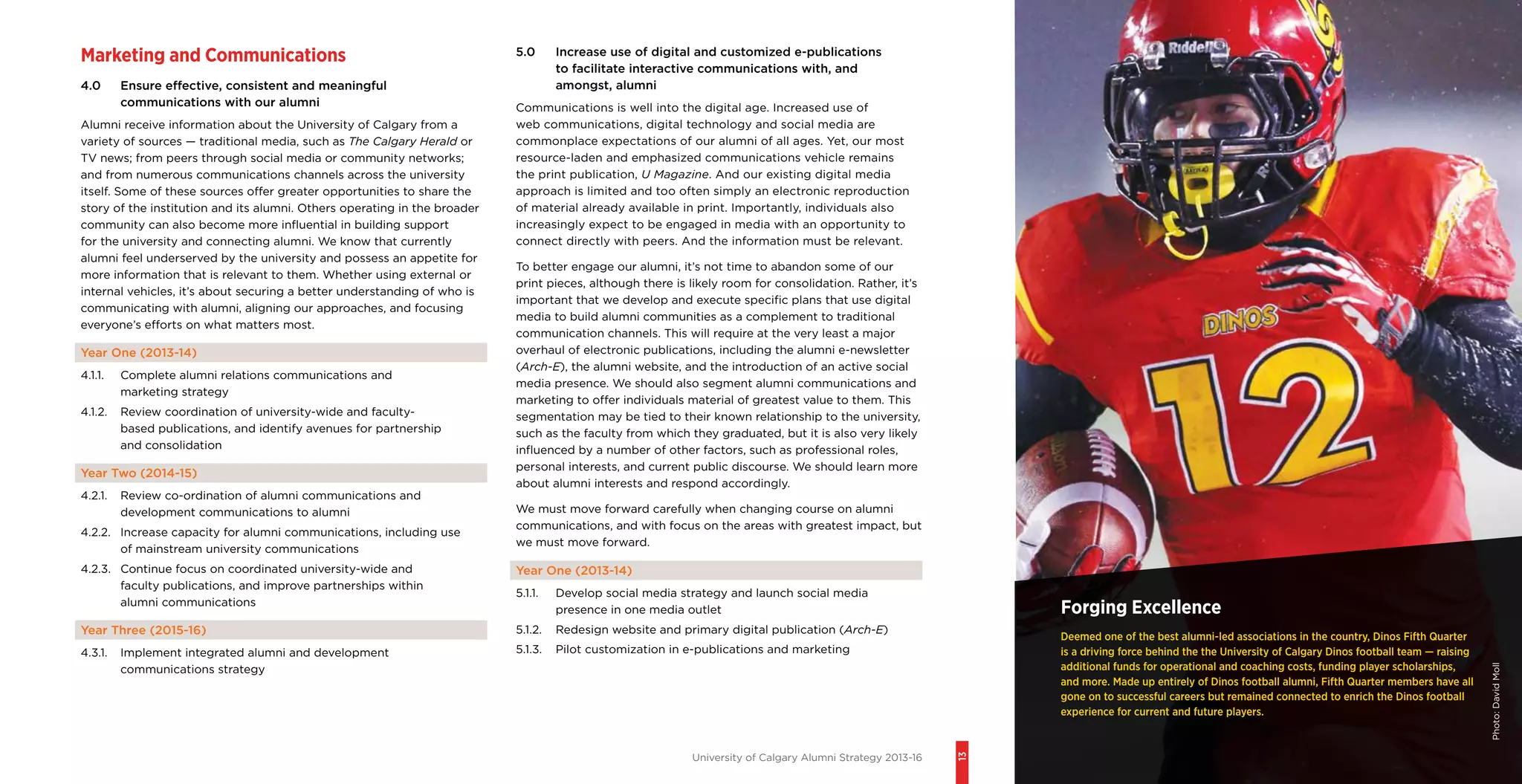
Forging Excellence
Deemed one of the best alumni-led associations in the country, Dinos Fifth Quarter
is a driving force behind the the University of Calgary Dinos football team — raising
additional funds for operational and coaching costs, funding player scholarships,
and more. Made up entirely of Dinos football alumni, Fifth Quarter members have all
gone on to successful careers but remained connected to enrich the Dinos football
experience for current and future players.
Marketing and Communications
4.0	 Ensure effective, consistent and meaningful
communications with our alumni
Alumni receive information about the University of Calgary from a
variety of sources — traditional media, such as The Calgary Herald or
TV news; from peers through social media or community networks;
and from numerous communications channels across the university
itself. Some of these sources offer greater opportunities to share the
story of the institution and its alumni. Others operating in the broader
community can also become more influential in building support
for the university and connecting alumni. We know that currently
alumni feel underserved by the university and possess an appetite for
more information that is relevant to them. Whether using external or
internal vehicles, it’s about securing a better understanding of who is
communicating with alumni, aligning our approaches, and focusing
everyone’s efforts on what matters most.
Year One (2013-14)
4.1.1.	 Complete alumni relations communications and
marketing strategy
4.1.2.	 Review coordination of university-wide and faculty-
based publications, and identify avenues for partnership
and consolidation
Year Two (2014-15)
4.2.1.	 Review co-ordination of alumni communications and
development communications to alumni
4.2.2.	 Increase capacity for alumni communications, including use
of mainstream university communications
4.2.3.	 Continue focus on coordinated university-wide and
faculty publications, and improve partnerships within
alumni communications
Year Three (2015-16)
4.3.1.	 Implement integrated alumni and development
communications strategy
5.0	 Increase use of digital and customized e-publications
to facilitate interactive communications with, and
amongst, alumni
Communications is well into the digital age. Increased use of
web communications, digital technology and social media are
commonplace expectations of our alumni of all ages. Yet, our most
resource-laden and emphasized communications vehicle remains
the print publication, U Magazine. And our existing digital media
approach is limited and too often simply an electronic reproduction
of material already available in print. Importantly, individuals also
increasingly expect to be engaged in media with an opportunity to
connect directly with peers. And the information must be relevant.
To better engage our alumni, it’s not time to abandon some of our
print pieces, although there is likely room for consolidation. Rather, it’s
important that we develop and execute specific plans that use digital
media to build alumni communities as a complement to traditional
communication channels. This will require at the very least a major
overhaul of electronic publications, including the alumni e-newsletter
(Arch-E), the alumni website, and the introduction of an active social
media presence. We should also segment alumni communications and
marketing to offer individuals material of greatest value to them. This
segmentation may be tied to their known relationship to the university,
such as the faculty from which they graduated, but it is also very likely
influenced by a number of other factors, such as professional roles,
personal interests, and current public discourse. We should learn more
about alumni interests and respond accordingly.
We must move forward carefully when changing course on alumni
communications, and with focus on the areas with greatest impact, but
we must move forward.
Year One (2013-14)
5.1.1.	 Develop social media strategy and launch social media
presence in one media outlet
5.1.2.	 Redesign website and primary digital publication (Arch-E)
5.1.3.	 Pilot customization in e-publications and marketing
Photo:DavidMoll
14
University of Calgary Alumni Strategy 2013-16
Year Two (2014-15)
5.2.1.	 Implement social media strategy
5.2.2.	 Expand customization with e-publications and marketing,
including partnership with at least one faculty
Year Three (2015-16)
5.3.1.	 Initiate mapping of individual alumni interests to
e-communications
6.0	 Improve connection to the university through innovative
marketing of programs and services to alumni
Programs and services are a key part of engaging alumni. This covers
the full gamut from ongoing, active involvement in work such as
volunteer programs or serving on the Alumni Board to supporting the
university, and its alumni program, through purchasing insurance or
travel programs. As noted in other areas throughout this plan, increasing
alumni engagement isn’t necessarily about offering more and more. In
many cases, it will be about making alumni aware of all that we already
offer — from within the alumni program and throughout other areas of
the university. Worryingly, we know awareness of our existing program
and services is low. And, as we move to be greater supporters of other
university activities — such as campus services, faculty lectures, major
university events — we must be more creative in our approach to draw
attention to these opportunities.
In the next three years, there will be significant focus on marketing
all elements of the alumni program more effectively. Segmented
marketing, the integration of technology, and the cross-promotion
of our offerings will become standard practice.
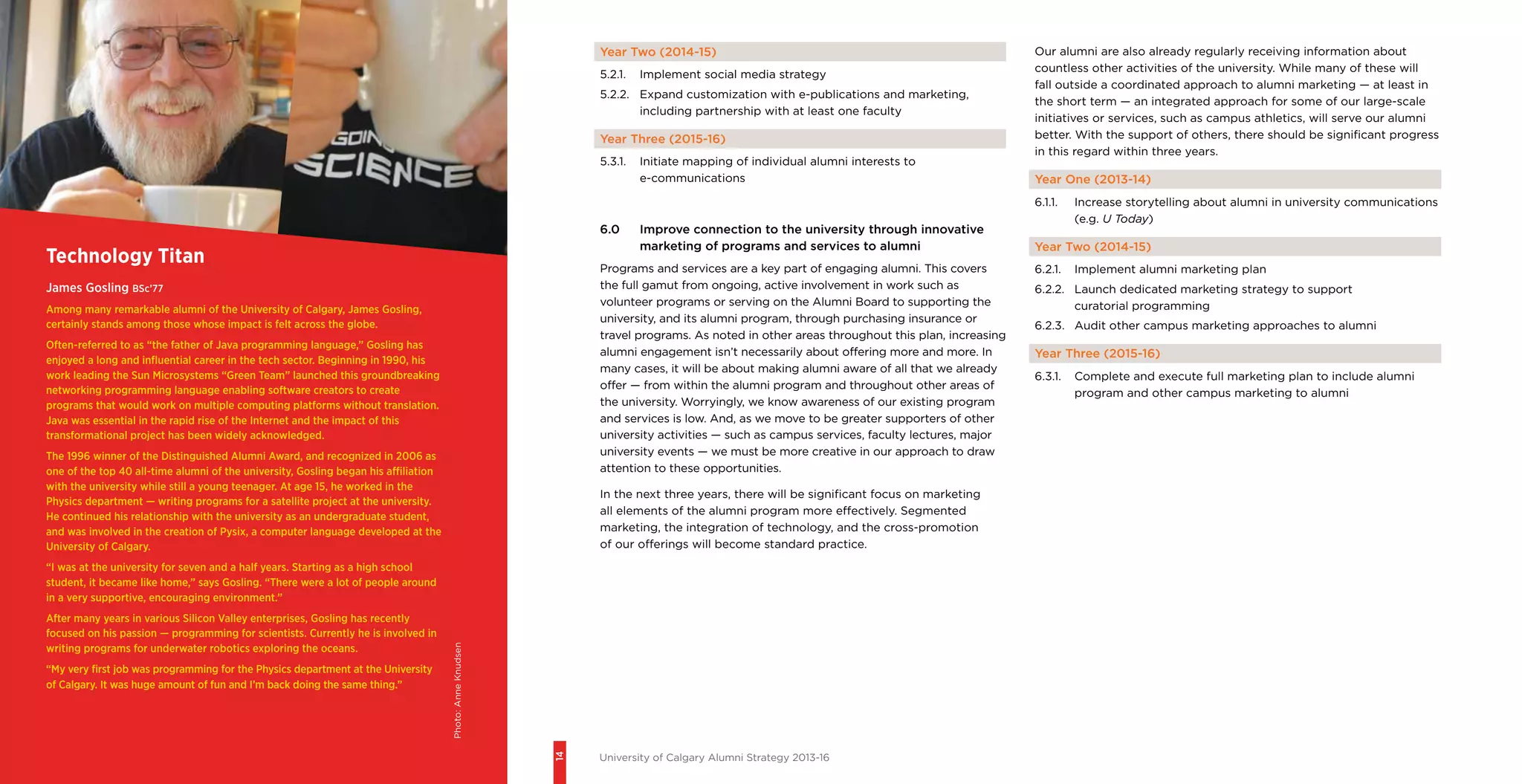
Technology Titan
James Gosling BSc’77
Among many remarkable alumni of the University of Calgary, James Gosling,
certainly stands among those whose impact is felt across the globe.
Often-referred to as “the father of Java programming language,” Gosling has
enjoyed a long and influential career in the tech sector. Beginning in 1990, his
work leading the Sun Microsystems “Green Team” launched this groundbreaking
networking programming language enabling software creators to create
programs that would work on multiple computing platforms without translation.
Java was essential in the rapid rise of the Internet and the impact of this
transformational project has been widely acknowledged.
The 1996 winner of the Distinguished Alumni Award, and recognized in 2006 as
one of the top 40 all-time alumni of the university, Gosling began his affiliation
with the university while still a young teenager. At age 15, he worked in the
Physics department — writing programs for a satellite project at the university.
He continued his relationship with the university as an undergraduate student,
and was involved in the creation of Pysix, a computer language developed at the
University of Calgary.
“I was at the university for seven and a half years. Starting as a high school
student, it became like home,” says Gosling. “There were a lot of people around
in a very supportive, encouraging environment.”
After many years in various Silicon Valley enterprises, Gosling has recently
focused on his passion — programming for scientists. Currently he is involved in
writing programs for underwater robotics exploring the oceans.
“My very first job was programming for the Physics department at the University
of Calgary. It was huge amount of fun and I’m back doing the same thing.”
Our alumni are also already regularly receiving information about
countless other activities of the university. While many of these will
fall outside a coordinated approach to alumni marketing — at least in
the short term — an integrated approach for some of our large-scale
initiatives or services, such as campus athletics, will serve our alumni
better. With the support of others, there should be significant progress
in this regard within three years.
Year One (2013-14)
6.1.1.	 Increase storytelling about alumni in university communications
(e.g. U Today)
Year Two (2014-15)
6.2.1.	 Implement alumni marketing plan
6.2.2.	 Launch dedicated marketing strategy to support
curatorial programming
6.2.3.	 Audit other campus marketing approaches to alumni
Year Three (2015-16)
6.3.1.	 Complete and execute full marketing plan to include alumni
program and other campus marketing to alumni
Photo:AnneKnudsen
University of Calgary Alumni Strategy 2013-16
15
Partnerships and Recruitment
7.0	 Establish coordinated approach to engaging alumni broadly
across the university
Alumni at any university engage through a wide variety of
opportunities — within the faculties from which they graduated;
through their relationships as donors, university employees, or
community leaders; or through other campus services. Traditionally
programming from the central alumni team engaged a small portion
of the alumni population through a limited program — and in some
cases high-quality programming — but it wasn’t coordinated with
other key players operating in the alumni engagement space.
Now, with a refocused and revitalized effort, operating as a university-
wide alumni operation within one university family, it will be important
to purposefully, but respectfully, step up to the plate under this larger
mandate. Key partners in Community Engagement, and central and
faculty-based development operations, have already been identified
and integrated planning should be achieved over the life of this
plan. Acknowledging that many other units in the university are also
undergoing a major transformation, key partners will be identified
and efforts undertaken to better coordinate planning. This is a slow
process, and there will be bumps along the way, but it has the potential
to reap tremendous rewards for our alumni and the institution.
Year One (2013-14)
7.1.1.	 Develop integrated plan with Community Engagement
7.1.2.	 Create strategic relationship map of university and
community partners
Year Two (2014-15)
7.2.1.	 Develop integrated plan with central Development
7.2.2.	 Actively map common objectives in collaboration with
targeted strategic partners and initiate related activities to
leverage partnerships
Year Three (2015-16)
7.3.1.	 Initiate coordinated annual planning with strategic partners, and
complete at least two additional integrated plans
7.3.2.	 Complete integrated planning with central Development and
faculty development partners
8.0	 Increase engagement for key “alumni of influence” and
“communities of interest”
Actively engaging large numbers of alumni is no easy task, and it
needs a starting place. With no measurement practices in place,
opinions of the scope of our engagement, and where we are making
headway, vary. Currently, notable alumni are sometimes as engaged
as donors. Or, their connections to the university take root through
serving on various advisory groups or formal university bodies. Often,
relationships with alumni are held and sustained by individuals such
as university leaders, development leaders or faculty. These can all
be very positive for the university and individual alumni. But, it is also
commonly agreed that we are missing opportunities to activate key
alumni and connectors.
The number of notable alumni steadily increases, and our alumni are
now leaders in industry, academic pursuits, politics and the community.
Many have already become some of the university’s greatest
champions; with effective stewarding, many more will come into the
fold. Over time, the alumni operation will become well-positioned to
complement others on campus by identifying and stewarding alumni
well. The first necessary step is to expand our knowledge of notable
alumni and those leading communities of interest.
Year One (2013-14)
8.1.1.	 Increase knowledge of alumni of influence through dedicated
data collection and stewardship plan
8.1.2.	 Audit communities of interest and identify potentially high-
impact networks
Year Two (2014-15)
8.2.1.	 Activate engagement and stewardship plan for local alumni
of influence
8.2.2.	 Improve ties to existing chapters and alumni communities; and
initiate relationships with other local communities of interest,
including all chapters for all faculties
Year Three (2015-16)
8.3.2.	 Ensure full “communities of interest” program up and running,
including faculty and regional networks
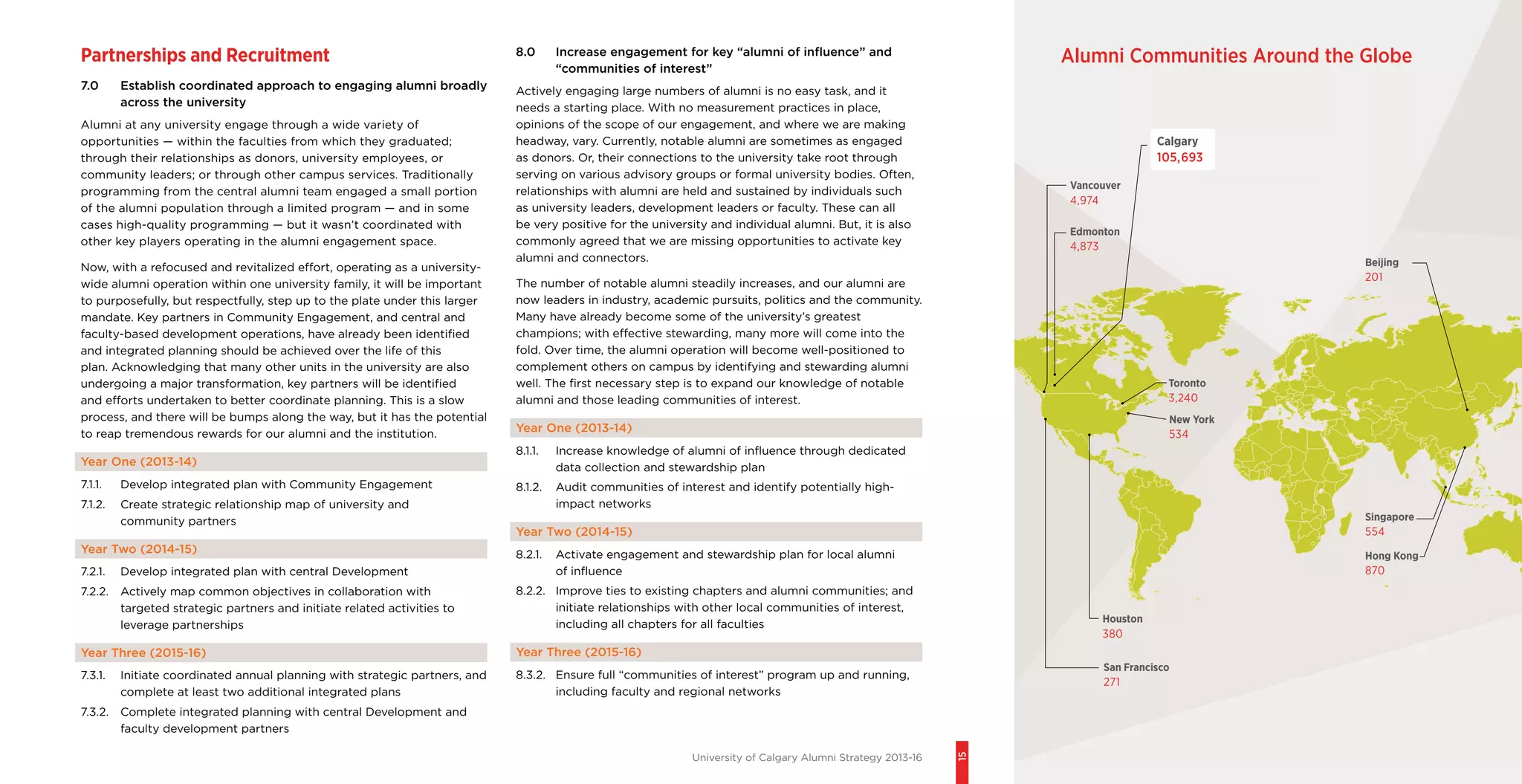
Edmonton
4,873
Toronto
3,240
Vancouver
4,974
Houston
380
New York
534
San Francisco
271
Beijing
201
Hong Kong
870
Singapore
554
Calgary
105,693
Alumni Communities Around the Globe
16
University of Calgary Alumni Strategy 2013-16
9.0	 Develop fully-integrated model for faculty-based and
university-wide alumni program
While on the surface not as exciting or as widely appreciated as a
new program launch, a redesign of alumni communications efforts, or
better engagement of some of our key alumni, an integrated approach
between the university-wide and faculty-based programs is essential
to maximizing alumni engagement efforts. As noted previously,
partnerships between the central alumni program and faculty-
based programs have traditionally been hit and miss. Relationships,
if they existed at all, were cordial, but there was a distinct lack of
true, sustained partnerships that set common goals or objectives,
developed and executed initiatives together, or shared resources.
Moving forward, there has been renewed interest and commitment
to greater integration on behalf of many players in the alumni work
of the university. University and alumni leadership, including the
institution’s executive, deans, and the Alumni Board have shown their
support for this approach, and progress has been made in a very
short time. Some partners, such as the Haskayne School of Business,
the Schulich School of Engineering, and the faculties of Medicine
and Science have dedicated alumni staff and have already begun
taking steps towards establishing greater ties to the university-wide
program. Many others, such as the faculties of Law, Environmental
Design, Arts and Education have partnered on individual initiatives
in the past 18 months. While limitations exist, moving towards
integrated plans and service agreements will prepare us well for
immediate needs and for the long term.
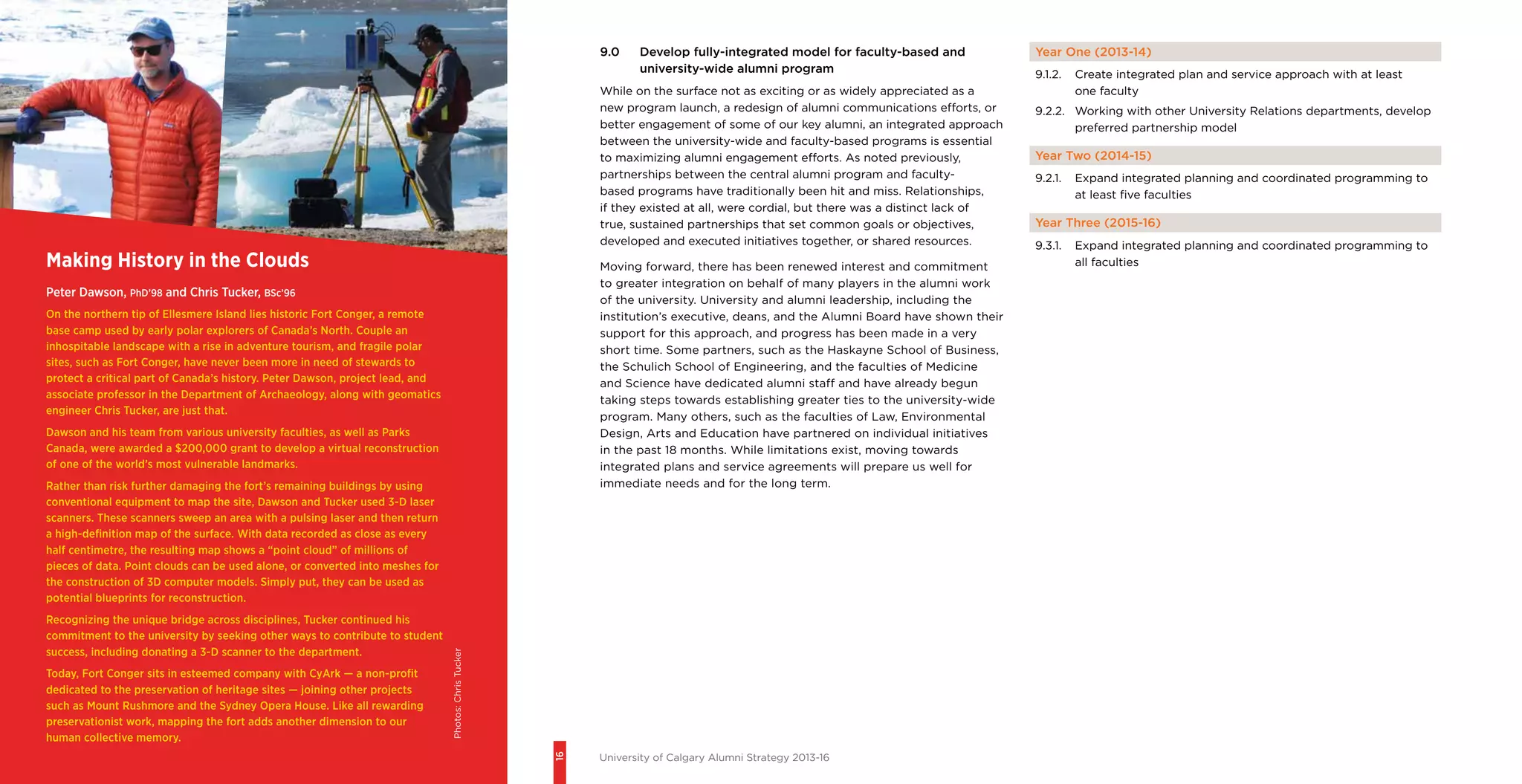
Making History in the Clouds
Peter Dawson, PhD’98 and Chris Tucker, BSc’96
On the northern tip of Ellesmere Island lies historic Fort Conger, a remote
base camp used by early polar explorers of Canada’s North. Couple an
inhospitable landscape with a rise in adventure tourism, and fragile polar
sites, such as Fort Conger, have never been more in need of stewards to
protect a critical part of Canada’s history. Peter Dawson, project lead, and
associate professor in the Department of Archaeology, along with geomatics
engineer Chris Tucker, are just that.
Dawson and his team from various university faculties, as well as Parks
Canada, were awarded a $200,000 grant to develop a virtual reconstruction
of one of the world’s most vulnerable landmarks.
Rather than risk further damaging the fort’s remaining buildings by using
conventional equipment to map the site, Dawson and Tucker used 3-D laser
scanners. These scanners sweep an area with a pulsing laser and then return
a high-definition map of the surface. With data recorded as close as every
half centimetre, the resulting map shows a “point cloud” of millions of
pieces of data. Point clouds can be used alone, or converted into meshes for
the construction of 3D computer models. Simply put, they can be used as
potential blueprints for reconstruction.
Recognizing the unique bridge across disciplines, Tucker continued his
commitment to the university by seeking other ways to contribute to student
success, including donating a 3-D scanner to the department.
Today, Fort Conger sits in esteemed company with CyArk — a non-profit
dedicated to the preservation of heritage sites — joining other projects
such as Mount Rushmore and the Sydney Opera House. Like all rewarding
preservationist work, mapping the fort adds another dimension to our
human collective memory.
Year One (2013-14)
9.1.2.	 Create integrated plan and service approach with at least
one faculty
9.2.2.	 Working with other University Relations departments, develop
preferred partnership model
Year Two (2014-15)
9.2.1.	 Expand integrated planning and coordinated programming to
at least five faculties
Year Three (2015-16)
9.3.1.	 Expand integrated planning and coordinated programming to
all faculties
Photos:ChrisTucker
University of Calgary Alumni Strategy 2013-16
17
Performance and Market Research
10.0	 Improve strategic engagement of alumni throughout
university governance and counsel
The Alumni Association has undergone a significant shift over the past
few years, and one that unfortunately coincided with a time of major
transformation at the university. For this alumni plan to truly have an
impact, meaningful objectives of the university’s alumni must be met
in conjunction with reaching the goals of Eyes High. This is not to
suggest they are mutually exclusive, or in competition, but rather that
we take some meaningful steps to articulate the value of the program
to both parties. This includes better defining the core relationship
between the university and its alumni as operationalized through
the Alumni Association and its Board. It also includes developing a
consistent and supportive arrangement of structured alumni groups,
such as advisory groups, and within alumni communities (traditionally
known as chapters). Alumni have a big role to play in advancing the
institution, as the university has a valuable role to play in the lives of
our alumni.
Year One (2013-14)
10.1.1.	 Complete governance review of Alumni Association Board,
alumni faculty chapters, regional chapters, and other senior
alumni roles in university governance
Year Two (2014-15)
10.2.1.	 Implement phase one recommendations from governance
review, with focus on Alumni Association Board and
related committees
10.2.2.	 Create annual Alumni Board plan
Year Three (2015-16)
10.3.1.	 Implement remaining recommendations from
governance review
11.0	 Develop performance management culture and practices
across all alumni programming
Within the advancement profession, alumni relations has often escaped
the rigour expected of other activities such as fundraising or marketing.
Collaborative and crowd-pleasing by nature, alumni professionals
brought their commitment to sharing treasured experiences with others
to the table, and worked hard at implementing ideas emanating from
many, many sources. Regularly these ideas lacked resources to execute
thoroughly, and also lacked a strong method of defining impact. Lessons
learned from other schools may have been put forth, and may have even
been helpful, but they were usually implemented or suggested without
the necessary understanding or discussion of fit. The University of
Calgary was no different in this regard.
Now, with a noticeable commitment across the institution to move
forward aggressively, but deliberately, on the alumni program, the
use of performance management and research is paramount. Regular
practices to be incorporated into the alumni operation over the
next three years include surveying and benchmarking, measuring
engagement of alumni, and regular program assessment. Special
attention will also be given to creating common practices across
university-wide and faculty-based programs, and to broadly sharing
findings and collaborating on areas of improvement.
Year One (2013-14)
11.1.1.	 Complete industry best practice review and incorporate tactics
into alumni program
11.1.2.	 Complete program audit of all alumni programs on campus
11.1.3.	 Develop common program assessment tool
11.1.4.	 Fully develop market research plan
11.1.5.	 Execute professional degree and graduate alumni survey
Year Two (2014-15)
11.2.1.	 Incorporate findings from program assessment into alumni plans
in university-wide and faculty-based programs
11.2.2.	 Initiate second phase of market research plan
Year Three (2015-16)
11.3.1.	 Ensure all alumni programs are using common assessment tool
11.3.2.	 Execute second undergraduate alumni survey
18
University of Calgary Alumni Strategy 2013-16
12.0	 Ensure high-quality external and internal customer
experience
Currently, at best, we receive mixed reviews in this regard. While
undoubtedly many staff and faculty at the university care about our
alumni, and do their best to assist, we know that universities are large
and complex organizations, and that many can become lost trying
to connect with us. We also know that in some cases we are building
alumni engagement on top of a difficult student experience, or we are
inheriting a fractured interaction an individual may have had in the
days since his or her graduation.
Year One (2013-14)
12.1.1.	 Conduct internal business process review
12.1.2.	 Incorporate alumni service matrix to serve alumni communities
of interest
12.1.3.	 In collaboration with other University Relations departments,
and Development, launch database review to improve customer
relationship model (CRM) and measurement capabilities
Year Two (2014-15)
12.2.1.	 Implement phase one recommendations of business
process review
12.2.2.	 Incorporate findings of database review
Year Three (2015-16)
12.3.1.	 Implement remaining recommendation from business
process review
Alumni can become the
University of Calgary’s
greatest champions. But,
first, they must feel valued
and we must do our best
to ensure their interactions
with the institution
are positive.
Alumni can become the University of Calgary’s greatest champions.
But, first, they must feel valued and we must do our best to ensure their
interactions with the institution are positive. The alumni relations staff
alone cannot change the broad approach to interacting with alumni, nor
can change happen overnight. But, measures can be taken to ensure we
are managing relationships using the correct tools; making appropriate
promises, with unfailing follow-up; simplifying access for our alumni; and
providing the proper support to others across campus. The following
steps will help take us in the right direction.
University of Calgary Alumni Strategy 2013-16
19
Performance Measures
Performance measures that have been identified already include:
•	 number of alumni engaged;
•	 percentage of well-served alumni, and customer satisfaction
with programs or activities;
•	 depth of alumni engagement in notable alumni;
•	 program impact on pride in the institution, building sense of
community, and university reputation amongst alumni;
•	 number of addressable alumni;
•	 alumni engagement retention rate;
•	 number of alumni communities engaged and program reach;
•	 financial performance of affinity programs;
•	 number and growth of alumni donors;
•	 unique website visitors, bounce rates and view duration;
•	 digital communications open rates;
•	 communications relevance and satisfaction; and
•	 affinity program account growth and campus service usage.
Finally, as this plan outlined some areas that require greater
investigation and planning, some measures will emerge as strategies
are further defined and implemented.
Of course, the most evident measure of success of this plan will be the
ability to execute against the objectives, priorities and goals outlined,
and, in turn, build affinity with the university’s alumni and enhance
the reputation of the institution. This is not a plan that will be dusted
off at the end of three years to verify we’ve stayed on course; rather,
progress against the objectives, priorities and goals will be reviewed
regularly and adjustments made as needed.
Individual programs and activities will be measured regularly at
the university-wide and faculty-based programs. Steps have already
been taken to set a more consistent and robust approach to measuring
performance, but there is a lot of work to be done in this regard.
As the success of aligning alumni activities across the campus takes
hold, so will effectiveness on this front improve.
Also, performance of the alumni programs will look not only at the
quality and reach of alumni programs or activities (or example,
event satisfaction or attendance), which are important to understanding
impact. Performance will also be measured by the effect these activities
have on building community, and changing attitudes and behaviours
towards the institution. Standards to measure performance will be
implemented to ensure the full impact of alumni engagement across the
institution is well understood and to develop a shared understanding.
A full suite of performance measures is already well into development
for the University of Calgary alumni operation, and a metrics map
will be used to support measurement from the front-line activity
level through annual performance of the full alumni program. Some
will require a greater capacity to measure or more and better data
infrastructure; others are ready for implementation in 2013-14.
Rob Allen BComm’82
Lawrence Bailey BA’04
Mark Blackwell BComm’11
Judith Hanson BA’77, BN’79, MN’83
John Hickie MD’91
Vern Kimball BA’81, MBA’90
Russ Mackenzie BSc’87
Bonnie MacRae-Kilb BPE’83
Trevor Sawatzky BComm’04
Raphael Jacobs BA’13
Sarah Akierman BA’09, BSc’09
20
University of Calgary Alumni Strategy 2013-16
Embarking on a Journey to Excellence
Pay it Forward
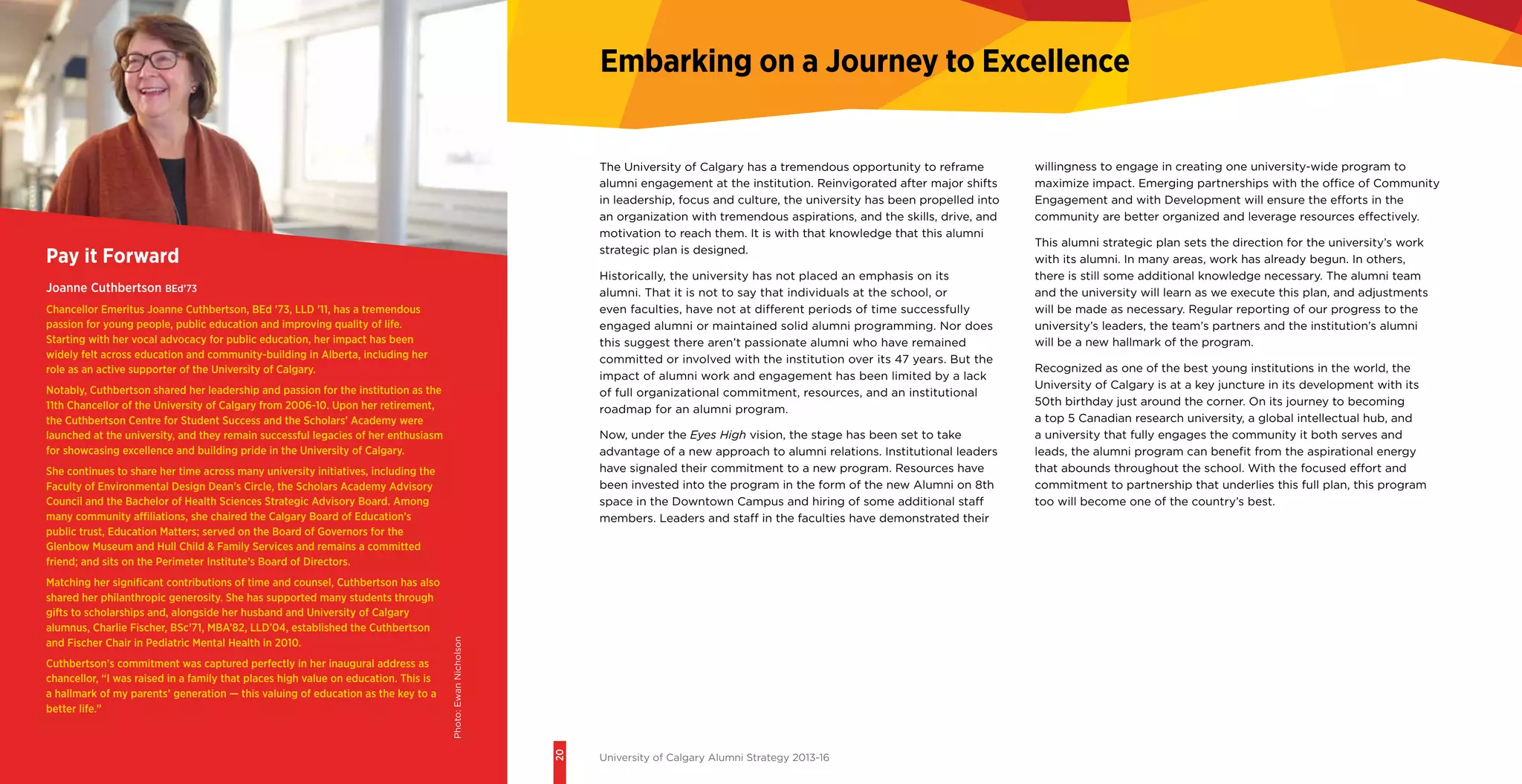
Joanne Cuthbertson BEd’73
Chancellor Emeritus Joanne Cuthbertson, BEd ’73, LLD ’11, has a tremendous
passion for young people, public education and improving quality of life.
Starting with her vocal advocacy for public education, her impact has been
widely felt across education and community-building in Alberta, including her
role as an active supporter of the University of Calgary.
Notably, Cuthbertson shared her leadership and passion for the institution as the
11th Chancellor of the University of Calgary from 2006-10. Upon her retirement,
the Cuthbertson Centre for Student Success and the Scholars’ Academy were
launched at the university, and they remain successful legacies of her enthusiasm
for showcasing excellence and building pride in the University of Calgary.
She continues to share her time across many university initiatives, including the
Faculty of Environmental Design Dean’s Circle, the Scholars Academy Advisory
Council and the Bachelor of Health Sciences Strategic Advisory Board. Among
many community affiliations, she chaired the Calgary Board of Education’s
public trust, Education Matters; served on the Board of Governors for the
Glenbow Museum and Hull Child & Family Services and remains a committed
friend; and sits on the Perimeter Institute’s Board of Directors.
Matching her significant contributions of time and counsel, Cuthbertson has also
shared her philanthropic generosity. She has supported many students through
gifts to scholarships and, alongside her husband and University of Calgary
alumnus, Charlie Fischer, BSc’71, MBA’82, LLD’04, established the Cuthbertson
and Fischer Chair in Pediatric Mental Health in 2010.
Cuthbertson’s commitment was captured perfectly in her inaugural address as
chancellor, “I was raised in a family that places high value on education. This is
a hallmark of my parents’ generation — this valuing of education as the key to a
better life.”
The University of Calgary has a tremendous opportunity to reframe
alumni engagement at the institution. Reinvigorated after major shifts
in leadership, focus and culture, the university has been propelled into
an organization with tremendous aspirations, and the skills, drive, and
motivation to reach them. It is with that knowledge that this alumni
strategic plan is designed.
Historically, the university has not placed an emphasis on its
alumni. That it is not to say that individuals at the school, or
even faculties, have not at different periods of time successfully
engaged alumni or maintained solid alumni programming. Nor does
this suggest there aren’t passionate alumni who have remained
committed or involved with the institution over its 47 years. But the
impact of alumni work and engagement has been limited by a lack
of full organizational commitment, resources, and an institutional
roadmap for an alumni program.
Now, under the Eyes High vision, the stage has been set to take
advantage of a new approach to alumni relations. Institutional leaders
have signaled their commitment to a new program. Resources have
been invested into the program in the form of the new Alumni on 8th
space in the Downtown Campus and hiring of some additional staff
members. Leaders and staff in the faculties have demonstrated their
willingness to engage in creating one university-wide program to
maximize impact. Emerging partnerships with the office of Community
Engagement and with Development will ensure the efforts in the
community are better organized and leverage resources effectively.
This alumni strategic plan sets the direction for the university’s work
with its alumni. In many areas, work has already begun. In others,
there is still some additional knowledge necessary. The alumni team
and the university will learn as we execute this plan, and adjustments
will be made as necessary. Regular reporting of our progress to the
university’s leaders, the team’s partners and the institution’s alumni
will be a new hallmark of the program.
Recognized as one of the best young institutions in the world, the
University of Calgary is at a key juncture in its development with its
50th birthday just around the corner. On its journey to becoming
a top 5 Canadian research university, a global intellectual hub, and
a university that fully engages the community it both serves and
leads, the alumni program can benefit from the aspirational energy
that abounds throughout the school. With the focused effort and
commitment to partnership that underlies this full plan, this program
too will become one of the country’s best.
Photo:EwanNicholson
The Alumni Strategy is the result of extensive engagement across the university’s alumni and extended community.
The University of Calgary would like to thank the many grads in Calgary and around the world who have provided
their time, counsel and energy to us since we began this journey in 1966.
Special thanks for this project are due to the following individuals for their commitment and contributions:
Strategy Advisory Group
•	 Hardave Birk [SU President, 2012-13]
•	 Voula Cocolakis [Executive Director, Residence and
Ancillary Services]
•	 Guy Gendron [Dean, Schulich School of Engineering,
to July 2013]
•	 Ian Holloway [Dean, Faculty of Law]
•	 Leigh Hurst [Event and Alumni Relations Specialist,
Faculty of Medicine]
•	 Kim Lawrence [Associate Vice-President, Marketing]
•	 Ken McKinnon [Alumni Association President, Alumni
Association, 2008-13]
•	 Susan Mide Kiss [Director, Community Engagement]
•	 Franco Rizutti [GSA President, 2012-13]
•	 Brendan Robinson [Executive Director,
Development Campaign]
•	 Richard Sigurdson [Dean, Faculty of Arts]
•	 Dennis Sumara [Dean, Faculty of Education]
Strategy Development Work Team
•	 Pamela Aranas [Alumni Programming Officer]
•	 Rita Egizii [Director, Alumni Relations, Haskayne
School of Business]
•	 Vern Kimball [President, Alumni Association, 2013-present]
•	 Bonnie MacRae-Kilb [Alumni Association Board Member]
•	 Erin Mason [Marketing Strategist, Alumni]
Strategy Leadership Team
•	 Mark C. Sollis [Associate Vice-President, Alumni]
•	 Marie Earl [former alumni executive at Stanford University
and the University of British Columbia]
•	 Matthew Fox [former Associate Director, University Relations]
•	 Lindsay Reid [Director, Alumni Programs and Services]
University of Calgary Alumni
Alumni on 8th — 727 8th Street SW
Calgary, AB T2P 2A8
Canada

University of Calgary Alumni Strategy 2013-16

  • 1.
  • 2.
  • 3.
    University of CalgaryAlumni Strategy 2013-16 1 the 100,000 who still call Calgary home — as partners in this transformational milestone, and as lifelong stewards of the University of Calgary, will be an important legacy of that celebration. In order to leverage this vision and convergence of opportunities, the university must now undertake a new, strategic, university-wide effort to nurture relationships with our alumni so that they see themselves as valued institutional stakeholders, both contributing to and benefiting from the university’s success into the future. Unfortunately, market research to date indicates quite clearly that we have some significant work to do to build long-term, loyal relationships with alumni. Years of insufficient and inconsistent efforts to engage alumni have yielded a difficult starting place. Our graduates are often disengaged from the institution and look back with mixed opinions on their student years. However, there remains a tremendous opportunity. Set in the strategic vision of Eyes High, the University of Calgary’s aspiration to become one of Canada’s top research universities by 2016 drives the considerable pace of change at the institution. Operationalized through the Academic and Strategic Research Plans, this vision marks a significant turning point in the institution’s history. It also explicitly calls for us to “fully integrate the university with the community” and makes special note of the role of alumni in leading this charge. Similarly, two other important milestones afford opportunities to raise the bar of alumni engagement at the University of Calgary. The 50th anniversary in 2016, which provides a focal point for much of the university’s transformation efforts, will undoubtedly require the strength of alumni in building a sense of pride and connection with the community. Engaging the university’s 155,000 alumni — including Strengthening our Alumni Community The University of Calgary will be a global intellectual hub located in Canada’s most enterprising city. In this spirited, high-quality learning environment, students will thrive in programs made rich by research and hands-on experiences. By our 50th anniversary in 2016, we will be one of Canada’s top five research universities, fully engaging the communities we both serve and lead.
  • 4.
    2 University of CalgaryAlumni Strategy 2013-16 Calgary Stampede CEO Vern Kimball, BA’81, MBA’90 Alumni Association President Mark C. Sollis Associate Vice-President, Alumni The Goal is Clear: to thoughtfully construct an alumni relations program that will benefit both alumni and the institution for years to come. Photos:RileyBrandt 2 University of Calgary Alumni Strategy 2013-16
  • 5.
    University of CalgaryAlumni Strategy 2013-16 3 Although they do not feel they have been well served to date, alumni remain favourably disposed to the University of Calgary, and there is a sense they will engage if we can capture their attention and steward their interest and time well. In order to turn the tide, we will need to better understand the feelings, needs and behaviours of the alumni body as a whole, of various segments of alumni, and particularly those of individual alumni, in order to better serve them. And we need to ensure that we continue to measure impact and interests to inform our offerings. It must also be noted that the way forward does not rest with the alumni department alone. Only by working together across the institution will the promise of alumni engagement be realized, as alumni come to us through all manner of services or relationships. Affinities are sometimes strongest with a particular faculty, department or student group, or alumni might access the campus through one of our many tremendous facilities or community programs. Fortunately, a collaborative spirit prevails in terms of institutional commitment to relationship building, offering joint programming, and sharing our learning, as well as to working on infrastructural elements that are foundational to alumni relations, such as building effective communications with alumni and coordinating data management. In balancing the need to move as quickly as possible in building relationships with alumni and making judicious use of limited resources, a significant focus will be placed on creating a university-wide and faculty-based partnership framework that leverages existing strengths with the aim of creating more high-value opportunities for alumni to be involved with the university. Improving our communication with alumni will be an immediate priority, especially as this allows the university to reach alumni broadly and relatively inexpensively. And, an investment in digital media will permit us to provide more tailored and timely The University of Calgary Alumni's new office — Alumni on 8th — is in the heart of one of the busiest pedestrian corridors in downtown Calgary, occupying a street-front space at the university’s downtown campus. It is a great place to work, meet and learn. Alumni on 8th is the main office for University of Calgary alumni programs and services, serving our alumni community in the downtown core. Alumni at TFDL [Taylor Family Digital Library] on our main campus serves both alumni and future alumni. communications, as well as enable alumni to make the most of alumni networks on their own. The programming will take advantage of Calgary’s unique community spirit and the very best of what the university has to offer — its intellectual riches. Building carefully, the alumni program will invest in facilitating opportunities for alumni to make a difference in their local community and in partnering across campus to enrich access to some of the institution’s abundance of lectures, panels, debates, etc. In addition, there will be continued focus on improving our regional programming in selected target markets. Already, a more tightly coordinated regional alumni relations strategy has begun to yield benefits as volunteer leaders and regional alumni communities have started to emerge. The goal is clear: to thoughtfully construct an alumni relations program that will benefit both alumni and the institution for years to come. Hallmarks of this program will include effectively stewarding resources, making commitments to alumni that we can sustain over time, being responsive to both alumni and to university partners, and regularly measuring and reporting out results. This strategic plan demonstrates an intent to “relaunch” the university’s alumni program and make explicit our commitment to fully engaging alumni in the life of the university. By moving alumni to become champions of the University of Calgary, the institution stands to gain not only their financial support, but contributions in the form of social capital — alumni recommending the institution to others, opening doors and making connections for the university, sharing their stories and wisdom with students, sponsoring research, and much more. In turn, the university will offer alumni a much broader and more personalized array of opportunities that will enrich their lives in ways they find meaningful.
  • 6.
    4 University of CalgaryAlumni Strategy 2013-16 In mid-2012, the University of Calgary signalled its commitment to step up engagement of alumni by hiring the university’s first associate vice-president alumni relations. As part of this promise, under new alumni leadership, the university set out to initiate ongoing market research of the undergraduate alumni population, complete an audit of the current alumni engagement activity across the institution, benchmark against peers across the continent, stabilize existing activities and rebalance the resources invested in the program, and, ultimately develop a new strategy that would be consistent with the overarching Eyes High vision and strategy, as well as University of Calgary’s Academic and Strategic Research Plans. During this process, there has been broad consultation to garner the views of key stakeholders through formal interviews, one-on-one meetings, local small-group discussions and regional events. Peer institutions considered to be “best in class” in particular dimensions of alumni relations have been solicited to provide advice to the University of Calgary Alumni Team. In addition, staff has worked to identify current and potential strategic partners, and incorporate partnerships and more clearly defined outcomes into all of the planning for existing work. Research and Benchmarking As part of the development of the strategic plan, a major study of alumni was conducted in the fall 2012. In addition, internal assessments of the existing alumni program were gathered from key institutional leaders, as well as conducted by the new associate vice- president. Benchmarking occurred along with a best practice review of peer institutions. Consistent themes were found throughout. Alumni Omnibus Survey Regular market research will be part of evaluating the overall program, learning more about alumni interests and expectations, and understanding the impact of individual program elements. Setting the foundation for future work, in addition to informing the plan, this first large-scale study was intended to measure: • attitudes towards the university and its alumni engagement; • self-reported alumni behaviours related to the university and its alumni program; and • performance and expectations across alumni programming and communications. Creating the Plan It’s Not Just a Place Bonnie MacRae-Kilb BPE’83 Bonnie MacRae-Kilb’s proud road to the University of Calgary’s Athletic Hall of Fame, the institution’s Senate and the Alumni Association Board began with a childhood accident. She might have been a dancer, but a classroom desktop mishap pushed her to sports. “I was tall and 12 and when my knees banged the tabletop, it fell and chopped the end of my big toe,” says, MacRae-Kilb, chuckling. “It ended the dance career my mom wanted but started me down the path to athletics. I was more comfortable catching or throwing a ball than dancing, anyway.” A five-time, first-team conference all-star volleyball player who played in three national finals with the Dinos before turning pro in Italy, and then returning to the university to give back as an assistant coach from 1985-91, MacRae-Kilb is the epitome of University of Calgary pride. “I believe in the university because every day I see what we accomplish,” she says. “I’m so excited by our key strategic plans. I’m excited about the new teaching institute. We’ve set the bar high, starting at the student experience through to the level of research.” Two-time Canada West Player of the Year, All Canadian, University of Calgary Athlete of the Year in 1982 and 1983, Canada National Team member: these are just a few of the highlights on her lengthy list of accomplishments. Her proudest university moment, though, wasn’t about awards or even the endowed athletic scholarship in her name (the Bonnie MacRae-Kilb Women’s Volleyball Scholarship). It came when she sat with her husband, Brad Kilb, who teaches kinesiology, watching their son Brett receive his University of Calgary medical degree. “People ask me why I’m so connected to the university,” says MacRae-Kilb, who left being an interior designer a few years ago to become a painter of acrylics. “I say because it’s home. It’s not just a place, it’s a feeling, and University of Calgary feels right.” Regular market research will be part of evaluating the overall program.Photo:RileyBrandt
  • 7.
    University of CalgaryAlumni Strategy 2013-16 5 2 Alumni are favourably disposed towards the University of Calgary, but disengaged from it. Eighty-one per cent of the university’s alumni take pride in their degree; 61 per cent believe the institution values its alumni; and 58 per cent feel the University of Calgary makes a difference in the world. However, only 15 per cent feel part of the university community, and only 25 per cent believe they have a stake in the institution’s success and achievements. In addition, two key findings provide direction for alumni communications, alumni programming and other alumni engagement with the university: i. Alumni who feel part of the university community are far more likely to have favourable feelings towards the university ii. Alumni who feel they are still part of the university community are more likely to express interest in staying involved in every way possible (e.g. receiving information, volunteering, attending sports and university events). In the University of Calgary’s case, the data reinforced there is strong quantitative corroboration to support focus on addressing an intuitive virtuous cycle in alumni programming: “just as those who feel part of a community are most likely to express interest in staying involved, prior research has consistently shown that participation and involvement engender feelings of community.” Representative of the alumni population, the following three key findings emerged: 3 Alumni have limited knowledge of the institution and Eyes High. More than half of our alumni were “not informed enough” to comment on four tested goals of the university’s strategic vision: • integrate research and teaching to produce graduates adept at analysis and problem solving; • be one of the top-five research universities in Canada; • contribute to Calgary’s emergence as a world-class city by playing a more active role in the civic, intellectual and cultural life of the city; and • elevate Alberta voices and ideas to the world stage. However, more positively, 55-70 per cent of those who are aware believed the university was “ahead of” or “on-target” to meet these goals. Similarly, in almost all categories tested, such as opportunities to volunteer, or information about professors and research, alumni indicated they did not receive enough information from the university rather than too much (in some cases this variance was 25 per cent or greater). Moving forward, a similar study of graduate and other post- baccalaureate alumni has been undertaken to support program development for this unique group of alumni. Also, further market research (surveys, focus groups, interviews) will be initiated, including testing the impact of individual programs and communications. All of the studies will continue to inform the direction of university- wide and faculty-based programming, and the results will be purposefully integrated to support continuous improvement in alumni programming. 1 The university’s alumni are not active supporters of the institution. The “net promoter” score — active promoters minus detractors — amongst University of Calgary alumni is significantly below standard. Also, in no age demographic tested, no faculty, nor in local versus non- local alumni, does the institution achieve an acceptable net promoter score university-wide amongst its undergraduate alumni. However, a growth opportunity exists with a significant number of our alumni identified as passive supporters of the institution.
  • 8.
    6 University of CalgaryAlumni Strategy 2013-16 Important to set ambitious goals, and to maintain focus on the long-term as well as the immediate deliverables; Reporting clear results is critical to long-term success; Previous alumni efforts were hit or miss, not sustained or not scaled such that they were high impact; There is a need to build beyond event-based programming into other areas of alumni engagement; Opportunity to build broad-based alumni engagement initiatives to seize Calgary’s position as one of the world’s most desirable locations; Effective partnerships across the university, and amongst faculties, essential for success; and Strong potential to use communications to recognize institutional excellence and alumni contributions to economic and social vitality. Internal Review In addition to external research, an internal assessment of the program was conducted to better understand the current state and the way forward. Among tremendous feedback on the state of the program, and the way forward, the following represents themes from that internal review:
  • 9.
    University of CalgaryAlumni Strategy 2013-16 7 Sets and maintains focus on clearly defined outcomes; Peer Benchmarking The following benchmarks of a best-in-class alumni program in North America were identified: Beyond Campus Borders Reflecting the essential connection between the University of Calgary and the community, the Senate is a key element of the institution’s engagement efforts. It is focused on increasing support for the university, improving recognition of the institution’s contributions, and raising awareness of the value of a university education. Ian Minnifee, BA’94, and two-term senator, says his role “allows him to see Calgary’s best-kept secret — the University of Calgary.” Currently an advisor at Sagium, this former Dinos basketball star and long-time supporter of athletics embodies alumni engagement through his efforts “to share the great work of the university with the community.” Among the 62 university senators, 25 are alumni. Builds on affinity through student experience, but also regularly seeks to understand emerging alumni needs and demands; Actively engages significant portion of its alumni annually (15-20%); Offers strong local, national, and international programming; Supports multiple institutional objectives — stewarding alumni investment of time, talent and treasure wisely; Is seen as a significant source of support and influence by alumni and the institution; and Embodies and regularly reinforces a lifelong relationship. PhotoprovidedbyIanMinnifee University of Calgary Alumni Strategy 2013-16 7
  • 10.
    8 University of CalgaryAlumni Strategy 2013-16 A Wealth of Intellectual Riches When the University of Calgary was established in 1966, it was understood that the intellectual riches of a university education could live on, long after students completed their formal education. That vision has not changed. Numerous programs and events are constantly being designed where mind, body and spirit can be nurtured among friends and family. Through several distinguished speaker series — from the Schulich School of Engineering’s latest Distinguished Speakers Panel that addressed the key drivers behind moving Canadian oil to market, to the Haskayne Business Research Sessions — many faculties and departments host programs that marry fellowship and entertainment with the vigorous and continuous development of the mind. Alumni already learn more about the changing nature of education through Engaging Ideas in Education, or trends in industrial or environmental design by engaging in Design Matters. Increasing access for our alumni to the tremendous discourse throughout the campus reinforces the special bond this community has with its alma mater, and will shape the university moving forward. As the University of Calgary has done for almost a half-century, ground-breaking research will continue, remarkable students will register by the thousands, and talented professors will tackle tough challenges. The shaping of a world-class university will continue to take hard work, creativity and vision. Many opportunities for alumni to be part of the discussion exist, and many more will be highlighted in the years to come. A Changing Environment and Expected Outcomes Under new leadership, the institutional environment has changed dramatically over the past three years and a shift in perspective on broader alumni and community involvement — entrenched in Eyes High — is evident. In fact, a key pillar of this strategic direction, “integrate the university with the community,” sets an expectation of the university to increase and improve its efforts to build an ongoing relationship with its alumni. Also, with the upcoming 50th anniversary in 2016, there is some urgency to create a new level of sustainable alumni engagement at the University of Calgary. Keen to leverage this new focus on alumni, the advisory group and work team embarked on a mission to define the program’s starting place and the intended outcomes. Discussions covered the program’s success and challenges, beliefs and values that exist across the university, the importance and potential impact of a successful alumni program, and the development of a shared understanding of the importance of alumni. From this exercise, a collection of core beliefs about alumni engagement and a value proposition were developed. Reflecting the aspirations of Eyes High, the following captures the University of Calgary’s purpose for engaging alumni. We believe alumni are valued, lifelong stakeholders, and that when they are informed and engaged they will become our strongest ambassadors all the while reflecting our achievements through their own. We also believe the university offers value to alumni through connecting them to activities and services of the university, supporting an active network of peers, and building the profile of institutional and alumni successes. Lastly, together, we can support and lead important contributions to the broader community. Valued and engaged effectively, alumni become “net promoters,” defined as alumni who actively promote the University of Calgary in the community — often at times independent of the presence or direct efforts of the institution. Photo:MadelineHardy
  • 11.
    University of CalgaryAlumni Strategy 2013-16 9 University Of Calgary Alumni Value Proposition Benefits to the University Benefits for the Institution’s Alumni Significantly improve the reputation of the university Cause alumni to feel pride in their affiliation with the university and its direction Secure greater investment of support — time, talent, and treasure — from alumni, and those whom they influence Secure meaningful opportunities for alumni to be engaged — and foster an appreciation for being part of an institution making a difference in the world Support and enhance core academic and research activities of an institution leading positive change in the community Ensure alumni ongoing access to the intellectual riches of the university they desire Outcome A deliberate and focused effort to increase alumni satisfaction and engagement will lead to a greater alumni presence in university life, and improved pride in the university noticeably — and measurably — by 2016 Value Proposition Early in 2014, one of Canada’s best-known entrepreneurs, innovative philanthropists, and the author of Redefining Success: Still Making Mistakes, W. Brett Wilson, MBA’85, shared life lessons with students and new alumni in a keynote talk. Giving alumni access to the intellectual riches of their alma mater is a service that University of Calgary Alumni is well positioned to provide. Our new curatorial program, launching later in 2014, will identify unique learning opportunities on campus and package them for alumni. A value proposition captures a commitment to clients of what they can expect to receive as part of a service. In this case, the clients of the alumni program are the university itself and its alumni. The following value proposition sets — at the highest level — specific outcomes of a broader, impact-focused alumni program that benefits the alumni and the university. In creating this strategic plan it was clear there was a need for a well-articulated set of outcomes that could be used by leaders, staff, and alumni to explain the value of an alumni program and what it is intending to achieve. Given the university’s current efforts in engaging alumni, it was similarly evident to the advisory group and work team these needed to explicitly state the benefits for both the institution and for its alumni. Photo:HeatherFritzPhoto:RileyBrandt Faculty of Law professor Jennifer Koshan, LLB’88, presented her work with the Equality Effect’s 160 Girls Project, at a recent gathering of the faculty’s Assentio Mentium program. This initiative connects the faculty with Calgary’s legal community, and gives law students, faculty, alumni, and members of the legal community a place to discuss current legal issues and expand their networks.
  • 12.
    10 University of CalgaryAlumni Strategy 2013-16 Strategic Objectives and Priorities Strategic objectives emerged from the planning and consultation process, providing a roadmap for the period leading up to the University of Calgary’s 50th anniversary in 2016: • Create a partnership framework that leverages existing strengths at the University of Calgary and generates a substantial increase in opportunities for alumni to be involved with the university in ways that benefit alumni, the University of Calgary, and the community; • Establish an alumni relations service-delivery model for university-wide and faculty-based programming that facilitates alumni engaging with each other and with the university; • Improve institutional knowledge of alumni feelings, needs, and behaviours to better serve alumni and the university; • Make strategic use of communications as an alumni engagement tool; and • Build strong alumni communities to foster support for the university and to nurture valued relationships for alumni. Staying focused, regularly assessing our progress, remaining nimble in order to incorporate discoveries along the way or address changes in environment, and meeting key deliverables will afford the greatest chance of meeting the strategic objectives. To achieve these objectives, the following strategic priorities and annual goals for 2013-16 were identified. Programs and Services 1.0 Establish the University of Calgary as a recognized force in serving the community through alumni community-impact programming Calgary has long been known as a city with tremendous community spirit, and one in which people are eager to take an active role in meeting the city’s needs. The university’s alumni are no different. With more than two-thirds of alumni remaining in Calgary, there is a tremendous opportunity to reach out into Calgary and engage our alumni through “community-impact programming.” Programming in this area may include taking on a particular cause, such as building a home through Habitat for Humanity, or through facilitating multiple efforts within a set timeframe, such as a widespread day of service. Efforts would be coordinated through the university-wide alumni office, however, a strong emphasis would be placed on engaging the broader university community, including partners in the faculties, alumni within the faculty and staff, and alumni connectors throughout the city. Building this program slowly and with the correct supporting infrastructure will be key to its success. Also, as local successes are achieved, there will be opportunities to expand the program into some of the key regional markets. Year One (2013-14) 1.1.1. Develop community impact program plan 1.1.2. Launch community impact pilot through strategic partnership Year Two (2014-15) 1.2.1. Launch community impact program with focus on local activity (Phase 1) Year Three (2015-16) 1.3.1. Expand community impact program to select regional markets (Phase 2) Life is a Circus Tom Otjes BPE’83 After earning a University of Calgary degree, graduates often find fulfilling work. Yet some still dream of running away and joining the circus. Tom Otjes followed his dream and found a way to do both. He used his education and lengthy experience as an acrobatics coach in Calgary as a launch pad, seizing the opportunity to be coach of the Cirque du Soleil ‘O’ show in Las Vegas 17 years ago. He is now senior head coach for Cirque’s resident shows. So what’s life in the circus like? Otjes wakes at 6 a.m., pours a black coffee and reads through emails before going on a run from his Las Vegas home. Then he goes to work, often stopping in at the Cirque office before visiting coaches and artists to ensure the shows are held to a strict level of professionalism. “I’ve been fortunate to work at a job that I love,” says Otjes, who hikes, camps and goes boating with his wife when he’s not working. “My advice to students is to find what you love and follow it. I appreciate not everyone can do this, but it will go a long way to keeping you happy.” Otjes returned to campus recently and participated in an alumni panel, sharing his post-university experiences as part of Grad Day 2014. He told students that earning his degree made him realize he could meet any challenge. “I was honoured to be asked to come back and help out,” says Otjes. “When alumni share their experiences, people can see that the university gives you the tools to be capable and helps you make an impact.” With one of his two daughters studying kinesiology at the University of Calgary, Otjes maintains strong ties with the institution and visits other family in Calgary annually. Mystère by Cirque du Soleil at TI. Photos by Matt Beard. Costumes by Dominique Lemieux ©Cirque du Soleil Inc.
  • 13.
    University of CalgaryAlumni Strategy 2013-16 11 2.0 Strengthen alumni connections to the university through high-quality, high-impact alumni programs The university’s alumni program already has some of the core elements of a national-class operation. Programs such as the Arch Awards, Graduating this Year, or Skate with Santa offer a positive engagement experience through recognizing alumni, offering access to professional development, or sharing campus services with alumni. However, with increased focus, greater resources, and more emphasis on partnership, there is significant opportunity for growth. Traditionally, an alumni program is evaluated solely on its ability to draw people together through events and by the success of its services, such as affinity programs. More recently, this has evolved, and it is increasingly essential to measure the true and sustainable impact of the program, and to focus efforts on programs and services that better reflect alumni expectations and the university’s strengths. Over the next three years, the emphasis of the alumni program will be on activities that provide access to the wealth of talent within the alumni community, students, faculty, and staff. Programs and services will be regularly evaluated to better understand the full impact and to ensure offerings are of the highest quality. This will occur regardless of whether programming is local or in the key regional markets, or whether offered by the university-wide team or by one of the faculty- based alumni operations. What the alumni team does, it will do well. Year One (2013-14) 2.1.1. Identify suite of marquee programs to be offered by university- wide alumni team 2.1.2. Implement regional program strategy 2.1.3. Review alumni recognition programs across campus, including Arch Awards 2.1.4. Conduct review of business services 2.1.5. Complete cost-impact analysis of programs and eliminate low- impact programs 2.1.6. Develop and implement customer service standards for alumni programs and staff Year Two (2014-15) 2.2.1. Implement recommendations from alumni recognition review into 2014 Arch Awards 2.2.2. Implement recommendations from business services review, including introduction of at least one revenue-generating and/ or high-impact service 2.2.3. Initiate small-scale program with core elements of a large-scale “alumni weekend” 2.2.4. Introduce higher-value alumni card with enhanced service and data-collection capabilities 2.2.5 Develop plan for alumni engagement campaign launch Year Three (2015-16) 2.3.1. Implement recommendations for alumni recognition review across faculties 2.3.2. Continue implementation of recommendations from business services review, including at least one campus service 2.3.3. Launch alumni weekend 2.3.4. Finalize plan and execute alumni engagement campaign launch
  • 14.
    12 University of CalgaryAlumni Strategy 2013-16 Year One (2013-14) 3.1.1. Conduct audit of existing university “intellectual programming” 3.1.2. Launch curatorial programming pilot Year Two (2014-15) 3.2.1. Develop and implement full-scale curatorial program 3.2.2. Improve at least one campus service to alumni through strategic partnership Year Three (2015-16) 3.3.1. Develop and begin implementation of alumni career programming — in partnership with other campus services 3.3.2. Continue improvements to campus services for alumni broadening reach to three partners 3.0 Expand program and service offerings to alumni through curatorial function and strategic partnerships As alumni programs grow, there is a tendency to launch new programs rather than take a good look at what’s already in place. While exciting, and potentially less complicated, adding new programs is not the way forward in a resource-strained environment, nor does it necessarily entrench the benefit of alumni programming within the broader university. The University of Calgary already offers a large collection of events, lectures, panels, etc. — programming with strong ties to the institution’s intellectual core — that would be of tremendous interest to alumni. Over the next few years, the alumni team can play a role as curators — building partnerships across faculties — with the goal of sharing existing activities with alumni. Partners will benefit from the opportunity to share the great work of faculty and staff with a larger audience. Alumni gain from increased access to the university’s intellectual capacity. Curatorial programming offers the classic win-win. The University of Calgary already offers a large collection of events, lectures, panels, etc.— programming with strong ties to the institution’s intellectual core — that would be of tremendous interest to alumni. Over the next few years, the alumni team can play a role as curators.
  • 15.
    University of CalgaryAlumni Strategy 2013-16 13 Forging Excellence Deemed one of the best alumni-led associations in the country, Dinos Fifth Quarter is a driving force behind the the University of Calgary Dinos football team — raising additional funds for operational and coaching costs, funding player scholarships, and more. Made up entirely of Dinos football alumni, Fifth Quarter members have all gone on to successful careers but remained connected to enrich the Dinos football experience for current and future players. Marketing and Communications 4.0 Ensure effective, consistent and meaningful communications with our alumni Alumni receive information about the University of Calgary from a variety of sources — traditional media, such as The Calgary Herald or TV news; from peers through social media or community networks; and from numerous communications channels across the university itself. Some of these sources offer greater opportunities to share the story of the institution and its alumni. Others operating in the broader community can also become more influential in building support for the university and connecting alumni. We know that currently alumni feel underserved by the university and possess an appetite for more information that is relevant to them. Whether using external or internal vehicles, it’s about securing a better understanding of who is communicating with alumni, aligning our approaches, and focusing everyone’s efforts on what matters most. Year One (2013-14) 4.1.1. Complete alumni relations communications and marketing strategy 4.1.2. Review coordination of university-wide and faculty- based publications, and identify avenues for partnership and consolidation Year Two (2014-15) 4.2.1. Review co-ordination of alumni communications and development communications to alumni 4.2.2. Increase capacity for alumni communications, including use of mainstream university communications 4.2.3. Continue focus on coordinated university-wide and faculty publications, and improve partnerships within alumni communications Year Three (2015-16) 4.3.1. Implement integrated alumni and development communications strategy 5.0 Increase use of digital and customized e-publications to facilitate interactive communications with, and amongst, alumni Communications is well into the digital age. Increased use of web communications, digital technology and social media are commonplace expectations of our alumni of all ages. Yet, our most resource-laden and emphasized communications vehicle remains the print publication, U Magazine. And our existing digital media approach is limited and too often simply an electronic reproduction of material already available in print. Importantly, individuals also increasingly expect to be engaged in media with an opportunity to connect directly with peers. And the information must be relevant. To better engage our alumni, it’s not time to abandon some of our print pieces, although there is likely room for consolidation. Rather, it’s important that we develop and execute specific plans that use digital media to build alumni communities as a complement to traditional communication channels. This will require at the very least a major overhaul of electronic publications, including the alumni e-newsletter (Arch-E), the alumni website, and the introduction of an active social media presence. We should also segment alumni communications and marketing to offer individuals material of greatest value to them. This segmentation may be tied to their known relationship to the university, such as the faculty from which they graduated, but it is also very likely influenced by a number of other factors, such as professional roles, personal interests, and current public discourse. We should learn more about alumni interests and respond accordingly. We must move forward carefully when changing course on alumni communications, and with focus on the areas with greatest impact, but we must move forward. Year One (2013-14) 5.1.1. Develop social media strategy and launch social media presence in one media outlet 5.1.2. Redesign website and primary digital publication (Arch-E) 5.1.3. Pilot customization in e-publications and marketing Photo:DavidMoll
  • 16.
    14 University of CalgaryAlumni Strategy 2013-16 Year Two (2014-15) 5.2.1. Implement social media strategy 5.2.2. Expand customization with e-publications and marketing, including partnership with at least one faculty Year Three (2015-16) 5.3.1. Initiate mapping of individual alumni interests to e-communications 6.0 Improve connection to the university through innovative marketing of programs and services to alumni Programs and services are a key part of engaging alumni. This covers the full gamut from ongoing, active involvement in work such as volunteer programs or serving on the Alumni Board to supporting the university, and its alumni program, through purchasing insurance or travel programs. As noted in other areas throughout this plan, increasing alumni engagement isn’t necessarily about offering more and more. In many cases, it will be about making alumni aware of all that we already offer — from within the alumni program and throughout other areas of the university. Worryingly, we know awareness of our existing program and services is low. And, as we move to be greater supporters of other university activities — such as campus services, faculty lectures, major university events — we must be more creative in our approach to draw attention to these opportunities. In the next three years, there will be significant focus on marketing all elements of the alumni program more effectively. Segmented marketing, the integration of technology, and the cross-promotion of our offerings will become standard practice. Technology Titan James Gosling BSc’77 Among many remarkable alumni of the University of Calgary, James Gosling, certainly stands among those whose impact is felt across the globe. Often-referred to as “the father of Java programming language,” Gosling has enjoyed a long and influential career in the tech sector. Beginning in 1990, his work leading the Sun Microsystems “Green Team” launched this groundbreaking networking programming language enabling software creators to create programs that would work on multiple computing platforms without translation. Java was essential in the rapid rise of the Internet and the impact of this transformational project has been widely acknowledged. The 1996 winner of the Distinguished Alumni Award, and recognized in 2006 as one of the top 40 all-time alumni of the university, Gosling began his affiliation with the university while still a young teenager. At age 15, he worked in the Physics department — writing programs for a satellite project at the university. He continued his relationship with the university as an undergraduate student, and was involved in the creation of Pysix, a computer language developed at the University of Calgary. “I was at the university for seven and a half years. Starting as a high school student, it became like home,” says Gosling. “There were a lot of people around in a very supportive, encouraging environment.” After many years in various Silicon Valley enterprises, Gosling has recently focused on his passion — programming for scientists. Currently he is involved in writing programs for underwater robotics exploring the oceans. “My very first job was programming for the Physics department at the University of Calgary. It was huge amount of fun and I’m back doing the same thing.” Our alumni are also already regularly receiving information about countless other activities of the university. While many of these will fall outside a coordinated approach to alumni marketing — at least in the short term — an integrated approach for some of our large-scale initiatives or services, such as campus athletics, will serve our alumni better. With the support of others, there should be significant progress in this regard within three years. Year One (2013-14) 6.1.1. Increase storytelling about alumni in university communications (e.g. U Today) Year Two (2014-15) 6.2.1. Implement alumni marketing plan 6.2.2. Launch dedicated marketing strategy to support curatorial programming 6.2.3. Audit other campus marketing approaches to alumni Year Three (2015-16) 6.3.1. Complete and execute full marketing plan to include alumni program and other campus marketing to alumni Photo:AnneKnudsen
  • 17.
    University of CalgaryAlumni Strategy 2013-16 15 Partnerships and Recruitment 7.0 Establish coordinated approach to engaging alumni broadly across the university Alumni at any university engage through a wide variety of opportunities — within the faculties from which they graduated; through their relationships as donors, university employees, or community leaders; or through other campus services. Traditionally programming from the central alumni team engaged a small portion of the alumni population through a limited program — and in some cases high-quality programming — but it wasn’t coordinated with other key players operating in the alumni engagement space. Now, with a refocused and revitalized effort, operating as a university- wide alumni operation within one university family, it will be important to purposefully, but respectfully, step up to the plate under this larger mandate. Key partners in Community Engagement, and central and faculty-based development operations, have already been identified and integrated planning should be achieved over the life of this plan. Acknowledging that many other units in the university are also undergoing a major transformation, key partners will be identified and efforts undertaken to better coordinate planning. This is a slow process, and there will be bumps along the way, but it has the potential to reap tremendous rewards for our alumni and the institution. Year One (2013-14) 7.1.1. Develop integrated plan with Community Engagement 7.1.2. Create strategic relationship map of university and community partners Year Two (2014-15) 7.2.1. Develop integrated plan with central Development 7.2.2. Actively map common objectives in collaboration with targeted strategic partners and initiate related activities to leverage partnerships Year Three (2015-16) 7.3.1. Initiate coordinated annual planning with strategic partners, and complete at least two additional integrated plans 7.3.2. Complete integrated planning with central Development and faculty development partners 8.0 Increase engagement for key “alumni of influence” and “communities of interest” Actively engaging large numbers of alumni is no easy task, and it needs a starting place. With no measurement practices in place, opinions of the scope of our engagement, and where we are making headway, vary. Currently, notable alumni are sometimes as engaged as donors. Or, their connections to the university take root through serving on various advisory groups or formal university bodies. Often, relationships with alumni are held and sustained by individuals such as university leaders, development leaders or faculty. These can all be very positive for the university and individual alumni. But, it is also commonly agreed that we are missing opportunities to activate key alumni and connectors. The number of notable alumni steadily increases, and our alumni are now leaders in industry, academic pursuits, politics and the community. Many have already become some of the university’s greatest champions; with effective stewarding, many more will come into the fold. Over time, the alumni operation will become well-positioned to complement others on campus by identifying and stewarding alumni well. The first necessary step is to expand our knowledge of notable alumni and those leading communities of interest. Year One (2013-14) 8.1.1. Increase knowledge of alumni of influence through dedicated data collection and stewardship plan 8.1.2. Audit communities of interest and identify potentially high- impact networks Year Two (2014-15) 8.2.1. Activate engagement and stewardship plan for local alumni of influence 8.2.2. Improve ties to existing chapters and alumni communities; and initiate relationships with other local communities of interest, including all chapters for all faculties Year Three (2015-16) 8.3.2. Ensure full “communities of interest” program up and running, including faculty and regional networks Edmonton 4,873 Toronto 3,240 Vancouver 4,974 Houston 380 New York 534 San Francisco 271 Beijing 201 Hong Kong 870 Singapore 554 Calgary 105,693 Alumni Communities Around the Globe
  • 18.
    16 University of CalgaryAlumni Strategy 2013-16 9.0 Develop fully-integrated model for faculty-based and university-wide alumni program While on the surface not as exciting or as widely appreciated as a new program launch, a redesign of alumni communications efforts, or better engagement of some of our key alumni, an integrated approach between the university-wide and faculty-based programs is essential to maximizing alumni engagement efforts. As noted previously, partnerships between the central alumni program and faculty- based programs have traditionally been hit and miss. Relationships, if they existed at all, were cordial, but there was a distinct lack of true, sustained partnerships that set common goals or objectives, developed and executed initiatives together, or shared resources. Moving forward, there has been renewed interest and commitment to greater integration on behalf of many players in the alumni work of the university. University and alumni leadership, including the institution’s executive, deans, and the Alumni Board have shown their support for this approach, and progress has been made in a very short time. Some partners, such as the Haskayne School of Business, the Schulich School of Engineering, and the faculties of Medicine and Science have dedicated alumni staff and have already begun taking steps towards establishing greater ties to the university-wide program. Many others, such as the faculties of Law, Environmental Design, Arts and Education have partnered on individual initiatives in the past 18 months. While limitations exist, moving towards integrated plans and service agreements will prepare us well for immediate needs and for the long term. Making History in the Clouds Peter Dawson, PhD’98 and Chris Tucker, BSc’96 On the northern tip of Ellesmere Island lies historic Fort Conger, a remote base camp used by early polar explorers of Canada’s North. Couple an inhospitable landscape with a rise in adventure tourism, and fragile polar sites, such as Fort Conger, have never been more in need of stewards to protect a critical part of Canada’s history. Peter Dawson, project lead, and associate professor in the Department of Archaeology, along with geomatics engineer Chris Tucker, are just that. Dawson and his team from various university faculties, as well as Parks Canada, were awarded a $200,000 grant to develop a virtual reconstruction of one of the world’s most vulnerable landmarks. Rather than risk further damaging the fort’s remaining buildings by using conventional equipment to map the site, Dawson and Tucker used 3-D laser scanners. These scanners sweep an area with a pulsing laser and then return a high-definition map of the surface. With data recorded as close as every half centimetre, the resulting map shows a “point cloud” of millions of pieces of data. Point clouds can be used alone, or converted into meshes for the construction of 3D computer models. Simply put, they can be used as potential blueprints for reconstruction. Recognizing the unique bridge across disciplines, Tucker continued his commitment to the university by seeking other ways to contribute to student success, including donating a 3-D scanner to the department. Today, Fort Conger sits in esteemed company with CyArk — a non-profit dedicated to the preservation of heritage sites — joining other projects such as Mount Rushmore and the Sydney Opera House. Like all rewarding preservationist work, mapping the fort adds another dimension to our human collective memory. Year One (2013-14) 9.1.2. Create integrated plan and service approach with at least one faculty 9.2.2. Working with other University Relations departments, develop preferred partnership model Year Two (2014-15) 9.2.1. Expand integrated planning and coordinated programming to at least five faculties Year Three (2015-16) 9.3.1. Expand integrated planning and coordinated programming to all faculties Photos:ChrisTucker
  • 19.
    University of CalgaryAlumni Strategy 2013-16 17 Performance and Market Research 10.0 Improve strategic engagement of alumni throughout university governance and counsel The Alumni Association has undergone a significant shift over the past few years, and one that unfortunately coincided with a time of major transformation at the university. For this alumni plan to truly have an impact, meaningful objectives of the university’s alumni must be met in conjunction with reaching the goals of Eyes High. This is not to suggest they are mutually exclusive, or in competition, but rather that we take some meaningful steps to articulate the value of the program to both parties. This includes better defining the core relationship between the university and its alumni as operationalized through the Alumni Association and its Board. It also includes developing a consistent and supportive arrangement of structured alumni groups, such as advisory groups, and within alumni communities (traditionally known as chapters). Alumni have a big role to play in advancing the institution, as the university has a valuable role to play in the lives of our alumni. Year One (2013-14) 10.1.1. Complete governance review of Alumni Association Board, alumni faculty chapters, regional chapters, and other senior alumni roles in university governance Year Two (2014-15) 10.2.1. Implement phase one recommendations from governance review, with focus on Alumni Association Board and related committees 10.2.2. Create annual Alumni Board plan Year Three (2015-16) 10.3.1. Implement remaining recommendations from governance review 11.0 Develop performance management culture and practices across all alumni programming Within the advancement profession, alumni relations has often escaped the rigour expected of other activities such as fundraising or marketing. Collaborative and crowd-pleasing by nature, alumni professionals brought their commitment to sharing treasured experiences with others to the table, and worked hard at implementing ideas emanating from many, many sources. Regularly these ideas lacked resources to execute thoroughly, and also lacked a strong method of defining impact. Lessons learned from other schools may have been put forth, and may have even been helpful, but they were usually implemented or suggested without the necessary understanding or discussion of fit. The University of Calgary was no different in this regard. Now, with a noticeable commitment across the institution to move forward aggressively, but deliberately, on the alumni program, the use of performance management and research is paramount. Regular practices to be incorporated into the alumni operation over the next three years include surveying and benchmarking, measuring engagement of alumni, and regular program assessment. Special attention will also be given to creating common practices across university-wide and faculty-based programs, and to broadly sharing findings and collaborating on areas of improvement. Year One (2013-14) 11.1.1. Complete industry best practice review and incorporate tactics into alumni program 11.1.2. Complete program audit of all alumni programs on campus 11.1.3. Develop common program assessment tool 11.1.4. Fully develop market research plan 11.1.5. Execute professional degree and graduate alumni survey Year Two (2014-15) 11.2.1. Incorporate findings from program assessment into alumni plans in university-wide and faculty-based programs 11.2.2. Initiate second phase of market research plan Year Three (2015-16) 11.3.1. Ensure all alumni programs are using common assessment tool 11.3.2. Execute second undergraduate alumni survey
  • 20.
    18 University of CalgaryAlumni Strategy 2013-16 12.0 Ensure high-quality external and internal customer experience Currently, at best, we receive mixed reviews in this regard. While undoubtedly many staff and faculty at the university care about our alumni, and do their best to assist, we know that universities are large and complex organizations, and that many can become lost trying to connect with us. We also know that in some cases we are building alumni engagement on top of a difficult student experience, or we are inheriting a fractured interaction an individual may have had in the days since his or her graduation. Year One (2013-14) 12.1.1. Conduct internal business process review 12.1.2. Incorporate alumni service matrix to serve alumni communities of interest 12.1.3. In collaboration with other University Relations departments, and Development, launch database review to improve customer relationship model (CRM) and measurement capabilities Year Two (2014-15) 12.2.1. Implement phase one recommendations of business process review 12.2.2. Incorporate findings of database review Year Three (2015-16) 12.3.1. Implement remaining recommendation from business process review Alumni can become the University of Calgary’s greatest champions. But, first, they must feel valued and we must do our best to ensure their interactions with the institution are positive. Alumni can become the University of Calgary’s greatest champions. But, first, they must feel valued and we must do our best to ensure their interactions with the institution are positive. The alumni relations staff alone cannot change the broad approach to interacting with alumni, nor can change happen overnight. But, measures can be taken to ensure we are managing relationships using the correct tools; making appropriate promises, with unfailing follow-up; simplifying access for our alumni; and providing the proper support to others across campus. The following steps will help take us in the right direction.
  • 21.
    University of CalgaryAlumni Strategy 2013-16 19 Performance Measures Performance measures that have been identified already include: • number of alumni engaged; • percentage of well-served alumni, and customer satisfaction with programs or activities; • depth of alumni engagement in notable alumni; • program impact on pride in the institution, building sense of community, and university reputation amongst alumni; • number of addressable alumni; • alumni engagement retention rate; • number of alumni communities engaged and program reach; • financial performance of affinity programs; • number and growth of alumni donors; • unique website visitors, bounce rates and view duration; • digital communications open rates; • communications relevance and satisfaction; and • affinity program account growth and campus service usage. Finally, as this plan outlined some areas that require greater investigation and planning, some measures will emerge as strategies are further defined and implemented. Of course, the most evident measure of success of this plan will be the ability to execute against the objectives, priorities and goals outlined, and, in turn, build affinity with the university’s alumni and enhance the reputation of the institution. This is not a plan that will be dusted off at the end of three years to verify we’ve stayed on course; rather, progress against the objectives, priorities and goals will be reviewed regularly and adjustments made as needed. Individual programs and activities will be measured regularly at the university-wide and faculty-based programs. Steps have already been taken to set a more consistent and robust approach to measuring performance, but there is a lot of work to be done in this regard. As the success of aligning alumni activities across the campus takes hold, so will effectiveness on this front improve. Also, performance of the alumni programs will look not only at the quality and reach of alumni programs or activities (or example, event satisfaction or attendance), which are important to understanding impact. Performance will also be measured by the effect these activities have on building community, and changing attitudes and behaviours towards the institution. Standards to measure performance will be implemented to ensure the full impact of alumni engagement across the institution is well understood and to develop a shared understanding. A full suite of performance measures is already well into development for the University of Calgary alumni operation, and a metrics map will be used to support measurement from the front-line activity level through annual performance of the full alumni program. Some will require a greater capacity to measure or more and better data infrastructure; others are ready for implementation in 2013-14. Rob Allen BComm’82 Lawrence Bailey BA’04 Mark Blackwell BComm’11 Judith Hanson BA’77, BN’79, MN’83 John Hickie MD’91 Vern Kimball BA’81, MBA’90 Russ Mackenzie BSc’87 Bonnie MacRae-Kilb BPE’83 Trevor Sawatzky BComm’04 Raphael Jacobs BA’13 Sarah Akierman BA’09, BSc’09
  • 22.
    20 University of CalgaryAlumni Strategy 2013-16 Embarking on a Journey to Excellence Pay it Forward Joanne Cuthbertson BEd’73 Chancellor Emeritus Joanne Cuthbertson, BEd ’73, LLD ’11, has a tremendous passion for young people, public education and improving quality of life. Starting with her vocal advocacy for public education, her impact has been widely felt across education and community-building in Alberta, including her role as an active supporter of the University of Calgary. Notably, Cuthbertson shared her leadership and passion for the institution as the 11th Chancellor of the University of Calgary from 2006-10. Upon her retirement, the Cuthbertson Centre for Student Success and the Scholars’ Academy were launched at the university, and they remain successful legacies of her enthusiasm for showcasing excellence and building pride in the University of Calgary. She continues to share her time across many university initiatives, including the Faculty of Environmental Design Dean’s Circle, the Scholars Academy Advisory Council and the Bachelor of Health Sciences Strategic Advisory Board. Among many community affiliations, she chaired the Calgary Board of Education’s public trust, Education Matters; served on the Board of Governors for the Glenbow Museum and Hull Child & Family Services and remains a committed friend; and sits on the Perimeter Institute’s Board of Directors. Matching her significant contributions of time and counsel, Cuthbertson has also shared her philanthropic generosity. She has supported many students through gifts to scholarships and, alongside her husband and University of Calgary alumnus, Charlie Fischer, BSc’71, MBA’82, LLD’04, established the Cuthbertson and Fischer Chair in Pediatric Mental Health in 2010. Cuthbertson’s commitment was captured perfectly in her inaugural address as chancellor, “I was raised in a family that places high value on education. This is a hallmark of my parents’ generation — this valuing of education as the key to a better life.” The University of Calgary has a tremendous opportunity to reframe alumni engagement at the institution. Reinvigorated after major shifts in leadership, focus and culture, the university has been propelled into an organization with tremendous aspirations, and the skills, drive, and motivation to reach them. It is with that knowledge that this alumni strategic plan is designed. Historically, the university has not placed an emphasis on its alumni. That it is not to say that individuals at the school, or even faculties, have not at different periods of time successfully engaged alumni or maintained solid alumni programming. Nor does this suggest there aren’t passionate alumni who have remained committed or involved with the institution over its 47 years. But the impact of alumni work and engagement has been limited by a lack of full organizational commitment, resources, and an institutional roadmap for an alumni program. Now, under the Eyes High vision, the stage has been set to take advantage of a new approach to alumni relations. Institutional leaders have signaled their commitment to a new program. Resources have been invested into the program in the form of the new Alumni on 8th space in the Downtown Campus and hiring of some additional staff members. Leaders and staff in the faculties have demonstrated their willingness to engage in creating one university-wide program to maximize impact. Emerging partnerships with the office of Community Engagement and with Development will ensure the efforts in the community are better organized and leverage resources effectively. This alumni strategic plan sets the direction for the university’s work with its alumni. In many areas, work has already begun. In others, there is still some additional knowledge necessary. The alumni team and the university will learn as we execute this plan, and adjustments will be made as necessary. Regular reporting of our progress to the university’s leaders, the team’s partners and the institution’s alumni will be a new hallmark of the program. Recognized as one of the best young institutions in the world, the University of Calgary is at a key juncture in its development with its 50th birthday just around the corner. On its journey to becoming a top 5 Canadian research university, a global intellectual hub, and a university that fully engages the community it both serves and leads, the alumni program can benefit from the aspirational energy that abounds throughout the school. With the focused effort and commitment to partnership that underlies this full plan, this program too will become one of the country’s best. Photo:EwanNicholson
  • 23.
    The Alumni Strategyis the result of extensive engagement across the university’s alumni and extended community. The University of Calgary would like to thank the many grads in Calgary and around the world who have provided their time, counsel and energy to us since we began this journey in 1966. Special thanks for this project are due to the following individuals for their commitment and contributions: Strategy Advisory Group • Hardave Birk [SU President, 2012-13] • Voula Cocolakis [Executive Director, Residence and Ancillary Services] • Guy Gendron [Dean, Schulich School of Engineering, to July 2013] • Ian Holloway [Dean, Faculty of Law] • Leigh Hurst [Event and Alumni Relations Specialist, Faculty of Medicine] • Kim Lawrence [Associate Vice-President, Marketing] • Ken McKinnon [Alumni Association President, Alumni Association, 2008-13] • Susan Mide Kiss [Director, Community Engagement] • Franco Rizutti [GSA President, 2012-13] • Brendan Robinson [Executive Director, Development Campaign] • Richard Sigurdson [Dean, Faculty of Arts] • Dennis Sumara [Dean, Faculty of Education] Strategy Development Work Team • Pamela Aranas [Alumni Programming Officer] • Rita Egizii [Director, Alumni Relations, Haskayne School of Business] • Vern Kimball [President, Alumni Association, 2013-present] • Bonnie MacRae-Kilb [Alumni Association Board Member] • Erin Mason [Marketing Strategist, Alumni] Strategy Leadership Team • Mark C. Sollis [Associate Vice-President, Alumni] • Marie Earl [former alumni executive at Stanford University and the University of British Columbia] • Matthew Fox [former Associate Director, University Relations] • Lindsay Reid [Director, Alumni Programs and Services]
  • 24.
    University of CalgaryAlumni Alumni on 8th — 727 8th Street SW Calgary, AB T2P 2A8 Canada