ALUM TREATMENT
OF WATER
BY
A.JASHWANTH REDDY
CSE(DATA SCIENCE)
21951A6748
INSTITUTE OF AERONAUTICAL ENGINEERING
Contents:
INTRODUCTION
ALUM (ALUMINIUM SULPHATE)
CHEMICAL COMPOSITION OF ALUM
THERAPEUTIC USES OF ALUM
HOW TO USE ALUM?
SIDE EFFECTS OF ALUM
PRECAUTIONS TO TAKE WITH ALUM
INTERACTION WITH OTHER DRUGS
WHAT IS ALUM?
WHAT ARE THE USES OF ALUM?
IS ALUM SAFE FOR WATER TREATMENT
Introduction:
Alum is a mineral found in nature in both pure and impure forms. It is derived from
alumen ore, which is a mineral salt. It is obtained from the soil ore found in Nepal,
Bihar, Punjab, and the Kathiawar area. It is a colourless, clear, odourless, crystalline
mass or granular powder with a sweetish astringent flavour. It has a molecular
weight of 458.28 gm. It is found in Egypt, Italy, England, Germany, and India.
When heated, it melts and loses its water of
crystallisation at around 200 degrees resulting in an anhydrous salt. It is frequently
contaminated with impurities in markets. It can be made suitable for therapeutic
use by dissolving it in boiling water, filtering the solution, and evaporating it to
produce crystals, which should be preserved for future use. Alum is a category of
hydrated double salts that usually contain aluminium sulphate, the water of
hydration, and another element’s sulphate.
When heated, it melts and loses its water of crystallisation at around 200 degrees resulting in an
anhydrous salt. It is frequently contaminated with impurities in markets. It can be made suitable for
therapeutic use by dissolving it in boiling water, filtering the solution, and evaporating it to produce
crystals, which should be preserved for future use. Alum is a category of hydrated double salts that usually
contain aluminium sulphate, the water of hydration, and another element’s sulphate. Aluminium potassium
sulphate, also known as potassium alum or potash alum, is the most commercially important alum. It is
made by evaporating a solution of aluminium sulphate and potassium sulphate in water.
With the sulphates of sodium, ammonia, cesium, silver,
rubidium, thallium, hydrazine, hydroxylamine, numerous organic amines, and potentially lithium,
aluminium sulphate can produce alums. Aluminium sulphate can also be replaced by sulphates of trivalent
iron, chromium, manganese, cobalt, gallium, titanium, vanadium, iridium, rhodium, and indium.
Alum (Aluminum Sulfate)
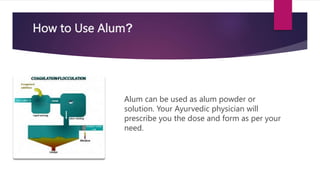
One of the first of the several steps that municipal water suppliers use to prepare water
for distribution is getting it as clear and as particulate-free as possible. To accomplish
this, the water is treated with aluminum sulfate, commonly called alum, which serves as a
flocculant. Raw water often holds tiny suspended particles that are very difficult for a
filter to catch. Alum causes them to clump together so that they can settle out of the
water or be easily trapped by a filter.
Usually a mixture of water with 48 percent filter alum is injected into the raw
incoming water at a rate of 18 to 24 parts per million. The alum promotes coagulation of
fine particles which helps resolve problems of color as well a turbidity. If the process is
given enough time to work and is applied properly, it not only corrects problems in the
water but actually results in removing most of the aluminum used in the process.
Although concern over the safety of treating water with aluminum has often been voiced,
there is no evidence that aluminum in water, whether it comes from the aluminum
sulfate used in treatment or from other sources, is a health issue. Actually, most
aluminum that we take in does come from other sources. One study showed that only
between 0.4% and 1.0% of our lifetime intake of aluminum comes from alum used to
prepare municipal water. Most aluminum intake is from aluminum that occurs naturally in
foods, aluminum used in food packaging, and from products like deodorants and
vaccines.
Water treatment for aluminum is normally not needed, but aluminum is easy to
with reverse osmosis or distillation.
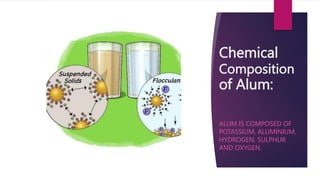
Chemical
Composition
of Alum:
ALUM IS COMPOSED OF
POTASSIUM, ALUMINIUM,
HYDROGEN, SULPHUR
AND OXYGEN.
Therapeutic Uses of Alum:
Various therapeutic properties of alum are listed below.
 Antibacterial
 Antiplatelet (prevents platelet aggregation)
 Anti-obesity
 Anti- haemorrhagic (stops bleeding)
 Anti-inflammatory
 Antidandruff
 Anti-asthamatic
How to Use Alum?
Alum can be used as alum powder or
solution. Your Ayurvedic physician will
prescribe you the dose and form as per your
need.
Side Effects of
Alum:
Several side effects associated with
alum use are listed below.
 Dry skin
 Skin irritation
 Dizziness
 A feeling of throat tightness
 Fluid accumulation around the eye
 Hives (red and itchy skin)
 Hypersensitivity reaction
 Life-threatening allergic reaction
 Puffy face from water retention
 Skin ulcer
 Throat swelling
Precautions to Take With Alum:
The safety studies of alum on pregnant and breastfeeding women have not been
carried out. Therefore, it should only be taken under the supervision and advice of a
doctor. No research has been done on the safe use of alum in children.
Interactions With Other Drugs:
There is not much information available on how alum interacts with other medications.
Hence, patients should consult a doctor before taking alum if they take any other
drug or supplement.
What is alum?
Alum is a mineral found in nature in both pure and impure forms, derived from alumen
ore. It is a colourless, clear, odourless, crystalline mass or granular powder with a
sweetish astringent flavour.
What are the uses of alum?
Alum is used for managing bleeding gums, gingivitis, pyorrhoea, tonsillitis, pharyngitis,
piles, vaginal inflammation, leucorrhoea (whitish or yellowish coloured discharge from
the vagina), gonorrhoea, kidney and bladder abscess (swelling with pus), renal and
bladder stones, conjunctivitis, ear abscess, dandruff, burns, breast hypertrophy
(increase in size), stomatitis, dementia (memory loss), asthma and bleeding.
Is alum safe for water treatment?
Alum, or Phitkari, is an acceptable white-coloured salt-like substance. It is a combination
of aluminium sulfate and potassium sulfate. Alum (aluminium sulfate) is a nontoxic liquid
mainly used in water purification treatment to clarify drinking water crystalline in nature.
Alum has been repeatedly shown to be safe for humans. Alum is a common food
additive and has also been used for decades to clean our drinking water before
consumption. HAB uses the exact same drinking water certified alum when preforming a
lake improvement application. Aluminum is a main ingredient of alum, is the third most
abundant element in the earth’s crust and naturally occurs in lake sediments. Virtually all
food, water, air and soil contain aluminum and the average adult consumes 7-9
milligrams of aluminum every day.
The FDA supports the safe use of alum as a food additive and a single dose of Maalox
contains 400 milligrams of aluminum itself. Alum use in lakes results in an especially low
exposure to aluminum as very low amounts of aluminum are added during an
application and the alum remains undissolved in the lake sediments.
How does alum affect water?
Alum, or Phitkari, is an acceptable white-coloured salt-like substance. It is a combination
of aluminium sulfate and potassium sulfate. Alum (aluminium sulfate) is a nontoxic liquid
mainly used in water purification treatment to clarify drinking water crystalline in nature.
What is Alum and How Does it Work?
Alum (aluminum sulfate) is a nontoxic liquid that is commonly used in water treatment
plants to clarify drinking water. It’s use in lakes began in the early 1970’s and is used to
reduce the amount of phosphorus in the water. Lower amounts of phosphorus lead to
lower amounts of algae and the symptoms associated with poor water quality. Alum is
most often used to control phosphorus release from the lake bottom sediments (internal
loading). Research has shown that even when external sources of phosphorus from the
surrounding watershed are lowered, the internal cycling can continue to support
significant nuisance algal blooms.
Alum is applied to lakes using specialized equipment and barges
that ensure the precise placement of the material in the lake. On contact with the water,
the liquid alum forms a fluffy aluminum hydroxide precipitate called floc.
Aluminum hydroxide (the principle ingredient of common antacids such as Maalox)
binds with the phosphorus to form an aluminum phosphate compound. The compound
is insoluble in water and the bound phosphorus can no longer be used to fuel the algae.
As the floc settles, phosphorus and particles are removed from the water column leaving
the lake noticeably clearer. The floc then forms a thin layer on the bottom that binds the
phosphorus as it leaches out of the bottom sediments during internal loading events.
The floc layer keeps the phosphorus from entering the overlying water and makes it
unavailable to the algae. The result is a reduction in the frequency and intensity of
nuisance algal boom, rather than the total elimination of all algae.
Where Does All of This Phosphorus
Come From?
Phosphorus enters lakes from two sources. Phosphorus entering the lake from outside
sources are called external sources. These sources originate in the watershed and are
either directly rinsed into the lake or flow to a stream that enters the lake. Common
external sources include lawn fertilizers, septic systems, agricultural practices, stormwater,
soil erosion and geese: anything that causes phosphorus to enter the lake from the
watershed.
Once the external source of
phosphorus enters the lake, it is deposited in the lakebed and is recycled back into the
water column. This is the second source of phosphorus and it originates from within the
lake itself.
This is called an internal source and these inputs are most common during the summer
and winter when water oxygen concentrations are low or zero near the bottom. This
condition causes changes in the chemistry of the lakebed that lead to the phosphorus
leaching out of the sediment and into the water.
Both external and internal sources of phosphorus are important in managing
lake water quality. The relative contribution of each source must be understood and
measured to design the best solution for any given lake. External sources can be
measured in the water entering the lake or estimated from models of the surrounding
watershed. Internal sources are determined by collecting lakebed sediment samples
(cores) and measuring the amount phosphorus available to leach out into the water.
ALUM TREATMENT.pptx

ALUM TREATMENT.pptx

  • 1.
    ALUM TREATMENT OF WATER BY A.JASHWANTHREDDY CSE(DATA SCIENCE) 21951A6748 INSTITUTE OF AERONAUTICAL ENGINEERING
  • 2.
    Contents: INTRODUCTION ALUM (ALUMINIUM SULPHATE) CHEMICALCOMPOSITION OF ALUM THERAPEUTIC USES OF ALUM HOW TO USE ALUM? SIDE EFFECTS OF ALUM PRECAUTIONS TO TAKE WITH ALUM INTERACTION WITH OTHER DRUGS WHAT IS ALUM? WHAT ARE THE USES OF ALUM? IS ALUM SAFE FOR WATER TREATMENT
  • 3.
    Introduction: Alum is amineral found in nature in both pure and impure forms. It is derived from alumen ore, which is a mineral salt. It is obtained from the soil ore found in Nepal, Bihar, Punjab, and the Kathiawar area. It is a colourless, clear, odourless, crystalline mass or granular powder with a sweetish astringent flavour. It has a molecular weight of 458.28 gm. It is found in Egypt, Italy, England, Germany, and India. When heated, it melts and loses its water of crystallisation at around 200 degrees resulting in an anhydrous salt. It is frequently contaminated with impurities in markets. It can be made suitable for therapeutic use by dissolving it in boiling water, filtering the solution, and evaporating it to produce crystals, which should be preserved for future use. Alum is a category of hydrated double salts that usually contain aluminium sulphate, the water of hydration, and another element’s sulphate.
  • 4.
    When heated, itmelts and loses its water of crystallisation at around 200 degrees resulting in an anhydrous salt. It is frequently contaminated with impurities in markets. It can be made suitable for therapeutic use by dissolving it in boiling water, filtering the solution, and evaporating it to produce crystals, which should be preserved for future use. Alum is a category of hydrated double salts that usually contain aluminium sulphate, the water of hydration, and another element’s sulphate. Aluminium potassium sulphate, also known as potassium alum or potash alum, is the most commercially important alum. It is made by evaporating a solution of aluminium sulphate and potassium sulphate in water. With the sulphates of sodium, ammonia, cesium, silver, rubidium, thallium, hydrazine, hydroxylamine, numerous organic amines, and potentially lithium, aluminium sulphate can produce alums. Aluminium sulphate can also be replaced by sulphates of trivalent iron, chromium, manganese, cobalt, gallium, titanium, vanadium, iridium, rhodium, and indium.
  • 5.
    Alum (Aluminum Sulfate) Oneof the first of the several steps that municipal water suppliers use to prepare water for distribution is getting it as clear and as particulate-free as possible. To accomplish this, the water is treated with aluminum sulfate, commonly called alum, which serves as a flocculant. Raw water often holds tiny suspended particles that are very difficult for a filter to catch. Alum causes them to clump together so that they can settle out of the water or be easily trapped by a filter. Usually a mixture of water with 48 percent filter alum is injected into the raw incoming water at a rate of 18 to 24 parts per million. The alum promotes coagulation of fine particles which helps resolve problems of color as well a turbidity. If the process is given enough time to work and is applied properly, it not only corrects problems in the water but actually results in removing most of the aluminum used in the process.
  • 6.
    Although concern overthe safety of treating water with aluminum has often been voiced, there is no evidence that aluminum in water, whether it comes from the aluminum sulfate used in treatment or from other sources, is a health issue. Actually, most aluminum that we take in does come from other sources. One study showed that only between 0.4% and 1.0% of our lifetime intake of aluminum comes from alum used to prepare municipal water. Most aluminum intake is from aluminum that occurs naturally in foods, aluminum used in food packaging, and from products like deodorants and vaccines. Water treatment for aluminum is normally not needed, but aluminum is easy to with reverse osmosis or distillation.
  • 7.
    Chemical Composition of Alum: ALUM ISCOMPOSED OF POTASSIUM, ALUMINIUM, HYDROGEN, SULPHUR AND OXYGEN.
  • 8.
    Therapeutic Uses ofAlum: Various therapeutic properties of alum are listed below.  Antibacterial  Antiplatelet (prevents platelet aggregation)  Anti-obesity  Anti- haemorrhagic (stops bleeding)  Anti-inflammatory  Antidandruff  Anti-asthamatic
  • 9.
    How to UseAlum? Alum can be used as alum powder or solution. Your Ayurvedic physician will prescribe you the dose and form as per your need.
  • 10.
    Side Effects of Alum: Severalside effects associated with alum use are listed below.  Dry skin  Skin irritation  Dizziness  A feeling of throat tightness  Fluid accumulation around the eye  Hives (red and itchy skin)  Hypersensitivity reaction  Life-threatening allergic reaction  Puffy face from water retention  Skin ulcer  Throat swelling
  • 11.
    Precautions to TakeWith Alum: The safety studies of alum on pregnant and breastfeeding women have not been carried out. Therefore, it should only be taken under the supervision and advice of a doctor. No research has been done on the safe use of alum in children. Interactions With Other Drugs: There is not much information available on how alum interacts with other medications. Hence, patients should consult a doctor before taking alum if they take any other drug or supplement.
  • 12.
    What is alum? Alumis a mineral found in nature in both pure and impure forms, derived from alumen ore. It is a colourless, clear, odourless, crystalline mass or granular powder with a sweetish astringent flavour. What are the uses of alum? Alum is used for managing bleeding gums, gingivitis, pyorrhoea, tonsillitis, pharyngitis, piles, vaginal inflammation, leucorrhoea (whitish or yellowish coloured discharge from the vagina), gonorrhoea, kidney and bladder abscess (swelling with pus), renal and bladder stones, conjunctivitis, ear abscess, dandruff, burns, breast hypertrophy (increase in size), stomatitis, dementia (memory loss), asthma and bleeding.
  • 13.
    Is alum safefor water treatment? Alum, or Phitkari, is an acceptable white-coloured salt-like substance. It is a combination of aluminium sulfate and potassium sulfate. Alum (aluminium sulfate) is a nontoxic liquid mainly used in water purification treatment to clarify drinking water crystalline in nature. Alum has been repeatedly shown to be safe for humans. Alum is a common food additive and has also been used for decades to clean our drinking water before consumption. HAB uses the exact same drinking water certified alum when preforming a lake improvement application. Aluminum is a main ingredient of alum, is the third most abundant element in the earth’s crust and naturally occurs in lake sediments. Virtually all food, water, air and soil contain aluminum and the average adult consumes 7-9 milligrams of aluminum every day.
  • 14.
    The FDA supportsthe safe use of alum as a food additive and a single dose of Maalox contains 400 milligrams of aluminum itself. Alum use in lakes results in an especially low exposure to aluminum as very low amounts of aluminum are added during an application and the alum remains undissolved in the lake sediments. How does alum affect water? Alum, or Phitkari, is an acceptable white-coloured salt-like substance. It is a combination of aluminium sulfate and potassium sulfate. Alum (aluminium sulfate) is a nontoxic liquid mainly used in water purification treatment to clarify drinking water crystalline in nature.
  • 15.
    What is Alumand How Does it Work? Alum (aluminum sulfate) is a nontoxic liquid that is commonly used in water treatment plants to clarify drinking water. It’s use in lakes began in the early 1970’s and is used to reduce the amount of phosphorus in the water. Lower amounts of phosphorus lead to lower amounts of algae and the symptoms associated with poor water quality. Alum is most often used to control phosphorus release from the lake bottom sediments (internal loading). Research has shown that even when external sources of phosphorus from the surrounding watershed are lowered, the internal cycling can continue to support significant nuisance algal blooms. Alum is applied to lakes using specialized equipment and barges that ensure the precise placement of the material in the lake. On contact with the water, the liquid alum forms a fluffy aluminum hydroxide precipitate called floc.
  • 16.
    Aluminum hydroxide (theprinciple ingredient of common antacids such as Maalox) binds with the phosphorus to form an aluminum phosphate compound. The compound is insoluble in water and the bound phosphorus can no longer be used to fuel the algae. As the floc settles, phosphorus and particles are removed from the water column leaving the lake noticeably clearer. The floc then forms a thin layer on the bottom that binds the phosphorus as it leaches out of the bottom sediments during internal loading events. The floc layer keeps the phosphorus from entering the overlying water and makes it unavailable to the algae. The result is a reduction in the frequency and intensity of nuisance algal boom, rather than the total elimination of all algae.
  • 17.
    Where Does Allof This Phosphorus Come From? Phosphorus enters lakes from two sources. Phosphorus entering the lake from outside sources are called external sources. These sources originate in the watershed and are either directly rinsed into the lake or flow to a stream that enters the lake. Common external sources include lawn fertilizers, septic systems, agricultural practices, stormwater, soil erosion and geese: anything that causes phosphorus to enter the lake from the watershed. Once the external source of phosphorus enters the lake, it is deposited in the lakebed and is recycled back into the water column. This is the second source of phosphorus and it originates from within the lake itself.
  • 18.
    This is calledan internal source and these inputs are most common during the summer and winter when water oxygen concentrations are low or zero near the bottom. This condition causes changes in the chemistry of the lakebed that lead to the phosphorus leaching out of the sediment and into the water. Both external and internal sources of phosphorus are important in managing lake water quality. The relative contribution of each source must be understood and measured to design the best solution for any given lake. External sources can be measured in the water entering the lake or estimated from models of the surrounding watershed. Internal sources are determined by collecting lakebed sediment samples (cores) and measuring the amount phosphorus available to leach out into the water.