ALTERNATIVE BUILDING
TECHNIQUES
PRESENTOR-ANUJ KUMAR MAURYA
COMPONENTS OF EARTH
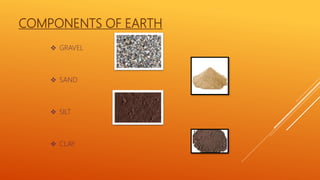
 GRAVEL
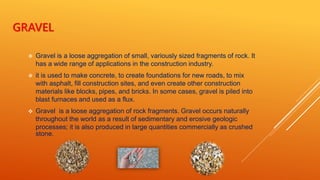
 SAND
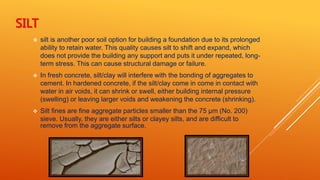
 SILT
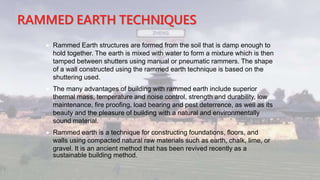
 CLAY
GRAVEL
 Gravel is a loose aggregation of small, variously sized fragments of rock. It
has a wide range of applications in the construction industry.
 it is used to make concrete, to create foundations for new roads, to mix
with asphalt, fill construction sites, and even create other construction
materials like blocks, pipes, and bricks. In some cases, gravel is piled into
blast furnaces and used as a flux.
 Gravel is a loose aggregation of rock fragments. Gravel occurs naturally
throughout the world as a result of sedimentary and erosive geologic
processes; it is also produced in large quantities commercially as crushed
stone.
SAND
 Alternative sand is mainly categorised as crushed rock sand (CRS),
industrial by-product sand and recycled fine aggregate (RFA).
 Construction Sand means sand that is predominantly produced and used
for local construction purposes, such as asphalt or concrete. All existing
sand pits containing alluvial sand shall be included within this definition.
 Sand is used for making concrete, mortars, and plasters and also for filling
under floor, basements. To avoid transport expenses as it plays a major
part of the cost of sand, as far as possible local sand is preferred to
maintain the economy in construction.
SILT
 silt is another poor soil option for building a foundation due to its prolonged
ability to retain water. This quality causes silt to shift and expand, which
does not provide the building any support and puts it under repeated, long-
term stress. This can cause structural damage or failure.
 In fresh concrete, silt/clay will interfere with the bonding of aggregates to
cement. In hardened concrete, if the silt/clay come in come in contact with
water in air voids, it can shrink or swell, either building internal pressure
(swelling) or leaving larger voids and weakening the concrete (shrinking).
 Silt fines are fine aggregate particles smaller than the 75 µm (No. 200)
sieve. Usually, they are either silts or clayey silts, and are difficult to
remove from the aggregate surface.
CLAY
 Also a primary ingredient in many natural building techniques, clay is used
to create adobe, cob, cordwood, and rammed earth structures and building
elements such as wattle and daub, clay plaster, clay render case, clay
floors and clay paints and ceramic building material.
 Clay is a finely-grained natural rock or soil material that, along with other
materials such as stone and wood, has been used as for construction for
thousands of years.
 structural clay products, ceramic products intended for use in building
construction. Typical structural clay products are building brick, paving
brick, terra-cotta facing tile, roofing tile, and drainage pipe.
RAMMED EARTH TECHNIQUES
 Rammed Earth structures are formed from the soil that is damp enough to
hold together. The earth is mixed with water to form a mixture which is then
tamped between shutters using manual or pneumatic rammers. The shape
of a wall constructed using the rammed earth technique is based on the
shuttering used.
 The many advantages of building with rammed earth include superior
thermal mass, temperature and noise control, strength and durability, low
maintenance, fire proofing, load bearing and pest deterrence, as well as its
beauty and the pleasure of building with a natural and environmentally
sound material.
 Rammed earth is a technique for constructing foundations, floors, and
walls using compacted natural raw materials such as earth, chalk, lime, or
gravel. It is an ancient method that has been revived recently as a
sustainable building method.
FILLER SLAB
 Filler slab is alternate slab construction technology where part of concrete
in bottom of slab is replaced by filler material. The basic principal is that the
concrete in bottom half of RCC slab is structurally not required as concrete
acts as compression material which is required in top half portion of slab.
 The filler slab is based on the principle that for roofs which are simply
supported as the lower part of the slab experience tensile forces while the
upper part of the slab is subjected to compressive forces and material used
as a replacement includes bricks, cellular concrete blocks, and tiles.
 Fillers are materials whose function in concrete is based mainly on size
and shape. They can interact with cement in several ways; to improve
particle packing and give the fresh concrete other properties, and even to
reduce the amount of cement in concrete without loss of strength.
JACK ARCH ROOF
 A jack arch is classically defined as a structural element in masonry
construction that provides support at openings in the masonry. Alternate
names are 'flat arch' and 'straight arch'. Unlike regular arches, jack arches are
not semicircular in form.
 An arch works on compression. They have been used for millennia as a
means to span and support weight above an opening. The jack arch is tighter
at the bottom and wider at the top. As long as the homeowner continues to pay
their gravity bill, the arch will continue to support weight over a span.
 Jack arch roof is composed of arches of either brick or lime concrete,
supported on lower flange of R.S.J.s. The joists are spaced 1.0 to 1.5 m centre
to centre, and are supported at their ends either on walls or on longitudinal
girders. The rise of the arch is kept 1/12th of the span.
ALTERNATIVE BUILDING TECHNIQUE - EARTH (USE OF EARTH AS A MATERIAL)

ALTERNATIVE BUILDING TECHNIQUE - EARTH (USE OF EARTH AS A MATERIAL)

  • 1.
  • 2.
    COMPONENTS OF EARTH GRAVEL  SAND  SILT  CLAY
  • 3.
    GRAVEL  Gravel isa loose aggregation of small, variously sized fragments of rock. It has a wide range of applications in the construction industry.  it is used to make concrete, to create foundations for new roads, to mix with asphalt, fill construction sites, and even create other construction materials like blocks, pipes, and bricks. In some cases, gravel is piled into blast furnaces and used as a flux.  Gravel is a loose aggregation of rock fragments. Gravel occurs naturally throughout the world as a result of sedimentary and erosive geologic processes; it is also produced in large quantities commercially as crushed stone.
  • 4.
    SAND  Alternative sandis mainly categorised as crushed rock sand (CRS), industrial by-product sand and recycled fine aggregate (RFA).  Construction Sand means sand that is predominantly produced and used for local construction purposes, such as asphalt or concrete. All existing sand pits containing alluvial sand shall be included within this definition.  Sand is used for making concrete, mortars, and plasters and also for filling under floor, basements. To avoid transport expenses as it plays a major part of the cost of sand, as far as possible local sand is preferred to maintain the economy in construction.
  • 5.
    SILT  silt isanother poor soil option for building a foundation due to its prolonged ability to retain water. This quality causes silt to shift and expand, which does not provide the building any support and puts it under repeated, long- term stress. This can cause structural damage or failure.  In fresh concrete, silt/clay will interfere with the bonding of aggregates to cement. In hardened concrete, if the silt/clay come in come in contact with water in air voids, it can shrink or swell, either building internal pressure (swelling) or leaving larger voids and weakening the concrete (shrinking).  Silt fines are fine aggregate particles smaller than the 75 µm (No. 200) sieve. Usually, they are either silts or clayey silts, and are difficult to remove from the aggregate surface.
  • 6.
    CLAY  Also aprimary ingredient in many natural building techniques, clay is used to create adobe, cob, cordwood, and rammed earth structures and building elements such as wattle and daub, clay plaster, clay render case, clay floors and clay paints and ceramic building material.  Clay is a finely-grained natural rock or soil material that, along with other materials such as stone and wood, has been used as for construction for thousands of years.  structural clay products, ceramic products intended for use in building construction. Typical structural clay products are building brick, paving brick, terra-cotta facing tile, roofing tile, and drainage pipe.
  • 7.
    RAMMED EARTH TECHNIQUES Rammed Earth structures are formed from the soil that is damp enough to hold together. The earth is mixed with water to form a mixture which is then tamped between shutters using manual or pneumatic rammers. The shape of a wall constructed using the rammed earth technique is based on the shuttering used.  The many advantages of building with rammed earth include superior thermal mass, temperature and noise control, strength and durability, low maintenance, fire proofing, load bearing and pest deterrence, as well as its beauty and the pleasure of building with a natural and environmentally sound material.  Rammed earth is a technique for constructing foundations, floors, and walls using compacted natural raw materials such as earth, chalk, lime, or gravel. It is an ancient method that has been revived recently as a sustainable building method.
  • 8.
    FILLER SLAB  Fillerslab is alternate slab construction technology where part of concrete in bottom of slab is replaced by filler material. The basic principal is that the concrete in bottom half of RCC slab is structurally not required as concrete acts as compression material which is required in top half portion of slab.  The filler slab is based on the principle that for roofs which are simply supported as the lower part of the slab experience tensile forces while the upper part of the slab is subjected to compressive forces and material used as a replacement includes bricks, cellular concrete blocks, and tiles.  Fillers are materials whose function in concrete is based mainly on size and shape. They can interact with cement in several ways; to improve particle packing and give the fresh concrete other properties, and even to reduce the amount of cement in concrete without loss of strength.
  • 9.
    JACK ARCH ROOF A jack arch is classically defined as a structural element in masonry construction that provides support at openings in the masonry. Alternate names are 'flat arch' and 'straight arch'. Unlike regular arches, jack arches are not semicircular in form.  An arch works on compression. They have been used for millennia as a means to span and support weight above an opening. The jack arch is tighter at the bottom and wider at the top. As long as the homeowner continues to pay their gravity bill, the arch will continue to support weight over a span.  Jack arch roof is composed of arches of either brick or lime concrete, supported on lower flange of R.S.J.s. The joists are spaced 1.0 to 1.5 m centre to centre, and are supported at their ends either on walls or on longitudinal girders. The rise of the arch is kept 1/12th of the span.