Yue Pan & Erik Stolterman
Indiana University Bloomington, IN, USA
{panyue, estolter}@indiana.edu
Pattern Language and HCI:
Experiences and Expectations
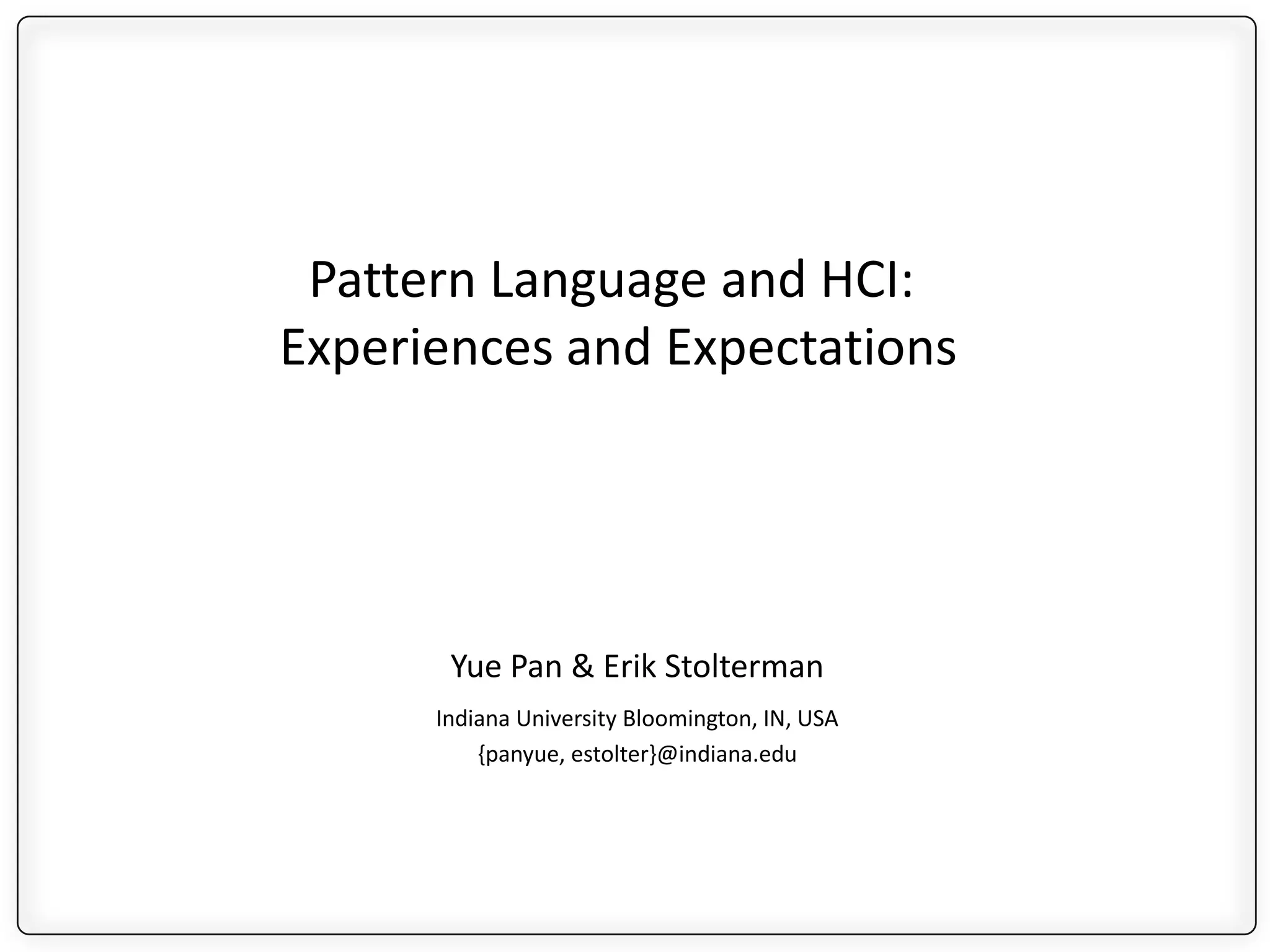
Pattern Language in Architecture Design
Pattern Language
• Problem
• Context
• Forces
• Solution
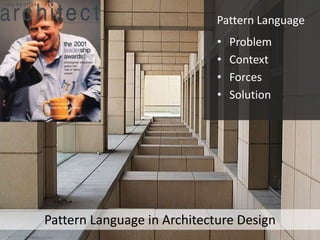
Pattern Language in Interaction Design
Pattern Language in Social Studies
Pattern Language in Ubiquitous Computing
Pattern Language in Ethnography Research
research question1:
why has Pattern Language as an object of study
created such enthusiasm and interest over the
years?
research question2:
why has Pattern Language as a tool not been more
widespread and successful?
Interviews
interview
We sent email to 24 PL experts.
14 experts replied.
Interviews were conducted by email or
Skype.
4 experts are working for industry.
10 experts are working for academia. PL experts
interview
Interview questions:
1. People’s initial engagement with PL;
2. Rewards and Challenges of developing PL;
3. Why PL not been more successful;
4. Future of PL in HCI field.
Findings
Challenges of Developing PL—Demand Extensive Efforts
R3: “First of all, IT IS AN IMMENSE AMOUNT
OF WORK!!! First you harvest ideas for
potential patterns, then you seek the evidence
(examples where it was used), and then you
start writing the first draft, then iterate and
publish. Do that 100+ times and it will cost you
more than a year of your life!”
Challenges of Developing PL—Applying PL in Real World
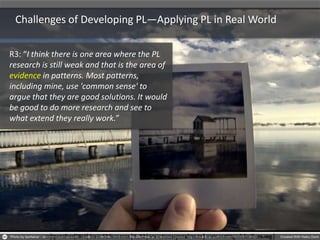
R3: “I think there is one area where the PL
research is still weak and that is the area of
evidence in patterns. Most patterns,
including mine, use 'common sense' to
argue that they are good solutions. It would
be good to do more research and see to
what extend they really work.”
R10: “In contrast, computer scientists and
programmers in particular are very
comfortable with formalizations. So its no
surprise that patterns has had success in
programming where you have things like
UML.”
“Designers on the other hand resist
formalizations, particularly descriptive ones
rather than generative or process-oriented
ones like design methods.”
Challenges of Developing PL—Formalization
Insight:
PL is NOT easy to use.
Pattern LanguageAdvantages of Using PL—Education
R8: “As part of teacher I do. I use
Jennifer Tidwell’s book in my course
‘Interacting Form’ to teach graphic
students.”
Advantages of Using PL—Representing Knowledge
R3: “Patterns could be a great way to
capture design solutions and link it to
characteristics of the task, user or any
other part of the context of use. And so I
started writing my first patterns, trying to
find out how I could use the pattern
'format' to capture design knowledge.”
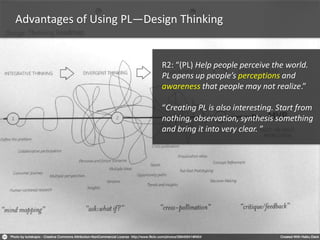
Pattern LanguageAdvantages of Using PL—Design Thinking
R2: “(PL) Help people perceive the world.
PL opens up people’s perceptions and
awareness that people may not realize.”
“Creating PL is also interesting. Start from
nothing, observation, synthesis something
and bring it into very clear. ”
Insight:
Use PL to inform design thinking.
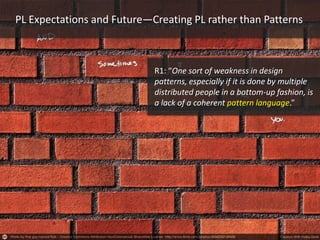
PL Expectations and Future—Creating PL rather than Patterns
R1: “One sort of weakness in design
patterns, especially if it is done by multiple
distributed people in a bottom-up fashion, is
a lack of a coherent pattern language.”
Insight:
Develop PL rather than patterns.
PL Expectations and Future—More Evaluation
R6: “More research examining the
practicalities of using PLs within actual
design processes, ethnographic and
empirical studies are needed.”
Insight:
Evaluate PL in a real design setting.
Discussion
Pattern Language
Discussion
We study and evaluate PL as
1. A tool and methodological approach to learn about
other methods and tools in general.
2. A catalyst to understand problems, solutions, values
within design and research process.
Design Methods Research @IU
Yue Pan & Erik Stolterman
Indiana University, USA
{panyue, estolter}@indiana.edu
NSF
Thanks!

Pattern Language and HCI: Expectations and Experiences

  • 1.
    Yue Pan &Erik Stolterman Indiana University Bloomington, IN, USA {panyue, estolter}@indiana.edu Pattern Language and HCI: Experiences and Expectations
  • 2.
    Pattern Language inArchitecture Design
  • 3.
    Pattern Language inArchitecture Design Pattern Language • Problem • Context • Forces • Solution
  • 4.
    Pattern Language inInteraction Design
  • 5.
    Pattern Language inSocial Studies
  • 6.
    Pattern Language inUbiquitous Computing
  • 7.
    Pattern Language inEthnography Research
  • 8.
    research question1: why hasPattern Language as an object of study created such enthusiasm and interest over the years?
  • 9.
    research question2: why hasPattern Language as a tool not been more widespread and successful?
  • 10.
  • 11.
    interview We sent emailto 24 PL experts. 14 experts replied. Interviews were conducted by email or Skype. 4 experts are working for industry. 10 experts are working for academia. PL experts
  • 12.
    interview Interview questions: 1. People’sinitial engagement with PL; 2. Rewards and Challenges of developing PL; 3. Why PL not been more successful; 4. Future of PL in HCI field.
  • 13.
  • 14.
    Challenges of DevelopingPL—Demand Extensive Efforts R3: “First of all, IT IS AN IMMENSE AMOUNT OF WORK!!! First you harvest ideas for potential patterns, then you seek the evidence (examples where it was used), and then you start writing the first draft, then iterate and publish. Do that 100+ times and it will cost you more than a year of your life!”
  • 15.
    Challenges of DevelopingPL—Applying PL in Real World R3: “I think there is one area where the PL research is still weak and that is the area of evidence in patterns. Most patterns, including mine, use 'common sense' to argue that they are good solutions. It would be good to do more research and see to what extend they really work.”
  • 16.
    R10: “In contrast,computer scientists and programmers in particular are very comfortable with formalizations. So its no surprise that patterns has had success in programming where you have things like UML.” “Designers on the other hand resist formalizations, particularly descriptive ones rather than generative or process-oriented ones like design methods.” Challenges of Developing PL—Formalization
  • 17.
    Insight: PL is NOTeasy to use.
  • 18.
    Pattern LanguageAdvantages ofUsing PL—Education R8: “As part of teacher I do. I use Jennifer Tidwell’s book in my course ‘Interacting Form’ to teach graphic students.”
  • 19.
    Advantages of UsingPL—Representing Knowledge R3: “Patterns could be a great way to capture design solutions and link it to characteristics of the task, user or any other part of the context of use. And so I started writing my first patterns, trying to find out how I could use the pattern 'format' to capture design knowledge.”
  • 20.
    Pattern LanguageAdvantages ofUsing PL—Design Thinking R2: “(PL) Help people perceive the world. PL opens up people’s perceptions and awareness that people may not realize.” “Creating PL is also interesting. Start from nothing, observation, synthesis something and bring it into very clear. ”
  • 21.
    Insight: Use PL toinform design thinking.
  • 22.
    PL Expectations andFuture—Creating PL rather than Patterns R1: “One sort of weakness in design patterns, especially if it is done by multiple distributed people in a bottom-up fashion, is a lack of a coherent pattern language.”
  • 23.
  • 24.
    PL Expectations andFuture—More Evaluation R6: “More research examining the practicalities of using PLs within actual design processes, ethnographic and empirical studies are needed.”
  • 25.
    Insight: Evaluate PL ina real design setting.
  • 26.
  • 27.
    Pattern Language Discussion We studyand evaluate PL as 1. A tool and methodological approach to learn about other methods and tools in general. 2. A catalyst to understand problems, solutions, values within design and research process.
  • 28.
    Design Methods Research@IU Yue Pan & Erik Stolterman Indiana University, USA {panyue, estolter}@indiana.edu NSF Thanks!

Editor's Notes

  • #8 As well as Ethnography research