Cross-Examination of Expert
Witnesses
Michael DeBlis III, Esq.
2
The Law Surrounding Experts
• Rule 702. Testimony by Experts: If scientific, technical,
or other specialized knowledge will assist the trier of
fact to understand the evidence or to determine a fact
in issue, a witness qualified as an expert by knowledge,
skill, experience, training, or education, may testify
thereto in the form of an opinion or otherwise, if (1)
the testimony is based upon sufficient facts or data, (2)
the testimony is the product of reliable principles and
methods, and (3) the witness has applied the principles
and methods reliably to the facts of the case
3
The Law Surrounding Experts
• FRYE and DAUBERT tests.
4
Expert Opinion
• Expert Opinion
– Four basic requirements for expert testimony to
be admissible:
5
Expert Opinion
• An expert must have special knowledge, skill,
training, education, or experience. Court has broad
discretion to determine what constitutes such type
of skill
6
Expert Opinion
• The opinion must be helpful or assist the trier of fact
in understanding the evidence,
–Appropriate subject matter: Means the opinion
must “assist” the trier of fact. Subdivides into
requirement that (1) the methodology must be
reliable and (2) the opinion must be relevant (“fit”
the facts of the case). Reliability and relevance (fit)
are conditions to admissibility. This means that the
proponent must convince the trial judge by a
preponderance of the evidence that these
conditions have been satisfied
7
Expert Opinion
• The witness must be qualified as an expert,
–In other words, the opinion must be within the
expert’s field of expertise
–Qualifications need n/ be formal or academic. An
expert can be qualified based merely on
experience
8
Expert Opinion
• Example: An expert truck mechanic who was
qualified as an expert mechanic may not give an
opinion as to the speed of two vehicles at the point
of impact. That type of opinion is beyond the scope
of the expert mechanic’s field of expertise. To give
an opinion on the speed of vehicles at the point of
impact would require an expert on accident
reconstruction, not an expert mechanic
9
Expert Opinion
• The expert must possess reasonable certainty or
probability regarding the opinion,
–“Doctor, do you have an opinion based upon
reasonable medical certainty about…”
10
Expert Opinion
• Basis of opinion by expert
– Issue: On what facts may an expert base his
opinion?
– Opinion must be supported by a proper factual
basis
11
Expert Opinion
– Facts supporting the opinion must be either:
• Facts w/in the personal knowledge of the
expert; or
–Testimony by a coroner (qualified as an
expert witness) as to the findings of an
autopsy. These would be facts perceived
before trial and would be a proper basis for
an opinion
12
Expert Opinion
• Facts that would not be within the personal knowledge
of the expert but which could be supplied to the expert
in court by the evidence usually through a hypothetical
question; or
– Facts about a fatal accident made known to the
expert at trial despite her lack of personal
knowledge.
– “Assume Dr. Grosse that the following facts are
true.” All of the facts in the hypothetical question
must have been admitted into evidence
13
Expert Opinion
• An expert may base his opinion on facts
(1) that are not within the personal
knowledge of the expert and (2) that are
not in evidence in the case as long as the
facts are of a type that experts in the field
would reasonably rely upon in making
out of court professional decisions
14
Expert Opinion
–Hypo: Doctor hired to testify for P in a
personal injury action based his opinion in
part on a radiologist’s report of what P’s x-
rays revealed. The witness doctor had never
seen the x-rays. Neither the x-rays nor the
radiologist’s report are in evidence. May the
doctor give his opinion? Yes. Doctors rely on
radiologist’s reports all the time in making
out of court professional decisions.
15
Expert Opinion
• 705: Disclosure of facts or data underlying
expert opinion
– An expert need not give the reasons for her
opinion on direct examination. However, she may
be required to disclose such information on cross-
examination
16
Expert Opinion
• 704: Opinion on ultimate issue
– 704(a): An expert witness may give an opinion on
an ultimate issue
• Example: Testimony as to whether a testator had
sufficient mental capacity to know the nature and
extent of his property and the natural objects of his
bounty would be a permissible area for expert opinion.
17
Expert Opinion
• But what if the expert is asked, “In your
opinion, did the testator have legal capacity to
make a will?” This would not be a proper
question. Even though it goes to an ultimate
issue, it goes well beyond what is permissible
b/c it snatches the issue away from the jury. An
expert cannot be asked to directly state
whether the testator had legal capacity to make
a will
18
Expert Opinion
• 704(b): Limitation on an expert’s ability to give
an opinion on ultimate issues in criminal cases
– Severe limitation
– An expert may not give an opinion as to whether a
criminal defendant did or did not have a particular
mental state constituting an element of the crime
charged or a defense thereto
19
Expert Opinion
– Example: Murder case and the defendant pleads
not guilty by reason of insanity. An expert witness
may not be asked, “In your opinion, do you think
that D was insane at the time of the killing?”
20
Expert Opinion
• Learned Treatise
– Hypo: P sues D for damages claiming serious injury
resulting from negligence of D. Injury is that P has
extra hole in his head. “Gray’s Anatomy” on page
22 states that such a hole is bad news.
– Q1: May P start out by reading text to jury? No
21
Expert Opinion
–Q2: May text be used to impeach contrary
opinion by defense expert (that it is
“normal” for a person to have more than
one hole in his head)? Yes
22
Expert Opinion
– A learned text, treatise or article concerning a
relevant discipline is admissible as an exception to
hearsay if:
• Testimony of your own expert that the learned
text, treaty or article is authoritative,
–Authoritativeness for a learned treatise is
established by (1) expert testimony or (2) by
judicial notice
–It’s the standard in the field: “Gray’s
Anatomy is authoritative”
23
Expert Opinion
• Your own expert actually relied on the text or
treatise that you want to put into evidence on
direct or it was called to his attention on cross-
examination,
24
Expert Opinion
• Admission on cross-examination of your
opposing expert,
–“Dr. Adams, are you familiar with Gray’s
Anatomy? Do you consider it authoritative?”
If he answers “yes,” then you can use it
25
Expert Opinion
– Q3: May the text be offered for its truth? Yes,
under FRE it is admissible for its truth as an
exception to the rule against hearsay
26
Expert Opinion
– Limitations
• Expert must testify (at trial or deposition)
unless judge takes judicial notice
• Treatise is admitted by being read to the jury.
Text itself is n/ received as evidence unless
offered by the adverse party
27
The “Sniffer” Machine
• Dr. Vass and his laboratory stand to make a fortune selling
their contraption of a smell machine to law enforcement
across the country. If this judge allows it in the case, many
people including Dr. Vass stand to make a lot of money. Never
before has a judge allowed it, but these people know that they
have a damn good chance with this particular judge allowing
this machine to be used in trial. Once Vass’s machine is used in
trial, it validates and elevates the value of Vass’s invention. He
and the lab can then sell it to every police department in the
nation. When that happens, they are off to the races with the
U.S. Patent Office with Dr. Vass’s machine.
28
What does this mean for us in the
courtroom?
• More motions before the trial.
• More questioning of expert witnesses.
• Real research into the science and the expert.
29
Challenging the expert
• Whether it’s about their qualifications.
• The actual “expertise” they claim.
• Use MOTIONS - You may not stop the expert
from testifying, but you can limit what they
say.
30
Don’t ignore
investigating and
challenging the expert
• Question their qualifications.
• There are three kinds of experts:
– Highly trained,
– Experienced on-the-job,
– Questionable training or area
of expertise.
31
Strategy
Considerations
32
Preparing to Question
the Expert
• Learn about the field
– Inbau & Moensens, Scientific Evidence in
Criminal Cases
• Use the phone
• Get TRANSCRIPTS
• Do some research
– Check college textbooks
– Read everything the opposing side’s expert has
written
33
Interview the Expert Yourself
34
Experts and Language
• Understand their language.
• Learn how to explain things clearly and
concisely for the jury.
• Avoid sounding condescending.
35
Basic Principles
• Regular cross-examination rules apply.
• Thorough preparation is important.
• Only ask leading questions.
• One fact for each question.
• Never ask a question if you don’t
already know the answer.
• Create a method that works for you.
36
Special Problems When Witness Is an Expert
• The expert knows more than you do.
• It’s harder to control an expert than a regular
witness.
• The expert will likely be well-educated and
articulate.
• Expert is experienced at giving testimony in
court.
37
Examples of Cross-Examination of Experts
• Forensic Pathologist in State v. Morehead
• Radiologist in State v. Carey
• Shaken baby syndrome experts in State v.
Carey
38
Forensic Pathologist
• State v. Morehead (client accused of strangling

grandmother)
– The defense argued that the grandmother
died from heart failure
– Cross-examining the medical examiner
was crucial to the outcome of the case
– Examples of managing the witness and
understanding the terminology
39
Experts on the Shaken Baby Syndrome
• State v. Carey (client accused of shaking a 5-
month old baby leading to brain damage)
– Several expert witnesses testified for the state
– Cross-examination of radiologist who reviewed the
CAT scan and the MRI
– Cross-examination of an outside expert on the
“Shaken Baby Syndrome”
40
Cross-Examination
• How should the jury feel about the expert
after you are done cross-examining him?
– Is this reliable science?
– Can they trust the witness?
– Can they trust the evidence?
– Can they rely on the evidence presented?
41
Check for Bias
• Who do they testify for?
• Follow the money trail.
• Membership in organizations.
• Personal biases they might have.
42
Challenging the
Result
• “Things not done”
cross-examination
• Result is not OBJECTIVE
• Different levels of
certainty
43
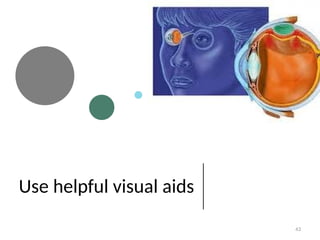
Use helpful visual aids
44
Cross by
learned
treatise
45
Ten Principles for Preparing
to Cross-examine an Expert
• (1) Identify opinions that need to be
challenged.
• (2) Gather all necessary materials for cross-
examination.
• (3) Get the complete CV of the opposing
expert.
• (4) Look into the expert’s past testimony.
• (5) Check for allegations of mistake or
misconduct.
46
Ten Principles for Preparing
to Cross-examine an Expert
• (6) Research relevant treatises and articles
about the topic.
• (7) Hire an expert if necessary.
• (8) Meet the opposing expert before the trial.
• (9) Learn the important terminology related to
the topic.
• (10) Develop a system to organize your cross-
examination (like a system based on chapters).
47
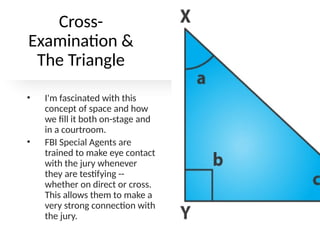
Cross-
Examination &
The Triangle
• I'm fascinated with this
concept of space and how
we fill it both on-stage and
in a courtroom.
• FBI Special Agents are
trained to make eye contact
with the jury whenever
they are testifying --
whether on direct or cross.
This allows them to make a
very strong connection with
the jury.
48
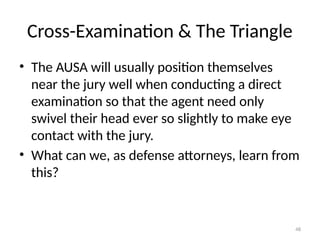
Cross-Examination & The Triangle
• The AUSA will usually position themselves
near the jury well when conducting a direct
examination so that the agent need only
swivel their head ever so slightly to make eye
contact with the jury.
• What can we, as defense attorneys, learn from
this?
49
Cross-Examination &
The Triangle
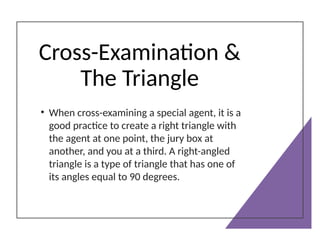
• When cross-examining a special agent, it is a
good practice to create a right triangle with
the agent at one point, the jury box at
another, and you at a third. A right-angled
triangle is a type of triangle that has one of
its angles equal to 90 degrees.
50
Cross-
Examination &
The Triangle
• Simplifying this, I try to stand on
the opposite side of the courtroom
from the jury box. That forces the
witness to crane their neck and
turn their head in a direction that
is opposite to the jury box to look
at me when I am asking the
question. The agent is less likely to
turn back to the jury box and face
the jury when answering the
question.
51
Cross-Examination & The Triangle
• Seasoned agents will still break eye contact
with the attorney and turn back to face the
jury when answering the question. However,
in my experience, it does not happen with the
same amount of frequency as when the
defense attorney stands on the opposite side
of the courtroom from the jury box.
52
Connect
With
Me!
53
Contact
Information
• Website: www.DeBlisLaw.com
• Email:
MJDeBlis@DeBlisLaw.com
• Office: 973-783-7000