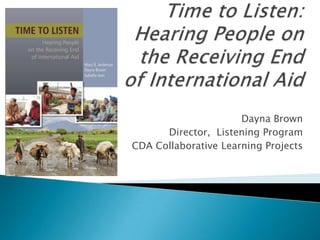
Dayna Brown
      Director, Listening Program
CDA Collaborative Learning Projects
Staff are evaluated and
rewarded for managing
projects on time and on
budget
“Donors demand task focused work. Staff
would love to have more time to talk to
people in the camp, to spend the night in the
camp, but we have reports due, with
facts, and numbers and it needs to be right to
keep the funding coming. The donors are not
helping us be respectful because they come
with their new ideas, trends and we have to
jump…we end up with ridiculous time frames
to do things. We cut out the process and
spend the rest of the year doing damage
control.”
   Director of an INGO on the Thai-Burma border
Staff would be evaluated and
rewarded for quality of
relationships and results that
recipients say make lasting
positive changes in their lives
Monitoring and
evaluation is done by
providers on project
spending and delivery of
planned assistance
“What impact are you talking about? The
impact is just spending money. Goods are
delivered with no sense of social
development. There is no interest to
develop people; it is all reduced to
practicality. Just know how to write a report.
The focus is on skills put into the
framework of outputs with no reflection
included.”
   Director of a Lebanese NGO
Monitoring, evaluation, and
follow-up would be done by
providers and recipients on
the results and long-term
effects of assistance
By efficiently providing tangible and
intangible inputs, international actors
can effectively cause, catalyze, or
support positive economic, social and
political change in other countries.
The role of international assistance in
promoting positive social, political and
economic change is to expand the range of
options that people in a society can consider,
to engage with them in weighing the costs
and benefits of each option and, from this, to
co-develop and co-implement a joint
strategy for pursuing the changes they seek.
 Policydevelopment and use
 Procedures
 Allocation of resources
 Who we hire and work with
◦ In how you do your job?
◦ In how your agency, department or
  program works?
◦ With your partners and stakeholders?
◦ With your donors and supporters?
◦ Across the humanitarian sector?
Time to Listen is available for purchase on
 Amazon and downloadable for free at
www.cda-collaborative.org

Follow our blog Time to Listen on Wordpress

Feedback and questions: dbrown@cdainc.com

Time to listen (Danya Brown, CDA Collaborative Learning Projects)

  • 1.
    Dayna Brown Director, Listening Program CDA Collaborative Learning Projects
  • 2.
    Staff are evaluatedand rewarded for managing projects on time and on budget
  • 3.
    “Donors demand taskfocused work. Staff would love to have more time to talk to people in the camp, to spend the night in the camp, but we have reports due, with facts, and numbers and it needs to be right to keep the funding coming. The donors are not helping us be respectful because they come with their new ideas, trends and we have to jump…we end up with ridiculous time frames to do things. We cut out the process and spend the rest of the year doing damage control.” Director of an INGO on the Thai-Burma border
  • 4.
    Staff would beevaluated and rewarded for quality of relationships and results that recipients say make lasting positive changes in their lives
  • 5.
    Monitoring and evaluation isdone by providers on project spending and delivery of planned assistance
  • 6.
    “What impact areyou talking about? The impact is just spending money. Goods are delivered with no sense of social development. There is no interest to develop people; it is all reduced to practicality. Just know how to write a report. The focus is on skills put into the framework of outputs with no reflection included.” Director of a Lebanese NGO
  • 7.
    Monitoring, evaluation, and follow-upwould be done by providers and recipients on the results and long-term effects of assistance
  • 8.
    By efficiently providingtangible and intangible inputs, international actors can effectively cause, catalyze, or support positive economic, social and political change in other countries.
  • 9.
    The role ofinternational assistance in promoting positive social, political and economic change is to expand the range of options that people in a society can consider, to engage with them in weighing the costs and benefits of each option and, from this, to co-develop and co-implement a joint strategy for pursuing the changes they seek.
  • 10.
     Policydevelopment anduse  Procedures  Allocation of resources  Who we hire and work with
  • 11.
    ◦ In howyou do your job? ◦ In how your agency, department or program works? ◦ With your partners and stakeholders? ◦ With your donors and supporters? ◦ Across the humanitarian sector?
  • 12.
    Time to Listenis available for purchase on Amazon and downloadable for free at www.cda-collaborative.org Follow our blog Time to Listen on Wordpress Feedback and questions: dbrown@cdainc.com