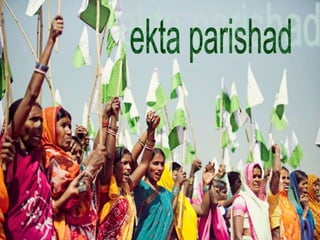
Ekta Parishad
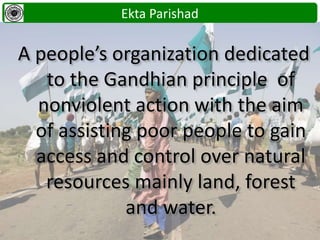
A people’s organization dedicated
to the Gandhian principle of
nonviolent action with the aim
of assisting poor people to gain
access and control over natural
resources mainly land, forest
and water.
INDIA AT A GLANCE
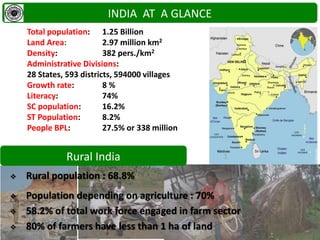
Total population: 1.25 Billion
Land Area: 2.97 million km2
Density: 382 pers./km2
Administrative Divisions:
28 States, 593 districts, 594000 villages
Growth rate: 8 %
Literacy: 74%
SC population: 16.2%
ST Population: 8.2%
People BPL: 27.5% or 338 million
Rural India
 Rural population : 68.8%
 Population depending on agriculture : 70%
 58.2% of total work force engaged in farm sector
 80% of farmers have less than 1 ha of land
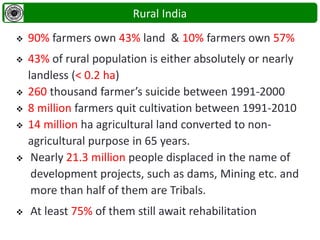
 90% farmers own 43% land & 10% farmers own 57%
 43% of rural population is either absolutely or nearly
landless (< 0.2 ha)
 260 thousand farmer’s suicide between 1991-2000
 8 million farmers quit cultivation between 1991-2010
 14 million ha agricultural land converted to non-
agricultural purpose in 65 years.
 Nearly 21.3 million people displaced in the name of
development projects, such as dams, Mining etc. and
more than half of them are Tribals.
 At least 75% of them still await rehabilitation
Rural India
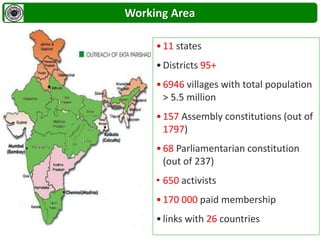
•11 states
•Districts 95+
•6946 villages with total population
> 5.5 million
•157 Assembly constitutions (out of
1797)
•68 Parliamentarian constitution
(out of 237)
• 650 activists
•170 000 paid membership
•links with 26 countries
Working Area
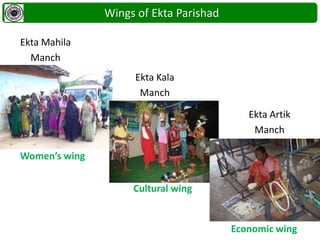
Wings of Ekta Parishad
Women’s wing
Cultural wing
Economic wing
Ekta Mahila
Manch
Ekta Kala
Manch
Ekta Artik
Manch
Status of women in India
 Women Population: 48.5% or 596 million
 Sex Ratio: 940 females per 1,000 males
 India stand in 114th position in women equality
 55% women are malnourished
 Only 65% women are literate
Present Scenario of Women and Land
 86% of rural women depend on agriculture.
 Less than 10% of privately held land nationwide is in
the name of women.
 Women’s land rights remain largely insecure.
Women also lack equal land rights under marriage
and divorce laws.
 According to legislation, women have the same right
to own land as men.
 A step forward - Forest Rights Act 2006 gives joint
land entitlement.
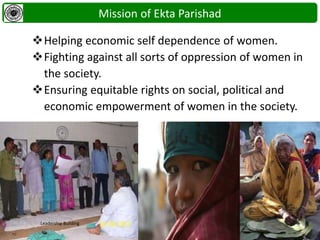
Mission of Ekta Parishad
Helping economic self dependence of women.
Fighting against all sorts of oppression of women in
the society.
Ensuring equitable rights on social, political and
economic empowerment of women in the society.
Leadership Building
Challenges in front of Ekta Parishad
Related to Land
 Displacement /acquisition due to Dams, Sanctuaries,
Mining, Industries and absence of compensation.
 Landlessness for agriculture and Alienation of tribal
land.
 Land grabbing by powerful people.
 Harassment by the govt. officials as well as other
powerful people.
 Poor Implementation or Unfavorable attitude of the
officials on land reforms.
Objectives
 Awareness creation
 Formation of Village Group
 Build village leadership
 Organize community based organizations
 Initiate people’s actions (Foot March, Public rally,
Sit-in, Public hearing)
 Advocacy, dialogue and Building linkages
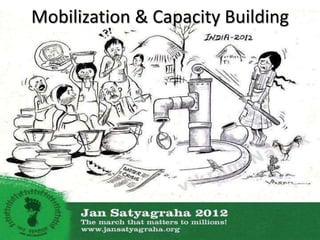
Mobilization & Capacity Building
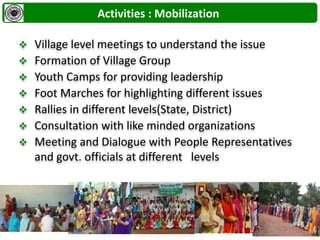
 Village level meetings to understand the issue
 Formation of Village Group
 Youth Camps for providing leadership
 Foot Marches for highlighting different issues
 Rallies in different levels(State, District)
 Consultation with like minded organizations
 Meeting and Dialogue with People Representatives
and govt. officials at different levels
Activities : Mobilization
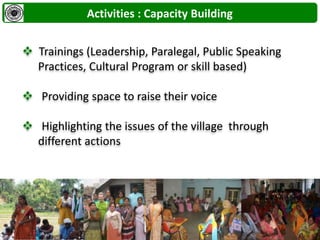
 Trainings (Leadership, Paralegal, Public Speaking
Practices, Cultural Program or skill based)
 Providing space to raise their voice
 Highlighting the issues of the village through
different actions
Activities : Capacity Building
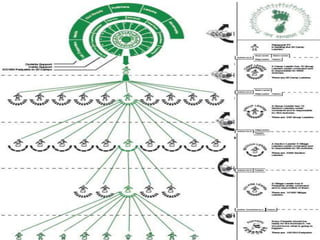
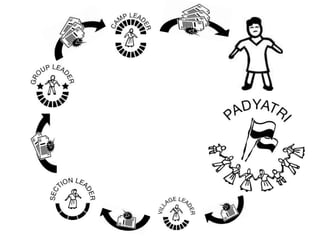
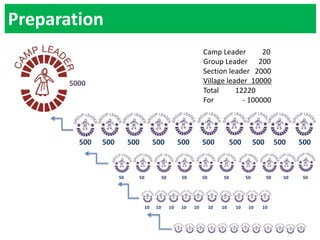
Preparation
Camp Leader 20
Group Leader 200
Section leader 2000
Village leader 10000
Total 12220
For - 100000
5000
500 500 500 500 500 500 500 500 500 500
50 50 50 50 50 50 50 50 50 50
10 10 10 10 10 10 10 10 10 10
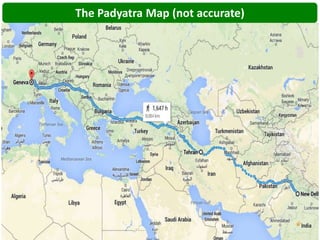
The Padyatra Map (not accurate)
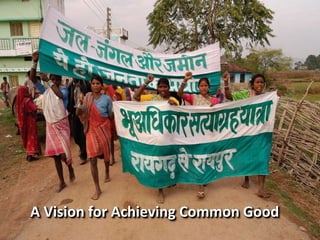
A Vision for Achieving Common Good
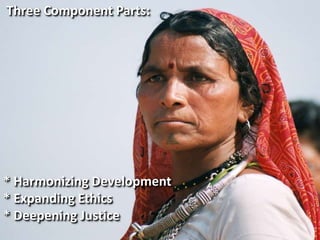
Three Component Parts:
* Harmonizing Development
* Expanding Ethics
* Deepening Justice
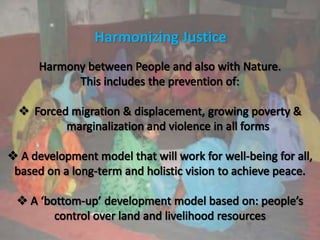
Harmonizing Justice
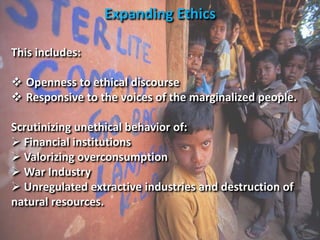
This includes:
 Openness to ethical discourse
 Responsive to the voices of the marginalized people.
Scrutinizing unethical behavior of:
 Financial institutions
 Valorizing overconsumption
 War Industry
 Unregulated extractive industries and destruction of
natural resources.
Expanding Ethics
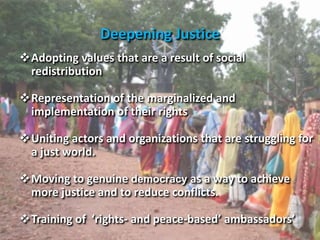
Deepening Justice
Adopting values that are a result of social
redistribution
Representation of the marginalized and
implementation of their rights
Uniting actors and organizations that are struggling for
a just world.
Moving to genuine democracy as a way to achieve
more justice and to reduce conflicts.
Training of ‘rights- and peace-based’ ambassadors’
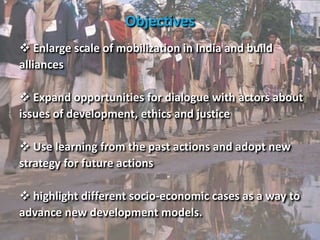
 Enlarge scale of mobilization in India and build
alliances
 Expand opportunities for dialogue with actors about
issues of development, ethics and justice
 Use learning from the past actions and adopt new
strategy for future actions
 highlight different socio-economic cases as a way to
advance new development models.
Objectives
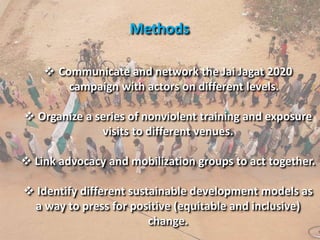
Methods
 Communicate and network the Jai Jagat 2020
campaign with actors on different levels.
 Organize a series of nonviolent training and exposure
visits to different venues.
 Link advocacy and mobilization groups to act together.
 Identify different sustainable development models as
a way to press for positive (equitable and inclusive)
change.
 Connecting and working towards a global social
movement.
 Establish a new generation of youth with faith in
nonviolence and nonviolent action.
 Increase public discourse and practice on
Development, Ethics and Justice.
Expected Impact
2014: International Youth Program
2014- 2015: Meetings for New Millennium Development Goals
2016: International Women’s Program
2017: Cadre Building for 2020 Program
2018: International Conference on Nonviolent Economy
2019: International March for Development, Justice and Ethics
2020: One Million Walk (Global)
Activities and Timeline
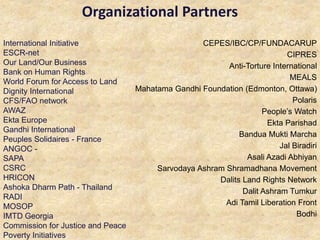
Organizational Partners
CEPES/IBC/CP/FUNDACARUP
CIPRES
Anti-Torture International
MEALS
Mahatama Gandhi Foundation (Edmonton, Ottawa)
Polaris
People’s Watch
Ekta Parishad
Bandua Mukti Marcha
Jal Biradiri
Asali Azadi Abhiyan
Sarvodaya Ashram Shramadhana Movement
Dalits Land Rights Network
Dalit Ashram Tumkur
Adi Tamil Liberation Front
Bodhi
International Initiative
ESCR-net
Our Land/Our Business
Bank on Human Rights
World Forum for Access to Land
Dignity International
CFS/FAO network
AWAZ
Ekta Europe
Gandhi International
Peuples Solidaires - France
ANGOC -
SAPA
CSRC
HRICON
Ashoka Dharm Path - Thailand
RADI
MOSOP
IMTD Georgia
Commission for Justice and Peace
Poverty Initiatives
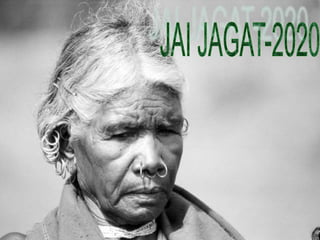
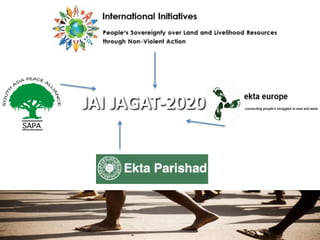
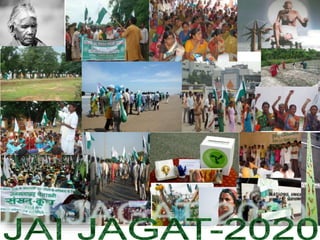
JAI JAGAT-2020
www.ektaparishad.com
Ekta Website
www.ektaeurope.org
www.facebook.com/ektaparishad
Ekta Social Media - Facebook
www.facebook.com/pages/International-Initiatives/904597232901254
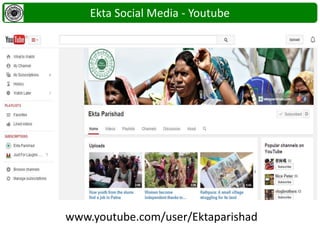
www.youtube.com/user/Ektaparishad
Ekta Social Media - Youtube
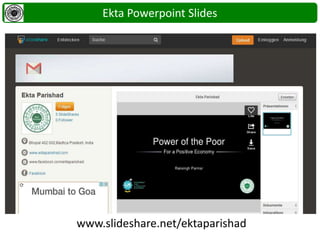
www.slideshare.net/ektaparishad
Ekta Powerpoint Slides
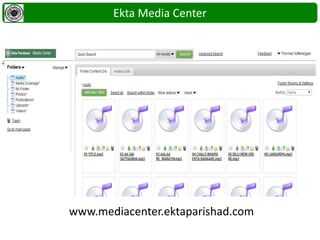
www.mediacenter.ektaparishad.com
Ekta Media Center

All about ekta

  • 2.
    Ekta Parishad A people’sorganization dedicated to the Gandhian principle of nonviolent action with the aim of assisting poor people to gain access and control over natural resources mainly land, forest and water.
  • 3.
    INDIA AT AGLANCE Total population: 1.25 Billion Land Area: 2.97 million km2 Density: 382 pers./km2 Administrative Divisions: 28 States, 593 districts, 594000 villages Growth rate: 8 % Literacy: 74% SC population: 16.2% ST Population: 8.2% People BPL: 27.5% or 338 million Rural India  Rural population : 68.8%  Population depending on agriculture : 70%  58.2% of total work force engaged in farm sector  80% of farmers have less than 1 ha of land
  • 4.
     90% farmersown 43% land & 10% farmers own 57%  43% of rural population is either absolutely or nearly landless (< 0.2 ha)  260 thousand farmer’s suicide between 1991-2000  8 million farmers quit cultivation between 1991-2010  14 million ha agricultural land converted to non- agricultural purpose in 65 years.  Nearly 21.3 million people displaced in the name of development projects, such as dams, Mining etc. and more than half of them are Tribals.  At least 75% of them still await rehabilitation Rural India
  • 5.
    •11 states •Districts 95+ •6946villages with total population > 5.5 million •157 Assembly constitutions (out of 1797) •68 Parliamentarian constitution (out of 237) • 650 activists •170 000 paid membership •links with 26 countries Working Area
  • 6.
    Wings of EktaParishad Women’s wing Cultural wing Economic wing Ekta Mahila Manch Ekta Kala Manch Ekta Artik Manch
  • 7.
    Status of womenin India  Women Population: 48.5% or 596 million  Sex Ratio: 940 females per 1,000 males  India stand in 114th position in women equality  55% women are malnourished  Only 65% women are literate
  • 8.
    Present Scenario ofWomen and Land  86% of rural women depend on agriculture.  Less than 10% of privately held land nationwide is in the name of women.  Women’s land rights remain largely insecure. Women also lack equal land rights under marriage and divorce laws.  According to legislation, women have the same right to own land as men.  A step forward - Forest Rights Act 2006 gives joint land entitlement.
  • 9.
    Mission of EktaParishad Helping economic self dependence of women. Fighting against all sorts of oppression of women in the society. Ensuring equitable rights on social, political and economic empowerment of women in the society. Leadership Building
  • 10.
    Challenges in frontof Ekta Parishad Related to Land  Displacement /acquisition due to Dams, Sanctuaries, Mining, Industries and absence of compensation.  Landlessness for agriculture and Alienation of tribal land.  Land grabbing by powerful people.  Harassment by the govt. officials as well as other powerful people.  Poor Implementation or Unfavorable attitude of the officials on land reforms.
  • 11.
    Objectives  Awareness creation Formation of Village Group  Build village leadership  Organize community based organizations  Initiate people’s actions (Foot March, Public rally, Sit-in, Public hearing)  Advocacy, dialogue and Building linkages
  • 12.
  • 13.
     Village levelmeetings to understand the issue  Formation of Village Group  Youth Camps for providing leadership  Foot Marches for highlighting different issues  Rallies in different levels(State, District)  Consultation with like minded organizations  Meeting and Dialogue with People Representatives and govt. officials at different levels Activities : Mobilization
  • 14.
     Trainings (Leadership,Paralegal, Public Speaking Practices, Cultural Program or skill based)  Providing space to raise their voice  Highlighting the issues of the village through different actions Activities : Capacity Building
  • 17.
    Preparation Camp Leader 20 GroupLeader 200 Section leader 2000 Village leader 10000 Total 12220 For - 100000 5000 500 500 500 500 500 500 500 500 500 500 50 50 50 50 50 50 50 50 50 50 10 10 10 10 10 10 10 10 10 10
  • 19.
    The Padyatra Map(not accurate)
  • 20.
    A Vision forAchieving Common Good
  • 21.
    Three Component Parts: *Harmonizing Development * Expanding Ethics * Deepening Justice
  • 22.
  • 23.
    This includes:  Opennessto ethical discourse  Responsive to the voices of the marginalized people. Scrutinizing unethical behavior of:  Financial institutions  Valorizing overconsumption  War Industry  Unregulated extractive industries and destruction of natural resources. Expanding Ethics
  • 24.
    Deepening Justice Adopting valuesthat are a result of social redistribution Representation of the marginalized and implementation of their rights Uniting actors and organizations that are struggling for a just world. Moving to genuine democracy as a way to achieve more justice and to reduce conflicts. Training of ‘rights- and peace-based’ ambassadors’
  • 25.
     Enlarge scaleof mobilization in India and build alliances  Expand opportunities for dialogue with actors about issues of development, ethics and justice  Use learning from the past actions and adopt new strategy for future actions  highlight different socio-economic cases as a way to advance new development models. Objectives
  • 26.
    Methods  Communicate andnetwork the Jai Jagat 2020 campaign with actors on different levels.  Organize a series of nonviolent training and exposure visits to different venues.  Link advocacy and mobilization groups to act together.  Identify different sustainable development models as a way to press for positive (equitable and inclusive) change.
  • 27.
     Connecting andworking towards a global social movement.  Establish a new generation of youth with faith in nonviolence and nonviolent action.  Increase public discourse and practice on Development, Ethics and Justice. Expected Impact
  • 28.
    2014: International YouthProgram 2014- 2015: Meetings for New Millennium Development Goals 2016: International Women’s Program 2017: Cadre Building for 2020 Program 2018: International Conference on Nonviolent Economy 2019: International March for Development, Justice and Ethics 2020: One Million Walk (Global) Activities and Timeline
  • 29.
    Organizational Partners CEPES/IBC/CP/FUNDACARUP CIPRES Anti-Torture International MEALS MahatamaGandhi Foundation (Edmonton, Ottawa) Polaris People’s Watch Ekta Parishad Bandua Mukti Marcha Jal Biradiri Asali Azadi Abhiyan Sarvodaya Ashram Shramadhana Movement Dalits Land Rights Network Dalit Ashram Tumkur Adi Tamil Liberation Front Bodhi International Initiative ESCR-net Our Land/Our Business Bank on Human Rights World Forum for Access to Land Dignity International CFS/FAO network AWAZ Ekta Europe Gandhi International Peuples Solidaires - France ANGOC - SAPA CSRC HRICON Ashoka Dharm Path - Thailand RADI MOSOP IMTD Georgia Commission for Justice and Peace Poverty Initiatives
  • 30.
  • 31.
  • 32.
    www.facebook.com/ektaparishad Ekta Social Media- Facebook www.facebook.com/pages/International-Initiatives/904597232901254
  • 33.
  • 35.
  • 36.