ALKALOID
MR. RAJ D. THORAT
M.PHARM
ASSISTANT PROFESSOR
RAJARSHI SHAHU COLLEGE
OF PHARMACY, MARKHEL.
Contents
 Introduction
 History
 Alkaloids Are Found In
 Properties
 Classification Of
Alkaloids
 Chemical Tests For
Alkaloids
 Alkaloids containing
drugs
 References
Introduction
 Alkaloids are a group of naturally occurring chemical compounds, that contain mostly
basic nitrogen atoms.
 Alkaloids are basic nitrogen – containing compounds obtained from plants, animals,
bacteria & fungi.
 Alkaloids are the natural products are also called secondary metabolites products.
 Alkaloids are the role of secondary metabolites in plant defense system.
 The term alkaloids was coined by Meissner in 1819.
 The term alkaloids derived from Alkali like generally nitrogen is in heterocyclic rings
( Primary, secondary, tertiary or quaternary amines).
History
Isolation Of Alkaloids Years
Opium & Narcotine 1803
Emetine & Strychnine 1817
Caffeine & Colchicine 1819
Quinine 1820
Papaverine 1821
Thebaine 1835
Alkaloids Are Found In
Plant Parts Plants
Leaves Coca, Dhatura, Belladona
Unripe capsule Opium
Seeds Colchicum, Nuxvomica
Stem bark Cinchona, Kurchi
Flowering buds Hyoscyamus
Rhizome & roots Rauwolfia, Ipecac
Whole aerial part Ephedra, Lobelia
🌳
🌿
🌹
Properties
1) Condition
Most alkaloids are crystalline solids.
Few alkaloids are amorphous solids ex.
Emetine.
Some are liquids that are either; Volatile ex.
Nicotine & coniine.
Non-volatile ex. Hyoscine & pilocarpine.
2) Color
The majority of alkaloids are colorless but
some are colored ex. Colchicine.
Barberine are yellow.
3) Solubility
Both alkaloidal bases and their salts are
soluble in alcohol.
Exceptions bases soluble in water: caffeine,
ephedrine, codeine, colchicine.
Classification Of Alkaloids
Sr.no Types Examples
1. True alkaloids N- In heterocyclic ring & originate
from amino acid. Ex. Morphine,
Atropine.
2. Proto alkaloids Contains nitrogen but not in ring. Ex.
Mascaline, Colchicine.
3. Pseudo alkaloids Do not originate from amino acid. Ex.
Terpenes & Steroidal alkaloids.
4. Peptide and cyclopeptide Ex. Sativanine-N, Sativanine-O.
Chemical Tests For Alkaloids
Reagents Observation
Hagers R. (Picric acid)) Yellow precipitate
Mayer’s R. (Pot. Mercuric Iodide
Solution)
Creamy precipitate
Wagner’s R. (Pot. Triiodide solution) Reddish brown precipitate
Dragendroff’s R. (Pot.bismuth
iodide solution)
Reddish brown precipitate
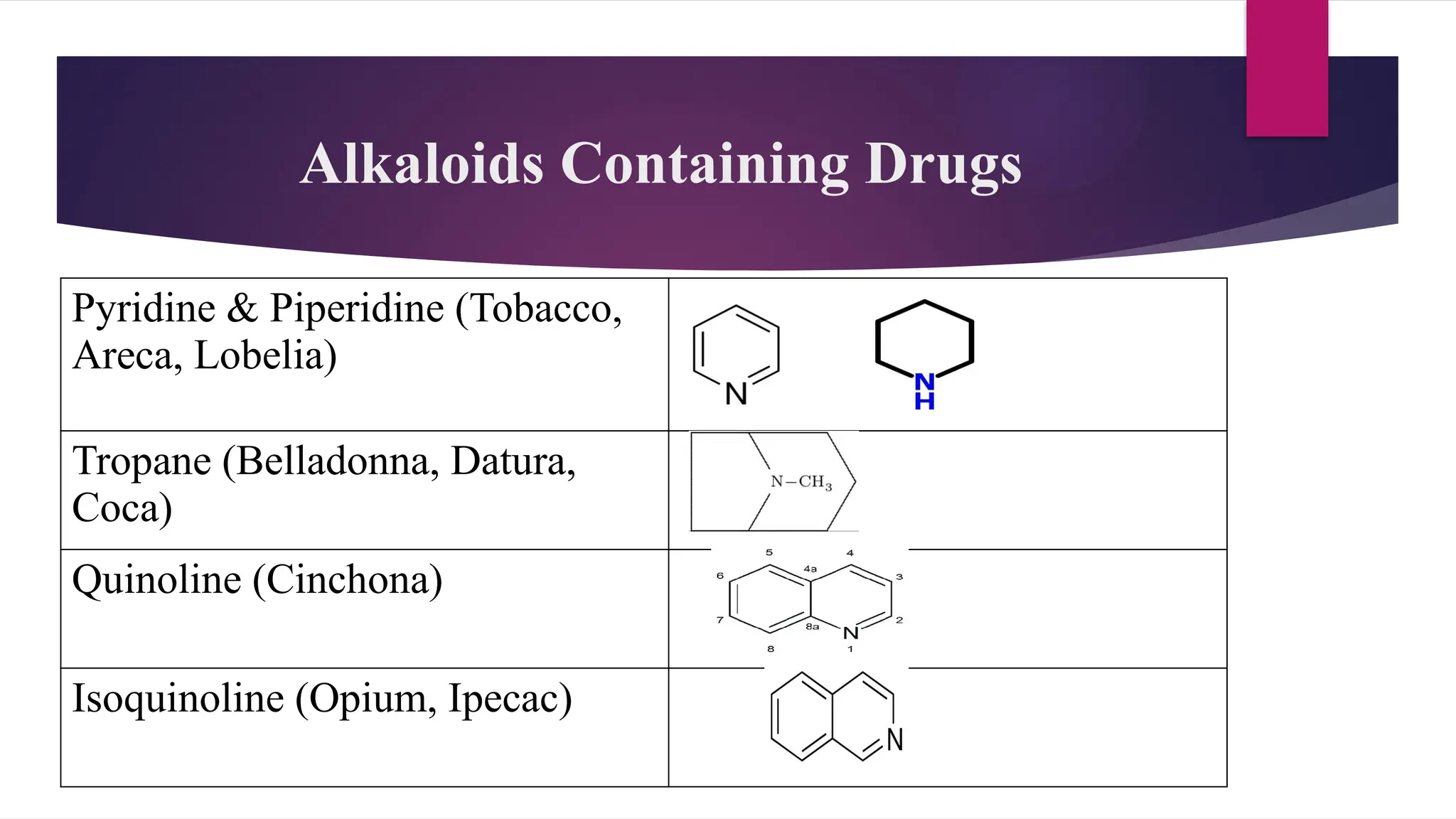
Alkaloids Containing Drugs
Pyridine & Piperidine (Tobacco,
Areca, Lobelia)
Tropane (Belladonna, Datura,
Coca)
Quinoline (Cinchona)
Isoquinoline (Opium, Ipecac)
Indole (Rauwolfia, Vinca)
Imidazole (Pilocarpus)
Steroidal
Refferences
 Pharmacognosy and phytochemistry nirali prakashan,
gokhale, purohit, kokate.
 A science of natural products ebook , book saga
publication, Patil, Pandya.
ALKALOID general introduction pharmacognosy

ALKALOID general introduction pharmacognosy

  • 1.
    ALKALOID MR. RAJ D.THORAT M.PHARM ASSISTANT PROFESSOR RAJARSHI SHAHU COLLEGE OF PHARMACY, MARKHEL.
  • 3.
    Contents  Introduction  History Alkaloids Are Found In  Properties  Classification Of Alkaloids  Chemical Tests For Alkaloids  Alkaloids containing drugs  References
  • 4.
    Introduction  Alkaloids area group of naturally occurring chemical compounds, that contain mostly basic nitrogen atoms.  Alkaloids are basic nitrogen – containing compounds obtained from plants, animals, bacteria & fungi.  Alkaloids are the natural products are also called secondary metabolites products.  Alkaloids are the role of secondary metabolites in plant defense system.  The term alkaloids was coined by Meissner in 1819.  The term alkaloids derived from Alkali like generally nitrogen is in heterocyclic rings ( Primary, secondary, tertiary or quaternary amines).
  • 5.
    History Isolation Of AlkaloidsYears Opium & Narcotine 1803 Emetine & Strychnine 1817 Caffeine & Colchicine 1819 Quinine 1820 Papaverine 1821 Thebaine 1835
  • 6.
    Alkaloids Are FoundIn Plant Parts Plants Leaves Coca, Dhatura, Belladona Unripe capsule Opium Seeds Colchicum, Nuxvomica Stem bark Cinchona, Kurchi Flowering buds Hyoscyamus Rhizome & roots Rauwolfia, Ipecac Whole aerial part Ephedra, Lobelia 🌳 🌿 🌹
  • 7.
    Properties 1) Condition Most alkaloidsare crystalline solids. Few alkaloids are amorphous solids ex. Emetine. Some are liquids that are either; Volatile ex. Nicotine & coniine. Non-volatile ex. Hyoscine & pilocarpine. 2) Color The majority of alkaloids are colorless but some are colored ex. Colchicine. Barberine are yellow. 3) Solubility Both alkaloidal bases and their salts are soluble in alcohol. Exceptions bases soluble in water: caffeine, ephedrine, codeine, colchicine.
  • 8.
    Classification Of Alkaloids Sr.noTypes Examples 1. True alkaloids N- In heterocyclic ring & originate from amino acid. Ex. Morphine, Atropine. 2. Proto alkaloids Contains nitrogen but not in ring. Ex. Mascaline, Colchicine. 3. Pseudo alkaloids Do not originate from amino acid. Ex. Terpenes & Steroidal alkaloids. 4. Peptide and cyclopeptide Ex. Sativanine-N, Sativanine-O.
  • 9.
    Chemical Tests ForAlkaloids Reagents Observation Hagers R. (Picric acid)) Yellow precipitate Mayer’s R. (Pot. Mercuric Iodide Solution) Creamy precipitate Wagner’s R. (Pot. Triiodide solution) Reddish brown precipitate Dragendroff’s R. (Pot.bismuth iodide solution) Reddish brown precipitate
  • 10.
    Alkaloids Containing Drugs Pyridine& Piperidine (Tobacco, Areca, Lobelia) Tropane (Belladonna, Datura, Coca) Quinoline (Cinchona) Isoquinoline (Opium, Ipecac)
  • 11.
  • 12.
    Refferences  Pharmacognosy andphytochemistry nirali prakashan, gokhale, purohit, kokate.  A science of natural products ebook , book saga publication, Patil, Pandya.