The Challenges of the
   Emerging Regulatory
      Environment
                  Alison Johns
Head of Leadership, Governance and Management
               13 November 2012
Policy Drivers 1
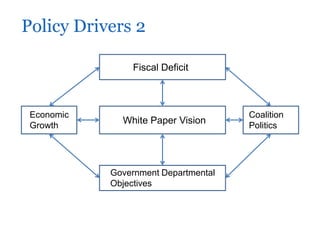
Policy Drivers 2

                Fiscal Deficit


 Economic                             Coalition
 Growth
              White Paper Vision      Politics


            Government Departmental
            Objectives
HE policy context (1)

• Parliament approves £9K fee limit (December 2010)
• HE White Paper (June 2011)
• BIS Technical Consultation (August 2011)
• Innovation & Research Strategy (December 2011)
• BIS response to consultations (June 2012)
• Joint HEFCE/OFFA letter (May 2012)
• Joint HEFCE/SLC letter (June 2012)
Students at the heart of the system
GOVERNMENT’S AIMS
•   Create an open, dynamic and affordable HE system with
    more competition and innovation, and a level playing
    field for new providers
•   Maintain the highest quality of HE, safeguarding the
    strong international reputation of English universities
•   Reduce the regulatory and administrative burden,
    adopting a risk-based approach while improving
    accountability to students
•   Regulatory framework should protect interests of
    students and public investment
……uncertainty

• Student number controls
• Future regulatory environment
• Government investment
• Student behaviour
• Institutional responses
• Unintended consequences
Students at the Heart of the System
    and BIS Technical Consultation
• “to deliver a better student experience; to
  promote social mobility and widen participation;
  to create a more responsive HE sector in which
  funding follows the decisions of learners and
  where successful institutions are freed to thrive”

• An operating framework which ensures
  accountability for public funding, protects the
  collective student interest and gives priority to
  quality improvement
the FM and how it might
        change
HEFCE’s Financial Memorandum
PRINCIPLES UNDERPINNING THE RELATIONSHIP


• Institutional autonomy
• Low risk sector
• Regulation proportionate to risk
• Support and engagement strategy
• Openness - Risk letter
HEFCE’s Financial Memorandum
     FORMAL REQUIREMENTS: REFRESHING YOUR MEMORY

Part 1 sets out:
– Our responsibilities to institutions
– Institutions’ responsibilities to HEFCE
– Financial management and
  sustainability
– Other requirements on institutions
– Accountability and risk assessment
– supporting annexes give details of the mandatory
  requirements of the financial memorandum; the
  Audit Code of Practice; institutional support
  strategy; and consent for financial commitments
HEFCE’s Financial Memorandum
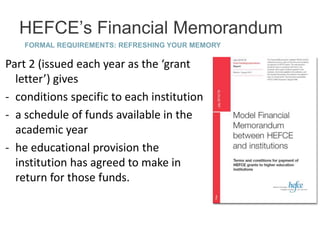
   FORMAL REQUIREMENTS: REFRESHING YOUR MEMORY

Part 2 (issued each year as the ‘grant
  letter’) gives
- conditions specific to each institution
- a schedule of funds available in the
  academic year
- he educational provision the
  institution has agreed to make in
  return for those funds.
Financial Memorandum-Formal
        Requirements
 • Risk management, internal control, corporate governance
 • Monitor performance
 • Sustainability and financial viability
 • Inform HEFCE of adverse changes
 • Regularity
 • Value for money
 • Audit processes
Technical Consultation Proposals
•   The introduction of an independent lead
    regulator
•   A single regulatory framework for
    provider designation for student support
    and HEFCE teaching grant
•   The adoption of a single gateway for
    entry to the higher education sector
•   Reforms to Degree Awarding Powers
    (DAPs) and University Title (UT) criteria
•   Simplifying the process for changing
    corporate status
Government’s response to
consultation
13 June 2011 ministerial letter to HEFCE and SLC

•   expresses its intention to move its reform agenda
    forward primarily through administrative, rather
    than legislative means.
•   sets out the next steps for HEFCE and the SLC,
    working with the other national agencies through
    the Regulatory Partnership Group (RPG) in taking
    forward the vision in the White Paper.
New regulatory framework for HE


                             Funding and legislation     Funding and regulation
        Student loans


                                 Universities
                                 and colleges             Standards and quality
HE statistics


            Student complaints                         Fair access
Regulatory Partnership Group

•   Operating framework
•   Data Governance
•   Corporate forms
•   New Financial Memorandum
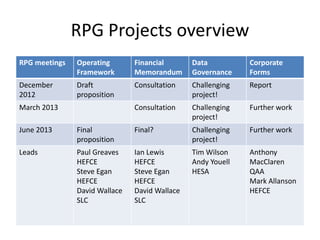
RPG Projects overview
RPG meetings   Operating       Financial       Data          Corporate
               Framework       Memorandum      Governance    Forms
December       Draft           Consultation    Challenging   Report
2012           proposition                     project!
March 2013                     Consultation    Challenging   Further work
                                               project!
June 2013      Final           Final?          Challenging   Further work
               proposition                     project!
Leads          Paul Greaves    Ian Lewis       Tim Wilson    Anthony
               HEFCE           HEFCE           Andy Youell   MacClaren
               Steve Egan      Steve Egan      HESA          QAA
               HEFCE           HEFCE                         Mark Allanson
               David Wallace   David Wallace                 HEFCE
               SLC             SLC
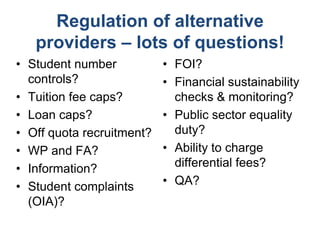
Regulation of alternative
   providers – lots of questions!
• Student number           • FOI?
  controls?                • Financial sustainability
• Tuition fee caps?          checks & monitoring?
• Loan caps?               • Public sector equality
• Off quota recruitment?     duty?
• WP and FA?               • Ability to charge
• Information?               differential fees?
• Student complaints       • QA?
  (OIA)?
Response the HE White Paper
             11 June 2012
• Review the existing student support course designation
  system for alternative providers to include SNCs and more
  robust and transparent requirements on:
   – QA
   – financial sustainability
   – management and governance

• Consult later this year on the process of applying SNCs to
  alternative providers who have courses designated for
  student support purposes
Regulatory Partnership Group
PROGRAMME OF WORK

•   Developing an operating framework – description of the
    funding and regulatory arrangements for English HE and the
    contracts/memoranda of understanding that facilitate it
•   Designing a successor to HEFCE’s financial memorandum – a
    document to set out the expectations of those in receipt of
    public investment, whether through HEFCE grant or SLC-
    arranged loan
•   Redesigning the data and information landscape – taking the
    opportunity to look at data collection and streamlining its
    collection in the interests of efficiency and reducing burden
•   Investigating constitutions and corporate forms adopted by
    organisations that provide HE in England.
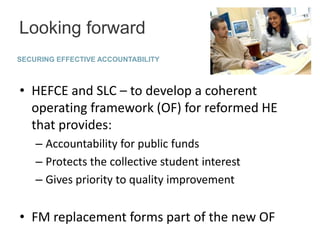
Looking forward
SECURING EFFECTIVE ACCOUNTABILITY


• HEFCE and SLC – to develop a coherent
  operating framework (OF) for reformed HE
  that provides:
    – Accountability for public funds
    – Protects the collective student interest
    – Gives priority to quality improvement


• FM replacement forms part of the new OF
Looking forward
SECURING EFFECTIVE ACCOUNTABILITY


• A two stage process
    – Consult on principles – early 2013
    – Consult on detail – around May 2013
    – Operationalise from autumn 2013
• Key issues
    – What are public funds?
    – Putting self in position of students
    – Where do they get assurance from
        • Quality?
        • Complaints procedures?
        • Financial sustainability?
Looking forward
SECURING EFFECTIVE ACCOUNTABILITY: POTENTIAL WAYS FORWARD


 • Legislation

 • Co-regulation/self-regulation
    – “….we comply with the requirements of the
    new FM and you can take comfort…..”

 Aim: Be clear for students what they can take
 comfort from and what they cannot – influence
 where they go
A new financial memorandum
                     Some key questions:

• What are public funds? What can be included?
• Who and what organisations are included?
   – The replacement FM needs to cover the public and
     collective student interests; and to be able to apply to all
     providers?
• How will it be described?
   – “Providers of HE: statement of accountability
     requirements”?
   – “Accountability of providers of HE to students and the
     public”?
• What sanctions are available for non-compliance?
   – Removal of designation?
   – Others?
What does it all mean for you?
REGULATION AND THE HE COMMUNITY

•   Consultation on SNCs for alternative providers with
    designated courses (November 2012)
•   Consultation on the new operating framework
    (Spring 2013)
•   Admission of the second cohort of students paying
    fees of £6,000 - £9,000 (September/October 2013)
•   Introduction of a successor to HEFCE’s financial
    memorandum, covering all public investment from
    whatever source (Autumn 2013)
Discussion
Thank you
a.johns@hefce.ac.uk

“HEFCE as the Regulator – when money isn’t the controlling factor” - Alison Johns, Head of Leadership, Governance & Management, HECFE

  • 1.
    The Challenges ofthe Emerging Regulatory Environment Alison Johns Head of Leadership, Governance and Management 13 November 2012
  • 2.
  • 3.
    Policy Drivers 2 Fiscal Deficit Economic Coalition Growth White Paper Vision Politics Government Departmental Objectives
  • 4.
    HE policy context(1) • Parliament approves £9K fee limit (December 2010) • HE White Paper (June 2011) • BIS Technical Consultation (August 2011) • Innovation & Research Strategy (December 2011) • BIS response to consultations (June 2012) • Joint HEFCE/OFFA letter (May 2012) • Joint HEFCE/SLC letter (June 2012)
  • 5.
    Students at theheart of the system
  • 6.
    GOVERNMENT’S AIMS • Create an open, dynamic and affordable HE system with more competition and innovation, and a level playing field for new providers • Maintain the highest quality of HE, safeguarding the strong international reputation of English universities • Reduce the regulatory and administrative burden, adopting a risk-based approach while improving accountability to students • Regulatory framework should protect interests of students and public investment
  • 7.
    ……uncertainty • Student numbercontrols • Future regulatory environment • Government investment • Student behaviour • Institutional responses • Unintended consequences
  • 8.
    Students at theHeart of the System and BIS Technical Consultation • “to deliver a better student experience; to promote social mobility and widen participation; to create a more responsive HE sector in which funding follows the decisions of learners and where successful institutions are freed to thrive” • An operating framework which ensures accountability for public funding, protects the collective student interest and gives priority to quality improvement
  • 9.
    the FM andhow it might change
  • 10.
    HEFCE’s Financial Memorandum PRINCIPLESUNDERPINNING THE RELATIONSHIP • Institutional autonomy • Low risk sector • Regulation proportionate to risk • Support and engagement strategy • Openness - Risk letter
  • 11.
    HEFCE’s Financial Memorandum FORMAL REQUIREMENTS: REFRESHING YOUR MEMORY Part 1 sets out: – Our responsibilities to institutions – Institutions’ responsibilities to HEFCE – Financial management and sustainability – Other requirements on institutions – Accountability and risk assessment – supporting annexes give details of the mandatory requirements of the financial memorandum; the Audit Code of Practice; institutional support strategy; and consent for financial commitments
  • 12.
    HEFCE’s Financial Memorandum FORMAL REQUIREMENTS: REFRESHING YOUR MEMORY Part 2 (issued each year as the ‘grant letter’) gives - conditions specific to each institution - a schedule of funds available in the academic year - he educational provision the institution has agreed to make in return for those funds.
  • 13.
    Financial Memorandum-Formal Requirements • Risk management, internal control, corporate governance • Monitor performance • Sustainability and financial viability • Inform HEFCE of adverse changes • Regularity • Value for money • Audit processes
  • 14.
    Technical Consultation Proposals • The introduction of an independent lead regulator • A single regulatory framework for provider designation for student support and HEFCE teaching grant • The adoption of a single gateway for entry to the higher education sector • Reforms to Degree Awarding Powers (DAPs) and University Title (UT) criteria • Simplifying the process for changing corporate status
  • 15.
    Government’s response to consultation 13June 2011 ministerial letter to HEFCE and SLC • expresses its intention to move its reform agenda forward primarily through administrative, rather than legislative means. • sets out the next steps for HEFCE and the SLC, working with the other national agencies through the Regulatory Partnership Group (RPG) in taking forward the vision in the White Paper.
  • 16.
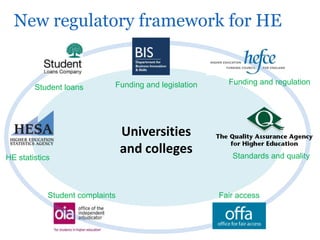
    New regulatory frameworkfor HE Funding and legislation Funding and regulation Student loans Universities and colleges Standards and quality HE statistics Student complaints Fair access
  • 17.
    Regulatory Partnership Group • Operating framework • Data Governance • Corporate forms • New Financial Memorandum
  • 18.
    RPG Projects overview RPGmeetings Operating Financial Data Corporate Framework Memorandum Governance Forms December Draft Consultation Challenging Report 2012 proposition project! March 2013 Consultation Challenging Further work project! June 2013 Final Final? Challenging Further work proposition project! Leads Paul Greaves Ian Lewis Tim Wilson Anthony HEFCE HEFCE Andy Youell MacClaren Steve Egan Steve Egan HESA QAA HEFCE HEFCE Mark Allanson David Wallace David Wallace HEFCE SLC SLC
  • 19.
    Regulation of alternative providers – lots of questions! • Student number • FOI? controls? • Financial sustainability • Tuition fee caps? checks & monitoring? • Loan caps? • Public sector equality • Off quota recruitment? duty? • WP and FA? • Ability to charge • Information? differential fees? • Student complaints • QA? (OIA)?
  • 20.
    Response the HEWhite Paper 11 June 2012 • Review the existing student support course designation system for alternative providers to include SNCs and more robust and transparent requirements on: – QA – financial sustainability – management and governance • Consult later this year on the process of applying SNCs to alternative providers who have courses designated for student support purposes
  • 21.
    Regulatory Partnership Group PROGRAMMEOF WORK • Developing an operating framework – description of the funding and regulatory arrangements for English HE and the contracts/memoranda of understanding that facilitate it • Designing a successor to HEFCE’s financial memorandum – a document to set out the expectations of those in receipt of public investment, whether through HEFCE grant or SLC- arranged loan • Redesigning the data and information landscape – taking the opportunity to look at data collection and streamlining its collection in the interests of efficiency and reducing burden • Investigating constitutions and corporate forms adopted by organisations that provide HE in England.
  • 22.
    Looking forward SECURING EFFECTIVEACCOUNTABILITY • HEFCE and SLC – to develop a coherent operating framework (OF) for reformed HE that provides: – Accountability for public funds – Protects the collective student interest – Gives priority to quality improvement • FM replacement forms part of the new OF
  • 23.
    Looking forward SECURING EFFECTIVEACCOUNTABILITY • A two stage process – Consult on principles – early 2013 – Consult on detail – around May 2013 – Operationalise from autumn 2013 • Key issues – What are public funds? – Putting self in position of students – Where do they get assurance from • Quality? • Complaints procedures? • Financial sustainability?
  • 24.
    Looking forward SECURING EFFECTIVEACCOUNTABILITY: POTENTIAL WAYS FORWARD • Legislation • Co-regulation/self-regulation – “….we comply with the requirements of the new FM and you can take comfort…..” Aim: Be clear for students what they can take comfort from and what they cannot – influence where they go
  • 25.
    A new financialmemorandum Some key questions: • What are public funds? What can be included? • Who and what organisations are included? – The replacement FM needs to cover the public and collective student interests; and to be able to apply to all providers? • How will it be described? – “Providers of HE: statement of accountability requirements”? – “Accountability of providers of HE to students and the public”? • What sanctions are available for non-compliance? – Removal of designation? – Others?
  • 26.
    What does itall mean for you? REGULATION AND THE HE COMMUNITY • Consultation on SNCs for alternative providers with designated courses (November 2012) • Consultation on the new operating framework (Spring 2013) • Admission of the second cohort of students paying fees of £6,000 - £9,000 (September/October 2013) • Introduction of a successor to HEFCE’s financial memorandum, covering all public investment from whatever source (Autumn 2013)
  • 27.
  • 28.

Editor's Notes

  • #4  These objectives in tensionDecisions take timeMultiple external uncertaintiesApparent inconsistencyLead and lag unpredictable (Access, NSP)320bn quantitative easing ↑pension deficitUKBA immigration policy – verseas YFinancial control vs. student choiceW Participation (Ycost) vs Market disciplineNo legislationImpact of tuition fees on CPI then government finances
  • #11 First principle is institutional autonomy. Introduction to the FM says “Under the Further and Higher Education Act 1992, which established HEFCE, the Secretary of State is not entitled to frame his conditions of grant to us by reference to specific institutions, or to particular courses of study or programmes of research, or to the criteria for the selection and appointment of academic staff or for the admission of students. This is designed to safeguard both institutional and academic autonomy, which are widely regarded as key factors in the success of English higher education. We strongly endorse these principles”However HEFCE has a clear regulatory duty to ensure that universities in receipt of public funds provide value for money and are responsible in their use of these funds. We also ensure that the funding we distribute accurately reflects what is delivered. In addition, we now act as the principal regulator for those universities and colleges that are exempt charities, advising the Charity Commission where appropriate. We aim to reduce the accountability burden on institutions by enabling other public bodies, wherever possible, to rely on our systems of oversight and assurance.HEFCE is also legally responsible for making sure that the quality of learning and teaching is assessed in each university and college across England. We also assess the quality of research, enabling us to fund research selectively by supporting excellence wherever it is found
  • #12 The Model Financial Memorandum sets out the formal relationship between HEFCE and the governing bodies and accountable officers of the higher education institutions (HEIs) it funds. It reflects our responsibility to provide annual assurance to Parliament that: Our funds are being used for the purposes for which they were givenRisk management, control and governance in the sector is effective Value for money is being achieved.
  • #17 .
  • #23 We have been asked to develop the new operating framework and replacement for the financial memorandum within the existing legislative framework, but HEFCE’s powers are limited to attaching conditions to the grants it provides; it is legally prevented from attaching conditions to funding derived from other sourcesHEFCE sanctions will continue to carry weight for the next two years and possibly three years. When funding for old regime students is phased out a large number of HEIs will still continue to receive substantial HEFCE funding either through teaching funding or through research, but 30 of them will receive less than £5 million per year which is less than the maximum penalty HEFCE can impose under existing legislation (all explained in paragraph 23 of Ian’s paper). Since we also have a statutory duty to ensure quality and one of the sanctions is withdrawal of funding, we won’t have that sanction (see paragraph 21).
  • #24 We have been asked to develop the new operating framework and replacement for the financial memorandum within the existing legislative framework, but HEFCE’s powers are limited to attaching conditions to the grants it provides; it is legally prevented from attaching conditions to funding derived from other sourcesHEFCE sanctions will continue to carry weight for the next two years and possibly three years. When funding for old regime students is phased out a large number of HEIs will still continue to receive substantial HEFCE funding either through teaching funding or through research, but 30 of them will receive less than £5 million per year which is less than the maximum penalty HEFCE can impose under existing legislation (all explained in paragraph 23 of Ian’s paper). Since we also have a statutory duty to ensure quality and one of the sanctions is withdrawal of funding, we won’t have that sanction (see paragraph 21).
  • #25 Legislation – whatever you feel able to say about thatVoluntary agreement - This will require all parties to be willing to sign up to and abide by such a voluntary agreement. This would be tested if one or more institutions decided to leave, so casting doubt on whether effective accountability can be achieved through such a voluntary agreement. It may be that such a voluntary agreement could operate for a limited time, but not in the long-term. The threat of legislative action, though, may be sufficient to ensure a voluntary agreement is effective (paragraph 32)