Aligning
Organization
Development
With
Business Goals
July 29, 2015
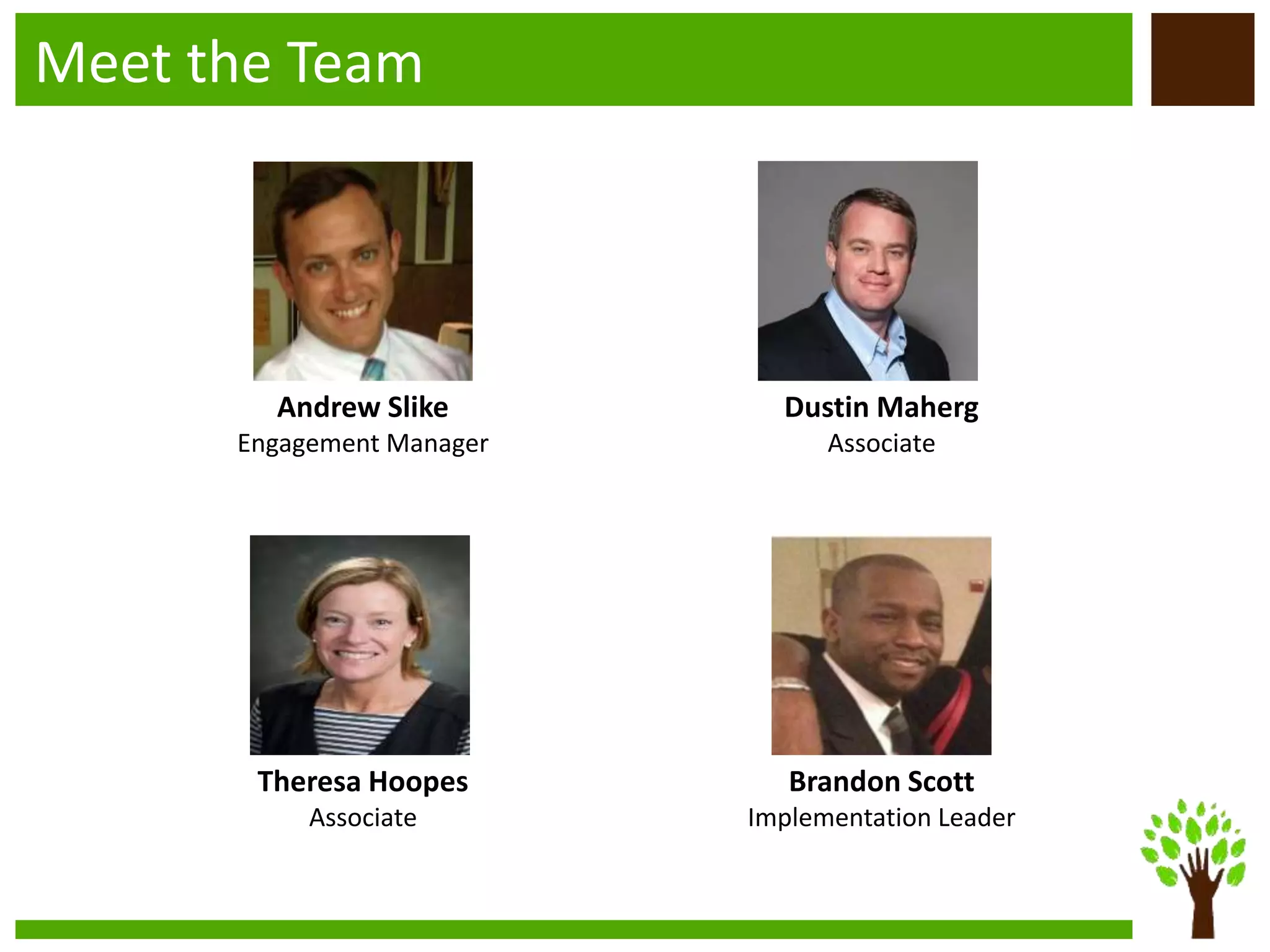
Meet the Team
Andrew Slike
Engagement Manager
Dustin Maherg
Associate
Brandon Scott
Implementation Leader
Theresa Hoopes
Associate
Introduction
Andrew Slike
Engagement Manager
What You can Expect
Summary
Collective Advancement
Communication
Transparency
Definition of Terms
Organizational Development – System-wide application of
behavioral science knowledge to the planned development
and reinforcement of organizational strategies, structures, and
processes for improving an organization’s effectiveness
(Cummings and Worley, 2009).
Alignment – A descriptive term to symbolize a range of
management-driven processes based on planning and
directing training projects toward strategic goals (Anderson,
2009).
Change Management – A set of tools or structures intended
to keep any change efforts under control (Kotter, 2008).
Theory
OD Theory as it Relates to OD Interventions
Theresa Hoopes
Associate
Organization Development Defined
Cummings and Worley (2009) defined organization
development as a “system-wide application of behavioral
science knowledge to the planned development and
reinforcement of organizational strategies, structures, and
processes for improving an organization’s effectiveness” (p. 2).
“Organization development is a planned process of change in
an organization’s culture through the utilization of behavioral
science technology, research, and theory…is the process of
increasing organizational effectiveness and facilitating
personal and organizational change through the use of
interventions driven by social and behavioral science
knowledge.”
Cummings, T G. & Worley, C. G. (1997). Organization Development and Change
Brazzel and Jones (2014) The NTL Handbook of Organizational Development and Change
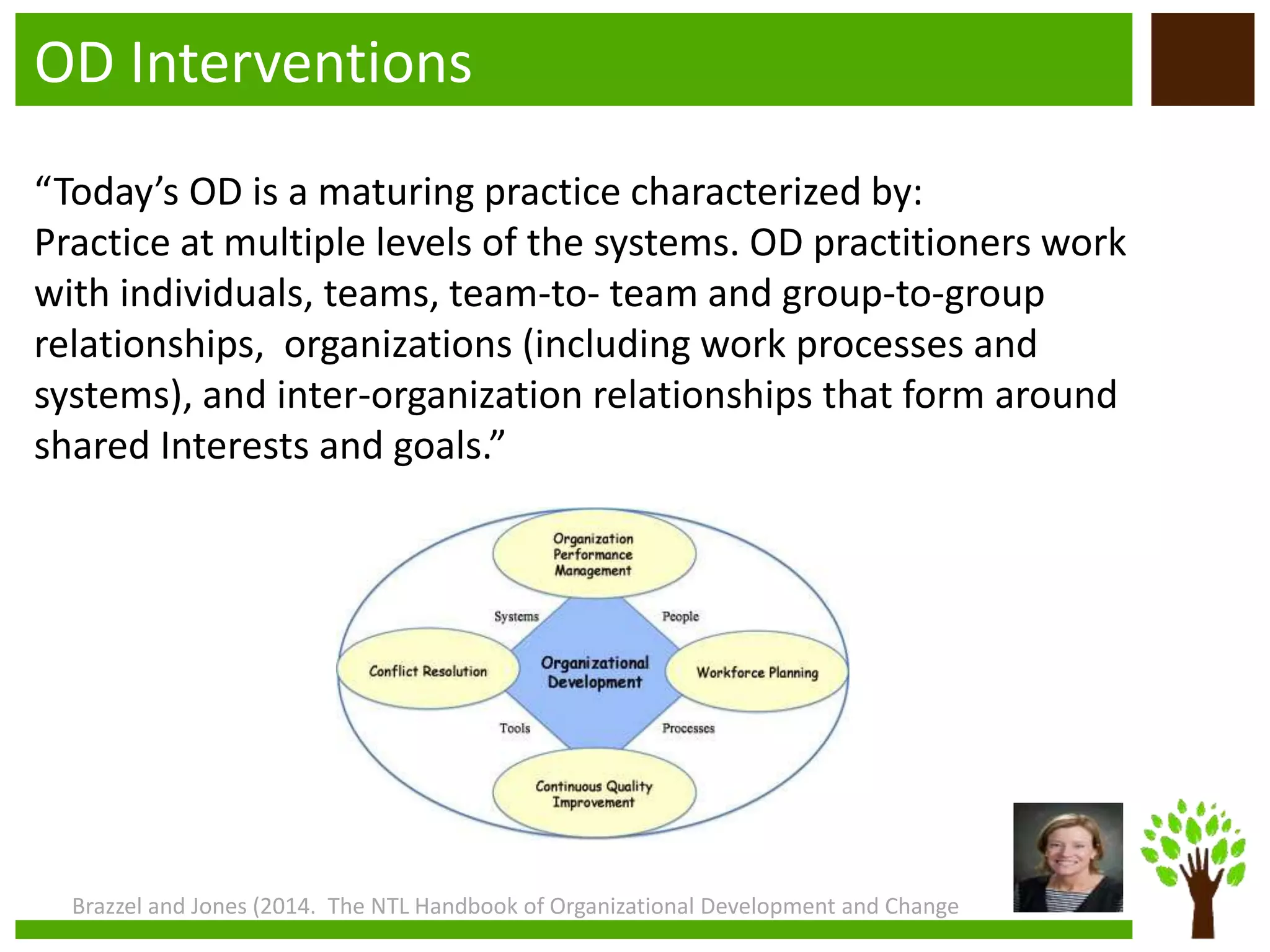
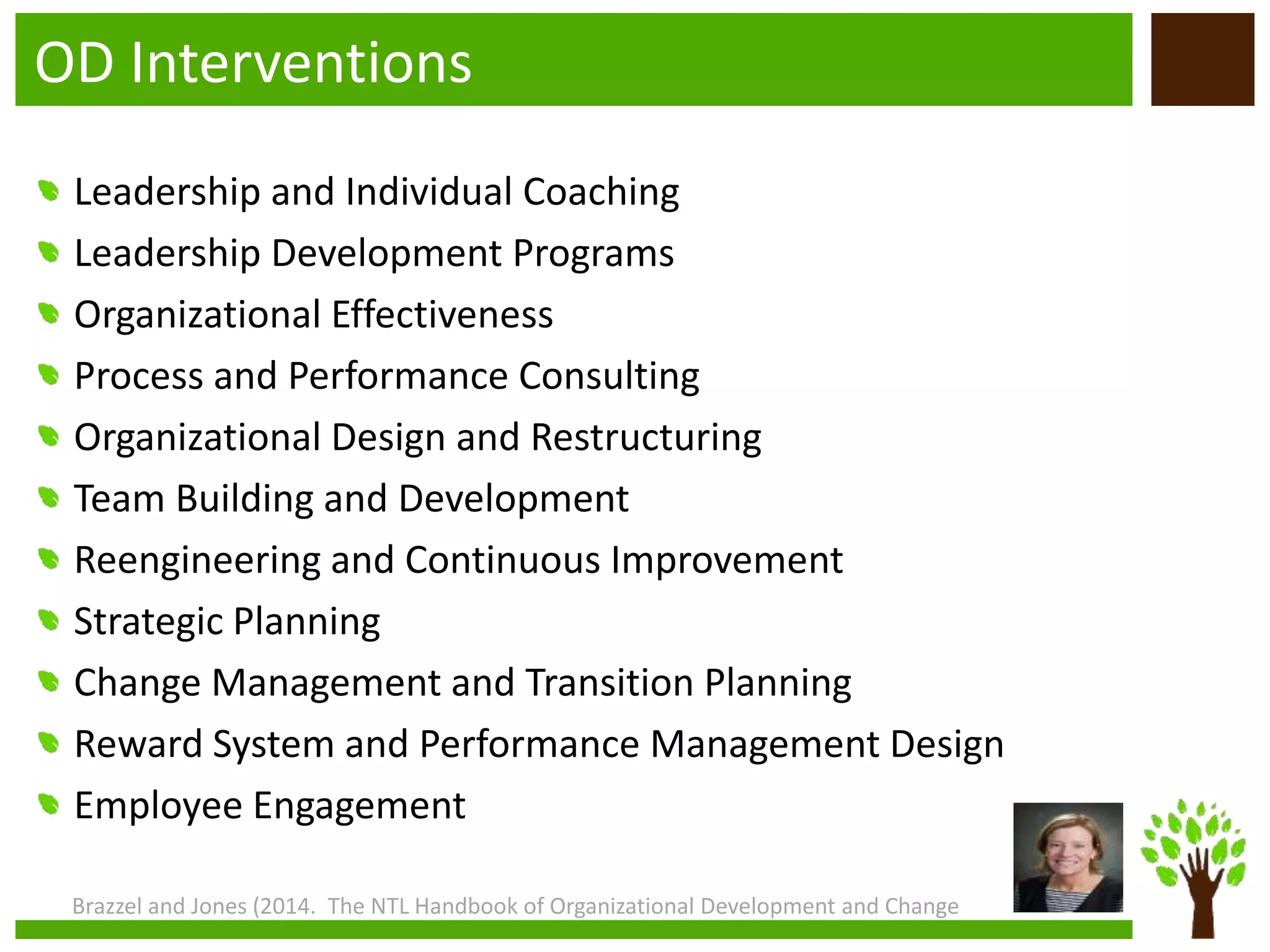
OD Interventions
“Today’s OD is a maturing practice characterized by:
Practice at multiple levels of the systems. OD practitioners work
with individuals, teams, team-to- team and group-to-group
relationships, organizations (including work processes and
systems), and inter-organization relationships that form around
shared Interests and goals.”
Brazzel and Jones (2014. The NTL Handbook of Organizational Development and Change
OD Interventions
Brazzel and Jones (2014. The NTL Handbook of Organizational Development and Change
Leadership and Individual Coaching
Leadership Development Programs
Organizational Effectiveness
Process and Performance Consulting
Organizational Design and Restructuring
Team Building and Development
Reengineering and Continuous Improvement
Strategic Planning
Change Management and Transition Planning
Reward System and Performance Management Design
Employee Engagement
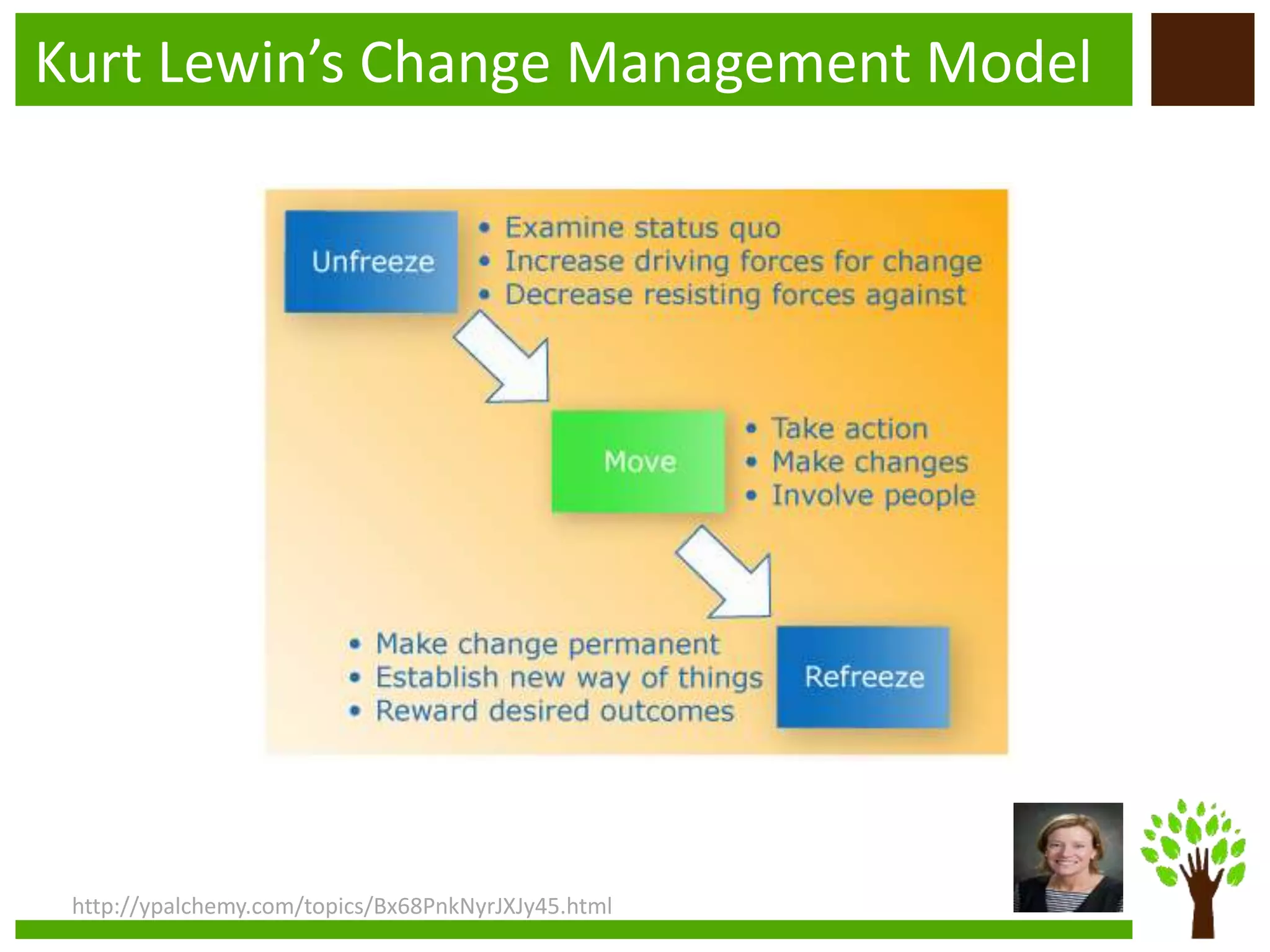
Kurt Lewin’s Change Management Model
http://ypalchemy.com/topics/Bx68PnkNyrJXJy45.html
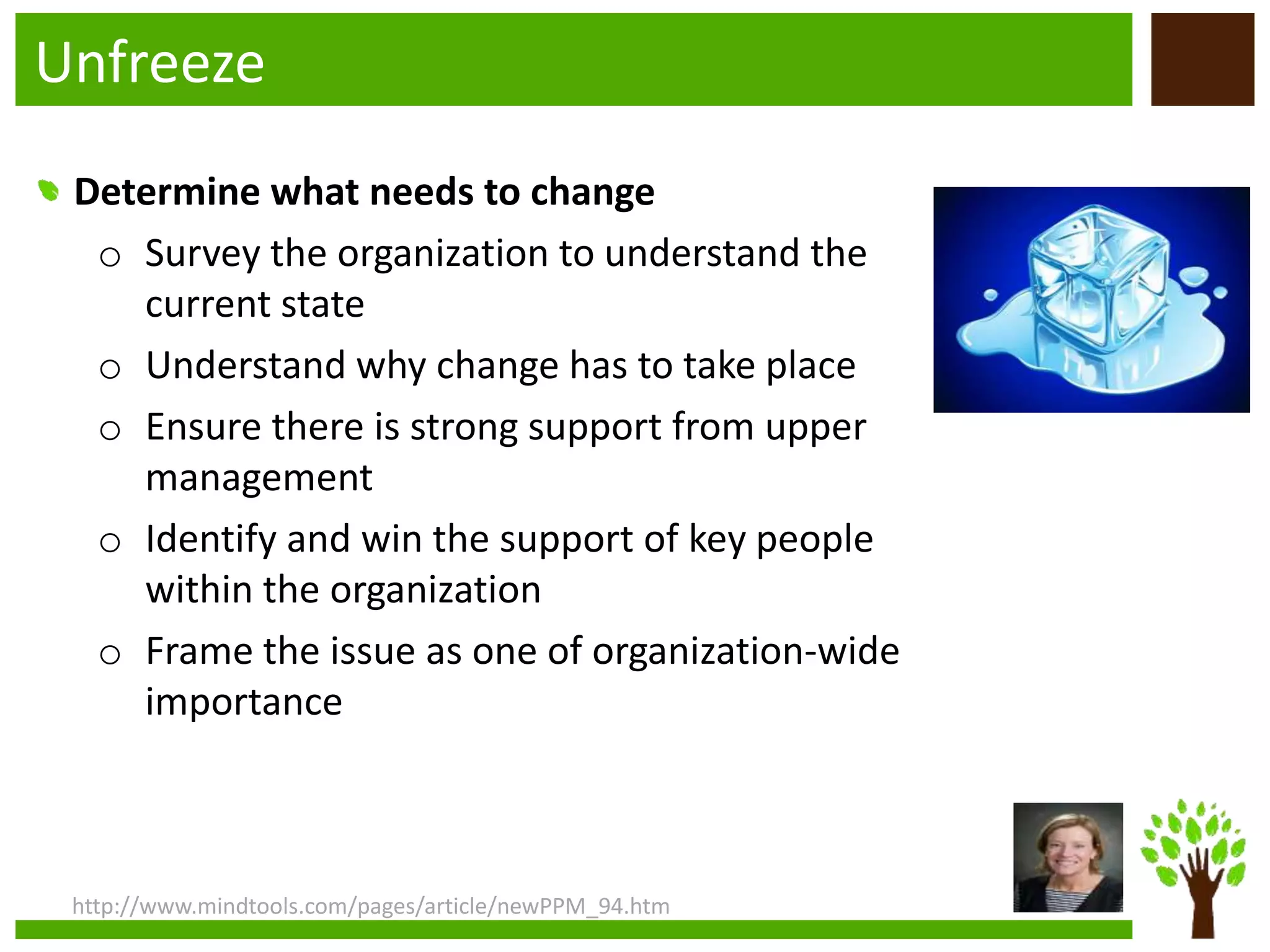
Unfreeze
http://www.mindtools.com/pages/article/newPPM_94.htm
Determine what needs to change
o Survey the organization to understand the
current state
o Understand why change has to take place
o Ensure there is strong support from upper
management
o Identify and win the support of key people
within the organization
o Frame the issue as one of organization-wide
importance
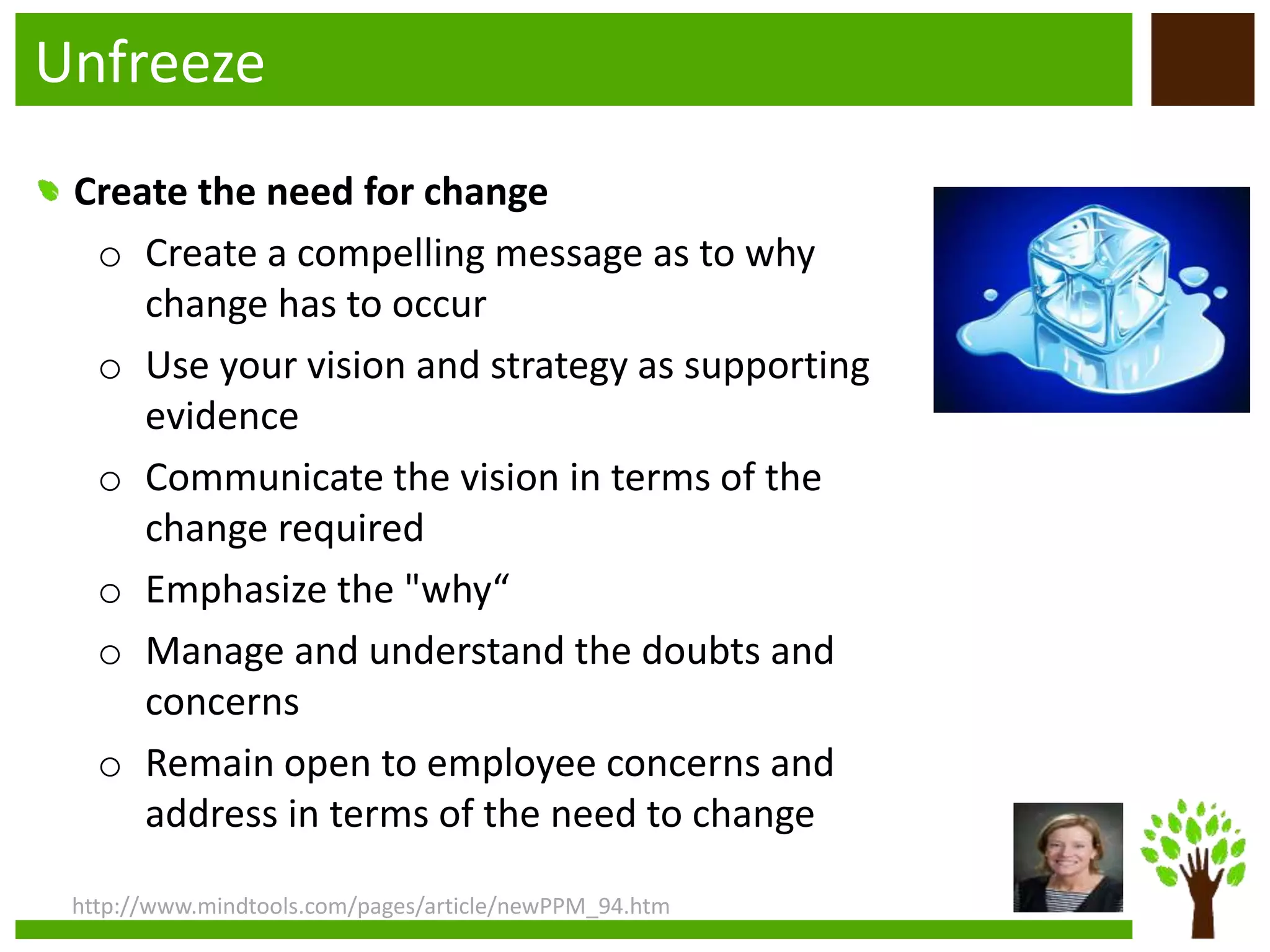
Unfreeze
http://www.mindtools.com/pages/article/newPPM_94.htm
Create the need for change
o Create a compelling message as to why
change has to occur
o Use your vision and strategy as supporting
evidence
o Communicate the vision in terms of the
change required
o Emphasize the "why“
o Manage and understand the doubts and
concerns
o Remain open to employee concerns and
address in terms of the need to change
Change
http://www.mindtools.com/pages/article/newPPM_94.htm
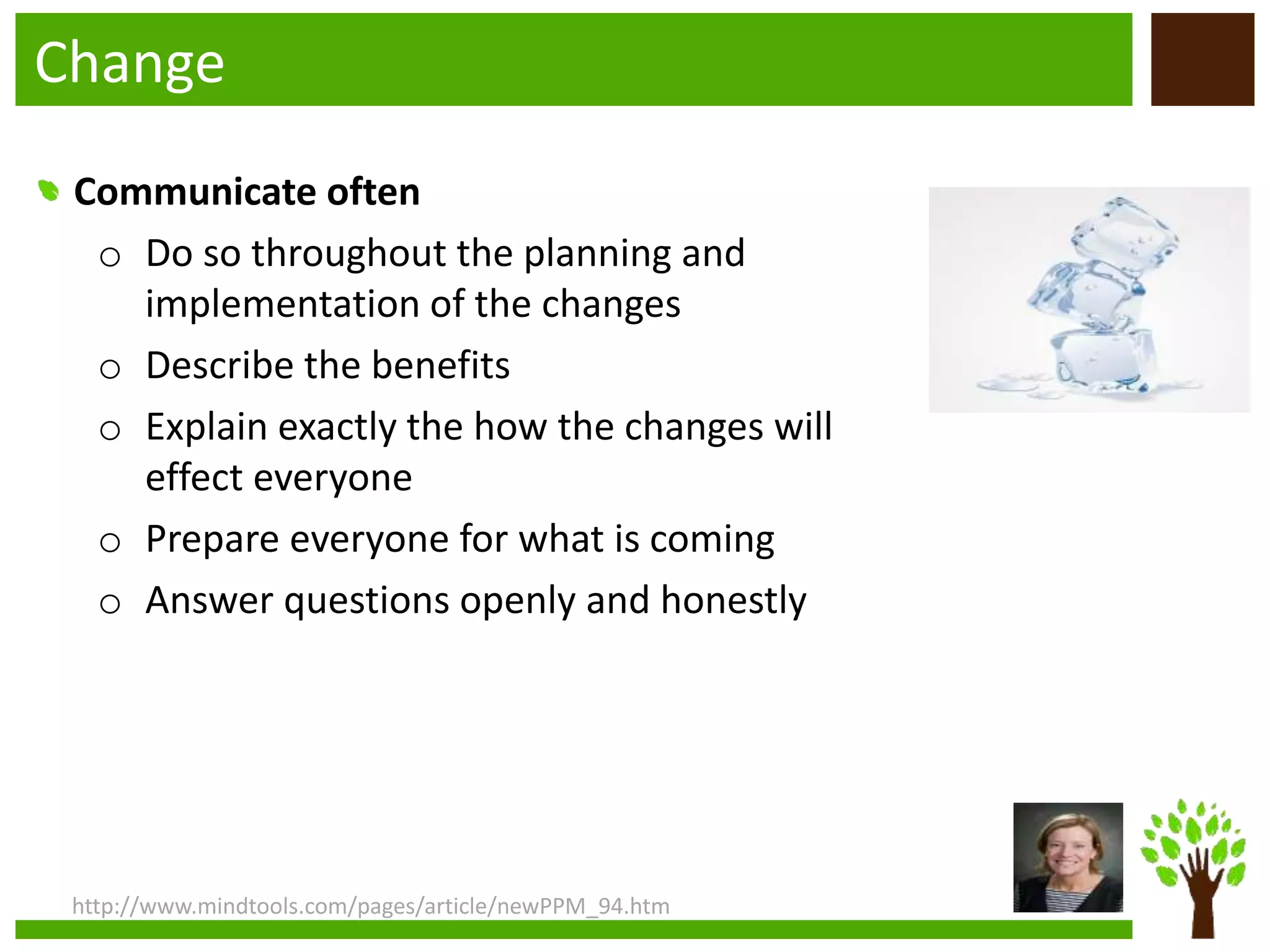
Communicate often
o Do so throughout the planning and
implementation of the changes
o Describe the benefits
o Explain exactly the how the changes will
effect everyone
o Prepare everyone for what is coming
o Answer questions openly and honestly
Unfreeze
http://www.mindtools.com/pages/article/newPPM_94.htm
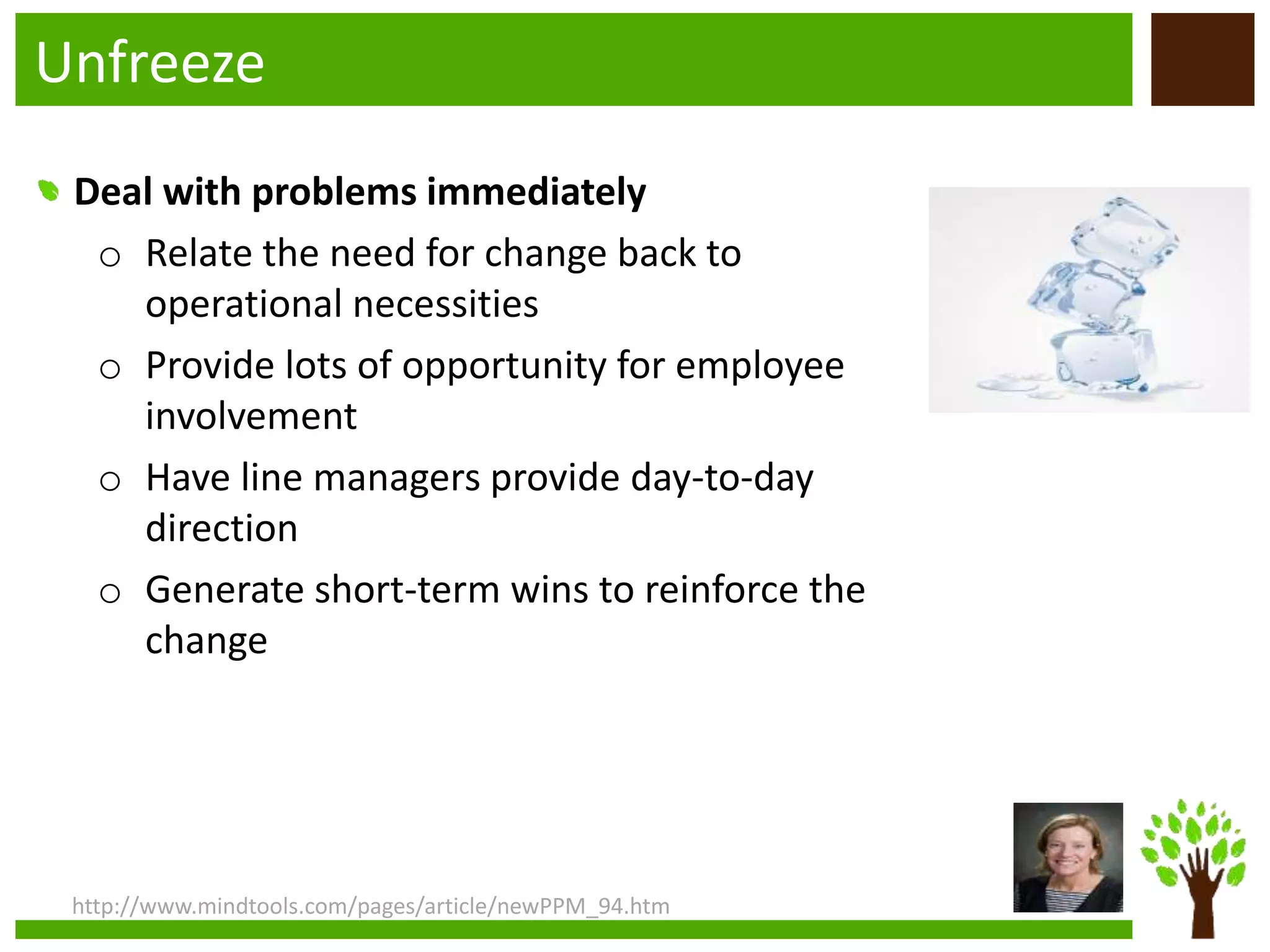
Deal with problems immediately
o Relate the need for change back to
operational necessities
o Provide lots of opportunity for employee
involvement
o Have line managers provide day-to-day
direction
o Generate short-term wins to reinforce the
change
Refreeze
http://www.mindtools.com/pages/article/newPPM_94.htm
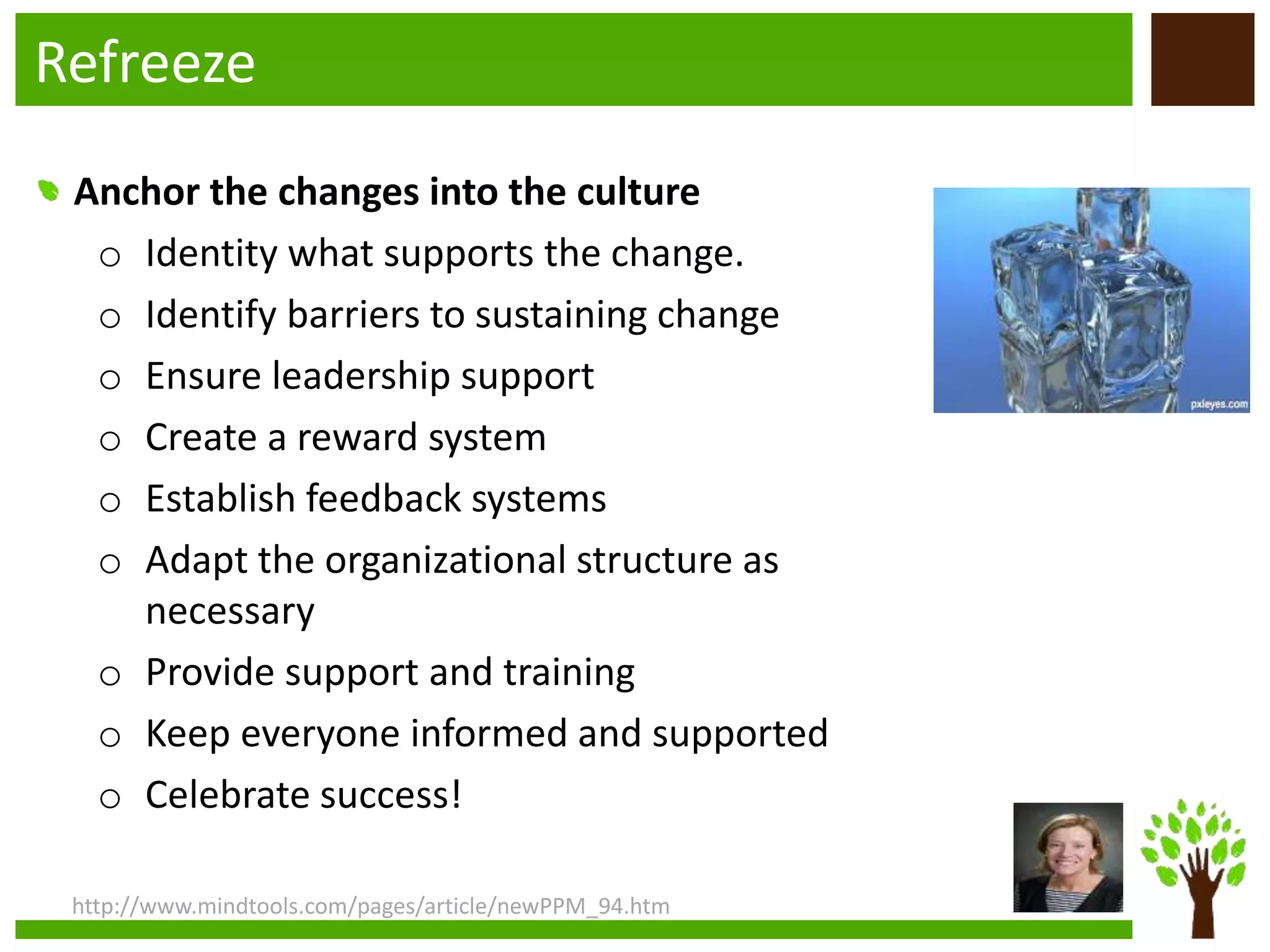
Anchor the changes into the culture
o Identity what supports the change.
o Identify barriers to sustaining change
o Ensure leadership support
o Create a reward system
o Establish feedback systems
o Adapt the organizational structure as
necessary
o Provide support and training
o Keep everyone informed and supported
o Celebrate success!
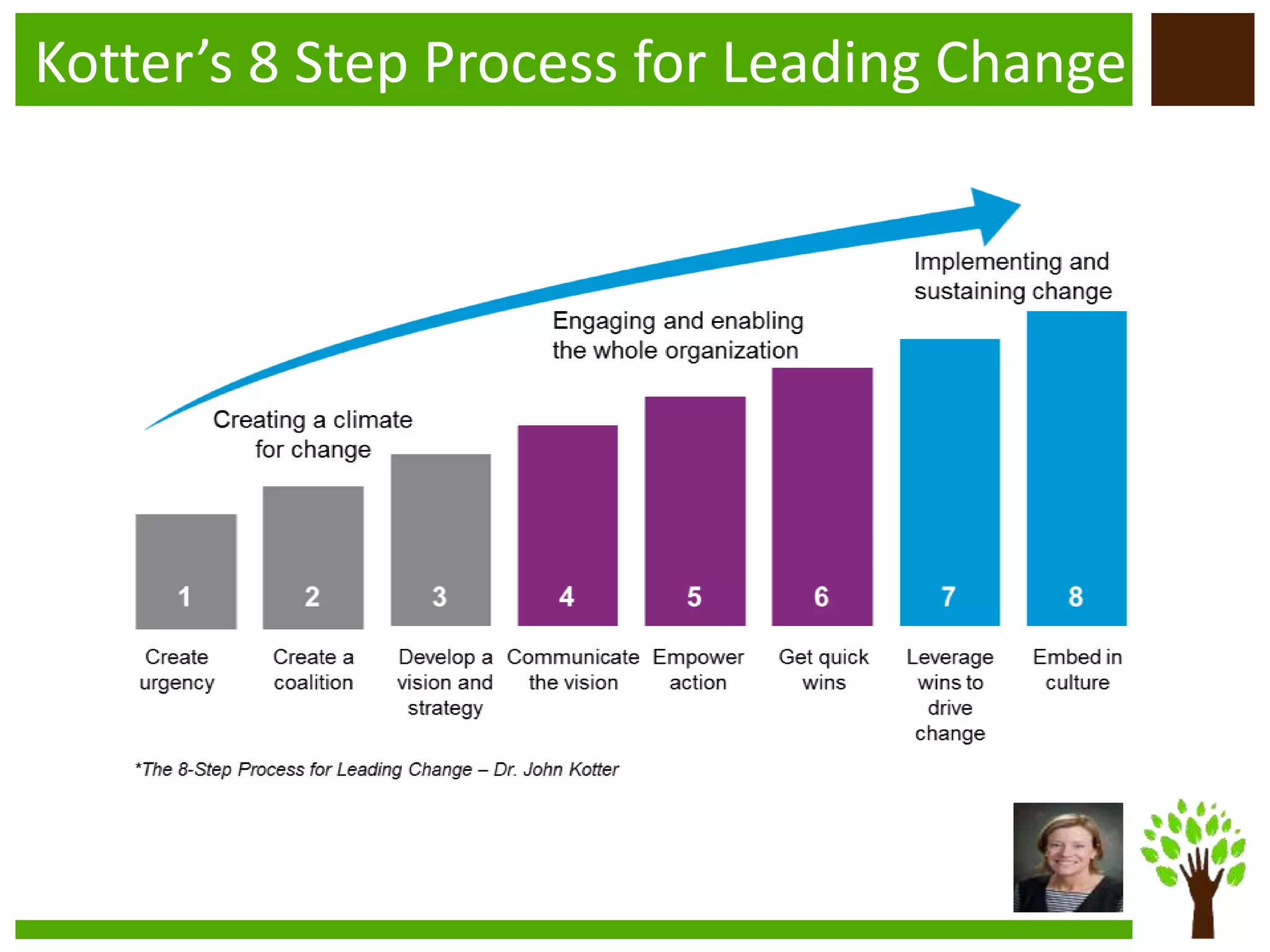
Kotter’s 8 Step Process for Leading Change
Knowledge and Skills
Knowledge and Skills for both
Consulting and Business Leaders
Dustin Maherg
Associate
Knowledge and Skills
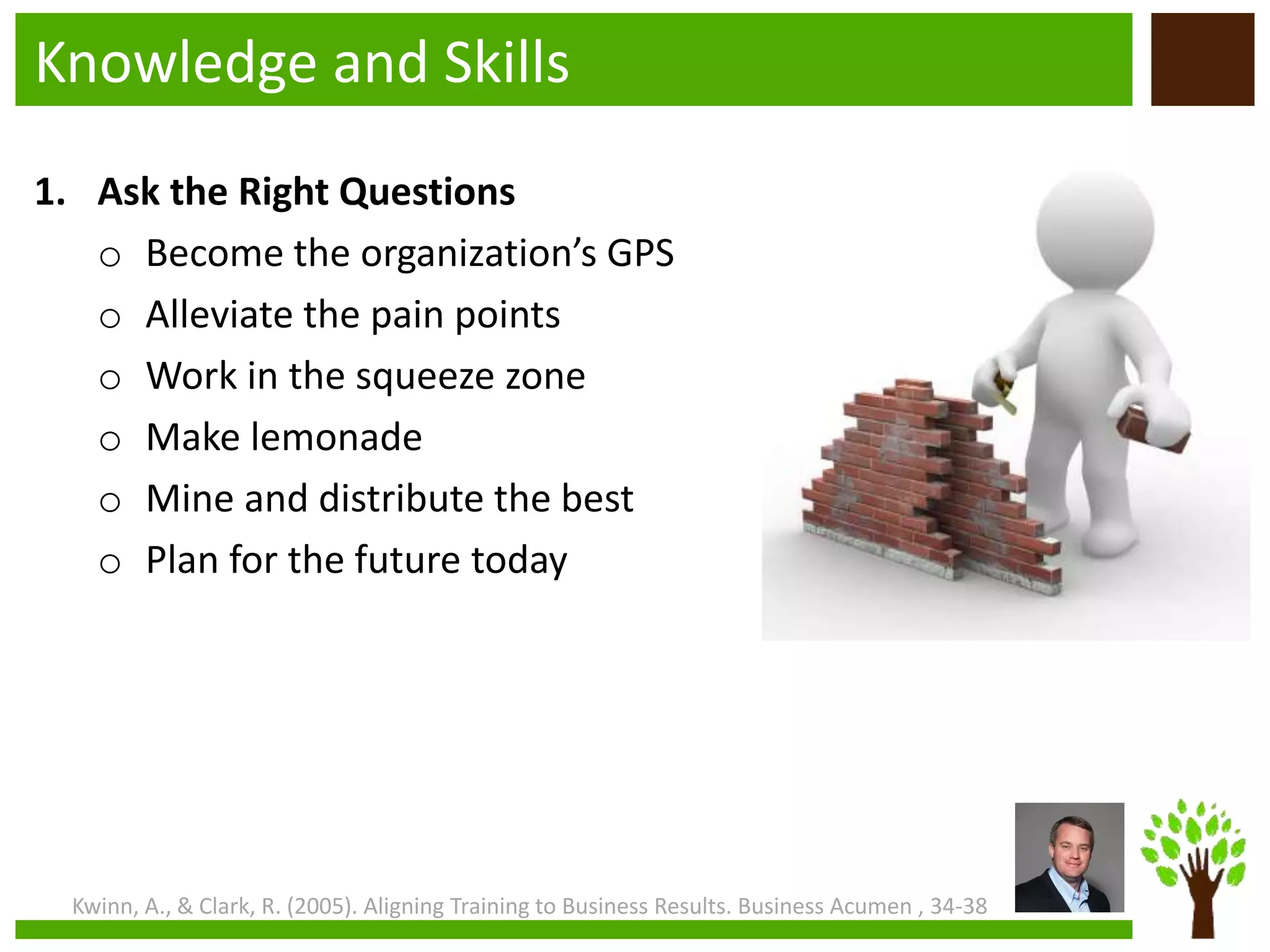
1. Ask the Right Questions
o Become the organization’s GPS
o Alleviate the pain points
o Work in the squeeze zone
o Make lemonade
o Mine and distribute the best
o Plan for the future today
Kwinn, A., & Clark, R. (2005). Aligning Training to Business Results. Business Acumen , 34-38
Knowledge and Skills
2. Monitor organizational policies and procedures
o Schedule periodic reviews
o Consider the following when reviewing:
a. Alignment with organizational strategy
b. Updated employee training to reflect any changes
c. Enhance any opportunities
d. Eliminate process steps that do not add value
e. Identify and document anything not formally
documented
f. Assess implications and make changes as necessary
Ngah, J. (2003). Aligning the Business. Internal Auditor , 61-64
Knowledge and Skills
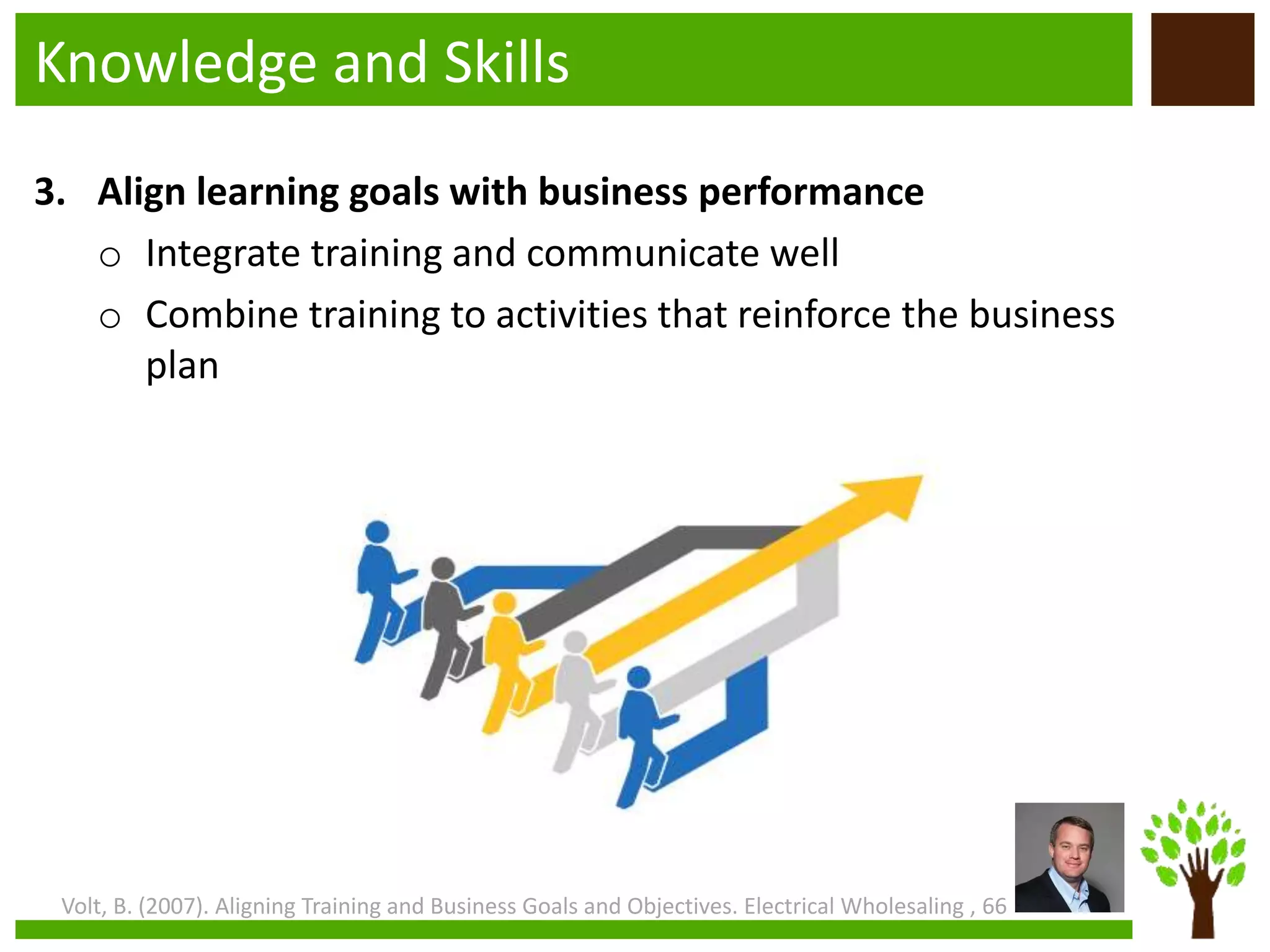
3. Align learning goals with business performance
o Integrate training and communicate well
o Combine training to activities that reinforce the business
plan
Volt, B. (2007). Aligning Training and Business Goals and Objectives. Electrical Wholesaling , 66
Knowledge and Skills
4. Run learning as a business
o Manage cost for greater efficiency
o Focus on the business value and add metrics
o Ensure integration with overall business strategy
Wearing, C. (2003). Aligning Learning to Business Goals. National Underwriter , 21-22
Barriers
Brandon Scott
Implementation Leader
Barriers to Organizational Business Alignment
Barriers
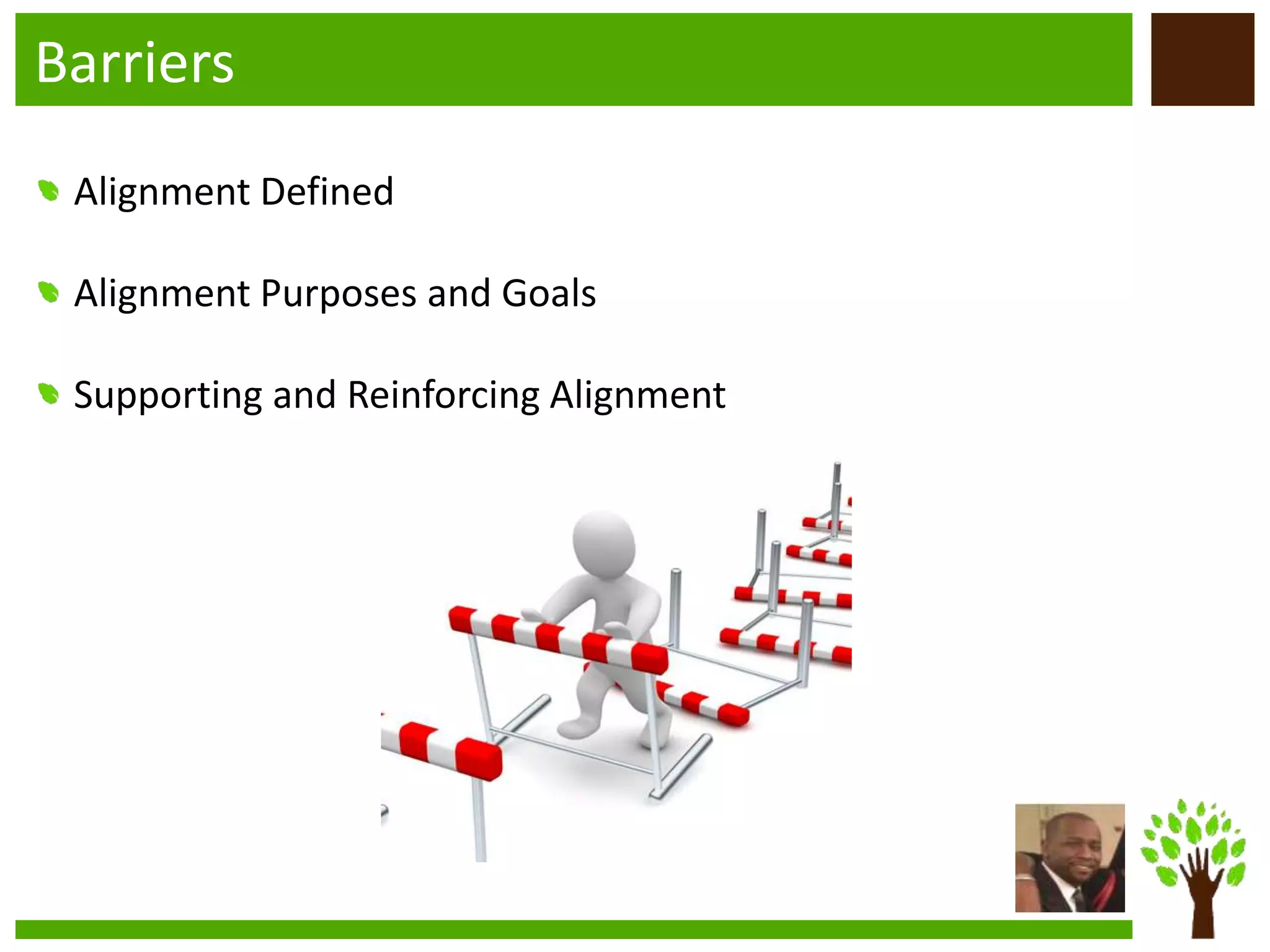
Alignment Defined
Alignment Purposes and Goals
Supporting and Reinforcing Alignment
Potential Barriers
Transparent Communication
Insufficient Modeling (Upper Management)
Support from Middle Management
Disconnect between Internal Systems
Preexisting Organizational Infrastructures
Business Pressure
Potential Barriers
Difficult Employees
Low team member confidence; low morale and support
Cover or Overt Competitiveness
Organizational Culture
Conclusion

Alinging OD with business goals_Team Presentation

  • 1.
  • 2.
    Meet the Team AndrewSlike Engagement Manager Dustin Maherg Associate Brandon Scott Implementation Leader Theresa Hoopes Associate
  • 3.
  • 4.
  • 5.
    Definition of Terms OrganizationalDevelopment – System-wide application of behavioral science knowledge to the planned development and reinforcement of organizational strategies, structures, and processes for improving an organization’s effectiveness (Cummings and Worley, 2009). Alignment – A descriptive term to symbolize a range of management-driven processes based on planning and directing training projects toward strategic goals (Anderson, 2009). Change Management – A set of tools or structures intended to keep any change efforts under control (Kotter, 2008).
  • 6.
    Theory OD Theory asit Relates to OD Interventions Theresa Hoopes Associate
  • 7.
    Organization Development Defined Cummingsand Worley (2009) defined organization development as a “system-wide application of behavioral science knowledge to the planned development and reinforcement of organizational strategies, structures, and processes for improving an organization’s effectiveness” (p. 2). “Organization development is a planned process of change in an organization’s culture through the utilization of behavioral science technology, research, and theory…is the process of increasing organizational effectiveness and facilitating personal and organizational change through the use of interventions driven by social and behavioral science knowledge.” Cummings, T G. & Worley, C. G. (1997). Organization Development and Change Brazzel and Jones (2014) The NTL Handbook of Organizational Development and Change
  • 8.
    OD Interventions “Today’s ODis a maturing practice characterized by: Practice at multiple levels of the systems. OD practitioners work with individuals, teams, team-to- team and group-to-group relationships, organizations (including work processes and systems), and inter-organization relationships that form around shared Interests and goals.” Brazzel and Jones (2014. The NTL Handbook of Organizational Development and Change
  • 9.
    OD Interventions Brazzel andJones (2014. The NTL Handbook of Organizational Development and Change Leadership and Individual Coaching Leadership Development Programs Organizational Effectiveness Process and Performance Consulting Organizational Design and Restructuring Team Building and Development Reengineering and Continuous Improvement Strategic Planning Change Management and Transition Planning Reward System and Performance Management Design Employee Engagement
  • 10.
    Kurt Lewin’s ChangeManagement Model http://ypalchemy.com/topics/Bx68PnkNyrJXJy45.html
  • 11.
    Unfreeze http://www.mindtools.com/pages/article/newPPM_94.htm Determine what needsto change o Survey the organization to understand the current state o Understand why change has to take place o Ensure there is strong support from upper management o Identify and win the support of key people within the organization o Frame the issue as one of organization-wide importance
  • 12.
    Unfreeze http://www.mindtools.com/pages/article/newPPM_94.htm Create the needfor change o Create a compelling message as to why change has to occur o Use your vision and strategy as supporting evidence o Communicate the vision in terms of the change required o Emphasize the "why“ o Manage and understand the doubts and concerns o Remain open to employee concerns and address in terms of the need to change
  • 13.
    Change http://www.mindtools.com/pages/article/newPPM_94.htm Communicate often o Doso throughout the planning and implementation of the changes o Describe the benefits o Explain exactly the how the changes will effect everyone o Prepare everyone for what is coming o Answer questions openly and honestly
  • 14.
    Unfreeze http://www.mindtools.com/pages/article/newPPM_94.htm Deal with problemsimmediately o Relate the need for change back to operational necessities o Provide lots of opportunity for employee involvement o Have line managers provide day-to-day direction o Generate short-term wins to reinforce the change
  • 15.
    Refreeze http://www.mindtools.com/pages/article/newPPM_94.htm Anchor the changesinto the culture o Identity what supports the change. o Identify barriers to sustaining change o Ensure leadership support o Create a reward system o Establish feedback systems o Adapt the organizational structure as necessary o Provide support and training o Keep everyone informed and supported o Celebrate success!
  • 16.
    Kotter’s 8 StepProcess for Leading Change
  • 17.
    Knowledge and Skills Knowledgeand Skills for both Consulting and Business Leaders Dustin Maherg Associate
  • 18.
    Knowledge and Skills 1.Ask the Right Questions o Become the organization’s GPS o Alleviate the pain points o Work in the squeeze zone o Make lemonade o Mine and distribute the best o Plan for the future today Kwinn, A., & Clark, R. (2005). Aligning Training to Business Results. Business Acumen , 34-38
  • 19.
    Knowledge and Skills 2.Monitor organizational policies and procedures o Schedule periodic reviews o Consider the following when reviewing: a. Alignment with organizational strategy b. Updated employee training to reflect any changes c. Enhance any opportunities d. Eliminate process steps that do not add value e. Identify and document anything not formally documented f. Assess implications and make changes as necessary Ngah, J. (2003). Aligning the Business. Internal Auditor , 61-64
  • 20.
    Knowledge and Skills 3.Align learning goals with business performance o Integrate training and communicate well o Combine training to activities that reinforce the business plan Volt, B. (2007). Aligning Training and Business Goals and Objectives. Electrical Wholesaling , 66
  • 21.
    Knowledge and Skills 4.Run learning as a business o Manage cost for greater efficiency o Focus on the business value and add metrics o Ensure integration with overall business strategy Wearing, C. (2003). Aligning Learning to Business Goals. National Underwriter , 21-22
  • 22.
    Barriers Brandon Scott Implementation Leader Barriersto Organizational Business Alignment
  • 23.
    Barriers Alignment Defined Alignment Purposesand Goals Supporting and Reinforcing Alignment
  • 24.
    Potential Barriers Transparent Communication InsufficientModeling (Upper Management) Support from Middle Management Disconnect between Internal Systems Preexisting Organizational Infrastructures Business Pressure
  • 25.
    Potential Barriers Difficult Employees Lowteam member confidence; low morale and support Cover or Overt Competitiveness Organizational Culture
  • 26.

Editor's Notes

  • #8 Cummings, T G. & Worley, C. G. (1997). Organization Development and Change Brazzel, M. & Jones, B. B. (2014). The NTL Handbook of Organizational Development and Change. Principles. Practices, and Perspectives. San Francisco, CA. Pfeiffer.
  • #9 Brazzel, M. & Jones, B. B. (2014). The NTL Handbook of Organizational Development and Change. Principles. Practices, and Perspectives. San Francisco, CA. Pfeiffer.
  • #10 Brazzel, M. & Jones, B. B. (2014). The NTL Handbook of Organizational Development and Change. Principles. Practices, and Perspectives. San Francisco, CA. Pfeiffer.
  • #11 The model represents a model for understanding the change process. For Lewin, the process of change entails creating the perception that a change is needed, then moving toward the new, desired level of behavior and finally, solidifying that new behavior as the norm. The model serves as the basis for many modern change models. One of the cornerstone models for understanding organizational change was developed by Kurt Lewin in the 1950s, and is still used today. His model is a simple and easy-to-understand framework for managing change known as Unfreeze – Change – Refreeze. Lewin, a physicist as well as social scientist, explained organizational change using the analogy of changing the shape of a block of ice, i.e. unfreezing a large cube of ice to change it and reform it into a cone of ice. By recognizing these three distinct stages of change, you can plan to implement the change required. You start by creating the motivation to change (unfreeze) as it is necessary to change existing attitudes towards working practices and prepare the ground. Communication about the proposed change is vital at this stage if people are to understand and support it. You move through the change process by promoting effective communications and empowering people to embrace new ways of working and learn new values, attitudes and behaviors. Problems are identified and action plans developed to enable implementation. Maximum flexibility is needed in the planning and implementation of the change. The process ends when the organization returns to a sense of stability (refreeze) and the benefits of the change are realized, which is necessary for creating the confidence from which to embark on the next inevitable change. Praise, rewards and other reinforcement by managers are required on an individual level and more effective performance at an organizational level. Not until the change has become incorporated into the culture can it be said to be frozen.
  • #17 The eight steps to transforming your organization are as follows. (1)] establish a sense of urgency about the need to achieve change - people will not change if they cannot see the need to do so; (2)] create a guiding coalition - assemble a group with power energy and influence in the organization to lead the change; (3)] develop a vision and strategy - create a vision of what the change is about, tell people why the change is needed and how it will be achieved; (4)] communicate the change vision - tell people, in every possible way and at every opportunity, about the why, what and how of the changes; (5)] empower broad-based action - involve people in the change effort, get people to think about the changes and how to achieve them rather than thinking about why they do not like the changes and how to stop them; (6)] generate short-term wins - seeing the changes happening and working and recognizing the work being done by people towards achieving the change is critical; (7)] consolidate gains and produce more change - create momentum for change by building on successes in the change, invigorate people through the changes, develop people as change agents; and (8)] anchor new approaches in the corporate culture - this is critical to long-term success and institutionalizing the changes. Failure to do so may mean that changes achieved through hard work and effort slip away with people's tendency to revert to the old and comfortable ways of doing things. (pp. 766). Kotter and Schlesinger (2008) noted that the steps should be implemented in sequence, so that you prepare the culture for change. It is important to assess employees’ capacity and readiness to adopt the change as well. Simply planning and resourcing the change will lead to a successful outcome if the people are not ready. “Many managers underestimate not only the variety of ways people can react to organizational change, but also the ways they can positively influence specific individuals and groups during a change…An education and communication program is ideal when resistance is based on inadequate or inaccurate information and analysis, especially if the initiators need the resisters’ help in implementing the change…If the initiators involve the potential resisters in some aspect of the design and implementation of the change, they can often forestall resistance” (pp. 134-135).