ORGANIZATION
DEVELOPMENT
ORGANIZATION DEVELOPMENT
Kurt Lewin (1898 – 1947)
One of the modern pioneers of
social, organizational, and applied
psychology.
Widely recognized as the founding
father of OD.
OD is a systematic, integrated and planned approach to
improve the effectiveness of the enterprise. It is designed
to solve problems that adversely affect the operational
efficiency at all levels
The practice of changing people and organizations for
positive growth
ORGANIZATION DEVELOPMENT
Organization Development (OD) is "an
effort, planned, organization-wide, and
managed from the top, to increase
organization effectiveness and health
through
planned interventions in the
organization's processes, using
behavioral-science knowledge."
-Beckhard
ORGANIZATION DEVELOPMENT
Characteristics of OD
• OD is systematic approach to planned change
• OD is grounded in solid research and theory
• OD recognizes the reciprocal relationship
between individual and organizations
• OD is Goal Oriented
Objectives of OD
• Improves organizational Performance
• Make organization better adaptive to its
environment
• Make the members willing to face problems
• Improves internal behavioural Patterns
• Understand ones own self and others
OD Strategies
ORGANIZATION DEVELOPMENT
Action Research - An assessment and problem solving process
aimed at improved effectiveness for the entire organization or
specific work units.
Conflict Management - Bringing conflicts to the surface to discover
their roots, developing a common ground from which to resolve or
better manage conflict.
Executive Development - One-on-one or group developmental
consultation with CEO's or VP's to improve their effectiveness.
Goal Setting - Defining and applying concrete goals as a road map
to help an organization get where it wants to go.
OD Strategies
ORGANIZATION DEVELOPMENT
Group Facilitation - Helping people learn to interact more
effectively at meetings and to apply group guidelines that foster
open communication, participation and accomplishment.
Strategic Planning - A dynamic process which defines the
organization's mission and vision, sets goals and develops action
steps to help an organization focus its present and future
resources toward fulfilling its vision.
Teambuilding - Improving how well organization members help
one another in activities where they must interact.
OD Interventions
Individual Focused Interventions
– Sensitivity Training
– Skill training
– Role Negotiations
– Career Planning
Organization and Group Focused interventions
Survey Feedback
Data collection
ORGANIZATION DEVELOPMENT
WHAT IS ACTION
RESEARCH?
ORGANIZATION DEVELOPMENT
STEPS IN ACTION RESEARCH
Entry
finding needs for change within an organization
Start-up and Contracting
identify critical success factors; clarify roles for the
consultant(s) and employees; deal with resistance within the
organization
Assessment and Diagnosis
collect data in order to find the opportunities and
problems in the organization
Feedback
two-way process serves to tell those what one found out,
based on an analysis of the data
Action Planning
distill recommendations from the assessment and feedback;
consider alternative actions
ORGANIZATION DEVELOPMENT
STEPS IN ACTION RESEARCH
Intervention
carry out the change process
ORGANIZATION DEVELOPMENT
STEPS IN ACTION RESEARCH
Evaluation
evaluation procedure to verify this success, identify needs for
new or continuing OD activities, and improve the OD process
Separation
recognize when it is more productive for the client and
consultant to undertake other activities
Adoption
implementing processes to insure that OD remains an ongoing
activity within the organization
ORGANIZATION DEVELOPMENT
Changing nature of the workplace
workers today want feedback on their performance,
they want a sense of accomplishment;
they need to be more efficient
Human resources
employees in the company; large fraction of the
costs of doing business
WHY DO OD?
ORGANIZATION DEVELOPMENT
Accelerated rate of change
thinking has changed radically about
organizational structures to emphasize faster
customer response, lower costs and continuous
learning
Global market
the competition is so stiff; our environments are
changing, so our organizations must also
change to survive and prosper
WHY DO OD?
ORGANIZATION DEVELOPMENT
Internal Consultants
employees of the organization
External Consultants
people from outside the organization
WHO DO OD?
CHANGE
To be successful, OD must have the involvement of all employers.
AGENTS
ORGANIZATION DEVELOPMENT
WHEN IS AN
ORGANIZATION READY
FOR OD?
ORGANIZATION DEVELOPMENT
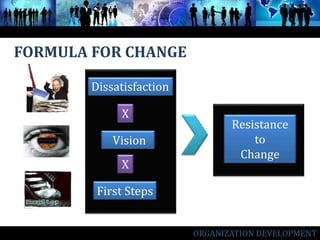
Vision
Resistance
to
Change
Dissatisfaction
First Steps
X
X
FORMULA FOR CHANGE
To thrive in tomorrow's business environment
—characterized by a dynamic work force, rapid
changes in technology, changing nature of the
workplace and the increasing instability of the global
environment—organizational development must
be an ongoing effort.
Encouraging continual examination and
readiness for change must be part of the
organization's culture.
ORGANIZATION DEVELOPMENT
THANK YOU FOR
LISTENING!

OB - notes on Organizational Developemnt.pptx

  • 1.
  • 2.
    ORGANIZATION DEVELOPMENT Kurt Lewin(1898 – 1947) One of the modern pioneers of social, organizational, and applied psychology. Widely recognized as the founding father of OD.
  • 3.
    OD is asystematic, integrated and planned approach to improve the effectiveness of the enterprise. It is designed to solve problems that adversely affect the operational efficiency at all levels The practice of changing people and organizations for positive growth ORGANIZATION DEVELOPMENT
  • 4.
    Organization Development (OD)is "an effort, planned, organization-wide, and managed from the top, to increase organization effectiveness and health through planned interventions in the organization's processes, using behavioral-science knowledge." -Beckhard ORGANIZATION DEVELOPMENT
  • 5.
    Characteristics of OD •OD is systematic approach to planned change • OD is grounded in solid research and theory • OD recognizes the reciprocal relationship between individual and organizations • OD is Goal Oriented
  • 6.
    Objectives of OD •Improves organizational Performance • Make organization better adaptive to its environment • Make the members willing to face problems • Improves internal behavioural Patterns • Understand ones own self and others
  • 7.
    OD Strategies ORGANIZATION DEVELOPMENT ActionResearch - An assessment and problem solving process aimed at improved effectiveness for the entire organization or specific work units. Conflict Management - Bringing conflicts to the surface to discover their roots, developing a common ground from which to resolve or better manage conflict. Executive Development - One-on-one or group developmental consultation with CEO's or VP's to improve their effectiveness. Goal Setting - Defining and applying concrete goals as a road map to help an organization get where it wants to go.
  • 8.
    OD Strategies ORGANIZATION DEVELOPMENT GroupFacilitation - Helping people learn to interact more effectively at meetings and to apply group guidelines that foster open communication, participation and accomplishment. Strategic Planning - A dynamic process which defines the organization's mission and vision, sets goals and develops action steps to help an organization focus its present and future resources toward fulfilling its vision. Teambuilding - Improving how well organization members help one another in activities where they must interact.
  • 9.
    OD Interventions Individual FocusedInterventions – Sensitivity Training – Skill training – Role Negotiations – Career Planning Organization and Group Focused interventions Survey Feedback Data collection
  • 10.
  • 11.
    ORGANIZATION DEVELOPMENT STEPS INACTION RESEARCH Entry finding needs for change within an organization Start-up and Contracting identify critical success factors; clarify roles for the consultant(s) and employees; deal with resistance within the organization Assessment and Diagnosis collect data in order to find the opportunities and problems in the organization
  • 12.
    Feedback two-way process servesto tell those what one found out, based on an analysis of the data Action Planning distill recommendations from the assessment and feedback; consider alternative actions ORGANIZATION DEVELOPMENT STEPS IN ACTION RESEARCH Intervention carry out the change process
  • 13.
    ORGANIZATION DEVELOPMENT STEPS INACTION RESEARCH Evaluation evaluation procedure to verify this success, identify needs for new or continuing OD activities, and improve the OD process Separation recognize when it is more productive for the client and consultant to undertake other activities Adoption implementing processes to insure that OD remains an ongoing activity within the organization
  • 14.
    ORGANIZATION DEVELOPMENT Changing natureof the workplace workers today want feedback on their performance, they want a sense of accomplishment; they need to be more efficient Human resources employees in the company; large fraction of the costs of doing business WHY DO OD?
  • 15.
    ORGANIZATION DEVELOPMENT Accelerated rateof change thinking has changed radically about organizational structures to emphasize faster customer response, lower costs and continuous learning Global market the competition is so stiff; our environments are changing, so our organizations must also change to survive and prosper WHY DO OD?
  • 16.
    ORGANIZATION DEVELOPMENT Internal Consultants employeesof the organization External Consultants people from outside the organization WHO DO OD? CHANGE To be successful, OD must have the involvement of all employers. AGENTS
  • 17.
    ORGANIZATION DEVELOPMENT WHEN ISAN ORGANIZATION READY FOR OD?
  • 18.
  • 19.
    To thrive intomorrow's business environment —characterized by a dynamic work force, rapid changes in technology, changing nature of the workplace and the increasing instability of the global environment—organizational development must be an ongoing effort. Encouraging continual examination and readiness for change must be part of the organization's culture. ORGANIZATION DEVELOPMENT
  • 20.

Editor's Notes

  • #5 To improve the organization's capacity to handle its internal and external functioning and relationships. Includes: improved interpersonal and group processes more effective communication enhanced ability to cope with organizational problems of all kinds more effective decision processes more appropriate leadership style improved skill in dealing with destructive conflict higher levels of trust and cooperation among members