Biomimicry and
Permeable Interlocking
Concrete Pavements (“PICP”)
…a ‘natural’ approach
Rick Crooks
Mutual Materials Company
www.mutualmaterials.com
Summer Teachers Institute: June 24, 2015
Thurston Conservation District
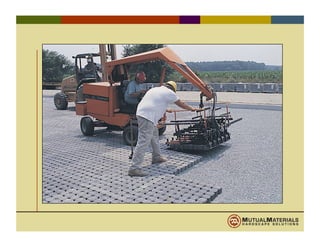
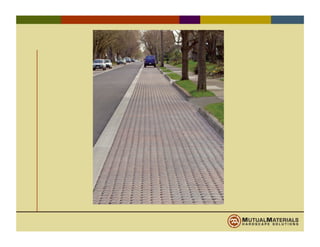
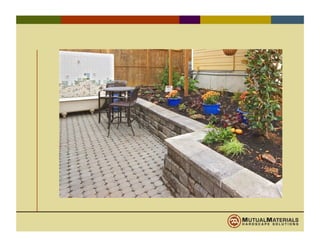
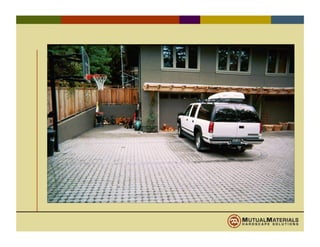
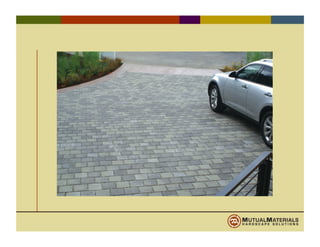
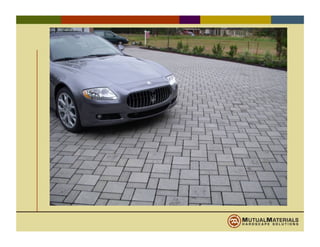
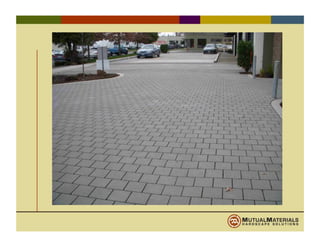
Permeable Interlocking Concrete Pavement
An innovative, sustainable
pavement that functions both
as a durable traffic surface
and
a stormwater infiltration or
detention system
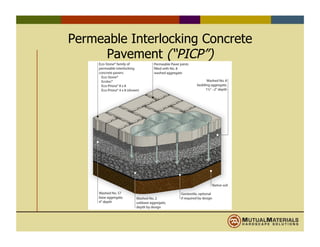
Permeable Interlocking Concrete
Pavement (“PICP”)
Permeable Interlocking Concrete Pavements
Differ from standard interlocking concrete
pavements:
•  They have the same material characteristics
(high strength, durable finish), but…
•  The system of underlying base aggregates and
paver drainage features allow for infiltration of
stormwater runoff…
•  This decreases negative impacts on our
environment and lets our paved surfaces act as
a stormwater infiltration or detention system
PICP System Benefits
•  Increased groundwater recharge
•  Contaminants are filtered and reduced
•  Peak flows and volumes are lowered,
reducing downstream flow and erosion
•  Runoff temperatures are lowered
•  Visually attractive pavement
•  Ability to reinstate after repairs
•  Maintainable - clogged openings can be
cleaned
•  Immediately serviceable
PICP Components
•  “Permeable” Pavers
– Manufactured to the same specification as
“standard” pavers
– But, includes “drainage features”
•  Wide joints
•  Drainage holes
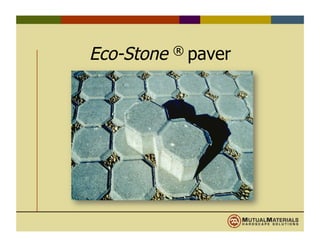
Eco-Stone ® paver
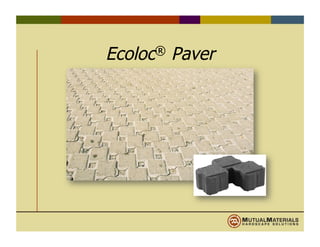
Ecoloc® Paver
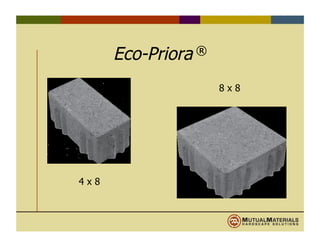
Eco-Priora ®
4 x 8
8 x 8
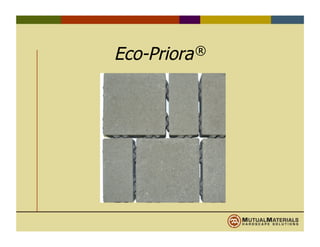
Eco-Priora®
PICP Components
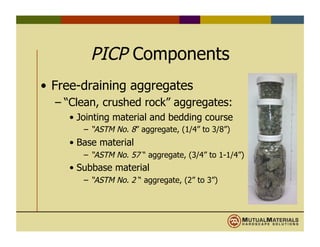
•  Free-draining aggregates
– “Clean, crushed rock” aggregates:
•  Jointing material and bedding course
–  “ASTM No. 8” aggregate, (1/4” to 3/8”)
•  Base material
–  “ASTM No. 57 “ aggregate, (3/4” to 1-1/4”)
•  Subbase material
–  “ASTM No. 2 “ aggregate, (2” to 3”)
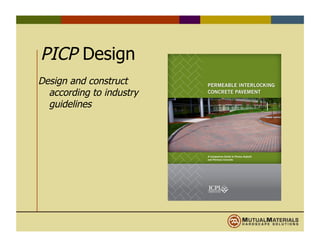
PICP Design
Design and construct
according to industry
guidelines
PICP Design and Industry Info:
Online resources available at:
www.icpi.org
www.uni-groupusa.org
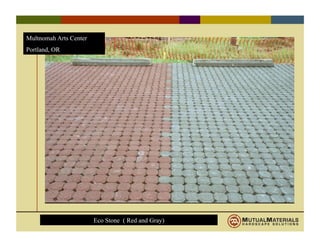
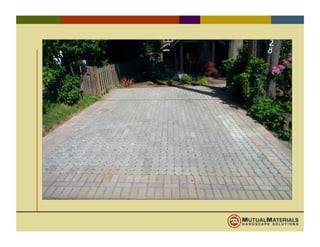
Eco Stone ( Red and Gray)
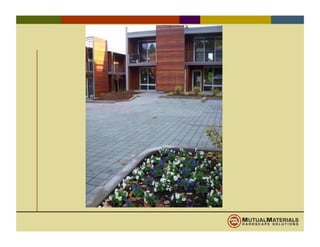
Multnomah Arts Center
Portland, OR
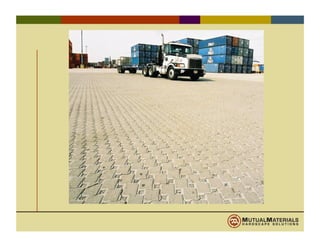
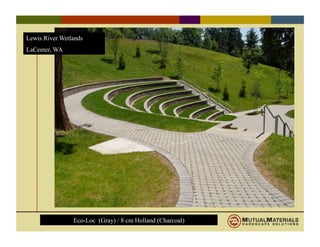
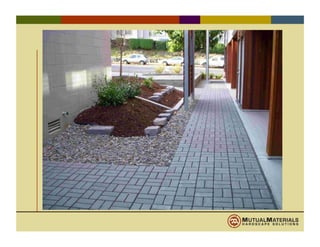
Eco-Loc (Gray) / 8 cm Holland (Charcoal)
Lewis River Wetlands
LaCenter, WA
Sustainable Development
“….development that meets the needs of
the present without compromising the
ability of future generations to meet
their own needs.”
(1987 UN World Commission on Environment and Development)
THANK YOU!
Rick Crooks
Mutual Materials Company
rcrooks@mutualmaterials.com
(425) 922-7370

Permeable Interlocking Concrete Pavers

  • 1.
    Biomimicry and Permeable Interlocking ConcretePavements (“PICP”) …a ‘natural’ approach Rick Crooks Mutual Materials Company www.mutualmaterials.com Summer Teachers Institute: June 24, 2015 Thurston Conservation District
  • 2.
    Permeable Interlocking ConcretePavement An innovative, sustainable pavement that functions both as a durable traffic surface and a stormwater infiltration or detention system
  • 3.
  • 4.
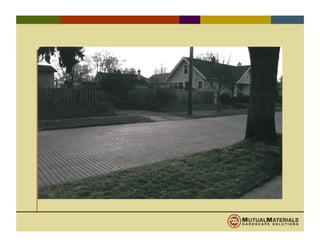
    Permeable Interlocking ConcretePavements Differ from standard interlocking concrete pavements: •  They have the same material characteristics (high strength, durable finish), but… •  The system of underlying base aggregates and paver drainage features allow for infiltration of stormwater runoff… •  This decreases negative impacts on our environment and lets our paved surfaces act as a stormwater infiltration or detention system
  • 5.
    PICP System Benefits • Increased groundwater recharge •  Contaminants are filtered and reduced •  Peak flows and volumes are lowered, reducing downstream flow and erosion •  Runoff temperatures are lowered •  Visually attractive pavement •  Ability to reinstate after repairs •  Maintainable - clogged openings can be cleaned •  Immediately serviceable
  • 6.
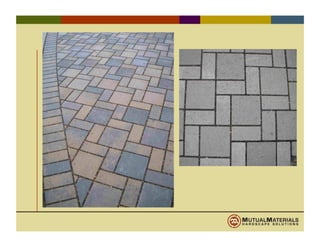
    PICP Components •  “Permeable”Pavers – Manufactured to the same specification as “standard” pavers – But, includes “drainage features” •  Wide joints •  Drainage holes
  • 7.
  • 8.
  • 9.
  • 10.
  • 11.
    PICP Components •  Free-drainingaggregates – “Clean, crushed rock” aggregates: •  Jointing material and bedding course –  “ASTM No. 8” aggregate, (1/4” to 3/8”) •  Base material –  “ASTM No. 57 “ aggregate, (3/4” to 1-1/4”) •  Subbase material –  “ASTM No. 2 “ aggregate, (2” to 3”)
  • 14.
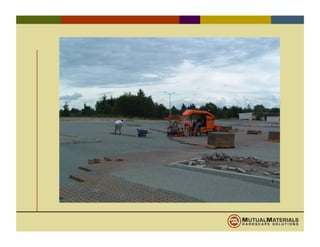
    PICP Design Design andconstruct according to industry guidelines
  • 15.
    PICP Design andIndustry Info: Online resources available at: www.icpi.org www.uni-groupusa.org
  • 21.
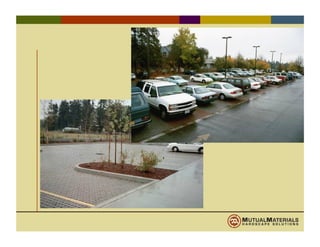
    Eco Stone (Red and Gray) Multnomah Arts Center Portland, OR
  • 31.
    Eco-Loc (Gray) /8 cm Holland (Charcoal) Lewis River Wetlands LaCenter, WA
  • 42.
    Sustainable Development “….development thatmeets the needs of the present without compromising the ability of future generations to meet their own needs.” (1987 UN World Commission on Environment and Development)
  • 43.
    THANK YOU! Rick Crooks MutualMaterials Company rcrooks@mutualmaterials.com (425) 922-7370