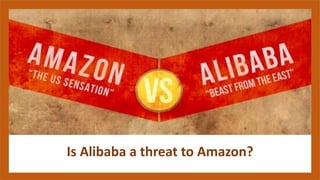
Is Alibaba a threat to Amazon?
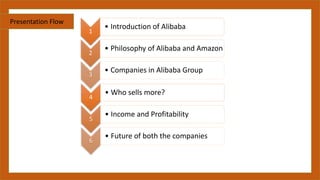
Presentation Flow 
1 
•Introduction of Alibaba 
2 
•Philosophy of Alibaba and Amazon 
3 
•Companies in Alibaba Group 
4 
•Who sells more? 
5 
•Income and Profitability 
6 
•Future of both the companies
Story of ED
Introduction –Alibaba.com 
•On 22ndSeptember 2014, Alibaba claimed title for largest IPO ever 
•Alibaba raised an eye-popping amount of $25 Billion 
•The company grew out of Jack Ma’s small apartment in Hangzhou back in 1999 into a multi-billion dollar company today 
•He raised money from family and friends to launch Alibaba.com –a B2B portal for connecting Western businesses and Chinese manufacturers 
•Since then, the company has grown to be the largest e-commerce company in the world
Philosophy of Jack Ma 
“…we want to help small businesses grow by solving their problems through Internet technology. We fight for the little guy.” -Jack Ma of Alibaba
Philosophy of Amazon 
Amazon is obsessed with the customer and getting them the best possible price –at almost any cost. They’re notorious for alienating suppliers, content partners and publishers in their pursuit of this goal.
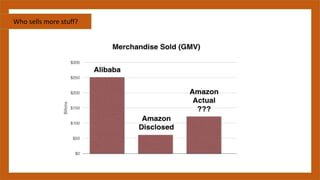
Who sells more stuff?
Income from Fees
Profitability 
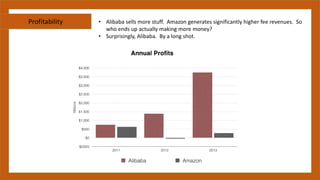
•Alibaba sells more stuff. Amazon generates significantly higher fee revenues. So who ends up actually making more money? 
•Surprisingly, Alibaba. By a long shot.
Why such a difference? 
In 2013, Alibaba made more than 10x as much money as Amazon. While Alibaba’s profits have grown consistently in the past few years, Amazon’s have languished. Amazon even lost money in 2012. 
Why such a massive difference?
Why such a difference? 
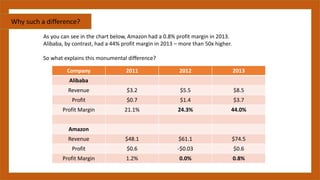
As you can see in the chart below, Amazon had a 0.8% profit margin in 2013. Alibaba, by contrast, had a 44% profit margin in 2013 –more than 50x higher. 
So what explains this monumental difference? 
Company 
2011 
2012 
2013 
Alibaba 
Revenue 
$3.2 
$5.5 
$8.5 
Profit 
$0.7 
$1.4 
$3.7 
Profit Margin 
21.1% 
24.3% 
44.0% 
Amazon 
Revenue 
$48.1 
$61.1 
$74.5 
Profit 
$0.6 
-$0.03 
$0.6 
Profit Margin 
1.2% 
0.0% 
0.8%
Why such a difference? 
What explains this monumental difference? In a phrase, “warehouses vs. software”. 
Alibaba doesn’t sell products themselves. Instead, they simply offer a web platform that facilitates the exchange of good 
Amazon, by contrast, is in the business of selling directly to consumers –and has to deal with all of the logistically complex and expensive physical aspects that go along with it. Namely, building out a vast warehouse network.
The Future 
•Alibaba has a stranglehold on the Chinese market and Amazon is the undisputed U.S. leader 
•They both have such a massive head start –and an intimate understanding of their market and models –that it’d be extremely difficult for one to knock the other from their perch. 
•Imagine if smaller independent U.S. merchants could easily sell and ship their high-end products to consumers in China 
•Alibaba already proved the model by successfully connecting Chinese manufacturers and western businesses with Alibaba.com 
•It will be especially interesting to see how Amazon addresses Alibaba’s rise, and what their next move will be. 
•Whatever happens, it will undoubtedly be exciting to watch.
Alibaba vs amazon future

Alibaba vs amazon future

  • 1.
    Is Alibaba athreat to Amazon?
  • 2.
    Presentation Flow 1 •Introduction of Alibaba 2 •Philosophy of Alibaba and Amazon 3 •Companies in Alibaba Group 4 •Who sells more? 5 •Income and Profitability 6 •Future of both the companies
  • 3.
  • 4.
    Introduction –Alibaba.com •On22ndSeptember 2014, Alibaba claimed title for largest IPO ever •Alibaba raised an eye-popping amount of $25 Billion •The company grew out of Jack Ma’s small apartment in Hangzhou back in 1999 into a multi-billion dollar company today •He raised money from family and friends to launch Alibaba.com –a B2B portal for connecting Western businesses and Chinese manufacturers •Since then, the company has grown to be the largest e-commerce company in the world
  • 5.
    Philosophy of JackMa “…we want to help small businesses grow by solving their problems through Internet technology. We fight for the little guy.” -Jack Ma of Alibaba
  • 6.
    Philosophy of Amazon Amazon is obsessed with the customer and getting them the best possible price –at almost any cost. They’re notorious for alienating suppliers, content partners and publishers in their pursuit of this goal.
  • 8.
  • 9.
  • 10.
    Profitability •Alibaba sellsmore stuff. Amazon generates significantly higher fee revenues. So who ends up actually making more money? •Surprisingly, Alibaba. By a long shot.
  • 11.
    Why such adifference? In 2013, Alibaba made more than 10x as much money as Amazon. While Alibaba’s profits have grown consistently in the past few years, Amazon’s have languished. Amazon even lost money in 2012. Why such a massive difference?
  • 12.
    Why such adifference? As you can see in the chart below, Amazon had a 0.8% profit margin in 2013. Alibaba, by contrast, had a 44% profit margin in 2013 –more than 50x higher. So what explains this monumental difference? Company 2011 2012 2013 Alibaba Revenue $3.2 $5.5 $8.5 Profit $0.7 $1.4 $3.7 Profit Margin 21.1% 24.3% 44.0% Amazon Revenue $48.1 $61.1 $74.5 Profit $0.6 -$0.03 $0.6 Profit Margin 1.2% 0.0% 0.8%
  • 13.
    Why such adifference? What explains this monumental difference? In a phrase, “warehouses vs. software”. Alibaba doesn’t sell products themselves. Instead, they simply offer a web platform that facilitates the exchange of good Amazon, by contrast, is in the business of selling directly to consumers –and has to deal with all of the logistically complex and expensive physical aspects that go along with it. Namely, building out a vast warehouse network.
  • 14.
    The Future •Alibabahas a stranglehold on the Chinese market and Amazon is the undisputed U.S. leader •They both have such a massive head start –and an intimate understanding of their market and models –that it’d be extremely difficult for one to knock the other from their perch. •Imagine if smaller independent U.S. merchants could easily sell and ship their high-end products to consumers in China •Alibaba already proved the model by successfully connecting Chinese manufacturers and western businesses with Alibaba.com •It will be especially interesting to see how Amazon addresses Alibaba’s rise, and what their next move will be. •Whatever happens, it will undoubtedly be exciting to watch.