ODONTOLOGI            DR…MISAEL
A ..UACJ.             PALACIOS


CLASSIFICATION OF PRINT MATERIALS ..
(ALGINATOS.)


                        PROFESOR…DR. ALFREDO
                          NEVAREZ RASCON.
In the printing materials are:

ELASTIC: those that pass from a fluid state to a highly elastic. Or solid
which can be removed from undercuts with relative ease and with
minimal deformation.

  THESE ARE CLASSIFIED
  IN TURN IN:

  HYDROCOLLOIDS.


 -Reversible (AGAR-AGAR)
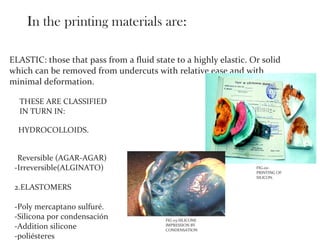
 -Irreversible(ALGINATO)                                          FIG.02-
                                                                  PRINTING OF
                                                                  SILICON.

 2.ELASTOMERS

 -Poly mercaptano sulfuré.
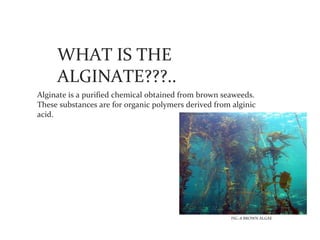
 -Silicona por condensación               FIG 03-SILICONE
 -Addition silicone                       IMPRESSION BY
                                          CONDENSATION
 -poliésteres
NON ELASTICS : Those materials that react assume rigidity, and
in some cases little or no elasticity.
CLASSIFIED IN TURN IN:

1-type plaster Paris.
2-molding compounds.
3-impression pastes.
4-wax to take impressions.
5-Polymers to take impressions


                                                              FIG.4-PLASTER PARIS


            FIG.-5 WAX PRINT
ALGINATES»


FIG.-6 Alginate impression   FIG7- Alginate impressions
WHAT IS THE
     ALGINATE???..
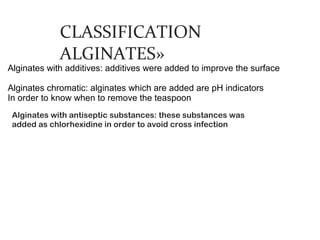
Alginate is a purified chemical obtained from brown seaweeds.
These substances are for organic polymers derived from alginic
acid.


                                                       FIG.-8 BROWN ALGAE
CARACTERISTICAS»
Son compuestos que incluyen una variedad de productos
constituidos por los ácidos D-MANURICO y L-
GULURONICO y que son extraídos de algas marrones
conocidas como Phaeophyceae, siendo que las más
importantes para la producción comercial de los alginatos.


               FIG.-9 ALGAS PARDAS (PHAEOPHYCEAE
CLASSIFICATION
             ALGINATES»
Alginates with additives: additives were added to improve the surface

Alginates chromatic: alginates which are added are pH indicators
In order to know when to remove the teaspoon
 Alginates with antiseptic substances: these substances was
 added as chlorhexidine in order to avoid cross infection
USES OF THE
ALGINATE»
Alginate is a material widely used in dentistry for
impressions of teeth and adjacent soft tissues.


                                                 FIG.-11 PRINT MAKING
                                                 ALGINATE


   FIG.-10 INSTRUMENTAL
   ALGINATE
Components»

The main component of the alginate is the sodium salt of the acid
alguinio.

Furthermore, the powder contains calcium sulfate, trisodium
phosphate.


(Trisodium phosphate allows a more prolonged handling of the
preparation, thus it is said that retards the staling)
ADVANTAGES»
 -ECONOMIC.

 -EASY HANDLING.

 -Hydrophilic properties


                           FIG.-12 MAKING CORRECT alginate
                           impression.
DISADVANTAGES»

 -dimensional changes

 -Low-fidelity details

 -Elastic Recovery


                         FIG.-13 STRUCTURE FAILED alginate
                         impression.
TRADEMARKS»


-Alidel
-Ortho print
-Phase
-Cavec k 37
-hydro gum
BIBLIOGRAPHY»

http://www.google.com.mx/search?tbm=isch&hl=es&source=hp&biw=1024&
gs_sm=e&gs_upl=886l3208l0l3605l8l8l0l1l1l0l254l921l0.4.1l5l0


 http://www.elprisma.com/apuntes/odontologia/alginatos/


  http://odontored.wordpress.com/2011/08/12/clasificacion-de-los-materiale


    http://es.wikipedia.org/wiki/Alginato

ALGINATOS

  • 1.
    ODONTOLOGI DR…MISAEL A ..UACJ. PALACIOS CLASSIFICATION OF PRINT MATERIALS .. (ALGINATOS.) PROFESOR…DR. ALFREDO NEVAREZ RASCON.
  • 2.
    In the printingmaterials are: ELASTIC: those that pass from a fluid state to a highly elastic. Or solid which can be removed from undercuts with relative ease and with minimal deformation. THESE ARE CLASSIFIED IN TURN IN: HYDROCOLLOIDS. -Reversible (AGAR-AGAR) -Irreversible(ALGINATO) FIG.02- PRINTING OF SILICON. 2.ELASTOMERS -Poly mercaptano sulfuré. -Silicona por condensación FIG 03-SILICONE -Addition silicone IMPRESSION BY CONDENSATION -poliésteres
  • 3.
    NON ELASTICS :Those materials that react assume rigidity, and in some cases little or no elasticity. CLASSIFIED IN TURN IN: 1-type plaster Paris. 2-molding compounds. 3-impression pastes. 4-wax to take impressions. 5-Polymers to take impressions FIG.4-PLASTER PARIS FIG.-5 WAX PRINT
  • 4.
    ALGINATES» FIG.-6 Alginate impression FIG7- Alginate impressions
  • 5.
    WHAT IS THE ALGINATE???.. Alginate is a purified chemical obtained from brown seaweeds. These substances are for organic polymers derived from alginic acid. FIG.-8 BROWN ALGAE
  • 6.
    CARACTERISTICAS» Son compuestos queincluyen una variedad de productos constituidos por los ácidos D-MANURICO y L- GULURONICO y que son extraídos de algas marrones conocidas como Phaeophyceae, siendo que las más importantes para la producción comercial de los alginatos. FIG.-9 ALGAS PARDAS (PHAEOPHYCEAE
  • 7.
    CLASSIFICATION ALGINATES» Alginates with additives: additives were added to improve the surface Alginates chromatic: alginates which are added are pH indicators In order to know when to remove the teaspoon Alginates with antiseptic substances: these substances was added as chlorhexidine in order to avoid cross infection
  • 8.
    USES OF THE ALGINATE» Alginateis a material widely used in dentistry for impressions of teeth and adjacent soft tissues. FIG.-11 PRINT MAKING ALGINATE FIG.-10 INSTRUMENTAL ALGINATE
  • 9.
    Components» The main componentof the alginate is the sodium salt of the acid alguinio. Furthermore, the powder contains calcium sulfate, trisodium phosphate. (Trisodium phosphate allows a more prolonged handling of the preparation, thus it is said that retards the staling)
  • 10.
    ADVANTAGES» -ECONOMIC. -EASYHANDLING. -Hydrophilic properties FIG.-12 MAKING CORRECT alginate impression.
  • 11.
    DISADVANTAGES» -dimensional changes -Low-fidelity details -Elastic Recovery FIG.-13 STRUCTURE FAILED alginate impression.
  • 12.
  • 13.