642 Teacher Education and Practice, Vol. 29, No. 4 / Fall 2016
Algebra Problem-Solving
Equity Challenges
Building Middle School Preservice Teachers’
Diversity Awareness
GERALD KULM, ZAHIRA MERCHANT, TINGTING MA, AYSE TUGBA ONER,
TRINA DAVIS, AND CHANCE W. LEWIS
ABSTRACT: This article focuses on Algebra Problem-Solving Equity Challenge
(APSEC) activities, which are designed to build preservice teachers’ awareness,
knowledge, and skill in teaching diverse middle-grade students. Thirty-five par-
ticipants completed a precourse Cultural and Beliefs Inventory, four APSEC ac-
tivities, and surveys on the effects of the APSEC activities on their awareness and
knowledge about teaching for diversity. Qualitative analyses of the participants’
responses to APSEC activities revealed that participants were able to improve
the cultural relevance of word problems, describe how to address students’
misconceptions, and answer questions that might arise in a diverse classroom.
A structural equation model showed that participants’ cultural beliefs affected
responses to student misconceptions and, subsequently, perceptions about suc-
cess with problem solving, answering student questions, and lesson planning.
The key intermediary role of work with misconceptions is seen as an important
finding that may suggest a strategy for teaching algebra for equity.
cA key challenge in mathematics teacher education is to prepare
teachers who have deep knowledge of mathematics (Kulm, 2008)
and awareness and understanding of the diverse cultures and characteristics
of their students (Sleeter, 2001). Preservice teachers should be equipped
with the pedagogical content knowledge (Shulman, 1986, 1987) and equity
consciousness (McKenzie & Skrla, 2011) necessary to be effective in diverse
middle-grade classrooms. Building diversity awareness is especially challeng-
ing, as the typical preservice elementary/middle-grades teacher population
that is made up mainly of middle-class white females (Kulm et al., 2011). The
authors are part of a research team on a 5-year National Science Foundation–
funded design experiment (Lamberg & Middleton, 2009) that employs sev-
eral strategies in a required problem-solving course in an attempt to enhance
middle-grade preservice teachers’ knowledge for teaching algebra for equity.
This research study focuses on a central component of the course Algebra
Problem-Solving Equity Challenge (APSEC) activities, which are designed
to build preservice teachers’ awareness, knowledge, and skill in teaching
diverse middle-grade students. Each APSEC consists of the following: (1)
an open-ended mathematics problem, (2) questions about misconceptions
Algebra Problem-Solving Equity Challenges 643
related to the mathematics topic of the problem, (3) a lesson-planning ex-
ercise aimed at diverse students, and (4) mathematics and cultural questions
that middle-grade students might ask during the lesson. Each of these activi-
ties comprises about 2 hours of classroom instruction and about 2.5 hours of
after-class homework. The activities are focused on early algebra content and
are independent of each other, making it possible to select and implement
one or more of them in a mathematics methods or mathematics course for
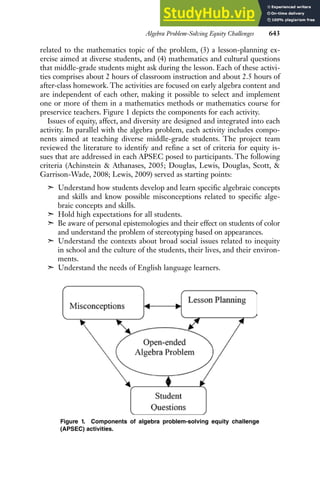
preservice teachers. Figure 1 depicts the components for each activity.
Issues of equity, affect, and diversity are designed and integrated into each
activity. In parallel with the algebra problem, each activity includes compo-
nents aimed at teaching diverse middle-grade students. The project team
reviewed the literature to identify and refine a set of criteria for equity is-
sues that are addressed in each APSEC posed to participants. The following
criteria (Achinstein & Athanases, 2005; Douglas, Lewis, Douglas, Scott, &
Garrison-Wade, 2008; Lewis, 2009) served as starting points:
➣ Understand how students develop and learn specific algebraic concepts
and skills and know possible misconceptions related to specific alge-
braic concepts and skills.
➣ Hold high expectations for all students.
➣ Be aware of personal epistemologies and their effect on students of color
and understand the problem of stereotyping based on appearances.
➣ Understand the contexts about broad social issues related to inequity
in school and the culture of the students, their lives, and their environ-
ments.
➣ Understand the needs of English language learners.
Figure 1. Components of algebra problem-solving equity challenge
(APSEC) activities.
644 GERALD KULM ET AL.
In this article, we describe the individual components of the APSEC activi-
ties, the implementation of the activities, and initial results on their effective-
ness in building preservice teachers’ awareness and knowledge of culturally
relevant strategies (Ladson-Billings, 1995, 2005) for teaching middle-grade
students. The following research questions are addressed:
➣ How do the participants respond to questions on the cultural relevance
of mathematical problems?
➣ How well do participants apply problem-solving knowledge to settings
that require them to consider the thinking of students in diverse settings?
Theoretical Framework
The work on developing the APSEC activities was guided by a framework
of a hypothetical learning trajectory (HLT) for learning to teach algebra for
diversity. We developed two separate but overlapping HLTs—one for solving
algebra problems and the other to characterizes teachers’ strategies to engage
and motivate diverse students in learning algebra. The present study focuses
on the second of these HLTs. The trajectories follow the model of Simon
and Tzur (2004), who provided the following set of assumptions about the
characteristics and use of an HLT:
➣ Generation of an HLT is based on understanding of the current knowl-
edge of the students involved.
➣ An HLT is a vehicle for planning learning of particular mathematical
concepts.
➣ Mathematical tasks provide tools for promoting learning of particular
mathematical tasks and are, therefore, a key part of the instructional
process.
➣ Because of the hypothetical and inherently uncertain nature of this
process, the teacher is regularly involved in modifying every aspect of
the HLT (p. 93).
The HLTs facilitate building on existing knowledge and developing deeper
knowledge of the topics. To describe how this knowledge is built, we began
with the model of Lamberg and Middleton (2009) in constructing the HLTs.
This model contains (1) descriptions of the conceptual scheme at each level
of learning; (2) summaries of the cause/effect mechanisms that characterize
students’ current knowledge; (3) cognitive interpretations of current knowl-
edge, including possible misconceptions; and (4) intermediary understand-
ings that are necessary for bridging to the next level of the learning trajectory
(p. 237). The HLT for learning to teach algebra for diversity is comprised
of three different approaches to prepare preservice teachers for teaching for
equity (Kulm et al., 2011):
Algebra Problem-Solving Equity Challenges 645
➣ Cultural relevance—use of a context or scenario for learning activi-
ties that are based on and relevant to middle-grade students’ diverse
cultures and lives
➣ Situated learning—use of a context that allows students to have con-
crete and hands-on experiences with mathematics knowledge and skills,
including a realistic setting in which students use a variety of skills,
concepts, and tools
➣ Critical pedagogy—use of a context in which students investigate the
sources of mathematical knowledge or identify social justice problems
and plausible solutions
The trajectory, based on findings from research, provides possible steps
to bridge to more sophisticated strategies for teaching algebra for diversity
(Brown, Davis, & Kulm, 2012). We used the HLT (1) to guide the design,
development, and revision of the APSEC activities and other course activi-
ties; (2) as an instructional tool to help participants understand strategies for
teaching algebra problem solving for diversity; and (3) as a framework to
guide research into the effects of course activities.
Literature Review
Culturally Relevant Teaching
Equity consciousness embodies four beliefs: (1) all children (with a few
exceptions who are extremely disabled) have the capability to excel academi-
cally; (2) all children refers to all with diverse innate, cognitive, linguistic,
sociodemographic, socioeconomic, and cultural characteristics; (3) adults in
school should take accountability for student learning; and (4) practices in
school should be changed to meet all children’s needs (Skrla, McKenzie, &
Scheurich, 2009). Researchers have made numerous efforts to promote equity
consciousness and adopt critical race theory in education to achieve cultur-
ally relevant teaching (e.g., Ladson-Billings, 1994, 1995, 1998, 2001, 2005).
According to Ladson-Billings (1995), teachers who adopt culturally relevant
pedagogy should enable students to (1) develop academic achievement, (2)
improve cultural competence, and (3) develop a sociopolitical consciousness.
Teacher education standards include diversity as one of the essential factors
for teacher candidates to acknowledge and promote (National Council for
the Accreditation of Teacher Education [NCATE], 2008). In particular, pro-
spective teachers are required to “operationalize the belief that all students
can learn; [and] demonstrate fairness in educational settings by meeting the
educational needs of all students in a caring, non-discriminatory, and equi-
table manner” (NCATE, 2008, p. 7). To better prepare prospective teach-
ers for diversity in teaching, NCATE (2008) specified that curricula, field
experiences, and clinical practice should be provided for teacher candidates
646 GERALD KULM ET AL.
to improve their knowledge, skills, and professional dispositions concerning
diversity.
Preservice Teachers and Problem Solving
The complex nature and significant role of problem solving in mathematics
teaching and learning has been widely acknowledged among researchers and
practitioners (Cobb, Yackel, & Wood, 1993; National Council of Teachers of
Mathematics, 1989, 2000; Schoenfeld, 1992; Silver, 1985). Recognizing the
importance for mathematics learners (especially pre-K–12 students) to learn
to think mathematically and become mathematical problem solvers, research-
ers have begun to show interest in preservice teachers’ problem solving. The
shift in focus from pre-K–12 students’ problem solving to preservice teach-
ers’ problem solving is due mainly to an increasingly accepted notion that
teachers’ mathematical knowledge for teaching has a significant impact on
student achievement (e.g., Ball & Bass, 2003; National Mathematics Advisory
Panel, 2008).
Along with other important knowledge, such as mathematical facts and
representations, concepts, proving, reasoning, and making connections, the
ability to solve problems is an important dimension of teachers’ mathemati-
cal knowledge for teaching (Ponte, 2009). Prior research has documented
evidence that preservice teachers are inadequately prepared in mathematical
knowledge for teaching in their teacher education programs (Ball & Bass,
2000; Conference Board of Mathematical Sciences, 2001). Concerns regard-
ing preservice teachers’ problem-solving skills and strategies have also been
raised. For example, in a study of preservice teachers’ arithmetic and algebra
word problem-solving skills and strategies, researchers concluded that
pre-service teachers who had arrived at the end of their teacher education still
continued to demonstrate problem-solving behaviour characterized by (some
of) the problematic features of the student teachers who had just started their
teacher education. (Dooren, Verschaffel, & Onghena, 2003, p. 45)
Another line of earlier research focused on problem solving as an effective
approach for developing preservice teachers’ mathematical knowledge for
teaching. For example, working with preservice teachers on mathematical tasks
can help them develop their mathematical knowledge for teaching arithmetic
operations (Chapman, 2007) and improve preservice teachers’ content and
pedagogical knowledge of and attitudes toward proportional reasoning (Ben-
Chaim, Keret, & Ilany, 2007). In designing the tasks, an essential issue is to
allow preservice teachers to experience doing mathematics “in their own situ-
ation, through having particularized a general strategy for themselves, rather
than relying on being given particular ‘things to do’” (Watson & Mason, 2007,
p. 208), so that preservice teachers can become more aware of what their future
learners may experience.This line of research identifies problem solving as one
of the key mathematical topics that teacher education courses should focus on
Algebra Problem-Solving Equity Challenges 647
to achieve effective teacher education as well as effective teaching (Watson &
Mason, 2007). More important, a shared understanding should be achieved
about why, how, and when teaching and learning key mathematical topics (e.g.,
problem solving) should occur in teacher education, and how these impact pre-
service teachers’ future instruction or their rejection of the topics as irrelevant
to their own teaching (Watson & Mason, 2007).
Student Misconceptions
We included student misconceptions about algebra as an important compo-
nent in the APSEC activities. The achievement gap in mathematics between
white students and students of color is due, in part, to the weak preparation
received by many students. Poorly prepared teachers are a critical aspect of
that preparation. A lack of mathematics knowledge can result in students
forming incomplete understanding or misconceptions about important ideas
and concepts in algebra. A student can continue his or her education with mis-
conceptions unless a teacher knows and recognizes them. Misconceptions are
explanations of a concept made by students and usually are stable, robust, and
resistant to change because the idea is accepted by students and works in many
cases (Chi, 2005). Misconceptions affect how students understand the concept
and should be changed to reach expert understanding (Hammer, 1996).
Students have misconceptions about mathematics ideas that are essential
to learning algebra, including ratios, proportions, and equations (Dogan &
Cetin, 2009; Erek, 2008; Kaplan, Isleyen, & Ozturk, 2011; Kocakaya Baysal,
2010; Li, 2006). The first numbers skill for students is in the area of ratios,
proportions, and percents, and students have difficulties understanding ratios.
Students’ difficulties with ratios and incomplete understanding of propor-
tional relationships are key factors in developing the concept of linear equa-
tions and functions (Milgram, 2005).
Many studies have examined students’ misconceptions about ratio, propor-
tions, and equations (Dogan & Cetin, 2009; Erek, 2008; Kaplan et al., 2011;
Kocakaya Baysal, 2010; Li, 2006). These studies have indicated that students
lack proper knowledge about direct and inverse proportions; have difficulty
writing a ratio and finding the proportion; lack understanding of the concept
of functions, equations, and the relationship between functions and equa-
tions; have difficulty assigning a constant for an unknown; and believe that
letters representing unknowns are ranked alphabetically.
Students’ misconceptions may develop or persist partially because teach-
ers themselves have many of the same misconceptions. Research has shown
that preservice teachers have difficulty defining functions with one-to-one
correspondence and other properties, lack understanding of the conditions
of functions and multiple representations of functions, have problems with
unit ratios and finding the missing value in proportions, and have incomplete
knowledge about linear equations (Aydin & Kogce, 2008; Dede & Soybas,
648 GERALD KULM ET AL.
2011; Li, 2007; Livy & Vale, 2011). To prevent and correct students’ miscon-
ceptions, teachers’ misconceptions should be corrected first. We believe that
well-prepared teachers who can recognize and address their own and their
students’ mathematical misconceptions are essential to equitable mathemat-
ics learning.
Methods
In this section, we provide information on the participants, procedures, and
data sources employed to address the research questions.
Participants
The 35 participants were middle-grade mathematics preservice teach-
ers enrolled in a required mathematics problem-solving course at a large
southwestern research university. The upper-division undergraduate class
consisted of 19 junior and 16 seniors. There were 29 white females, one
African American female, two Hispanic females, and three white males.
These demographics reflect the overall population of preservice teachers
at the university.
Procedures
The problem-solving course consisted of (1) problem-solving heuristics
(Polya, 1957); (2) strategies for teaching diverse students, which included
four APSEC activities, presentations by experts on diversity, readings, and
discussions of strategies for teaching for equity; (3) tutoring a student avatar
in Second Life who had a misconception; and (4) teaching experience in Second
Life to simulate a middle-grade classroom. This study focused on the second
component of the course, specifically on the APSEC activities.
Data Sources
Each APSEC activity consisted of five parts: problem solving, culturally
relevant problem, misconceptions, lesson planning, and answers to students’
mathematics and equity questions. After they completed solutions to the
mathematics problem, the participants responded to the four following parts
that included questions and activities to develop awareness and knowledge of
the issues of adapting and presenting mathematics problems to middle-grade
students. A rubric developed by the first author, who was the course instruc-
tor, was used to score the participants’ responses to each of the five parts. The
first and second authors compared scores in order to reach agreement. The
scores on the four APSEC activities counted as 20% of participants’ grade.
Algebra Problem-Solving Equity Challenges 649
APSEC Activities and Components
In the following summaries, we describe each APSEC component. The
“Results” section will provide specific examples of the activities along with
sample participant responses.
Algebra Problem
The algebra problem served as the anchor for a series of questions on student
thinking and lesson planning for diverse classrooms. Each algebra problems
addressed the following characteristics:
➣ Alignment with one or more algebraic learning goals (variables, change,
or operations)
➣ Open ended, with multiple possible solution strategies and opportuni-
ties for extension and/or generalization
➣ Accessible, engaging, challenging, and relevant to diverse middle-grade
students (grades 6 to 8), especially students at risk or low achievers
➣ Accessible via technology learning tools (e.g., graphing tools, simula-
tions, and video representations)
Participants used Polya’s (1957) heuristic approaches to solve the problem,
then wrote a complete account of their process of understanding, planning,
carrying out, and looking back at their solution. A brief description of the
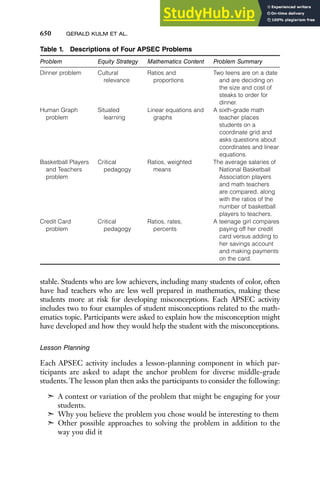
four problems used in the current study is shown in Table 1.
Cultural Relevance
An essential goal of the ASPEC activities was to provide examples and prac-
tice in identifying problems that could be culturally relevant to students. The
anchor problems were intended to be relevant to the preservice teachers and
to provide a starting point for them to revise or adapt the contexts to their
own future middle-grade students. In order to assess the participants’ ideas
and knowledge about criteria for cultural relevance, we asked the follow-
ing questions in each activity: (1) Explain why the problem may or may not
be culturally relevant to particular students. (2) How could you change the
context of the problem to make it more culturally relevant to students? (3)
Explain why the context you chose would be relevant and engaging.
Misconceptions
Many students enter the middle grades with misconceptions that are barriers to
learning algebra. Misconceptions often develop when students apply procedures
without fully understanding them. If a teacher who is unaware of or is unable to
explain why a procedure or algorithm works, the misconception becomes more
650 GERALD KULM ET AL.
stable. Students who are low achievers, including many students of color, often
have had teachers who are less well prepared in mathematics, making these
students more at risk for developing misconceptions. Each APSEC activity
includes two to four examples of student misconceptions related to the math-
ematics topic. Participants were asked to explain how the misconception might
have developed and how they would help the student with the misconceptions.
Lesson Planning
Each APSEC activity includes a lesson-planning component in which par-
ticipants are asked to adapt the anchor problem for diverse middle-grade
students. The lesson plan then asks the participants to consider the following:
➣ A context or variation of the problem that might be engaging for your
students.
➣ Why you believe the problem you chose would be interesting to them
➣ Other possible approaches to solving the problem in addition to the
way you did it
Table 1. Descriptions of Four APSEC Problems
Problem Equity Strategy Mathematics Content Problem Summary
Dinner problem Cultural
relevance
Ratios and
proportions
Two teens are on a date
and are deciding on
the size and cost of
steaks to order for
dinner.
Human Graph
problem
Situated
learning
Linear equations and
graphs
A sixth-grade math
teacher places
students on a
coordinate grid and
asks questions about
coordinates and linear
equations.
Basketball Players
and Teachers
problem
Critical
pedagogy
Ratios, weighted
means
The average salaries of
National Basketball
Association players
and math teachers
are compared, along
with the ratios of the
number of basketball
players to teachers.
Credit Card
problem
Critical
pedagogy
Ratios, rates,
percents
A teenage girl compares
paying off her credit
card versus adding to
her savings account
and making payments
on the card.
Algebra Problem-Solving Equity Challenges 651
➣ Possible difficulties, partial solutions, or incorrect answers, along with
questions or hints that can redirect or guide students
➣ Extensions, generalizations, or questions for students who quickly solve
the problem
➣ Questions to probe students’ understanding of the problem
Student Questions
In order to build participants’ pedagogical knowledge, each APSEC activity
includes two types of questions that simulate what students might ask in the
classroom: mathematical questions and equity questions. The mathematical
questions focus on the concepts addressed by the ASPEC, requiring teachers
to explain why a procedure works, or the meaning of a mathematical concept.
The equity questions reflect middle-grade students’ family background or
everyday experiences, sometimes offering somewhat “off-topic” issues for the
teacher to deal with.
Results
In this section, we present data and analyses to address each of the research
questions. The participants’ responses to the questions in the APSEC activi-
ties were examined to address each research question. The following example
responses were chosen to be representative of those of the 35 participants.
The authors reviewed the responses and agreed to the validity of these ex-
amples as the way most participants answered the questions. The codes pro-
vided for each response were IDs assigned to participants and used for all of
the data collection procedures.
Awareness of Cultural Relevance and Student Thinking
Generally, the participants were able to identify the characteristics of cultural
relevance and to make meaningful suggestions for improving its cultural rel-
evance for their future middle-grade students. On the Dinner problem, for
example, a typical response was the following:
The dinner problem may not be culturally relevant to some students because
they may not eat steaks, much less know what a steak really is. A student may
come from a poor family who cannot afford steaks, a vegetarian family where
meat is not eaten, or even a certain religion where certain meats are not to be
eaten. (AD1014)
A few participants had difficulty with the concept of “culture,” thinking of
it primarily as identifying students who are immigrants. Other participants
focused on the direct relevance of a context to students’ interests, believing
that if a student had not directly experienced a situation, it would not be
652 GERALD KULM ET AL.
culturally relevant. For example, a response about the Basketball Players and
Teachers problem was the following:
Children in middle school are not old enough to become a school teacher, so that
issue is not relevant to their life right now, and may never be if teaching is not
what they are interested in. Most kids don’t know what they are going to be one
day, so if focusing on jobs to be culturally relevant, middle school teachers should
choose jobs, like baby-sitting, that students are likely to have at that age. (AD1005)
The participants were able to suggest contexts that would make the anchor
problems more culturally relevant to middle-grade students. They focused on
activities that students would likely have direct experience in their daily lives. On
the Dinner problem, nearly all of the participants suggested a fast-food setting.
Most of them would use the Human Graph problem as it was originally stated,
although a few of them suggested a real context in addition to the relevance
of the physical activity. The participants seemed to have the most difficulty in
making suggestions on the Credit Card problem. An example is the following:
I couldn’t think of anything that works like a credit card, so I would just change
the content around the question. I would use a different name maybe the name
of the teacher and include what he or she bought in order to get into debt. So
the things he or she would buy could be video games, clothes, etc. Things that
the students are familiar with. (AD1018)
Another participant wrote,
The only way I can think to make this problem more culturally relevant is to
have a discussion on credit cards and how they work, have them act out the sce-
nario and talk about what they might have spent $1,000 on personally. (AD1026)
In order to examine the participants’ understanding of student thinking,
we reviewed their responses to questions about student misconceptions and
to questions that students might ask during a mathematics lesson. On the
misconceptions, most of the students were able to identify the difficulty and
were usually able to give a reasonable explanation of how the misconception
might have arisen. For example, we asked participants to respond to the fol-
lowing misconception about proportions:
“Constant difference” or “additive” strategy: The relationship within the ratios
is computed by subtracting one term from another, and then the difference is
applied to the second ratio. Example: Find x: 3/8 = x/12. Solution: 12 − 8 = 4,
so x = 3 + 4 = 7.
Many of the participants wrote about using concrete materials or pictures to
demonstrate concepts and provided suggestions such as the following:
I would start by making sure the student understands the amounts of numbers
he was looking at. I could do this by creating two pie diagrams. One would be
split into 8 with 3 shaded in (3/8) and the other would be split into 12 (x/12).
I would talk them through that each piece has a specific size to it, and they are
different between each diagram. I would have them overlay the pies so that they
could see how many sections of the 12 pie would fit in 3 of the 8 pie. (AD1021)
Algebra Problem-Solving Equity Challenges 653
On the other hand, some students had difficulty providing help that would
address the concept. The introduction to the exercise explicitly stated that
misconceptions were not about not knowing how to do the “steps” in a
procedure but rather about the student’s misunderstanding of a concept. In
class, the instructor emphasized that addressing a misconception required
more than simply telling the student that he or she was wrong or repeating
the correct procedure. Participants were encouraged to ask “why” questions
and involve the student in an activity or conversation about the underly-
ing mathematical concept. Nevertheless, many participants wrote that they
would tell or show the student how to do the problem correctly. For ex-
ample, for the misconception “It takes several points to determine a line,” a
participant wrote,
First I will explain to the student that it only takes two points to create a line. I
would have the student give me two random but close point so I can graph it. I
would use a ruler to show me the length of the line. I think students have this
misconception because a line goes on forever. (AD1003)
Most of the students were able to answer the classroom questions about
mathematics. Some of the answers were similar to textbook definitions, but
many of the participants wrote responses that attempted to speak as if they
were directed at middle-grade students. In response to the student question
“Are graphs always lines?,” a typical response was the following:
No, graphs are not always lines. You can have circles, parabolas that have a vertex
which is when the lines starts to curve upward or downward. It depends on how
the equation looks like that depends on how the figure on the graph is going to
look like. Let’s try some out! (AD1032)
There were some gaps in basic algebra knowledge. For example, on the
question “Is x + 5 a linear equation?,” many participants knew the character-
istics of a linear equation but did not distinguish between an expression and
an equation. They wrote answers similar to this participant’s response:
x + 5 is a linear equation. Let me explain why. A linear equation is an equation
between two variables that gives a straight line when plotted on a graph. Also the
equation does not include any exponents. (AD1024)
Many of the participants had difficulty in responding to simulated student
questions that related to cultural issues or questions that were “off track”
from the lesson. In wishing to move on with the lesson, they gave responses
that did not take the opportunity to find out about the student’s thinking.
For example, in responding to the student comment “My mom says we can’t
afford to eat steak,” participants wrote the following:
➣ That’s okay, there a lot of people who cannot afford to eat steak.
(AD1013)
➣ No worries, I am paying in the problem. (AD1019)
654 GERALD KULM ET AL.
Some participants were able to give good responses that accepted the stu-
dent’s contribution but still did not explore the student’s thinking or personal
background. An example is the following:
➣ I would say something along the lines of, “Thank you for pointing that
out. Steak can be expensive, especially if it is good steak, and so we can-
not always spend money on it. So what would you want to buy instead of
steak? Something that you can afford with your own personal money?”
We can use that for our problem. (AD1026)
➣ Okay, have you ever seen at a grocery store? How you can buy candy
by the ounce? How about we use that idea instead of steak? (AD1002)
➣ Okay, let’s pretend that instead of steak ounces that is the amount of
chicken nuggets or fries. Now let’s try to find the price of the fries or
chicken nuggets. (AD1027)
In summary, the APSEC activities provided opportunities for the partici-
pants to learn and apply problem-solving knowledge to settings that required
them to consider the thinking of students in diverse settings. They improved
their abilities to consider possible student misconceptions and how to deal
with them. The participants had practice in responding to questions about
mathematical content as well as cultural issues that might arise in a middle-
grade mathematics classroom.
Discussion
A central goal of the current project is to build and enhance preservice math-
ematics teachers’ awareness and effectiveness in teaching for equity. Our ap-
proach is to integrate ideas about diversity and culture seamlessly into math-
ematics problems and planning for teaching. Too often in preservice education,
courses that address multicultural ideas and courses that present mathematics
content and/or methods are separate, usually taught by faculty in separate de-
partments or programs. Preservice teachers seldom consider classroom culture
and diversity in the context of subject matter content and delivery of classroom
instruction. This situation is similar to the case 25 years ago when Shulman
(1986, 1987) introduced the notion of pedagogical content knowledge, thus
combining knowledge of teaching with knowledge of content. We believe that
combining knowledge of teaching for equity and knowledge of teaching math-
ematics is essential to closing the achievement gap and producing equitable
academic outcomes for all students, particularly in mathematics courses.
The participants in this study had the typical demographic characteristics
of many elementary and middle-grade preservice teachers. Their notions
about culture and teaching mathematics in diverse classrooms were some-
what naive partly due to their limited experience with different cultures, both
in where they grew up and in having limited previous teaching experience.
Algebra Problem-Solving Equity Challenges 655
On the other hand, they were open and ready to engage in activities and
discussions about equity. They saw their development and knowledge about
cultures different from their own as essential to becoming effective teachers.
In these ways, the participants were an ideal population for our research on
the activities that might be effective in enhancing awareness and knowledge
about teaching algebra for equity.
The participants’ responses to questions about culturally relevant teaching
and student thinking reflected their own experiences as well as the course
activities. In class discussions, we emphasized the importance of using real-
life problem contexts that would engage middle-grade students. The anchor
problems seemed to be effective in providing the participants with firsthand
experience with problems that engaged them, providing a springboard for
devising contexts that would be appropriate for middle-grade students. The
participants worked in groups and experienced the importance of recognizing
multiple solution approaches used by their classmates. On the other hand,
their lack of experience with diversity was reflected in the contexts they
chose for culturally relevant problems. Although they showed awareness of
diverse cultures, such as food preferences or living standards, few of them
integrated that awareness into the problem contexts they chose. Nearly all of
the contexts they chose were typical middle-class settings, such as fast food,
popular entertainment, or sports that were familiar to their own experiences.
The participants’ judgment of cultural relevance seemed to be focused on
whether students might have had direct, personal experience with the spe-
cific context of a problem in their own lives. The participants initially viewed
student questions that were not directly related to the mathematical content
of a lesson to be distractions or, at the very least, something to be answered
as tactfully as possible. They avoided using the questions as opportunities to
learn about the students’ lives and cultures, perhaps fearing to say something
that might be off topic or even “politically incorrect.” Some of the partici-
pants began to overcome this barrier by accepting the student’s contribution
in their responses. As stated by Ladson-Billings (1995), culturally relevant
pedagogy adopted by teachers is positively associated with students’ academic
achievement. In our study, we found that some participants became aware
that by getting to know the cultural and other personal backgrounds of their
students, they would be more successful in engaging them in learning algebra.
The participants’ responses to student misconceptions were improved dur-
ing the course. They initially answered, as expected from their own experi-
ence, by repeating or telling the student how to do the procedure correctly.
Although some participants continued this approach, most of them learned to
use concrete representations, engage the students in discussion, and ask ques-
tions that helped reveal the student’s source of misunderstanding. Examples
provided in class, role-playing with peers, and feedback on their responses
helped to build the participants’ repertoire of strategies for dealing with com-
mon mathematical misconceptions.
656 GERALD KULM ET AL.
Acknowledgment
This project is funded by National Science Foundation grant 1020132. Any
opinions, findings, and conclusions or recommendations expressed in these
materials are those of the authors and do not necessarily reflect the views of
the National Science Foundation.
References
Achinstein, B., & Athanases, S. Z. (2005). Focusing new teachers on diversity and
equity: Toward a knowledge base for mentors. Teaching and Teacher Education, 21,
843–862.
Aydin, M., & Kogce, D. (2008). Ogretment adaylarinin “denklem ve fonksiyon” ka-
vramlarina iliskin algilari [Preservice teachers’ perceptions of “equation and func-
tion” conceptions]. Yuzuncu Yil Universitesi Dergisi, 5, 46–58.
Ball, D. L., & Bass, H. (2000). Interweaving content and pedagogy in teaching and
learning to teach: Knowing and using mathematics. In J. Boaler (Ed.), Multiple
perspectives on the teaching and learning of mathematics (pp. 83–104). Westport, CT:
Ablex.
Ball, D. L., & Bass, L. (2003). Toward a practice-based theory of mathematical knowl-
edge for teaching. In B. Davis & E. Simmt (Eds.), Proceedings of the 2002 Annual
Meeting of the Canadian Mathematics Education Study Group (pp. 3–14). Edmonton,
AB: CMESG/GCEDM.
Ben-Chaim, D., Keret, Y., & Ilany, B. (2007). Designing and implementing authentic
investigative proportional reasoning tasks: The impact on pre-service mathematics
teachers’ content and pedagogical knowledge and attitudes. Journal of Mathematics
Teacher Education, 10, 333–340.
Brown, I. A., Davis, T., & Kulm, G. (2012). Preservice teachers’ knowledge for teach-
ing algebra for equity in the middle grades: A preliminary report [Special Issue].
Journal of Negro Education, 80, 266–283.
Chapman, O. (2007). Facilitating preservice teachers’ development of mathematics
knowledge for teaching arithmetic operations. Journal of Mathematics Teacher Educa-
tion, 10, 341–349.
Chi, M. T. H. (2005). Commonsense conceptions of emergent processes: Why some
misconceptions are robust. Journal of the Learning Sciences, 14, 161–199.
Cobb, P., Yackel, E., & Wood, T. (1993). Theoretical orientation. In T. Wood, P. Cobb,
E. Yackel, & D. Ball (Eds.), Rethinking elementary school mathematics: Insights and is-
sues (pp. 21–32). Reston, VA: National Council of Teachers of Mathematics.
Conference Board of the Mathematical Sciences. (2001). The mathematical education of
teachers. Providence, RI: American Mathematical Society.
Dede, Y., & Soybas, D. (2011). Preservice mathematics teachers’ experiences about
function and equation concepts. Eurasia Journal of Mathematics, Science and Technol-
ogy Education, 7, 89–102.
Dogan, A., & Cetin, I. (2009). Dogru ve ters oranti konusundaki 7. ve 9. Sinif ogren-
cilerinin karam yanilgilarini [Seventh- and ninth-grade students’ misconceptions
about ratio and proportion]. Usak Universitesi Sosyal Bilimler Dergisi, 2, 118–128.
Algebra Problem-Solving Equity Challenges 657
Dooren, W. V., Verschaffel, L., & Onghena, P. (2003). Pre-service teachers’ preferred
strategies for solving arithmetic and algebra word problems. Journal of Mathematics
Teacher Education, 6, 27–52.
Douglas, B., Lewis, C., Douglas, A., Scott, M. E., & Garrison-Wade, D. (2008). The
impact of white teachers on the academic achievement of black students: An explor-
atory qualitative analysis. Educational Foundations, 22, 47–62.
Erek, G. (2008). Using technology in preventing and remedying seventh grade students’
misconceptions in forming and solving linear equations. Unpublished master’s thesis.
Middle East Technical University, Ankara, Turkey.
Hammer, D. (1996). Misconceptions or P-primes: How may alternative perspectives
of cognitive structure influence instructional perceptions and intentions? Journal of
the Learning Science, 5, 97–127.
Kaplan, A., Isleyen, T., & Ozturk, M. (2011). 6. sinif oran oranti konusundaki̇ kavram
yanilgilari [The misconceptions in ratio and proportion concept among sixth-grade
students]. Kastamonu Egitim Dergisi, 19, 953–968.
Kocakaya Baysal, F. (2010). Ilkogretim ogrencilerin (4–8. Sinif) cebir ogrenme al-
aninda olusturduklari kavram yanilgilari [Misconceptions of primary school stu-
dents (fourth to eighth grades) in learning of algebra]. Unpublished master’s thesis.
Abant Izzet Baysal University, Bolu, Turkey.
Kulm, G. (Ed.). (2008). Teacher knowledge and practice in middle grades mathematics. Rot-
terdam: Sense.
Kulm, G., Brown, I. A., Lewis, C. W., Davis, T. J., An, S., & Anderson, L. (2011).
Knowledge foundations for teaching algebra for equity. In Proceedings of the 33rd
Annual Conference of the North American Chapter of the International Group for the
Psychology of Mathematics Education (pp. 182–189). Reno: University of Nevada
Press.
Ladson-Billings, G. (1994). The Dreamkeepers: Successful teachers for African American
children. San Francisco: Jossey-Bass.
Ladson-Billings, G. (1995). Toward a theory of culturally relevant teaching. American
Educational Research Journal, 33, 465–491.
Ladson-Billings, G. (1998). Just what is critical race theory and what’s it doing in a
nice field like education? International Journal of Qualitative Studies in Education,
11(1), 7–24.
Ladson-Billings, G. (2001). Crossing over to Canaan: The journey of new teachers in diverse
classrooms. San Francisco: Jossey-Bass.
Ladson-Billings, G. (2005). Is the team all right? Diversity and teacher education.
Journal of Teacher Education, 56(2), 229–234.
Lamberg, T., & Middleton, J. A. (2009). Design research perspectives on transition-
ing from individual microgenetic interviews to a whole-class teaching experiment.
Educational Researcher, 38(4), 233–245.
Lewis, C. W. (2009). An educator’s guide to working with African American students. West
Conshohocken, PA: Infinity.
Li, X. (2006). Cognitive analysis of students’ errors and misconceptions in variables, equations,
and functions. Unpublished doctoral dissertation. Texas A&M University, College
Station.
Li, X. (2007). An investigation of secondary school algebra teachers’ mathematical knowledge
for teaching algebraic equation solving. Unpublished doctoral dissertation. University
of Texas, Austin.
658 GERALD KULM ET AL.
Livy, S., & Vale, C. (2011). First year pre-service teachers’ mathematical content
knowledge: Methods of solution for a ratio question. Mathematics Teacher Education
and Development, 13, 22–43.
McKenzie, K. B., & Skrla, L. (2011). Using equity audits in the classroom to reach and teach
all students. Thousand Oaks, CA: Corwin Press.
Milgram, R. J. (2005). The mathematics pre-service teachers need to know. Stanford, CA:
Stanford University Press.
National Council for the Accreditation of Teacher Education. (2008). NCATE stan-
dards for the accreditation of teacher preparation Institutions. Washington, DC: Author.
National Council of Teachers of Mathematics. (1989). Curriculum and evaluation stan-
dards for school mathematics. Reston, VA: Author.
National Council of Teachers of Mathematics. (2000). Principles and standards for school
mathematics. Reston, VA: Author.
National Mathematics Advisory Panel. (2008). Foundations for success: The final report
of the National Mathematics Advisory Panel. http://www.ed.gov/about/bdscomm/list/
mathpanel/report/final-report.pdf
Polya, G. (1957). How to solve it. Princeton, NJ: Princeton University Press.
Ponte, J. P. (2009). Conditions of progress in mathematics teacher education. Journal
of Mathematics Teacher Education, 12(5), 311–313.
Schoenfeld, A. H. (1992). Learning to think mathematically: Problem solving, meta-
cognition, and sense-making in mathematics. In D. Grouws (Ed.), Handbook for
research on mathematics teaching and learning (pp. 334–370). New York: Macmillan.
Shulman, L. S. (1986). Those who understand: Knowledge growth in teaching. Edu-
cational Researcher, 15(2), 4–14.
Shulman, L. S. (1987). Knowledge and teaching: Foundations of the new reform.
Harvard Educational Review, 57, 1–22.
Silver, E. A. (Ed.). (1985). Teaching and learning mathematical problem solving: Multiple
research perspectives. Hillsdale, NJ: Lawrence Erlbaum Associates.
Simon, M. A., & Tzur, R. (2004). Explicating the role of mathematical tasks in concep-
tual learning: An elaboration of the hypothetical learning trajectory. Mathematical
Thinking and Learning, 6(2), 91–104.
Skrla, L., McKenzie, K., & Scheurich, J. (2009). Using equity audits to create equitable
and excellent schools. Thousand Oaks, CA: Corwin.
Sleeter, C. E. (2001). Preparing teachers for culturally diverse schools: Research and
the overwhelming presence of whiteness. Journal of Teacher Education, 52(2), 94–106.
Watson, A., & Mason, J. (2007). Taken-as-shared: A review of common assumptions
about mathematical tasks in teacher education. Journal of Mathematics Teacher Educa-
tion, 10, 205–215.
✍
Gerald Kulm is Professor Emeritus of Mathematics Education in the College of Edu-
cation and Human Development, Texas A&M University. He is principal investiga-
tor of a current National Science Foundation project, Preservice Teachers’ Knowledge
for Teaching Algebra for Equity in the Middle Grades. His areas of research include
mathematics knowledge for teaching, mathematics assessment, and curriculum
evaluation. He may be reached via e-mail at gkulm@tamu.edu.
Algebra Problem-Solving Equity Challenges 659
Zahira Merchant is an assistant professor at San Francisco State University. She
previously served as postdoctoral research associate and manager of the National
Science Foundation project, Preservice Teachers’ Knowledge for Teaching Algebra for
Equity in the Middle Grades, at Texas A&M University. She earned her doctoral
degree specializing in the area of educational technology. Her research interests in-
clude designing instruction in 3-D virtual environments, spatial ability, assessment,
and teacher education. She is the recipient of Robert Gagne Award for outstanding
instructional design awarded to her by the Association of the Educational Communi-
cation and Technology. She may be reached via e-mail at zahiram@sfsu.edu.
Tingting Ma was a graduate research assistant for the National Science Founda-
tion project, Preservice Teachers’ Knowledge for Teaching Algebra for Equity in the
Middle Grades. She received her PhD in curriculum and instruction at Texas A&M
University, specializing in mathematics education. Her research focuses on teacher
knowledge, teacher preparation, and mathematics curriculum studies. She may be
reached via e-mail at ttma2007@gmail.com.
Ayse Tugba Oner was a graduate teaching/research assistant on the National Science
Foundation project, Preservice Teachers’ Knowledge for Algebra Teaching for Equity.
She received her PhD in curriculum and instruction at Texas A&M University,
specializing in mathematics education. Her research interests are science, technology,
engineering, and mathematics education; teacher knowledge; and spatial thinking
ability. She may be reached via e-mail at tugbaone@gmail.com.
Trina Davis is an associate professor at Texas A&M University. She has led a
number of research-and-development efforts on innovative technology projects in
the College of Education. She is a co–principal investigator on a National Science
Foundation project, Preservice Teachers’ Knowledge for Teaching Algebra for Equity
in the Middle Grades, and founder and codirector of Glasscock Island in Second Life.
Her research includes investigations related to teaching and learning in online and
3-D virtual environments as well as large-scale school technology studies. She may be
reached via e-mail at trinadavis@tamu.edu.
Chance W. Lewis is the Carol Grotnes Belk Distinguished Professor and Endowed
Chair of Urban Education in the College of Education at the University of North
Carolina, Charlotte. Additionally, he is the director of the Urban Education Col-
laborative, which is publishing a new generation of research on what works in urban
schools. He may be reached via e-mail at chance.lewis@uncc.edu.
Copyright of Teacher Education & Practice is the property of Scarecrow Press Inc. and its
content may not be copied or emailed to multiple sites or posted to a listserv without the
copyright holder's express written permission. However, users may print, download, or email
articles for individual use.

Algebra Problem-Solving Equity Challenges

  • 1.
    642 Teacher Educationand Practice, Vol. 29, No. 4 / Fall 2016 Algebra Problem-Solving Equity Challenges Building Middle School Preservice Teachers’ Diversity Awareness GERALD KULM, ZAHIRA MERCHANT, TINGTING MA, AYSE TUGBA ONER, TRINA DAVIS, AND CHANCE W. LEWIS ABSTRACT: This article focuses on Algebra Problem-Solving Equity Challenge (APSEC) activities, which are designed to build preservice teachers’ awareness, knowledge, and skill in teaching diverse middle-grade students. Thirty-five par- ticipants completed a precourse Cultural and Beliefs Inventory, four APSEC ac- tivities, and surveys on the effects of the APSEC activities on their awareness and knowledge about teaching for diversity. Qualitative analyses of the participants’ responses to APSEC activities revealed that participants were able to improve the cultural relevance of word problems, describe how to address students’ misconceptions, and answer questions that might arise in a diverse classroom. A structural equation model showed that participants’ cultural beliefs affected responses to student misconceptions and, subsequently, perceptions about suc- cess with problem solving, answering student questions, and lesson planning. The key intermediary role of work with misconceptions is seen as an important finding that may suggest a strategy for teaching algebra for equity. cA key challenge in mathematics teacher education is to prepare teachers who have deep knowledge of mathematics (Kulm, 2008) and awareness and understanding of the diverse cultures and characteristics of their students (Sleeter, 2001). Preservice teachers should be equipped with the pedagogical content knowledge (Shulman, 1986, 1987) and equity consciousness (McKenzie & Skrla, 2011) necessary to be effective in diverse middle-grade classrooms. Building diversity awareness is especially challeng- ing, as the typical preservice elementary/middle-grades teacher population that is made up mainly of middle-class white females (Kulm et al., 2011). The authors are part of a research team on a 5-year National Science Foundation– funded design experiment (Lamberg & Middleton, 2009) that employs sev- eral strategies in a required problem-solving course in an attempt to enhance middle-grade preservice teachers’ knowledge for teaching algebra for equity. This research study focuses on a central component of the course Algebra Problem-Solving Equity Challenge (APSEC) activities, which are designed to build preservice teachers’ awareness, knowledge, and skill in teaching diverse middle-grade students. Each APSEC consists of the following: (1) an open-ended mathematics problem, (2) questions about misconceptions
  • 2.
    Algebra Problem-Solving EquityChallenges 643 related to the mathematics topic of the problem, (3) a lesson-planning ex- ercise aimed at diverse students, and (4) mathematics and cultural questions that middle-grade students might ask during the lesson. Each of these activi- ties comprises about 2 hours of classroom instruction and about 2.5 hours of after-class homework. The activities are focused on early algebra content and are independent of each other, making it possible to select and implement one or more of them in a mathematics methods or mathematics course for preservice teachers. Figure 1 depicts the components for each activity. Issues of equity, affect, and diversity are designed and integrated into each activity. In parallel with the algebra problem, each activity includes compo- nents aimed at teaching diverse middle-grade students. The project team reviewed the literature to identify and refine a set of criteria for equity is- sues that are addressed in each APSEC posed to participants. The following criteria (Achinstein & Athanases, 2005; Douglas, Lewis, Douglas, Scott, & Garrison-Wade, 2008; Lewis, 2009) served as starting points: ➣ Understand how students develop and learn specific algebraic concepts and skills and know possible misconceptions related to specific alge- braic concepts and skills. ➣ Hold high expectations for all students. ➣ Be aware of personal epistemologies and their effect on students of color and understand the problem of stereotyping based on appearances. ➣ Understand the contexts about broad social issues related to inequity in school and the culture of the students, their lives, and their environ- ments. ➣ Understand the needs of English language learners. Figure 1. Components of algebra problem-solving equity challenge (APSEC) activities.
  • 3.
    644 GERALD KULMET AL. In this article, we describe the individual components of the APSEC activi- ties, the implementation of the activities, and initial results on their effective- ness in building preservice teachers’ awareness and knowledge of culturally relevant strategies (Ladson-Billings, 1995, 2005) for teaching middle-grade students. The following research questions are addressed: ➣ How do the participants respond to questions on the cultural relevance of mathematical problems? ➣ How well do participants apply problem-solving knowledge to settings that require them to consider the thinking of students in diverse settings? Theoretical Framework The work on developing the APSEC activities was guided by a framework of a hypothetical learning trajectory (HLT) for learning to teach algebra for diversity. We developed two separate but overlapping HLTs—one for solving algebra problems and the other to characterizes teachers’ strategies to engage and motivate diverse students in learning algebra. The present study focuses on the second of these HLTs. The trajectories follow the model of Simon and Tzur (2004), who provided the following set of assumptions about the characteristics and use of an HLT: ➣ Generation of an HLT is based on understanding of the current knowl- edge of the students involved. ➣ An HLT is a vehicle for planning learning of particular mathematical concepts. ➣ Mathematical tasks provide tools for promoting learning of particular mathematical tasks and are, therefore, a key part of the instructional process. ➣ Because of the hypothetical and inherently uncertain nature of this process, the teacher is regularly involved in modifying every aspect of the HLT (p. 93). The HLTs facilitate building on existing knowledge and developing deeper knowledge of the topics. To describe how this knowledge is built, we began with the model of Lamberg and Middleton (2009) in constructing the HLTs. This model contains (1) descriptions of the conceptual scheme at each level of learning; (2) summaries of the cause/effect mechanisms that characterize students’ current knowledge; (3) cognitive interpretations of current knowl- edge, including possible misconceptions; and (4) intermediary understand- ings that are necessary for bridging to the next level of the learning trajectory (p. 237). The HLT for learning to teach algebra for diversity is comprised of three different approaches to prepare preservice teachers for teaching for equity (Kulm et al., 2011):
  • 4.
    Algebra Problem-Solving EquityChallenges 645 ➣ Cultural relevance—use of a context or scenario for learning activi- ties that are based on and relevant to middle-grade students’ diverse cultures and lives ➣ Situated learning—use of a context that allows students to have con- crete and hands-on experiences with mathematics knowledge and skills, including a realistic setting in which students use a variety of skills, concepts, and tools ➣ Critical pedagogy—use of a context in which students investigate the sources of mathematical knowledge or identify social justice problems and plausible solutions The trajectory, based on findings from research, provides possible steps to bridge to more sophisticated strategies for teaching algebra for diversity (Brown, Davis, & Kulm, 2012). We used the HLT (1) to guide the design, development, and revision of the APSEC activities and other course activi- ties; (2) as an instructional tool to help participants understand strategies for teaching algebra problem solving for diversity; and (3) as a framework to guide research into the effects of course activities. Literature Review Culturally Relevant Teaching Equity consciousness embodies four beliefs: (1) all children (with a few exceptions who are extremely disabled) have the capability to excel academi- cally; (2) all children refers to all with diverse innate, cognitive, linguistic, sociodemographic, socioeconomic, and cultural characteristics; (3) adults in school should take accountability for student learning; and (4) practices in school should be changed to meet all children’s needs (Skrla, McKenzie, & Scheurich, 2009). Researchers have made numerous efforts to promote equity consciousness and adopt critical race theory in education to achieve cultur- ally relevant teaching (e.g., Ladson-Billings, 1994, 1995, 1998, 2001, 2005). According to Ladson-Billings (1995), teachers who adopt culturally relevant pedagogy should enable students to (1) develop academic achievement, (2) improve cultural competence, and (3) develop a sociopolitical consciousness. Teacher education standards include diversity as one of the essential factors for teacher candidates to acknowledge and promote (National Council for the Accreditation of Teacher Education [NCATE], 2008). In particular, pro- spective teachers are required to “operationalize the belief that all students can learn; [and] demonstrate fairness in educational settings by meeting the educational needs of all students in a caring, non-discriminatory, and equi- table manner” (NCATE, 2008, p. 7). To better prepare prospective teach- ers for diversity in teaching, NCATE (2008) specified that curricula, field experiences, and clinical practice should be provided for teacher candidates
  • 5.
    646 GERALD KULMET AL. to improve their knowledge, skills, and professional dispositions concerning diversity. Preservice Teachers and Problem Solving The complex nature and significant role of problem solving in mathematics teaching and learning has been widely acknowledged among researchers and practitioners (Cobb, Yackel, & Wood, 1993; National Council of Teachers of Mathematics, 1989, 2000; Schoenfeld, 1992; Silver, 1985). Recognizing the importance for mathematics learners (especially pre-K–12 students) to learn to think mathematically and become mathematical problem solvers, research- ers have begun to show interest in preservice teachers’ problem solving. The shift in focus from pre-K–12 students’ problem solving to preservice teach- ers’ problem solving is due mainly to an increasingly accepted notion that teachers’ mathematical knowledge for teaching has a significant impact on student achievement (e.g., Ball & Bass, 2003; National Mathematics Advisory Panel, 2008). Along with other important knowledge, such as mathematical facts and representations, concepts, proving, reasoning, and making connections, the ability to solve problems is an important dimension of teachers’ mathemati- cal knowledge for teaching (Ponte, 2009). Prior research has documented evidence that preservice teachers are inadequately prepared in mathematical knowledge for teaching in their teacher education programs (Ball & Bass, 2000; Conference Board of Mathematical Sciences, 2001). Concerns regard- ing preservice teachers’ problem-solving skills and strategies have also been raised. For example, in a study of preservice teachers’ arithmetic and algebra word problem-solving skills and strategies, researchers concluded that pre-service teachers who had arrived at the end of their teacher education still continued to demonstrate problem-solving behaviour characterized by (some of) the problematic features of the student teachers who had just started their teacher education. (Dooren, Verschaffel, & Onghena, 2003, p. 45) Another line of earlier research focused on problem solving as an effective approach for developing preservice teachers’ mathematical knowledge for teaching. For example, working with preservice teachers on mathematical tasks can help them develop their mathematical knowledge for teaching arithmetic operations (Chapman, 2007) and improve preservice teachers’ content and pedagogical knowledge of and attitudes toward proportional reasoning (Ben- Chaim, Keret, & Ilany, 2007). In designing the tasks, an essential issue is to allow preservice teachers to experience doing mathematics “in their own situ- ation, through having particularized a general strategy for themselves, rather than relying on being given particular ‘things to do’” (Watson & Mason, 2007, p. 208), so that preservice teachers can become more aware of what their future learners may experience.This line of research identifies problem solving as one of the key mathematical topics that teacher education courses should focus on
  • 6.
    Algebra Problem-Solving EquityChallenges 647 to achieve effective teacher education as well as effective teaching (Watson & Mason, 2007). More important, a shared understanding should be achieved about why, how, and when teaching and learning key mathematical topics (e.g., problem solving) should occur in teacher education, and how these impact pre- service teachers’ future instruction or their rejection of the topics as irrelevant to their own teaching (Watson & Mason, 2007). Student Misconceptions We included student misconceptions about algebra as an important compo- nent in the APSEC activities. The achievement gap in mathematics between white students and students of color is due, in part, to the weak preparation received by many students. Poorly prepared teachers are a critical aspect of that preparation. A lack of mathematics knowledge can result in students forming incomplete understanding or misconceptions about important ideas and concepts in algebra. A student can continue his or her education with mis- conceptions unless a teacher knows and recognizes them. Misconceptions are explanations of a concept made by students and usually are stable, robust, and resistant to change because the idea is accepted by students and works in many cases (Chi, 2005). Misconceptions affect how students understand the concept and should be changed to reach expert understanding (Hammer, 1996). Students have misconceptions about mathematics ideas that are essential to learning algebra, including ratios, proportions, and equations (Dogan & Cetin, 2009; Erek, 2008; Kaplan, Isleyen, & Ozturk, 2011; Kocakaya Baysal, 2010; Li, 2006). The first numbers skill for students is in the area of ratios, proportions, and percents, and students have difficulties understanding ratios. Students’ difficulties with ratios and incomplete understanding of propor- tional relationships are key factors in developing the concept of linear equa- tions and functions (Milgram, 2005). Many studies have examined students’ misconceptions about ratio, propor- tions, and equations (Dogan & Cetin, 2009; Erek, 2008; Kaplan et al., 2011; Kocakaya Baysal, 2010; Li, 2006). These studies have indicated that students lack proper knowledge about direct and inverse proportions; have difficulty writing a ratio and finding the proportion; lack understanding of the concept of functions, equations, and the relationship between functions and equa- tions; have difficulty assigning a constant for an unknown; and believe that letters representing unknowns are ranked alphabetically. Students’ misconceptions may develop or persist partially because teach- ers themselves have many of the same misconceptions. Research has shown that preservice teachers have difficulty defining functions with one-to-one correspondence and other properties, lack understanding of the conditions of functions and multiple representations of functions, have problems with unit ratios and finding the missing value in proportions, and have incomplete knowledge about linear equations (Aydin & Kogce, 2008; Dede & Soybas,
  • 7.
    648 GERALD KULMET AL. 2011; Li, 2007; Livy & Vale, 2011). To prevent and correct students’ miscon- ceptions, teachers’ misconceptions should be corrected first. We believe that well-prepared teachers who can recognize and address their own and their students’ mathematical misconceptions are essential to equitable mathemat- ics learning. Methods In this section, we provide information on the participants, procedures, and data sources employed to address the research questions. Participants The 35 participants were middle-grade mathematics preservice teach- ers enrolled in a required mathematics problem-solving course at a large southwestern research university. The upper-division undergraduate class consisted of 19 junior and 16 seniors. There were 29 white females, one African American female, two Hispanic females, and three white males. These demographics reflect the overall population of preservice teachers at the university. Procedures The problem-solving course consisted of (1) problem-solving heuristics (Polya, 1957); (2) strategies for teaching diverse students, which included four APSEC activities, presentations by experts on diversity, readings, and discussions of strategies for teaching for equity; (3) tutoring a student avatar in Second Life who had a misconception; and (4) teaching experience in Second Life to simulate a middle-grade classroom. This study focused on the second component of the course, specifically on the APSEC activities. Data Sources Each APSEC activity consisted of five parts: problem solving, culturally relevant problem, misconceptions, lesson planning, and answers to students’ mathematics and equity questions. After they completed solutions to the mathematics problem, the participants responded to the four following parts that included questions and activities to develop awareness and knowledge of the issues of adapting and presenting mathematics problems to middle-grade students. A rubric developed by the first author, who was the course instruc- tor, was used to score the participants’ responses to each of the five parts. The first and second authors compared scores in order to reach agreement. The scores on the four APSEC activities counted as 20% of participants’ grade.
  • 8.
    Algebra Problem-Solving EquityChallenges 649 APSEC Activities and Components In the following summaries, we describe each APSEC component. The “Results” section will provide specific examples of the activities along with sample participant responses. Algebra Problem The algebra problem served as the anchor for a series of questions on student thinking and lesson planning for diverse classrooms. Each algebra problems addressed the following characteristics: ➣ Alignment with one or more algebraic learning goals (variables, change, or operations) ➣ Open ended, with multiple possible solution strategies and opportuni- ties for extension and/or generalization ➣ Accessible, engaging, challenging, and relevant to diverse middle-grade students (grades 6 to 8), especially students at risk or low achievers ➣ Accessible via technology learning tools (e.g., graphing tools, simula- tions, and video representations) Participants used Polya’s (1957) heuristic approaches to solve the problem, then wrote a complete account of their process of understanding, planning, carrying out, and looking back at their solution. A brief description of the four problems used in the current study is shown in Table 1. Cultural Relevance An essential goal of the ASPEC activities was to provide examples and prac- tice in identifying problems that could be culturally relevant to students. The anchor problems were intended to be relevant to the preservice teachers and to provide a starting point for them to revise or adapt the contexts to their own future middle-grade students. In order to assess the participants’ ideas and knowledge about criteria for cultural relevance, we asked the follow- ing questions in each activity: (1) Explain why the problem may or may not be culturally relevant to particular students. (2) How could you change the context of the problem to make it more culturally relevant to students? (3) Explain why the context you chose would be relevant and engaging. Misconceptions Many students enter the middle grades with misconceptions that are barriers to learning algebra. Misconceptions often develop when students apply procedures without fully understanding them. If a teacher who is unaware of or is unable to explain why a procedure or algorithm works, the misconception becomes more
  • 9.
    650 GERALD KULMET AL. stable. Students who are low achievers, including many students of color, often have had teachers who are less well prepared in mathematics, making these students more at risk for developing misconceptions. Each APSEC activity includes two to four examples of student misconceptions related to the math- ematics topic. Participants were asked to explain how the misconception might have developed and how they would help the student with the misconceptions. Lesson Planning Each APSEC activity includes a lesson-planning component in which par- ticipants are asked to adapt the anchor problem for diverse middle-grade students. The lesson plan then asks the participants to consider the following: ➣ A context or variation of the problem that might be engaging for your students. ➣ Why you believe the problem you chose would be interesting to them ➣ Other possible approaches to solving the problem in addition to the way you did it Table 1. Descriptions of Four APSEC Problems Problem Equity Strategy Mathematics Content Problem Summary Dinner problem Cultural relevance Ratios and proportions Two teens are on a date and are deciding on the size and cost of steaks to order for dinner. Human Graph problem Situated learning Linear equations and graphs A sixth-grade math teacher places students on a coordinate grid and asks questions about coordinates and linear equations. Basketball Players and Teachers problem Critical pedagogy Ratios, weighted means The average salaries of National Basketball Association players and math teachers are compared, along with the ratios of the number of basketball players to teachers. Credit Card problem Critical pedagogy Ratios, rates, percents A teenage girl compares paying off her credit card versus adding to her savings account and making payments on the card.
  • 10.
    Algebra Problem-Solving EquityChallenges 651 ➣ Possible difficulties, partial solutions, or incorrect answers, along with questions or hints that can redirect or guide students ➣ Extensions, generalizations, or questions for students who quickly solve the problem ➣ Questions to probe students’ understanding of the problem Student Questions In order to build participants’ pedagogical knowledge, each APSEC activity includes two types of questions that simulate what students might ask in the classroom: mathematical questions and equity questions. The mathematical questions focus on the concepts addressed by the ASPEC, requiring teachers to explain why a procedure works, or the meaning of a mathematical concept. The equity questions reflect middle-grade students’ family background or everyday experiences, sometimes offering somewhat “off-topic” issues for the teacher to deal with. Results In this section, we present data and analyses to address each of the research questions. The participants’ responses to the questions in the APSEC activi- ties were examined to address each research question. The following example responses were chosen to be representative of those of the 35 participants. The authors reviewed the responses and agreed to the validity of these ex- amples as the way most participants answered the questions. The codes pro- vided for each response were IDs assigned to participants and used for all of the data collection procedures. Awareness of Cultural Relevance and Student Thinking Generally, the participants were able to identify the characteristics of cultural relevance and to make meaningful suggestions for improving its cultural rel- evance for their future middle-grade students. On the Dinner problem, for example, a typical response was the following: The dinner problem may not be culturally relevant to some students because they may not eat steaks, much less know what a steak really is. A student may come from a poor family who cannot afford steaks, a vegetarian family where meat is not eaten, or even a certain religion where certain meats are not to be eaten. (AD1014) A few participants had difficulty with the concept of “culture,” thinking of it primarily as identifying students who are immigrants. Other participants focused on the direct relevance of a context to students’ interests, believing that if a student had not directly experienced a situation, it would not be
  • 11.
    652 GERALD KULMET AL. culturally relevant. For example, a response about the Basketball Players and Teachers problem was the following: Children in middle school are not old enough to become a school teacher, so that issue is not relevant to their life right now, and may never be if teaching is not what they are interested in. Most kids don’t know what they are going to be one day, so if focusing on jobs to be culturally relevant, middle school teachers should choose jobs, like baby-sitting, that students are likely to have at that age. (AD1005) The participants were able to suggest contexts that would make the anchor problems more culturally relevant to middle-grade students. They focused on activities that students would likely have direct experience in their daily lives. On the Dinner problem, nearly all of the participants suggested a fast-food setting. Most of them would use the Human Graph problem as it was originally stated, although a few of them suggested a real context in addition to the relevance of the physical activity. The participants seemed to have the most difficulty in making suggestions on the Credit Card problem. An example is the following: I couldn’t think of anything that works like a credit card, so I would just change the content around the question. I would use a different name maybe the name of the teacher and include what he or she bought in order to get into debt. So the things he or she would buy could be video games, clothes, etc. Things that the students are familiar with. (AD1018) Another participant wrote, The only way I can think to make this problem more culturally relevant is to have a discussion on credit cards and how they work, have them act out the sce- nario and talk about what they might have spent $1,000 on personally. (AD1026) In order to examine the participants’ understanding of student thinking, we reviewed their responses to questions about student misconceptions and to questions that students might ask during a mathematics lesson. On the misconceptions, most of the students were able to identify the difficulty and were usually able to give a reasonable explanation of how the misconception might have arisen. For example, we asked participants to respond to the fol- lowing misconception about proportions: “Constant difference” or “additive” strategy: The relationship within the ratios is computed by subtracting one term from another, and then the difference is applied to the second ratio. Example: Find x: 3/8 = x/12. Solution: 12 − 8 = 4, so x = 3 + 4 = 7. Many of the participants wrote about using concrete materials or pictures to demonstrate concepts and provided suggestions such as the following: I would start by making sure the student understands the amounts of numbers he was looking at. I could do this by creating two pie diagrams. One would be split into 8 with 3 shaded in (3/8) and the other would be split into 12 (x/12). I would talk them through that each piece has a specific size to it, and they are different between each diagram. I would have them overlay the pies so that they could see how many sections of the 12 pie would fit in 3 of the 8 pie. (AD1021)
  • 12.
    Algebra Problem-Solving EquityChallenges 653 On the other hand, some students had difficulty providing help that would address the concept. The introduction to the exercise explicitly stated that misconceptions were not about not knowing how to do the “steps” in a procedure but rather about the student’s misunderstanding of a concept. In class, the instructor emphasized that addressing a misconception required more than simply telling the student that he or she was wrong or repeating the correct procedure. Participants were encouraged to ask “why” questions and involve the student in an activity or conversation about the underly- ing mathematical concept. Nevertheless, many participants wrote that they would tell or show the student how to do the problem correctly. For ex- ample, for the misconception “It takes several points to determine a line,” a participant wrote, First I will explain to the student that it only takes two points to create a line. I would have the student give me two random but close point so I can graph it. I would use a ruler to show me the length of the line. I think students have this misconception because a line goes on forever. (AD1003) Most of the students were able to answer the classroom questions about mathematics. Some of the answers were similar to textbook definitions, but many of the participants wrote responses that attempted to speak as if they were directed at middle-grade students. In response to the student question “Are graphs always lines?,” a typical response was the following: No, graphs are not always lines. You can have circles, parabolas that have a vertex which is when the lines starts to curve upward or downward. It depends on how the equation looks like that depends on how the figure on the graph is going to look like. Let’s try some out! (AD1032) There were some gaps in basic algebra knowledge. For example, on the question “Is x + 5 a linear equation?,” many participants knew the character- istics of a linear equation but did not distinguish between an expression and an equation. They wrote answers similar to this participant’s response: x + 5 is a linear equation. Let me explain why. A linear equation is an equation between two variables that gives a straight line when plotted on a graph. Also the equation does not include any exponents. (AD1024) Many of the participants had difficulty in responding to simulated student questions that related to cultural issues or questions that were “off track” from the lesson. In wishing to move on with the lesson, they gave responses that did not take the opportunity to find out about the student’s thinking. For example, in responding to the student comment “My mom says we can’t afford to eat steak,” participants wrote the following: ➣ That’s okay, there a lot of people who cannot afford to eat steak. (AD1013) ➣ No worries, I am paying in the problem. (AD1019)
  • 13.
    654 GERALD KULMET AL. Some participants were able to give good responses that accepted the stu- dent’s contribution but still did not explore the student’s thinking or personal background. An example is the following: ➣ I would say something along the lines of, “Thank you for pointing that out. Steak can be expensive, especially if it is good steak, and so we can- not always spend money on it. So what would you want to buy instead of steak? Something that you can afford with your own personal money?” We can use that for our problem. (AD1026) ➣ Okay, have you ever seen at a grocery store? How you can buy candy by the ounce? How about we use that idea instead of steak? (AD1002) ➣ Okay, let’s pretend that instead of steak ounces that is the amount of chicken nuggets or fries. Now let’s try to find the price of the fries or chicken nuggets. (AD1027) In summary, the APSEC activities provided opportunities for the partici- pants to learn and apply problem-solving knowledge to settings that required them to consider the thinking of students in diverse settings. They improved their abilities to consider possible student misconceptions and how to deal with them. The participants had practice in responding to questions about mathematical content as well as cultural issues that might arise in a middle- grade mathematics classroom. Discussion A central goal of the current project is to build and enhance preservice math- ematics teachers’ awareness and effectiveness in teaching for equity. Our ap- proach is to integrate ideas about diversity and culture seamlessly into math- ematics problems and planning for teaching. Too often in preservice education, courses that address multicultural ideas and courses that present mathematics content and/or methods are separate, usually taught by faculty in separate de- partments or programs. Preservice teachers seldom consider classroom culture and diversity in the context of subject matter content and delivery of classroom instruction. This situation is similar to the case 25 years ago when Shulman (1986, 1987) introduced the notion of pedagogical content knowledge, thus combining knowledge of teaching with knowledge of content. We believe that combining knowledge of teaching for equity and knowledge of teaching math- ematics is essential to closing the achievement gap and producing equitable academic outcomes for all students, particularly in mathematics courses. The participants in this study had the typical demographic characteristics of many elementary and middle-grade preservice teachers. Their notions about culture and teaching mathematics in diverse classrooms were some- what naive partly due to their limited experience with different cultures, both in where they grew up and in having limited previous teaching experience.
  • 14.
    Algebra Problem-Solving EquityChallenges 655 On the other hand, they were open and ready to engage in activities and discussions about equity. They saw their development and knowledge about cultures different from their own as essential to becoming effective teachers. In these ways, the participants were an ideal population for our research on the activities that might be effective in enhancing awareness and knowledge about teaching algebra for equity. The participants’ responses to questions about culturally relevant teaching and student thinking reflected their own experiences as well as the course activities. In class discussions, we emphasized the importance of using real- life problem contexts that would engage middle-grade students. The anchor problems seemed to be effective in providing the participants with firsthand experience with problems that engaged them, providing a springboard for devising contexts that would be appropriate for middle-grade students. The participants worked in groups and experienced the importance of recognizing multiple solution approaches used by their classmates. On the other hand, their lack of experience with diversity was reflected in the contexts they chose for culturally relevant problems. Although they showed awareness of diverse cultures, such as food preferences or living standards, few of them integrated that awareness into the problem contexts they chose. Nearly all of the contexts they chose were typical middle-class settings, such as fast food, popular entertainment, or sports that were familiar to their own experiences. The participants’ judgment of cultural relevance seemed to be focused on whether students might have had direct, personal experience with the spe- cific context of a problem in their own lives. The participants initially viewed student questions that were not directly related to the mathematical content of a lesson to be distractions or, at the very least, something to be answered as tactfully as possible. They avoided using the questions as opportunities to learn about the students’ lives and cultures, perhaps fearing to say something that might be off topic or even “politically incorrect.” Some of the partici- pants began to overcome this barrier by accepting the student’s contribution in their responses. As stated by Ladson-Billings (1995), culturally relevant pedagogy adopted by teachers is positively associated with students’ academic achievement. In our study, we found that some participants became aware that by getting to know the cultural and other personal backgrounds of their students, they would be more successful in engaging them in learning algebra. The participants’ responses to student misconceptions were improved dur- ing the course. They initially answered, as expected from their own experi- ence, by repeating or telling the student how to do the procedure correctly. Although some participants continued this approach, most of them learned to use concrete representations, engage the students in discussion, and ask ques- tions that helped reveal the student’s source of misunderstanding. Examples provided in class, role-playing with peers, and feedback on their responses helped to build the participants’ repertoire of strategies for dealing with com- mon mathematical misconceptions.
  • 15.
    656 GERALD KULMET AL. Acknowledgment This project is funded by National Science Foundation grant 1020132. Any opinions, findings, and conclusions or recommendations expressed in these materials are those of the authors and do not necessarily reflect the views of the National Science Foundation. References Achinstein, B., & Athanases, S. Z. (2005). Focusing new teachers on diversity and equity: Toward a knowledge base for mentors. Teaching and Teacher Education, 21, 843–862. Aydin, M., & Kogce, D. (2008). Ogretment adaylarinin “denklem ve fonksiyon” ka- vramlarina iliskin algilari [Preservice teachers’ perceptions of “equation and func- tion” conceptions]. Yuzuncu Yil Universitesi Dergisi, 5, 46–58. Ball, D. L., & Bass, H. (2000). Interweaving content and pedagogy in teaching and learning to teach: Knowing and using mathematics. In J. Boaler (Ed.), Multiple perspectives on the teaching and learning of mathematics (pp. 83–104). Westport, CT: Ablex. Ball, D. L., & Bass, L. (2003). Toward a practice-based theory of mathematical knowl- edge for teaching. In B. Davis & E. Simmt (Eds.), Proceedings of the 2002 Annual Meeting of the Canadian Mathematics Education Study Group (pp. 3–14). Edmonton, AB: CMESG/GCEDM. Ben-Chaim, D., Keret, Y., & Ilany, B. (2007). Designing and implementing authentic investigative proportional reasoning tasks: The impact on pre-service mathematics teachers’ content and pedagogical knowledge and attitudes. Journal of Mathematics Teacher Education, 10, 333–340. Brown, I. A., Davis, T., & Kulm, G. (2012). Preservice teachers’ knowledge for teach- ing algebra for equity in the middle grades: A preliminary report [Special Issue]. Journal of Negro Education, 80, 266–283. Chapman, O. (2007). Facilitating preservice teachers’ development of mathematics knowledge for teaching arithmetic operations. Journal of Mathematics Teacher Educa- tion, 10, 341–349. Chi, M. T. H. (2005). Commonsense conceptions of emergent processes: Why some misconceptions are robust. Journal of the Learning Sciences, 14, 161–199. Cobb, P., Yackel, E., & Wood, T. (1993). Theoretical orientation. In T. Wood, P. Cobb, E. Yackel, & D. Ball (Eds.), Rethinking elementary school mathematics: Insights and is- sues (pp. 21–32). Reston, VA: National Council of Teachers of Mathematics. Conference Board of the Mathematical Sciences. (2001). The mathematical education of teachers. Providence, RI: American Mathematical Society. Dede, Y., & Soybas, D. (2011). Preservice mathematics teachers’ experiences about function and equation concepts. Eurasia Journal of Mathematics, Science and Technol- ogy Education, 7, 89–102. Dogan, A., & Cetin, I. (2009). Dogru ve ters oranti konusundaki 7. ve 9. Sinif ogren- cilerinin karam yanilgilarini [Seventh- and ninth-grade students’ misconceptions about ratio and proportion]. Usak Universitesi Sosyal Bilimler Dergisi, 2, 118–128.
  • 16.
    Algebra Problem-Solving EquityChallenges 657 Dooren, W. V., Verschaffel, L., & Onghena, P. (2003). Pre-service teachers’ preferred strategies for solving arithmetic and algebra word problems. Journal of Mathematics Teacher Education, 6, 27–52. Douglas, B., Lewis, C., Douglas, A., Scott, M. E., & Garrison-Wade, D. (2008). The impact of white teachers on the academic achievement of black students: An explor- atory qualitative analysis. Educational Foundations, 22, 47–62. Erek, G. (2008). Using technology in preventing and remedying seventh grade students’ misconceptions in forming and solving linear equations. Unpublished master’s thesis. Middle East Technical University, Ankara, Turkey. Hammer, D. (1996). Misconceptions or P-primes: How may alternative perspectives of cognitive structure influence instructional perceptions and intentions? Journal of the Learning Science, 5, 97–127. Kaplan, A., Isleyen, T., & Ozturk, M. (2011). 6. sinif oran oranti konusundaki̇ kavram yanilgilari [The misconceptions in ratio and proportion concept among sixth-grade students]. Kastamonu Egitim Dergisi, 19, 953–968. Kocakaya Baysal, F. (2010). Ilkogretim ogrencilerin (4–8. Sinif) cebir ogrenme al- aninda olusturduklari kavram yanilgilari [Misconceptions of primary school stu- dents (fourth to eighth grades) in learning of algebra]. Unpublished master’s thesis. Abant Izzet Baysal University, Bolu, Turkey. Kulm, G. (Ed.). (2008). Teacher knowledge and practice in middle grades mathematics. Rot- terdam: Sense. Kulm, G., Brown, I. A., Lewis, C. W., Davis, T. J., An, S., & Anderson, L. (2011). Knowledge foundations for teaching algebra for equity. In Proceedings of the 33rd Annual Conference of the North American Chapter of the International Group for the Psychology of Mathematics Education (pp. 182–189). Reno: University of Nevada Press. Ladson-Billings, G. (1994). The Dreamkeepers: Successful teachers for African American children. San Francisco: Jossey-Bass. Ladson-Billings, G. (1995). Toward a theory of culturally relevant teaching. American Educational Research Journal, 33, 465–491. Ladson-Billings, G. (1998). Just what is critical race theory and what’s it doing in a nice field like education? International Journal of Qualitative Studies in Education, 11(1), 7–24. Ladson-Billings, G. (2001). Crossing over to Canaan: The journey of new teachers in diverse classrooms. San Francisco: Jossey-Bass. Ladson-Billings, G. (2005). Is the team all right? Diversity and teacher education. Journal of Teacher Education, 56(2), 229–234. Lamberg, T., & Middleton, J. A. (2009). Design research perspectives on transition- ing from individual microgenetic interviews to a whole-class teaching experiment. Educational Researcher, 38(4), 233–245. Lewis, C. W. (2009). An educator’s guide to working with African American students. West Conshohocken, PA: Infinity. Li, X. (2006). Cognitive analysis of students’ errors and misconceptions in variables, equations, and functions. Unpublished doctoral dissertation. Texas A&M University, College Station. Li, X. (2007). An investigation of secondary school algebra teachers’ mathematical knowledge for teaching algebraic equation solving. Unpublished doctoral dissertation. University of Texas, Austin.
  • 17.
    658 GERALD KULMET AL. Livy, S., & Vale, C. (2011). First year pre-service teachers’ mathematical content knowledge: Methods of solution for a ratio question. Mathematics Teacher Education and Development, 13, 22–43. McKenzie, K. B., & Skrla, L. (2011). Using equity audits in the classroom to reach and teach all students. Thousand Oaks, CA: Corwin Press. Milgram, R. J. (2005). The mathematics pre-service teachers need to know. Stanford, CA: Stanford University Press. National Council for the Accreditation of Teacher Education. (2008). NCATE stan- dards for the accreditation of teacher preparation Institutions. Washington, DC: Author. National Council of Teachers of Mathematics. (1989). Curriculum and evaluation stan- dards for school mathematics. Reston, VA: Author. National Council of Teachers of Mathematics. (2000). Principles and standards for school mathematics. Reston, VA: Author. National Mathematics Advisory Panel. (2008). Foundations for success: The final report of the National Mathematics Advisory Panel. http://www.ed.gov/about/bdscomm/list/ mathpanel/report/final-report.pdf Polya, G. (1957). How to solve it. Princeton, NJ: Princeton University Press. Ponte, J. P. (2009). Conditions of progress in mathematics teacher education. Journal of Mathematics Teacher Education, 12(5), 311–313. Schoenfeld, A. H. (1992). Learning to think mathematically: Problem solving, meta- cognition, and sense-making in mathematics. In D. Grouws (Ed.), Handbook for research on mathematics teaching and learning (pp. 334–370). New York: Macmillan. Shulman, L. S. (1986). Those who understand: Knowledge growth in teaching. Edu- cational Researcher, 15(2), 4–14. Shulman, L. S. (1987). Knowledge and teaching: Foundations of the new reform. Harvard Educational Review, 57, 1–22. Silver, E. A. (Ed.). (1985). Teaching and learning mathematical problem solving: Multiple research perspectives. Hillsdale, NJ: Lawrence Erlbaum Associates. Simon, M. A., & Tzur, R. (2004). Explicating the role of mathematical tasks in concep- tual learning: An elaboration of the hypothetical learning trajectory. Mathematical Thinking and Learning, 6(2), 91–104. Skrla, L., McKenzie, K., & Scheurich, J. (2009). Using equity audits to create equitable and excellent schools. Thousand Oaks, CA: Corwin. Sleeter, C. E. (2001). Preparing teachers for culturally diverse schools: Research and the overwhelming presence of whiteness. Journal of Teacher Education, 52(2), 94–106. Watson, A., & Mason, J. (2007). Taken-as-shared: A review of common assumptions about mathematical tasks in teacher education. Journal of Mathematics Teacher Educa- tion, 10, 205–215. ✍ Gerald Kulm is Professor Emeritus of Mathematics Education in the College of Edu- cation and Human Development, Texas A&M University. He is principal investiga- tor of a current National Science Foundation project, Preservice Teachers’ Knowledge for Teaching Algebra for Equity in the Middle Grades. His areas of research include mathematics knowledge for teaching, mathematics assessment, and curriculum evaluation. He may be reached via e-mail at gkulm@tamu.edu.
  • 18.
    Algebra Problem-Solving EquityChallenges 659 Zahira Merchant is an assistant professor at San Francisco State University. She previously served as postdoctoral research associate and manager of the National Science Foundation project, Preservice Teachers’ Knowledge for Teaching Algebra for Equity in the Middle Grades, at Texas A&M University. She earned her doctoral degree specializing in the area of educational technology. Her research interests in- clude designing instruction in 3-D virtual environments, spatial ability, assessment, and teacher education. She is the recipient of Robert Gagne Award for outstanding instructional design awarded to her by the Association of the Educational Communi- cation and Technology. She may be reached via e-mail at zahiram@sfsu.edu. Tingting Ma was a graduate research assistant for the National Science Founda- tion project, Preservice Teachers’ Knowledge for Teaching Algebra for Equity in the Middle Grades. She received her PhD in curriculum and instruction at Texas A&M University, specializing in mathematics education. Her research focuses on teacher knowledge, teacher preparation, and mathematics curriculum studies. She may be reached via e-mail at ttma2007@gmail.com. Ayse Tugba Oner was a graduate teaching/research assistant on the National Science Foundation project, Preservice Teachers’ Knowledge for Algebra Teaching for Equity. She received her PhD in curriculum and instruction at Texas A&M University, specializing in mathematics education. Her research interests are science, technology, engineering, and mathematics education; teacher knowledge; and spatial thinking ability. She may be reached via e-mail at tugbaone@gmail.com. Trina Davis is an associate professor at Texas A&M University. She has led a number of research-and-development efforts on innovative technology projects in the College of Education. She is a co–principal investigator on a National Science Foundation project, Preservice Teachers’ Knowledge for Teaching Algebra for Equity in the Middle Grades, and founder and codirector of Glasscock Island in Second Life. Her research includes investigations related to teaching and learning in online and 3-D virtual environments as well as large-scale school technology studies. She may be reached via e-mail at trinadavis@tamu.edu. Chance W. Lewis is the Carol Grotnes Belk Distinguished Professor and Endowed Chair of Urban Education in the College of Education at the University of North Carolina, Charlotte. Additionally, he is the director of the Urban Education Col- laborative, which is publishing a new generation of research on what works in urban schools. He may be reached via e-mail at chance.lewis@uncc.edu.
  • 19.
    Copyright of TeacherEducation & Practice is the property of Scarecrow Press Inc. and its content may not be copied or emailed to multiple sites or posted to a listserv without the copyright holder's express written permission. However, users may print, download, or email articles for individual use.