
Industrial Microalgae Cultivation
Operating Strategies to Reduce the Light-specific
Energy Input of Flat-Panel Airlift Photobioreactors
Peter Bergmann
CSO, Subitec GmbH
c MARCH, 2017
SUBITEC GMBH, JULIUS-HÖLDER-STR. 36, 70597 STUTTGART, GERMANY
WWW.SUBITEC.COM/EN/
WWW.LINKEDIN.COM/COMPANY/SUBITEC-GMBH
INFO@SUBITEC.COM
Contents
1 Preface . . . . . . . . . . . . . . . . . . . . . . . . . . . . . . . . . . . . . . . . . . . . . . . . . . . . . . . . 4
1.1 Author’s Foreword 4
2 Introduction . . . . . . . . . . . . . . . . . . . . . . . . . . . . . . . . . . . . . . . . . . . . . . . . . . . . 5
2.1 Background 5
2.2 Objective 5
3 Experimental Design . . . . . . . . . . . . . . . . . . . . . . . . . . . . . . . . . . . . . . . . . . . 6
3.1 On Outdoor Cultivations 6
3.2 On Indoor Cultivations 6
3.3 Statistical Treatment 6
4 Results and Discussion . . . . . . . . . . . . . . . . . . . . . . . . . . . . . . . . . . . . . . . . . . 7
4.1 On Outdoor Cultivations 7
4.2 On Indoor Cultivations 8
5 Conclusion . . . . . . . . . . . . . . . . . . . . . . . . . . . . . . . . . . . . . . . . . . . . . . . . . . . . . 9
1. Preface
1.1 Author’s Foreword
Dear customers and prospects, dear colleagues and friends,
As you may be aware, microalgal biotechnology has great potential to help solving some of the
worlds pressing environmental and social threats and helping economies to higher prosperity and
sustainability. However, to support such development, the industry needs to continuously develop
more sustainable phototrophic production methods that enable higher efficiency at lower costs.
Being an established company in our industry with a strong track record for customer specific
solutions for producing different phototrophic microorganisms, it is in our interest to invest in and
conduct extensive in-house R&D to improve the commercial viability of microalgal biotechnology.
What you may not be aware of, is that many things are taking place behind closed doors at our
250 m2 laboratories. Our research staff works tirelessly exploring our tiny photosynthetic friends
and generating tons of research data and findings.
I now have the pleasure of sharing some of these findings with you and to give you an opportunity
to dive deeper into our R&D activities and gain insights and ideas that support your endeavors.
This short communication on operating strategies is the first that we are putting out in this format.
There will be more similar communications in the future for different topics. Please feel free to give
feedback of any kind: questions, amendments, remarks – no matter if positive or negative. I want to
encourage communication and discussion on the topics as this is the best way to drive progress.
Yours sincerely,
Peter Bergmann
P.BERGMANN@SUBITEC.COM
2. Introduction
2.1 Background
For the economically viable production of microalgal biomass in closed systems at industrial scale,
high growth rates over a large range of culture densities are required.
In cultures using optimized media and process parameters, especially pH and temperature, light
represents the one and only limiting factor. This is mainly due to the effect of mutual cell-shading
(absorption). In addition, reflection effects arising from the photobioreactor’s (PBR’s) surface, water
column and air bubbles further decrease the light availability. As the result, at least 75% of impinging
photons are not efficiently used for assimilatory photosynthesis at full sunlight. Their energy is
therefore not converted into biochemical energy necessary for the biosynthesis of organic target
molecules, either in from of biomass or high added-value products (HAVs) such as astaxanthin.
Thus they are wasted and biomass concentration increases only linearly over time, not efficiently
exploiting the full potential of the biological system microalgae.
To counteract these limiting effects, convective mass transfer (turbulence by aeration) is essential
in order to constantly allocate cells from the dimly lit or rather dark PBR interior to the illuminated
surface. Energy is required to generate the turbulence contributing to overall production costs and
reflecting a major part of the operational expenditures (OPEX).
2.2 Objective
With respect to the preceding context, operating strategies for flat-panel airlift photobioreactors
(FPA-PBRs) with intrinsic static mixers were developed. Hereby, two scenarios were taken as the
basis for the assessment:
• outdoor cultivations prone to fluctuating solar conditions for the production of bulk products
and
• indoor cultivations with static artificial light supply for the production of HAVs.
The work aimed towards a significant decrease of operational expenditures with respect to aeration
whilst keeping productivity to a maximum.
3. Experimental Design
3.1 On Outdoor Cultivations
Experiments addressing outdoor cultivations were performed in 6 L FPA-PBRs utilizing the ther-
mophilic cyanobacterium Thermosynechococcus elongatus BP-1 applying mod. BG 11 medium at
55◦C. Illumination was supplied constantly by high pressure sodium vapor (HPS) lamps with photon
flux densities (PFDs) between 180 and 780 µmol m-2 s-1 (sub-saturating to supra-saturating PFDs,
data not shown). The aeration rate was varied between 0.11 vvm (40 L h-1) and 0.83 vvm (300 L
h-1). CO2 was supplied constantly at 6% v/v.
3.2 On Indoor Cultivations
Experiments addressing indoor cultivations were performed in 28 L FPA-PBRs utilizing the green
alga Chlorella sorokinaina SAG211-8k applying mod. DSN medium at 25◦C. Illumination was
supplied constantly by HPS lamps with a PFD of 370 µmol m-2 s-1. The aeration rate was set to
0.24 vvm (360 L h-1) but was intermittent is distinct intervals (e.g. 5 s on, 5 s off). CO2 was supplied
constantly at 5% v/v.
3.3 Statistical Treatment
Experiments were performed in duplicates at minimum. The exact number of replicates is stated for
each experiment. In order to cope with fluctuations in growth deriving from the biological system as
well as technical limits (e.g. slight fluctuations of temperature and CO2 supply) data was evaluated
by overlaying the available growth data for given experiments. This procedure also allowed for
the presentation of an otherwise vast data pool gained in multiple photobioreactors resulting from
randomized experiments. Growth data was fitted to result in a single representative growth curve
for each experiment. The fitted growth curves were then differentiated (first derivative) to result in
curves of volumetric productivity (Pvol.) over the course of the dry weight (DW).
4. Results and Discussion
4.1 On Outdoor Cultivations
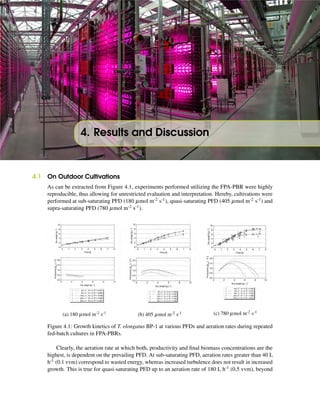
As can be extracted from Figure 4.1, experiments performed utilizing the FPA-PBR were highly
reproducible, thus allowing for unrestricted evaluation and interpretation. Hereby, cultivations were
performed at sub-saturating PFD (180 µmol m-2 s-1), quasi-saturating PFD (405 µmol m-2 s-1) and
supra-saturating PFD (780 µmol m-2 s-1).
(a) 180 µmol m-2 s-1
(b) 405 µmol m-2 s-1 (c) 780 µmol m-2 s-1
Figure 4.1: Growth kinetics of T. elongatus BP-1 at various PFDs and aeration rates during repeated
fed-batch cultures in FPA-PBRs.
Clearly, the aeration rate at which both, productivity and final biomass concentrations are the
highest, is dependent on the prevailing PFD. At sub-saturating PFD, aeration rates greater than 40 L
h-1 (0.1 vvm) correspond to wasted energy, whereas increased turbulence does not result in increased
growth. This is true for quasi-saturating PFD up to an aeration rate of 180 L h-1 (0.5 vvm), beyond
8 Chapter 4. Results and Discussion
which no growth promoting effects were observed. At supra-saturating PFD, maximum productivity
and biomass concentration positively correlates to the applied aeration rate. However, this effect
is predominant only beyond a biomass concentration of 3 g L-1, below which the minimal applied
aeration rate of 0.1 vvm was sufficient to sustain maximum growth.
The results allow for an essential derivation of an optimized operating strategy for FPA-PBRs for
field installations, during which the aeration rate is continuously and automatically adapted using the
prevailing light intensity and biomass concentration as control parameters. By doing so, the procedure
allows for either low-energy cultivation during periods of dim light or low biomass concentration or
for increased productivity during periods of intense light and high biomass concentration.
When applied to actual day courses during microalgal cultivations in Germany, the implementa-
tion of the proposed operating strategy may account for a reduction of required process energy for
aeration of at least 45%, thus significantly decreasing the costs of produced biomass.
4.2 On Indoor Cultivations
When it comes to indoor cultivations utilizing artificial lighting, it is most often applied in a
static manner by applying a distinct PFD. Hereby, an alternative way of reducing the operational
expenditures of culture mixing is represented by the application of intermittent aeration deploying
different pulse settings, presently only described during night time operation outdoors.
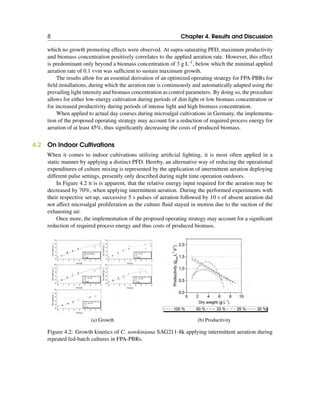
In Figure 4.2 it is is apparent, that the relative energy input required for the aeration may be
decreased by 70%, when applying intermittent aeration. During the performed experiments with
their respective set-up, successive 5 s pulses of aeration followed by 10 s of absent aeration did
not affect microalgal proliferation as the culture fluid stayed in motion due to the suction of the
exhausting air.
Once more, the implementation of the proposed operating strategy may account for a significant
reduction of required process energy and thus costs of produced biomass.
(a) Growth (b) Productivity
Figure 4.2: Growth kinetics of C. sorokiniana SAG211-8k applying intermittent aeration during
repeated fed-batch cultures in FPA-PBRs.
5. Conclusion
! Light attenuation in photobioreactors is evident
! Light attenuation can partially be coped with by adapted aeration
! The aeration rate should be adjusted based on light intensity and biomass concentration
! At high light intensity and high biomass concentration, increased aeration rate provides
increased productivity and a higher maximum biomass concentration
! At low light intensity or low biomass concentration, reduced aeration rate provides decreased
energy consumption
! Managing the aeration rate allows for an energy reduction of up to 45% during outdoor
cultivations
! During indoor cultivations, the application of intermittent aeration allows for an energy
reduction of up to 70%
Notice: No responsibility is assumed by the publisher for any injury and/or damage to persons or property as a matter of products liability, negligence or otherwise, or from
any use or operation of any methods, products, instructions or ideas contained in the material herein. Patent Pending.

Algae cultivation operating strategies

  • 1.
    Industrial Microalgae Cultivation OperatingStrategies to Reduce the Light-specific Energy Input of Flat-Panel Airlift Photobioreactors Peter Bergmann CSO, Subitec GmbH
  • 2.
    c MARCH, 2017 SUBITECGMBH, JULIUS-HÖLDER-STR. 36, 70597 STUTTGART, GERMANY WWW.SUBITEC.COM/EN/ WWW.LINKEDIN.COM/COMPANY/SUBITEC-GMBH INFO@SUBITEC.COM
  • 3.
    Contents 1 Preface .. . . . . . . . . . . . . . . . . . . . . . . . . . . . . . . . . . . . . . . . . . . . . . . . . . . . . . . 4 1.1 Author’s Foreword 4 2 Introduction . . . . . . . . . . . . . . . . . . . . . . . . . . . . . . . . . . . . . . . . . . . . . . . . . . . . 5 2.1 Background 5 2.2 Objective 5 3 Experimental Design . . . . . . . . . . . . . . . . . . . . . . . . . . . . . . . . . . . . . . . . . . . 6 3.1 On Outdoor Cultivations 6 3.2 On Indoor Cultivations 6 3.3 Statistical Treatment 6 4 Results and Discussion . . . . . . . . . . . . . . . . . . . . . . . . . . . . . . . . . . . . . . . . . . 7 4.1 On Outdoor Cultivations 7 4.2 On Indoor Cultivations 8 5 Conclusion . . . . . . . . . . . . . . . . . . . . . . . . . . . . . . . . . . . . . . . . . . . . . . . . . . . . . 9
  • 4.
    1. Preface 1.1 Author’sForeword Dear customers and prospects, dear colleagues and friends, As you may be aware, microalgal biotechnology has great potential to help solving some of the worlds pressing environmental and social threats and helping economies to higher prosperity and sustainability. However, to support such development, the industry needs to continuously develop more sustainable phototrophic production methods that enable higher efficiency at lower costs. Being an established company in our industry with a strong track record for customer specific solutions for producing different phototrophic microorganisms, it is in our interest to invest in and conduct extensive in-house R&D to improve the commercial viability of microalgal biotechnology. What you may not be aware of, is that many things are taking place behind closed doors at our 250 m2 laboratories. Our research staff works tirelessly exploring our tiny photosynthetic friends and generating tons of research data and findings. I now have the pleasure of sharing some of these findings with you and to give you an opportunity to dive deeper into our R&D activities and gain insights and ideas that support your endeavors. This short communication on operating strategies is the first that we are putting out in this format. There will be more similar communications in the future for different topics. Please feel free to give feedback of any kind: questions, amendments, remarks – no matter if positive or negative. I want to encourage communication and discussion on the topics as this is the best way to drive progress. Yours sincerely, Peter Bergmann P.BERGMANN@SUBITEC.COM
  • 5.
    2. Introduction 2.1 Background Forthe economically viable production of microalgal biomass in closed systems at industrial scale, high growth rates over a large range of culture densities are required. In cultures using optimized media and process parameters, especially pH and temperature, light represents the one and only limiting factor. This is mainly due to the effect of mutual cell-shading (absorption). In addition, reflection effects arising from the photobioreactor’s (PBR’s) surface, water column and air bubbles further decrease the light availability. As the result, at least 75% of impinging photons are not efficiently used for assimilatory photosynthesis at full sunlight. Their energy is therefore not converted into biochemical energy necessary for the biosynthesis of organic target molecules, either in from of biomass or high added-value products (HAVs) such as astaxanthin. Thus they are wasted and biomass concentration increases only linearly over time, not efficiently exploiting the full potential of the biological system microalgae. To counteract these limiting effects, convective mass transfer (turbulence by aeration) is essential in order to constantly allocate cells from the dimly lit or rather dark PBR interior to the illuminated surface. Energy is required to generate the turbulence contributing to overall production costs and reflecting a major part of the operational expenditures (OPEX). 2.2 Objective With respect to the preceding context, operating strategies for flat-panel airlift photobioreactors (FPA-PBRs) with intrinsic static mixers were developed. Hereby, two scenarios were taken as the basis for the assessment: • outdoor cultivations prone to fluctuating solar conditions for the production of bulk products and • indoor cultivations with static artificial light supply for the production of HAVs. The work aimed towards a significant decrease of operational expenditures with respect to aeration whilst keeping productivity to a maximum.
  • 6.
    3. Experimental Design 3.1On Outdoor Cultivations Experiments addressing outdoor cultivations were performed in 6 L FPA-PBRs utilizing the ther- mophilic cyanobacterium Thermosynechococcus elongatus BP-1 applying mod. BG 11 medium at 55◦C. Illumination was supplied constantly by high pressure sodium vapor (HPS) lamps with photon flux densities (PFDs) between 180 and 780 µmol m-2 s-1 (sub-saturating to supra-saturating PFDs, data not shown). The aeration rate was varied between 0.11 vvm (40 L h-1) and 0.83 vvm (300 L h-1). CO2 was supplied constantly at 6% v/v. 3.2 On Indoor Cultivations Experiments addressing indoor cultivations were performed in 28 L FPA-PBRs utilizing the green alga Chlorella sorokinaina SAG211-8k applying mod. DSN medium at 25◦C. Illumination was supplied constantly by HPS lamps with a PFD of 370 µmol m-2 s-1. The aeration rate was set to 0.24 vvm (360 L h-1) but was intermittent is distinct intervals (e.g. 5 s on, 5 s off). CO2 was supplied constantly at 5% v/v. 3.3 Statistical Treatment Experiments were performed in duplicates at minimum. The exact number of replicates is stated for each experiment. In order to cope with fluctuations in growth deriving from the biological system as well as technical limits (e.g. slight fluctuations of temperature and CO2 supply) data was evaluated by overlaying the available growth data for given experiments. This procedure also allowed for the presentation of an otherwise vast data pool gained in multiple photobioreactors resulting from randomized experiments. Growth data was fitted to result in a single representative growth curve for each experiment. The fitted growth curves were then differentiated (first derivative) to result in curves of volumetric productivity (Pvol.) over the course of the dry weight (DW).
  • 7.
    4. Results andDiscussion 4.1 On Outdoor Cultivations As can be extracted from Figure 4.1, experiments performed utilizing the FPA-PBR were highly reproducible, thus allowing for unrestricted evaluation and interpretation. Hereby, cultivations were performed at sub-saturating PFD (180 µmol m-2 s-1), quasi-saturating PFD (405 µmol m-2 s-1) and supra-saturating PFD (780 µmol m-2 s-1). (a) 180 µmol m-2 s-1 (b) 405 µmol m-2 s-1 (c) 780 µmol m-2 s-1 Figure 4.1: Growth kinetics of T. elongatus BP-1 at various PFDs and aeration rates during repeated fed-batch cultures in FPA-PBRs. Clearly, the aeration rate at which both, productivity and final biomass concentrations are the highest, is dependent on the prevailing PFD. At sub-saturating PFD, aeration rates greater than 40 L h-1 (0.1 vvm) correspond to wasted energy, whereas increased turbulence does not result in increased growth. This is true for quasi-saturating PFD up to an aeration rate of 180 L h-1 (0.5 vvm), beyond
  • 8.
    8 Chapter 4.Results and Discussion which no growth promoting effects were observed. At supra-saturating PFD, maximum productivity and biomass concentration positively correlates to the applied aeration rate. However, this effect is predominant only beyond a biomass concentration of 3 g L-1, below which the minimal applied aeration rate of 0.1 vvm was sufficient to sustain maximum growth. The results allow for an essential derivation of an optimized operating strategy for FPA-PBRs for field installations, during which the aeration rate is continuously and automatically adapted using the prevailing light intensity and biomass concentration as control parameters. By doing so, the procedure allows for either low-energy cultivation during periods of dim light or low biomass concentration or for increased productivity during periods of intense light and high biomass concentration. When applied to actual day courses during microalgal cultivations in Germany, the implementa- tion of the proposed operating strategy may account for a reduction of required process energy for aeration of at least 45%, thus significantly decreasing the costs of produced biomass. 4.2 On Indoor Cultivations When it comes to indoor cultivations utilizing artificial lighting, it is most often applied in a static manner by applying a distinct PFD. Hereby, an alternative way of reducing the operational expenditures of culture mixing is represented by the application of intermittent aeration deploying different pulse settings, presently only described during night time operation outdoors. In Figure 4.2 it is is apparent, that the relative energy input required for the aeration may be decreased by 70%, when applying intermittent aeration. During the performed experiments with their respective set-up, successive 5 s pulses of aeration followed by 10 s of absent aeration did not affect microalgal proliferation as the culture fluid stayed in motion due to the suction of the exhausting air. Once more, the implementation of the proposed operating strategy may account for a significant reduction of required process energy and thus costs of produced biomass. (a) Growth (b) Productivity Figure 4.2: Growth kinetics of C. sorokiniana SAG211-8k applying intermittent aeration during repeated fed-batch cultures in FPA-PBRs.
  • 9.
    5. Conclusion ! Lightattenuation in photobioreactors is evident ! Light attenuation can partially be coped with by adapted aeration ! The aeration rate should be adjusted based on light intensity and biomass concentration ! At high light intensity and high biomass concentration, increased aeration rate provides increased productivity and a higher maximum biomass concentration ! At low light intensity or low biomass concentration, reduced aeration rate provides decreased energy consumption ! Managing the aeration rate allows for an energy reduction of up to 45% during outdoor cultivations ! During indoor cultivations, the application of intermittent aeration allows for an energy reduction of up to 70% Notice: No responsibility is assumed by the publisher for any injury and/or damage to persons or property as a matter of products liability, negligence or otherwise, or from any use or operation of any methods, products, instructions or ideas contained in the material herein. Patent Pending.