It’s Just….
Alex Schieren
As you’re testing...
! Something you don’t expect happens
! Something crashes
! Something produces an incorrect value
! A test/scenario “fails”
What’s the follow up?
! Conversation?
! ‘Bug Report’
! Meeting
! ….
Somehow this information needs to be communicated
What’s the content of that follow up?
! It should just…
! It didn’t work…
! I clicked and it broke
What information have you provided to allow the problem to be fixed?
How can we improve?
“Just”
I always try to catch myself when I say this
Let’s get one thing
straight… The problem
isn’t that someone
decided to display the
wrong value on screen.
Perception and
Relationships
Differences in
Mental Models &
Thinking
Perspective Matters
Constraints
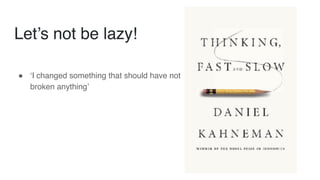
Let’s not be lazy!
! ‘I changed something that should have not
broken anything’
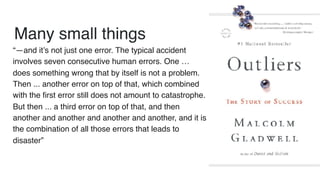
Many small things
“—and it’s not just one error. The typical accident
involves seven consecutive human errors. One …
does something wrong that by itself is not a problem.
Then ... another error on top of that, which combined
with the first error still does not amount to catastrophe.
But then ... a third error on top of that, and then
another and another and another and another, and it is
the combination of all those errors that leads to
disaster”
You already know
that things will go
wrong
Just like Outliers says, often
times it’s many things and not
just one.
This goes for bugs as well as
ways for us to improve ourselves
Learn
! This keeps coming up
! Work with the team to understand the more fragile parts
! Work with the team to understand some nuances
! Work with your team to be a more cohesive unit -- there can be some
negative side effects to this when you all start thinking too similarly.
! Never stop working to improve yourself
Data
Not to be confused with “big data”
LOGS
! Can understand more about the system then you know
! Can generate tests off logs
! Can get metrics what is being used or not used
! Can go back to see if you covered something
! Can understand the flow of data through the system
! Use an artifact when explaining something
! What would be useful information for you to have?
Test more effectively
When you have all these tools and you can continually work on improving yourself
you are invaluable.
Work with your team
Understand
Know what to test
What can you group together
Diagnose!
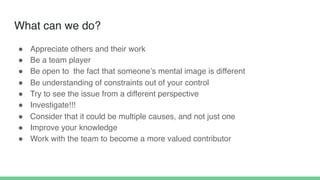
What can we do?
! Appreciate others and their work
! Be a team player
! Be open to the fact that someone’s mental image is different
! Be understanding of constraints out of your control
! Try to see the issue from a different perspective
! Investigate!!!
! Consider that it could be multiple causes, and not just one
! Improve your knowledge
! Work with the team to become a more valued contributor

Alexandra Schieren: It's Just...

  • 1.
  • 2.
    As you’re testing... !Something you don’t expect happens ! Something crashes ! Something produces an incorrect value ! A test/scenario “fails”
  • 3.
    What’s the followup? ! Conversation? ! ‘Bug Report’ ! Meeting ! …. Somehow this information needs to be communicated
  • 4.
    What’s the contentof that follow up? ! It should just… ! It didn’t work… ! I clicked and it broke What information have you provided to allow the problem to be fixed? How can we improve?
  • 5.
    “Just” I always tryto catch myself when I say this
  • 6.
    Let’s get onething straight… The problem isn’t that someone decided to display the wrong value on screen.
  • 7.
  • 8.
  • 9.
  • 10.
  • 11.
    Let’s not belazy! ! ‘I changed something that should have not broken anything’
  • 13.
    Many small things “—andit’s not just one error. The typical accident involves seven consecutive human errors. One … does something wrong that by itself is not a problem. Then ... another error on top of that, which combined with the first error still does not amount to catastrophe. But then ... a third error on top of that, and then another and another and another and another, and it is the combination of all those errors that leads to disaster”
  • 14.
    You already know thatthings will go wrong
  • 15.
    Just like Outlierssays, often times it’s many things and not just one. This goes for bugs as well as ways for us to improve ourselves
  • 16.
    Learn ! This keepscoming up ! Work with the team to understand the more fragile parts ! Work with the team to understand some nuances ! Work with your team to be a more cohesive unit -- there can be some negative side effects to this when you all start thinking too similarly. ! Never stop working to improve yourself
  • 17.
    Data Not to beconfused with “big data”
  • 18.
    LOGS ! Can understandmore about the system then you know ! Can generate tests off logs ! Can get metrics what is being used or not used ! Can go back to see if you covered something ! Can understand the flow of data through the system ! Use an artifact when explaining something ! What would be useful information for you to have?
  • 19.
    Test more effectively Whenyou have all these tools and you can continually work on improving yourself you are invaluable. Work with your team Understand Know what to test What can you group together Diagnose!
  • 20.
    What can wedo? ! Appreciate others and their work ! Be a team player ! Be open to the fact that someone’s mental image is different ! Be understanding of constraints out of your control ! Try to see the issue from a different perspective ! Investigate!!! ! Consider that it could be multiple causes, and not just one ! Improve your knowledge ! Work with the team to become a more valued contributor