Context-Driven Performance
Testing
Alexander Podelko
About the speaker
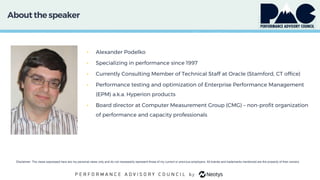
• Alexander Podelko
• Specializing in performance since 1997
• Currently Consulting Member of Technical Staff at Oracle (Stamford, CT office)
• Performance testing and optimization of Enterprise Performance Management
(EPM) a.k.a. Hyperion products
• Board director at Computer Measurement Group (CMG) – non-profit organization
of performance and capacity professionals
Disclaimer: The views expressed here are my personal views only and do not necessarily represent those of my current or previous employers. All brands and trademarks mentioned are the property of their owners.
Context-Driven Testing
•
•
•
•
Context-DrivenTesting
• Context-driven approach was initially introduced by James Bach, Brian
Marick, Bret Pettichord, and Cem Kaner
• http://context-driven-testing.com
• Declared a “school” in 2001 (Lessons Learned in Software Testing)
• Became political
BasicPrinciples
• The value of any practice depends on its context.
• There are good practices in context, but there are no best practices.
• People, working together, are the most important part of any project’s context.
• Projects unfold over time in ways that are often not predictable.
BasicPrinciples
• The product is a solution. If the problem isn’t solved, the product doesn’t work.
• Good software testing is a challenging intellectual process.
• Only through judgment and skill, exercised cooperatively throughout the entire project,
are we able to do the right things at the right times to effectively test our products.
« Traditional» Approach
• Load / Performance Testing is:
• Last moment before deployment
• Last step in the waterfall process
• Checking against given requirements / SLAs
• Throwing it back over the wall if reqs are not met
• System-level
• Realistic workload
• With variations when needed: stress, uptime, etc.
• Lab environment
• Often scale-down
• Protocol level record-and-playback
• Expensive tools requiring special skills
Early Performance Testing
- Exploratory, Continuous
•
•
•
•
Agile Development
• Agile development should be rather a trivial case for performance testing
• You have a working system each iteration to test early by definition.
• You need performance engineer for the whole project
• Savings come from detecting problems early
• You need to adjust requirements for implemented functionality
• Additional functionality will impact performance
The MainIssue on theAgile Side
• It doesn’t [always] work this way in practice
• That is why you have “Hardening Iterations”, “Technical Debt” and similar
notions
• Same old problem: functionality gets priority over performance
The MainIssue on theTestingSide
• Performance Engineering teams don’t scale well
• Even assuming that they are competent and effective
• Increased volume exposes the problem
• Early testing
• Each iteration
• Remedies: automation, making performance everyone’s job
Early Testing– MentalityChange
• Making performance everyone’s job
• Late record/playback performance testing -> Early Performance
Engineering
• System-level requirements -> Component-level requirements
• Record/playback approach -> Programming to generate load/create stubs
• "Black Box" -> "Grey Box”
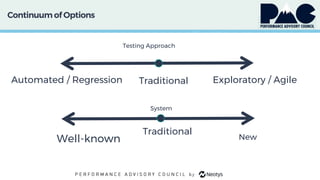
Continuum of Options
NewWell-known
System
Testing Approach
Exploratory / AgileAutomated / Regression
Traditional
Traditional
ExploratoryPerformanceTesting
• Rather alien for performance testing, but probably more relevant than for
functional testing
• We learn about system’s performance as we start to run test
• Only guesses for new systems
• Rather a performance engineering process bringing the system to the
proper state than just testing
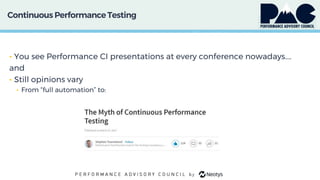
Continuous PerformanceTesting
• You see Performance CI presentations at every conference nowadays….
and
• Still opinions vary
• From “full automation” to:
DifferentPerspectives
• Consultant: need to test the system
• In its current state
• Why bother about automation?
• External or internal
• Performance Engineer
• On an agile team
• Need to test it each build/iteration/sprint/etc.
• Automation Engineer / SDET / etc.
Automation:Considerations
• You need to know the system well enough to make meaningful
automation
• If system is new, overheads are too high
• So almost no automation in traditional environments
• If the same system is tested again and again
• It makes sense to invest in setting up automation
• Automated interfaces should be stable enough
• APIs are usually more stable on early stages
Time/ResourceConsiderations
• Performance tests take time and resources
• The larger tests, the more
• May be not an option on each check-in
• Need of a tiered solution
• Some performance measurements each build
• Daily mid-size performance tests
• Periodic large-scale / uptime tests outside CI
Automation:Limitations
• Works great to find regressions and check against requirements
• Doesn’t cover:
• Exploratory tests
• Large scale / scope / duration / volume
• “Full Automation” doesn’t look like a real option, should be a combination
Environment / Scope / Granularity
•
•
•
•
Environment
• Cloud
• No more excuse of not having hardware
• Lab vs. Service (SaaS) vs. Cloud (IaaS)
• For both the system and load generators
• Test vs. Production
Scenarios
• System validation for high load
• Outside load (service or cloud), production system
• Wider scope, lower repeatability
• Performance optimization / troubleshooting
• Isolated lab environment
• Limited scope, high repeatability
• Testing in Cloud
• Lowering costs (in case of periodic tests)
• Limited scope, low repeatability
Find Your Way
• If performance risk is high it may be a combination of environments, e.g.
• Outside tests against the production environment to test for max load
• Lab for performance optimization / troubleshooting
• Limited performance environments to be used as part of continuous integration
Scope / Granularity
• System level
• Component level
• Service Virtualization, etc.
• Server time
• Server + Network (WAN simulation, etc.)
• End-to-end (User Experience)
• Each may require different approach / tools
Load Generation
•
•
•
•
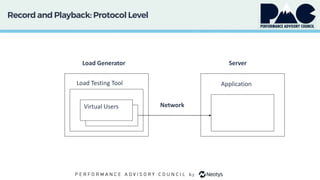
Record and Playback: Protocol Level
Load Testing Tool
Virtual Users
ServerLoad Generator
Application
Network
Considerations
• Usually doesn't work for testing components
• Each tool support a limited number of technologies (protocols)
• Some technologies are very time-consuming
• Workload validity in case of sophisticated logic on the client side is not
guaranteed
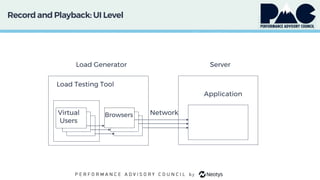
Record and Playback: UI Level
Load Testing Tool
Virtual
Users
ServerLoad Generator
Application
NetworkBrowsers
Considerations
• Scalability
• Still require more resources
• Supported technologies
• Timing accuracy
• Playback accuracy
• For example, for HtmlUnit
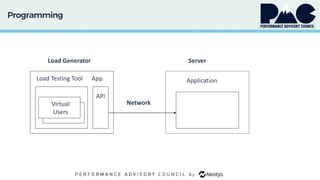
Programming
Load Testing Tool App.
ServerLoad Generator
Application
Network
API
Virtual
Users
Considerations
• Requires programming / access to APIs
• Tool support
• Extensibility
• Language support
• May require more resources
• Environment may need to be set
Production Workload
• A/B testing, canary testing
• Should work well if
• homogenous workloads and a way to control them precisely
• potential issues have minimal impact on user satisfaction and company image and you
can easily rollback the changes
• fully parallel and scalable architecture
Performance testing/Engineering Strategy
•
•
•
•
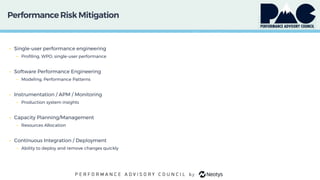
PerformanceRisk Mitigation
• Single-user performance engineering
• Profiling, WPO, single-user performance
• Software Performance Engineering
• Modeling, Performance Patterns
• Instrumentation / APM / Monitoring
• Production system insights
• Capacity Planning/Management
• Resources Allocation
• Continuous Integration / Deployment
• Ability to deploy and remove changes quickly
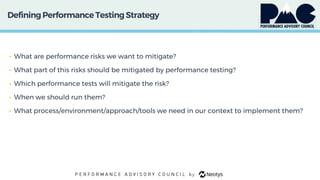
DefiningPerformanceTestingStrategy
• What are performance risks we want to mitigate?
• What part of this risks should be mitigated by performance testing?
• Which performance tests will mitigate the risk?
• When we should run them?
• What process/environment/approach/tools we need in our context to implement them?
Examples
• Handling full/extra load
• System level, production[-like env], realistic load
• Catching regressions
• Continuous testing, limited scale/env
• Early detection of performance problems
• Exploratory tests, targeted workload
• Performance optimization/investigation
• Dedicated env, targeted workload
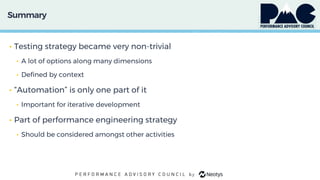
Summary
• Testing strategy became very non-trivial
• A lot of options along many dimensions
• Defined by context
• “Automation” is only one part of it
• Important for iterative development
• Part of performance engineering strategy
• Should be considered amongst other activities
Questions?
Alexander Podelko
alex.podelko@oracle.com
apodelko@yahoo.com
alexanderpodelko.com/blog
@apodelko
Thank you

Alexander Podelko - Context-Driven Performance Testing

  • 1.
  • 2.
    About the speaker •Alexander Podelko • Specializing in performance since 1997 • Currently Consulting Member of Technical Staff at Oracle (Stamford, CT office) • Performance testing and optimization of Enterprise Performance Management (EPM) a.k.a. Hyperion products • Board director at Computer Measurement Group (CMG) – non-profit organization of performance and capacity professionals Disclaimer: The views expressed here are my personal views only and do not necessarily represent those of my current or previous employers. All brands and trademarks mentioned are the property of their owners.
  • 3.
  • 4.
    Context-DrivenTesting • Context-driven approachwas initially introduced by James Bach, Brian Marick, Bret Pettichord, and Cem Kaner • http://context-driven-testing.com • Declared a “school” in 2001 (Lessons Learned in Software Testing) • Became political
  • 5.
    BasicPrinciples • The valueof any practice depends on its context. • There are good practices in context, but there are no best practices. • People, working together, are the most important part of any project’s context. • Projects unfold over time in ways that are often not predictable.
  • 6.
    BasicPrinciples • The productis a solution. If the problem isn’t solved, the product doesn’t work. • Good software testing is a challenging intellectual process. • Only through judgment and skill, exercised cooperatively throughout the entire project, are we able to do the right things at the right times to effectively test our products.
  • 7.
    « Traditional» Approach •Load / Performance Testing is: • Last moment before deployment • Last step in the waterfall process • Checking against given requirements / SLAs • Throwing it back over the wall if reqs are not met • System-level • Realistic workload • With variations when needed: stress, uptime, etc. • Lab environment • Often scale-down • Protocol level record-and-playback • Expensive tools requiring special skills
  • 8.
    Early Performance Testing -Exploratory, Continuous • • • •
  • 9.
    Agile Development • Agiledevelopment should be rather a trivial case for performance testing • You have a working system each iteration to test early by definition. • You need performance engineer for the whole project • Savings come from detecting problems early • You need to adjust requirements for implemented functionality • Additional functionality will impact performance
  • 10.
    The MainIssue ontheAgile Side • It doesn’t [always] work this way in practice • That is why you have “Hardening Iterations”, “Technical Debt” and similar notions • Same old problem: functionality gets priority over performance
  • 11.
    The MainIssue ontheTestingSide • Performance Engineering teams don’t scale well • Even assuming that they are competent and effective • Increased volume exposes the problem • Early testing • Each iteration • Remedies: automation, making performance everyone’s job
  • 12.
    Early Testing– MentalityChange •Making performance everyone’s job • Late record/playback performance testing -> Early Performance Engineering • System-level requirements -> Component-level requirements • Record/playback approach -> Programming to generate load/create stubs • "Black Box" -> "Grey Box”
  • 13.
    Continuum of Options NewWell-known System TestingApproach Exploratory / AgileAutomated / Regression Traditional Traditional
  • 14.
    ExploratoryPerformanceTesting • Rather alienfor performance testing, but probably more relevant than for functional testing • We learn about system’s performance as we start to run test • Only guesses for new systems • Rather a performance engineering process bringing the system to the proper state than just testing
  • 15.
    Continuous PerformanceTesting • Yousee Performance CI presentations at every conference nowadays…. and • Still opinions vary • From “full automation” to:
  • 16.
    DifferentPerspectives • Consultant: needto test the system • In its current state • Why bother about automation? • External or internal • Performance Engineer • On an agile team • Need to test it each build/iteration/sprint/etc. • Automation Engineer / SDET / etc.
  • 17.
    Automation:Considerations • You needto know the system well enough to make meaningful automation • If system is new, overheads are too high • So almost no automation in traditional environments • If the same system is tested again and again • It makes sense to invest in setting up automation • Automated interfaces should be stable enough • APIs are usually more stable on early stages
  • 18.
    Time/ResourceConsiderations • Performance teststake time and resources • The larger tests, the more • May be not an option on each check-in • Need of a tiered solution • Some performance measurements each build • Daily mid-size performance tests • Periodic large-scale / uptime tests outside CI
  • 19.
    Automation:Limitations • Works greatto find regressions and check against requirements • Doesn’t cover: • Exploratory tests • Large scale / scope / duration / volume • “Full Automation” doesn’t look like a real option, should be a combination
  • 20.
    Environment / Scope/ Granularity • • • •
  • 21.
    Environment • Cloud • Nomore excuse of not having hardware • Lab vs. Service (SaaS) vs. Cloud (IaaS) • For both the system and load generators • Test vs. Production
  • 22.
    Scenarios • System validationfor high load • Outside load (service or cloud), production system • Wider scope, lower repeatability • Performance optimization / troubleshooting • Isolated lab environment • Limited scope, high repeatability • Testing in Cloud • Lowering costs (in case of periodic tests) • Limited scope, low repeatability
  • 23.
    Find Your Way •If performance risk is high it may be a combination of environments, e.g. • Outside tests against the production environment to test for max load • Lab for performance optimization / troubleshooting • Limited performance environments to be used as part of continuous integration
  • 24.
    Scope / Granularity •System level • Component level • Service Virtualization, etc. • Server time • Server + Network (WAN simulation, etc.) • End-to-end (User Experience) • Each may require different approach / tools
  • 25.
  • 26.
    Record and Playback:Protocol Level Load Testing Tool Virtual Users ServerLoad Generator Application Network
  • 27.
    Considerations • Usually doesn'twork for testing components • Each tool support a limited number of technologies (protocols) • Some technologies are very time-consuming • Workload validity in case of sophisticated logic on the client side is not guaranteed
  • 28.
    Record and Playback:UI Level Load Testing Tool Virtual Users ServerLoad Generator Application NetworkBrowsers
  • 29.
    Considerations • Scalability • Stillrequire more resources • Supported technologies • Timing accuracy • Playback accuracy • For example, for HtmlUnit
  • 30.
    Programming Load Testing ToolApp. ServerLoad Generator Application Network API Virtual Users
  • 31.
    Considerations • Requires programming/ access to APIs • Tool support • Extensibility • Language support • May require more resources • Environment may need to be set
  • 32.
    Production Workload • A/Btesting, canary testing • Should work well if • homogenous workloads and a way to control them precisely • potential issues have minimal impact on user satisfaction and company image and you can easily rollback the changes • fully parallel and scalable architecture
  • 33.
  • 34.
    PerformanceRisk Mitigation • Single-userperformance engineering • Profiling, WPO, single-user performance • Software Performance Engineering • Modeling, Performance Patterns • Instrumentation / APM / Monitoring • Production system insights • Capacity Planning/Management • Resources Allocation • Continuous Integration / Deployment • Ability to deploy and remove changes quickly
  • 35.
    DefiningPerformanceTestingStrategy • What areperformance risks we want to mitigate? • What part of this risks should be mitigated by performance testing? • Which performance tests will mitigate the risk? • When we should run them? • What process/environment/approach/tools we need in our context to implement them?
  • 36.
    Examples • Handling full/extraload • System level, production[-like env], realistic load • Catching regressions • Continuous testing, limited scale/env • Early detection of performance problems • Exploratory tests, targeted workload • Performance optimization/investigation • Dedicated env, targeted workload
  • 37.
    Summary • Testing strategybecame very non-trivial • A lot of options along many dimensions • Defined by context • “Automation” is only one part of it • Important for iterative development • Part of performance engineering strategy • Should be considered amongst other activities
  • 38.
  • 39.