1
Alcohol: Addiction and Study
Rehearsal
ARN 2014
Mexico
2
Thanks
To our Professor for accepting our project and encouraging us to surpass ourselves in
knowledge and responsiveness.
To my colleagues, partners and friends Lucero and Elías who as a team have become a
molecule of knowledge and have tirelessly invested more than 300 man-hours in defining,
building, researching, contributing, delimiting and grounding all aspects of this project.
To the National Polytechnic Institute (IPN), to the National School of Medicine and
Homeopathy (ENMH), which shelters us and allows us as students (universitas magistrorum
et scholarium), to self-analyze from our perspective and approach the medical challenges,
which under its tutelage, preparation and confidence, we are doctors, contributors and actors
of a firm and sustained, well-founded and scientific solution.
Thank you
The day that as doctors and scientists, we investigate under the sole premise of wanting to
help humanity, that day knowledge will be obtained as clear as water and as solid as
diamond. ARN 2014
3
Content
1.- Definition
2.- Concept
3.- Theories
4.- Current situation: •World, •Latin America, •Mexico
5.- WHO classification of the disease
6.- Risk factors
7.- Etiology
8.- Anatomy
9.- Anthropology
10.- Physiology
11.- Neurobiology of addiction
12.- Complications
13.- Signs and symptoms
14- Diagnosis
15.- Prevention
16- Treatment
17.- Background (not included)
18.- Problem statement
19.- Protocol objectives
20.- Variables
21.- Hypothesis
22.- Justification
23.- Research design (not included)
24.- Schedules
25.- Procedure
26.- Results (not included)
27.- Analysis of the results (not included)
28.- Discussion of the results
29.- Conclusion of the results
30.- General conclusion and results
31.- Suggestions
4
1.- Definition
Currently, the harmful use of alcohol and drug consumption is one of the biggest public
health problems in the world, due to its high social and economic cost; registering in youth.1
The concept of alcoholism encompasses both addictive behavior to alcohol, as well as the
set of somatic and psychological problems or disorders caused by the use/abuse and
dependence on this substance.
It is considered one of the toxins that accompany and sometimes destroy the bio-psycho-
social environment of the individual and his own life; alcohol addiction is a major physical
health problem.2
The World Health Organization (WHO) states the following: ―Alcoholics are those heavy
drinkers whose dependence on alcohol has reached such a degree that they present notable
mental disorders or interference with their mental or physical health, with their interpersonal
relationships and their social functioning. and economic, or they have clear signs of a
tendency to orient themselves towards such symptoms. That is why, then, such people
require treatment.
2.- Concept
As a more current concept of alcoholism we can cite the proposal by Edwards (1986a) who
points out that alcoholism supposes the establishment of the subject's dependence on
drinking, which manifests itself with the following symptoms:
• Loss of control over drinking, which can manifest itself at the start of consumption
or at the end of consumption once started.
• Need to consume alcohol on an empty stomach, to drink at various times of the
day and to do so before events that cause stress.
• Onset of withdrawal syndrome when you stop drinking, which disappears when you
resume drinking.
• Alcohol tolerance.
• Progressive abandonment of other sources of satisfaction.
• Loss of job, family or friends due to drinking, is
1 V. Vinet Eugenia; Faundez Ximena. Alcohol and drug use in adolescents evaluated through
the MMPI-A. Mental Health 2012.
2 National Autonomous University of Mexico. Alcoholism. Notions, Consequences and Self-assessment
5
In other words, consumption persists despite its harmful consequences.
• Short-term memory deficit.
• Loss of awareness of reality and denial of the disease.
3.- Theory
Alcoholism is a problem that has little to do with the type of alcohol consumed, how long one
has been drinking, or the exact amount of alcohol consumed. However, alcoholism has a lot
to do with the person's uncontrollable urge to drink. This definition of alcoholism helps us
understand why for most alcoholics a "little bit of willpower" is not enough to stop drinking.
In science, there are many possible causes of alcoholism. As Marty, M (1969) refers -...it
seems that alcoholism, like fever, is symptomatic of an almost unlimited variety of causes...-
Alcoholism has an origin, for some scientists, physiological; while for another group of
scientists, its origin comes from a psychological factor.
In order to explain the factors that can influence or determine the appearance of alcoholism,
various psychological, sociocultural and biological theories have been elaborated; from
which fundamental conclusions are obtained, being impossible to generalize to the social
stratum, race, creed, age, sex, profession, in a single theory. 3
In countries like Africa and Asia, a large part of the old social controls that existed have been
lost, while in Western countries a lifestyle characterized by excessive consumption has
developed, which has resulted in nearly 70% of The world population consumes beverages
in different proportions. However, alcohol consumption varies by geographic area, being
more common in urban areas than in rural areas.
Social costs appear among people of any socioeconomic level, having a high prevalence
among people of high social classes. As much as in the direct and indirect purchase and
sale, they have been estimated at more than 150 billion dollars,
3 Andres Bello Catholic University. Alcoholism: Generating Factor of Criminogenic Behaviors in
the Intrafamily Environment. March, 2003
6
fundamentally valued in losses in production, health care, accidents and crimes.
More men than women consume alcohol in most countries, however these figures have
been equalizing in recent years, since currently for every three men a woman also drinks. In
men, alcoholism is more intense between the ages of 18 and 20 approximately; while in
women the rate of alcohol consumption varies between the ages of 25 and 29.4
These theories are not mutually exclusive, since they allow us to realize that we are facing
a disease with serious repercussions, which causes alterations in the organism and the
psyche of any subject that suffers from it.
1. Psychological Theories.
They study the relationship between disorders and alcoholism. However
psychological differences are found among alcoholics.
Among these are:
a. Anxiety Reduction Theory.
They are based on the ability of alcohol to eliminate tensions; however, the
effect of the drink is not the same in all people, since the effects of alcohol
depend on the dose of ethanol, the social circumstances and the individual's
point of the alcoholic curve.
Some alcoholics and regular drinkers say that alcohol helps them relax and
feel safe in difficult situations.
b. Reinforcement Theories.
They are based on the premise that people start drinking, abusing alcohol, or
simply drink because alcohol gives them satisfaction. Counting two types of
reinforcement. Positive reinforcement can be found in the approval of
friendships, social relationships, stress relief, and the feeling of
independence and power it produces. However, the negative reinforcement
is found in the self-destructive tendency, elimination of unpleasant memories
and violations of any kind.
4 Martinez H, Alejandra. Female Alcoholism: Social Problems. The Window, No. 16/ 2002.
7
c. Transactional Theories.
The onset of alcoholism and its persistence are due to communication
problems, which worsen as the disease progresses. Alcoholism is a form of
interaction between the alcoholic and his family, who use alcohol and its
consequences as an excuse for his behavior.
d. Psychodynamic Theories.
This approach coincides with behaviorist theories by stating that the alcoholic
tries to satisfy some personal need with the drink.
Some other theories attribute the origin of alcoholism to the desire to
overcome feelings of inferiority or experience a sense of power. As well as
the need that human beings have for affection and to feel that others care
about them.
e. Personality theories.
They are based on the statement that alcoholism is associated with various
personality traits, having many points in common with Psychodynamic
Theories.
Some investigations have found that alcoholic individuals have a marked
elevation of depression and psychopathic disorders. Some other jobs reflect
problems of aggressiveness and difficulty controlling their impulses.
2. Sociocultural theories.
This model is applied to the study of the historical aspects of alcohol abuse, to the
comparative study of different cultures, to the analysis of its meaning, and to the
promotion of and for society.
Sociocultural theories can be related to drinking habits, and problems arising as a
result of it.
3. Biological Theories.
a. Physiological Theories.
8
Alcoholics present too many physiological alterations, since the deterioration
occurs as a consequence of prolonged alcohol intake and a deficient diet;
just as the chemical substances present in alcohol induce a substance similar
to morphine in the brain, which would be responsible for alcoholic addiction.
b. Genetic theories.
Various theories try to explain the etiology of alcoholism from a genetic point
of view; however, it has not been possible to verify even after various studies
have been carried out, since more than anything it affects a psychological,
sociocultural influence.
4.- Current situation
4.1.- World
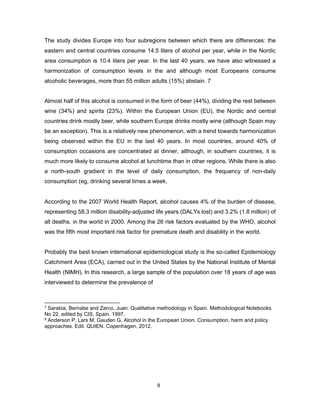
According to the latest report published by the UN Office on Drugs and Crime (UNODC
2012), global estimates indicate that the prevalence of alcohol use during the month prior to
data collection is 42% (taking into account account that alcohol consumption is legal in most
countries), a figure that is eight times higher than the annual prevalence of illicit drug use
(5.0%). The prevalence of heavy episodic weekly alcohol use is eight times higher than
problematic use of illegal drugs. Drug use accounts for 0.9% of total disability-adjusted life
years lost globally, or 10% of total life years lost as a result of the use of psychoactive
substances (drugs, alcohol and tobacco). 5
Europe is the region of the world where more alcohol is consumed, despite the decrease
observed in relation to the data known for the 70s, which placed the consumption of pure
alcohol per adult/year at 15 litres. European adults aged 15 and over consume an average
of 12.5 liters of alcohol, more than anywhere else in the world, according to a recent joint
study by the World Health Organization and the European Commission.6
5 Erickson, F.: Qualitative Research Methods on Teaching. In MC Wittrock (Ed.), The Research of Teaching.
Madrid. Piados-MEC. 1989.
6 Anderson P, Lars M, Gauden G 2012
9
The study divides Europe into four subregions between which there are differences: the
eastern and central countries consume 14.5 liters of alcohol per year, while in the Nordic
area consumption is 10.4 liters per year. In the last 40 years, we have also witnessed a
harmonization of consumption levels in the and although most Europeans consume
alcoholic beverages, more than 55 million adults (15%) abstain. 7
Almost half of this alcohol is consumed in the form of beer (44%), dividing the rest between
wine (34%) and spirits (23%). Within the European Union (EU), the Nordic and central
countries drink mostly beer, while southern Europe drinks mostly wine (although Spain may
be an exception). This is a relatively new phenomenon, with a trend towards harmonization
being observed within the EU in the last 40 years. In most countries, around 40% of
consumption occasions are concentrated at dinner, although, in southern countries, it is
much more likely to consume alcohol at lunchtime than in other regions. While there is also
a north-south gradient in the level of daily consumption, the frequency of non-daily
consumption (eg, drinking several times a week,
According to the 2007 World Health Report, alcohol causes 4% of the burden of disease,
representing 58.3 million disability-adjusted life years (DALYs lost) and 3.2% (1.8 million) of
all deaths. in the world in 2000. Among the 26 risk factors evaluated by the WHO, alcohol
was the fifth most important risk factor for premature death and disability in the world.
Probably the best known international epidemiological study is the so-called Epidemiology
Catchment Area (ECA), carried out in the United States by the National Institute of Mental
Health (NIMH). In this research, a large sample of the population over 18 years of age was
interviewed to determine the prevalence of
7 Sarabia, Bernabe and Zarco, Juan. Qualitative methodology in Spain. Methodological Notebooks
No 22. edited by CIS, Spain. 1997.
8 Anderson P, Lars M, Gauden G. Alcohol in the European Union. Consumption, harm and policy
approaches. Edit. QUIEN. Copenhagen, 2012.
10
different mental disorders among which were alcohol abuse and dependence.
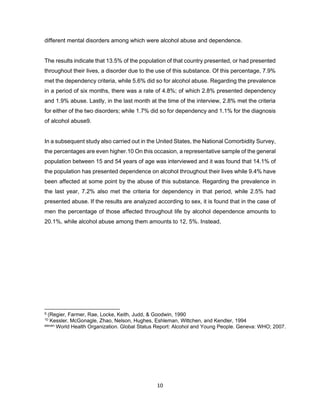
The results indicate that 13.5% of the population of that country presented, or had presented
throughout their lives, a disorder due to the use of this substance. Of this percentage, 7.9%
met the dependency criteria, while 5.6% did so for alcohol abuse. Regarding the prevalence
in a period of six months, there was a rate of 4.8%; of which 2.8% presented dependency
and 1.9% abuse. Lastly, in the last month at the time of the interview, 2.8% met the criteria
for either of the two disorders; while 1.7% did so for dependency and 1.1% for the diagnosis
of alcohol abuse9.
In a subsequent study also carried out in the United States, the National Comorbidity Survey,
the percentages are even higher.10 On this occasion, a representative sample of the general
population between 15 and 54 years of age was interviewed and it was found that 14.1% of
the population has presented dependence on alcohol throughout their lives while 9.4% have
been affected at some point by the abuse of this substance. Regarding the prevalence in
the last year, 7.2% also met the criteria for dependency in that period, while 2.5% had
presented abuse. If the results are analyzed according to sex, it is found that in the case of
men the percentage of those affected throughout life by alcohol dependence amounts to
20.1%, while alcohol abuse among them amounts to 12, 5%. Instead,
9 (Regier, Farmer, Rae, Locke, Keith, Judd, & Goodwin, 1990
10 Kessler, McGonagle, Zhao, Nelson, Hughes, Eshleman, Wittchen, and Kendler, 1994
eleven World Health Organization. Global Status Report: Alcohol and Young People. Geneva: WHO; 2007.
11
12
12 Health Secretary. Action Program: Addictions. Alcoholism and Abuse of Alcoholic Beverages.
12
4.2.- Latin America
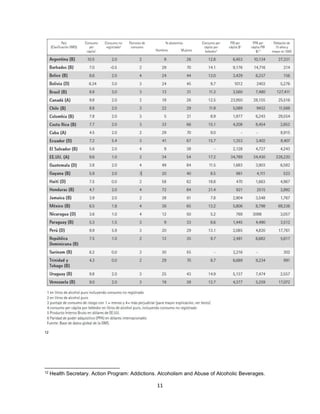
In the year 2000, alcohol was the most important risk factor for health in the Americas in
low- and middle-income countries (including Brazil, Mexico, and most Latin American
countries). Alcohol consumption in Latin America is approximately 40% higher than the
world average. 13
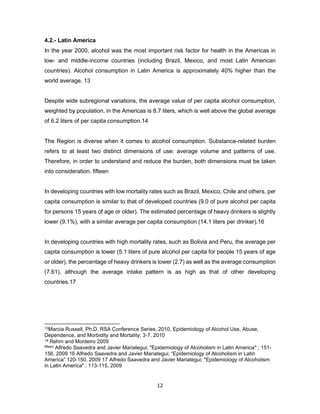
Despite wide subregional variations, the average value of per capita alcohol consumption,
weighted by population, in the Americas is 8.7 liters, which is well above the global average
of 6.2 liters of per capita consumption.14
The Region is diverse when it comes to alcohol consumption. Substance-related burden
refers to at least two distinct dimensions of use: average volume and patterns of use.
Therefore, in order to understand and reduce the burden, both dimensions must be taken
into consideration. fifteen
In developing countries with low mortality rates such as Brazil, Mexico, Chile and others, per
capita consumption is similar to that of developed countries (9.0 of pure alcohol per capita
for persons 15 years of age or older). The estimated percentage of heavy drinkers is slightly
lower (9.1%), with a similar average per capita consumption (14.1 liters per drinker).16
In developing countries with high mortality rates, such as Bolivia and Peru, the average per
capita consumption is lower (5.1 liters of pure alcohol per capita for people 15 years of age
or older), the percentage of heavy drinkers is lower (2.7) as well as the average consumption
(7.61), although the average intake pattern is as high as that of other developing
countries.17
13Marcia Russell, Ph.D. RSA Conference Series, 2010, Epidemiology of Alcohol Use, Abuse,
Dependence, and Morbidity and Mortality; 3-7, 2010
14 Rehm and Monteiro 2009
fifteen Alfredo Saavedra and Javier Mariategui; "Epidemiology of Alcoholism in Latin America" ; 151-
156, 2009 16 Alfredo Saavedra and Javier Mariategui; “Epidemiology of Alcoholism in Latin
America” 120-150, 2009 17 Alfredo Saavedra and Javier Mariategui; "Epidemiology of Alcoholism
in Latin America" ; 113-115, 2009
13
4.3.- Mexico
In Mexico, more than 32 million people between the ages of 12 and 65 consume alcoholic
beverages. 19.1 million are men and 13.3 are women.
In Mexico, according to data from the federal government (Secretary of Health and the
National Council Against Addictions), practically eight out of ten men (79%) and five out of
ten women (53%) have consumed alcohol at some time in their lives. . In the country there
are more than 32 million people between 12 and 65 years of age who are drinkers. Are
19.1 million men and 13.3 million women.
But that's not the problem, it's this: three out of ten men (31%) and 6% of women drink
excessive amounts (at least five drinks on each occasion). There are more than 14 million
people (14.2 million) who drink alcohol "under patterns that put their health and that of third
parties at risk." Of that number, more than three million Mexicans drink excessively at least
once a week.
And the most serious: another 3.3 million Mexicans have "severe dependence" on alcohol.
Of the total number of addicts, more than a million and a half require not only "outpatient
treatment" (for example, Alcoholics Anonymous meetings), but also "residential treatment"
(admissions to detoxification and rehabilitation clinics), since their "high-grade" addiction "
causes them a huge "social dysfunction".
Taking care of them would represent for the Mexican State (only three out of ten alcoholics
receive external or internal treatment) a cost of 1.2 billion pesos per year. That is, one
hundred million pesos a month, 3.2 million pesos a day.
This public health problem has severe economic and health consequences:
-One in ten pesos spent by the health sector in the country is allocated to treat conditions
associated with alcohol abuse, such as cirrhosis of the liver, injuries from vehicle accidents,
dependency, and homicides.
14
-Four out of ten people who have attempted suicide (44%) have done so under the influence
of alcohol. In seven out of ten completed suicides (77%) the victim was intoxicated with
alcohol.
-The main cause of violence against women is excessive alcohol consumption: in six out of
ten cases of violent women, his partner, he, or both, were drunk.
-In five out of ten homicides the victim was drunk.
-One in ten Mexicans claims to have labor problems due to their alcohol consumption. In
fact, in 10% of deaths due to work accidents, the person affected had ingested alcohol.
-The first cause in Mexico of the so-called Days Lived with Disability (DALY'S), according to
the WHO, is alcohol abuse (6.2% of cases). They are followed by arterial hypertension and
smoking.
-In Mexico, an average of 400,000 traffic accidents are reported each year (Pan American
Health Organization, PAHO), 1,95 every day, 45 every hour, at least one every 1.8 minutes.
-Six out of ten fatal traffic accidents (60%) are related to alcohol abuse: the victims had high
levels of liquid in their blood. 54% of these mishaps occurred Thursday, Friday and Saturday.
- Accidents, which have grown 600% in 15 years, represent the fourth leading cause of
national death: 36 thousand people killed per year, 98 per day, four every hour, one every
15 minutes.
-For every death, more than two additional people are disabled (WHO): 90 thousand a year,
246 per day, ten every hour, one every 7.5 minutes.
15
- 35% of traffic accidents with serious injuries are also caused by excess alcohol. 43% of
the injured take up to a year to return to work.
-In nine out of ten accidents where drunken people are involved, there is some type of
physical damage to those affected: pilot, co-pilot, passengers, or third parties, such as
drivers of other vehicles and pedestrians (National Institute of Public Health).
-Losses due to crashes represent up to 2% of the Gross Domestic Product.
-The hospital cost to care for the victims of these 400,000 annual crashes is 6,600 million
pesos a year, 18 million pesos every day, 753,000 pesos per hour.
-Four out of ten accidents (45%) on public roads (not counting vehicular ones) are related
to people under the influence of alcohol.
-One in five people (21%) who enter the emergency services in the country have alcohol in
their blood, practically double that in the United States (11%). Among those who came to
hospitals for trauma and injury, 27% of men and 4% of women had alcohol in their blood.
As an example, in the Federal District, according to the Forensic Medical Service, 848
people died in 2006 under "ethyl intoxication." There were two people a day, one every 12
hours. Why did they die? In the first place, due to traffic accidents (32.7%).
Second, for homicide (quarrels, assaults, revenge, 23.2%). In fourth place, due to suicide
(13.7%).
In third place there were 156 "natural" deaths (18.5%) where people were under the
influence of "ethyl intoxication or other substances". That is to say, it is presumed that they
died... of a drunkenness or a passion. Thirteen people a month died like this. Three every
week.
16
Our country has extensive experience in epidemiological and qualitative research on alcohol
consumption. Since the 1970s, studies have been carried out in Mexico with the same
methodology, using uniform collection and analysis techniques for each type of population
studied, which allow us to know the global panorama of the phenomenon of drug use in
different scenarios such as such as the home, schools, and treatment centers.18
Below are the results produced by various institutions as well as by studies carried out in
the country, as a preamble and reference to the results found in the National Survey of
Addictions 2011. 19
Household Surveys20
Various household surveys have been carried out in our country in relation to the use of
substances. Some of them are nationally representative, such as the National Addiction
Survey (ENA) (Secretaría de Salud, 1990, 1994, 1998, 2003, 2009).
Surveys have also been carried out in different cities of the Republic such as Tijuana, Ciudad
Juárez, Monterrey, Querétaro and Yucatán, in 2005.21
The ENA, carried out periodically, has the purpose of measuring the evolution of substance
use and other mental health problems. The last survey carried out in 2008 shows that in
terms of alcohol, abuse/dependence increased from 4.1% in 2002 to 5.5% in 2008. By sex,
both had significant increases (8.3% to 9.7% in men and 0.4% to 1.7% in women).
Student Surveys22
In the country, unfortunately there is still no recent national survey on students. However,
the work with various states has made it possible to have surveys on middle, high school
and college students in Nuevo León (2006), Jalisco and the State of Mexico (2009), as well
as in Mexico City, which has
18 Rodriguez, G.; Gil, J. And García, E.: Qualitative Research Methodology. Cistern Editorial. Spain.
1999. 19 Calderón, G. Campillo, C. Suárez, C. Community Responses to Alcohol-Related
Problems. Mexico: WHO-IMP Monograph.
twenty Gutiérrez R. Databases on alcohol statistics. Alcohol Information Center. Mexican Institute of
Psychiatry. Mexico City, Mexico.
twenty-one Rojas, Fleiz, Villatoro, Gutiérrez & Medina-Mora, 2009
22 Epidemiology of Alcohol Consumption UN (UNODC 2012); 36-39, 2010
17
with periodic measurements (every 3 years). There is another group of surveys in this
population that have been reported in the 2008 National Survey of Addictions.
The measurement carried out in Nuevo León23 reports, in relation to alcohol
consumption at some time, this was 43.9% where 44.6% were men and 43.2% women.
For its part, in Jalisco24 it was found with respect to alcohol consumption at some time, its
prevalence in the population was 65.1%, 65.3% in men and 64.9% in women.
In the survey of the State of Mexico25 it is reported in relation to alcohol consumption at
some time, the prevalence in students was 70.8%, with women registering a higher alcohol
consumption (71.9%) in relation to men (69.7%). .
Finally, the measurements of 2006 and 2009 carried out in Mexico City26 regarding alcohol
consumption at some time, in 2006 the prevalence was 68.8% (men 68.2% and women
69.4%); for 2009 this figure increased to 71.4%, being the same percentage for both sexes.
Employee Surveys27
The consumption of psychoactive substances is widespread in the general population, with
the most prevalent consumption being legal substances such as alcohol. In addition to the
strictly health consequences, consumption has repercussions in other areas, including the
social and economic and more specifically in the labor situation and employment and work
conditions.
Focusing on the work environment, alcohol consumption can have important repercussions
for workers, both because it affects the performance of the tasks they have to carry out in
their work environment and because of the socio-sanitary problems that it can generate in
the workplace. family and individual. In addition, in some cases the consumption of these
substances can affect third parties, contributing to cause accidents at work.
23 Villatoro, Gutiérrez, Quiroz, Juárez & Medina Mora, 2007
24 Chávez, Villatoro, Robles, Bretón, Sánchez, et al., 2010
25 Martín del Campo, Villatoro, Mosqueda, Gaytán, López, et al., 2009
26 Villatoro et al, 2009; 2011
27 Epidemiology of Alcohol Consumption UN (UNODC 2012);24-27, 2010
18
Some studies show that job insecurity has considerable effects on alcohol use, while the
characteristics of the activity itself have smaller effects. The complex relationship between
employment and consumption of psychoactive substances is, at present, of special interest,
as a result of the economic crisis we are experiencing, which could influence how the
population behaves towards drug consumption. 28
The results of the survey confirm that, as in the general population, alcohol is the most
consumed psychoactive drug in the working population. The prevalence of consumption at
some point in life is 92.7% in men and 87.6% in women, in the last 12 months it is 82.4% in
men and 71.3 in women, in the last 30 days it is 73 7% in men and 53.8% in women and
daily consumption is 15.3% and 4.7% in men and women respectively.
Risk drinkers (more than 20 cc/day for women and more than 30 cc/day for men) are
considered 12.2% of men and 4.9% of women and high-risk drinkers (> 50cc/ day men and
> 30 cc/day women) 5.0% of men and 2.3% of women. 26.5% of men and 14.0% of women
have gotten drunk in the last year. Alcohol binge drinking or binge drinking (consumption of
5 or more standard units of alcohol in an approximate interval of two hours) stands at 19.7%
and 7.7% in men and women respectively.29
The prevalences of all indicators of alcohol consumption are higher among men than among
women. There are no great differences in the prevalence of consumption in life, in the 12
months, in the 30 days or during the weekends according to age group (16-34 and 35-64).
However, the prevalence of daily or weekday consumption is higher in the older age group,
and the prevalence of binge eating and drinking is higher among the youngest.
In the bivariate analysis, the following appear to be clearly associated with daily alcohol
consumption: a low level of income, a low level of education, and working in the primary
sector, in the
28 Cabildo, HM; "Epidemiological considerations on alcoholism and drug addiction in the
Mexican Republic". Neurology, Neurosurgery-Psychiatry, (Mexico), 67: 21-23, 2007
29 From some alcoholisms and some knowledge. Eduardo Menéndez, CIESAS, Othón de
Mendizábal Collection, Mexico, Casa Chata Editions, Mexico
19
construction or hospitality. On the other hand, working in construction and having a night
shift seem to be associated with binge drinking or drunkenness.
Both daily alcohol consumption and high-risk consumption in men is higher among
managers/professionals. In women, the differences are smaller and no significant
differences are found after adjusting for age, educational level, marital status and country of
origin (except in skilled manual workers who consume significantly less than managers and
professionals). 30
Men with part-time/part-time have a greater consumption of high-risk alcohol. In women, this
type of consumption is concentrated in a continuous shift in the afternoon and a
continuous/rotary shift at night. 31 The men who say they perform dangerous tasks or in
painful conditions (heat, cold, bad smells, uncomfortable postures, etc.) are also the ones
who state they consume more alcohol, especially high-risk drinkers or daily alcohol
consumers. Women show a similar pattern. In relation to psychosocial risks, a very
consistent pattern can be seen in men, with alcohol consumption always being higher among
workers who declare that they are exposed to said risks. However, employment conditions
(salary and job security) appear to have little influence on alcohol consumption.
Nearly half of the working population believes that the consumption of alcohol and other
drugs in the workplace is a very important problem that, in addition, can affect productivity
or work performance, lead to bad relationships between colleagues and a bad work
environment, and even , increase the risk of accident at work. However, 8 out of 10
interviewees state that they do not know, or have not known, a partner who consumes
alcohol or other drugs excessively. 32
Alcohol consumption is associated with increased risk of accidents, physical violence, risky
sexual behavior, breast cancer, and causes loss of productivity, family problems, and
cognitive decline in advanced ages. In Mexico, the use of
30 Beary, MD, Lacey, JH, & Merry, J. (1986). Alcoholism and eating disorders in women of fertile
age. British Journal of Addiction, 81, 685-9.
31 Medina-Mora ME., Tapia R., Sepúlveda J., Rascón ML., Mariño MC., Villatoro J. Patterns of
alcohol consumption and symptoms of dependence in the urban population of the Mexican
Republic. Annals 2, Mexican Institute of Psychiatry, 133-137.
32 Calderon. G. and Calbido HM; “Aspects related to the problem of alcoholism in Mexico”,
report presented to the Study Group on Epidemiological Research on alcoholism problems, San
José. Costa Rica, June 2009
20
Alcohol is the fourth leading cause of mortality (8.4%),8 involving cirrhosis of the liver,
intentional and unintentional injuries, motor vehicle accidents, and homicides. This
document aims to analyze alcohol consumption in Mexican adolescents and adults with
information from ENSA 2000 and ENSANUT 2006 and 2012 to assist in the design of public
policies for its prevention and control.
Teenagers
The prevalence of alcohol consumption was defined as consumption of an alcoholic drink
on a daily or occasional basis in the last year. Between the years 2000 and 2012, there is
no statistically significant change in the total percentage of adolescents who consume
alcohol (24.8% in 2000; 25% in 2012). 33
In 2012, 28.8 and 21.2% of men and women, respectively, reported consuming alcohol. No
changes were observed in consumption compared to the year 2000.34
Adults
Alcohol consumption among adults was defined as daily or occasional consumption.
Between 2000 and 2012, an increase in the total percentage of adults who consume alcohol
is observed (39.7% in 2000, 34.1% in 2006 and 53.9% in 2012). Among men, the increase
was from 56.1% in the year 2000 to 53.1% in 2006, and to 67.8% in 2012, and among
women from 24.3% in the year 2000 to 18.5% in 2006, and to 41.3% in 2012.35
5.- WHO classification of the disease
Doctor Jellinek establishes as a definition of the alcoholic five groups or categories that, with
the classification established, in his typology, by Professor Don Francisco Alonso
Fernández, have served as a pattern to establish the diagnosis of the individuals who
observe this pathology.36
33 Aubà, J. and Villalbí, JR Consumption of alcoholic beverages in adolescence. Primary Care
3. 4Aubà, J. and Villalbí, JR (2011). Consumption of alcoholic beverages in adolescence. Primary
Care, 11, 26-31.
35 Medina-Mora ME, Natera G. Borges G. Alcoholism and abuse of alcoholic beverages. In:
Mexican observatory on tobacco, alcohol and other drugs. Editor; CONADIC, Ministry of Health,
Editorial; 15-25.
36 Epidemiology of Alcohol Consumption UN (UNODC 2011); 45-48, 2010
21
5.1.-Classification of Alcoholics
According to Professor Don Francisco Alonso Fernández
Regular Heavy Drinker or Habitual Drinker:It is one who often ingests, often on a daily
basis, an amount of alcohol that carries health risks, without ever or almost never becoming
drunk. They regularly and chronically abuse alcohol.
alcoholic drinker:They are those who indulge in alcoholic beverages with irregular
frequency until they cannot take it anymore or culminate at least in a state of intoxication.
The alcoholic is an impulsive drinker. Presents mental dependence for the drink. For the
alcoholic drink represents fighting unpleasant experiences of loneliness, despair, etc.
Mentally ill drinker:that is delivered to the drink in order to modify the experiences and
emotional tensions, produced by a mental illness. Depressed, psychopathic, oligophrenic,
etc.37
5.1.1.-Classification of Alcoholism
According to Dr. Jellinek
Given the different nuances that arise when faced with a unitary definition of alcoholism, it
is for this reason that one should speak of "Alcoholisms" (in the plural, or alcoholic
existences), and not of "Alcoholism" (in the singular, or alcoholic organism), due to the
existence of several species of alcoholism.38
Type <<Alpha>>:Undisciplined and rebellious, no loss of control or ability to refrain.
Psychological dependency. I would agree, with mentally ill drinkers. Type <<Beta>>: Drink as
a social pattern, out of habit, there may be somatic symptoms, such as gastritis, liver cirrhosis,
etc. There is no physical or mental dependence. No withdrawal syndrome. It would be
included within the regular excessive drinkers.
Type <<Gamma>>:Alcohol-adapted metabolism. Physical dependence with accompanying
withdrawal syndrome. Lost of control. There are possibilities of passing from the ―alpha‖ or
―beta‖ types to the ―gamma‖ types, comparable to the type of ―alcohol addict‖ of Alonso
Fernández.
Type <<Delta>>:Great physical dependence, severe withdrawal syndrome "Regular
excessive drinkers" by Alonso Fernández.
37 National Institute on Alcohol Abuse and Alcoholism. The physicians' guide to helping patients with alcohol
problems. Washington, DC: Government Printing Office,
38 Allan, C. (1995). Alcohol problems and anxiety disorders. A critical review, Alcohol and
Alcoholism, 30, 145-51.
22
Type <<Epsilon>>:It is a periodic or intermittent form, ascribing it, in part, to the old
"dipsomania (intermittent form)". Dipsomania, which would be a syndrome in which
occasional episodes of alcohol ingestion stand out, in individuals who, in reality, are not
alcoholics or who are at least in a completely different way from others; in popular language,
"quarterly drinkers".
5.2.-Classification according to Psychology39
All people are alcoholics and are grouped into the following types:
Teetotaler:Those who do not enjoy or show a taste for alcoholic beverages do not generate
interest in continuing consumption.
Social drinkers:They are considered the second type and consume alcohol in activities
such as weddings, fifteen years, however, drinking is not the focus of their meeting and they
do not tolerate getting drunk.
Social Alcoholics:Those who usually get drunk at parties maintain some control over their
behavior, frequent places where they are customers, and drinking does not interfere with
their family or work.
alcoholics:Who are obviously identified by their behaviors associated with alcohol
consumption, unkempt physical appearance and total irresponsibility in the main areas of
their lives.
One of the objectives of this work is to offer information that is as accurate and accessible
as possible on alcoholism so that it can be used not only by professionals and other people
whose work directly affects the recovery of alcoholic patients, but also as informative guide
and for the action of the patients themselves and their families; as well as anyone who
wishes to delve into the subject.
5.3.-Practical Classification
That is why we consider it prudent to offer a classification of alcoholism that serves as a
reference to know the process of evolution of the disease and the individual location point.
Although we know the classifications of Jellinek, Marconi and
39 Allan, C. (1991). Psychological symptoms, psychiatric disorder and alcohol dependence among
men and women attending a community based voluntary agency and an Alcohol Treatment Unit.
British Journal of Addiction, 86, 419-427.
23
others existing in the world, we will only expose here the proposal by Ricardo Gonzáles
Menéndez and Ochoa (1992). For this the easiest understanding and assimilation. This
classification has the following order:
1. Total abstinent:It's the guy who never drinks. Represented by approximately half of
the world's population.
2. Exceptional drinker:It is the subject who drinks occasionally in a limited amount, 1
or 2 drinks, and in very special situations that do not exceed 5 in a year.
3. Social Drinker:This is the name given to subjects who drink without transgressing
social norms and do not meet the toxic and deterministic criteria, since alcohol does
not produce harmful bio-psychosocial effects and they maintain their freedom from
it. Marconi, with criteria of quantity and frequency of consumption, refers to a
category equivalent to this, which adjusts to environments with high rates of
alcoholism but which in Cuba we consider very flexible in its upper limit. This
category, which he calls moderate alcohol consumption or moderate drinker, accepts
drinking more than three times a week, less than the equivalent of a quarter bottle of
rum, a bottle, a bottle of wine or half bottles of beer low graduation, and also includes
up to no less than 12 states of light intoxication per year.
4. Abusive drinker without dependency:It exceeds in quantity and frequency the
socially indicated limits. This is especially important because when exceeding the
referred amount, more than 20% of the calories of the diet are consumed in alcohol,
which shortly leads to the establishment of physical dependence and the move to
the next category.
5. Uncomplicated alcoholic dependent: Physical dependence is established, which
is clinically expressed by the appearance during withdrawal of severe tremors,
nervousness, insomnia, headache, sweating, diarrhea, or subacute Delirium
pictures. However, there are still no complications whose appearance signals the
establishment of the next category.
6. Complicated alcoholic dependent:Psychic complications such as delirium
tremens, alcoholic hallucinosis, alcoholic jealousy delusions and Korsakov's
psychosis set in, or somatic complications such as polyneuritis, cirrhosis,
cardiomyopathies and gastritis appear.
24
7. Complicated alcoholic dependent in final phase:At this stage the physical, mental
and social deterioration is notable and the patient follows the prototype of the skyde
row or the clochard, English and French names for homeless alcoholics. There is
here a reduction in tolerance to the poison and the occasional appearance of
convulsive pictures. Also included here are patients with severe malnutrition and
those with digestive localization cancer as a consequence of the local irritant and
carcinogenic dissolving effect of alcohol.
We must also add that depending on the evolution of alcoholism this can be:
1. Continuous: The abusive behavior is maintained without stages of mitigation.
2. Intermittent: Periods of attenuation or abstinence are achieved for months.
3. Remitter: Prolonged stages of alcohol withdrawal are achieved where the patient
regains his freedom from alcohol.
Now, obviously, one is not born an alcoholic nor does a human being become an alcoholic
in a short time. The development of alcohol dependence can emerge over a period of 5 to
25 years, followed by a relatively consistent progressive pattern. Initially, the individual
experiences a phase of tolerance to alcohol, which results in the ability to consume a large
amount before its adverse effects are noticed.
6.- Risk factors
6.1.- Psychological factors:
The need for comfort for anxiety, conflicts in personal relationships, low self-esteem, etc.
The psychological factors proposed by Bandura and Walters, which emphasize learning by
observing models. The influence exerted by the model depends on its characteristics, such
as its social position, competence, perceived similarity, attractiveness and the existing
relationship with the observer. Bandura points out that those people with whom one interacts
habitually establish behavior patterns that, when observed repeatedly, tend to be learned
more quickly. 40
6.2.- Social factors:
40Alterman, A., Erdlen, F. & Murphy, E. (1981). Alcohol abuse in the psychiatric hospital population.
Addictive Behaviors, 6, 69-73.
25
Certain environments favor alcohol consumption more than others. In certain regions, going
out for wine is the most performed daily social activity. The same can be said of parties for
adolescents in which alcohol consumption is favored and rewarded.
Alcohol consumption and its effects on life and health will not be understandable and
therefore modifiable if it is not seen as a process through which society and culture shape
the ―alcoholization process‖, defined by Eduardo Menéndez. as ―the economic-political
and sociocultural processes that operate in a historically determined situation to establish
the dominant characteristics of the use and consumption of alcohol (including non-use and
non-consumption) by subjects and social groups‖. 41
Anthropology helps to reflect on alcohol consumption as a cultural process. Anthropological
studies on alcohol consumption are abundant. In the case of damages and risks, the
discussion is how they can be avoided or controlled, and for this it is essential to know the
―uses‖ and ―abuses‖ that societies give to alcohol.
The extensive list of situations and properties that are given to alcohol vary from one society
to another and we highlight the following situations, as they explain why alcoholism is such
a frequent phenomenon in our societies:
Thus, we have rites linked to the life cycle: at marriage, at birth, at birthdays, at death, there
is an almost obligatory use of intoxicating drinks.
Alcohol consumption is also a means to formalize agreements, such as when the healer
recommends that spouses in conflict resolve their differences by exchanging bottles of
brandy.42
It is part of initiation rites, for example, at puberty, since drinking or smoking gives adult
status or gender identity rites: a "real man who does not quit", does not refuse alcohol
consumption, or the new image of the self-sufficient woman who drinks alcohol as a symbol
of freedom.
41 American Psychiatric Association, (1980). Diagnostic and statistical manual of mental disorders
(3rd ed.). Washington, DC APA.
42 Aragón, CM and Miquel, M. (1995). Alcoholism. In A Belloch, B Sandin, F Ramos (Eds.).
Manual of Psychopathology. Madrid. Mc Graw Hill.
26
It is a remedy for certain diseases, or it is used to withstand cold, fatigue, pain and even to
ward off hunger. It is given the property of food, appetizer and digestive, which is why it is
common for it to be a daily part of the subject's diet.
Due to its effects on the nervous system, it gives a sense of security and facilitates social
coexistence in the case of family or public parties.
The pleasurable effect of sexual disinhibition causes "escapes" or permissions that
otherwise would not be allowed. 43
Let's add to this mix the publicity and the enormous (giant) profits of the alcohol industry and
governments, since it gives them political control and foreign exchange income through
taxes.
So far we have the two extreme situations where the limits between one and the other are
very indefinite. On the one hand, the consumption of alcohol in a “moderate” and socially
controlled way that has social functions and possible benefits.44
And, on the other hand, alcoholism with an enormous social and human cost that is much
more than a medical problem that causes enormous economic losses (for example work
absenteeism), material damage (accidents), violence, social and family disintegration.
Excessive alcohol consumption has been associated with factors that have become
accentuated in modern societies such as: high levels of stress due to demands,
individualism and competitiveness; enormous loads of frustration in the face of unresolved
needs or expectations; a consumer culture that falsely tries to solve problems45 and that
have their origin in bad relationships and bad social conditions; a powerful alcohol industry
like the tobacco industry and “sophisticated” forms of political control.
43 Baca-Baldomero, E. (1999). Preface. In: M. Bernardo Arroyo and M. Roca Bennasar (Eds.).
Personality disorders. Evaluation and treatment. Barcelona. Masson.
44 Bibb, J. & Chambless, D. (1986). Alcohol use and abuse among diagnosed agoraphobics.
Behavior Research and therapy, 24, 49-58.
Four. Five Bertera, JH and Parsons, OA (1978). Impaired visual search in alcoholics. Alcoholism:
Clinical and Experimental Research,2, 9-14.
27
6.3.-Educational and family factors:
The habits of the parents influence the children. If they grow up in an environment where
alcohol is celebrated as something related to partying, well-being and euphoria, while
reducing fear and anxiety.
The habits of family members and people close to the adolescent have an influence when
setting, maintaining or eliminating their own behavioral patterns. Various authors include
modeling processes as determining factors in the consumption process.46 The role played
by models in the acquisition and maintenance of certain behaviors such as the consumption
of toxic substances or violent behaviors.
Recent studies have found a positive relationship between adolescent alcohol use and that
of their friends, siblings, and parent, in that order.47
In the majority of explanatory models for the initiation of alcohol consumption, having parents
and friends who are consumers are included as a risk factor.
Various theoretical48 and empirical49 studies have confirmed the influence of the
consumption habits of parents and friends on the consumption behavior of adolescents.
Muñoz and Graña found in the case of legal drugs that maternal and paternal figures exert
similar influences on their children's consumption. In the use of psychotropic drugs, the
maternal figure had a greater influence.
It has been observed that adolescents whose models drink are generally more likely to try
alcohol and other drugs. Generally, the consumption of illegal drugs is well preceded by the
consumption of legal substances, the usual process being: alcohol-tobacco-marijuana-other
illegal drugs.
46 Muñoz-Rivas and Graña, 2001; Hombrados and Dominguez, 2004
47 Espada, Pereira and García-Fernández, 2008
48 Becoña, Espada and Mendez
49De la Villa, Rodríguez and Sirvent, 2007; Martinez and Robles; Pons, Secades and
Fernández-Hermida; Font- Mayolas and Plans
28
6.4.- Biological factors: Alcoholism seen as a gender issue
Alcoholism and its consequences take a different form for men and women. This form is
determined, in part by biological issues, but, in a very special way, it is given by social and
cultural issues.
According to the National Survey of Addictions, since adolescence alcohol consumption
begins to be more frequent in men than in women. In the group from 12 to 17 years old, in
the urban environment 35% of the men and 25% of the women consumed a full glass of
alcoholic beverage in the last year and in the rural environment it was 18 and 9.9%, for men
and women respectively. In turn, considering the consumption of 5 drinks or more, it was
more frequent in urban men (10.5%) than in urban women (3.4%), following the same
behavior in rural areas.
Men in a greater proportion consumed alcohol in the last year, drink in greater quantities
and their patterns of consumption, more frequently than in women, are: moderate, high and
customary. In turn, the prevalence of alcohol dependence is more frequent in men than in
women.
It should also be noted that alcohol consumption is experienced differently by men and
women. From the biological point of view, it has been pointed out that women are more
susceptible to acute alcohol intoxication, as well as developing serious liver disease or
breast cancer. From a social and cultural point of view, the experience of alcohol
consumption is also different for men and women. It highlights that the woman suffers from
the alcoholism of the man through the increase in abuse. In the 2002 National Survey of
Addictions, the problems produced by having drunk most frequently reported by men were
precisely those related to arguments or fights with their partner.
In turn, the social stigmatization of drinking is more intense in women than in men, and family
losses are also more frequent. In a study with AA people it was found that 33% of the women
were divorced and only 19% of the men were. In turn, it has been found that women's risk
of suffering physical abuse from their husbands is 3.3 times greater when he is a heavy
drinker.
The harmful effects of alcohol consumption exceed in number and severity the damage
caused by the consumption of other drugs. In recent years, an equalization has been
detected in the patterns of alcohol consumption of adolescent boys and girls,
29
In some cases, there is even a reversal in the trend in favor of greater risk consumption
among them. This fact is worrisome due to the differential aspects of alcohol metabolization
between both sexes that means that, for the same consumption, women reach higher blood
concentrations than men and, therefore, are more affected. This fact is mainly explained by
two factors: a lower activity in women of the alcohol-dehydrogenase (ADH) enzyme
responsible for metabolizing alcohol and a lower amount of water in the female body, which
facilitates a higher rate of absorption of the substance. .fifty
The age, sex and other biological characteristics of the consumer determine the different
degrees of risk. The degree of exposure to alcoholic beverages and the circumstances and
context in which ingestion occurs also come into play. Thus, alcohol consumption ranks third
in the world among risk factors for disease and disability; in the Western Pacific and the
Americas it ranks first, and in Europe, second. In addition, some 320,000 young people
between the ages of 15 and 29 die of alcohol-related causes, representing 9% of mortality
in this age group. In pregnant women, alcohol consumption can cause fetal alcohol
syndrome and complications related to preterm birth, which impair the health and
development of newborns.
7.- Etiology
There is no defined cause of alcoholism but there are factors that may play a role in its
development. People with an alcoholic family member are more likely to develop alcoholism
than others who do not.
8.- Anatomy
A few minutes after ingesting alcohol, it passes into the bloodstream where it can remain for
several hours and from which it exerts its action on the various organs of the body.
Firstly, ethanol affects the normal functioning of the brain, as it interferes with the normal
activity of various neurotransmitters (chemical compounds used by nerve cells to
communicate with each other). Fundamentally aminobuteric acid (gamma, dopamine and
serotonin). This explains the effects felt by all
fifty Franciscus, 2007
30
people when they consume it in abundance. When the concentration is 0.1% (100 milligrams
per 100 milliliters of blood) most individuals present euphoria and disinhibition. As the levels
increase and the figures are 0.2% to 0.3%, its depressant effects are evident with excessive
sleepiness. Values above 0.35% are potentially lethal as they affect the nerve centers that
control breathing. Contrary to what may be believed, alcohol is not a stimulant of the Central
Nervous System but a depressant of it, since the initial sensation of euphoria and
disinhibition is followed by a state of drowsiness with blurred vision, muscular incoordination,
increased time response, decreased ability to attend and understand, muscle fatigue, etc.
.
Ethanol affects the entire body, however one of the most affected organs is the liver. This
fulfills the mission of transforming alcohol into other substances that are not dangerous for
the subject, but it has a limited capacity: it can metabolize between 20 and 30 grams of
alcohol per hour and meanwhile the drink circulates through the blood, damaging the rest of
the body. organs through which it passes.
Excessive alcohol consumption causes heartburn, vomiting, diarrhea, drop in body
temperature, thirst, headache, dehydration, etc. If the ingested doses have been very high
- in the case of acute ethylic intoxication - it can induce respiratory depression, ethylic coma
and occasionally death.
8.1.- Brain:degeneration and atrophy. As the fluidity of neural membranes is modified, the
functioning of the nervous system is impaired.
8.2.- Blood:Anemia: This disease is caused by a lack of red blood cells. Because vitamin
B12 is lacking, the bone marrow does not have all the elements necessary to make the
proper number of red blood cells.
Alcohol abuse that increases resistance to blood flow and can cause disorders in the
circulatory system and bleeding.
8.3.- Heart:The full range of cardiac abnormalities. (Myocarditis).
8.4.- Liver:Liver cirrhosis: it is produced by a degeneration of the cells that make up the
liver. This disease evolves slowly and when it has advanced, it
31
characterized by swelling of the abdomen. In the short or long term, cirrhosis leads to death.
Alcohol-related hepatitis can cause death if the affected person persists in drinking alcohol.
Between 10 and 20 percent of people who consume high amounts of alcohol develop alcohol
cirrhosis or liver damage. But, if you stop taking it, this condition is often reversible.
8.5.- Stomach:Ulcers: corresponds to the partial or total destruction of lining tissues (that
upholster or cover certain organs). Tissue destruction can occur in the skin, stomach, small
intestine, etc. The serious thing about ulcers is that they can injure blood vessels, causing
internal bleeding.
Chronic gastritis: corresponds to an inflammation of the stomach mucosa. Some symptoms
are: intense thirst and loss of appetite, cramps, belching, headache and general body
fatigue.
8.6.- Pancreas:inflammation and degeneration. Pancreatitis: corresponds to an acute
inflammation of the pancreas. This causes poor digestion of food, especially fats. In some
alcoholics, an irreversible alteration of liver function occurs, which can prevent adequate
glycogen storage and favor the tendency to hypoglycemia (decrease in blood sugar) due to
the inability to mobilize glucose.
8.7.- Intestine:Disorders in the absorption of vitamins, hydrates and fats that cause
deficiency symptoms.
Avitaminosis B (lack of vitamin B): the presence of alcohol determines a deficiency of vitamin
B in the body, probably due to poor absorption of it in the intestine and/or its storage in the
liver. Avitaminosis B can cause heart failure in the person, the heart is unable to deliver to
the body all the blood that the body needs. It can be treated by injecting vitamin B.
8.8-. Nerve inflammation:the most characteristic symptoms are muscular disorders. The
person has problems walking and also sensitivity disorders, resulting in tingling on the skin.
32
8.9.- Cancer:Heavy alcohol use over a long period of time increases the risk of developing
certain forms of cancer, especially cancers of the esophagus, mouth, throat, vocal cords,
colon, and rectum. 75% of these types of cancers are attributed to alcohol consumption. In
addition, alcohol enhances the carcinogenic effects of other substances such as tar and
nicotine, so the combination of alcohol with tobacco significantly increases the chances of
cancer. Other studies have shown that women are at a slightly higher risk of developing
breast cancer if they drink two or more drinks a day.
8.10.- Skin disorders:Muscle and bone: severe alcoholism is associated with osteoporosis,
wasting of the muscles with swelling and pain, skin wounds and itching.
8.11.- Sexuality and reproduction:Drunk men lose sexual potency and women are
inhibited desire. Drinking causes major hormonal and menstrual disorders. Thus the
alcoholic is generally impotent, in addition to suffering from other disorders such as
premature ejaculation and delayed ejaculation. The female body contains 5 to 10 percent
less water than the male. This explains why the same dose of alcohol, being more
concentrated in the tissues, has a greater toxic effect. With the same amount ingested, a
woman's blood contains a higher alcohol level than a man's, and hence the intoxication is
faster. In it, the period of time between the first drinking problems and physical dependence
is also shorter. Alcohol decreases fertility, that is,
8.12.- Congenital defects in babies:Alcohol consumed during pregnancy can cause a
number of birth defects in babies, the most serious of which is fetal alcohol syndrome.
Children born with alcohol-related birth defects have learning and behavior problems for the
rest of their lives. In such children, the syndrome is characterized by the presence of a series
of very typical newborn lesions: they are low-birth-weight children, premature, with smaller
heads and eyes, and small palpebral openings, with different types of brain injuries that
cause mental retardation,
33
inadequate development, with a cry different from that of the normal child, with high mortality
and with other associated malformations. It is common for them to present manifestations
of alcoholic deprivation, such as tremors, convulsions, irritability, and frequently the
pregnancy ends in abortion.
As we have seen, alcohol affects all body systems. Causes irritation of the gastrointestinal
tract and erosion of the stomach lining, causing nausea and vomiting. Vitamins are not
absorbed properly, leading to nutritional deficiencies due to prolonged alcohol consumption.
You can also develop liver disease, called cirrhosis of the liver; the cardiovascular system
can be affected by cardiomyopathy; sexual dysfunction presents as erectile dysfunction in
men and with cessation of menstruation in women and, finally, alcohol consumption during
pregnancy can cause problems in the development of the fetus, which is known as
alcoholism syndrome fetal.
9.- Anthropology
Lhe word alcohol is derived from the word “alkehal”, which means the finest, most refined,
and its distillation is ancient. Since ancient times, man has observed that a sweetened fruit
juice exposed to the open air for a few days turns into a concoction that has special
psychotropic properties. Thus he learned to ferment grains and juices to obtain a substance
that gave him a special state. A state that varied in different people according to the amount
ingested and according to the motivations for his interference. We refer to the state of
alcoholic intoxication.
Ethnologists say that there is no town that has not managed to produce fermented
beverages containing alcohol. This fermentation process is probably one of the first
chemical reactions that man knew how to carry out. However, alcoholic beverages can be
obtained by fermentation or distillation, the oldest being fermented, since distillation was
not known until the Middle Ages, which provided stronger drinks.
Many are already the years of history of alcohol and its consumption. According to
archaeological findings, prehistoric man discovered the way to make it around 6,400 BC,
during the Neolithic period. This is how they were born
34
wine and beer, as well as numerous traditional beverages. Existing written reports on the
use of beer, wine and other alcoholic beverages date back to approximately 3000 years BC
and their use has been mainly due to their tonic and euphoric effects that produce feelings
of well-being and joy. Perhaps it is because of these same sensations that fermented drinks
have been the object of simultaneous glorification and abomination.
Due to its properties and the mysteries that were woven around fermentation for many
years, this drink began to be used for mystical or sacred purposes. We can cite as an
example the cult of Dionysus or Bacchus, or the conversion of wine into blood in the
Catholic mass. In the Bible, for example, and especially in the Old Testament, wine is
referred to nearly five hundred times, either to praise it or, on the contrary, to alert men
against its curse. Its excessive use, drunkenness or drunkenness, was considered a vice,
a sin, associated with madness, degeneration and violence.
Fermentation had accompanied man not only in religious rituals but also in those activities
where the effort was greater. Alcohol was the first drug and perhaps this history has
contributed to its legalization.
Despite its customary presence in the history of mankind, it was not until the fifteenth
century that Basil Valentin called..."spirit of wine" that state of euphoria and excitability into
which people "fell". Lowitz being in 1796 the one who first obtained alcohol in its most pure
state, although the distillation process applied to fermented beverages dates back between
the year 800 and 1100 of our era, where the distillation processes appeared, which made
it possible to create spirits with a high alcoholic content, such as whiskey, vodka, rum or
brandy, among others.
Ethyl alcohol or ethanol, with the formula C2H5OH, is a clear, colorless liquid with a burnt
taste and a characteristic pleasant odor that is concentrated by distillation of dilute solutions
where certain dehydrating agents extract the water and produce absolute ethanol. It has a
melting point of -114.1°C, a boiling point of 78.5°C, a relative density of 0.789 at 20°C, and
a freezing point below -40°C. These features greatly expand its use. Most ethanol not
intended for human consumption is synthetically prepared, both
35
from ethanol (acetaldehyde) from ethyne (acetylene), as well as from petroleum ethene. It
is also made in small quantities from wood pulp. The oxidation of ethanol produces ethanol
which in turn is oxidized to ethanoic acid. On dehydration, ethanol forms diethylether.
Butadiene, used in the manufacture of synthetic rubber, and chloroethane, a local
anesthetic, are other of the many chemicals made from ethanol. It is an effective solvent for
a large number of substances and is used in the production of perfumes, lacquers, celluloids
and explosives.
Many opinions and many criticisms have been raised about the properties of alcohol; while
some considered it as something essential to give vigor and youth, in addition to curing a
multitude of diseases, others said that it only causes pathological disorders.
The truth is that in the middle of the 19th century the Swedish doctor Magnus Huss coined
a term on which we have a special interest in this work: Alcoholism. Used to designate the
common denominator of diseases whose cause was ethyl alcohol. The ending in "ism" had
the advantage that it no longer had that affective charge that until then had fatally
condemned those who "liked" it, if they were already doing it for pleasure at that time in
their lives, from the state of intoxication.
By that epoch appear numerous jobs clinical that described
thetoxic consequences of alcoholism, and some sociological aspects, within the
French school Legrain (1889), Garnier (1890), Mignot (1905), etc., and the German
school, at the beginning of this century: Kraepeling, Heilbronner, A Florel, E. Bleuler, etc.
However, at the same time, at the end of the 19th century, a whole pseudo-scientific
literature emerged that obscured the problem of the etiology and pathogenesis of
alcoholism, with moralizing and passionate considerations linked to the reigning theory on
degeneration: alcoholism. it became a vice and an attribute of degeneration.
10.- Physiology
10.1.- Ethanol metabolism
36
Alcohol, like any substance that can be ingested and has a series of effects on the body,
undergoes a series of transformations. The processes of absorption, distribution,
metabolism and elimination of ethanol are briefly described below.
10.2. Absorption
The absorption of ethanol takes place for the most part in the digestive tract. That is, it can
access the bloodstream from the oral cavity, esophagus, stomach, and intestines. However,
it is mainly in the small intestine where absorption takes place. This is due to the presence
in this organ of microvilli that greatly increase the absorption surface.51
The average duration of the gastric ethanol absorption process is 1.7 minutes. However, it
must be taken into account that the absorption time increases depending on the dose. In
addition, there are other factors that affect the bioavailability of this substance, that is, its
concentration in the blood. In the first place, ethanol can remain more or less time in the
stomach; For example, the presence of food slows its passage to the intestine, while mixing
it with soft drinks speeds up this process. In this way, if ethanol remains in the stomach for
a longer time, its metabolism will begin in this organ, based on the enzymes found there.52
On the other hand, genetic differences also influence the enzymatic capacity to metabolize
alcohol and, therefore, the bioavailability of this substance. This implies the existence of
differences based on sex and race. Thus, women having less of the enzyme alcohol
dehydrogenase (ADH) have higher ethanol concentrations for the same consumption than
men. Likewise, there are also racial differences, since a lower activity of this enzyme has
been found in the body of Orientals compared to Caucasians. 53
51 Aragon, Miquel, Correa and Sanchis-Segura, 2002
52 Holford, 1987
53 Aragon et al., 2002
56
Aragon et al., 2002
37
Along the same lines, the level of concentration of the different alcoholic beverages
It also produces differences in the rate of absorption. There is an inverted "U" relationship
between the concentration of the ethyl preparation and said speed, in such a way that it is
when the ethanol concentration is around 40% that absorption is faster.54
10.3.- Distribution
Ethanol is an amphipathic substance, that is, it has a partition coefficient of 0.5, so it
dissolves in lipid and aqueous media. However, it dissolves much better in water, so its
distribution is similar to that of water in the body.
This characteristic of ethanol translates again into differences based on sex. Thus, due to
the differences in the proportion of fat between men and women, the volume of distribution
is different for both (0.7 L/Kg in men compared to 0.6L/Kg in women).
In short, female subjects, due to the higher proportion of fat and the aforementioned lower
expression of the ADH enzyme, in addition to the fact that they generally have a lower body
weight, have higher blood ethanol concentrations for identical consumptions. .55
10.4. Elimination
Although most of the elimination of ethanol occurs through metabolism, there is a small
percentage (approximately 1%) that is eliminated without undergoing any transformation
through its incorporation into urine, feces, sweat and exhaled air.
There is great inter-individual variability, but it is estimated that on average between 10 and
20 mg is eliminated. of ethanol per 100 ml. of blood and time However, various factors affect
this speed, such as: genetic factors, the consumption of sugars, some medicines or tobacco,
and some phenomena linked to tolerance.56
54 Holford, 1987
55 Aragon et al., 2002
59
Julkunen, Tannenbaum, Baraona and Hare,
1985
38
10.5.- Metabolism
The process of ethanol metabolism occurs mainly in the liver, which
oxidizes between 85% and 90% of the ethanol ingested.57 However, as already mentioned,
the process begins in the stomach and small intestine where what is called the first
metabolic step takes place.58 However , the percentage of alcohol eliminated in this first
step, is not irrelevant compared to that metabolized in the liver. In addition, it has been seen
that after chronic administration of ethanol the gastric activity of ADH is reduced, which
further decreases the relevance of this first metabolic step.59
Ethanol is mainly metabolized by oxidation, transforming it into acetaldehyde through the
main work of the alcohol dehydrogenase (ADH) enzyme. There are also two other enzymatic
systems in the liver that make this same reaction possible and that become relevant when
faced with very high levels of alcohol or some deficiency of the main system. These two
systems are the catalase-hydrogen peoxide complex and the ethanol oxidative microsomal
system (MEOS). Next, the acetaldehyde resulting from the previous process is metabolized
to acetate. This function is performed largely by hepatic aldehyde dehydrogenase (ALDH).
10.5.1. Alcohol Dehydrogenase (ADH)
This enzyme has a major role in the metabolization of ethanol. Its mechanism of action
consists of catalyzing the reversible conversion of alcohols to their corresponding aldehydes
and ketones using NAD (Nicotinamide-Adenine-Dinucleotide) as a cofactor.
Human hepatic ADH is a metalloenzyme consisting of two polypeptide chains containing
four grams of Zn per mole of enzyme. In reality, it is an enzymatic complex and, depending
on the amino acids that make up each enzyme, up to 6 different subtypes have been
identified, each one dependent on genes, or at least, different alleles. In fact, the genetic
polymorphism referring to this enzyme complex is what explains the interracial differences
secondary to alcohol consumption already mentioned.60
57 Agarwal, 1998
58 Mezei, 1985
39
10.5.2. catalase
Catalase, in the presence of hydrogen peroxide, catalyzes the oxidation of ethanol to
acetaldehyde.61 Experimental work that tries to clarify the degree of intervention of catalase
in ethanol metabolism is controversial.62 However, it seems that it is in conditions of chronic
consumption when this enzyme intervenes.63
10.5.3. The microsomal ethanol oxidation system (Meos)
The Meos, or microsomal ethanol oxidation system, is located in the endoplasmic reticulum
of cells. This enzyme system is first described by Lieber and DeCarli in 1968, belongs to
the P450 family of microsomal cytochromes, and is often referred to as P450 CYP2E1.
The exact mechanism by which ethanol induces this enzyme is not yet known. Up to now,
the experimental data support a post-transcriptional induction through the stabilization of
the protein as its rapid degradation phase is abolished.64
Likewise, at present it is not possible to determine exactly the contribution of Meos to the
general metabolism of ethanol since, on the other hand, it seems to depend on the type of
consumption. Thus, while in an acute administration of ethanol, this system would contribute
little to its metabolism,65 after chronic administration it would account for 22% of the total
metabolism.66
On the other hand, it should be noted that the genetic polymorphism of this enzymatic
system and its involvement in the differential predisposition to alcoholism is a subject
pending study.67
60 Yin, 1998
61 Keilin, Hartree, 1936, 1945
62 Sanchis, 2000
63 Hawkins and Kalant, 1972
64 Hu, Ingelman-Sundberg, and Lindros, 1995
65 Thurman and Handler, 1989
66 Song, 1996
67 Sanchis, 2000
40
10.5.4. Aldehyde Dehydrogenase (ALDH)
In a second phase, acetaldehyde, which is produced by the oxidation of ethanol from any
of the enzymatic systems described, is in turn metabolized into acetate by the hepatic
aldehyde dehydrogenase enzyme.
In humans, 12 genes encoding different types of ALDH with distinct amino acid sequences
have been isolated. However, there are only two hepatic isoenzymes: cytosolic ALDH1 and
mitochondrial ALDH2; the rest is distributed in other tissues.
Regarding the functioning of this enzyme, it is interesting to mention the contributions of
genetic research. Thus, it has been discovered that there is a genetic variant of ALDH2,
ALDH2*2, which has been found in 40% of Orientals and less than 10% of Caucasians.68
This variant has a low specific activity, therefore , in the individuals that present it, the
oxidation of acetaldehyde is very deficient, producing accumulations of this even with a
moderate consumption of alcohol. Thus, the accumulation of acetaldehyde causes strong
toxic effects and causes the so-called alcohol sensitivity syndrome (flushing response). This
reaction that occurs frequently in Orientals,
10.6 Neurobiology of alcohol use
The neurobiology of alcoholism is a very recent field of knowledge. Studies on the subject,
although more and more numerous, date mainly from the last decade. The marked increase
in research on the neurobiology of addictions is largely explained by the significant
development experienced by brain neuroimaging techniques.
The study of the human brain using brain neuroimaging techniques is making it possible to
obtain new representations of this organ in vivo. On the one hand, structural neuroimaging
offers insight into brain size, such as the degree of dilation of the cerebral ventricles and the
volume of the sulci and fissures of the cortex.
68 Lieber, 1997
69 Erikson, 2001
41
brain, which are indicators related to the degree of brain atrophy. Structural neuroimaging
tests are computerized axial tomography (CT) and magnetic nuclear resonance (NMR).
These techniques, although useful for understanding how alcoholism affects the brain as a
whole, provide less information regarding the processes of acquisition and maintenance of
addiction.
In this sense, the revolution has come from functional neuroimaging techniques that provide
a measure of brain activity, using different indicators. In this way, these tests study cerebral
blood flow (CBF), related to neuronal metabolism and general brain functionalism. Likewise,
they evaluate cerebral blood oxygenation and the distribution of neurotransmitters in the
brain, by measuring the number of receptors or the neurotransmitter transporter. Functional
neuroimaging tests include positron emission tomography (PET), single photon emission
computed tomography (SPECT), and functional magnetic resonance imaging (FMR).
Based on these techniques, the knowledge of the mechanisms of action of ethanol in the
brain has been deepened, the knowledge of the Cerebral Reward System has been
improved and it has been possible to determine, at least in part, which are the
neurotransmitters involved.
10.6.1.- Mechanism of action
Alcohol consumption affects neural communication systems in multiple ways, from simple
individual interneuronal communication to the complex neural pathways that interconnect
different brain areas and constitute a higher level of complexity within the nervous system.
Although for years it has been considered that ethanol lacked specific neuronal receptors,
proposing the effect of this substance on the cell membrane itself as a mechanism of action,
these approaches are currently being modified.
Thus, ethanol interacts with certain proteins that are located in the neuronal membrane and
are responsible for signal transmission. Most of the actions of ethanol are due to two specific
receptors: the receptor
42
GABAA (or GABAA -ionophore CI-) of the amino acid GABA and the NMDA (N-methyl-D-
aspartate) receptor of glutamate. GABA is the inhibitory neurotransmitter par excellence of
the Central Nervous System, that is, the neurons that use it temporarily decrease the
responses of other neurons to subsequent stimuli. For its part, glutamate (together with
aspartate) is the excitatory neurotransmitter par excellence, thus, the response of neurons
innervated by glutamatergic neurons is increased. Ethanol potentiates the action of GABA
and antagonizes the action of glutamate, so that at the brain level ethanol potentiates the
inhibitor and inhibits the excitator. Therefore, its actions are properly those of a depressant
of the CNS.70
10.6.2.- The theory of alteration of the neuronal membrane
Since Chin and Goldstein (1981) published a study carried out with mice, the hypothesis of
impaired membrane fluidity has gained enormous importance. This work analyzed the "in
vivo" and "in vitro" biophysical effects of ethanol on the synaptic and erythrocyte membranes
of mice to which ethanol was administered both acutely and prolonged. This hypothesis
proposed that the acute effects of ethanol are due to to an increase in the fluidity of the
neuronal membrane, so that chronic consumption would compensatoryly increase the
rigidity of the membrane, with the consequent alteration of functions.
However, although there have been many subsequent studies aimed at testing this
hypothesis, there is as much evidence for as against it.71
The starting point of this model resides in the fact that the special composition of the ethanol
molecule gives it the possibility of being soluble in water and in lipids at the same time. Due
to these characteristics, effects on the physicochemical and biological properties of
neuronal membranes are attributed to alcohol.
In any case, it seems that the main support for this theory resided in the fact that no specific
receptors for ethanol had been found, so it was thought that its ability to influence the CNS
was based on its ability to alter the membrane of the neuron itself. thanks to its lipid solubility.
However, some authors discard this model due to its inability to explain
70 Nutt, 1999
71 Sanchis, 2000
43
the most characteristic alcoholic actions such as intoxication, blackouts, the tolerance
phenomenon and hyperexcitability present in the withdrawal syndrome.72 Likewise, other
authors affirm that the interaction of alcohol with the lipid membrane does not justify the
alterations that occur after alcohol use. consumption of small doses, such as the anxiolytic
effect, euphoria, cognitive deficit or lack of coordination.73
Likewise, against the hypothesis of membrane alteration, the results of recent studies can
be used that provide data on the existence of the two specific receptors for alcohol
mentioned above, which are detailed below.
10.6.3.- The GABA receptor
The GABAA receptor-CI ionophore complex is a protein made up of five subunits,
assembled to form a channel inside it, which crosses the neuronal membrane.
The GABAA receptor has specific binding sites, including the site on which GABA acts, the
benzodiazepine binding site, and the site on which barbiturates act. Ethanol does not act
directly on these three sites but enhances the actions of compounds that act on any of them.
Consequently, ethanol favors the flux of chlorine induced by GABA, benzodiazepines, and
barbiturates, not because it opens the channel per se, but because it potentiates the action
of the substances that open it. In parallel, the antagonists of these substances tend to
antagonize the action of ethanol.
It should be noted that GABA potentiation by ethanol does not occur in all brain regions, nor
in all cell types of the same region, nor even in all GABAA receptors of the same neuron.
One possible explanation lies in the heterogeneity of the subunits that make up the GABAA
receptors.74
Lastly, it should be noted that the role of these receptors in alcoholism may
72 Diamond and Gordon, 1997
73 Grace, 1989; Goldstein, 1996
74 Ayesta, 2002
44
be key even in the development of this disease. Thus, some researchers have confirmed a
decrease in the number of GABA receptors in the cerebellum and cortical regions of
alcoholics.75 However, the interpretation of this data is not clear, since it may be the result
of years of abuse or constitute a marker of vulnerability prior to alcoholism.
In this sense, studies on children of alcoholics, who are a risk group for the development of
alcoholism, are useful. Some studies report that these subjects have decreased sensitivity
to alcohol and an increased euphoric response to benzodiazepines (BZDs), suggesting a
shared vulnerability to both alcohol dependence and BZDs in these subjects.76
10.6.7.- The NMDA receptor
The NMDA receptor, one of the main glutamate receptors, is coupled to a cation channel.
Its activation leads to an increase in the permeability of NA+, K+, and Ca 2+, which causes
depolarization of the neuronal membrane. The acute action of ethanol on this receptor is to
decrease the flow of Ca+ through the channel, which is the opposite action to that of
aspartate.77
The antagonistic action of ethanol against NMDA receptors occurs at concentrations above
100mg/dl and is responsible for part of the effects of alcohol intoxication, such as
blackouts.78
In any case, it is unknown exactly how the effect of ethanol on the NMDA receptor is
produced, since the blocking action does not seem to be exerted on the glutamate binding
site or on the modulatory sites known at the moment. Likewise, as in the GABAa receptor,
there is great local and regional variability in the actions of ethanol on the NMDA receptor.79
75 Abi-Dargham, Cristal, Anjilvel, Scanley, Zoghbi, Baldwin et al., 1998
76 Schuckit and Smith, 1996
77 Wirkner, Poelchen, Koles, Muhlberg, Scheiber, Allgaier, and Illes, 1999.
78 Eckardt, File, Gessa, Grant, Guerra, Hoffman, Kalant, Koob, Li, & Tabakoff, 1998
79 Ayesta, 2002
45
10.7.- The brain reward system
Ethanol, like any substance capable of generating dependency, has intrinsic reinforcing
properties. Half a century ago, it was clearly documented that drugs of abuse could act as
reinforcers and it was also verified that their mechanism of action was very similar to that of
natural reinforcers.80
Thus, although at the beginning it was thought that the basic motivation to consume any
drug was to avoid withdrawal syndrome or some underlying pathology, the hypothesis was
subsequently consolidated that the reinforcing effects of these substances are more related
to their ability to stimulate the systems brain reward.81
The "Brain Reward System" (CRS) was described for the first time by Olds and Milner in
1954, with a methodology of intracranial electrical stimulation. These authors, in their studies
with experimental animals, verified how they struggled to achieve electrical stimulation of
certain brain areas.The model of brain stimulation reward opened an important field of study
on the interaction between the action of a drug and the activation of the CRS.Subsequent
studies confirmed that some of the substances of abuse increased the sensitivity of animals
to electrical stimulation in some brain areas.82
It is currently accepted that drugs act on a certain neurobiological substrate, which is the
CRS, which explains their ability to powerfully influence individual behavior. These brain
circuits that are involved in the genesis and maintenance of addictive processes include
different brain regions and pathways. The mesolimbic dopaminergic system has special
importance, within which the medial prosencephalic bundle stands out, formed by a group
of dopaminergic neurons that connect the ventral tegmental area with the prefrontal cortex,
passing through the nucleus accumbens, which plays a central role in the circuit. Although
the involvement of dopamine in this circuit is essential, non-dopamine neurons are also
involved, such as encephalinergic and/or GABAergic ones.
80 Nichols, Headlee, and Coppock, 1956
81 Jiménez, Ponce, Rubio and Palomo, 2003a
82 Killam, Olds and Sinclair, 1957
46
In any case, other brain structures are also involved in addictive behaviors. Among them,
amygdala and hippocampus, some motor structures, Meynert's basal nucleus, the
pedunculo-pontine nucleus and the locus coeruleus.
Therefore, the SRC includes a set of closely connected brain nuclei forming a functional and
anatomical circuit that has been called the limbic-motor reinforcement circuit.83 Among the
various connections that it includes, the following can be highlighted:84
• The ventral tegmental area sends dense projections to the nucleus
accumbens, the medial frontal cortex, and the lateral hypothalamus.
• The medial prefrontal cortex, the lateral hypothalamus, and the hippocampus send
powerful impulses to the nucleus accumbens.
• The nucleus accumbens and the frontal medial cortex project to the ventral
tegmental area.
• The nucleus accumbens projects to the lateral hypothalamus.
10.8.- Neurotransmitters involved
At the neurochemical level, the neurotransmitters involved in the drug addiction
phenomenon have been analysed. These substances are amino acids that have a
fundamental role in the transmission of nerve impulses between neurons and therefore
intervene in one way or another in all brain processes. There are 100 different types of
neurotransmitters, several of which are involved in the effect of alcohol on the brain.
On the one hand, as has already been pointed out, in alcohol dependence there is a
hyperfunction of GABAergic neurotransmission, that is, of gamma-aminobutyric acid, which
seems to have an important weight in the reinforcing effect of ethanol.85 On the other hand,
the exact function of the glutamate neurotransmitter is still poorly understood. In any case,
it has been seen that the chronic administration of ethanol induces a decrease in GABAergic
neurotransmission and an increase in glutamatergic neurotransmission that contributes to
neuronal hyperexcitability and convulsive crises that can appear during alcohol withdrawal
syndrome.86
83 Watson, Trujillo, Herman, and Akil, 1989
84 Jimenez et al., 2003a
85 Guard, Segura, Gonzalo, 2000
86 Guardia and Prat, 1997
47
There are fewer studies on the role of glycine. This amino acid is like GABA, an inhibitory
neurotransmitter of the Nervous System. Alcohol has been shown to increase the functions
of glycine-strictin receptors without altering the fluidity of the lipid phase of the neuronal
membrane, which may explain part of the acute effects of ethanol consumption.87
10.8.1.- Dopamine
In any case, dopamine has undoubtedly been the most studied neurotransmitter in
addictions. This has been the case since the discovery that the medial prosencephalic
bundle, the central core of the CRS, is mainly made up of dopaminergic neurons, which
attributes an essential role to them in the experimentation of reinforcement associated with
drug use. Subsequently, it has been found that this neurotransmitter is also involved in the
desire to consume and therefore in relapses, as well as in the appearance of withdrawal
syndrome.
So, dopamine also seems to be involved in the craving effect. Various studies have
determined that the alterations in the dopaminergic neurotransmission system, which occur
as a consequence of the chronic consumption of psychoactive substances, could constitute,
at least in part, the neurobiological substrate of the intense and prolonged desire for a drug.
In fact, the results of several studies suggest that low levels of dopamine in the synapses of
the basal ganglia, or a higher density of D2 dopamine receptors, could be related to early
relapse in alcoholic patients, which in turn could be related to mediated by the craving
effect.88
In their attempt to explain why the desire to consume persists for so long that it precipitates
relapses, Robinson and Berridge (1993) develop the theory of incentive sensitization. This
model explains how the intermittent administration of drugs causes lasting modifications in
the systems involved in the motivational processes of incentive and reward. These
modifications are due to neuroadaptive changes that leave neurotransmission systems
hypersensitive to drugs and related stimuli. This increases the ability of the stimulus to be
attractive to the individual based on the
87 Valenzuela and Harris, 1997
88 Guardia et al., 2000
89
Jiménez, Ponce, Rubio and Jiménez,
2003b
90
Wise, 1996
48
previous experience, which is called ―incentive salience‖. This process induces a
compulsive pattern of consumption so that once it has started, the subject loses control.
This model suggests that there is a fundamental difference between the process of desiring
an incentive "salience" and the process of liking an incentive "pleasure", which would be
mediated by different neurobiological substrates. It is interesting to note that addicts report
that although the subjective pleasure "like" a drug remains constant or even decreases with
prolonged use, the craving "desire" increases with experience. Robinson and Berridge
(2000) provide evidence that the mesotelencephalic dopaminergic system mediates the
desire for the incentive and not the pleasure produced by it,
In summary, sensitization is considered by these authors as the progressive increase in the
reinforcing effects of drugs during the acquisition of behavior, which implies a change in the
salience of the incentive (desiring) and that increases with repeated exposure to the drugs.
drugs. This is attributed to the sensitization of the mesocorticolimbic dopaminergic system
whose overactivity represents the breakdown of homeostasis and triggers the craving
experience.89
On the other hand, some studies have highlighted the role of dopamine in mediating the
withdrawal syndrome. The neuroadaptation processes subsequent to the continued
administration of drugs seem to be related to the phenomenon of dopaminergic depletion
that occurs after cessation of ethanol consumption and which is related to the "rebound
effect" of depression of the CRS.90
In any case, it seems clear that ethanol increases the firing of dopaminergic neurons in the
ventral tegmental area, as well as the release of dopamine in the nucleus accumbens. On
the other hand, in line with what was mentioned with the GABA receptors, there could also
be some kind of vulnerability marker here. Thus, in animal studies it has been shown that
rats with a high preference for ethanol release more dopamine in the nucleus accumbens
than rats with a low preference.91
95
Schulteis and Koob,
1994
96
Guardia et al., 2000
49
10.8.2.- The opioid system
On the other hand, the brain synthesizes opioid peptides, such as endorphins or
enkephalins, which act as endogenous transmitters in the opioid receptors involved in
different functions such as appetite, pain or the stress response.92
The opioid system is also implicated in alcohol addiction.93 It seems to have a role as a
mediator of the reinforcing effects of alcohol and as a modulator of its consumption, being
also involved in the effect of lack of control. It should be noted that the involvement of the
opioid system in addictive phenomena occurs largely through its incidence in the activation
of the dopaminergic reward system,94 which, as has been seen, is key in almost all
addictive processes.
Dopaminergic activity through two different mechanisms: a direct inhibitory effect on these
cells, and an increase in the synthesis and release of dopamine in the cells of the ventral
tegmental area that project onto the accumbens and in turn inhibit it.95
When ethanol is administered acutely, it causes activation of opioid receptors, which is
probably due to the release of endogenous opioids, particularly p-endorphin. On the other
hand, its chronic administration can produce changes in opioidergic neurotransmission,
altering the sensitivity of opioid receptors.96
Thus, it seems that this substance, through an indirect effect of activating certain opioid
receptors, produces the release of dopamine in the nucleus accumbens, which again is
related to the craving effect and alcohol-seeking behaviour. In fact, the administration of
opioid antagonists (naloxone, naltrexone) reduces the oral administration of ethanol,
indicating that certain
endogenous opioid peptides increase ethylic reinforcement.97
91 Ayesta, 2002
92 Nutt, 1996
93 Davis and Walsh, 1970
94 Jimenez et al., 2003b
102
Tomkins and Sellers,
2001
50
10.8.3.- Serotonin
Serotonin also appears to be involved in alcohol dependence processes.98 Different studies
suggest that serotonergic dysfunction may increase biological vulnerability to alcohol
dependence. Thus, a low level of serotonin reuptake in the CNS (measured with 5HIAA
levels in CSF) has been associated with the genesis of alcohol abuse and impulsive-
aggressive behavior. Likewise, in early-onset alcoholics this finding is associated with a
more severe course of alcoholism and impaired social functioning.99
On the other hand, it seems that chronic alcohol intoxication reduces the density of the
serotonin transporter, which is associated with anxiety and depression, which in turn
increases the risk of relapse in alcoholics.100
11.- Neurobiology of addiction
11.1.- Brain reward circuit and drugs of abuse
Addiction to drugs of abuse can be considered a disease of the brain reward system.101
Substances of abuse are capable of modulating this circuit, which is essential in the initiation
and maintenance of behaviors that are important for survival, such as eating or sexual
activity. The medial telencephalic fasciculus, which connects the ventral tegmental area with
the nucleus accumbens, were the first structures identified in this system. Also involved in
the circuit are projections from the ventral tegmental area and the nucleus accumbens that
innervate other limbic (such as the amygdala) and cortical areas of the brain important for
expressing emotions, reacting to certain stimuli, and the ability to make plans. and make
judgments.102
Although the medial telencephalic tract is made up of neurons containing dopamine,
serotonin, and norepinephrine, it is dopaminergic projection that has been
97 Di Chiara, Acquas and Tanda, 1996
98 Camí and Farré, 2003
99 Heinz, Highley, Gorey, Saunders, Jones, Hommer et al., 1998
100 Guardia et al., 2000
101 Vetulani, 2001
107
Laviolette and Van der Kooy, 2003; LeMoal et al, 1979; Pettit et al, 1984; Rassnick et al,
1993a,b
51
classically more involved in reinforcement. Thus, both natural (food, sex) and artificial (drugs
of abuse) reinforcers activate this pathway (also known as
―dopaminergic mesocorticolimbic pathway‖), thus producing an increase in dopamine
release in the nucleus accumbens.103 Dopaminergic neurons are activated by stimuli that
lead the animal to perform or repeat a specific behavior (motivational stimulus).104
From an evolutionary point of view, the brain reward circuit increases survival because it
gives priority to essential actions for living beings, such as reproduction or feeding; globally,
this system plays an essential role in cognitive, reinforcement, and motivational
processes.105 However, naturally pleasurable activities are controlled by feedback
mechanisms that activate aversive centers and put an end to those behaviors, while those
restrictions do not. appear in the case of drugs of abuse. There are several groups of
substances that activate the reward circuit and that can lead to drug dependence, which in
humans is a chronic and recurring disease, characterized by an absolute loss of control over
the drug, and in which craving, desire (in English,
Despite the great importance played by the dopaminergic mesocorticolimbic system, in
recent years it has been shown that the acute reinforcing properties of various drugs of
abuse are independent of the dopaminergic system, since rodents that inactivate this
system continue to show positive reinforcement. after the administration of alcohol, heroin
and nicotine.107 There is currently a consensus that addiction, at the brain level, is the
product of progressive dysregulation and multiple pathophysiological changes in many brain
structures and systems, not just the mesolimbic dopaminergic system. Thus, the striatal-
palidal-thalamic circuit participates in the transition from motivation to
103 Tomkins and Sellers, 2001
104 DiChiara, 1997
105 Lupica and Riegel, 2005
106 Vetulani, 2001
112
Vetulani, 2001; Weiss and Porrino, 2002; LeMoal and Koob,
2007
52
action,108 while the prefrontal cortex has an important role in the self-regulation of behavior
and its pathology in self-control problems.109 On the other hand, a primary aspect in
emotion and motivation depends on the assessment of external environmental stimuli.
Interconnected brain areas such as the amygdala, ventral striatum, and prefrontal cortex
depend on this assessment.110 In addition, stress brain circuits are involved in initial
vulnerability to drugs of abuse, negative reinforcement associated with withdrawal—both
acute late- and stress-induced relapse.111
11.2.- Alcohol as a drug of abuse
Caffeine and nicotine aside, alcohol is by far the most commonly used legal drug. The
addictive behavior associated with alcoholism is characterized by a compulsive
preoccupation with obtaining alcohol, loss of control over consumption, and the
development of tolerance and dependence, as well as deterioration in social and work
relationships. Like other addictive disorders, alcoholism is associated with a chronic
vulnerability to relapse after cessation of alcohol use. The reasons that lead to excessive
alcohol consumption in some individuals and not in others are complex, since they respond
to the interactions that occur between genetic, psychosocial, environmental and
neurobiological factors.112
11.3.- Pharmacology of alcohol
Ethyl alcohol or ethanol (CH3-CH2-OH) is a clear, colorless, volatile, flammable, water-
soluble and fat-soluble liquid, although to a lesser extent. Regarding its nutritional value, 1
gram of alcohol provides the body with 7.1 Kcal; however, this energy contribution is not
accompanied by a nutritional contribution, such as minerals, proteins or vitamins. Although
the main responsible for the actions is alcohol, other compounds that are present in
alcoholic beverages can contribute to increase the damage when drunk in excess; among
them are low molecular weight alcohols (methanol, butanol), aldehydes, esters, histamine,
phenols, tannins, iron, lead, and cobalt.113
108 Kelly, 2004; Mogenson et al, 1980
109 Arnsten and Li, 2005; Dalley et al, 2004; Miller and Cohen, 2001
110 Cardinal etal, 2002
111 Goders, 1997; Kreek and Koob, 1998; Piazza et al, 1996; Piazza and Le Moal, 1997, 1998
53
Alcohol is obtained mainly from the anaerobic fermentation of carbohydrates, through
alcoholic fermentation. Once ingested, approximately 25% is absorbed in the stomach, with
the remainder crossing the membranes of the gastrointestinal tract by simple diffusion. The
speed of absorption is influenced by factors such as the presence of food in the stomach,
the amount of alcohol ingested and the characteristics of the drink consumed. Once
absorbed, alcohol is distributed throughout the body, except for fatty tissue. Alcohol easily
crosses the blood-brain and placental barriers; it can also pass into breast milk.114
With respect to its metabolism, a part of the alcohol ingested is metabolized in the stomach,
through the enzyme alcohol-dehydrogenase (ADH). However, most of the absorbed alcohol
is metabolized in the liver, where it undergoes two oxidative processes: in the first, which
takes place in the cytoplasm of the hepatocyte through ADH, ethanol turns into
acetaldehyde; in the second step the acetaldehyde is oxidized to acetate. To a lesser extent,
alcohol is oxidized in microsomes through a specific metabolic pathway called "microsomal
oxidative system for ethanol oxidation." Peroxisome-localized catalases constitute a third
metabolic pathway of little or no importance.
The ADH and ALDH enzymes present genetic variants, that is, several genetic
polymorphisms have been found that are expressed differently in different racial groups.
Thus, in some ethnic studies it has been observed that 40% of Orientals have more
functional forms (isozymes) of ADH, that is, capable of catabolizing ethanol more quickly,
which leads to greater and faster accumulations of acetaldehyde. . Acetaldehyde is toxic,
so in these people it produces an aversive effect, preventing the subject from drinking
excessively. From this fact, it could be inferred that the inactive form of ADH would have a
deterrent effect on alcohol consumption.115
113 Álvarez-González and Del Río Gracia, 2003
114 Álvarez-González and Del Río Gracia, 2003
115 Thomasson et al. 1994; Chen et al. nineteen ninety six; Tanaka et al. 1997; Álvarez-González and Del Río
Gracia, 2003
54
11.4.- Effects of alcohol on human physiology
Ethanol is toxic to most body tissues. Its chronic and excessive consumption has been
associated not only with the development of alcohol dependence syndrome, but also with
numerous inflammatory and degenerative diseases that can end the lives of those who
suffer from them. The paradigm of organic lesions caused by chronic ethanol consumption
is liver cirrhosis. Most liver injuries caused by alcohol usually begin as hepatic steatosis,
later progressing to alcoholic hepatitis, liver cirrhosis, and even primitive liver carcinoma. In
any case, diseases caused by chronic alcohol consumption affect almost all tissues and
systems of the body. Thus, it has serious effects on the cardiovascular system (alcoholic
cardiomyopathy), pancreas (acute and chronic pancreatitis), central nervous system
(cerebral and cerebellar atrophy, encephalopathies), peripheral nerves (alcoholic
polyneuropathy), musculoskeletal system (osteoporosis, alcoholic myopathy) and on the
fetus (fetal alcohol syndrome). Psychoorganic diseases (lacunar amnesia, alcoholic
dementia), psychotic disorders or other psychiatric diseases such as anxiety and depression
may also appear as a consequence of chronic excessive consumption of alcohol. The
development of these lesions depends to a large extent on the amount of alcohol consumed
by the patients (total cumulative dose of alcohol during the subject's lifetime),
11.5.- Effects of alcohol on the central nervous system (CNS)
11.5.1.- Mechanisms of action at the molecular level of alcohol
Unlike other substances of abuse, alcohol does not exert its psychotropic effects through its
binding to a specific receptor, but rather it is capable of modifying, at the neuronal membrane
level, the permeability of some ionic channels and the functionality of certain receptors
particularly sensitive to the action of alcohol. The psychotropic effects perceived after
alcohol consumption are therefore the sum of these actions.117
116 Estruch, 2002
55
Ethanol is a weak drug; tens of grams are needed to produce a pharmacological effect
(contrary to what happens with most drugs of abuse, which act in the body at doses of
milligrams or micrograms per kilogram). Its molecule does not have an asymmetric carbon,
therefore, as already mentioned, its interaction with biological substrates is not
stereoselective. The complexity and multitude of effects that ethanol produces paradoxically
contrasts with the simplicity of its chemical structure. The hydroxyl group forms a dipole in
the molecule that favors the formation of hydrogen bonds (or the breaking of existing ones)
with proteins or with the polar heads of membrane phospholipids. It is the formation of
hydrogen bonds that makes the molecule soluble in water in all proportions, and what makes
it capable of modifying the organization of aqueous molecules in the extracellular matrix,
thus being able to alter the solubility of ligands or ions that interact with membrane receptors.
Furthermore, ethanol is capable of producing a disturbance of the membrane architecture
by altering the order or composition of the lipids located within the lipid bilayer, or by
modifying the structure of the phospholipids within the protein-protein microdomain. lipid
that maintains the architecture of the protein. On the contrary, although ethanol can also be
located on the outer surface of the membrane and interact with the polar heads of
phospholipids, this type of interaction produces small effects and only occurs at high alcohol
concentrations (>100 mM). In any case,
―Hydrophobic pockets located in the water-protein domains. These sites can be found near
the water-lipid interface, as is the case with receptors for
117 Columbia, 1997
118 Ayesta, 2002
56
GABA type A (GABA^), can also be located in some area of the receptor pore through which
ions pass, as in the case of the NMDA receptor, or finally, they can be located in allosteric
modulation sites of the receptor, in the amino terminal extracellular domain, where the
endogenous ligand recognition site is located, as occurs in the case of the acetylcholine
receptor.119
As can be seen, the pharmacological effects of ethanol are, on the one hand, non-selective,
since not only the organization of the membrane and the function of the enzymes linked to
it can be affected, but also that of the enzymes and proteins involved. in signal transduction,
ion channels, ionophores coupled to receptors and transporter proteins, as well as gene
expression can be affected. However, on the other hand, the effects of ethanol can also be
considered as specific, since the molecule interacts with discrete sites of each particular
protein, which are critical for protein function and cell functioning.120
Therefore, ethanol is capable of influencing the function of most, if not all, neuronal systems,
at the molecular, cellular, and systemic levels. Due to the reversibility of the interaction
between ethanol and biological molecules, alterations in brain function associated with
chronic alcohol consumption are the result of plastic (adaptive) modifications that take place
in the brain in response to the effects of alcohol. ethanol, rather than the direct effect of the
drug on a particular substrate. These changes can be of short or long duration, but
reversible, or they can be permanent and associated with degenerative processes in certain
brain areas.121
One of the most relevant questions that arises when studying the changes caused by alcohol
at such different levels is whether ethanol acts directly on neurotransmitters and their
receptors, or if it exerts its actions indirectly, altering the fine balance of neurotransmission
in the brain. . The brain is a network of neurotransmission systems, and most
neurotransmitters are linked to each other either because they share the same metabolic
pathway (as in the case of
119 Fadda and Rossetti, 1998
120 Fadda and Rossetti, 1998
121 Fadda and Rossetti, 1998
124
Diana et al,
2003
57
GABA and glutamate) or by their neuronal connections (for example, GABA-glutamate-
dopamine; see figure 1); also because they share, in many cases, G proteins and other
signaling pathways at the level of the molecular mechanisms to which their receptors are
coupled. All these systems always act in balance, so that if one system is disturbed, the
imbalance will appear in all the others.
11.5.2.- Acute effects of alcohol
Regarding the neurobiology of the reinforcing effects that alcohol produces after acute
exposure, it can be concluded that these effects are produced as a consequence of its ability
to modulate the activity and functioning of various neurotransmission and neuromodulation
systems.
11.5.2.1.-Dopaminergic system
Since ethanol acts as a positive reinforcer, part of the research has focused on the study of
its action on the dopaminergic function of the ventral tegmental area in the previously
mentioned mesocorticolimbic reward pathway. Ethanol increases the firing rate of
dopaminergic neurons in the ventral tegmental area122 and the release of dopamine at the
terminals where these neurons arrive, so that, like most drugs of abuse, it is capable of
producing an increase in concentration of dopamine in the nucleus accumbens.123 This
excitatory effect on dopaminergic neurons in the ventral tegmental area is not mediated by
a change in synaptic transmission, but is produced by the action of ethanol directly on these
neurons.124
Other studies carried out to analyze the role of dopamine in the reinforcing properties of
alcohol have shown that ethanol microinjection in the ventral tegmental area supports
alcohol self-administration; Likewise, ethanol increases, in a dose-dependent manner, the
release of dopamine in the nucleus accumbens in rats that self-administer alcohol. On the
other hand, the blocking
122 Gessa et al, 1985
123 Di Chiara and Imperato, 1988
58
Pharmacological or genetic evidence of dopaminergic transmission has also revealed the
role of dopamine in the reinforcing actions of ethanol.125 Animals knockout for D1 or D2
receptors have been found to consume less ethanol and show less place-preferential
conditioning. place preference, or CPP) induced by ethanol.126
However, studies carried out with animals in which a lesion in the mesolimbic dopaminergic
pathway is caused (the nucleus accumbens is denervated), through the injection of 6-
hydroxydopamine, have shown that this denervation does not interfere with the consumption
of alcohol or with responses induced by ethanol reinforcement.127 Similarly, the elevation
of dopamine levels in the nucleus accumbens by the administration of a selective dopamine
reuptake inhibitor has not been shown to be capable of altering alcohol self-administration.
128 This demonstrates that ethanol self-administration is not dependent on activation of the
nucleus accumbens by dopamine.129
Stimulation of dopaminergic transmission in the nucleus accumbens is possibly necessary
for the reinforcing effects associated with the stimulant actions of low-dose alcohol, but is
not essential for other aspects that are also part of the reinforcing actions of alcohol, such
as its anxiolytic effect.130
11.5.2.2- GABAergic system
γ-Aminobutyric acid or GABA is the main inhibitory neurotransmitter of the CNS. The
GABAergic system plays a very important role in the behavioral and pharmacological effects
of ethanol. GABAA receptors are transmembrane proteins formed by heteropentamers
organized from subunits that may belong to one of the seven different classes that have
been described: a1-6, P1-3, y1-3, 5, 8, 0, and n. 131 In these receptors, an ionophore for
the chloride ion is part of the GABAA receptor. In addition, it presents binding sites for
benzodiazepines, picrotoxin, and barbiturates. Binding sites for benzodiazepines and
barbiturates exert a
125 Weiss and Porrino, 2002
126 Cunningham et al, 2000, Risinger et al, 2000
127 Ikemoto et al, 1997; Koistinen et al, 2001
128 Engleman et al, 2000
129 Weiss and Porrino, 2002; LeMoal and Koob, 2007
130 Weiss and Porrino, 2002
131 Marutha Ravindran and Ticku, 2006b
59
positive allosteric interaction at the GABAa receptor, that is, they are able to increase the
binding capacity of GABA to its binding site on the GABAa receptor and the function of the
ionophore, which leads to increased hyperpolarization of the membrane. In contrast to the
GABA A receptor-chloride ionophore complex, the GABAb receptor is associated with a
pertussis toxin-sensitive G protein. While GABAa receptor activation produces inhibition
(pre- or postsynaptic) via modulation of chloride conductance, GABAB receptors are
coupled to calcium or potassium channels (pre- or postsynaptic, respectively) which, when
open, they let these ions out of the cell cytoplasm, so that neuronal inhibition occurs.
GABAB receptors are present in fewer numbers in the CNS, when compared to GABAa
receptors. It has been suggested that the GABAb receptor could participate in the
inhibition of the release of amines, excitatory amino acids, peptides, hormones and GABA
itself.132
The actions that alcohol exerts on GABAergic receptors have been especially implicated in
its reinforcing properties. The in vitro actions of ethanol on the GABAa receptor, altering the
ionic currents that pass through it, are one of its most potent effects (dose as low as 1-3
mM).133 There is also evidence supporting the idea that, at least in part, the behavioral and
cognitive effects of ethanol are mediated through potentiation of GABAa receptor-mediated
synaptic inhibition.134 However, despite the fact that most studies suggest that ethanol
increases GABAergic neurotransmission Through direct allosteric potentiation of GABAA
postsynaptic receptors, other mechanisms of action on these receptors have also been
described:
On the other hand, one of the drugs most used in vivo in preclinical and clinical studies
related to dependence on drugs of abuse is baclofen, a GABAB receptor agonist. It has
been described that agonists of this receptor are capable of
132 Smith et al, 1999
133 Koob, 2003
134 Ariwodola and Weiner, 2004
135 Chandler et al, 1998
60
reduce the self-administration of various drugs of abuse, including cocaine, heroin, nicotine,
and alcohol.136 Regarding its specific actions on alcohol in rats, baclofen has been shown
to cause a reduction in ethanol consumption under various experimental protocols. , as for
example in the ―free choice‖,137 ―limited access to alcohol‖138 and operant self-
administration tests.139 Likewise, baclofen has been described as a drug capable of
decreasing the reinforcing and motivational properties of alcohol, such as it has been
revealed when carrying out “extinction response” experiments.140 Regarding studies
carried out in humans, preliminary preclinical studies have shown that baclofen is capable
of reducing the desire to drink (craving) in alcoholic patients. 141
11.5.2.3.- Glutamatergic system
Glutamate is the major excitatory neurotransmitter in the CNS, and is now known to play an
important role in alcoholism. Glutamatergic receptors in the CNS are divided into ionotropic
—they form an ion channel- (NMDA, AMPA and kainate) and metabotropic —coupled to G
proteins-. The actions of alcohol on the glutamatergic system are based on its ability to
modify the activity of ionotropic receptors for glutamate, both AMPA/kainate receptors and
NMDA-type receptors, although the effects of ethanol on receptors are not NMDA have
been worse described than those produced on NMDA-type receptors.142
The action of ethanol on AMPA/kainate receptors requires higher doses than are needed to
inhibit NMDA143 receptors. In addition, it has been suggested that there are different
subtypes of kainate-type receptors that present different sensitivity to alcohol, due to the
different configuration of their subunits.144
For its part, the NMDA receptor is permeable to calcium, sodium and potassium, and has
been implicated in multiple processes, both physiological (synaptic plasticity, learning and
memory), and pathological (epileptic seizures and neurotoxicity). These receptors
136 Besheer et al, 2004
137 Colombo et al, 2000, 2002b
138 Stromberg, 2004
139 Anstrom et al, 2003, Colombo et al, 2003, Besheer et al, 2004
140 Colombo et al, 2003
141 Addolorato et al, 2000, 2002
142 Dodd et al, 2000
143 Hoffman et al, 1989, Lovinger et al, 1989
144 Gonzales and Jaworski, 1997
61
They are composed of two types of subunits, NR1 and NR2 (NR2A-D), forming tetramers.
Each receptor is always made up of two NR1 subunits and two of the NR2145 subunits.
The different NR2 subunits vary in terms of their amino acid composition, their
pharmacological properties, and their distribution in the adult brain146. Thus, the
composition of the NMDA receptor subunits will determine its physiological characteristics,
including its sensitivity to ethanol. Receptors containing NR2A and NR2B subunits have
been reported to be more sensitive to ethanol than those containing NR2C or NR2D
subunits.147
Biochemical studies carried out on the action of ethanol on NMDA receptors have shown
that a dose as low as 0.03% is capable of inhibiting the ionic flow that passes through these
receptors 148; this is very significant, since these are doses that are easily reached for
human consumption. It has also been described that the postsynaptic release of
neurotransmitters such as dopamine, norepinephrine, and acetylcholine induced by NMDA
receptor activation can be interfered with by the action of ethanol.149
On the other hand, electrophysiological analyzes have shown that alcohol reduces the
excitatory electrical signals evoked by NMDA receptors; this lower electrical activity would
help explain the lower release of neurotransmitters in response to the aforementioned
NMDA receptor activation. The convergence between the biochemical and
electrophysiological results supports the hypothesis that inhibition of glutamatergic
transmission represents one of the main molecular mechanisms underlying the actions of
alcohol in the brain.150
However, the precise site of action of ethanol on the NMDA receptor is still unknown.
Inhibition of this receptor function is not thought to be mediated by direct competition for
binding sites on the channel, since ethanol does not
145 Ishii et al, 1993; Monyer et al, 1992
146 Magnusson et al. 2002; Sah and Lopez De Armentia 2003
147 Masood et al. 1994; Mirshahi and Woodward 1995
148 Lovinger et al, 1989
149 Gonzales and Jaworski, 1997
150 Gonzales and Jaworski, 1997
62
it competes for the binding sites of NMDA, magnesium (which acts by blocking the pore
when the receptor is not activated), or polyamines; however, it is capable of modifying the
opening kinetics of the channel. Since the nature of the ethanol interaction does not involve
competitive mechanisms, it has been proposed that ethanol and other n-alcohols bind to a
hydrophobic pocket of the channel and thus cause ion conductance modification.151
Likewise, ethanol presents other mechanisms of action in addition to its direct action on the
NMDA receptor: receptor phosphorylation/dephosphorylation, as well as second messenger
phosphorylation systems capable of directly or indirectly modulating receptor function, can
be seen. disturbed by ethanol. These mechanisms of alcohol action have also been
proposed for the GABAa receptor.152
11.5.2.4.-Opioid system
Opioid peptides have classically been implicated in the acute reinforcing properties of
alcohol. Studies with opioid receptor antagonists, both general (naloxone and naltrexone,
for example) and selective for receptors
^- or 5- opioid, have shown that these compounds are capable of decreasing self-
administration in rodents under various experimental procedures.153 The results obtained
with knock-out mice for the ^-opioid receptor suggest that this receptor is mainly involved in
the reinforcement of ethanol, while those found with knock-out mice for the type 5 receptor
point to a participation of these receptors in the reduction of the increased state of anxiety
that these mice present.154
The participation of the opioid system in alcohol addiction has not been fully defined,
although it is known that it interferes with dopaminergic transmission in the nucleus
accumbens, but other effects that are independent of dopamine are also implicated. Ethanol
increases endorphin levels in the nucleus accumbens, suggesting that the attenuation of
the reinforcing properties of alcohol by opioid antagonists could be related to the inhibition
of the actions
151 Dodd et al, 2000
152 Chandler et al, 1998
153 Froehlich, 1997
154 Weiss and Porrino, 2002
63
endogenous release of endorphins in the nucleus accumbens.155 However, these effects
must also be dependent on interactions with dopaminergic mechanisms, since the
administration of opioid antagonists decreases the ethanol-induced release of dopamine in
the nucleus accumbens.156 On the other On the other hand, selective lesions of the
dopaminergic terminals in the nucleus accumbens do not alter the self-administration of
ethanol in rats, while naltrexone is capable of reducing alcohol consumption in these same
animals157. As can be seen, other mechanisms are involved that do not affect dopaminergic
transmission and that contribute to the suppressive effects of opioid antagonists on alcohol
consumption.158
11.5.2.5.- Serotonergic system
Serotonergic pathways originate in the raphe nuclei, located in the brain stem, and project
to numerous cortical and subcortical areas of the brain. The extensive serotonergic
innervation is consequently associated with a multitude of functions modulated by this
neurotransmitter, and explains the variety of psychiatric disorders with which serotonergic
dysfunction has been associated.159 Said dysfunction has also been implicated in the
pathogenesis and maintenance of consumption. excessive drinking as well as alcohol
dependence, that is, it is hypothesized that there is an inverse relationship between brain
serotonergic tone and alcohol consumption (low serotonin levels correlate with high alcohol
consumption).160
Ethanol is capable of potentiating the action of serotonin on 5-HT3 receptors,161 as well as
on 5-HT1A somatodendritic autoreceptors. Likewise, it has been seen that alcohol causes
an increase in extracellular levels of serotonin in the nucleus accumbens, the frontal cortex,
and the ventral hippocampus 162. Finally, in several rodent models with a high preference
for alcohol, it has been described that tissue levels of serotonin are reduced and present
less
155 Olive etal, 2001
156 Gonzales and Weiss, 1998
157 Koistinen et al, 2001
158 Weiss and Porrino, 2002
159 Heinz et al, 2001
160 Kelai et al, 2003
161 Lover, 1997
162 Thielen et al, 2001
64
density of 5-HT1B and 5-HT2A receptors, but greater number of 5-HT1A receptors in the
medial prefrontal cortex.163
Pharmacological studies have shown that compounds that act by increasing the synaptic
availability of serotonin (for example, through an increase in the levels of serotonergic
precursors, or through the blockade of serotonin reuptake) are able to decrease
consumption. of alcohol. For their part, antagonists of various types of serotonergic
receptors are also capable of reducing ethanol self-administration. In particular, 5-HT3
receptor antagonists reduce alcohol self-administration, while 5-HT2 receptor antagonists
(including drugs capable of antagonizing not only 5-HT2 receptors but also the
aforementioned 5-HT1A autoreceptors ) selectively produce a reduction in the acute
reinforcement of alcohol.164
With respect to studies with knock-out animals, experiments have been carried out with
knock-out mice for the 5-HT1B receptor, observing that these animals show less intoxication
in response to a single dose of alcohol, when given compared with wild-type animals,
indicating that this receptor is involved in acute alcohol intoxication165.
11.5.2.6.- Other effects
Much of the ion channels can be modulated by ethanol. Among them, calcium channels
stand out: by an unknown mechanism, the acute administration of ethanol acts on N-type,
T-type and, especially, L-type calcium channels, inhibiting their function166. Nicotinic
acetylcholine receptors are also affected by alcohol, seeing their function inhibited 167. At
the level of second messengers, it has been described that protein kinase C is involved in
many of the cellular responses to ethanol, regulating the sensitivity to ethanol of various
channels and receivers. Alcohol also appears to potentiate receptor-mediated cAMP
production, which could explain part of its intracellular effects. Adenosine appears to
mediate many of the effects that ethanol
163 Langen et al, 2002
164 Koob, 2003
165 Lover, 1997
166 Ayesta, 2002
167 Forman and Miller, 1989
65
exerts on cAMP; the action of ethanol on adenosine seems to take place both at the level
of adenosine receptors and at the level of one of the adenosine transporters168. Finally,
transcription factors such as c-fos and CREB also seem to be affected by ethanol.169
11.6.-Tolerance
The continued use of alcohol is supported by the sensations of positive reinforcement that
are experienced after consumption. However, due to the development of tolerance, the
euphoria associated with alcohol consumption decreases over time, and even becomes a
negative reinforcement from the moment alcohol begins to be consumed to relieve
symptoms. of the withdrawal syndrome.
The development of tolerance after chronic alcohol intake could be the consequence of
some neuroadaptive changes in the brain that would ultimately lead to dependence. These
changes could occur in one of the multiple mechanisms that are activated from the time the
drug is administered until the appearance of its pharmacological effects171. Among these
mechanisms, alterations in synaptic function (in synaptic plasticity) have been one of the
most studied aspects, and in particular, compensatory changes in NMDA and GABAA
receptors that probably contribute to the development of tolerance to ethanol 172 .
Acute tolerance to ethanol may be of particular importance in determining an individual's
initial sensitivity to the intoxicating effects of alcohol 173 . NMDA and GABAa receptors are
thought to be involved; the rapidity of the changes that occur during this process excludes
the involvement of transcriptional processes, and rather suggests the modulation of the
receptor function by the second messenger system (participation of tyrosine kinases and
tyrosine phosphatases in the case of NMDA receptor, and protein kinase C in the case of
the GABA^ receptor), that is, at this time, modifications only occur at the post-transductional
level174.
168 Ayesta, 2002
169 Ayesta, 2002; Wallner et al, 2006
170 Valdez and Koob, 2004
171 Fadda and Rossetti, 1998
172 Chandler et al, 1998
173 Schuckit and Smith, 1996
66
For its part, chronic tolerance to alcohol is characterized, among other things, by a reduction
in inhibitory neurotransmission mediated by GABA, and an increase in excitatory
transmission mediated by glutamate. It is believed that the mechanisms underlying these
phenomena are, on the one hand, functional changes that occur in NMDA and GABA A
receptors, since prolonged exposure to alcohol leads to sensitization of NMDA receptor-
mediated processes, including calcium flux and calcium-dependent processes such as
excitotoxicity and nitric oxide formation. Likewise, it has been described that the flux of
chloride coupled to the GABAa receptor, increased by the acute administration of ethanol,
is decreased after chronic exposure. 175 It has been proposed that these processes are
due to changes in the constitution of receptor subunits and alternative splicing processes.
On the other hand, it has also been suggested that the changes in the transmission of these
neurotransmitters could be caused by changes in the density of the mentioned receptors,
that is, by up- and down-regulation phenomena. In the case of the GABAa receptor, most
studies suggest that there are no changes in the density of the receptors after chronic
exposure to ethanol, but rather a change in the expression of the subunits that make it
up176. Thus, an increase in the expression of the subunits and A4177, A6178, Pt,
Regarding the NMDA receptor, numerous studies indicate that chronic treatment with
intoxicating doses of ethanol causes an increase in the function of these receptors, although
there is some controversy about the cellular basis of this phenomenon. Some studies have
described increases in protein and/or mRNA expression of the
174 Chandler et al, 1998
175Mhatre and Ticku, 1994; Devaud et
al, 1995 176 Chandler et al, 1998, De
Witte et al, 2003 177 Devaud et al, 1995
178 Mhatre and Ticku, 1992
179 Mhatre and Ticku, 1994
180 Mhatre et al, 1993; Sheela Rani and Ticku, 2006
181 Mhatre et al, 1993
182 Sheela Rani and Ticku, 2006
191
Kalluri and Ticku,
2002b
67
NMDA receptor subunits, especially NR2B183, while others have shown an increase in
NMDA receptor function without changes in receptor density184. It has also been suggested
that chronic alcohol exposure could induce alterations in the synaptic traffic of these
receptors185. All these alterations are considered the neuroadaptive response caused by
the chronic blockade of NMDA receptors by ethanol and contribute to the hyperexcitability
and excitotoxicity associated with withdrawal after prolonged periods of alcohol
exposure186.
It is important to point out the fact that different patterns of alcohol administration seem to
cause different changes in the expression of GABA A and NMDA receptor subunits. Thus,
it has been described that an intermittent pattern of alcohol administration has less
pronounced effects on the expression of the GABA A receptor, but increases the expression
levels of the NR2B subunit of the NMDA receptor more dramatically than chronic exposure
in cultures of cortical neurons187 .
Among the mechanisms that mediate chronic alcohol tolerance, the participation of second
messenger systems has also been proposed, particularly the phosphorylation of NMDA and
GABAa receptors by type C (PKC) and A (PKA) kinases and the type II calcium-calmodulin
kinase enzyme188. Furthermore, both chronic and intermittent exposure to alcohol
modulate the phosphorylation of GABAa receptors by tyrosine kinases189.
On the other hand, it is known that ethanol is capable of inhibiting the phosphorylation of
GABAa receptors by MAPK (mitogen-activated protein kinase)190 (and could also modulate
these receptors through the inhibition of kinases regulated by extracellular signals (ERKs).
) 191. Finally, it has also been proposed that the modification of receptor grouping and their
subcellular distribution could be mechanisms
183 Hu et al, 1996; Kumari and Ticku, 1998; Marutha Ravindran and Ticku, 2004; Sheela Rani and Ticku, 2006
184 Chandler et al, 1997; Rudolph et al, 1997; Ferreira et al, 2001
185 Carpenter-Hyland et al, 2004
186 Thomas and Morriset, 2000; Carpenter-Hyland et al, 2004
187 Sheela Rani and Ticku, 2006
188 Chandler et al, 1998
189 Marutha Ravindran and Ticku, 2006a and 2006b
190 Kalluri and Ticku, 2002a
68
potentials that could also cause changes in excitatory and inhibitory neurotransmission in
the brain after chronic exposure to alcohol 192.
With regard to other neurotransmission systems, it has been described that chronic alcohol
consumption determines hyperactivity of brain noradrenergic neurons, probably due to low
functionality of type a2 presynaptic receptors. This phenomenon also manifests itself during
the first hours after consumption is interrupted, thus contributing to the appearance of
withdrawal symptoms193.
Finally, the dysregulation of the excitation/inhibition balance that occurs after chronic alcohol
consumption also seems to be mediated by calcium channels, both those that are coupled
to receptors and those that are voltage-gated. During tolerance and withdrawal, there is an
adaptive increase in these channels, which leads to the aforementioned neuronal
hyperexcitability 194.
11.7.- Dependence and withdrawal
There is no universally accepted criterion about what dependence means in laboratory
animals, as, in a certain way, it also occurs in humans. In addition, there are obvious
limitations when applying certain human criteria for dependence to laboratory animals, for
example when dealing with concepts such as control over alcohol consumption. Many
humans who say they have a drinking problem do not have physical symptoms of
dependence 195. However, other authors argue that withdrawal is at the center of alcohol
dependence, and maintain that true alcohol dependence does not occur if it is not have
withdrawal symptoms. Dependence is currently considered to be a "continuous" pathology
and not a "binary" one,
192 Chandler et al, 1998
193 Columbia, 1997
194 De Witte et al, 2003
195 gallate, 2004
196 DeWitte et al., 2003
197 gallate, 2004
69
Alcohol dependence is the result of the modifications with which some neurotransmission
systems adapt to the continuous presence of high concentrations of ethanol, in an attempt
to normalize brain function constantly subjected to alcohol damage198. The changes due
to chronic alcohol intake are generally the opposite of those produced by its acute
administration. Once alcohol consumption is discontinued, its concentration in the brain
drops sharply, in less time than neurons need to readjust. In this time interval (only a few
hours after cessation of consumption) the cellular action of alcohol begins to fail, and this
lack of adaptation of the neurons manifests itself with the appearance of withdrawal
symptoms 199, characterized by auditory and visual hallucinations, confusion and
disorientation, loss of consciousness, and pronounced autonomic hyperactivity. Death can
even occur due to respiratory and cardiovascular collapse. Thus, the absence of alcohol
acts as negative reinforcement, and both laboratory animals and humans will tend to avoid
the environment and behaviors that induce this negative state. Under these conditions,
ethanol intake is capable of suppressing and even preventing the onset of the physical and
mental discomforts characteristic of this detoxification process202. However, the affective
component of withdrawal (and not just the physical symptoms of withdrawal) is believed to
be critical to the development of alcoholism.
198 DeWitte et al., 2003
199 Columbia, 1997
200 Zhang et al, 2007
201 Santucci et al, 2008
202 DeWitte et al, 2003
70
As already stated, alcohol withdrawal exposes all the adaptations that the brain has set in
motion to counteract the effects of the continued presence of alcohol. Among the most far-
reaching, and therefore most evident, are the adaptations that have occurred in the systems
that control the excitatory and inhibitory balance of the brain, that is, the modifications in the
glutamatergic and GABAergic systems. Cessation of alcohol consumption leads the brain
to a state of overexcitation, which is due to increased glutamatergic transmission, as well
as impaired GABAergic transmission. The increase in excitatory transmission responds not
only to a greater release of glutamate itself, which actually occurs in areas such as the
striatum,204 the nucleus accumbens,205 the amygdala,206 and the hippocampus,207 but
also to the greater number of NMDA receptors, changes in the composition of their subunits,
and increased calcium flux through receptor-coupled or voltage-gated calcium channels.
The increase in excitatory transmission produces excitotoxicity processes in the nervous
system; For this reason, it is considered that changes in the glutamatergic system are one
of the main causes of the neuropathological alterations induced by chronic ethanol
consumption in the brain of laboratory animals and humans208. In addition, the
administration of alcohol during alcohol withdrawal has been shown to reduce withdrawal-
induced neuronal damage, suggesting that withdrawal is responsible for subsequent
neuronal death209. but also to the greater number of NMDA receptors, to changes in the
composition of their subunits and to the increase in calcium fluxes through receptor-coupled
or voltage-gated calcium channels. The increase in excitatory transmission produces
excitotoxicity processes in the nervous system; For this reason, it is considered that changes
in the glutamatergic system are one of the main causes of the neuropathological alterations
induced by chronic ethanol consumption in the brain of laboratory animals and humans208.
In addition, the administration of alcohol during alcohol withdrawal has been shown to
reduce withdrawal-induced neuronal damage, suggesting that withdrawal is responsible for
subsequent neuronal death209. but also to the greater number of NMDA receptors, to
changes in the composition of their subunits and to the increase in calcium fluxes through
receptor-coupled or voltage-gated calcium channels. The increase in excitatory
transmission produces excitotoxicity processes in the nervous system; For this reason, it is
considered that changes in the glutamatergic system are one of the main causes of the
neuropathological alterations induced by chronic ethanol consumption in the brain of
laboratory animals and humans208. In addition, the administration of alcohol during alcohol
withdrawal has been shown to reduce withdrawal-induced neuronal damage, suggesting
71
that withdrawal is responsible for subsequent neuronal death209. to changes in the
composition of its subunits and to the increase in calcium fluxes through receptor-coupled
or voltage-gated calcium channels. The increase in excitatory transmission produces
excitotoxicity processes in the nervous system; For this reason, it is considered that changes
in the glutamatergic system are one of the main causes of the neuropathological alterations
induced by chronic ethanol consumption in the brain of laboratory animals and humans208.
In addition, the administration of alcohol during alcohol withdrawal has been shown to
reduce withdrawal-induced neuronal damage, suggesting that withdrawal is responsible for
subsequent neuronal death209. to changes in the composition of its subunits and to the
increase in calcium fluxes through receptor-coupled or voltage-gated calcium channels. The
increase in excitatory transmission produces excitotoxicity processes in the nervous system;
For this reason, it is considered that changes in the glutamatergic system are one of the
main causes of the neuropathological alterations induced by chronic ethanol consumption
in the brain of laboratory animals and humans208. In addition, the administration of alcohol
during alcohol withdrawal has been shown to reduce withdrawal-induced neuronal damage,
suggesting that withdrawal is responsible for subsequent neuronal death209.
At the same time, there is a decrease in GABAergic transmission, in this case due to a
change in the composition of its subunits, which entails an alteration in the permeability of
the channel and therefore in the conductance of the ions. Again it should be noted that a
different effect on GABAergic and dopaminergic transmission has been described
depending on the type of exposure(s) and
203 Valdez and Koob, 2004
204 Rossetti and Carboni, 1995; Rossetti et al, 1999
205 Dahchour and De Witte, 2000
206 Roberto et al, 2004
207 Dahchour and De Witte, 2003
208 Fadda and Rossetti, 1998; DeWitte et al, 2003
209 Nagy et al, 2001; Nagy and Laszlo 2002
72
alcohol withdrawal(s): an intermittent pattern of ethanol administration could cause an
increase in the reinforcing properties of alcohol, as suggested by the fact that ethanol has a
greater effect on dopaminergic neurons of the ventral tegmental area after its intermittent
administration210, that is, a non-continuous administration pattern (one or two daily
administrations) could result in completely different adaptive changes in the reward system
than would be caused by another type of experimental design in which the administration
was more continuous211. On the other hand, it has been described that intermittent
exposure to alcohol (which, moreover, is the most common in humans) increases the
duration and severity of the signs present during the withdrawal syndrome212 and has more
severe effects on the CNS, giving rise to neurotoxicity processes, altered
electroencephalograms, greater susceptibility to seizures and an increase in the animal's
state of anxiety213. That is, an intermittent pattern of alcohol administration causes more
cell damage and neuronal loss than a continuous pattern.
As already explained, the acute administration of alcohol stimulates the electrical activity of
mesolimbic dopaminergic neurons and the consequent release of dopamine from their
synaptic endings. On the contrary, during the alcohol withdrawal crisis, a reduction in the
electrical activity of the dopaminergic neurons and a decrease in the release of dopamine
in the nucleus accumbens are observed214. It has been proposed that this phenomenon
could underlie the dysphoria and depression associated with alcohol withdrawal crises.215
Dopaminergic depletion and depression of the reward system seem to constitute a common
denominator of withdrawal after chronic intoxication with multiple drugs (cocaine,
amphetamine, opioids...). These neuroadaptive changes in dopaminergic function that
occur during alcohol withdrawal have been proposed as part of the neurobiological substrate
that would cause the desire to drink again in dependent subjects. However, dopaminergic
depletion during withdrawal does not seem to be a sufficient condition for seeking the drug
that
210 Diana et al, 2003
211 Diana et al, 2003
212 Becker et al, 1997
213 Cagetti et al, 2003; Kokka et al, 2003; Qiang et al, 2007
214 Koob, 2003
215 Columbia, 1997
73
occurs in dependent states. Ethanol, administered acutely, is capable of stimulating the
release of not only dopamine, but also serotonin in the nucleus accumbens. Conversely,
withdrawal causes a deficiency in the release of these neurotransmitters. A decrease in
serotonergic neurotransmission has been associated with anxiety and depression; and it
also seems to be involved in alcohol dependence, as well as in the maintenance of its
excessive consumption. Experiments with alcohol-dependent rats have suggested that
deficits in serotonin release in the nucleus accumbens could contribute to the negative
affective consequences of alcohol withdrawal, and motivate alcohol-seeking behaviour. In
humans, a lower availability of serotonin transporters has been found in the area of the
raphe nuclei, which has been correlated with increased levels of anxiety and depression
during the early period of withdrawal. Impaired serotonergic activity in alcoholics could result
in decreased impulse control over drug use, particularly over alcohol use.217
As already explained, an important aspect of the withdrawal syndrome is the existence of
increased central excitation, which corresponds to an overactivity of the sympathetic
nervous system. Noradrenaline levels are increased, on the one hand, by overstimulation
of noradrenergic neurons due to increased glutamatergic transmission and, on the other
hand, by the loss of autoinhibition of noradrenaline itself, due to a deficit in the function of
the noradrenaline. a2.218 autoreceptor
The withdrawal syndrome is also a major source of stress; the limbic system responds
immediately with an increase in FRC that is also associated with the appearance of
anxiogenic-type responses. During acute alcohol withdrawal, there is also an increase in
cortisol levels; the magnitude of this increase has been related to the severity of withdrawal
symptoms.219. However, CRF is a neuropeptide that acts not only on the hypothalamic-
pituitary-adrenal (HPA) axis, but also exerts its actions on other
216 Fadda and Rossetti, 1998
217 DeWitte et al, 2003
218 DeWitte et al, 2003
219 Le and Shaham, 2002
74
levels in the CNS. Thus, during alcohol withdrawal there is an increase in the extracellular
levels of CRF, especially in the central nucleus of the amygdala.220 The administration of
CRF antagonists in this nucleus attenuates the increase in anxiogenic-type responses and
exacerbated consumption. of alcohol associated with alcohol withdrawal221.
NPY is also involved in the neurobiological mechanisms of stress control. Acute alcohol
withdrawal is associated with decreased NPY levels in certain nuclei of the amygdala and
in the piriform cortex; it has been proposed that alcohol-induced changes in NPY activity in
the amygdala could be involved not only in stress responses, but also in the motivational
effects of ethanol. In this way, the reduced activity of NPY, together with the increase in
CRF activity, could constitute one of the motivational bases that influence alcohol self-
administration behavior during abstinence from this substance222.
11.8- Relapse
ANDheThe desire or need to obtain a drug that can "inundate" an addict months or even
years after the last consumption of the drug is one of the longest lasting effects and one that
has the greatest weight in addictive processes 223. In studies In preclinical studies in
laboratory animals, two types of experimental models are used to evaluate alcohol relapse:
the alcohol deprivation model and the reinstatement model.
The first model is based on the study of alcohol intake behavior after prolonged periods of
forced abstinence in animals that are already "experts" in alcohol intake. After re-exposure
to ethanol, there is a transient increase in the amount of alcohol that the animal drinks, with
respect to what it drank prior to deprivation; This phenomenon is called the alcohol
deprivation effect or ADE224 and has been described in numerous strains of genetically
selected rats, in
220 Merlo Pich et al, 1995
221 Rassnick et al, 1993c; Funk et al, 2006
222 Koob, 2003; Valdez and Koob, 2004
223 Kalivas and McFarland, 2003
224 Sinclair and Senter, 1967
75
mice, primates, as well as in human social drinkers. ADE occurs, in laboratory animals, in
the paradigms of free choice (water vs. alcohol) and operant self-administration. The
experiments carried out under this last paradigm suggest that ADE could be due to an
increase in the reinforcing properties of alcohol, which would occur after its prolonged
abstinence. On the other hand, increased drug use not only occurs in the case of alcohol,
but also with other drugs of abuse, and also does not appear exclusively in the case of
substances of abuse, but also occurs with other types of reinforcement such as the
consumption of sugary solutions, or sexual activity. The experimental models that study the
phenomenon of ADE are useful as a model of relapse to alcohol, since in the clinic there is
also an increase in the amount of alcohol consumed after withdrawal. However, they show
deficiencies with respect to their etiological validity, that is, in this model the effect of re-
exposure itself is studied, while in the case of humans what is also interesting is the
motivation that leads to the compulsive search for the drug and the relapse, that is, the step
before the relapse: the motivation that precedes consumption.225
For its part, the restitution model evaluates the ability of acute exposure to the drug, or some
other stimulus, to restore the behavior of seeking the drug, also after prolonged periods of
abstinence 226. Both in human addicts As in animal models of relapse, this return to drug
use can be precipitated by three different types of stimuli: (i) exposure to an environmental
stimulus (that is, to something very specific in the context) that is strongly associated with
the consumption of the substance, (ii) contact with a pharmacological stimulus (which may
be the drug itself or a related pharmacological agent), or (iii) exposure to certain stressful
elements. These three types of stimuli activate different neural mechanisms, especially the
circuits involved in sensory perception. In this way, an addict, in this case an alcoholic, is
able to clearly distinguish between the three types of incentive, such as, for example, a
bottle of wine, the effects of drinking a drink, or a stressful situation that precipitates desire
and can cause a relapse to drinking.
225 Le and Shaham, 2002
226 Le and Shaham, 2002
76
One of the components of these different perceptions is the subjective value that the
alcoholic (although this is extensible to all addictions) gives to each experience, that is, while
the drug itself constitutes a positive reinforcement, the stressful environment is interpreted
as a negative circumstance. Although the three types of sensory events are experienced
differently by the addict, all of them are capable of provoking a related interoceptive state
that increases the probability of using the substance again. Given the common behavioral
response that addicts have, it has been hypothesized that while the neural circuits that
mediate the perception and conscious interpretation of stimuli are different,
Treatments with opioid antagonists for type 2 receptors (naltrexone and naloxone) attenuate
both the ADE and the restitution of toxic-dependent behavior induced by re-exposure to
alcohol or stimuli associated with consumption (but not by stress), which which suggests a
participation of this type of opioid receptors, probably those located in the areas involved in
reinforcement, in relapse not only to alcohol but also to other drugs of abuse.228 Likewise,
serotonin 5-HT3 receptor antagonists such as Ondansetron (a drug used clinically for the
treatment of alcoholism) induces not only a decrease in alcohol intake during the
consumption phase, but also a decrease in ADE and a lower relapse rate (Johnson et al,
2000). However,
227 Kalivas and McFarland, 2003
228 Le and Shaham, 2002
229 Johnson and Ait-Daoud, 2000
77
in glutamatergic transmission.230 Lastly, studies carried out to understand the mechanisms
underlying stress-induced relapse have shown the participation of CRF which, at the time
of relapse, would act on places other than the HPA axis, so that some of these would be
those that would be found to be involved in relapse to substances of abuse 231. It has been
described that sustained abstinence from alcohol increases neuronal sensitivity to CRF in
rats up to 15 weeks after cessation of consumption, which could induce a increased
sensitivity to stressful stimuli in the environment and could be related to the chronic
vulnerability to long-term relapse that occurs in this addiction232. Besides,
Regarding the brain mechanisms underlying alcohol relapse, it has been proposed that
activation of the dopaminergic system at the level of the limbic system and an alteration of
glutamatergic neurotransmission within this system could play an important role. It is
believed, however, that the neural circuits involved in the restitution of drug use behavior
are different in the case of that which is induced by stress and that which is induced by a
new contact with the drug.234 It is also important to note that the ability of a drug to reduce
self-administration of alcohol does not have to be accompanied by positive effects on
relapse, which makes the search for an effective treatment in drug addiction even more
difficult, and is one more evidence of the complexity, in all senses,
11.9 Alcoholism as a neurodegenerative process
Excessive alcohol consumption, both acute and chronic, as well as its sudden interruption,
produce various neurological syndromes in humans. Acute alcohol intoxication and
withdrawal syndrome are considered by themselves
230 Spanagel and Zieglganberger, 1997
231 Le and Shaham, 2002
232 DeWitte et al, 2003
233 Martin-Fardon et al, 2000
2. 3. 4 Le and Shaham, 2002
78
neurological syndromes; In addition, there are other syndromes that respond more to
chronic alcohol consumption associated or not with nutritional disorders. Prominent among
these are Wernicke-Korsakoff syndrome, alcoholic polyneuropathy, alcoholic cerebellar
degeneration, Marchiafava-Bignani syndrome, and central pontine myelinosis.235
However, although human alcoholics show neurodegeneration after very prolonged periods
of excessive alcohol consumption, , in animal models deterioration can be observed after
only a few days of exposure to ethanol due to necrotic processes (Obernier et al, 2002a),
although in general it has been described that the damage is more pronounced under
protocols of intermittent ethanol administration, i.e. , which entail successive periods of
abstinence.236
Although the direct harmful effects of alcohol and its metabolites per se and those that are
more a consequence of the chronic presence of alcohol in the brain (changes in receptor
density, in the composition of subunits, etc.) are not well defined, There does seem to be a
consensus that the corticolimbic areas (olfactory bulb, piriform and entorhinal cortex) and
the hippocampus are the most affected areas of the brain.237
Regarding the molecular mechanisms that underlie the neurotoxic effect of alcohol, it has
already been mentioned that after chronic alcohol administration there is a compensatory
increase in the number of NMDA receptors or other binding sites related to different types
of pathways. calcium, and/or alterations in the expression of different subunits of these ion
channels (which give rise to more sensitive receptors), which causes an increase in
neuronal sensitivity to excitotoxic damage. These neuroadaptations occur in response to
the permanent inhibition of NMDA receptors by the ethanol molecule.
When alcohol is withdrawn, this inhibitory effect of ethanol disappears, so that, as a
consequence of the different adaptive changes developed by the cell, intracellular calcium
levels increase excessively, thus destabilizing the
235 Parés and Cavalry, 2002
236 Becker et al, 1997; Cagetti et al, 2003; Kokka et al, 2003; Qiang et al, 2007
237 Collins et al, 1996; Obernier et al, 2002b; Mitrirattanakul et al, 2007
79
intracellular calcium homeostasis. These processes could be relevant for the increased
excitability of the CNS, which results in the appearance of withdrawal syndrome signs such
as seizures or proconvulsive states, and could initiate processes of excitotoxicity and loss
of neurons in certain areas. of the brain during periods of abstinence.238 In fact, one of the
treatments that has been attempted to prevent seizures induced by alcohol withdrawal is
the NMDA antagonist dizocilpine (MK-801), observing that it is effectively capable of
preventing these attacks;239 however, treatment with MK-801 did not ameliorate neuronal
damage caused by ethanol,240 possibly due to the neurotoxic effect of this drug per se.
In a complementary way, it has also been hypothesized that ethanol could damage the brain
due to an increase in oxidative stress. Thus, chronic alcohol consumption is associated, on
the one hand, with oxidative damage to cellular proteins, lipids, and DNA, and on the other,
a decrease in the levels of the endogenous antioxidants glutathione and superoxide
dismutase.242 The role of oxidative stress in the Alcohol-induced brain damage has also
been studied after the acute administration of alcohol, where it has been observed that a
loss of mitochondrial DNA occurs, which can be prevented both by the administration of
antioxidants and through the inhibition of ethanol metabolism. which would indicate that the
increase in the production of superoxide radicals would be mainly due to mitochondrial
dysfunction caused by alcohol.
238 Nagy et al, 2001
239 Grant et al, 1992
240 Collins et al, 1998; Corso et al, 1998
241 Lipton and Chen, 2004
242 Bailey et al, 2001; Thirunavukkarasu et al, 2003
243 Mansouri et al, 2001
244 Herrera et al, 2003; Hamelink et al, 2005
80
Lastly, another of the suggested mechanisms to explain the neurodegeneration that
appears after suffering repeated cycles of alcohol consumption and subsequent abstinence
is cerebral edema, which is possibly associated with excess vasopressin secretion245 and
alterations in the cellular control of ionic transport. . This phenomenon would also lead to
neurotoxicity and neuronal loss.246
12.- Complications from Alcoholism
• Acute and chronic pancreatitis.
• alcoholic cardiomyopathy.
• alcoholic neuropathy.
• Bleeding esophageal varices.
• Brain degeneration.
• Hepatic cirrhosis.
• Complications of alcohol withdrawal.
• Depression.
• Dysfunction in erections.
• Fetal alcoholic syndrome in the children of alcoholic women.
• Increased blood pressure.
• Increase in the incidence of cancer.
• Insomnia.
• Nutritional deficiencies.
• Suicide.
• Wernicke-Korsakoff syndrome.
13.- Signs and symptoms
13.1.-Initial symptoms:incipient alcoholism (period that consumes about 10 years). The
subject, already a regular consumer of alcoholic beverages, makes promises to himself and
to others: ―Next time I will control myself better―, ―I know the limits well and I never go
too far‖. He deliberately lies about the number of drinks taken or denies having consumed
alcoholic beverages, even in the face of evidence to the contrary. He drinks quickly and
complains that others "talk to him too much." He usually has one or more drinks before
attending
245 Lambie, 1985
81
246 Collins et al, 1998
82
to a meeting or show where drinks will be served. He has certain chosen moments to drink:
before lunch, after work, before dinner or special events (important appointments, theater,
meetings, etc.), and also because of certain states of mind: tiredness, nervousness,
depression. Their eating habits are not greatly affected, but a tendency can already be seen
to give way to drink during meals and to try to improve their appetite with special liquors,
greatly prolonging the time they eat, etc.
13.2.-Intermediate symptoms(occupy from two to five years from the end of the previous
period). Promises and lies are now more frequent and more serious as the excessive drinker
has to hide the fact that he drinks differently. He usually tries to create the myth that he stops
when he wants to and his tricks are meant to support him, even though deep inside he
realizes his inability. By lying and promising, he also pursues other goals: avoiding problems
at work, not exposing himself to criticism, preventing scenes at home. He is distinguished
by drinking larger amounts and faster than his friends and by always being ready for the
opportunity to do so.
He starts eating with a certain degree of intoxication and his diet is usually very irregular and
insufficient, at inappropriate times and based on foods other than those for daily home
consumption. You are often irritable, tired, or depressed and need "a drink" to feel better.
During the last stages of this intermediate period, some important manifestations appear or
are accentuated: the subject begins to drink at hours that were previously respected (during
work, for example), he drinks alone, he exceeds himself during the weekend, passing it
sometimes in a continuous state of manifest drunkenness, he drinks when he wakes up and
starts the work week in poor physical condition. An important and easily recognizable fact is
that his irritability intensifies during short periods of abstinence.
13.3.-Late symptoms: Advanced alcoholism that can lead to loss of mental health, death
or recovery.
Now the alcoholic "drinks to live and lives to drink", eats very little and without order and
remains drunk at very inappropriate times such as at work, in an interview to get a new job,
in religious services or in a important appointment. However, many subjects at this stage
are capable of causing a
83
good impression in a first interview and even manage to convince about their self-control.
The forgetfulness of what happened during the state of intoxication increases (mental
blackouts from drunkenness), the periods of intense and continuous alcohol ingestion are
longer depending on the financial state and the physical conditions of the person.
This is the stage in which the job is lost and falls into the repetition of labor failures,
descending in the social scale and in the quality of employment. As the addiction is already
serious, he has to get money by resorting to any measure, even running the risk of facing
problems with the law. The family relationship is impossible or has been lost, which is why
the suffering is evident. Physical and psychological complications are already a rule.
However, it is important to distinguish the stages of alcoholic consumption through which
the problem drinker passes to become an alcoholic, which are, according to Ricardo
González Menéndez (1995), the following:
1. Stage of dangerous consumption of alcohol.
2. Stage of harmful consumption of alcohol.
3. Stage of alcohol dependence.
13.3.1.- Dangerous consumption of alcohol:
It is when the amount and frequency of ingestion exceeds the norm established by society.
Although it is not well specified, it is what we value as what someone who drinks normally
consumes and which internationally is described as drinking drinks on no more than two
occasions a week and a quantity of alcohol that does not exceed the equivalent of a quarter
bottle of rum, or a bottle of wine, or five half bottles of beer per day of consumption.
Dangerous consumption is also called light drunkenness (some degree of euphoria,
decreased fine criticism and a certain degree of motor incoordination sufficient to make
driving a vehicle dangerous) that appears more than once a month, that is, more than twelve
times a year. According to this author, light drunkenness is the state in which someone who
has played a game of dominoes ends in which four players drank a bottle of rum.
84
13.3.2.- Harmful consumption of alcohol:
It is the state that is reached by way of dangerous consumption, it is established when some
initial physical damage (such as gastritis, diarrhea), or psychic (depression or anxiety
pictures) appears; and also when there is evidence of repeated social harm (repeated job
losses or love partners due to drinking).
13.3.3.-Alcohol dependence:
It is when to the previous steps (dangerous consumption and harmful consumption)
progressive slavery to alcoholic beverages is added so that little by little they become the
main interest of the person to the point of needing more and more consumption, since when
interrupting it manifests different types of discomforts.
This author adds that dangerous consumption is the so-called alert that it evolves towards
alcoholism and that if this pattern of consumption is maintained, the subject will fall into the
clutches of drug addiction.247
Harmful consumption is the initial and benign form of alcoholism, alcohol dependence being
advanced alcoholism that will later present serious complications until it reaches its final
state of deterioration in which the subject practically becomes a homeless person.
It is paradoxical, after having taken a tour of the serious consequences of alcohol on the
physical, psychological and social health of human beings, to see how the disease grows
gradually despite the fact that it is the only one that is managed. Of course, there are several
reasons that make it really difficult to counteract the appearance of alcohol consumption and
its degradation to become a disease.
One of these points is social stimulation in all its manifestations, which we have already
addressed. The second is the number of misconceptions that have allowed legalization and
encourage the use of the substance:
• Promotes sexual performance.
• Increases body temperature. -To get warm.‖
• Improves digestion.
247 Mullen, K., 1987. Taken from "Basic assumptions for the treatment of Alcoholism." In colli. M.2005
85
• Promotes sleep.
• Promotes personal performance.
• It helps you forget the sorrows.
Although these conceptions, which come from popular wisdom, have elements of truth, they
do not constitute the whole truth about alcohol consumption. The excess in the consumption
of this substance has serious repercussions in the human being.
Another trap of alcohol is its incidence on the cerebral cortex and the hypothalamus. The
brain is divided into several parts, one of which is of great interest to us. The autonomic
nervous system and hypothalamus, precisely where the need to ingest alcohol is created.
The hypothalamus is a part of the brain about the size of a cherry, located behind the
eyeballs. It is an important regulator of various automatic functions, such as many related to
the hormonal system. It also regulates heart function and blood pressure, as well as body
temperature, hunger and thirst, water balance, part of emotional behavior and sleep.
Alcohol leaves the blood vessels and directly touches the hypothalamus. This insult of
alcohol on the hypothalamus is the cause of alcoholism. The direct action of alcohol on the
hypothalamus cannot be repaired, it is the reason why the alcoholic will never be able to
drink alcohol on an occasional basis.
These neurological consequences are what make alcoholism chronic and irreversible, since
the damage caused to these systems, seen in traces of neuronal death, cannot be
recovered, so the disease becomes incurable. This word can be highly fatalistic if it is not
understood what its real dynamics are. The fact that the disease is incurable does not speak,
far from it, of its unstoppable and irremediable course towards death.
14- Diagnosis
14.1.- Intervention Strategies
86
This section will address aspects related to the "assessment and diagnosis" of alcohol
consumption, especially among adolescents and young adults, "brief interventions"
especially useful in low-risk consumers and in people who engage in harmful consumption
and finally, the "alcoholism treatment" that will include both pharmacological aspects and
psychotherapeutic intervention. 248
14.2.- Evaluation and Diagnosis
The medical history and the evaluation instruments of alcohol consumption provide the
necessary information to carry out an adequate evaluation and establish an accurate
diagnosis. These two aspects are addressed here, paying special attention to those
instruments designed for use in adolescents.
The detection of alcohol consumption among adolescents and young adults is an
unavoidable duty of health professionals.
• Physical appearance: tiredness, indifference as an expression of lack of energy,
passivity, physical signs such as dark circles, red eyes, etc.
• Learning process: concentration difficulties, irregular class attendance, uneven study
pace with learning impairment, passivity in solving problems.
• Behavior: sudden mood swings, resigned posture and lack of participation, frequent
tendency to consumerism, inability to make decisions, inhibition of guilt and
responsibility, avoiding conflicts, feelings of weakness offset by a false appearance
of strength, rejection of offers of help , aggressive behavior, infractions of school
regulations, depressive states.
• Relationship with others: poor relationships with others, inhibitions in dealing with the
other sex, bad behavior with peers, frequent change of relationships, tensions in
relationships with parents, educators and superiors, lack of communication about
difficulties and personal concerns, systematic oppositional behavior.
248 Aubá J, Gual A, Monràs M. Diagnosis of problems related to alcohol consumption.
In: Training Course on Prevention and Treatment of Alcoholism.
14.2.1.-Medical history and evaluation of alcohol consumption
The clinical interview constitutes the basic element for the detection of alcohol consumption,
although it can be supported by various psychometric and laboratory tests.
The clinical history constitutes the most valuable instrument for the evaluation of the patient
with alcohol problems.
There are a series of essential aspects, related to alcohol, that must be collected at first and
other sections that can be postponed for another moment in case there are time problems
87
to finish the complete story.
• Elements of the medical history
• Must-haves
• Amount of alcohol consumed Family history
• Consequences of consumption Personal history
• Relationship between consumption and consequences History of consumption
• Evolution time of consumption Physical examination
• Lab tests
Given that there is frequent denial or minimization of alcohol consumption, especially in
adolescents, it is recommended to ask questions that encourage an honest answer such as
"what do you usually drink when you go out with friends on weekends?", since in This type
of question implies that he drinks and the type of drink is requested. In the event that the
reason for consultation is associated with drinking, a more direct interview style can be
carried out and specific questions can be asked about the pattern of consumption and its
consequences. In any case, an empathic attitude on the part of the professional contributes
to a closer therapeutic relationship and to the patient trusting the medical criteria.
14.2.2.-Instruments for the evaluation of alcohol consumption
At present, there are numerous specific instruments for the assessment of alcohol
consumption and although, as already mentioned, they can never replace the anamnesis
and clinical examination when making the diagnosis of alcoholism, they have a series of
uses and They provide a series of advantages that must be taken into consideration.
One of the problems that must be solved when using these questionnaires is the reliability
of the responses. There are a number of aspects to take into account to improve honesty,
such as: a trusting environment, inserting questions into a broader framework, ensuring the
instructions are understood, knowing the questionnaire used.
Regardless of what has been stated, a series of strategies can be used that can be useful
when it comes to improving the validity and reliability of the information collected.
88
14.2.3.-Objectives and usefulness of the specific questionnaires
• Detect risk drinkers
• Detect the consequences of alcohol
• Detect and diagnose alcoholism
• Detect predisposition to alcoholism
• Assess the severity of alcoholism
14.2.3.1.-Advantages of specific questionnaires
• They are managed massively and collectively
• They are fast, low cost, and easy to fix and manage
• They are not invasive to the subject
• They can be applied by trained auxiliary personnel
• Detect various aspects of the disease: early, behavioral and psychological
manifestations
• They are comparable and have replicability (reliability)
• They have higher specificity and at least similar sensitivity than other diagnostic
instruments.
14.3.-Strategies to improve the validity and reliability of the information
Compare with legal or medical history
Compare with alcohol, breathalyzer and other biological markers
Compare self-reported consumption with that collected by the doctor
Information on collaterals
Include sincerity indices
Include neuropsychological assessments of amnestic and cognitive status
Include evaluation of subjective and emotional aspects. It provides very sensitive
information, although less precise, than the apparently more objective and clear questions,
which are precisely the ones that are most likely to be denied.
14.4.-Detection instruments
The purpose of this type of instrument is to carry out a screening prior to diagnosis, or what
is the same, an early detection of cases.
These are simple instruments to apply and have value from the clinical and epidemiological
point of view.
89
14.4.1.-Specific instruments for young people
Any therapeutic intervention will require an adequate prior diagnostic evaluation that has
instruments to assess alcohol consumption and its severity.
14.4.2.-Detection instruments in adolescents
Adolescent Drinking Index (ADI). Developed by Harrel and Wirtz. It is a questionnaire
designed for adolescents between 12 and 17 years old. It consists of 24 questions that
correspond to 4 different areas: loss of control, social indicators, psychological indicators
and physical indicators. Scores can range from 0 to 62 points. Scores equal to or greater
than 16 require a more exhaustive evaluation.
Adolescent Alcohol Involvement Scale (AAIS).
Created by Mayer and Filstead. It is a self-administered questionnaire consisting of 14
questions that assess aspects related to alcohol consumption and its consequences in three
areas: psychological functioning, social relationships, and family life. Scores higher than 42
points would require more detailed evaluations.
14.4.3.-Other useful instruments in adolescents
There are other instruments, which include detection of alcohol problems among their areas,
such as the Personal Experience Screening Questionnaire (PESQ), the Drug Use Screening
Inventory (DUSI), or the Problem Oriented Screening Instrument for Teenagers (POSIT).
14.5.-Clinical severity scales of addiction
Teen Addiction Severity Index (T-ASI) It is a semi-structured interview created by Kaminer
et al144, based on the Addiction Severity Index, for use in adolescents with psychoactive
substance abuse, including alcohol. It consists of 154 questions that
They are grouped into 7 subscales: use of psychoactive substances, school situation,
employment and financial situation, family relationships, social relationships, legal problems,
and psychiatric condition. The time required for its administration usually ranges between
20 and 45 minutes.
14.5.1.-Adolescent Drug Abuse Diagnosis (ADAD)
This is an interview developed by Friedman and Utada145, designed to establish the
90
diagnosis and plan treatments. It covers 9 areas and, like the previous one, the score
obtained in each of them reflects the need for treatment in that area.
It must always be taken into account that any therapeutic intervention will require an
adequate prior diagnostic evaluation that has instruments for the evaluation of alcohol
consumption such as those outlined.
14.5.2.-Biological markers
Laboratory tests represent a valuable aid in the diagnosis of alcoholism, since they can
provide objective information on alcohol consumption and its organic repercussions,
although it must be remembered that when they are used in isolation, their lack of accuracy
is accused. sensitivity and specificity, therefore they must be assessed in the context of the
general clinical evaluation.
• recent alcohol use
Recent alcohol consumption can be verified by determining the substance in various body
fluids: blood, exhaled air, urine, saliva, sweat and transdermal, with an approximate duration
of positivity of around 24 hours. Of all of them, perhaps the determination in exhaled breath,
breathalyzer and alcoholuria are the most reliable indicators of recent alcohol consumption,
without presupposing the existence of a dependency problem.
• Chronic alcohol use
Despite the many efforts made, there are no specific laboratory tests for alcohol dependence
and, through them, only excessive chronic consumption of this substance can be verified.
The interest of these markers basically lies in the following aspects: diagnostic aid of
sustained excessive consumption (early detection), diagnostic confirmation, detection of
problem drinkers when applied to large population groups (epidemiological diagnosis),
evolutionary control or follow-up of patients. alcoholics (withdrawal control).
The most commonly used parameters for this purpose are the enzyme Gamma-Glutamyl
Transpeptidase (GGT), Mean Corpuscular Volume (MCV), transaminases and
determination of Deficient Carbohydrate Transferrin (CDT). These determinations, although
91
they are not specific, can be very useful; specifically, the joint performance of GGT and CDT
has a predictive capacity of 100% in consumers of more than 6 UBEs/day. However, since
CDT is not routinely determined in a large number of health care facilities, it is considered
that the joint determination of GGT and VCM would be the most efficient routine
determination, since it would allow two thirds of patients to be classified.
15.- Prevention
The global strategy to reduce the harmful use of alcohol represents a collective commitment
by WHO Member States to consistently implement measures to reduce the global burden of
disease caused by harmful use. The strategy includes science-based policies and
interventions that can protect health and save lives if implemented correctly. It also includes
a series of principles that should guide the development and implementation of policies; it
also sets out priority areas for global action, recommends specific targets for the national
action programme, and gives a strong mandate to WHO to strengthen action at all levels.
Policy options and interventions that can be applied at the national level can be grouped
into 10 areas, which complement and support each other, namely: Leadership, awareness
and commitment;
• Response of health services;
• community action;
• Policies and measures against driving vehicles under the influence of alcohol;
• Availability of alcohol;
• Marketing and promotion of alcoholic beverages;
• Pricing policies;
• Mitigation of the negative consequences of alcohol consumption and drunkenness;
• Reducing the public health impact of illicit alcohol and informally produced alcohol;
• Monitoring and surveillance.
Governments and communities have various strategies to treat and prevent the adverse
effects of alcohol abuse. These include the regulation of the sale, supply and consumption
of alcohol. Health promotion strategies directed at entire populations or important risk
groups; measures to minimize the risk of adverse consequences following alcohol ingestion
in some contexts (for example, licensed outlets and road safety), and/or for special high-risk
groups; detection and application of early intervention programs; treatment programs to help
92
problem drinkers reduce or quit drinking altogether.
For the Federal Government, the prevention and treatment of addictions are the key to
making progress in the area of reducing the demand for drugs and reducing the health,
psychosocial and public safety problems caused by their use, abuse and dependence. .
Therefore, through the Ministry of Health, the Specific Action Program 2007-2012:
Prevention and Treatment of Addictions (PAE) was designed as a public policy to express
the importance assigned to this health problem. The PAE was based on strategies and lines
of action derived from two lines of action of the National Development Plan 2007-2012
(PND):
Pillar no. 1:Rule of Law and Security. Among the issues of Public Safety, it proposes
strengthening the culture of legality, restoring the social fabric, rescuing public spaces for
the enjoyment and safety of citizens, reinforcing safety and the culture of prevention, in order
to achieve safe schools without the threat of drugs, prioritizing the areas with the highest
crime rate
Pillar no. 2:Equal opportunities. On the subject of Health, it proposes strengthening policies
against addictions caused by the consumption of alcohol, tobacco and drugs, as well as
promoting labor productivity through healthy work environments, the prevention and control
of disabling diseases and the prevention of addictions.
15.1.-Reduction of the Harmful Use of Alcohol
The Federal Government has joined the global actions proposed by the World Health
Organization regarding the reduction of the harmful use of alcohol, since Mexico assumed
the regional leadership through the co-Presidency of the Group of the Americas for the
Development of a Regional Plan of Action that will seek to facilitate the implementation of
national efforts to reduce rates of harmful use of alcohol through training and technical
assistance among countries. Likewise, in this Administration, actions have been
strengthened to provide information and raise awareness among the population, through
various strategies and with the participation of various institutions, about the negative
consequences related to alcohol consumption, particularly among young people and
adolescents.
93
15.2.-Strategies to reduce alcohol consumption
There are various medical measures that have been aimed at dealing with the problem of
alcohol consumption and the specific disorders associated with it:
Regarding the treatment of disorders due to the use of alcohol, the brief intervention used
for cases of dangerous use of alcohol has been used with relative success and is not useful
when a situation of dependency has already passed. Progression to specialized treatment
or self-help groups has been recommended when a situation of dependency has passed.
Within the specialized treatment, abstinence and rehabilitative treatment will be sought,
which can be internal or external, and cognitive behavioral therapies or those based on the
12 steps (AA) that have more of a motivational base have been carried out with similar
success.
From a pharmacological point of view, benzodiazepines have been used to support
abstinence, disulfiram, which triggers discomfort when alcohol is ingested (with little success
and sometimes with aggressive reactions from the patient if it is administered without their
knowledge by relatives), and acamprosate, which It has shown some efficacy in reducing
the discomfort of withdrawal.
The available evidence, according to Room and Babor, shows that 1) those who seek help
have better results, although there are variations regarding the type of help; 2)
hospitalization is not better than outpatient treatment and 3) there is no evidence that
psychotherapy is better than medication.
However, from a public health perspective, when asked whether a greater provision of
treatment has an effect in lowering the incidence rate of alcohol problems in the population,
it is a yes with reservations.
Well, providing treatment is a social imperative, but by itself it is not enough to reduce those
rates.
In the field of population-based strategies, the effects of some such as the following have
been studied: the increase in the price of alcoholic beverages, although not popular, has
shown to be effective in reducing deaths from cirrhosis and from a direct cause of alcohol;
94
the use of a breathalyzer in vehicle drivers has been shown to reduce fatal accidents by up
to 15%; Limitations on drinking in public places and training for bartenders have also been
implemented (for example, to respect age limits, not to serve someone who arrives already
drunk or problem drinkers).
Room and Babor propose to reach a framework agreement like the one recently agreed with
respect to tobacco, in the field of alcohol.
However, it should be considered that part of the relationship between alcohol, society and
culture, alcohol consumption is a sociocultural product. The ―medicalization of this issue,
could lead us to think that alcoholism is only a problem for some people (alcoholics) and
then direct our views and actions only to them, without considering that, in reality, it is a
product of the ways of thinking and to act socially, which correspond to all of us. In
prevention, although measures such as those mentioned above are important, then, it is
also important to consider that the use of alcohol is the product of a society in which
alcoholics are stigmatized while alcohol is promoted, in which points to it as an important
problem but at the same time it is used, either to obtain direct profit from its sale or,
15.3.-Prevention strategies
As with other drugs, the ultimate goal of prevention would be to reduce the prevalence, delay
the age of onset, and reduce the harm associated with alcohol consumption.
• The first of these is, therefore, to reduce alcohol consumption as much as possible.
In the case of this substance, clearly integrated into Western culture, which does not
perceive the risks associated with its consumption, this objective can generate
undoubted conflicts of interest and also be the object of rejection by a part of the
population. Despite this, it is necessary to adopt population approaches with
measures aimed at reducing consumption in the general population in order to
reduce the damage caused by alcohol125, and as a priority in minors.
It is also necessary to identify very specific behaviors that are responsible for most
health and social costs and that can be encompassed within the concept of alcohol
abuse behaviors.
95
• For this reason, a second final objective of prevention consists of reducing these
risky behaviors, intervening to do so from different environments. Harm reduction
programs aimed at different groups (drivers, pregnant women, workers in a situation
of risk, etc.) also help to create a generic preventive culture and therefore achieve a
broader objective of global reduction in consumption.
• Delaying the age of onset is a third prevention objective in the case of alcohol. Not
only because of the damage caused by its use in minors, but also because this factor
is closely related to the evolution of consumption and the damage caused by it, so
that the sooner you begin to consume, the more likely there is to abusing alcohol and
probably other drugs as well. The age of onset is an important prognostic factor in
the treatment of alcoholism.
The achievement of these objectives involves modifying those variables that are more or
less directly related to the consumption and abuse of alcohol, that is, the risk and protection
factors.
Achieving all of the above implies implementing prevention strategies that help create the
necessary conditions to implement programs, generating public and political awareness of
support for them; increasing information, modifying attitudes that favor abusive
consumption, reinforcing social norms against problematic or abusive consumption,
decreasing accessibility and availability, promoting the development of personal and social
skills and competencies and increasing skills and resistance as protective factors in
adolescents . Likewise, it will be necessary to offer them alternatives that really compete
with the hegemonic model of entertainment of many of today's young people, centered on
the consumption of substances.
In this context, regulatory measures are targeted preventive actions whose objective is to
prevent damage associated with alcohol consumption in minors and have a greater impact
than other actions.
15.4.-Areas of prevention
Below we want to outline the application of these objectives in the different fields of action:
96
educational, family, community, labor and regulatory, also pointing out the importance of the
participation of the media.
15.4.1.-Educational field
1. Educational programs that allow:
a. Modify the perception of normality of consumption and pro-consumption
attitudes.
b. Increase risk perception
c. Modify the normative perception of the group and erroneous beliefs towards
the use of substances
d. empower he development of factors of
protection: skills andpersonal skills
e. Promote links with society-family-school
f. Prevention of school failure
g. Promote the inclusion of health education in the project of the center
h. Detection of minors at risk
15.4.2.-Family area
• Promote the development of children's personal skills and resources
• Promote family protection factors, bonds through improved communication,
development of self-esteem and autonomy
• Intervene early with children of consumers
• Involve the family in school programs
15.4.3.-Community Scope
Within the community there are numerous risk and protective factors that can be addressed
in preventive programs. Evidence shows that in the case of community programs,
effectiveness depends fundamentally on the possibility of covering multiple components:
when work is combined with schools, with parents, the local media, social organizations, the
police, the health centers and social services, the interventions show good results.
97
The efficiency of these programs depends to a large extent on the community's
organizational capacity to involve all these actors within the same project with shared
objectives and specific competencies.
• Modify perception of normality of consumption and pro-consumption attitudes.
• Sensitize the population to increase social rejection of certain consumption
patterns
• Increase risk perception
• Institutional information and awareness campaigns
• Priority intervention in higher risk areas
• Encourage the use of community resources
• Decrease accessibility.
15.4.4.-Means of communication
It is important to act on the impact of media messages on beliefs, intentions, attitudes and
social norms. Well-designed media campaigns can have direct effects on behavior. The
media also influence the social conception of a problem, and indirectly affect political
decision-making on measures for intervention on it.
15.4.5.-Legislative Scope
• Decrease accessibility and availability
• Supply control: laws regulating sales and advertising
• Promotion of research on the effects and consequences
15.4.6.-Work area
In this area, it is especially important to prevent the consumption of institutionalized
substances such as alcohol, prioritizing sectors and groups and always counting on the
participation of business organizations, unions and prevention services.
16.- Treatment
The objective of the treatment is aimed at motivating the patient to accept it, as well as
keeping the subject abstaining for life. Although the therapeutic objective of the treatment of
alcoholism will be in the long term, for "integral" recovery, objectives must be considered in
the short, medium and long term. To achieve them, pharmacological and psychosocial
98
techniques will be combined.
The therapeutic approach of a patient with alcohol dependence must cover two phases:
detoxification and detoxification. The detoxification phase consists of the abrupt and
programmed suppression of alcohol consumption, and the use of strategies and drugs to
make the deprivation of alcohol and alcohol as comfortable as possible for the patient.
Avoid the complications inherent to withdrawal. Then begins the cessation phase, whose
main objective is the prevention of relapses in consumption, through a multimodal approach.
16.1.-Therapeutic objectives in the treatment of alcoholism
• Short term
o detox
• intake suppression
• Avoidance/overcoming withdrawal symptoms
• Treatment of associated acute pathology
• If necessary, social intervention
• medium term
o Sustained absolute abstinence
• By conscience and personal decision
• Resolve/alleviate physical, mental and social problems
• Arrest biopsychosocial deterioration
o Responsible role in treatment
o extinction of dependent behavior
• Acquire personal habits and social skills in sobriety
• Long-term
o comprehensive recovery
• Consolidate acquired attitudes and habits
• Promotion of personal development 132
16.2.-Medical treatment
detox
This takes place in most cases in the outpatient setting, however there are a series of
circumstances that are subsidiary to its performance in a hospital environment.
The detoxification process of the alcoholic patient implies the immediate and total
99
suppression of alcohol, which, in turn, means preventing or treating the withdrawal
syndrome. Currently, there is an important arsenal of drugs with different properties and
pharmacological profiles that make it possible to individualize treatment plans based on the
particular characteristics of each patient.
During this process, the patient must receive an adequate hydroelectrolytic intake, in
addition to group B vitamins (B1 + B6 + B12), as well as folic acid and/or iron, if necessary.
Reasons for hospital detoxification
• Absence of a person responsible for supervising the process (except when the expected
intensity of the withdrawal syndrome is minimal)
• Existence of a history of seizures or delirium
• Multiple failures in out-of-hospital detoxification
• Existence of serious organic or psychiatric pathology (acute psychosis, suicidal ideation...)
• Appearance during detoxification of a severe withdrawal syndrome despite having taken
• Full therapeutic measures
Detoxification will be the first phase of treatment and will consist of removing all alcohol
from the patient's body.
To detoxify, on many occasions we will use drugs, but not in all patients, since the motivation
to stop drinking and the possibility of suffering a withdrawal syndrome are first assessed, in
addition to the expected degree of compliance.
Detoxification can be performed in two environments, outpatient or hospital.
outpatient detox
It is the most common way to start a detoxification, since in most cases a treatment can be
given to avoid the physical picture of withdrawal and initiate withdrawal at the patient's own
home.
Outpatient detoxification will be used in most cases, using some drugs that will allow the
patient to recover their normal
psychological and physical "functioning"
The main objective is to avoid withdrawal syndrome, for which anxiolytics, drugs to reduce
withdrawal syndrome, tranquilizers and vitamins (especially vitamin B) and mineral salts are
used.
Once the detoxification is done, we will assess the need to continue with this type of drugs:
100
Benzodiazepines:
The calming and anxiolytic effect produced by benzodiazepines is the product of the
inhibitory synaptic effects of GABA.
The places where these receptors are found in greater amounts are the parts of the brain
responsible for regulating emotional behavior, specifically in the brain structure known as
the limbic system, and within it, mainly in the amygdala.
High anxiety, personality disorders, excitability, and impulsivity predict relapse into alcohol
use.
The places where these receptors are found in greater amounts are the parts of the brain
responsible for regulating emotional behavior, specifically in the brain structure known as
the limbic system, and within it, mainly in the amygdala.
Thus, they potentiate the inhibitory effect of GABA on the neurons of the Central Nervous
System, producing anxiolysis.
clomethiazole
Like benzodiazepines, it also presents cross-tolerance with alcohol, and there are several
publications on it that confirm its efficacy in the treatment of alcohol withdrawal, although
with less evidence than for benzodiazepines.
Clomethiazole has a greater risk of producing side effects, such as the risk of
cardiorespiratory arrest, especially at large doses, than benzodiazepines due to less
tolerability and greater severity of interactions if alcohol is consumed. 140
hospital detox
When the CIWA assessment is very high, when the patient has a serious organic pathology,
or a severe psychiatric condition, it will be advisable to carry out detoxification in a hospital
environment with a more exhaustive control of the symptoms, and thus avoid
decompensation of previous pathologies or very severe deprivation pictures.
It may also be a criterion to enter a person who lacks a social network or support family that
can control medication, food or other alterations or needs that may appear during the onset
of withdrawal.
cessation
It basically includes psychological treatment, and sometimes uses pharmacological
techniques (alcohol interdictors - anticraving drugs - drugs for impulsivity).
It is the second phase of the treatment, and consists of maintaining the abstinence of the
101
subject and facilitating the opportune changes so that he can achieve the objectives of
abstinence and maintenance in it.
We know that alcohol produces both physical and psychological dependence in drinkers and
that each type of dependence is mediated by different mechanisms of action, which are
important to identify in order to know the treatment to use, or what is the same, the drugs
that can be useful.
In this phase, an attempt would be made to maintain over time the situation of non-
consumption achieved with detoxification. During this phase, action must be taken on
multiple aspects of the patient and their environment, in order to consolidate the behavior of
not consuming alcohol (however, it must be borne in mind that cessation of habit does not
consist only of a mere absence of consumption). .
Weaning is a complex process that requires a structured treatment carried out in
coordination between primary care and specialized levels. The therapeutic approach will be
based on the pillars of pharmacological treatment, psychotherapy and self-help groups.
16.3.-Anti-craving drugs
One of the most important problems that the excessive drinker must face when he stops
drinking is the phenomenon of Craving or compulsive desire to drink, sometimes as a flash
of memory before a certain circumstance, environment or company, others due to the
discomfort of not consuming that impels him again urgently to consume.
It is difficult to have an exact definition or translation of the word Craving into Spanish, for
this reason we have translated it as irresistible desire or impulse, but it is even more difficult
to measure since each person will experience it with a different intensity and need.
These drugs can be given to the patient even if they have not yet achieved abstinence, since
they do not interact with alcohol and can be a way to reduce consumption until abstinence
is achieved, but above all, their usefulness lies in using them once consumption has stopped
to maintain abstinence, reduce the craving for consumption and therefore reduce the
possibility of a relapse appearing.
naltrexone
It is one of the two most used anticraving drugs and approved by the FDA (Food and Drug
Administration), it is an opiate antagonist, which had been used in the treatment of heroin
102
addicts in the so-called drug-free programs, it acts on receptors opiates, which are shared
by both opiates and ethanol.
The various clinical studies show that the use of natrexone increases abstinence, decreases
the time and amount of drink among those who continue to drink and take the medication,
as well as the days of consumption, the number of drinks per day, the frequency and severity
decrease. of the relapses, the days of high consumption and score lower on the craving
scale.
Acamprosate
The other anticraving drug that has been used is calcium acetylhomotaurinate
(acamprosate), related to taurine, GABA (gamma aminobutyric acid) and glutamate; It would
act by restoring normal GABAergic activity, diminished by chronic alcohol consumption,
while decreasing the state of hyperfunction of excitatory glutamatergic neurotransmission,
thus alleviating the state of residual hyperexcitability of the central nervous system (CNS)
that would persist after the drug. cessation of alcohol consumption, in people who have
developed an alcohol dependence.
16.4.-Drugs for impulsivity
A group of drugs are being used lately in the treatment of addictions, these are the new
antiepileptics, within this group of drugs are the new generation anticonvulsants or
antiepileptics, which act as mood stabilizers (mood regulators), anticraving , and to control
anxiety and impulses.
Among them we have Gabapentin, Topiramate, Pregabalin, Lamotrigine, Oxcarbazepine,
Zonisamide as well as Thiogabine, and Felbamate, the latter little used.
One of the common therapeutic effects of these drugs would be related to impulse control,
through different mechanisms of action, including the voltage-dependent blockade of sodium
and calcium ions and the neurotransmitter inhibition or excitation effect at the GABA (gamma
acid) level. aminobutyric) or glutamate.
16.5.-Adjuvant treatment
The adjuvant treatment will be adjusted according to the associated pathology that the
patient presents, whether organic or psychiatric. The fact is that not only alcohol
dependence must be treated, but also the comorbidity or pathology derived from its
103
excessive consumption, or on occasions cause of it.
individual psychotherapy:
Individual work requires a very large personal involvement on the part of the therapist and
the patient.
The objectives of the treatment are not limited to achieving abstinence and social reinsertion,
these are milestones on a path that will lead to greater self-knowledge, adopting less
regressive behaviors, accepting one's own limitations to become more autonomous, facing
losses and achieving healthier and more satisfactory ties in the family, social and work
context.
Alcoholism and addictions in general are a symptom that something is not working well in
that person's mental health and life, which is why it is important to see what is happening to
them, what their life is like today, how they reached their current levels of consumption and
what role alcohol has played throughout its development. If we are not clear about this, we
could provisionally separate the subject from the symptom and promote a certain
dependence on the treatment, since abstinence will be maintained as long as it continues.
Regarding alcohol consumption, from this approach, abstinence is a consequence of the
change that is achieved in the subject's personality. If the need for consumption disappears,
if alcohol ceases to make sense in the mental life of a patient, if it is filled with other more
healthy and vital contents, if the substance ceases to be invested with magical qualities and
is no longer experienced as essential, there will no longer be room for alcohol or desire to
consume it.
What is sought is a profound restructuring of the personality, a change in the patient's
relationship with himself and with his environment.
That the patient stops acting by calming his anguish with alcohol consumption and that he
begins to be able to talk about himself and think about what is happening to him and what
he feels.
The cure consists in this reconstruction and rearrangement of a personality that had
developed with some difficulties. The aim is to train the alcoholic patient so that he can make
his own decisions more freely and does not continue to see himself doomed over and over
again to the monotonous repetition of consumption.
104
Most alcoholics do not usually seek to quit using. In general, what they seek is to reduce
this consumption, to "control" the substance, when the problem is usually precisely the lack
of control over themselves and the permanent discomfort that this generates. And they are
usually forced by personal or family circumstances.
group psychotherapy
Due to the characteristics and limitations of treatment associations, both for the patient and
the family member, it is usually carried out in groups 2. In addition to saving resources, the
group offers a series of advantages that will favor a process of personal enrichment,
provided that an expert therapist is capable of achieving a group climate of encounter and
growth.
Generally, after a more or less variable period of abstinence, worked in self-help groups and
supported by the prescribed medical treatment, the patient joins the therapeutic group.
These groups are sometimes differentiated - the patients on the one hand and the relatives
on the other, and sometimes they work together. In these cases, the family member tends
to place all the problems on the alcoholic patient, avoiding dealing with their own and those
of the relationship, becoming a judge, prosecutor or pseudo-therapist who rescues them.
Trend that must be taken into account to bring it to light and analyze it
We understand the group as a field of multiple interactions, in which the differences and
heterogeneities of the members that make it up are welcomed, and which fosters a particular
climate of communication, emotional contagion and chain reactions that facilitate reflective
thinking.
Family and/or couples therapy
These therapies are based on the assumption that the patient is a reflection of a dysfunction
of the entire family system, whose dynamics must be modified.
It should be noted that the role of the family is fundamental, since it favors or suffers the
consequences of the disease and favors or hinders the recovery of the patient, without
forgetting the possible development of pathology in the couple or nuclear family of the
alcoholic patient (co-alcoholism ).
This therapy can be used as a method to include the patient's relatives in the therapeutic
process as change agents and/or to reorganize inadequate family systems that have
promoted or perpetuated consumption behavior. Drinking may be playing an "adaptive" role,
105
taking the blame, necessitating reorganization of the family system and finding more
appropriate ways to maintain homeostasis.
On other occasions, the family is asked to cooperate in carrying out an operational functional
analysis of the problem (triggers, consequences, etc.), also asking them to generate
possible solutions and collaborate in a concrete way in the solutions agreed upon by
consensus.
self help groups
Self-help groups (Alcoholics Anonymous) act by reinforcing the decision not to come into
contact with alcohol.
Although these organizations differ in some aspects, they are characterized by being mixed
(they include both men and women) and their main objective is that members remain
abstinent from alcohol, as well as help other alcoholics to get sober. Assistance to these
groups can be incorporated as one more element to the rest of the therapeutic interventions
that are being developed.
The only requirement for membership is a desire to give up alcohol.
The work consists of holding meetings, one or more a week, in which a member talks about
a particular topic or his personal experience with alcohol to share it with the group, which
supports him, without judging him, and initiates a constructive exchange of experiences.
It insists that each member is incapable of facing alcoholic addiction on their own, from which
it is only possible to recover through abstinence and encourages an examination of
psychological problems (guilt, temptations, tendency to blame others , etc.), fostering
sincerity and hope in recovery-.
The basic purposes of the self-help groups would be, among others, the following:
motivation, both for the patient himself and for society, for the treatment and recovery of the
alcoholic patient; collaborate in the prevention, treatment, rehabilitation and reinsertion of
the alcoholic patient; follow the healing and rehabilitation phases of its members; collaborate
with the professionals of the assistance teams for alcoholics; promote health or social
information about alcohol, support the preventive fight against alcoholism; collaborate in
epidemiological studies, etc.
The average age of entry into the group is around thirty years, and these programs are rarely
used by adolescents and patients at the beginning of adult life. Some of the personal
106
characteristics of those who attend are: being sociable and cooperative, feeling guilty about
their alcoholic behavior, dependent, presenting
serious and chronic problems of all kinds, middle class, physically healthy and socially
stable. In the last decade there has been a trend towards a higher proportion of women and
a higher frequency of addiction to other psychoactive substances.
Some points against it would be the excessive emphasis on the medical model of
consumption or on religious aspects, the absence, on occasions, of medical advice and the
scarcity of controlled studies on its effectiveness.
Although attempts have been made to assess the effectiveness of self-help groups using
controlled designs, selection problems and other methodological difficulties have prevented
proper interpretation of the results.
16.6.-Standardization and integration strategies
Normalization and integration should be the final goal of the treatment of alcohol
dependence, and could be defined as the stage of comprehensive recovery of the patient.
During this last phase, the stabilization initiated in previous stages (detoxification/weaning
and stabilization) has just been consolidated. It will be necessary to use psychosocial
strategies that allow the normalization of all aspects of the young person's life
1. Personal and family.
2. Cultural (return to normalization in adolescent schooling).
3. Labor (educational-labor guidance programs, job search facilitation).
4. Social (leisure and free time programs to encourage participation in activities with
other young people).
5. Legal (advice and help for handling legal problems, if any).
6. Identification of risk situations and acquisition of strategies to avoid relapse.
Therefore, it is necessary to have the support of primary care teams and social services.
It is also highly recommended that the patient be supervised by his therapist for several
more years, thus following the evolution of the patient once he has practically completed his
treatment.
We can only talk about overcoming dependency when the patient has achieved a change in
those facets of his life that were altered by alcohol. The absence of such change is what
often leads to relapse.
107
17.0.- Background (not included)
18. Problem Statement
The higher level school population is highly vulnerable to alcohol consumption, due to the
possibilities of access they have to purchase alcoholic beverages and the increase in the
availability of consumption situations that occur once they enter the teaching environment.
Upper level.
Alcoholic beverages have been used since the beginning of human history, past opinions
and traditions often cloud explanations on the subject. The oldest alcoholic beverages were
fermented concoctions of relatively low alcohol content, that is, beers and wines. When the
Arabs introduced the then-recent technique of distillation in Europe, in the Middle Ages,
alchemists believed that alcohol was the much-sought elixir of life and that is why it was
considered the remedy for all illnesses, as indicated by the term whiskey (in Gaelic:
usquebaugh, ―water of life‖) we now know that the therapeutic value of alcohol is much
more limited than its social value. Alcohol consumption is a serious form of psychological
dependence coupled with a pronounced physical dependence.
Institutionalized dependencies such as alcohol constitute a major public health problem. In
this sense, man has known alcohol for approximately 3 thousand years, the immediate
effects on behavior and the negative effects of repeated drunkenness in an individual.
Precisely, in the last century, attempts to prohibit the use of alcohol were based mainly on
moral and social considerations. Currently, alcohol consumption is a major social problem
in many countries around the world.
Alcohol meets the parameters established under the definition of drug, which has
several acceptances, as defined by the World Health Organization (WHO), where the name
―drug is applicable to any substance, therapeutic or not, that,
Introduced into the body by any mechanism (inhalation, ingestion, friction, intravenous
administration, and others), it is capable of acting on the individual's central nervous system
until it causes a physical or intellectual alteration, the experimentation of new sensations or
the modification of the mental state.
This modification conditioned by the immediate (psychoactive) or persistent
(chronic) effects predispose to a continuous reiteration of use of the product. Thus,
108
throughout this century there have been numerous attempts to classify alcohol that causes
dependency, a difficult task, moreover, since the possible classification criteria are very
varied. This is not surprising, since the obvious difficulties of classification soon become
obsolete due to the introduction of new products and the constant scientific knowledge about
their characteristics. For this reason it is clear that alcohol dependence is not only a health
problem, but that it is fundamentally a social problem. Both the causes and the
consequences of alcohol-dependence occupy a prominent place in the social sphere. It
means that alcohol consumption not only has medical consequences for the individual
consumer,
Since the addicted alcohol consumer presents a serious problem from the psychological
point of view, this dependence implies a symptom, since the "base" of the addiction does
not reside only in the chemical effect but in the patient's personality and the relationships
that it establishes with alcohol. On the other hand, the higher level student is in a stage of
life in which there is a greater tendency to make decisions such as alcohol consumption,
without this not meaning that it occurs in other stages or ages of a student's life. individual.
From what can be inferred from these approaches, that behind the consumption of alcohol
there is a call effect that translates into silence and we can only see the behavior of the
student that has changed and we usually attribute it to the crisis of a difficult age.
The consumption of alcohol in higher level students should be considered as a public
health problem,since the increase in frequency and intensity, in addition to the increasingly
lower age of onset, produce damage to health, since the
The abuse of alcoholic beverages increases, among others, gastrointestinal and
cardiovascular diseases, traffic accidents, violent deaths and the spread of sexually
transmitted diseases due to abuse and sexual violence linked to the excessive use of these
substances. Added to this are the academic, family, and social difficulties caused by the
abuse in question.
Now, we know that alcohol inevitably imprisons the personality of individuals, to the point of
taking it to the very gates of hell.
In Mexico, more than 32 million people between the ages of 12 and 65 consume alcoholic
beverages. 19.1 million are men and 13.3 are women.
109
In Mexico, according to data from the federal government (Secretary of Health and the
National Council Against Addictions), practically eight out of ten men (79%) and five out of
ten women (53%) have consumed alcohol at some time in their lives. . In the country there
are more than 32 million people between 12 and 65 years of age who are drinkers. Are
19.1 million men and 13.3 million women.
But that's not the problem, it's this: three out of ten men (31%) and 6% of women drink
excessive amounts (at least five drinks on each occasion). There are more than 14 million
people (14.2 million) who drink alcohol "under patterns that put their health and that of third
parties at risk." Of that number, more than three million Mexicans drink excessively at least
once a week.
And the most serious: another 3.3 million Mexicans have "severe dependence" on alcohol.
Of the total number of addicts, more than a million and a half require not only "outpatient
treatment" (for example, Alcoholics Anonymous meetings), but also "residential treatment"
(admissions to detoxification and rehabilitation clinics), since their "high-grade" addiction "
causes them a huge "social dysfunction".
This public health problem has severe economic and health consequences:
-One in ten pesos spent by the health sector in the country is allocated to treat conditions
associated with alcohol abuse, such as cirrhosis of the liver, injuries from vehicle accidents,
dependency, and homicides.
-Four out of ten people who have attempted suicide (44%) have done so under the influence
of alcohol. In seven out of ten completed suicides (77%) the victim was intoxicated with
alcohol.
-The main cause of violence against women is excessive alcohol consumption: in six out of
ten cases of violent women, his partner, he, or both, were drunk.
-In five out of ten homicides the victim was drunk.
-One in ten Mexicans claims to have labor problems due to their alcohol consumption. In
110
fact, in 10% of deaths due to work accidents, the person affected had ingested alcohol.
-The first cause in Mexico of the so-called Days Lived with Disability (DALY'S),
according to the WHO, is alcohol abuse(6.2% of the cases). They are followed by arterial
hypertension and smoking.
-In Mexico, an average of 400,000 traffic accidents are reported each year (Pan American
Health Organization, PAHO), 1,95 every day, 45 every hour, at least one every 1.8 minutes.
-Six out of ten fatal traffic accidents (60%) are related to alcohol abuse: the victims had high
levels of liquid in their blood. 54% of these mishaps occurred Thursday, Friday and Saturday.
- Accidents, which have grown 600% in 15 years, represent the fourth leading cause of
national death: 36 thousand people killed per year, 98 per day, four every hour, one every
15 minutes.
-For every death, more than two additional people are disabled (WHO): 90 thousand a year,
246 per day, ten every hour, one every 7.5 minutes.
- 35% of traffic accidents with serious injuries are also caused by excess alcohol. 43% of
the injured take up to a year to return to work.
-In nine out of ten accidents where drunken people are involved, there is some type of
physical damage to those affected: pilot, co-pilot, passengers, or third parties, such as
drivers of other vehicles and pedestrians (National Institute of Public Health).
-Losses due to crashes represent up to 2% of the Gross Domestic Product.
-The hospital cost to care for the victims of these 400,000 annual crashes is 6,600 million
pesos a year, 18 million pesos every day, 753,000 pesos per hour.
-Four out of ten accidents (45%) on public roads (not counting vehicular ones) are related
to people under the influence of alcohol.
111
-One in five people (21%) who enter the emergency services in the country have
alcohol in their blood, practically double that in the United States(eleven%). Among
those who came to hospitals for trauma and injury, 27% of men and 4% of women had
alcohol in their blood.
As an example, in Mexico City (CDMX), according to the Forensic Medical Service, 848
people died in 2006 under "ethyl intoxication." There were two people a day, one every 12
hours. Why did they die? In the first place, due to traffic accidents (32.7%). Second, for
homicide (quarrels, assaults, revenge, 23.2%). In fourth place, due to suicide (13.7%). In
third place there were 156 "natural" deaths (18.5%) where people were under the influence
of "ethyl intoxication or other substances". That is to say, it is presumed that they died... of
a drunkenness or a passion. Thirteen people a month died like this. Three every week.
In the survey of the State of Mexico249 it is reported in relation to the consumption of alcohol
at some time, the prevalence in students was 70.8%, with women registering a higher
consumption of alcohol (71.9%) in relation to men (69.7%). .
Finally, the measurements of 2006 and 2009 carried out in Mexico City250 ever used
alcohol, in 2006 the prevalence was 68.8% (men 68.2% and women 69.4%); for 2009 this
figure increased to 71.4%, being the same percentage for both sexes.
The efforts made in the school environment to stop them seem to be ineffective, this raises
a series of questions:
Have the methods to combat them been wrong?
Are higher level schools prepared to face the phenomenon?
Is alcohol solving problems on a personal level?
Is this scourge the ordinary social model of the higher level student? Questions
for which we currently have no answers.
Thus, in higher level schools the issue of alcohol consumption has been dealt with in a
dispersed manner, when in reality it is necessary to address it in a comprehensive and
coordinated manner. Non-integral approaches have been content with the legal aspect, with
the medical-sanitary, psychosocial or socio-cultural aspect.
What it has done is substitute one insufficiency for another, without being aware that when
it becomes a phenomenon from local to global and emerges as a new social problem, which
112
requires an evolution that goes beyond descriptive empirical research to cover the
systematization gap that affects understanding of this global phenomenon.
249 Martín del Campo, Villatoro, Mosqueda, Gaytán, López, et al., 2009
250 Villatoro et al, 2009; 2011
113
As the social and personal consequences associated with the consumption of alcoholic
substances are so evident, it is valid to ask:
Why do higher level students drink, if they know the harmful effects of alcohol both
in the short and long term?
A possible answer to this question can be approached from the singularity of the subject,
we carry out very simple and direct student surveys, in technical terms, due to their
Personality, their age (20 years 19%), sex (male 81% ) and activity added to the study (80%
do not work, only study).
It is clear that for the drinking student, the fact of consuming produces a sensation of
pleasure, tranquility or even exaltation. People seek to feel better and make up for those
deficiencies that they have on a social, affective or intellectual level such as insecurity, lack
of self-confidence, loneliness or sadness and in the case of the student not knowing how to
channel a school disappointment, a poor academic performance or believing that drinking is
synonymous with success or belonging to a group. A fearful or weak-willed subject, a young
man who comes from a dysfunctional family, finds a refuge in alcohol where he can dispel
his fears. But as time goes on he needs more alcohol consumption until it reaches a level
that can significantly disrupt his personality, academic, social and work life.
The experience of students who habitually consume alcohol, either to achieve
recognition, solving problems that they cannot handle on a daily basis, finding areas of
opportunity or simply satisfying the desire to drink, generates a series of dysfunctions in their
environment that alter the rhythm of their academic and social life.
On the other hand, there are purely technical careers, which lead to a greater risk of
consumption of alcoholic substances among students. Therefore, this problem is not only of
a medical or public health nature, since it also puts social health at risk. Thus, alcohol
consumption is a cause of disease in the student population, which is the most vulnerable
due to causes; either loving, family, mental, economic, academic, among others.
114
19. Research objectives.
General objective.
To determine the consumption of alcohol and associated risk factors in students.
Specific objectives.
• Identify risk factors for drinking alcoholic beverages among students
• Determine the age of the students and their initiation with the consumption of alcohol.
• Identify the relationship the student has with the person who first supplied the
alcohol.
20. variables
Independent variable
o Risk factors that lead to alcohol intake.
o Emotional problems
o Depression
o Social and/or family pressure
o Rejection (social, family, personal)
Dependent variable
Degree of alcoholism.
Continuous Quantitative Variable
Age of the students surveyed.
The survey was based on higher level students, presenting an average of between
17-25 years.
Discontinuous Quantitative Variable
X number of people.
Qualitative Variables
students of both sexes.
115
21. Hypothesis
a) Students blend into the student environment they arrive at
b) Students have a feeling of belonging
c) Friendship inhibits behavioral consequences
d) The cost of alcohol shores up a shoddy black market
e) There is no recognition of non-consumers
f) There is no academic incentive to physical exercise like in American schools
g) There are no talks or a program directed to the student of orientation and real
consequence of alcohol
h) There are no direct academic consequences for the promoters of this pro-alcohol
attitude.
22. Justification
In the theoretical field, the findings of this study could generate a theoretical body that
supports alcohol consumption in N students in Mexico City, as a frame of reference for
further studies, and thus be able to contribute to eradicating this scourge that it destroys the
personality of the students.
Regarding the value of the study, it is susceptible to scientific measurement if it is put into
practice. This is important in research as it is ensuring that it can be carried out and its results
can contribute to determining the statistical associations related to alcohol consumption.
Likewise, the study has a practical value because through its results some conclusions and
recommendations are established aimed at presenting alternative solutions to the problems
raised.
116
23. Research design (not included)
Material Resources (Equipment)
Material Resources (Instrumental)
Material Resources (Consumption)
Human Resources
Financial resources
Exclusion and Inclusion Criteria
Exclusion.
• For our work, external personnel will be discarded
• People under 17 years of age will not be necessary.
• Surveys whose answers are children will be excluded.
• The maximum age for this survey should be 25 years.
• There is the possibility that the semester does not go according to age; For this
reason, the average age will be specified.
Inclusion.
• It doesn't matter your gender.
• Students must be between the ages of 17-25.
• It doesn't matter what degree they are studying.
• Any student who wishes to respond to the survey.
25. schedule procedure
An investigation of the factors involved in alcohol consumption was carried out in young
people and adults with a specific age range of 19 to 25 years (they are the ones who
responded).
To carry out the study, an anonymous epidemiological survey was applied to each of the
students on the campus, which consisted of a questionnaire based on interrogations
prepared by health institutions such as PAHO, likewise, it was taken into consideration,
going to health centers of support to people with the problem of alcoholism, as it was ―AA‖
Alcoholics Anonymous, this group provided its questionnaires used to determine the
suffering of alcoholism in people. Based on the
117
review and analysis of said material, an adequate survey was carried out to provide us with
the data required in this investigation.
Once the primary data was collected, the information was compiled in a model elaborated
for this purpose and the results were processed using a calculator. The percentage analysis
and the statistical significance test were applied with 98% reliability.
Tables and graphs were made to facilitate the analysis of the results, conclusions and
recommendations.
26. Results (not included)
27.- Analysis of the results (not included)
28. Discussion of the results
To analyze the results, what was obtained in the survey will be combined, taking into account
that we worked with 2 groups (student and young adult) according to the stage of
identification as consumers.
The consumption of alcoholic beverages in students is high, and we observe that the older,
the greater the frequency of consumers.
The association between age and consumption corresponds to what was expected, since it
is known that there are psychosocial differences between the two stages, such as
differences in the social role, close to that of adults in late adolescence, which increases
desires and behaviors of consumption in these, as part of a self-perception of self-
determination and maturity in their psychosocial development.
Also with increasing age, more permissiveness towards these behaviors is shown. When
we refer to behavior towards alcohol and we see that the majority of students in both stages
have a normal consumption, we appreciate that this has its origin in the predominance of
favorable social and family conditions for their personal and emotional development.
118
In turn, in the focus group technique in relation to the risk of being alcoholic, the majority
identified as a risk of alcoholism frequent drinking, in not excessive amounts, and
unreasonable drinking of homemade drinks. No student, despite the fact that all had
ingested alcoholic beverages, stated that they felt at risk of getting sick, an attitude typical
of them, since they do not perceive the risk of getting sick as a result of a gradual process.
When analyzing the main characteristics of alcohol consumption in students, we assess that
most of them start drinking in the late stage, in correspondence with our sociocultural
customs, especially men, and that there is a significant percentage of them who begin to
drink it. before the age of 18, which has very negative repercussions on their future health,
In relation to the place of consumption, our results confirm that friends and the family
environment have a very important role in the beginning of the consumption of the students.
Alcohol behavior of students in the adolescent-adult stages.
In the surveys it is perceived that parents or guardians provide them with money, since 80%
do not work, that together they buy alcoholic beverages and there are not many restrictions
in the places of sale, a criterion that shows the tolerance that exists in our environment. by
relatives, friends, and also by many shopping centers in the community that constantly
violate existing legal provisions regarding the trade of alcoholic beverages.
In the stage of the life of the students that we are analyzing, the frequency of consumption
increases with the passage of the stages of youth and its membership, and in our opinion
this is related to the characteristics of each one of them.
It was verified that the majority of the students do not get drunk until they get lost (never),
and that among those who do, there are important differences between both sexes,
presenting a greater tendency among males.
119
Likewise, we are concerned about the fact that beer is the type of drink with the highest
frequency of consumption for alcoholism prevention work, since although greater purchasing
power is not required to buy it, it also requires greater consumption for the individual
experiences negative experiences caused by alcohol, and this makes it a powerful reinforcer
of the habit of consumption.
Another important characteristic is that it is generally family and friends who invite students
to drink, a worrying issue, since this is showing the social insensitivity to censor the habitual
consumption of alcohol, a process that leads to alcohol dependence.
In the focus group technique, it was obtained that the majority in both groups expressed that
they have felt reproached and criticized by adults if they do it outside the home and without
consent, sometimes taking severe repressive measures; however, at other times they have
drinks with family and friends, and are accepted and encouraged.
Some respondents are regularly invited to drink alcoholic beverages by their teachers, a
finding that is not negligible, if one takes into account the educational role that the educator
must play in the school setting. The level of information about alcoholism is generally
sufficient, and especially in late age. This is due to the fact that in this last stage the
development of thought and the maturation of the personality make it easier for health care
to be assumed as something personal, controllable and possible about which one must know
and to achieve it one must act.
In any case, thinking that behavior is only rational and that people, just knowing the risks
and their costs, would change it, means omitting such important aspects as motivation,
emotions, learning history, expectations, and the dynamics of relationships. relationships.
When talking about when they consider a person to be an alcoholic, the majority in both age
groups considered that they are people who get drunk every day, who cause family conflicts,
who have work difficulties, or who neglect their personal appearance and diet. It is
noteworthy that in all the groups this was expressed as a fundamental aspect to take into
account in alcoholics, there was no discussion
120
of amounts of alcohol that exceed community standards, nor was alcohol dependence
discussed, that is, no reference was made to slavery criteria, only harmfulness, quantity,
and frequency were analyzed.
The behavior and reasons for consumption found are related to the characteristics of each
of the stages. The first stage is characterized by its intense emotionality, where the aim is to
raise self-esteem to face the new role and the desire for new experiences predominates. In
the second stage, the demands and needs for independence and emancipation increase,
which are often accompanied by insecurity, which is why the proportion of those who
consume because they feel safe and confident is higher here. The proportion of individuals
who drink for fun and look good to others is higher in early youth, because here the group
acquires its greatest importance.
Regarding the causes of ingestion of alcoholic beverages, the majority expressed that they
ingested for imbibing and to seek independence and security. This criterion is very
suggestive, since it is close to those expressed by adults as a reason for consumption,
however, we know that alcohol intake is not only a severe manifestation of stress, but also
a way or lifestyle that facilitates it. . By consensus they expressed that there were hardly any
recreational options. The students of late youth expressed, for the most part, that they
moved to other places to look for options, and the majority of the students of early youth
reported that they had limitations on the part of their parents to go to other places.
The lack of recreational options and motivations, self-care stimuli, is undoubtedly a social
factor that influences against healthy lifestyles. This analysis allowed us to reach the
conclusions that the predominant behavior towards alcohol consumption was normal in both
stages, but that it increases in the late stage of youth; the level of information about
alcoholism is predominantly sufficient in students; The psychosocial risk factors that are
related to the consumption of alcoholic beverages for both stages are inadequate patterns
of education in relation to normal behavior towards alcohol, imitation or group contagion,
poor self-esteem, insufficient level of information about the excessive consumption of
121
alcohol and the lack of recreational, sports and incentive options by the school or institute
itself.
29. survey conclusion
1. It was confirmed that alcohol is the most consumed psychoactive substance (SPA) in
higher education institutions, data revealed by the United Nations UDCP.
2. The environment in which young people and the group of friends develop is decisive in
consumption, because 48% live together.
3. Young people get drunk for different reasons: to combat idleness, to avoid problems, to
conquer boys or girls and to be fashionable.
4. There is a separation of alcohol consumption and sex. (81% male)
5. The family appears as a promoter of consumption; the family facilitate consumption (25-
32%) because they consider that it does not entail any problem or danger.
6. Alcohol is easily available, it is legal, it is promoted by the media making it more
dangerous for young people.
7. Alcohol is observed as a social and common substance in higher education schools,
especially when they are surrounded by outlets (63%).
8. There is a link between sex (intimacy) and alcohol.
9. A relationship is observed between the use of alcohol and the academic consequences
such as: loss of evaluations, absence from class and evasion of academic commitment (50%
drank more than average twice a month and 20% daily).
122
30. General conclusion
• One of the factors associated with alcohol consumption is biological maturation.
• Another is the exposure of young people to commercials and advertisements for
alcoholic beverages, where alcohol is synonymous with happiness.
• The urban context, or place where alcohol consumption is allowed and has access,
also has an impact as an associated factor.
• The social factor is a predominant factor in alcohol consumption; friends, close
peers, couples, and small groups become a dominant influence determining
substance use.
• Consuming alcohol is part of the selection and socialization among friends, since
there must be approval from others, avoiding social exclusion by those who consume
alcohol.
• Approval attitudes from peers are a factor associated with alcohol consumption in
young people. It has been found that the relationship with parents is also influential,
especially those in which the young person has a conflictive relationship with them,
and when their behaviors are linked to substance use.
• From the relationship with parents and peers, the feelings and emotions of young
people, the result of these interactions, acquire great importance. Consequently,
feelings and emotions can be considered as one more factor associated with alcohol
consumption.
123
• Given the above, the need for a permanent program is identified by schools, social
institutions and the family, which is exercised in a different way from the current one,
since it is adults who have the responsibility to guide decisions and behaviors. Of the
youngs.
• Another important factor is the level of social satisfaction, since young people believe
that with alcohol consumption they will obtain positive consequences due to the role
that its effects play in interpersonal relationships, thus giving rise to an increase in
the level of personal satisfaction.
• The factors that allude to the relationships that young people have with their parents
and with their peers, make it possible for there to be conflicts with others, social
pressure and also pleasant or unpleasant moments. Depending on the situation,
there may or may not be an influence on alcohol consumption.
• There are other factors specific to the individual, which are called
―personal situations‖, where there are unpleasant emotions in the face of an event,
physical discomfort, pleasant emotions, testing self-control and need.
31. Suggestions
After concluding the investigation, it was observed that there are factors that affect the
problem of alcohol consumption such as: economic, social, educational and family, which
have an influence on the determination to consume alcoholic beverages.
All this adds to the crisis that our society and the country presents. Thus, it is the purpose
that this research contributes to arouse academic interest on the subject and to become
aware of its seriousness. It is also important to take into account creating specialized
treatment and promoting a surveillance and control system.
It is necessary to encourage all sectors that have the responsibility of ensuring the well-
being and protection of the health of the student population to eliminate this
124
scourge of school society, promoting programs aimed at families that, as we have seen, are
an important factor in the initiation of alcohol consumption, since it is the family members
who provide this drug and, without realizing it, can induce students to an addiction, they
must be made aware so that when they notice an anomaly in any of their members, they
adopt measures aimed at their protection, both psychological (affection, affection and
others) and material (basic needs).
The authorities of each school (public and private) are obliged to make an effort so that the
existing health and prevention programs reach the student's family nucleus. It is important
to note that the doctor of each school incorporates the routine of assist the health of students
in their area of influence.
Since higher education schools are the most affected, it is advisable to use
• print media (internal)
• electronic media, blogs
• social networks,
• televisions,
• conferences,
• conferences,
• permanent courses in the school plan directly, without nuances
To disseminate programs in which families are alerted to the problems that a lack of
communication between their members can cause and encourage:
• sports scholarships
• recognition of good health and habits, via school grade and financial incentive
• form an image of the intelligent and integral student who does not run away from
the problem, but rather faces it, proposes and solves it.
Alcohol is a legal drugstart there and train professionals who are a dam or brake for those
who no longer see the way out of a bad habit or allowed vice, can recover the path and not
contribute to damage that will destroy their family and their
125
way of life, because if something is not done frontally as a Higher Level Public School, only
the rural will have been changed for the urban where the same premise governs that justifies
everything and entails social amnesia:
Uses and Customs (the subordinate reason per se)
As students we are obliged to propose studies of alcoholism and from the particular to
extrapolate it to the general, since in all schools it can be a deep-rooted problem that has a
margin of error in results not much higher than 10%, hence it can be questioned. if
professionals are not created sick or propitious to the copy of uses of work or school
initiation, instead of healthier beings.
And where there is a clear difference in behavior of those who do not have the opportunity
to attend higher education, the students arrive without vice and leave with them, where the
parents make an economic and social sacrifice. for the improvement of their children and
instead they have to see that they were only adapted to a social inertia.
Where the first ones on whom the weight of doing the right thing and being called to account
should fall, is on the promoters of the training and education of young people, since in them
the trust of fulfilling a commitment in the public sphere has been placed, acquired and
accepted, from the training of the best professionals and professionals nationwide.
School alcoholism studies should be analyzed and act accordingly.
The development of prevention and correction programs in the student population should
be a priority of public and private policies.
The design of preventive and corrective programs should consider variables associated with
this situation, which facilitate the contextual control of consumption, as well as the
development of measurable differential activities and objectives, with clear results for the
various student populations in the short, medium and long term.
For a healthy, professional and committed, exemplary and innovative youth. ARN 2014
Thank you
126
Bibliographic references.
1. Erickson, F.: Qualitative Research Methods on Teaching. In MC Wittrock (Ed.), The
Research of Teaching. Madrid. Piados-MEC. 1989.
2. Rodriguez, G.; Gil, J. And García, E.: Qualitative Research Methodology. Cistern
Editorial. Spain. 1999.
3. Sarabia, Bernabe and Zarco, Juan. Qualitative methodology in Spain. Methodological
Notebooks No 22. edited by CIS, Spain. 1997.
4. World Health Organization. Global Status Report: Alcohol and Young People. Geneva:
WHO; 2007.
5. World Health Organization. Global Status Report: Alcohol and Young People. Geneva:
WHO; 2007.
6. Epidemiology of Alcohol Consumption UN (UNODC 2012);24-27, 2010
7. Epidemiology of Alcohol Consumption UN (UNODC 2012); 36-39, 2010
8. Anderson P, Lars M, Gauden G. Alcohol in the European Union. Consumption, harm and
policy approaches. Edit. QUIEN. Copenhagen, 2012.
9. Epidemiology of Alcohol Consumption UN (UNODC 2011); 45-48, 2010
10. Alfredo Saavedra and Javier Mariategui; "Epidemiology of Alcoholism in Latin America"
; 113-115, 2009
11. Alfredo Saavedra and Javier Mariategui; ―Epidemiology of Alcoholism in Latin
America‖ 120-15, 2009
12. Cabildo, HM; ―Epidemiological considerations on alcoholism and drug addiction in the
Mexican Republic‖. Neurology, Neurosurgery-Psychiatry, (Mexico), 67: 21-23, 2007
13. Calderon. G. and Calbido HM; ―Aspects related to the problem of alcoholism in
Mexico‖, report presented to the Study Group on Epidemiological Research on alcoholism
problems, San José. Costa Rica, June 2009
14. Alfredo Saavedra and Javier Mariategui; "Epidemiology of Alcoholism in Latin America"
; 151-156, 2009
127
15. Gutiérrez R. Databases on alcohol statistics. Alcohol Information Center. Mexican
Institute of Psychiatry. Mexico City, Mexico.
16. Gutiérrez R. Databases on alcohol statistics. Alcohol Information Center. Mexican
Institute of Psychiatry. Mexico City, Mexico.
17. Medina-Mora ME., Tapia R., Sepúlveda J., Rascón ML., Mariño MC., Villatoro J.
Patterns of alcohol consumption and symptoms of dependence in the urban population of
the Mexican Republic. Annals 2, Mexican Institute of Psychiatry, 133-137.
18. Health Secretary. Action Program: Addictions. Alcoholism and Abuse of Alcoholic
Beverages.
19. Calderón, G. Campillo, C. Suárez, C. Community Responses to Alcohol-Related
Problems. Mexico: WHO-IMP Monograph.
20. Aubà, J. and Villalbí, JR Consumption of alcoholic beverages in adolescence. Primary
Care
21. Aubà, J. and Villalbí, JR (2011). Consumption of alcoholic beverages in adolescence.
Primary Care, 11, 26-31.
22. Medina-Mora ME, Natera G. Borges G. Alcoholism and abuse of alcoholic beverages.
In: Mexican observatory on tobacco, alcohol and other drugs. Editor; CONADIC, Ministry of
Health, Editorial; 15-25.
23. National Institute on Alcohol Abuse and Alcoholism. The physicians' guide to helping
patients with alcohol problems. Washington, DC: Government Printing Office.
24. Aubá J, Gual A, Monràs M. Diagnosis of problems related to alcohol consumption. In:
Training Course on Prevention and Treatment of Alcoholism.
25. Allan, C. (1991). Psychological symptoms, psychiatric disorder and alcohol dependence
among men and women attending a community based voluntary agency and an Alcohol
Treatment Unit. British Journal of Addiction, 86, 419-427.
26. Allan, C. (1995). Alcohol problems and anxiety disorders. A critical review, Alcohol and
Alcoholism, 30, 145-51.
28. Alonso-Fernandez, F. (1981). Alcohol-dependence. Madrid. Pyramid.
29. Alterman, A., Erdlen, F. & Murphy, E. (1981). Alcohol abuse in the psychiatric hospital
population. Addictive Behaviors, 6, 69-73.
30. American Psychiatric Association, (1980). Diagnostic and statistical manual of mental
disorders (3rd ed.). Washington, DC APA.
128
31. Aragón, CM and Miquel, M. (1995). Alcoholism. In A Belloch, B Sandin, F Ramos (Eds.).
Manual of Psychopathology. Madrid. Mc Graw Hill.
32. Baca-Baldomero, E. (1999). Preface. In: M. Bernardo Arroyo and M. Roca Bennasar
(Eds.). Personality disorders. Evaluation and treatment. Barcelona. Masson.
33. Beary, MD, Lacey, JH, & Merry, J. (1986). Alcoholism and eating disorders in women
of fertile age. British Journal of Addiction, 81, 685-9.
34. Bertera, JH and Parsons, OA (1978). Impaired visual search in alcoholics. Alcoholism:
Clinical and Experimental Research,2, 9-14.
35. Bibb, J. & Chambless, D. (1986). Alcohol use and abuse among diagnosed
agoraphobics. Behavior Research and therapy, 24, 49-58.
36. United Nations. Political Declaration of the High Level Meeting of the General Assembly
on the Prevention and Control of Noncommunicable Diseases. September 2011. Geneva:
UN, 2011
37. Coronado G, Beasley J, Livaudais J. Alcohol consumption and the risk of breast cancer.
Public Health Mex 2011; 53(5): 440-447.
38. Sullivan, EV, Fama, R., Rosenbloom, MJ, & Pfefferbaum, A. (2002). A profile of
neuropsychological deficits in alcoholic women. Neuropsychology, 16, 74-83.
39. Selzer, M. (1971). The Michigan Alcoholism Screening Test: the quest for a new
diagnostic instrument. American Journal of Psychiatry, 127, 1653-1658.
40. Shallice, T. (1982). Specific impairments of planning. Philos Trans R Soc London B Biol
Sci, 298, 199-209.
41. Shallice, T. (1988). From neuropsychology to mental structure. Cambridge. Cambridge
University Press.
42. Santos, P., Forcada, R. and Zamorano, MC (2001). Personality disorders in alcoholics.
Addictive Disorders, 3, 287-300}
43. Rousanville, MD, Dolinsky, ZS, Babor, TF, & Meyer, R. (1987). Psychopathology as a
predictor of treatment outcome in alcoholics. Archives of General Psychiatry, 44, 505-513.
44. Roy, A., Lamparski, D., Jong, J., Moore, V., & Linnoila, M. (1990). Characteristics of
alcoholics who attempt suicide. American Journal of Psychiatry, 147, 761-765.
45. Rubio, G., Jiménez, MA, Ponce, G. and Santo-Domingo, J. (2003). Assessment of
alcohol use disorders. In: J. Bobes, M. Casas and M. Gutiérrez (Eds.). Drug addiction
assessment and treatment manual. Barcelona. Publishers Psychiatry.
129
46. Rodríguez-Martos, A. (1995). Transition from risky consumption to alcohol dependence
syndrome. Addictions, 7, 179-210
47. Peele St. Alexander, BK (1987). Theories of Addiction. In: St. Peele, (ed.). The Meaning
of Addiction, 7th ed. Lexington: Lexington Books. DC Health and Company.
48. Pelegrín, C. and Tirapu, J. (1995). Neuropsychiatry of traumatic prefrontal damage.
Monographs of Psychiatry, 7,11-21.
49. Iruarrizaga, I. (1999). Neuropsychological alterations in alcoholism and polydrug
addiction. (PhD thesis). Madrid. Complutense University.
50. Isbell, H., Fraser, HF, Wikler, A., Belleville, RE & Eiseman, AJ (1995). An experimental
study of the etiology of "rum fits" and delirium tremens. Journal of Studies on Alcohol, 16.1-
33.

Alcohol: Addiction and Study

  • 1.
    1 Alcohol: Addiction andStudy Rehearsal ARN 2014 Mexico
  • 2.
    2 Thanks To our Professorfor accepting our project and encouraging us to surpass ourselves in knowledge and responsiveness. To my colleagues, partners and friends Lucero and Elías who as a team have become a molecule of knowledge and have tirelessly invested more than 300 man-hours in defining, building, researching, contributing, delimiting and grounding all aspects of this project. To the National Polytechnic Institute (IPN), to the National School of Medicine and Homeopathy (ENMH), which shelters us and allows us as students (universitas magistrorum et scholarium), to self-analyze from our perspective and approach the medical challenges, which under its tutelage, preparation and confidence, we are doctors, contributors and actors of a firm and sustained, well-founded and scientific solution. Thank you The day that as doctors and scientists, we investigate under the sole premise of wanting to help humanity, that day knowledge will be obtained as clear as water and as solid as diamond. ARN 2014
  • 3.
    3 Content 1.- Definition 2.- Concept 3.-Theories 4.- Current situation: •World, •Latin America, •Mexico 5.- WHO classification of the disease 6.- Risk factors 7.- Etiology 8.- Anatomy 9.- Anthropology 10.- Physiology 11.- Neurobiology of addiction 12.- Complications 13.- Signs and symptoms 14- Diagnosis 15.- Prevention 16- Treatment 17.- Background (not included) 18.- Problem statement 19.- Protocol objectives 20.- Variables 21.- Hypothesis 22.- Justification 23.- Research design (not included) 24.- Schedules 25.- Procedure 26.- Results (not included) 27.- Analysis of the results (not included) 28.- Discussion of the results 29.- Conclusion of the results 30.- General conclusion and results 31.- Suggestions
  • 4.
    4 1.- Definition Currently, theharmful use of alcohol and drug consumption is one of the biggest public health problems in the world, due to its high social and economic cost; registering in youth.1 The concept of alcoholism encompasses both addictive behavior to alcohol, as well as the set of somatic and psychological problems or disorders caused by the use/abuse and dependence on this substance. It is considered one of the toxins that accompany and sometimes destroy the bio-psycho- social environment of the individual and his own life; alcohol addiction is a major physical health problem.2 The World Health Organization (WHO) states the following: ―Alcoholics are those heavy drinkers whose dependence on alcohol has reached such a degree that they present notable mental disorders or interference with their mental or physical health, with their interpersonal relationships and their social functioning. and economic, or they have clear signs of a tendency to orient themselves towards such symptoms. That is why, then, such people require treatment. 2.- Concept As a more current concept of alcoholism we can cite the proposal by Edwards (1986a) who points out that alcoholism supposes the establishment of the subject's dependence on drinking, which manifests itself with the following symptoms: • Loss of control over drinking, which can manifest itself at the start of consumption or at the end of consumption once started. • Need to consume alcohol on an empty stomach, to drink at various times of the day and to do so before events that cause stress. • Onset of withdrawal syndrome when you stop drinking, which disappears when you resume drinking. • Alcohol tolerance. • Progressive abandonment of other sources of satisfaction. • Loss of job, family or friends due to drinking, is 1 V. Vinet Eugenia; Faundez Ximena. Alcohol and drug use in adolescents evaluated through the MMPI-A. Mental Health 2012. 2 National Autonomous University of Mexico. Alcoholism. Notions, Consequences and Self-assessment
  • 5.
    5 In other words,consumption persists despite its harmful consequences. • Short-term memory deficit. • Loss of awareness of reality and denial of the disease. 3.- Theory Alcoholism is a problem that has little to do with the type of alcohol consumed, how long one has been drinking, or the exact amount of alcohol consumed. However, alcoholism has a lot to do with the person's uncontrollable urge to drink. This definition of alcoholism helps us understand why for most alcoholics a "little bit of willpower" is not enough to stop drinking. In science, there are many possible causes of alcoholism. As Marty, M (1969) refers -...it seems that alcoholism, like fever, is symptomatic of an almost unlimited variety of causes...- Alcoholism has an origin, for some scientists, physiological; while for another group of scientists, its origin comes from a psychological factor. In order to explain the factors that can influence or determine the appearance of alcoholism, various psychological, sociocultural and biological theories have been elaborated; from which fundamental conclusions are obtained, being impossible to generalize to the social stratum, race, creed, age, sex, profession, in a single theory. 3 In countries like Africa and Asia, a large part of the old social controls that existed have been lost, while in Western countries a lifestyle characterized by excessive consumption has developed, which has resulted in nearly 70% of The world population consumes beverages in different proportions. However, alcohol consumption varies by geographic area, being more common in urban areas than in rural areas. Social costs appear among people of any socioeconomic level, having a high prevalence among people of high social classes. As much as in the direct and indirect purchase and sale, they have been estimated at more than 150 billion dollars, 3 Andres Bello Catholic University. Alcoholism: Generating Factor of Criminogenic Behaviors in the Intrafamily Environment. March, 2003
  • 6.
    6 fundamentally valued inlosses in production, health care, accidents and crimes. More men than women consume alcohol in most countries, however these figures have been equalizing in recent years, since currently for every three men a woman also drinks. In men, alcoholism is more intense between the ages of 18 and 20 approximately; while in women the rate of alcohol consumption varies between the ages of 25 and 29.4 These theories are not mutually exclusive, since they allow us to realize that we are facing a disease with serious repercussions, which causes alterations in the organism and the psyche of any subject that suffers from it. 1. Psychological Theories. They study the relationship between disorders and alcoholism. However psychological differences are found among alcoholics. Among these are: a. Anxiety Reduction Theory. They are based on the ability of alcohol to eliminate tensions; however, the effect of the drink is not the same in all people, since the effects of alcohol depend on the dose of ethanol, the social circumstances and the individual's point of the alcoholic curve. Some alcoholics and regular drinkers say that alcohol helps them relax and feel safe in difficult situations. b. Reinforcement Theories. They are based on the premise that people start drinking, abusing alcohol, or simply drink because alcohol gives them satisfaction. Counting two types of reinforcement. Positive reinforcement can be found in the approval of friendships, social relationships, stress relief, and the feeling of independence and power it produces. However, the negative reinforcement is found in the self-destructive tendency, elimination of unpleasant memories and violations of any kind. 4 Martinez H, Alejandra. Female Alcoholism: Social Problems. The Window, No. 16/ 2002.
  • 7.
    7 c. Transactional Theories. Theonset of alcoholism and its persistence are due to communication problems, which worsen as the disease progresses. Alcoholism is a form of interaction between the alcoholic and his family, who use alcohol and its consequences as an excuse for his behavior. d. Psychodynamic Theories. This approach coincides with behaviorist theories by stating that the alcoholic tries to satisfy some personal need with the drink. Some other theories attribute the origin of alcoholism to the desire to overcome feelings of inferiority or experience a sense of power. As well as the need that human beings have for affection and to feel that others care about them. e. Personality theories. They are based on the statement that alcoholism is associated with various personality traits, having many points in common with Psychodynamic Theories. Some investigations have found that alcoholic individuals have a marked elevation of depression and psychopathic disorders. Some other jobs reflect problems of aggressiveness and difficulty controlling their impulses. 2. Sociocultural theories. This model is applied to the study of the historical aspects of alcohol abuse, to the comparative study of different cultures, to the analysis of its meaning, and to the promotion of and for society. Sociocultural theories can be related to drinking habits, and problems arising as a result of it. 3. Biological Theories. a. Physiological Theories.
  • 8.
    8 Alcoholics present toomany physiological alterations, since the deterioration occurs as a consequence of prolonged alcohol intake and a deficient diet; just as the chemical substances present in alcohol induce a substance similar to morphine in the brain, which would be responsible for alcoholic addiction. b. Genetic theories. Various theories try to explain the etiology of alcoholism from a genetic point of view; however, it has not been possible to verify even after various studies have been carried out, since more than anything it affects a psychological, sociocultural influence. 4.- Current situation 4.1.- World According to the latest report published by the UN Office on Drugs and Crime (UNODC 2012), global estimates indicate that the prevalence of alcohol use during the month prior to data collection is 42% (taking into account account that alcohol consumption is legal in most countries), a figure that is eight times higher than the annual prevalence of illicit drug use (5.0%). The prevalence of heavy episodic weekly alcohol use is eight times higher than problematic use of illegal drugs. Drug use accounts for 0.9% of total disability-adjusted life years lost globally, or 10% of total life years lost as a result of the use of psychoactive substances (drugs, alcohol and tobacco). 5 Europe is the region of the world where more alcohol is consumed, despite the decrease observed in relation to the data known for the 70s, which placed the consumption of pure alcohol per adult/year at 15 litres. European adults aged 15 and over consume an average of 12.5 liters of alcohol, more than anywhere else in the world, according to a recent joint study by the World Health Organization and the European Commission.6 5 Erickson, F.: Qualitative Research Methods on Teaching. In MC Wittrock (Ed.), The Research of Teaching. Madrid. Piados-MEC. 1989. 6 Anderson P, Lars M, Gauden G 2012
  • 9.
    9 The study dividesEurope into four subregions between which there are differences: the eastern and central countries consume 14.5 liters of alcohol per year, while in the Nordic area consumption is 10.4 liters per year. In the last 40 years, we have also witnessed a harmonization of consumption levels in the and although most Europeans consume alcoholic beverages, more than 55 million adults (15%) abstain. 7 Almost half of this alcohol is consumed in the form of beer (44%), dividing the rest between wine (34%) and spirits (23%). Within the European Union (EU), the Nordic and central countries drink mostly beer, while southern Europe drinks mostly wine (although Spain may be an exception). This is a relatively new phenomenon, with a trend towards harmonization being observed within the EU in the last 40 years. In most countries, around 40% of consumption occasions are concentrated at dinner, although, in southern countries, it is much more likely to consume alcohol at lunchtime than in other regions. While there is also a north-south gradient in the level of daily consumption, the frequency of non-daily consumption (eg, drinking several times a week, According to the 2007 World Health Report, alcohol causes 4% of the burden of disease, representing 58.3 million disability-adjusted life years (DALYs lost) and 3.2% (1.8 million) of all deaths. in the world in 2000. Among the 26 risk factors evaluated by the WHO, alcohol was the fifth most important risk factor for premature death and disability in the world. Probably the best known international epidemiological study is the so-called Epidemiology Catchment Area (ECA), carried out in the United States by the National Institute of Mental Health (NIMH). In this research, a large sample of the population over 18 years of age was interviewed to determine the prevalence of 7 Sarabia, Bernabe and Zarco, Juan. Qualitative methodology in Spain. Methodological Notebooks No 22. edited by CIS, Spain. 1997. 8 Anderson P, Lars M, Gauden G. Alcohol in the European Union. Consumption, harm and policy approaches. Edit. QUIEN. Copenhagen, 2012.
  • 10.
    10 different mental disordersamong which were alcohol abuse and dependence. The results indicate that 13.5% of the population of that country presented, or had presented throughout their lives, a disorder due to the use of this substance. Of this percentage, 7.9% met the dependency criteria, while 5.6% did so for alcohol abuse. Regarding the prevalence in a period of six months, there was a rate of 4.8%; of which 2.8% presented dependency and 1.9% abuse. Lastly, in the last month at the time of the interview, 2.8% met the criteria for either of the two disorders; while 1.7% did so for dependency and 1.1% for the diagnosis of alcohol abuse9. In a subsequent study also carried out in the United States, the National Comorbidity Survey, the percentages are even higher.10 On this occasion, a representative sample of the general population between 15 and 54 years of age was interviewed and it was found that 14.1% of the population has presented dependence on alcohol throughout their lives while 9.4% have been affected at some point by the abuse of this substance. Regarding the prevalence in the last year, 7.2% also met the criteria for dependency in that period, while 2.5% had presented abuse. If the results are analyzed according to sex, it is found that in the case of men the percentage of those affected throughout life by alcohol dependence amounts to 20.1%, while alcohol abuse among them amounts to 12, 5%. Instead, 9 (Regier, Farmer, Rae, Locke, Keith, Judd, & Goodwin, 1990 10 Kessler, McGonagle, Zhao, Nelson, Hughes, Eshleman, Wittchen, and Kendler, 1994 eleven World Health Organization. Global Status Report: Alcohol and Young People. Geneva: WHO; 2007.
  • 11.
    11 12 12 Health Secretary.Action Program: Addictions. Alcoholism and Abuse of Alcoholic Beverages.
  • 12.
    12 4.2.- Latin America Inthe year 2000, alcohol was the most important risk factor for health in the Americas in low- and middle-income countries (including Brazil, Mexico, and most Latin American countries). Alcohol consumption in Latin America is approximately 40% higher than the world average. 13 Despite wide subregional variations, the average value of per capita alcohol consumption, weighted by population, in the Americas is 8.7 liters, which is well above the global average of 6.2 liters of per capita consumption.14 The Region is diverse when it comes to alcohol consumption. Substance-related burden refers to at least two distinct dimensions of use: average volume and patterns of use. Therefore, in order to understand and reduce the burden, both dimensions must be taken into consideration. fifteen In developing countries with low mortality rates such as Brazil, Mexico, Chile and others, per capita consumption is similar to that of developed countries (9.0 of pure alcohol per capita for persons 15 years of age or older). The estimated percentage of heavy drinkers is slightly lower (9.1%), with a similar average per capita consumption (14.1 liters per drinker).16 In developing countries with high mortality rates, such as Bolivia and Peru, the average per capita consumption is lower (5.1 liters of pure alcohol per capita for people 15 years of age or older), the percentage of heavy drinkers is lower (2.7) as well as the average consumption (7.61), although the average intake pattern is as high as that of other developing countries.17 13Marcia Russell, Ph.D. RSA Conference Series, 2010, Epidemiology of Alcohol Use, Abuse, Dependence, and Morbidity and Mortality; 3-7, 2010 14 Rehm and Monteiro 2009 fifteen Alfredo Saavedra and Javier Mariategui; "Epidemiology of Alcoholism in Latin America" ; 151- 156, 2009 16 Alfredo Saavedra and Javier Mariategui; “Epidemiology of Alcoholism in Latin America” 120-150, 2009 17 Alfredo Saavedra and Javier Mariategui; "Epidemiology of Alcoholism in Latin America" ; 113-115, 2009
  • 13.
    13 4.3.- Mexico In Mexico,more than 32 million people between the ages of 12 and 65 consume alcoholic beverages. 19.1 million are men and 13.3 are women. In Mexico, according to data from the federal government (Secretary of Health and the National Council Against Addictions), practically eight out of ten men (79%) and five out of ten women (53%) have consumed alcohol at some time in their lives. . In the country there are more than 32 million people between 12 and 65 years of age who are drinkers. Are 19.1 million men and 13.3 million women. But that's not the problem, it's this: three out of ten men (31%) and 6% of women drink excessive amounts (at least five drinks on each occasion). There are more than 14 million people (14.2 million) who drink alcohol "under patterns that put their health and that of third parties at risk." Of that number, more than three million Mexicans drink excessively at least once a week. And the most serious: another 3.3 million Mexicans have "severe dependence" on alcohol. Of the total number of addicts, more than a million and a half require not only "outpatient treatment" (for example, Alcoholics Anonymous meetings), but also "residential treatment" (admissions to detoxification and rehabilitation clinics), since their "high-grade" addiction " causes them a huge "social dysfunction". Taking care of them would represent for the Mexican State (only three out of ten alcoholics receive external or internal treatment) a cost of 1.2 billion pesos per year. That is, one hundred million pesos a month, 3.2 million pesos a day. This public health problem has severe economic and health consequences: -One in ten pesos spent by the health sector in the country is allocated to treat conditions associated with alcohol abuse, such as cirrhosis of the liver, injuries from vehicle accidents, dependency, and homicides.
  • 14.
    14 -Four out often people who have attempted suicide (44%) have done so under the influence of alcohol. In seven out of ten completed suicides (77%) the victim was intoxicated with alcohol. -The main cause of violence against women is excessive alcohol consumption: in six out of ten cases of violent women, his partner, he, or both, were drunk. -In five out of ten homicides the victim was drunk. -One in ten Mexicans claims to have labor problems due to their alcohol consumption. In fact, in 10% of deaths due to work accidents, the person affected had ingested alcohol. -The first cause in Mexico of the so-called Days Lived with Disability (DALY'S), according to the WHO, is alcohol abuse (6.2% of cases). They are followed by arterial hypertension and smoking. -In Mexico, an average of 400,000 traffic accidents are reported each year (Pan American Health Organization, PAHO), 1,95 every day, 45 every hour, at least one every 1.8 minutes. -Six out of ten fatal traffic accidents (60%) are related to alcohol abuse: the victims had high levels of liquid in their blood. 54% of these mishaps occurred Thursday, Friday and Saturday. - Accidents, which have grown 600% in 15 years, represent the fourth leading cause of national death: 36 thousand people killed per year, 98 per day, four every hour, one every 15 minutes. -For every death, more than two additional people are disabled (WHO): 90 thousand a year, 246 per day, ten every hour, one every 7.5 minutes.
  • 15.
    15 - 35% oftraffic accidents with serious injuries are also caused by excess alcohol. 43% of the injured take up to a year to return to work. -In nine out of ten accidents where drunken people are involved, there is some type of physical damage to those affected: pilot, co-pilot, passengers, or third parties, such as drivers of other vehicles and pedestrians (National Institute of Public Health). -Losses due to crashes represent up to 2% of the Gross Domestic Product. -The hospital cost to care for the victims of these 400,000 annual crashes is 6,600 million pesos a year, 18 million pesos every day, 753,000 pesos per hour. -Four out of ten accidents (45%) on public roads (not counting vehicular ones) are related to people under the influence of alcohol. -One in five people (21%) who enter the emergency services in the country have alcohol in their blood, practically double that in the United States (11%). Among those who came to hospitals for trauma and injury, 27% of men and 4% of women had alcohol in their blood. As an example, in the Federal District, according to the Forensic Medical Service, 848 people died in 2006 under "ethyl intoxication." There were two people a day, one every 12 hours. Why did they die? In the first place, due to traffic accidents (32.7%). Second, for homicide (quarrels, assaults, revenge, 23.2%). In fourth place, due to suicide (13.7%). In third place there were 156 "natural" deaths (18.5%) where people were under the influence of "ethyl intoxication or other substances". That is to say, it is presumed that they died... of a drunkenness or a passion. Thirteen people a month died like this. Three every week.
  • 16.
    16 Our country hasextensive experience in epidemiological and qualitative research on alcohol consumption. Since the 1970s, studies have been carried out in Mexico with the same methodology, using uniform collection and analysis techniques for each type of population studied, which allow us to know the global panorama of the phenomenon of drug use in different scenarios such as such as the home, schools, and treatment centers.18 Below are the results produced by various institutions as well as by studies carried out in the country, as a preamble and reference to the results found in the National Survey of Addictions 2011. 19 Household Surveys20 Various household surveys have been carried out in our country in relation to the use of substances. Some of them are nationally representative, such as the National Addiction Survey (ENA) (Secretaría de Salud, 1990, 1994, 1998, 2003, 2009). Surveys have also been carried out in different cities of the Republic such as Tijuana, Ciudad Juárez, Monterrey, Querétaro and Yucatán, in 2005.21 The ENA, carried out periodically, has the purpose of measuring the evolution of substance use and other mental health problems. The last survey carried out in 2008 shows that in terms of alcohol, abuse/dependence increased from 4.1% in 2002 to 5.5% in 2008. By sex, both had significant increases (8.3% to 9.7% in men and 0.4% to 1.7% in women). Student Surveys22 In the country, unfortunately there is still no recent national survey on students. However, the work with various states has made it possible to have surveys on middle, high school and college students in Nuevo León (2006), Jalisco and the State of Mexico (2009), as well as in Mexico City, which has 18 Rodriguez, G.; Gil, J. And García, E.: Qualitative Research Methodology. Cistern Editorial. Spain. 1999. 19 Calderón, G. Campillo, C. Suárez, C. Community Responses to Alcohol-Related Problems. Mexico: WHO-IMP Monograph. twenty Gutiérrez R. Databases on alcohol statistics. Alcohol Information Center. Mexican Institute of Psychiatry. Mexico City, Mexico. twenty-one Rojas, Fleiz, Villatoro, Gutiérrez & Medina-Mora, 2009 22 Epidemiology of Alcohol Consumption UN (UNODC 2012); 36-39, 2010
  • 17.
    17 with periodic measurements(every 3 years). There is another group of surveys in this population that have been reported in the 2008 National Survey of Addictions. The measurement carried out in Nuevo León23 reports, in relation to alcohol consumption at some time, this was 43.9% where 44.6% were men and 43.2% women. For its part, in Jalisco24 it was found with respect to alcohol consumption at some time, its prevalence in the population was 65.1%, 65.3% in men and 64.9% in women. In the survey of the State of Mexico25 it is reported in relation to alcohol consumption at some time, the prevalence in students was 70.8%, with women registering a higher alcohol consumption (71.9%) in relation to men (69.7%). . Finally, the measurements of 2006 and 2009 carried out in Mexico City26 regarding alcohol consumption at some time, in 2006 the prevalence was 68.8% (men 68.2% and women 69.4%); for 2009 this figure increased to 71.4%, being the same percentage for both sexes. Employee Surveys27 The consumption of psychoactive substances is widespread in the general population, with the most prevalent consumption being legal substances such as alcohol. In addition to the strictly health consequences, consumption has repercussions in other areas, including the social and economic and more specifically in the labor situation and employment and work conditions. Focusing on the work environment, alcohol consumption can have important repercussions for workers, both because it affects the performance of the tasks they have to carry out in their work environment and because of the socio-sanitary problems that it can generate in the workplace. family and individual. In addition, in some cases the consumption of these substances can affect third parties, contributing to cause accidents at work. 23 Villatoro, Gutiérrez, Quiroz, Juárez & Medina Mora, 2007 24 Chávez, Villatoro, Robles, Bretón, Sánchez, et al., 2010 25 Martín del Campo, Villatoro, Mosqueda, Gaytán, López, et al., 2009 26 Villatoro et al, 2009; 2011 27 Epidemiology of Alcohol Consumption UN (UNODC 2012);24-27, 2010
  • 18.
    18 Some studies showthat job insecurity has considerable effects on alcohol use, while the characteristics of the activity itself have smaller effects. The complex relationship between employment and consumption of psychoactive substances is, at present, of special interest, as a result of the economic crisis we are experiencing, which could influence how the population behaves towards drug consumption. 28 The results of the survey confirm that, as in the general population, alcohol is the most consumed psychoactive drug in the working population. The prevalence of consumption at some point in life is 92.7% in men and 87.6% in women, in the last 12 months it is 82.4% in men and 71.3 in women, in the last 30 days it is 73 7% in men and 53.8% in women and daily consumption is 15.3% and 4.7% in men and women respectively. Risk drinkers (more than 20 cc/day for women and more than 30 cc/day for men) are considered 12.2% of men and 4.9% of women and high-risk drinkers (> 50cc/ day men and > 30 cc/day women) 5.0% of men and 2.3% of women. 26.5% of men and 14.0% of women have gotten drunk in the last year. Alcohol binge drinking or binge drinking (consumption of 5 or more standard units of alcohol in an approximate interval of two hours) stands at 19.7% and 7.7% in men and women respectively.29 The prevalences of all indicators of alcohol consumption are higher among men than among women. There are no great differences in the prevalence of consumption in life, in the 12 months, in the 30 days or during the weekends according to age group (16-34 and 35-64). However, the prevalence of daily or weekday consumption is higher in the older age group, and the prevalence of binge eating and drinking is higher among the youngest. In the bivariate analysis, the following appear to be clearly associated with daily alcohol consumption: a low level of income, a low level of education, and working in the primary sector, in the 28 Cabildo, HM; "Epidemiological considerations on alcoholism and drug addiction in the Mexican Republic". Neurology, Neurosurgery-Psychiatry, (Mexico), 67: 21-23, 2007 29 From some alcoholisms and some knowledge. Eduardo Menéndez, CIESAS, Othón de Mendizábal Collection, Mexico, Casa Chata Editions, Mexico
  • 19.
    19 construction or hospitality.On the other hand, working in construction and having a night shift seem to be associated with binge drinking or drunkenness. Both daily alcohol consumption and high-risk consumption in men is higher among managers/professionals. In women, the differences are smaller and no significant differences are found after adjusting for age, educational level, marital status and country of origin (except in skilled manual workers who consume significantly less than managers and professionals). 30 Men with part-time/part-time have a greater consumption of high-risk alcohol. In women, this type of consumption is concentrated in a continuous shift in the afternoon and a continuous/rotary shift at night. 31 The men who say they perform dangerous tasks or in painful conditions (heat, cold, bad smells, uncomfortable postures, etc.) are also the ones who state they consume more alcohol, especially high-risk drinkers or daily alcohol consumers. Women show a similar pattern. In relation to psychosocial risks, a very consistent pattern can be seen in men, with alcohol consumption always being higher among workers who declare that they are exposed to said risks. However, employment conditions (salary and job security) appear to have little influence on alcohol consumption. Nearly half of the working population believes that the consumption of alcohol and other drugs in the workplace is a very important problem that, in addition, can affect productivity or work performance, lead to bad relationships between colleagues and a bad work environment, and even , increase the risk of accident at work. However, 8 out of 10 interviewees state that they do not know, or have not known, a partner who consumes alcohol or other drugs excessively. 32 Alcohol consumption is associated with increased risk of accidents, physical violence, risky sexual behavior, breast cancer, and causes loss of productivity, family problems, and cognitive decline in advanced ages. In Mexico, the use of 30 Beary, MD, Lacey, JH, & Merry, J. (1986). Alcoholism and eating disorders in women of fertile age. British Journal of Addiction, 81, 685-9. 31 Medina-Mora ME., Tapia R., Sepúlveda J., Rascón ML., Mariño MC., Villatoro J. Patterns of alcohol consumption and symptoms of dependence in the urban population of the Mexican Republic. Annals 2, Mexican Institute of Psychiatry, 133-137. 32 Calderon. G. and Calbido HM; “Aspects related to the problem of alcoholism in Mexico”, report presented to the Study Group on Epidemiological Research on alcoholism problems, San José. Costa Rica, June 2009
  • 20.
    20 Alcohol is thefourth leading cause of mortality (8.4%),8 involving cirrhosis of the liver, intentional and unintentional injuries, motor vehicle accidents, and homicides. This document aims to analyze alcohol consumption in Mexican adolescents and adults with information from ENSA 2000 and ENSANUT 2006 and 2012 to assist in the design of public policies for its prevention and control. Teenagers The prevalence of alcohol consumption was defined as consumption of an alcoholic drink on a daily or occasional basis in the last year. Between the years 2000 and 2012, there is no statistically significant change in the total percentage of adolescents who consume alcohol (24.8% in 2000; 25% in 2012). 33 In 2012, 28.8 and 21.2% of men and women, respectively, reported consuming alcohol. No changes were observed in consumption compared to the year 2000.34 Adults Alcohol consumption among adults was defined as daily or occasional consumption. Between 2000 and 2012, an increase in the total percentage of adults who consume alcohol is observed (39.7% in 2000, 34.1% in 2006 and 53.9% in 2012). Among men, the increase was from 56.1% in the year 2000 to 53.1% in 2006, and to 67.8% in 2012, and among women from 24.3% in the year 2000 to 18.5% in 2006, and to 41.3% in 2012.35 5.- WHO classification of the disease Doctor Jellinek establishes as a definition of the alcoholic five groups or categories that, with the classification established, in his typology, by Professor Don Francisco Alonso Fernández, have served as a pattern to establish the diagnosis of the individuals who observe this pathology.36 33 Aubà, J. and Villalbí, JR Consumption of alcoholic beverages in adolescence. Primary Care 3. 4Aubà, J. and Villalbí, JR (2011). Consumption of alcoholic beverages in adolescence. Primary Care, 11, 26-31. 35 Medina-Mora ME, Natera G. Borges G. Alcoholism and abuse of alcoholic beverages. In: Mexican observatory on tobacco, alcohol and other drugs. Editor; CONADIC, Ministry of Health, Editorial; 15-25. 36 Epidemiology of Alcohol Consumption UN (UNODC 2011); 45-48, 2010
  • 21.
    21 5.1.-Classification of Alcoholics Accordingto Professor Don Francisco Alonso Fernández Regular Heavy Drinker or Habitual Drinker:It is one who often ingests, often on a daily basis, an amount of alcohol that carries health risks, without ever or almost never becoming drunk. They regularly and chronically abuse alcohol. alcoholic drinker:They are those who indulge in alcoholic beverages with irregular frequency until they cannot take it anymore or culminate at least in a state of intoxication. The alcoholic is an impulsive drinker. Presents mental dependence for the drink. For the alcoholic drink represents fighting unpleasant experiences of loneliness, despair, etc. Mentally ill drinker:that is delivered to the drink in order to modify the experiences and emotional tensions, produced by a mental illness. Depressed, psychopathic, oligophrenic, etc.37 5.1.1.-Classification of Alcoholism According to Dr. Jellinek Given the different nuances that arise when faced with a unitary definition of alcoholism, it is for this reason that one should speak of "Alcoholisms" (in the plural, or alcoholic existences), and not of "Alcoholism" (in the singular, or alcoholic organism), due to the existence of several species of alcoholism.38 Type <<Alpha>>:Undisciplined and rebellious, no loss of control or ability to refrain. Psychological dependency. I would agree, with mentally ill drinkers. Type <<Beta>>: Drink as a social pattern, out of habit, there may be somatic symptoms, such as gastritis, liver cirrhosis, etc. There is no physical or mental dependence. No withdrawal syndrome. It would be included within the regular excessive drinkers. Type <<Gamma>>:Alcohol-adapted metabolism. Physical dependence with accompanying withdrawal syndrome. Lost of control. There are possibilities of passing from the ―alpha‖ or ―beta‖ types to the ―gamma‖ types, comparable to the type of ―alcohol addict‖ of Alonso Fernández. Type <<Delta>>:Great physical dependence, severe withdrawal syndrome "Regular excessive drinkers" by Alonso Fernández. 37 National Institute on Alcohol Abuse and Alcoholism. The physicians' guide to helping patients with alcohol problems. Washington, DC: Government Printing Office, 38 Allan, C. (1995). Alcohol problems and anxiety disorders. A critical review, Alcohol and Alcoholism, 30, 145-51.
  • 22.
    22 Type <<Epsilon>>:It isa periodic or intermittent form, ascribing it, in part, to the old "dipsomania (intermittent form)". Dipsomania, which would be a syndrome in which occasional episodes of alcohol ingestion stand out, in individuals who, in reality, are not alcoholics or who are at least in a completely different way from others; in popular language, "quarterly drinkers". 5.2.-Classification according to Psychology39 All people are alcoholics and are grouped into the following types: Teetotaler:Those who do not enjoy or show a taste for alcoholic beverages do not generate interest in continuing consumption. Social drinkers:They are considered the second type and consume alcohol in activities such as weddings, fifteen years, however, drinking is not the focus of their meeting and they do not tolerate getting drunk. Social Alcoholics:Those who usually get drunk at parties maintain some control over their behavior, frequent places where they are customers, and drinking does not interfere with their family or work. alcoholics:Who are obviously identified by their behaviors associated with alcohol consumption, unkempt physical appearance and total irresponsibility in the main areas of their lives. One of the objectives of this work is to offer information that is as accurate and accessible as possible on alcoholism so that it can be used not only by professionals and other people whose work directly affects the recovery of alcoholic patients, but also as informative guide and for the action of the patients themselves and their families; as well as anyone who wishes to delve into the subject. 5.3.-Practical Classification That is why we consider it prudent to offer a classification of alcoholism that serves as a reference to know the process of evolution of the disease and the individual location point. Although we know the classifications of Jellinek, Marconi and 39 Allan, C. (1991). Psychological symptoms, psychiatric disorder and alcohol dependence among men and women attending a community based voluntary agency and an Alcohol Treatment Unit. British Journal of Addiction, 86, 419-427.
  • 23.
    23 others existing inthe world, we will only expose here the proposal by Ricardo Gonzáles Menéndez and Ochoa (1992). For this the easiest understanding and assimilation. This classification has the following order: 1. Total abstinent:It's the guy who never drinks. Represented by approximately half of the world's population. 2. Exceptional drinker:It is the subject who drinks occasionally in a limited amount, 1 or 2 drinks, and in very special situations that do not exceed 5 in a year. 3. Social Drinker:This is the name given to subjects who drink without transgressing social norms and do not meet the toxic and deterministic criteria, since alcohol does not produce harmful bio-psychosocial effects and they maintain their freedom from it. Marconi, with criteria of quantity and frequency of consumption, refers to a category equivalent to this, which adjusts to environments with high rates of alcoholism but which in Cuba we consider very flexible in its upper limit. This category, which he calls moderate alcohol consumption or moderate drinker, accepts drinking more than three times a week, less than the equivalent of a quarter bottle of rum, a bottle, a bottle of wine or half bottles of beer low graduation, and also includes up to no less than 12 states of light intoxication per year. 4. Abusive drinker without dependency:It exceeds in quantity and frequency the socially indicated limits. This is especially important because when exceeding the referred amount, more than 20% of the calories of the diet are consumed in alcohol, which shortly leads to the establishment of physical dependence and the move to the next category. 5. Uncomplicated alcoholic dependent: Physical dependence is established, which is clinically expressed by the appearance during withdrawal of severe tremors, nervousness, insomnia, headache, sweating, diarrhea, or subacute Delirium pictures. However, there are still no complications whose appearance signals the establishment of the next category. 6. Complicated alcoholic dependent:Psychic complications such as delirium tremens, alcoholic hallucinosis, alcoholic jealousy delusions and Korsakov's psychosis set in, or somatic complications such as polyneuritis, cirrhosis, cardiomyopathies and gastritis appear.
  • 24.
    24 7. Complicated alcoholicdependent in final phase:At this stage the physical, mental and social deterioration is notable and the patient follows the prototype of the skyde row or the clochard, English and French names for homeless alcoholics. There is here a reduction in tolerance to the poison and the occasional appearance of convulsive pictures. Also included here are patients with severe malnutrition and those with digestive localization cancer as a consequence of the local irritant and carcinogenic dissolving effect of alcohol. We must also add that depending on the evolution of alcoholism this can be: 1. Continuous: The abusive behavior is maintained without stages of mitigation. 2. Intermittent: Periods of attenuation or abstinence are achieved for months. 3. Remitter: Prolonged stages of alcohol withdrawal are achieved where the patient regains his freedom from alcohol. Now, obviously, one is not born an alcoholic nor does a human being become an alcoholic in a short time. The development of alcohol dependence can emerge over a period of 5 to 25 years, followed by a relatively consistent progressive pattern. Initially, the individual experiences a phase of tolerance to alcohol, which results in the ability to consume a large amount before its adverse effects are noticed. 6.- Risk factors 6.1.- Psychological factors: The need for comfort for anxiety, conflicts in personal relationships, low self-esteem, etc. The psychological factors proposed by Bandura and Walters, which emphasize learning by observing models. The influence exerted by the model depends on its characteristics, such as its social position, competence, perceived similarity, attractiveness and the existing relationship with the observer. Bandura points out that those people with whom one interacts habitually establish behavior patterns that, when observed repeatedly, tend to be learned more quickly. 40 6.2.- Social factors: 40Alterman, A., Erdlen, F. & Murphy, E. (1981). Alcohol abuse in the psychiatric hospital population. Addictive Behaviors, 6, 69-73.
  • 25.
    25 Certain environments favoralcohol consumption more than others. In certain regions, going out for wine is the most performed daily social activity. The same can be said of parties for adolescents in which alcohol consumption is favored and rewarded. Alcohol consumption and its effects on life and health will not be understandable and therefore modifiable if it is not seen as a process through which society and culture shape the ―alcoholization process‖, defined by Eduardo Menéndez. as ―the economic-political and sociocultural processes that operate in a historically determined situation to establish the dominant characteristics of the use and consumption of alcohol (including non-use and non-consumption) by subjects and social groups‖. 41 Anthropology helps to reflect on alcohol consumption as a cultural process. Anthropological studies on alcohol consumption are abundant. In the case of damages and risks, the discussion is how they can be avoided or controlled, and for this it is essential to know the ―uses‖ and ―abuses‖ that societies give to alcohol. The extensive list of situations and properties that are given to alcohol vary from one society to another and we highlight the following situations, as they explain why alcoholism is such a frequent phenomenon in our societies: Thus, we have rites linked to the life cycle: at marriage, at birth, at birthdays, at death, there is an almost obligatory use of intoxicating drinks. Alcohol consumption is also a means to formalize agreements, such as when the healer recommends that spouses in conflict resolve their differences by exchanging bottles of brandy.42 It is part of initiation rites, for example, at puberty, since drinking or smoking gives adult status or gender identity rites: a "real man who does not quit", does not refuse alcohol consumption, or the new image of the self-sufficient woman who drinks alcohol as a symbol of freedom. 41 American Psychiatric Association, (1980). Diagnostic and statistical manual of mental disorders (3rd ed.). Washington, DC APA. 42 Aragón, CM and Miquel, M. (1995). Alcoholism. In A Belloch, B Sandin, F Ramos (Eds.). Manual of Psychopathology. Madrid. Mc Graw Hill.
  • 26.
    26 It is aremedy for certain diseases, or it is used to withstand cold, fatigue, pain and even to ward off hunger. It is given the property of food, appetizer and digestive, which is why it is common for it to be a daily part of the subject's diet. Due to its effects on the nervous system, it gives a sense of security and facilitates social coexistence in the case of family or public parties. The pleasurable effect of sexual disinhibition causes "escapes" or permissions that otherwise would not be allowed. 43 Let's add to this mix the publicity and the enormous (giant) profits of the alcohol industry and governments, since it gives them political control and foreign exchange income through taxes. So far we have the two extreme situations where the limits between one and the other are very indefinite. On the one hand, the consumption of alcohol in a “moderate” and socially controlled way that has social functions and possible benefits.44 And, on the other hand, alcoholism with an enormous social and human cost that is much more than a medical problem that causes enormous economic losses (for example work absenteeism), material damage (accidents), violence, social and family disintegration. Excessive alcohol consumption has been associated with factors that have become accentuated in modern societies such as: high levels of stress due to demands, individualism and competitiveness; enormous loads of frustration in the face of unresolved needs or expectations; a consumer culture that falsely tries to solve problems45 and that have their origin in bad relationships and bad social conditions; a powerful alcohol industry like the tobacco industry and “sophisticated” forms of political control. 43 Baca-Baldomero, E. (1999). Preface. In: M. Bernardo Arroyo and M. Roca Bennasar (Eds.). Personality disorders. Evaluation and treatment. Barcelona. Masson. 44 Bibb, J. & Chambless, D. (1986). Alcohol use and abuse among diagnosed agoraphobics. Behavior Research and therapy, 24, 49-58. Four. Five Bertera, JH and Parsons, OA (1978). Impaired visual search in alcoholics. Alcoholism: Clinical and Experimental Research,2, 9-14.
  • 27.
    27 6.3.-Educational and familyfactors: The habits of the parents influence the children. If they grow up in an environment where alcohol is celebrated as something related to partying, well-being and euphoria, while reducing fear and anxiety. The habits of family members and people close to the adolescent have an influence when setting, maintaining or eliminating their own behavioral patterns. Various authors include modeling processes as determining factors in the consumption process.46 The role played by models in the acquisition and maintenance of certain behaviors such as the consumption of toxic substances or violent behaviors. Recent studies have found a positive relationship between adolescent alcohol use and that of their friends, siblings, and parent, in that order.47 In the majority of explanatory models for the initiation of alcohol consumption, having parents and friends who are consumers are included as a risk factor. Various theoretical48 and empirical49 studies have confirmed the influence of the consumption habits of parents and friends on the consumption behavior of adolescents. Muñoz and Graña found in the case of legal drugs that maternal and paternal figures exert similar influences on their children's consumption. In the use of psychotropic drugs, the maternal figure had a greater influence. It has been observed that adolescents whose models drink are generally more likely to try alcohol and other drugs. Generally, the consumption of illegal drugs is well preceded by the consumption of legal substances, the usual process being: alcohol-tobacco-marijuana-other illegal drugs. 46 Muñoz-Rivas and Graña, 2001; Hombrados and Dominguez, 2004 47 Espada, Pereira and García-Fernández, 2008 48 Becoña, Espada and Mendez 49De la Villa, Rodríguez and Sirvent, 2007; Martinez and Robles; Pons, Secades and Fernández-Hermida; Font- Mayolas and Plans
  • 28.
    28 6.4.- Biological factors:Alcoholism seen as a gender issue Alcoholism and its consequences take a different form for men and women. This form is determined, in part by biological issues, but, in a very special way, it is given by social and cultural issues. According to the National Survey of Addictions, since adolescence alcohol consumption begins to be more frequent in men than in women. In the group from 12 to 17 years old, in the urban environment 35% of the men and 25% of the women consumed a full glass of alcoholic beverage in the last year and in the rural environment it was 18 and 9.9%, for men and women respectively. In turn, considering the consumption of 5 drinks or more, it was more frequent in urban men (10.5%) than in urban women (3.4%), following the same behavior in rural areas. Men in a greater proportion consumed alcohol in the last year, drink in greater quantities and their patterns of consumption, more frequently than in women, are: moderate, high and customary. In turn, the prevalence of alcohol dependence is more frequent in men than in women. It should also be noted that alcohol consumption is experienced differently by men and women. From the biological point of view, it has been pointed out that women are more susceptible to acute alcohol intoxication, as well as developing serious liver disease or breast cancer. From a social and cultural point of view, the experience of alcohol consumption is also different for men and women. It highlights that the woman suffers from the alcoholism of the man through the increase in abuse. In the 2002 National Survey of Addictions, the problems produced by having drunk most frequently reported by men were precisely those related to arguments or fights with their partner. In turn, the social stigmatization of drinking is more intense in women than in men, and family losses are also more frequent. In a study with AA people it was found that 33% of the women were divorced and only 19% of the men were. In turn, it has been found that women's risk of suffering physical abuse from their husbands is 3.3 times greater when he is a heavy drinker. The harmful effects of alcohol consumption exceed in number and severity the damage caused by the consumption of other drugs. In recent years, an equalization has been detected in the patterns of alcohol consumption of adolescent boys and girls,
  • 29.
    29 In some cases,there is even a reversal in the trend in favor of greater risk consumption among them. This fact is worrisome due to the differential aspects of alcohol metabolization between both sexes that means that, for the same consumption, women reach higher blood concentrations than men and, therefore, are more affected. This fact is mainly explained by two factors: a lower activity in women of the alcohol-dehydrogenase (ADH) enzyme responsible for metabolizing alcohol and a lower amount of water in the female body, which facilitates a higher rate of absorption of the substance. .fifty The age, sex and other biological characteristics of the consumer determine the different degrees of risk. The degree of exposure to alcoholic beverages and the circumstances and context in which ingestion occurs also come into play. Thus, alcohol consumption ranks third in the world among risk factors for disease and disability; in the Western Pacific and the Americas it ranks first, and in Europe, second. In addition, some 320,000 young people between the ages of 15 and 29 die of alcohol-related causes, representing 9% of mortality in this age group. In pregnant women, alcohol consumption can cause fetal alcohol syndrome and complications related to preterm birth, which impair the health and development of newborns. 7.- Etiology There is no defined cause of alcoholism but there are factors that may play a role in its development. People with an alcoholic family member are more likely to develop alcoholism than others who do not. 8.- Anatomy A few minutes after ingesting alcohol, it passes into the bloodstream where it can remain for several hours and from which it exerts its action on the various organs of the body. Firstly, ethanol affects the normal functioning of the brain, as it interferes with the normal activity of various neurotransmitters (chemical compounds used by nerve cells to communicate with each other). Fundamentally aminobuteric acid (gamma, dopamine and serotonin). This explains the effects felt by all fifty Franciscus, 2007
  • 30.
    30 people when theyconsume it in abundance. When the concentration is 0.1% (100 milligrams per 100 milliliters of blood) most individuals present euphoria and disinhibition. As the levels increase and the figures are 0.2% to 0.3%, its depressant effects are evident with excessive sleepiness. Values above 0.35% are potentially lethal as they affect the nerve centers that control breathing. Contrary to what may be believed, alcohol is not a stimulant of the Central Nervous System but a depressant of it, since the initial sensation of euphoria and disinhibition is followed by a state of drowsiness with blurred vision, muscular incoordination, increased time response, decreased ability to attend and understand, muscle fatigue, etc. . Ethanol affects the entire body, however one of the most affected organs is the liver. This fulfills the mission of transforming alcohol into other substances that are not dangerous for the subject, but it has a limited capacity: it can metabolize between 20 and 30 grams of alcohol per hour and meanwhile the drink circulates through the blood, damaging the rest of the body. organs through which it passes. Excessive alcohol consumption causes heartburn, vomiting, diarrhea, drop in body temperature, thirst, headache, dehydration, etc. If the ingested doses have been very high - in the case of acute ethylic intoxication - it can induce respiratory depression, ethylic coma and occasionally death. 8.1.- Brain:degeneration and atrophy. As the fluidity of neural membranes is modified, the functioning of the nervous system is impaired. 8.2.- Blood:Anemia: This disease is caused by a lack of red blood cells. Because vitamin B12 is lacking, the bone marrow does not have all the elements necessary to make the proper number of red blood cells. Alcohol abuse that increases resistance to blood flow and can cause disorders in the circulatory system and bleeding. 8.3.- Heart:The full range of cardiac abnormalities. (Myocarditis). 8.4.- Liver:Liver cirrhosis: it is produced by a degeneration of the cells that make up the liver. This disease evolves slowly and when it has advanced, it
  • 31.
    31 characterized by swellingof the abdomen. In the short or long term, cirrhosis leads to death. Alcohol-related hepatitis can cause death if the affected person persists in drinking alcohol. Between 10 and 20 percent of people who consume high amounts of alcohol develop alcohol cirrhosis or liver damage. But, if you stop taking it, this condition is often reversible. 8.5.- Stomach:Ulcers: corresponds to the partial or total destruction of lining tissues (that upholster or cover certain organs). Tissue destruction can occur in the skin, stomach, small intestine, etc. The serious thing about ulcers is that they can injure blood vessels, causing internal bleeding. Chronic gastritis: corresponds to an inflammation of the stomach mucosa. Some symptoms are: intense thirst and loss of appetite, cramps, belching, headache and general body fatigue. 8.6.- Pancreas:inflammation and degeneration. Pancreatitis: corresponds to an acute inflammation of the pancreas. This causes poor digestion of food, especially fats. In some alcoholics, an irreversible alteration of liver function occurs, which can prevent adequate glycogen storage and favor the tendency to hypoglycemia (decrease in blood sugar) due to the inability to mobilize glucose. 8.7.- Intestine:Disorders in the absorption of vitamins, hydrates and fats that cause deficiency symptoms. Avitaminosis B (lack of vitamin B): the presence of alcohol determines a deficiency of vitamin B in the body, probably due to poor absorption of it in the intestine and/or its storage in the liver. Avitaminosis B can cause heart failure in the person, the heart is unable to deliver to the body all the blood that the body needs. It can be treated by injecting vitamin B. 8.8-. Nerve inflammation:the most characteristic symptoms are muscular disorders. The person has problems walking and also sensitivity disorders, resulting in tingling on the skin.
  • 32.
    32 8.9.- Cancer:Heavy alcoholuse over a long period of time increases the risk of developing certain forms of cancer, especially cancers of the esophagus, mouth, throat, vocal cords, colon, and rectum. 75% of these types of cancers are attributed to alcohol consumption. In addition, alcohol enhances the carcinogenic effects of other substances such as tar and nicotine, so the combination of alcohol with tobacco significantly increases the chances of cancer. Other studies have shown that women are at a slightly higher risk of developing breast cancer if they drink two or more drinks a day. 8.10.- Skin disorders:Muscle and bone: severe alcoholism is associated with osteoporosis, wasting of the muscles with swelling and pain, skin wounds and itching. 8.11.- Sexuality and reproduction:Drunk men lose sexual potency and women are inhibited desire. Drinking causes major hormonal and menstrual disorders. Thus the alcoholic is generally impotent, in addition to suffering from other disorders such as premature ejaculation and delayed ejaculation. The female body contains 5 to 10 percent less water than the male. This explains why the same dose of alcohol, being more concentrated in the tissues, has a greater toxic effect. With the same amount ingested, a woman's blood contains a higher alcohol level than a man's, and hence the intoxication is faster. In it, the period of time between the first drinking problems and physical dependence is also shorter. Alcohol decreases fertility, that is, 8.12.- Congenital defects in babies:Alcohol consumed during pregnancy can cause a number of birth defects in babies, the most serious of which is fetal alcohol syndrome. Children born with alcohol-related birth defects have learning and behavior problems for the rest of their lives. In such children, the syndrome is characterized by the presence of a series of very typical newborn lesions: they are low-birth-weight children, premature, with smaller heads and eyes, and small palpebral openings, with different types of brain injuries that cause mental retardation,
  • 33.
    33 inadequate development, witha cry different from that of the normal child, with high mortality and with other associated malformations. It is common for them to present manifestations of alcoholic deprivation, such as tremors, convulsions, irritability, and frequently the pregnancy ends in abortion. As we have seen, alcohol affects all body systems. Causes irritation of the gastrointestinal tract and erosion of the stomach lining, causing nausea and vomiting. Vitamins are not absorbed properly, leading to nutritional deficiencies due to prolonged alcohol consumption. You can also develop liver disease, called cirrhosis of the liver; the cardiovascular system can be affected by cardiomyopathy; sexual dysfunction presents as erectile dysfunction in men and with cessation of menstruation in women and, finally, alcohol consumption during pregnancy can cause problems in the development of the fetus, which is known as alcoholism syndrome fetal. 9.- Anthropology Lhe word alcohol is derived from the word “alkehal”, which means the finest, most refined, and its distillation is ancient. Since ancient times, man has observed that a sweetened fruit juice exposed to the open air for a few days turns into a concoction that has special psychotropic properties. Thus he learned to ferment grains and juices to obtain a substance that gave him a special state. A state that varied in different people according to the amount ingested and according to the motivations for his interference. We refer to the state of alcoholic intoxication. Ethnologists say that there is no town that has not managed to produce fermented beverages containing alcohol. This fermentation process is probably one of the first chemical reactions that man knew how to carry out. However, alcoholic beverages can be obtained by fermentation or distillation, the oldest being fermented, since distillation was not known until the Middle Ages, which provided stronger drinks. Many are already the years of history of alcohol and its consumption. According to archaeological findings, prehistoric man discovered the way to make it around 6,400 BC, during the Neolithic period. This is how they were born
  • 34.
    34 wine and beer,as well as numerous traditional beverages. Existing written reports on the use of beer, wine and other alcoholic beverages date back to approximately 3000 years BC and their use has been mainly due to their tonic and euphoric effects that produce feelings of well-being and joy. Perhaps it is because of these same sensations that fermented drinks have been the object of simultaneous glorification and abomination. Due to its properties and the mysteries that were woven around fermentation for many years, this drink began to be used for mystical or sacred purposes. We can cite as an example the cult of Dionysus or Bacchus, or the conversion of wine into blood in the Catholic mass. In the Bible, for example, and especially in the Old Testament, wine is referred to nearly five hundred times, either to praise it or, on the contrary, to alert men against its curse. Its excessive use, drunkenness or drunkenness, was considered a vice, a sin, associated with madness, degeneration and violence. Fermentation had accompanied man not only in religious rituals but also in those activities where the effort was greater. Alcohol was the first drug and perhaps this history has contributed to its legalization. Despite its customary presence in the history of mankind, it was not until the fifteenth century that Basil Valentin called..."spirit of wine" that state of euphoria and excitability into which people "fell". Lowitz being in 1796 the one who first obtained alcohol in its most pure state, although the distillation process applied to fermented beverages dates back between the year 800 and 1100 of our era, where the distillation processes appeared, which made it possible to create spirits with a high alcoholic content, such as whiskey, vodka, rum or brandy, among others. Ethyl alcohol or ethanol, with the formula C2H5OH, is a clear, colorless liquid with a burnt taste and a characteristic pleasant odor that is concentrated by distillation of dilute solutions where certain dehydrating agents extract the water and produce absolute ethanol. It has a melting point of -114.1°C, a boiling point of 78.5°C, a relative density of 0.789 at 20°C, and a freezing point below -40°C. These features greatly expand its use. Most ethanol not intended for human consumption is synthetically prepared, both
  • 35.
    35 from ethanol (acetaldehyde)from ethyne (acetylene), as well as from petroleum ethene. It is also made in small quantities from wood pulp. The oxidation of ethanol produces ethanol which in turn is oxidized to ethanoic acid. On dehydration, ethanol forms diethylether. Butadiene, used in the manufacture of synthetic rubber, and chloroethane, a local anesthetic, are other of the many chemicals made from ethanol. It is an effective solvent for a large number of substances and is used in the production of perfumes, lacquers, celluloids and explosives. Many opinions and many criticisms have been raised about the properties of alcohol; while some considered it as something essential to give vigor and youth, in addition to curing a multitude of diseases, others said that it only causes pathological disorders. The truth is that in the middle of the 19th century the Swedish doctor Magnus Huss coined a term on which we have a special interest in this work: Alcoholism. Used to designate the common denominator of diseases whose cause was ethyl alcohol. The ending in "ism" had the advantage that it no longer had that affective charge that until then had fatally condemned those who "liked" it, if they were already doing it for pleasure at that time in their lives, from the state of intoxication. By that epoch appear numerous jobs clinical that described thetoxic consequences of alcoholism, and some sociological aspects, within the French school Legrain (1889), Garnier (1890), Mignot (1905), etc., and the German school, at the beginning of this century: Kraepeling, Heilbronner, A Florel, E. Bleuler, etc. However, at the same time, at the end of the 19th century, a whole pseudo-scientific literature emerged that obscured the problem of the etiology and pathogenesis of alcoholism, with moralizing and passionate considerations linked to the reigning theory on degeneration: alcoholism. it became a vice and an attribute of degeneration. 10.- Physiology 10.1.- Ethanol metabolism
  • 36.
    36 Alcohol, like anysubstance that can be ingested and has a series of effects on the body, undergoes a series of transformations. The processes of absorption, distribution, metabolism and elimination of ethanol are briefly described below. 10.2. Absorption The absorption of ethanol takes place for the most part in the digestive tract. That is, it can access the bloodstream from the oral cavity, esophagus, stomach, and intestines. However, it is mainly in the small intestine where absorption takes place. This is due to the presence in this organ of microvilli that greatly increase the absorption surface.51 The average duration of the gastric ethanol absorption process is 1.7 minutes. However, it must be taken into account that the absorption time increases depending on the dose. In addition, there are other factors that affect the bioavailability of this substance, that is, its concentration in the blood. In the first place, ethanol can remain more or less time in the stomach; For example, the presence of food slows its passage to the intestine, while mixing it with soft drinks speeds up this process. In this way, if ethanol remains in the stomach for a longer time, its metabolism will begin in this organ, based on the enzymes found there.52 On the other hand, genetic differences also influence the enzymatic capacity to metabolize alcohol and, therefore, the bioavailability of this substance. This implies the existence of differences based on sex and race. Thus, women having less of the enzyme alcohol dehydrogenase (ADH) have higher ethanol concentrations for the same consumption than men. Likewise, there are also racial differences, since a lower activity of this enzyme has been found in the body of Orientals compared to Caucasians. 53 51 Aragon, Miquel, Correa and Sanchis-Segura, 2002 52 Holford, 1987 53 Aragon et al., 2002
  • 37.
    56 Aragon et al.,2002 37 Along the same lines, the level of concentration of the different alcoholic beverages It also produces differences in the rate of absorption. There is an inverted "U" relationship between the concentration of the ethyl preparation and said speed, in such a way that it is when the ethanol concentration is around 40% that absorption is faster.54 10.3.- Distribution Ethanol is an amphipathic substance, that is, it has a partition coefficient of 0.5, so it dissolves in lipid and aqueous media. However, it dissolves much better in water, so its distribution is similar to that of water in the body. This characteristic of ethanol translates again into differences based on sex. Thus, due to the differences in the proportion of fat between men and women, the volume of distribution is different for both (0.7 L/Kg in men compared to 0.6L/Kg in women). In short, female subjects, due to the higher proportion of fat and the aforementioned lower expression of the ADH enzyme, in addition to the fact that they generally have a lower body weight, have higher blood ethanol concentrations for identical consumptions. .55 10.4. Elimination Although most of the elimination of ethanol occurs through metabolism, there is a small percentage (approximately 1%) that is eliminated without undergoing any transformation through its incorporation into urine, feces, sweat and exhaled air. There is great inter-individual variability, but it is estimated that on average between 10 and 20 mg is eliminated. of ethanol per 100 ml. of blood and time However, various factors affect this speed, such as: genetic factors, the consumption of sugars, some medicines or tobacco, and some phenomena linked to tolerance.56 54 Holford, 1987 55 Aragon et al., 2002
  • 38.
    59 Julkunen, Tannenbaum, Baraonaand Hare, 1985 38 10.5.- Metabolism The process of ethanol metabolism occurs mainly in the liver, which oxidizes between 85% and 90% of the ethanol ingested.57 However, as already mentioned, the process begins in the stomach and small intestine where what is called the first metabolic step takes place.58 However , the percentage of alcohol eliminated in this first step, is not irrelevant compared to that metabolized in the liver. In addition, it has been seen that after chronic administration of ethanol the gastric activity of ADH is reduced, which further decreases the relevance of this first metabolic step.59 Ethanol is mainly metabolized by oxidation, transforming it into acetaldehyde through the main work of the alcohol dehydrogenase (ADH) enzyme. There are also two other enzymatic systems in the liver that make this same reaction possible and that become relevant when faced with very high levels of alcohol or some deficiency of the main system. These two systems are the catalase-hydrogen peoxide complex and the ethanol oxidative microsomal system (MEOS). Next, the acetaldehyde resulting from the previous process is metabolized to acetate. This function is performed largely by hepatic aldehyde dehydrogenase (ALDH). 10.5.1. Alcohol Dehydrogenase (ADH) This enzyme has a major role in the metabolization of ethanol. Its mechanism of action consists of catalyzing the reversible conversion of alcohols to their corresponding aldehydes and ketones using NAD (Nicotinamide-Adenine-Dinucleotide) as a cofactor. Human hepatic ADH is a metalloenzyme consisting of two polypeptide chains containing four grams of Zn per mole of enzyme. In reality, it is an enzymatic complex and, depending on the amino acids that make up each enzyme, up to 6 different subtypes have been identified, each one dependent on genes, or at least, different alleles. In fact, the genetic polymorphism referring to this enzyme complex is what explains the interracial differences secondary to alcohol consumption already mentioned.60 57 Agarwal, 1998 58 Mezei, 1985
  • 39.
    39 10.5.2. catalase Catalase, inthe presence of hydrogen peroxide, catalyzes the oxidation of ethanol to acetaldehyde.61 Experimental work that tries to clarify the degree of intervention of catalase in ethanol metabolism is controversial.62 However, it seems that it is in conditions of chronic consumption when this enzyme intervenes.63 10.5.3. The microsomal ethanol oxidation system (Meos) The Meos, or microsomal ethanol oxidation system, is located in the endoplasmic reticulum of cells. This enzyme system is first described by Lieber and DeCarli in 1968, belongs to the P450 family of microsomal cytochromes, and is often referred to as P450 CYP2E1. The exact mechanism by which ethanol induces this enzyme is not yet known. Up to now, the experimental data support a post-transcriptional induction through the stabilization of the protein as its rapid degradation phase is abolished.64 Likewise, at present it is not possible to determine exactly the contribution of Meos to the general metabolism of ethanol since, on the other hand, it seems to depend on the type of consumption. Thus, while in an acute administration of ethanol, this system would contribute little to its metabolism,65 after chronic administration it would account for 22% of the total metabolism.66 On the other hand, it should be noted that the genetic polymorphism of this enzymatic system and its involvement in the differential predisposition to alcoholism is a subject pending study.67 60 Yin, 1998 61 Keilin, Hartree, 1936, 1945 62 Sanchis, 2000 63 Hawkins and Kalant, 1972 64 Hu, Ingelman-Sundberg, and Lindros, 1995 65 Thurman and Handler, 1989 66 Song, 1996 67 Sanchis, 2000
  • 40.
    40 10.5.4. Aldehyde Dehydrogenase(ALDH) In a second phase, acetaldehyde, which is produced by the oxidation of ethanol from any of the enzymatic systems described, is in turn metabolized into acetate by the hepatic aldehyde dehydrogenase enzyme. In humans, 12 genes encoding different types of ALDH with distinct amino acid sequences have been isolated. However, there are only two hepatic isoenzymes: cytosolic ALDH1 and mitochondrial ALDH2; the rest is distributed in other tissues. Regarding the functioning of this enzyme, it is interesting to mention the contributions of genetic research. Thus, it has been discovered that there is a genetic variant of ALDH2, ALDH2*2, which has been found in 40% of Orientals and less than 10% of Caucasians.68 This variant has a low specific activity, therefore , in the individuals that present it, the oxidation of acetaldehyde is very deficient, producing accumulations of this even with a moderate consumption of alcohol. Thus, the accumulation of acetaldehyde causes strong toxic effects and causes the so-called alcohol sensitivity syndrome (flushing response). This reaction that occurs frequently in Orientals, 10.6 Neurobiology of alcohol use The neurobiology of alcoholism is a very recent field of knowledge. Studies on the subject, although more and more numerous, date mainly from the last decade. The marked increase in research on the neurobiology of addictions is largely explained by the significant development experienced by brain neuroimaging techniques. The study of the human brain using brain neuroimaging techniques is making it possible to obtain new representations of this organ in vivo. On the one hand, structural neuroimaging offers insight into brain size, such as the degree of dilation of the cerebral ventricles and the volume of the sulci and fissures of the cortex. 68 Lieber, 1997 69 Erikson, 2001
  • 41.
    41 brain, which areindicators related to the degree of brain atrophy. Structural neuroimaging tests are computerized axial tomography (CT) and magnetic nuclear resonance (NMR). These techniques, although useful for understanding how alcoholism affects the brain as a whole, provide less information regarding the processes of acquisition and maintenance of addiction. In this sense, the revolution has come from functional neuroimaging techniques that provide a measure of brain activity, using different indicators. In this way, these tests study cerebral blood flow (CBF), related to neuronal metabolism and general brain functionalism. Likewise, they evaluate cerebral blood oxygenation and the distribution of neurotransmitters in the brain, by measuring the number of receptors or the neurotransmitter transporter. Functional neuroimaging tests include positron emission tomography (PET), single photon emission computed tomography (SPECT), and functional magnetic resonance imaging (FMR). Based on these techniques, the knowledge of the mechanisms of action of ethanol in the brain has been deepened, the knowledge of the Cerebral Reward System has been improved and it has been possible to determine, at least in part, which are the neurotransmitters involved. 10.6.1.- Mechanism of action Alcohol consumption affects neural communication systems in multiple ways, from simple individual interneuronal communication to the complex neural pathways that interconnect different brain areas and constitute a higher level of complexity within the nervous system. Although for years it has been considered that ethanol lacked specific neuronal receptors, proposing the effect of this substance on the cell membrane itself as a mechanism of action, these approaches are currently being modified. Thus, ethanol interacts with certain proteins that are located in the neuronal membrane and are responsible for signal transmission. Most of the actions of ethanol are due to two specific receptors: the receptor
  • 42.
    42 GABAA (or GABAA-ionophore CI-) of the amino acid GABA and the NMDA (N-methyl-D- aspartate) receptor of glutamate. GABA is the inhibitory neurotransmitter par excellence of the Central Nervous System, that is, the neurons that use it temporarily decrease the responses of other neurons to subsequent stimuli. For its part, glutamate (together with aspartate) is the excitatory neurotransmitter par excellence, thus, the response of neurons innervated by glutamatergic neurons is increased. Ethanol potentiates the action of GABA and antagonizes the action of glutamate, so that at the brain level ethanol potentiates the inhibitor and inhibits the excitator. Therefore, its actions are properly those of a depressant of the CNS.70 10.6.2.- The theory of alteration of the neuronal membrane Since Chin and Goldstein (1981) published a study carried out with mice, the hypothesis of impaired membrane fluidity has gained enormous importance. This work analyzed the "in vivo" and "in vitro" biophysical effects of ethanol on the synaptic and erythrocyte membranes of mice to which ethanol was administered both acutely and prolonged. This hypothesis proposed that the acute effects of ethanol are due to to an increase in the fluidity of the neuronal membrane, so that chronic consumption would compensatoryly increase the rigidity of the membrane, with the consequent alteration of functions. However, although there have been many subsequent studies aimed at testing this hypothesis, there is as much evidence for as against it.71 The starting point of this model resides in the fact that the special composition of the ethanol molecule gives it the possibility of being soluble in water and in lipids at the same time. Due to these characteristics, effects on the physicochemical and biological properties of neuronal membranes are attributed to alcohol. In any case, it seems that the main support for this theory resided in the fact that no specific receptors for ethanol had been found, so it was thought that its ability to influence the CNS was based on its ability to alter the membrane of the neuron itself. thanks to its lipid solubility. However, some authors discard this model due to its inability to explain 70 Nutt, 1999 71 Sanchis, 2000
  • 43.
    43 the most characteristicalcoholic actions such as intoxication, blackouts, the tolerance phenomenon and hyperexcitability present in the withdrawal syndrome.72 Likewise, other authors affirm that the interaction of alcohol with the lipid membrane does not justify the alterations that occur after alcohol use. consumption of small doses, such as the anxiolytic effect, euphoria, cognitive deficit or lack of coordination.73 Likewise, against the hypothesis of membrane alteration, the results of recent studies can be used that provide data on the existence of the two specific receptors for alcohol mentioned above, which are detailed below. 10.6.3.- The GABA receptor The GABAA receptor-CI ionophore complex is a protein made up of five subunits, assembled to form a channel inside it, which crosses the neuronal membrane. The GABAA receptor has specific binding sites, including the site on which GABA acts, the benzodiazepine binding site, and the site on which barbiturates act. Ethanol does not act directly on these three sites but enhances the actions of compounds that act on any of them. Consequently, ethanol favors the flux of chlorine induced by GABA, benzodiazepines, and barbiturates, not because it opens the channel per se, but because it potentiates the action of the substances that open it. In parallel, the antagonists of these substances tend to antagonize the action of ethanol. It should be noted that GABA potentiation by ethanol does not occur in all brain regions, nor in all cell types of the same region, nor even in all GABAA receptors of the same neuron. One possible explanation lies in the heterogeneity of the subunits that make up the GABAA receptors.74 Lastly, it should be noted that the role of these receptors in alcoholism may 72 Diamond and Gordon, 1997 73 Grace, 1989; Goldstein, 1996 74 Ayesta, 2002
  • 44.
    44 be key evenin the development of this disease. Thus, some researchers have confirmed a decrease in the number of GABA receptors in the cerebellum and cortical regions of alcoholics.75 However, the interpretation of this data is not clear, since it may be the result of years of abuse or constitute a marker of vulnerability prior to alcoholism. In this sense, studies on children of alcoholics, who are a risk group for the development of alcoholism, are useful. Some studies report that these subjects have decreased sensitivity to alcohol and an increased euphoric response to benzodiazepines (BZDs), suggesting a shared vulnerability to both alcohol dependence and BZDs in these subjects.76 10.6.7.- The NMDA receptor The NMDA receptor, one of the main glutamate receptors, is coupled to a cation channel. Its activation leads to an increase in the permeability of NA+, K+, and Ca 2+, which causes depolarization of the neuronal membrane. The acute action of ethanol on this receptor is to decrease the flow of Ca+ through the channel, which is the opposite action to that of aspartate.77 The antagonistic action of ethanol against NMDA receptors occurs at concentrations above 100mg/dl and is responsible for part of the effects of alcohol intoxication, such as blackouts.78 In any case, it is unknown exactly how the effect of ethanol on the NMDA receptor is produced, since the blocking action does not seem to be exerted on the glutamate binding site or on the modulatory sites known at the moment. Likewise, as in the GABAa receptor, there is great local and regional variability in the actions of ethanol on the NMDA receptor.79 75 Abi-Dargham, Cristal, Anjilvel, Scanley, Zoghbi, Baldwin et al., 1998 76 Schuckit and Smith, 1996 77 Wirkner, Poelchen, Koles, Muhlberg, Scheiber, Allgaier, and Illes, 1999. 78 Eckardt, File, Gessa, Grant, Guerra, Hoffman, Kalant, Koob, Li, & Tabakoff, 1998 79 Ayesta, 2002
  • 45.
    45 10.7.- The brainreward system Ethanol, like any substance capable of generating dependency, has intrinsic reinforcing properties. Half a century ago, it was clearly documented that drugs of abuse could act as reinforcers and it was also verified that their mechanism of action was very similar to that of natural reinforcers.80 Thus, although at the beginning it was thought that the basic motivation to consume any drug was to avoid withdrawal syndrome or some underlying pathology, the hypothesis was subsequently consolidated that the reinforcing effects of these substances are more related to their ability to stimulate the systems brain reward.81 The "Brain Reward System" (CRS) was described for the first time by Olds and Milner in 1954, with a methodology of intracranial electrical stimulation. These authors, in their studies with experimental animals, verified how they struggled to achieve electrical stimulation of certain brain areas.The model of brain stimulation reward opened an important field of study on the interaction between the action of a drug and the activation of the CRS.Subsequent studies confirmed that some of the substances of abuse increased the sensitivity of animals to electrical stimulation in some brain areas.82 It is currently accepted that drugs act on a certain neurobiological substrate, which is the CRS, which explains their ability to powerfully influence individual behavior. These brain circuits that are involved in the genesis and maintenance of addictive processes include different brain regions and pathways. The mesolimbic dopaminergic system has special importance, within which the medial prosencephalic bundle stands out, formed by a group of dopaminergic neurons that connect the ventral tegmental area with the prefrontal cortex, passing through the nucleus accumbens, which plays a central role in the circuit. Although the involvement of dopamine in this circuit is essential, non-dopamine neurons are also involved, such as encephalinergic and/or GABAergic ones. 80 Nichols, Headlee, and Coppock, 1956 81 Jiménez, Ponce, Rubio and Palomo, 2003a 82 Killam, Olds and Sinclair, 1957
  • 46.
    46 In any case,other brain structures are also involved in addictive behaviors. Among them, amygdala and hippocampus, some motor structures, Meynert's basal nucleus, the pedunculo-pontine nucleus and the locus coeruleus. Therefore, the SRC includes a set of closely connected brain nuclei forming a functional and anatomical circuit that has been called the limbic-motor reinforcement circuit.83 Among the various connections that it includes, the following can be highlighted:84 • The ventral tegmental area sends dense projections to the nucleus accumbens, the medial frontal cortex, and the lateral hypothalamus. • The medial prefrontal cortex, the lateral hypothalamus, and the hippocampus send powerful impulses to the nucleus accumbens. • The nucleus accumbens and the frontal medial cortex project to the ventral tegmental area. • The nucleus accumbens projects to the lateral hypothalamus. 10.8.- Neurotransmitters involved At the neurochemical level, the neurotransmitters involved in the drug addiction phenomenon have been analysed. These substances are amino acids that have a fundamental role in the transmission of nerve impulses between neurons and therefore intervene in one way or another in all brain processes. There are 100 different types of neurotransmitters, several of which are involved in the effect of alcohol on the brain. On the one hand, as has already been pointed out, in alcohol dependence there is a hyperfunction of GABAergic neurotransmission, that is, of gamma-aminobutyric acid, which seems to have an important weight in the reinforcing effect of ethanol.85 On the other hand, the exact function of the glutamate neurotransmitter is still poorly understood. In any case, it has been seen that the chronic administration of ethanol induces a decrease in GABAergic neurotransmission and an increase in glutamatergic neurotransmission that contributes to neuronal hyperexcitability and convulsive crises that can appear during alcohol withdrawal syndrome.86 83 Watson, Trujillo, Herman, and Akil, 1989 84 Jimenez et al., 2003a 85 Guard, Segura, Gonzalo, 2000 86 Guardia and Prat, 1997
  • 47.
    47 There are fewerstudies on the role of glycine. This amino acid is like GABA, an inhibitory neurotransmitter of the Nervous System. Alcohol has been shown to increase the functions of glycine-strictin receptors without altering the fluidity of the lipid phase of the neuronal membrane, which may explain part of the acute effects of ethanol consumption.87 10.8.1.- Dopamine In any case, dopamine has undoubtedly been the most studied neurotransmitter in addictions. This has been the case since the discovery that the medial prosencephalic bundle, the central core of the CRS, is mainly made up of dopaminergic neurons, which attributes an essential role to them in the experimentation of reinforcement associated with drug use. Subsequently, it has been found that this neurotransmitter is also involved in the desire to consume and therefore in relapses, as well as in the appearance of withdrawal syndrome. So, dopamine also seems to be involved in the craving effect. Various studies have determined that the alterations in the dopaminergic neurotransmission system, which occur as a consequence of the chronic consumption of psychoactive substances, could constitute, at least in part, the neurobiological substrate of the intense and prolonged desire for a drug. In fact, the results of several studies suggest that low levels of dopamine in the synapses of the basal ganglia, or a higher density of D2 dopamine receptors, could be related to early relapse in alcoholic patients, which in turn could be related to mediated by the craving effect.88 In their attempt to explain why the desire to consume persists for so long that it precipitates relapses, Robinson and Berridge (1993) develop the theory of incentive sensitization. This model explains how the intermittent administration of drugs causes lasting modifications in the systems involved in the motivational processes of incentive and reward. These modifications are due to neuroadaptive changes that leave neurotransmission systems hypersensitive to drugs and related stimuli. This increases the ability of the stimulus to be attractive to the individual based on the 87 Valenzuela and Harris, 1997 88 Guardia et al., 2000
  • 48.
    89 Jiménez, Ponce, Rubioand Jiménez, 2003b 90 Wise, 1996 48 previous experience, which is called ―incentive salience‖. This process induces a compulsive pattern of consumption so that once it has started, the subject loses control. This model suggests that there is a fundamental difference between the process of desiring an incentive "salience" and the process of liking an incentive "pleasure", which would be mediated by different neurobiological substrates. It is interesting to note that addicts report that although the subjective pleasure "like" a drug remains constant or even decreases with prolonged use, the craving "desire" increases with experience. Robinson and Berridge (2000) provide evidence that the mesotelencephalic dopaminergic system mediates the desire for the incentive and not the pleasure produced by it, In summary, sensitization is considered by these authors as the progressive increase in the reinforcing effects of drugs during the acquisition of behavior, which implies a change in the salience of the incentive (desiring) and that increases with repeated exposure to the drugs. drugs. This is attributed to the sensitization of the mesocorticolimbic dopaminergic system whose overactivity represents the breakdown of homeostasis and triggers the craving experience.89 On the other hand, some studies have highlighted the role of dopamine in mediating the withdrawal syndrome. The neuroadaptation processes subsequent to the continued administration of drugs seem to be related to the phenomenon of dopaminergic depletion that occurs after cessation of ethanol consumption and which is related to the "rebound effect" of depression of the CRS.90 In any case, it seems clear that ethanol increases the firing of dopaminergic neurons in the ventral tegmental area, as well as the release of dopamine in the nucleus accumbens. On the other hand, in line with what was mentioned with the GABA receptors, there could also be some kind of vulnerability marker here. Thus, in animal studies it has been shown that rats with a high preference for ethanol release more dopamine in the nucleus accumbens than rats with a low preference.91
  • 49.
    95 Schulteis and Koob, 1994 96 Guardiaet al., 2000 49 10.8.2.- The opioid system On the other hand, the brain synthesizes opioid peptides, such as endorphins or enkephalins, which act as endogenous transmitters in the opioid receptors involved in different functions such as appetite, pain or the stress response.92 The opioid system is also implicated in alcohol addiction.93 It seems to have a role as a mediator of the reinforcing effects of alcohol and as a modulator of its consumption, being also involved in the effect of lack of control. It should be noted that the involvement of the opioid system in addictive phenomena occurs largely through its incidence in the activation of the dopaminergic reward system,94 which, as has been seen, is key in almost all addictive processes. Dopaminergic activity through two different mechanisms: a direct inhibitory effect on these cells, and an increase in the synthesis and release of dopamine in the cells of the ventral tegmental area that project onto the accumbens and in turn inhibit it.95 When ethanol is administered acutely, it causes activation of opioid receptors, which is probably due to the release of endogenous opioids, particularly p-endorphin. On the other hand, its chronic administration can produce changes in opioidergic neurotransmission, altering the sensitivity of opioid receptors.96 Thus, it seems that this substance, through an indirect effect of activating certain opioid receptors, produces the release of dopamine in the nucleus accumbens, which again is related to the craving effect and alcohol-seeking behaviour. In fact, the administration of opioid antagonists (naloxone, naltrexone) reduces the oral administration of ethanol, indicating that certain endogenous opioid peptides increase ethylic reinforcement.97 91 Ayesta, 2002 92 Nutt, 1996 93 Davis and Walsh, 1970 94 Jimenez et al., 2003b
  • 50.
    102 Tomkins and Sellers, 2001 50 10.8.3.-Serotonin Serotonin also appears to be involved in alcohol dependence processes.98 Different studies suggest that serotonergic dysfunction may increase biological vulnerability to alcohol dependence. Thus, a low level of serotonin reuptake in the CNS (measured with 5HIAA levels in CSF) has been associated with the genesis of alcohol abuse and impulsive- aggressive behavior. Likewise, in early-onset alcoholics this finding is associated with a more severe course of alcoholism and impaired social functioning.99 On the other hand, it seems that chronic alcohol intoxication reduces the density of the serotonin transporter, which is associated with anxiety and depression, which in turn increases the risk of relapse in alcoholics.100 11.- Neurobiology of addiction 11.1.- Brain reward circuit and drugs of abuse Addiction to drugs of abuse can be considered a disease of the brain reward system.101 Substances of abuse are capable of modulating this circuit, which is essential in the initiation and maintenance of behaviors that are important for survival, such as eating or sexual activity. The medial telencephalic fasciculus, which connects the ventral tegmental area with the nucleus accumbens, were the first structures identified in this system. Also involved in the circuit are projections from the ventral tegmental area and the nucleus accumbens that innervate other limbic (such as the amygdala) and cortical areas of the brain important for expressing emotions, reacting to certain stimuli, and the ability to make plans. and make judgments.102 Although the medial telencephalic tract is made up of neurons containing dopamine, serotonin, and norepinephrine, it is dopaminergic projection that has been 97 Di Chiara, Acquas and Tanda, 1996 98 Camí and Farré, 2003 99 Heinz, Highley, Gorey, Saunders, Jones, Hommer et al., 1998 100 Guardia et al., 2000 101 Vetulani, 2001
  • 51.
    107 Laviolette and Vander Kooy, 2003; LeMoal et al, 1979; Pettit et al, 1984; Rassnick et al, 1993a,b 51 classically more involved in reinforcement. Thus, both natural (food, sex) and artificial (drugs of abuse) reinforcers activate this pathway (also known as ―dopaminergic mesocorticolimbic pathway‖), thus producing an increase in dopamine release in the nucleus accumbens.103 Dopaminergic neurons are activated by stimuli that lead the animal to perform or repeat a specific behavior (motivational stimulus).104 From an evolutionary point of view, the brain reward circuit increases survival because it gives priority to essential actions for living beings, such as reproduction or feeding; globally, this system plays an essential role in cognitive, reinforcement, and motivational processes.105 However, naturally pleasurable activities are controlled by feedback mechanisms that activate aversive centers and put an end to those behaviors, while those restrictions do not. appear in the case of drugs of abuse. There are several groups of substances that activate the reward circuit and that can lead to drug dependence, which in humans is a chronic and recurring disease, characterized by an absolute loss of control over the drug, and in which craving, desire (in English, Despite the great importance played by the dopaminergic mesocorticolimbic system, in recent years it has been shown that the acute reinforcing properties of various drugs of abuse are independent of the dopaminergic system, since rodents that inactivate this system continue to show positive reinforcement. after the administration of alcohol, heroin and nicotine.107 There is currently a consensus that addiction, at the brain level, is the product of progressive dysregulation and multiple pathophysiological changes in many brain structures and systems, not just the mesolimbic dopaminergic system. Thus, the striatal- palidal-thalamic circuit participates in the transition from motivation to 103 Tomkins and Sellers, 2001 104 DiChiara, 1997 105 Lupica and Riegel, 2005 106 Vetulani, 2001
  • 52.
    112 Vetulani, 2001; Weissand Porrino, 2002; LeMoal and Koob, 2007 52 action,108 while the prefrontal cortex has an important role in the self-regulation of behavior and its pathology in self-control problems.109 On the other hand, a primary aspect in emotion and motivation depends on the assessment of external environmental stimuli. Interconnected brain areas such as the amygdala, ventral striatum, and prefrontal cortex depend on this assessment.110 In addition, stress brain circuits are involved in initial vulnerability to drugs of abuse, negative reinforcement associated with withdrawal—both acute late- and stress-induced relapse.111 11.2.- Alcohol as a drug of abuse Caffeine and nicotine aside, alcohol is by far the most commonly used legal drug. The addictive behavior associated with alcoholism is characterized by a compulsive preoccupation with obtaining alcohol, loss of control over consumption, and the development of tolerance and dependence, as well as deterioration in social and work relationships. Like other addictive disorders, alcoholism is associated with a chronic vulnerability to relapse after cessation of alcohol use. The reasons that lead to excessive alcohol consumption in some individuals and not in others are complex, since they respond to the interactions that occur between genetic, psychosocial, environmental and neurobiological factors.112 11.3.- Pharmacology of alcohol Ethyl alcohol or ethanol (CH3-CH2-OH) is a clear, colorless, volatile, flammable, water- soluble and fat-soluble liquid, although to a lesser extent. Regarding its nutritional value, 1 gram of alcohol provides the body with 7.1 Kcal; however, this energy contribution is not accompanied by a nutritional contribution, such as minerals, proteins or vitamins. Although the main responsible for the actions is alcohol, other compounds that are present in alcoholic beverages can contribute to increase the damage when drunk in excess; among them are low molecular weight alcohols (methanol, butanol), aldehydes, esters, histamine, phenols, tannins, iron, lead, and cobalt.113 108 Kelly, 2004; Mogenson et al, 1980 109 Arnsten and Li, 2005; Dalley et al, 2004; Miller and Cohen, 2001 110 Cardinal etal, 2002 111 Goders, 1997; Kreek and Koob, 1998; Piazza et al, 1996; Piazza and Le Moal, 1997, 1998
  • 53.
    53 Alcohol is obtainedmainly from the anaerobic fermentation of carbohydrates, through alcoholic fermentation. Once ingested, approximately 25% is absorbed in the stomach, with the remainder crossing the membranes of the gastrointestinal tract by simple diffusion. The speed of absorption is influenced by factors such as the presence of food in the stomach, the amount of alcohol ingested and the characteristics of the drink consumed. Once absorbed, alcohol is distributed throughout the body, except for fatty tissue. Alcohol easily crosses the blood-brain and placental barriers; it can also pass into breast milk.114 With respect to its metabolism, a part of the alcohol ingested is metabolized in the stomach, through the enzyme alcohol-dehydrogenase (ADH). However, most of the absorbed alcohol is metabolized in the liver, where it undergoes two oxidative processes: in the first, which takes place in the cytoplasm of the hepatocyte through ADH, ethanol turns into acetaldehyde; in the second step the acetaldehyde is oxidized to acetate. To a lesser extent, alcohol is oxidized in microsomes through a specific metabolic pathway called "microsomal oxidative system for ethanol oxidation." Peroxisome-localized catalases constitute a third metabolic pathway of little or no importance. The ADH and ALDH enzymes present genetic variants, that is, several genetic polymorphisms have been found that are expressed differently in different racial groups. Thus, in some ethnic studies it has been observed that 40% of Orientals have more functional forms (isozymes) of ADH, that is, capable of catabolizing ethanol more quickly, which leads to greater and faster accumulations of acetaldehyde. . Acetaldehyde is toxic, so in these people it produces an aversive effect, preventing the subject from drinking excessively. From this fact, it could be inferred that the inactive form of ADH would have a deterrent effect on alcohol consumption.115 113 Álvarez-González and Del Río Gracia, 2003 114 Álvarez-González and Del Río Gracia, 2003 115 Thomasson et al. 1994; Chen et al. nineteen ninety six; Tanaka et al. 1997; Álvarez-González and Del Río Gracia, 2003
  • 54.
    54 11.4.- Effects ofalcohol on human physiology Ethanol is toxic to most body tissues. Its chronic and excessive consumption has been associated not only with the development of alcohol dependence syndrome, but also with numerous inflammatory and degenerative diseases that can end the lives of those who suffer from them. The paradigm of organic lesions caused by chronic ethanol consumption is liver cirrhosis. Most liver injuries caused by alcohol usually begin as hepatic steatosis, later progressing to alcoholic hepatitis, liver cirrhosis, and even primitive liver carcinoma. In any case, diseases caused by chronic alcohol consumption affect almost all tissues and systems of the body. Thus, it has serious effects on the cardiovascular system (alcoholic cardiomyopathy), pancreas (acute and chronic pancreatitis), central nervous system (cerebral and cerebellar atrophy, encephalopathies), peripheral nerves (alcoholic polyneuropathy), musculoskeletal system (osteoporosis, alcoholic myopathy) and on the fetus (fetal alcohol syndrome). Psychoorganic diseases (lacunar amnesia, alcoholic dementia), psychotic disorders or other psychiatric diseases such as anxiety and depression may also appear as a consequence of chronic excessive consumption of alcohol. The development of these lesions depends to a large extent on the amount of alcohol consumed by the patients (total cumulative dose of alcohol during the subject's lifetime), 11.5.- Effects of alcohol on the central nervous system (CNS) 11.5.1.- Mechanisms of action at the molecular level of alcohol Unlike other substances of abuse, alcohol does not exert its psychotropic effects through its binding to a specific receptor, but rather it is capable of modifying, at the neuronal membrane level, the permeability of some ionic channels and the functionality of certain receptors particularly sensitive to the action of alcohol. The psychotropic effects perceived after alcohol consumption are therefore the sum of these actions.117 116 Estruch, 2002
  • 55.
    55 Ethanol is aweak drug; tens of grams are needed to produce a pharmacological effect (contrary to what happens with most drugs of abuse, which act in the body at doses of milligrams or micrograms per kilogram). Its molecule does not have an asymmetric carbon, therefore, as already mentioned, its interaction with biological substrates is not stereoselective. The complexity and multitude of effects that ethanol produces paradoxically contrasts with the simplicity of its chemical structure. The hydroxyl group forms a dipole in the molecule that favors the formation of hydrogen bonds (or the breaking of existing ones) with proteins or with the polar heads of membrane phospholipids. It is the formation of hydrogen bonds that makes the molecule soluble in water in all proportions, and what makes it capable of modifying the organization of aqueous molecules in the extracellular matrix, thus being able to alter the solubility of ligands or ions that interact with membrane receptors. Furthermore, ethanol is capable of producing a disturbance of the membrane architecture by altering the order or composition of the lipids located within the lipid bilayer, or by modifying the structure of the phospholipids within the protein-protein microdomain. lipid that maintains the architecture of the protein. On the contrary, although ethanol can also be located on the outer surface of the membrane and interact with the polar heads of phospholipids, this type of interaction produces small effects and only occurs at high alcohol concentrations (>100 mM). In any case, ―Hydrophobic pockets located in the water-protein domains. These sites can be found near the water-lipid interface, as is the case with receptors for 117 Columbia, 1997 118 Ayesta, 2002
  • 56.
    56 GABA type A(GABA^), can also be located in some area of the receptor pore through which ions pass, as in the case of the NMDA receptor, or finally, they can be located in allosteric modulation sites of the receptor, in the amino terminal extracellular domain, where the endogenous ligand recognition site is located, as occurs in the case of the acetylcholine receptor.119 As can be seen, the pharmacological effects of ethanol are, on the one hand, non-selective, since not only the organization of the membrane and the function of the enzymes linked to it can be affected, but also that of the enzymes and proteins involved. in signal transduction, ion channels, ionophores coupled to receptors and transporter proteins, as well as gene expression can be affected. However, on the other hand, the effects of ethanol can also be considered as specific, since the molecule interacts with discrete sites of each particular protein, which are critical for protein function and cell functioning.120 Therefore, ethanol is capable of influencing the function of most, if not all, neuronal systems, at the molecular, cellular, and systemic levels. Due to the reversibility of the interaction between ethanol and biological molecules, alterations in brain function associated with chronic alcohol consumption are the result of plastic (adaptive) modifications that take place in the brain in response to the effects of alcohol. ethanol, rather than the direct effect of the drug on a particular substrate. These changes can be of short or long duration, but reversible, or they can be permanent and associated with degenerative processes in certain brain areas.121 One of the most relevant questions that arises when studying the changes caused by alcohol at such different levels is whether ethanol acts directly on neurotransmitters and their receptors, or if it exerts its actions indirectly, altering the fine balance of neurotransmission in the brain. . The brain is a network of neurotransmission systems, and most neurotransmitters are linked to each other either because they share the same metabolic pathway (as in the case of 119 Fadda and Rossetti, 1998 120 Fadda and Rossetti, 1998 121 Fadda and Rossetti, 1998
  • 57.
    124 Diana et al, 2003 57 GABAand glutamate) or by their neuronal connections (for example, GABA-glutamate- dopamine; see figure 1); also because they share, in many cases, G proteins and other signaling pathways at the level of the molecular mechanisms to which their receptors are coupled. All these systems always act in balance, so that if one system is disturbed, the imbalance will appear in all the others. 11.5.2.- Acute effects of alcohol Regarding the neurobiology of the reinforcing effects that alcohol produces after acute exposure, it can be concluded that these effects are produced as a consequence of its ability to modulate the activity and functioning of various neurotransmission and neuromodulation systems. 11.5.2.1.-Dopaminergic system Since ethanol acts as a positive reinforcer, part of the research has focused on the study of its action on the dopaminergic function of the ventral tegmental area in the previously mentioned mesocorticolimbic reward pathway. Ethanol increases the firing rate of dopaminergic neurons in the ventral tegmental area122 and the release of dopamine at the terminals where these neurons arrive, so that, like most drugs of abuse, it is capable of producing an increase in concentration of dopamine in the nucleus accumbens.123 This excitatory effect on dopaminergic neurons in the ventral tegmental area is not mediated by a change in synaptic transmission, but is produced by the action of ethanol directly on these neurons.124 Other studies carried out to analyze the role of dopamine in the reinforcing properties of alcohol have shown that ethanol microinjection in the ventral tegmental area supports alcohol self-administration; Likewise, ethanol increases, in a dose-dependent manner, the release of dopamine in the nucleus accumbens in rats that self-administer alcohol. On the other hand, the blocking 122 Gessa et al, 1985 123 Di Chiara and Imperato, 1988
  • 58.
    58 Pharmacological or geneticevidence of dopaminergic transmission has also revealed the role of dopamine in the reinforcing actions of ethanol.125 Animals knockout for D1 or D2 receptors have been found to consume less ethanol and show less place-preferential conditioning. place preference, or CPP) induced by ethanol.126 However, studies carried out with animals in which a lesion in the mesolimbic dopaminergic pathway is caused (the nucleus accumbens is denervated), through the injection of 6- hydroxydopamine, have shown that this denervation does not interfere with the consumption of alcohol or with responses induced by ethanol reinforcement.127 Similarly, the elevation of dopamine levels in the nucleus accumbens by the administration of a selective dopamine reuptake inhibitor has not been shown to be capable of altering alcohol self-administration. 128 This demonstrates that ethanol self-administration is not dependent on activation of the nucleus accumbens by dopamine.129 Stimulation of dopaminergic transmission in the nucleus accumbens is possibly necessary for the reinforcing effects associated with the stimulant actions of low-dose alcohol, but is not essential for other aspects that are also part of the reinforcing actions of alcohol, such as its anxiolytic effect.130 11.5.2.2- GABAergic system γ-Aminobutyric acid or GABA is the main inhibitory neurotransmitter of the CNS. The GABAergic system plays a very important role in the behavioral and pharmacological effects of ethanol. GABAA receptors are transmembrane proteins formed by heteropentamers organized from subunits that may belong to one of the seven different classes that have been described: a1-6, P1-3, y1-3, 5, 8, 0, and n. 131 In these receptors, an ionophore for the chloride ion is part of the GABAA receptor. In addition, it presents binding sites for benzodiazepines, picrotoxin, and barbiturates. Binding sites for benzodiazepines and barbiturates exert a 125 Weiss and Porrino, 2002 126 Cunningham et al, 2000, Risinger et al, 2000 127 Ikemoto et al, 1997; Koistinen et al, 2001 128 Engleman et al, 2000 129 Weiss and Porrino, 2002; LeMoal and Koob, 2007 130 Weiss and Porrino, 2002 131 Marutha Ravindran and Ticku, 2006b
  • 59.
    59 positive allosteric interactionat the GABAa receptor, that is, they are able to increase the binding capacity of GABA to its binding site on the GABAa receptor and the function of the ionophore, which leads to increased hyperpolarization of the membrane. In contrast to the GABA A receptor-chloride ionophore complex, the GABAb receptor is associated with a pertussis toxin-sensitive G protein. While GABAa receptor activation produces inhibition (pre- or postsynaptic) via modulation of chloride conductance, GABAB receptors are coupled to calcium or potassium channels (pre- or postsynaptic, respectively) which, when open, they let these ions out of the cell cytoplasm, so that neuronal inhibition occurs. GABAB receptors are present in fewer numbers in the CNS, when compared to GABAa receptors. It has been suggested that the GABAb receptor could participate in the inhibition of the release of amines, excitatory amino acids, peptides, hormones and GABA itself.132 The actions that alcohol exerts on GABAergic receptors have been especially implicated in its reinforcing properties. The in vitro actions of ethanol on the GABAa receptor, altering the ionic currents that pass through it, are one of its most potent effects (dose as low as 1-3 mM).133 There is also evidence supporting the idea that, at least in part, the behavioral and cognitive effects of ethanol are mediated through potentiation of GABAa receptor-mediated synaptic inhibition.134 However, despite the fact that most studies suggest that ethanol increases GABAergic neurotransmission Through direct allosteric potentiation of GABAA postsynaptic receptors, other mechanisms of action on these receptors have also been described: On the other hand, one of the drugs most used in vivo in preclinical and clinical studies related to dependence on drugs of abuse is baclofen, a GABAB receptor agonist. It has been described that agonists of this receptor are capable of 132 Smith et al, 1999 133 Koob, 2003 134 Ariwodola and Weiner, 2004 135 Chandler et al, 1998
  • 60.
    60 reduce the self-administrationof various drugs of abuse, including cocaine, heroin, nicotine, and alcohol.136 Regarding its specific actions on alcohol in rats, baclofen has been shown to cause a reduction in ethanol consumption under various experimental protocols. , as for example in the ―free choice‖,137 ―limited access to alcohol‖138 and operant self- administration tests.139 Likewise, baclofen has been described as a drug capable of decreasing the reinforcing and motivational properties of alcohol, such as it has been revealed when carrying out “extinction response” experiments.140 Regarding studies carried out in humans, preliminary preclinical studies have shown that baclofen is capable of reducing the desire to drink (craving) in alcoholic patients. 141 11.5.2.3.- Glutamatergic system Glutamate is the major excitatory neurotransmitter in the CNS, and is now known to play an important role in alcoholism. Glutamatergic receptors in the CNS are divided into ionotropic —they form an ion channel- (NMDA, AMPA and kainate) and metabotropic —coupled to G proteins-. The actions of alcohol on the glutamatergic system are based on its ability to modify the activity of ionotropic receptors for glutamate, both AMPA/kainate receptors and NMDA-type receptors, although the effects of ethanol on receptors are not NMDA have been worse described than those produced on NMDA-type receptors.142 The action of ethanol on AMPA/kainate receptors requires higher doses than are needed to inhibit NMDA143 receptors. In addition, it has been suggested that there are different subtypes of kainate-type receptors that present different sensitivity to alcohol, due to the different configuration of their subunits.144 For its part, the NMDA receptor is permeable to calcium, sodium and potassium, and has been implicated in multiple processes, both physiological (synaptic plasticity, learning and memory), and pathological (epileptic seizures and neurotoxicity). These receptors 136 Besheer et al, 2004 137 Colombo et al, 2000, 2002b 138 Stromberg, 2004 139 Anstrom et al, 2003, Colombo et al, 2003, Besheer et al, 2004 140 Colombo et al, 2003 141 Addolorato et al, 2000, 2002 142 Dodd et al, 2000 143 Hoffman et al, 1989, Lovinger et al, 1989 144 Gonzales and Jaworski, 1997
  • 61.
    61 They are composedof two types of subunits, NR1 and NR2 (NR2A-D), forming tetramers. Each receptor is always made up of two NR1 subunits and two of the NR2145 subunits. The different NR2 subunits vary in terms of their amino acid composition, their pharmacological properties, and their distribution in the adult brain146. Thus, the composition of the NMDA receptor subunits will determine its physiological characteristics, including its sensitivity to ethanol. Receptors containing NR2A and NR2B subunits have been reported to be more sensitive to ethanol than those containing NR2C or NR2D subunits.147 Biochemical studies carried out on the action of ethanol on NMDA receptors have shown that a dose as low as 0.03% is capable of inhibiting the ionic flow that passes through these receptors 148; this is very significant, since these are doses that are easily reached for human consumption. It has also been described that the postsynaptic release of neurotransmitters such as dopamine, norepinephrine, and acetylcholine induced by NMDA receptor activation can be interfered with by the action of ethanol.149 On the other hand, electrophysiological analyzes have shown that alcohol reduces the excitatory electrical signals evoked by NMDA receptors; this lower electrical activity would help explain the lower release of neurotransmitters in response to the aforementioned NMDA receptor activation. The convergence between the biochemical and electrophysiological results supports the hypothesis that inhibition of glutamatergic transmission represents one of the main molecular mechanisms underlying the actions of alcohol in the brain.150 However, the precise site of action of ethanol on the NMDA receptor is still unknown. Inhibition of this receptor function is not thought to be mediated by direct competition for binding sites on the channel, since ethanol does not 145 Ishii et al, 1993; Monyer et al, 1992 146 Magnusson et al. 2002; Sah and Lopez De Armentia 2003 147 Masood et al. 1994; Mirshahi and Woodward 1995 148 Lovinger et al, 1989 149 Gonzales and Jaworski, 1997 150 Gonzales and Jaworski, 1997
  • 62.
    62 it competes forthe binding sites of NMDA, magnesium (which acts by blocking the pore when the receptor is not activated), or polyamines; however, it is capable of modifying the opening kinetics of the channel. Since the nature of the ethanol interaction does not involve competitive mechanisms, it has been proposed that ethanol and other n-alcohols bind to a hydrophobic pocket of the channel and thus cause ion conductance modification.151 Likewise, ethanol presents other mechanisms of action in addition to its direct action on the NMDA receptor: receptor phosphorylation/dephosphorylation, as well as second messenger phosphorylation systems capable of directly or indirectly modulating receptor function, can be seen. disturbed by ethanol. These mechanisms of alcohol action have also been proposed for the GABAa receptor.152 11.5.2.4.-Opioid system Opioid peptides have classically been implicated in the acute reinforcing properties of alcohol. Studies with opioid receptor antagonists, both general (naloxone and naltrexone, for example) and selective for receptors ^- or 5- opioid, have shown that these compounds are capable of decreasing self- administration in rodents under various experimental procedures.153 The results obtained with knock-out mice for the ^-opioid receptor suggest that this receptor is mainly involved in the reinforcement of ethanol, while those found with knock-out mice for the type 5 receptor point to a participation of these receptors in the reduction of the increased state of anxiety that these mice present.154 The participation of the opioid system in alcohol addiction has not been fully defined, although it is known that it interferes with dopaminergic transmission in the nucleus accumbens, but other effects that are independent of dopamine are also implicated. Ethanol increases endorphin levels in the nucleus accumbens, suggesting that the attenuation of the reinforcing properties of alcohol by opioid antagonists could be related to the inhibition of the actions 151 Dodd et al, 2000 152 Chandler et al, 1998 153 Froehlich, 1997 154 Weiss and Porrino, 2002
  • 63.
    63 endogenous release ofendorphins in the nucleus accumbens.155 However, these effects must also be dependent on interactions with dopaminergic mechanisms, since the administration of opioid antagonists decreases the ethanol-induced release of dopamine in the nucleus accumbens.156 On the other On the other hand, selective lesions of the dopaminergic terminals in the nucleus accumbens do not alter the self-administration of ethanol in rats, while naltrexone is capable of reducing alcohol consumption in these same animals157. As can be seen, other mechanisms are involved that do not affect dopaminergic transmission and that contribute to the suppressive effects of opioid antagonists on alcohol consumption.158 11.5.2.5.- Serotonergic system Serotonergic pathways originate in the raphe nuclei, located in the brain stem, and project to numerous cortical and subcortical areas of the brain. The extensive serotonergic innervation is consequently associated with a multitude of functions modulated by this neurotransmitter, and explains the variety of psychiatric disorders with which serotonergic dysfunction has been associated.159 Said dysfunction has also been implicated in the pathogenesis and maintenance of consumption. excessive drinking as well as alcohol dependence, that is, it is hypothesized that there is an inverse relationship between brain serotonergic tone and alcohol consumption (low serotonin levels correlate with high alcohol consumption).160 Ethanol is capable of potentiating the action of serotonin on 5-HT3 receptors,161 as well as on 5-HT1A somatodendritic autoreceptors. Likewise, it has been seen that alcohol causes an increase in extracellular levels of serotonin in the nucleus accumbens, the frontal cortex, and the ventral hippocampus 162. Finally, in several rodent models with a high preference for alcohol, it has been described that tissue levels of serotonin are reduced and present less 155 Olive etal, 2001 156 Gonzales and Weiss, 1998 157 Koistinen et al, 2001 158 Weiss and Porrino, 2002 159 Heinz et al, 2001 160 Kelai et al, 2003 161 Lover, 1997 162 Thielen et al, 2001
  • 64.
    64 density of 5-HT1Band 5-HT2A receptors, but greater number of 5-HT1A receptors in the medial prefrontal cortex.163 Pharmacological studies have shown that compounds that act by increasing the synaptic availability of serotonin (for example, through an increase in the levels of serotonergic precursors, or through the blockade of serotonin reuptake) are able to decrease consumption. of alcohol. For their part, antagonists of various types of serotonergic receptors are also capable of reducing ethanol self-administration. In particular, 5-HT3 receptor antagonists reduce alcohol self-administration, while 5-HT2 receptor antagonists (including drugs capable of antagonizing not only 5-HT2 receptors but also the aforementioned 5-HT1A autoreceptors ) selectively produce a reduction in the acute reinforcement of alcohol.164 With respect to studies with knock-out animals, experiments have been carried out with knock-out mice for the 5-HT1B receptor, observing that these animals show less intoxication in response to a single dose of alcohol, when given compared with wild-type animals, indicating that this receptor is involved in acute alcohol intoxication165. 11.5.2.6.- Other effects Much of the ion channels can be modulated by ethanol. Among them, calcium channels stand out: by an unknown mechanism, the acute administration of ethanol acts on N-type, T-type and, especially, L-type calcium channels, inhibiting their function166. Nicotinic acetylcholine receptors are also affected by alcohol, seeing their function inhibited 167. At the level of second messengers, it has been described that protein kinase C is involved in many of the cellular responses to ethanol, regulating the sensitivity to ethanol of various channels and receivers. Alcohol also appears to potentiate receptor-mediated cAMP production, which could explain part of its intracellular effects. Adenosine appears to mediate many of the effects that ethanol 163 Langen et al, 2002 164 Koob, 2003 165 Lover, 1997 166 Ayesta, 2002 167 Forman and Miller, 1989
  • 65.
    65 exerts on cAMP;the action of ethanol on adenosine seems to take place both at the level of adenosine receptors and at the level of one of the adenosine transporters168. Finally, transcription factors such as c-fos and CREB also seem to be affected by ethanol.169 11.6.-Tolerance The continued use of alcohol is supported by the sensations of positive reinforcement that are experienced after consumption. However, due to the development of tolerance, the euphoria associated with alcohol consumption decreases over time, and even becomes a negative reinforcement from the moment alcohol begins to be consumed to relieve symptoms. of the withdrawal syndrome. The development of tolerance after chronic alcohol intake could be the consequence of some neuroadaptive changes in the brain that would ultimately lead to dependence. These changes could occur in one of the multiple mechanisms that are activated from the time the drug is administered until the appearance of its pharmacological effects171. Among these mechanisms, alterations in synaptic function (in synaptic plasticity) have been one of the most studied aspects, and in particular, compensatory changes in NMDA and GABAA receptors that probably contribute to the development of tolerance to ethanol 172 . Acute tolerance to ethanol may be of particular importance in determining an individual's initial sensitivity to the intoxicating effects of alcohol 173 . NMDA and GABAa receptors are thought to be involved; the rapidity of the changes that occur during this process excludes the involvement of transcriptional processes, and rather suggests the modulation of the receptor function by the second messenger system (participation of tyrosine kinases and tyrosine phosphatases in the case of NMDA receptor, and protein kinase C in the case of the GABA^ receptor), that is, at this time, modifications only occur at the post-transductional level174. 168 Ayesta, 2002 169 Ayesta, 2002; Wallner et al, 2006 170 Valdez and Koob, 2004 171 Fadda and Rossetti, 1998 172 Chandler et al, 1998 173 Schuckit and Smith, 1996
  • 66.
    66 For its part,chronic tolerance to alcohol is characterized, among other things, by a reduction in inhibitory neurotransmission mediated by GABA, and an increase in excitatory transmission mediated by glutamate. It is believed that the mechanisms underlying these phenomena are, on the one hand, functional changes that occur in NMDA and GABA A receptors, since prolonged exposure to alcohol leads to sensitization of NMDA receptor- mediated processes, including calcium flux and calcium-dependent processes such as excitotoxicity and nitric oxide formation. Likewise, it has been described that the flux of chloride coupled to the GABAa receptor, increased by the acute administration of ethanol, is decreased after chronic exposure. 175 It has been proposed that these processes are due to changes in the constitution of receptor subunits and alternative splicing processes. On the other hand, it has also been suggested that the changes in the transmission of these neurotransmitters could be caused by changes in the density of the mentioned receptors, that is, by up- and down-regulation phenomena. In the case of the GABAa receptor, most studies suggest that there are no changes in the density of the receptors after chronic exposure to ethanol, but rather a change in the expression of the subunits that make it up176. Thus, an increase in the expression of the subunits and A4177, A6178, Pt, Regarding the NMDA receptor, numerous studies indicate that chronic treatment with intoxicating doses of ethanol causes an increase in the function of these receptors, although there is some controversy about the cellular basis of this phenomenon. Some studies have described increases in protein and/or mRNA expression of the 174 Chandler et al, 1998 175Mhatre and Ticku, 1994; Devaud et al, 1995 176 Chandler et al, 1998, De Witte et al, 2003 177 Devaud et al, 1995 178 Mhatre and Ticku, 1992 179 Mhatre and Ticku, 1994 180 Mhatre et al, 1993; Sheela Rani and Ticku, 2006 181 Mhatre et al, 1993 182 Sheela Rani and Ticku, 2006
  • 67.
    191 Kalluri and Ticku, 2002b 67 NMDAreceptor subunits, especially NR2B183, while others have shown an increase in NMDA receptor function without changes in receptor density184. It has also been suggested that chronic alcohol exposure could induce alterations in the synaptic traffic of these receptors185. All these alterations are considered the neuroadaptive response caused by the chronic blockade of NMDA receptors by ethanol and contribute to the hyperexcitability and excitotoxicity associated with withdrawal after prolonged periods of alcohol exposure186. It is important to point out the fact that different patterns of alcohol administration seem to cause different changes in the expression of GABA A and NMDA receptor subunits. Thus, it has been described that an intermittent pattern of alcohol administration has less pronounced effects on the expression of the GABA A receptor, but increases the expression levels of the NR2B subunit of the NMDA receptor more dramatically than chronic exposure in cultures of cortical neurons187 . Among the mechanisms that mediate chronic alcohol tolerance, the participation of second messenger systems has also been proposed, particularly the phosphorylation of NMDA and GABAa receptors by type C (PKC) and A (PKA) kinases and the type II calcium-calmodulin kinase enzyme188. Furthermore, both chronic and intermittent exposure to alcohol modulate the phosphorylation of GABAa receptors by tyrosine kinases189. On the other hand, it is known that ethanol is capable of inhibiting the phosphorylation of GABAa receptors by MAPK (mitogen-activated protein kinase)190 (and could also modulate these receptors through the inhibition of kinases regulated by extracellular signals (ERKs). ) 191. Finally, it has also been proposed that the modification of receptor grouping and their subcellular distribution could be mechanisms 183 Hu et al, 1996; Kumari and Ticku, 1998; Marutha Ravindran and Ticku, 2004; Sheela Rani and Ticku, 2006 184 Chandler et al, 1997; Rudolph et al, 1997; Ferreira et al, 2001 185 Carpenter-Hyland et al, 2004 186 Thomas and Morriset, 2000; Carpenter-Hyland et al, 2004 187 Sheela Rani and Ticku, 2006 188 Chandler et al, 1998 189 Marutha Ravindran and Ticku, 2006a and 2006b 190 Kalluri and Ticku, 2002a
  • 68.
    68 potentials that couldalso cause changes in excitatory and inhibitory neurotransmission in the brain after chronic exposure to alcohol 192. With regard to other neurotransmission systems, it has been described that chronic alcohol consumption determines hyperactivity of brain noradrenergic neurons, probably due to low functionality of type a2 presynaptic receptors. This phenomenon also manifests itself during the first hours after consumption is interrupted, thus contributing to the appearance of withdrawal symptoms193. Finally, the dysregulation of the excitation/inhibition balance that occurs after chronic alcohol consumption also seems to be mediated by calcium channels, both those that are coupled to receptors and those that are voltage-gated. During tolerance and withdrawal, there is an adaptive increase in these channels, which leads to the aforementioned neuronal hyperexcitability 194. 11.7.- Dependence and withdrawal There is no universally accepted criterion about what dependence means in laboratory animals, as, in a certain way, it also occurs in humans. In addition, there are obvious limitations when applying certain human criteria for dependence to laboratory animals, for example when dealing with concepts such as control over alcohol consumption. Many humans who say they have a drinking problem do not have physical symptoms of dependence 195. However, other authors argue that withdrawal is at the center of alcohol dependence, and maintain that true alcohol dependence does not occur if it is not have withdrawal symptoms. Dependence is currently considered to be a "continuous" pathology and not a "binary" one, 192 Chandler et al, 1998 193 Columbia, 1997 194 De Witte et al, 2003 195 gallate, 2004 196 DeWitte et al., 2003 197 gallate, 2004
  • 69.
    69 Alcohol dependence isthe result of the modifications with which some neurotransmission systems adapt to the continuous presence of high concentrations of ethanol, in an attempt to normalize brain function constantly subjected to alcohol damage198. The changes due to chronic alcohol intake are generally the opposite of those produced by its acute administration. Once alcohol consumption is discontinued, its concentration in the brain drops sharply, in less time than neurons need to readjust. In this time interval (only a few hours after cessation of consumption) the cellular action of alcohol begins to fail, and this lack of adaptation of the neurons manifests itself with the appearance of withdrawal symptoms 199, characterized by auditory and visual hallucinations, confusion and disorientation, loss of consciousness, and pronounced autonomic hyperactivity. Death can even occur due to respiratory and cardiovascular collapse. Thus, the absence of alcohol acts as negative reinforcement, and both laboratory animals and humans will tend to avoid the environment and behaviors that induce this negative state. Under these conditions, ethanol intake is capable of suppressing and even preventing the onset of the physical and mental discomforts characteristic of this detoxification process202. However, the affective component of withdrawal (and not just the physical symptoms of withdrawal) is believed to be critical to the development of alcoholism. 198 DeWitte et al., 2003 199 Columbia, 1997 200 Zhang et al, 2007 201 Santucci et al, 2008 202 DeWitte et al, 2003
  • 70.
    70 As already stated,alcohol withdrawal exposes all the adaptations that the brain has set in motion to counteract the effects of the continued presence of alcohol. Among the most far- reaching, and therefore most evident, are the adaptations that have occurred in the systems that control the excitatory and inhibitory balance of the brain, that is, the modifications in the glutamatergic and GABAergic systems. Cessation of alcohol consumption leads the brain to a state of overexcitation, which is due to increased glutamatergic transmission, as well as impaired GABAergic transmission. The increase in excitatory transmission responds not only to a greater release of glutamate itself, which actually occurs in areas such as the striatum,204 the nucleus accumbens,205 the amygdala,206 and the hippocampus,207 but also to the greater number of NMDA receptors, changes in the composition of their subunits, and increased calcium flux through receptor-coupled or voltage-gated calcium channels. The increase in excitatory transmission produces excitotoxicity processes in the nervous system; For this reason, it is considered that changes in the glutamatergic system are one of the main causes of the neuropathological alterations induced by chronic ethanol consumption in the brain of laboratory animals and humans208. In addition, the administration of alcohol during alcohol withdrawal has been shown to reduce withdrawal- induced neuronal damage, suggesting that withdrawal is responsible for subsequent neuronal death209. but also to the greater number of NMDA receptors, to changes in the composition of their subunits and to the increase in calcium fluxes through receptor-coupled or voltage-gated calcium channels. The increase in excitatory transmission produces excitotoxicity processes in the nervous system; For this reason, it is considered that changes in the glutamatergic system are one of the main causes of the neuropathological alterations induced by chronic ethanol consumption in the brain of laboratory animals and humans208. In addition, the administration of alcohol during alcohol withdrawal has been shown to reduce withdrawal-induced neuronal damage, suggesting that withdrawal is responsible for subsequent neuronal death209. but also to the greater number of NMDA receptors, to changes in the composition of their subunits and to the increase in calcium fluxes through receptor-coupled or voltage-gated calcium channels. The increase in excitatory transmission produces excitotoxicity processes in the nervous system; For this reason, it is considered that changes in the glutamatergic system are one of the main causes of the neuropathological alterations induced by chronic ethanol consumption in the brain of laboratory animals and humans208. In addition, the administration of alcohol during alcohol withdrawal has been shown to reduce withdrawal-induced neuronal damage, suggesting
  • 71.
    71 that withdrawal isresponsible for subsequent neuronal death209. to changes in the composition of its subunits and to the increase in calcium fluxes through receptor-coupled or voltage-gated calcium channels. The increase in excitatory transmission produces excitotoxicity processes in the nervous system; For this reason, it is considered that changes in the glutamatergic system are one of the main causes of the neuropathological alterations induced by chronic ethanol consumption in the brain of laboratory animals and humans208. In addition, the administration of alcohol during alcohol withdrawal has been shown to reduce withdrawal-induced neuronal damage, suggesting that withdrawal is responsible for subsequent neuronal death209. to changes in the composition of its subunits and to the increase in calcium fluxes through receptor-coupled or voltage-gated calcium channels. The increase in excitatory transmission produces excitotoxicity processes in the nervous system; For this reason, it is considered that changes in the glutamatergic system are one of the main causes of the neuropathological alterations induced by chronic ethanol consumption in the brain of laboratory animals and humans208. In addition, the administration of alcohol during alcohol withdrawal has been shown to reduce withdrawal-induced neuronal damage, suggesting that withdrawal is responsible for subsequent neuronal death209. At the same time, there is a decrease in GABAergic transmission, in this case due to a change in the composition of its subunits, which entails an alteration in the permeability of the channel and therefore in the conductance of the ions. Again it should be noted that a different effect on GABAergic and dopaminergic transmission has been described depending on the type of exposure(s) and 203 Valdez and Koob, 2004 204 Rossetti and Carboni, 1995; Rossetti et al, 1999 205 Dahchour and De Witte, 2000 206 Roberto et al, 2004 207 Dahchour and De Witte, 2003 208 Fadda and Rossetti, 1998; DeWitte et al, 2003 209 Nagy et al, 2001; Nagy and Laszlo 2002
  • 72.
    72 alcohol withdrawal(s): anintermittent pattern of ethanol administration could cause an increase in the reinforcing properties of alcohol, as suggested by the fact that ethanol has a greater effect on dopaminergic neurons of the ventral tegmental area after its intermittent administration210, that is, a non-continuous administration pattern (one or two daily administrations) could result in completely different adaptive changes in the reward system than would be caused by another type of experimental design in which the administration was more continuous211. On the other hand, it has been described that intermittent exposure to alcohol (which, moreover, is the most common in humans) increases the duration and severity of the signs present during the withdrawal syndrome212 and has more severe effects on the CNS, giving rise to neurotoxicity processes, altered electroencephalograms, greater susceptibility to seizures and an increase in the animal's state of anxiety213. That is, an intermittent pattern of alcohol administration causes more cell damage and neuronal loss than a continuous pattern. As already explained, the acute administration of alcohol stimulates the electrical activity of mesolimbic dopaminergic neurons and the consequent release of dopamine from their synaptic endings. On the contrary, during the alcohol withdrawal crisis, a reduction in the electrical activity of the dopaminergic neurons and a decrease in the release of dopamine in the nucleus accumbens are observed214. It has been proposed that this phenomenon could underlie the dysphoria and depression associated with alcohol withdrawal crises.215 Dopaminergic depletion and depression of the reward system seem to constitute a common denominator of withdrawal after chronic intoxication with multiple drugs (cocaine, amphetamine, opioids...). These neuroadaptive changes in dopaminergic function that occur during alcohol withdrawal have been proposed as part of the neurobiological substrate that would cause the desire to drink again in dependent subjects. However, dopaminergic depletion during withdrawal does not seem to be a sufficient condition for seeking the drug that 210 Diana et al, 2003 211 Diana et al, 2003 212 Becker et al, 1997 213 Cagetti et al, 2003; Kokka et al, 2003; Qiang et al, 2007 214 Koob, 2003 215 Columbia, 1997
  • 73.
    73 occurs in dependentstates. Ethanol, administered acutely, is capable of stimulating the release of not only dopamine, but also serotonin in the nucleus accumbens. Conversely, withdrawal causes a deficiency in the release of these neurotransmitters. A decrease in serotonergic neurotransmission has been associated with anxiety and depression; and it also seems to be involved in alcohol dependence, as well as in the maintenance of its excessive consumption. Experiments with alcohol-dependent rats have suggested that deficits in serotonin release in the nucleus accumbens could contribute to the negative affective consequences of alcohol withdrawal, and motivate alcohol-seeking behaviour. In humans, a lower availability of serotonin transporters has been found in the area of the raphe nuclei, which has been correlated with increased levels of anxiety and depression during the early period of withdrawal. Impaired serotonergic activity in alcoholics could result in decreased impulse control over drug use, particularly over alcohol use.217 As already explained, an important aspect of the withdrawal syndrome is the existence of increased central excitation, which corresponds to an overactivity of the sympathetic nervous system. Noradrenaline levels are increased, on the one hand, by overstimulation of noradrenergic neurons due to increased glutamatergic transmission and, on the other hand, by the loss of autoinhibition of noradrenaline itself, due to a deficit in the function of the noradrenaline. a2.218 autoreceptor The withdrawal syndrome is also a major source of stress; the limbic system responds immediately with an increase in FRC that is also associated with the appearance of anxiogenic-type responses. During acute alcohol withdrawal, there is also an increase in cortisol levels; the magnitude of this increase has been related to the severity of withdrawal symptoms.219. However, CRF is a neuropeptide that acts not only on the hypothalamic- pituitary-adrenal (HPA) axis, but also exerts its actions on other 216 Fadda and Rossetti, 1998 217 DeWitte et al, 2003 218 DeWitte et al, 2003 219 Le and Shaham, 2002
  • 74.
    74 levels in theCNS. Thus, during alcohol withdrawal there is an increase in the extracellular levels of CRF, especially in the central nucleus of the amygdala.220 The administration of CRF antagonists in this nucleus attenuates the increase in anxiogenic-type responses and exacerbated consumption. of alcohol associated with alcohol withdrawal221. NPY is also involved in the neurobiological mechanisms of stress control. Acute alcohol withdrawal is associated with decreased NPY levels in certain nuclei of the amygdala and in the piriform cortex; it has been proposed that alcohol-induced changes in NPY activity in the amygdala could be involved not only in stress responses, but also in the motivational effects of ethanol. In this way, the reduced activity of NPY, together with the increase in CRF activity, could constitute one of the motivational bases that influence alcohol self- administration behavior during abstinence from this substance222. 11.8- Relapse ANDheThe desire or need to obtain a drug that can "inundate" an addict months or even years after the last consumption of the drug is one of the longest lasting effects and one that has the greatest weight in addictive processes 223. In studies In preclinical studies in laboratory animals, two types of experimental models are used to evaluate alcohol relapse: the alcohol deprivation model and the reinstatement model. The first model is based on the study of alcohol intake behavior after prolonged periods of forced abstinence in animals that are already "experts" in alcohol intake. After re-exposure to ethanol, there is a transient increase in the amount of alcohol that the animal drinks, with respect to what it drank prior to deprivation; This phenomenon is called the alcohol deprivation effect or ADE224 and has been described in numerous strains of genetically selected rats, in 220 Merlo Pich et al, 1995 221 Rassnick et al, 1993c; Funk et al, 2006 222 Koob, 2003; Valdez and Koob, 2004 223 Kalivas and McFarland, 2003 224 Sinclair and Senter, 1967
  • 75.
    75 mice, primates, aswell as in human social drinkers. ADE occurs, in laboratory animals, in the paradigms of free choice (water vs. alcohol) and operant self-administration. The experiments carried out under this last paradigm suggest that ADE could be due to an increase in the reinforcing properties of alcohol, which would occur after its prolonged abstinence. On the other hand, increased drug use not only occurs in the case of alcohol, but also with other drugs of abuse, and also does not appear exclusively in the case of substances of abuse, but also occurs with other types of reinforcement such as the consumption of sugary solutions, or sexual activity. The experimental models that study the phenomenon of ADE are useful as a model of relapse to alcohol, since in the clinic there is also an increase in the amount of alcohol consumed after withdrawal. However, they show deficiencies with respect to their etiological validity, that is, in this model the effect of re- exposure itself is studied, while in the case of humans what is also interesting is the motivation that leads to the compulsive search for the drug and the relapse, that is, the step before the relapse: the motivation that precedes consumption.225 For its part, the restitution model evaluates the ability of acute exposure to the drug, or some other stimulus, to restore the behavior of seeking the drug, also after prolonged periods of abstinence 226. Both in human addicts As in animal models of relapse, this return to drug use can be precipitated by three different types of stimuli: (i) exposure to an environmental stimulus (that is, to something very specific in the context) that is strongly associated with the consumption of the substance, (ii) contact with a pharmacological stimulus (which may be the drug itself or a related pharmacological agent), or (iii) exposure to certain stressful elements. These three types of stimuli activate different neural mechanisms, especially the circuits involved in sensory perception. In this way, an addict, in this case an alcoholic, is able to clearly distinguish between the three types of incentive, such as, for example, a bottle of wine, the effects of drinking a drink, or a stressful situation that precipitates desire and can cause a relapse to drinking. 225 Le and Shaham, 2002 226 Le and Shaham, 2002
  • 76.
    76 One of thecomponents of these different perceptions is the subjective value that the alcoholic (although this is extensible to all addictions) gives to each experience, that is, while the drug itself constitutes a positive reinforcement, the stressful environment is interpreted as a negative circumstance. Although the three types of sensory events are experienced differently by the addict, all of them are capable of provoking a related interoceptive state that increases the probability of using the substance again. Given the common behavioral response that addicts have, it has been hypothesized that while the neural circuits that mediate the perception and conscious interpretation of stimuli are different, Treatments with opioid antagonists for type 2 receptors (naltrexone and naloxone) attenuate both the ADE and the restitution of toxic-dependent behavior induced by re-exposure to alcohol or stimuli associated with consumption (but not by stress), which which suggests a participation of this type of opioid receptors, probably those located in the areas involved in reinforcement, in relapse not only to alcohol but also to other drugs of abuse.228 Likewise, serotonin 5-HT3 receptor antagonists such as Ondansetron (a drug used clinically for the treatment of alcoholism) induces not only a decrease in alcohol intake during the consumption phase, but also a decrease in ADE and a lower relapse rate (Johnson et al, 2000). However, 227 Kalivas and McFarland, 2003 228 Le and Shaham, 2002 229 Johnson and Ait-Daoud, 2000
  • 77.
    77 in glutamatergic transmission.230Lastly, studies carried out to understand the mechanisms underlying stress-induced relapse have shown the participation of CRF which, at the time of relapse, would act on places other than the HPA axis, so that some of these would be those that would be found to be involved in relapse to substances of abuse 231. It has been described that sustained abstinence from alcohol increases neuronal sensitivity to CRF in rats up to 15 weeks after cessation of consumption, which could induce a increased sensitivity to stressful stimuli in the environment and could be related to the chronic vulnerability to long-term relapse that occurs in this addiction232. Besides, Regarding the brain mechanisms underlying alcohol relapse, it has been proposed that activation of the dopaminergic system at the level of the limbic system and an alteration of glutamatergic neurotransmission within this system could play an important role. It is believed, however, that the neural circuits involved in the restitution of drug use behavior are different in the case of that which is induced by stress and that which is induced by a new contact with the drug.234 It is also important to note that the ability of a drug to reduce self-administration of alcohol does not have to be accompanied by positive effects on relapse, which makes the search for an effective treatment in drug addiction even more difficult, and is one more evidence of the complexity, in all senses, 11.9 Alcoholism as a neurodegenerative process Excessive alcohol consumption, both acute and chronic, as well as its sudden interruption, produce various neurological syndromes in humans. Acute alcohol intoxication and withdrawal syndrome are considered by themselves 230 Spanagel and Zieglganberger, 1997 231 Le and Shaham, 2002 232 DeWitte et al, 2003 233 Martin-Fardon et al, 2000 2. 3. 4 Le and Shaham, 2002
  • 78.
    78 neurological syndromes; Inaddition, there are other syndromes that respond more to chronic alcohol consumption associated or not with nutritional disorders. Prominent among these are Wernicke-Korsakoff syndrome, alcoholic polyneuropathy, alcoholic cerebellar degeneration, Marchiafava-Bignani syndrome, and central pontine myelinosis.235 However, although human alcoholics show neurodegeneration after very prolonged periods of excessive alcohol consumption, , in animal models deterioration can be observed after only a few days of exposure to ethanol due to necrotic processes (Obernier et al, 2002a), although in general it has been described that the damage is more pronounced under protocols of intermittent ethanol administration, i.e. , which entail successive periods of abstinence.236 Although the direct harmful effects of alcohol and its metabolites per se and those that are more a consequence of the chronic presence of alcohol in the brain (changes in receptor density, in the composition of subunits, etc.) are not well defined, There does seem to be a consensus that the corticolimbic areas (olfactory bulb, piriform and entorhinal cortex) and the hippocampus are the most affected areas of the brain.237 Regarding the molecular mechanisms that underlie the neurotoxic effect of alcohol, it has already been mentioned that after chronic alcohol administration there is a compensatory increase in the number of NMDA receptors or other binding sites related to different types of pathways. calcium, and/or alterations in the expression of different subunits of these ion channels (which give rise to more sensitive receptors), which causes an increase in neuronal sensitivity to excitotoxic damage. These neuroadaptations occur in response to the permanent inhibition of NMDA receptors by the ethanol molecule. When alcohol is withdrawn, this inhibitory effect of ethanol disappears, so that, as a consequence of the different adaptive changes developed by the cell, intracellular calcium levels increase excessively, thus destabilizing the 235 Parés and Cavalry, 2002 236 Becker et al, 1997; Cagetti et al, 2003; Kokka et al, 2003; Qiang et al, 2007 237 Collins et al, 1996; Obernier et al, 2002b; Mitrirattanakul et al, 2007
  • 79.
    79 intracellular calcium homeostasis.These processes could be relevant for the increased excitability of the CNS, which results in the appearance of withdrawal syndrome signs such as seizures or proconvulsive states, and could initiate processes of excitotoxicity and loss of neurons in certain areas. of the brain during periods of abstinence.238 In fact, one of the treatments that has been attempted to prevent seizures induced by alcohol withdrawal is the NMDA antagonist dizocilpine (MK-801), observing that it is effectively capable of preventing these attacks;239 however, treatment with MK-801 did not ameliorate neuronal damage caused by ethanol,240 possibly due to the neurotoxic effect of this drug per se. In a complementary way, it has also been hypothesized that ethanol could damage the brain due to an increase in oxidative stress. Thus, chronic alcohol consumption is associated, on the one hand, with oxidative damage to cellular proteins, lipids, and DNA, and on the other, a decrease in the levels of the endogenous antioxidants glutathione and superoxide dismutase.242 The role of oxidative stress in the Alcohol-induced brain damage has also been studied after the acute administration of alcohol, where it has been observed that a loss of mitochondrial DNA occurs, which can be prevented both by the administration of antioxidants and through the inhibition of ethanol metabolism. which would indicate that the increase in the production of superoxide radicals would be mainly due to mitochondrial dysfunction caused by alcohol. 238 Nagy et al, 2001 239 Grant et al, 1992 240 Collins et al, 1998; Corso et al, 1998 241 Lipton and Chen, 2004 242 Bailey et al, 2001; Thirunavukkarasu et al, 2003 243 Mansouri et al, 2001 244 Herrera et al, 2003; Hamelink et al, 2005
  • 80.
    80 Lastly, another ofthe suggested mechanisms to explain the neurodegeneration that appears after suffering repeated cycles of alcohol consumption and subsequent abstinence is cerebral edema, which is possibly associated with excess vasopressin secretion245 and alterations in the cellular control of ionic transport. . This phenomenon would also lead to neurotoxicity and neuronal loss.246 12.- Complications from Alcoholism • Acute and chronic pancreatitis. • alcoholic cardiomyopathy. • alcoholic neuropathy. • Bleeding esophageal varices. • Brain degeneration. • Hepatic cirrhosis. • Complications of alcohol withdrawal. • Depression. • Dysfunction in erections. • Fetal alcoholic syndrome in the children of alcoholic women. • Increased blood pressure. • Increase in the incidence of cancer. • Insomnia. • Nutritional deficiencies. • Suicide. • Wernicke-Korsakoff syndrome. 13.- Signs and symptoms 13.1.-Initial symptoms:incipient alcoholism (period that consumes about 10 years). The subject, already a regular consumer of alcoholic beverages, makes promises to himself and to others: ―Next time I will control myself better―, ―I know the limits well and I never go too far‖. He deliberately lies about the number of drinks taken or denies having consumed alcoholic beverages, even in the face of evidence to the contrary. He drinks quickly and complains that others "talk to him too much." He usually has one or more drinks before attending 245 Lambie, 1985
  • 81.
  • 82.
    82 to a meetingor show where drinks will be served. He has certain chosen moments to drink: before lunch, after work, before dinner or special events (important appointments, theater, meetings, etc.), and also because of certain states of mind: tiredness, nervousness, depression. Their eating habits are not greatly affected, but a tendency can already be seen to give way to drink during meals and to try to improve their appetite with special liquors, greatly prolonging the time they eat, etc. 13.2.-Intermediate symptoms(occupy from two to five years from the end of the previous period). Promises and lies are now more frequent and more serious as the excessive drinker has to hide the fact that he drinks differently. He usually tries to create the myth that he stops when he wants to and his tricks are meant to support him, even though deep inside he realizes his inability. By lying and promising, he also pursues other goals: avoiding problems at work, not exposing himself to criticism, preventing scenes at home. He is distinguished by drinking larger amounts and faster than his friends and by always being ready for the opportunity to do so. He starts eating with a certain degree of intoxication and his diet is usually very irregular and insufficient, at inappropriate times and based on foods other than those for daily home consumption. You are often irritable, tired, or depressed and need "a drink" to feel better. During the last stages of this intermediate period, some important manifestations appear or are accentuated: the subject begins to drink at hours that were previously respected (during work, for example), he drinks alone, he exceeds himself during the weekend, passing it sometimes in a continuous state of manifest drunkenness, he drinks when he wakes up and starts the work week in poor physical condition. An important and easily recognizable fact is that his irritability intensifies during short periods of abstinence. 13.3.-Late symptoms: Advanced alcoholism that can lead to loss of mental health, death or recovery. Now the alcoholic "drinks to live and lives to drink", eats very little and without order and remains drunk at very inappropriate times such as at work, in an interview to get a new job, in religious services or in a important appointment. However, many subjects at this stage are capable of causing a
  • 83.
    83 good impression ina first interview and even manage to convince about their self-control. The forgetfulness of what happened during the state of intoxication increases (mental blackouts from drunkenness), the periods of intense and continuous alcohol ingestion are longer depending on the financial state and the physical conditions of the person. This is the stage in which the job is lost and falls into the repetition of labor failures, descending in the social scale and in the quality of employment. As the addiction is already serious, he has to get money by resorting to any measure, even running the risk of facing problems with the law. The family relationship is impossible or has been lost, which is why the suffering is evident. Physical and psychological complications are already a rule. However, it is important to distinguish the stages of alcoholic consumption through which the problem drinker passes to become an alcoholic, which are, according to Ricardo González Menéndez (1995), the following: 1. Stage of dangerous consumption of alcohol. 2. Stage of harmful consumption of alcohol. 3. Stage of alcohol dependence. 13.3.1.- Dangerous consumption of alcohol: It is when the amount and frequency of ingestion exceeds the norm established by society. Although it is not well specified, it is what we value as what someone who drinks normally consumes and which internationally is described as drinking drinks on no more than two occasions a week and a quantity of alcohol that does not exceed the equivalent of a quarter bottle of rum, or a bottle of wine, or five half bottles of beer per day of consumption. Dangerous consumption is also called light drunkenness (some degree of euphoria, decreased fine criticism and a certain degree of motor incoordination sufficient to make driving a vehicle dangerous) that appears more than once a month, that is, more than twelve times a year. According to this author, light drunkenness is the state in which someone who has played a game of dominoes ends in which four players drank a bottle of rum.
  • 84.
    84 13.3.2.- Harmful consumptionof alcohol: It is the state that is reached by way of dangerous consumption, it is established when some initial physical damage (such as gastritis, diarrhea), or psychic (depression or anxiety pictures) appears; and also when there is evidence of repeated social harm (repeated job losses or love partners due to drinking). 13.3.3.-Alcohol dependence: It is when to the previous steps (dangerous consumption and harmful consumption) progressive slavery to alcoholic beverages is added so that little by little they become the main interest of the person to the point of needing more and more consumption, since when interrupting it manifests different types of discomforts. This author adds that dangerous consumption is the so-called alert that it evolves towards alcoholism and that if this pattern of consumption is maintained, the subject will fall into the clutches of drug addiction.247 Harmful consumption is the initial and benign form of alcoholism, alcohol dependence being advanced alcoholism that will later present serious complications until it reaches its final state of deterioration in which the subject practically becomes a homeless person. It is paradoxical, after having taken a tour of the serious consequences of alcohol on the physical, psychological and social health of human beings, to see how the disease grows gradually despite the fact that it is the only one that is managed. Of course, there are several reasons that make it really difficult to counteract the appearance of alcohol consumption and its degradation to become a disease. One of these points is social stimulation in all its manifestations, which we have already addressed. The second is the number of misconceptions that have allowed legalization and encourage the use of the substance: • Promotes sexual performance. • Increases body temperature. -To get warm.‖ • Improves digestion. 247 Mullen, K., 1987. Taken from "Basic assumptions for the treatment of Alcoholism." In colli. M.2005
  • 85.
    85 • Promotes sleep. •Promotes personal performance. • It helps you forget the sorrows. Although these conceptions, which come from popular wisdom, have elements of truth, they do not constitute the whole truth about alcohol consumption. The excess in the consumption of this substance has serious repercussions in the human being. Another trap of alcohol is its incidence on the cerebral cortex and the hypothalamus. The brain is divided into several parts, one of which is of great interest to us. The autonomic nervous system and hypothalamus, precisely where the need to ingest alcohol is created. The hypothalamus is a part of the brain about the size of a cherry, located behind the eyeballs. It is an important regulator of various automatic functions, such as many related to the hormonal system. It also regulates heart function and blood pressure, as well as body temperature, hunger and thirst, water balance, part of emotional behavior and sleep. Alcohol leaves the blood vessels and directly touches the hypothalamus. This insult of alcohol on the hypothalamus is the cause of alcoholism. The direct action of alcohol on the hypothalamus cannot be repaired, it is the reason why the alcoholic will never be able to drink alcohol on an occasional basis. These neurological consequences are what make alcoholism chronic and irreversible, since the damage caused to these systems, seen in traces of neuronal death, cannot be recovered, so the disease becomes incurable. This word can be highly fatalistic if it is not understood what its real dynamics are. The fact that the disease is incurable does not speak, far from it, of its unstoppable and irremediable course towards death. 14- Diagnosis 14.1.- Intervention Strategies
  • 86.
    86 This section willaddress aspects related to the "assessment and diagnosis" of alcohol consumption, especially among adolescents and young adults, "brief interventions" especially useful in low-risk consumers and in people who engage in harmful consumption and finally, the "alcoholism treatment" that will include both pharmacological aspects and psychotherapeutic intervention. 248 14.2.- Evaluation and Diagnosis The medical history and the evaluation instruments of alcohol consumption provide the necessary information to carry out an adequate evaluation and establish an accurate diagnosis. These two aspects are addressed here, paying special attention to those instruments designed for use in adolescents. The detection of alcohol consumption among adolescents and young adults is an unavoidable duty of health professionals. • Physical appearance: tiredness, indifference as an expression of lack of energy, passivity, physical signs such as dark circles, red eyes, etc. • Learning process: concentration difficulties, irregular class attendance, uneven study pace with learning impairment, passivity in solving problems. • Behavior: sudden mood swings, resigned posture and lack of participation, frequent tendency to consumerism, inability to make decisions, inhibition of guilt and responsibility, avoiding conflicts, feelings of weakness offset by a false appearance of strength, rejection of offers of help , aggressive behavior, infractions of school regulations, depressive states. • Relationship with others: poor relationships with others, inhibitions in dealing with the other sex, bad behavior with peers, frequent change of relationships, tensions in relationships with parents, educators and superiors, lack of communication about difficulties and personal concerns, systematic oppositional behavior. 248 Aubá J, Gual A, Monràs M. Diagnosis of problems related to alcohol consumption. In: Training Course on Prevention and Treatment of Alcoholism. 14.2.1.-Medical history and evaluation of alcohol consumption The clinical interview constitutes the basic element for the detection of alcohol consumption, although it can be supported by various psychometric and laboratory tests. The clinical history constitutes the most valuable instrument for the evaluation of the patient with alcohol problems. There are a series of essential aspects, related to alcohol, that must be collected at first and other sections that can be postponed for another moment in case there are time problems
  • 87.
    87 to finish thecomplete story. • Elements of the medical history • Must-haves • Amount of alcohol consumed Family history • Consequences of consumption Personal history • Relationship between consumption and consequences History of consumption • Evolution time of consumption Physical examination • Lab tests Given that there is frequent denial or minimization of alcohol consumption, especially in adolescents, it is recommended to ask questions that encourage an honest answer such as "what do you usually drink when you go out with friends on weekends?", since in This type of question implies that he drinks and the type of drink is requested. In the event that the reason for consultation is associated with drinking, a more direct interview style can be carried out and specific questions can be asked about the pattern of consumption and its consequences. In any case, an empathic attitude on the part of the professional contributes to a closer therapeutic relationship and to the patient trusting the medical criteria. 14.2.2.-Instruments for the evaluation of alcohol consumption At present, there are numerous specific instruments for the assessment of alcohol consumption and although, as already mentioned, they can never replace the anamnesis and clinical examination when making the diagnosis of alcoholism, they have a series of uses and They provide a series of advantages that must be taken into consideration. One of the problems that must be solved when using these questionnaires is the reliability of the responses. There are a number of aspects to take into account to improve honesty, such as: a trusting environment, inserting questions into a broader framework, ensuring the instructions are understood, knowing the questionnaire used. Regardless of what has been stated, a series of strategies can be used that can be useful when it comes to improving the validity and reliability of the information collected.
  • 88.
    88 14.2.3.-Objectives and usefulnessof the specific questionnaires • Detect risk drinkers • Detect the consequences of alcohol • Detect and diagnose alcoholism • Detect predisposition to alcoholism • Assess the severity of alcoholism 14.2.3.1.-Advantages of specific questionnaires • They are managed massively and collectively • They are fast, low cost, and easy to fix and manage • They are not invasive to the subject • They can be applied by trained auxiliary personnel • Detect various aspects of the disease: early, behavioral and psychological manifestations • They are comparable and have replicability (reliability) • They have higher specificity and at least similar sensitivity than other diagnostic instruments. 14.3.-Strategies to improve the validity and reliability of the information Compare with legal or medical history Compare with alcohol, breathalyzer and other biological markers Compare self-reported consumption with that collected by the doctor Information on collaterals Include sincerity indices Include neuropsychological assessments of amnestic and cognitive status Include evaluation of subjective and emotional aspects. It provides very sensitive information, although less precise, than the apparently more objective and clear questions, which are precisely the ones that are most likely to be denied. 14.4.-Detection instruments The purpose of this type of instrument is to carry out a screening prior to diagnosis, or what is the same, an early detection of cases. These are simple instruments to apply and have value from the clinical and epidemiological point of view.
  • 89.
    89 14.4.1.-Specific instruments foryoung people Any therapeutic intervention will require an adequate prior diagnostic evaluation that has instruments to assess alcohol consumption and its severity. 14.4.2.-Detection instruments in adolescents Adolescent Drinking Index (ADI). Developed by Harrel and Wirtz. It is a questionnaire designed for adolescents between 12 and 17 years old. It consists of 24 questions that correspond to 4 different areas: loss of control, social indicators, psychological indicators and physical indicators. Scores can range from 0 to 62 points. Scores equal to or greater than 16 require a more exhaustive evaluation. Adolescent Alcohol Involvement Scale (AAIS). Created by Mayer and Filstead. It is a self-administered questionnaire consisting of 14 questions that assess aspects related to alcohol consumption and its consequences in three areas: psychological functioning, social relationships, and family life. Scores higher than 42 points would require more detailed evaluations. 14.4.3.-Other useful instruments in adolescents There are other instruments, which include detection of alcohol problems among their areas, such as the Personal Experience Screening Questionnaire (PESQ), the Drug Use Screening Inventory (DUSI), or the Problem Oriented Screening Instrument for Teenagers (POSIT). 14.5.-Clinical severity scales of addiction Teen Addiction Severity Index (T-ASI) It is a semi-structured interview created by Kaminer et al144, based on the Addiction Severity Index, for use in adolescents with psychoactive substance abuse, including alcohol. It consists of 154 questions that They are grouped into 7 subscales: use of psychoactive substances, school situation, employment and financial situation, family relationships, social relationships, legal problems, and psychiatric condition. The time required for its administration usually ranges between 20 and 45 minutes. 14.5.1.-Adolescent Drug Abuse Diagnosis (ADAD) This is an interview developed by Friedman and Utada145, designed to establish the
  • 90.
    90 diagnosis and plantreatments. It covers 9 areas and, like the previous one, the score obtained in each of them reflects the need for treatment in that area. It must always be taken into account that any therapeutic intervention will require an adequate prior diagnostic evaluation that has instruments for the evaluation of alcohol consumption such as those outlined. 14.5.2.-Biological markers Laboratory tests represent a valuable aid in the diagnosis of alcoholism, since they can provide objective information on alcohol consumption and its organic repercussions, although it must be remembered that when they are used in isolation, their lack of accuracy is accused. sensitivity and specificity, therefore they must be assessed in the context of the general clinical evaluation. • recent alcohol use Recent alcohol consumption can be verified by determining the substance in various body fluids: blood, exhaled air, urine, saliva, sweat and transdermal, with an approximate duration of positivity of around 24 hours. Of all of them, perhaps the determination in exhaled breath, breathalyzer and alcoholuria are the most reliable indicators of recent alcohol consumption, without presupposing the existence of a dependency problem. • Chronic alcohol use Despite the many efforts made, there are no specific laboratory tests for alcohol dependence and, through them, only excessive chronic consumption of this substance can be verified. The interest of these markers basically lies in the following aspects: diagnostic aid of sustained excessive consumption (early detection), diagnostic confirmation, detection of problem drinkers when applied to large population groups (epidemiological diagnosis), evolutionary control or follow-up of patients. alcoholics (withdrawal control). The most commonly used parameters for this purpose are the enzyme Gamma-Glutamyl Transpeptidase (GGT), Mean Corpuscular Volume (MCV), transaminases and determination of Deficient Carbohydrate Transferrin (CDT). These determinations, although
  • 91.
    91 they are notspecific, can be very useful; specifically, the joint performance of GGT and CDT has a predictive capacity of 100% in consumers of more than 6 UBEs/day. However, since CDT is not routinely determined in a large number of health care facilities, it is considered that the joint determination of GGT and VCM would be the most efficient routine determination, since it would allow two thirds of patients to be classified. 15.- Prevention The global strategy to reduce the harmful use of alcohol represents a collective commitment by WHO Member States to consistently implement measures to reduce the global burden of disease caused by harmful use. The strategy includes science-based policies and interventions that can protect health and save lives if implemented correctly. It also includes a series of principles that should guide the development and implementation of policies; it also sets out priority areas for global action, recommends specific targets for the national action programme, and gives a strong mandate to WHO to strengthen action at all levels. Policy options and interventions that can be applied at the national level can be grouped into 10 areas, which complement and support each other, namely: Leadership, awareness and commitment; • Response of health services; • community action; • Policies and measures against driving vehicles under the influence of alcohol; • Availability of alcohol; • Marketing and promotion of alcoholic beverages; • Pricing policies; • Mitigation of the negative consequences of alcohol consumption and drunkenness; • Reducing the public health impact of illicit alcohol and informally produced alcohol; • Monitoring and surveillance. Governments and communities have various strategies to treat and prevent the adverse effects of alcohol abuse. These include the regulation of the sale, supply and consumption of alcohol. Health promotion strategies directed at entire populations or important risk groups; measures to minimize the risk of adverse consequences following alcohol ingestion in some contexts (for example, licensed outlets and road safety), and/or for special high-risk groups; detection and application of early intervention programs; treatment programs to help
  • 92.
    92 problem drinkers reduceor quit drinking altogether. For the Federal Government, the prevention and treatment of addictions are the key to making progress in the area of reducing the demand for drugs and reducing the health, psychosocial and public safety problems caused by their use, abuse and dependence. . Therefore, through the Ministry of Health, the Specific Action Program 2007-2012: Prevention and Treatment of Addictions (PAE) was designed as a public policy to express the importance assigned to this health problem. The PAE was based on strategies and lines of action derived from two lines of action of the National Development Plan 2007-2012 (PND): Pillar no. 1:Rule of Law and Security. Among the issues of Public Safety, it proposes strengthening the culture of legality, restoring the social fabric, rescuing public spaces for the enjoyment and safety of citizens, reinforcing safety and the culture of prevention, in order to achieve safe schools without the threat of drugs, prioritizing the areas with the highest crime rate Pillar no. 2:Equal opportunities. On the subject of Health, it proposes strengthening policies against addictions caused by the consumption of alcohol, tobacco and drugs, as well as promoting labor productivity through healthy work environments, the prevention and control of disabling diseases and the prevention of addictions. 15.1.-Reduction of the Harmful Use of Alcohol The Federal Government has joined the global actions proposed by the World Health Organization regarding the reduction of the harmful use of alcohol, since Mexico assumed the regional leadership through the co-Presidency of the Group of the Americas for the Development of a Regional Plan of Action that will seek to facilitate the implementation of national efforts to reduce rates of harmful use of alcohol through training and technical assistance among countries. Likewise, in this Administration, actions have been strengthened to provide information and raise awareness among the population, through various strategies and with the participation of various institutions, about the negative consequences related to alcohol consumption, particularly among young people and adolescents.
  • 93.
    93 15.2.-Strategies to reducealcohol consumption There are various medical measures that have been aimed at dealing with the problem of alcohol consumption and the specific disorders associated with it: Regarding the treatment of disorders due to the use of alcohol, the brief intervention used for cases of dangerous use of alcohol has been used with relative success and is not useful when a situation of dependency has already passed. Progression to specialized treatment or self-help groups has been recommended when a situation of dependency has passed. Within the specialized treatment, abstinence and rehabilitative treatment will be sought, which can be internal or external, and cognitive behavioral therapies or those based on the 12 steps (AA) that have more of a motivational base have been carried out with similar success. From a pharmacological point of view, benzodiazepines have been used to support abstinence, disulfiram, which triggers discomfort when alcohol is ingested (with little success and sometimes with aggressive reactions from the patient if it is administered without their knowledge by relatives), and acamprosate, which It has shown some efficacy in reducing the discomfort of withdrawal. The available evidence, according to Room and Babor, shows that 1) those who seek help have better results, although there are variations regarding the type of help; 2) hospitalization is not better than outpatient treatment and 3) there is no evidence that psychotherapy is better than medication. However, from a public health perspective, when asked whether a greater provision of treatment has an effect in lowering the incidence rate of alcohol problems in the population, it is a yes with reservations. Well, providing treatment is a social imperative, but by itself it is not enough to reduce those rates. In the field of population-based strategies, the effects of some such as the following have been studied: the increase in the price of alcoholic beverages, although not popular, has shown to be effective in reducing deaths from cirrhosis and from a direct cause of alcohol;
  • 94.
    94 the use ofa breathalyzer in vehicle drivers has been shown to reduce fatal accidents by up to 15%; Limitations on drinking in public places and training for bartenders have also been implemented (for example, to respect age limits, not to serve someone who arrives already drunk or problem drinkers). Room and Babor propose to reach a framework agreement like the one recently agreed with respect to tobacco, in the field of alcohol. However, it should be considered that part of the relationship between alcohol, society and culture, alcohol consumption is a sociocultural product. The ―medicalization of this issue, could lead us to think that alcoholism is only a problem for some people (alcoholics) and then direct our views and actions only to them, without considering that, in reality, it is a product of the ways of thinking and to act socially, which correspond to all of us. In prevention, although measures such as those mentioned above are important, then, it is also important to consider that the use of alcohol is the product of a society in which alcoholics are stigmatized while alcohol is promoted, in which points to it as an important problem but at the same time it is used, either to obtain direct profit from its sale or, 15.3.-Prevention strategies As with other drugs, the ultimate goal of prevention would be to reduce the prevalence, delay the age of onset, and reduce the harm associated with alcohol consumption. • The first of these is, therefore, to reduce alcohol consumption as much as possible. In the case of this substance, clearly integrated into Western culture, which does not perceive the risks associated with its consumption, this objective can generate undoubted conflicts of interest and also be the object of rejection by a part of the population. Despite this, it is necessary to adopt population approaches with measures aimed at reducing consumption in the general population in order to reduce the damage caused by alcohol125, and as a priority in minors. It is also necessary to identify very specific behaviors that are responsible for most health and social costs and that can be encompassed within the concept of alcohol abuse behaviors.
  • 95.
    95 • For thisreason, a second final objective of prevention consists of reducing these risky behaviors, intervening to do so from different environments. Harm reduction programs aimed at different groups (drivers, pregnant women, workers in a situation of risk, etc.) also help to create a generic preventive culture and therefore achieve a broader objective of global reduction in consumption. • Delaying the age of onset is a third prevention objective in the case of alcohol. Not only because of the damage caused by its use in minors, but also because this factor is closely related to the evolution of consumption and the damage caused by it, so that the sooner you begin to consume, the more likely there is to abusing alcohol and probably other drugs as well. The age of onset is an important prognostic factor in the treatment of alcoholism. The achievement of these objectives involves modifying those variables that are more or less directly related to the consumption and abuse of alcohol, that is, the risk and protection factors. Achieving all of the above implies implementing prevention strategies that help create the necessary conditions to implement programs, generating public and political awareness of support for them; increasing information, modifying attitudes that favor abusive consumption, reinforcing social norms against problematic or abusive consumption, decreasing accessibility and availability, promoting the development of personal and social skills and competencies and increasing skills and resistance as protective factors in adolescents . Likewise, it will be necessary to offer them alternatives that really compete with the hegemonic model of entertainment of many of today's young people, centered on the consumption of substances. In this context, regulatory measures are targeted preventive actions whose objective is to prevent damage associated with alcohol consumption in minors and have a greater impact than other actions. 15.4.-Areas of prevention Below we want to outline the application of these objectives in the different fields of action:
  • 96.
    96 educational, family, community,labor and regulatory, also pointing out the importance of the participation of the media. 15.4.1.-Educational field 1. Educational programs that allow: a. Modify the perception of normality of consumption and pro-consumption attitudes. b. Increase risk perception c. Modify the normative perception of the group and erroneous beliefs towards the use of substances d. empower he development of factors of protection: skills andpersonal skills e. Promote links with society-family-school f. Prevention of school failure g. Promote the inclusion of health education in the project of the center h. Detection of minors at risk 15.4.2.-Family area • Promote the development of children's personal skills and resources • Promote family protection factors, bonds through improved communication, development of self-esteem and autonomy • Intervene early with children of consumers • Involve the family in school programs 15.4.3.-Community Scope Within the community there are numerous risk and protective factors that can be addressed in preventive programs. Evidence shows that in the case of community programs, effectiveness depends fundamentally on the possibility of covering multiple components: when work is combined with schools, with parents, the local media, social organizations, the police, the health centers and social services, the interventions show good results.
  • 97.
    97 The efficiency ofthese programs depends to a large extent on the community's organizational capacity to involve all these actors within the same project with shared objectives and specific competencies. • Modify perception of normality of consumption and pro-consumption attitudes. • Sensitize the population to increase social rejection of certain consumption patterns • Increase risk perception • Institutional information and awareness campaigns • Priority intervention in higher risk areas • Encourage the use of community resources • Decrease accessibility. 15.4.4.-Means of communication It is important to act on the impact of media messages on beliefs, intentions, attitudes and social norms. Well-designed media campaigns can have direct effects on behavior. The media also influence the social conception of a problem, and indirectly affect political decision-making on measures for intervention on it. 15.4.5.-Legislative Scope • Decrease accessibility and availability • Supply control: laws regulating sales and advertising • Promotion of research on the effects and consequences 15.4.6.-Work area In this area, it is especially important to prevent the consumption of institutionalized substances such as alcohol, prioritizing sectors and groups and always counting on the participation of business organizations, unions and prevention services. 16.- Treatment The objective of the treatment is aimed at motivating the patient to accept it, as well as keeping the subject abstaining for life. Although the therapeutic objective of the treatment of alcoholism will be in the long term, for "integral" recovery, objectives must be considered in the short, medium and long term. To achieve them, pharmacological and psychosocial
  • 98.
    98 techniques will becombined. The therapeutic approach of a patient with alcohol dependence must cover two phases: detoxification and detoxification. The detoxification phase consists of the abrupt and programmed suppression of alcohol consumption, and the use of strategies and drugs to make the deprivation of alcohol and alcohol as comfortable as possible for the patient. Avoid the complications inherent to withdrawal. Then begins the cessation phase, whose main objective is the prevention of relapses in consumption, through a multimodal approach. 16.1.-Therapeutic objectives in the treatment of alcoholism • Short term o detox • intake suppression • Avoidance/overcoming withdrawal symptoms • Treatment of associated acute pathology • If necessary, social intervention • medium term o Sustained absolute abstinence • By conscience and personal decision • Resolve/alleviate physical, mental and social problems • Arrest biopsychosocial deterioration o Responsible role in treatment o extinction of dependent behavior • Acquire personal habits and social skills in sobriety • Long-term o comprehensive recovery • Consolidate acquired attitudes and habits • Promotion of personal development 132 16.2.-Medical treatment detox This takes place in most cases in the outpatient setting, however there are a series of circumstances that are subsidiary to its performance in a hospital environment. The detoxification process of the alcoholic patient implies the immediate and total
  • 99.
    99 suppression of alcohol,which, in turn, means preventing or treating the withdrawal syndrome. Currently, there is an important arsenal of drugs with different properties and pharmacological profiles that make it possible to individualize treatment plans based on the particular characteristics of each patient. During this process, the patient must receive an adequate hydroelectrolytic intake, in addition to group B vitamins (B1 + B6 + B12), as well as folic acid and/or iron, if necessary. Reasons for hospital detoxification • Absence of a person responsible for supervising the process (except when the expected intensity of the withdrawal syndrome is minimal) • Existence of a history of seizures or delirium • Multiple failures in out-of-hospital detoxification • Existence of serious organic or psychiatric pathology (acute psychosis, suicidal ideation...) • Appearance during detoxification of a severe withdrawal syndrome despite having taken • Full therapeutic measures Detoxification will be the first phase of treatment and will consist of removing all alcohol from the patient's body. To detoxify, on many occasions we will use drugs, but not in all patients, since the motivation to stop drinking and the possibility of suffering a withdrawal syndrome are first assessed, in addition to the expected degree of compliance. Detoxification can be performed in two environments, outpatient or hospital. outpatient detox It is the most common way to start a detoxification, since in most cases a treatment can be given to avoid the physical picture of withdrawal and initiate withdrawal at the patient's own home. Outpatient detoxification will be used in most cases, using some drugs that will allow the patient to recover their normal psychological and physical "functioning" The main objective is to avoid withdrawal syndrome, for which anxiolytics, drugs to reduce withdrawal syndrome, tranquilizers and vitamins (especially vitamin B) and mineral salts are used. Once the detoxification is done, we will assess the need to continue with this type of drugs:
  • 100.
    100 Benzodiazepines: The calming andanxiolytic effect produced by benzodiazepines is the product of the inhibitory synaptic effects of GABA. The places where these receptors are found in greater amounts are the parts of the brain responsible for regulating emotional behavior, specifically in the brain structure known as the limbic system, and within it, mainly in the amygdala. High anxiety, personality disorders, excitability, and impulsivity predict relapse into alcohol use. The places where these receptors are found in greater amounts are the parts of the brain responsible for regulating emotional behavior, specifically in the brain structure known as the limbic system, and within it, mainly in the amygdala. Thus, they potentiate the inhibitory effect of GABA on the neurons of the Central Nervous System, producing anxiolysis. clomethiazole Like benzodiazepines, it also presents cross-tolerance with alcohol, and there are several publications on it that confirm its efficacy in the treatment of alcohol withdrawal, although with less evidence than for benzodiazepines. Clomethiazole has a greater risk of producing side effects, such as the risk of cardiorespiratory arrest, especially at large doses, than benzodiazepines due to less tolerability and greater severity of interactions if alcohol is consumed. 140 hospital detox When the CIWA assessment is very high, when the patient has a serious organic pathology, or a severe psychiatric condition, it will be advisable to carry out detoxification in a hospital environment with a more exhaustive control of the symptoms, and thus avoid decompensation of previous pathologies or very severe deprivation pictures. It may also be a criterion to enter a person who lacks a social network or support family that can control medication, food or other alterations or needs that may appear during the onset of withdrawal. cessation It basically includes psychological treatment, and sometimes uses pharmacological techniques (alcohol interdictors - anticraving drugs - drugs for impulsivity). It is the second phase of the treatment, and consists of maintaining the abstinence of the
  • 101.
    101 subject and facilitatingthe opportune changes so that he can achieve the objectives of abstinence and maintenance in it. We know that alcohol produces both physical and psychological dependence in drinkers and that each type of dependence is mediated by different mechanisms of action, which are important to identify in order to know the treatment to use, or what is the same, the drugs that can be useful. In this phase, an attempt would be made to maintain over time the situation of non- consumption achieved with detoxification. During this phase, action must be taken on multiple aspects of the patient and their environment, in order to consolidate the behavior of not consuming alcohol (however, it must be borne in mind that cessation of habit does not consist only of a mere absence of consumption). . Weaning is a complex process that requires a structured treatment carried out in coordination between primary care and specialized levels. The therapeutic approach will be based on the pillars of pharmacological treatment, psychotherapy and self-help groups. 16.3.-Anti-craving drugs One of the most important problems that the excessive drinker must face when he stops drinking is the phenomenon of Craving or compulsive desire to drink, sometimes as a flash of memory before a certain circumstance, environment or company, others due to the discomfort of not consuming that impels him again urgently to consume. It is difficult to have an exact definition or translation of the word Craving into Spanish, for this reason we have translated it as irresistible desire or impulse, but it is even more difficult to measure since each person will experience it with a different intensity and need. These drugs can be given to the patient even if they have not yet achieved abstinence, since they do not interact with alcohol and can be a way to reduce consumption until abstinence is achieved, but above all, their usefulness lies in using them once consumption has stopped to maintain abstinence, reduce the craving for consumption and therefore reduce the possibility of a relapse appearing. naltrexone It is one of the two most used anticraving drugs and approved by the FDA (Food and Drug Administration), it is an opiate antagonist, which had been used in the treatment of heroin
  • 102.
    102 addicts in theso-called drug-free programs, it acts on receptors opiates, which are shared by both opiates and ethanol. The various clinical studies show that the use of natrexone increases abstinence, decreases the time and amount of drink among those who continue to drink and take the medication, as well as the days of consumption, the number of drinks per day, the frequency and severity decrease. of the relapses, the days of high consumption and score lower on the craving scale. Acamprosate The other anticraving drug that has been used is calcium acetylhomotaurinate (acamprosate), related to taurine, GABA (gamma aminobutyric acid) and glutamate; It would act by restoring normal GABAergic activity, diminished by chronic alcohol consumption, while decreasing the state of hyperfunction of excitatory glutamatergic neurotransmission, thus alleviating the state of residual hyperexcitability of the central nervous system (CNS) that would persist after the drug. cessation of alcohol consumption, in people who have developed an alcohol dependence. 16.4.-Drugs for impulsivity A group of drugs are being used lately in the treatment of addictions, these are the new antiepileptics, within this group of drugs are the new generation anticonvulsants or antiepileptics, which act as mood stabilizers (mood regulators), anticraving , and to control anxiety and impulses. Among them we have Gabapentin, Topiramate, Pregabalin, Lamotrigine, Oxcarbazepine, Zonisamide as well as Thiogabine, and Felbamate, the latter little used. One of the common therapeutic effects of these drugs would be related to impulse control, through different mechanisms of action, including the voltage-dependent blockade of sodium and calcium ions and the neurotransmitter inhibition or excitation effect at the GABA (gamma acid) level. aminobutyric) or glutamate. 16.5.-Adjuvant treatment The adjuvant treatment will be adjusted according to the associated pathology that the patient presents, whether organic or psychiatric. The fact is that not only alcohol dependence must be treated, but also the comorbidity or pathology derived from its
  • 103.
    103 excessive consumption, oron occasions cause of it. individual psychotherapy: Individual work requires a very large personal involvement on the part of the therapist and the patient. The objectives of the treatment are not limited to achieving abstinence and social reinsertion, these are milestones on a path that will lead to greater self-knowledge, adopting less regressive behaviors, accepting one's own limitations to become more autonomous, facing losses and achieving healthier and more satisfactory ties in the family, social and work context. Alcoholism and addictions in general are a symptom that something is not working well in that person's mental health and life, which is why it is important to see what is happening to them, what their life is like today, how they reached their current levels of consumption and what role alcohol has played throughout its development. If we are not clear about this, we could provisionally separate the subject from the symptom and promote a certain dependence on the treatment, since abstinence will be maintained as long as it continues. Regarding alcohol consumption, from this approach, abstinence is a consequence of the change that is achieved in the subject's personality. If the need for consumption disappears, if alcohol ceases to make sense in the mental life of a patient, if it is filled with other more healthy and vital contents, if the substance ceases to be invested with magical qualities and is no longer experienced as essential, there will no longer be room for alcohol or desire to consume it. What is sought is a profound restructuring of the personality, a change in the patient's relationship with himself and with his environment. That the patient stops acting by calming his anguish with alcohol consumption and that he begins to be able to talk about himself and think about what is happening to him and what he feels. The cure consists in this reconstruction and rearrangement of a personality that had developed with some difficulties. The aim is to train the alcoholic patient so that he can make his own decisions more freely and does not continue to see himself doomed over and over again to the monotonous repetition of consumption.
  • 104.
    104 Most alcoholics donot usually seek to quit using. In general, what they seek is to reduce this consumption, to "control" the substance, when the problem is usually precisely the lack of control over themselves and the permanent discomfort that this generates. And they are usually forced by personal or family circumstances. group psychotherapy Due to the characteristics and limitations of treatment associations, both for the patient and the family member, it is usually carried out in groups 2. In addition to saving resources, the group offers a series of advantages that will favor a process of personal enrichment, provided that an expert therapist is capable of achieving a group climate of encounter and growth. Generally, after a more or less variable period of abstinence, worked in self-help groups and supported by the prescribed medical treatment, the patient joins the therapeutic group. These groups are sometimes differentiated - the patients on the one hand and the relatives on the other, and sometimes they work together. In these cases, the family member tends to place all the problems on the alcoholic patient, avoiding dealing with their own and those of the relationship, becoming a judge, prosecutor or pseudo-therapist who rescues them. Trend that must be taken into account to bring it to light and analyze it We understand the group as a field of multiple interactions, in which the differences and heterogeneities of the members that make it up are welcomed, and which fosters a particular climate of communication, emotional contagion and chain reactions that facilitate reflective thinking. Family and/or couples therapy These therapies are based on the assumption that the patient is a reflection of a dysfunction of the entire family system, whose dynamics must be modified. It should be noted that the role of the family is fundamental, since it favors or suffers the consequences of the disease and favors or hinders the recovery of the patient, without forgetting the possible development of pathology in the couple or nuclear family of the alcoholic patient (co-alcoholism ). This therapy can be used as a method to include the patient's relatives in the therapeutic process as change agents and/or to reorganize inadequate family systems that have promoted or perpetuated consumption behavior. Drinking may be playing an "adaptive" role,
  • 105.
    105 taking the blame,necessitating reorganization of the family system and finding more appropriate ways to maintain homeostasis. On other occasions, the family is asked to cooperate in carrying out an operational functional analysis of the problem (triggers, consequences, etc.), also asking them to generate possible solutions and collaborate in a concrete way in the solutions agreed upon by consensus. self help groups Self-help groups (Alcoholics Anonymous) act by reinforcing the decision not to come into contact with alcohol. Although these organizations differ in some aspects, they are characterized by being mixed (they include both men and women) and their main objective is that members remain abstinent from alcohol, as well as help other alcoholics to get sober. Assistance to these groups can be incorporated as one more element to the rest of the therapeutic interventions that are being developed. The only requirement for membership is a desire to give up alcohol. The work consists of holding meetings, one or more a week, in which a member talks about a particular topic or his personal experience with alcohol to share it with the group, which supports him, without judging him, and initiates a constructive exchange of experiences. It insists that each member is incapable of facing alcoholic addiction on their own, from which it is only possible to recover through abstinence and encourages an examination of psychological problems (guilt, temptations, tendency to blame others , etc.), fostering sincerity and hope in recovery-. The basic purposes of the self-help groups would be, among others, the following: motivation, both for the patient himself and for society, for the treatment and recovery of the alcoholic patient; collaborate in the prevention, treatment, rehabilitation and reinsertion of the alcoholic patient; follow the healing and rehabilitation phases of its members; collaborate with the professionals of the assistance teams for alcoholics; promote health or social information about alcohol, support the preventive fight against alcoholism; collaborate in epidemiological studies, etc. The average age of entry into the group is around thirty years, and these programs are rarely used by adolescents and patients at the beginning of adult life. Some of the personal
  • 106.
    106 characteristics of thosewho attend are: being sociable and cooperative, feeling guilty about their alcoholic behavior, dependent, presenting serious and chronic problems of all kinds, middle class, physically healthy and socially stable. In the last decade there has been a trend towards a higher proportion of women and a higher frequency of addiction to other psychoactive substances. Some points against it would be the excessive emphasis on the medical model of consumption or on religious aspects, the absence, on occasions, of medical advice and the scarcity of controlled studies on its effectiveness. Although attempts have been made to assess the effectiveness of self-help groups using controlled designs, selection problems and other methodological difficulties have prevented proper interpretation of the results. 16.6.-Standardization and integration strategies Normalization and integration should be the final goal of the treatment of alcohol dependence, and could be defined as the stage of comprehensive recovery of the patient. During this last phase, the stabilization initiated in previous stages (detoxification/weaning and stabilization) has just been consolidated. It will be necessary to use psychosocial strategies that allow the normalization of all aspects of the young person's life 1. Personal and family. 2. Cultural (return to normalization in adolescent schooling). 3. Labor (educational-labor guidance programs, job search facilitation). 4. Social (leisure and free time programs to encourage participation in activities with other young people). 5. Legal (advice and help for handling legal problems, if any). 6. Identification of risk situations and acquisition of strategies to avoid relapse. Therefore, it is necessary to have the support of primary care teams and social services. It is also highly recommended that the patient be supervised by his therapist for several more years, thus following the evolution of the patient once he has practically completed his treatment. We can only talk about overcoming dependency when the patient has achieved a change in those facets of his life that were altered by alcohol. The absence of such change is what often leads to relapse.
  • 107.
    107 17.0.- Background (notincluded) 18. Problem Statement The higher level school population is highly vulnerable to alcohol consumption, due to the possibilities of access they have to purchase alcoholic beverages and the increase in the availability of consumption situations that occur once they enter the teaching environment. Upper level. Alcoholic beverages have been used since the beginning of human history, past opinions and traditions often cloud explanations on the subject. The oldest alcoholic beverages were fermented concoctions of relatively low alcohol content, that is, beers and wines. When the Arabs introduced the then-recent technique of distillation in Europe, in the Middle Ages, alchemists believed that alcohol was the much-sought elixir of life and that is why it was considered the remedy for all illnesses, as indicated by the term whiskey (in Gaelic: usquebaugh, ―water of life‖) we now know that the therapeutic value of alcohol is much more limited than its social value. Alcohol consumption is a serious form of psychological dependence coupled with a pronounced physical dependence. Institutionalized dependencies such as alcohol constitute a major public health problem. In this sense, man has known alcohol for approximately 3 thousand years, the immediate effects on behavior and the negative effects of repeated drunkenness in an individual. Precisely, in the last century, attempts to prohibit the use of alcohol were based mainly on moral and social considerations. Currently, alcohol consumption is a major social problem in many countries around the world. Alcohol meets the parameters established under the definition of drug, which has several acceptances, as defined by the World Health Organization (WHO), where the name ―drug is applicable to any substance, therapeutic or not, that, Introduced into the body by any mechanism (inhalation, ingestion, friction, intravenous administration, and others), it is capable of acting on the individual's central nervous system until it causes a physical or intellectual alteration, the experimentation of new sensations or the modification of the mental state. This modification conditioned by the immediate (psychoactive) or persistent (chronic) effects predispose to a continuous reiteration of use of the product. Thus,
  • 108.
    108 throughout this centurythere have been numerous attempts to classify alcohol that causes dependency, a difficult task, moreover, since the possible classification criteria are very varied. This is not surprising, since the obvious difficulties of classification soon become obsolete due to the introduction of new products and the constant scientific knowledge about their characteristics. For this reason it is clear that alcohol dependence is not only a health problem, but that it is fundamentally a social problem. Both the causes and the consequences of alcohol-dependence occupy a prominent place in the social sphere. It means that alcohol consumption not only has medical consequences for the individual consumer, Since the addicted alcohol consumer presents a serious problem from the psychological point of view, this dependence implies a symptom, since the "base" of the addiction does not reside only in the chemical effect but in the patient's personality and the relationships that it establishes with alcohol. On the other hand, the higher level student is in a stage of life in which there is a greater tendency to make decisions such as alcohol consumption, without this not meaning that it occurs in other stages or ages of a student's life. individual. From what can be inferred from these approaches, that behind the consumption of alcohol there is a call effect that translates into silence and we can only see the behavior of the student that has changed and we usually attribute it to the crisis of a difficult age. The consumption of alcohol in higher level students should be considered as a public health problem,since the increase in frequency and intensity, in addition to the increasingly lower age of onset, produce damage to health, since the The abuse of alcoholic beverages increases, among others, gastrointestinal and cardiovascular diseases, traffic accidents, violent deaths and the spread of sexually transmitted diseases due to abuse and sexual violence linked to the excessive use of these substances. Added to this are the academic, family, and social difficulties caused by the abuse in question. Now, we know that alcohol inevitably imprisons the personality of individuals, to the point of taking it to the very gates of hell. In Mexico, more than 32 million people between the ages of 12 and 65 consume alcoholic beverages. 19.1 million are men and 13.3 are women.
  • 109.
    109 In Mexico, accordingto data from the federal government (Secretary of Health and the National Council Against Addictions), practically eight out of ten men (79%) and five out of ten women (53%) have consumed alcohol at some time in their lives. . In the country there are more than 32 million people between 12 and 65 years of age who are drinkers. Are 19.1 million men and 13.3 million women. But that's not the problem, it's this: three out of ten men (31%) and 6% of women drink excessive amounts (at least five drinks on each occasion). There are more than 14 million people (14.2 million) who drink alcohol "under patterns that put their health and that of third parties at risk." Of that number, more than three million Mexicans drink excessively at least once a week. And the most serious: another 3.3 million Mexicans have "severe dependence" on alcohol. Of the total number of addicts, more than a million and a half require not only "outpatient treatment" (for example, Alcoholics Anonymous meetings), but also "residential treatment" (admissions to detoxification and rehabilitation clinics), since their "high-grade" addiction " causes them a huge "social dysfunction". This public health problem has severe economic and health consequences: -One in ten pesos spent by the health sector in the country is allocated to treat conditions associated with alcohol abuse, such as cirrhosis of the liver, injuries from vehicle accidents, dependency, and homicides. -Four out of ten people who have attempted suicide (44%) have done so under the influence of alcohol. In seven out of ten completed suicides (77%) the victim was intoxicated with alcohol. -The main cause of violence against women is excessive alcohol consumption: in six out of ten cases of violent women, his partner, he, or both, were drunk. -In five out of ten homicides the victim was drunk. -One in ten Mexicans claims to have labor problems due to their alcohol consumption. In
  • 110.
    110 fact, in 10%of deaths due to work accidents, the person affected had ingested alcohol. -The first cause in Mexico of the so-called Days Lived with Disability (DALY'S), according to the WHO, is alcohol abuse(6.2% of the cases). They are followed by arterial hypertension and smoking. -In Mexico, an average of 400,000 traffic accidents are reported each year (Pan American Health Organization, PAHO), 1,95 every day, 45 every hour, at least one every 1.8 minutes. -Six out of ten fatal traffic accidents (60%) are related to alcohol abuse: the victims had high levels of liquid in their blood. 54% of these mishaps occurred Thursday, Friday and Saturday. - Accidents, which have grown 600% in 15 years, represent the fourth leading cause of national death: 36 thousand people killed per year, 98 per day, four every hour, one every 15 minutes. -For every death, more than two additional people are disabled (WHO): 90 thousand a year, 246 per day, ten every hour, one every 7.5 minutes. - 35% of traffic accidents with serious injuries are also caused by excess alcohol. 43% of the injured take up to a year to return to work. -In nine out of ten accidents where drunken people are involved, there is some type of physical damage to those affected: pilot, co-pilot, passengers, or third parties, such as drivers of other vehicles and pedestrians (National Institute of Public Health). -Losses due to crashes represent up to 2% of the Gross Domestic Product. -The hospital cost to care for the victims of these 400,000 annual crashes is 6,600 million pesos a year, 18 million pesos every day, 753,000 pesos per hour. -Four out of ten accidents (45%) on public roads (not counting vehicular ones) are related to people under the influence of alcohol.
  • 111.
    111 -One in fivepeople (21%) who enter the emergency services in the country have alcohol in their blood, practically double that in the United States(eleven%). Among those who came to hospitals for trauma and injury, 27% of men and 4% of women had alcohol in their blood. As an example, in Mexico City (CDMX), according to the Forensic Medical Service, 848 people died in 2006 under "ethyl intoxication." There were two people a day, one every 12 hours. Why did they die? In the first place, due to traffic accidents (32.7%). Second, for homicide (quarrels, assaults, revenge, 23.2%). In fourth place, due to suicide (13.7%). In third place there were 156 "natural" deaths (18.5%) where people were under the influence of "ethyl intoxication or other substances". That is to say, it is presumed that they died... of a drunkenness or a passion. Thirteen people a month died like this. Three every week. In the survey of the State of Mexico249 it is reported in relation to the consumption of alcohol at some time, the prevalence in students was 70.8%, with women registering a higher consumption of alcohol (71.9%) in relation to men (69.7%). . Finally, the measurements of 2006 and 2009 carried out in Mexico City250 ever used alcohol, in 2006 the prevalence was 68.8% (men 68.2% and women 69.4%); for 2009 this figure increased to 71.4%, being the same percentage for both sexes. The efforts made in the school environment to stop them seem to be ineffective, this raises a series of questions: Have the methods to combat them been wrong? Are higher level schools prepared to face the phenomenon? Is alcohol solving problems on a personal level? Is this scourge the ordinary social model of the higher level student? Questions for which we currently have no answers. Thus, in higher level schools the issue of alcohol consumption has been dealt with in a dispersed manner, when in reality it is necessary to address it in a comprehensive and coordinated manner. Non-integral approaches have been content with the legal aspect, with the medical-sanitary, psychosocial or socio-cultural aspect. What it has done is substitute one insufficiency for another, without being aware that when it becomes a phenomenon from local to global and emerges as a new social problem, which
  • 112.
    112 requires an evolutionthat goes beyond descriptive empirical research to cover the systematization gap that affects understanding of this global phenomenon. 249 Martín del Campo, Villatoro, Mosqueda, Gaytán, López, et al., 2009 250 Villatoro et al, 2009; 2011
  • 113.
    113 As the socialand personal consequences associated with the consumption of alcoholic substances are so evident, it is valid to ask: Why do higher level students drink, if they know the harmful effects of alcohol both in the short and long term? A possible answer to this question can be approached from the singularity of the subject, we carry out very simple and direct student surveys, in technical terms, due to their Personality, their age (20 years 19%), sex (male 81% ) and activity added to the study (80% do not work, only study). It is clear that for the drinking student, the fact of consuming produces a sensation of pleasure, tranquility or even exaltation. People seek to feel better and make up for those deficiencies that they have on a social, affective or intellectual level such as insecurity, lack of self-confidence, loneliness or sadness and in the case of the student not knowing how to channel a school disappointment, a poor academic performance or believing that drinking is synonymous with success or belonging to a group. A fearful or weak-willed subject, a young man who comes from a dysfunctional family, finds a refuge in alcohol where he can dispel his fears. But as time goes on he needs more alcohol consumption until it reaches a level that can significantly disrupt his personality, academic, social and work life. The experience of students who habitually consume alcohol, either to achieve recognition, solving problems that they cannot handle on a daily basis, finding areas of opportunity or simply satisfying the desire to drink, generates a series of dysfunctions in their environment that alter the rhythm of their academic and social life. On the other hand, there are purely technical careers, which lead to a greater risk of consumption of alcoholic substances among students. Therefore, this problem is not only of a medical or public health nature, since it also puts social health at risk. Thus, alcohol consumption is a cause of disease in the student population, which is the most vulnerable due to causes; either loving, family, mental, economic, academic, among others.
  • 114.
    114 19. Research objectives. Generalobjective. To determine the consumption of alcohol and associated risk factors in students. Specific objectives. • Identify risk factors for drinking alcoholic beverages among students • Determine the age of the students and their initiation with the consumption of alcohol. • Identify the relationship the student has with the person who first supplied the alcohol. 20. variables Independent variable o Risk factors that lead to alcohol intake. o Emotional problems o Depression o Social and/or family pressure o Rejection (social, family, personal) Dependent variable Degree of alcoholism. Continuous Quantitative Variable Age of the students surveyed. The survey was based on higher level students, presenting an average of between 17-25 years. Discontinuous Quantitative Variable X number of people. Qualitative Variables students of both sexes.
  • 115.
    115 21. Hypothesis a) Studentsblend into the student environment they arrive at b) Students have a feeling of belonging c) Friendship inhibits behavioral consequences d) The cost of alcohol shores up a shoddy black market e) There is no recognition of non-consumers f) There is no academic incentive to physical exercise like in American schools g) There are no talks or a program directed to the student of orientation and real consequence of alcohol h) There are no direct academic consequences for the promoters of this pro-alcohol attitude. 22. Justification In the theoretical field, the findings of this study could generate a theoretical body that supports alcohol consumption in N students in Mexico City, as a frame of reference for further studies, and thus be able to contribute to eradicating this scourge that it destroys the personality of the students. Regarding the value of the study, it is susceptible to scientific measurement if it is put into practice. This is important in research as it is ensuring that it can be carried out and its results can contribute to determining the statistical associations related to alcohol consumption. Likewise, the study has a practical value because through its results some conclusions and recommendations are established aimed at presenting alternative solutions to the problems raised.
  • 116.
    116 23. Research design(not included) Material Resources (Equipment) Material Resources (Instrumental) Material Resources (Consumption) Human Resources Financial resources Exclusion and Inclusion Criteria Exclusion. • For our work, external personnel will be discarded • People under 17 years of age will not be necessary. • Surveys whose answers are children will be excluded. • The maximum age for this survey should be 25 years. • There is the possibility that the semester does not go according to age; For this reason, the average age will be specified. Inclusion. • It doesn't matter your gender. • Students must be between the ages of 17-25. • It doesn't matter what degree they are studying. • Any student who wishes to respond to the survey. 25. schedule procedure An investigation of the factors involved in alcohol consumption was carried out in young people and adults with a specific age range of 19 to 25 years (they are the ones who responded). To carry out the study, an anonymous epidemiological survey was applied to each of the students on the campus, which consisted of a questionnaire based on interrogations prepared by health institutions such as PAHO, likewise, it was taken into consideration, going to health centers of support to people with the problem of alcoholism, as it was ―AA‖ Alcoholics Anonymous, this group provided its questionnaires used to determine the suffering of alcoholism in people. Based on the
  • 117.
    117 review and analysisof said material, an adequate survey was carried out to provide us with the data required in this investigation. Once the primary data was collected, the information was compiled in a model elaborated for this purpose and the results were processed using a calculator. The percentage analysis and the statistical significance test were applied with 98% reliability. Tables and graphs were made to facilitate the analysis of the results, conclusions and recommendations. 26. Results (not included) 27.- Analysis of the results (not included) 28. Discussion of the results To analyze the results, what was obtained in the survey will be combined, taking into account that we worked with 2 groups (student and young adult) according to the stage of identification as consumers. The consumption of alcoholic beverages in students is high, and we observe that the older, the greater the frequency of consumers. The association between age and consumption corresponds to what was expected, since it is known that there are psychosocial differences between the two stages, such as differences in the social role, close to that of adults in late adolescence, which increases desires and behaviors of consumption in these, as part of a self-perception of self- determination and maturity in their psychosocial development. Also with increasing age, more permissiveness towards these behaviors is shown. When we refer to behavior towards alcohol and we see that the majority of students in both stages have a normal consumption, we appreciate that this has its origin in the predominance of favorable social and family conditions for their personal and emotional development.
  • 118.
    118 In turn, inthe focus group technique in relation to the risk of being alcoholic, the majority identified as a risk of alcoholism frequent drinking, in not excessive amounts, and unreasonable drinking of homemade drinks. No student, despite the fact that all had ingested alcoholic beverages, stated that they felt at risk of getting sick, an attitude typical of them, since they do not perceive the risk of getting sick as a result of a gradual process. When analyzing the main characteristics of alcohol consumption in students, we assess that most of them start drinking in the late stage, in correspondence with our sociocultural customs, especially men, and that there is a significant percentage of them who begin to drink it. before the age of 18, which has very negative repercussions on their future health, In relation to the place of consumption, our results confirm that friends and the family environment have a very important role in the beginning of the consumption of the students. Alcohol behavior of students in the adolescent-adult stages. In the surveys it is perceived that parents or guardians provide them with money, since 80% do not work, that together they buy alcoholic beverages and there are not many restrictions in the places of sale, a criterion that shows the tolerance that exists in our environment. by relatives, friends, and also by many shopping centers in the community that constantly violate existing legal provisions regarding the trade of alcoholic beverages. In the stage of the life of the students that we are analyzing, the frequency of consumption increases with the passage of the stages of youth and its membership, and in our opinion this is related to the characteristics of each one of them. It was verified that the majority of the students do not get drunk until they get lost (never), and that among those who do, there are important differences between both sexes, presenting a greater tendency among males.
  • 119.
    119 Likewise, we areconcerned about the fact that beer is the type of drink with the highest frequency of consumption for alcoholism prevention work, since although greater purchasing power is not required to buy it, it also requires greater consumption for the individual experiences negative experiences caused by alcohol, and this makes it a powerful reinforcer of the habit of consumption. Another important characteristic is that it is generally family and friends who invite students to drink, a worrying issue, since this is showing the social insensitivity to censor the habitual consumption of alcohol, a process that leads to alcohol dependence. In the focus group technique, it was obtained that the majority in both groups expressed that they have felt reproached and criticized by adults if they do it outside the home and without consent, sometimes taking severe repressive measures; however, at other times they have drinks with family and friends, and are accepted and encouraged. Some respondents are regularly invited to drink alcoholic beverages by their teachers, a finding that is not negligible, if one takes into account the educational role that the educator must play in the school setting. The level of information about alcoholism is generally sufficient, and especially in late age. This is due to the fact that in this last stage the development of thought and the maturation of the personality make it easier for health care to be assumed as something personal, controllable and possible about which one must know and to achieve it one must act. In any case, thinking that behavior is only rational and that people, just knowing the risks and their costs, would change it, means omitting such important aspects as motivation, emotions, learning history, expectations, and the dynamics of relationships. relationships. When talking about when they consider a person to be an alcoholic, the majority in both age groups considered that they are people who get drunk every day, who cause family conflicts, who have work difficulties, or who neglect their personal appearance and diet. It is noteworthy that in all the groups this was expressed as a fundamental aspect to take into account in alcoholics, there was no discussion
  • 120.
    120 of amounts ofalcohol that exceed community standards, nor was alcohol dependence discussed, that is, no reference was made to slavery criteria, only harmfulness, quantity, and frequency were analyzed. The behavior and reasons for consumption found are related to the characteristics of each of the stages. The first stage is characterized by its intense emotionality, where the aim is to raise self-esteem to face the new role and the desire for new experiences predominates. In the second stage, the demands and needs for independence and emancipation increase, which are often accompanied by insecurity, which is why the proportion of those who consume because they feel safe and confident is higher here. The proportion of individuals who drink for fun and look good to others is higher in early youth, because here the group acquires its greatest importance. Regarding the causes of ingestion of alcoholic beverages, the majority expressed that they ingested for imbibing and to seek independence and security. This criterion is very suggestive, since it is close to those expressed by adults as a reason for consumption, however, we know that alcohol intake is not only a severe manifestation of stress, but also a way or lifestyle that facilitates it. . By consensus they expressed that there were hardly any recreational options. The students of late youth expressed, for the most part, that they moved to other places to look for options, and the majority of the students of early youth reported that they had limitations on the part of their parents to go to other places. The lack of recreational options and motivations, self-care stimuli, is undoubtedly a social factor that influences against healthy lifestyles. This analysis allowed us to reach the conclusions that the predominant behavior towards alcohol consumption was normal in both stages, but that it increases in the late stage of youth; the level of information about alcoholism is predominantly sufficient in students; The psychosocial risk factors that are related to the consumption of alcoholic beverages for both stages are inadequate patterns of education in relation to normal behavior towards alcohol, imitation or group contagion, poor self-esteem, insufficient level of information about the excessive consumption of
  • 121.
    121 alcohol and thelack of recreational, sports and incentive options by the school or institute itself. 29. survey conclusion 1. It was confirmed that alcohol is the most consumed psychoactive substance (SPA) in higher education institutions, data revealed by the United Nations UDCP. 2. The environment in which young people and the group of friends develop is decisive in consumption, because 48% live together. 3. Young people get drunk for different reasons: to combat idleness, to avoid problems, to conquer boys or girls and to be fashionable. 4. There is a separation of alcohol consumption and sex. (81% male) 5. The family appears as a promoter of consumption; the family facilitate consumption (25- 32%) because they consider that it does not entail any problem or danger. 6. Alcohol is easily available, it is legal, it is promoted by the media making it more dangerous for young people. 7. Alcohol is observed as a social and common substance in higher education schools, especially when they are surrounded by outlets (63%). 8. There is a link between sex (intimacy) and alcohol. 9. A relationship is observed between the use of alcohol and the academic consequences such as: loss of evaluations, absence from class and evasion of academic commitment (50% drank more than average twice a month and 20% daily).
  • 122.
    122 30. General conclusion •One of the factors associated with alcohol consumption is biological maturation. • Another is the exposure of young people to commercials and advertisements for alcoholic beverages, where alcohol is synonymous with happiness. • The urban context, or place where alcohol consumption is allowed and has access, also has an impact as an associated factor. • The social factor is a predominant factor in alcohol consumption; friends, close peers, couples, and small groups become a dominant influence determining substance use. • Consuming alcohol is part of the selection and socialization among friends, since there must be approval from others, avoiding social exclusion by those who consume alcohol. • Approval attitudes from peers are a factor associated with alcohol consumption in young people. It has been found that the relationship with parents is also influential, especially those in which the young person has a conflictive relationship with them, and when their behaviors are linked to substance use. • From the relationship with parents and peers, the feelings and emotions of young people, the result of these interactions, acquire great importance. Consequently, feelings and emotions can be considered as one more factor associated with alcohol consumption.
  • 123.
    123 • Given theabove, the need for a permanent program is identified by schools, social institutions and the family, which is exercised in a different way from the current one, since it is adults who have the responsibility to guide decisions and behaviors. Of the youngs. • Another important factor is the level of social satisfaction, since young people believe that with alcohol consumption they will obtain positive consequences due to the role that its effects play in interpersonal relationships, thus giving rise to an increase in the level of personal satisfaction. • The factors that allude to the relationships that young people have with their parents and with their peers, make it possible for there to be conflicts with others, social pressure and also pleasant or unpleasant moments. Depending on the situation, there may or may not be an influence on alcohol consumption. • There are other factors specific to the individual, which are called ―personal situations‖, where there are unpleasant emotions in the face of an event, physical discomfort, pleasant emotions, testing self-control and need. 31. Suggestions After concluding the investigation, it was observed that there are factors that affect the problem of alcohol consumption such as: economic, social, educational and family, which have an influence on the determination to consume alcoholic beverages. All this adds to the crisis that our society and the country presents. Thus, it is the purpose that this research contributes to arouse academic interest on the subject and to become aware of its seriousness. It is also important to take into account creating specialized treatment and promoting a surveillance and control system. It is necessary to encourage all sectors that have the responsibility of ensuring the well- being and protection of the health of the student population to eliminate this
  • 124.
    124 scourge of schoolsociety, promoting programs aimed at families that, as we have seen, are an important factor in the initiation of alcohol consumption, since it is the family members who provide this drug and, without realizing it, can induce students to an addiction, they must be made aware so that when they notice an anomaly in any of their members, they adopt measures aimed at their protection, both psychological (affection, affection and others) and material (basic needs). The authorities of each school (public and private) are obliged to make an effort so that the existing health and prevention programs reach the student's family nucleus. It is important to note that the doctor of each school incorporates the routine of assist the health of students in their area of influence. Since higher education schools are the most affected, it is advisable to use • print media (internal) • electronic media, blogs • social networks, • televisions, • conferences, • conferences, • permanent courses in the school plan directly, without nuances To disseminate programs in which families are alerted to the problems that a lack of communication between their members can cause and encourage: • sports scholarships • recognition of good health and habits, via school grade and financial incentive • form an image of the intelligent and integral student who does not run away from the problem, but rather faces it, proposes and solves it. Alcohol is a legal drugstart there and train professionals who are a dam or brake for those who no longer see the way out of a bad habit or allowed vice, can recover the path and not contribute to damage that will destroy their family and their
  • 125.
    125 way of life,because if something is not done frontally as a Higher Level Public School, only the rural will have been changed for the urban where the same premise governs that justifies everything and entails social amnesia: Uses and Customs (the subordinate reason per se) As students we are obliged to propose studies of alcoholism and from the particular to extrapolate it to the general, since in all schools it can be a deep-rooted problem that has a margin of error in results not much higher than 10%, hence it can be questioned. if professionals are not created sick or propitious to the copy of uses of work or school initiation, instead of healthier beings. And where there is a clear difference in behavior of those who do not have the opportunity to attend higher education, the students arrive without vice and leave with them, where the parents make an economic and social sacrifice. for the improvement of their children and instead they have to see that they were only adapted to a social inertia. Where the first ones on whom the weight of doing the right thing and being called to account should fall, is on the promoters of the training and education of young people, since in them the trust of fulfilling a commitment in the public sphere has been placed, acquired and accepted, from the training of the best professionals and professionals nationwide. School alcoholism studies should be analyzed and act accordingly. The development of prevention and correction programs in the student population should be a priority of public and private policies. The design of preventive and corrective programs should consider variables associated with this situation, which facilitate the contextual control of consumption, as well as the development of measurable differential activities and objectives, with clear results for the various student populations in the short, medium and long term. For a healthy, professional and committed, exemplary and innovative youth. ARN 2014 Thank you
  • 126.
    126 Bibliographic references. 1. Erickson,F.: Qualitative Research Methods on Teaching. In MC Wittrock (Ed.), The Research of Teaching. Madrid. Piados-MEC. 1989. 2. Rodriguez, G.; Gil, J. And García, E.: Qualitative Research Methodology. Cistern Editorial. Spain. 1999. 3. Sarabia, Bernabe and Zarco, Juan. Qualitative methodology in Spain. Methodological Notebooks No 22. edited by CIS, Spain. 1997. 4. World Health Organization. Global Status Report: Alcohol and Young People. Geneva: WHO; 2007. 5. World Health Organization. Global Status Report: Alcohol and Young People. Geneva: WHO; 2007. 6. Epidemiology of Alcohol Consumption UN (UNODC 2012);24-27, 2010 7. Epidemiology of Alcohol Consumption UN (UNODC 2012); 36-39, 2010 8. Anderson P, Lars M, Gauden G. Alcohol in the European Union. Consumption, harm and policy approaches. Edit. QUIEN. Copenhagen, 2012. 9. Epidemiology of Alcohol Consumption UN (UNODC 2011); 45-48, 2010 10. Alfredo Saavedra and Javier Mariategui; "Epidemiology of Alcoholism in Latin America" ; 113-115, 2009 11. Alfredo Saavedra and Javier Mariategui; ―Epidemiology of Alcoholism in Latin America‖ 120-15, 2009 12. Cabildo, HM; ―Epidemiological considerations on alcoholism and drug addiction in the Mexican Republic‖. Neurology, Neurosurgery-Psychiatry, (Mexico), 67: 21-23, 2007 13. Calderon. G. and Calbido HM; ―Aspects related to the problem of alcoholism in Mexico‖, report presented to the Study Group on Epidemiological Research on alcoholism problems, San José. Costa Rica, June 2009 14. Alfredo Saavedra and Javier Mariategui; "Epidemiology of Alcoholism in Latin America" ; 151-156, 2009
  • 127.
    127 15. Gutiérrez R.Databases on alcohol statistics. Alcohol Information Center. Mexican Institute of Psychiatry. Mexico City, Mexico. 16. Gutiérrez R. Databases on alcohol statistics. Alcohol Information Center. Mexican Institute of Psychiatry. Mexico City, Mexico. 17. Medina-Mora ME., Tapia R., Sepúlveda J., Rascón ML., Mariño MC., Villatoro J. Patterns of alcohol consumption and symptoms of dependence in the urban population of the Mexican Republic. Annals 2, Mexican Institute of Psychiatry, 133-137. 18. Health Secretary. Action Program: Addictions. Alcoholism and Abuse of Alcoholic Beverages. 19. Calderón, G. Campillo, C. Suárez, C. Community Responses to Alcohol-Related Problems. Mexico: WHO-IMP Monograph. 20. Aubà, J. and Villalbí, JR Consumption of alcoholic beverages in adolescence. Primary Care 21. Aubà, J. and Villalbí, JR (2011). Consumption of alcoholic beverages in adolescence. Primary Care, 11, 26-31. 22. Medina-Mora ME, Natera G. Borges G. Alcoholism and abuse of alcoholic beverages. In: Mexican observatory on tobacco, alcohol and other drugs. Editor; CONADIC, Ministry of Health, Editorial; 15-25. 23. National Institute on Alcohol Abuse and Alcoholism. The physicians' guide to helping patients with alcohol problems. Washington, DC: Government Printing Office. 24. Aubá J, Gual A, Monràs M. Diagnosis of problems related to alcohol consumption. In: Training Course on Prevention and Treatment of Alcoholism. 25. Allan, C. (1991). Psychological symptoms, psychiatric disorder and alcohol dependence among men and women attending a community based voluntary agency and an Alcohol Treatment Unit. British Journal of Addiction, 86, 419-427. 26. Allan, C. (1995). Alcohol problems and anxiety disorders. A critical review, Alcohol and Alcoholism, 30, 145-51. 28. Alonso-Fernandez, F. (1981). Alcohol-dependence. Madrid. Pyramid. 29. Alterman, A., Erdlen, F. & Murphy, E. (1981). Alcohol abuse in the psychiatric hospital population. Addictive Behaviors, 6, 69-73. 30. American Psychiatric Association, (1980). Diagnostic and statistical manual of mental disorders (3rd ed.). Washington, DC APA.
  • 128.
    128 31. Aragón, CMand Miquel, M. (1995). Alcoholism. In A Belloch, B Sandin, F Ramos (Eds.). Manual of Psychopathology. Madrid. Mc Graw Hill. 32. Baca-Baldomero, E. (1999). Preface. In: M. Bernardo Arroyo and M. Roca Bennasar (Eds.). Personality disorders. Evaluation and treatment. Barcelona. Masson. 33. Beary, MD, Lacey, JH, & Merry, J. (1986). Alcoholism and eating disorders in women of fertile age. British Journal of Addiction, 81, 685-9. 34. Bertera, JH and Parsons, OA (1978). Impaired visual search in alcoholics. Alcoholism: Clinical and Experimental Research,2, 9-14. 35. Bibb, J. & Chambless, D. (1986). Alcohol use and abuse among diagnosed agoraphobics. Behavior Research and therapy, 24, 49-58. 36. United Nations. Political Declaration of the High Level Meeting of the General Assembly on the Prevention and Control of Noncommunicable Diseases. September 2011. Geneva: UN, 2011 37. Coronado G, Beasley J, Livaudais J. Alcohol consumption and the risk of breast cancer. Public Health Mex 2011; 53(5): 440-447. 38. Sullivan, EV, Fama, R., Rosenbloom, MJ, & Pfefferbaum, A. (2002). A profile of neuropsychological deficits in alcoholic women. Neuropsychology, 16, 74-83. 39. Selzer, M. (1971). The Michigan Alcoholism Screening Test: the quest for a new diagnostic instrument. American Journal of Psychiatry, 127, 1653-1658. 40. Shallice, T. (1982). Specific impairments of planning. Philos Trans R Soc London B Biol Sci, 298, 199-209. 41. Shallice, T. (1988). From neuropsychology to mental structure. Cambridge. Cambridge University Press. 42. Santos, P., Forcada, R. and Zamorano, MC (2001). Personality disorders in alcoholics. Addictive Disorders, 3, 287-300} 43. Rousanville, MD, Dolinsky, ZS, Babor, TF, & Meyer, R. (1987). Psychopathology as a predictor of treatment outcome in alcoholics. Archives of General Psychiatry, 44, 505-513. 44. Roy, A., Lamparski, D., Jong, J., Moore, V., & Linnoila, M. (1990). Characteristics of alcoholics who attempt suicide. American Journal of Psychiatry, 147, 761-765. 45. Rubio, G., Jiménez, MA, Ponce, G. and Santo-Domingo, J. (2003). Assessment of alcohol use disorders. In: J. Bobes, M. Casas and M. Gutiérrez (Eds.). Drug addiction assessment and treatment manual. Barcelona. Publishers Psychiatry.
  • 129.
    129 46. Rodríguez-Martos, A.(1995). Transition from risky consumption to alcohol dependence syndrome. Addictions, 7, 179-210 47. Peele St. Alexander, BK (1987). Theories of Addiction. In: St. Peele, (ed.). The Meaning of Addiction, 7th ed. Lexington: Lexington Books. DC Health and Company. 48. Pelegrín, C. and Tirapu, J. (1995). Neuropsychiatry of traumatic prefrontal damage. Monographs of Psychiatry, 7,11-21. 49. Iruarrizaga, I. (1999). Neuropsychological alterations in alcoholism and polydrug addiction. (PhD thesis). Madrid. Complutense University. 50. Isbell, H., Fraser, HF, Wikler, A., Belleville, RE & Eiseman, AJ (1995). An experimental study of the etiology of "rum fits" and delirium tremens. Journal of Studies on Alcohol, 16.1- 33.