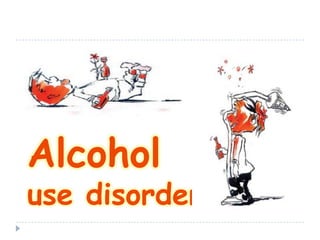

Alcohol
use disorder
What is alcohol?
Alcohol is a generic term for many different
 chemical compounds
It is a clear, colorless liquid that comes from
  fermenting — or breaking down — natural
  substances such as fruit, corn, grain or sugarcane.
  The type of alcohol consumed by humans is ethyl
  alcohol or ethanol.
Ethanol can have different colors, tastes, potency
  (strength) and flavors, depending on the fruits or
  vegetables used in its manufacture, the process of
  manufacture and the additives used.
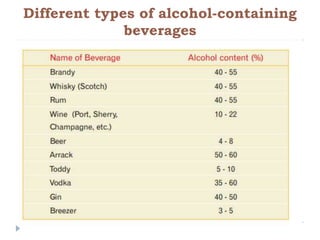
Different types of alcohol-containing
              beverages
Alcohol use
Many communities consider the occasional use of
alcohol, for recreational purposes or on social
occasions, as ‘normal’ and ‘acceptable’.

 There is little awareness that even the occasional or
social use of alcohol does carry a risk of road traffic
injuries or industrial accidents.

Intoxication from occasional use can lead to violence
or socially inappropriate or embarrassing behaviour.
Alcohol abuse,
    also called ―problem drinking‖, is a pattern of excessive
         drinking that results in adverse health and social
   consequences to the drinker, and often to those around the
           drinker. People with an alcohol abuse problem:
● Use alcohol to help them change the way they feel about
themselves and/or some aspects of their lives.
● Get complaints about their alcohol use.
● Lose interest in activities and hobbies that used to bring
pleasure.
● Get irritable as their usual drinking time approaches,
  especially if
alcohol isn't available.
● Keep alcohol in unlikely places at home, at work and in the
  car.
● Drink alone or in secret.
Alcohol dependence refers to a cluster of
  symptoms. There are four main symptoms:
Craving- A strong need, or compulsion, to drink.
Impaired control -The inability to limit one's drinking on
  any given occasion.
Physical Dependence- Withdrawal symptoms, such
as nausea, sweating, shakiness, and anxiety, when
  alcohol use is stopped after a period of heavy
  drinking.
Tolerance- — The need for increasing amounts of
  alcohol in order to feel its effects
The user knows that alcohol use causes significant
  impairment and though he/she may have a desire to
  cut down or control its use, does not or cannot give it
  up, resulting in heavier use of alcohol than intended
   and subsequent reduction of social or occupational
                         activities.

There are many factors, psychological, social,
 environmental, and genetic, that play a role in
 alcohol dependence.

Alcohol dependence is not just bad behaviour or a
  habit. It is a chronic and progressive disease.
Harmful use of alcohol is when some people,
 usually after a period of prolonged use, develop a
    pattern of use which causes damage to an
                 individual’s health.
 Many patterns of consumption of alcohol can be
considered as harmful use of alcohol, for example,
  drinking alcohol and driving — which can lead to
road traffic injuries, “binge drinking” (drinking too
much alcohol at one time) sometimes indulged in by
 teenagers, pay-day drinking when a person drinks
  heavily on the day he gets his salary, or pregnant
               women drinking alcohol.
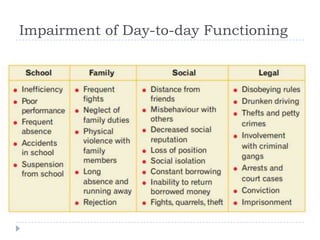
Impairment of Day-to-day Functioning
CAGE Questionnaire
Four simple questions, which comprise the CAGE test
  developed by Dr John Ewing is widely used for
  alcohol abuse screening. (To help remember these
  questions, note the first letter of a key word in each
  question spells ―CAGE‖).
● Do you feel that you should Cut down on your
  drinking?
● Do you feel Annoyed when other people comment
  about your drinking habits?
● Do you ever feel bad or Guilty about your drinking?
● Do you ever need a drink (Eye opener) first thing in
  the morning to steady your nerves or to get rid of a
  hangover?
                       T&T Don Bosco Goa July 2012
Some myths and
misconceptions about
alcohol consumption
Myth
Alcohol helps people to forget their problems.
Truth
 This has become a 'truth' because regular and heavy
   alcohol-users often say this is the reason why they
   drink alcohol. Very often the opposite is found to be
  true – people bring up forgotten problems only when
                   they are intoxicated.
Myth
Alcohol is a stress buster.
Truth
Alcohol is frequently resorted to as a ―cover up‖ during
  times of temporary or ongoing stress or grief
  experienced due to the loss of a loved one or the
  end of a relationship, unresolved family tensions or
  chronic work stress. However, alcohol increases the
  level of biological stress that is placed on the body.
  Adrenaline levels increase in the body as we drink.
  We may feel more relaxed when we drink alcohol,
  but the body actually comes under additional stress.
Myth
A man needs to drink alcohol to prove his manliness.

Truth
On the contrary, people who need to use alcohol
  develop a tolerance for it and become dependent on
  it, thereby losing their will power and independence.
Myth
One needs to drink alcohol to be trendy and part of the
  group.
Truth
Behavioral research has documented that in a group
  drinking alcohol; even those who are not drinking can
  have an equally good time and behave in the same
  uninhibited manner. Adolescents call this ―getting high on
  other people‘s alcohol‖. Forcing or urging someone to
  drink as a condition of group membership or acceptance
  can lead to tragic consequences, hospitalization, sexual
  and other types of violence and even death. Ultimately,
  alcoholics can be very lonely people shunned by family,
  friends and society.
M.V Act 1988
   Under section 185 Motor Vehicle Act, 1988, the
    concentration of alcohol has been specified maximum as
    30 mg/100 ml of blood detected in a test by a breath
    analyzer.
   The penalty for the first offence is with imprisonment for a
    term upto 6 months or with fine upto Rs.2,000/- or both.
   For second or subsequent offence (if committed within 3
    years of the commission of previous similar offence), with
    imprisonment for a term upto 2 years or with fine upto
    Rs.3000/- or with both.
   Arrest without warrant by a police officer in uniform under
    section 202 M.V. Act, 1988.
   Procedure for breath and laboratory tests is specified
    under section 203 & 204 M.V. Act, 1988.
   The offence is non-compoundable under section 200
    M.V. Act, 1988 (all challans are sent to the Court for
    taking cognizance)
Alcohol & Injuries


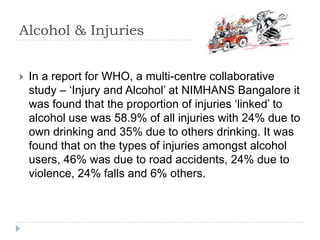
   In a report for WHO, a multi-centre collaborative
    study – ‗Injury and Alcohol‘ at NIMHANS Bangalore it
    was found that the proportion of injuries ‗linked‘ to
    alcohol use was 58.9% of all injuries with 24% due to
    own drinking and 35% due to others drinking. It was
    found that on the types of injuries amongst alcohol
    users, 46% was due to road accidents, 24% due to
    violence, 24% falls and 6% others.
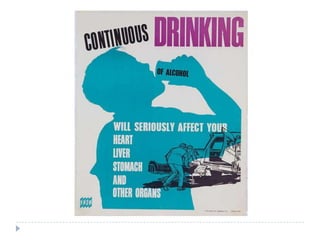
Complications of Chronic Alcohol Use
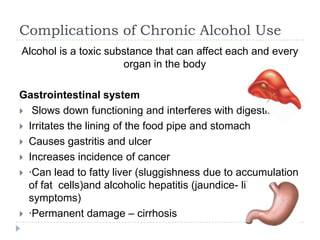
Alcohol is a toxic substance that can affect each and every
                      organ in the body

Gastrointestinal system
 Slows down functioning and interferes with digestion
 Irritates the lining of the food pipe and stomach
 Causes gastritis and ulcer
 Increases incidence of cancer
 ·Can lead to fatty liver (sluggishness due to accumulation
  of fat cells)and alcoholic hepatitis (jaundice- like
  symptoms)
 ·Permanent damage – cirrhosis
Central Nervous System
   Delirium tremens
   Rum fits (alcohol withdrawal seizures)
   Alcohol hallucininosis
   Alcoholic dementia
   Suicide
   Cerebral degeneration
   Head injuries and fractures
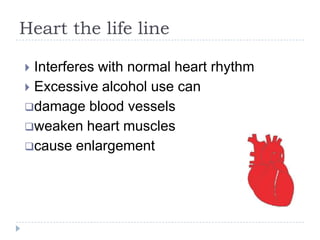
Heart the life line

 Interferes with normal heart rhythm
 Excessive alcohol use can
damage blood vessels
weaken heart muscles
cause enlargement
Other effects
 Acne
 Alcoholic hypoglycemia
 Malnutrition
 Anemia
 Sexual dysfunction
 Decreased immune function- can lead to
  infections such as tuberculosis.
Don’t be influenced by anybody.
 Don’t be impressed by anybody.
 Look, see, be aware- and choose.
But remember, the responsibility is
                yours.
Alcohol abuse
Alcohol abuse
Alcohol abuse
Alcohol abuse
Alcohol abuse
Alcohol abuse
Alcohol abuse
Alcohol abuse

Alcohol abuse

  • 1.
  • 2.
    What is alcohol? Alcoholis a generic term for many different chemical compounds It is a clear, colorless liquid that comes from fermenting — or breaking down — natural substances such as fruit, corn, grain or sugarcane. The type of alcohol consumed by humans is ethyl alcohol or ethanol. Ethanol can have different colors, tastes, potency (strength) and flavors, depending on the fruits or vegetables used in its manufacture, the process of manufacture and the additives used.
  • 3.
    Different types ofalcohol-containing beverages
  • 5.
    Alcohol use Many communitiesconsider the occasional use of alcohol, for recreational purposes or on social occasions, as ‘normal’ and ‘acceptable’. There is little awareness that even the occasional or social use of alcohol does carry a risk of road traffic injuries or industrial accidents. Intoxication from occasional use can lead to violence or socially inappropriate or embarrassing behaviour.
  • 6.
    Alcohol abuse, also called ―problem drinking‖, is a pattern of excessive drinking that results in adverse health and social consequences to the drinker, and often to those around the drinker. People with an alcohol abuse problem: ● Use alcohol to help them change the way they feel about themselves and/or some aspects of their lives. ● Get complaints about their alcohol use. ● Lose interest in activities and hobbies that used to bring pleasure. ● Get irritable as their usual drinking time approaches, especially if alcohol isn't available. ● Keep alcohol in unlikely places at home, at work and in the car. ● Drink alone or in secret.
  • 7.
    Alcohol dependence refersto a cluster of symptoms. There are four main symptoms: Craving- A strong need, or compulsion, to drink. Impaired control -The inability to limit one's drinking on any given occasion. Physical Dependence- Withdrawal symptoms, such as nausea, sweating, shakiness, and anxiety, when alcohol use is stopped after a period of heavy drinking. Tolerance- — The need for increasing amounts of alcohol in order to feel its effects
  • 8.
    The user knowsthat alcohol use causes significant impairment and though he/she may have a desire to cut down or control its use, does not or cannot give it up, resulting in heavier use of alcohol than intended and subsequent reduction of social or occupational activities. There are many factors, psychological, social, environmental, and genetic, that play a role in alcohol dependence. Alcohol dependence is not just bad behaviour or a habit. It is a chronic and progressive disease.
  • 9.
    Harmful use ofalcohol is when some people, usually after a period of prolonged use, develop a pattern of use which causes damage to an individual’s health. Many patterns of consumption of alcohol can be considered as harmful use of alcohol, for example, drinking alcohol and driving — which can lead to road traffic injuries, “binge drinking” (drinking too much alcohol at one time) sometimes indulged in by teenagers, pay-day drinking when a person drinks heavily on the day he gets his salary, or pregnant women drinking alcohol.
  • 10.
  • 11.
    CAGE Questionnaire Four simplequestions, which comprise the CAGE test developed by Dr John Ewing is widely used for alcohol abuse screening. (To help remember these questions, note the first letter of a key word in each question spells ―CAGE‖). ● Do you feel that you should Cut down on your drinking? ● Do you feel Annoyed when other people comment about your drinking habits? ● Do you ever feel bad or Guilty about your drinking? ● Do you ever need a drink (Eye opener) first thing in the morning to steady your nerves or to get rid of a hangover? T&T Don Bosco Goa July 2012
  • 12.
    Some myths and misconceptionsabout alcohol consumption
  • 13.
    Myth Alcohol helps peopleto forget their problems. Truth This has become a 'truth' because regular and heavy alcohol-users often say this is the reason why they drink alcohol. Very often the opposite is found to be true – people bring up forgotten problems only when they are intoxicated.
  • 14.
    Myth Alcohol is astress buster. Truth Alcohol is frequently resorted to as a ―cover up‖ during times of temporary or ongoing stress or grief experienced due to the loss of a loved one or the end of a relationship, unresolved family tensions or chronic work stress. However, alcohol increases the level of biological stress that is placed on the body. Adrenaline levels increase in the body as we drink. We may feel more relaxed when we drink alcohol, but the body actually comes under additional stress.
  • 15.
    Myth A man needsto drink alcohol to prove his manliness. Truth On the contrary, people who need to use alcohol develop a tolerance for it and become dependent on it, thereby losing their will power and independence.
  • 16.
    Myth One needs todrink alcohol to be trendy and part of the group. Truth Behavioral research has documented that in a group drinking alcohol; even those who are not drinking can have an equally good time and behave in the same uninhibited manner. Adolescents call this ―getting high on other people‘s alcohol‖. Forcing or urging someone to drink as a condition of group membership or acceptance can lead to tragic consequences, hospitalization, sexual and other types of violence and even death. Ultimately, alcoholics can be very lonely people shunned by family, friends and society.
  • 17.
    M.V Act 1988  Under section 185 Motor Vehicle Act, 1988, the concentration of alcohol has been specified maximum as 30 mg/100 ml of blood detected in a test by a breath analyzer.  The penalty for the first offence is with imprisonment for a term upto 6 months or with fine upto Rs.2,000/- or both.  For second or subsequent offence (if committed within 3 years of the commission of previous similar offence), with imprisonment for a term upto 2 years or with fine upto Rs.3000/- or with both.  Arrest without warrant by a police officer in uniform under section 202 M.V. Act, 1988.  Procedure for breath and laboratory tests is specified under section 203 & 204 M.V. Act, 1988.  The offence is non-compoundable under section 200 M.V. Act, 1988 (all challans are sent to the Court for taking cognizance)
  • 18.
    Alcohol & Injuries  In a report for WHO, a multi-centre collaborative study – ‗Injury and Alcohol‘ at NIMHANS Bangalore it was found that the proportion of injuries ‗linked‘ to alcohol use was 58.9% of all injuries with 24% due to own drinking and 35% due to others drinking. It was found that on the types of injuries amongst alcohol users, 46% was due to road accidents, 24% due to violence, 24% falls and 6% others.
  • 19.
    Complications of ChronicAlcohol Use Alcohol is a toxic substance that can affect each and every organ in the body Gastrointestinal system  Slows down functioning and interferes with digestion  Irritates the lining of the food pipe and stomach  Causes gastritis and ulcer  Increases incidence of cancer  ·Can lead to fatty liver (sluggishness due to accumulation of fat cells)and alcoholic hepatitis (jaundice- like symptoms)  ·Permanent damage – cirrhosis
  • 20.
    Central Nervous System  Delirium tremens  Rum fits (alcohol withdrawal seizures)  Alcohol hallucininosis  Alcoholic dementia  Suicide  Cerebral degeneration  Head injuries and fractures
  • 21.
    Heart the lifeline  Interferes with normal heart rhythm  Excessive alcohol use can damage blood vessels weaken heart muscles cause enlargement
  • 22.
    Other effects  Acne Alcoholic hypoglycemia  Malnutrition  Anemia  Sexual dysfunction  Decreased immune function- can lead to infections such as tuberculosis.
  • 23.
    Don’t be influencedby anybody. Don’t be impressed by anybody. Look, see, be aware- and choose. But remember, the responsibility is yours.