Why I am Here
 I am a mom
 I am an educator
 I love the ocean and

everything that goes with
 I want my children to have
a deep appreciation for the
Hudson River and the
ocean
Why You are Here
 Where we want to build it
 Where we are in the process
 What if anything I can do

 What the aquarium will have regarding

facilities and such (scope, exhibits)
 Target ages and audiences?
 Idle curiosity
"In the end, we will conserve only
what we love, we will love only
what we understand, and we will
understand only what we are
taught.“
- Baba Dioum, 1968
Our Vision

The Hudson River, in our backyard, a gateway to
the oceans and seas beyond
Our Values
 To nurture and ensure the

well-being of all the animals
in our care
 To educate visitors about the
plants and animals that rely
on our rivers and oceans for
their survival
 To conserve our Hudson River
Estuary for future generations
Our Mission Statement
To immerse visitors into the
aquatic diversity of the Hudson
River and the oceans beyond
Why the Capital Region?
 Crossroads of the Mohawk River

and the Hudson River
 Population > 1 million people and
expected to grow
 Visitors > 5 million people
 73 school districts and 21 colleges
and universities
Why Now?
 Following the lead of the College of Nanoscale

Science and Engineering (CNSE),

I

 an aquarium could foster collaboration between

the


public, state and federal government and private
industry

 in conservation efforts and aquaculture research

 The Governor recently hosted NY’s 1st Tourism

Summit designed to bring more visitors to New
York State

N
Y
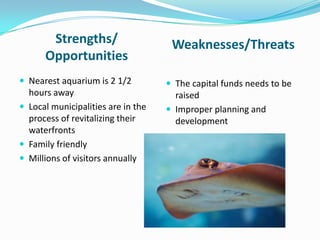
Strengths/
Opportunities
 Nearest aquarium is 2 1/2

hours away
 Local municipalities are in the
process of revitalizing their
waterfronts
 Family friendly
 Millions of visitors annually

Weaknesses/Threats
 The capital funds needs to be

raised
 Improper planning and
development
Important Facts to Remember
 Aquariums are tourist magnets
 Aquariums are economic catalysts
 Aquariums improve quality of life for residents

Photo by Guy Schmidt via Flickr
Photo by Ron Cogswell via Flickr
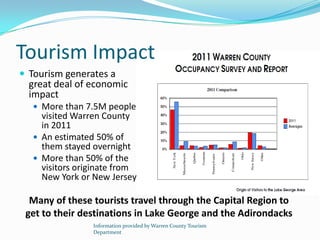
Tourism Impact
 Tourism generates a

great deal of economic
impact
 More than 7.5M people

visited Warren County
in 2011
 An estimated 50% of
them stayed overnight
 More than 50% of the
visitors originate from
New York or New Jersey

Many of these tourists travel through the Capital Region to
get to their destinations in Lake George and the Adirondacks
Information provided by Warren County Tourism
Department
Tourism Impact continued

Second
Homes
6%

 Tourism generates jobs, more than

30,000 in the Capital Region and
Saratoga
 More than 5M people spent the
night in the Capital Region and
Saratoga in 2011

Lodging
20%
Transport
23%

Retail & Svc
Stations
19%

Recreation
4%

F&B
28%

We have the tourists let’s give
them another reason to stay
Information provided by NYS Department of
Economic Development
An Economic Engine
 Spending by visitors generates significant retail and

consumer services sales
 Direct and indirect job creation
 Temporary job creation
Lead by Example
 Constructed Wetlands to treat waste water
 Recycling Bins
 Compostable Toilets
 Organic Gardening

 Aquaculture and Coral Propagation
 Rain Collection System
Green Energy
 We strive to lead by example as a showcase of what green

technologies can do. Potential projects include:
 Solar heated water
 Geo thermal heated water

 Solar power
 Hydro-electric
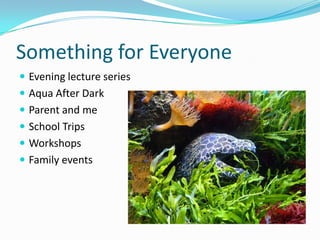
Something for Everyone
 Evening lecture series
 Aqua After Dark
 Parent and me
 School Trips

 Workshops
 Family events
Educational Impact
• As a global leader in

nanotechnology, the Capital Region
needs to improve
Science, Technology, Engineering and
Math (STEM) education initiatives

 Young child’s play area exhibits and workshops
 School age programs and camp offerings during summer





and school vacations
High school exhibit interpreter program
College internships in fisheries, education and business
Homeschooler lecture and lab series
Distance learning
Collaboration
 University researchers
 Private industry
 DEC and other agencies
 Working with other museums
to enhance each other
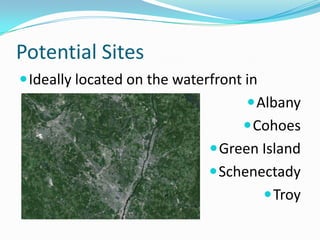
Potential Sites
 Ideally located on the waterfront in
 Albany
 Cohoes
 Green Island
 Schenectady

 Troy
Introducing the creatures
An exhibit devoted to the aquatic native
species of NY from the Adirondacks to Long
Island and everywhere in between.
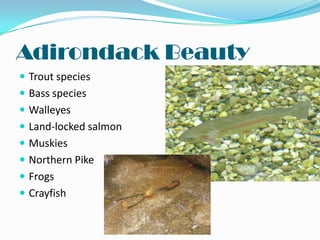
Adirondack Beauty
 Trout species
 Bass species
 Walleyes
 Land-locked salmon

 Muskies
 Northern Pike
 Frogs

 Crayfish
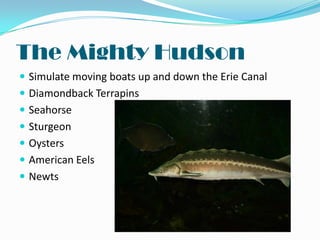
The Mighty Hudson
 Simulate moving boats up and down the Erie Canal
 Diamondback Terrapins
 Seahorse
 Sturgeon

 Oysters
 American Eels
 Newts
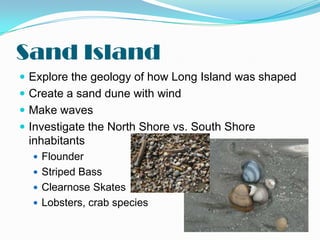
Sand Island
 Explore the geology of how Long Island was shaped
 Create a sand dune with wind
 Make waves
 Investigate the North Shore vs. South Shore

inhabitants
 Flounder
 Striped Bass
 Clearnose Skates
 Lobsters, crab species
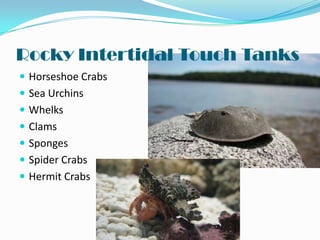
Rocky Intertidal Touch Tanks
 Horseshoe Crabs
 Sea Urchins
 Whelks
 Clams

 Sponges
 Spider Crabs
 Hermit Crabs
An exhibit of American Species, from the Atlantic coast to the
Pacific coast
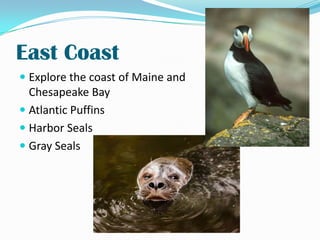
East Coast
 Explore the coast of Maine and
Chesapeake Bay
 Atlantic Puffins
 Harbor Seals
 Gray Seals
Gulf Coast
 Explore the Everglades and the Bayou
 American Alligators
 Roseate Spoonbills
 Fiddler crabs

 Whelks
 Shrimp
West Coast
 Explore a Kelp Forest
 Featuring:
 California Sea Lions
 Giant Pacific Octopus
 Rockfish species
 Invertebrates





sea stars
snails
urchins
This exhibit will showcase all the beauty that the ocean’s coral
reefs have to offer and the predators of the deep blue sea.
Coral Garden
 South Pacific Reef
 Caribbean Reef
 Captive bred species
Shark & Ray Splash Bay
 Interactive exhibit where guests will have the opportunity

to touch and feed animals
Ocean in Motion
 Sharks
 Eels
 Sea Turtle
 Schooling fish
Follow the impact our human species has on our natural
environment in this exhibit
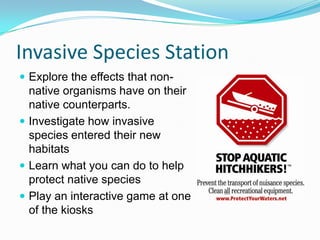
Invasive Species Station
 Explore the effects that non-

native organisms have on their
native counterparts.
 Investigate how invasive
species entered their new
habitats
 Learn what you can do to help
protect native species
 Play an interactive game at one
of the kiosks
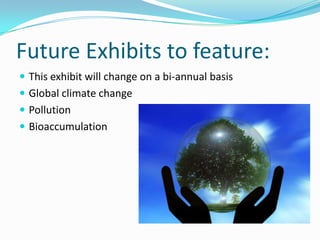
Future Exhibits to feature:
 This exhibit will change on a bi-annual basis
 Global climate change
 Pollution
 Bioaccumulation
It’s not just the fish
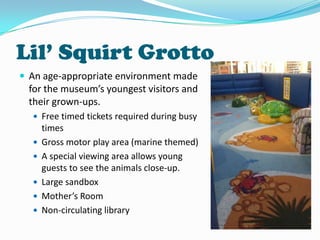
Lil’ Squirt Grotto
 An age-appropriate environment made

for the museum’s youngest visitors and
their grown-ups.
 Free timed tickets required during busy








times
Gross motor play area (marine themed)
A special viewing area allows young
guests to see the animals close-up.
Large sandbox
Mother’s Room
Non-circulating library
Marine Science Center
 Classrooms (can also be used for private parties)
 Wet Lab for dissections
 SMARTboard Technology
 Ceiling Mounted Projectors

 Distance Learning Lab
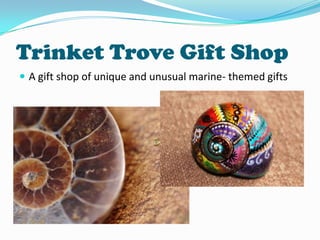
Trinket Trove Gift Shop
 A gift shop of unique and unusual marine- themed gifts
Shark Bites Cafe
 Featuring locally grown and produced items
 Snacks and light fare for children and adults
 Ability to cater events on premises
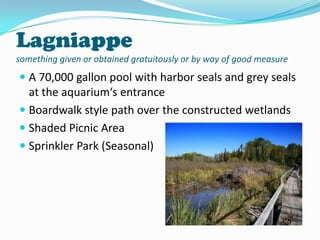
Lagniappe
something given or obtained gratuitously or by way of good measure

 A 70,000 gallon pool with harbor seals and grey seals
at the aquarium‘s entrance
 Boardwalk style path over the constructed wetlands
 Shaded Picnic Area
 Sprinkler Park (Seasonal)
How we can do it
Where can the money come from?
 State Funding and Grants- Local Waterfront Revitalization







Grants
Federal Funding and Grants- Congressman Tonko’s Mighty
Waters Task Force
Private donors and foundations
Municipal Bonds
Fundraisers
Crowdfunding site
Tentative Plan over 8-10 years
 Acquire Not-for-profit Status
 Establish work groups
 Raise funds for feasibility study







and legal costs
Hire design team and
consultants
Raise funds for the master plan
Site Acquisition
Secure capital
Outreach

Construction

Design
A transformative
investment
in the Capital
Region’s future starts
here
What You Can Do Next
Volunteer

Stay in Touch

 Looking for individuals who can

 Follow our Albany Aquarium

commit 1-2 hours a month to
form working groups:
 Planning
 Marketing/ Outreach
 Fundraising

Facebook Page
 Follow us on Twitter
@AlbanyAqua
 Sign Up for our quarterly
newsletter
 Send us an e-mail at
AlbanyAquarium@yahoo.com

Albany Aquarium Project presentation

  • 2.
    Why I amHere  I am a mom  I am an educator  I love the ocean and everything that goes with  I want my children to have a deep appreciation for the Hudson River and the ocean
  • 3.
    Why You areHere  Where we want to build it  Where we are in the process  What if anything I can do  What the aquarium will have regarding facilities and such (scope, exhibits)  Target ages and audiences?  Idle curiosity
  • 4.
    "In the end,we will conserve only what we love, we will love only what we understand, and we will understand only what we are taught.“ - Baba Dioum, 1968
  • 5.
    Our Vision The HudsonRiver, in our backyard, a gateway to the oceans and seas beyond
  • 6.
    Our Values  Tonurture and ensure the well-being of all the animals in our care  To educate visitors about the plants and animals that rely on our rivers and oceans for their survival  To conserve our Hudson River Estuary for future generations
  • 7.
    Our Mission Statement Toimmerse visitors into the aquatic diversity of the Hudson River and the oceans beyond
  • 8.
    Why the CapitalRegion?  Crossroads of the Mohawk River and the Hudson River  Population > 1 million people and expected to grow  Visitors > 5 million people  73 school districts and 21 colleges and universities
  • 9.
    Why Now?  Followingthe lead of the College of Nanoscale Science and Engineering (CNSE), I  an aquarium could foster collaboration between the  public, state and federal government and private industry  in conservation efforts and aquaculture research  The Governor recently hosted NY’s 1st Tourism Summit designed to bring more visitors to New York State N Y
  • 10.
    Strengths/ Opportunities  Nearest aquariumis 2 1/2 hours away  Local municipalities are in the process of revitalizing their waterfronts  Family friendly  Millions of visitors annually Weaknesses/Threats  The capital funds needs to be raised  Improper planning and development
  • 11.
    Important Facts toRemember  Aquariums are tourist magnets  Aquariums are economic catalysts  Aquariums improve quality of life for residents Photo by Guy Schmidt via Flickr Photo by Ron Cogswell via Flickr
  • 12.
    Tourism Impact  Tourismgenerates a great deal of economic impact  More than 7.5M people visited Warren County in 2011  An estimated 50% of them stayed overnight  More than 50% of the visitors originate from New York or New Jersey Many of these tourists travel through the Capital Region to get to their destinations in Lake George and the Adirondacks Information provided by Warren County Tourism Department
  • 13.
    Tourism Impact continued Second Homes 6% Tourism generates jobs, more than 30,000 in the Capital Region and Saratoga  More than 5M people spent the night in the Capital Region and Saratoga in 2011 Lodging 20% Transport 23% Retail & Svc Stations 19% Recreation 4% F&B 28% We have the tourists let’s give them another reason to stay Information provided by NYS Department of Economic Development
  • 14.
    An Economic Engine Spending by visitors generates significant retail and consumer services sales  Direct and indirect job creation  Temporary job creation
  • 15.
    Lead by Example Constructed Wetlands to treat waste water  Recycling Bins  Compostable Toilets  Organic Gardening  Aquaculture and Coral Propagation  Rain Collection System
  • 16.
    Green Energy  Westrive to lead by example as a showcase of what green technologies can do. Potential projects include:  Solar heated water  Geo thermal heated water  Solar power  Hydro-electric
  • 17.
    Something for Everyone Evening lecture series  Aqua After Dark  Parent and me  School Trips  Workshops  Family events
  • 18.
    Educational Impact • Asa global leader in nanotechnology, the Capital Region needs to improve Science, Technology, Engineering and Math (STEM) education initiatives  Young child’s play area exhibits and workshops  School age programs and camp offerings during summer     and school vacations High school exhibit interpreter program College internships in fisheries, education and business Homeschooler lecture and lab series Distance learning
  • 19.
    Collaboration  University researchers Private industry  DEC and other agencies  Working with other museums to enhance each other
  • 20.
    Potential Sites  Ideallylocated on the waterfront in  Albany  Cohoes  Green Island  Schenectady  Troy
  • 21.
  • 22.
    An exhibit devotedto the aquatic native species of NY from the Adirondacks to Long Island and everywhere in between.
  • 23.
    Adirondack Beauty  Troutspecies  Bass species  Walleyes  Land-locked salmon  Muskies  Northern Pike  Frogs  Crayfish
  • 24.
    The Mighty Hudson Simulate moving boats up and down the Erie Canal  Diamondback Terrapins  Seahorse  Sturgeon  Oysters  American Eels  Newts
  • 25.
    Sand Island  Explorethe geology of how Long Island was shaped  Create a sand dune with wind  Make waves  Investigate the North Shore vs. South Shore inhabitants  Flounder  Striped Bass  Clearnose Skates  Lobsters, crab species
  • 26.
    Rocky Intertidal TouchTanks  Horseshoe Crabs  Sea Urchins  Whelks  Clams  Sponges  Spider Crabs  Hermit Crabs
  • 27.
    An exhibit ofAmerican Species, from the Atlantic coast to the Pacific coast
  • 28.
    East Coast  Explorethe coast of Maine and Chesapeake Bay  Atlantic Puffins  Harbor Seals  Gray Seals
  • 29.
    Gulf Coast  Explorethe Everglades and the Bayou  American Alligators  Roseate Spoonbills  Fiddler crabs  Whelks  Shrimp
  • 30.
    West Coast  Explorea Kelp Forest  Featuring:  California Sea Lions  Giant Pacific Octopus  Rockfish species  Invertebrates    sea stars snails urchins
  • 31.
    This exhibit willshowcase all the beauty that the ocean’s coral reefs have to offer and the predators of the deep blue sea.
  • 32.
    Coral Garden  SouthPacific Reef  Caribbean Reef  Captive bred species
  • 33.
    Shark & RaySplash Bay  Interactive exhibit where guests will have the opportunity to touch and feed animals
  • 34.
    Ocean in Motion Sharks  Eels  Sea Turtle  Schooling fish
  • 35.
    Follow the impactour human species has on our natural environment in this exhibit
  • 36.
    Invasive Species Station Explore the effects that non- native organisms have on their native counterparts.  Investigate how invasive species entered their new habitats  Learn what you can do to help protect native species  Play an interactive game at one of the kiosks
  • 37.
    Future Exhibits tofeature:  This exhibit will change on a bi-annual basis  Global climate change  Pollution  Bioaccumulation
  • 38.
  • 39.
    Lil’ Squirt Grotto An age-appropriate environment made for the museum’s youngest visitors and their grown-ups.  Free timed tickets required during busy      times Gross motor play area (marine themed) A special viewing area allows young guests to see the animals close-up. Large sandbox Mother’s Room Non-circulating library
  • 40.
    Marine Science Center Classrooms (can also be used for private parties)  Wet Lab for dissections  SMARTboard Technology  Ceiling Mounted Projectors  Distance Learning Lab
  • 41.
    Trinket Trove GiftShop  A gift shop of unique and unusual marine- themed gifts
  • 42.
    Shark Bites Cafe Featuring locally grown and produced items  Snacks and light fare for children and adults  Ability to cater events on premises
  • 43.
    Lagniappe something given orobtained gratuitously or by way of good measure  A 70,000 gallon pool with harbor seals and grey seals at the aquarium‘s entrance  Boardwalk style path over the constructed wetlands  Shaded Picnic Area  Sprinkler Park (Seasonal)
  • 44.
  • 45.
    Where can themoney come from?  State Funding and Grants- Local Waterfront Revitalization      Grants Federal Funding and Grants- Congressman Tonko’s Mighty Waters Task Force Private donors and foundations Municipal Bonds Fundraisers Crowdfunding site
  • 46.
    Tentative Plan over8-10 years  Acquire Not-for-profit Status  Establish work groups  Raise funds for feasibility study      and legal costs Hire design team and consultants Raise funds for the master plan Site Acquisition Secure capital Outreach Construction Design
  • 47.
    A transformative investment in theCapital Region’s future starts here
  • 48.
    What You CanDo Next Volunteer Stay in Touch  Looking for individuals who can  Follow our Albany Aquarium commit 1-2 hours a month to form working groups:  Planning  Marketing/ Outreach  Fundraising Facebook Page  Follow us on Twitter @AlbanyAqua  Sign Up for our quarterly newsletter  Send us an e-mail at AlbanyAquarium@yahoo.com

Editor's Notes

  • #15 Out of town overnight and day trip visitors accounts for most of this
  • #46 New York State has put aside $220Million for economic development this year
  • #47 (site, development, planning)