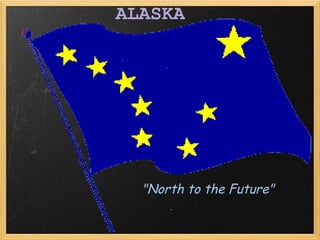
ALASKA "North to the Future"
Background Information Alaska   is the 49th state of the U.S., on January 3, 1959. is the largest state in the United States by area.  The people According to the 2006–2008 American Community Survey conducted by the U.S. Census Bureau: White Americans made up 68.6% of Alaska's population.  Blacks or African Americans made up 3.3%  American Indians and Alaska Natives made up 13.4%  Asian Americans made up 4.5% Pacific Islander Americans made up 0.7%  Individuals from some other race made up 1.7% of Alaska's population while individuals from two or more races made up 7.8% of the state's population.  Hispanics or Latinos made up 5.8% of Alaska's population. The largest ancestry group in Alaska is German Americans, who make up 20.2% of Alaska's population and are the only ethnic group in the state to number over 100,000 members.  Irish Americans make up 12.7% of Alaska's population English Americans make up 10.9% of the state's population.
Background Information cont. The people Norwegian Americans made up 4.3% of Alaska's population Scottish Americans make up 3.1% of the state's population. Spoken language(s) According to the 2005–2007 American Community Survey,  84.7% of people over the age of five speak only English at home.  About 3.5% speak Spanish at home.  About 2.2% speak another Indo-European language at home and  about 4.3% speak an Asian language at home.   And about 5.3% speak other languages at home. A total of 5.2% of Alaskans speak one of the state's 22 indigenous languages, known locally as "native languages".  These languages belong to two major language families: Eskimo-Aleut and Na-Dene. As the homeland of these two major language families of North America
EDUCATION Standards Alaska Standards, 4th Edition http://www.eed.state.ak.us/standards/pdf/standards.pdf Like every education standards, listing of expectations at every grade levels, etc.  Alaska English Language Proficiency Standards  http://www.eed.state.ak.us/tls/assessment/elp/ELPStandards/ELPBOOKFinalMarch2006.pdf focuses on the progressive development of the English language. It addresses four domains: listening, speaking. reading and writing. There are five proficiency levels in which the students are graded on ranging from: Beginning Low, Beginning High, Intermediate Low, Intermediate High, Proficient/Proficient High. 
The Natives are talking...   Light of the Feather: Pathways Through Contemporary Indian America,  author Mick Fedullo quotes an Apache elder who says that the students' parents,   "Anglos [white people] trying to make them  forget  they were Apaches; trying to make them turn against their parents, telling them that  Indian ways were evil . Well, a lot of those kids came to believe that their teachers were the evil ones, and so anything that had to do with "education" was also evil--like books. Those kids came back to the reservation, got married, and had their own kids. And now they  don't want anything to do with the white man's education . The only reason they send their kids to school is because it's the law. But they tell their  kids not to take school seriously ." To be successful, educators must overcome their students' resistance to education and master the art of intercultural communication. To overcome that resistance Jim Cummins of the Ontario Institute for Educational Studies found that: Educators must  involve parents  in the running of the school. School curriculum needs to  reflect the cultural background  of the student. Experiential and interactive  teaching methods need to be used. Testing  must be used to help students learn effectively, rather than to sort and label students. If teachers take this approach, they will employ a bilingual-additive, "English Plus" approach, which contrasts dramatically with the traditional assimilationist approach. This world requires that they be bilingual and bicultural in their Native language and traditions and in the English language and its traditions. Finding the most effective ways to interact with others requires understanding and the willingness to tolerate differences. 
The Natives are talking... School Dedication  Nikaitchuat Ilisagvait Kotzebue Started in 1998, Nikaitchuat Ilisagvait is a private language immersion preschool in Kotzebue, AK that teaches in the Inupiaq language and houses about 20 students a year. The all day program’s students are between three and five years old. Though the school would eventually like to teach in Inupiaq through the twelfth grade, it is limited by space and funding. Ya De Da Ah School Chickaloon The Ya De Da Ah School is a semi-immersion, privately funded tribal school that teaches the Ahtna Athabaskan language. Elders come to the school every other week to supplement daily language instruction.The school serves twelve children all together from pre-school to the 9th grade. There are two hours of language instruction per day and students are divided into two classes: preschool and first through ninth grade. There are three levels of proficiency, but instructors are only capable of teaching the first two: nouns and simple phrases, and conversation implementing simple phrases. There are two fluent speakers from the Athna Region: Jeanie Maxum 65, and Markle Pete, 75. North Slope Borough School District Barrow Iñupiaq as a Second Language setting with instruction occurring for a duration of anywhere from 20-30 minutes per day. Parents who live in Barrow also have the option of placing their children in the Iñupiaq Immersion Program where instruction is delivered in Iñupiaq from preschool through fourth grade and are transitioned into English with 90 minutes of instruction in the Iñupiaq language at fifth grade. Children who are in the middle school in Barrow receive instruction in the Iñupiaq language for an uninterrupted duration of 80 minutes per session alternating classes every other day. Secondary school students receive instruction as an elective.
The Natives are talking... In efforts to stabilize the Indigenous Language the INDIAN NATIONS AT RISK TASK FORCE, established National Education goals for American Indians and Alaska Natives including: GOAL 1: Readiness for School GOAL 2: Maintain Native Languages and Cultures GOAL 3: Literacy GOAL 4: Student Academic Achievement GOAL 5: High School Graduation GOAL 6: High-Quality Native and non-Native School Personnel GOAL 7: Safe and Alcohol-Free and Drug-Free School GOAL 8: Adult Education and Lifelong Learning GOAL 9: Restructuring Schools GOAL 10: Parental, Community, and Tribal Partnerships h ttp://jan.ucc.nau.edu/~jar/SIL/INARgoals.pdf
ALASKA'S LANGUAGES
RESOURCES: Native Language http://www.uaa.alaska.edu/cafe/upload/BERKELEY-_Word4_-2.pdf Mapping Alaska's Language http://www.uaf.edu/anlc/languages.html American Indian/Alaska Native Education http://jan.ucc.nau.edu/~jar/AIE/Ind_Ed.html Language Revitalization http://www.alaskool.org/language/LanguageRevitalization.htm

Alaska

  • 1.
    ALASKA "North tothe Future"
  • 2.
    Background Information Alaska  is the 49th state of the U.S., on January 3, 1959. is the largest state in the United States by area.  The people According to the 2006–2008 American Community Survey conducted by the U.S. Census Bureau: White Americans made up 68.6% of Alaska's population.  Blacks or African Americans made up 3.3%  American Indians and Alaska Natives made up 13.4%  Asian Americans made up 4.5% Pacific Islander Americans made up 0.7%  Individuals from some other race made up 1.7% of Alaska's population while individuals from two or more races made up 7.8% of the state's population.  Hispanics or Latinos made up 5.8% of Alaska's population. The largest ancestry group in Alaska is German Americans, who make up 20.2% of Alaska's population and are the only ethnic group in the state to number over 100,000 members.  Irish Americans make up 12.7% of Alaska's population English Americans make up 10.9% of the state's population.
  • 3.
    Background Information cont.The people Norwegian Americans made up 4.3% of Alaska's population Scottish Americans make up 3.1% of the state's population. Spoken language(s) According to the 2005–2007 American Community Survey,  84.7% of people over the age of five speak only English at home.  About 3.5% speak Spanish at home.  About 2.2% speak another Indo-European language at home and  about 4.3% speak an Asian language at home.   And about 5.3% speak other languages at home. A total of 5.2% of Alaskans speak one of the state's 22 indigenous languages, known locally as "native languages".  These languages belong to two major language families: Eskimo-Aleut and Na-Dene. As the homeland of these two major language families of North America
  • 4.
    EDUCATION Standards AlaskaStandards, 4th Edition http://www.eed.state.ak.us/standards/pdf/standards.pdf Like every education standards, listing of expectations at every grade levels, etc.  Alaska English Language Proficiency Standards  http://www.eed.state.ak.us/tls/assessment/elp/ELPStandards/ELPBOOKFinalMarch2006.pdf focuses on the progressive development of the English language. It addresses four domains: listening, speaking. reading and writing. There are five proficiency levels in which the students are graded on ranging from: Beginning Low, Beginning High, Intermediate Low, Intermediate High, Proficient/Proficient High. 
  • 5.
    The Natives aretalking...   Light of the Feather: Pathways Through Contemporary Indian America,  author Mick Fedullo quotes an Apache elder who says that the students' parents,   "Anglos [white people] trying to make them forget they were Apaches; trying to make them turn against their parents, telling them that Indian ways were evil . Well, a lot of those kids came to believe that their teachers were the evil ones, and so anything that had to do with "education" was also evil--like books. Those kids came back to the reservation, got married, and had their own kids. And now they don't want anything to do with the white man's education . The only reason they send their kids to school is because it's the law. But they tell their kids not to take school seriously ." To be successful, educators must overcome their students' resistance to education and master the art of intercultural communication. To overcome that resistance Jim Cummins of the Ontario Institute for Educational Studies found that: Educators must involve parents in the running of the school. School curriculum needs to reflect the cultural background of the student. Experiential and interactive teaching methods need to be used. Testing must be used to help students learn effectively, rather than to sort and label students. If teachers take this approach, they will employ a bilingual-additive, "English Plus" approach, which contrasts dramatically with the traditional assimilationist approach. This world requires that they be bilingual and bicultural in their Native language and traditions and in the English language and its traditions. Finding the most effective ways to interact with others requires understanding and the willingness to tolerate differences. 
  • 6.
    The Natives aretalking... School Dedication Nikaitchuat Ilisagvait Kotzebue Started in 1998, Nikaitchuat Ilisagvait is a private language immersion preschool in Kotzebue, AK that teaches in the Inupiaq language and houses about 20 students a year. The all day program’s students are between three and five years old. Though the school would eventually like to teach in Inupiaq through the twelfth grade, it is limited by space and funding. Ya De Da Ah School Chickaloon The Ya De Da Ah School is a semi-immersion, privately funded tribal school that teaches the Ahtna Athabaskan language. Elders come to the school every other week to supplement daily language instruction.The school serves twelve children all together from pre-school to the 9th grade. There are two hours of language instruction per day and students are divided into two classes: preschool and first through ninth grade. There are three levels of proficiency, but instructors are only capable of teaching the first two: nouns and simple phrases, and conversation implementing simple phrases. There are two fluent speakers from the Athna Region: Jeanie Maxum 65, and Markle Pete, 75. North Slope Borough School District Barrow Iñupiaq as a Second Language setting with instruction occurring for a duration of anywhere from 20-30 minutes per day. Parents who live in Barrow also have the option of placing their children in the Iñupiaq Immersion Program where instruction is delivered in Iñupiaq from preschool through fourth grade and are transitioned into English with 90 minutes of instruction in the Iñupiaq language at fifth grade. Children who are in the middle school in Barrow receive instruction in the Iñupiaq language for an uninterrupted duration of 80 minutes per session alternating classes every other day. Secondary school students receive instruction as an elective.
  • 7.
    The Natives aretalking... In efforts to stabilize the Indigenous Language the INDIAN NATIONS AT RISK TASK FORCE, established National Education goals for American Indians and Alaska Natives including: GOAL 1: Readiness for School GOAL 2: Maintain Native Languages and Cultures GOAL 3: Literacy GOAL 4: Student Academic Achievement GOAL 5: High School Graduation GOAL 6: High-Quality Native and non-Native School Personnel GOAL 7: Safe and Alcohol-Free and Drug-Free School GOAL 8: Adult Education and Lifelong Learning GOAL 9: Restructuring Schools GOAL 10: Parental, Community, and Tribal Partnerships h ttp://jan.ucc.nau.edu/~jar/SIL/INARgoals.pdf
  • 8.
  • 9.
    RESOURCES: Native Languagehttp://www.uaa.alaska.edu/cafe/upload/BERKELEY-_Word4_-2.pdf Mapping Alaska's Language http://www.uaf.edu/anlc/languages.html American Indian/Alaska Native Education http://jan.ucc.nau.edu/~jar/AIE/Ind_Ed.html Language Revitalization http://www.alaskool.org/language/LanguageRevitalization.htm