Alan Cox
The Danger of Cutting Marketing
 Don’t waste a good recession
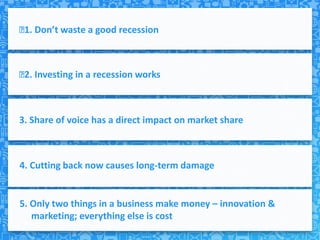
 1.


 Investing in a recession works
 2.


3. Share of voice has a direct impact on market share


4. Cutting back now causes long-term damage


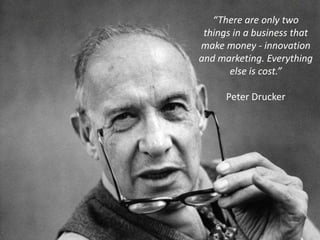
5. Only two things in a business make money – innovation &
   marketing; everything else is cost
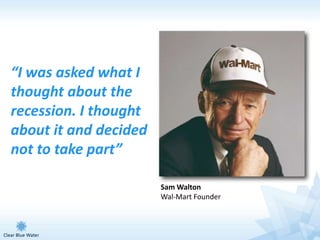
“I was asked what I
thought about the
recession. I thought
about it and decided
not to take part”

                       Sam Walton
                       Wal-Mart Founder
Don’t waste a good recession
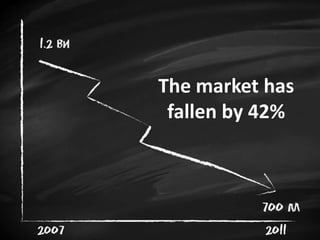
The market has
 fallen by 42%
Time of great opportunity
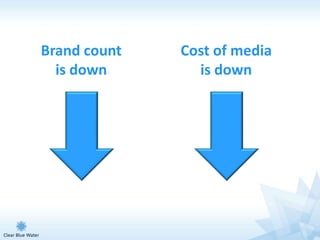
Brand count   Cost of media
  is down       is down
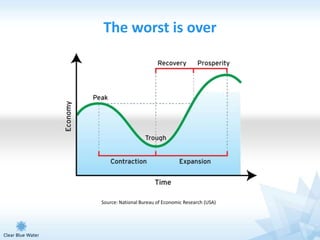
The worst is over


Source: National Bureau of Economic Research (USA)
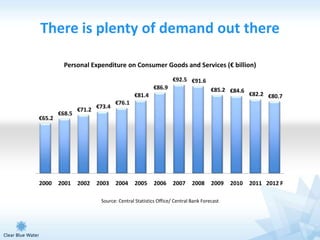
There is plenty of demand out there

          Personal Expenditure on Consumer Goods and Services (€ billion)

                                                          €92.5 €91.6
                                                €86.9                       €85.2 €84.6
                                       €81.4                                              €82.2 €80.7
                              €76.1
                €71.2 €73.4
        €68.5
€65.2


2000    2001    2002   2003   2004     2005      2006     2007     2008     2009   2010   2011 2012 F

                        Source: Central Statistics Office/ Central Bank Forecast
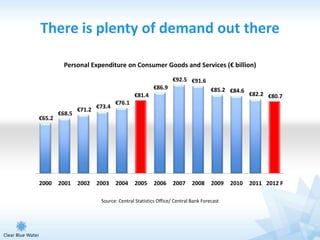
There is plenty of demand out there

          Personal Expenditure on Consumer Goods and Services (€ billion)

                                                          €92.5 €91.6
                                                €86.9                       €85.2 €84.6
                                       €81.4                                              €82.2 €80.7
                              €76.1
                €71.2 €73.4
        €68.5
€65.2


2000    2001    2002   2003   2004     2005      2006     2007     2008     2009   2010   2011 2012 F

                        Source: Central Statistics Office/ Central Bank Forecast
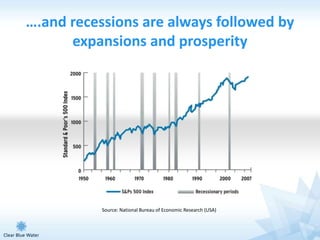
….and recessions are always followed by
      expansions and prosperity


           Source: National Bureau of Economic Research (USA)
Investing in a recession works
“The rationale that a company can afford
    to cutback on advertising because
everybody else is cutting back is fallacious;
     executives should cash in on the
   opportunity that rival companies are
            creating for them”
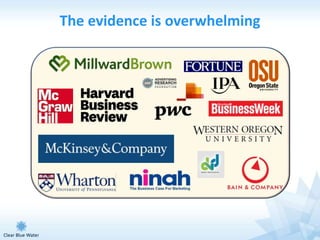
The evidence is overwhelming
The actions taken during a
  recession decide the future
growth or decline of a company
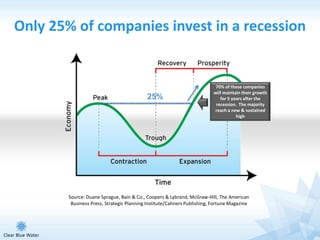
Only 25% of companies invest in a recession


                                                                          70% of these companies
                                                                         will maintain their growth
                                           25%                              for 5 years after the
                                                                          recession. The majority
                                                                         reach a new & sustained
                                                                                    high


        Source: Duane Sprague, Bain & Co., Coopers & Lybrand, McGraw-Hill, The American
         Business Press, Strategic Planning Institute/Cahners Publishing, Fortune Magazine
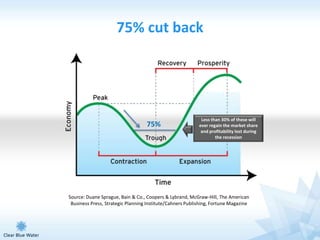
75% cut back


                                                            Less than 30% of these will
                                   75%                     ever regain the market share
                                                            and profitability lost during
                                                                   the recession


Source: Duane Sprague, Bain & Co., Coopers & Lybrand, McGraw-Hill, The American

 Business Press, Strategic Planning Institute/Cahners Publishing, Fortune Magazine
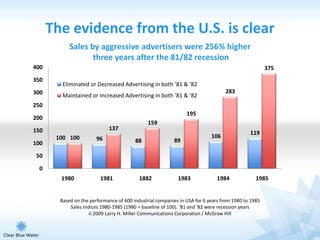
The evidence from the U.S. is clear
            Sales by aggressive advertisers were 256% higher
                   three years after the 81/82 recession
400                                                                                                 375
350
         Eliminated or Decreased Advertising in both '81 & '82
300                                                                              283
         Maintained or Increased Advertising in both '81 & '82
250
                                                                195
200
                                               159
150                          137
                                                                                            119
       100 100          96                                                 106
100                                      88               89

 50

 0
        1980             1981              1882             1983             1984              1985


        Based on the performance of 600 industrial companies in USA for 6 years from 1980 to 1985
            Sales Indices 1980-1985 (1980 = baseline of 100). ‘81 and ‘82 were recession years
                     © 2009 Larry H. Miller Communications Corporation / McGraw Hill
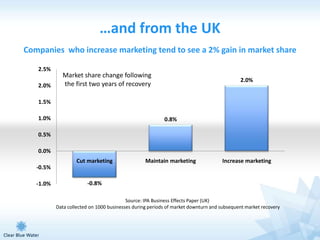
…and from the UK
Companies who increase marketing tend to see a 2% gain in market share

   2.5%
             Market share change following
                                                                                           2.0%
   2.0%      the first two years of recovery

   1.5%

   1.0%                                                   0.8%

   0.5%

   0.0%
                   Cut marketing                  Maintain marketing               Increase marketing
   -0.5%

   -1.0%                -0.8%

                                          Source: IPA Business Effects Paper (UK)
           Data collected on 1000 businesses during periods of market downturn and subsequent market recovery
Share of voice has a direct
 impact on market share
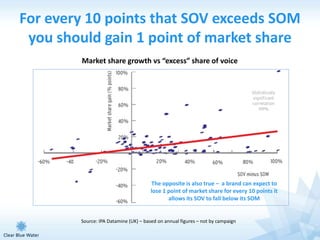
For every 10 points that SOV exceeds SOM
 you should gain 1 point of market share
        Market share growth vs “excess” share of voice


                                       The opposite is also true – a brand can expect to
                                       lose 1 point of market share for every 10 points it
                                              allows its SOV to fall below its SOM


        Source: IPA Datamine (UK) – based on annual figures – not by campaign
Cutting back now causes
   long-term damage
“The short-term result of cutting
  expenditure looks attractive for a short
while……but hides the considerable damage
 being done to longer-term profitability“


           Drawn from analysis of 880 case studies from the IPA Databank
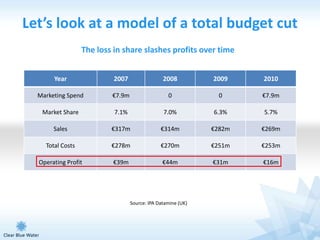
Let’s look at a model of a total budget cut
                  The loss in share slashes profits over time


       Year                2007                 2008          2009    2010

  Marketing Spend         €7.9m                   0             0     €7.9m

   Market Share            7.1%                 7.0%          6.3%    5.7%

       Sales              €317m                €314m          €282m   €269m

    Total Costs           €278m                €270m          €251m   €253m

  Operating Profit        €39m                  €44m          €31m    €16m


                                  Source: IPA Datamine (UK)
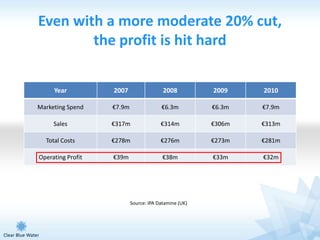
Even with a more moderate 20% cut,
        the profit is hit hard

     Year          2007                  2008          2009    2010

Marketing Spend    €7.9m                €6.3m          €6.3m   €7.9m

     Sales         €317m                €314m          €306m   €313m

  Total Costs      €278m                €276m          €273m   €281m

Operating Profit   €39m                  €38m          €33m    €32m


                           Source: IPA Datamine (UK)
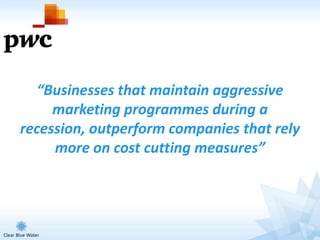
“Businesses that maintain aggressive
     marketing programmes during a
recession, outperform companies that rely
     more on cost cutting measures”
Government has a role to play
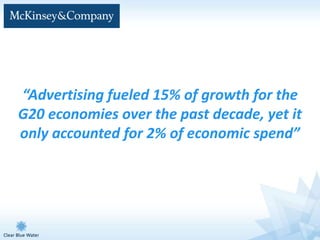
“Advertising fueled 15% of growth for the
G20 economies over the past decade, yet it
only accounted for 2% of economic spend”
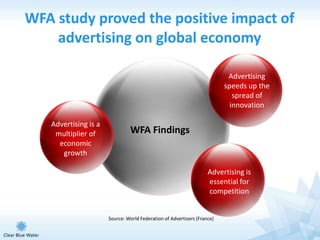
WFA study proved the positive impact of
    advertising on global economy

                                                                          Advertising
                                                                         speeds up the
                                                                            spread of
                                                                           innovation

   Advertising is a
    multiplier of              WFA Findings
     economic
      growth

                                                                   Advertising is
                                                                   essential for
                                                                   competition


                      Source: World Federation of Advertisers (France)
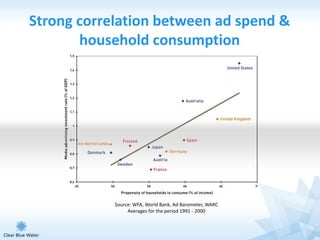
Strong correlation between ad spend &
       household consumption


            Source: WFA, World Bank, Ad Barometer, WARC
                 Averages for the period 1991 - 2000
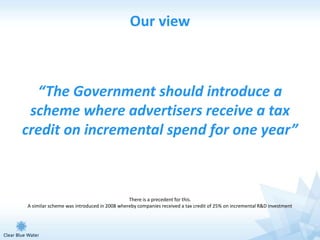
Our view


  “The Government should introduce a
 scheme where advertisers receive a tax
credit on incremental spend for one year”


                                            There is a precedent for this.
A similar scheme was introduced in 2008 whereby companies received a tax credit of 25% on incremental R&D investment
“There are only two
 things in a business that
make money - innovation
and marketing. Everything
       else is cost.”

      Peter Drucker
Alan Cox Advertising Effectiveness

Alan Cox Advertising Effectiveness

  • 1.
  • 3.
    The Danger ofCutting Marketing
  • 4.
     Don’t wastea good recession 1.  Investing in a recession works 2. 3. Share of voice has a direct impact on market share 4. Cutting back now causes long-term damage 5. Only two things in a business make money – innovation & marketing; everything else is cost
  • 5.
    “I was askedwhat I thought about the recession. I thought about it and decided not to take part” Sam Walton Wal-Mart Founder
  • 7.
    Don’t waste agood recession
  • 8.
    The market has fallen by 42%
  • 9.
    Time of greatopportunity
  • 10.
    Brand count Cost of media is down is down
  • 11.
    The worst isover Source: National Bureau of Economic Research (USA)
  • 12.
    There is plentyof demand out there Personal Expenditure on Consumer Goods and Services (€ billion) €92.5 €91.6 €86.9 €85.2 €84.6 €81.4 €82.2 €80.7 €76.1 €71.2 €73.4 €68.5 €65.2 2000 2001 2002 2003 2004 2005 2006 2007 2008 2009 2010 2011 2012 F Source: Central Statistics Office/ Central Bank Forecast
  • 13.
    There is plentyof demand out there Personal Expenditure on Consumer Goods and Services (€ billion) €92.5 €91.6 €86.9 €85.2 €84.6 €81.4 €82.2 €80.7 €76.1 €71.2 €73.4 €68.5 €65.2 2000 2001 2002 2003 2004 2005 2006 2007 2008 2009 2010 2011 2012 F Source: Central Statistics Office/ Central Bank Forecast
  • 14.
    ….and recessions arealways followed by expansions and prosperity Source: National Bureau of Economic Research (USA)
  • 16.
    Investing in arecession works
  • 17.
    “The rationale thata company can afford to cutback on advertising because everybody else is cutting back is fallacious; executives should cash in on the opportunity that rival companies are creating for them”
  • 18.
    The evidence isoverwhelming
  • 19.
    The actions takenduring a recession decide the future growth or decline of a company
  • 20.
    Only 25% ofcompanies invest in a recession 70% of these companies will maintain their growth 25% for 5 years after the recession. The majority reach a new & sustained high Source: Duane Sprague, Bain & Co., Coopers & Lybrand, McGraw-Hill, The American Business Press, Strategic Planning Institute/Cahners Publishing, Fortune Magazine
  • 21.
    75% cut back Less than 30% of these will 75% ever regain the market share and profitability lost during the recession Source: Duane Sprague, Bain & Co., Coopers & Lybrand, McGraw-Hill, The American Business Press, Strategic Planning Institute/Cahners Publishing, Fortune Magazine
  • 22.
    The evidence fromthe U.S. is clear Sales by aggressive advertisers were 256% higher three years after the 81/82 recession 400 375 350 Eliminated or Decreased Advertising in both '81 & '82 300 283 Maintained or Increased Advertising in both '81 & '82 250 195 200 159 150 137 119 100 100 96 106 100 88 89 50 0 1980 1981 1882 1983 1984 1985 Based on the performance of 600 industrial companies in USA for 6 years from 1980 to 1985 Sales Indices 1980-1985 (1980 = baseline of 100). ‘81 and ‘82 were recession years © 2009 Larry H. Miller Communications Corporation / McGraw Hill
  • 23.
    …and from theUK Companies who increase marketing tend to see a 2% gain in market share 2.5% Market share change following 2.0% 2.0% the first two years of recovery 1.5% 1.0% 0.8% 0.5% 0.0% Cut marketing Maintain marketing Increase marketing -0.5% -1.0% -0.8% Source: IPA Business Effects Paper (UK) Data collected on 1000 businesses during periods of market downturn and subsequent market recovery
  • 25.
    Share of voicehas a direct impact on market share
  • 26.
    For every 10points that SOV exceeds SOM you should gain 1 point of market share Market share growth vs “excess” share of voice The opposite is also true – a brand can expect to lose 1 point of market share for every 10 points it allows its SOV to fall below its SOM Source: IPA Datamine (UK) – based on annual figures – not by campaign
  • 28.
    Cutting back nowcauses long-term damage
  • 29.
    “The short-term resultof cutting expenditure looks attractive for a short while……but hides the considerable damage being done to longer-term profitability“ Drawn from analysis of 880 case studies from the IPA Databank
  • 30.
    Let’s look ata model of a total budget cut The loss in share slashes profits over time Year 2007 2008 2009 2010 Marketing Spend €7.9m 0 0 €7.9m Market Share 7.1% 7.0% 6.3% 5.7% Sales €317m €314m €282m €269m Total Costs €278m €270m €251m €253m Operating Profit €39m €44m €31m €16m Source: IPA Datamine (UK)
  • 31.
    Even with amore moderate 20% cut, the profit is hit hard Year 2007 2008 2009 2010 Marketing Spend €7.9m €6.3m €6.3m €7.9m Sales €317m €314m €306m €313m Total Costs €278m €276m €273m €281m Operating Profit €39m €38m €33m €32m Source: IPA Datamine (UK)
  • 32.
    “Businesses that maintainaggressive marketing programmes during a recession, outperform companies that rely more on cost cutting measures”
  • 33.
    Government has arole to play
  • 34.
    “Advertising fueled 15%of growth for the G20 economies over the past decade, yet it only accounted for 2% of economic spend”
  • 36.
    WFA study provedthe positive impact of advertising on global economy Advertising speeds up the spread of innovation Advertising is a multiplier of WFA Findings economic growth Advertising is essential for competition Source: World Federation of Advertisers (France)
  • 37.
    Strong correlation betweenad spend & household consumption Source: WFA, World Bank, Ad Barometer, WARC Averages for the period 1991 - 2000
  • 38.
    Our view “The Government should introduce a scheme where advertisers receive a tax credit on incremental spend for one year” There is a precedent for this. A similar scheme was introduced in 2008 whereby companies received a tax credit of 25% on incremental R&D investment
  • 40.
    “There are onlytwo things in a business that make money - innovation and marketing. Everything else is cost.” Peter Drucker

Editor's Notes

  • #31 The likely impact of this decline on the profitability of the brand over the three year period was then modelled assuming a fairly typical cost structure for a packaged goods brand. Other assumptions made were that category growth ceased for two years and resumed 5% growth in the third year; that marketing communications expenditure for the brand was restored in the third year; and that fixed costs for the brand rose with RPI across the downturn. The resulting profitability pattern echoed the conclusions of other researchers: that a short-term improvement was rapidly overtaken by a severe decline that became acute in the third year when the marketing budget was restored (source IPA Datamine doc)