Unfinished Business: Economic
   Repercussions of Austerity

        Presentation for Conference on
The Global Economic Crisis & Canadian Austerity
          Ryerson University, Toronto
               March 23, 2012

Toby Sanger, Canadian Union of Public Employees
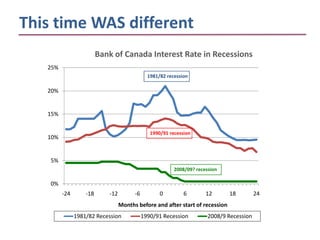
This time WAS different
                         Bank of Canada Interest Rate in Recessions
   25%
                                               1981/82 recession

   20%


   15%


                                                1990/91 recession
   10%


    5%
                                                          2008/09? recession

    0%
         -24       -18      -12         -6          0         6        12      18          24
                                  Months before and after start of recession
               1981/82 Recession             1990/91 Recession          2008/9 Recession
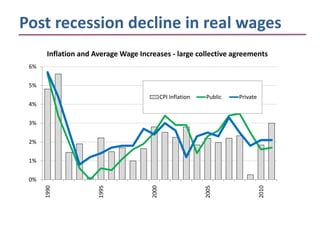
Post recession decline in real wages
       Inflation and Average Wage Increases - large collective agreements
 6%


 5%
                                             CPI Inflation   Public   Private
 4%


 3%


 2%


 1%


 0%
      1990


                      1995


                                      2000


                                                             2005


                                                                                2010
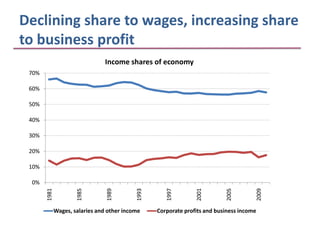
Declining share to wages, increasing share
to business profit
                                 Income shares of economy
 70%

 60%

 50%

 40%

 30%

 20%

 10%

 0%
       1981


                      1985


                                 1989


                                            1993


                                                      1997


                                                                 2001


                                                                            2005


                                                                                       2009
              Wages, salaries and other income     Corporate profits and business income
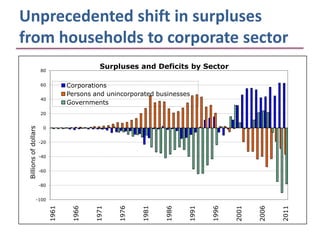
Unprecedented shift in surpluses
from households to corporate sector
                       80
                                              Surpluses and Deficits by Sector

                       60           Corporations
                                    Persons and unincorporated businesses
                       40
                                    Governments
                       20


                        0
 Billions of dollars


                       -20


                       -40


                       -60


                       -80


                  -100
                                     1966


                                                                                      2001
                             1961


                                            1971


                                                   1976


                                                          1981


                                                                 1986


                                                                        1991


                                                                               1996


                                                                                             2006


                                                                                                    2011
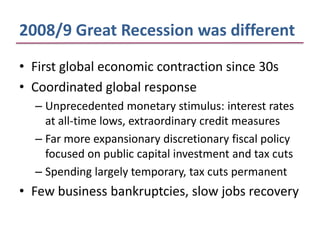
2008/9 Great Recession was different
• First global economic contraction since 30s
• Coordinated global response
  – Unprecedented monetary stimulus: interest rates
    at all-time lows, extraordinary credit measures
  – Far more expansionary discretionary fiscal policy
    focused on public capital investment and tax cuts
  – Spending largely temporary, tax cuts permanent
• Few business bankruptcies, slow jobs recovery
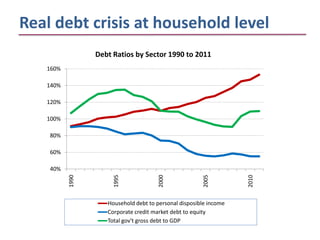
Real debt crisis at household level
                 Debt Ratios by Sector 1990 to 2011
   160%

   140%

   120%

   100%

    80%

    60%

    40%
          1990


                      1995


                                      2000


                                                       2005


                                                                   2010
                    Household debt to personal disposible income
                    Corporate credit market debt to equity
                    Total gov't gross debt to GDP
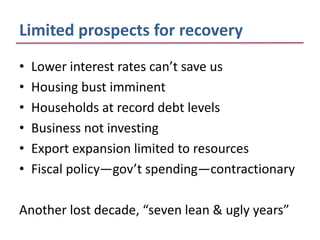
Limited prospects for recovery
•   Lower interest rates can’t save us
•   Housing bust imminent
•   Households at record debt levels
•   Business not investing
•   Export expansion limited to resources
•   Fiscal policy—gov’t spending—contractionary

Another lost decade, “seven lean & ugly years”
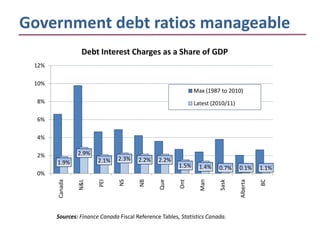
Government debt ratios manageable
                 Debt Interest Charges as a Share of GDP
 12%

 10%
                                                              Max (1987 to 2010)
  8%                                                          Latest (2010/11)

  6%

  4%

  2%            2.9%
                       2.1%    2.3%    2.2%    2.2%
       1.9%
                                                       1.5%     1.4%   0.7%      0.1%      1.1%
  0%
                               NS


                                                                                           BC
                       PEI


                                       NB


                                               Que


                                                       Ont


                                                                Man


                                                                                 Alberta
                                                                        Sask
       Canada


                N&L


       Sources: Finance Canada Fiscal Reference Tables, Statistics Canada.
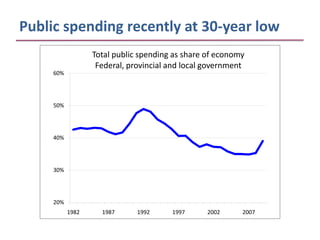
Public spending recently at 30-year low
                  Total public spending as share of economy
                   Federal, provincial and local government
     60%


     50%


     40%


     30%


     20%
           1982     1987      1992     1997      2002     2007
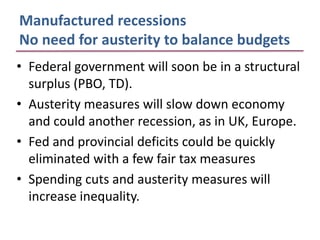
Manufactured recessions
No need for austerity to balance budgets
• Federal government will soon be in a structural
  surplus (PBO, TD).
• Austerity measures will slow down economy
  and could another recession, as in UK, Europe.
• Fed and provincial deficits could be quickly
  eliminated with a few fair tax measures
• Spending cuts and austerity measures will
  increase inequality.
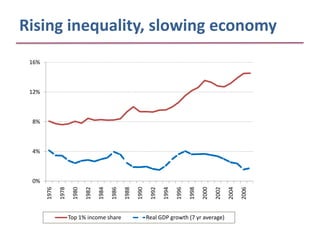
Rising inequality, slowing economy
 16%


 12%


 8%


 4%


 0%
       1976

              1978

                      1980

                             1982

                                    1984

                                           1986

                                                  1988

                                                         1990

                                                                 1992

                                                                        1994

                                                                               1996

                                                                                      1998

                                                                                             2000

                                                                                                    2002

                                                                                                           2004

                                                                                                                  2006
                     Top 1% income share                        Real GDP growth (7 yr average)
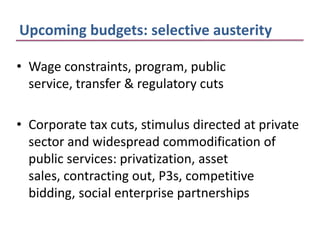
Upcoming budgets: selective austerity

• Wage constraints, program, public
  service, transfer & regulatory cuts

• Corporate tax cuts, stimulus directed at private
  sector and widespread commodification of
  public services: privatization, asset
  sales, contracting out, P3s, competitive
  bidding, social enterprise partnerships
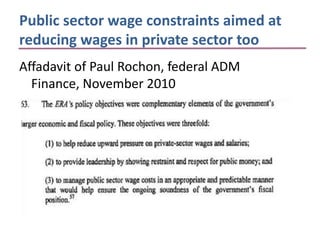
Public sector wage constraints aimed at
reducing wages in private sector too
Affadavit of Paul Rochon, federal ADM
  Finance, November 2010
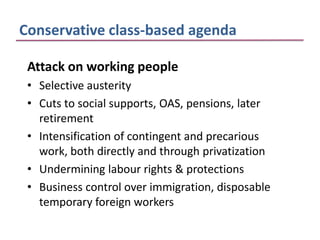
Conservative class-based agenda

 Attack on working people
 • Selective austerity
 • Cuts to social supports, OAS, pensions, later
   retirement
 • Intensification of contingent and precarious
   work, both directly and through privatization
 • Undermining labour rights & protections
 • Business control over immigration, disposable
   temporary foreign workers
Conservative class-based agenda
Strengthening power of capital
• Corporate tax cuts
• Commodification of public services:
  privatization, contracting-out,P3s, SIBs, privatization
  of foreign aid
• Environmental deregulation to aid faster capital
  accumulation through resource exploitation
• Investor protection “free trade” agreements
Conservative class-based agenda
Suppressing democracy
• Elimination of federal funding for “advocacy”
  activities, cuts to NGOs
• Bill C-377 to hamstring labour unions from engaging
  in advocacy
• Vilification of opponents
• Elimination of constructive political dialogue
• Growth of security state apparatus
• Electoral fraud, “shenanigans”
How to respond?
• Class perspective 99% vs 1%
• Expose contradictions
  – Failures of neo-liberalism & trickle-down
  – Costs of privatization, market solution
  – Fiscal: fair taxes
• Resist commodification and advance expansion
  of public services
• Broaden alliances & strengthen solidarity
• Strikes & actions maintain public support
• Mobilization through democratization

1/3 Toby Sanger: Unfinished Business

  • 1.
    Unfinished Business: Economic Repercussions of Austerity Presentation for Conference on The Global Economic Crisis & Canadian Austerity Ryerson University, Toronto March 23, 2012 Toby Sanger, Canadian Union of Public Employees
  • 2.
    This time WASdifferent Bank of Canada Interest Rate in Recessions 25% 1981/82 recession 20% 15% 1990/91 recession 10% 5% 2008/09? recession 0% -24 -18 -12 -6 0 6 12 18 24 Months before and after start of recession 1981/82 Recession 1990/91 Recession 2008/9 Recession
  • 3.
    Post recession declinein real wages Inflation and Average Wage Increases - large collective agreements 6% 5% CPI Inflation Public Private 4% 3% 2% 1% 0% 1990 1995 2000 2005 2010
  • 4.
    Declining share towages, increasing share to business profit Income shares of economy 70% 60% 50% 40% 30% 20% 10% 0% 1981 1985 1989 1993 1997 2001 2005 2009 Wages, salaries and other income Corporate profits and business income
  • 5.
    Unprecedented shift insurpluses from households to corporate sector 80 Surpluses and Deficits by Sector 60 Corporations Persons and unincorporated businesses 40 Governments 20 0 Billions of dollars -20 -40 -60 -80 -100 1966 2001 1961 1971 1976 1981 1986 1991 1996 2006 2011
  • 6.
    2008/9 Great Recessionwas different • First global economic contraction since 30s • Coordinated global response – Unprecedented monetary stimulus: interest rates at all-time lows, extraordinary credit measures – Far more expansionary discretionary fiscal policy focused on public capital investment and tax cuts – Spending largely temporary, tax cuts permanent • Few business bankruptcies, slow jobs recovery
  • 7.
    Real debt crisisat household level Debt Ratios by Sector 1990 to 2011 160% 140% 120% 100% 80% 60% 40% 1990 1995 2000 2005 2010 Household debt to personal disposible income Corporate credit market debt to equity Total gov't gross debt to GDP
  • 8.
    Limited prospects forrecovery • Lower interest rates can’t save us • Housing bust imminent • Households at record debt levels • Business not investing • Export expansion limited to resources • Fiscal policy—gov’t spending—contractionary Another lost decade, “seven lean & ugly years”
  • 9.
    Government debt ratiosmanageable Debt Interest Charges as a Share of GDP 12% 10% Max (1987 to 2010) 8% Latest (2010/11) 6% 4% 2% 2.9% 2.1% 2.3% 2.2% 2.2% 1.9% 1.5% 1.4% 0.7% 0.1% 1.1% 0% NS BC PEI NB Que Ont Man Alberta Sask Canada N&L Sources: Finance Canada Fiscal Reference Tables, Statistics Canada.
  • 10.
    Public spending recentlyat 30-year low Total public spending as share of economy Federal, provincial and local government 60% 50% 40% 30% 20% 1982 1987 1992 1997 2002 2007
  • 11.
    Manufactured recessions No needfor austerity to balance budgets • Federal government will soon be in a structural surplus (PBO, TD). • Austerity measures will slow down economy and could another recession, as in UK, Europe. • Fed and provincial deficits could be quickly eliminated with a few fair tax measures • Spending cuts and austerity measures will increase inequality.
  • 12.
    Rising inequality, slowingeconomy 16% 12% 8% 4% 0% 1976 1978 1980 1982 1984 1986 1988 1990 1992 1994 1996 1998 2000 2002 2004 2006 Top 1% income share Real GDP growth (7 yr average)
  • 13.
    Upcoming budgets: selectiveausterity • Wage constraints, program, public service, transfer & regulatory cuts • Corporate tax cuts, stimulus directed at private sector and widespread commodification of public services: privatization, asset sales, contracting out, P3s, competitive bidding, social enterprise partnerships
  • 14.
    Public sector wageconstraints aimed at reducing wages in private sector too Affadavit of Paul Rochon, federal ADM Finance, November 2010
  • 15.
    Conservative class-based agenda Attack on working people • Selective austerity • Cuts to social supports, OAS, pensions, later retirement • Intensification of contingent and precarious work, both directly and through privatization • Undermining labour rights & protections • Business control over immigration, disposable temporary foreign workers
  • 16.
    Conservative class-based agenda Strengtheningpower of capital • Corporate tax cuts • Commodification of public services: privatization, contracting-out,P3s, SIBs, privatization of foreign aid • Environmental deregulation to aid faster capital accumulation through resource exploitation • Investor protection “free trade” agreements
  • 17.
    Conservative class-based agenda Suppressingdemocracy • Elimination of federal funding for “advocacy” activities, cuts to NGOs • Bill C-377 to hamstring labour unions from engaging in advocacy • Vilification of opponents • Elimination of constructive political dialogue • Growth of security state apparatus • Electoral fraud, “shenanigans”
  • 18.
    How to respond? •Class perspective 99% vs 1% • Expose contradictions – Failures of neo-liberalism & trickle-down – Costs of privatization, market solution – Fiscal: fair taxes • Resist commodification and advance expansion of public services • Broaden alliances & strengthen solidarity • Strikes & actions maintain public support • Mobilization through democratization

Editor's Notes

  • #3 Canada’s previous post-war recessions were both explicitly and intentionally caused by the federal government raising interest rates to slow down the economy and reduce the pace of wage increases, ostensibly to reduce inflation.In the two years prior to the recessions, the Bank of Canada doubled its short-term interest rates, which also pushed up medium and long-term interest rates. This hiking of interest rates to over 10% slowed down investment, increased personal and business bankruptcies and pushed unemployment to double-digit rates. In these previous recessions, the economic decline, lower revenues, higher social spending and high interest rates also caused large increases in government deficits. Coming out of these recessions, Canadian governments embarked on deficit-cutting crusades, largely through cuts in program spending also involved public sector wage freezes or constraints to “share the pain” with public sector workers .Despite the contractionary fiscal policies, the economy was able to ultimately grow coming out of these recessions because the federal government ran expansionary monetary policies. Following both the 1981/2 and 1990/1 recessions, interest rates were reduced by more than half.
  • #4  The consequence of successive contractionary monetary policies for the private sector and contractionary fiscal policies, as well as direct wage suppression, in the public sector was a steep decline in the rate of wage increases.
  • #5 Following these effectively orchestrated recessions and wage constraint measures, the share of the national income going to wages and salaries declined on a long-term basis as the share going to profit increased substantially.There are blips and dips of the wage and profit share during recessions, but what’s notable about this recent recession is how little corporate profits declined in total and as a share of the economy. Wages also includes income from farm operators and investment and interest incomesCorp profits plus unincorpbusines & rents income
  • #7 Overgrown and out of control financial sector and household debt-financed growth masked a stagnant underlying economy. Interest rates were reduced to all-time lows, in some cases negative, contradicting previous assertions that governments had limited control over them. Despite the severe credit crunch in the private sector, there were far fewer business bankruptcies in this recession than in previous post-war recessions because of rock-bottom interest rates, extraordinary provision of credit to business and much lower corporate debt ratios. Discretionary fiscal policy was far more expansionary than in previous recessions: gov’t capital investment increased at a far faster pace than in previous recessions. In Canada, and other countries, stimulus measures were unbalanced: spending measures and those benefiting workers or households were temporary, while tax cuts for business were made permanent. Following this close brush with worldwide depression there was hope among many that it would lead to some positive structural measures to stabilize the economic system and at least marginally reduce inequalities, as had eventually happened after both the 1870s Long Depression and the 1930s Great Depression.
  • #9 Overgrown and out of control financial sector and household debt-financed growth masked a stagnant underlying economy. Interest rates were reduced to all-time lows, in some cases negative, contradicting previous assertions that governments had limited control over them. Despite the severe credit crunch in the private sector, there were far fewer business bankruptcies in this recession than in previous post-war recessions because of rock-bottom interest rates, extraordinary provision of credit to business and much lower corporate debt ratios. Discretionary fiscal policy was far more expansionary than in previous recessions: gov’t capital investment increased at a far faster pace than in previous recessions. In Canada, and other countries, stimulus measures were unbalanced: spending measures and those benefiting workers or households were temporary, while tax cuts for business were made permanent. Following this close brush with worldwide depression there was hope among many that it would lead to some positive structural measures to stabilize the economic system and at least marginally reduce inequalities, as had eventually happened after both the 1870s Long Depression and the 1930s Great Depression.
  • #12 Carlo & Chris Hurl put it well: “Janus” or two faced austerity”
  • #14 Carlo & Chris Hurl put it well: “Janus” or two faced austerity”
  • #19 Neo-liberal economics clearly failed and growth prospects limited—even proponents now questioning long-held beliefs.Class divisions are deepening and becoming more apparent.Occupy movement brought 99% vs 1% to the foreOpportunity to move beyond diverse alliance-based extra-parliamentary politicsSome, but limited potential at parliamentary level to articulate progressive alternatives: constrained by NDP caution & aim to form opposition, attract the middle groundUnions adopting more class-based language, approachBoth commodification of public services and of public goods, natural wealth. Real problem is lack of time among workers, potential activists. Students, families working ever harder, no mass army of unemployed.Momentum behind Occupy movement both expression of gross inequalities and desire to express voice by diverse people feeling disenfranchised by economically and politically.