THE EUROPEAN AGRICULTURAL
KNOWLEDGE AND INNOVATION SYSTEM
(AKIS) TOWARDS AN INTERACTIVE
INNOVATION MODEL
SCAR-swg Agricultural Knowledge and Innovation
Systems
Krijn Poppe
co-chair SCAR swg AKIS
(LEI Wageningen UR)
CONTENT
 Introduction
 Concepts:
 Science, R&D and Innovation
 AKIS
 The EIP-AGRI
 Looking into the future: 3 scenarios for AKIS
 Actions to make the system more robust and more
interactive.
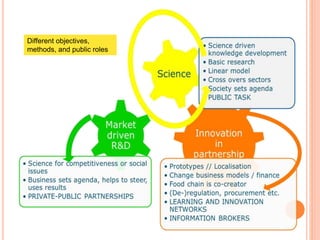
Different objectives,
methods, and public roles
THE FOOD CHAIN AND AKIS
AKIS ARE QUITE DIFFERENT BETWEEN COUNTRIES
/ REGIONS / SECTORS – E.G. EXTENSION
INNOVATION BY INTERACTION IN NETWORKS
 Innovation as a process has strong learning aspects:
learn how to do new things, bottom-up.
 Alternative: force (or pay for) quality standards, mandates
 Thematically-focused learning networks of different
actors can help.
 Generating learning and innovation through interactions
between the involved actors.
 Members can include farmers, extension workers, food
industry, researchers, government and ngo
representatives and other stakeholders.
Is reflected in EIP-Agri: Operational Groups,
Thematic Networks, Multi-actor projects
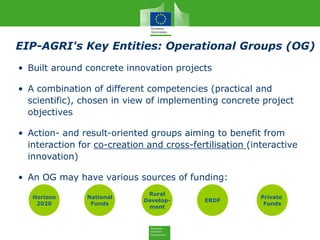
EIP-AGRI's Key Entities: Operational Groups (OG)
• Built around concrete innovation projects
• A combination of different competencies (practical and
scientific), chosen in view of implementing concrete project
objectives
• Action- and result-oriented groups aiming to benefit from
interaction for co-creation and cross-fertilisation (interactive
innovation)
• An OG may have various sources of funding:
Horizon
2020
National
Funds
Rural
Develop-
ment
ERDF
Private
Funds
Farmers
NGOs Advisors
Researchers
Agri-
business Operational
Group
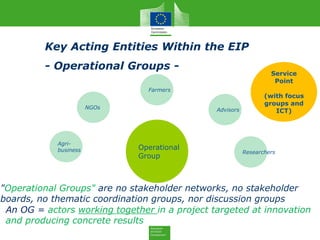
Key Acting Entities Within the EIP
- Operational Groups -
"Operational Groups" are no stakeholder networks, no stakeholder
boards, no thematic coordination groups, nor discussion groups
An OG = actors working together in a project targeted at innovation
and producing concrete results
Service
Point
(with focus
groups and
ICT)
Thematic networks under Horizon 2020
• Projects involving all concerned stakeholders (researchers,
farmers, advisors, enterprises, education, NGOs, administration,
regulatory bodies…): no pure research networks
• Stocktaking, mapping and state-of-the-art of existing
scientific knowledge & best practices: what do we have/what
do we miss to make used
• Projects must develop end-user material to facilitate the
discussion on, sharing and dissemination of knowledge in an easy
accessible way: input for education and a research database
for end-users (long term availability of results in a common
format)
• "multi-actor" is more than a strong dissemination requirement or
what a broad stakeholders' board can deliver
• "all along the project" *: a clear role for the different actors
in the work plan, from the participation in the planning of work
and experiments, their execution up until the dissemination of
results and the possible demonstration phase.
• Project proposals should illustrate sufficient quantity and quality
of knowledge exchange activities
This should generate innovative solutions that are more likely
to be applied thanks to the cross-fertilisation* of ideas between
actors, the co-creation and the generation of co-ownership for
eventual results.
(*legal base in Specific Programme)
Multi-actor projects in
Horizon 2020 Work Programme 2014-2015
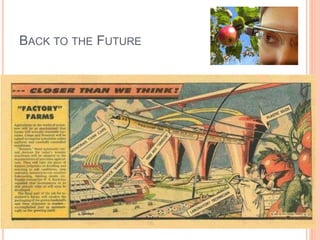
BACK TO THE FUTURE
3 SCENARIO’S TO EXPLORE THE FUTURE
 HighTech: strong influence new technology owned by
multinationals. Driverless tractors, contract farming and a rural
exodus. US of Europe. Rich society with inequality.
Sustainability issues solved. Bio-boom scenario.
 Self-organisation: Europe of regions where new ICT
technologies with disruptive business models lead to self-
organisation, bottom-up democracy, short-supply chains, multi-
functional agriculture. European institutions are weak, regions
and cities rule. Inequalities between regions, depending on
endowments.
 Collapse: Big climate change effects, mass-migration and
political turbulence leads to a collapse of institutions and
European integration. Regional and local communities look for
self-sufficiency. Bio-scarcity and labour intensive agriculture.
Technology development becomes dependent on science in
China, India, Brazil.
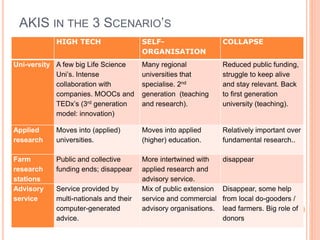
AKIS IN THE 3 SCENARIO’S
HIGH TECH SELF-
ORGANISATION
COLLAPSE
Uni-versity A few big Life Science
Uni’s. Intense
collaboration with
companies. MOOCs and
TEDx’s (3rd generation
model: innovation)
Many regional
universities that
specialise. 2nd
generation (teaching
and research).
Reduced public funding,
struggle to keep alive
and stay relevant. Back
to first generation
university (teaching).
Applied
research
Moves into (applied)
universities.
Moves into applied
(higher) education.
Relatively important over
fundamental research..
Farm
research
stations
Public and collective
funding ends; disappear
More intertwined with
applied research and
advisory service.
disappear
Advisory
service
Service provided by
multi-nationals and their
computer-generated
advice.
Mix of public extension
service and commercial
advisory organisations.
Disappear, some help
from local do-gooders /
lead farmers. Big role of
donors
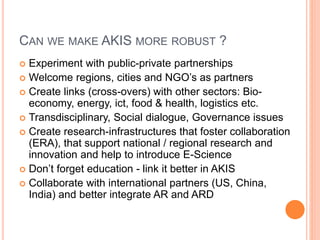
CAN WE MAKE AKIS MORE ROBUST ?
 Experiment with public-private partnerships
 Welcome regions, cities and NGO’s as partners
 Create links (cross-overs) with other sectors: Bio-
economy, energy, ict, food & health, logistics etc.
 Transdisciplinary, Social dialogue, Governance issues
 Create research-infrastructures that foster collaboration
(ERA), that support national / regional research and
innovation and help to introduce E-Science
 Don’t forget education - link it better in AKIS
 Collaborate with international partners (US, China,
India) and better integrate AR and ARD
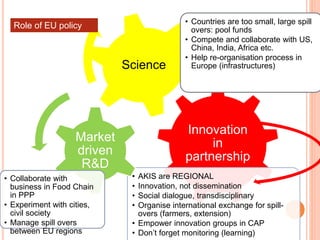
Innovation
in
partnership
• AKIS are REGIONAL
• Innovation, not dissemination
• Social dialogue, transdisciplinary
• Organise international exchange for spill-
overs (farmers, extension)
• Empower innovation groups in CAP
• Don’t forget monitoring (learning)
Market
driven
R&D
• Collaborate with
business in Food Chain
in PPP
• Experiment with cities,
civil society
• Manage spill overs
between EU regions
Science
• Countries are too small, large spill
overs: pool funds
• Compete and collaborate with US,
China, India, Africa etc.
• Help re-organisation process in
Europe (infrastructures)
Role of EU policy
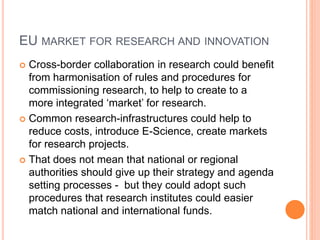
EU MARKET FOR RESEARCH AND INNOVATION
 Cross-border collaboration in research could benefit
from harmonisation of rules and procedures for
commissioning research, to help to create to a
more integrated ‘market’ for research.
 Common research-infrastructures could help to
reduce costs, introduce E-Science, create markets
for research projects.
 That does not mean that national or regional
authorities should give up their strategy and agenda
setting processes - but they could adopt such
procedures that research institutes could easier
match national and international funds.
SEE THE WEBSITE OF THE SCAR:
HTTP://EC.EUROPA.EU/RESEARCH/AGRICULTURE/SCAR/INDEX_EN.HTML
Krijn.Poppe@wur.nl
Thanks for your attention

AKIS 1 +2 + 3 Ancona june 2015

  • 1.
    THE EUROPEAN AGRICULTURAL KNOWLEDGEAND INNOVATION SYSTEM (AKIS) TOWARDS AN INTERACTIVE INNOVATION MODEL SCAR-swg Agricultural Knowledge and Innovation Systems Krijn Poppe co-chair SCAR swg AKIS (LEI Wageningen UR)
  • 2.
    CONTENT  Introduction  Concepts: Science, R&D and Innovation  AKIS  The EIP-AGRI  Looking into the future: 3 scenarios for AKIS  Actions to make the system more robust and more interactive.
  • 3.
  • 4.
  • 5.
    AKIS ARE QUITEDIFFERENT BETWEEN COUNTRIES / REGIONS / SECTORS – E.G. EXTENSION
  • 6.
    INNOVATION BY INTERACTIONIN NETWORKS  Innovation as a process has strong learning aspects: learn how to do new things, bottom-up.  Alternative: force (or pay for) quality standards, mandates  Thematically-focused learning networks of different actors can help.  Generating learning and innovation through interactions between the involved actors.  Members can include farmers, extension workers, food industry, researchers, government and ngo representatives and other stakeholders. Is reflected in EIP-Agri: Operational Groups, Thematic Networks, Multi-actor projects
  • 7.
    EIP-AGRI's Key Entities:Operational Groups (OG) • Built around concrete innovation projects • A combination of different competencies (practical and scientific), chosen in view of implementing concrete project objectives • Action- and result-oriented groups aiming to benefit from interaction for co-creation and cross-fertilisation (interactive innovation) • An OG may have various sources of funding: Horizon 2020 National Funds Rural Develop- ment ERDF Private Funds
  • 8.
    Farmers NGOs Advisors Researchers Agri- business Operational Group KeyActing Entities Within the EIP - Operational Groups - "Operational Groups" are no stakeholder networks, no stakeholder boards, no thematic coordination groups, nor discussion groups An OG = actors working together in a project targeted at innovation and producing concrete results Service Point (with focus groups and ICT)
  • 9.
    Thematic networks underHorizon 2020 • Projects involving all concerned stakeholders (researchers, farmers, advisors, enterprises, education, NGOs, administration, regulatory bodies…): no pure research networks • Stocktaking, mapping and state-of-the-art of existing scientific knowledge & best practices: what do we have/what do we miss to make used • Projects must develop end-user material to facilitate the discussion on, sharing and dissemination of knowledge in an easy accessible way: input for education and a research database for end-users (long term availability of results in a common format)
  • 10.
    • "multi-actor" ismore than a strong dissemination requirement or what a broad stakeholders' board can deliver • "all along the project" *: a clear role for the different actors in the work plan, from the participation in the planning of work and experiments, their execution up until the dissemination of results and the possible demonstration phase. • Project proposals should illustrate sufficient quantity and quality of knowledge exchange activities This should generate innovative solutions that are more likely to be applied thanks to the cross-fertilisation* of ideas between actors, the co-creation and the generation of co-ownership for eventual results. (*legal base in Specific Programme) Multi-actor projects in Horizon 2020 Work Programme 2014-2015
  • 11.
  • 12.
    3 SCENARIO’S TOEXPLORE THE FUTURE  HighTech: strong influence new technology owned by multinationals. Driverless tractors, contract farming and a rural exodus. US of Europe. Rich society with inequality. Sustainability issues solved. Bio-boom scenario.  Self-organisation: Europe of regions where new ICT technologies with disruptive business models lead to self- organisation, bottom-up democracy, short-supply chains, multi- functional agriculture. European institutions are weak, regions and cities rule. Inequalities between regions, depending on endowments.  Collapse: Big climate change effects, mass-migration and political turbulence leads to a collapse of institutions and European integration. Regional and local communities look for self-sufficiency. Bio-scarcity and labour intensive agriculture. Technology development becomes dependent on science in China, India, Brazil.
  • 13.
    AKIS IN THE3 SCENARIO’S HIGH TECH SELF- ORGANISATION COLLAPSE Uni-versity A few big Life Science Uni’s. Intense collaboration with companies. MOOCs and TEDx’s (3rd generation model: innovation) Many regional universities that specialise. 2nd generation (teaching and research). Reduced public funding, struggle to keep alive and stay relevant. Back to first generation university (teaching). Applied research Moves into (applied) universities. Moves into applied (higher) education. Relatively important over fundamental research.. Farm research stations Public and collective funding ends; disappear More intertwined with applied research and advisory service. disappear Advisory service Service provided by multi-nationals and their computer-generated advice. Mix of public extension service and commercial advisory organisations. Disappear, some help from local do-gooders / lead farmers. Big role of donors
  • 14.
    CAN WE MAKEAKIS MORE ROBUST ?  Experiment with public-private partnerships  Welcome regions, cities and NGO’s as partners  Create links (cross-overs) with other sectors: Bio- economy, energy, ict, food & health, logistics etc.  Transdisciplinary, Social dialogue, Governance issues  Create research-infrastructures that foster collaboration (ERA), that support national / regional research and innovation and help to introduce E-Science  Don’t forget education - link it better in AKIS  Collaborate with international partners (US, China, India) and better integrate AR and ARD
  • 15.
    Innovation in partnership • AKIS areREGIONAL • Innovation, not dissemination • Social dialogue, transdisciplinary • Organise international exchange for spill- overs (farmers, extension) • Empower innovation groups in CAP • Don’t forget monitoring (learning) Market driven R&D • Collaborate with business in Food Chain in PPP • Experiment with cities, civil society • Manage spill overs between EU regions Science • Countries are too small, large spill overs: pool funds • Compete and collaborate with US, China, India, Africa etc. • Help re-organisation process in Europe (infrastructures) Role of EU policy
  • 16.
    EU MARKET FORRESEARCH AND INNOVATION  Cross-border collaboration in research could benefit from harmonisation of rules and procedures for commissioning research, to help to create to a more integrated ‘market’ for research.  Common research-infrastructures could help to reduce costs, introduce E-Science, create markets for research projects.  That does not mean that national or regional authorities should give up their strategy and agenda setting processes - but they could adopt such procedures that research institutes could easier match national and international funds.
  • 17.
    SEE THE WEBSITEOF THE SCAR: HTTP://EC.EUROPA.EU/RESEARCH/AGRICULTURE/SCAR/INDEX_EN.HTML Krijn.Poppe@wur.nl Thanks for your attention