Health and
Consumers
Health and
Consumers
"Interactive Innovation in motion:
linking research and practice"
Ana Cuadrado Galván
DG Agriculture and Rural Development
Research and Innovation Unit
European Initiatives and Programmes
EIP-AGRI H2020
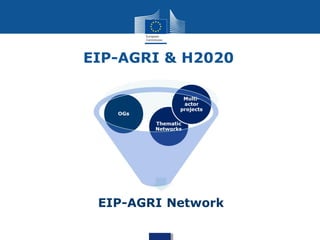
EIP-AGRI & H2020
The SC2 Work programme defines the multi-actor approach:
Collaboration between various actors to make best use of
complementary types of knowledge (scientific, practical,
organisational, etc) in view of co-creation and diffusion of
solutions/opportunities ready to implement in practice.
Multi-actor projects in WP 2016-2017
A multi-actor project needs to demonstrate:
• how the project proposal's objectives and planning are targeted
to needs / problems and opportunities of end-users
• complementarity with existing research and best practices
[What is the project's added value? - Avoid recycling projects:
repetition and continuation of former projects – more of the same]
• sufficient involvement of key actors with complementary types
of knowledge (scientific and practical) should be reflected in
the composition of the project consortium to reach the project
objectives and make its results broadly implemented.
[Include partners beyond scientists, such as farmers, farmers'
groups, advisors etc - Don't forget to think about involving multipliers
to strengthen impacts]
IMPACT! Multi-actor projects in WP 2016-2017
A multi-actor project:
• As a minimum, should result in substantial easily understandable
practical knowledge for broad dissemination in the common EIP
format
[focus on concrete and concisely written results (not project activities
description): possibly some 100 EIP practice abstracts in a
practitioners/farmers' language, best practices resulting from the
projects' work, some qualitative audio-visual material, etc
Do not reinvent the wheel: use existing long term available
dissemination channels for practitioners, lasting beyond the project
period]
• Facilitation/mediation between actors and involving for instance
RD operational groups, are strongly recommended
[but don't make impossible promises and mix up funding sources and
policies: H2020 consortia cannot start up Operational Groups]
IMPACT! Multi-actor projects in WP 2016-2017
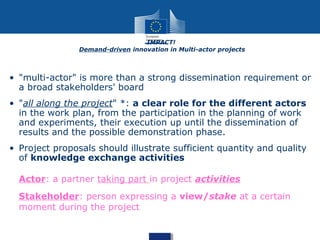
• "multi-actor" is more than a strong dissemination requirement or
a broad stakeholders' board
• "all along the project" *: a clear role for the different actors
in the work plan, from the participation in the planning of work
and experiments, their execution up until the dissemination of
results and the possible demonstration phase.
• Project proposals should illustrate sufficient quantity and quality
of knowledge exchange activities
Actor: a partner taking part in project activities
Stakeholder: person expressing a view/stake at a certain
moment during the project
IMPACT!
Demand-driven innovation in Multi-actor projects
Thematic networks in WP 2016-2017:
Compiling knowledge ready for practice
• Projects involving all actors relevant for the chose theme (e.g. researchers,
farmers, advisors, enterprises, education, NGOs, administration, regulatory bodies, EIP
project groups…):
[no pure research networks, use funding efficient: not as many actors as possible but chose
those actors that are complementary and can really contribute]
• Provide a comprehensive description of the state of the art: Partners should
summarise, share and present existing scientific knowledge & best practices that
are not sufficiently known (and applied) by practitioners
[when defining objectives: illustrate the added value, relevance of the theme, needs and
potential for farming/forestry. Get input from the existing projects from various funding
sources and avoid recycling of projects and project partners]
Expected impact:
•Support for the EIP through interaction with operational groups, and delivery of a substantial
number of "practice abstracts" in the common EIP format [provide a good description &
quantification/qualification of the outputs]
•Long term available
[KISS, no temporary fancy IT tools/platforms]
•Using the main existing dissemination channels most used by practitioners
[where the material stays available after the project finishes]
•Audio-visual material wherever possible
[farmers/end-users learn with their eyes]
•Greater user acceptance and dissemination of end-user material
Thematic networks in WP 2016-2017:
Compiling knowledge ready for practice
SFS-1C-2015
iSAGE Sustainability of terrestrial livestock
SFS-2B -2015
SOILCARE Soil cropping improving systems
SFS-5-2015
NEURICE
Crop productivity strategies (Genetics x Environment x Management)GoodBerry
TomGEM
SFS-13-2015
MyToolBox
Biological contamination of crops and food chain
MycoKey
SFS-20-2015 Strength2Food
Sustainable food chains: EU quality policy and public sector
procurement
ISIB-2-2015
Smart-AKIS
Smart Farming Technology:
Farm Management Information Systems, Precision Agriculture and
Agriculture automation and robotics
HNV-Link Support HNV farmlands through knowledge and innovation
AGRIFORVALOR Valorization of biomass side-streams from agriculture and forest
4D4F Data and sensor driven decision making on dairy farms
EuroDairy
Practice-based innovations in dairy farming: resource efficiency,
Biodiversity, Animal care, and Socio-economic resilience
EUFRUIT
fruit: cultivar development, minimise residues, storage and fruit
quality, sustainability of production systems
ISIB-4b-2015 ALTERFOR Improved forest management models
WATER-4b-
2015
FERTINNOWA
Optimize water and nutrient use efficiency:
dbase on innovative technologies and practices for fertigation of
horticultural crops
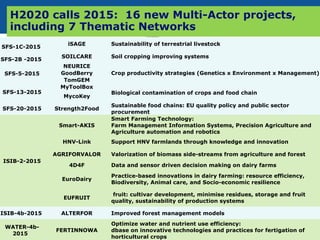
H2020 calls 2015: 16 new Multi-Actor projects,
including 7 Thematic Networks
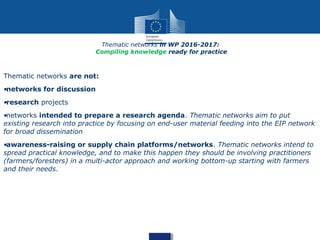
Thematic networks are not:
•networks for discussion
•research projects
•networks intended to prepare a research agenda. Thematic networks aim to put
existing research into practice by focusing on end-user material feeding into the EIP network
for broad dissemination
•awareness-raising or supply chain platforms/networks. Thematic networks intend to
spread practical knowledge, and to make this happen they should be involving practitioners
(farmers/foresters) in a multi-actor approach and working bottom-up starting with farmers
and their needs.
Thematic networks in WP 2016-2017:
Compiling knowledge ready for practice
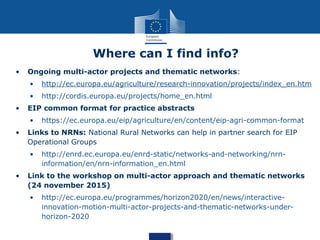
• Ongoing multi-actor projects and thematic networks:
• http://ec.europa.eu/agriculture/research-innovation/projects/index_en.htm
• http://cordis.europa.eu/projects/home_en.html
• EIP common format for practice abstracts
• https://ec.europa.eu/eip/agriculture/en/content/eip-agri-common-format
• Links to NRNs: National Rural Networks can help in partner search for EIP
Operational Groups
• http://enrd.ec.europa.eu/enrd-static/networks-and-networking/nrn-
information/en/nrn-information_en.html
• Link to the workshop on multi-actor approach and thematic networks
(24 november 2015)
• http://ec.europa.eu/programmes/horizon2020/en/news/interactive-
innovation-motion-multi-actor-projects-and-thematic-networks-under-
horizon-2020
Where can I find info?

Interactive Innovation in Motion

  • 1.
    Health and Consumers Health and Consumers "InteractiveInnovation in motion: linking research and practice" Ana Cuadrado Galván DG Agriculture and Rural Development Research and Innovation Unit
  • 2.
    European Initiatives andProgrammes EIP-AGRI H2020
  • 3.
  • 4.
    The SC2 Workprogramme defines the multi-actor approach: Collaboration between various actors to make best use of complementary types of knowledge (scientific, practical, organisational, etc) in view of co-creation and diffusion of solutions/opportunities ready to implement in practice. Multi-actor projects in WP 2016-2017
  • 5.
    A multi-actor projectneeds to demonstrate: • how the project proposal's objectives and planning are targeted to needs / problems and opportunities of end-users • complementarity with existing research and best practices [What is the project's added value? - Avoid recycling projects: repetition and continuation of former projects – more of the same] • sufficient involvement of key actors with complementary types of knowledge (scientific and practical) should be reflected in the composition of the project consortium to reach the project objectives and make its results broadly implemented. [Include partners beyond scientists, such as farmers, farmers' groups, advisors etc - Don't forget to think about involving multipliers to strengthen impacts] IMPACT! Multi-actor projects in WP 2016-2017
  • 6.
    A multi-actor project: •As a minimum, should result in substantial easily understandable practical knowledge for broad dissemination in the common EIP format [focus on concrete and concisely written results (not project activities description): possibly some 100 EIP practice abstracts in a practitioners/farmers' language, best practices resulting from the projects' work, some qualitative audio-visual material, etc Do not reinvent the wheel: use existing long term available dissemination channels for practitioners, lasting beyond the project period] • Facilitation/mediation between actors and involving for instance RD operational groups, are strongly recommended [but don't make impossible promises and mix up funding sources and policies: H2020 consortia cannot start up Operational Groups] IMPACT! Multi-actor projects in WP 2016-2017
  • 7.
    • "multi-actor" ismore than a strong dissemination requirement or a broad stakeholders' board • "all along the project" *: a clear role for the different actors in the work plan, from the participation in the planning of work and experiments, their execution up until the dissemination of results and the possible demonstration phase. • Project proposals should illustrate sufficient quantity and quality of knowledge exchange activities Actor: a partner taking part in project activities Stakeholder: person expressing a view/stake at a certain moment during the project IMPACT! Demand-driven innovation in Multi-actor projects
  • 8.
    Thematic networks inWP 2016-2017: Compiling knowledge ready for practice • Projects involving all actors relevant for the chose theme (e.g. researchers, farmers, advisors, enterprises, education, NGOs, administration, regulatory bodies, EIP project groups…): [no pure research networks, use funding efficient: not as many actors as possible but chose those actors that are complementary and can really contribute] • Provide a comprehensive description of the state of the art: Partners should summarise, share and present existing scientific knowledge & best practices that are not sufficiently known (and applied) by practitioners [when defining objectives: illustrate the added value, relevance of the theme, needs and potential for farming/forestry. Get input from the existing projects from various funding sources and avoid recycling of projects and project partners]
  • 9.
    Expected impact: •Support forthe EIP through interaction with operational groups, and delivery of a substantial number of "practice abstracts" in the common EIP format [provide a good description & quantification/qualification of the outputs] •Long term available [KISS, no temporary fancy IT tools/platforms] •Using the main existing dissemination channels most used by practitioners [where the material stays available after the project finishes] •Audio-visual material wherever possible [farmers/end-users learn with their eyes] •Greater user acceptance and dissemination of end-user material Thematic networks in WP 2016-2017: Compiling knowledge ready for practice
  • 10.
    SFS-1C-2015 iSAGE Sustainability ofterrestrial livestock SFS-2B -2015 SOILCARE Soil cropping improving systems SFS-5-2015 NEURICE Crop productivity strategies (Genetics x Environment x Management)GoodBerry TomGEM SFS-13-2015 MyToolBox Biological contamination of crops and food chain MycoKey SFS-20-2015 Strength2Food Sustainable food chains: EU quality policy and public sector procurement ISIB-2-2015 Smart-AKIS Smart Farming Technology: Farm Management Information Systems, Precision Agriculture and Agriculture automation and robotics HNV-Link Support HNV farmlands through knowledge and innovation AGRIFORVALOR Valorization of biomass side-streams from agriculture and forest 4D4F Data and sensor driven decision making on dairy farms EuroDairy Practice-based innovations in dairy farming: resource efficiency, Biodiversity, Animal care, and Socio-economic resilience EUFRUIT fruit: cultivar development, minimise residues, storage and fruit quality, sustainability of production systems ISIB-4b-2015 ALTERFOR Improved forest management models WATER-4b- 2015 FERTINNOWA Optimize water and nutrient use efficiency: dbase on innovative technologies and practices for fertigation of horticultural crops H2020 calls 2015: 16 new Multi-Actor projects, including 7 Thematic Networks
  • 11.
    Thematic networks arenot: •networks for discussion •research projects •networks intended to prepare a research agenda. Thematic networks aim to put existing research into practice by focusing on end-user material feeding into the EIP network for broad dissemination •awareness-raising or supply chain platforms/networks. Thematic networks intend to spread practical knowledge, and to make this happen they should be involving practitioners (farmers/foresters) in a multi-actor approach and working bottom-up starting with farmers and their needs. Thematic networks in WP 2016-2017: Compiling knowledge ready for practice
  • 12.
    • Ongoing multi-actorprojects and thematic networks: • http://ec.europa.eu/agriculture/research-innovation/projects/index_en.htm • http://cordis.europa.eu/projects/home_en.html • EIP common format for practice abstracts • https://ec.europa.eu/eip/agriculture/en/content/eip-agri-common-format • Links to NRNs: National Rural Networks can help in partner search for EIP Operational Groups • http://enrd.ec.europa.eu/enrd-static/networks-and-networking/nrn- information/en/nrn-information_en.html • Link to the workshop on multi-actor approach and thematic networks (24 november 2015) • http://ec.europa.eu/programmes/horizon2020/en/news/interactive- innovation-motion-multi-actor-projects-and-thematic-networks-under- horizon-2020 Where can I find info?

Editor's Notes

  • #4 Interactive Innovation Model: fosters the development of research into practical applications and the creation of new ideas thanks to the interaction between actors with different knowledge (practice, scientific, organisational etc)