Cross-cutting aspects
Franz Immler (EASME)
Fabio DALAN
Maria Jose AMARAL
21 September 2015
Infoday Climate Action,
Environment, Resource
Efficiency and Raw Materials
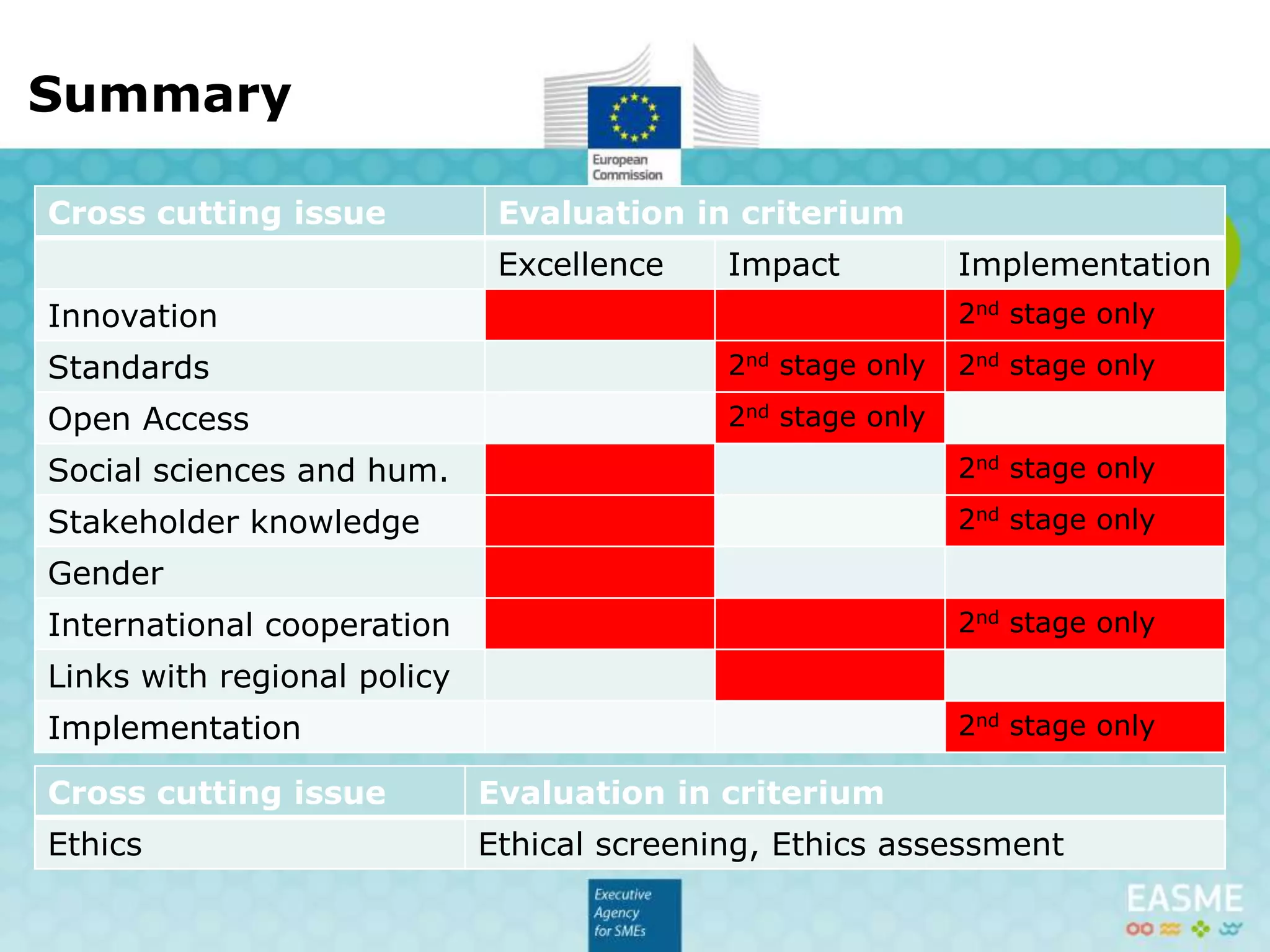
Cross cutting aspects
 Innovation
 Standards
 Social science and humanities
 Stakeholder Knowledge
 Gender dimension
 International cooperation
 Ethics
 Link to regional policy (ESIF, etc)
 SME's involvement
 Implementation
Excellence: Clarity and pertinence of the objectives;
Soundness of the concept; credibility of the proposed
methodology, progress beyond SotA, innovation potential;
interdisciplinary approaches; use of stakeholder knowledge
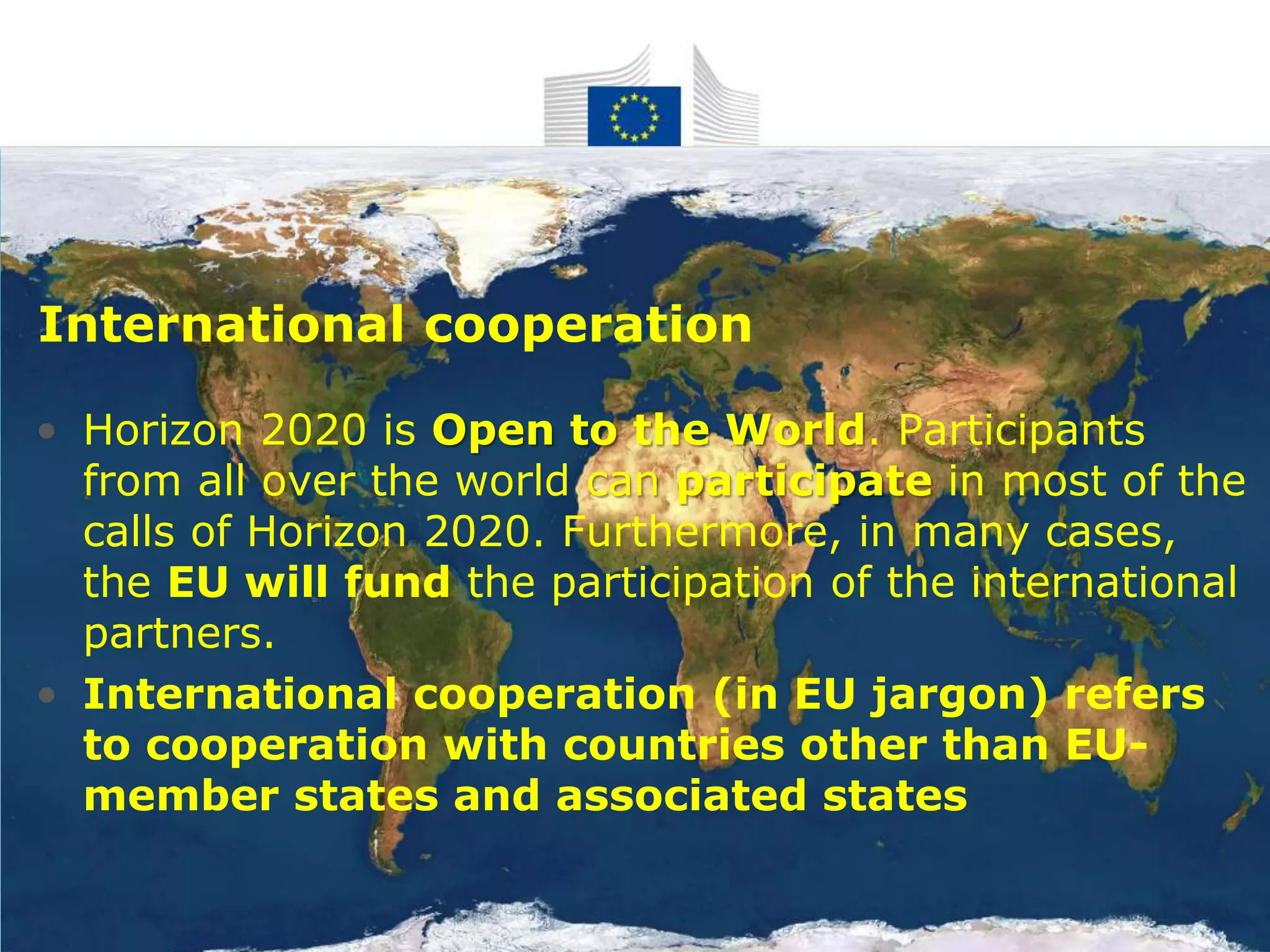
Impact: expected impact in the topic description; innovation
capacity; other impacts; exploitation, dissemination and
communication.
Implementation: workplan; management structure;
consortium; appropriate allocation of tasks and resources; risk
and innovation management.
Evaluation – Award criteria (IA/RIA)
(General Annexes H)
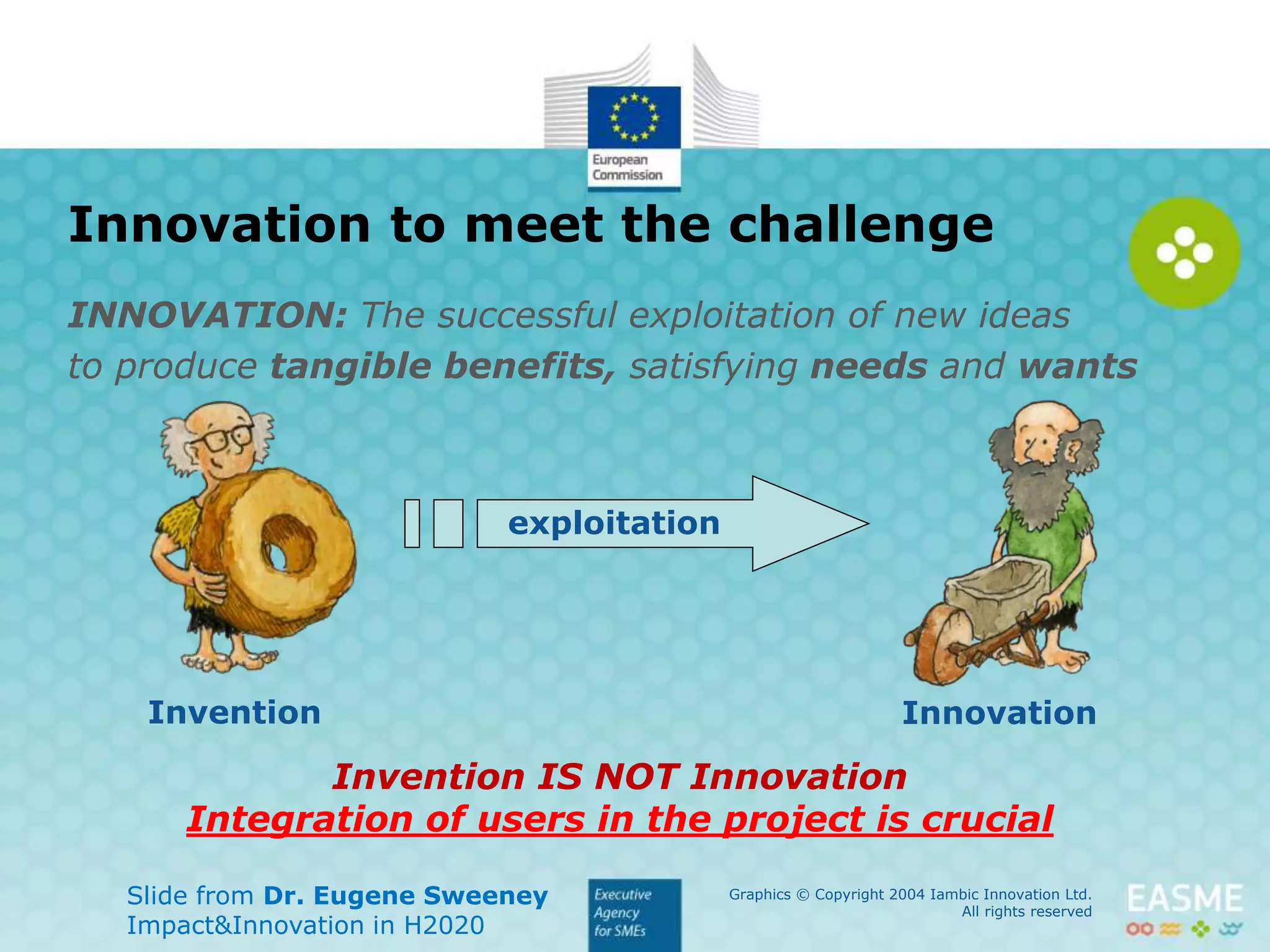
Innovation to meet the challenge
INNOVATION: The successful exploitation of new ideas
to produce tangible benefits, satisfying needs and wants
exploitation
Graphics © Copyright 2004 Iambic Innovation Ltd.
All rights reserved
Slide from Dr. Eugene Sweeney
Impact&Innovation in H2020
Invention IS NOT Innovation
Integration of users in the project is crucial
Invention Innovation
Innovation in evaluation award
criteria
• Excellence - Innovation potential: the potential of a
project to create useful new knowledge or
technology
• Impact - Innovation capacity: capacity to develop
products and services with significant benefits for
users
• Implementation - Innovation management: Identify
and exploit R&D results, IPR management
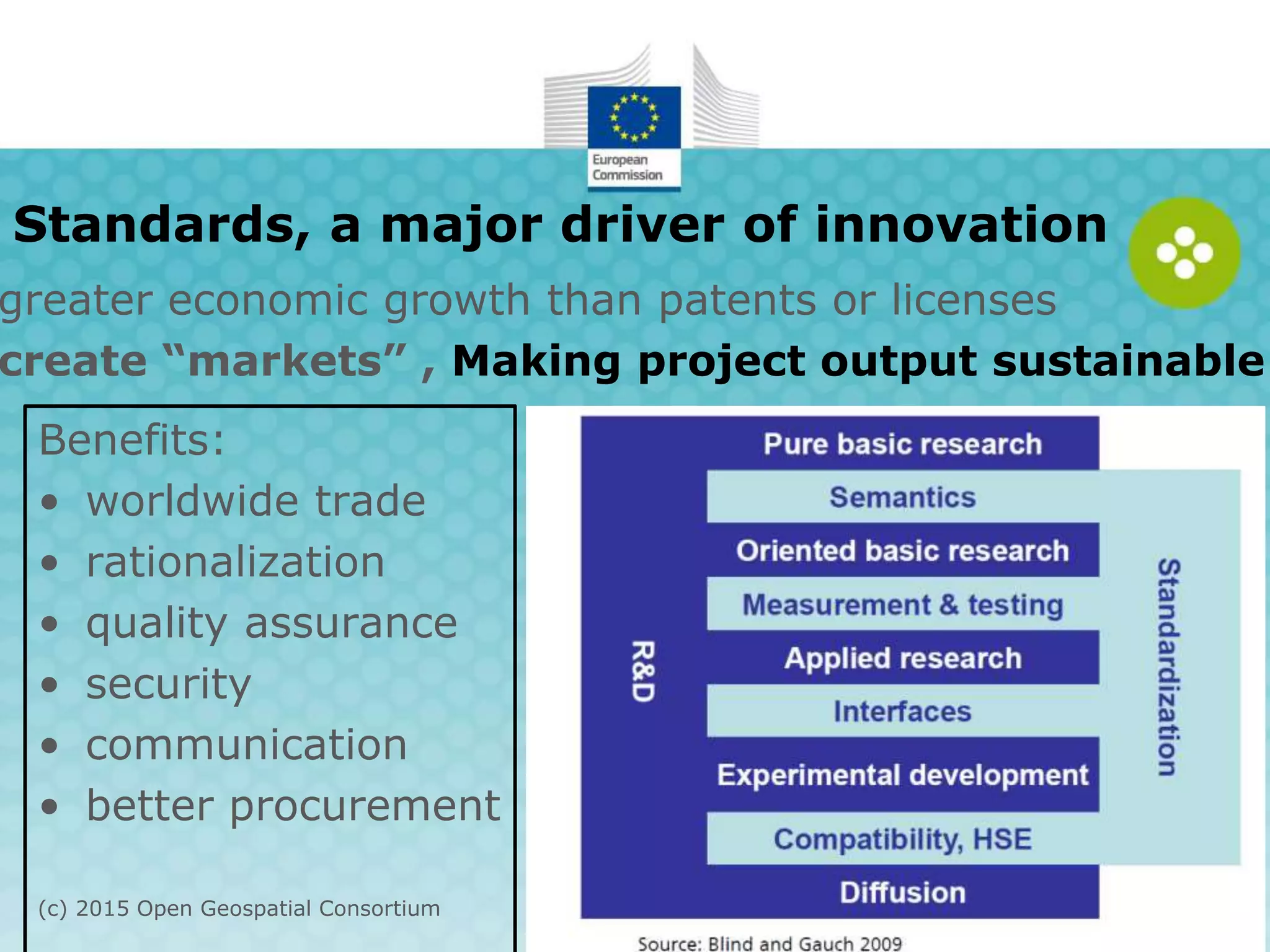
Standards, a major driver of innovation
greater economic growth than patents or licenses
create “markets”, Making project output sustainable
Benefits:
• rationalization
• quality assurance
• security
• communication
• better procurement
• worldwide trade
(c) 2015 Open Geospatial Consortium
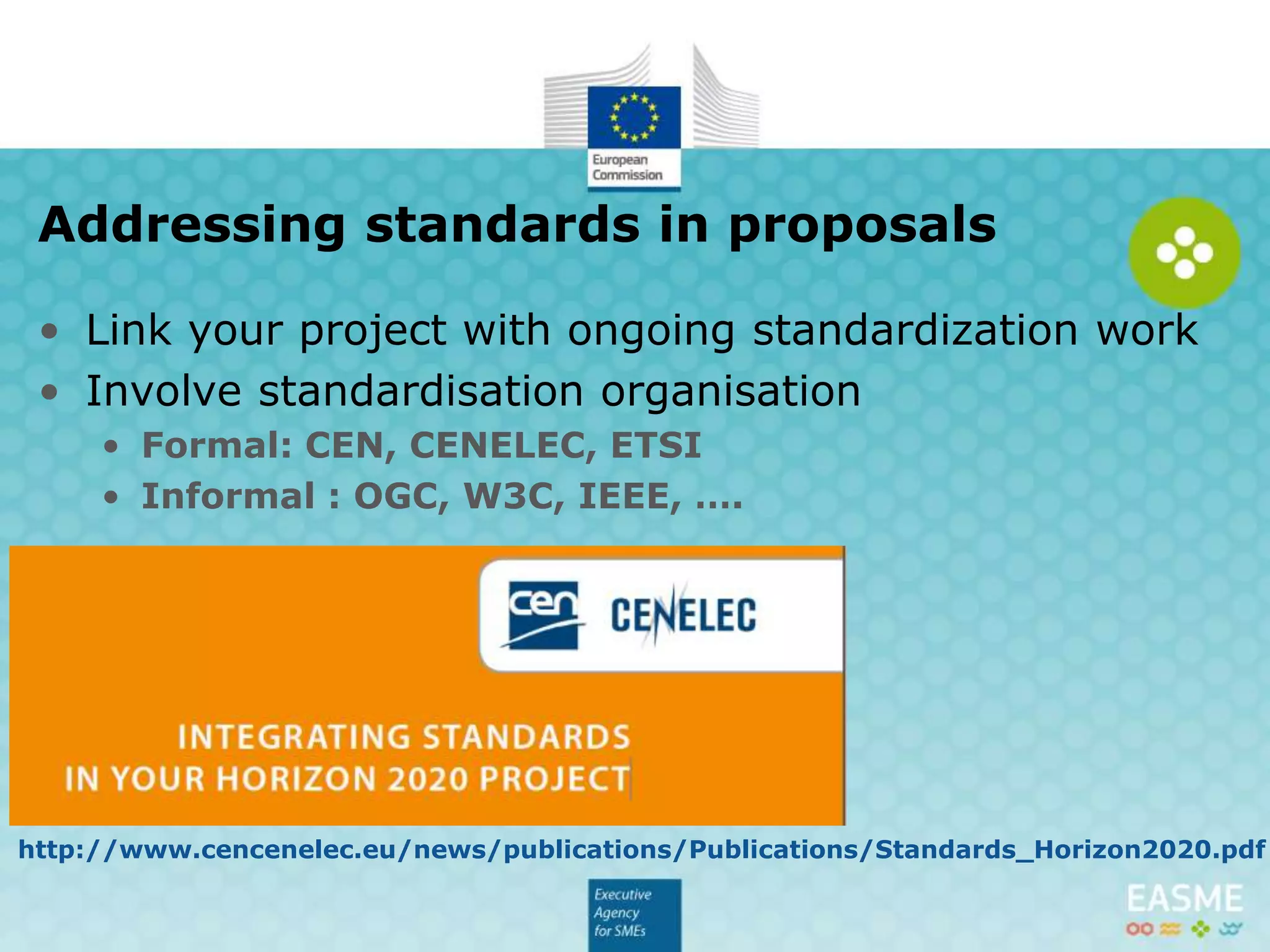
• Link your project with ongoing standardization work
• Involve standardisation organisation
• Formal: CEN, CENELEC, ETSI
• Informal: OGC, W3C, IEEE, ….
• More info:
Addressing standards in proposals
http://www.cencenelec.eu/news/publications/Publications/Standards_Horizon2020.pdf
• "All activities related to Earth observation data and
other spatial data should comply at best with and
build upon the existing Infrastructure for Spatial
Information in the European Community (INSPIRE)".
(SC5 work programme introduction)
• More info:
• JRC webiste: http://inspire.ec.europa.eu/
• OGC website:
http://www.opengeospatial.org/pressroom/marketrep
ort/inspire
INSPIRE
Beneficiaries in projects participating in the Pilot on
Open Research Data are invited to
• Follow the GEOSS Data Sharing Principles
• Register data in the GEO data portal
GEO - GEOSS
Proposals must provide a short, general outline of
their policy for data management, including the
following issues:
• What types of data will the project generate/collect?
• What standards and licenses will be used?
• How will this data be exploited and/or shared/made
accessible for verification and re-use?
• How will this data be curated and preserved?
• Data Management Plan as deliverable.
Open access to research data (pilot)
• All SC5 topics are by default participating in the
pilot, except raw material topics (SC5-13, 14, 15, 16,17)
• Proposals can opt out.
• Opting out will not be taken into account in evaluation.
• Justification still useful <- impact criterium
Open access to research data (pilot)
• Open access must be granted to all publications
resulting from Horizon 2020 actions.
• Further guidance on open access is available in the
H2020 Online Manual on the Participant Portal.
 Open data pilot: All data underlying the publication must be
accessible <- good scientific practise
Open access to research publications
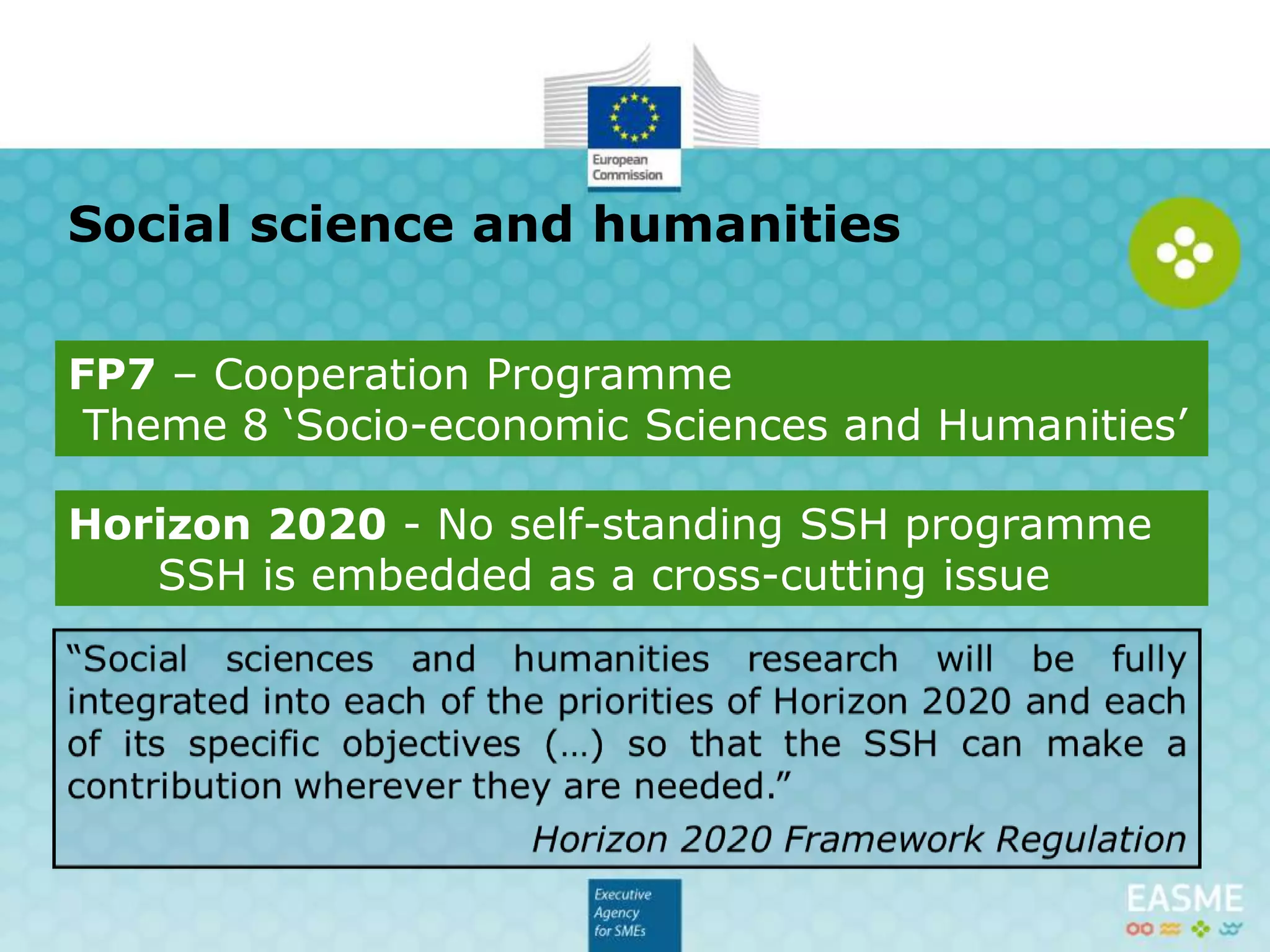
Social science and humanities
Horizon 2020 - No self-standing SSH programme
SSH is embedded as a cross-cutting issue
FP7 – Cooperation Programme
Theme 8 ‘Socio-economic Sciences and Humanities’
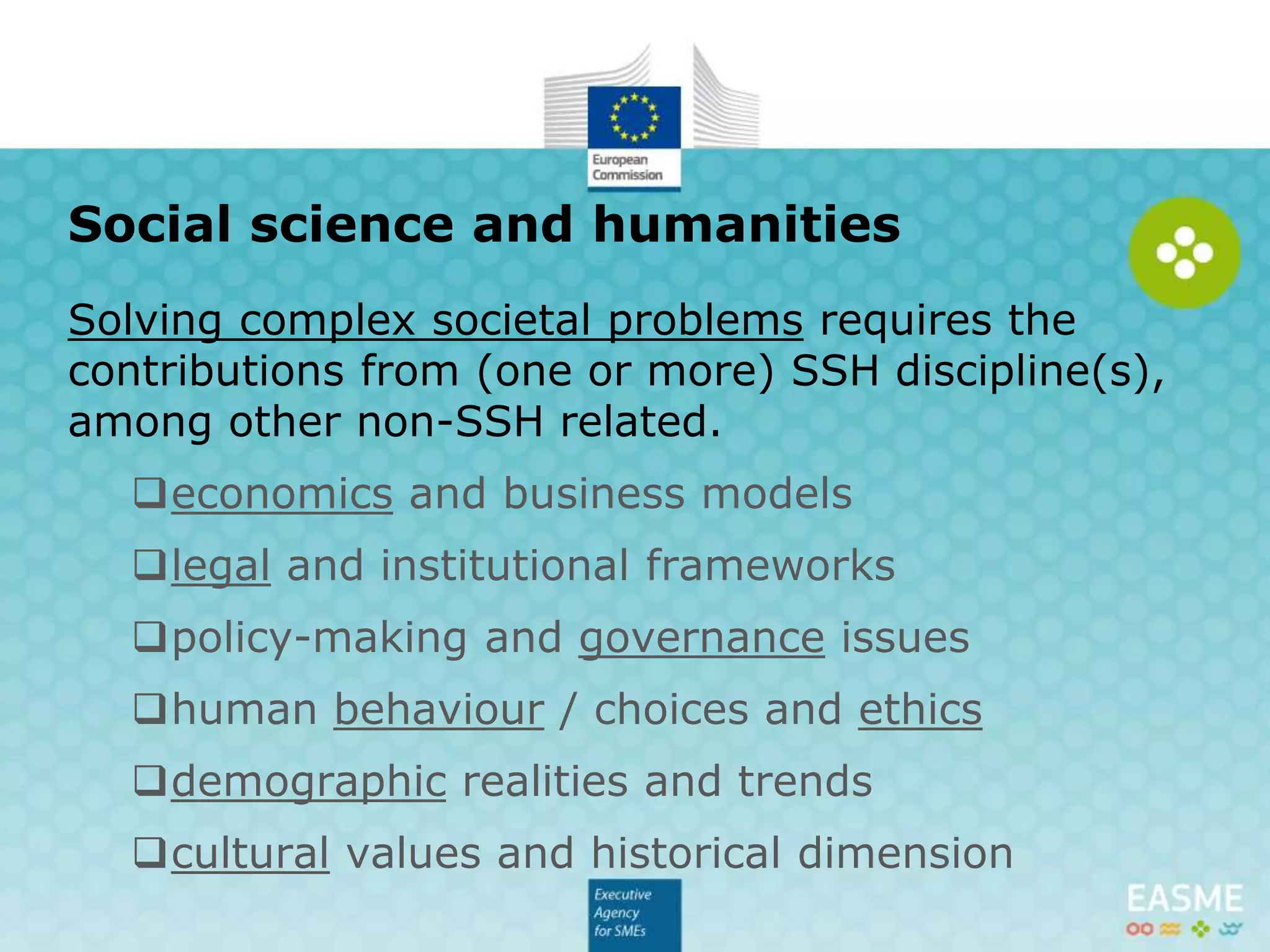
Solving complex societal problems requires the
contributions from (one or more) SSH discipline(s),
among other non-SSH related.
economics and business models
legal and institutional frameworks
policy-making and governance issues
human behaviour / choices and ethics
demographic realities and trends
cultural values and historical dimension
Social science and humanities
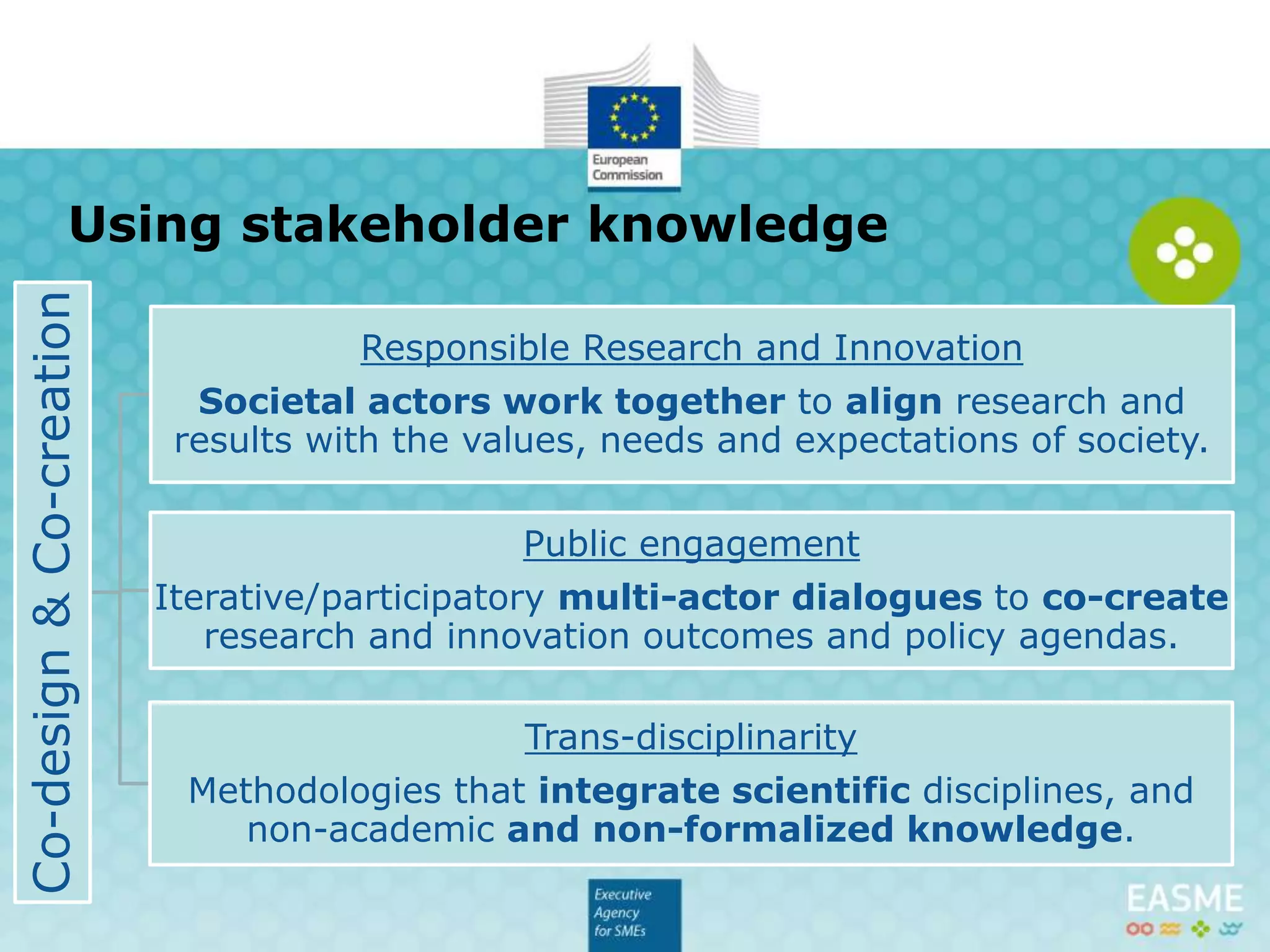
Using stakeholder knowledge
Co-design&Co-creation
Responsible Research and Innovation
Societal actors work together to align research and
results with the values, needs and expectations of society.
Public engagement
Iterative/participatory multi-actor dialogues to co-create
research and innovation outcomes and policy agendas.
Trans-disciplinarity
Methodologies that integrate scientific disciplines, and
non-academic and non-formalized knowledge.
Gender dimension
Gender relevant if it can be expected that its findings
affect [groups of] women and men differently.
Contribute to the soundness of the proposed work,
both scientifically, technically and socially.
If not explicitly integrated into a topic, applicants can
still decide to address it if they find it relevant
Gender balance in the consortium
(also a ranking criterion)
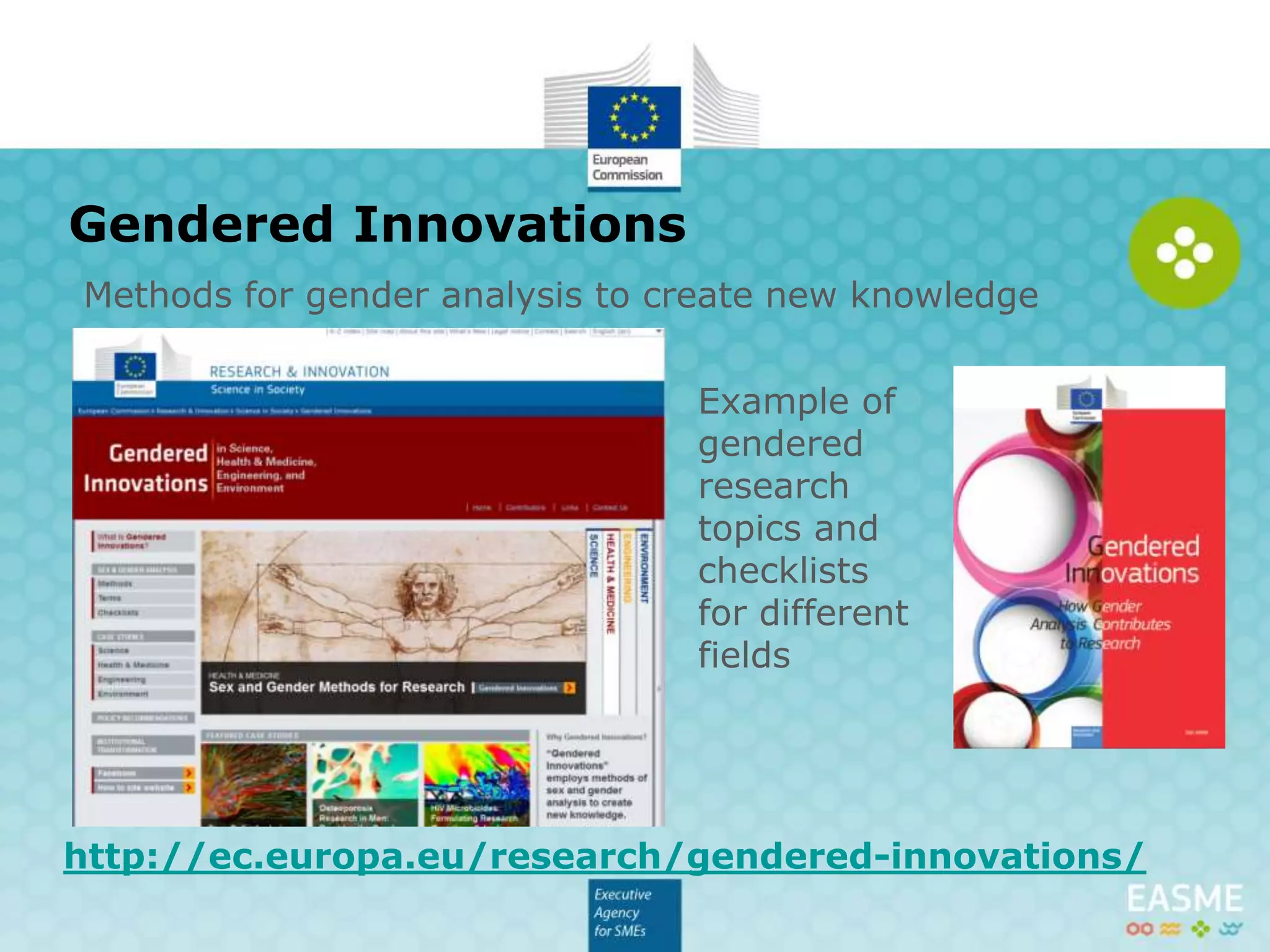
Gendered Innovations
Example of
gendered
research
topics and
checklists
for different
fields
http://ec.europa.eu/research/gendered-innovations/
Methods for gender analysis to create new knowledge
Ethics in H2020
Requirement set in legislation (Reg. 1290/2013, art.
13,14,18,23) and Grant Agreement (art. 34, 39)
Perform your own self-assessment
The Commission will verify and may set
additional requirements if not in the proposal;
Ethic issues block the signature of the grant agreement
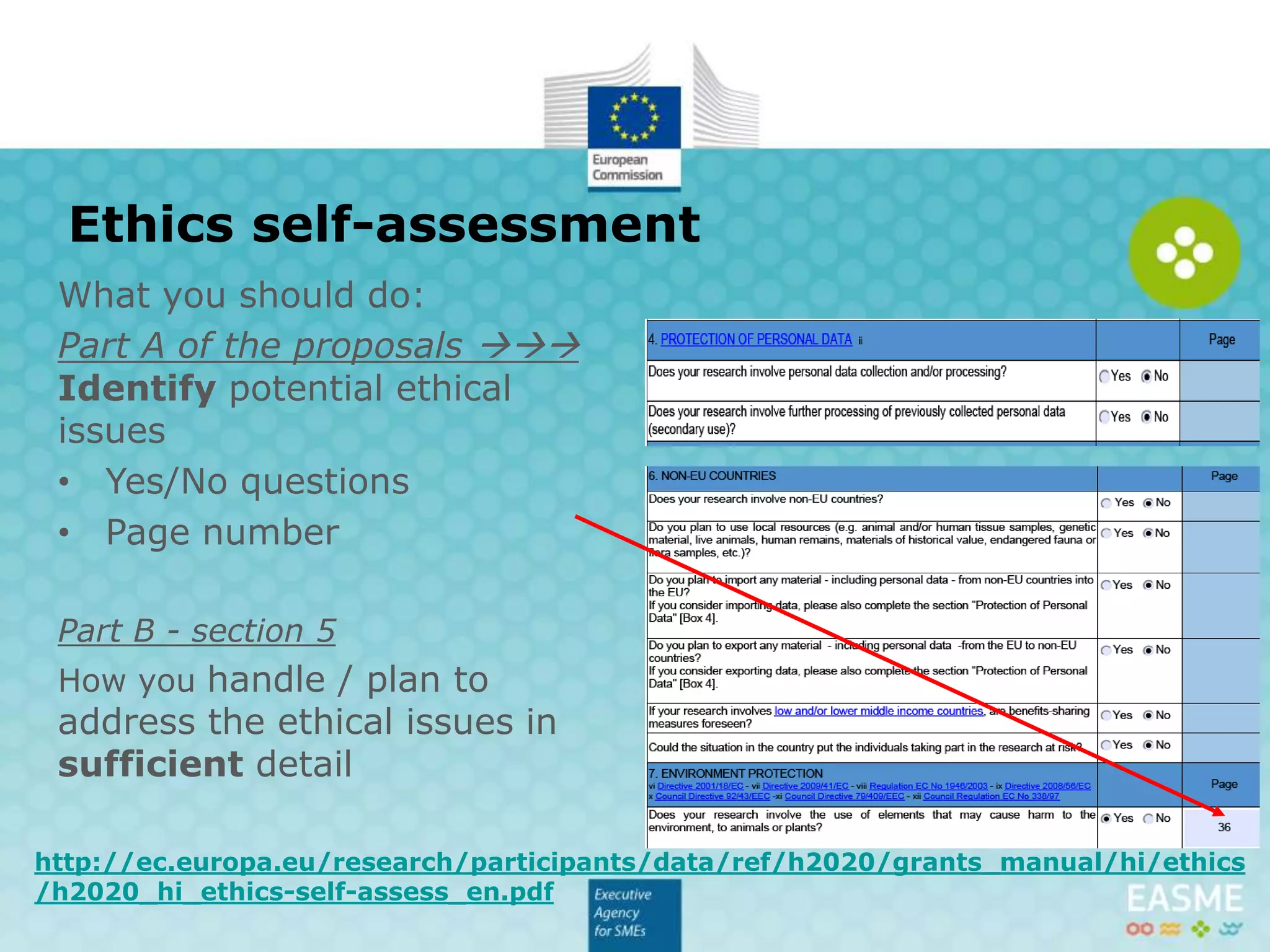
Ethics self-assessment
What you should do:
Part A of the proposals 
Identify potential ethical
issues
• Yes/No questions
• Page number
Part B - section 5
How you handle / plan to
address the ethical issues in
sufficient detail
http://ec.europa.eu/research/participants/data/ref/h2020/grants_manual/hi/ethics
/h2020_hi_ethics-self-assess_en.pdf
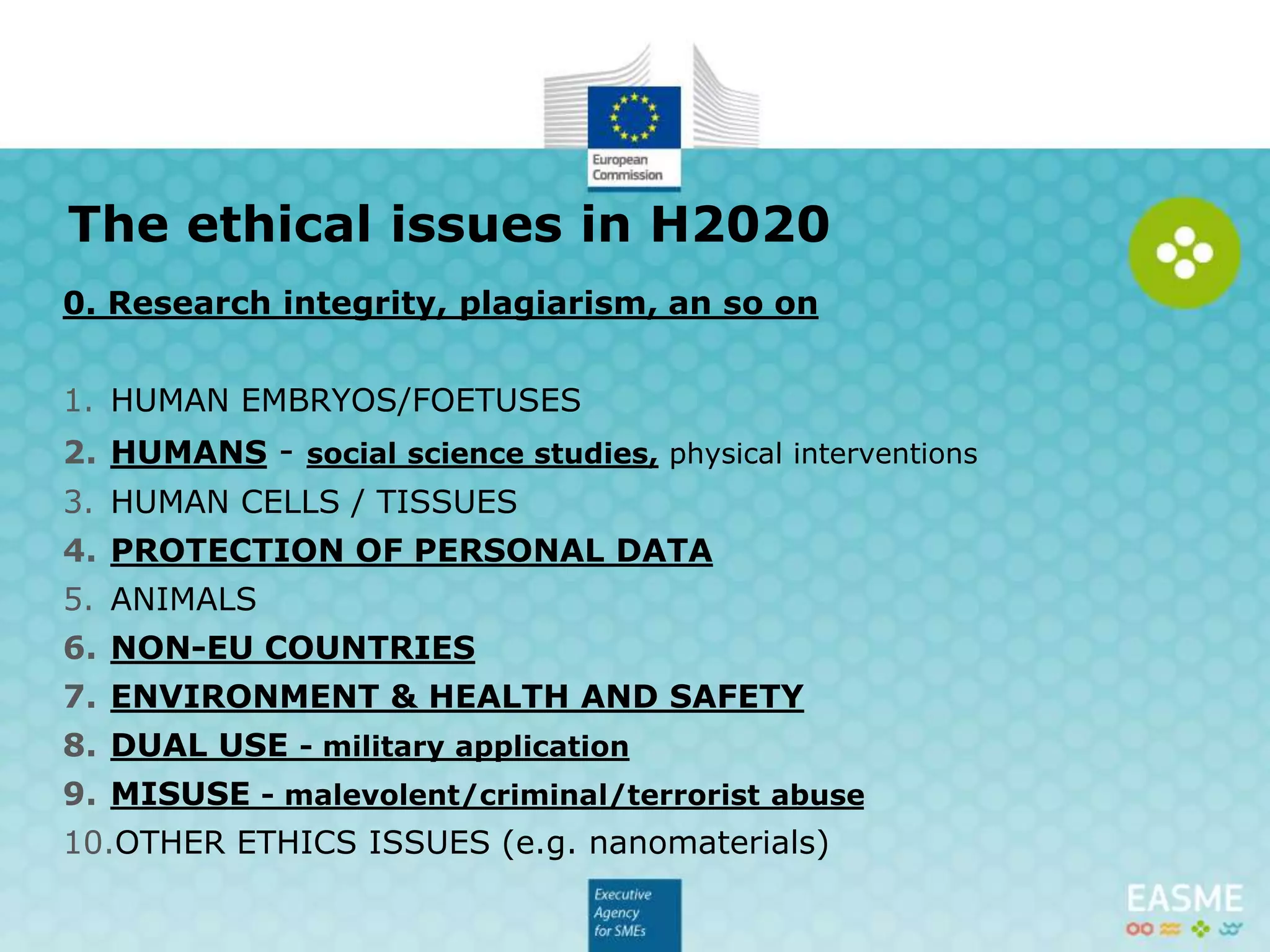
0. Research integrity, plagiarism, an so on
1. HUMAN EMBRYOS/FOETUSES
2. HUMANS - social science studies, physical interventions
3. HUMAN CELLS / TISSUES
4. PROTECTION OF PERSONAL DATA
5. ANIMALS
6. NON-EU COUNTRIES
7. ENVIRONMENT & HEALTH AND SAFETY
8. DUAL USE - military application
9. MISUSE - malevolent/criminal/terrorist abuse
10.OTHER ETHICS ISSUES (e.g. nanomaterials)
The ethical issues in H2020
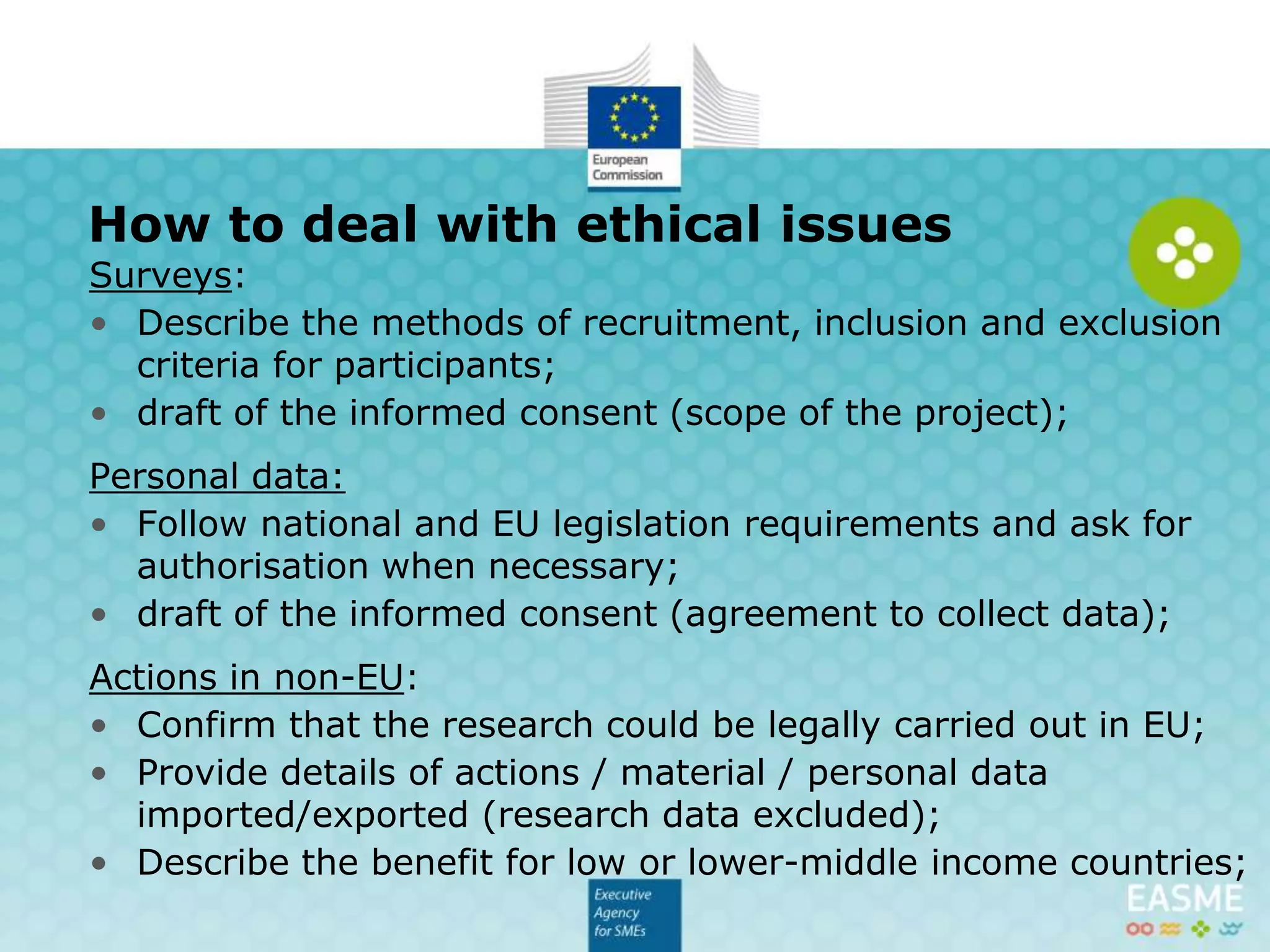
Surveys:
• Describe the methods of recruitment, inclusion and exclusion
criteria for participants;
• draft of the informed consent (scope of the project);
Personal data:
• Follow national and EU legislation requirements and ask for
authorisation when necessary;
• draft of the informed consent (agreement to collect data);
Actions in non-EU:
• Confirm that the research could be legally carried out in EU;
• Provide details of actions / material / personal data
imported/exported (research data excluded);
• Describe the co-benefit for low or lower-middle income
countries;
How to deal with ethical issues (1/2)
Environmental & Health and safety:
• Identify authorisations/permits needed;
• risk-benefit analysis (environment) or risk assessment
(health / safety);
Dual-use or misuse or other
• Give details in section 5 on the measures to be taken to
prevent abuse or on the exclusive civilian focus of the
research.
How to deal with ethical issues (2/2)
Nationalauthorityapproval?
• Horizon 2020 is Open to the World. Participants
from all over the world can participate in most of the
calls of Horizon 2020. Furthermore, in many cases,
the EU will fund the participation of the international
partners.
• International cooperation (in EU jargon) refers
to cooperation with countries other than EU-
member states and associated states
International cooperation
• Associated countries participate in Horizon 2020
under the same conditions as EU Member States.
• 13 states, as of August 2015:
• Iceland
• Norway
• Albania
• Bosnia and Herzegovina
• the former Yugoslav Republic of Macedonia
• Montenegro
• Serbia
• Turkey
• Israel
• Moldova
• Switzerland (partial association, see below)
• Faroe Islands
• Ukraine
Associated states
ELIGIBILITY:
RIA/IA:
at least 3 partners
from 3 diff. MS/AS
CSA:
At least one legal
entity.
http://ec.europa.eu/research/participants/docs/h2020-funding-
guide/cross-cutting-issues/international-cooperation_en.htm
Afghanistan, Algeria, American Samoa, Angola, Argentina, Armenia, Azerbaijan, Bangladesh,
Belarus, Belize, Benin, Bhutan, Bolivia, Botswana, Burkina Faso, Burundi, Cambodia, Cameroon,
Cape Verde, Central African Republic, Chad, Chile, Colombia, Comoros, Congo (Democratic
People’s Republic), Congo (Republic), Costa Rica, Côte d’Ivoire, Cuba, Djibouti, Democratic
People's Republic of Korea ,Dominica, Dominican Republic, Ecuador, Egypt, El Salvador, Eritrea,
Ethiopia, Fiji, Gabon, Gambia, Georgia, Ghana, Grenada, Guatemala, Guinea, Guinea-Buissau,
Guyana, Haiti, Honduras, Indonesia, Iran, Iraq, Jamaica, Jordan, Kazakhstan, Kenya, Kiribati,
Kosovo*, Kyrgyz Republic, Lao, Lebanon, Lesotho, Liberia, Libya, Madagascar, Malawi, Malaysia,
Maldives, Mali, Marshall Islands, Mauritania, Mauritius, Micronesia, Mongolia, Morocco,
Mozambique, Myanmar, Namibia, Nepal, Nicaragua, Niger, Nigeria, Pakistan, Palau, Palestine,
Panama, Papua New Guinea, Paraguay, Peru, Philippines, Rwanda, Samoa, Sao Tome and
Principe, Senegal, Seychelles, Sierra Leone, Solomon Islands, Somalia, South Africa, South
Sudan, Sri Lanka, St. Kitts and Nevis, St. Lucia, St. Vincent and the Grenadines, Sudan,
Suriname, Swaziland, Syrian Arab Republic, Tajikistan, Tanzania, Thailand, Timor-Leste, Togo,
Tonga, Tunisia, Turkmenistan, Tuvalu, Uganda, Ukraine**, Uzbekistan, Vanuatu, Uruguay,
Venezuela, Vietnam, Yemen, Zambia, Zimbabwe.
Countries eligible for automatic
funding (WP,general Annex A)
• USA, Canada, Mexico, Japan, Australia, New Zealand,
Hong-Kong, Taiwan, Singapore, Brasil, Russia, India,
China, … also Switzerland (for Pillar 2 and 3),
• International organisations
• (except Org. whose members are Member States or associated countries, and
whose principal objective is to promote scientific and technological cooperation
in Europe
Are welcome to participate, but are not automatically
funded
Industrialized countries
• Still funded if participation is deemed essential for the
project by the Commission
 (provide unique expertise, access to infrastructure/data/region)
• Should have a budget, but requested EU contribution
= 0
• Some countries (e.g. CH; RU, JP, for certain topics
like Arctic) automatically contribute the budget
• It is your responsibility to ensure the funding. Address
the risk!
Partners not eligible for automatic funding
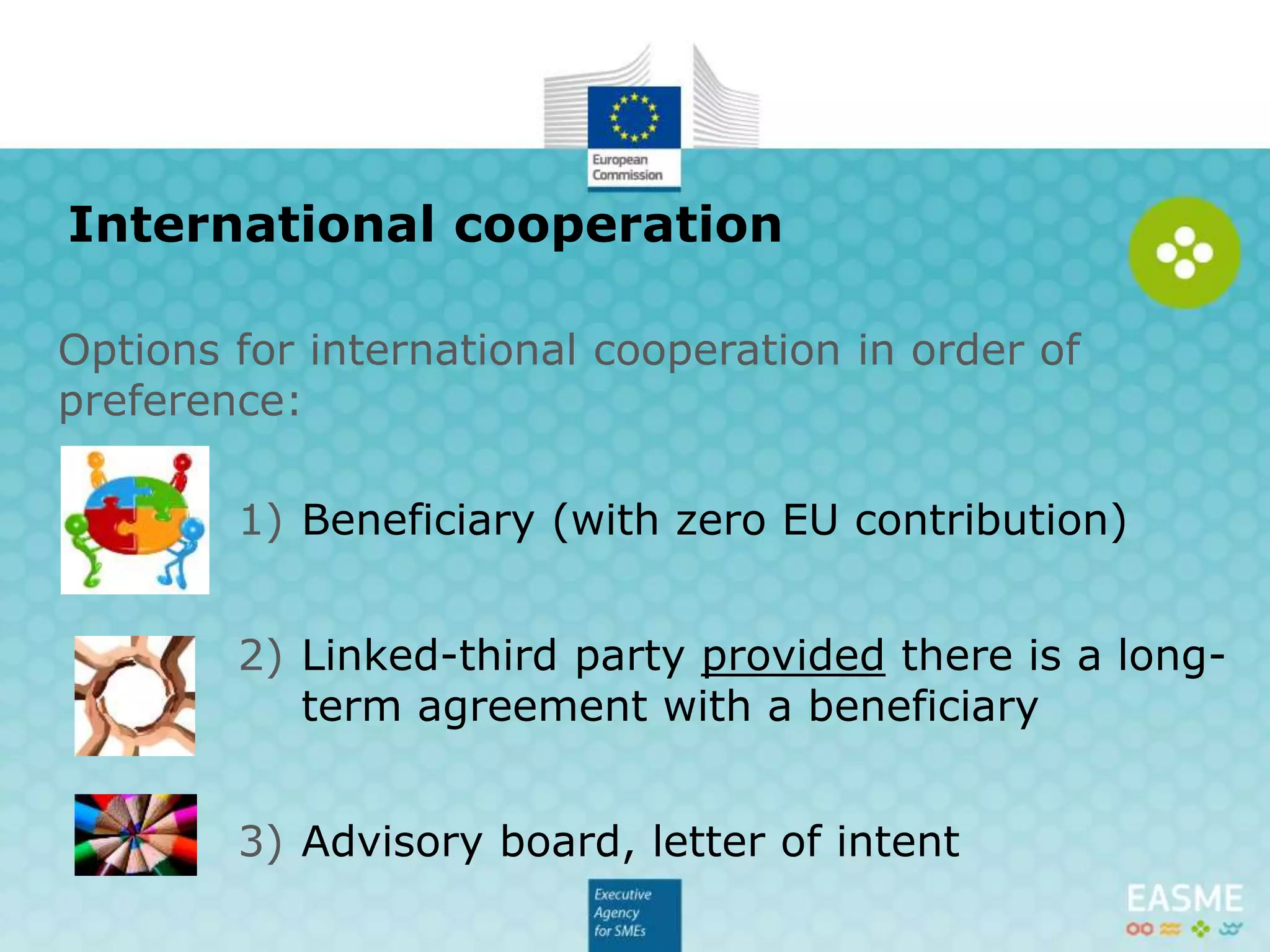
1) Beneficiary
2) Linked-third party provided there is a long-
term agreement with a beneficiary
3) Advisory board, cooperation partner
International cooperation
Options for international cooperation in order of
preference:
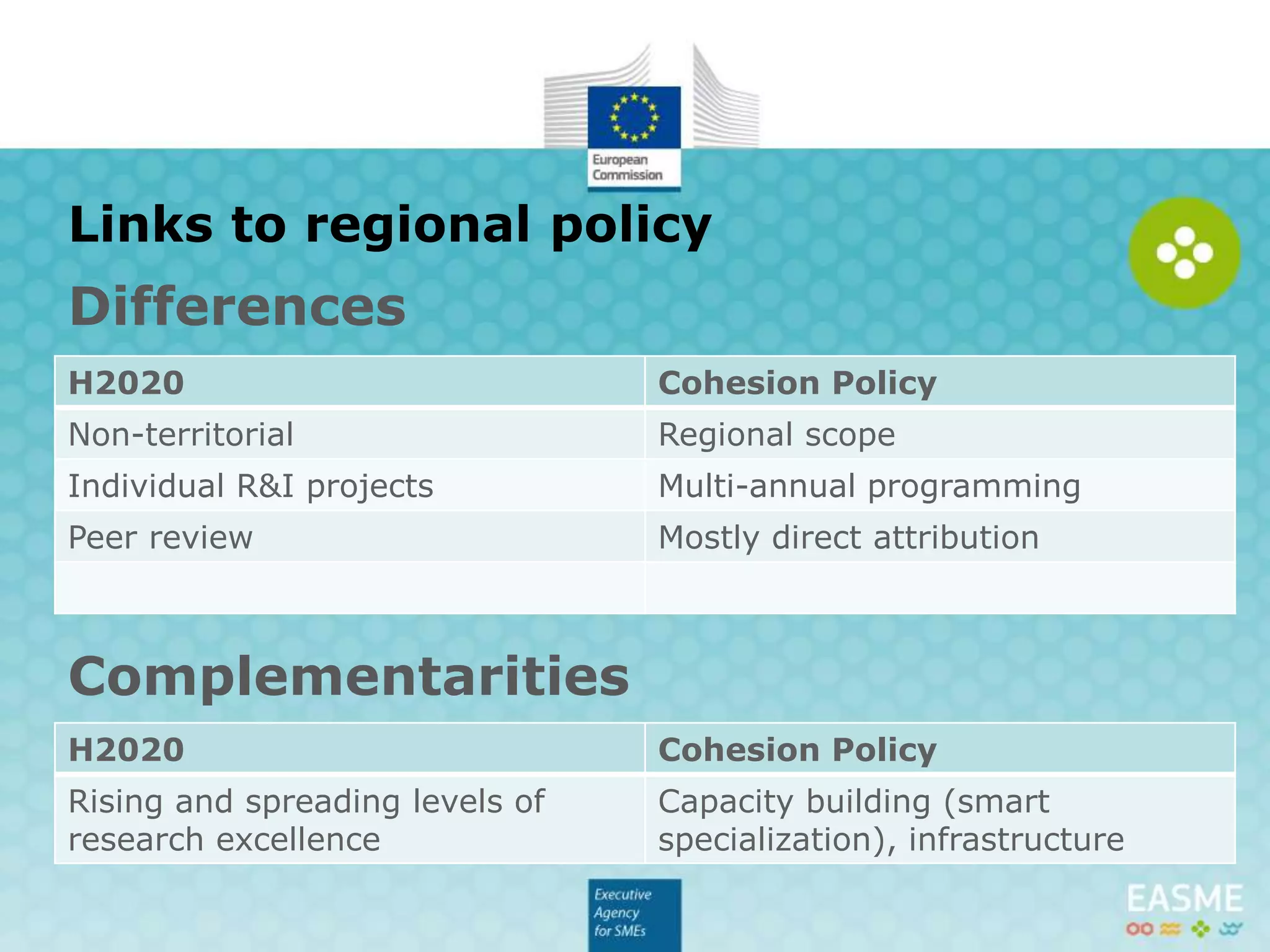
H2020 Cohesion Policy
Non-territorial Regional scope
Individual R&I projects Multi-annual programming
Peer review Mostly direct attribution
Links to regional policy
H2020 Cohesion Policy
Rising and spreading levels of
research excellence
Capacity building (smart
specialization), infrastructure
Differences
Complementarities
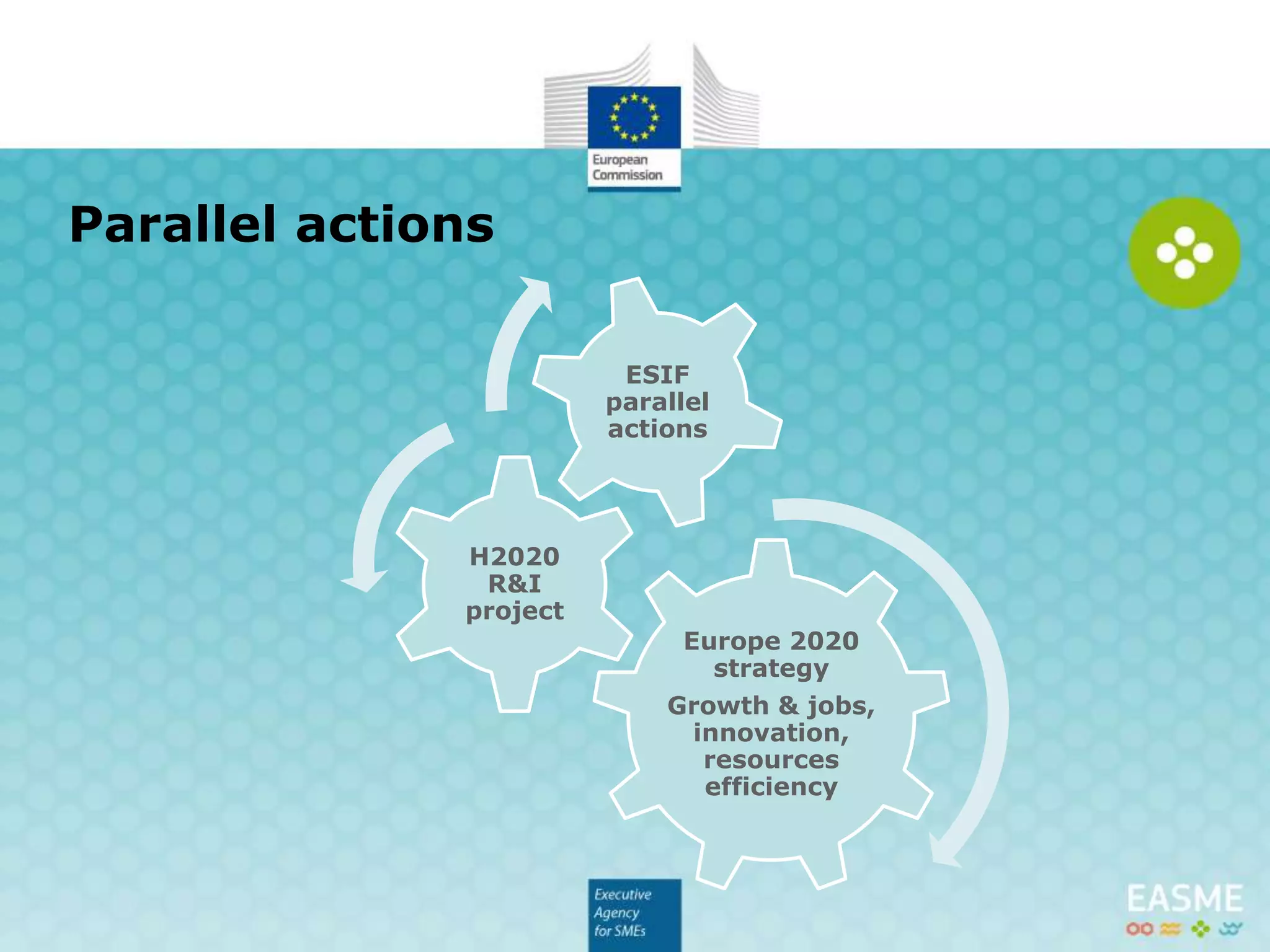
Parallel actions
Europe 2020
strategy
Growth & jobs,
innovation,
resources
efficiency
H2020
R&I
project
ESIF
parallel
actions
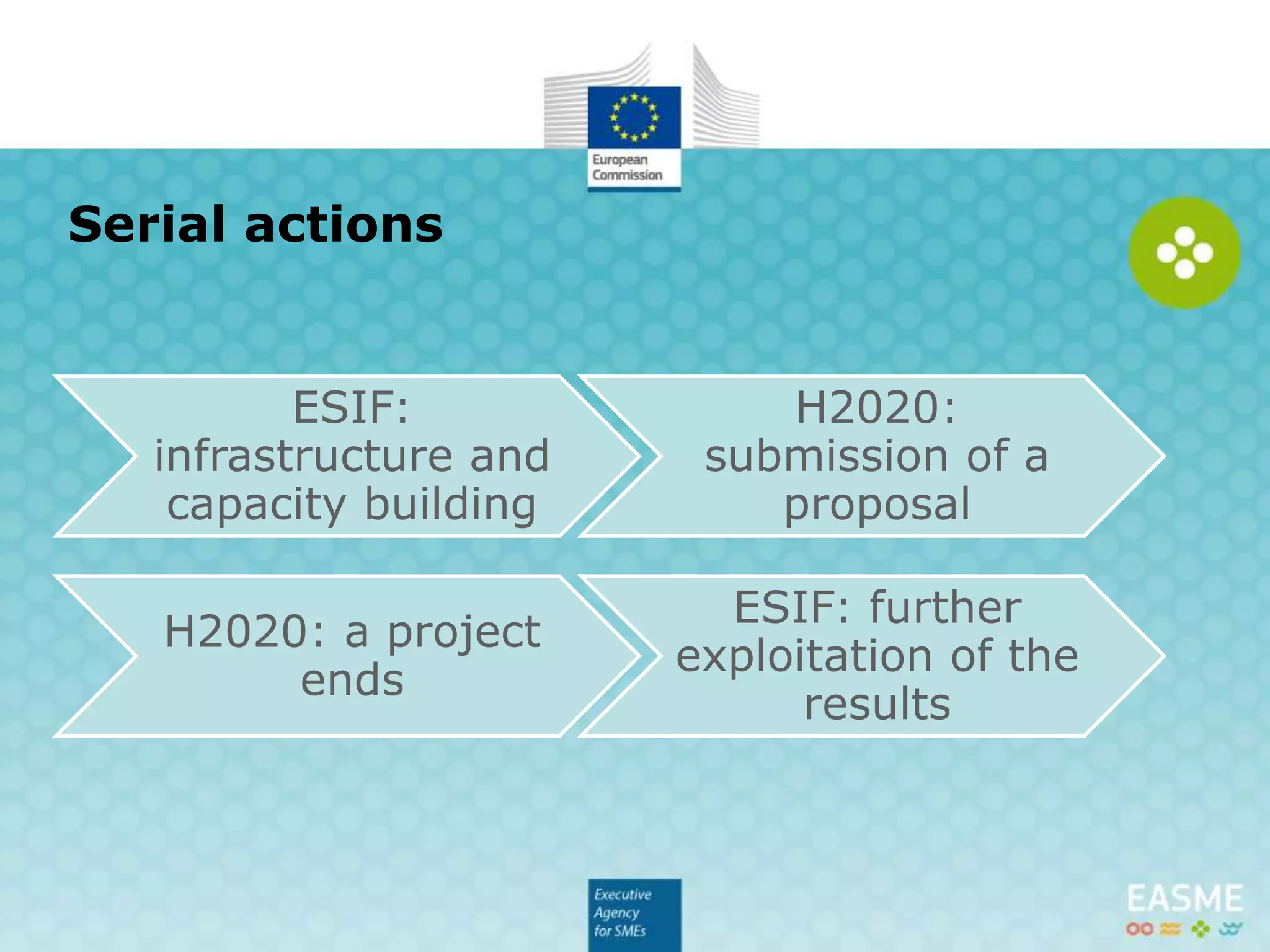
Serial actions
ESIF:
infrastructure and
capacity building
H2020:
submission of a
proposal
H2020: a project
ends
ESIF: further
exploitation of the
results
NO NEGOTIATION approach in H2020
-> projects are implemented as proposed.
• Consortium, with significant contribution from each
participant
• Management structure (incl Innovation management)
• Review mechanisms and risk management
• Appropriate structure of work plan, deliverables,
Milestones
 One task, one beneficiary, one deliverable
• Allocation of resources
Quality and efficiency of the
implementation
• 'Deliverable’ means
• a distinct output of the project, meaningful in terms of the project's overall
objectives and constituted by a report, software, data, website, conference,
survey, etc.
• ‘Milestones’ means control points in the project that
help to chart progress.
• may correspond to the completion of one or several key deliverable(s), allowing
the next phase of the work to begin.
• may be needed at intermediary points so that, if problems have arisen,
corrective measures can be taken.
• may be a critical decision point in the project where, for example, the
consortium must decide which of several technologies to adopt for further
development.
Deliverables and Milestones
• Greater involvement of SME in Horizon 2020
activities desired.
• SME's are needed for exploiting business
opportunities provided by innovations.
 Budget allocated to SMEs may be relevant in for
ranking
 SME's should tick the box in Part A of the proposal
SMEs
• Maximize the impact of you project
• Dissemination plan
• Sound plan of exploitation, transferability and
sustainability of the activities
• Quantification of impacts
• Credible mechanism for monitoring performances
• Communication (separate talk)
Dissemination, exploitation and
communication
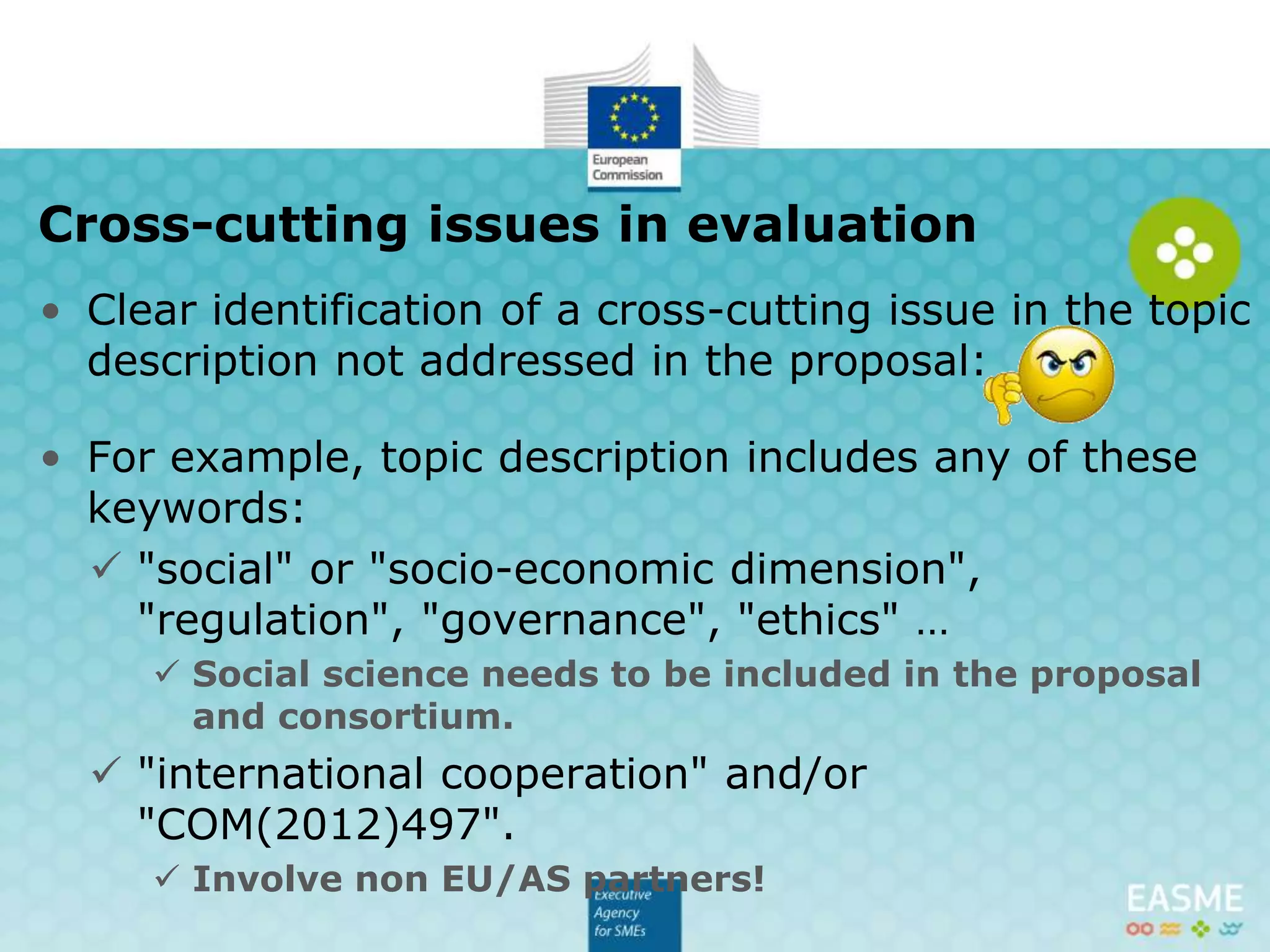
• Clear identification of a cross-cutting issue in the topic
description not addressed in the proposal:
• For example, topic description includes any of these
keywords:
 "social" or "socio-economic dimension",
"regulation", "governance", "ethics" …
 Social science needs to be included in the proposal
and consortium.
 "international cooperation" and/or
"COM(2012)497". -> Involve non EU/AS partners!
Cross-cutting issues in evaluation
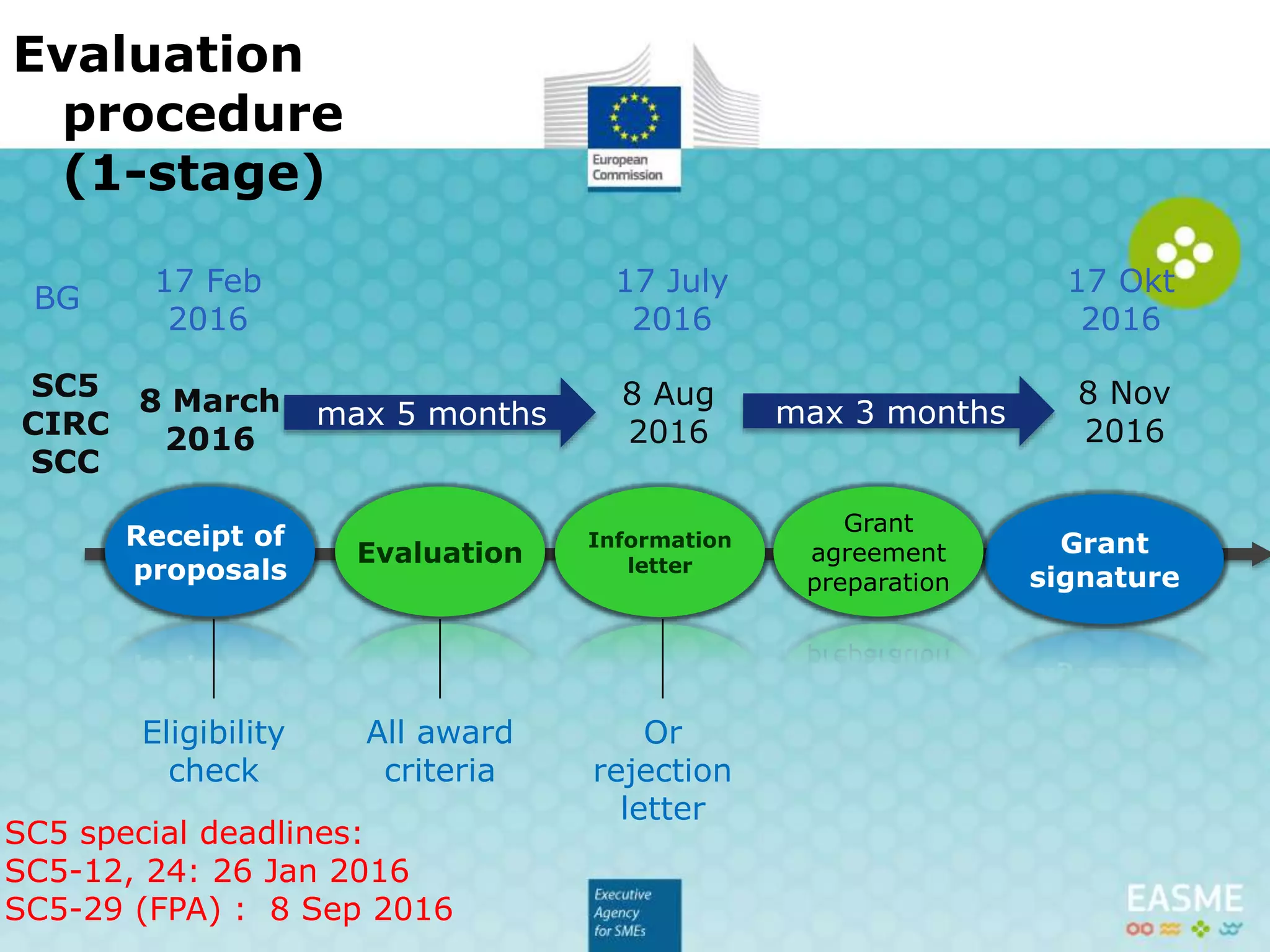
Evaluation
procedure
(1-stage)
Receipt of
proposals
Evaluation
Information
letter
Grant
signature
Eligibility
check
8 March
2016
8 Aug
2016
max 5 months max 3 months
8 Nov
2016
Grant
agreement
preparation
All award
criteria
SC5
CIRC
SCC
SC5 special deadlines:
SC5-12, 24: 26 Jan 2016
SC5-29 (FPA) : 8 Sep 2016
BG
17 Feb
2016
17 July
2016
17 Oct
2016
Or
rejection
letter
Evaluation
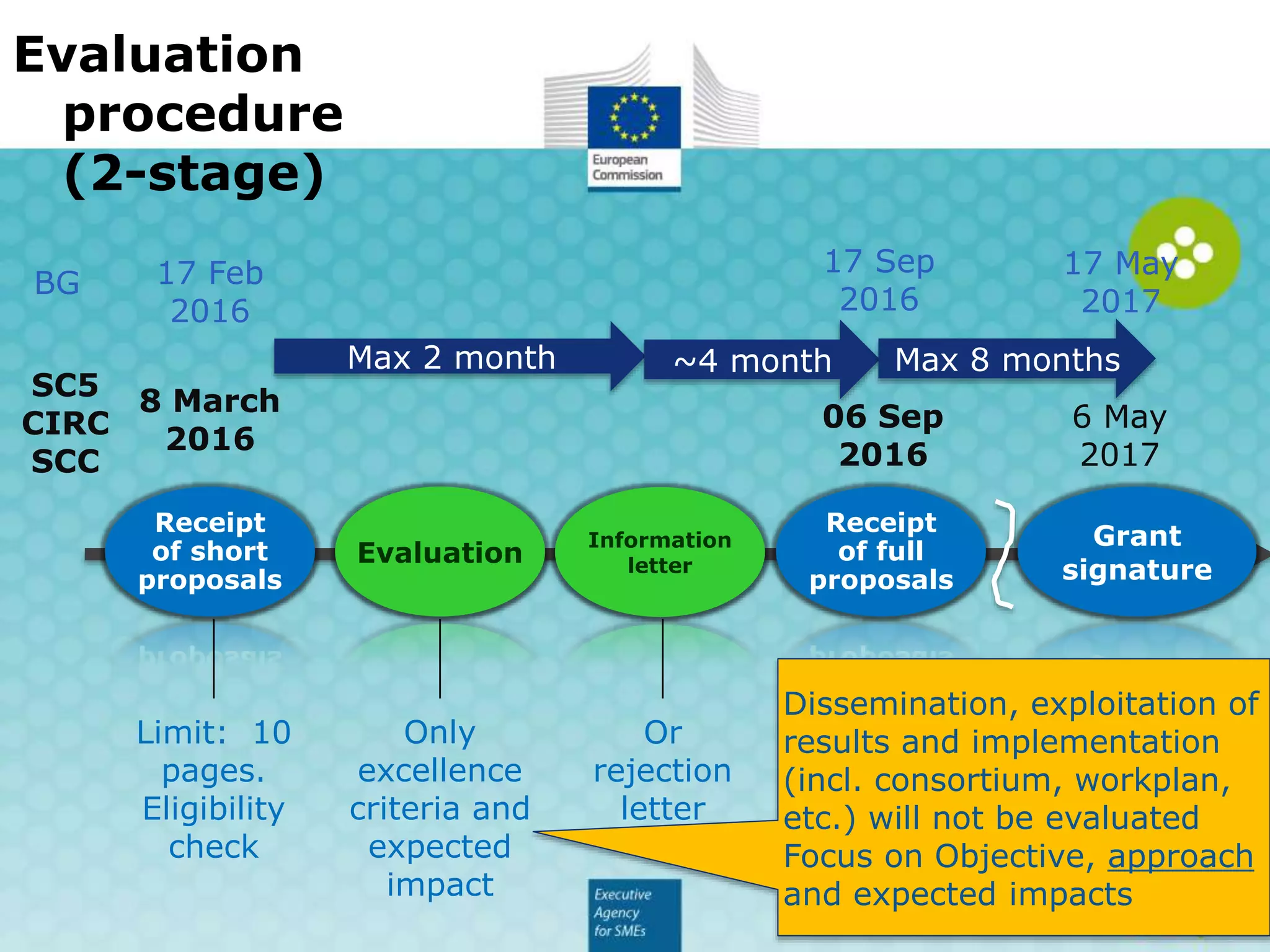
procedure
(2-stage)
Receipt
of short
proposals
Evaluation
Information
letter
Limit: 10
pages.
Eligibility
check
8 March
2016
Max 2 month ~4 month
6 May
2017
Only
excellence
criteria and
expected
impact
SC5
CIRC
SCC
BG 17 Feb
2016
17 May
2017
Or
rejection
letter
Receipt
of full
proposals
06 Sep
2016
17 Sep
2016
Grant
signature
Max 8 months
Dissemination, exploitation of
results and implementation
(incl. consortium, workplan,
etc.) will not be evaluated
Focus on Objectives, approach
and expected impacts
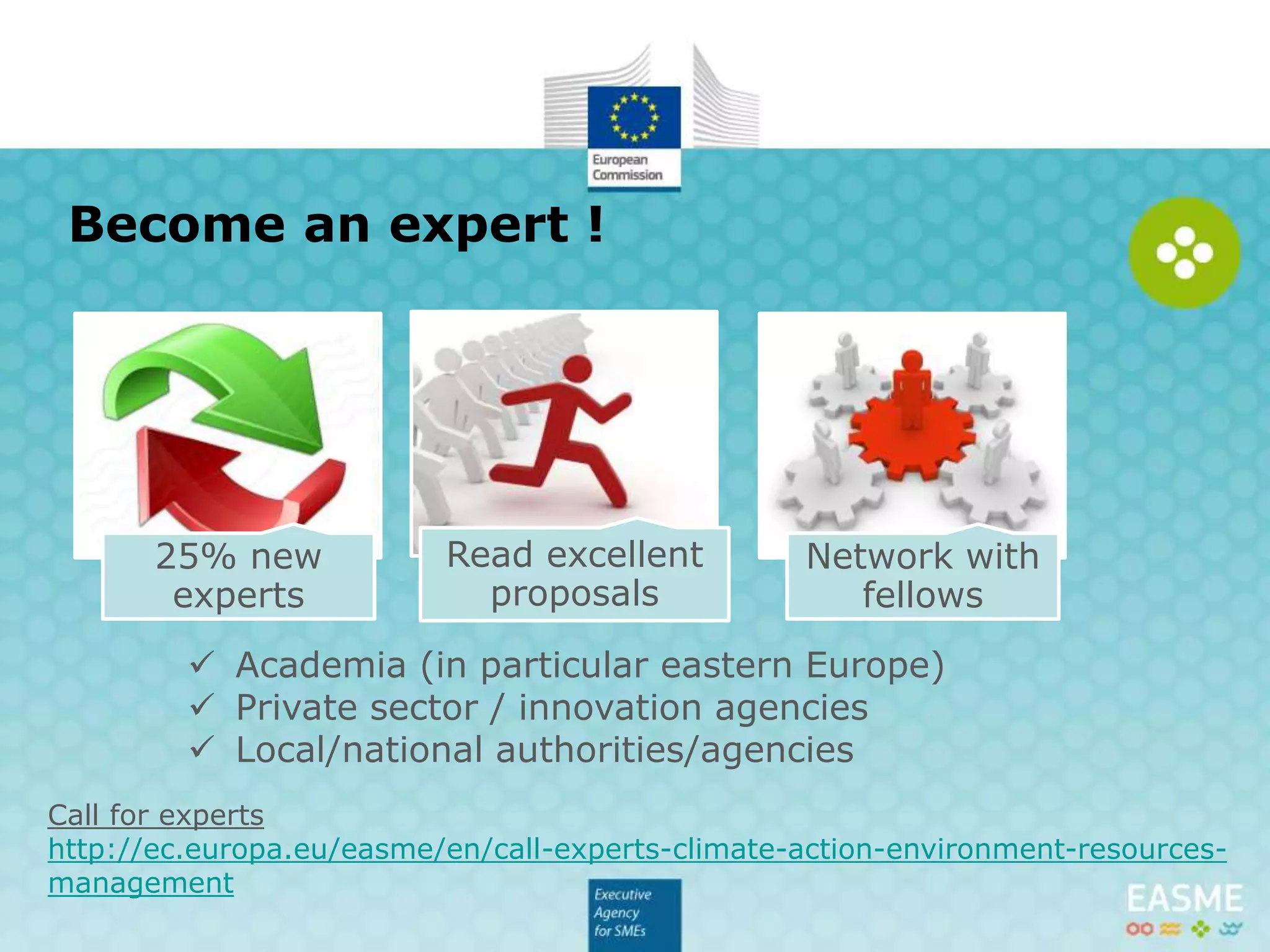
Become an expert !
25% new
experts
Read excellent
proposals
Network with
fellows
 Academia (in particular eastern Europe)
 Private sector / innovation agencies
 Local/national authorities/agencies
Call for experts
http://ec.europa.eu/easme/en/call-experts-climate-action-environment-resources-
management
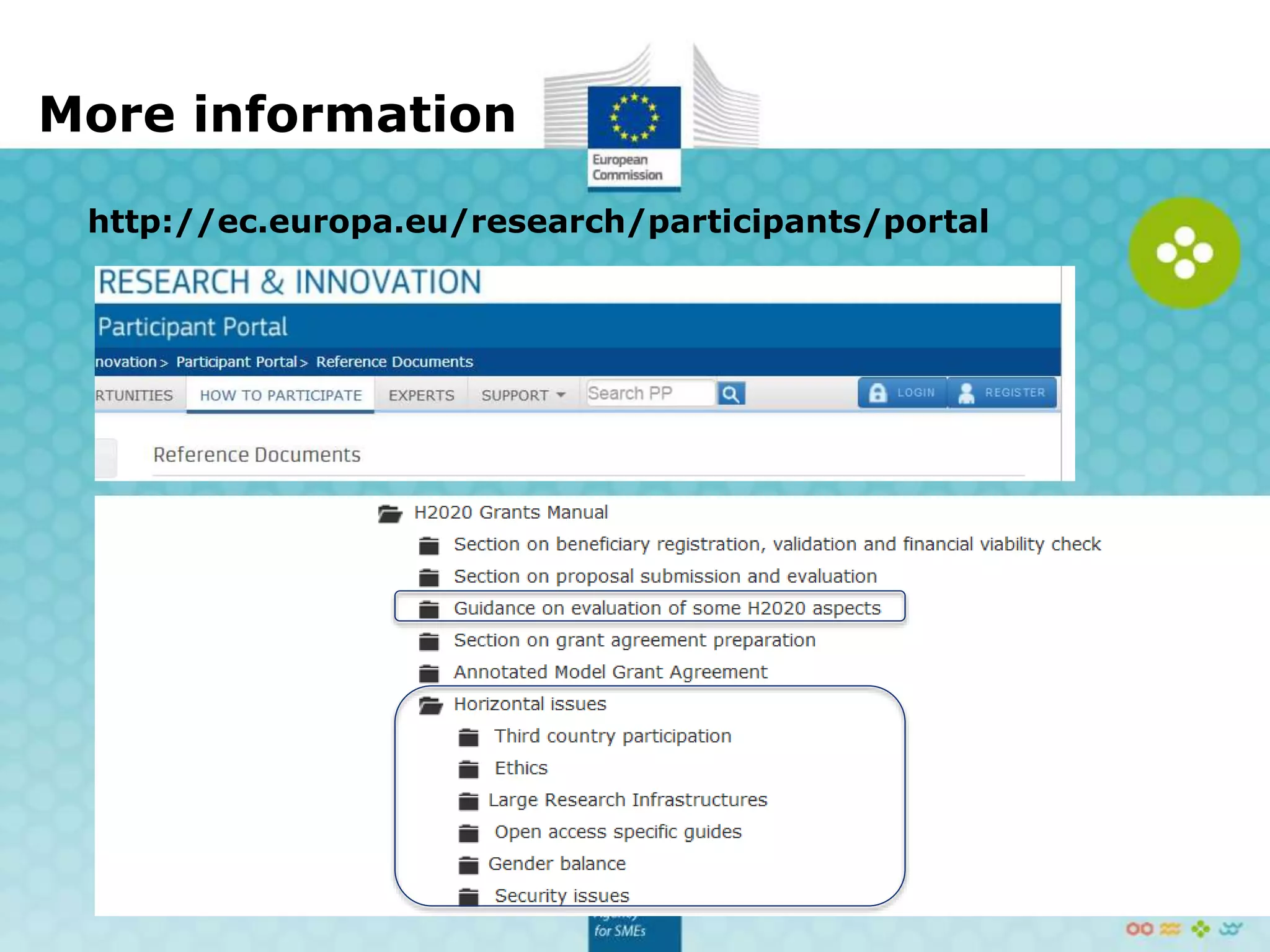
More information
http://ec.europa.eu/research/participants/portal
Thank you
for your
Attention
Contact: EASME-H2020-SC5-ENQUIRIES@ec.europa.eu

Horizon 2020 SC5 cross-cutting issues

  • 1.
    Cross-cutting aspects Franz Immler(EASME) Fabio DALAN Maria Jose AMARAL 21 September 2015 Infoday Climate Action, Environment, Resource Efficiency and Raw Materials
  • 2.
    Cross cutting aspects Innovation  Standards  Social science and humanities  Stakeholder Knowledge  Gender dimension  International cooperation  Ethics  Link to regional policy (ESIF, etc)  SME's involvement  Implementation
  • 3.
    Excellence: Clarity andpertinence of the objectives; Soundness of the concept; credibility of the proposed methodology, progress beyond SotA, innovation potential; interdisciplinary approaches; use of stakeholder knowledge Impact: expected impact in the topic description; innovation capacity; other impacts; exploitation, dissemination and communication. Implementation: workplan; management structure; consortium; appropriate allocation of tasks and resources; risk and innovation management. Evaluation – Award criteria (IA/RIA) (General Annexes H)
  • 4.
    Innovation to meetthe challenge INNOVATION: The successful exploitation of new ideas to produce tangible benefits, satisfying needs and wants exploitation Graphics © Copyright 2004 Iambic Innovation Ltd. All rights reserved Slide from Dr. Eugene Sweeney Impact&Innovation in H2020 Invention IS NOT Innovation Integration of users in the project is crucial Invention Innovation
  • 5.
    Innovation in evaluationaward criteria • Excellence - Innovation potential: the potential of a project to create useful new knowledge or technology • Impact - Innovation capacity: capacity to develop products and services with significant benefits for users • Implementation - Innovation management: Identify and exploit R&D results, IPR management
  • 6.
    Standards, a majordriver of innovation greater economic growth than patents or licenses create “markets”, Making project output sustainable Benefits: • rationalization • quality assurance • security • communication • better procurement • worldwide trade (c) 2015 Open Geospatial Consortium
  • 7.
    • Link yourproject with ongoing standardization work • Involve standardisation organisation • Formal: CEN, CENELEC, ETSI • Informal: OGC, W3C, IEEE, …. • More info: Addressing standards in proposals http://www.cencenelec.eu/news/publications/Publications/Standards_Horizon2020.pdf
  • 8.
    • "All activitiesrelated to Earth observation data and other spatial data should comply at best with and build upon the existing Infrastructure for Spatial Information in the European Community (INSPIRE)". (SC5 work programme introduction) • More info: • JRC webiste: http://inspire.ec.europa.eu/ • OGC website: http://www.opengeospatial.org/pressroom/marketrep ort/inspire INSPIRE
  • 9.
    Beneficiaries in projectsparticipating in the Pilot on Open Research Data are invited to • Follow the GEOSS Data Sharing Principles • Register data in the GEO data portal GEO - GEOSS
  • 10.
    Proposals must providea short, general outline of their policy for data management, including the following issues: • What types of data will the project generate/collect? • What standards and licenses will be used? • How will this data be exploited and/or shared/made accessible for verification and re-use? • How will this data be curated and preserved? • Data Management Plan as deliverable. Open access to research data (pilot)
  • 11.
    • All SC5topics are by default participating in the pilot, except raw material topics (SC5-13, 14, 15, 16,17) • Proposals can opt out. • Opting out will not be taken into account in evaluation. • Justification still useful <- impact criterium Open access to research data (pilot)
  • 12.
    • Open accessmust be granted to all publications resulting from Horizon 2020 actions. • Further guidance on open access is available in the H2020 Online Manual on the Participant Portal.  Open data pilot: All data underlying the publication must be accessible <- good scientific practise Open access to research publications
  • 13.
    Social science andhumanities Horizon 2020 - No self-standing SSH programme SSH is embedded as a cross-cutting issue FP7 – Cooperation Programme Theme 8 ‘Socio-economic Sciences and Humanities’
  • 14.
    Solving complex societalproblems requires the contributions from (one or more) SSH discipline(s), among other non-SSH related. economics and business models legal and institutional frameworks policy-making and governance issues human behaviour / choices and ethics demographic realities and trends cultural values and historical dimension Social science and humanities
  • 15.
    Using stakeholder knowledge Co-design&Co-creation ResponsibleResearch and Innovation Societal actors work together to align research and results with the values, needs and expectations of society. Public engagement Iterative/participatory multi-actor dialogues to co-create research and innovation outcomes and policy agendas. Trans-disciplinarity Methodologies that integrate scientific disciplines, and non-academic and non-formalized knowledge.
  • 16.
    Gender dimension Gender relevantif it can be expected that its findings affect [groups of] women and men differently. Contribute to the soundness of the proposed work, both scientifically, technically and socially. If not explicitly integrated into a topic, applicants can still decide to address it if they find it relevant Gender balance in the consortium (also a ranking criterion)
  • 17.
    Gendered Innovations Example of gendered research topicsand checklists for different fields http://ec.europa.eu/research/gendered-innovations/ Methods for gender analysis to create new knowledge
  • 18.
    Ethics in H2020 Requirementset in legislation (Reg. 1290/2013, art. 13,14,18,23) and Grant Agreement (art. 34, 39) Perform your own self-assessment The Commission will verify and may set additional requirements if not in the proposal; Ethic issues block the signature of the grant agreement
  • 19.
    Ethics self-assessment What youshould do: Part A of the proposals  Identify potential ethical issues • Yes/No questions • Page number Part B - section 5 How you handle / plan to address the ethical issues in sufficient detail http://ec.europa.eu/research/participants/data/ref/h2020/grants_manual/hi/ethics /h2020_hi_ethics-self-assess_en.pdf
  • 20.
    0. Research integrity,plagiarism, an so on 1. HUMAN EMBRYOS/FOETUSES 2. HUMANS - social science studies, physical interventions 3. HUMAN CELLS / TISSUES 4. PROTECTION OF PERSONAL DATA 5. ANIMALS 6. NON-EU COUNTRIES 7. ENVIRONMENT & HEALTH AND SAFETY 8. DUAL USE - military application 9. MISUSE - malevolent/criminal/terrorist abuse 10.OTHER ETHICS ISSUES (e.g. nanomaterials) The ethical issues in H2020
  • 21.
    Surveys: • Describe themethods of recruitment, inclusion and exclusion criteria for participants; • draft of the informed consent (scope of the project); Personal data: • Follow national and EU legislation requirements and ask for authorisation when necessary; • draft of the informed consent (agreement to collect data); Actions in non-EU: • Confirm that the research could be legally carried out in EU; • Provide details of actions / material / personal data imported/exported (research data excluded); • Describe the co-benefit for low or lower-middle income countries; How to deal with ethical issues (1/2)
  • 22.
    Environmental & Healthand safety: • Identify authorisations/permits needed; • risk-benefit analysis (environment) or risk assessment (health / safety); Dual-use or misuse or other • Give details in section 5 on the measures to be taken to prevent abuse or on the exclusive civilian focus of the research. How to deal with ethical issues (2/2) Nationalauthorityapproval?
  • 23.
    • Horizon 2020is Open to the World. Participants from all over the world can participate in most of the calls of Horizon 2020. Furthermore, in many cases, the EU will fund the participation of the international partners. • International cooperation (in EU jargon) refers to cooperation with countries other than EU- member states and associated states International cooperation
  • 24.
    • Associated countriesparticipate in Horizon 2020 under the same conditions as EU Member States. • 13 states, as of August 2015: • Iceland • Norway • Albania • Bosnia and Herzegovina • the former Yugoslav Republic of Macedonia • Montenegro • Serbia • Turkey • Israel • Moldova • Switzerland (partial association, see below) • Faroe Islands • Ukraine Associated states ELIGIBILITY: RIA/IA: at least 3 partners from 3 diff. MS/AS CSA: At least one legal entity.
  • 25.
    http://ec.europa.eu/research/participants/docs/h2020-funding- guide/cross-cutting-issues/international-cooperation_en.htm Afghanistan, Algeria, AmericanSamoa, Angola, Argentina, Armenia, Azerbaijan, Bangladesh, Belarus, Belize, Benin, Bhutan, Bolivia, Botswana, Burkina Faso, Burundi, Cambodia, Cameroon, Cape Verde, Central African Republic, Chad, Chile, Colombia, Comoros, Congo (Democratic People’s Republic), Congo (Republic), Costa Rica, Côte d’Ivoire, Cuba, Djibouti, Democratic People's Republic of Korea ,Dominica, Dominican Republic, Ecuador, Egypt, El Salvador, Eritrea, Ethiopia, Fiji, Gabon, Gambia, Georgia, Ghana, Grenada, Guatemala, Guinea, Guinea-Buissau, Guyana, Haiti, Honduras, Indonesia, Iran, Iraq, Jamaica, Jordan, Kazakhstan, Kenya, Kiribati, Kosovo*, Kyrgyz Republic, Lao, Lebanon, Lesotho, Liberia, Libya, Madagascar, Malawi, Malaysia, Maldives, Mali, Marshall Islands, Mauritania, Mauritius, Micronesia, Mongolia, Morocco, Mozambique, Myanmar, Namibia, Nepal, Nicaragua, Niger, Nigeria, Pakistan, Palau, Palestine, Panama, Papua New Guinea, Paraguay, Peru, Philippines, Rwanda, Samoa, Sao Tome and Principe, Senegal, Seychelles, Sierra Leone, Solomon Islands, Somalia, South Africa, South Sudan, Sri Lanka, St. Kitts and Nevis, St. Lucia, St. Vincent and the Grenadines, Sudan, Suriname, Swaziland, Syrian Arab Republic, Tajikistan, Tanzania, Thailand, Timor-Leste, Togo, Tonga, Tunisia, Turkmenistan, Tuvalu, Uganda, Ukraine**, Uzbekistan, Vanuatu, Uruguay, Venezuela, Vietnam, Yemen, Zambia, Zimbabwe. Countries eligible for automatic funding (WP,general Annex A)
  • 26.
    • USA, Canada,Mexico, Japan, Australia, New Zealand, Hong-Kong, Taiwan, Singapore, Brasil, Russia, India, China, … also Switzerland (for Pillar 2 and 3), • International organisations • (except Org. whose members are Member States or associated countries, and whose principal objective is to promote scientific and technological cooperation in Europe Are welcome to participate, but are not automatically funded Industrialized countries
  • 27.
    • Still fundedif participation is deemed essential for the project by the Commission  (provide unique expertise, access to infrastructure/data/region) • Should have a budget, but requested EU contribution = 0 • Some countries (e.g. CH; RU, JP, for certain topics like Arctic) automatically contribute the budget • It is your responsibility to ensure the funding. Address the risk! Partners not eligible for automatic funding
  • 28.
    1) Beneficiary 2) Linked-thirdparty provided there is a long- term agreement with a beneficiary 3) Advisory board, cooperation partner International cooperation Options for international cooperation in order of preference:
  • 29.
    H2020 Cohesion Policy Non-territorialRegional scope Individual R&I projects Multi-annual programming Peer review Mostly direct attribution Links to regional policy H2020 Cohesion Policy Rising and spreading levels of research excellence Capacity building (smart specialization), infrastructure Differences Complementarities
  • 30.
    Parallel actions Europe 2020 strategy Growth& jobs, innovation, resources efficiency H2020 R&I project ESIF parallel actions
  • 31.
    Serial actions ESIF: infrastructure and capacitybuilding H2020: submission of a proposal H2020: a project ends ESIF: further exploitation of the results
  • 32.
    NO NEGOTIATION approachin H2020 -> projects are implemented as proposed. • Consortium, with significant contribution from each participant • Management structure (incl Innovation management) • Review mechanisms and risk management • Appropriate structure of work plan, deliverables, Milestones  One task, one beneficiary, one deliverable • Allocation of resources Quality and efficiency of the implementation
  • 33.
    • 'Deliverable’ means •a distinct output of the project, meaningful in terms of the project's overall objectives and constituted by a report, software, data, website, conference, survey, etc. • ‘Milestones’ means control points in the project that help to chart progress. • may correspond to the completion of one or several key deliverable(s), allowing the next phase of the work to begin. • may be needed at intermediary points so that, if problems have arisen, corrective measures can be taken. • may be a critical decision point in the project where, for example, the consortium must decide which of several technologies to adopt for further development. Deliverables and Milestones
  • 34.
    • Greater involvementof SME in Horizon 2020 activities desired. • SME's are needed for exploiting business opportunities provided by innovations.  Budget allocated to SMEs may be relevant in for ranking  SME's should tick the box in Part A of the proposal SMEs
  • 35.
    • Maximize theimpact of you project • Dissemination plan • Sound plan of exploitation, transferability and sustainability of the activities • Quantification of impacts • Credible mechanism for monitoring performances • Communication (separate talk) Dissemination, exploitation and communication
  • 36.
    • Clear identificationof a cross-cutting issue in the topic description not addressed in the proposal: • For example, topic description includes any of these keywords:  "social" or "socio-economic dimension", "regulation", "governance", "ethics" …  Social science needs to be included in the proposal and consortium.  "international cooperation" and/or "COM(2012)497". -> Involve non EU/AS partners! Cross-cutting issues in evaluation
  • 37.
    Evaluation procedure (1-stage) Receipt of proposals Evaluation Information letter Grant signature Eligibility check 8 March 2016 8Aug 2016 max 5 months max 3 months 8 Nov 2016 Grant agreement preparation All award criteria SC5 CIRC SCC SC5 special deadlines: SC5-12, 24: 26 Jan 2016 SC5-29 (FPA) : 8 Sep 2016 BG 17 Feb 2016 17 July 2016 17 Oct 2016 Or rejection letter
  • 38.
    Evaluation procedure (2-stage) Receipt of short proposals Evaluation Information letter Limit: 10 pages. Eligibility check 8March 2016 Max 2 month ~4 month 6 May 2017 Only excellence criteria and expected impact SC5 CIRC SCC BG 17 Feb 2016 17 May 2017 Or rejection letter Receipt of full proposals 06 Sep 2016 17 Sep 2016 Grant signature Max 8 months Dissemination, exploitation of results and implementation (incl. consortium, workplan, etc.) will not be evaluated Focus on Objectives, approach and expected impacts
  • 39.
    Become an expert! 25% new experts Read excellent proposals Network with fellows  Academia (in particular eastern Europe)  Private sector / innovation agencies  Local/national authorities/agencies Call for experts http://ec.europa.eu/easme/en/call-experts-climate-action-environment-resources- management
  • 40.
  • 41.
    Thank you for your Attention Contact:EASME-H2020-SC5-ENQUIRIES@ec.europa.eu

Editor's Notes

  • #3 http://ec.europa.eu/research/participants/data/ref/h2020/grants_manual/pse/h2020-evaluation-faq_en.pdf
  • #4 Innovation potential means: in case of RIA, the potential that the projects creates new knowledge that is useful to applicable innovations (i.e. new or improved goods or services) or societal innovation; in case of IA, the design and demonstration of new or improved goods or services. Innovation potential means: capability of the project to convert new knowledge (whether acquired within the project or somewhere else) into innovation, or in other words or broadly speaking, whether it is capable to create a marketable or societal benefit from new knowledge. The criteria are standard for all H2020 calls hence for some calls certain criteria are less important than others Excellence • Sub-criterion - Clarity and pertinence of the objectives • Sub-criterion - Credibility of the proposed approach • Sub-criterion - Soundness of the concept, including trans-disciplinary considerations, where relevant • Sub-criterion - Extent that proposed work is ambitious, has innovation potential, and is beyond the state of the Impact • The expected impacts listed in the work programme under the relevant topic • Enhancing innovation capacity and integration of new knowledge • Strengthening the competitiveness and growth of companies by developing innovations meeting the needs of European • Any other environmental and socially important impacts • Effectiveness of the proposed measures to exploit and disseminate the project results (including management of Quality and efficiency of the implementation • Coherence and effectiveness of the work plan, including appropriateness of the allocation of tasks and resources • Complementarity of the participants within the consortium (when relevant) • Appropriateness of the management structures and procedures, including risk and innovation management AL Albania NO Norway IL Israel CH Switzerland IS Iceland RS Serbia TR Turkey BA Bosnia and Herzegovina MK the former Yugoslav Republic of Macedonia UA Ukraine MD Moldova ME Montenegro FO Faroe Islands
  • #5 Omitting words like "commercialisation" -> addressing all kinds of innovation including social innovation. However, where there are benefits created that address needs, there is a buisness opportinity
  • #6 The evaluation of the exploitation component of the proposal takes into account also the presence of players (including in particular SME and the private sector in general) that have a clear interest in re-using the results of the research and further disseminate it and exploit it after the end of the project (different levels of details are also required depending on the action: RIA or IA)
  • #7 An agreed way of doing something” distilled wisdom of expertise increase productivity Make organizations more successful people’s lives easier, safer and healthier (c) 2015 Open Geospatial Consortium Types of standards Formal; Through National Representation (NSB) National (NS), European (EN): CEN International Standards (IS): ISO Informal, through Standards Developing Organisations (IEEE, SAE, OGC, OASIS, W3C, …) Organisation or individual representation Consensus process In Technical Committees Private, DeFacto Standard -> Making project output sustainable
  • #9 Five sets of Implementing Rules are being drafted: -­ Metadata - Network Services - Data Specifications: Interoperability of spatial data sets and services ­‐ Data and Service Sharing -­ Monitoring and Reporting
  • #12 Rationale behind open data policy: maximize the impact
  • #15 SSH Horizon 2020 calls are aimed at solving complex societal problems and should therefore fund contributions from SSH disciplines that can tackle these problems. A successful contribution of SSH, depending on the topic, may require collaboration among various SSH disciplines and/or between SSH and non-SSH disciplines. Proposals under these topics are expected to take into account the social, economic, behavioural, institutional, historical and/or cultural dimensions, as appropriate, of a societal issue.
  • #16  RRI implies that societal actors (researchers, citizens, policy makers, business, third sector organisations, etc.) work together during the whole research and innovation process in order to better align both the process and its outcomes with the values, needs and expectations of society. In practice, under Horizon 2020, RRI is implemented as a package that includes multi-actor and public engagement in research and innovation, enabling easier access to scientific results, the take up of gender and ethics in the research and innovation content and process, and formal and informal science education. Public engagement implies the establishment of iterative and participatory multi-actor dialogues to foster mutual understanding and co-create research and innovation outcomes and policy agendas. It is about bringing on board researchers, policy makers, industry and civil society organisations and NGO, and citizens, to deliberate on matters of science and technology.PE also creates the space for ethical value-laden issues to be explored, while bringing inclusiveness, transparency, diversity, and creativity into the R&I process. Trans-disciplinarity refers to approaches and methodologies that integrate as necessary (a) theories, concepts, knowledge, data, and techniques from two or more scientific disciplines, and (b) non-academic and non-formalized knowledge. Non-formalized knowledge may come from relevant societal actors and stakeholders such as healthcare practitioners, farmers, user groups etc.
  • #17 GENDER A topic is considered gender relevant when it can be expected that its findings affect women and men or groups of women and men differently. Addressing the gender dimension will contribute to the scientific quality and societal relevance of the produced knowledge, technology and innovation. The H2020 proposal template, under ‘Concept and approach’, includes a standard question for applicants: “Where relevant, describe how sex and/or gender analysis is taken into account in the project’s content”. http://ec.europa.eu/research/science-society/gendered-innovations/index_en.cfm When the gender dimension is not explicitly integrated into a topic, applicants can still decide to address it in their proposal if they find it relevant Gender aspects are considered in the section excellence – concept and approach, see FAQ 5. WP 2016 currently flagged: CIRC-01 / BG-08 / SC5-01
  • #18 GENDER A topic is considered gender relevant when it can be expected that its findings affect women and men or groups of women and men differently. Addressing the gender dimension will contribute to the scientific quality and societal relevance of the produced knowledge, technology and innovation. The H2020 proposal template, under ‘Concept and approach’, includes a standard question for applicants: “Where relevant, describe how sex and/or gender analysis is taken into account in the project’s content”. http://ec.europa.eu/research/science-society/gendered-innovations/index_en.cfm When the gender dimension is not explicitly integrated into a topic, applicants can still decide to address it in their proposal if they find it relevant Gender aspects are considered in the section excellence – concept and approach, see FAQ 5.
  • #19 All proposals are screened for ethical issues No compliance can lead the Commission to avoid signing the GA or terminate it if it is running If you have not done your homework correctly the Commission will place the missing requirements to complement your Ethical self-assessment
  • #22 If certain elements are not know at the time of the proposal (e.g. exact text of the inform consent) simply mention that participants will be informed and a consent will be required. The text will be delivered to the Commission before the starting of the action (month X) via (mean of delivery) PERSONAL DATA Each Member States has a national authority that deals with personal data protection. EU Directive 95/46/EC is a DIRECTIVE therefore the transposition to national legislation may somewhat differ from country to country AND certain countries could decide to set stricter requirement (but not more lenient) set in additional legislation (not necessarily related with the EC directive and its transposition) EU Directive 95/46/EC is under "major" revision - you need to comply with the revised version You need to mention how you got the data; where they are store; who has access to them; If re-using already existing data you need to have the consent. Depending on the legislation you may need to ask the consent to the individuals or to the authority supervising the personal data. Actions outside the EU For any action outside the EU, the applicants must confirm that the proposed research is compatible with the Union and International legislation and could have been legally conducted in one of the EU Member States.
  • #25 RIA/IA: at least three independent legal entities, established in a different Member State or associated country CSA: at least one legal entity.
  • #28 when funding for such participants is provided for under a bilateral scientific and technological agreement or any other arrangement between the Union and an international organisation or a third country: when the Commission deems participation of the entity essential for carrying out the action funded through Horizon 2020
  • #29 "letter of intent"
  • #37 Generally, every proposal will benefit from addressing the cross-cutting aspect presented, if not all, than at least most of them But clearly not all these aspect are equally relevant in every topic, and this will be taken into account during the evaluation. However if a call topic description clearly identifies one of these aspects as relevent it needs to be addressed. Otherwise this will be noted as a shortcoming of the proposal and lead to a lower score. For example … " gender" for gender, "standardisation" for standards" Please ask in the afternoon sessions for detail.
  • #40 We need a balance of profiles from all part of the society (the same balance we hope to see in the consortiums presenting a proposal)