 Painting is a mode of creative expression, and the forms are
numerous. Drawing, gesture, composition, narration ,
abstraction , among other aesthetic modes, may serve to
manifest the expressive and conceptual intention of the
practitioner. Paintings can be naturalistic and
representational (as in a still life or landscape
painting), photographic, abstract, narrative, symbolist (as
in Symbolist art), emotive (as in Expressionism),
or political in nature ) as in Activism .
 A portion of the history of painting in both Eastern and
Western art is dominated by spiritual motifs and ideas.
Examples of this kind of painting range from artwork
depicting mythological figures on pottery, to Biblical scenes
rendered on the interior walls and ceiling of the Sistine
Chapel, to scenes from the life of Buddha or other images
of Eastern religious origin.
 Architectural painting is a form of genre painting where the
predominant focus lies on architecture, both outdoors views
and interiors. While architecture was present in many of the
earliest paintings and illuminations, it was mainly used as
background or to provide rhythm to a painting. In the
Renaissance, architecture was used to emphasize the
perspective and create a sense of depth.
 In Western art, architectural painting as an independent genre
developed in the 16th century in Flanders and the
Netherlands, and reached its peak in 16th and 17th century
Dutch painting.
 Prehistoric cave paintings have been discovered in many
parts of the world, from Europe and Africa to Australia.
Africa has some of the earliest paintings and rock engravings
to have been securely dated.
 Nearly 30,000 years old, they are discovered in 1969 on the
rock face in a cave in Namibia. But the most numerous and
the most sophisticated of prehistoric paintings are on the
walls of caves in southwest France and northern Spain.
 It is said that the oldest paint in America was found in a cave
in Baja California (6 to 12 thousand years old) among many
other caves with Great Murals; images of men and women,
and wildlife are the most common paintings on this Mexican
rock-shelters. Land animals depicted include rabbits,
mountain sheeps, and deers, as well as marine mammals,
fish, and shorebirds.
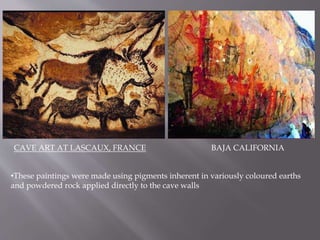
BAJA CALIFORNIACAVE ART AT LASCAUX, FRANCE
•These paintings were made using pigments inherent in variously coloured earths
and powdered rock applied directly to the cave walls
General Features
During the Renaissance, painters embraced classicism (simplicity, balance,
clarity; see Western Aesthetics) and physical realism. The Early
Renaissance (led by Florence) was the formative period of this approach; in
other words, it was Early Renaissance artists who initially developed and
refined techniques of classicism and physical realism. Once this foundation had
been established, the pinnacle of classicism was achieved in the High
Renaissance (led by Rome). During the Late Renaissance (which had no
particular leader, though both Florence and Rome remained primary forces),
the severe balance and simplicity of the High Renaissance was relaxed,
presaging the Baroque era.
A major strain of Late Renaissance art was mannerism: the deliberate pursuit
of novelty and complexity. In painting, mannerism entailed distortion of
physical forms (e.g. elongated human anatomy), unnatural colouring and
lighting, the arrangement of figures in complex poses, and
somewhat imbalanced, restless composition (as opposed to the balanced,
stable composition of pure classicism).23 Mannerism, which was led jointly
by Florence and Rome, was therefore quite contrived and artificial (i.e.
"mannered"), hence its name. Though only a portion of Late Renaissance artists
belonged to this movement, the features of mannerism (and its sheer
willingness to "break the rules") were widely influential
Painters in the Renaissance employed several different techniques to
create works. Here are a few of the most important techniques and
materials that were available to them
Fresco
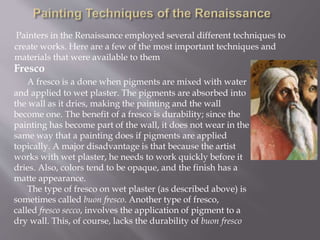
A fresco is a done when pigments are mixed with water
and applied to wet plaster. The pigments are absorbed into
the wall as it dries, making the painting and the wall
become one. The benefit of a fresco is durability; since the
painting has become part of the wall, it does not wear in the
same way that a painting does if pigments are applied
topically. A major disadvantage is that because the artist
works with wet plaster, he needs to work quickly before it
dries. Also, colors tend to be opaque, and the finish has a
matte appearance.
The type of fresco on wet plaster (as described above) is
sometimes called buon fresco. Another type of fresco,
called fresco secco, involves the application of pigment to a
dry wall. This, of course, lacks the durability of buon fresco
Tempera
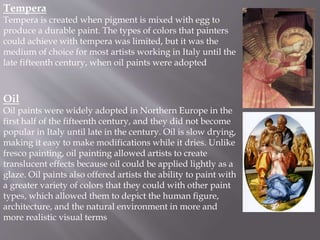
Tempera is created when pigment is mixed with egg to
produce a durable paint. The types of colors that painters
could achieve with tempera was limited, but it was the
medium of choice for most artists working in Italy until the
late fifteenth century, when oil paints were adopted
Oil
Oil paints were widely adopted in Northern Europe in the
first half of the fifteenth century, and they did not become
popular in Italy until late in the century. Oil is slow drying,
making it easy to make modifications while it dries. Unlike
fresco painting, oil painting allowed artists to create
translucent effects because oil could be applied lightly as a
glaze. Oil paints also offered artists the ability to paint with
a greater variety of colors that they could with other paint
types, which allowed them to depict the human figure,
architecture, and the natural environment in more and
more realistic visual terms
 The most common and respected form of art,
according to authors like Pliny or Pausanias,
were panel paintings, individual, portable
paintings on wood boards.
 The techniques used were encaustic (wax)
painting and tempera.
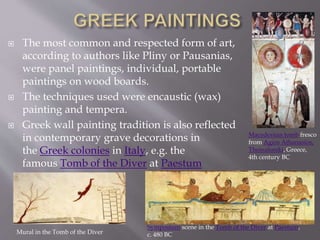
 Greek wall painting tradition is also reflected
in contemporary grave decorations in
the Greek colonies in Italy, e.g. the
famous Tomb of the Diver at Paestum
Macedonian tomb fresco
from Agios Athanasios,
Thessaloniki, Greece,
4th century BC
Symposium scene in the Tomb of the Diver at Paestum,
c. 480 BCMural in the Tomb of the Diver
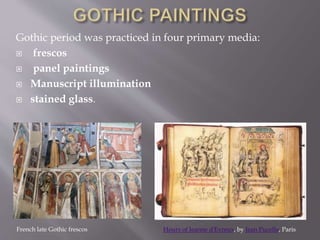
Gothic period was practiced in four primary media:
 frescos
 panel paintings
 Manuscript illumination
 stained glass.
Hours of Jeanne d'Evreux, by Jean Pucelle, ParisFrench late Gothic frescos
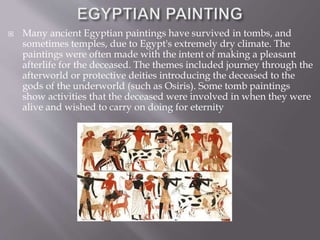
 Many ancient Egyptian paintings have survived in tombs, and
sometimes temples, due to Egypt's extremely dry climate. The
paintings were often made with the intent of making a pleasant
afterlife for the deceased. The themes included journey through the
afterworld or protective deities introducing the deceased to the
gods of the underworld (such as Osiris). Some tomb paintings
show activities that the deceased were involved in when they were
alive and wished to carry on doing for eternity
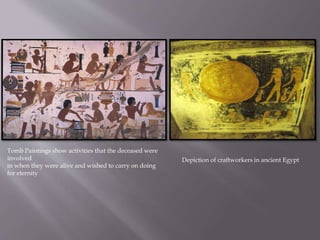
Tomb Paintings show activities that the deceased were
involved
in when they were alive and wished to carry on doing
for eternity
Depiction of craftworkers in ancient Egypt
Modernism describes both a set of cultural tendencies and an array of
associated cultural movements, originally arising from wide-scale and far-
reaching changes to Western societyin the late 19th century and early 20th
century. Modernism was a revolt against the conservative values
of realism. The term encompasses the activities and output of those who
felt the "traditional" forms of art, architecture, literature, religious faith,
social organization and daily life were becoming outdated in the new
economic, social and political conditions of an emerging fully
industrialized world. A salient characteristic of modernism is self-
consciousness. This often led to experiments with form, and work that
draws attention to the processes and materials used (and to the further
tendency of abstraction).
Impressionism
The first example of modernism in painting was impressionism, a school of
painting that initially focused on work done, not in studios, but outdoors.
Impressionist paintings demonstrated that human beings do not see objects, but
instead see light itself
 Other modernist styles include:
 Color Field
 Lyrical Abstraction
 Hard-edge painting
 Expressionism
 Cubism
 Pop art

painting in architecture

  • 1.
     Painting isa mode of creative expression, and the forms are numerous. Drawing, gesture, composition, narration , abstraction , among other aesthetic modes, may serve to manifest the expressive and conceptual intention of the practitioner. Paintings can be naturalistic and representational (as in a still life or landscape painting), photographic, abstract, narrative, symbolist (as in Symbolist art), emotive (as in Expressionism), or political in nature ) as in Activism .  A portion of the history of painting in both Eastern and Western art is dominated by spiritual motifs and ideas. Examples of this kind of painting range from artwork depicting mythological figures on pottery, to Biblical scenes rendered on the interior walls and ceiling of the Sistine Chapel, to scenes from the life of Buddha or other images of Eastern religious origin.
  • 2.
     Architectural paintingis a form of genre painting where the predominant focus lies on architecture, both outdoors views and interiors. While architecture was present in many of the earliest paintings and illuminations, it was mainly used as background or to provide rhythm to a painting. In the Renaissance, architecture was used to emphasize the perspective and create a sense of depth.  In Western art, architectural painting as an independent genre developed in the 16th century in Flanders and the Netherlands, and reached its peak in 16th and 17th century Dutch painting.
  • 3.
     Prehistoric cavepaintings have been discovered in many parts of the world, from Europe and Africa to Australia. Africa has some of the earliest paintings and rock engravings to have been securely dated.  Nearly 30,000 years old, they are discovered in 1969 on the rock face in a cave in Namibia. But the most numerous and the most sophisticated of prehistoric paintings are on the walls of caves in southwest France and northern Spain.  It is said that the oldest paint in America was found in a cave in Baja California (6 to 12 thousand years old) among many other caves with Great Murals; images of men and women, and wildlife are the most common paintings on this Mexican rock-shelters. Land animals depicted include rabbits, mountain sheeps, and deers, as well as marine mammals, fish, and shorebirds.
  • 4.
    BAJA CALIFORNIACAVE ARTAT LASCAUX, FRANCE •These paintings were made using pigments inherent in variously coloured earths and powdered rock applied directly to the cave walls
  • 5.
    General Features During theRenaissance, painters embraced classicism (simplicity, balance, clarity; see Western Aesthetics) and physical realism. The Early Renaissance (led by Florence) was the formative period of this approach; in other words, it was Early Renaissance artists who initially developed and refined techniques of classicism and physical realism. Once this foundation had been established, the pinnacle of classicism was achieved in the High Renaissance (led by Rome). During the Late Renaissance (which had no particular leader, though both Florence and Rome remained primary forces), the severe balance and simplicity of the High Renaissance was relaxed, presaging the Baroque era. A major strain of Late Renaissance art was mannerism: the deliberate pursuit of novelty and complexity. In painting, mannerism entailed distortion of physical forms (e.g. elongated human anatomy), unnatural colouring and lighting, the arrangement of figures in complex poses, and somewhat imbalanced, restless composition (as opposed to the balanced, stable composition of pure classicism).23 Mannerism, which was led jointly by Florence and Rome, was therefore quite contrived and artificial (i.e. "mannered"), hence its name. Though only a portion of Late Renaissance artists belonged to this movement, the features of mannerism (and its sheer willingness to "break the rules") were widely influential
  • 6.
    Painters in theRenaissance employed several different techniques to create works. Here are a few of the most important techniques and materials that were available to them Fresco A fresco is a done when pigments are mixed with water and applied to wet plaster. The pigments are absorbed into the wall as it dries, making the painting and the wall become one. The benefit of a fresco is durability; since the painting has become part of the wall, it does not wear in the same way that a painting does if pigments are applied topically. A major disadvantage is that because the artist works with wet plaster, he needs to work quickly before it dries. Also, colors tend to be opaque, and the finish has a matte appearance. The type of fresco on wet plaster (as described above) is sometimes called buon fresco. Another type of fresco, called fresco secco, involves the application of pigment to a dry wall. This, of course, lacks the durability of buon fresco
  • 7.
    Tempera Tempera is createdwhen pigment is mixed with egg to produce a durable paint. The types of colors that painters could achieve with tempera was limited, but it was the medium of choice for most artists working in Italy until the late fifteenth century, when oil paints were adopted Oil Oil paints were widely adopted in Northern Europe in the first half of the fifteenth century, and they did not become popular in Italy until late in the century. Oil is slow drying, making it easy to make modifications while it dries. Unlike fresco painting, oil painting allowed artists to create translucent effects because oil could be applied lightly as a glaze. Oil paints also offered artists the ability to paint with a greater variety of colors that they could with other paint types, which allowed them to depict the human figure, architecture, and the natural environment in more and more realistic visual terms
  • 8.
     The mostcommon and respected form of art, according to authors like Pliny or Pausanias, were panel paintings, individual, portable paintings on wood boards.  The techniques used were encaustic (wax) painting and tempera.  Greek wall painting tradition is also reflected in contemporary grave decorations in the Greek colonies in Italy, e.g. the famous Tomb of the Diver at Paestum Macedonian tomb fresco from Agios Athanasios, Thessaloniki, Greece, 4th century BC Symposium scene in the Tomb of the Diver at Paestum, c. 480 BCMural in the Tomb of the Diver
  • 9.
    Gothic period waspracticed in four primary media:  frescos  panel paintings  Manuscript illumination  stained glass. Hours of Jeanne d'Evreux, by Jean Pucelle, ParisFrench late Gothic frescos
  • 10.
     Many ancientEgyptian paintings have survived in tombs, and sometimes temples, due to Egypt's extremely dry climate. The paintings were often made with the intent of making a pleasant afterlife for the deceased. The themes included journey through the afterworld or protective deities introducing the deceased to the gods of the underworld (such as Osiris). Some tomb paintings show activities that the deceased were involved in when they were alive and wished to carry on doing for eternity
  • 11.
    Tomb Paintings showactivities that the deceased were involved in when they were alive and wished to carry on doing for eternity Depiction of craftworkers in ancient Egypt
  • 12.
    Modernism describes botha set of cultural tendencies and an array of associated cultural movements, originally arising from wide-scale and far- reaching changes to Western societyin the late 19th century and early 20th century. Modernism was a revolt against the conservative values of realism. The term encompasses the activities and output of those who felt the "traditional" forms of art, architecture, literature, religious faith, social organization and daily life were becoming outdated in the new economic, social and political conditions of an emerging fully industrialized world. A salient characteristic of modernism is self- consciousness. This often led to experiments with form, and work that draws attention to the processes and materials used (and to the further tendency of abstraction). Impressionism The first example of modernism in painting was impressionism, a school of painting that initially focused on work done, not in studios, but outdoors. Impressionist paintings demonstrated that human beings do not see objects, but instead see light itself
  • 13.
     Other moderniststyles include:  Color Field  Lyrical Abstraction  Hard-edge painting  Expressionism  Cubism  Pop art