

AIRTEL MAGIC


         Roll Nos:8201 to 8212
               Div B
Background Note

   Cellular telephony was introduced in India in early 1990’s.
   Only two major players- Bharti (Airtel) & Essar.
   Only post paid services available and very high tariff rates
     about Rs.16/min for outgoing calls.
   Monopoly prevailed and tariff rates as well as handsets were
    very expensive.
   Hence phone services regarded as luxury and target customers
    were elite segment of society.
Why limited growth?
   High Tariff rates

   Services restricted only to Metros.

   Lack of awareness among people.

   Low standard of Living.

   Government regulations.
Launch of PRE-PAID Services
   Major cellular services providers launched pre-paid services in
    late 1990’s.
   The main aim was to target customers from all sections.
   Prepaid cellular cards gained quick popularity.
   Tariff rates declined 75% between 1990-2000.
   By October 02 ,out of the 8.5 million users , 65% belonged to
    prepaid segment.
   An estimated 80% of new add-ons were prepaid subscribers.
The Magic of magic……
   Bharati launched its own prepaid cellular service under magic
    brand in Jan 99.
   First launched in Delhi and later in other circles in India.
   Magic targeted at infrequent mobile users.
   Acquiring a magic connection was made very easy.
   Made more accessible with magic made available at
    Departmental stores, gifts shop, telephone booths, Kirana
    stores etc.
   It offered instant connectivity , STD/ISD facility, voice-mail
    and sms facility.
   Made available in various denominations (300-3000).
Radical transformation in cellular market
   The subscriber base increased to 6.4 million in March 2002 as
    compared to 3.5 million in March 2001.
   Growth rate in subscribers
          Rajastan             179%
          Harayana              151%
          Kerala                151%
   Analysts estimated that the number of subscribers in 2004
    would reach 25 million as compared to 4.5 million in 2002.
   The immense potential lured all major players and hence
    Bharati also felt the need to revamp its strategies to retain its
    position.
Revamping the marketing strategies

   Newer areas, changes in pricing, positioning and advertising.
   New value additions and better services.
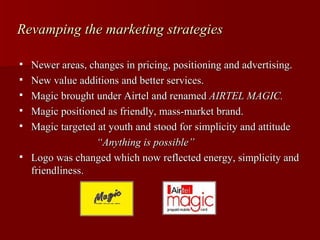
   Magic brought under Airtel and renamed AIRTEL MAGIC.
   Magic positioned as friendly, mass-market brand.
   Magic targeted at youth and stood for simplicity and attitude
                  “Anything is possible”
   Logo was changed which now reflected energy, simplicity and
    friendliness.
   Introduced special features .

   It also introduced doorstep delivery of Magic cards.

   In mid 2002,Bharati launched regional roaming network in
    Asia for magic subscribers.

   Also regional roaming facility was offered to customers within
    the country as well.

   It also waived intra-operator call charges in some parts of the
    country.
Celebrity Endorsements

   In 2002, Saurav Ganguly and Leading movie stars Madhavan
    and Kareena Kapoor were signed as the endorsers of Airtel
    Magic.
   Objective was to cash upon the two biggest passions of Indian
    masses-Movies & Cricket.
   In October 2002, a TVC was launched featuring Shah rukh
    khan and Kareena Kapoor.
   This TVC was developed by Percept Advertising, India’s
    leading advertising agency.
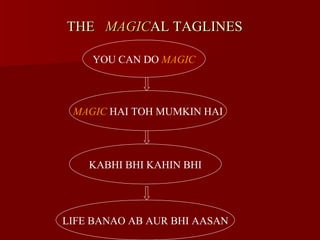
THE MAGICAL TAGLINES

    YOU CAN DO MAGIC


 MAGIC HAI TOH MUMKIN HAI


    KABHI BHI KAHIN BHI


LIFE BANAO AB AUR BHI AASAN
Market Leader
   Airtel comes to you from Bharti Airtel Limited
   The businesses at Bharti Airtel have been structured into three
    strategic business units (SBU's) - Mobile services, Broadband
    & Telephone services (B&T) & Enterprise services.
   First private telecom service provider to connect all states of
    India .
   Covers 23 telecom circles of the country, has 21 million
    customers
   Highly successful brand in India
Mission
   We will meet the mobile communication needs of our
    customers
    Vision
   ‘To be the most admired brand in India by 2010’
    Values
   We will always put our customers first. We will always trust
    and respect each other. We will respect our associates as we
    respect each other. We will work together through a process of
    continuous improvement.
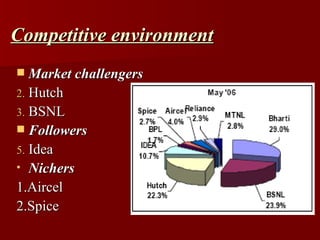
Competitive environment
  Market challengers
2. Hutch
3. BSNL
 Followers
5. Idea
• Nichers
1.Aircel
2.Spice
MARKETING MIX
Product
   Airtel Pre-paid
   Airtel Post-paid
   Blackberry Wireless Handheld
   Value Added Services (VAS)
    The different value added services provided by Airtel are-
      Instant Balance Enquiry
      24Hr recharge Facility
      Caller line identification
      Call divert, Call wait & Call Hold
      Multimedia messaging service (MMS)
      Airtel Live Portal
   SMS based Information Service
..Contd
       Hello Tunes & Ring Tones
       Voice Mail Service
       Easy Post-paid bill collection
       Gifting of Ring Tones & Hello Tunes
       GPRS

   Business Solutions
Price
   Customer based pricing strategies.

   Flexible pricing mechanism

   Controlled by TRAI.
Place
   It has wide and extensive presence even in the remotest areas

   Airtel Customer Care Touch Points

   Distributors like
    E.g. Paan shops, grocery stores, chemists, outlet etc.
Outlets
Promotion
•   Large scale print and video advertising.

•   Big celebrities like SRK and Sachin are roped in to endorse
    the product.

•   In 2002 Airtel got its Signature tune from A.R. Rehman, this
    signature tune is perhaps the most downloaded tune in India.

•   Provides innovations such as Bollywood movie premiers,
    music services such as ring back tones & many more.
..Contd
   "Friendz" pre-paid connection for youth," Ladies Special"
    plan, Seniors plan.

   Executives corporate plan (First to give prepaid in this
    category).

   Special discounts in calling rates & sms services.

   Providing wallpapers and screensavers on website.
Financials
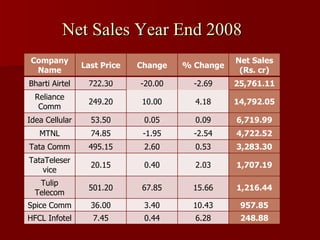
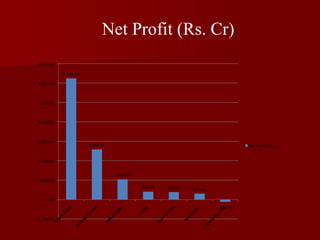
Net Sales Year End 2008
 Company                                         Net Sales
                Last Price   Change   % Change
  Name                                            (Rs. cr)
Bharti Airtel    722.30      -20.00     -2.69    25,761.11
  Reliance
                 249.20       10.00     4.18     14,792.05
   Comm
Idea Cellular     53.50       0.05      0.09     6,719.99
   MTNL           74.85       -1.95     -2.54    4,722.52
Tata Comm        495.15       2.60      0.53     3,283.30
TataTeleser
                  20.15       0.40      2.03     1,707.19
    vice
   Tulip
                 501.20       67.85     15.66    1,216.44
  Telecom
Spice Comm        36.00       3.40      10.43     957.85
HFCL Infotel       7.45       0.44      6.28      248.88
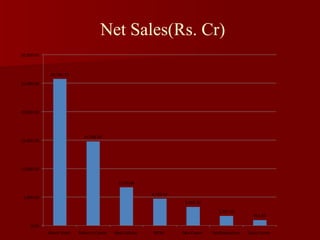
Net Sales(Rs. Cr)
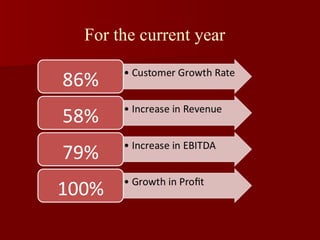
For the current year
Net Profit (Rs. Cr)
SWOT
STRENGTHS
   Bharti Airtel has more than 65 million customers (July 2008).
   It is the largest cellular provider in India, and also supplies
    broadband and telephone services - as well as many other
    telecommunications services to both domestic and corporate
    customers.
   Other stakeholders include Sony-Ericsson, Nokia - and Sing
    Tel, with whom they hold a strategic alliance. This means that
    the business has access to knowledge and technology from
    other parts of the telecommunications world.
   The company has covered the entire Indian nation with its
    network. This has underpinned its large and rising customer
    base.
WEAKNESS
 Price Competition from BSNL and MTNL
 Losing lead on technical expertise.
 Until recently Airtel did not own its own towers, which
  was a particular strength of some of its competitors such as
  Hutchison Essar.
 When started initially,the business had little knowledge and
  experience of how a cellular telephone system actually
  worked. So the start-up business had to outsource to
  industry experts in the field. .
OPPORTUNITIES
–   The fast extending IPLC market.
–    Latest technology and low-cost advantage.
–   Growth of mobile phone users.
–   Untapped Rural Market.
–   Bharti Airtel is embarking on another joint venture with
    Vodafone Essar and Idea Cellular to create a new
    independent tower company called Indus Towers. This new
    business will control more than 60% of India's network
    towers.
THREATS
   Airtel and Vodafone seem to be having an on/off relationship

   Bharti Airtel could also be the target for the takeover vision of
    other global telecommunications players that wish to move
    into the Indian market.
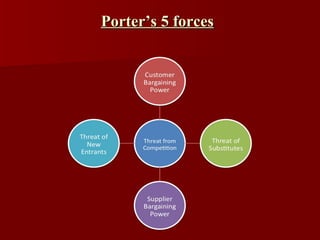
Porter’s 5 forces
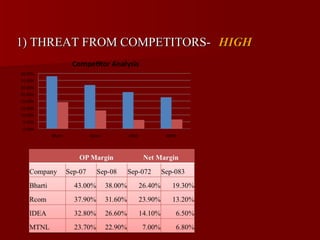
1) THREAT FROM COMPETITORS- HIGH
2) CUSTOMER BARGAINING POWER - HIGH

   Lack of differentiation among Service Providers
   Cut throat Competition
   Low Switching Costs
   Attractive Schemes for new connection
   Availability of all operators everywhere
   Difficulty to differentiate Brand
   Number Portability will have –Ve Impact
   Businesses & Consumers
3) THREAT OF SUBSTITUES- HIGH

   Cellular Services address the communication needs and
    staying connected.

   Hence a necessity, but there are substitutes
    Landline
    CDMA
4)THREAT OF NEW ENTRANTS – Previously LOW
                           Now HIGH.

Previously Low because
 Huge License Fees to be paid upfront & High gestation period
 Spectrum Availability & Regulatory Issues
 Infrastructure Setup Cost - High
 Rapidly changing technology
Now High because
 New Entrants are ready to enter with Huge Capital Considering the
   attractiveness of the market
 Increase Of FDI to 76% bringing competiton from Foreign players
 New Entrants from Non telecom companies with the ease of
   Outsourcing
Recommendations
Future strategies
   Translate its expertise in Indian markets to other emerging
    economies.

   This could call for acquisitions globally.

   Indian market inspite of being the worlds largest is still not
    matured. Opportunities abound in the hinterland which must
    be exploited
Future Strategies to retain its market share

   New tariff plans.

   More value added services.

   Increase in visibility and coverage

   The AirTel - AirTel advantage

   New innovative packages

   More of the e-factor
Technical Front
   Widening the network coverage area.

   Increasing quality of service and interconnectivity.

   Innovative VAS such as e-recharge or recharge using sms.

   Advanced technology introduction such as M-commerce
    e.g. m-check, ATM recharge.
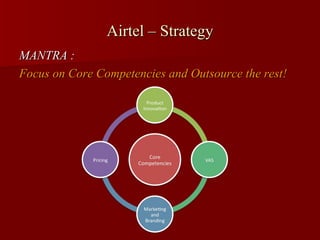
Airtel – Strategy
MANTRA :
Focus on Core Competencies and Outsource the rest!
THANK YOU

Airtel magic

  • 1.
    AIRTEL MAGIC Roll Nos:8201 to 8212 Div B
  • 2.
    Background Note  Cellular telephony was introduced in India in early 1990’s.  Only two major players- Bharti (Airtel) & Essar.  Only post paid services available and very high tariff rates about Rs.16/min for outgoing calls.  Monopoly prevailed and tariff rates as well as handsets were very expensive.  Hence phone services regarded as luxury and target customers were elite segment of society.
  • 3.
    Why limited growth?  High Tariff rates  Services restricted only to Metros.  Lack of awareness among people.  Low standard of Living.  Government regulations.
  • 4.
    Launch of PRE-PAIDServices  Major cellular services providers launched pre-paid services in late 1990’s.  The main aim was to target customers from all sections.  Prepaid cellular cards gained quick popularity.  Tariff rates declined 75% between 1990-2000.  By October 02 ,out of the 8.5 million users , 65% belonged to prepaid segment.  An estimated 80% of new add-ons were prepaid subscribers.
  • 5.
    The Magic ofmagic……  Bharati launched its own prepaid cellular service under magic brand in Jan 99.  First launched in Delhi and later in other circles in India.  Magic targeted at infrequent mobile users.  Acquiring a magic connection was made very easy.  Made more accessible with magic made available at Departmental stores, gifts shop, telephone booths, Kirana stores etc.  It offered instant connectivity , STD/ISD facility, voice-mail and sms facility.  Made available in various denominations (300-3000).
  • 6.
    Radical transformation incellular market  The subscriber base increased to 6.4 million in March 2002 as compared to 3.5 million in March 2001.  Growth rate in subscribers Rajastan 179% Harayana 151% Kerala 151%  Analysts estimated that the number of subscribers in 2004 would reach 25 million as compared to 4.5 million in 2002.  The immense potential lured all major players and hence Bharati also felt the need to revamp its strategies to retain its position.
  • 7.
    Revamping the marketingstrategies  Newer areas, changes in pricing, positioning and advertising.  New value additions and better services.  Magic brought under Airtel and renamed AIRTEL MAGIC.  Magic positioned as friendly, mass-market brand.  Magic targeted at youth and stood for simplicity and attitude “Anything is possible”  Logo was changed which now reflected energy, simplicity and friendliness.
  • 8.
    Introduced special features .  It also introduced doorstep delivery of Magic cards.  In mid 2002,Bharati launched regional roaming network in Asia for magic subscribers.  Also regional roaming facility was offered to customers within the country as well.  It also waived intra-operator call charges in some parts of the country.
  • 9.
    Celebrity Endorsements  In 2002, Saurav Ganguly and Leading movie stars Madhavan and Kareena Kapoor were signed as the endorsers of Airtel Magic.  Objective was to cash upon the two biggest passions of Indian masses-Movies & Cricket.  In October 2002, a TVC was launched featuring Shah rukh khan and Kareena Kapoor.  This TVC was developed by Percept Advertising, India’s leading advertising agency.
  • 11.
    THE MAGICAL TAGLINES YOU CAN DO MAGIC MAGIC HAI TOH MUMKIN HAI KABHI BHI KAHIN BHI LIFE BANAO AB AUR BHI AASAN
  • 12.
    Market Leader  Airtel comes to you from Bharti Airtel Limited  The businesses at Bharti Airtel have been structured into three strategic business units (SBU's) - Mobile services, Broadband & Telephone services (B&T) & Enterprise services.  First private telecom service provider to connect all states of India .  Covers 23 telecom circles of the country, has 21 million customers  Highly successful brand in India
  • 13.
    Mission  We will meet the mobile communication needs of our customers Vision  ‘To be the most admired brand in India by 2010’ Values  We will always put our customers first. We will always trust and respect each other. We will respect our associates as we respect each other. We will work together through a process of continuous improvement.
  • 14.
    Competitive environment  Market challengers 2. Hutch 3. BSNL  Followers 5. Idea • Nichers 1.Aircel 2.Spice
  • 15.
  • 16.
    Product  Airtel Pre-paid  Airtel Post-paid  Blackberry Wireless Handheld  Value Added Services (VAS) The different value added services provided by Airtel are-  Instant Balance Enquiry  24Hr recharge Facility  Caller line identification  Call divert, Call wait & Call Hold  Multimedia messaging service (MMS)  Airtel Live Portal  SMS based Information Service
  • 17.
    ..Contd  Hello Tunes & Ring Tones  Voice Mail Service  Easy Post-paid bill collection  Gifting of Ring Tones & Hello Tunes  GPRS  Business Solutions
  • 18.
    Price  Customer based pricing strategies.  Flexible pricing mechanism  Controlled by TRAI.
  • 19.
    Place  It has wide and extensive presence even in the remotest areas  Airtel Customer Care Touch Points  Distributors like E.g. Paan shops, grocery stores, chemists, outlet etc.
  • 20.
  • 21.
    Promotion • Large scale print and video advertising. • Big celebrities like SRK and Sachin are roped in to endorse the product. • In 2002 Airtel got its Signature tune from A.R. Rehman, this signature tune is perhaps the most downloaded tune in India. • Provides innovations such as Bollywood movie premiers, music services such as ring back tones & many more.
  • 22.
    ..Contd  "Friendz" pre-paid connection for youth," Ladies Special" plan, Seniors plan.  Executives corporate plan (First to give prepaid in this category).  Special discounts in calling rates & sms services.  Providing wallpapers and screensavers on website.
  • 23.
  • 24.
    Net Sales YearEnd 2008 Company Net Sales Last Price Change % Change Name (Rs. cr) Bharti Airtel 722.30 -20.00 -2.69 25,761.11 Reliance 249.20 10.00 4.18 14,792.05 Comm Idea Cellular 53.50 0.05 0.09 6,719.99 MTNL 74.85 -1.95 -2.54 4,722.52 Tata Comm 495.15 2.60 0.53 3,283.30 TataTeleser 20.15 0.40 2.03 1,707.19 vice Tulip 501.20 67.85 15.66 1,216.44 Telecom Spice Comm 36.00 3.40 10.43 957.85 HFCL Infotel 7.45 0.44 6.28 248.88
  • 25.
  • 26.
  • 27.
  • 28.
  • 29.
    STRENGTHS  Bharti Airtel has more than 65 million customers (July 2008).  It is the largest cellular provider in India, and also supplies broadband and telephone services - as well as many other telecommunications services to both domestic and corporate customers.  Other stakeholders include Sony-Ericsson, Nokia - and Sing Tel, with whom they hold a strategic alliance. This means that the business has access to knowledge and technology from other parts of the telecommunications world.  The company has covered the entire Indian nation with its network. This has underpinned its large and rising customer base.
  • 30.
    WEAKNESS  Price Competitionfrom BSNL and MTNL  Losing lead on technical expertise.  Until recently Airtel did not own its own towers, which was a particular strength of some of its competitors such as Hutchison Essar.  When started initially,the business had little knowledge and experience of how a cellular telephone system actually worked. So the start-up business had to outsource to industry experts in the field. .
  • 31.
    OPPORTUNITIES – The fast extending IPLC market. – Latest technology and low-cost advantage. – Growth of mobile phone users. – Untapped Rural Market. – Bharti Airtel is embarking on another joint venture with Vodafone Essar and Idea Cellular to create a new independent tower company called Indus Towers. This new business will control more than 60% of India's network towers.
  • 32.
    THREATS  Airtel and Vodafone seem to be having an on/off relationship  Bharti Airtel could also be the target for the takeover vision of other global telecommunications players that wish to move into the Indian market.
  • 33.
  • 34.
    1) THREAT FROMCOMPETITORS- HIGH
  • 35.
    2) CUSTOMER BARGAININGPOWER - HIGH  Lack of differentiation among Service Providers  Cut throat Competition  Low Switching Costs  Attractive Schemes for new connection  Availability of all operators everywhere  Difficulty to differentiate Brand  Number Portability will have –Ve Impact  Businesses & Consumers
  • 36.
    3) THREAT OFSUBSTITUES- HIGH  Cellular Services address the communication needs and staying connected.  Hence a necessity, but there are substitutes Landline CDMA
  • 37.
    4)THREAT OF NEWENTRANTS – Previously LOW Now HIGH. Previously Low because  Huge License Fees to be paid upfront & High gestation period  Spectrum Availability & Regulatory Issues  Infrastructure Setup Cost - High  Rapidly changing technology Now High because  New Entrants are ready to enter with Huge Capital Considering the attractiveness of the market  Increase Of FDI to 76% bringing competiton from Foreign players  New Entrants from Non telecom companies with the ease of Outsourcing
  • 38.
  • 39.
    Future strategies  Translate its expertise in Indian markets to other emerging economies.  This could call for acquisitions globally.  Indian market inspite of being the worlds largest is still not matured. Opportunities abound in the hinterland which must be exploited
  • 40.
    Future Strategies toretain its market share  New tariff plans.  More value added services.  Increase in visibility and coverage  The AirTel - AirTel advantage  New innovative packages  More of the e-factor
  • 41.
    Technical Front  Widening the network coverage area.  Increasing quality of service and interconnectivity.  Innovative VAS such as e-recharge or recharge using sms.  Advanced technology introduction such as M-commerce e.g. m-check, ATM recharge.
  • 42.
    Airtel – Strategy MANTRA: Focus on Core Competencies and Outsource the rest!
  • 43.

Editor's Notes

  • #33 Airtel and Vodafone seem to be having an on/off relationship. Vodafone which owned a 5.6% stake in the Airtel business sold it back to Airtel, and instead invested in its rival Hutchison Essar. Knowledge and technology previously available to Airtel now moves into the hands of one of its competitors.