Page 1 of 34
“Airline Operational Efficiency” – by Imran Asif imran.asif@gmail.com http://bd.linkedin.com/in/imranasif/
____________________________________________
Special Topic Paper on
AIRLINE OPERATIONAL EFFICIENCY
____________________________________________
Prepared by
Imran Asif
for Ph.D. (Aviation) in Operations at ERAU
03 August, 2013
Page 2 of 34
“Airline Operational Efficiency” – by Imran Asif imran.asif@gmail.com http://bd.linkedin.com/in/imranasif/
This paper explores the problems of defining, understanding, and improving operational
efficiency within an airline.
First we consider the effects that an air carrier’s overall strategy and geographic area of
operation may have on the airline’s efficiency. In addition, we look at various traps that airlines
can fall into when they analyze the efficiency of their operations. In the rest of the paper we
explore such issues as organizational structure, scheduling, turnaround times, maintenance
scheduling, fleet age, fuel management, fleet type implications on payload efficiency, dispatch
issues, load planning, and coordination issues related to producing an efficient operation.
Although all of the topic areas should be quite familiar to most readers, it is hoped that some of
the points mentioned in each topic area may prove useful to airlines seeking to maximize
operational efficiency. I have tried to touch on as many factors and elements as possible, rather
than exploring any one exhaustively.
What is an Efficient Operation?
Of course, this is the key question. The answers may sound intuitive, but they can also be quite
complex. We can look at any operation and based on our perception of those factors we believe
to be most important with regard to efficiency, identify those factors of a particular operation
that we believe to have the greatest impact on the success or failure of the operation. But it is
much more difficult to identify a legitimate basis upon which airline operations can be
compared in order to determine which operation is more efficient.
It is hard to compare airline operations because depending on the geography within which an
airline is operating, its fundamental route structure, and the type of traffic it experiences, an
airline will experience different major external barriers to efficiency. Additionally, internal issues
such as labor union issues (or government-mandated labor rules) may further impose a major
burden on the airline’s efforts to obtain maximum efficiency, because such issues are often
outside the airline’s direct control.
It is clear, though, that within any given operation, “improvements” in the following areas will
tend to increase an airline’s efficiency:
 turnaround time (keeping ratios of international versus domestic flights, or wide-body
versus narrow-body aircraft constant)
 aircraft utilization (keeping stage length and fleet mix constant)
 crew utilization (hours per month)
 maintenance check times (assuming the fleet doesn’t change)
 fuel consumption (keeping all of the above constant)
 fuel over destination (FOD) improvements (can be defined as increasing the number of
flights that operate at the minimum levels of fuel defined by applicable regulations or
company requirements)
 payload (passengers plus cargo) on key flights
Page 3 of 34
“Airline Operational Efficiency” – by Imran Asif imran.asif@gmail.com http://bd.linkedin.com/in/imranasif/
 fleet assignment (total payload on flights, always limited structurally or by takeoff weight)
 total flight delays, in terms of both number of flights and total time
 diversions
But those qualifiers shown parenthetically along with the listed areas of improvement must be
observed if one is to know that “true” efficiency improvements have been achieved. Otherwise
the observations may be misinterpreted as efficiency improvements when in reality the change
reflects merely a change in the parameters of the operation or an improvement in one
parameter at the expense of another.
Judging Efficiency
Before we look at the methods to improve the areas I have just outlined, it is important to
consider ways in which an airline can control efficiency as well as potential pitfalls that an
airline should avoid when addressing operational efficiency.
Corporate Organizational Issues
Critical to the pursuit of efficiency within an airline operation is the organizational structure of
the airline and how the departments fulfill their roles. Near-term operational decisions need to
be made by the operations department. Longer-term operational decisions need to be made
with at least as much input from finance and marketing departments of the company as from
the operations department.
Within an airline, it is necessary for each department to have a clear understanding of its role
as it relates to the airline’s operations:
 Strategic planning defines the corporate strategy and any major changes; these might
include new major routes, hubs, major destinations, and so forth. This department will
perform broad financial analyses of operational impacts.
 Sales and marketing defines where and how the company needs to change its focus: for
example, changing schedules and frequencies, making minor route changes,
opening/closing minor destinations, changing gauge (size of aircraft), determining levels of
service (definition of product), and so forth. Sales and marketing is also responsible for
gathering and maintaining exhaustive revenue data. The most difficult data to manage are
data on the amount of revenue per leg generated, so that the airline has a clear idea of the
relation of legs to all origin & destination (O&D) effects. The most difficult data to define
are how to attribute revenue when frequent flyer free tickets are used.
 Finance, apart from its obvious and customary roles, must be able to provide exhaustive
cost data to the operations department. Data should be organized in such a way that it is
possible to view and all data in terms of costs per station, aircraft, fleet, flight, flight hour,
cycle, route, crew member, and so forth. In other words, it should be possible to look at any
and all data as either a fixed or a variable cost, depending on which factors one is holding
fixed n any given analysis.
 Operations should never lose sight of the fact that it provides a service to the sales and
marketing side of the airline. The planes are not there merely to be flown; they are there to
Page 4 of 34
“Airline Operational Efficiency” – by Imran Asif imran.asif@gmail.com http://bd.linkedin.com/in/imranasif/
make money. The initial and most important service provided by the operations
department is the provision of timely information to those departments with commercial
responsibility for making operational decisions that may have adverse cost or other
impacts. In order to be able to do this, the efficient operations department must maintain
exhaustive data pertinent to all elements of the operation, including all its parameters. If,
however, it is possible to make a change in the operation requested by sales and
marketing and still have a profitable operation, then operations must expect to implement
the change, no matter how inconvenient it might be.
False Signals
In the airline industry it is necessary for the airline departments to have a clear understanding
of their roles, an appreciation of the enormous amounts of cost at issue, as well as a grasp on
revenue data for the following reason: the enormous capital investment in aircraft required to
build an airline permits an airline to be run maintaining a good positive cash flow while in fact it
is losing enormous amounts of money. Unlike other industries in which a company that
continues to lose money quickly runs out of cash, goes bankrupt, and ceases to exist, in the
airline industry carriers that have serious operating deficits because of inefficiencies in their
operations and poor management can continue to maintain a strong cash position by borrowing
money against their assets. Some airlines have borrowed money and simply not repaid it, while
they continued to maintain cash flow and operating profit. An airline can go on this way for
years while running itself to the ground, and several major carriers have done so in the twenty
years since the deregulation of the US airline industry – notably TWA and PanAm in the 1980s.
The fact that such carriers were able to pay all their operating expenses masked the
weaknesses of their operations and management.
The point of focusing so much on this discussion of financial issues and operating parameters
of efficiency is that it is unfortunately often easy to assume that efficiency has improved, when
in fact some of the operating parameters have merely changed. T is even worse when an airline
assumes that its operation is efficient when it isn’t or assumes that its operation is unprofitable
when it is not.
Even in successful air carriers, the finance department is run by the financial analyst without
the involvement of the operations personnel. Some of the most common problems that are
made as a result include;
 Errors in figuring costs, for example, fixed versus hourly or cycle versus hourly costs. These
mistakes are particularly troublesome when it comes time to analyzing the impacts of
changes in flight times. It should be remembered that any cost can be either fixed or
variable depending on the type of analysis being performed.
 Errors in categorizing costs as aircraft-related instead of airport-related. This is particularly
an issue when an airline is starting up new routes.
 Errors in assessing the factors surrounding the economic performance of various
aircraft/fleets. If a particular fleet appears not to be sufficiently profitable, it may be that it
is being deployed inefficiently.
 Errors in accounting for frequent flyer revenue. Frequent flyer tickets are not “free”; a
portion of the revenue from every ticket should be attributed to its value. If an airline has a
route structure such that free tickets tend to be primarily cashed in toward a particular set
Page 5 of 34
“Airline Operational Efficiency” – by Imran Asif imran.asif@gmail.com http://bd.linkedin.com/in/imranasif/
of destinations, great care must be taken in assessing the profitability or lack thereof of
these destinations. Assuming that these tickets provide “zero revenue” has caused major
airlines to make major fleet and route decisions in error.
 Errors in analyzing the costs of diversions. If the diversions are unplanned, their costs are
easily underestimated. If they are planned en route diversions, their costs are usually wildly
overestimated.
 Errors in estimating the amount of slack, or extra resources, necessary to run an effective
operation. The acquisition of new physical or human resources must never be viewed in
terms of their cost but rather in terms of the cost of not having them in the event of a
problem.
Efficiencies and Inefficiencies of Long-Haul Operations
Some international operations bring with them some extreme and unavoidable inefficiencies
that cannot be separated from the operation. Some of these are:
 Long turnarounds. Long flights need longer turnarounds because more time is needed for
cleaning and flight preparation. Two-engine aircraft need long turnarounds prior to flying
extended range twin-engine operations (ETOPS) because more rigorous line maintenance
checks need to be conducted. Also certain regions have airport practices that impose
longer turnarounds than others. And, of course, having to put disembarking passengers
through immigration and customs, and embarking passengers through international police
control puts the airline at the mercy of the weaknesses of such facilities at any airport.
 Scheduling. Each region and each major route has its own scheduling patterns for long-haul
traffic. For example, across the North Atlantic most westbound flights are scheduled during
daylight hours and most eastbound flights during nighttime hours. This flight pattern
ensures high daily aircraft utilization and ensures arrival/departure times that meet
customer preferences. In contrast, other long-haul traffic responds to traveler preference
for nighttime flights rather than daytime flights. Whether only perceived or real, there is a
common view that less time is wasted if one sleeps during a flight rather than sleeping in a
hotel at either end of a flight that lasts 8-14 hours. The nighttime flight schedule requires
that upon arriving at their destination, aircraft remain idle during the day until that
evening’s flight. The only way for an airline to increase aircraft utilization for this type of
flight pattern would be for the airline to take advantage of beyond traffic rights where such
rights are available. In this case long-haul aircraft utilization ranges from 12 to 16 hours.
 Fuel cost differentials. Fuel cost (the price per gallon or liter) varies from one country to the
next and from one airport to another. Airlines resort to tankering fuel (carrying more fuel
than needed based on the length of the trip and the fuel reserves required per regulations)
to cope with extreme differences in fuel costs, especially those that result from taxes.
Tankering is crucial for promoting cost efficiency, but it also wastes fuel even while it saves
money, since tinkering increases the weight of the aircraft and as a result increases the
fuel burn.
 Inefficient basing of kitchens. Double catering takes up galley space and adds to the
weight of the aircraft. If a carrier can eliminate double catering, it can possibly cut down on
galley size, thus creating more seats or cargo space and thus more revenue; it can also
decrease the amount of fuel burned. In order to cut double catering, the airline may need
Page 6 of 34
“Airline Operational Efficiency” – by Imran Asif imran.asif@gmail.com http://bd.linkedin.com/in/imranasif/
to open new kitchens, which is a major investment and can increase operating costs.
Locating kitchens in a lower-cost environment can cut such costs.
 Inefficient basing of crews. If the carrier does not have extra crew bases, crew utilization is
decreased because crew have to make longer trips away from home, and therefore the
airline may need to hire more crew to cover its operations. Details vary depending on the
country of operations and crew contracts, but generally speaking more time away from
base means less time spent flying and more money spent paying per diems and hotel
costs. Building a new crew base is a major investment involving big operating and
administrative costs. And when an airline creates new crew bases in other countries, it may
apply different certifying authorities’ standards and pay scales based on local laws and
conditions.
Banked Hub-and-Spoke versus Star versus Point-to-Point Route Structure
The single strategic organizational element that has the greatest impact on the absolute
efficiency of an airline is how it puts together its route structure and schedule. The most critical
elements in an airline’s route structure and schedule are the specific choice of airports the
airline will serve and the times allocated to flight arrivals and departures.
In the early days of aviation, aircraft performance limited air service to short-haul routes, and all
flights were point-to-point. As longer-range aircraft were developed, flights were still operated
point-to-point. Besides, passengers have always preferred point-to-point service – getting to
their destination without any intermediate stops.
The diffuse, hubless point-to-point operations of the 1940s and 1950s no longer exist. There are
still operations that are referred to as point-to-point, but with important differences. The old
point-to-point approach was very much like an intercity bus or train – going a long way but
making many intermediate stops along the way to drop off and pick up passengers. New point-
to-point operations try to offer connections as well. The Southwest Airline operation is a point-to-
point operation, but it has such high frequencies in its principal hubs that it provides a level of
connection service that might normally be associated with a banked hub-and-spoke system. All
airlines have a principal base of operations. But not every airlines’ principal base of operations
can be considered a hub. If, in fact, an airline’s primary base is also its hub, how is that hub
operated?
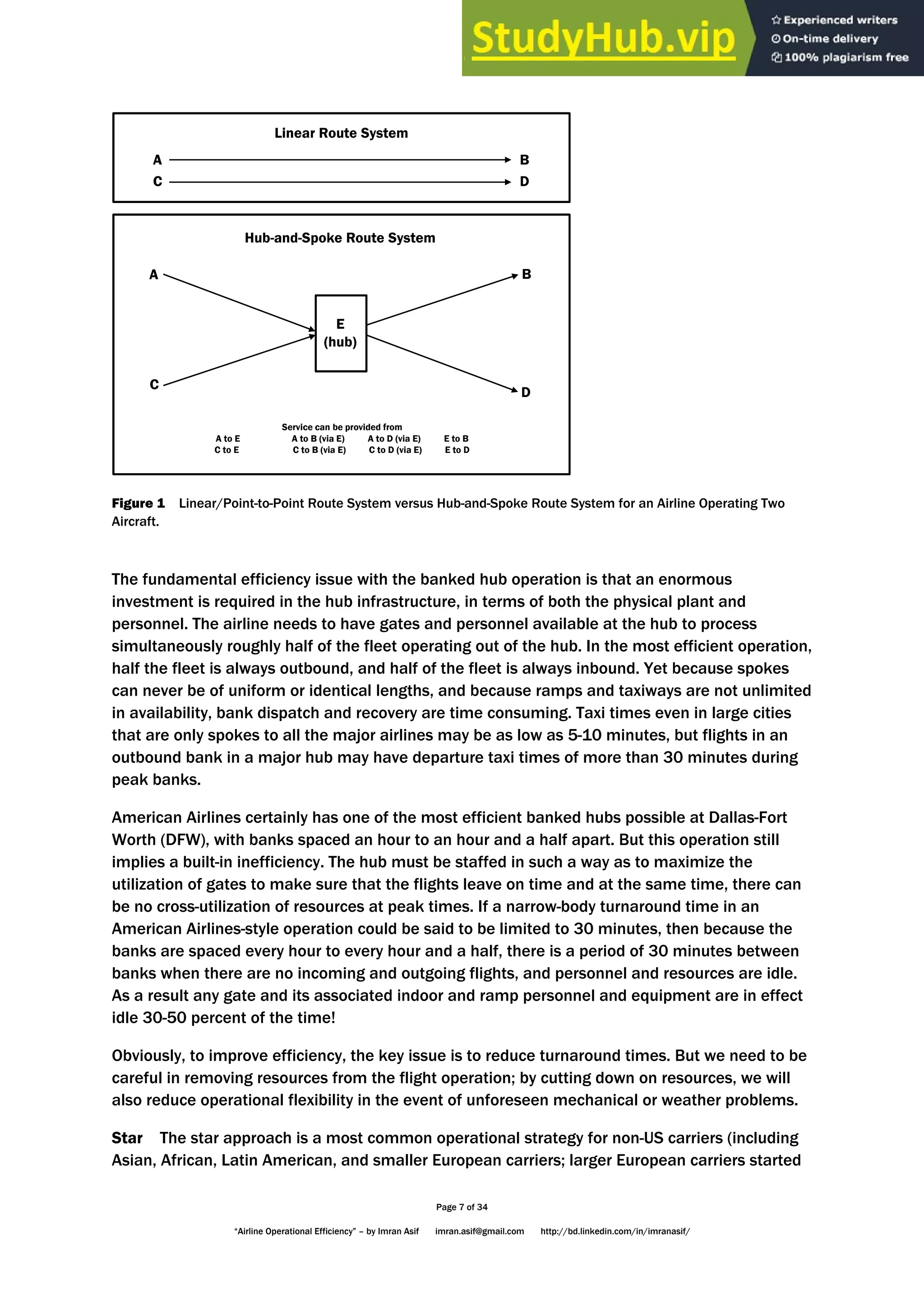
In the 1970s, it was noted that in roughly the same amount of time, with the same number of
aircraft, an airline that had previously been able to fly passengers only from A to B and from C
to D could, by using connecting point E (a hub city), provide a service from A to E, A to B via E, A
to D via E, E to B, C to E, C to B via E, C to D via E, and E to D, as shown in Figure 1. But these
connections required careful coordination at point E.
Now let’s take a look as some efficiencies of different network organizations.
Banked Hub-and-Spoke Networks In the 1980s, the hub-and-spoke concept became the
dominant operations methodology for all major carriers, with the notable exception of US-based
Southwest Airlines. In the hub-and-spoke operation all the aircraft leave the major hub in waves,
or outbound banks, go to short or medium-haul spoke destinations, then return again in
inbound banks. The inbound banks are coordinated with outbound banks to provide the
passengers with a geometric combination of destinations.
Page 7 of 34
“Airline Operational Efficiency” – by Imran Asif imran.asif@gmail.com http://bd.linkedin.com/in/imranasif/
A
C
B
D
Linear Route System
A
C
B
D
E
(hub)
Service can be provided from
A to E A to B (via E) A to D (via E) E to B
C to E C to B (via E) C to D (via E) E to D
Hub-and-Spoke Route System
Figure 1 Linear/Point-to-Point Route System versus Hub-and-Spoke Route System for an Airline Operating Two
Aircraft.
The fundamental efficiency issue with the banked hub operation is that an enormous
investment is required in the hub infrastructure, in terms of both the physical plant and
personnel. The airline needs to have gates and personnel available at the hub to process
simultaneously roughly half of the fleet operating out of the hub. In the most efficient operation,
half the fleet is always outbound, and half of the fleet is always inbound. Yet because spokes
can never be of uniform or identical lengths, and because ramps and taxiways are not unlimited
in availability, bank dispatch and recovery are time consuming. Taxi times even in large cities
that are only spokes to all the major airlines may be as low as 5-10 minutes, but flights in an
outbound bank in a major hub may have departure taxi times of more than 30 minutes during
peak banks.
American Airlines certainly has one of the most efficient banked hubs possible at Dallas-Fort
Worth (DFW), with banks spaced an hour to an hour and a half apart. But this operation still
implies a built-in inefficiency. The hub must be staffed in such a way as to maximize the
utilization of gates to make sure that the flights leave on time and at the same time, there can
be no cross-utilization of resources at peak times. If a narrow-body turnaround time in an
American Airlines-style operation could be said to be limited to 30 minutes, then because the
banks are spaced every hour to every hour and a half, there is a period of 30 minutes between
banks when there are no incoming and outgoing flights, and personnel and resources are idle.
As a result any gate and its associated indoor and ramp personnel and equipment are in effect
idle 30-50 percent of the time!
Obviously, to improve efficiency, the key issue is to reduce turnaround times. But we need to be
careful in removing resources from the flight operation; by cutting down on resources, we will
also reduce operational flexibility in the event of unforeseen mechanical or weather problems.
Star The star approach is a most common operational strategy for non-US carriers (including
Asian, African, Latin American, and smaller European carriers; larger European carriers started
Page 8 of 34
“Airline Operational Efficiency” – by Imran Asif imran.asif@gmail.com http://bd.linkedin.com/in/imranasif/
this way but have grown beyond it), especially since many of these carriers began as flag
carriers, operating from a country’s principal city.
In the star approach, all flights depart from the hub, going out to a spoke and returning at the
earliest opportunity. It is generally not possible for passengers to connect via the hub; all
destinations and viewed as terminal.
Typically, a star operation can incorporate many flights with intermediate stops, a tactic
frequently used when an airline has low traffic or few aircraft. From an operational standpoint,
the star is most efficient; from a passenger and marketing standpoint it is the hardest business
to grow because it offers no connections. The operation becomes more efficient as turnaround
time is reduced. The greatest challenge to efficiency is that any problems that occur,
mechanical or otherwise, in any spoke are extremely time consuming to resolve because there
are no spare human or material resources in the spoke.
A further point of efficiency for the star system is that spare aircraft, an important problem-
resolution tool in the banked hub approach, are not really necessary in a star. Instead spare
aircraft capacity can be maintained by programming a little slack into the light maintenance
checks, and always being aggressive in the Minimum Equipment List (MEL) so as to have
aircraft capacity in the hub from the maintenance environment. If everything on the aircraft is
fixed and maintenance checks are up-to-date, the next time the aircraft passes through the hub
after an item breaks, this creates spare capacity, which can be utilized when a backup aircraft
is needed. Postponing needed maintenance eliminates this spare capacity. Building sack time
into the maintenance checks in the hub creates hours of idle time between hangar and
jetbridge that are effectively the same as having spare aircraft on hand to accommodate
diversions, major failures, or other problems – at the same time as allowing for the occasional
delay in completing maintenance work.
Although the star can be an extremely efficient operation, it is a major barrier to the growth of
an airline, because only through offering interconnections between multiple airports can an
airline gain synergism from aircraft in an operation.
As the airline gains more frequencies in existing markets directly from the hub, it should
attempt as early as possible to build secondary hubs, to trigger further growth.
Multiple Overlaid Stars As some airlines have grown, they have built their route structures by
building secondary hub. This can be done either by growing a point-to-point operation that
incorporates the multiple hubs, or by overlaying the different operations on top of each other,
that is, setting up independent star operations that may look like multiple hubs on a map but
that actually operate independently.
Looking at the route map of airlines that use different methodologies, superficially there
appears to be no difference among multiple overlaid stars, multiple integrated stars, and
multiple banked hubs. But the differences are significant.
How are stars “overlaid”? The most common method, followed by some major European
carriers, is for the different hub operations to be functionally independent, each one having its
own dedicated fleet(s) and crews. The apparent advantage to the airline is simplicity, but the
loss is potential synergism. Unless the stars have an enormous number of aircraft and flights
associated with them, connection opportunities are quite limited.
Page 9 of 34
“Airline Operational Efficiency” – by Imran Asif imran.asif@gmail.com http://bd.linkedin.com/in/imranasif/
British Airways is an example of this philosophy. This carrier is, in effect, forced to adopt the
overlaid star approach owing to the restrictions and limits to growth imposed by Heathrow.
British Airways has gotten around this restriction by isolating certain operations to other areas,
such as Gatwick, and solving the connections problem by brute force.
The other alternative is to grow other stars that are inherently more connected with each other,
rather than to overlay the stars. The best example of this method is the operation of Southwest
Airlines, generally viewed as the most efficient airline in a variety of areas, and certainly one of
the most successful. Southwest began early in its history by operating a star network from
Dallas as if it were a banked hub. The airline entered some markets that could justify high
enough frequency to provide the same effect to passengers as if the airline were operating
banks – even though it was not. Southwest has continued to grow by creating new stars, always
tightly connected with the other stars, and always continuing to offer the same simulation of
banks.
If an airline has the opportunity to create additional hubs, as long as they are not so closely
located that one would never fly from one to the other and as long as they can be tightly linked,
the airline should always take advantage of such an opportunity.
Fleet Planning Considerations
Next to the decisions of how to lay out and operate the hub(s), some of the most significant
factors in creating operating efficiencies in an airline are the decisions made regarding the
aircraft types and traits that will make up an airline’s fleet. Those elements that must be
considered are fleet age, aircraft size, aircraft engines, ETOPS, and aircraft range.
In a general sense, and with some qualification, an airline’s fleet should be selected based on
the mission that will be flown, just as military aircraft are chosen to fulfill a particular mission.
For the commercial airline, fleet needs are defined based on aircraft type ratings, route
structure, aircraft range, airport infrastructure constraints, and so forth.
Also “the ideal efficient airline” is one that operates the least number of different types of
aircraft based on its different missions and therefore significantly benefits from the
“commonality” that exists within aircraft in its fleet. The best example of an airline that has
suited its aircraft to its fleet to its mission is Southwest Airlines, which operates a common fleet
of Boeing 737s and has done so for the entirety of its history. Since Southwest started with this
one fleet, the airline’s entire growth philosophy has been based on growing only where the
mission remained the same. Unfortunately for Southwest, any fleet type eventually becomes
extinct. The new generation of B737 aircraft is different from the earlier aircraft in so many
ways that in many operational respects it is virtually an entirely different airplane. For example,
crew-cross training on a 737-300 or 737-500 and a 737-800 is barely different from cross-
training on totally different aircraft types. The new models of the airplanes are so different that
the new generation even uses a different towbar. In effect, Southwest now is a two-fleet airline
– with old and new 737 aircraft.
The caveat that must be applied when buying aircraft to suit the airline’s mission is whether the
mission is likely to change by itself. In other words, “mission-specific” should not be taken to
Page 10 of 34
“Airline Operational Efficiency” – by Imran Asif imran.asif@gmail.com http://bd.linkedin.com/in/imranasif/
extremes, and the selected fleet needs to be sufficiently versatile to be able to adapt to the
expected changes in the mission over a five to ten year horizon.
If an airline finds itself in a situation where the missions flown and the operation n general are
incompatible with the existing fleet, it is important that the airline consider modifying its fleet
as soon as possible.
The costs of flying too many different aircraft types can bring inefficiencies and other
associated cost penalties in such areas as:
 maintenance,
 maintenance inventory,
 ground equipment,
 number of pilots required,
 pilot training and qualification costs,
 average aircraft utilization,
 flexibility with regard to cargo/passenger mix,
 route structure flexibility, and
 delays, cancellations, and lack of operational flexibility to recover from irregularities.
So what are some of the key factors and trade-offs associated with fleet selection? What are
some of the complexities of the mission?
Fleet Age
Old aircraft are much cheaper to purchase or lease than are new aircraft. But older aircraft cost
more to maintain, and the necessary regulatory maintenance checks require more time to
complete. Therefore, both dispatch reliability and the overall utilization of older aircraft do not
fare well when these factors are used to compare the older aircraft to newer aircraft.
Most older aircraft are unable to meet new noise requirements in the United States and Europe.
But this consideration should make them even cheaper for Latin America, Asia, and African
operations.
Older aircraft models of one type have less range and are less fuel efficient when compared to
newer models of that same aircraft type. But range is less important in a cargo operation than
in an all-passenger or mixed passenger/cargo operation when an airline is considering whether
to purchase or lease the aircraft. In certain instances, extra stops on long-haul cargo flights as
well as additional fuel burn may be acceptable or even economically appealing, given the lower
ownership/lease costs.
When considering the purchase or lease of older aircraft, an airline must consider whether it
has the maintenance infrastructure to cope with the added maintenance burden. If the airline’s
maintenance organization is strong, purchasing or leasing older aircraft with lower ownership or
lease costs may be a good idea. Conversely, a weak maintenance infrastructure should lead an
airline to purchase or lease newer, more efficient aircraft.
Page 11 of 34
“Airline Operational Efficiency” – by Imran Asif imran.asif@gmail.com http://bd.linkedin.com/in/imranasif/
Aircraft Size
Ways of defining the issue of aircraft size are frequency versus size, or route demand per unit
time. Achieving efficiency in aircraft size is a function of how well the airline can meet
passenger expectations with a given size aircraft. Based on a simple efficiency calculation, the
more people who are stuffed in a metal tube, the cheaper they can be flown (that is, a jumbo
with bad seat pitch). The fewer people who can fit in the tube, the more expensive it is to fly
them (the inefficiencies and high cost per passenger of turboprop aircraft). But it is the
interaction between the mathematical efficiency of a particular aircraft size and passenger
expectations that produces operational efficiency.
In the early 1970s the introduction of the Boeing 747 made “long haul” synonymous with
“jumbo.” The 747 was the only aircraft flown on any transoceanic and most transcontinental
routes in the world. Frequencies in a given airline schedule depended on the passenger demand
per day or per week. The only major exception to this modus operandi was that airlines that just
didn’t have the traffic to support jumbos occasionally built route structures based on the DC10
or L1011.
But in the 1980s this pattern began to change, led by American Airline’s introduction of smaller
aircraft on transatlantic flights, in order to provide greater frequencies. With the domestic
success of the Southwest model of frequency, the average traveler came to expect flight every
hour for a short-haul route and every day or better for a long-haul route.
All of this history has been provided to make the following point: aircraft size therefore
becomes an issue of passenger expectations and demographics. In the case of Asia, the jumbo
jet is still king, owing to the extremely poor ratio of airports to people. The continuation of this
condition combined with the growth of traffic in the future are what is fueling the demand for a
larger aircraft, such as the Airbus A380. In flights to and from Africa and Latin America, the
expectation is a daily frequency, and therefore the demographics of the destination in these
continents governs the size of the aircraft (hence the success of the Boeing 787 Dreamliner). It
should be noted that if efficiency is a function of passenger expectations, one must be aware
that people’s preferences change over time, and that the rationale behind today’s good fleet
decisions may be totally invalid after a few years.
In the case of the transatlantic market, multiple daily frequencies between large cities are
expected, as well as daily frequencies to secondary cities. The smaller wide-bodies (Airbus
A330, Boeing 777, and the Boeing 787, for example) have therefore become dominant.
In the case of US domestic operations, near-hourly frequencies have become mandatory in
major markets, creating massive use of narrow-body aircraft between major and midsize cities.
This trend has also meant that fewer jets fly to small cities. Smaller markets that used to be
served by one or two narrow-body jet flights per day gradually became turboprop destinations,
to free up the jets for other markets and to increase frequency. But the high operating costs
(per passenger) and the low passenger acceptance of turboprops has led to a compromise
since the 1990s – the use of regional jets.
Other fleet selection issues are related to airport infrastructure associated with the airline
operation. Different aircraft have different runway requirements. Short runways or low runway
bearing strength may limit a fleet to flying with inefficient payloads. The first operator of a given
fleet in a region will incur higher operating costs. For instance, the opportunities to borrow or
rent equipment to service a new aircraft type are likely to be limited. In the case of
Page 12 of 34
“Airline Operational Efficiency” – by Imran Asif imran.asif@gmail.com http://bd.linkedin.com/in/imranasif/
maintenance problems and/or unforeseen shortages in parts, there is no opportunity for the
operator to rely on other airlines to “bail you out.”
Aircraft Engines
in selecting a fleet, some consideration must be given to efficiencies related to aircraft engines.
Engine purchase, spares, and maintenance are some of the most considerable costs associated
with an airline operation. Here are some points to consider when choosing an engine:
 Newer engines are more efficient. Older engines are cheaper. If you are contemplating
acquiring used aircraft, it is important to consider how the trade-off between newer and older
engines will affect your airline.
 Be aware of engine commonality among fleet types. Engine commonality across multiple
fleet types reduces maintenance inventory and mechanic training costs. Various models of
JT8-D engines are used on Boeing 727, 737, DC-9 and MD-80. Various models of CFM56
engines are used on Boeing 737, Airbus A320, A340 and so forth.
 It is unwise to assume that buying two engines is cheaper than buying four – although this is
a common assumption. When we look at comparisons between two-engine and comparable
four-engine aircraft (and this observation is more true for larger aircraft than for smaller
aircraft), the total costs to purchase and to maintain the two-engine aircraft may exceed the
total costs to purchase and to maintain the four-engine aircraft, because regulatory
constraints require that an airline must purchase an extra 50 percent of thrust on the two-
engine aircraft in order for it to survive an engine failure on takeoff.
 Consider carefully your choice of engines, keeping in mind the airports where the fleet will be
operated, in terms of susceptibility to Foreign Object Damage (FOD).
 Consider carefully the altitude of the airports being served when selecting the thrust
capabilities of engines. It may be desirable to equip a fleet partially with one model of an
engine and the rest of the fleet with a slightly different model of the same engine, based on
the requirements for high-altitude airports an airline may serve.
 Consider that manufacturers generally provide information on maximum payload
capabilities, minimum runway length, and range information based on takeoff weights,
given temperature, winds, and so forth. But these figures are usually calculated assuming
the use of maximum takeoff power. If, on the other hand, an airline has the ability to always
use reduced takeoff power based on favorable operating conditions, such as actual takeoff
weights that are substantially less than the maximum takeoff weights permitted under
prevailing conditions, an airline can increase engine life by 20 percent or more. This
consideration must be factored into the feet and engine selection decision.
Extended Range Twin-Engine Operations
Extended range twin-engine operations (ETOPS) is a critical consideration for an airline that is
acquiring long-range aircraft. In some cases a twin-engine aircraft may be economically much
more attractive to an airline and may appear more efficient on paper, But several cost and
efficiency factors should be considered here:
 The airline’s routes must be considered. Extended range twin-engine operations may require
aircraft to fly longer routes in some cases.
Page 13 of 34
“Airline Operational Efficiency” – by Imran Asif imran.asif@gmail.com http://bd.linkedin.com/in/imranasif/
 If an airline does not already have ETOPS experience, there is a delay associated with
gaining approval for ETOPS flights, and in the meantime the airline’s flights will have to
operate more restrictive routes.
 An airline should carefully review the experience of other carriers flying the same aircraft. If
there is a single in-flight shutdown of an engine in a random location (by regulation the plane
must land at the closest alternate airport), the aircraft can e out of service for from four days
to a week. This situation can cost the airline millions of dollars in recovery and disruption
costs. Another plane must be flown to the location to pick up the passengers, the passengers
may need to be put up at a hotel, and another engine and repair crew will have to be flown in
to mount another engine on the disabled plane. Conversely, in the event of an in-flight
shutdown of a four-engine aircraft, passengers can still get to their destination, and at most
the aircraft is taken out of service for two days but with no further disruption (the worst case
is canceling the return passenger flight, and the plane is flown back empty to home base on
three engines to undergo an engine change). While twin-engine aircraft like the B777 has
become industry-leader in reliable ETOPS operations, not many twin-engine aircraft can
match that performance.
Aircraft Range
What exactly is aircraft range? One would assume that this is the maximum distance the
airplane can fly. But the maximum range and the “natural” range of an aircraft are highly
dependent on the idiosyncrasies of a given airline.
All aircraft have load restrictions, but these restrictions vary depending on the interplay of
passenger load, cargo load, and stage length, and each of these factors is unique to a given
operation. Range will be limited based on the following factors:
 Range limited by Maximum Zero Fuel Weight (MZFW). Aircraft have a structural weight limit
on the payload that can be carried within the tube. The maximum distance that an aircraft
can fly carrying maximum payload will vary from one aircraft type/model to another and
depends on prevailing winds.
 Equilibrium point. The equilibrium point is the point at which the aircraft is the most
economical to operate. It is the point beyond which the aircraft becomes limited by
Maximum Takeoff Weight (MTOW) instead of MZFW. As the range of the aircraft is
increased, a trade-off occurs between payload and fuel. An increase in range requires more
fuel to be carried resulting in reduced payload.
 Range limited by Maximum Takeoff Weight (MTOW). The point at which the aircraft’s range is
limited by the sum of the operating weight of the empty aircraft plus the weight of passenger
payload, baggage, cargo, and fuel load less taxi fuel is the MTOW limitation. The MTOW is
either the maximum designed Takeoff Weight (TOW) as limited by aircraft strength and
airworthiness requirements or the TOW as limited by airport infrastructure constraints and
operating conditions. Airport infrastructure and performance constraints are determined by
actual runway length, the slope of the runway, the elevation of the airport, temperature,
barometric pressure, prevailing wind conditions, runway contamination, and obstacles in the
departure path. Range beyond this limit can be increased by reducing the takeoff weight and
as a result the payload.
Page 14 of 34
“Airline Operational Efficiency” – by Imran Asif imran.asif@gmail.com http://bd.linkedin.com/in/imranasif/
 Range at maximum passenger payload. This limitation of range is the point at which the
aircraft’s range is limited by the total combination of passenger payload weight (including
luggage) and fuel load, but with no cargo. Airlines that fly only passengers often view this
range as the aircraft’s maximum range.
 Absolute range. This is the range of the empty aircraft. An aircraft’s absolute range has no
relevance except for ferry operations.
How is range most relevant in an efficient operation? The efficient airline carries cargo and
passengers on the same aircraft and considers its most strategic routes versus the equilibrium
point of any aircraft it is considering buying.
A further important consideration with regard to range should be pointed out: After the initial
introduction of a new aircraft, the manufacturers always seem to come out with a modified or
“stretch” version or derivative aircraft. It is important to know that the equilibrium point of many
of the stretch versions is nearly equal to the range at maximum passenger payload. The
efficient airline will buy such aircraft only if its most profitable routes truly require the capacity
for accommodating passengers and also offer opportunity to carry cargo.
Ramp Tower
In many efficient airlines, a ramp tower is used to achieve the necessary level of coordination of
ramp activities. The ramp tower centralizes all the different turnaround and dispatch control
functions for the flights at the hub. The concept originates from certain major US carriers that
have constructed a mini-control tower on top of terminal buildings in order to better control
their own ramp area. In today’s larger carriers, some ramp towers are located miles from the
actual ramp – in one case even in a basement – but the concept is the same. And even though
overseas carriers rarely control the ramp or even schedule their own gates, the concept of a
ramp tower can and should be applied at the major hubs of any airline.
Following are some of the different areas in which the ramp tower may be involved n
dispatching a flight.
 Aircraft. The ramp tower can never assign or reassign aircraft, since this is a Systems
Operations Control (SOC) center function (to be discussed in greater detail later in this
paper). But a key function of the ramp tower is the monitoring of any aircraft problems,
communication with all passenger service personnel, communication with the SOC, and
communication with the rest of the ramp tower groups to ensure that other resources are
not tied up waiting around broken aircraft.
 Crew monitoring. The ramp tower can never assign pr reassign crews, since this is an SOC
function. But the ramp tower should have a staff person dedicated to monitoring all crew
check-in functions and checking that crew have been briefed on all departures in a timely
fashion, that crew are checked in, that crew members have received their paperwork, and so
forth. In the case of various international carriers, the airline is responsible for crew transport
even at crew bases and hub airports. The person in the ramp tower who is responsible for
monitoring crew watches out for any transit delays in crew transportation, or in previously
unreported crew absences, communicates by radio to van drivers, and reports problems to
crew tracking in SOC.
Page 15 of 34
“Airline Operational Efficiency” – by Imran Asif imran.asif@gmail.com http://bd.linkedin.com/in/imranasif/
 Baggage/cargo loading. Personnel in the ramp tower coordinate crews between flights for all
baggage loading/unloading/transfer functions and coordinate standby cargo loading. They
are in constant communication with the load agents in SOC.
 Flight closeout/commercial dispatch. Ramp tower staff coordinate the passenger closeout of
all flights with the counter agents and gate agents (in airports that allow gate check-in).
Ramp tower staff are in constant communication with the load agents in SOC.
 Catering. Staff in the ramp tower coordinate between catering and the gate agents to ensure
that standby meals are loaded where necessary. They resolve any errors in the
catering/provisioning process and allocate standby meals between flights in the event of
delays.
 Cleaning. Ramp tower workers coordinate the cleaning crews.
 Ground equipment. Ramp tower personnel coordinate all ground equipment.
 Gate scheduling. In airports where it is permitted, ramp tower personnel schedule gates. In
the efficient airline, this process incorporates considerations of consistency, passenger travel
patterns, equipment considerations, and minimizing connection time for high-volume
transfers.
The efficient airline should have a ramp tower in order to function smoothly and consistently in
its major hubs. The ramp tower enables shorter turnaround times and shorter times between
banks than would otherwise be possible. In a nonbanked hub, in the event of aircraft arriving
late, the ramp tower creates opportunities for an airline to reduce the effect of delay downline
by making possible a tighter control of all hub resources.
It is important to note that ramp tower personnel have a coordination and communication
function between the different groups that are represented, the SOC, and their own respective
areas. They are not the supervisors of their teams; rather, they are coordinators.
The Efficient Turnaround
Standards for turnarounds vary widely in the industry. In Europe and Asia most turnarounds are
one to two hours. In the US, a typical narrow-body turnaround is from 25 to 40 minutes. A wide-
body turnaround is from 45 to 75 minutes, longest on the international flights. Southwest is
famous for managing to have 10-15 minute turnarounds.
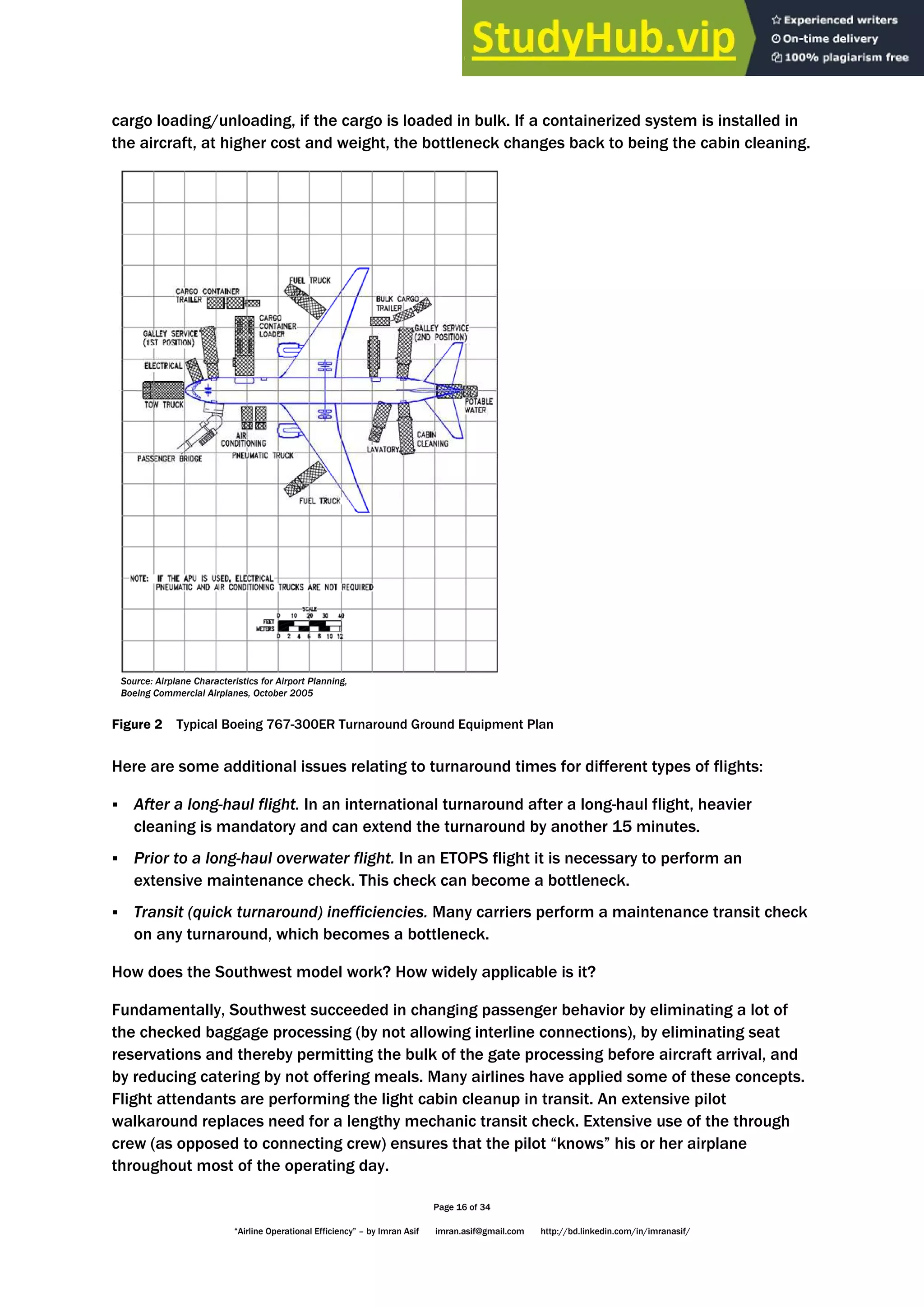
Figure 2 illustrates the ground equipment involved in a typical turnaround of a Boeing 767-
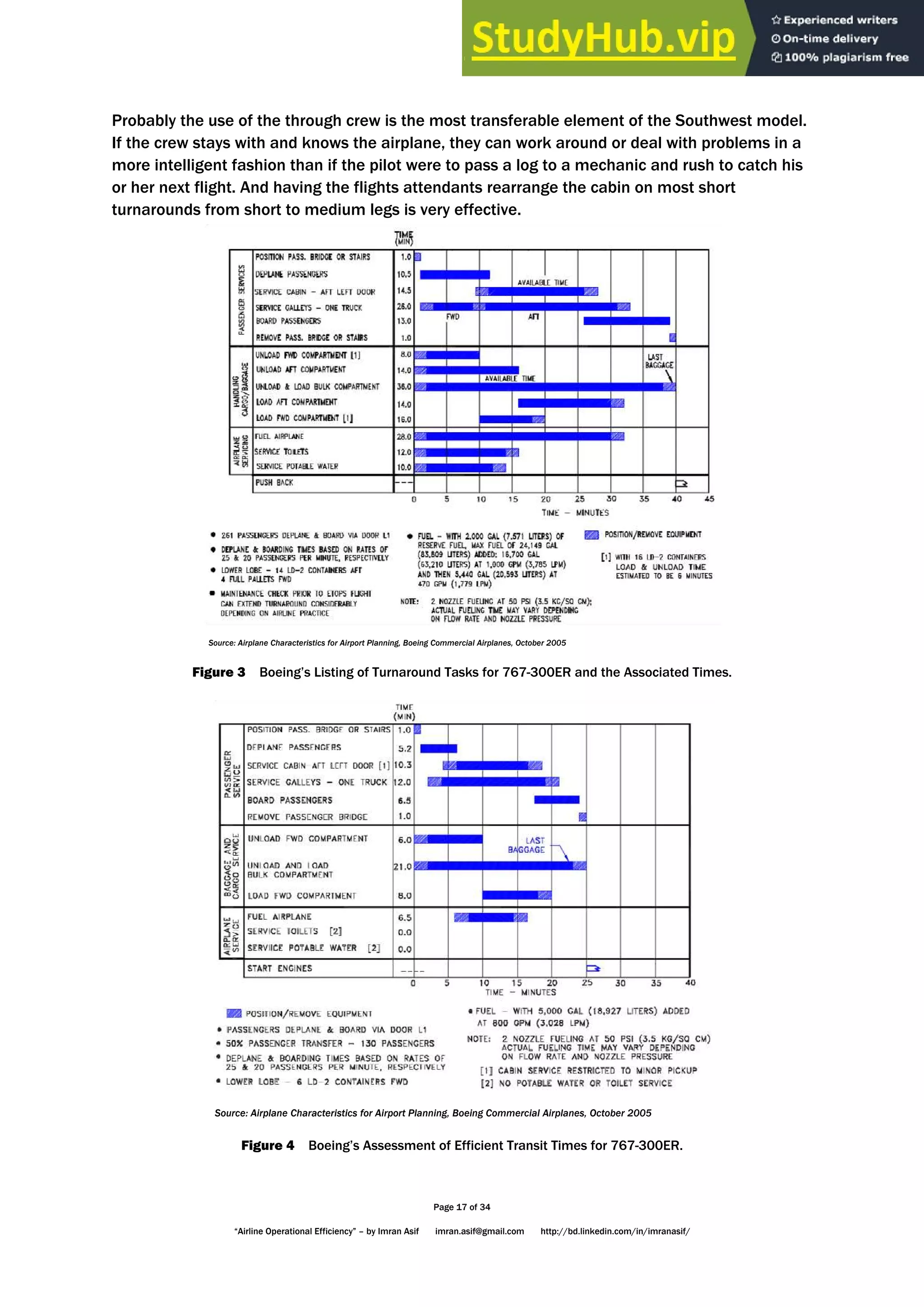
300ER. Figure 3 gives a time breakdown of the tasks entailed in a turnaround for the same
aircraft, as envisaged by Boeing. Boeing’s idea of a rapid intermediate transit is illustrated in
Figure 4.
In the Boeing models, a 767-300ER turnaround can be executed in 40 minutes and a transit in
25. These models depict the average activities in many airlines. Although this Boeing model
presents a reasonable approach to a 767-300ER turnaround, with the bottleneck being cabin
activity, in a narrow-body aircraft the typical bottleneck in a rapid turnaround would be the
Page 16 of 34
“Airline Operational Efficiency” – by Imran Asif imran.asif@gmail.com http://bd.linkedin.com/in/imranasif/
cargo loading/unloading, if the cargo is loaded in bulk. If a containerized system is installed in
the aircraft, at higher cost and weight, the bottleneck changes back to being the cabin cleaning.
Source: Airplane Characteristics for Airport Planning,
Boeing Commercial Airplanes, October 2005
Figure 2 Typical Boeing 767-300ER Turnaround Ground Equipment Plan
Here are some additional issues relating to turnaround times for different types of flights:
 After a long-haul flight. In an international turnaround after a long-haul flight, heavier
cleaning is mandatory and can extend the turnaround by another 15 minutes.
 Prior to a long-haul overwater flight. In an ETOPS flight it is necessary to perform an
extensive maintenance check. This check can become a bottleneck.
 Transit (quick turnaround) inefficiencies. Many carriers perform a maintenance transit check
on any turnaround, which becomes a bottleneck.
How does the Southwest model work? How widely applicable is it?
Fundamentally, Southwest succeeded in changing passenger behavior by eliminating a lot of
the checked baggage processing (by not allowing interline connections), by eliminating seat
reservations and thereby permitting the bulk of the gate processing before aircraft arrival, and
by reducing catering by not offering meals. Many airlines have applied some of these concepts.
Flight attendants are performing the light cabin cleanup in transit. An extensive pilot
walkaround replaces need for a lengthy mechanic transit check. Extensive use of the through
crew (as opposed to connecting crew) ensures that the pilot “knows” his or her airplane
throughout most of the operating day.
Page 17 of 34
“Airline Operational Efficiency” – by Imran Asif imran.asif@gmail.com http://bd.linkedin.com/in/imranasif/
Probably the use of the through crew is the most transferable element of the Southwest model.
If the crew stays with and knows the airplane, they can work around or deal with problems in a
more intelligent fashion than if the pilot were to pass a log to a mechanic and rush to catch his
or her next flight. And having the flights attendants rearrange the cabin on most short
turnarounds from short to medium legs is very effective.
Source: Airplane Characteristics for Airport Planning, Boeing Commercial Airplanes, October 2005
Figure 3 Boeing’s Listing of Turnaround Tasks for 767-300ER and the Associated Times.
Source: Airplane Characteristics for Airport Planning, Boeing Commercial Airplanes, October 2005
Figure 4 Boeing’s Assessment of Efficient Transit Times for 767-300ER.
Page 18 of 34
“Airline Operational Efficiency” – by Imran Asif imran.asif@gmail.com http://bd.linkedin.com/in/imranasif/
The efficient airline can also make improvements in the passenger check-in, boarding, and
other processes to cut turnaround time:
 A key to better check-in and boarding is to reduce errors in passenger counts. Although
technology can assist in this process, even a manual process can considerably reduce errors
by ensuring that at every phase of check-in there is one master control of passenger count.
 Every passenger over two years old must always receive the same number of documents
associated with the check-in process. One of these documents must be a boarding pass. If
the airline permits combined ticket/boarding passes, then a passenger who does not have
the combined ticket/boarding pass should surrender his or her document during check-in. If
the airline uses two separate documents, then the airline should make sure that no
nonrevenue, transfer passenger, irregular operation accommodee, or anyone else should be
given anything but exactly two documents.
 There must be at any one time be one point of control of passenger count. Initially, it will be
at the counter. Several minutes before boarding, the control must pass to the gate. At that
point, any further counter activity must be communicated to the gate.
 As the passenger passes the gate agent, the passenger must surrender one piece of paper
and show the other to the flight attendant as he or she boards. The flight attendant should
count passengers, but these counts can very well be in error. But in this scheme, it is virtually
impossible to have a wrong gate count if each passenger surrenders exactly one document
to the gate agent. If there is a mismatch in the count between the door of the plane and the
gate agent, then if the gate agent cross-checks with check-in and the computer count, it can
be assumed that the flight attendants made an error.
 A further key to reducing boarding time is to try schemes such as zone boarding (rear to
front) or window boarding. The worst interference with zone boarding is allowing business
and first-class passengers on the aircraft first. From a passenger service standpoint, this
concept can b sold to the front cabin passengers by ensuring that flight attendants never
allow use of overhead bins by economy passengers passing through the front cabin. Further
support for this approach can be gained by careful use of executive lounges on international
flights, with late boarding available from the lounges.
 The bottleneck of the cargo loading/unloading process can be solved by hiring additional
ground crew, putting more parallelism into the process, and carrying out careful time
management studies. Given the value of shorter turnaround times, it is often cost-effective
to hire more personnel.
 Maintenance transit checks should be reduced wherever possible by using the pilot
walkaround more extensively.
System Operations Control Center
The organization to run and control an airline’s operation is critical not only to safety but also to
efficiency. For maximum efficiency, the best organization is one that is centralized and has an
operating philosophy that is proactive rather than reactive.
Page 19 of 34
“Airline Operational Efficiency” – by Imran Asif imran.asif@gmail.com http://bd.linkedin.com/in/imranasif/
Primarily owing to lack of communications and systems, historically the operation and control
functions in airlines have been decentralized. Weight and balance were always manually
calculated, and flights were frequently planned by the departure station. The flight was then
passed on to the arrival station. Flight following was not a universal element in the control of
the operation, and in many regions is still not. Today modern systems and communications
allow increased centralization of an airline’s operation function.
The Systems Operations Control (SOC) center is responsible, as its name indicates, for the
control of an airline’s day-to-day operation. Its goals can be defined as safety first, schedule
reliability, and efficiency.
For the purpose of this paper, safety is a given. The focus here is on schedule reliability and
efficiency. In the subsequent discussion I highlight the inherent trade-off between schedule
reliability and operational efficiency. On the one hand, efficiency demands that during the
scheduling effort aircraft, crew, and personnel utilization be maximized and turnarounds be
minimized; whereas on the other hand, schedule reliability demands that some slack and
buffers be built into schedules to ensure that some day-to-day irregularities can be absorbed
and the operation will be able to be restored to normal, enabling the airline to meet its on-time
performance goals.
Some air carriers still operate their flights primarily in a reactive mode. The flight is planned and
dispatched, and the appropriate departments within the airline (such as maintenance, dispatch,
flight planning, and weight and balance) provide resources for flights as they arrive and depart
primarily on a local basis. If there is a problem, the downline stations can only react; they can’t
plan ahead. In contrast, in a more advanced and efficient operation today the network is run
from a centralized SOC center. The overall organizational structure shown in Figure 5 is typical
of the organization maintained by a number of today’s successful airlines.
The primary functions that make up an efficient SOC typically include operations coordination,
flight dispatch, crew scheduling and tracking, weight and balance, maintenance operations
control (MOC), and operations analysis.
Operations Coordination
The operations coordination group is responsible for solving operational problems. Operations
coordinator monitor the airline’s fleet and hubs, looking for problems with a eye toward
avoiding them if possible and implementing proactive solutions where problems cannot be
avoided. An efficient operation has some spare aircraft capacity. In the case of a large airline
(one with more than one hundred aircraft) spare capacity will actually be spare, unscheduled
aircraft. A typical percentage of spares in an efficient operation is anywhere from 1 percent to 3
percent spare aircraft, depending on the necessities of the operation.
In a smaller operation, spare aircraft capability is achieved by deliberately building slack time
into the maintenance schedule. For instance, the airline would design the schedule so that an
aircraft coming out of a maintenance check in the morning would not be put back into service
until later that afternoon, thus producing roughly one-third of a spare aircraft.
Failure to provide adequate spare aircraft capacity results in much greater downline delays in
the event of a serious weather problem or a severe maintenance problem. Consider that even in
an efficient operation, there are situations in which the majority of an airline’s delays are the
result of delays that carried over from a previous flight or earlier flights.
Page 20 of 34
“Airline Operational Efficiency” – by Imran Asif imran.asif@gmail.com http://bd.linkedin.com/in/imranasif/
In the event of irregularities, the operations coordinator ensures the availability of an aircraft
and crew for flights that are affected. The operations coordinator is continuously monitoring
aircraft availability, particularly focusing on the different hubs. If there is an equipment failure
in a hub, the efficient operations coordinator will use methods such as “daisy-chaining” the
failure down the outbound schedule from the hub. (In daisy-chaining new, incoming aircraft or
their components are swapped with the latest outbound aircraft until a repair of the
nonfunctional equipment can be affected.) If the failure is in a spoke or if the problem is that
there was a diversion or some other event that has produced aircraft/crew unavailability in
some location, depending on the mission requirements of the flights, the operations
coordinator will attempt to “create” aircraft in the schedule by canceling flights, combining
flights, delaying flights, and so forth, or some combination thereof. Care must be taken to
balance all cancelations such that a worse problem is not created later based on the operations
coordinator implementing a certain solution to the current problem.
Operations
coordinator
Flight
dispatchers
Aircraft
crews
Weight and
balance
Maintenance
operations
control (MOC)
Operations
analysis
Director
SOC center
Fleets
Hubs
Crisis
Region 1
Region 2
….
Scheduling
(monthly)
Pilots
Flight
attendants
Tracking
(repair)
Pilots
Flight
attendants
Fleets
Fuel
analysis
Routes
analysis
Navigation
database
Payload
coordination
Delay
analysis
….
Figure 5 The SOC Center of an Efficient Airline
The most critical function of operations coordinators is to have a plan for schedule recovery in
the event that any type of massive disruption occurs owing to weather – irregular operations –
and extensive diversion of flights becomes necessary. Any flight that is at risk of being unable to
land at its destination airport and as a result may potentially need to divert to its alternate
airport (in other words, a flight that is experiencing in-flight holding and running low on fuel)
must closely be monitored. In the efficient airline, the schedule recovery process must begin
before the aircraft has even arrived at its alternate airport. The mushrooming of downline
effects is directly related to how quickly the recovery process can be commenced.
Page 21 of 34
“Airline Operational Efficiency” – by Imran Asif imran.asif@gmail.com http://bd.linkedin.com/in/imranasif/
Flight Dispatch
The job of the fight dispatcher is to prepare a flight plan that enables an aircraft to carry a
maximum payload to its destination at the lowest possible cost. To achieve this objective the
flight dispatcher creates the flight plan based on meteorological forecasts for the en route and
terminal portion of the flight; considers relevant Notices to Airmen (NOTAMs) that may affect
the flight, such as the availability of approach and landing facilities, aircraft performance
limitations (takeoff, climb, cruise, descent, and landing); selects the route based on air traffic
control restrictions; analyzes flight time; and determines fuel requirements. Throughout this
process, the flight dispatcher interacts with the weight and balance department (which in turn
interacts with the local airport and cargo staff) and the captain to refine the flight plan until the
time of actual departure.
Flight dispatchers can be organized most efficiently by geographic regions. If there is an overlap
or redundancy between the flight dispatcher and other members of the team for the same
region, it is easier to follow flights, arrange lunch breaks and other interruptions, providing a
natural balancing of workload.
Some airlines organize their flight dispatchers by assigning each one to a specific fleet.
Obviously, if a flight dispatcher specializes in certain fleet types, his or her flight plans might be
superior to that application. The problem with this type of assignment is that if there is a
problem with a flight, the specialist flight dispatcher may be able to provide only an equipment
substitution of the same type. If an airline is small enough (or trim enough) that it has only one
fleet type with aircraft of a similar size, this is okay. But in an airline with multiple aircraft types
of similar range and size, this flight dispatcher assignment is a major inefficiency that reduces
overall aircraft utilization over time. It is important to note that the efficient operation should
always be designed to operate well not in good conditions but in bad weather or in the event of
equipment failures. In other words, the most efficient operation is error tolerant, even when
setting up such an operation may mean certain incremental capital investment.
Dispatching an Efficient Flight The dispatch of a flight involves more than just the turnaround
process. If a flight is to be efficient, there must be a great deal of coordination between the
ramp tower and the SOC organizations. The coordination is in part meant to ensure speed, but
more important in the long run, it should promote accuracy.
The Flight Planning Process In many operations, especially for short-haul operations, simple
repetitive flight plans may be used, or the flight dispatcher may be able to prepare a flight plan
several hours prior to the departure of the flight. But in completing the flight planning several
hours before a flight departs, the flight dispatcher assumes that the environment is stable, that
actual weather conditions match forecasts, that airport and air traffic control infrastructure
impose no dynamic constraints or cause delays, and that loads can be accurately predicted.
Where these assumptions do not hold true, for example, for long-haul operations that are
subject to a dynamic environment, the flight dispatcher is usually required to prepare several
flight plans, the last of which is usually completed only 15 minutes prior to the departure of the
flight. In a dynamic environment, the final flight plan is prepared after passenger counts and
cargo weights are known exactly and final fuel figures are also available.
A flight plan is a legal document, and all flights must file a flight plan. It is necessary for air
safety that air traffic control knows when and where an aircraft is expected to be. In addition,
every nation has a set of regulations governing flying such that any flight must also have a plan
Page 22 of 34
“Airline Operational Efficiency” – by Imran Asif imran.asif@gmail.com http://bd.linkedin.com/in/imranasif/
for fuel consumption, reserve fuel, possible use of an alternate airport, holding in the event of a
delay in the air, clearing all mountains in the event of an engine failure or cabin
depressurization, and other contingencies. Different rules apply in different countries, but there
are some important themes the rules have in common:
 There are many possible flight plans that are legal for any flight.
 Each flight will have its own minimum fuel requirement. A common mistake many airlines
make is always to apply a certain procedure and then to view the results of that procedure
as an absolute minimum.
 National standards are the same for all destinations (except for international versus
domestic). Yet operational conditions at each destination are different. Therefore the
minimum fuel required for a given legal flight plan may in some case be too generous and in
others too low for a conservative, safe operation.
 There is no legal obligation for an airline to have operational flight plans that deal with
contingency events in the same way as is required by the legal, filed flight plan.
 And, finally, the most important point, which all pilots know but few operations managers
take into account: A flight plan is only a plan. Absolutely no flight will ever be flown exactly to
the plan!
Based on the conclusions that can be drawn from these points, I offer the following suggestions
for an efficient airline:
 The airline should analyze all routes and all destinations for all safety, delay, cost, and
contingency issues. This analysis should be performed by a team consisting of dispatchers,
pilots, and operational analysts.
 The actual operation of all flights should be analyzed. This is easiest to do with the Aircraft
Communication Addressing and Reporting Systems (ACARS – which permits the integration
of ground-based and aircraft-based systems). Nevertheless, operations can still be analyzed
manually for all important flights within an airline.
 The airline should develop a flight operation game plan that defines how to deal with en
route delays, diversions, en route alternates, major fuel overburns, contingency fuel, and
other flight plan variables.
 Each flight shall be planned with a minimum legal plan, but then flown in accordance with
the airline’s operational philosophy.
An excellent approach to developing an operational philosophy from the standpoints of both
efficiency and safety is to apply the concept of reclearance to all flights. In this procedure, used
on long-haul flights, a flight between point A and point B will actually be filed to intermediate
point C. Upon nearing point C the flight will be refiled to point B, or perhaps to yet another
intermediate point. This flight filing approach enhances safety because the alternate point
becomes more of an en route point instead of a destination concept, and the pilot always has a
nearby contingency airport. This approach also enhances cost control, because the fuel over
destination can be reduced, since the flight is now focused on what will happen during the
Page 23 of 34
“Airline Operational Efficiency” – by Imran Asif imran.asif@gmail.com http://bd.linkedin.com/in/imranasif/
flight, as opposed to a contingency at the destination. Since the contingency is less vague, fuel
can be controlled more exactly.
Exactness in Flight Planning Any operation must deal with no-show, go-show, and standby
passengers. The efficient operation also uses standby cargo and standby fuel. Failure to have a
flight plan that reflects the flight’s realities will result in differences in altitude, especially on
aircraft with a Flight Management System (FMS) and will result in differences in fuel burn. Large
variances between the flight plan and the actual fuel burn reduce pilot confidence in the flight
plan, frequently causing pilots to request additional fuel on a regular basis. The result can be
reduced cargo payload, increased fuel load, and in turn reduced revenue and increased direct
operating costs.
For any type of fuel control initiative to work, there must be a high degree of confidence in the
result. For there to be confidence in the flight planning process, especially on the part of the
pilots, their execution of the flight plan should regularly produce little variance from the plan. To
reduce variance required fine-tuning of the flight planning process.
In addition, to reduce variance a flight should be planned using real and final numbers for the
final flight plan. In the efficient airline, these plans are refined many times prior to the actual
departure of the flight. There are several problems that come up at the last minute, challenging
the flight dispatcher: there are no-show passengers and go-show passengers, there may be the
need to load extra or less fuel at the last minute, and there may also be no-show cargo. All of
these circumstances change the load plan, which in turn changes the flight plan. The actual
weight should be neither lower nor greater than the weights that appear in the final flight plan.
The less likely case is that the aircraft will have excessive weight. An aircraft that takes off with
weights that are over those in the load and flight plan poses potential safety hazards and
violates applicable regulations.
 The aircraft potentially exceeds the structural weight of the aircraft.
 It potentially exceeds the structural landing weight, with possible attendant damage to the
aircraft.
 The aircraft potentially attempts takeoff with insufficient power or flap settings, which could
require more runway than is available, especially in a location with high temperature, in a
high altitude, and/or with a short runway.
In the more likely case, if a flight takes off with a plan based on numbers that were too high,
the result will be two potential economic and variance problems:
 In older aircraft, with no FMS, the aircraft will fly at a lower-than-efficient altitude, resulting in
burning more fuel than is necessary. Although the fuel burn may be within the planed
parameters, it will nevertheless be inefficient.
 In a newer aircraft with an FMS, immediately upon clearing the terminal area after takeoff,
the pilot will consult the FMS so that the aircraft can find its own best altitude and climb to
that altitude, based on the economic parameters loaded in the FMS (see Figure 6). Flying at
this altitude will create an underburn. The aircraft will burn less fuel, but the variation from
the flight plan will create a problem in pilots’ perception of flight plan reliability, thereby
Page 24 of 34
“Airline Operational Efficiency” – by Imran Asif imran.asif@gmail.com http://bd.linkedin.com/in/imranasif/
exacerbating long-term fuel problems – because when the pilots don’t believe the flight
plans, they request more fuel.
Actual cruise level from FMS
(from lighter actual Takeoff Weight)
Flying higher = slower, less fuel consumption
Cruise levels from flight plan
(maximum altitude from planned weight)
Figure 6 FMS altitude Adjustment, Based on Incorrect Flight Plan Weights.
One of the major purposes of an FMS is to enable the pilot to replan a flight in real time, so that
the aircraft will always fly the most economical route and altitude, given the actual winds aloft
and the real-time actual aircraft weight. The replanning of a flight is, of course, subject to ATC
authorization. It is also important that the FMS be loaded with correct information about
airframe irregularities (which create more friction and cause the plane to burn more fuel) and
deterioration in engine performance and/or fuel burn and the correct economic factors for
computing the Cost Index. The Cost Index is a flight planning parameter that relates aircraft
time-related costs, fixed (cycle) costs, and fuel. In calculating time-related costs, it is important
to separate maintenance costs carefully between cycle-related and non-cycle-related costs.
Crew costs are virtually always time-related, even when they are viewed in other calculations
within the airline as “fixed.” For instance, if a pilot’s salary is fixed but he flies 80 hours per
month, adding 80 more pilot-hours to the schedule requires hiring another pilot. Therefore, the
crew cost is completely hourly.
Another caveat that must be applied to the use of the FMS is that it optimizes the flight plan in
the local context. When an aircraft is crossing the jet stream in the Northern or Southern
Hemispheres, it may occasionally be appropriate for the aircraft to fly a longer route and/or fly
a plan that is suboptimal at some point. The dispatcher must alert the pilot when he or she is
flying a longer route for shorter wind distance, so that the pilot does not heed the FMS and seek
direct routings all along the way.
The Efficient Payload In order to make the dispatch process efficient, the passenger numbers
and cargo weights should reflect what is actually being carried on the aircraft, and this must be
done in as short a time as possible so as not to impede aircraft turnaround or create problems
with late-arriving passengers. The problem with a last-minute dispatch, of course, is that aircraft
weights will not be known until the last minute. The solution is to take an approach similar to
just-in-time manufacturing.
The entire dispatch must be organized around the concept of allowing for the maximum likely
variation in the number of passengers accommodated. The passenger closeout is the critical
event driving the plans. If an airline does not accept late-arriving passengers, it creates an
image problem. The typical no-show rate for an airline may be 10 percent. In an aircraft the size
Page 25 of 34
“Airline Operational Efficiency” – by Imran Asif imran.asif@gmail.com http://bd.linkedin.com/in/imranasif/
of a 767, a variance of 10 percent in terms of total passengers onboard may create a potential
weight variance of 20 passengers, or a variation in weight around 2 tons or more. The fuel
required to carry the extra weight on a trip of 8 hours would be about 800 pounds. A
conservative yet effective approach to maximizing payload for this flight scenario would follow a
time line like the following in the hours before the flight departs:
 4 hours (cargo). Prepare standby cargo weighing twice as much as expected standby
passengers, that is 2 tons, in in units of single cargo portions, in this case three to four LD-2s.
 4 hours (load planning). Do preliminary weight and balance.
 4 hours (dispatch). Prepare preliminary flight plan.
 2 hours (counter). Begin passenger check-in.
 1 hour (cargo). Load all but standby cargo.
 1 hour (ground handling). Begin loading baggage containers.
 1 hour (load planning). Using latest counter information, refine weight and balance.
 1 hour (dispatch). Produce new flight plan.
 1 hour (ground handling). Load all but 5,000 pounds of fuel. Remainder is standby fuel.
 40 minutes (gate personnel). Begin passenger boarding.
 30 minutes (counter). Do flight passenger closeout.
 25 minutes (load planning). Figure final weight and balance.
 25 minutes (dispatch). Prepare final flight plan.
 20 minutes (cargo). Load standby cargo.
 20 minutes (ground handling). Load standby fuel.
 15 minutes (ground handling). Load remaining baggage containers.
 10 minutes (gate personnel). Deliver final documents to pilot.
This flight would be able to leave on time, within a turnaround time of 1:15 (assuming 15
minutes maximum for passenger/luggage/cargo unloading).
Flight Following After the flight has departed, the flight dispatcher monitors its progress. This
activity is usually a routine task until the flight nears its destination. When the flight nears its
destination, the flight dispatcher must obtain critical information on terminal weather
conditions, runways in use, arrival acceptance rates, and potential air traffic restrictions such as
any extensive holding. Proactive planning during this phase of the flight makes possible optimal
decision making. If delays cause additional fuel burn en route, it may be advantageous to
contemplate an en route fuel stop. By making such a stop, the pilot might avoid the
ramifications of continuing toward a weather-impacted, congested destination and arriving in a
terminal area of the destination airport only to be forced to divert to an alternate airport
Page 26 of 34
“Airline Operational Efficiency” – by Imran Asif imran.asif@gmail.com http://bd.linkedin.com/in/imranasif/
because of fuel reserves onboard the aircraft are inadequate to absorb delays. Critical for the
dispatcher’s ability to provide decision support and guidance to the captain during any special
circumstances as the availability of up-to-date information regarding actual weather conditions
and ATC delays at the destination airport.
Most countries issue a state license as the only authorization to work as a flight (or aircraft)
dispatcher after applicants demonstrate that they have completed a certified training course
and have passed a certified qualifying exam. In some countries, rather than issue a state
license, the airline is made responsible and required to issue flight dispatchers a company
certification.
In the United States the Federal Aviation regulations (FARs) Part 121 and Part 65 contain
pertinent regulations regarding aircraft dispatchers. In FAR 121, the FAA mandates a shared
responsibility for each flight between the flight dispatcher and the captain. This regulation
significantly enhances safety. Although only the pilot can be aware of what is happening on the
airplane and in the immediate surrounding environment, the flight dispatcher has the
advantage of a global view and a calm working environment. For these reasons the dispatcher
can help the pilot identify and resolve problems that occur in any extremely stressful flight
operation, such as in bad weather, with lengthy holding, with diversions, and so forth. In these
and similar situations, the flight dispatcher and the captain work as a team to resolve minor
problems before they begin to affect safety. This teamwork makes possible a more efficient
operation.
In foreign environments where FAR 121 or its equivalent is not mandated, it still greatly
behooves an airline to create the same type of operational structure. Doing so means hiring
more staff for the flight dispatch organization than is typical for the average foreign carrier, but
the cost of the additional personnel resources is minimal given the benefits: fuel conservation,
better aircraft utilization, and a more efficient operation.
Crew Scheduling and Tracking
Crew schedulers prepare the monthly schedule for all cockpit and cabin crews. In an efficient
airline, both types of crews are scheduled by the same organization, primarily because the crew
scheduling and crew tracking of both types of crews need to be tied together, and the crew
tracking task is identical regardless of the type of crew.
The people responsible for crew tracking, or crew repair, are usually senior former crew
schedulers. The flight dispatcher comes to crew scheduling to ensure that there is a crew for his
or her flight. In the event that there is a problem with the crew or any crew member, the flight
dispatcher interacts with crew tracking to resolve the problem.
In an efficient airline, the crew schedule is built so that the bulk of standby crews will be
available toward the end of the month, or other crew scheduling periods, so that when the
regular crew members run out of maximum monthly hours, as fixed by contract, labor unions, or
legal work rules, there will be standby crew available to cover contingencies. The exact
percentage of standby crews required overall is something that should be fine-tuned by the
airline. The reason to stack them toward the end of the month is that the purpose of having
standbys is to have the flexibility to deal with disruption. Each disruption uses up more and
more of the regular crew’s maximum legal work time. As the end of the month approaches, a
ajor cause of disruption begins to become crews running out of time. On the other hand, if an
Page 27 of 34
“Airline Operational Efficiency” – by Imran Asif imran.asif@gmail.com http://bd.linkedin.com/in/imranasif/
airline’s scheduling produces crews that rarely run out of time, then this implies that the
operation may have too much slack in it.
Weight and Balance
The job of the load agent in the weight and balance group is to take all the weight inputs
associated with the flight – the amount of fuel from the flight dispatcher’s initial flight plan, the
cargo weights from the cargo group, passenger weight and baggage information from the
passenger check-in at the airport – and to produce a load plan for the airport handling
personnel that conforms to Center of Gravity (CG) requirements for the aircraft. The load agent,
in turn, is responsible for providing all weight information necessary to the flight dispatcher, and
then the load agent must work with the flight dispatcher and the airport personnel continuously
as the flight is prepared for departure, until the absolute final weights are known, including all
standby passengers, cargo, baggage, and fuel weights.
In the efficient airline operation, if a flight has major revenue associated with cargo or if it is an
important and possible full or weight-limited long-haul international flight, the load agent starts
developing the first load plans for that flight at the beginning of his or her shift, many hours
before the flight is scheduled to depart. The weight and balance group should have sufficient
staff to have the capacity to produce multiple load plans in order to guarantee operational
efficiency and to be able to produce these plans accurately and in a timely manner.
Depending on the software tools available and the specific operation, the load agent may also
provide the takeoff power and flap settings for the departing flight.
Maintenance Operations Control
In the efficient operation, the Maintenance Operations Control (MOC) center is incorporated into
the SOC center. The MOC is actually part of the line maintenance organization and is made up
of senior line maintenance personnel, but in an efficient operation the MOC should be physically
located within the SOC.
The MOC works with the operations coordinators to assign and allocate aircraft. In an efficient
operation, the MOC also interacts closely with the flight dispatcher; in the event that any
equipment problem occurs during a flight, the MOC attempts to diagnose the details of the fault
while the aircraft is still en route. In the most efficient operation, much of this coordination can
be accomplished using ACARS. The MOC works proactively to obtain parts and service and/or to
put in place third-party personnel at the appropriate location as much as possible prior to the
arrival of a flight.
Operations Analysis – The Importance of Data an Systems to Efficiency
Knowledge of the operation is the only way to improve the operation, and knowledge comes
from the accumulation, analysis, and correct interpretation of vast amounts of data that are
pertinent to the operation. Much of the data associated with each flight can be accumulated
manually and fed into databases for later analysis. Although such a process is tedious, time
consuming, and prone to error, it is still mandatory for small carriers that lack more
sophisticated systems. At an absolute minimum, the collection of such data supports the
accurate calculation of block times and estimation of the departure and arrival phases of flights
for the flight planning system. Also accurate records of fuel consumption can be used to adjust
flight planning to take into consideration the deterioration of aircraft performance as planes get
older.
Page 28 of 34
“Airline Operational Efficiency” – by Imran Asif imran.asif@gmail.com http://bd.linkedin.com/in/imranasif/
In the past ten years, a great deal of technology has been developed to assist in the monitoring
and control of airline operations. On the ground, there are computer systems and software to
aid in the scheduling of flights, crews, aircraft, gates, and other airport activities and ground
personnel. Often these systems can be easily integrated. Anything that can be scheduled and
integrated can also be monitored in real time. Where automatic data feeds are not available,
even feeding manual movement messages into an automatic monitoring system can bring
more accuracy to operations, producing better control and optimization.
In the air, modern aircraft equipped with flight management systems, which allow dynamic
flight planning, as well as real-time optimization of the aircraft’s flight en route to its
destination, based on actual wind conditions as well as the real-time state of the aircraft’s
weight, altitude, and location. Many airlines are also equipped with the ACARS.
In the United States, airlines can also purchase the Aircraft Situation Display (ASD), which gives
near-real-time location information for all flights. In addition, airlines can purchase the historical
radar information of all their flights over the continental United States, which allows them to
analyze planned versus actual routes and altitudes, enabling them to further refine flight
planning, fuel planning, and other operational issues.
Outside the United States, an airline with satellite data communication, ACARS, and the latest
in FMS technology can derive the same information as that which is provided by the ASD and
the historical radar data. An airline can collect these data by querying aircraft for position
reports on a frequent basis. The resulting database can then be used to provide feedback and
to update the flight planning system. This system also enables the airline to analyze taxi-
out/taxi-in times, as well as distances flown by specific flights, while operating in terminal
airspace that is subject to radar vectors issued by air traffic control (ATC).
Having correct data relating to actual flights and using this information for flight planning is
critical to fuel conservation, as further discussed later in this paper.
One of the objectives of an efficient airline is to produce flight plans that are extremely accurate
and vary little beyond whatever deviations can easily be explained by terminal area delay
and/or special weather situations. The best approach to meeting this objective is to have a
process for continually analyzing al flight data. Where appropriate, these data are then fed back
into the flight planning system. Block times are fed into the scheduling system. Routes are
analyzed and modified if they are not the most efficient routes that can realistically be
achieved. Delays are analyzed, and operations analysis interacts with the entire operation to
reduce the causes of delays. Fuel consumption is analyzed, and operations analysis interacts
with flight technical engineering in the flight operations department.
A strategic element of operations analysis is looking for patterns in the operation’s problems –
especially in the area of delays – and identifying potential resource shortages that may be
contributing to delays. At the same time, the efficient operation must carefully balance
strategically placed slack resources in order to be flexible in the event that problems arise.
All of these functions are reactive feedback functions. But operations analysis also has one day-
of-operation role in the efficient airline: coordinating payload to maximize profits and
operational efficiencies. This day-of-operation role involves examining all critical cargo flights in
the operation on a daily basis and taking into account all patterns of fuel consumption, delays,
weather, problems in ramp coordination, and current passenger and cargo demand with the
Page 29 of 34
“Airline Operational Efficiency” – by Imran Asif imran.asif@gmail.com http://bd.linkedin.com/in/imranasif/
goal of maximizing the cargo payload on passenger flights flying routes with high cargo
demand. The reason that this role belongs to operations analysis is that this task is also a
function of feeding back the results of multivariable analysis into the operation. In order to have
the maximum positive effect, these data must be fed to the appropriate parties during the
operation.
Summary of Efficient System Operations Control
The efficient airline must have a dynamic SOC in order to function smoothly. The SOC collects
and analyzes all possible data that can be extracted from the operation. It looks for problems
before they occur, then solves them. In this fashion the SOC manages the entire operation at a
system network level.
A Case Study: Comparing the Efficiency of Flights
In order to compare the efficiency of flights, it is important to consider both their mission (as it
related to flight planning) as well as their absolute performance.
In the case of Lan Chile, the most important flights are Santiago-Miami (SCL-MIA). These flights
normally have a high load factor in terms of passengers, but these flights are also Lan Chile’s
most important in terms of cargo. A typical cargo tariff is US$ 0.80, so in addition to passenger
revenue, the flight can generate US$ 16,000 in cargo revenue with 20 tons of cargo. The key
element of the SCL-MIA mission is therefore to maximize payload. On the airline’s other flights,
the mission might be to minimize fuel cost (by maximizing tinkering) or to minimize fuel
consumption, and so forth. On the SCL-MIA route, there is always sufficient cargo to fill the
bellies of passenger aircraft, and there are two passenger and two or more cargo flights per day
on the route.
In absolute terms of efficiency, variances should be minimized on every flight. Variances in any
takeoff-related weights should be near zero. Variance in flight time should be minimal if an
aircraft is flying to good-weather destinations and there is no congestion upon arrival. Variances
in fuel burn in modern aircraft with FMS should be under 1 percent, assuming no flight delays.
In each of the four flights shown in Figure 7 there is some major point of inefficiency. All of
these flights should be roughly identical, except in their fuel consumption and flight times,
owing to seasonality of winds. Each one left Santiago at about 10pm, and arrived in Miami at
about 6am. The weather upon arrival was in all cases clear. Clear skies is a characteristic of
Miami at that hour throughout the year unless there is a hurricane or major tropical storm
nearby.
Page 30 of 34
“Airline Operational Efficiency” – by Imran Asif imran.asif@gmail.com http://bd.linkedin.com/in/imranasif/
Flight 1 Flight 2 Flight 3 Flight 4
Flight Number LA 502 SCL-MIA LA 502 SCL-MIA LA 502 SCL-MIA LA 502 SCL-MIA
Date 03 Jan 1998 11 Jan 1998 16 Oct 1998 06 May 1999
Aircraft Type 767-300 GE 767-300 GE 767-300 GE 767-300 GE
Aircraft Registration CC-CBJ CC-CRT CC-CRG CC-CZU
Planned Air Time 8:12 8:14 8:02 8:09
Actual Air Time 8:08 8:18 8:02 8:06
Variance -0:04 0:04 0:00 -0:03
Block Time 8:21 8:33 8:18 8:24
Block Fuel 51800 52400 51500 48700
Alternate TPA TPA TPA FLL
Ramp Arrival Fuel (RAF) 7700 7200 7200 4700
Excessive RAF 2.700 2.200 2.200 0
Planned Fuel Burn Off (FBO) 44600 44800 44300 43400
Actual Fuel Burn Off (FBO) 44100 45200 44300 44000
Variance FBO -500 400 0 600
Variance FBO Adjusted for TOW 675 442 2 624
Planned Takeoff Weight (TOW) 184700 185000 181300 182000
Actual Takeoff Weight (TOW) 178497 184781 181287 181875
Variance TOW -6.203 -219 -13 -125
Total Passengers 208 219 195 200
Passenger Payload 19.760 20.805 18.525 19.000
Cargo Payload 15.537 19.276 17.862 23.075
Total Payload 35.297 40.081 36.387 42.075
Maximum Possible Payload 42.165 40.665 37.234 42.709
Wasted Payload Weight 6.868 584 847 634
Aircraft Dry Operating Weight (DOW) 91.400 92.300 93.400 91.100
Aircraft Maximum Zero Fuel Weight (MZFW) 133.809 133.809 130.634 133.809
Aircraft Maximum Takeoff Weight (MTOW) 186.065 185.065 184.612 186.880
Aircraft Maximum Structural Payload 42.409 41.509 37.234 42.709
TPA = Tampa International Airport
FLL = Ft. Lauderdale-Hollywood International Airport
Figure 7 Comparing the Efficiency of Four SCL-MIA Flights.
Each of the four flights is detailed in the following paragraphs and is considered purely from a
passenger revenue standpoint. In each case on an aircraft with 219 seats, around 200
passengers were carried, indicating that the reservation, revenue management, no-show
management, and check-in processes were most likely handled reasonably well. But as we will
see, there were inefficiencies operationally. Let’s examine each one. The assumptions made in
the comments are logical given the knowledge of the Lan Chile dispatch operation.
Flight 1: January 3, 1998
This flight was controlled very poorly on a couple of grounds:
 For a flight that is to arrive in Miami in good weather, it should not be necessary to carry
large amounts of contingency fuel. Yet this flight planned Tampa as an alternate and arrived
with 7,700 kilos, or 17,000 pounds, of fuel left over. The total flying time was approximately
90 minutes, exceeding the average flying time to this destination by approximately 30
Page 31 of 34
“Airline Operational Efficiency” – by Imran Asif imran.asif@gmail.com http://bd.linkedin.com/in/imranasif/
minutes. Because it carried this extra fuel, the aircraft lost the opportunity to carry an
equivalent amount of cargo. If the excess fuel remaining for a prudently planned flight is
typically 2,700 kilos, we can calculate that this flight lost more than US$ 2,000 in potential
cargo revenue because it carried too much fuel.
 The dispatch of the flight was controlled very poorly. For whatever reason, the actual takeoff
weight was 6,200 kilos less than planned. The implication is that the only flight plan that
was done was calculated long before flight time, probably on the assumption that the
aircraft would carry a full passenger load with no no-shows. The excessive passenger and
fuel figures were given to the cargo group, which accordingly planned less than sufficient
cargo for the flight. In addition, the cargo group clearly did not plan and prepare standby
cargo, since there was an apparent no-show factor in the cargo as well.
The results were that, in addition to the US$ 2,000 in cargo revenue the flight lost owing to the
excessive fuel carried, an additional US$ 5,000 was lost to the inefficient use of all available
payload weight, since the aircraft left with 6,868 kilos below the most restrictive of MTOW and
MZFW, in this case the MTOW.
Flight 2: January 11, 1998
This flight was controlled reasonably well in its dispatch process. But like flight 1 it carried too
much fuel, used the Tampa alternate, and therefore also lost US$ 2,000 in potential cargo
revenue.
Flight 3: October 16, 1998
This flight was controlled reasonably well in its dispatch process. Once again, it also carried too
much fuel, used the Tampa alternate, and therefore also lost US$ 2,000 in potential cargo
revenue. But a much more serious inefficiency occurred in this flight: the wrong aircraft was
selected.
In every airline, in every fleet, there are numerous small differences between aircraft. The most
common are differences between individual aircraft in their weight figures. In the case of the
CC-CRG aircraft used on this flight, the aircraft happens to have both a lower Maximum Takeoff
Weight and a higher Dry Operating Weight (DOW; meaning that there is something heavier
about the basic airplane) than other aircraft in the Lan Chile fleet. This aircraft should not be
scheduled on flights where maximizing cargo is important. The effect of using this aircraft was
that the flight forfeited an additional four tons in potential cargo payload. The value of the lost
revenue was over US$ 3,000.
Flight 4: May 6, 1999
This flight was planned based on a much more reasonable ramp arrival fuel calculations,
landing with approximately one hour of fuel left. Using the alternate of Fort Lauderdale was
equivalent to the US domestic dispatch of a flight with no alternate required, 15 minutes of
holding, and 45 minutes of reserve fuel. This would be a typical prudent dispatch to a good-
weather arrival at an uncongested airport. The flight was dispatched impeccably.
Standby cargo and fuel were loaded, with load and flight plans computed based on actual and
final weights, thereby minimizing variances. As a result, this flight carried 2 to 7 tons more
cargo than the other flights we’ve studied here, meaning that this flight earned thousands of
dollars more in revenue.
Page 32 of 34
“Airline Operational Efficiency” – by Imran Asif imran.asif@gmail.com http://bd.linkedin.com/in/imranasif/
But no flight is perfect. In this case, there was an overburn of 600 kilos of fuel, or about 200
gallons, and this overburn cost more than US$ 100. Looking at other flight parameters, it would
appear that most likely the responsible factor was that the flight arrived 3 minutes earlier than
planned. If the flight had taken less time without overburn, that would imply that the aircraft
flew a slightly more direct route. That the flight took less time with an overburn implies that
either that a significant part of the flight was flown at a lower altitude or that the flight was
flown at a faster and less efficient Mach. It would be possible to get a more clear picture with
ACARS and using position reports.
Case Study Summary
The flight examples we have explored illustrate that what would normally appear to be relatively
minor points can have impacts of thousands of dollars on each flight. Of course, we have been
looking at some of the most important flights for this airline. But the same principles apply to
all flights.
Another key point is that most types of common management reports used in flight operations
would have considered flights 1 – 3 to be more efficient than flight 4, since it is more common
to look at the absolute fuel consumption and fuel variances of flights. In terms of absolute
overburn, flight 4 was worst. In terms of absolute consumption, it was marginally best. In
consumption per unit weight for this leg it was worst, by 1 to 2 percent. In consumption per unit
time, flight 4 was marginally worse than flight 1, marginally better than flight 2, and better by
1.5 percent than flight 3.
In terms of passenger revenue, assuming constant fares, all the flights were within 10 percent
of one another. In terms of cargo revenue, flight 4 was 15 – 50 percent better than the other
three.
In other words, when it comes to analyzing the efficiency of the operation, great care must be
taken in selecting which reports to study and how to interpret them. It is very easy to draw the
wrong conclusions and to measure the wrong indices.
Slack Resources
The efficient airline cannot function without at least some slack in all operational resources.
Failure to provide adequate slack in any resource will create major bottlenecks in the event of
maintenance problems, delays, or irregular operations owing to major weather events. These
bottlenecks lead to additional, downline delays, creating a domino effect.
There are two types of slack. One involves actually having extra resources on hand. The other is
created by not using existing resources to their capacity, that is, never fully approaching time-
limited events. Some of the resources for which it is necessary to create slack include:
 aircraft. Extra aircraft can be provided or occasional gaps can be created in schedules.
 gates (at hubs).
 pilots.
 flight attendants.
Page 33 of 34
“Airline Operational Efficiency” – by Imran Asif imran.asif@gmail.com http://bd.linkedin.com/in/imranasif/
 line maintenance (spare parts).
 line maintenance checks. Checks may be scheduled before they are necessary. If a B-check
is due every 600 hours, an airline can build in spare time by scheduling these checks every
550 hours.
 ground equipment. Beyond the spares required for normal operation, in the hub there need
to be resources to cover irregular operations.
 turnarounds. Scheduling occasional long turnarounds in spokes helps to promote recovery
from problems.
 ramp. Scheduling more overnights away from a major hub allows for greater efficiency in
ramp utilization.
 overnight maintenance. On the other hand, scheduling all light checks at night at home base
helps build slack into the daytime operation.
How can the airline calculate its spare resource needs? Everything is a series of trade-offs. A
figure that is widely used in the airline world to indicate the spare resources large airlines
generally need is 1 percent to 3 percent spare aircraft. Ownership or leasing costs of a narrow-
body are generally US$ 100,000 to US$ 200,000 per month, and wide-bodies cost US$
500,000 to US$ 1,000,000 per month. So an airline with a mixed fleet of 100 aircraft should
spend between US$ 300,000 to US$ 600,000 per month in spare aircraft.
In terms of planning slack for other resources, a rough figure to use as a starting point is 5
percent. For instance, some airlines operate their major hubs with this percentage of spare gate
capacity. The relative costs of this slack can be calculated for each resource, and obviously the
focus should be on providing extra resources in those areas where doing so is not too costly.
Some of the areas where adding slack can produce the greatest payback for the least expense
are ground personnel and adding staff to the SOC function.
So what is the cost of not providing sufficient slack? More irregular operations! Most of the
large US carriers have analyzed their irregular operations costs in the past decade and found
them to approach an average of US$ 500,000 per year per aircraft in the fleet. So our
hypothetical airline with 100 aircraft might have irregular operations costs of US$ 4,000,000
per month. In contrast, as more resources are devoted to creating slack, the costs of irregular
operations drop.
Conclusion
An airline operation can be efficient through proper planning. First and foremost and airline
needs to understand its philosophy and its goals. Does it wish to focus on scheduled
passengers, charters, or cargo? Businesspeople of vacationers? Flying to and from what type of
destinations? And how does it wish to combine any or all of these types of operations? What is
its growth philosophy? More destinations or more frequencies? What is its regional emphasis?
The overall strategy of the airline – the route structure, the fleets, the corporate planning – all of
these need to be integrated and fine-tuned in order to create an efficient operation. The correct
Page 34 of 34
“Airline Operational Efficiency” – by Imran Asif imran.asif@gmail.com http://bd.linkedin.com/in/imranasif/
type of data must be gathered exhaustively and analyzed in the context of what is important to
a particular airline’s operation. Misinterpretations are all too easy in this industry. Care must be
taken to make sure that the right type of data is being gathered and that it is being processed
correctly to yield the right type of information. The data must be fed back into every part of the
operation: the scheduling, the tunaround times, the maintenance check times, the flight
planning, and so forth.
The carrier’s operational organizations must be integrated to promote teamwork and
proactiveness in the control process. Staffing must be adequate. Communication is critical.
Just-in-time methods must be applied. There must be sufficient slack in the critical resources to
minimize the impact of bad weather and aircraft problems.
Consideration must be given to the type of operation and its contingencies. When it comes to
creating maintenance slack, an operation using old aircraft is very different from one using new
aircraft. Flight operations in Canada and the US are optimized differently from those in the
Middle East. Crews are optimized differently in airlines experiencing labor problems. Block
times are calculated differently by airlines that have to report delay statistics to the
government.
In summary, the efficient operation of an airline is an incredibly complex whole. Every part
needs to be optimized based on the unique circumstances surrounding every aspect of that part
and how it relates to the whole.

Airline Operational Efficiency

  • 1.
    Page 1 of34 “Airline Operational Efficiency” – by Imran Asif imran.asif@gmail.com http://bd.linkedin.com/in/imranasif/ ____________________________________________ Special Topic Paper on AIRLINE OPERATIONAL EFFICIENCY ____________________________________________ Prepared by Imran Asif for Ph.D. (Aviation) in Operations at ERAU 03 August, 2013
  • 2.
    Page 2 of34 “Airline Operational Efficiency” – by Imran Asif imran.asif@gmail.com http://bd.linkedin.com/in/imranasif/ This paper explores the problems of defining, understanding, and improving operational efficiency within an airline. First we consider the effects that an air carrier’s overall strategy and geographic area of operation may have on the airline’s efficiency. In addition, we look at various traps that airlines can fall into when they analyze the efficiency of their operations. In the rest of the paper we explore such issues as organizational structure, scheduling, turnaround times, maintenance scheduling, fleet age, fuel management, fleet type implications on payload efficiency, dispatch issues, load planning, and coordination issues related to producing an efficient operation. Although all of the topic areas should be quite familiar to most readers, it is hoped that some of the points mentioned in each topic area may prove useful to airlines seeking to maximize operational efficiency. I have tried to touch on as many factors and elements as possible, rather than exploring any one exhaustively. What is an Efficient Operation? Of course, this is the key question. The answers may sound intuitive, but they can also be quite complex. We can look at any operation and based on our perception of those factors we believe to be most important with regard to efficiency, identify those factors of a particular operation that we believe to have the greatest impact on the success or failure of the operation. But it is much more difficult to identify a legitimate basis upon which airline operations can be compared in order to determine which operation is more efficient. It is hard to compare airline operations because depending on the geography within which an airline is operating, its fundamental route structure, and the type of traffic it experiences, an airline will experience different major external barriers to efficiency. Additionally, internal issues such as labor union issues (or government-mandated labor rules) may further impose a major burden on the airline’s efforts to obtain maximum efficiency, because such issues are often outside the airline’s direct control. It is clear, though, that within any given operation, “improvements” in the following areas will tend to increase an airline’s efficiency:  turnaround time (keeping ratios of international versus domestic flights, or wide-body versus narrow-body aircraft constant)  aircraft utilization (keeping stage length and fleet mix constant)  crew utilization (hours per month)  maintenance check times (assuming the fleet doesn’t change)  fuel consumption (keeping all of the above constant)  fuel over destination (FOD) improvements (can be defined as increasing the number of flights that operate at the minimum levels of fuel defined by applicable regulations or company requirements)  payload (passengers plus cargo) on key flights
  • 3.
    Page 3 of34 “Airline Operational Efficiency” – by Imran Asif imran.asif@gmail.com http://bd.linkedin.com/in/imranasif/  fleet assignment (total payload on flights, always limited structurally or by takeoff weight)  total flight delays, in terms of both number of flights and total time  diversions But those qualifiers shown parenthetically along with the listed areas of improvement must be observed if one is to know that “true” efficiency improvements have been achieved. Otherwise the observations may be misinterpreted as efficiency improvements when in reality the change reflects merely a change in the parameters of the operation or an improvement in one parameter at the expense of another. Judging Efficiency Before we look at the methods to improve the areas I have just outlined, it is important to consider ways in which an airline can control efficiency as well as potential pitfalls that an airline should avoid when addressing operational efficiency. Corporate Organizational Issues Critical to the pursuit of efficiency within an airline operation is the organizational structure of the airline and how the departments fulfill their roles. Near-term operational decisions need to be made by the operations department. Longer-term operational decisions need to be made with at least as much input from finance and marketing departments of the company as from the operations department. Within an airline, it is necessary for each department to have a clear understanding of its role as it relates to the airline’s operations:  Strategic planning defines the corporate strategy and any major changes; these might include new major routes, hubs, major destinations, and so forth. This department will perform broad financial analyses of operational impacts.  Sales and marketing defines where and how the company needs to change its focus: for example, changing schedules and frequencies, making minor route changes, opening/closing minor destinations, changing gauge (size of aircraft), determining levels of service (definition of product), and so forth. Sales and marketing is also responsible for gathering and maintaining exhaustive revenue data. The most difficult data to manage are data on the amount of revenue per leg generated, so that the airline has a clear idea of the relation of legs to all origin & destination (O&D) effects. The most difficult data to define are how to attribute revenue when frequent flyer free tickets are used.  Finance, apart from its obvious and customary roles, must be able to provide exhaustive cost data to the operations department. Data should be organized in such a way that it is possible to view and all data in terms of costs per station, aircraft, fleet, flight, flight hour, cycle, route, crew member, and so forth. In other words, it should be possible to look at any and all data as either a fixed or a variable cost, depending on which factors one is holding fixed n any given analysis.  Operations should never lose sight of the fact that it provides a service to the sales and marketing side of the airline. The planes are not there merely to be flown; they are there to
  • 4.
    Page 4 of34 “Airline Operational Efficiency” – by Imran Asif imran.asif@gmail.com http://bd.linkedin.com/in/imranasif/ make money. The initial and most important service provided by the operations department is the provision of timely information to those departments with commercial responsibility for making operational decisions that may have adverse cost or other impacts. In order to be able to do this, the efficient operations department must maintain exhaustive data pertinent to all elements of the operation, including all its parameters. If, however, it is possible to make a change in the operation requested by sales and marketing and still have a profitable operation, then operations must expect to implement the change, no matter how inconvenient it might be. False Signals In the airline industry it is necessary for the airline departments to have a clear understanding of their roles, an appreciation of the enormous amounts of cost at issue, as well as a grasp on revenue data for the following reason: the enormous capital investment in aircraft required to build an airline permits an airline to be run maintaining a good positive cash flow while in fact it is losing enormous amounts of money. Unlike other industries in which a company that continues to lose money quickly runs out of cash, goes bankrupt, and ceases to exist, in the airline industry carriers that have serious operating deficits because of inefficiencies in their operations and poor management can continue to maintain a strong cash position by borrowing money against their assets. Some airlines have borrowed money and simply not repaid it, while they continued to maintain cash flow and operating profit. An airline can go on this way for years while running itself to the ground, and several major carriers have done so in the twenty years since the deregulation of the US airline industry – notably TWA and PanAm in the 1980s. The fact that such carriers were able to pay all their operating expenses masked the weaknesses of their operations and management. The point of focusing so much on this discussion of financial issues and operating parameters of efficiency is that it is unfortunately often easy to assume that efficiency has improved, when in fact some of the operating parameters have merely changed. T is even worse when an airline assumes that its operation is efficient when it isn’t or assumes that its operation is unprofitable when it is not. Even in successful air carriers, the finance department is run by the financial analyst without the involvement of the operations personnel. Some of the most common problems that are made as a result include;  Errors in figuring costs, for example, fixed versus hourly or cycle versus hourly costs. These mistakes are particularly troublesome when it comes time to analyzing the impacts of changes in flight times. It should be remembered that any cost can be either fixed or variable depending on the type of analysis being performed.  Errors in categorizing costs as aircraft-related instead of airport-related. This is particularly an issue when an airline is starting up new routes.  Errors in assessing the factors surrounding the economic performance of various aircraft/fleets. If a particular fleet appears not to be sufficiently profitable, it may be that it is being deployed inefficiently.  Errors in accounting for frequent flyer revenue. Frequent flyer tickets are not “free”; a portion of the revenue from every ticket should be attributed to its value. If an airline has a route structure such that free tickets tend to be primarily cashed in toward a particular set
  • 5.
    Page 5 of34 “Airline Operational Efficiency” – by Imran Asif imran.asif@gmail.com http://bd.linkedin.com/in/imranasif/ of destinations, great care must be taken in assessing the profitability or lack thereof of these destinations. Assuming that these tickets provide “zero revenue” has caused major airlines to make major fleet and route decisions in error.  Errors in analyzing the costs of diversions. If the diversions are unplanned, their costs are easily underestimated. If they are planned en route diversions, their costs are usually wildly overestimated.  Errors in estimating the amount of slack, or extra resources, necessary to run an effective operation. The acquisition of new physical or human resources must never be viewed in terms of their cost but rather in terms of the cost of not having them in the event of a problem. Efficiencies and Inefficiencies of Long-Haul Operations Some international operations bring with them some extreme and unavoidable inefficiencies that cannot be separated from the operation. Some of these are:  Long turnarounds. Long flights need longer turnarounds because more time is needed for cleaning and flight preparation. Two-engine aircraft need long turnarounds prior to flying extended range twin-engine operations (ETOPS) because more rigorous line maintenance checks need to be conducted. Also certain regions have airport practices that impose longer turnarounds than others. And, of course, having to put disembarking passengers through immigration and customs, and embarking passengers through international police control puts the airline at the mercy of the weaknesses of such facilities at any airport.  Scheduling. Each region and each major route has its own scheduling patterns for long-haul traffic. For example, across the North Atlantic most westbound flights are scheduled during daylight hours and most eastbound flights during nighttime hours. This flight pattern ensures high daily aircraft utilization and ensures arrival/departure times that meet customer preferences. In contrast, other long-haul traffic responds to traveler preference for nighttime flights rather than daytime flights. Whether only perceived or real, there is a common view that less time is wasted if one sleeps during a flight rather than sleeping in a hotel at either end of a flight that lasts 8-14 hours. The nighttime flight schedule requires that upon arriving at their destination, aircraft remain idle during the day until that evening’s flight. The only way for an airline to increase aircraft utilization for this type of flight pattern would be for the airline to take advantage of beyond traffic rights where such rights are available. In this case long-haul aircraft utilization ranges from 12 to 16 hours.  Fuel cost differentials. Fuel cost (the price per gallon or liter) varies from one country to the next and from one airport to another. Airlines resort to tankering fuel (carrying more fuel than needed based on the length of the trip and the fuel reserves required per regulations) to cope with extreme differences in fuel costs, especially those that result from taxes. Tankering is crucial for promoting cost efficiency, but it also wastes fuel even while it saves money, since tinkering increases the weight of the aircraft and as a result increases the fuel burn.  Inefficient basing of kitchens. Double catering takes up galley space and adds to the weight of the aircraft. If a carrier can eliminate double catering, it can possibly cut down on galley size, thus creating more seats or cargo space and thus more revenue; it can also decrease the amount of fuel burned. In order to cut double catering, the airline may need
  • 6.
    Page 6 of34 “Airline Operational Efficiency” – by Imran Asif imran.asif@gmail.com http://bd.linkedin.com/in/imranasif/ to open new kitchens, which is a major investment and can increase operating costs. Locating kitchens in a lower-cost environment can cut such costs.  Inefficient basing of crews. If the carrier does not have extra crew bases, crew utilization is decreased because crew have to make longer trips away from home, and therefore the airline may need to hire more crew to cover its operations. Details vary depending on the country of operations and crew contracts, but generally speaking more time away from base means less time spent flying and more money spent paying per diems and hotel costs. Building a new crew base is a major investment involving big operating and administrative costs. And when an airline creates new crew bases in other countries, it may apply different certifying authorities’ standards and pay scales based on local laws and conditions. Banked Hub-and-Spoke versus Star versus Point-to-Point Route Structure The single strategic organizational element that has the greatest impact on the absolute efficiency of an airline is how it puts together its route structure and schedule. The most critical elements in an airline’s route structure and schedule are the specific choice of airports the airline will serve and the times allocated to flight arrivals and departures. In the early days of aviation, aircraft performance limited air service to short-haul routes, and all flights were point-to-point. As longer-range aircraft were developed, flights were still operated point-to-point. Besides, passengers have always preferred point-to-point service – getting to their destination without any intermediate stops. The diffuse, hubless point-to-point operations of the 1940s and 1950s no longer exist. There are still operations that are referred to as point-to-point, but with important differences. The old point-to-point approach was very much like an intercity bus or train – going a long way but making many intermediate stops along the way to drop off and pick up passengers. New point- to-point operations try to offer connections as well. The Southwest Airline operation is a point-to- point operation, but it has such high frequencies in its principal hubs that it provides a level of connection service that might normally be associated with a banked hub-and-spoke system. All airlines have a principal base of operations. But not every airlines’ principal base of operations can be considered a hub. If, in fact, an airline’s primary base is also its hub, how is that hub operated? In the 1970s, it was noted that in roughly the same amount of time, with the same number of aircraft, an airline that had previously been able to fly passengers only from A to B and from C to D could, by using connecting point E (a hub city), provide a service from A to E, A to B via E, A to D via E, E to B, C to E, C to B via E, C to D via E, and E to D, as shown in Figure 1. But these connections required careful coordination at point E. Now let’s take a look as some efficiencies of different network organizations. Banked Hub-and-Spoke Networks In the 1980s, the hub-and-spoke concept became the dominant operations methodology for all major carriers, with the notable exception of US-based Southwest Airlines. In the hub-and-spoke operation all the aircraft leave the major hub in waves, or outbound banks, go to short or medium-haul spoke destinations, then return again in inbound banks. The inbound banks are coordinated with outbound banks to provide the passengers with a geometric combination of destinations.
  • 7.
    Page 7 of34 “Airline Operational Efficiency” – by Imran Asif imran.asif@gmail.com http://bd.linkedin.com/in/imranasif/ A C B D Linear Route System A C B D E (hub) Service can be provided from A to E A to B (via E) A to D (via E) E to B C to E C to B (via E) C to D (via E) E to D Hub-and-Spoke Route System Figure 1 Linear/Point-to-Point Route System versus Hub-and-Spoke Route System for an Airline Operating Two Aircraft. The fundamental efficiency issue with the banked hub operation is that an enormous investment is required in the hub infrastructure, in terms of both the physical plant and personnel. The airline needs to have gates and personnel available at the hub to process simultaneously roughly half of the fleet operating out of the hub. In the most efficient operation, half the fleet is always outbound, and half of the fleet is always inbound. Yet because spokes can never be of uniform or identical lengths, and because ramps and taxiways are not unlimited in availability, bank dispatch and recovery are time consuming. Taxi times even in large cities that are only spokes to all the major airlines may be as low as 5-10 minutes, but flights in an outbound bank in a major hub may have departure taxi times of more than 30 minutes during peak banks. American Airlines certainly has one of the most efficient banked hubs possible at Dallas-Fort Worth (DFW), with banks spaced an hour to an hour and a half apart. But this operation still implies a built-in inefficiency. The hub must be staffed in such a way as to maximize the utilization of gates to make sure that the flights leave on time and at the same time, there can be no cross-utilization of resources at peak times. If a narrow-body turnaround time in an American Airlines-style operation could be said to be limited to 30 minutes, then because the banks are spaced every hour to every hour and a half, there is a period of 30 minutes between banks when there are no incoming and outgoing flights, and personnel and resources are idle. As a result any gate and its associated indoor and ramp personnel and equipment are in effect idle 30-50 percent of the time! Obviously, to improve efficiency, the key issue is to reduce turnaround times. But we need to be careful in removing resources from the flight operation; by cutting down on resources, we will also reduce operational flexibility in the event of unforeseen mechanical or weather problems. Star The star approach is a most common operational strategy for non-US carriers (including Asian, African, Latin American, and smaller European carriers; larger European carriers started
  • 8.
    Page 8 of34 “Airline Operational Efficiency” – by Imran Asif imran.asif@gmail.com http://bd.linkedin.com/in/imranasif/ this way but have grown beyond it), especially since many of these carriers began as flag carriers, operating from a country’s principal city. In the star approach, all flights depart from the hub, going out to a spoke and returning at the earliest opportunity. It is generally not possible for passengers to connect via the hub; all destinations and viewed as terminal. Typically, a star operation can incorporate many flights with intermediate stops, a tactic frequently used when an airline has low traffic or few aircraft. From an operational standpoint, the star is most efficient; from a passenger and marketing standpoint it is the hardest business to grow because it offers no connections. The operation becomes more efficient as turnaround time is reduced. The greatest challenge to efficiency is that any problems that occur, mechanical or otherwise, in any spoke are extremely time consuming to resolve because there are no spare human or material resources in the spoke. A further point of efficiency for the star system is that spare aircraft, an important problem- resolution tool in the banked hub approach, are not really necessary in a star. Instead spare aircraft capacity can be maintained by programming a little slack into the light maintenance checks, and always being aggressive in the Minimum Equipment List (MEL) so as to have aircraft capacity in the hub from the maintenance environment. If everything on the aircraft is fixed and maintenance checks are up-to-date, the next time the aircraft passes through the hub after an item breaks, this creates spare capacity, which can be utilized when a backup aircraft is needed. Postponing needed maintenance eliminates this spare capacity. Building sack time into the maintenance checks in the hub creates hours of idle time between hangar and jetbridge that are effectively the same as having spare aircraft on hand to accommodate diversions, major failures, or other problems – at the same time as allowing for the occasional delay in completing maintenance work. Although the star can be an extremely efficient operation, it is a major barrier to the growth of an airline, because only through offering interconnections between multiple airports can an airline gain synergism from aircraft in an operation. As the airline gains more frequencies in existing markets directly from the hub, it should attempt as early as possible to build secondary hubs, to trigger further growth. Multiple Overlaid Stars As some airlines have grown, they have built their route structures by building secondary hub. This can be done either by growing a point-to-point operation that incorporates the multiple hubs, or by overlaying the different operations on top of each other, that is, setting up independent star operations that may look like multiple hubs on a map but that actually operate independently. Looking at the route map of airlines that use different methodologies, superficially there appears to be no difference among multiple overlaid stars, multiple integrated stars, and multiple banked hubs. But the differences are significant. How are stars “overlaid”? The most common method, followed by some major European carriers, is for the different hub operations to be functionally independent, each one having its own dedicated fleet(s) and crews. The apparent advantage to the airline is simplicity, but the loss is potential synergism. Unless the stars have an enormous number of aircraft and flights associated with them, connection opportunities are quite limited.
  • 9.
    Page 9 of34 “Airline Operational Efficiency” – by Imran Asif imran.asif@gmail.com http://bd.linkedin.com/in/imranasif/ British Airways is an example of this philosophy. This carrier is, in effect, forced to adopt the overlaid star approach owing to the restrictions and limits to growth imposed by Heathrow. British Airways has gotten around this restriction by isolating certain operations to other areas, such as Gatwick, and solving the connections problem by brute force. The other alternative is to grow other stars that are inherently more connected with each other, rather than to overlay the stars. The best example of this method is the operation of Southwest Airlines, generally viewed as the most efficient airline in a variety of areas, and certainly one of the most successful. Southwest began early in its history by operating a star network from Dallas as if it were a banked hub. The airline entered some markets that could justify high enough frequency to provide the same effect to passengers as if the airline were operating banks – even though it was not. Southwest has continued to grow by creating new stars, always tightly connected with the other stars, and always continuing to offer the same simulation of banks. If an airline has the opportunity to create additional hubs, as long as they are not so closely located that one would never fly from one to the other and as long as they can be tightly linked, the airline should always take advantage of such an opportunity. Fleet Planning Considerations Next to the decisions of how to lay out and operate the hub(s), some of the most significant factors in creating operating efficiencies in an airline are the decisions made regarding the aircraft types and traits that will make up an airline’s fleet. Those elements that must be considered are fleet age, aircraft size, aircraft engines, ETOPS, and aircraft range. In a general sense, and with some qualification, an airline’s fleet should be selected based on the mission that will be flown, just as military aircraft are chosen to fulfill a particular mission. For the commercial airline, fleet needs are defined based on aircraft type ratings, route structure, aircraft range, airport infrastructure constraints, and so forth. Also “the ideal efficient airline” is one that operates the least number of different types of aircraft based on its different missions and therefore significantly benefits from the “commonality” that exists within aircraft in its fleet. The best example of an airline that has suited its aircraft to its fleet to its mission is Southwest Airlines, which operates a common fleet of Boeing 737s and has done so for the entirety of its history. Since Southwest started with this one fleet, the airline’s entire growth philosophy has been based on growing only where the mission remained the same. Unfortunately for Southwest, any fleet type eventually becomes extinct. The new generation of B737 aircraft is different from the earlier aircraft in so many ways that in many operational respects it is virtually an entirely different airplane. For example, crew-cross training on a 737-300 or 737-500 and a 737-800 is barely different from cross- training on totally different aircraft types. The new models of the airplanes are so different that the new generation even uses a different towbar. In effect, Southwest now is a two-fleet airline – with old and new 737 aircraft. The caveat that must be applied when buying aircraft to suit the airline’s mission is whether the mission is likely to change by itself. In other words, “mission-specific” should not be taken to
  • 10.
    Page 10 of34 “Airline Operational Efficiency” – by Imran Asif imran.asif@gmail.com http://bd.linkedin.com/in/imranasif/ extremes, and the selected fleet needs to be sufficiently versatile to be able to adapt to the expected changes in the mission over a five to ten year horizon. If an airline finds itself in a situation where the missions flown and the operation n general are incompatible with the existing fleet, it is important that the airline consider modifying its fleet as soon as possible. The costs of flying too many different aircraft types can bring inefficiencies and other associated cost penalties in such areas as:  maintenance,  maintenance inventory,  ground equipment,  number of pilots required,  pilot training and qualification costs,  average aircraft utilization,  flexibility with regard to cargo/passenger mix,  route structure flexibility, and  delays, cancellations, and lack of operational flexibility to recover from irregularities. So what are some of the key factors and trade-offs associated with fleet selection? What are some of the complexities of the mission? Fleet Age Old aircraft are much cheaper to purchase or lease than are new aircraft. But older aircraft cost more to maintain, and the necessary regulatory maintenance checks require more time to complete. Therefore, both dispatch reliability and the overall utilization of older aircraft do not fare well when these factors are used to compare the older aircraft to newer aircraft. Most older aircraft are unable to meet new noise requirements in the United States and Europe. But this consideration should make them even cheaper for Latin America, Asia, and African operations. Older aircraft models of one type have less range and are less fuel efficient when compared to newer models of that same aircraft type. But range is less important in a cargo operation than in an all-passenger or mixed passenger/cargo operation when an airline is considering whether to purchase or lease the aircraft. In certain instances, extra stops on long-haul cargo flights as well as additional fuel burn may be acceptable or even economically appealing, given the lower ownership/lease costs. When considering the purchase or lease of older aircraft, an airline must consider whether it has the maintenance infrastructure to cope with the added maintenance burden. If the airline’s maintenance organization is strong, purchasing or leasing older aircraft with lower ownership or lease costs may be a good idea. Conversely, a weak maintenance infrastructure should lead an airline to purchase or lease newer, more efficient aircraft.
  • 11.
    Page 11 of34 “Airline Operational Efficiency” – by Imran Asif imran.asif@gmail.com http://bd.linkedin.com/in/imranasif/ Aircraft Size Ways of defining the issue of aircraft size are frequency versus size, or route demand per unit time. Achieving efficiency in aircraft size is a function of how well the airline can meet passenger expectations with a given size aircraft. Based on a simple efficiency calculation, the more people who are stuffed in a metal tube, the cheaper they can be flown (that is, a jumbo with bad seat pitch). The fewer people who can fit in the tube, the more expensive it is to fly them (the inefficiencies and high cost per passenger of turboprop aircraft). But it is the interaction between the mathematical efficiency of a particular aircraft size and passenger expectations that produces operational efficiency. In the early 1970s the introduction of the Boeing 747 made “long haul” synonymous with “jumbo.” The 747 was the only aircraft flown on any transoceanic and most transcontinental routes in the world. Frequencies in a given airline schedule depended on the passenger demand per day or per week. The only major exception to this modus operandi was that airlines that just didn’t have the traffic to support jumbos occasionally built route structures based on the DC10 or L1011. But in the 1980s this pattern began to change, led by American Airline’s introduction of smaller aircraft on transatlantic flights, in order to provide greater frequencies. With the domestic success of the Southwest model of frequency, the average traveler came to expect flight every hour for a short-haul route and every day or better for a long-haul route. All of this history has been provided to make the following point: aircraft size therefore becomes an issue of passenger expectations and demographics. In the case of Asia, the jumbo jet is still king, owing to the extremely poor ratio of airports to people. The continuation of this condition combined with the growth of traffic in the future are what is fueling the demand for a larger aircraft, such as the Airbus A380. In flights to and from Africa and Latin America, the expectation is a daily frequency, and therefore the demographics of the destination in these continents governs the size of the aircraft (hence the success of the Boeing 787 Dreamliner). It should be noted that if efficiency is a function of passenger expectations, one must be aware that people’s preferences change over time, and that the rationale behind today’s good fleet decisions may be totally invalid after a few years. In the case of the transatlantic market, multiple daily frequencies between large cities are expected, as well as daily frequencies to secondary cities. The smaller wide-bodies (Airbus A330, Boeing 777, and the Boeing 787, for example) have therefore become dominant. In the case of US domestic operations, near-hourly frequencies have become mandatory in major markets, creating massive use of narrow-body aircraft between major and midsize cities. This trend has also meant that fewer jets fly to small cities. Smaller markets that used to be served by one or two narrow-body jet flights per day gradually became turboprop destinations, to free up the jets for other markets and to increase frequency. But the high operating costs (per passenger) and the low passenger acceptance of turboprops has led to a compromise since the 1990s – the use of regional jets. Other fleet selection issues are related to airport infrastructure associated with the airline operation. Different aircraft have different runway requirements. Short runways or low runway bearing strength may limit a fleet to flying with inefficient payloads. The first operator of a given fleet in a region will incur higher operating costs. For instance, the opportunities to borrow or rent equipment to service a new aircraft type are likely to be limited. In the case of
  • 12.
    Page 12 of34 “Airline Operational Efficiency” – by Imran Asif imran.asif@gmail.com http://bd.linkedin.com/in/imranasif/ maintenance problems and/or unforeseen shortages in parts, there is no opportunity for the operator to rely on other airlines to “bail you out.” Aircraft Engines in selecting a fleet, some consideration must be given to efficiencies related to aircraft engines. Engine purchase, spares, and maintenance are some of the most considerable costs associated with an airline operation. Here are some points to consider when choosing an engine:  Newer engines are more efficient. Older engines are cheaper. If you are contemplating acquiring used aircraft, it is important to consider how the trade-off between newer and older engines will affect your airline.  Be aware of engine commonality among fleet types. Engine commonality across multiple fleet types reduces maintenance inventory and mechanic training costs. Various models of JT8-D engines are used on Boeing 727, 737, DC-9 and MD-80. Various models of CFM56 engines are used on Boeing 737, Airbus A320, A340 and so forth.  It is unwise to assume that buying two engines is cheaper than buying four – although this is a common assumption. When we look at comparisons between two-engine and comparable four-engine aircraft (and this observation is more true for larger aircraft than for smaller aircraft), the total costs to purchase and to maintain the two-engine aircraft may exceed the total costs to purchase and to maintain the four-engine aircraft, because regulatory constraints require that an airline must purchase an extra 50 percent of thrust on the two- engine aircraft in order for it to survive an engine failure on takeoff.  Consider carefully your choice of engines, keeping in mind the airports where the fleet will be operated, in terms of susceptibility to Foreign Object Damage (FOD).  Consider carefully the altitude of the airports being served when selecting the thrust capabilities of engines. It may be desirable to equip a fleet partially with one model of an engine and the rest of the fleet with a slightly different model of the same engine, based on the requirements for high-altitude airports an airline may serve.  Consider that manufacturers generally provide information on maximum payload capabilities, minimum runway length, and range information based on takeoff weights, given temperature, winds, and so forth. But these figures are usually calculated assuming the use of maximum takeoff power. If, on the other hand, an airline has the ability to always use reduced takeoff power based on favorable operating conditions, such as actual takeoff weights that are substantially less than the maximum takeoff weights permitted under prevailing conditions, an airline can increase engine life by 20 percent or more. This consideration must be factored into the feet and engine selection decision. Extended Range Twin-Engine Operations Extended range twin-engine operations (ETOPS) is a critical consideration for an airline that is acquiring long-range aircraft. In some cases a twin-engine aircraft may be economically much more attractive to an airline and may appear more efficient on paper, But several cost and efficiency factors should be considered here:  The airline’s routes must be considered. Extended range twin-engine operations may require aircraft to fly longer routes in some cases.
  • 13.
    Page 13 of34 “Airline Operational Efficiency” – by Imran Asif imran.asif@gmail.com http://bd.linkedin.com/in/imranasif/  If an airline does not already have ETOPS experience, there is a delay associated with gaining approval for ETOPS flights, and in the meantime the airline’s flights will have to operate more restrictive routes.  An airline should carefully review the experience of other carriers flying the same aircraft. If there is a single in-flight shutdown of an engine in a random location (by regulation the plane must land at the closest alternate airport), the aircraft can e out of service for from four days to a week. This situation can cost the airline millions of dollars in recovery and disruption costs. Another plane must be flown to the location to pick up the passengers, the passengers may need to be put up at a hotel, and another engine and repair crew will have to be flown in to mount another engine on the disabled plane. Conversely, in the event of an in-flight shutdown of a four-engine aircraft, passengers can still get to their destination, and at most the aircraft is taken out of service for two days but with no further disruption (the worst case is canceling the return passenger flight, and the plane is flown back empty to home base on three engines to undergo an engine change). While twin-engine aircraft like the B777 has become industry-leader in reliable ETOPS operations, not many twin-engine aircraft can match that performance. Aircraft Range What exactly is aircraft range? One would assume that this is the maximum distance the airplane can fly. But the maximum range and the “natural” range of an aircraft are highly dependent on the idiosyncrasies of a given airline. All aircraft have load restrictions, but these restrictions vary depending on the interplay of passenger load, cargo load, and stage length, and each of these factors is unique to a given operation. Range will be limited based on the following factors:  Range limited by Maximum Zero Fuel Weight (MZFW). Aircraft have a structural weight limit on the payload that can be carried within the tube. The maximum distance that an aircraft can fly carrying maximum payload will vary from one aircraft type/model to another and depends on prevailing winds.  Equilibrium point. The equilibrium point is the point at which the aircraft is the most economical to operate. It is the point beyond which the aircraft becomes limited by Maximum Takeoff Weight (MTOW) instead of MZFW. As the range of the aircraft is increased, a trade-off occurs between payload and fuel. An increase in range requires more fuel to be carried resulting in reduced payload.  Range limited by Maximum Takeoff Weight (MTOW). The point at which the aircraft’s range is limited by the sum of the operating weight of the empty aircraft plus the weight of passenger payload, baggage, cargo, and fuel load less taxi fuel is the MTOW limitation. The MTOW is either the maximum designed Takeoff Weight (TOW) as limited by aircraft strength and airworthiness requirements or the TOW as limited by airport infrastructure constraints and operating conditions. Airport infrastructure and performance constraints are determined by actual runway length, the slope of the runway, the elevation of the airport, temperature, barometric pressure, prevailing wind conditions, runway contamination, and obstacles in the departure path. Range beyond this limit can be increased by reducing the takeoff weight and as a result the payload.
  • 14.
    Page 14 of34 “Airline Operational Efficiency” – by Imran Asif imran.asif@gmail.com http://bd.linkedin.com/in/imranasif/  Range at maximum passenger payload. This limitation of range is the point at which the aircraft’s range is limited by the total combination of passenger payload weight (including luggage) and fuel load, but with no cargo. Airlines that fly only passengers often view this range as the aircraft’s maximum range.  Absolute range. This is the range of the empty aircraft. An aircraft’s absolute range has no relevance except for ferry operations. How is range most relevant in an efficient operation? The efficient airline carries cargo and passengers on the same aircraft and considers its most strategic routes versus the equilibrium point of any aircraft it is considering buying. A further important consideration with regard to range should be pointed out: After the initial introduction of a new aircraft, the manufacturers always seem to come out with a modified or “stretch” version or derivative aircraft. It is important to know that the equilibrium point of many of the stretch versions is nearly equal to the range at maximum passenger payload. The efficient airline will buy such aircraft only if its most profitable routes truly require the capacity for accommodating passengers and also offer opportunity to carry cargo. Ramp Tower In many efficient airlines, a ramp tower is used to achieve the necessary level of coordination of ramp activities. The ramp tower centralizes all the different turnaround and dispatch control functions for the flights at the hub. The concept originates from certain major US carriers that have constructed a mini-control tower on top of terminal buildings in order to better control their own ramp area. In today’s larger carriers, some ramp towers are located miles from the actual ramp – in one case even in a basement – but the concept is the same. And even though overseas carriers rarely control the ramp or even schedule their own gates, the concept of a ramp tower can and should be applied at the major hubs of any airline. Following are some of the different areas in which the ramp tower may be involved n dispatching a flight.  Aircraft. The ramp tower can never assign or reassign aircraft, since this is a Systems Operations Control (SOC) center function (to be discussed in greater detail later in this paper). But a key function of the ramp tower is the monitoring of any aircraft problems, communication with all passenger service personnel, communication with the SOC, and communication with the rest of the ramp tower groups to ensure that other resources are not tied up waiting around broken aircraft.  Crew monitoring. The ramp tower can never assign pr reassign crews, since this is an SOC function. But the ramp tower should have a staff person dedicated to monitoring all crew check-in functions and checking that crew have been briefed on all departures in a timely fashion, that crew are checked in, that crew members have received their paperwork, and so forth. In the case of various international carriers, the airline is responsible for crew transport even at crew bases and hub airports. The person in the ramp tower who is responsible for monitoring crew watches out for any transit delays in crew transportation, or in previously unreported crew absences, communicates by radio to van drivers, and reports problems to crew tracking in SOC.
  • 15.
    Page 15 of34 “Airline Operational Efficiency” – by Imran Asif imran.asif@gmail.com http://bd.linkedin.com/in/imranasif/  Baggage/cargo loading. Personnel in the ramp tower coordinate crews between flights for all baggage loading/unloading/transfer functions and coordinate standby cargo loading. They are in constant communication with the load agents in SOC.  Flight closeout/commercial dispatch. Ramp tower staff coordinate the passenger closeout of all flights with the counter agents and gate agents (in airports that allow gate check-in). Ramp tower staff are in constant communication with the load agents in SOC.  Catering. Staff in the ramp tower coordinate between catering and the gate agents to ensure that standby meals are loaded where necessary. They resolve any errors in the catering/provisioning process and allocate standby meals between flights in the event of delays.  Cleaning. Ramp tower workers coordinate the cleaning crews.  Ground equipment. Ramp tower personnel coordinate all ground equipment.  Gate scheduling. In airports where it is permitted, ramp tower personnel schedule gates. In the efficient airline, this process incorporates considerations of consistency, passenger travel patterns, equipment considerations, and minimizing connection time for high-volume transfers. The efficient airline should have a ramp tower in order to function smoothly and consistently in its major hubs. The ramp tower enables shorter turnaround times and shorter times between banks than would otherwise be possible. In a nonbanked hub, in the event of aircraft arriving late, the ramp tower creates opportunities for an airline to reduce the effect of delay downline by making possible a tighter control of all hub resources. It is important to note that ramp tower personnel have a coordination and communication function between the different groups that are represented, the SOC, and their own respective areas. They are not the supervisors of their teams; rather, they are coordinators. The Efficient Turnaround Standards for turnarounds vary widely in the industry. In Europe and Asia most turnarounds are one to two hours. In the US, a typical narrow-body turnaround is from 25 to 40 minutes. A wide- body turnaround is from 45 to 75 minutes, longest on the international flights. Southwest is famous for managing to have 10-15 minute turnarounds. Figure 2 illustrates the ground equipment involved in a typical turnaround of a Boeing 767- 300ER. Figure 3 gives a time breakdown of the tasks entailed in a turnaround for the same aircraft, as envisaged by Boeing. Boeing’s idea of a rapid intermediate transit is illustrated in Figure 4. In the Boeing models, a 767-300ER turnaround can be executed in 40 minutes and a transit in 25. These models depict the average activities in many airlines. Although this Boeing model presents a reasonable approach to a 767-300ER turnaround, with the bottleneck being cabin activity, in a narrow-body aircraft the typical bottleneck in a rapid turnaround would be the
  • 16.
    Page 16 of34 “Airline Operational Efficiency” – by Imran Asif imran.asif@gmail.com http://bd.linkedin.com/in/imranasif/ cargo loading/unloading, if the cargo is loaded in bulk. If a containerized system is installed in the aircraft, at higher cost and weight, the bottleneck changes back to being the cabin cleaning. Source: Airplane Characteristics for Airport Planning, Boeing Commercial Airplanes, October 2005 Figure 2 Typical Boeing 767-300ER Turnaround Ground Equipment Plan Here are some additional issues relating to turnaround times for different types of flights:  After a long-haul flight. In an international turnaround after a long-haul flight, heavier cleaning is mandatory and can extend the turnaround by another 15 minutes.  Prior to a long-haul overwater flight. In an ETOPS flight it is necessary to perform an extensive maintenance check. This check can become a bottleneck.  Transit (quick turnaround) inefficiencies. Many carriers perform a maintenance transit check on any turnaround, which becomes a bottleneck. How does the Southwest model work? How widely applicable is it? Fundamentally, Southwest succeeded in changing passenger behavior by eliminating a lot of the checked baggage processing (by not allowing interline connections), by eliminating seat reservations and thereby permitting the bulk of the gate processing before aircraft arrival, and by reducing catering by not offering meals. Many airlines have applied some of these concepts. Flight attendants are performing the light cabin cleanup in transit. An extensive pilot walkaround replaces need for a lengthy mechanic transit check. Extensive use of the through crew (as opposed to connecting crew) ensures that the pilot “knows” his or her airplane throughout most of the operating day.
  • 17.
    Page 17 of34 “Airline Operational Efficiency” – by Imran Asif imran.asif@gmail.com http://bd.linkedin.com/in/imranasif/ Probably the use of the through crew is the most transferable element of the Southwest model. If the crew stays with and knows the airplane, they can work around or deal with problems in a more intelligent fashion than if the pilot were to pass a log to a mechanic and rush to catch his or her next flight. And having the flights attendants rearrange the cabin on most short turnarounds from short to medium legs is very effective. Source: Airplane Characteristics for Airport Planning, Boeing Commercial Airplanes, October 2005 Figure 3 Boeing’s Listing of Turnaround Tasks for 767-300ER and the Associated Times. Source: Airplane Characteristics for Airport Planning, Boeing Commercial Airplanes, October 2005 Figure 4 Boeing’s Assessment of Efficient Transit Times for 767-300ER.
  • 18.
    Page 18 of34 “Airline Operational Efficiency” – by Imran Asif imran.asif@gmail.com http://bd.linkedin.com/in/imranasif/ The efficient airline can also make improvements in the passenger check-in, boarding, and other processes to cut turnaround time:  A key to better check-in and boarding is to reduce errors in passenger counts. Although technology can assist in this process, even a manual process can considerably reduce errors by ensuring that at every phase of check-in there is one master control of passenger count.  Every passenger over two years old must always receive the same number of documents associated with the check-in process. One of these documents must be a boarding pass. If the airline permits combined ticket/boarding passes, then a passenger who does not have the combined ticket/boarding pass should surrender his or her document during check-in. If the airline uses two separate documents, then the airline should make sure that no nonrevenue, transfer passenger, irregular operation accommodee, or anyone else should be given anything but exactly two documents.  There must be at any one time be one point of control of passenger count. Initially, it will be at the counter. Several minutes before boarding, the control must pass to the gate. At that point, any further counter activity must be communicated to the gate.  As the passenger passes the gate agent, the passenger must surrender one piece of paper and show the other to the flight attendant as he or she boards. The flight attendant should count passengers, but these counts can very well be in error. But in this scheme, it is virtually impossible to have a wrong gate count if each passenger surrenders exactly one document to the gate agent. If there is a mismatch in the count between the door of the plane and the gate agent, then if the gate agent cross-checks with check-in and the computer count, it can be assumed that the flight attendants made an error.  A further key to reducing boarding time is to try schemes such as zone boarding (rear to front) or window boarding. The worst interference with zone boarding is allowing business and first-class passengers on the aircraft first. From a passenger service standpoint, this concept can b sold to the front cabin passengers by ensuring that flight attendants never allow use of overhead bins by economy passengers passing through the front cabin. Further support for this approach can be gained by careful use of executive lounges on international flights, with late boarding available from the lounges.  The bottleneck of the cargo loading/unloading process can be solved by hiring additional ground crew, putting more parallelism into the process, and carrying out careful time management studies. Given the value of shorter turnaround times, it is often cost-effective to hire more personnel.  Maintenance transit checks should be reduced wherever possible by using the pilot walkaround more extensively. System Operations Control Center The organization to run and control an airline’s operation is critical not only to safety but also to efficiency. For maximum efficiency, the best organization is one that is centralized and has an operating philosophy that is proactive rather than reactive.
  • 19.
    Page 19 of34 “Airline Operational Efficiency” – by Imran Asif imran.asif@gmail.com http://bd.linkedin.com/in/imranasif/ Primarily owing to lack of communications and systems, historically the operation and control functions in airlines have been decentralized. Weight and balance were always manually calculated, and flights were frequently planned by the departure station. The flight was then passed on to the arrival station. Flight following was not a universal element in the control of the operation, and in many regions is still not. Today modern systems and communications allow increased centralization of an airline’s operation function. The Systems Operations Control (SOC) center is responsible, as its name indicates, for the control of an airline’s day-to-day operation. Its goals can be defined as safety first, schedule reliability, and efficiency. For the purpose of this paper, safety is a given. The focus here is on schedule reliability and efficiency. In the subsequent discussion I highlight the inherent trade-off between schedule reliability and operational efficiency. On the one hand, efficiency demands that during the scheduling effort aircraft, crew, and personnel utilization be maximized and turnarounds be minimized; whereas on the other hand, schedule reliability demands that some slack and buffers be built into schedules to ensure that some day-to-day irregularities can be absorbed and the operation will be able to be restored to normal, enabling the airline to meet its on-time performance goals. Some air carriers still operate their flights primarily in a reactive mode. The flight is planned and dispatched, and the appropriate departments within the airline (such as maintenance, dispatch, flight planning, and weight and balance) provide resources for flights as they arrive and depart primarily on a local basis. If there is a problem, the downline stations can only react; they can’t plan ahead. In contrast, in a more advanced and efficient operation today the network is run from a centralized SOC center. The overall organizational structure shown in Figure 5 is typical of the organization maintained by a number of today’s successful airlines. The primary functions that make up an efficient SOC typically include operations coordination, flight dispatch, crew scheduling and tracking, weight and balance, maintenance operations control (MOC), and operations analysis. Operations Coordination The operations coordination group is responsible for solving operational problems. Operations coordinator monitor the airline’s fleet and hubs, looking for problems with a eye toward avoiding them if possible and implementing proactive solutions where problems cannot be avoided. An efficient operation has some spare aircraft capacity. In the case of a large airline (one with more than one hundred aircraft) spare capacity will actually be spare, unscheduled aircraft. A typical percentage of spares in an efficient operation is anywhere from 1 percent to 3 percent spare aircraft, depending on the necessities of the operation. In a smaller operation, spare aircraft capability is achieved by deliberately building slack time into the maintenance schedule. For instance, the airline would design the schedule so that an aircraft coming out of a maintenance check in the morning would not be put back into service until later that afternoon, thus producing roughly one-third of a spare aircraft. Failure to provide adequate spare aircraft capacity results in much greater downline delays in the event of a serious weather problem or a severe maintenance problem. Consider that even in an efficient operation, there are situations in which the majority of an airline’s delays are the result of delays that carried over from a previous flight or earlier flights.
  • 20.
    Page 20 of34 “Airline Operational Efficiency” – by Imran Asif imran.asif@gmail.com http://bd.linkedin.com/in/imranasif/ In the event of irregularities, the operations coordinator ensures the availability of an aircraft and crew for flights that are affected. The operations coordinator is continuously monitoring aircraft availability, particularly focusing on the different hubs. If there is an equipment failure in a hub, the efficient operations coordinator will use methods such as “daisy-chaining” the failure down the outbound schedule from the hub. (In daisy-chaining new, incoming aircraft or their components are swapped with the latest outbound aircraft until a repair of the nonfunctional equipment can be affected.) If the failure is in a spoke or if the problem is that there was a diversion or some other event that has produced aircraft/crew unavailability in some location, depending on the mission requirements of the flights, the operations coordinator will attempt to “create” aircraft in the schedule by canceling flights, combining flights, delaying flights, and so forth, or some combination thereof. Care must be taken to balance all cancelations such that a worse problem is not created later based on the operations coordinator implementing a certain solution to the current problem. Operations coordinator Flight dispatchers Aircraft crews Weight and balance Maintenance operations control (MOC) Operations analysis Director SOC center Fleets Hubs Crisis Region 1 Region 2 …. Scheduling (monthly) Pilots Flight attendants Tracking (repair) Pilots Flight attendants Fleets Fuel analysis Routes analysis Navigation database Payload coordination Delay analysis …. Figure 5 The SOC Center of an Efficient Airline The most critical function of operations coordinators is to have a plan for schedule recovery in the event that any type of massive disruption occurs owing to weather – irregular operations – and extensive diversion of flights becomes necessary. Any flight that is at risk of being unable to land at its destination airport and as a result may potentially need to divert to its alternate airport (in other words, a flight that is experiencing in-flight holding and running low on fuel) must closely be monitored. In the efficient airline, the schedule recovery process must begin before the aircraft has even arrived at its alternate airport. The mushrooming of downline effects is directly related to how quickly the recovery process can be commenced.
  • 21.
    Page 21 of34 “Airline Operational Efficiency” – by Imran Asif imran.asif@gmail.com http://bd.linkedin.com/in/imranasif/ Flight Dispatch The job of the fight dispatcher is to prepare a flight plan that enables an aircraft to carry a maximum payload to its destination at the lowest possible cost. To achieve this objective the flight dispatcher creates the flight plan based on meteorological forecasts for the en route and terminal portion of the flight; considers relevant Notices to Airmen (NOTAMs) that may affect the flight, such as the availability of approach and landing facilities, aircraft performance limitations (takeoff, climb, cruise, descent, and landing); selects the route based on air traffic control restrictions; analyzes flight time; and determines fuel requirements. Throughout this process, the flight dispatcher interacts with the weight and balance department (which in turn interacts with the local airport and cargo staff) and the captain to refine the flight plan until the time of actual departure. Flight dispatchers can be organized most efficiently by geographic regions. If there is an overlap or redundancy between the flight dispatcher and other members of the team for the same region, it is easier to follow flights, arrange lunch breaks and other interruptions, providing a natural balancing of workload. Some airlines organize their flight dispatchers by assigning each one to a specific fleet. Obviously, if a flight dispatcher specializes in certain fleet types, his or her flight plans might be superior to that application. The problem with this type of assignment is that if there is a problem with a flight, the specialist flight dispatcher may be able to provide only an equipment substitution of the same type. If an airline is small enough (or trim enough) that it has only one fleet type with aircraft of a similar size, this is okay. But in an airline with multiple aircraft types of similar range and size, this flight dispatcher assignment is a major inefficiency that reduces overall aircraft utilization over time. It is important to note that the efficient operation should always be designed to operate well not in good conditions but in bad weather or in the event of equipment failures. In other words, the most efficient operation is error tolerant, even when setting up such an operation may mean certain incremental capital investment. Dispatching an Efficient Flight The dispatch of a flight involves more than just the turnaround process. If a flight is to be efficient, there must be a great deal of coordination between the ramp tower and the SOC organizations. The coordination is in part meant to ensure speed, but more important in the long run, it should promote accuracy. The Flight Planning Process In many operations, especially for short-haul operations, simple repetitive flight plans may be used, or the flight dispatcher may be able to prepare a flight plan several hours prior to the departure of the flight. But in completing the flight planning several hours before a flight departs, the flight dispatcher assumes that the environment is stable, that actual weather conditions match forecasts, that airport and air traffic control infrastructure impose no dynamic constraints or cause delays, and that loads can be accurately predicted. Where these assumptions do not hold true, for example, for long-haul operations that are subject to a dynamic environment, the flight dispatcher is usually required to prepare several flight plans, the last of which is usually completed only 15 minutes prior to the departure of the flight. In a dynamic environment, the final flight plan is prepared after passenger counts and cargo weights are known exactly and final fuel figures are also available. A flight plan is a legal document, and all flights must file a flight plan. It is necessary for air safety that air traffic control knows when and where an aircraft is expected to be. In addition, every nation has a set of regulations governing flying such that any flight must also have a plan
  • 22.
    Page 22 of34 “Airline Operational Efficiency” – by Imran Asif imran.asif@gmail.com http://bd.linkedin.com/in/imranasif/ for fuel consumption, reserve fuel, possible use of an alternate airport, holding in the event of a delay in the air, clearing all mountains in the event of an engine failure or cabin depressurization, and other contingencies. Different rules apply in different countries, but there are some important themes the rules have in common:  There are many possible flight plans that are legal for any flight.  Each flight will have its own minimum fuel requirement. A common mistake many airlines make is always to apply a certain procedure and then to view the results of that procedure as an absolute minimum.  National standards are the same for all destinations (except for international versus domestic). Yet operational conditions at each destination are different. Therefore the minimum fuel required for a given legal flight plan may in some case be too generous and in others too low for a conservative, safe operation.  There is no legal obligation for an airline to have operational flight plans that deal with contingency events in the same way as is required by the legal, filed flight plan.  And, finally, the most important point, which all pilots know but few operations managers take into account: A flight plan is only a plan. Absolutely no flight will ever be flown exactly to the plan! Based on the conclusions that can be drawn from these points, I offer the following suggestions for an efficient airline:  The airline should analyze all routes and all destinations for all safety, delay, cost, and contingency issues. This analysis should be performed by a team consisting of dispatchers, pilots, and operational analysts.  The actual operation of all flights should be analyzed. This is easiest to do with the Aircraft Communication Addressing and Reporting Systems (ACARS – which permits the integration of ground-based and aircraft-based systems). Nevertheless, operations can still be analyzed manually for all important flights within an airline.  The airline should develop a flight operation game plan that defines how to deal with en route delays, diversions, en route alternates, major fuel overburns, contingency fuel, and other flight plan variables.  Each flight shall be planned with a minimum legal plan, but then flown in accordance with the airline’s operational philosophy. An excellent approach to developing an operational philosophy from the standpoints of both efficiency and safety is to apply the concept of reclearance to all flights. In this procedure, used on long-haul flights, a flight between point A and point B will actually be filed to intermediate point C. Upon nearing point C the flight will be refiled to point B, or perhaps to yet another intermediate point. This flight filing approach enhances safety because the alternate point becomes more of an en route point instead of a destination concept, and the pilot always has a nearby contingency airport. This approach also enhances cost control, because the fuel over destination can be reduced, since the flight is now focused on what will happen during the
  • 23.
    Page 23 of34 “Airline Operational Efficiency” – by Imran Asif imran.asif@gmail.com http://bd.linkedin.com/in/imranasif/ flight, as opposed to a contingency at the destination. Since the contingency is less vague, fuel can be controlled more exactly. Exactness in Flight Planning Any operation must deal with no-show, go-show, and standby passengers. The efficient operation also uses standby cargo and standby fuel. Failure to have a flight plan that reflects the flight’s realities will result in differences in altitude, especially on aircraft with a Flight Management System (FMS) and will result in differences in fuel burn. Large variances between the flight plan and the actual fuel burn reduce pilot confidence in the flight plan, frequently causing pilots to request additional fuel on a regular basis. The result can be reduced cargo payload, increased fuel load, and in turn reduced revenue and increased direct operating costs. For any type of fuel control initiative to work, there must be a high degree of confidence in the result. For there to be confidence in the flight planning process, especially on the part of the pilots, their execution of the flight plan should regularly produce little variance from the plan. To reduce variance required fine-tuning of the flight planning process. In addition, to reduce variance a flight should be planned using real and final numbers for the final flight plan. In the efficient airline, these plans are refined many times prior to the actual departure of the flight. There are several problems that come up at the last minute, challenging the flight dispatcher: there are no-show passengers and go-show passengers, there may be the need to load extra or less fuel at the last minute, and there may also be no-show cargo. All of these circumstances change the load plan, which in turn changes the flight plan. The actual weight should be neither lower nor greater than the weights that appear in the final flight plan. The less likely case is that the aircraft will have excessive weight. An aircraft that takes off with weights that are over those in the load and flight plan poses potential safety hazards and violates applicable regulations.  The aircraft potentially exceeds the structural weight of the aircraft.  It potentially exceeds the structural landing weight, with possible attendant damage to the aircraft.  The aircraft potentially attempts takeoff with insufficient power or flap settings, which could require more runway than is available, especially in a location with high temperature, in a high altitude, and/or with a short runway. In the more likely case, if a flight takes off with a plan based on numbers that were too high, the result will be two potential economic and variance problems:  In older aircraft, with no FMS, the aircraft will fly at a lower-than-efficient altitude, resulting in burning more fuel than is necessary. Although the fuel burn may be within the planed parameters, it will nevertheless be inefficient.  In a newer aircraft with an FMS, immediately upon clearing the terminal area after takeoff, the pilot will consult the FMS so that the aircraft can find its own best altitude and climb to that altitude, based on the economic parameters loaded in the FMS (see Figure 6). Flying at this altitude will create an underburn. The aircraft will burn less fuel, but the variation from the flight plan will create a problem in pilots’ perception of flight plan reliability, thereby
  • 24.
    Page 24 of34 “Airline Operational Efficiency” – by Imran Asif imran.asif@gmail.com http://bd.linkedin.com/in/imranasif/ exacerbating long-term fuel problems – because when the pilots don’t believe the flight plans, they request more fuel. Actual cruise level from FMS (from lighter actual Takeoff Weight) Flying higher = slower, less fuel consumption Cruise levels from flight plan (maximum altitude from planned weight) Figure 6 FMS altitude Adjustment, Based on Incorrect Flight Plan Weights. One of the major purposes of an FMS is to enable the pilot to replan a flight in real time, so that the aircraft will always fly the most economical route and altitude, given the actual winds aloft and the real-time actual aircraft weight. The replanning of a flight is, of course, subject to ATC authorization. It is also important that the FMS be loaded with correct information about airframe irregularities (which create more friction and cause the plane to burn more fuel) and deterioration in engine performance and/or fuel burn and the correct economic factors for computing the Cost Index. The Cost Index is a flight planning parameter that relates aircraft time-related costs, fixed (cycle) costs, and fuel. In calculating time-related costs, it is important to separate maintenance costs carefully between cycle-related and non-cycle-related costs. Crew costs are virtually always time-related, even when they are viewed in other calculations within the airline as “fixed.” For instance, if a pilot’s salary is fixed but he flies 80 hours per month, adding 80 more pilot-hours to the schedule requires hiring another pilot. Therefore, the crew cost is completely hourly. Another caveat that must be applied to the use of the FMS is that it optimizes the flight plan in the local context. When an aircraft is crossing the jet stream in the Northern or Southern Hemispheres, it may occasionally be appropriate for the aircraft to fly a longer route and/or fly a plan that is suboptimal at some point. The dispatcher must alert the pilot when he or she is flying a longer route for shorter wind distance, so that the pilot does not heed the FMS and seek direct routings all along the way. The Efficient Payload In order to make the dispatch process efficient, the passenger numbers and cargo weights should reflect what is actually being carried on the aircraft, and this must be done in as short a time as possible so as not to impede aircraft turnaround or create problems with late-arriving passengers. The problem with a last-minute dispatch, of course, is that aircraft weights will not be known until the last minute. The solution is to take an approach similar to just-in-time manufacturing. The entire dispatch must be organized around the concept of allowing for the maximum likely variation in the number of passengers accommodated. The passenger closeout is the critical event driving the plans. If an airline does not accept late-arriving passengers, it creates an image problem. The typical no-show rate for an airline may be 10 percent. In an aircraft the size
  • 25.
    Page 25 of34 “Airline Operational Efficiency” – by Imran Asif imran.asif@gmail.com http://bd.linkedin.com/in/imranasif/ of a 767, a variance of 10 percent in terms of total passengers onboard may create a potential weight variance of 20 passengers, or a variation in weight around 2 tons or more. The fuel required to carry the extra weight on a trip of 8 hours would be about 800 pounds. A conservative yet effective approach to maximizing payload for this flight scenario would follow a time line like the following in the hours before the flight departs:  4 hours (cargo). Prepare standby cargo weighing twice as much as expected standby passengers, that is 2 tons, in in units of single cargo portions, in this case three to four LD-2s.  4 hours (load planning). Do preliminary weight and balance.  4 hours (dispatch). Prepare preliminary flight plan.  2 hours (counter). Begin passenger check-in.  1 hour (cargo). Load all but standby cargo.  1 hour (ground handling). Begin loading baggage containers.  1 hour (load planning). Using latest counter information, refine weight and balance.  1 hour (dispatch). Produce new flight plan.  1 hour (ground handling). Load all but 5,000 pounds of fuel. Remainder is standby fuel.  40 minutes (gate personnel). Begin passenger boarding.  30 minutes (counter). Do flight passenger closeout.  25 minutes (load planning). Figure final weight and balance.  25 minutes (dispatch). Prepare final flight plan.  20 minutes (cargo). Load standby cargo.  20 minutes (ground handling). Load standby fuel.  15 minutes (ground handling). Load remaining baggage containers.  10 minutes (gate personnel). Deliver final documents to pilot. This flight would be able to leave on time, within a turnaround time of 1:15 (assuming 15 minutes maximum for passenger/luggage/cargo unloading). Flight Following After the flight has departed, the flight dispatcher monitors its progress. This activity is usually a routine task until the flight nears its destination. When the flight nears its destination, the flight dispatcher must obtain critical information on terminal weather conditions, runways in use, arrival acceptance rates, and potential air traffic restrictions such as any extensive holding. Proactive planning during this phase of the flight makes possible optimal decision making. If delays cause additional fuel burn en route, it may be advantageous to contemplate an en route fuel stop. By making such a stop, the pilot might avoid the ramifications of continuing toward a weather-impacted, congested destination and arriving in a terminal area of the destination airport only to be forced to divert to an alternate airport
  • 26.
    Page 26 of34 “Airline Operational Efficiency” – by Imran Asif imran.asif@gmail.com http://bd.linkedin.com/in/imranasif/ because of fuel reserves onboard the aircraft are inadequate to absorb delays. Critical for the dispatcher’s ability to provide decision support and guidance to the captain during any special circumstances as the availability of up-to-date information regarding actual weather conditions and ATC delays at the destination airport. Most countries issue a state license as the only authorization to work as a flight (or aircraft) dispatcher after applicants demonstrate that they have completed a certified training course and have passed a certified qualifying exam. In some countries, rather than issue a state license, the airline is made responsible and required to issue flight dispatchers a company certification. In the United States the Federal Aviation regulations (FARs) Part 121 and Part 65 contain pertinent regulations regarding aircraft dispatchers. In FAR 121, the FAA mandates a shared responsibility for each flight between the flight dispatcher and the captain. This regulation significantly enhances safety. Although only the pilot can be aware of what is happening on the airplane and in the immediate surrounding environment, the flight dispatcher has the advantage of a global view and a calm working environment. For these reasons the dispatcher can help the pilot identify and resolve problems that occur in any extremely stressful flight operation, such as in bad weather, with lengthy holding, with diversions, and so forth. In these and similar situations, the flight dispatcher and the captain work as a team to resolve minor problems before they begin to affect safety. This teamwork makes possible a more efficient operation. In foreign environments where FAR 121 or its equivalent is not mandated, it still greatly behooves an airline to create the same type of operational structure. Doing so means hiring more staff for the flight dispatch organization than is typical for the average foreign carrier, but the cost of the additional personnel resources is minimal given the benefits: fuel conservation, better aircraft utilization, and a more efficient operation. Crew Scheduling and Tracking Crew schedulers prepare the monthly schedule for all cockpit and cabin crews. In an efficient airline, both types of crews are scheduled by the same organization, primarily because the crew scheduling and crew tracking of both types of crews need to be tied together, and the crew tracking task is identical regardless of the type of crew. The people responsible for crew tracking, or crew repair, are usually senior former crew schedulers. The flight dispatcher comes to crew scheduling to ensure that there is a crew for his or her flight. In the event that there is a problem with the crew or any crew member, the flight dispatcher interacts with crew tracking to resolve the problem. In an efficient airline, the crew schedule is built so that the bulk of standby crews will be available toward the end of the month, or other crew scheduling periods, so that when the regular crew members run out of maximum monthly hours, as fixed by contract, labor unions, or legal work rules, there will be standby crew available to cover contingencies. The exact percentage of standby crews required overall is something that should be fine-tuned by the airline. The reason to stack them toward the end of the month is that the purpose of having standbys is to have the flexibility to deal with disruption. Each disruption uses up more and more of the regular crew’s maximum legal work time. As the end of the month approaches, a ajor cause of disruption begins to become crews running out of time. On the other hand, if an
  • 27.
    Page 27 of34 “Airline Operational Efficiency” – by Imran Asif imran.asif@gmail.com http://bd.linkedin.com/in/imranasif/ airline’s scheduling produces crews that rarely run out of time, then this implies that the operation may have too much slack in it. Weight and Balance The job of the load agent in the weight and balance group is to take all the weight inputs associated with the flight – the amount of fuel from the flight dispatcher’s initial flight plan, the cargo weights from the cargo group, passenger weight and baggage information from the passenger check-in at the airport – and to produce a load plan for the airport handling personnel that conforms to Center of Gravity (CG) requirements for the aircraft. The load agent, in turn, is responsible for providing all weight information necessary to the flight dispatcher, and then the load agent must work with the flight dispatcher and the airport personnel continuously as the flight is prepared for departure, until the absolute final weights are known, including all standby passengers, cargo, baggage, and fuel weights. In the efficient airline operation, if a flight has major revenue associated with cargo or if it is an important and possible full or weight-limited long-haul international flight, the load agent starts developing the first load plans for that flight at the beginning of his or her shift, many hours before the flight is scheduled to depart. The weight and balance group should have sufficient staff to have the capacity to produce multiple load plans in order to guarantee operational efficiency and to be able to produce these plans accurately and in a timely manner. Depending on the software tools available and the specific operation, the load agent may also provide the takeoff power and flap settings for the departing flight. Maintenance Operations Control In the efficient operation, the Maintenance Operations Control (MOC) center is incorporated into the SOC center. The MOC is actually part of the line maintenance organization and is made up of senior line maintenance personnel, but in an efficient operation the MOC should be physically located within the SOC. The MOC works with the operations coordinators to assign and allocate aircraft. In an efficient operation, the MOC also interacts closely with the flight dispatcher; in the event that any equipment problem occurs during a flight, the MOC attempts to diagnose the details of the fault while the aircraft is still en route. In the most efficient operation, much of this coordination can be accomplished using ACARS. The MOC works proactively to obtain parts and service and/or to put in place third-party personnel at the appropriate location as much as possible prior to the arrival of a flight. Operations Analysis – The Importance of Data an Systems to Efficiency Knowledge of the operation is the only way to improve the operation, and knowledge comes from the accumulation, analysis, and correct interpretation of vast amounts of data that are pertinent to the operation. Much of the data associated with each flight can be accumulated manually and fed into databases for later analysis. Although such a process is tedious, time consuming, and prone to error, it is still mandatory for small carriers that lack more sophisticated systems. At an absolute minimum, the collection of such data supports the accurate calculation of block times and estimation of the departure and arrival phases of flights for the flight planning system. Also accurate records of fuel consumption can be used to adjust flight planning to take into consideration the deterioration of aircraft performance as planes get older.
  • 28.
    Page 28 of34 “Airline Operational Efficiency” – by Imran Asif imran.asif@gmail.com http://bd.linkedin.com/in/imranasif/ In the past ten years, a great deal of technology has been developed to assist in the monitoring and control of airline operations. On the ground, there are computer systems and software to aid in the scheduling of flights, crews, aircraft, gates, and other airport activities and ground personnel. Often these systems can be easily integrated. Anything that can be scheduled and integrated can also be monitored in real time. Where automatic data feeds are not available, even feeding manual movement messages into an automatic monitoring system can bring more accuracy to operations, producing better control and optimization. In the air, modern aircraft equipped with flight management systems, which allow dynamic flight planning, as well as real-time optimization of the aircraft’s flight en route to its destination, based on actual wind conditions as well as the real-time state of the aircraft’s weight, altitude, and location. Many airlines are also equipped with the ACARS. In the United States, airlines can also purchase the Aircraft Situation Display (ASD), which gives near-real-time location information for all flights. In addition, airlines can purchase the historical radar information of all their flights over the continental United States, which allows them to analyze planned versus actual routes and altitudes, enabling them to further refine flight planning, fuel planning, and other operational issues. Outside the United States, an airline with satellite data communication, ACARS, and the latest in FMS technology can derive the same information as that which is provided by the ASD and the historical radar data. An airline can collect these data by querying aircraft for position reports on a frequent basis. The resulting database can then be used to provide feedback and to update the flight planning system. This system also enables the airline to analyze taxi- out/taxi-in times, as well as distances flown by specific flights, while operating in terminal airspace that is subject to radar vectors issued by air traffic control (ATC). Having correct data relating to actual flights and using this information for flight planning is critical to fuel conservation, as further discussed later in this paper. One of the objectives of an efficient airline is to produce flight plans that are extremely accurate and vary little beyond whatever deviations can easily be explained by terminal area delay and/or special weather situations. The best approach to meeting this objective is to have a process for continually analyzing al flight data. Where appropriate, these data are then fed back into the flight planning system. Block times are fed into the scheduling system. Routes are analyzed and modified if they are not the most efficient routes that can realistically be achieved. Delays are analyzed, and operations analysis interacts with the entire operation to reduce the causes of delays. Fuel consumption is analyzed, and operations analysis interacts with flight technical engineering in the flight operations department. A strategic element of operations analysis is looking for patterns in the operation’s problems – especially in the area of delays – and identifying potential resource shortages that may be contributing to delays. At the same time, the efficient operation must carefully balance strategically placed slack resources in order to be flexible in the event that problems arise. All of these functions are reactive feedback functions. But operations analysis also has one day- of-operation role in the efficient airline: coordinating payload to maximize profits and operational efficiencies. This day-of-operation role involves examining all critical cargo flights in the operation on a daily basis and taking into account all patterns of fuel consumption, delays, weather, problems in ramp coordination, and current passenger and cargo demand with the
  • 29.
    Page 29 of34 “Airline Operational Efficiency” – by Imran Asif imran.asif@gmail.com http://bd.linkedin.com/in/imranasif/ goal of maximizing the cargo payload on passenger flights flying routes with high cargo demand. The reason that this role belongs to operations analysis is that this task is also a function of feeding back the results of multivariable analysis into the operation. In order to have the maximum positive effect, these data must be fed to the appropriate parties during the operation. Summary of Efficient System Operations Control The efficient airline must have a dynamic SOC in order to function smoothly. The SOC collects and analyzes all possible data that can be extracted from the operation. It looks for problems before they occur, then solves them. In this fashion the SOC manages the entire operation at a system network level. A Case Study: Comparing the Efficiency of Flights In order to compare the efficiency of flights, it is important to consider both their mission (as it related to flight planning) as well as their absolute performance. In the case of Lan Chile, the most important flights are Santiago-Miami (SCL-MIA). These flights normally have a high load factor in terms of passengers, but these flights are also Lan Chile’s most important in terms of cargo. A typical cargo tariff is US$ 0.80, so in addition to passenger revenue, the flight can generate US$ 16,000 in cargo revenue with 20 tons of cargo. The key element of the SCL-MIA mission is therefore to maximize payload. On the airline’s other flights, the mission might be to minimize fuel cost (by maximizing tinkering) or to minimize fuel consumption, and so forth. On the SCL-MIA route, there is always sufficient cargo to fill the bellies of passenger aircraft, and there are two passenger and two or more cargo flights per day on the route. In absolute terms of efficiency, variances should be minimized on every flight. Variances in any takeoff-related weights should be near zero. Variance in flight time should be minimal if an aircraft is flying to good-weather destinations and there is no congestion upon arrival. Variances in fuel burn in modern aircraft with FMS should be under 1 percent, assuming no flight delays. In each of the four flights shown in Figure 7 there is some major point of inefficiency. All of these flights should be roughly identical, except in their fuel consumption and flight times, owing to seasonality of winds. Each one left Santiago at about 10pm, and arrived in Miami at about 6am. The weather upon arrival was in all cases clear. Clear skies is a characteristic of Miami at that hour throughout the year unless there is a hurricane or major tropical storm nearby.
  • 30.
    Page 30 of34 “Airline Operational Efficiency” – by Imran Asif imran.asif@gmail.com http://bd.linkedin.com/in/imranasif/ Flight 1 Flight 2 Flight 3 Flight 4 Flight Number LA 502 SCL-MIA LA 502 SCL-MIA LA 502 SCL-MIA LA 502 SCL-MIA Date 03 Jan 1998 11 Jan 1998 16 Oct 1998 06 May 1999 Aircraft Type 767-300 GE 767-300 GE 767-300 GE 767-300 GE Aircraft Registration CC-CBJ CC-CRT CC-CRG CC-CZU Planned Air Time 8:12 8:14 8:02 8:09 Actual Air Time 8:08 8:18 8:02 8:06 Variance -0:04 0:04 0:00 -0:03 Block Time 8:21 8:33 8:18 8:24 Block Fuel 51800 52400 51500 48700 Alternate TPA TPA TPA FLL Ramp Arrival Fuel (RAF) 7700 7200 7200 4700 Excessive RAF 2.700 2.200 2.200 0 Planned Fuel Burn Off (FBO) 44600 44800 44300 43400 Actual Fuel Burn Off (FBO) 44100 45200 44300 44000 Variance FBO -500 400 0 600 Variance FBO Adjusted for TOW 675 442 2 624 Planned Takeoff Weight (TOW) 184700 185000 181300 182000 Actual Takeoff Weight (TOW) 178497 184781 181287 181875 Variance TOW -6.203 -219 -13 -125 Total Passengers 208 219 195 200 Passenger Payload 19.760 20.805 18.525 19.000 Cargo Payload 15.537 19.276 17.862 23.075 Total Payload 35.297 40.081 36.387 42.075 Maximum Possible Payload 42.165 40.665 37.234 42.709 Wasted Payload Weight 6.868 584 847 634 Aircraft Dry Operating Weight (DOW) 91.400 92.300 93.400 91.100 Aircraft Maximum Zero Fuel Weight (MZFW) 133.809 133.809 130.634 133.809 Aircraft Maximum Takeoff Weight (MTOW) 186.065 185.065 184.612 186.880 Aircraft Maximum Structural Payload 42.409 41.509 37.234 42.709 TPA = Tampa International Airport FLL = Ft. Lauderdale-Hollywood International Airport Figure 7 Comparing the Efficiency of Four SCL-MIA Flights. Each of the four flights is detailed in the following paragraphs and is considered purely from a passenger revenue standpoint. In each case on an aircraft with 219 seats, around 200 passengers were carried, indicating that the reservation, revenue management, no-show management, and check-in processes were most likely handled reasonably well. But as we will see, there were inefficiencies operationally. Let’s examine each one. The assumptions made in the comments are logical given the knowledge of the Lan Chile dispatch operation. Flight 1: January 3, 1998 This flight was controlled very poorly on a couple of grounds:  For a flight that is to arrive in Miami in good weather, it should not be necessary to carry large amounts of contingency fuel. Yet this flight planned Tampa as an alternate and arrived with 7,700 kilos, or 17,000 pounds, of fuel left over. The total flying time was approximately 90 minutes, exceeding the average flying time to this destination by approximately 30
  • 31.
    Page 31 of34 “Airline Operational Efficiency” – by Imran Asif imran.asif@gmail.com http://bd.linkedin.com/in/imranasif/ minutes. Because it carried this extra fuel, the aircraft lost the opportunity to carry an equivalent amount of cargo. If the excess fuel remaining for a prudently planned flight is typically 2,700 kilos, we can calculate that this flight lost more than US$ 2,000 in potential cargo revenue because it carried too much fuel.  The dispatch of the flight was controlled very poorly. For whatever reason, the actual takeoff weight was 6,200 kilos less than planned. The implication is that the only flight plan that was done was calculated long before flight time, probably on the assumption that the aircraft would carry a full passenger load with no no-shows. The excessive passenger and fuel figures were given to the cargo group, which accordingly planned less than sufficient cargo for the flight. In addition, the cargo group clearly did not plan and prepare standby cargo, since there was an apparent no-show factor in the cargo as well. The results were that, in addition to the US$ 2,000 in cargo revenue the flight lost owing to the excessive fuel carried, an additional US$ 5,000 was lost to the inefficient use of all available payload weight, since the aircraft left with 6,868 kilos below the most restrictive of MTOW and MZFW, in this case the MTOW. Flight 2: January 11, 1998 This flight was controlled reasonably well in its dispatch process. But like flight 1 it carried too much fuel, used the Tampa alternate, and therefore also lost US$ 2,000 in potential cargo revenue. Flight 3: October 16, 1998 This flight was controlled reasonably well in its dispatch process. Once again, it also carried too much fuel, used the Tampa alternate, and therefore also lost US$ 2,000 in potential cargo revenue. But a much more serious inefficiency occurred in this flight: the wrong aircraft was selected. In every airline, in every fleet, there are numerous small differences between aircraft. The most common are differences between individual aircraft in their weight figures. In the case of the CC-CRG aircraft used on this flight, the aircraft happens to have both a lower Maximum Takeoff Weight and a higher Dry Operating Weight (DOW; meaning that there is something heavier about the basic airplane) than other aircraft in the Lan Chile fleet. This aircraft should not be scheduled on flights where maximizing cargo is important. The effect of using this aircraft was that the flight forfeited an additional four tons in potential cargo payload. The value of the lost revenue was over US$ 3,000. Flight 4: May 6, 1999 This flight was planned based on a much more reasonable ramp arrival fuel calculations, landing with approximately one hour of fuel left. Using the alternate of Fort Lauderdale was equivalent to the US domestic dispatch of a flight with no alternate required, 15 minutes of holding, and 45 minutes of reserve fuel. This would be a typical prudent dispatch to a good- weather arrival at an uncongested airport. The flight was dispatched impeccably. Standby cargo and fuel were loaded, with load and flight plans computed based on actual and final weights, thereby minimizing variances. As a result, this flight carried 2 to 7 tons more cargo than the other flights we’ve studied here, meaning that this flight earned thousands of dollars more in revenue.
  • 32.
    Page 32 of34 “Airline Operational Efficiency” – by Imran Asif imran.asif@gmail.com http://bd.linkedin.com/in/imranasif/ But no flight is perfect. In this case, there was an overburn of 600 kilos of fuel, or about 200 gallons, and this overburn cost more than US$ 100. Looking at other flight parameters, it would appear that most likely the responsible factor was that the flight arrived 3 minutes earlier than planned. If the flight had taken less time without overburn, that would imply that the aircraft flew a slightly more direct route. That the flight took less time with an overburn implies that either that a significant part of the flight was flown at a lower altitude or that the flight was flown at a faster and less efficient Mach. It would be possible to get a more clear picture with ACARS and using position reports. Case Study Summary The flight examples we have explored illustrate that what would normally appear to be relatively minor points can have impacts of thousands of dollars on each flight. Of course, we have been looking at some of the most important flights for this airline. But the same principles apply to all flights. Another key point is that most types of common management reports used in flight operations would have considered flights 1 – 3 to be more efficient than flight 4, since it is more common to look at the absolute fuel consumption and fuel variances of flights. In terms of absolute overburn, flight 4 was worst. In terms of absolute consumption, it was marginally best. In consumption per unit weight for this leg it was worst, by 1 to 2 percent. In consumption per unit time, flight 4 was marginally worse than flight 1, marginally better than flight 2, and better by 1.5 percent than flight 3. In terms of passenger revenue, assuming constant fares, all the flights were within 10 percent of one another. In terms of cargo revenue, flight 4 was 15 – 50 percent better than the other three. In other words, when it comes to analyzing the efficiency of the operation, great care must be taken in selecting which reports to study and how to interpret them. It is very easy to draw the wrong conclusions and to measure the wrong indices. Slack Resources The efficient airline cannot function without at least some slack in all operational resources. Failure to provide adequate slack in any resource will create major bottlenecks in the event of maintenance problems, delays, or irregular operations owing to major weather events. These bottlenecks lead to additional, downline delays, creating a domino effect. There are two types of slack. One involves actually having extra resources on hand. The other is created by not using existing resources to their capacity, that is, never fully approaching time- limited events. Some of the resources for which it is necessary to create slack include:  aircraft. Extra aircraft can be provided or occasional gaps can be created in schedules.  gates (at hubs).  pilots.  flight attendants.
  • 33.
    Page 33 of34 “Airline Operational Efficiency” – by Imran Asif imran.asif@gmail.com http://bd.linkedin.com/in/imranasif/  line maintenance (spare parts).  line maintenance checks. Checks may be scheduled before they are necessary. If a B-check is due every 600 hours, an airline can build in spare time by scheduling these checks every 550 hours.  ground equipment. Beyond the spares required for normal operation, in the hub there need to be resources to cover irregular operations.  turnarounds. Scheduling occasional long turnarounds in spokes helps to promote recovery from problems.  ramp. Scheduling more overnights away from a major hub allows for greater efficiency in ramp utilization.  overnight maintenance. On the other hand, scheduling all light checks at night at home base helps build slack into the daytime operation. How can the airline calculate its spare resource needs? Everything is a series of trade-offs. A figure that is widely used in the airline world to indicate the spare resources large airlines generally need is 1 percent to 3 percent spare aircraft. Ownership or leasing costs of a narrow- body are generally US$ 100,000 to US$ 200,000 per month, and wide-bodies cost US$ 500,000 to US$ 1,000,000 per month. So an airline with a mixed fleet of 100 aircraft should spend between US$ 300,000 to US$ 600,000 per month in spare aircraft. In terms of planning slack for other resources, a rough figure to use as a starting point is 5 percent. For instance, some airlines operate their major hubs with this percentage of spare gate capacity. The relative costs of this slack can be calculated for each resource, and obviously the focus should be on providing extra resources in those areas where doing so is not too costly. Some of the areas where adding slack can produce the greatest payback for the least expense are ground personnel and adding staff to the SOC function. So what is the cost of not providing sufficient slack? More irregular operations! Most of the large US carriers have analyzed their irregular operations costs in the past decade and found them to approach an average of US$ 500,000 per year per aircraft in the fleet. So our hypothetical airline with 100 aircraft might have irregular operations costs of US$ 4,000,000 per month. In contrast, as more resources are devoted to creating slack, the costs of irregular operations drop. Conclusion An airline operation can be efficient through proper planning. First and foremost and airline needs to understand its philosophy and its goals. Does it wish to focus on scheduled passengers, charters, or cargo? Businesspeople of vacationers? Flying to and from what type of destinations? And how does it wish to combine any or all of these types of operations? What is its growth philosophy? More destinations or more frequencies? What is its regional emphasis? The overall strategy of the airline – the route structure, the fleets, the corporate planning – all of these need to be integrated and fine-tuned in order to create an efficient operation. The correct
  • 34.
    Page 34 of34 “Airline Operational Efficiency” – by Imran Asif imran.asif@gmail.com http://bd.linkedin.com/in/imranasif/ type of data must be gathered exhaustively and analyzed in the context of what is important to a particular airline’s operation. Misinterpretations are all too easy in this industry. Care must be taken to make sure that the right type of data is being gathered and that it is being processed correctly to yield the right type of information. The data must be fed back into every part of the operation: the scheduling, the tunaround times, the maintenance check times, the flight planning, and so forth. The carrier’s operational organizations must be integrated to promote teamwork and proactiveness in the control process. Staffing must be adequate. Communication is critical. Just-in-time methods must be applied. There must be sufficient slack in the critical resources to minimize the impact of bad weather and aircraft problems. Consideration must be given to the type of operation and its contingencies. When it comes to creating maintenance slack, an operation using old aircraft is very different from one using new aircraft. Flight operations in Canada and the US are optimized differently from those in the Middle East. Crews are optimized differently in airlines experiencing labor problems. Block times are calculated differently by airlines that have to report delay statistics to the government. In summary, the efficient operation of an airline is an incredibly complex whole. Every part needs to be optimized based on the unique circumstances surrounding every aspect of that part and how it relates to the whole.