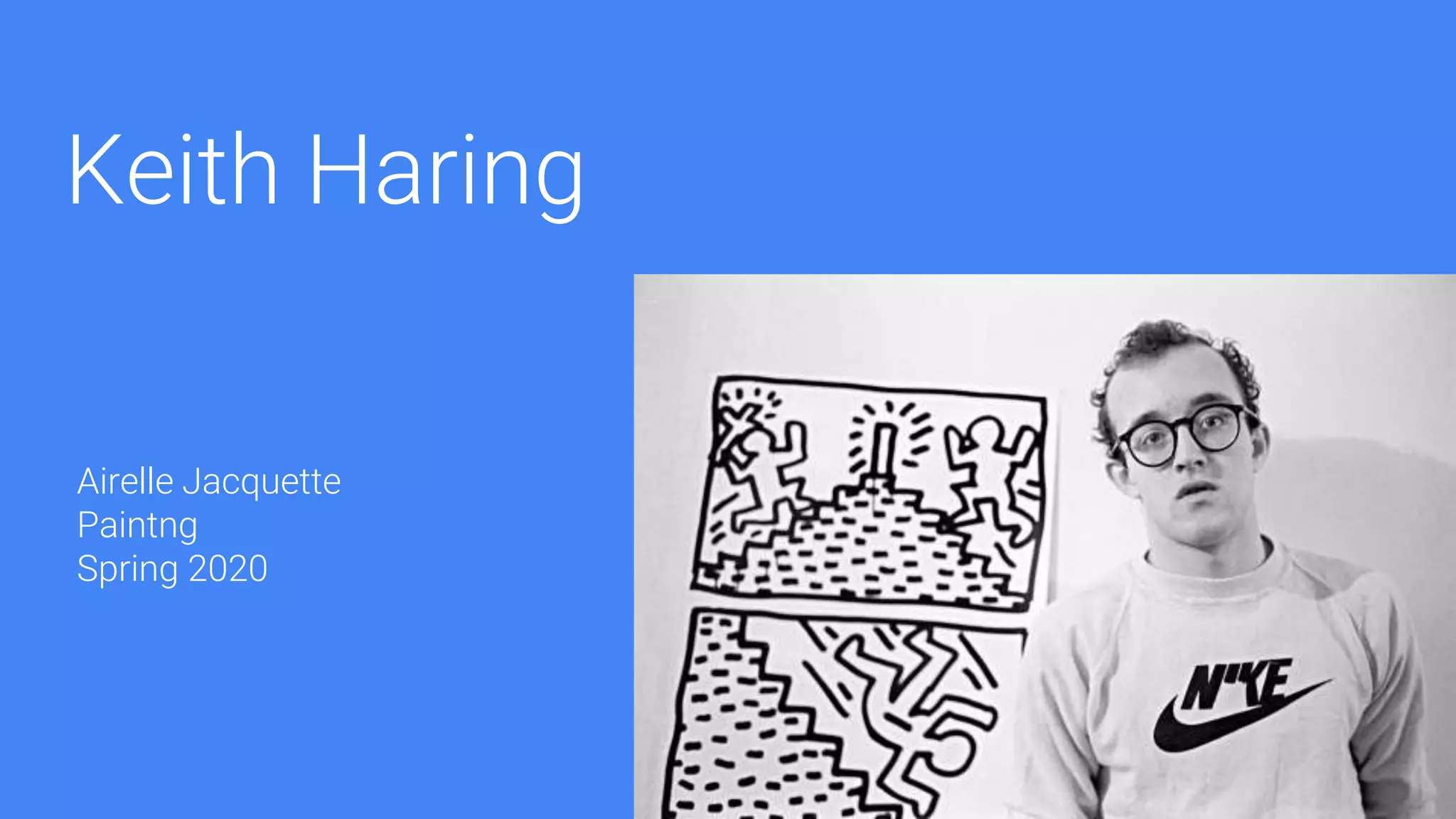
Keith Haring
Airelle Jacquette
Paintng
Spring 2020
Early Life
Keith Haring was best known for his graffiti styled
drawings that first started out in subways before in
museums. He was born in Reading, Pennsylvania on
May 4th, 1958 and grew up with his parents and three
sisters in Kutztown, Pennsylvania. As a child, Haring
was memorized by Walt Disney, Charles Schultz, and
Doctor Seuss cartoons and would spend many hours of
his time drawing with his father who had a hobby in
cartooning. In 1976 he graduated from high school and
attended Ivy School of Professional Art in Pittsburgh
and ended up dropping out after two semesters.
Mid-Life
In 1978 Haring moved to New York City to return to school and enroll at the
School of Visual Arts. While In New York he became friends with a fellow
emerging artists Jean-Michel Basquiat and Kenny Scharf. These artists
found a common love for the street art of graffiti that filled the streets and
ended up organizing exhibitions,” Haring and these other artists organized
exhibitions at downtown nightclubs and other alternative locations. While
having many competitors there he grew inspiration,” In addition to being
impressed by the innovation and energy of his contemporaries, Haring was
also inspired by the work of Jean Dubuffet, Pierre Alechinsky, William
Burroughs, Brion Gysin and Robert Henri’s manifesto The Art Spirit, which
asserted the fundamental independence of the artist.
Later Life
Haring started painting all over the city streets and when he
was on the subway he saw black paper rectangles that were
empty advertising panels on the station walls and using chalk
he started to draw his well known iconic drawings of things
such as radiant baby, a barking dog, flying saucer, large
hearts, and figures with TVs as heads ("Keith Haring" 2019).
While these graffiti drawings caught people’s attention it also
had him arrested for many of these drawings. In 1992 Haring
had his first art showing at the Tony Shafrazi Gallery, a gallery
that represented him his whole career ("Keith Haring" 2019).
On February 16th, 1990 at the age of 31 Haring died of AIDS-
related complications.
Keith Haring
“Best Buddies”
1990
26 x 32in
Elements and principles:
● Line
● Color
● Space
● Balance
The Elements and Principles of “Best
Friends”
Haring uses the use of thick lines to create the outline of the figures and the middle ground of
the floor. Haring uses negative space around the figures in the painting to make the image of
the two figures stand out against the background. He uses color in also helping the figures
stand out against their background, he uses light blue in the background around the figures to
make it move into the back while he uses yellow and orange making them come forward
against the blue background. The purple used in the flooring also makes it move to the back of
the figures and push up against the blue wall. Haring uses balance by using all 3 of the
elements of line to create the figures and the line between the floor and the wall, the cool colors
pushing into the back while the warm colors push to the front. What also helps create balance
is the dots in the flooring because it breaks up the pattern from the wall and the floor so they
don’t collide with each other and having two figures on each side of the painting also makes
this painting have balance.
Keith Haring
X-Man from Icons Portfolio”
1990
21 x 25in
X-Man From Icons Portfolio
Statue of Liberty
Keith Haring
“Statue of Liberty”
1986
Screen Print
37.5 x 28.25in

Airelle Jacquette: KEITH HARING

  • 1.
  • 2.
    Early Life Keith Haringwas best known for his graffiti styled drawings that first started out in subways before in museums. He was born in Reading, Pennsylvania on May 4th, 1958 and grew up with his parents and three sisters in Kutztown, Pennsylvania. As a child, Haring was memorized by Walt Disney, Charles Schultz, and Doctor Seuss cartoons and would spend many hours of his time drawing with his father who had a hobby in cartooning. In 1976 he graduated from high school and attended Ivy School of Professional Art in Pittsburgh and ended up dropping out after two semesters.
  • 3.
    Mid-Life In 1978 Haringmoved to New York City to return to school and enroll at the School of Visual Arts. While In New York he became friends with a fellow emerging artists Jean-Michel Basquiat and Kenny Scharf. These artists found a common love for the street art of graffiti that filled the streets and ended up organizing exhibitions,” Haring and these other artists organized exhibitions at downtown nightclubs and other alternative locations. While having many competitors there he grew inspiration,” In addition to being impressed by the innovation and energy of his contemporaries, Haring was also inspired by the work of Jean Dubuffet, Pierre Alechinsky, William Burroughs, Brion Gysin and Robert Henri’s manifesto The Art Spirit, which asserted the fundamental independence of the artist.
  • 4.
    Later Life Haring startedpainting all over the city streets and when he was on the subway he saw black paper rectangles that were empty advertising panels on the station walls and using chalk he started to draw his well known iconic drawings of things such as radiant baby, a barking dog, flying saucer, large hearts, and figures with TVs as heads ("Keith Haring" 2019). While these graffiti drawings caught people’s attention it also had him arrested for many of these drawings. In 1992 Haring had his first art showing at the Tony Shafrazi Gallery, a gallery that represented him his whole career ("Keith Haring" 2019). On February 16th, 1990 at the age of 31 Haring died of AIDS- related complications.
  • 5.
    Keith Haring “Best Buddies” 1990 26x 32in Elements and principles: ● Line ● Color ● Space ● Balance
  • 6.
    The Elements andPrinciples of “Best Friends” Haring uses the use of thick lines to create the outline of the figures and the middle ground of the floor. Haring uses negative space around the figures in the painting to make the image of the two figures stand out against the background. He uses color in also helping the figures stand out against their background, he uses light blue in the background around the figures to make it move into the back while he uses yellow and orange making them come forward against the blue background. The purple used in the flooring also makes it move to the back of the figures and push up against the blue wall. Haring uses balance by using all 3 of the elements of line to create the figures and the line between the floor and the wall, the cool colors pushing into the back while the warm colors push to the front. What also helps create balance is the dots in the flooring because it breaks up the pattern from the wall and the floor so they don’t collide with each other and having two figures on each side of the painting also makes this painting have balance.
  • 7.
    Keith Haring X-Man fromIcons Portfolio” 1990 21 x 25in X-Man From Icons Portfolio
  • 8.
    Statue of Liberty KeithHaring “Statue of Liberty” 1986 Screen Print 37.5 x 28.25in