SIMULATION OF
AIRCRAFT DYNAMICS-
LONGITUDINAL MODE
Minor Project
Group description
Name Roll No. Batch
Mahendra Gehlot 15/551 A1
Mousam Kumari 15/562 A1
Krishna Shekhawat 15/544 A1
Ishank Srivastava 15/679 A1
Under the supervision of –
Mr. Mohammed Shahid
Assistant Professor
Rajasthan Technical
University, Kota
Submitted to-
Mr. Brijesh Tripathi
Mr. Anshul Khandelwal
Objectives
• Simulation of Aircraft Dynamics (Longitudinal Mode) for Boeing 747.
• Error calculation of exact solution to approximate solution for short
and phugoid mode.
• Visualization of Aircraft Dynamic time history of various parameter of
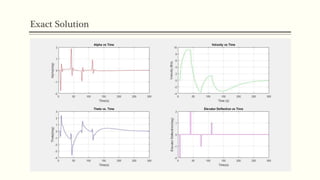
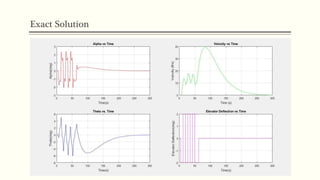
longitudinal mode for exact solution (Boeing 747).
Project outline
Aircraft
Equations of
motion
Decoupling of
EOM
Longitudinal
EOM
Selection of
aircraft
Step
1 Mathematical
Modelling on
MATLAB
Short Period
Approximation
Phugoid
Period
Approximation
Step
2 Simulink
Model
Results
Error
Calculation
Step
3 Visualisation
of Simulation
Conclusion
Step
4
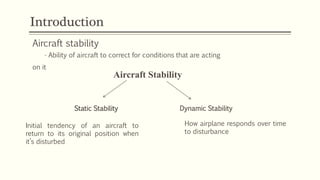
Introduction
Aircraft Stability
Static Stability Dynamic Stability
Aircraft stability
- Ability of aircraft to correct for conditions that are acting
on it
Initial tendency of an aircraft to
return to its original position when
it’s disturbed
How airplane responds over time
to disturbance
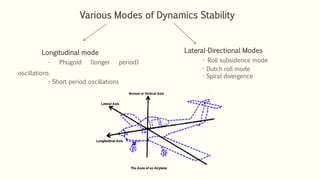
Various Modes of Dynamics Stability
Longitudinal mode
- Phugoid (longer period)
oscillations
- Short period oscillations
Lateral-Directional Modes
- Roll subsidence mode
- Dutch roll mode
- Spiral divergence
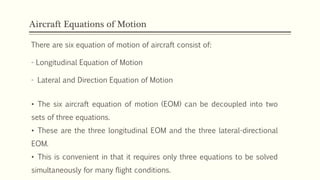
Aircraft Equations of Motion
There are six equation of motion of aircraft consist of:
- Longitudinal Equation of Motion
- Lateral and Direction Equation of Motion
• The six aircraft equation of motion (EOM) can be decoupled into two
sets of three equations.
• These are the three longitudinal EOM and the three lateral-directional
EOM.
• This is convenient in that it requires only three equations to be solved
simultaneously for many flight conditions.
Longitudinal Equations of Motion
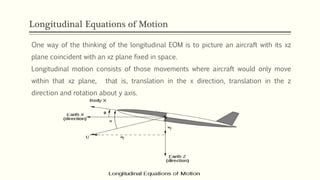
One way of the thinking of the longitudinal EOM is to picture an aircraft with its xz
plane coincident with an xz plane fixed in space.
Longitudinal motion consists of those movements where aircraft would only move
within that xz plane, that is, translation in the x direction, translation in the z
direction and rotation about y axis.
Longitudinal Equations of Motion
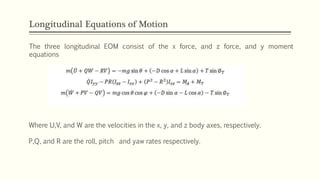
The three longitudinal EOM consist of the x force, and z force, and y moment
equations
Where U,V, and W are the velocities in the x, y, and z body axes, respectively.
P,Q, and R are the roll, pitch and yaw rates respectively.
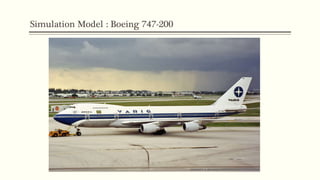
Simulation Model : Boeing 747-200
Approximations
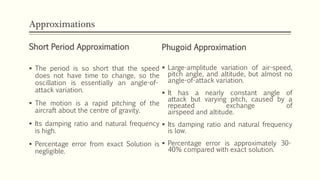
Short Period Approximation
 The period is so short that the speed
does not have time to change, so the
oscillation is essentially an angle-of-
attack variation.
 The motion is a rapid pitching of the
aircraft about the centre of gravity.
 Its damping ratio and natural frequency
is high.
 Percentage error from exact Solution is
negligible.
Phugoid Approximation
 Large-amplitude variation of air-speed,
pitch angle, and altitude, but almost no
angle-of-attack variation.
 It has a nearly constant angle of
attack but varying pitch, caused by a
repeated exchange of
airspeed and altitude.
 Its damping ratio and natural frequency
is low.
 Percentage error is approximately 30-
40% compared with exact solution.
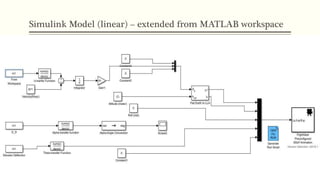
Simulink Model (linear) – extended from MATLAB workspace
Exact Solution
Exact Solution
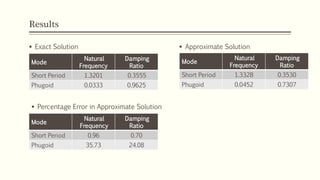
Results
 Exact Solution
Mode
Natural
Frequency
Damping
Ratio
Short Period 1.3201 0.3555
Phugoid 0.0333 0.9625
 Approximate Solution
Mode
Natural
Frequency
Damping
Ratio
Short Period 1.3328 0.3530
Phugoid 0.0452 0.7307
 Percentage Error in Approximate Solution
Mode
Natural
Frequency
Damping
Ratio
Short Period 0.96 0.70
Phugoid 35.73 24.08
Conclusion
 The phugoid approximations provide poor estimates while the short
period approximations are accurate.
 Time taken in short period mode to reach the equilibrium is 40-50
seconds after being disturbed and 280-300 seconds for phugoid
mode.
Aircraft dynamics mode simulation

Aircraft dynamics mode simulation

  • 1.
  • 2.
    Group description Name RollNo. Batch Mahendra Gehlot 15/551 A1 Mousam Kumari 15/562 A1 Krishna Shekhawat 15/544 A1 Ishank Srivastava 15/679 A1 Under the supervision of – Mr. Mohammed Shahid Assistant Professor Rajasthan Technical University, Kota Submitted to- Mr. Brijesh Tripathi Mr. Anshul Khandelwal
  • 3.
    Objectives • Simulation ofAircraft Dynamics (Longitudinal Mode) for Boeing 747. • Error calculation of exact solution to approximate solution for short and phugoid mode. • Visualization of Aircraft Dynamic time history of various parameter of longitudinal mode for exact solution (Boeing 747).
  • 4.
    Project outline Aircraft Equations of motion Decouplingof EOM Longitudinal EOM Selection of aircraft Step 1 Mathematical Modelling on MATLAB Short Period Approximation Phugoid Period Approximation Step 2 Simulink Model Results Error Calculation Step 3 Visualisation of Simulation Conclusion Step 4
  • 5.
    Introduction Aircraft Stability Static StabilityDynamic Stability Aircraft stability - Ability of aircraft to correct for conditions that are acting on it Initial tendency of an aircraft to return to its original position when it’s disturbed How airplane responds over time to disturbance
  • 6.
    Various Modes ofDynamics Stability Longitudinal mode - Phugoid (longer period) oscillations - Short period oscillations Lateral-Directional Modes - Roll subsidence mode - Dutch roll mode - Spiral divergence
  • 7.
    Aircraft Equations ofMotion There are six equation of motion of aircraft consist of: - Longitudinal Equation of Motion - Lateral and Direction Equation of Motion • The six aircraft equation of motion (EOM) can be decoupled into two sets of three equations. • These are the three longitudinal EOM and the three lateral-directional EOM. • This is convenient in that it requires only three equations to be solved simultaneously for many flight conditions.
  • 8.
    Longitudinal Equations ofMotion One way of the thinking of the longitudinal EOM is to picture an aircraft with its xz plane coincident with an xz plane fixed in space. Longitudinal motion consists of those movements where aircraft would only move within that xz plane, that is, translation in the x direction, translation in the z direction and rotation about y axis.
  • 9.
    Longitudinal Equations ofMotion The three longitudinal EOM consist of the x force, and z force, and y moment equations Where U,V, and W are the velocities in the x, y, and z body axes, respectively. P,Q, and R are the roll, pitch and yaw rates respectively.
  • 10.
    Simulation Model :Boeing 747-200
  • 11.
    Approximations Short Period Approximation The period is so short that the speed does not have time to change, so the oscillation is essentially an angle-of- attack variation.  The motion is a rapid pitching of the aircraft about the centre of gravity.  Its damping ratio and natural frequency is high.  Percentage error from exact Solution is negligible. Phugoid Approximation  Large-amplitude variation of air-speed, pitch angle, and altitude, but almost no angle-of-attack variation.  It has a nearly constant angle of attack but varying pitch, caused by a repeated exchange of airspeed and altitude.  Its damping ratio and natural frequency is low.  Percentage error is approximately 30- 40% compared with exact solution.
  • 12.
    Simulink Model (linear)– extended from MATLAB workspace
  • 13.
  • 14.
  • 15.
    Results  Exact Solution Mode Natural Frequency Damping Ratio ShortPeriod 1.3201 0.3555 Phugoid 0.0333 0.9625  Approximate Solution Mode Natural Frequency Damping Ratio Short Period 1.3328 0.3530 Phugoid 0.0452 0.7307  Percentage Error in Approximate Solution Mode Natural Frequency Damping Ratio Short Period 0.96 0.70 Phugoid 35.73 24.08
  • 16.
    Conclusion  The phugoidapproximations provide poor estimates while the short period approximations are accurate.  Time taken in short period mode to reach the equilibrium is 40-50 seconds after being disturbed and 280-300 seconds for phugoid mode.

Editor's Notes

  • #2 NOTE: Want a different image on this slide? Select the picture and delete it. Now click the Pictures icon in the placeholder to insert your own image.