Dr. A.G. Devi Prasad
MSc(Bot), MSc(Sus.Dev), Ph.D, PGDEP
P.G. Department of Environmental Science
University of Mysore
Mysore-570006
e-mail:- agdprasad@yahoo.com
Mobile; 9448033391
IMPACT OF ENVIRONMENTAL POLLUTION
Pollution – Definition
Any undesirable change in physical , chemical
or biological characteristics of air , land , water
Pollution is the introduction of contaminants into
an environment that causes instability, disorder,
harm or discomfort to the ecosystem i.e.
physical systems or living organisms.
Pollution can take the form of chemical
substances or energy, such as noise, heat, or
light. ...
Pollution
Air Pollution
Water Pollution
Soil Pollution
Waste production
AIR POLLUTION
Sources
 Combustion of fuel (natural gas, petroleum, coal and
wood)
 Industrial process
 Natural process (Volcanic)
Air Pollutants and its impact on human
health
Particulate Matter
Dust and smoke particles cause irritation of the
respiratory tract and produce bronchitis, asthma
and lung diseases.
Dust and smoke function as nuclei for
condensation of water vapors and produce smog
which attract chemicals like SO2, H2S, NO2,etc.
Smog not only reduce visibility but is also harmful
due to its contained chemicals.
SMOG
Smog is the combination of smoke and fog.
It is a man made air pollutant in urban
areas. The term smog was coined by
H.A.Des Voeux
Types of Smog
Photochemical Smog
Los Angeles Smog
 Photochemically- produced
 Associated with motor vehicle emissions
 Brown in color
“Los Angeles” Smog
Los Angeles Smog: driven by the photochemistry
of the volatile organic compounds (VOCs) and
oxygenated nitrogen species (NOx) contained in
exhaust from combustion engines.
Photochemical smog is air saturated with ozone,
VOCs and aerosol particles.
Industrial smog
The gray air in industrial cities in cold winter
areas, caused from burning fossil fuel.
Industrial smog is in the forms of dust, smoke,
soot, ashes, asbestos, oil, lead, heavy metals,
and sulfur oxides.
In 1952, industrial smog held in place by a
thermal inversion caused the 4,000 deaths in
London.
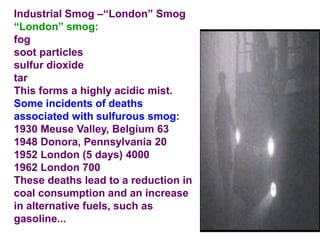
Industrial Smog –“London” Smog
“London” smog:
fog
soot particles
sulfur dioxide
tar
This forms a highly acidic mist.
Some incidents of deaths
associated with sulfurous smog:
1930 Meuse Valley, Belgium 63
1948 Donora, Pennsylvania 20
1952 London (5 days) 4000
1962 London 700
These deaths lead to a reduction in
coal consumption and an increase
in alternative fuels, such as
gasoline...
DUSTS (Pneumoconiosis)
Inorganic Dust
Coal Dust - Anthracosis
Silica - Silicosis
Asbestos - Asbestosis
Iron - Siderosis
Organic Dusts
Cane Fiber - Bagassosis
(Bronchi gets affected)
Cotton dust - Byssinosis
(In Textile industries)
Tobacco - Tobaccosis, Lung
Cancer
Grain Dust - Farmer’s Lungs
Coal Dust - Anthracosis
Silica - Silicosis
Asbestos - Asbestosis
Iron- Siderosis
The iris has the " rusty "
appearance that results
from siderosis.
Pneumoconiosis
A disease of the lungs
characterized by
fibrosis and caused by the
chronic
inhalation of mineral dusts,
especially silica
and asbestos. When
Insoluble Inorganic Material
(like
silica and asbestos) enters
the lungs, they stay in the
lungs and cause
inflammation and disease
Oxides of Nitrogen
- Brochiolitis
They cause eye irritation
and respiratory trouble.
They have mutagenic
properties
Ozone - Broncho constriction
Hydrocarbons – Lung Cancer
Sulphur dioxide –
COPD,Asthma
COPD - diseases of the
lungs in which the
airways become
narrowed
Grain Dust-Farmer’s Lungs
Carbon Monoxide
 It is formed by incomplete combustion of carbon
fuels in various industries , motor vehicles,
hearths,etc.
 It causes impairment of judgment and vision,
headache and dizziness.
Sulphur Dioxide
 It is produced in large quantity during smelting of
metallic ores.
 It causes trachial irritation, cough, bronchial spasms.
Chlorine
 It is present in volcanic eruptions and emitted in
processes involving use of chlorinated chemicals.
 It causes eye and respiratory ailments.
 Chlorine rising up in the atmosphere poses danger
to ozone layer.
Water Facts
Only about 3% of surface water is fresh water
One-fifth of the world population lack access to clean
drinking water
Over 2.6 billion people do not have adequate toilets,
sewers or latrines
Water-borne Diseases :
o Affect four billion people every
year
o Kill five million people including
6000 children every year
WATER POLLUTION
oo More than 2 million children are killed by
diarrhoeal diseases each year
o Earth’s oceans are the most important carbon
sink on the planet along with rain forests
o Demand for water will double in next 30 years
o Floods are most frequent disaster worldwide
World Water Demand/Year
1940 1000 km3
1990 4130 km3
2000 5000 km3
2002 6650 km3
2020 9000 km3
WATER POLLUTION
Sources and impacts
Domestic wastes and sewage -- Sewage of
municipalities, boats, ships, etc.
 It causes depletion of oxygen
 It produce foul odour and makes the water oily and
brownish.
 Increase the sludge which make the water unfit for
recreational and industrial use,
It induces the growth of algal blooms.
Surface Run-off -- The pollutants present on the
surface of land and fertilizers are washed down into
water bodies.
 The nitrites enter the blood and
combine with hemoglobin to form
methaemoglobin. The latter is
unable to transport oxygen and
gives rise to disease
called as methaemoglobinaemia.
Infants are the most affected,
showing signs of blueness around
the mouth, hands and feet, having
trouble breathing as well as
vomiting and diarrhoea.
Industrial Effluents– They are industrial wastes which
are either dumped in the soil or are allowed to pass into
water bodies. The effluents contains heavy metals,
cyanides, thicynates, chromates, acids, alkalies, organic
solvent,etc.
Mercury sources ; Coal, smelting of ores, paper/paint
industry
Mercury causes Minamata disease.
Minamata disease is the name
given to mercury toxicosis
(poisoning) that developed in
people who ate contaminated sea
food taken from Minamata Bay
The disease results in
crippling deformity
Sources of lead pollution
Paints, smelters, chemical and pesticide industries,
petrochemicals.
Lead poisoning (also known as plumbism, colica pictonium,
saturnism, painter's colic) is a medical condition caused by
increased levels of the heavy metal lead in the body.
Lead interferes with a variety of
body processes and is toxic to
many organs and tissues
including the heart, bones,
intestines, kidneys, reproductive
and nervous systems.
Cadmium causes renal damage, emphysema and
hypertension and Itai-Itai diseases.
Cadmium Pollution Sources ;
Smelting and refining of metals, or from the air in plants
that make cadmium products such as batteries, coatings,
or plastics .Cigarettes are also a significant source of
cadmium exposure Cadmium is used in industry as a
protective coat for iron, copper and steel Ex; telephone
wires. Paint pigments
Effects
Effects seen on liver and kidney mainly.
Organs of toxicity:- Central Nervous System,
Kidney .
One of the main effects of cadmium poisoning
is weak and brittle bones. Spinal and leg pain
is common, and a waddling gait often
develops due to bone deformities caused by
the cadmium. The pain eventually becomes
debilitating, with fractures becoming more
common as the bone weakens. Other
complications include coughing, anemia, and
kidney failure, leading to death
Symptoms
Amoebiasis, sometimes spelt amebiasis, is
one of those common diseases, caused by
a parasite which infects the bowel casing a
type of gastroenteritis infection.
This disease generally
occurs in young to
middle aged adults who
ingest contaminated food
or water containing the
Entamoeba histolytica
microorganism
Amoebiasis
Giardiasis
Giardiasis (gee-ar-die-a-sis with a soft "G") is
an infection of the small intestine that is caused
by the parasite, Giardia lamblia The most
common manifestations of giardiasis are
diarrhoea and abdominal pain, particularly
cramping; however, diarrhea is not invariable
and occurs in 60% to 90% of patients
The consequence of two bomb blasts over
Hiroshima and Nagasaki (JAPAN) still send waves of
tremor in us. Innumerable persons died. The survivors
not only suffered themselves but also passed to their
offspring malignant growth , cancer, congenital
deformities, mental retardation, etc.
Nuclear pollution– The source of nuclear pollution are
weapon testing, atomic power plants, recycling plants,
nuclear wastes, etc.
 It causes blood and bone cancer
 It disrupts normal functioning of thyroid, and
consequently produces abnormal growth and metabolism
Pesticides– They are discharged to the water
body through the agricultural run-off.
Chlorinated Hydrocarbon, organo pesticides and
inorganic pesticides are poisonous and causes
sweating, salivation, nausea, vomiting , diarrhoea
and muscular tremors for the people
Chromium has carcinogenic properties.
Nickel can cause damage to liver and kidney.
Arsenic can cause hyper-pigmentation, Keratosis
and black foot disease
Fluoride Pollution
96 % of fluoride is found in bones and teeth.
Fluorine is essential for the normal mineralization
of bones and formation of dental enamel.
Water resources near granitic rocks containing
more than 2.5 ppm cause Fluorosis The cause
of this diseases mainly due to consumption of
high quantity of fluoride through water, food,
cosmetic like fluoridated tooth paste, drugs
and inhaling air contaminated with fluoride in
industrial environment.
Fluorosis was first detected in India among cattle by the
farmers of Andhra pradesh State during early 1930. The
farmers noticed the inability of the bullocks to walk due to
painfull and stiff joints.
This endemic fluorosis had been identified in total 15
state of the Indian union.
Fluorosis is a clinical condition recognized by Shrott in
1937 .
NOISE POLLUTION
The term noise is applied to the sound that cause
irritation on hearing of healthy human being.
Sources
 Transport noise--- Originates from road traffic
(vehicular), air craft and rail traffic.
 Industrial noise--- It produced by presses; punch
and stamp machine, pneumatic drills, milling
machines, cutter and routers, dust extractors. etc.
 Domestic noise--- It is generated from domestic
appliance like washing machines, spin dryers, food
mixer, sink waste grinder and vacuum cleaner.
Effects Of Noise Pollution
Hearing damage from noise exposure
Pathological and Physiological disorders
The impact of noise may cause permanent
hearing loss due to the exposure to noise
levels exceeding 90 dB
SOLID WASTE
 Urban India produces 1,20,000 tons of MSW/Day.
 Per capita waste generation in major cities of India
ranges from 0.8 kg to 1.0 kg per day.
 Of the MSW collected; 94% is dumped on land and 5%
is composed.
 23 metrocities generates 30,000 tons of SW/Day.
 Class-I cities generate 50,000 tons of solid waste per
day
 Karnataka State generates 3553.97 tons/Day , disposes
2848.05 tons/Day and the remaining is un collected
wastes.
Sources
 Municipal Wastes
 Agricultural Wastes And Sewage Sludge
 Industrial Wastes and Mining Wastes
 Bio-Medical Wastes
 E-Wastes
 Radioactive Wastes
Effects of Solid Wastes
 Pollute ground water
 Waste becomes storehouses for pathogens
 Bag pickers affected by skin diseases, respiratory tract
infections, stomach infections, eye irritation, etc.
 Dumping helps the breeding of mosquitoes
 Burning releases furans (Chlorinated Carbons) which
reduces the fertility of human.
 Hazardous substances include mercury, chromium, etc
– Bioaccumulation
Accumulation of copper in soil inhibit plant growth.
What are
the
solutions
to all these
problems?
Let Us Together Build a World In
Which Every Person Has
Hygienic Environment
And Lives in
Sanitation
Safe Adequate water
HEALTHY
ENVIRONMENT
Sustainable
Development
Solid waste
Management
World
Conservation
strategy
Environmental
Laws
Hazards
mitigation
Energy
conservation
Rain water
Harvesting
Biodiversity
conservation
Pollution
control
Water
Resources
THANK YOU ALL

Environmental Pollution Presentation 2.ppt

  • 1.
    Dr. A.G. DeviPrasad MSc(Bot), MSc(Sus.Dev), Ph.D, PGDEP P.G. Department of Environmental Science University of Mysore Mysore-570006 e-mail:- agdprasad@yahoo.com Mobile; 9448033391 IMPACT OF ENVIRONMENTAL POLLUTION
  • 2.
    Pollution – Definition Anyundesirable change in physical , chemical or biological characteristics of air , land , water Pollution is the introduction of contaminants into an environment that causes instability, disorder, harm or discomfort to the ecosystem i.e. physical systems or living organisms. Pollution can take the form of chemical substances or energy, such as noise, heat, or light. ...
  • 3.
  • 4.
    AIR POLLUTION Sources  Combustionof fuel (natural gas, petroleum, coal and wood)  Industrial process  Natural process (Volcanic)
  • 5.
    Air Pollutants andits impact on human health Particulate Matter Dust and smoke particles cause irritation of the respiratory tract and produce bronchitis, asthma and lung diseases. Dust and smoke function as nuclei for condensation of water vapors and produce smog which attract chemicals like SO2, H2S, NO2,etc. Smog not only reduce visibility but is also harmful due to its contained chemicals.
  • 6.
    SMOG Smog is thecombination of smoke and fog. It is a man made air pollutant in urban areas. The term smog was coined by H.A.Des Voeux
  • 7.
  • 8.
    Los Angeles Smog Photochemically- produced  Associated with motor vehicle emissions  Brown in color
  • 9.
    “Los Angeles” Smog LosAngeles Smog: driven by the photochemistry of the volatile organic compounds (VOCs) and oxygenated nitrogen species (NOx) contained in exhaust from combustion engines. Photochemical smog is air saturated with ozone, VOCs and aerosol particles.
  • 10.
    Industrial smog The grayair in industrial cities in cold winter areas, caused from burning fossil fuel. Industrial smog is in the forms of dust, smoke, soot, ashes, asbestos, oil, lead, heavy metals, and sulfur oxides. In 1952, industrial smog held in place by a thermal inversion caused the 4,000 deaths in London.
  • 11.
    Industrial Smog –“London”Smog “London” smog: fog soot particles sulfur dioxide tar This forms a highly acidic mist. Some incidents of deaths associated with sulfurous smog: 1930 Meuse Valley, Belgium 63 1948 Donora, Pennsylvania 20 1952 London (5 days) 4000 1962 London 700 These deaths lead to a reduction in coal consumption and an increase in alternative fuels, such as gasoline...
  • 12.
    DUSTS (Pneumoconiosis) Inorganic Dust CoalDust - Anthracosis Silica - Silicosis Asbestos - Asbestosis Iron - Siderosis Organic Dusts Cane Fiber - Bagassosis (Bronchi gets affected) Cotton dust - Byssinosis (In Textile industries) Tobacco - Tobaccosis, Lung Cancer Grain Dust - Farmer’s Lungs
  • 13.
    Coal Dust -Anthracosis
  • 14.
  • 15.
    Asbestos - Asbestosis Iron-Siderosis The iris has the " rusty " appearance that results from siderosis.
  • 16.
    Pneumoconiosis A disease ofthe lungs characterized by fibrosis and caused by the chronic inhalation of mineral dusts, especially silica and asbestos. When Insoluble Inorganic Material (like silica and asbestos) enters the lungs, they stay in the lungs and cause inflammation and disease
  • 17.
    Oxides of Nitrogen -Brochiolitis They cause eye irritation and respiratory trouble. They have mutagenic properties
  • 18.
    Ozone - Bronchoconstriction
  • 19.
  • 20.
    Sulphur dioxide – COPD,Asthma COPD- diseases of the lungs in which the airways become narrowed
  • 21.
  • 22.
    Carbon Monoxide  Itis formed by incomplete combustion of carbon fuels in various industries , motor vehicles, hearths,etc.  It causes impairment of judgment and vision, headache and dizziness. Sulphur Dioxide  It is produced in large quantity during smelting of metallic ores.  It causes trachial irritation, cough, bronchial spasms.
  • 23.
    Chlorine  It ispresent in volcanic eruptions and emitted in processes involving use of chlorinated chemicals.  It causes eye and respiratory ailments.  Chlorine rising up in the atmosphere poses danger to ozone layer.
  • 24.
    Water Facts Only about3% of surface water is fresh water One-fifth of the world population lack access to clean drinking water Over 2.6 billion people do not have adequate toilets, sewers or latrines Water-borne Diseases : o Affect four billion people every year o Kill five million people including 6000 children every year WATER POLLUTION
  • 25.
    oo More than2 million children are killed by diarrhoeal diseases each year o Earth’s oceans are the most important carbon sink on the planet along with rain forests o Demand for water will double in next 30 years o Floods are most frequent disaster worldwide
  • 26.
    World Water Demand/Year 19401000 km3 1990 4130 km3 2000 5000 km3 2002 6650 km3 2020 9000 km3
  • 27.
    WATER POLLUTION Sources andimpacts Domestic wastes and sewage -- Sewage of municipalities, boats, ships, etc.  It causes depletion of oxygen  It produce foul odour and makes the water oily and brownish.  Increase the sludge which make the water unfit for recreational and industrial use, It induces the growth of algal blooms.
  • 28.
    Surface Run-off --The pollutants present on the surface of land and fertilizers are washed down into water bodies.  The nitrites enter the blood and combine with hemoglobin to form methaemoglobin. The latter is unable to transport oxygen and gives rise to disease called as methaemoglobinaemia. Infants are the most affected, showing signs of blueness around the mouth, hands and feet, having trouble breathing as well as vomiting and diarrhoea.
  • 29.
    Industrial Effluents– Theyare industrial wastes which are either dumped in the soil or are allowed to pass into water bodies. The effluents contains heavy metals, cyanides, thicynates, chromates, acids, alkalies, organic solvent,etc. Mercury sources ; Coal, smelting of ores, paper/paint industry Mercury causes Minamata disease. Minamata disease is the name given to mercury toxicosis (poisoning) that developed in people who ate contaminated sea food taken from Minamata Bay The disease results in crippling deformity
  • 30.
    Sources of leadpollution Paints, smelters, chemical and pesticide industries, petrochemicals. Lead poisoning (also known as plumbism, colica pictonium, saturnism, painter's colic) is a medical condition caused by increased levels of the heavy metal lead in the body. Lead interferes with a variety of body processes and is toxic to many organs and tissues including the heart, bones, intestines, kidneys, reproductive and nervous systems.
  • 31.
    Cadmium causes renaldamage, emphysema and hypertension and Itai-Itai diseases. Cadmium Pollution Sources ; Smelting and refining of metals, or from the air in plants that make cadmium products such as batteries, coatings, or plastics .Cigarettes are also a significant source of cadmium exposure Cadmium is used in industry as a protective coat for iron, copper and steel Ex; telephone wires. Paint pigments
  • 32.
    Effects Effects seen onliver and kidney mainly. Organs of toxicity:- Central Nervous System, Kidney . One of the main effects of cadmium poisoning is weak and brittle bones. Spinal and leg pain is common, and a waddling gait often develops due to bone deformities caused by the cadmium. The pain eventually becomes debilitating, with fractures becoming more common as the bone weakens. Other complications include coughing, anemia, and kidney failure, leading to death Symptoms
  • 33.
    Amoebiasis, sometimes speltamebiasis, is one of those common diseases, caused by a parasite which infects the bowel casing a type of gastroenteritis infection. This disease generally occurs in young to middle aged adults who ingest contaminated food or water containing the Entamoeba histolytica microorganism Amoebiasis
  • 34.
    Giardiasis Giardiasis (gee-ar-die-a-sis witha soft "G") is an infection of the small intestine that is caused by the parasite, Giardia lamblia The most common manifestations of giardiasis are diarrhoea and abdominal pain, particularly cramping; however, diarrhea is not invariable and occurs in 60% to 90% of patients
  • 35.
    The consequence oftwo bomb blasts over Hiroshima and Nagasaki (JAPAN) still send waves of tremor in us. Innumerable persons died. The survivors not only suffered themselves but also passed to their offspring malignant growth , cancer, congenital deformities, mental retardation, etc. Nuclear pollution– The source of nuclear pollution are weapon testing, atomic power plants, recycling plants, nuclear wastes, etc.  It causes blood and bone cancer  It disrupts normal functioning of thyroid, and consequently produces abnormal growth and metabolism
  • 36.
    Pesticides– They aredischarged to the water body through the agricultural run-off. Chlorinated Hydrocarbon, organo pesticides and inorganic pesticides are poisonous and causes sweating, salivation, nausea, vomiting , diarrhoea and muscular tremors for the people Chromium has carcinogenic properties. Nickel can cause damage to liver and kidney. Arsenic can cause hyper-pigmentation, Keratosis and black foot disease
  • 38.
    Fluoride Pollution 96 %of fluoride is found in bones and teeth. Fluorine is essential for the normal mineralization of bones and formation of dental enamel. Water resources near granitic rocks containing more than 2.5 ppm cause Fluorosis The cause of this diseases mainly due to consumption of high quantity of fluoride through water, food, cosmetic like fluoridated tooth paste, drugs and inhaling air contaminated with fluoride in industrial environment.
  • 39.
    Fluorosis was firstdetected in India among cattle by the farmers of Andhra pradesh State during early 1930. The farmers noticed the inability of the bullocks to walk due to painfull and stiff joints. This endemic fluorosis had been identified in total 15 state of the Indian union. Fluorosis is a clinical condition recognized by Shrott in 1937 .
  • 40.
    NOISE POLLUTION The termnoise is applied to the sound that cause irritation on hearing of healthy human being. Sources  Transport noise--- Originates from road traffic (vehicular), air craft and rail traffic.  Industrial noise--- It produced by presses; punch and stamp machine, pneumatic drills, milling machines, cutter and routers, dust extractors. etc.  Domestic noise--- It is generated from domestic appliance like washing machines, spin dryers, food mixer, sink waste grinder and vacuum cleaner.
  • 41.
    Effects Of NoisePollution Hearing damage from noise exposure Pathological and Physiological disorders The impact of noise may cause permanent hearing loss due to the exposure to noise levels exceeding 90 dB
  • 42.
    SOLID WASTE  UrbanIndia produces 1,20,000 tons of MSW/Day.  Per capita waste generation in major cities of India ranges from 0.8 kg to 1.0 kg per day.  Of the MSW collected; 94% is dumped on land and 5% is composed.  23 metrocities generates 30,000 tons of SW/Day.  Class-I cities generate 50,000 tons of solid waste per day  Karnataka State generates 3553.97 tons/Day , disposes 2848.05 tons/Day and the remaining is un collected wastes.
  • 43.
    Sources  Municipal Wastes Agricultural Wastes And Sewage Sludge  Industrial Wastes and Mining Wastes  Bio-Medical Wastes  E-Wastes  Radioactive Wastes
  • 44.
    Effects of SolidWastes  Pollute ground water  Waste becomes storehouses for pathogens  Bag pickers affected by skin diseases, respiratory tract infections, stomach infections, eye irritation, etc.  Dumping helps the breeding of mosquitoes  Burning releases furans (Chlorinated Carbons) which reduces the fertility of human.  Hazardous substances include mercury, chromium, etc – Bioaccumulation Accumulation of copper in soil inhibit plant growth.
  • 57.
  • 58.
    Let Us TogetherBuild a World In Which Every Person Has Hygienic Environment And Lives in Sanitation Safe Adequate water
  • 59.
  • 61.