CONTENTSCONTENTS
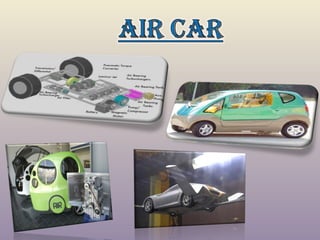
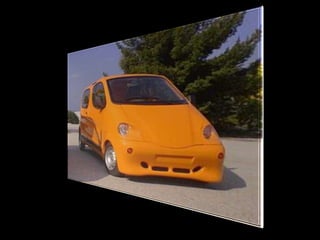
• The air car is powered by air engine.
• It is an emission free piston engine using compressed air
as the fuel.
• It was invented by Guy Nègre, a French engineer; in 1991
started Motor Development International (MDI)
Luxembourg.
• He invented a dual-energy engine running on both
compressed air as on regular fuel; then managed to create
a compressed air only-engine, and improved his design to
make it more powerful in the 15 years.
• Other people that have been working on the idea are
Armando Regusci and Angelo Di Pietro. They too have
companies, Rugusci started up Regusci Air and Di Pietro
started up Engine Air. They are selling their engines.
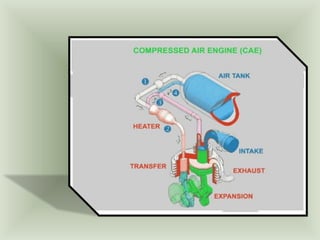
 It uses the expansion of compressed air to drive the
pistons in a modified piston engine.
 Efficiency of operation is gained through the use of
environmental heat at normal temperature to warm the
otherwise cold expanded air from the storage tank.
 This non-adiabatic expansion has the potential to greatly
increase the efficiency of the machine.
 The only exhaust gas is cold air (−15 °C), which may
also be used for air conditioning in a car.
 The source for air is a pressurized glass or carbon-fibre
tank holding air at around 3,000 lbf/in² (20 MPa).
 Air is delivered to the engine via a rather conventional
injection system.
 Used to power an urban car with room for five
passengers and a projected range of about 100 to
200 miles (160 to 320 km), depending on traffic
conditions.
 Main advantages are: no roadside emissions, low
cost technology, engine uses food oil for lubrication
(just about 1 liter, changes only every 30,000 miles
(50,000 km))and integrated air conditioning.
 The tanks may be refilled in about three minutes at a
service station, or in a few hours at home plugging
the car into the electric grid via an on-board
compressor.
• Compressed air technology allows for engines that are both
non polluting and economical; do not have a limited driving
range, are easy to get around cities in.
• Two technologies have been developed to meet different
needs: Single energy compressed air engines & Dual energy
compressed air plus fuel engines.
• The single energy engines will be available in both Mini cats
and City cats; conceived for city use, maximum speed is 50
km/h and where MDI believes polluting will soon be
prohibited.
• The dual energy engine, has been conceived as much for the
city as the open road, available in all MDI vehicles; engines
work exclusively with compressed air while running under 50
km/h in urban areas, outside urban areas at speeds over 50
km/h, the engines will switch to fuel mode.
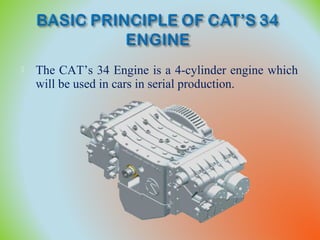
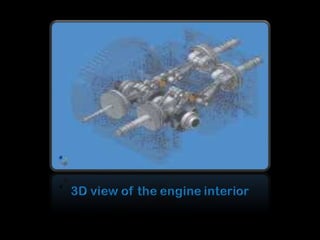
 The CAT’s 34 Engine is a 4-cylinder engine which
will be used in cars in serial production.
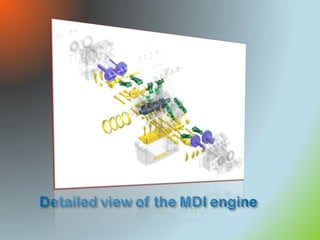
It was developed between the end of 2001 and the beginning of
2002, uses an innovative system to control the movement of the
2nd generation pistons and one single crankshaft.
The pistons work in two stages: one motor stage and one
intermediate stage of compression/expansion.
The engine has 4 two-stage pistons, i.e. 8 compression and/or
expansion chambers; have two functions: to compress ambient air
and refill the storage tanks; and to make successive expansions
(reheating air with ambient thermal energy) thereby approaching
isothermic expansion.
Steering-wheel is equipped with a 5kW electric moto-alternator.
This motor is simultaneously: the motor to compress air, the
starting motor, the alternator for recharging the battery, an electric
moderator/brake, a temporary power supply (e.g. for parking) .
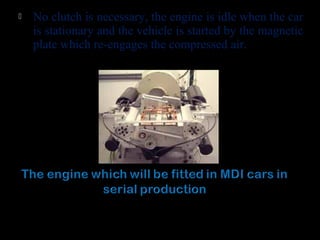
 No clutch is necessary, the engine is idle when the car
is stationary and the vehicle is started by the magnetic
plate which re-engages the compressed air.
 Gear changes are automatic, powered by an
electronic system developed by MDI. A computer
which controls the speed of the car is effectively
continuously changing gears .
Moto-alternatorMoto-alternator
 It connects the engine to the gearbox, supports the
CAT´s motor to allow the tanks to be refilled, as an
alternator it produces brake power, starts the vehicle
and provides extra power when necessary.
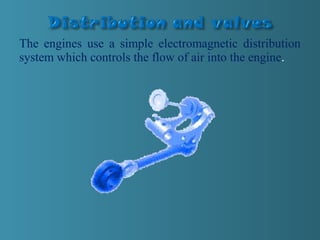
The engines use a simple electromagnetic distribution
system which controls the flow of air into the engine.
A) Compressed air tanks
 The compressed air tank is a glass or carbon-fiber tank,
hold 90 cubic meters of air compressed to 300 bars.
 This system is not dangerous in case of an accident as
there is no risk of operation. In the case of a major
accident, where the tanks are ruptured, they would not
explode since they are not metal, instead they would
crack, as they are made of carbon fiber.
 The tanks in CATs vehicles are composed of an interior
thermoplastic container which ensures it is airtight, is
held in a coiled and crossed carbon fiber shell.
The tanks used in the CAT´s vehicles should last for a period of
fifteen years, to be tested every five years.
The tanks weigh 35 - 40 kg for 100 liters of air at 300 bars.
For extra security, a protective plate is fixed underneath the
vehicle´s chassis, there is also an extraction system to deal with
water produced by condensation.
B) Brake power recovery
The MDI vehicles will be equipped with a range of modern
systems, i.e. one mechanism stops the engine when the car is
stationary (at traffic lights, junctions etc.).
Another interesting feature is the pneumatic system which
recovers about 13% of the power used.
 The MDI car body is built with fiber and injected foam.
 Two main advantages: cost and weight.
 Nowadays the use of sheet steel for car bodies is only
because it is cheaper to serially produce sheet steel
bodies than fiber ones, however, fiber is safer (it doesn
´t cut like steel), is easier to repair (it is glued), doesn´t
rust etc.
D) The Air Filter
 Before compression, the air must be filtered to get rid of
any impurities that could damage the engine; carbon
filters are used to eliminate dirt, dust, humidity and
other particles; the exhaust pipe on the MDI cars
produces clean air, which is cold on exit (between -15º
and 0º) and is harmless to human life.
• MDI has put together highly-resistant, yet light, chassis,
aluminium rods glued together; using rods enables to build a
more shock-resistant chassis than regular chassis.
Additionally, the rods are glued in the same way as aircraft,
allowing quick assembly and a more secure join than with
welding, helps to reduce manufacture time.
F) Electrical system
• Guy Nègre acquired the patent for an interesting invention for
installing electrics in a vehicle; using a radio transmission
system, each electrical component receives signals with a
microcontroller. So, instead of wiring each component
(headlights, dashboard lights, lights inside the car, etc.), one
cable connects all electrical parts in the car; advantages are
the ease of installation and repair, the removal of the
approximately 22 kg of wires no longer necessary, also the
entire system becomes an anti-theft alarm as soon as the key
is removed from the car.
 It uses no gasoline or other bio-carbon based fuel.
 Compressed air engines reduce the cost of vehicle
production, because there is no need to build a cooling
system, spark plugs, starter motor, or mufflers.
 The rate of self-discharge is very low opposed to
batteries that deplete their charge slowly over time.
Therefore, the vehicle may be left unused for longer
periods of time than electric cars.
 Expansion of the compressed air lowers its temperature;
this may be exploited for use as air conditioning.
 Reduction or elimination of hazardous chemicals such as
gasoline or battery acids/metals
 Some mechanical configurations may allow energy
recovery during braking by compressing and storing air.
 The overall efficiency of a vehicle using compressed air
energy storage, using the above refueling figures, is around
5-7%. For comparison, well to wheel efficiency of a
conventional internal-combustion drivetrain is about 14%,
 Early tests have demonstrated the limited storage capacity
of the tanks; the only published test of a vehicle running on
compressed air alone was limited to a range of 7.22 km.
 A 2005 study demonstrated that cars running on lithium-
ion batteries out-perform both compressed air and fuel cell
vehicles more than threefold at the same speeds. MDI
claimed in 2007 that an air car will be able to travel 140 km
in urban driving, and have a range of 80 km with a top
speed of 110 km/h (68 mph) on highways, when operating
on compressed air alone, but in as late as mid-2011, MDI
has still not produced any working prototype.
 Conversely, when air is compressed to fill the tank, its
temperature increases up. If the stored air is not cooled
while the tank is being filled, then when the air cools
off later, its pressure decreases and the available energy
decreases.
 a spring may be used to store work from the air as it is
inserted in the tank, thus maintaining a low pressure
difference between the tank and recharger, which
results in a lower temperature raise for the transferred
air.
• The commercial strategy is currently concentrated on the urban
markets with products including taxis, delivery vans and pickup
trucks.
• A model factory is being constructed in Brignoles, France.
• A taxi called "TOP" (Taxi Zero Pollution) and pickups truck,
were built. In May 1998, the first road tests of these prototypes
were done in Brignoles, France.
To manage the development process successfully, MDI has
contracted its product research and development activities to
CQFD Air Solution, a company based in
Brignoles, France. Here, under the direction of Guy Nègre, some
30 engineers and technicians have at their disposal the most
modern equipment for engine
and vehicle development, testing and production, supported by
the latest in information technology.
 The air car is a clean, easy to drive, high performance
car. MDI has achieved what the large car manufactures
have promised in a hundred years time.
 The end product is a light weight vehicle that can reach
speeds up to 220 km/h (even though the legal limit is
120), does not pollute like twentieth century vehicles
and does not take a lifetime to pay off.
 The principle advantages for an air powered vehicle are:
Fast recharge time; Long storage lifetime (electric
vehicle batteries have a limited useful number of cycles,
and sometimes a limited calendar lifetime, irrespective
of use); Potentially lower initial cost than battery
electric vehicles when mass produced.
Air Car

Air Car

  • 3.
  • 4.
    • The aircar is powered by air engine. • It is an emission free piston engine using compressed air as the fuel. • It was invented by Guy Nègre, a French engineer; in 1991 started Motor Development International (MDI) Luxembourg. • He invented a dual-energy engine running on both compressed air as on regular fuel; then managed to create a compressed air only-engine, and improved his design to make it more powerful in the 15 years. • Other people that have been working on the idea are Armando Regusci and Angelo Di Pietro. They too have companies, Rugusci started up Regusci Air and Di Pietro started up Engine Air. They are selling their engines.
  • 5.
     It usesthe expansion of compressed air to drive the pistons in a modified piston engine.  Efficiency of operation is gained through the use of environmental heat at normal temperature to warm the otherwise cold expanded air from the storage tank.  This non-adiabatic expansion has the potential to greatly increase the efficiency of the machine.  The only exhaust gas is cold air (−15 °C), which may also be used for air conditioning in a car.  The source for air is a pressurized glass or carbon-fibre tank holding air at around 3,000 lbf/in² (20 MPa).  Air is delivered to the engine via a rather conventional injection system.
  • 7.
     Used topower an urban car with room for five passengers and a projected range of about 100 to 200 miles (160 to 320 km), depending on traffic conditions.  Main advantages are: no roadside emissions, low cost technology, engine uses food oil for lubrication (just about 1 liter, changes only every 30,000 miles (50,000 km))and integrated air conditioning.  The tanks may be refilled in about three minutes at a service station, or in a few hours at home plugging the car into the electric grid via an on-board compressor.
  • 8.
    • Compressed airtechnology allows for engines that are both non polluting and economical; do not have a limited driving range, are easy to get around cities in. • Two technologies have been developed to meet different needs: Single energy compressed air engines & Dual energy compressed air plus fuel engines. • The single energy engines will be available in both Mini cats and City cats; conceived for city use, maximum speed is 50 km/h and where MDI believes polluting will soon be prohibited. • The dual energy engine, has been conceived as much for the city as the open road, available in all MDI vehicles; engines work exclusively with compressed air while running under 50 km/h in urban areas, outside urban areas at speeds over 50 km/h, the engines will switch to fuel mode.
  • 10.
     The CAT’s34 Engine is a 4-cylinder engine which will be used in cars in serial production.
  • 11.
    It was developedbetween the end of 2001 and the beginning of 2002, uses an innovative system to control the movement of the 2nd generation pistons and one single crankshaft. The pistons work in two stages: one motor stage and one intermediate stage of compression/expansion. The engine has 4 two-stage pistons, i.e. 8 compression and/or expansion chambers; have two functions: to compress ambient air and refill the storage tanks; and to make successive expansions (reheating air with ambient thermal energy) thereby approaching isothermic expansion. Steering-wheel is equipped with a 5kW electric moto-alternator. This motor is simultaneously: the motor to compress air, the starting motor, the alternator for recharging the battery, an electric moderator/brake, a temporary power supply (e.g. for parking) .
  • 14.
     No clutchis necessary, the engine is idle when the car is stationary and the vehicle is started by the magnetic plate which re-engages the compressed air.
  • 15.
     Gear changesare automatic, powered by an electronic system developed by MDI. A computer which controls the speed of the car is effectively continuously changing gears . Moto-alternatorMoto-alternator  It connects the engine to the gearbox, supports the CAT´s motor to allow the tanks to be refilled, as an alternator it produces brake power, starts the vehicle and provides extra power when necessary.
  • 16.
    The engines usea simple electromagnetic distribution system which controls the flow of air into the engine.
  • 17.
    A) Compressed airtanks  The compressed air tank is a glass or carbon-fiber tank, hold 90 cubic meters of air compressed to 300 bars.  This system is not dangerous in case of an accident as there is no risk of operation. In the case of a major accident, where the tanks are ruptured, they would not explode since they are not metal, instead they would crack, as they are made of carbon fiber.  The tanks in CATs vehicles are composed of an interior thermoplastic container which ensures it is airtight, is held in a coiled and crossed carbon fiber shell.
  • 18.
    The tanks usedin the CAT´s vehicles should last for a period of fifteen years, to be tested every five years. The tanks weigh 35 - 40 kg for 100 liters of air at 300 bars. For extra security, a protective plate is fixed underneath the vehicle´s chassis, there is also an extraction system to deal with water produced by condensation. B) Brake power recovery The MDI vehicles will be equipped with a range of modern systems, i.e. one mechanism stops the engine when the car is stationary (at traffic lights, junctions etc.). Another interesting feature is the pneumatic system which recovers about 13% of the power used.
  • 19.
     The MDIcar body is built with fiber and injected foam.  Two main advantages: cost and weight.  Nowadays the use of sheet steel for car bodies is only because it is cheaper to serially produce sheet steel bodies than fiber ones, however, fiber is safer (it doesn ´t cut like steel), is easier to repair (it is glued), doesn´t rust etc. D) The Air Filter  Before compression, the air must be filtered to get rid of any impurities that could damage the engine; carbon filters are used to eliminate dirt, dust, humidity and other particles; the exhaust pipe on the MDI cars produces clean air, which is cold on exit (between -15º and 0º) and is harmless to human life.
  • 20.
    • MDI hasput together highly-resistant, yet light, chassis, aluminium rods glued together; using rods enables to build a more shock-resistant chassis than regular chassis. Additionally, the rods are glued in the same way as aircraft, allowing quick assembly and a more secure join than with welding, helps to reduce manufacture time. F) Electrical system • Guy Nègre acquired the patent for an interesting invention for installing electrics in a vehicle; using a radio transmission system, each electrical component receives signals with a microcontroller. So, instead of wiring each component (headlights, dashboard lights, lights inside the car, etc.), one cable connects all electrical parts in the car; advantages are the ease of installation and repair, the removal of the approximately 22 kg of wires no longer necessary, also the entire system becomes an anti-theft alarm as soon as the key is removed from the car.
  • 21.
     It usesno gasoline or other bio-carbon based fuel.  Compressed air engines reduce the cost of vehicle production, because there is no need to build a cooling system, spark plugs, starter motor, or mufflers.  The rate of self-discharge is very low opposed to batteries that deplete their charge slowly over time. Therefore, the vehicle may be left unused for longer periods of time than electric cars.  Expansion of the compressed air lowers its temperature; this may be exploited for use as air conditioning.  Reduction or elimination of hazardous chemicals such as gasoline or battery acids/metals  Some mechanical configurations may allow energy recovery during braking by compressing and storing air.
  • 22.
     The overallefficiency of a vehicle using compressed air energy storage, using the above refueling figures, is around 5-7%. For comparison, well to wheel efficiency of a conventional internal-combustion drivetrain is about 14%,  Early tests have demonstrated the limited storage capacity of the tanks; the only published test of a vehicle running on compressed air alone was limited to a range of 7.22 km.  A 2005 study demonstrated that cars running on lithium- ion batteries out-perform both compressed air and fuel cell vehicles more than threefold at the same speeds. MDI claimed in 2007 that an air car will be able to travel 140 km in urban driving, and have a range of 80 km with a top speed of 110 km/h (68 mph) on highways, when operating on compressed air alone, but in as late as mid-2011, MDI has still not produced any working prototype.
  • 23.
     Conversely, whenair is compressed to fill the tank, its temperature increases up. If the stored air is not cooled while the tank is being filled, then when the air cools off later, its pressure decreases and the available energy decreases.  a spring may be used to store work from the air as it is inserted in the tank, thus maintaining a low pressure difference between the tank and recharger, which results in a lower temperature raise for the transferred air.
  • 24.
    • The commercialstrategy is currently concentrated on the urban markets with products including taxis, delivery vans and pickup trucks. • A model factory is being constructed in Brignoles, France. • A taxi called "TOP" (Taxi Zero Pollution) and pickups truck, were built. In May 1998, the first road tests of these prototypes were done in Brignoles, France. To manage the development process successfully, MDI has contracted its product research and development activities to CQFD Air Solution, a company based in Brignoles, France. Here, under the direction of Guy Nègre, some 30 engineers and technicians have at their disposal the most modern equipment for engine and vehicle development, testing and production, supported by the latest in information technology.
  • 25.
     The aircar is a clean, easy to drive, high performance car. MDI has achieved what the large car manufactures have promised in a hundred years time.  The end product is a light weight vehicle that can reach speeds up to 220 km/h (even though the legal limit is 120), does not pollute like twentieth century vehicles and does not take a lifetime to pay off.  The principle advantages for an air powered vehicle are: Fast recharge time; Long storage lifetime (electric vehicle batteries have a limited useful number of cycles, and sometimes a limited calendar lifetime, irrespective of use); Potentially lower initial cost than battery electric vehicles when mass produced.