Swami keshvanand institute of technology
management and Gramothan
8th semester seminar presentation(2019-20)
Topic : AIR POWERED CAR ( FUTURE OF
TRANSPORTATION)
Presented by
Name : Aman Singhal
Roll no. : 16ESKME022
Supervisor:
Mr. Arun Beniwal sir
(Assistant professor)
Coordinators:
Mr. Praveen Saraswat sir (Assistant professor)
Mr. Dinesh Kumar Sharma sir (Assistant
professor) 1
Contents
• Introduction
• About air car
• Air engine
• compressed air tanks
• Body
• Air filter
• Electrical system
• Refiling
• Advantages and limitation
• Future in India
• Conclusion
• Reference
2
Introduction
According to an ongoing temperature analysis conducted
by scientists at NASA, the average
global temperature on Earth has increased by about 0.8°
Celsius since 1880. One of biggest reason is pollution from
vehicle , now time is to switched to another means of
transportation.
Electric vehicle is one of the solution , but not the final
solution , but air powered vehicle / car can be one of the
final solution because it using natural air present in
atmosphere to run a vehicle .
French engineer Guy Negre has developed a concept of a
totally non pollution engine for use in urban areas, which
uses high-pressure compressed air to store the energy
needed for running the engine.
3
AMAN SINGHAL (16ESKME022)
About air car
•An air car is a car that can run on compressed air
alone without the use of conventional fuels used
in present day automobile.
•The technology with which air car run is
“COMPRESSED AIR TECHNOLOGY”(CAT)
•If the speed of car <= 60kmph then it can run on
compressed air alone.
•If speed of car > 60kmph then we need both fuel
and compressed air to run car.
4
Components
•Air engine
•Compressed air tanks
•Body
•Air filter
•Electrical system
•Refiling system
5
Air engine
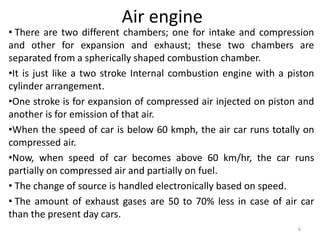
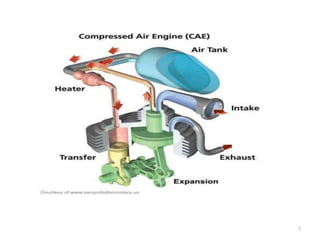
• There are two different chambers; one for intake and compression
and other for expansion and exhaust; these two chambers are
separated from a spherically shaped combustion chamber.
•It is just like a two stroke Internal combustion engine with a piston
cylinder arrangement.
•One stroke is for expansion of compressed air injected on piston and
another is for emission of that air.
•When the speed of car is below 60 kmph, the air car runs totally on
compressed air.
•Now, when speed of car becomes above 60 km/hr, the car runs
partially on compressed air and partially on fuel.
• The change of source is handled electronically based on speed.
• The amount of exhaust gases are 50 to 70% less in case of air car
than the present day cars.
6
7
Compressed air tank
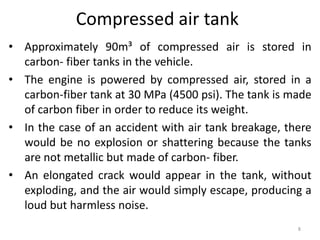
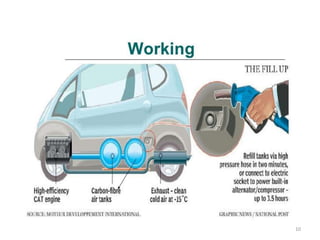
• Approximately 90m³ of compressed air is stored in
carbon- fiber tanks in the vehicle.
• The engine is powered by compressed air, stored in a
carbon-fiber tank at 30 MPa (4500 psi). The tank is made
of carbon fiber in order to reduce its weight.
• In the case of an accident with air tank breakage, there
would be no explosion or shattering because the tanks
are not metallic but made of carbon- fiber.
• An elongated crack would appear in the tank, without
exploding, and the air would simply escape, producing a
loud but harmless noise.
8
Body
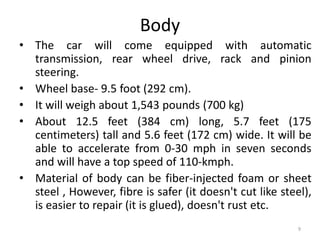
• The car will come equipped with automatic
transmission, rear wheel drive, rack and pinion
steering.
• Wheel base- 9.5 foot (292 cm).
• It will weigh about 1,543 pounds (700 kg)
• About 12.5 feet (384 cm) long, 5.7 feet (175
centimeters) tall and 5.6 feet (172 cm) wide. It will be
able to accelerate from 0-30 mph in seven seconds
and will have a top speed of 110-kmph.
• Material of body can be fiber-injected foam or sheet
steel , However, fibre is safer (it doesn't cut like steel),
is easier to repair (it is glued), doesn't rust etc.
9
10
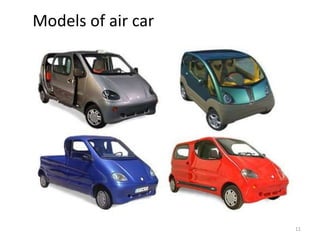
Models of air car
11
Air filter
• Before compression, the air must be filtered to get rid
of any impurities that could damage the engine. Carbon
filters are used to eliminate dirt, dust, humidity and
other particles which, unfortunately, are found in the
air in our cities.
• The exhaust pipe on the cars produces clean air, which
is cold on exit (between -15⁰ and 0⁰) and is harmless to
human life. With this system the air that comes out of
the car is cleaner than the air that went in.
• It is the first time that a car has produced minus
pollution, i.e. it eliminates’ and reduces existing
pollution rather than emitting dirt and harmful gases.
12
Electrical system
• Using a radio transmission system, each electrical
component receives signals with a microcontroller.
• Thus only one cable is needed for the whole car. So,
instead of wiring each component (headlights,
dashboard lights, lights inside the car, etc.), one cable
connects all electrical parts in the car.
• The most obvious advantages are the ease of
installation and repair and the removal of the
approximately 22 kg of wires no longer necessary.
• The entire system becomes an anti-theft alarm as soon
as the key is removed from the car.
13
Refiling system
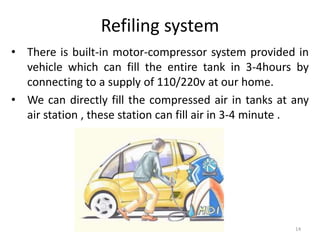
• There is built-in motor-compressor system provided in
vehicle which can fill the entire tank in 3-4hours by
connecting to a supply of 110/220v at our home.
• We can directly fill the compressed air in tanks at any
air station , these station can fill air in 3-4 minute .
14
Specification
•Intake and compression cylinder 230 cubic cm
•Expansion and exhaust cylinder 500 cubic cm
•Power max. 25 HP-CEE at 3000 rpm
•Torque max. 6.3 Kgm-CEE at 500-2500 rpm
•Power source electronically injected compressed air
15
Features of air car
• For now, the car is only optimal for city driving because
its range is limited to about 124 miles (200 km).
• Manufacturers claim to have designed engine that is
90 percent efficient. The air is compressed at pressure
about 150 times the rate the air is pressurized into car
tire or bicycle.
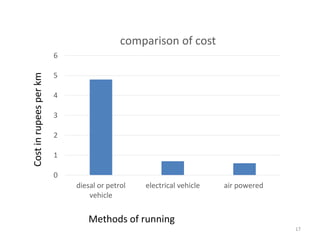
• The cost of driving such a car is typically projected to
be around Rs. 60 per 100 km, with a complete refill at
the "tank-station" at about Rs. 120 only.
16
17
0
1
2
3
4
5
6
diesal or petrol
vehicle
electrical vehicle air powered
comparison of cost
Methods of running
Costinrupeesperkm
Advantages
• Compressed air engines reduce the cost of vehicle
production by about 20%, because there is no need to build
a cooling system, spark plugs, starter motor, or mufflers.
• Refiling of air is very easy can be done at home or station.
• Avoidance of knocking phenomenon.
• No separate system for air conditioning, Expansion of the
compressed air lowers its temperature between (-15⁰ and
0⁰) this may be exploited for use as air conditioning.
• Can run on air as well as fuel.
• No pollution when speed is up to 60kmph, reduce pollution
up to 50-70% when speed is above 60kmph.
18
• Operating cost is also very low.
• Lighter vehicles would result in less wear on roads.
• Simplified, low cost maintenance, owing to the engine's
low operating temperature, e.g. oil change (2 liters of
vegetable oil) every 50,000 km.
• The rate of self-discharge is very low opposed to
batteries that deplete their charge slowly over time.
Therefore, the vehicle may be left unused for longer
periods of time than electric cars.
19
Limitation
• Its top speed is 110kmph.
• It can travel up to 200km after full recharging of tanks.
• Tanks get warm when filled rapidly. It would be difficult
to cool the tanks efficiently while charging and thus it
would either take a long time to fill the tanks, or they
would have to take less than a full charge (since heat
drives up the pressure).
20
A car that runs on air, in India soon
• Tata Motors has signed an agreement with Motor
Development International (MDI) of France to develop
a car that runs on compressed air, thus making it very
economical to run and be almost totally pollution free.
• Although there is no official word on when the car will
be commercially manufactured for India, reports say
that it will be sooner.
• The car could cost around Rs 350,000 in India and
would have a range of around 300 km between refuels.
The cost of a refill would be about Rs 90. 21
Conclusion
• From all the disruption made one can say that
by using air car there is reduction in air
pollution. The emission benefits of introducing
this zero emission technology are obvious. Also,
the aim of project is to cut cost, create job
locally. Also air car provides an answer to the
shortage of fuel and high price of fuel.
• With petrol and diesel prices going up , air car
is most economical solution for future
compared with fuel and electrical vehicle .
22
References
• www.seminarsonly.com/mechanical/airpoweredcar
• Suram Singh Verma,” Air powered vehicle", "Open fuels
and energy science journal –October 2008”,1,54-56
• www.seminarstopics.com
• www.academia.edu.com
• www.slideshare.com/airpoweredcar/image
• https://auto.howstuffworks.com/fuel-
efficiency/vehicles/air-car.htm
23
Thank you
24

Air powered car

  • 1.
    Swami keshvanand instituteof technology management and Gramothan 8th semester seminar presentation(2019-20) Topic : AIR POWERED CAR ( FUTURE OF TRANSPORTATION) Presented by Name : Aman Singhal Roll no. : 16ESKME022 Supervisor: Mr. Arun Beniwal sir (Assistant professor) Coordinators: Mr. Praveen Saraswat sir (Assistant professor) Mr. Dinesh Kumar Sharma sir (Assistant professor) 1
  • 2.
    Contents • Introduction • Aboutair car • Air engine • compressed air tanks • Body • Air filter • Electrical system • Refiling • Advantages and limitation • Future in India • Conclusion • Reference 2
  • 3.
    Introduction According to anongoing temperature analysis conducted by scientists at NASA, the average global temperature on Earth has increased by about 0.8° Celsius since 1880. One of biggest reason is pollution from vehicle , now time is to switched to another means of transportation. Electric vehicle is one of the solution , but not the final solution , but air powered vehicle / car can be one of the final solution because it using natural air present in atmosphere to run a vehicle . French engineer Guy Negre has developed a concept of a totally non pollution engine for use in urban areas, which uses high-pressure compressed air to store the energy needed for running the engine. 3 AMAN SINGHAL (16ESKME022)
  • 4.
    About air car •Anair car is a car that can run on compressed air alone without the use of conventional fuels used in present day automobile. •The technology with which air car run is “COMPRESSED AIR TECHNOLOGY”(CAT) •If the speed of car <= 60kmph then it can run on compressed air alone. •If speed of car > 60kmph then we need both fuel and compressed air to run car. 4
  • 5.
    Components •Air engine •Compressed airtanks •Body •Air filter •Electrical system •Refiling system 5
  • 6.
    Air engine • Thereare two different chambers; one for intake and compression and other for expansion and exhaust; these two chambers are separated from a spherically shaped combustion chamber. •It is just like a two stroke Internal combustion engine with a piston cylinder arrangement. •One stroke is for expansion of compressed air injected on piston and another is for emission of that air. •When the speed of car is below 60 kmph, the air car runs totally on compressed air. •Now, when speed of car becomes above 60 km/hr, the car runs partially on compressed air and partially on fuel. • The change of source is handled electronically based on speed. • The amount of exhaust gases are 50 to 70% less in case of air car than the present day cars. 6
  • 7.
  • 8.
    Compressed air tank •Approximately 90m³ of compressed air is stored in carbon- fiber tanks in the vehicle. • The engine is powered by compressed air, stored in a carbon-fiber tank at 30 MPa (4500 psi). The tank is made of carbon fiber in order to reduce its weight. • In the case of an accident with air tank breakage, there would be no explosion or shattering because the tanks are not metallic but made of carbon- fiber. • An elongated crack would appear in the tank, without exploding, and the air would simply escape, producing a loud but harmless noise. 8
  • 9.
    Body • The carwill come equipped with automatic transmission, rear wheel drive, rack and pinion steering. • Wheel base- 9.5 foot (292 cm). • It will weigh about 1,543 pounds (700 kg) • About 12.5 feet (384 cm) long, 5.7 feet (175 centimeters) tall and 5.6 feet (172 cm) wide. It will be able to accelerate from 0-30 mph in seven seconds and will have a top speed of 110-kmph. • Material of body can be fiber-injected foam or sheet steel , However, fibre is safer (it doesn't cut like steel), is easier to repair (it is glued), doesn't rust etc. 9
  • 10.
  • 11.
  • 12.
    Air filter • Beforecompression, the air must be filtered to get rid of any impurities that could damage the engine. Carbon filters are used to eliminate dirt, dust, humidity and other particles which, unfortunately, are found in the air in our cities. • The exhaust pipe on the cars produces clean air, which is cold on exit (between -15⁰ and 0⁰) and is harmless to human life. With this system the air that comes out of the car is cleaner than the air that went in. • It is the first time that a car has produced minus pollution, i.e. it eliminates’ and reduces existing pollution rather than emitting dirt and harmful gases. 12
  • 13.
    Electrical system • Usinga radio transmission system, each electrical component receives signals with a microcontroller. • Thus only one cable is needed for the whole car. So, instead of wiring each component (headlights, dashboard lights, lights inside the car, etc.), one cable connects all electrical parts in the car. • The most obvious advantages are the ease of installation and repair and the removal of the approximately 22 kg of wires no longer necessary. • The entire system becomes an anti-theft alarm as soon as the key is removed from the car. 13
  • 14.
    Refiling system • Thereis built-in motor-compressor system provided in vehicle which can fill the entire tank in 3-4hours by connecting to a supply of 110/220v at our home. • We can directly fill the compressed air in tanks at any air station , these station can fill air in 3-4 minute . 14
  • 15.
    Specification •Intake and compressioncylinder 230 cubic cm •Expansion and exhaust cylinder 500 cubic cm •Power max. 25 HP-CEE at 3000 rpm •Torque max. 6.3 Kgm-CEE at 500-2500 rpm •Power source electronically injected compressed air 15
  • 16.
    Features of aircar • For now, the car is only optimal for city driving because its range is limited to about 124 miles (200 km). • Manufacturers claim to have designed engine that is 90 percent efficient. The air is compressed at pressure about 150 times the rate the air is pressurized into car tire or bicycle. • The cost of driving such a car is typically projected to be around Rs. 60 per 100 km, with a complete refill at the "tank-station" at about Rs. 120 only. 16
  • 17.
    17 0 1 2 3 4 5 6 diesal or petrol vehicle electricalvehicle air powered comparison of cost Methods of running Costinrupeesperkm
  • 18.
    Advantages • Compressed airengines reduce the cost of vehicle production by about 20%, because there is no need to build a cooling system, spark plugs, starter motor, or mufflers. • Refiling of air is very easy can be done at home or station. • Avoidance of knocking phenomenon. • No separate system for air conditioning, Expansion of the compressed air lowers its temperature between (-15⁰ and 0⁰) this may be exploited for use as air conditioning. • Can run on air as well as fuel. • No pollution when speed is up to 60kmph, reduce pollution up to 50-70% when speed is above 60kmph. 18
  • 19.
    • Operating costis also very low. • Lighter vehicles would result in less wear on roads. • Simplified, low cost maintenance, owing to the engine's low operating temperature, e.g. oil change (2 liters of vegetable oil) every 50,000 km. • The rate of self-discharge is very low opposed to batteries that deplete their charge slowly over time. Therefore, the vehicle may be left unused for longer periods of time than electric cars. 19
  • 20.
    Limitation • Its topspeed is 110kmph. • It can travel up to 200km after full recharging of tanks. • Tanks get warm when filled rapidly. It would be difficult to cool the tanks efficiently while charging and thus it would either take a long time to fill the tanks, or they would have to take less than a full charge (since heat drives up the pressure). 20
  • 21.
    A car thatruns on air, in India soon • Tata Motors has signed an agreement with Motor Development International (MDI) of France to develop a car that runs on compressed air, thus making it very economical to run and be almost totally pollution free. • Although there is no official word on when the car will be commercially manufactured for India, reports say that it will be sooner. • The car could cost around Rs 350,000 in India and would have a range of around 300 km between refuels. The cost of a refill would be about Rs 90. 21
  • 22.
    Conclusion • From allthe disruption made one can say that by using air car there is reduction in air pollution. The emission benefits of introducing this zero emission technology are obvious. Also, the aim of project is to cut cost, create job locally. Also air car provides an answer to the shortage of fuel and high price of fuel. • With petrol and diesel prices going up , air car is most economical solution for future compared with fuel and electrical vehicle . 22
  • 23.
    References • www.seminarsonly.com/mechanical/airpoweredcar • SuramSingh Verma,” Air powered vehicle", "Open fuels and energy science journal –October 2008”,1,54-56 • www.seminarstopics.com • www.academia.edu.com • www.slideshare.com/airpoweredcar/image • https://auto.howstuffworks.com/fuel- efficiency/vehicles/air-car.htm 23
  • 24.