

AIR
CONDI
TI
ONER
WORK
PROCESS
TURBO
MODEL
LOW
WATT
POWER
SAVER
h t t p s : / / acebestbuy. shop/
Air conditioners, also known as ACs or air con,
are a common sight in many households,
businesses, and public spaces around the
world. They are used to cool down the air and
regulate the temperature and humidity levels
in a room or building, making it more
comfortable for people to work, sleep, or relax.
But how do air conditioners actually work? In
this article, we’ll take a closer look at the
science behind air conditioning and the
various components andprocesses involved.
“How does an air conditioner work” ?
1. Cooling Process
The cooling process is the heart of an air
conditioner. As mentioned, warm air is
drawn into the unit and passes over a cold
evaporator coil filled with refrigerant.
The refrigerant absorbs the heat from the
warm air and evaporates, turning into a
gas. The cooled air is then blown back into
the room by a fan, while the hot
refrigerant gas is pumped outside to a
condenser coil.
2. Refrigerant Circulation
The refrigerant is the
key tothe cooling
process in an air conditioner. It is a
chemical compound that is able to
absorb and release heat as it changes
from a liquid to a gas and back again.
The refrigerant circulates through a
closed loop of copper tubing, which
includes the evaporator coil, the
compressor, the condenser coil, and
an expansion
through the
valve.
system,
As it moves
it undergoes
changes in pressure and temperature
that enable it to absorb and release
heat.
3. Compressor
The compressor is
responsible for
pumping the refrigerant gas from the
evaporator coil to the condenser coil.
It does this by increasing the pressure
and temperature of the gas,
compressing it into a high-pressure
state. The high-pressure gas is then
pumped through the condenser coil,
where it releases the heat it absorbed
from the room into the outside air.
After this, the refrigerant returns to a
low-pressure state and is ready to be
used again.
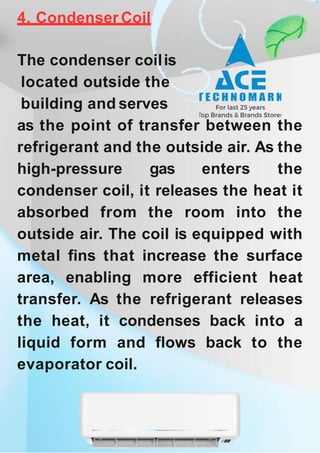
4. Condenser Coil
The condenser coilis
located outside the
building and serves
as the point of transfer between the
refrigerant and the outside air. As the
high-pressure gas enters the
condenser coil, it releases the heat it
absorbed from the room into the
outside air. The coil is equipped with
metal fins that increase the surface
area, enabling more efficient heat
transfer. As the refrigerant releases
the heat, it condenses back into a
liquid form and flows back to the
evaporator coil.
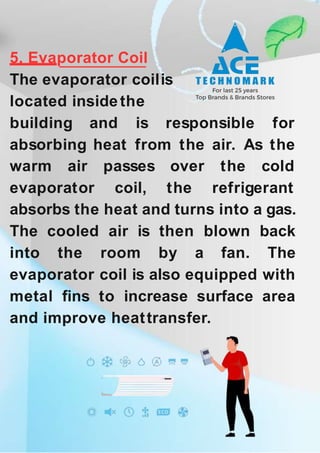
5. Evaporator Coil
The evaporator coilis
located insidethe
building and is responsible for
absorbing heat from the air. As the
warm air
evaporator
passes
coil,
over the cold
the refrigerant
absorbs the heat and turns into a gas.
The cooled air is then blown back
into the room by a fan. The
evaporator coil is also equipped with
metal fins to increase surface area
and improve heattransfer.
5 . ExpansionValve
The expansion valve regulates the
flow of refrigerant through the
system, ensuring that it enters the
evaporator coil at the right pressure
and temperature. As the refrigerant
exits the condenser coil, it is in a
high-pressure, high-temperature
state. The expansion valve reduces
the pressure and temperature of the
refrigerant, allowing it to evaporate
and absorb heat from the air as it
passes over the evaporator coil.
6. ExpansionValve
The expansion valve
regulates theflow of
refrigerant through
ensuring that it
the system,
enters the
evaporator coil at the right pressure
and temperature. As the refrigerant
exits the condenser coil, it is in a
high-pressure, high-temperature
state. The expansion valve reduces
the pressure and temperature of the
refrigerant, allowing it to evaporate
and absorb heat from the air as it
passes over the evaporator coil.
7. Thermostat
The thermostat is the component
that allows the user to set the
desired temperature for the room.
It measures the temperature of the air in
the room and sends a signal to the air
conditioner unit to turn on or off based on
the desired temperature. The thermostat
is typically located on the wall and is
connected to the air conditioner unit via
electrical wiring.
8. Humidity Control
In addition to cooling the air, air
conditioners also help to control humidity
levels in the room. As warm air passes
over the cold evaporator coil, moisture in
the air condenses on the coil and is
collected in a pan underneath. The
collected water is then drained out of the
unit via a pipe or tube. This process helps
to reduce the humidity levels in the room,
making it more comfortable for
occupants.
IIn conclusion, air conditioners are
complex systems that rely on several
components and processes to function
properly. Understanding how they work
can help users maintain their units and
troubleshoot any problems that may
arise.
ACE TECHNOMARK
BIGGEST AC DEALER IN NOIDA
J- 36 /
37 ,NEAR FOOT OVER BRIDGE,
J BLOCK, POCKETJ, SECTOR 18,NOIDA,
UTTARPRADESH, 201301
CALL: 8285666888
visi t us on : https:// acebestbuy.shop/

Air Conditioner Work Process

  • 1.
  • 2.
    Air conditioners, alsoknown as ACs or air con, are a common sight in many households, businesses, and public spaces around the world. They are used to cool down the air and regulate the temperature and humidity levels in a room or building, making it more comfortable for people to work, sleep, or relax. But how do air conditioners actually work? In this article, we’ll take a closer look at the science behind air conditioning and the various components andprocesses involved.
  • 3.
    “How does anair conditioner work” ? 1. Cooling Process The cooling process is the heart of an air conditioner. As mentioned, warm air is drawn into the unit and passes over a cold evaporator coil filled with refrigerant. The refrigerant absorbs the heat from the warm air and evaporates, turning into a gas. The cooled air is then blown back into the room by a fan, while the hot refrigerant gas is pumped outside to a condenser coil.
  • 4.
    2. Refrigerant Circulation Therefrigerant is the key tothe cooling process in an air conditioner. It is a chemical compound that is able to absorb and release heat as it changes from a liquid to a gas and back again. The refrigerant circulates through a closed loop of copper tubing, which includes the evaporator coil, the compressor, the condenser coil, and an expansion through the valve. system, As it moves it undergoes changes in pressure and temperature that enable it to absorb and release heat.
  • 5.
    3. Compressor The compressoris responsible for pumping the refrigerant gas from the evaporator coil to the condenser coil. It does this by increasing the pressure and temperature of the gas, compressing it into a high-pressure state. The high-pressure gas is then pumped through the condenser coil, where it releases the heat it absorbed from the room into the outside air. After this, the refrigerant returns to a low-pressure state and is ready to be used again.
  • 6.
    4. Condenser Coil Thecondenser coilis located outside the building and serves as the point of transfer between the refrigerant and the outside air. As the high-pressure gas enters the condenser coil, it releases the heat it absorbed from the room into the outside air. The coil is equipped with metal fins that increase the surface area, enabling more efficient heat transfer. As the refrigerant releases the heat, it condenses back into a liquid form and flows back to the evaporator coil.
  • 7.
    5. Evaporator Coil Theevaporator coilis located insidethe building and is responsible for absorbing heat from the air. As the warm air evaporator passes coil, over the cold the refrigerant absorbs the heat and turns into a gas. The cooled air is then blown back into the room by a fan. The evaporator coil is also equipped with metal fins to increase surface area and improve heattransfer.
  • 8.
    5 . ExpansionValve Theexpansion valve regulates the flow of refrigerant through the system, ensuring that it enters the evaporator coil at the right pressure and temperature. As the refrigerant exits the condenser coil, it is in a high-pressure, high-temperature state. The expansion valve reduces the pressure and temperature of the refrigerant, allowing it to evaporate and absorb heat from the air as it passes over the evaporator coil.
  • 9.
    6. ExpansionValve The expansionvalve regulates theflow of refrigerant through ensuring that it the system, enters the evaporator coil at the right pressure and temperature. As the refrigerant exits the condenser coil, it is in a high-pressure, high-temperature state. The expansion valve reduces the pressure and temperature of the refrigerant, allowing it to evaporate and absorb heat from the air as it passes over the evaporator coil. 7. Thermostat The thermostat is the component that allows the user to set the desired temperature for the room.
  • 10.
    It measures thetemperature of the air in the room and sends a signal to the air conditioner unit to turn on or off based on the desired temperature. The thermostat is typically located on the wall and is connected to the air conditioner unit via electrical wiring. 8. Humidity Control In addition to cooling the air, air conditioners also help to control humidity levels in the room. As warm air passes over the cold evaporator coil, moisture in the air condenses on the coil and is collected in a pan underneath. The collected water is then drained out of the unit via a pipe or tube. This process helps to reduce the humidity levels in the room, making it more comfortable for occupants.
  • 11.
    IIn conclusion, airconditioners are complex systems that rely on several components and processes to function properly. Understanding how they work can help users maintain their units and troubleshoot any problems that may arise.
  • 12.
    ACE TECHNOMARK BIGGEST ACDEALER IN NOIDA J- 36 / 37 ,NEAR FOOT OVER BRIDGE, J BLOCK, POCKETJ, SECTOR 18,NOIDA, UTTARPRADESH, 201301 CALL: 8285666888 visi t us on : https:// acebestbuy.shop/