Content
1
⚫Introduction
⚫Working principle
⚫Functions of components
⚫Advantages
⚫Limitations
⚫Conclusion
Introduction
2
⚫ In Indian railway there are different type of
coaches which are manufactured by
different units
⚫ ICF
⚫ RCF
(Integrated Coach Factory), Chennai
(Rail Coach Factory), Kapurtala
⚫ BEML (Bharat Earth Movers Limited),
Bengaluru
What is brake ?????
3
A brake is a device by means of which
artificial resistance is applied to a moving
machine member, in order to slow or stop
the motion of a machine.
What is Air Brake system ?
Brakes applied with the help of air pressure
are called Air Brakes and the system
actuated to apply this phenomenon is
called as Air Brake System.
Air Brake Concept
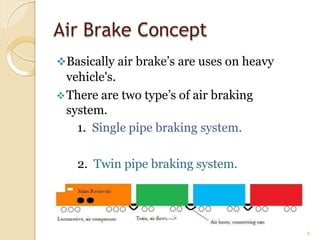
Basically air brake’s are uses on heavy
vehicle's.
There are two type’s of air braking
system.
1. Single pipe braking system.
2. Twin pipe braking system.
4
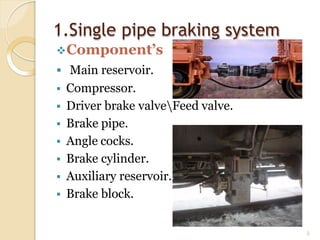
1.Single pipe braking system
Component’s
 Main reservoir.
 Compressor.
 Driver brake valveFeed valve.
 Brake pipe.
 Angle cocks.
 Brake cylinder.
 Auxiliary reservoir.
 Brake block.
5
Function of components
6
 Compressor:
The pump which draws air from
atmosphere and compresses it on the train.
 Main Reservoir:
Storage tank for compressed air for
braking and other pneumatic system.
 Feed Valve:
To ensure that the brake pipe pleasure
remains at the required level.
 Brake pipe:
The pipe running the length of the train.
Which transmits the variation in pressure
required to control the brake.
 Angle cocks:
At the end of the each vehicle angle cocks
are provided to allow the ends of the brake
pipe hoses.
 Brake cylinder:
Each vehicle are at least one brake
cylinder. Sometimes two or more are
provided.
11
 Auxiliary reservoir:
There is always a source of air available to
operate the brake auxiliary valve is connected
on one side of the piston of triple valve.
 Brake bloke:
This is frictional material which is pressed
against the surface of the wheel.
 Triple valve:
The orientation of the brake on each
vehicle is controlled by the tripled valve.
8
2.Twin pipe braking system
Twin pipe is the advanced process on
which it is possible to use of the air in
the auxiliary reservoir more quickly
then brake pipe can recharge it.
Basically there are two pipes are use
on the each vehicle.
9
Advantages
10
⚫ Air is available everywhere in atmosphere
so the brake can never run out of its
operating.
⚫ Air does not corrode the metals so the life of
pneumatic brake is more.
⚫ Air brakes are effective even with
considerable leakage, so an air brake system
can be designed with sufficient fail-safe
capacity to stop the vehicle safely even when
leaking.
Limitations
Maintenance
Initial cost
11
Conclusion
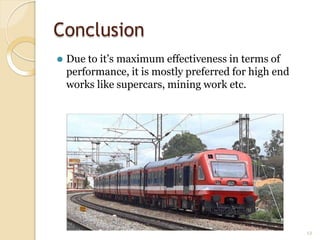
⚫ Due to it’s maximum effectiveness in terms of
performance, it is mostly preferred for high end
works like supercars, mining work etc.
12
13

AIR BRAKING SYSTEM AVINASH.pptx

  • 1.
    Content 1 ⚫Introduction ⚫Working principle ⚫Functions ofcomponents ⚫Advantages ⚫Limitations ⚫Conclusion
  • 2.
    Introduction 2 ⚫ In Indianrailway there are different type of coaches which are manufactured by different units ⚫ ICF ⚫ RCF (Integrated Coach Factory), Chennai (Rail Coach Factory), Kapurtala ⚫ BEML (Bharat Earth Movers Limited), Bengaluru
  • 3.
    What is brake????? 3 A brake is a device by means of which artificial resistance is applied to a moving machine member, in order to slow or stop the motion of a machine. What is Air Brake system ? Brakes applied with the help of air pressure are called Air Brakes and the system actuated to apply this phenomenon is called as Air Brake System.
  • 4.
    Air Brake Concept Basicallyair brake’s are uses on heavy vehicle's. There are two type’s of air braking system. 1. Single pipe braking system. 2. Twin pipe braking system. 4
  • 5.
    1.Single pipe brakingsystem Component’s  Main reservoir.  Compressor.  Driver brake valveFeed valve.  Brake pipe.  Angle cocks.  Brake cylinder.  Auxiliary reservoir.  Brake block. 5
  • 6.
    Function of components 6 Compressor: The pump which draws air from atmosphere and compresses it on the train.  Main Reservoir: Storage tank for compressed air for braking and other pneumatic system.  Feed Valve: To ensure that the brake pipe pleasure remains at the required level.
  • 7.
     Brake pipe: Thepipe running the length of the train. Which transmits the variation in pressure required to control the brake.  Angle cocks: At the end of the each vehicle angle cocks are provided to allow the ends of the brake pipe hoses.  Brake cylinder: Each vehicle are at least one brake cylinder. Sometimes two or more are provided. 11
  • 8.
     Auxiliary reservoir: Thereis always a source of air available to operate the brake auxiliary valve is connected on one side of the piston of triple valve.  Brake bloke: This is frictional material which is pressed against the surface of the wheel.  Triple valve: The orientation of the brake on each vehicle is controlled by the tripled valve. 8
  • 9.
    2.Twin pipe brakingsystem Twin pipe is the advanced process on which it is possible to use of the air in the auxiliary reservoir more quickly then brake pipe can recharge it. Basically there are two pipes are use on the each vehicle. 9
  • 10.
    Advantages 10 ⚫ Air isavailable everywhere in atmosphere so the brake can never run out of its operating. ⚫ Air does not corrode the metals so the life of pneumatic brake is more. ⚫ Air brakes are effective even with considerable leakage, so an air brake system can be designed with sufficient fail-safe capacity to stop the vehicle safely even when leaking.
  • 11.
  • 12.
    Conclusion ⚫ Due toit’s maximum effectiveness in terms of performance, it is mostly preferred for high end works like supercars, mining work etc. 12
  • 13.