Artificial Insemination
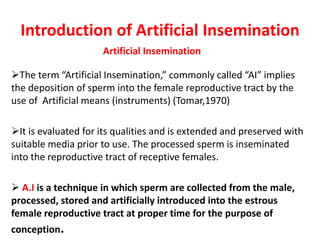
The term “Artificial Insemination,” commonly called “AI” implies
the deposition of sperm into the female reproductive tract by the
use of Artificial means (instruments) (Tomar,1970)
It is evaluated for its qualities and is extended and preserved with
suitable media prior to use. The processed sperm is inseminated
into the reproductive tract of receptive females.
 A.I is a technique in which sperm are collected from the male,
processed, stored and artificially introduced into the estrous
female reproductive tract at proper time for the purpose of
conception.
Introduction of Artificial Insemination
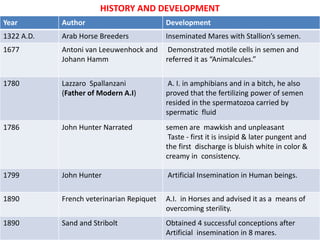
HISTORY AND DEVELOPMENT
Year Author Development
1322 A.D. Arab Horse Breeders Inseminated Mares with Stallion’s semen.
1677 Antoni van Leeuwenhock and
Johann Hamm
Demonstrated motile cells in semen and
referred it as “Animalcules.”
1780 Lazzaro Spallanzani
(Father of Modern A.I)
A. I. in amphibians and in a bitch, he also
proved that the fertilizing power of semen
resided in the spermatozoa carried by
spermatic fluid
1786 John Hunter Narrated semen are mawkish and unpleasant
Taste - first it is insipid & later pungent and
the first discharge is bluish white in color &
creamy in consistency.
1799 John Hunter Artificial Insemination in Human beings.
1890 French veterinarian Repiquet A.I. in Horses and advised it as a means of
overcoming sterility.
1890 Sand and Stribolt Obtained 4 successful conceptions after
Artificial insemination in 8 mares.
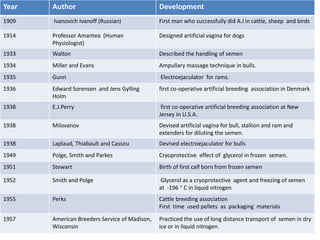
Year Author Development
1909 Ivanovich Ivanoff (Russian) First man who successfully did A.I in cattle, sheep and birds
1914 Professor Amantea (Human
Physiologist)
Designed artificial vagina for dogs
1933 Walton Described the handling of semen
1934 Miller and Evans Ampullary massage technique in bulls.
1935 Gunn Electroejaculator for rams.
1936 Edward Sorensen and Jens Gylling
Holm
first co-operative artificial breeding association in Denmark
1938 E.J.Perry first co-operative artificial breeding association at New
Jersey in U.S.A.
1938 Milovanov Devised artificial vagina for bull, stallion and ram and
extenders for diluting the semen.
1938 Laplaud, Thiabault and Cassou Devised electroejaculator for bulls
1949 Polge, Smith and Parkes Cryoprotective effect of glycerol in frozen semen.
1951 Stewart Birth of first calf born from frozen semen
1952 Smith and Polge Glycerol as a cryoprotective agent and freezing of semen
at -196 ° C in liquid nitrogen
1955 Perks Cattle breeding association
First time used pellets as packaging materials
1957 American Breeders Service of Madison,
Wisconsin
Practiced the use of long distance transport of semen in dry
ice or in liquid nitrogen.
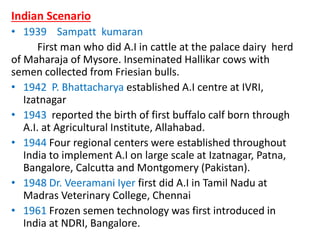
Indian Scenario
• 1939 Sampatt kumaran
First man who did A.I in cattle at the palace dairy herd
of Maharaja of Mysore. Inseminated Hallikar cows with
semen collected from Friesian bulls.
• 1942 P. Bhattacharya established A.I centre at IVRI,
Izatnagar
• 1943 reported the birth of first buffalo calf born through
A.I. at Agricultural Institute, Allahabad.
• 1944 Four regional centers were established throughout
India to implement A.I on large scale at Izatnagar, Patna,
Bangalore, Calcutta and Montgomery (Pakistan).
• 1948 Dr. Veeramani Iyer first did A.I in Tamil Nadu at
Madras Veterinary College, Chennai
• 1961 Frozen semen technology was first introduced in
India at NDRI, Bangalore.
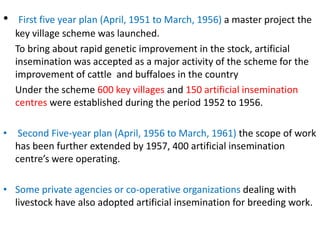
• First five year plan (April, 1951 to March, 1956) a master project the
key village scheme was launched.
To bring about rapid genetic improvement in the stock, artificial
insemination was accepted as a major activity of the scheme for the
improvement of cattle and buffaloes in the country
Under the scheme 600 key villages and 150 artificial insemination
centres were established during the period 1952 to 1956.
• Second Five-year plan (April, 1956 to March, 1961) the scope of work
has been further extended by 1957, 400 artificial insemination
centre’s were operating.
• Some private agencies or co-operative organizations dealing with
livestock have also adopted artificial insemination for breeding work.
Advantages of A.I.
 Quick genetic improvement
 Control of venereal diseases
 Maximum possible use of best sires
 Quick progeny testing
 Economical
 Correct breeding records
 Quality of semen
 Overcome size difference of animal
 Overcome physical inability of bull
 Easy transportation
 Cryopreservation of semen
 Early detection of undesirable genetic traits in the progeny
 Good programme for small holding dairy farmers
Disadvantages of A.I.
 Requires high standards of technical efficiency
 Proper and timely detection of estrus
 Proper knowledge of reproduction is required to avoid AI in
unwanted conditions.
 Genetic defects may be transmitted quickly if selection of a bull is
not perfect.
 High risk of inbreeding
 Costly equipments are required

A.I-PowerPoint ART ARTIFICIAL REPRODUCTIVE TECHNOLOGY

  • 1.
    Artificial Insemination The term“Artificial Insemination,” commonly called “AI” implies the deposition of sperm into the female reproductive tract by the use of Artificial means (instruments) (Tomar,1970) It is evaluated for its qualities and is extended and preserved with suitable media prior to use. The processed sperm is inseminated into the reproductive tract of receptive females.  A.I is a technique in which sperm are collected from the male, processed, stored and artificially introduced into the estrous female reproductive tract at proper time for the purpose of conception. Introduction of Artificial Insemination
  • 2.
    HISTORY AND DEVELOPMENT YearAuthor Development 1322 A.D. Arab Horse Breeders Inseminated Mares with Stallion’s semen. 1677 Antoni van Leeuwenhock and Johann Hamm Demonstrated motile cells in semen and referred it as “Animalcules.” 1780 Lazzaro Spallanzani (Father of Modern A.I) A. I. in amphibians and in a bitch, he also proved that the fertilizing power of semen resided in the spermatozoa carried by spermatic fluid 1786 John Hunter Narrated semen are mawkish and unpleasant Taste - first it is insipid & later pungent and the first discharge is bluish white in color & creamy in consistency. 1799 John Hunter Artificial Insemination in Human beings. 1890 French veterinarian Repiquet A.I. in Horses and advised it as a means of overcoming sterility. 1890 Sand and Stribolt Obtained 4 successful conceptions after Artificial insemination in 8 mares.
  • 3.
    Year Author Development 1909Ivanovich Ivanoff (Russian) First man who successfully did A.I in cattle, sheep and birds 1914 Professor Amantea (Human Physiologist) Designed artificial vagina for dogs 1933 Walton Described the handling of semen 1934 Miller and Evans Ampullary massage technique in bulls. 1935 Gunn Electroejaculator for rams. 1936 Edward Sorensen and Jens Gylling Holm first co-operative artificial breeding association in Denmark 1938 E.J.Perry first co-operative artificial breeding association at New Jersey in U.S.A. 1938 Milovanov Devised artificial vagina for bull, stallion and ram and extenders for diluting the semen. 1938 Laplaud, Thiabault and Cassou Devised electroejaculator for bulls 1949 Polge, Smith and Parkes Cryoprotective effect of glycerol in frozen semen. 1951 Stewart Birth of first calf born from frozen semen 1952 Smith and Polge Glycerol as a cryoprotective agent and freezing of semen at -196 ° C in liquid nitrogen 1955 Perks Cattle breeding association First time used pellets as packaging materials 1957 American Breeders Service of Madison, Wisconsin Practiced the use of long distance transport of semen in dry ice or in liquid nitrogen.
  • 4.
    Indian Scenario • 1939Sampatt kumaran First man who did A.I in cattle at the palace dairy herd of Maharaja of Mysore. Inseminated Hallikar cows with semen collected from Friesian bulls. • 1942 P. Bhattacharya established A.I centre at IVRI, Izatnagar • 1943 reported the birth of first buffalo calf born through A.I. at Agricultural Institute, Allahabad. • 1944 Four regional centers were established throughout India to implement A.I on large scale at Izatnagar, Patna, Bangalore, Calcutta and Montgomery (Pakistan). • 1948 Dr. Veeramani Iyer first did A.I in Tamil Nadu at Madras Veterinary College, Chennai • 1961 Frozen semen technology was first introduced in India at NDRI, Bangalore.
  • 5.
    • First fiveyear plan (April, 1951 to March, 1956) a master project the key village scheme was launched. To bring about rapid genetic improvement in the stock, artificial insemination was accepted as a major activity of the scheme for the improvement of cattle and buffaloes in the country Under the scheme 600 key villages and 150 artificial insemination centres were established during the period 1952 to 1956. • Second Five-year plan (April, 1956 to March, 1961) the scope of work has been further extended by 1957, 400 artificial insemination centre’s were operating. • Some private agencies or co-operative organizations dealing with livestock have also adopted artificial insemination for breeding work.
  • 6.
    Advantages of A.I. Quick genetic improvement  Control of venereal diseases  Maximum possible use of best sires  Quick progeny testing  Economical  Correct breeding records  Quality of semen  Overcome size difference of animal  Overcome physical inability of bull  Easy transportation  Cryopreservation of semen  Early detection of undesirable genetic traits in the progeny  Good programme for small holding dairy farmers
  • 7.
    Disadvantages of A.I. Requires high standards of technical efficiency  Proper and timely detection of estrus  Proper knowledge of reproduction is required to avoid AI in unwanted conditions.  Genetic defects may be transmitted quickly if selection of a bull is not perfect.  High risk of inbreeding  Costly equipments are required