AIIMS May 2017
Derma MCQs with
solutions
“ Out of 11 derma MCQs
asked in AIIMS May 2017, 10
were straight from this book.
(See references from this
book below)
Dr Saurabh Jindal
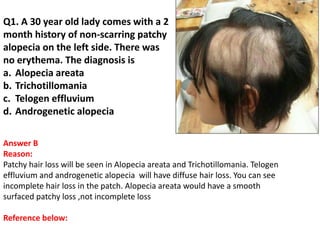
Q1. A 30 year old lady comes with a 2
month history of non-scarring patchy
alopecia on the left side. There was
no erythema. The diagnosis is
a. Alopecia areata
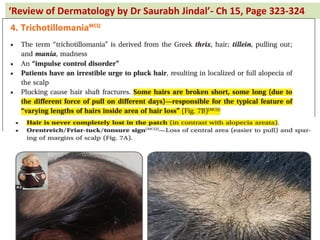
b. Trichotillomania
c. Telogen effluvium
d. Androgenetic alopecia
Answer B
Reason:
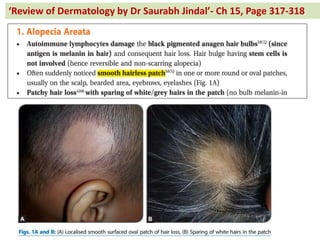
Patchy hair loss will be seen in Alopecia areata and Trichotillomania. Telogen
effluvium and androgenetic alopecia will have diffuse hair loss. You can see
incomplete hair loss in the patch. Alopecia areata would have a smooth
surfaced patchy loss ,not incomplete loss
Reference below:
Re ie of Dermatology by Dr Saurabh Jindal - Ch 15, Page 323-324
Re ie of Dermatology by Dr Saurabh Jindal - Ch 15, Page 317-318
Q2 . A patient comes with skin and oral lesions.
All are true except
a. Dsg 3 antibodies
b. Dsg 1 antibodies
c. Antibody against hemidesmosome
d. IgG type is the most common
Answer –C
Reason:
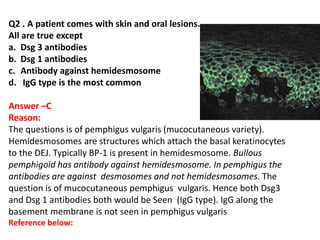
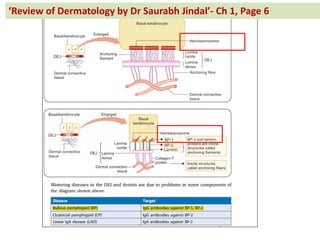
The questions is of pemphigus vulgaris (mucocutaneous variety).
Hemidesmosomes are structures which attach the basal keratinocytes
to the DEJ. Typically BP-1 is present in hemidesmosome. Bullous
pemphigoid has antibody against hemidesmosome. In pemphigus the
antibodies are against desmosomes and not hemidesmosomes. The
question is of mucocutaneous pemphigus vulgaris. Hence both Dsg3
and Dsg 1 antibodies both would be Seen (IgG type). IgG along the
basement membrane is not seen in pemphigus vulgaris
Reference below:
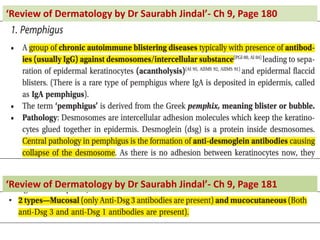
Re ie of Dermatology by Dr Saurabh Jindal - Ch 9, Page 180
Re ie of Dermatology by Dr Saurabh Jindal - Ch 9, Page 181
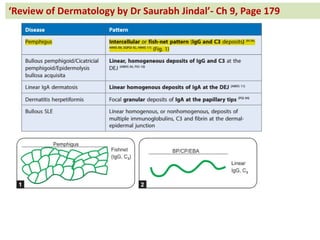
Re ie of Dermatology by Dr Saurabh Jindal - Ch 9, Page 179
Re ie of Dermatology by Dr Saurabh Jindal - Ch 1, Page 6
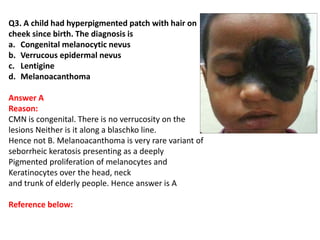
Q3. A child had hyperpigmented patch with hair on
cheek since birth. The diagnosis is
a. Congenital melanocytic nevus
b. Verrucous epidermal nevus
c. Lentigine
d. Melanoacanthoma
Answer A
Reason:
CMN is congenital. There is no verrucosity on the
lesions Neither is it along a blaschko line.
Hence not B. Melanoacanthoma is very rare variant of
seborrheic keratosis presenting as a deeply
Pigmented proliferation of melanocytes and
Keratinocytes over the head, neck
and trunk of elderly people. Hence answer is A
Reference below:
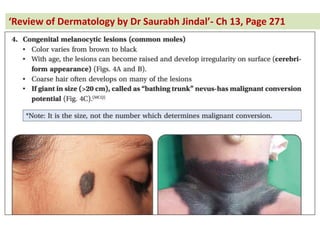
Re ie of Dermatology by Dr Saurabh Jindal - Ch 13, Page 271
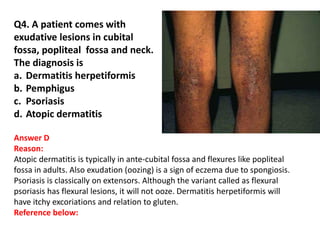
Q4. A patient comes with
exudative lesions in cubital
fossa, popliteal fossa and neck.
The diagnosis is
a. Dermatitis herpetiformis
b. Pemphigus
c. Psoriasis
d. Atopic dermatitis
Answer D
Reason:
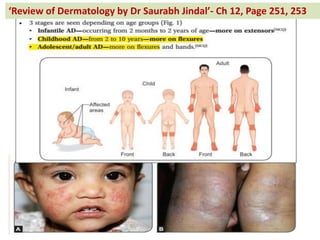
Atopic dermatitis is typically in ante-cubital fossa and flexures like popliteal
fossa in adults. Also exudation (oozing) is a sign of eczema due to spongiosis.
Psoriasis is classically on extensors. Although the variant called as flexural
psoriasis has flexural lesions, it will not ooze. Dermatitis herpetiformis will
have itchy excoriations and relation to gluten.
Reference below:
Re ie of Dermatology by Dr Saurabh Jindal - Ch 12, Page 251, 253
Q5 . A child comes with a circular 3 cm x 3 cm scaly patchy hair
loss with itching in the lesions. The investigation of choice is
a. Slit skin smear
b. KOH
c. Gram stain
d. Tzanck smear
Answer – B
Reason:
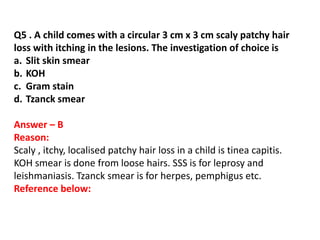
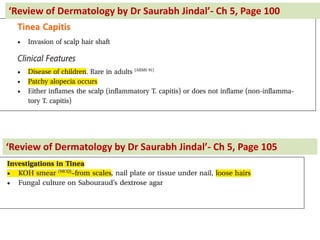
Scaly , itchy, localised patchy hair loss in a child is tinea capitis.
KOH smear is done from loose hairs. SSS is for leprosy and
leishmaniasis. Tzanck smear is for herpes, pemphigus etc.
Reference below:
Re ie of Dermatology by Dr Saurabh Jindal - Ch 5, Page 105
Re ie of Dermatology by Dr Saurabh Jindal - Ch 5, Page 100
Q6 . A patient comes with a genital ulcer.
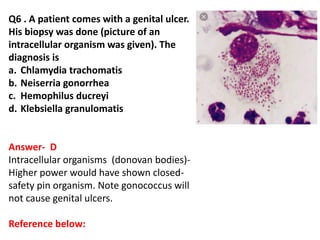
His biopsy was done (picture of an
intracellular organism was given). The
diagnosis is
a. Chlamydia trachomatis
b. Neiserria gonorrhea
c. Hemophilus ducreyi
d. Klebsiella granulomatis
Answer- D
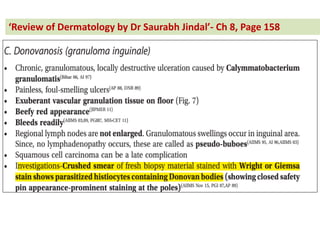
Intracellular organisms (donovan bodies)-
Higher power would have shown closed-
safety pin organism. Note gonococcus will
not cause genital ulcers.
Reference below:
Re ie of Dermatology by Dr Saurabh Jindal - Ch 8, Page 158
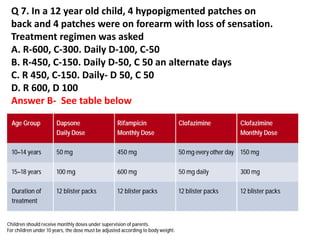
Q 7. In a 12 year old child, 4 hypopigmented patches on
back and 4 patches were on forearm with loss of sensation.
Treatment regimen was asked
A. R-600, C-300. Daily D-100, C-50
B. R-450, C-150. Daily D-50, C 50 an alternate days
C. R 450, C-150. Daily- D 50, C 50
D. R 600, D 100
Answer B- See table below
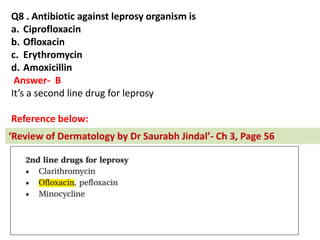
Q8 . Antibiotic against leprosy organism is
a. Ciprofloxacin
b. Ofloxacin
c. Erythromycin
d. Amoxicillin
Answer- B
It’s a second line drug for leprosy
Reference below:
Re ie of Dermatology by Dr Saurabh Jindal - Ch 3, Page 56
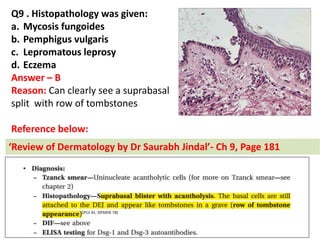
Q9 . Histopathology was given:
a. Mycosis fungoides
b. Pemphigus vulgaris
c. Lepromatous leprosy
d. Eczema
Answer – B
Reason: Can clearly see a suprabasal
split with row of tombstones
Reference below:
Re ie of Dermatology by Dr Saurabh Jindal - Ch 9, Page 181
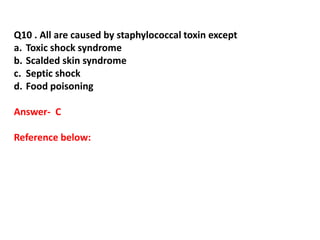
Q10 . All are caused by staphylococcal toxin except
a. Toxic shock syndrome
b. Scalded skin syndrome
c. Septic shock
d. Food poisoning
Answer- C
Reference below:
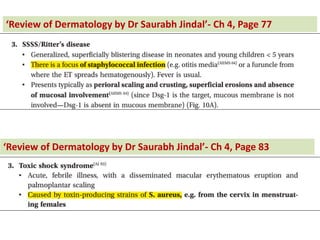
Re ie of Dermatology by Dr Saurabh Jindal - Ch 4, Page 83
Re ie of Dermatology by Dr Saurabh Jindal - Ch 4, Page 77
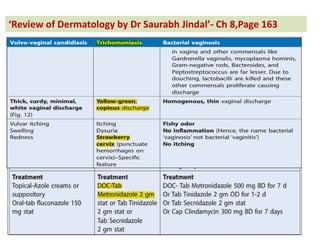
Q11 . A female comes with frothy, green vaginal discharge of 5
days duration. There was a strawberry cervix on examination.
The drug of choice is
a. Metronidazole
b. Tetracycline
c. Fluconazole
d. Ciprofloxacin
Answer- A
Reference below:
Re ie of Dermatology by Dr Saurabh Jindal - Ch 8,Page 163

AIIMS May 2017 Derma MCQs with solutions

  • 1.
    AIIMS May 2017 DermaMCQs with solutions “ Out of 11 derma MCQs asked in AIIMS May 2017, 10 were straight from this book. (See references from this book below) Dr Saurabh Jindal
  • 2.
    Q1. A 30year old lady comes with a 2 month history of non-scarring patchy alopecia on the left side. There was no erythema. The diagnosis is a. Alopecia areata b. Trichotillomania c. Telogen effluvium d. Androgenetic alopecia Answer B Reason: Patchy hair loss will be seen in Alopecia areata and Trichotillomania. Telogen effluvium and androgenetic alopecia will have diffuse hair loss. You can see incomplete hair loss in the patch. Alopecia areata would have a smooth surfaced patchy loss ,not incomplete loss Reference below:
  • 3.
    Re ie ofDermatology by Dr Saurabh Jindal - Ch 15, Page 323-324
  • 4.
    Re ie ofDermatology by Dr Saurabh Jindal - Ch 15, Page 317-318
  • 5.
    Q2 . Apatient comes with skin and oral lesions. All are true except a. Dsg 3 antibodies b. Dsg 1 antibodies c. Antibody against hemidesmosome d. IgG type is the most common Answer –C Reason: The questions is of pemphigus vulgaris (mucocutaneous variety). Hemidesmosomes are structures which attach the basal keratinocytes to the DEJ. Typically BP-1 is present in hemidesmosome. Bullous pemphigoid has antibody against hemidesmosome. In pemphigus the antibodies are against desmosomes and not hemidesmosomes. The question is of mucocutaneous pemphigus vulgaris. Hence both Dsg3 and Dsg 1 antibodies both would be Seen (IgG type). IgG along the basement membrane is not seen in pemphigus vulgaris Reference below:
  • 6.
    Re ie ofDermatology by Dr Saurabh Jindal - Ch 9, Page 180 Re ie of Dermatology by Dr Saurabh Jindal - Ch 9, Page 181
  • 7.
    Re ie ofDermatology by Dr Saurabh Jindal - Ch 9, Page 179
  • 8.
    Re ie ofDermatology by Dr Saurabh Jindal - Ch 1, Page 6
  • 9.
    Q3. A childhad hyperpigmented patch with hair on cheek since birth. The diagnosis is a. Congenital melanocytic nevus b. Verrucous epidermal nevus c. Lentigine d. Melanoacanthoma Answer A Reason: CMN is congenital. There is no verrucosity on the lesions Neither is it along a blaschko line. Hence not B. Melanoacanthoma is very rare variant of seborrheic keratosis presenting as a deeply Pigmented proliferation of melanocytes and Keratinocytes over the head, neck and trunk of elderly people. Hence answer is A Reference below:
  • 10.
    Re ie ofDermatology by Dr Saurabh Jindal - Ch 13, Page 271
  • 11.
    Q4. A patientcomes with exudative lesions in cubital fossa, popliteal fossa and neck. The diagnosis is a. Dermatitis herpetiformis b. Pemphigus c. Psoriasis d. Atopic dermatitis Answer D Reason: Atopic dermatitis is typically in ante-cubital fossa and flexures like popliteal fossa in adults. Also exudation (oozing) is a sign of eczema due to spongiosis. Psoriasis is classically on extensors. Although the variant called as flexural psoriasis has flexural lesions, it will not ooze. Dermatitis herpetiformis will have itchy excoriations and relation to gluten. Reference below:
  • 12.
    Re ie ofDermatology by Dr Saurabh Jindal - Ch 12, Page 251, 253
  • 13.
    Q5 . Achild comes with a circular 3 cm x 3 cm scaly patchy hair loss with itching in the lesions. The investigation of choice is a. Slit skin smear b. KOH c. Gram stain d. Tzanck smear Answer – B Reason: Scaly , itchy, localised patchy hair loss in a child is tinea capitis. KOH smear is done from loose hairs. SSS is for leprosy and leishmaniasis. Tzanck smear is for herpes, pemphigus etc. Reference below:
  • 14.
    Re ie ofDermatology by Dr Saurabh Jindal - Ch 5, Page 105 Re ie of Dermatology by Dr Saurabh Jindal - Ch 5, Page 100
  • 15.
    Q6 . Apatient comes with a genital ulcer. His biopsy was done (picture of an intracellular organism was given). The diagnosis is a. Chlamydia trachomatis b. Neiserria gonorrhea c. Hemophilus ducreyi d. Klebsiella granulomatis Answer- D Intracellular organisms (donovan bodies)- Higher power would have shown closed- safety pin organism. Note gonococcus will not cause genital ulcers. Reference below:
  • 16.
    Re ie ofDermatology by Dr Saurabh Jindal - Ch 8, Page 158
  • 17.
    Q 7. Ina 12 year old child, 4 hypopigmented patches on back and 4 patches were on forearm with loss of sensation. Treatment regimen was asked A. R-600, C-300. Daily D-100, C-50 B. R-450, C-150. Daily D-50, C 50 an alternate days C. R 450, C-150. Daily- D 50, C 50 D. R 600, D 100 Answer B- See table below
  • 18.
    Q8 . Antibioticagainst leprosy organism is a. Ciprofloxacin b. Ofloxacin c. Erythromycin d. Amoxicillin Answer- B It’s a second line drug for leprosy Reference below: Re ie of Dermatology by Dr Saurabh Jindal - Ch 3, Page 56
  • 19.
    Q9 . Histopathologywas given: a. Mycosis fungoides b. Pemphigus vulgaris c. Lepromatous leprosy d. Eczema Answer – B Reason: Can clearly see a suprabasal split with row of tombstones Reference below: Re ie of Dermatology by Dr Saurabh Jindal - Ch 9, Page 181
  • 20.
    Q10 . Allare caused by staphylococcal toxin except a. Toxic shock syndrome b. Scalded skin syndrome c. Septic shock d. Food poisoning Answer- C Reference below:
  • 21.
    Re ie ofDermatology by Dr Saurabh Jindal - Ch 4, Page 83 Re ie of Dermatology by Dr Saurabh Jindal - Ch 4, Page 77
  • 22.
    Q11 . Afemale comes with frothy, green vaginal discharge of 5 days duration. There was a strawberry cervix on examination. The drug of choice is a. Metronidazole b. Tetracycline c. Fluconazole d. Ciprofloxacin Answer- A Reference below:
  • 23.
    Re ie ofDermatology by Dr Saurabh Jindal - Ch 8,Page 163