AI METHODS FOR LOCALIZATION IN NOISY
ENVIRONMENT
ANA ANTONOVA & KAMELIA KOSEKOVA
GITHUB REPOS
 dataepisteme/AI-for-Localization
 datasciencesociety/Lego-Mindstorm
A.ANTONOVA & K.KOSEKOVA 2
LOCALIZATION?
 Position Tracking Global
Localization Kidnapped Robot
 Static and Dynamic Environment
 Passive and Active Localization
 Localization and Mapping
A.ANTONOVA & K.KOSEKOVA 3
UNCERTAINTY
 Environments
 Sensors
 Robots
 Models
 Computation
A.ANTONOVA & K.KOSEKOVA 4
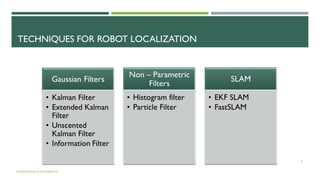
TECHNIQUES FOR ROBOT LOCALIZATION
A.ANTONOVA & K.KOSEKOVA
5
SOME IMPORTANT NOTIONS
 State
x0:t = {x0,x1, x2…,xt }
 Observation/measurement
z1:t = {z1,z2, z3…,zt }
 Control data
u1:t = {u1,u2, u3…,ut }
A.ANTONOVA & K.KOSEKOVA 6
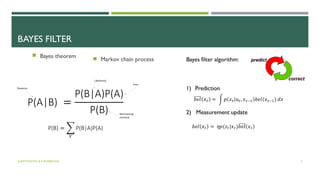
BAYES FILTER
 Bayes theorem  Markov chain process
A.ANTONOVA & K.KOSEKOVA 7
GAUSSIAN FILTERS
 Earliest implementations of the Bayes filter
 Assumptions:
 Beliefs are represented by multivariate normal distributions
 Properties of Gaussians:
 Unimodal
A.ANTONOVA & K.KOSEKOVA 8
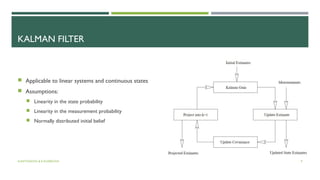
KALMAN FILTER
 Applicable to linear systems and continuous states
 Assumptions:
 Linearity in the state probability
 Linearity in the measurement probability
 Normally distributed initial belief
A.ANTONOVA & K.KOSEKOVA 9
EXTENDED KALMAN FILTER
 Applicable to nonlinear systems
 Applies linearization via Taylor expansion
 Approximates the nonlinear functions -> leads to a
Gaussian posterior belief
 The most popular tool for state estimation
 Computationally efficient
 Drawbacks: Uncapable of representing multi-modal
beliefs
A.ANTONOVA & K.KOSEKOVA 10GitHub: AtsushiSakai/PythonRobotics
EKF LOCALIZATION
 Special case of Markov localization
 Well-suited technique for local position tracking with limited uncertainty and in environments with distinct
features (landmarks)
 Initial position is known
 For the implementation of the algorithm we need the following:
 Motion model
 Measurement model
 Map of the environment
A.ANTONOVA & K.KOSEKOVA 11
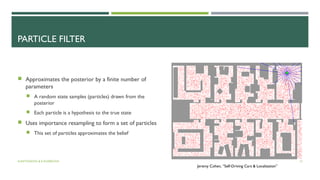
PARTICLE FILTER
 Approximates the posterior by a finite number of
parameters
 A random state samples (particles) drawn from the
posterior
 Each particle is a hypothesis to the true state
 Uses importance resampling to form a set of particles
 This set of particles approximates the belief
A.ANTONOVA & K.KOSEKOVA 12
Jeremy Cohen, “Self-Driving Cars & Localization”
MONTE CARLO LOCALIZATION
 Uses particle filter
 Able to solve local/global localization and kidnapped robot problems (recover from localization failure)
 The kidnapped robot problem is solved by adding random particles
 Able to process raw sensor measurements and negative information
 The accuracy-computational costs trade-off is achieved through the size of the particle set
 For the implementation of the algorithm we need the following:
 Motion model
 Measurement model
 Map of the environment
 Initial belief
A.ANTONOVA & K.KOSEKOVA 13
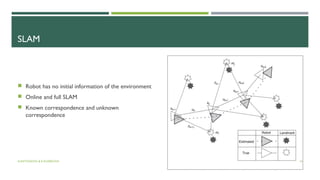
SLAM
 Robot has no initial information of the environment
 Online and full SLAM
 Known correspondence and unknown
correspondence
A.ANTONOVA & K.KOSEKOVA 14
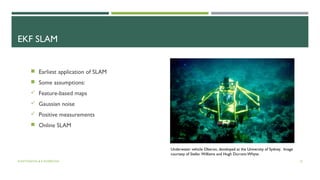
EKF SLAM
Underwater vehicle Oberon, developed at the University of Sydney. Image
courtesy of Stefan Williams and Hugh Durrant-Whyte.
 Earliest application of SLAM
 Some assumptions:
 Feature-based maps
 Gaussian noise
 Positive measurements
 Online SLAM
A.ANTONOVA & K.KOSEKOVA 15
FASTSLAM
 Resolving the computational complexity of EKF SLAM
 Each Particle in the algorithm get separate landmark
estimators for each landmark – log(N) time.
A.ANTONOVA & K.KOSEKOVA 16
GitHub: AtsushiSakai/PythonRobotics
17
“FastSLAM: A Factored Solution to theSimultaneous Localization and Mapping
ProblemWith Unknown Data Association”, M. Montemerlo
THANKYOU!
A.ANTONOVA & K.KOSEKOVA 18
Q&A

AI methods for localization in noisy environment

  • 1.
    AI METHODS FORLOCALIZATION IN NOISY ENVIRONMENT ANA ANTONOVA & KAMELIA KOSEKOVA
  • 2.
    GITHUB REPOS  dataepisteme/AI-for-Localization datasciencesociety/Lego-Mindstorm A.ANTONOVA & K.KOSEKOVA 2
  • 3.
    LOCALIZATION?  Position TrackingGlobal Localization Kidnapped Robot  Static and Dynamic Environment  Passive and Active Localization  Localization and Mapping A.ANTONOVA & K.KOSEKOVA 3
  • 4.
    UNCERTAINTY  Environments  Sensors Robots  Models  Computation A.ANTONOVA & K.KOSEKOVA 4
  • 5.
    TECHNIQUES FOR ROBOTLOCALIZATION A.ANTONOVA & K.KOSEKOVA 5
  • 6.
    SOME IMPORTANT NOTIONS State x0:t = {x0,x1, x2…,xt }  Observation/measurement z1:t = {z1,z2, z3…,zt }  Control data u1:t = {u1,u2, u3…,ut } A.ANTONOVA & K.KOSEKOVA 6
  • 7.
    BAYES FILTER  Bayestheorem  Markov chain process A.ANTONOVA & K.KOSEKOVA 7
  • 8.
    GAUSSIAN FILTERS  Earliestimplementations of the Bayes filter  Assumptions:  Beliefs are represented by multivariate normal distributions  Properties of Gaussians:  Unimodal A.ANTONOVA & K.KOSEKOVA 8
  • 9.
    KALMAN FILTER  Applicableto linear systems and continuous states  Assumptions:  Linearity in the state probability  Linearity in the measurement probability  Normally distributed initial belief A.ANTONOVA & K.KOSEKOVA 9
  • 10.
    EXTENDED KALMAN FILTER Applicable to nonlinear systems  Applies linearization via Taylor expansion  Approximates the nonlinear functions -> leads to a Gaussian posterior belief  The most popular tool for state estimation  Computationally efficient  Drawbacks: Uncapable of representing multi-modal beliefs A.ANTONOVA & K.KOSEKOVA 10GitHub: AtsushiSakai/PythonRobotics
  • 11.
    EKF LOCALIZATION  Specialcase of Markov localization  Well-suited technique for local position tracking with limited uncertainty and in environments with distinct features (landmarks)  Initial position is known  For the implementation of the algorithm we need the following:  Motion model  Measurement model  Map of the environment A.ANTONOVA & K.KOSEKOVA 11
  • 12.
    PARTICLE FILTER  Approximatesthe posterior by a finite number of parameters  A random state samples (particles) drawn from the posterior  Each particle is a hypothesis to the true state  Uses importance resampling to form a set of particles  This set of particles approximates the belief A.ANTONOVA & K.KOSEKOVA 12 Jeremy Cohen, “Self-Driving Cars & Localization”
  • 13.
    MONTE CARLO LOCALIZATION Uses particle filter  Able to solve local/global localization and kidnapped robot problems (recover from localization failure)  The kidnapped robot problem is solved by adding random particles  Able to process raw sensor measurements and negative information  The accuracy-computational costs trade-off is achieved through the size of the particle set  For the implementation of the algorithm we need the following:  Motion model  Measurement model  Map of the environment  Initial belief A.ANTONOVA & K.KOSEKOVA 13
  • 14.
    SLAM  Robot hasno initial information of the environment  Online and full SLAM  Known correspondence and unknown correspondence A.ANTONOVA & K.KOSEKOVA 14
  • 15.
    EKF SLAM Underwater vehicleOberon, developed at the University of Sydney. Image courtesy of Stefan Williams and Hugh Durrant-Whyte.  Earliest application of SLAM  Some assumptions:  Feature-based maps  Gaussian noise  Positive measurements  Online SLAM A.ANTONOVA & K.KOSEKOVA 15
  • 16.
    FASTSLAM  Resolving thecomputational complexity of EKF SLAM  Each Particle in the algorithm get separate landmark estimators for each landmark – log(N) time. A.ANTONOVA & K.KOSEKOVA 16 GitHub: AtsushiSakai/PythonRobotics
  • 17.
    17 “FastSLAM: A FactoredSolution to theSimultaneous Localization and Mapping ProblemWith Unknown Data Association”, M. Montemerlo
  • 18.