Comparative Analysis of Encryption Algorithms
FROM RESEARCH PAPER
SYMMETRIC & ASYMMETRIC ALGORITHMS
Agenda
 introduction
 Symmetric & Asymmetric Algorithms
 Which is the best algorithm?
 Comparative analysis (why best?)
 References (proof)
Introduction
.
 In this era the computer and software engineers have faced many attacks on
cyber security that affect the confidentiality of the users.
 These attacks broke almost all the security algorithms due to which the
confidentiality, authentication, integrity, availability and identification of the
user data is being affected.
.
.
Comparison on the basis of Different Parameters
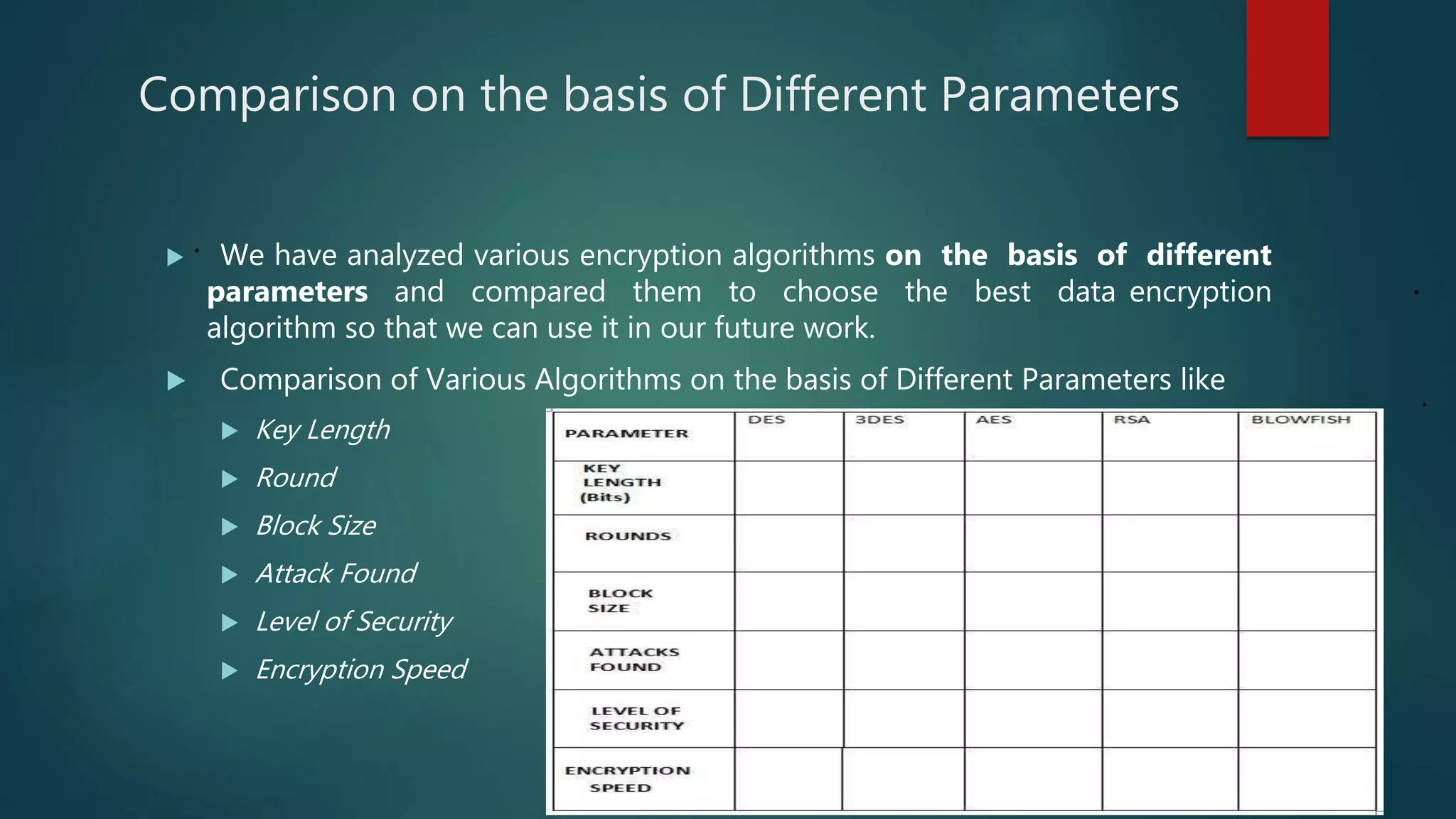
. We have analyzed various encryption algorithms on the basis of different
parameters and compared them to choose the best data encryption
algorithm so that we can use it in our future work.
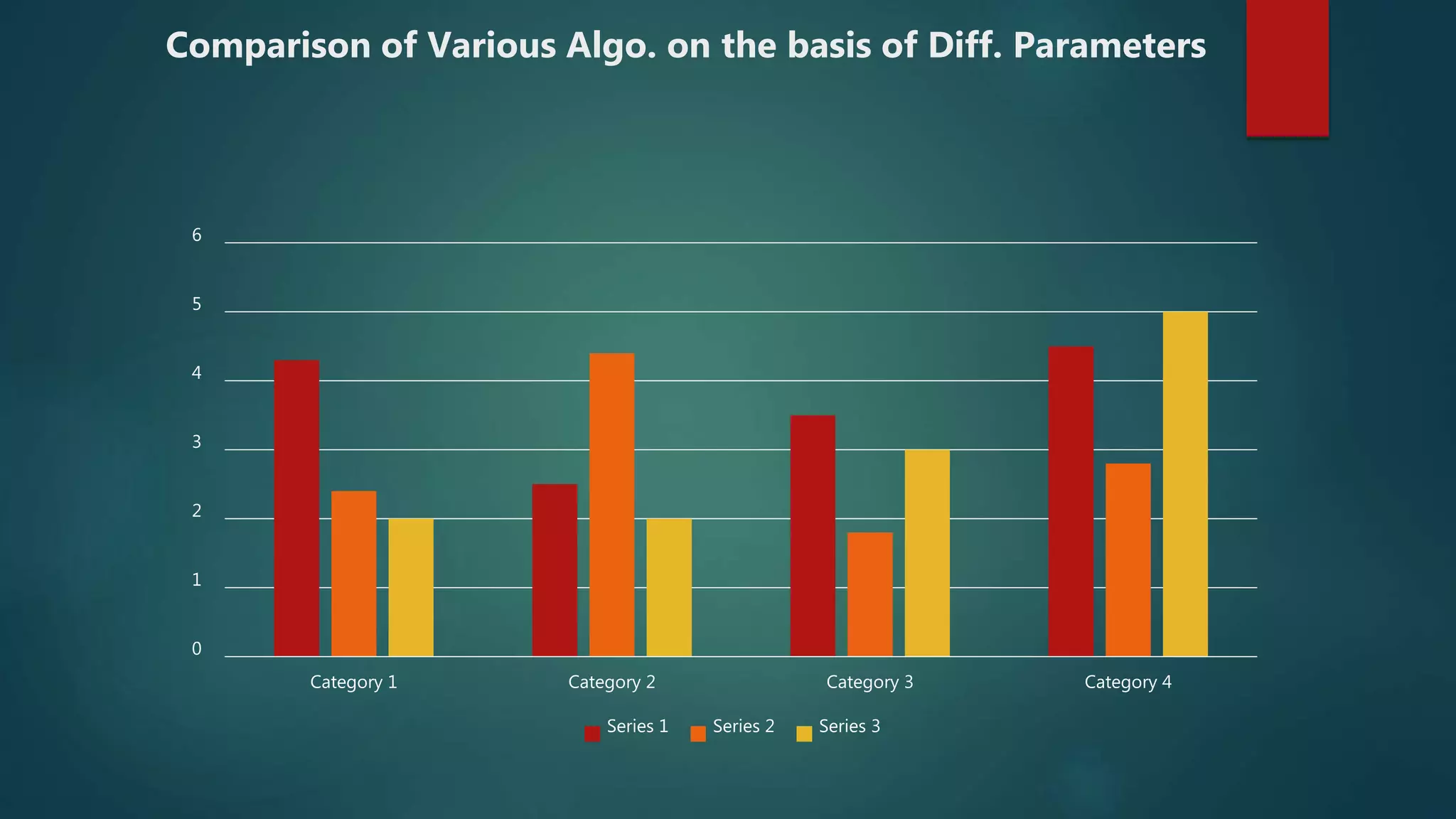
 Comparison of Various Algorithms on the basis of Different Parameters like
 Key Length
 Round
 Block Size
 Attack Found
 Level of Security
 Encryption Speed
.
.
Comparison of Various Algo. on the basis of Diff. Parameters
0
1
2
3
4
5
6
Category 1 Category 2 Category 3 Category 4
Series 1 Series 2 Series 3
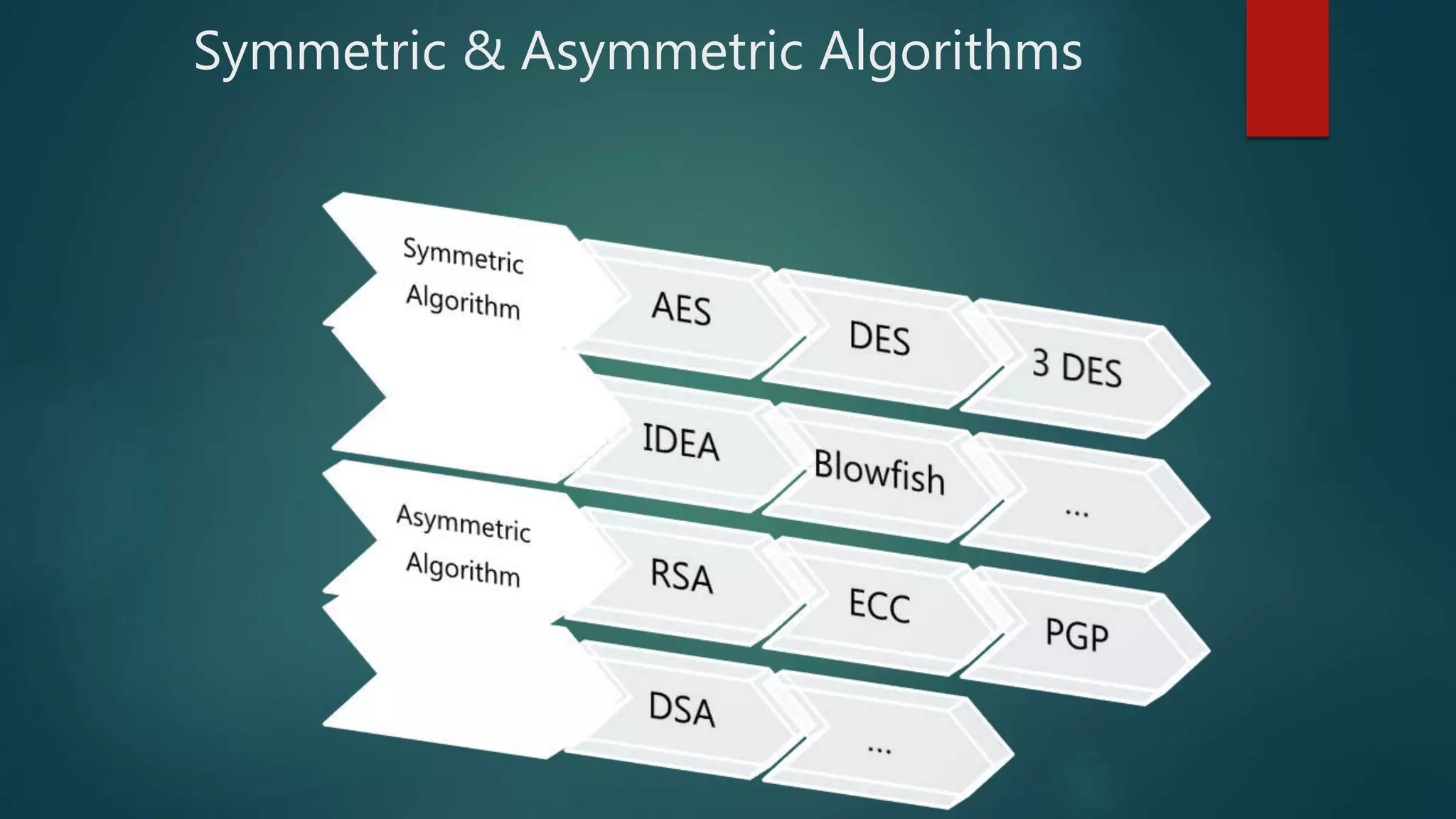
Symmetric & Asymmetric Algorithms
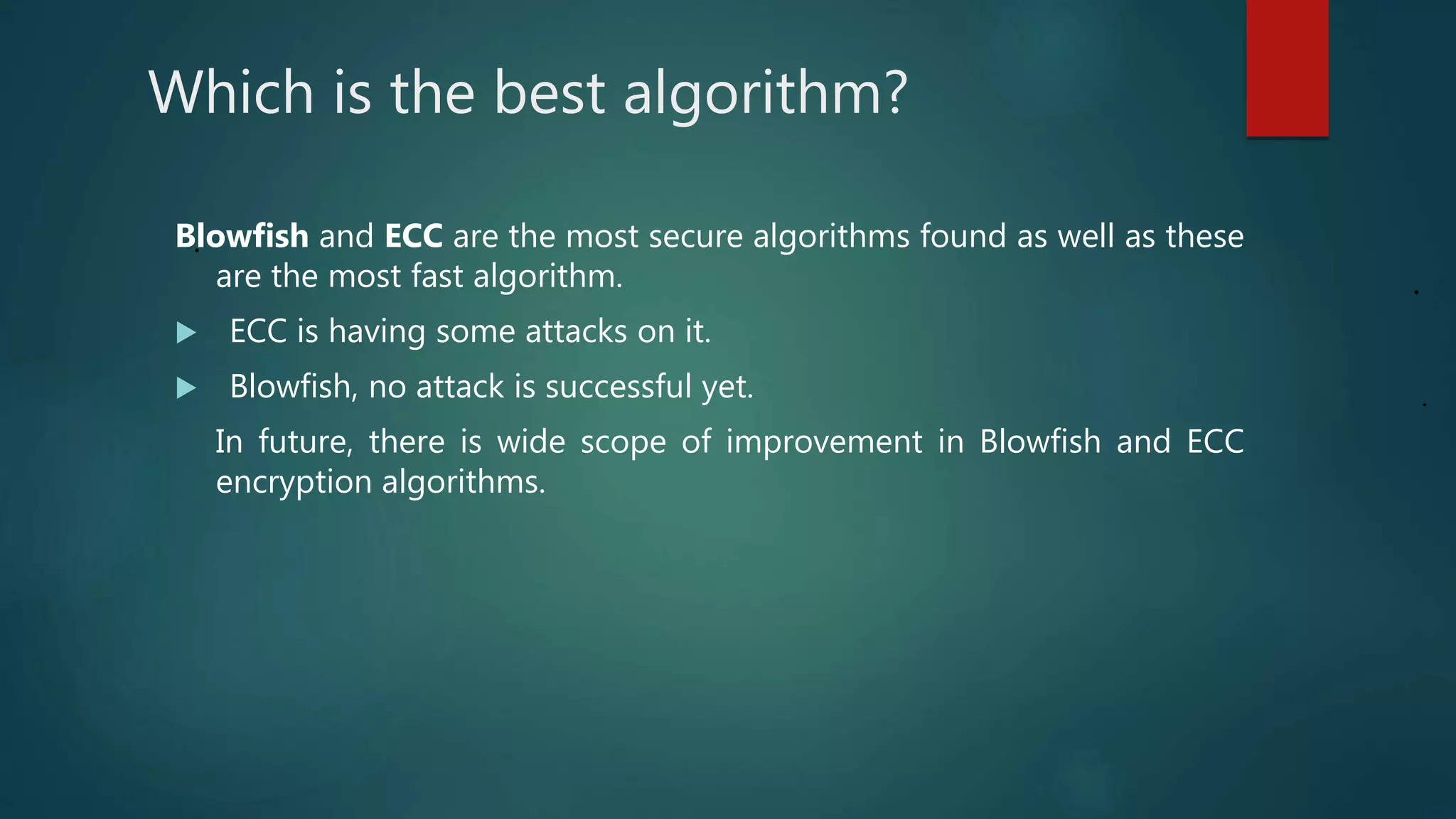
Which is the best algorithm?
.Blowfish and ECC are the most secure algorithms found as well as these
are the most fast algorithm.
 ECC is having some attacks on it.
 Blowfish, no attack is successful yet.
In future, there is wide scope of improvement in Blowfish and ECC
encryption algorithms.
.
.
BLOWFISH
.
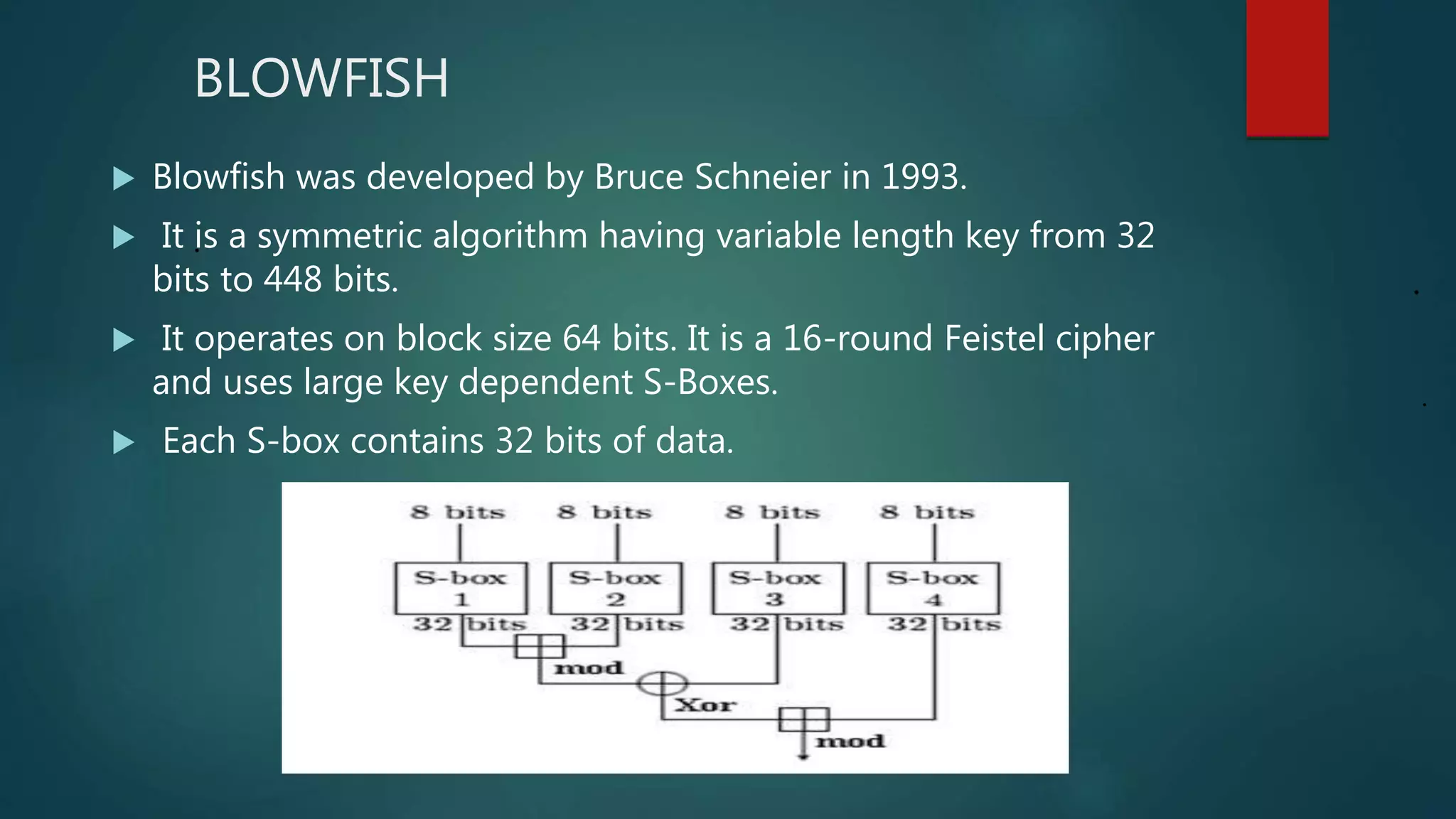
 Blowfish was developed by Bruce Schneier in 1993.
 It is a symmetric algorithm having variable length key from 32
bits to 448 bits.
 It operates on block size 64 bits. It is a 16-round Feistel cipher
and uses large key dependent S-Boxes.
 Each S-box contains 32 bits of data.
.
.
BLOWFISH
.
 Blowfish provides a good encryption rate in software.
 In many encryption simulation experiments the Blowfish
encryption algorithm is declared best because of security level
that is offers and speed of encryption, which is better than the
most of the encryption algorithm available.
.
.
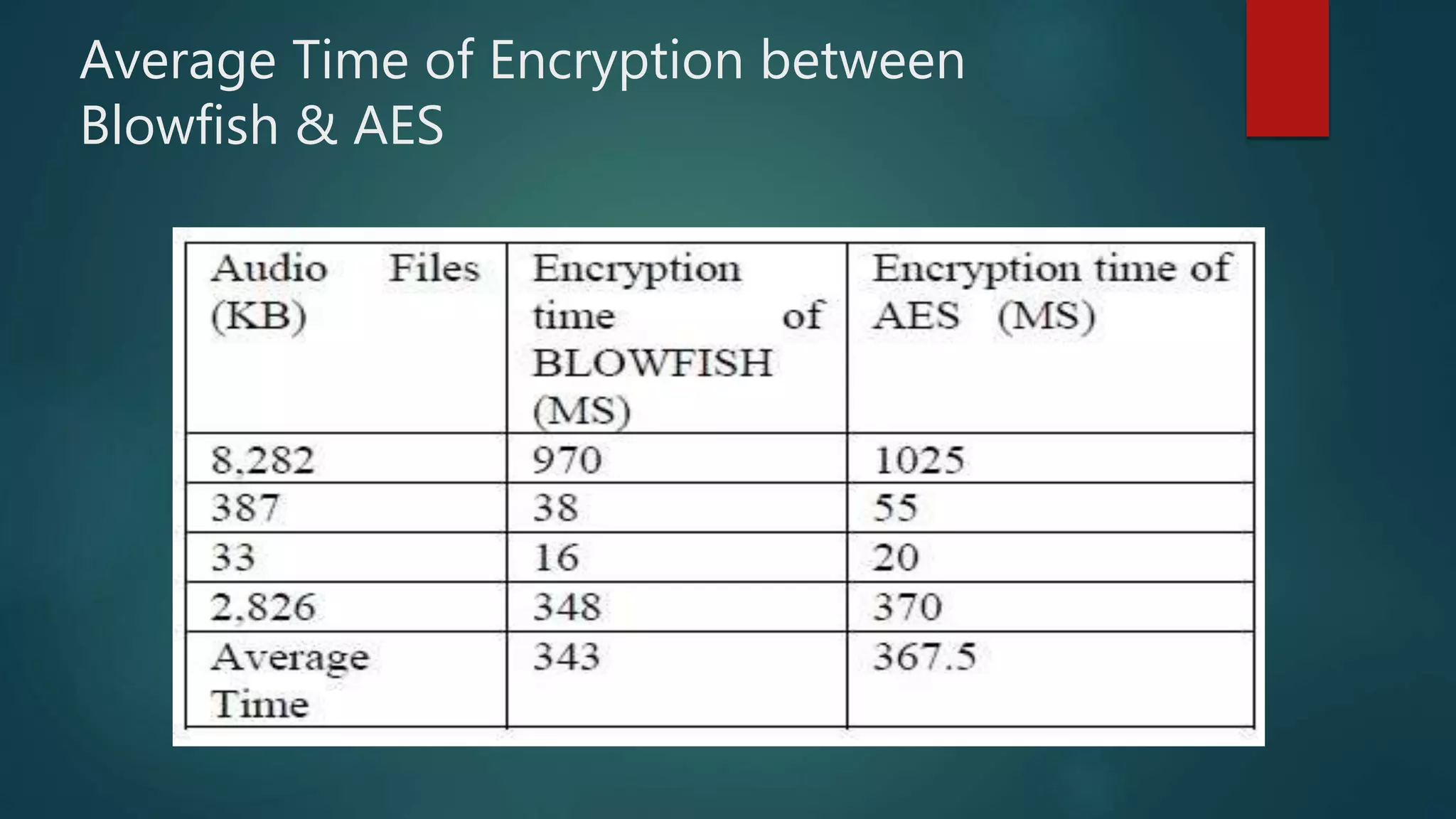
Average Time of Encryption between
Blowfish & AES
0
1
2
3
4
5
6
Category 1 Category 2 Category 3 Category 4
Series 1 Series 2 Series 3
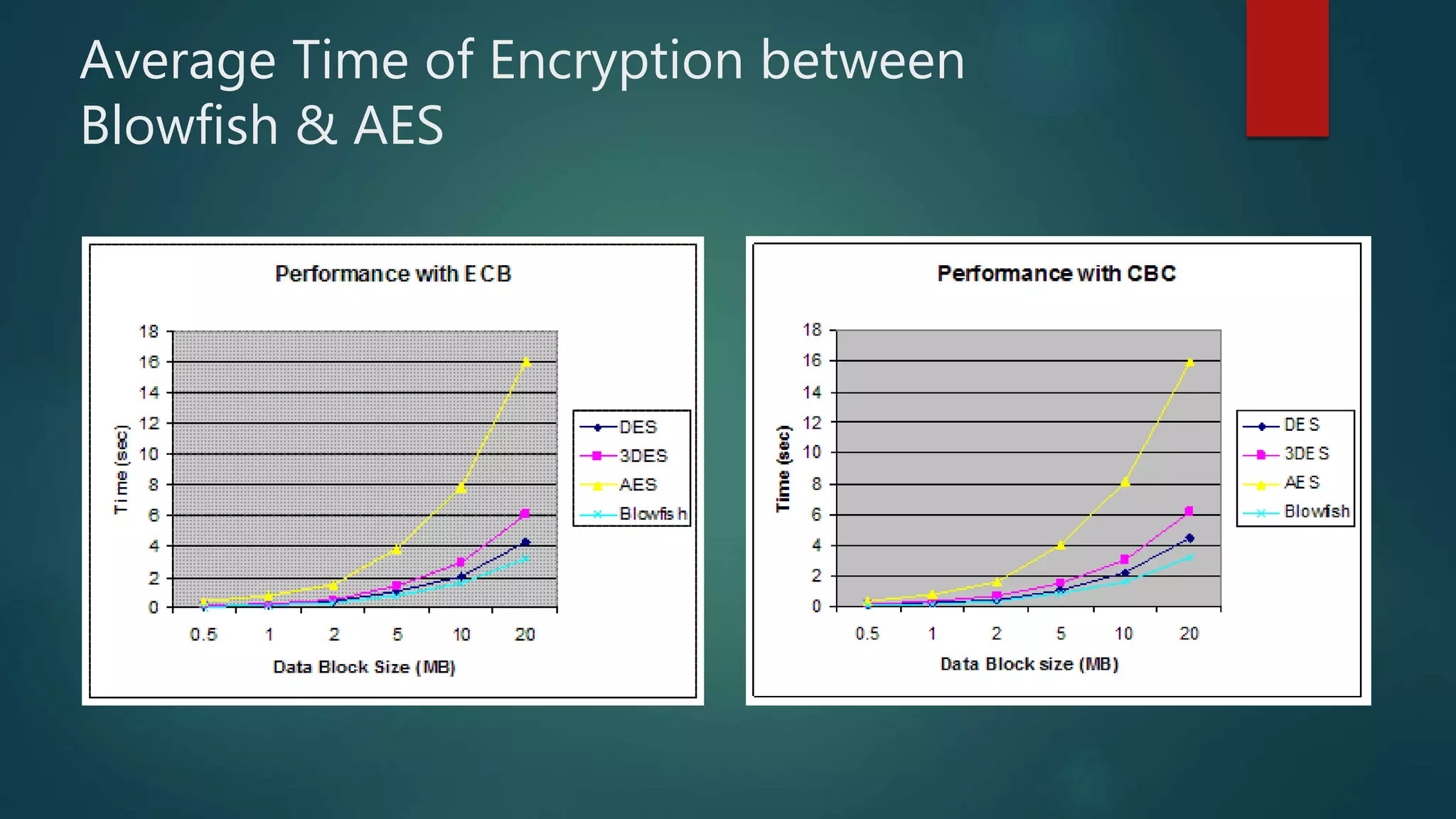
Average Time of Encryption between
Blowfish & AES
 Why AES is Mostly Used?
.
AES is designed for both hardware and in software. It accepts a
128-, 192- or 256-bit key. It has a decently quick key setup
time and relatively small memory requirements, and encrypts
128 bits of data at a time. .
. Why Blowfish is not Mostly Used?
Blowfish was designed for software. It uses a lot of memory and
has a relatively long key setup time, but it's fast after that. It
accepts keys up to 448 bits (which is massive overkill), and
encrypts 64 bits of data at a time.
References
.
 International Journal of Innovative Research in Computer and Communication Engineering, (An
ISO 3297: 2007 Certified Organization), Vol. 4, Issue 9, September 2016
 Milind Mathur.and Ayush Kesarwani “Comparison Between DES , 3DES ,RC2 , RC6 , BLOWFISH
And AES”, Proceedings of National Conference on New Horizons, university of Oklahoma, , ISBN
978-93-82338- 79-6,2013.
 Pratap Chandra Mandal, “Evaluation of performance of the Symmetric Key Algorithms: DES,
3DES ,AES and Blowfish”, Journal of Global Research in Computer Science, Volume 3, No. 8,
August 2012.
 Jawahar Thakur and Nagesh Kumar, “DES, AES and Blowfish: Symmetric Key Cryptography
Algorithms Simulation Based Performance
 Analysis”, International Journal of Emerging Technology and Advanced Engineering, ISSN 2250-
2459, Volume 1, Issue 2, December 2011.
 SparkIM project DLL for blowfish - http://www.codeproject.com/Tips/235342/Blow
fish-Encryption-Implementation-in-Net.
.
.
.
.
THANKS!
.
.

Comparative analysis of algorithms

  • 1.
    Comparative Analysis ofEncryption Algorithms FROM RESEARCH PAPER SYMMETRIC & ASYMMETRIC ALGORITHMS
  • 2.
    Agenda  introduction  Symmetric& Asymmetric Algorithms  Which is the best algorithm?  Comparative analysis (why best?)  References (proof)
  • 3.
    Introduction .  In thisera the computer and software engineers have faced many attacks on cyber security that affect the confidentiality of the users.  These attacks broke almost all the security algorithms due to which the confidentiality, authentication, integrity, availability and identification of the user data is being affected. . .
  • 4.
    Comparison on thebasis of Different Parameters . We have analyzed various encryption algorithms on the basis of different parameters and compared them to choose the best data encryption algorithm so that we can use it in our future work.  Comparison of Various Algorithms on the basis of Different Parameters like  Key Length  Round  Block Size  Attack Found  Level of Security  Encryption Speed . .
  • 5.
    Comparison of VariousAlgo. on the basis of Diff. Parameters 0 1 2 3 4 5 6 Category 1 Category 2 Category 3 Category 4 Series 1 Series 2 Series 3
  • 6.
  • 7.
    Which is thebest algorithm? .Blowfish and ECC are the most secure algorithms found as well as these are the most fast algorithm.  ECC is having some attacks on it.  Blowfish, no attack is successful yet. In future, there is wide scope of improvement in Blowfish and ECC encryption algorithms. . .
  • 8.
    BLOWFISH .  Blowfish wasdeveloped by Bruce Schneier in 1993.  It is a symmetric algorithm having variable length key from 32 bits to 448 bits.  It operates on block size 64 bits. It is a 16-round Feistel cipher and uses large key dependent S-Boxes.  Each S-box contains 32 bits of data. . .
  • 9.
    BLOWFISH .  Blowfish providesa good encryption rate in software.  In many encryption simulation experiments the Blowfish encryption algorithm is declared best because of security level that is offers and speed of encryption, which is better than the most of the encryption algorithm available. . .
  • 10.
    Average Time ofEncryption between Blowfish & AES 0 1 2 3 4 5 6 Category 1 Category 2 Category 3 Category 4 Series 1 Series 2 Series 3
  • 11.
    Average Time ofEncryption between Blowfish & AES
  • 12.
     Why AESis Mostly Used? . AES is designed for both hardware and in software. It accepts a 128-, 192- or 256-bit key. It has a decently quick key setup time and relatively small memory requirements, and encrypts 128 bits of data at a time. . . Why Blowfish is not Mostly Used? Blowfish was designed for software. It uses a lot of memory and has a relatively long key setup time, but it's fast after that. It accepts keys up to 448 bits (which is massive overkill), and encrypts 64 bits of data at a time.
  • 13.
    References .  International Journalof Innovative Research in Computer and Communication Engineering, (An ISO 3297: 2007 Certified Organization), Vol. 4, Issue 9, September 2016  Milind Mathur.and Ayush Kesarwani “Comparison Between DES , 3DES ,RC2 , RC6 , BLOWFISH And AES”, Proceedings of National Conference on New Horizons, university of Oklahoma, , ISBN 978-93-82338- 79-6,2013.  Pratap Chandra Mandal, “Evaluation of performance of the Symmetric Key Algorithms: DES, 3DES ,AES and Blowfish”, Journal of Global Research in Computer Science, Volume 3, No. 8, August 2012.  Jawahar Thakur and Nagesh Kumar, “DES, AES and Blowfish: Symmetric Key Cryptography Algorithms Simulation Based Performance  Analysis”, International Journal of Emerging Technology and Advanced Engineering, ISSN 2250- 2459, Volume 1, Issue 2, December 2011.  SparkIM project DLL for blowfish - http://www.codeproject.com/Tips/235342/Blow fish-Encryption-Implementation-in-Net. . .
  • 14.