CA’s SERVICES IN AGRICULTURE SECTOR ENHANCING
PRODUCTIVITY
BENEFIT TO AGRICULTURIST AND NATION
About the Author:
CA (Dr.) Adukia left no stone unturned during his career span expanding to more than
39 years. Having graduated from Sydenham College of Commerce & Economics in
1980 as 5th rank holder in Bombay University and he has also received a Gold Medal
for highest marks in Accountancy & Auditing. He cleared the Chartered Accountancy
Examination with 1st Rank in Intermediate and 6th
Rank in Final. He also secured 3rd
Rank in the Final Cost Accountancy Course. He has been awarded G.P. Kapadia prize
for best student of the year 1981. He also holds a Degree in law, PhD in Corporate
Governance in Mutual Funds, MBA, Diploma in IFRS (UK), and Diploma in Labour
law and Labour welfare, Diploma in IPR, Diploma in Criminology.
His mantra is to provide services to clients that help them in building better and
sustainable businesses. He is a knowledge seeker and believes that knowledge needs
to be ingrained and used for the benefit of society at large.
IGNITE YOUR UNLIMITED GOALS WITHOUT ANY BOUNDARY AND
SHARE YOUR EXPERTISE
If success is an engine then passion is fuel to that engine. Have you ever wondered
how successful people are better able to stick to their plans and achieve even more
success in their life? Well the mantra is
PASSION- START- CONSISTENCY-SHARING THE EXPERTISE-GROW
WITH ALL
As we have said earlier passion tends to drive success, mere passion will not help to
achieve everything you want if you don’t start.
“Everything is created twice, first in the mind than in reality”
 Robin Sharma, The Monk Who Sold His
Ferrari: A Fable About Fulfilling Your Dreams
And Reaching Your Destiny
There is no good time to start than now, things will happen the way you want them to
happen only if you start working on it.
Mere saying that “I Want” won’t let it happen you need to set your goals and
remember there is no limit to your goals. Additionally set goals that motivate you,
meaning such goals that make you happy, that are important to you.
It is equally important that you are committed to your goal, to maximize the likelihood
of success. To make sure this write down all your goals and why they are important to
you this will helps you to refresh again whenever you will lose confidence in your
ability to make it happen.
They say the setting goal is much simpler than being consistent on it, perhaps the
power of consistency may be the only factor that separates successful and
unsuccessful people. Successful people are successful because they chose to be
consistent with their goals, actions, and passion. Remember there is no shortcut to
hard work.
If you make it this far let us now discuss how to share your knowledge.
See having knowledge and expertise is one thing and sharing them among fellow
aspirants is another thing. When you share your knowledge it helps to deepen your
knowledge and engrains what you know.
Be A Leader- Stand Up – Be Vocal About What You Have To Offer
The legendary Greek Philosopher “Aristotle” once said- “Man is by very nature a
social animal; Society is something that precedes the individual.”
Therefore if we know something it becomes our duty to reach out as success is not just
about achieving your goal but to inspire others. We are blessed to be born in the
internet age where we can meet 1000s of people on a single digital platform. It helps
us to reach out to society that needs our services.
Powerful social media tools such as Facebook, Linked-in, Gmail, Youtube, Blogs
websites, Twitter, What’s app, Instagram, e- articles, etc. allows us to share our
knowledge and expertise and helps connecting people even though they are living
miles apart.
Collaborating and knowledge sharing:
The Internet has been the single biggest achievement of humans in the last 20 years
that has removed almost all communication barriers. Social media apps have emerged
as collaborating and knowledge-sharing tools that permit individuals to join a
community share and collect relevant knowledge. The Facebook group can join 6000
groups, similarly, a person can send over 2000 emails daily, and professional expertise
tools such as linked in allows you to be part of 100s of the group. Additionally, a
certain platform such as Twitter, blogs, podcasts helps to put our viewpoints.
Podcast power:
Although there are lots of tools available across the internet for knowledge sharing,
audio content is more digestible and absorbable, than is possible through the podcast.
For whom podcast is beneficial:
Consultant, Advisors, Motivational coach, experts- podcast allows such professionals
who have the desire to motivate others and possess valuable knowledge and expertise
that they can share with society. Not only this will benefit the end-user but their
experience will add to their learning.
You may be a legal professional, or a doctor, or a sports person, and there is no code
of ethics of profession that will debar you from your knowledge sharing. A doctor will
share his health tips, a sportsperson may share his fitness tips and a lawyer may share
his knowledge for general legal awareness.
Before the digital age, book writing, news articles were such few channels of
knowledge sharing, although these are equally important in the present age, with little
technological advancement you will reach your fellow learners perhaps much faster.
We take this opportunity to invite the knowledge-sharing hub as we feel it is our
prime duty to share what we know with society. Let us become members and address
the community which needs our services.
At this juncture, we find it apt to remember English Historian and Geologist Charles
Darwin’s famous quote
“In the long history of humankind those who learned to collaborate and
improvise most effectively have prevailed.”
Introduction:
Dear esteemed colleague
In pursuance of our government's mission of making India a "10 Trillion
Economy" by the year 2034, I would like to invite an active participation from
all professionals of chartered accountancy in the economic activities and
services rendered by the government through 60 Ministries that are working at a
central level in all 28 states and 8 union territories.
I strongly believe we possess the full-potential mindset and therefore the vision
of a 10 trillion economy can be achieved by the year 2024 itself. With the
government's various initiatives and programmes for enhancing the potentials of
all types of economic activities whether it be Make in India; Atmanirbhar
Bharat; Startups; Schemes for Micro, Small and Medium Enterprises and
Agriculture sector, Standup India, I feel that every Chartered Accountant can do
miracles by contributing in such initiative and leading the growth of every
enterprise, every professional from every corner of 28 states and 8 union
territories and ultimately making the job seeker as a job giver.
"Be A Leader- Stand Up - Be Vocal About What You Have To Offer"
As a mission of transforming profession and transforming great INDIA, we
must diversify in more than 50 value added services and use social media
extensively. Our excellence in regulatory procedures puts us in an
advantageous position that we can utilise in providing technical assistance and
guidance to the entrepreneurs who are certainly considered to be fresh blood
that keeps the economy healthy and flourishing.
I feel that the traditional area of practice like audit, direct and indirect taxation
should become a by-product and one must explore new areas as professional
opportunities and use it for the benefit of our society.
Few of such professional opportunities listed below:
1. Independent director (including woman director ) &
corporate governance
2. Arbitration , Mediation , Conciliation
3. Internal control & Risk management
4. MSME, startup
5. Consultant in Recovery Mechanism guidance - under IBC 2016,
SARFAESI, criminal Actions, tort etc.
6. Labour law compliance
7. Guidance in preparation for valuation exam and valuers
8. Service of forensic investigations general and also under IBC , NPA ,
disputes
9. Guidance in preparation for IP/ Valuer exam
10. Consultancy advisory in business tribunal practice there are 30 plus
tribunals available as referred in the present book
11. Service of drafting of business and other documents
12. Service under RERA and Real estate practice including specialisation
in registration of documents and stamping of documents
13. IPR advisory services
14. Guidance in financial crimes and laws like PMLA , BENAMI, fugitive
offender law
15. Cooperative sector services
16. Services under Non profit organization, Trusts, Section 8 companies
and Societies
17. Service related to Corporate Social Responsibility & sustainability
reporting
18. Consultancy, advise in drafting and preparing will , financial planning ,
power of attorney etc
19. Consultancy and information on Hindu laws , family laws
20. Service related to insolvency & bankruptcy
21. Service related to mergers & amalgamations
22. Service pertaining to NBFC & chit funds
23. Other service such as information technology , private data protection
24. Guidance consultancy in enhancing global trade / services / FEMA
25. Professional speaker on soft skill subjects
26. Motivational coach on topics time management / how to be charged
100% / emotion management / stress management / time management /
how to have 96 hours in a day/ how to be no 1 in world in your
passionate area
27.Consultancy in available benefits of government initiatives for instance
atmanirbhar Bharat projects
28.Providing services of social media use
29.Informative guidance on subsidies schemes of states
30.MSME finance and schemes
31.Professional service in compliance & importance of auditing standards
- peer review / disciplinary mechanism / regulator enquiry
32.Coaching to students CA Cs cma law
33.Providing consultancy on finance for non finance executives
34.Advisory on Startups
35.Virtual Entrepreneur Mentor, counsel / CFO /
This year I am contesting the ICAI election from western region, expecting your
well wishes and support. With the motto of "Together we achieve more" I am
humbly seeking your contribution in helping all professionals and every citizen
and making India a leading economy in the world.
At this juncture I am humbly putting my short description as below:
Dr. Rajkumar is the most outstanding contributor to the CA profession
and other professions, central government, all state governments and society.
He has attained 50 degrees and diplomas by securing top rank in many exams
and
have even authored 300+ books.
With the attitude of constant knowledge seeker and a lifetime student he is
actively involved in assisting/guiding every person, organisation, CA students
and members and also provide services to other professionals and helps them in
building better & sustainable business.
Additionally he has contributed for improvements in every ministry, state ,
regulator , ever charming, have also held chairmanship of WIRC and was a
council member.
As a constant explorer of new areas of learning I believe that our expertise
needs to be ingrained and used for the benefit of society at large.
I am contesting for central council from western region and can be reached
at
drrajkumasadukia@gmail.com or 9820061049
kindly give your /first preference/best preference vote for economic
independence of each citizen
download my books from
https://drive.google.com/drive/folders/1RzED5-
821FiwGauXMp0vknyfTOFWWpea?usp=sharing
Introduction:
Do you know India possess the largest arable area in the world followed by
United States, Russia, China and Brazil. Responsible in providing livelihood to
over 58% of the population and 44% workforce to the country, the sector has
remain dominant for the longest time.
With the sector’s immense contribution it is often considered to be backbone of
the economy. The digital and technical innovations have contributed
significantly to the sector’s recent performance.
In last few years the sector has been witnessing the rapid rise in technological
innovation and mushrooming of Agri-Entrepreneurship, AgriTech Start-ups due
to massive influex of investment, thereby enhancing the overall the efficiencies
accross the value chain.
The factors such policy reforms such as Atmanirbhar Bharat; Rashtriya Krishi
Vikas Yojana; Pradhan Mantri Fasal Bima Yojana; New farms laws and
advancement of digital technologies have been key drivers of Agricultural
Transformation.
Mentoring the budding Agri-Entrepreneurs:
It is well known that a mentor plays an important role in entrepreneurial
development of an individual. He guides entrepreneurs from conception of
business to product development and business growth.
With added advantage of financial expertise, regulatory and procedural
complaince excellency the the Chartered Accountant are well suited for the role
of professionals assistance, consultancy and overall mentoring the Agriculture
Entrepreneurship.
There are several aspects of buisness where the entrepreneur have to give focus
to. This entrepreneurs may seek assistance of chartered accountant in terms of
guiding through compliance procedure, fianancial management and strategies,
attracting investors with well buisness plan , so that they can freely focus upon
the core buisness planning.
The famous entrepreneur of India Mr. Ratan Tata, respected by everyone once
said,
“I need MBAs for running my business but Chartered Accountants to teach
them how to run the business.”
The Chartered Accountant may guide such agriculture enterprises, individual
seeking opportunities in the by making them understanding what type of skills
entrepreneurs need at each stage of mentoring relationship, that is, initiation,
cultivation, separation, and redefinition stage.
Recent Trends of Agriculture Sector
1. Digital innovation: The digital innovation in agriculture has
applicability in infrastructure development, supply chain management
and technology enablement of areas such as quality, traceability, logistics
and distribution and other areas of the value chain.
2. Leveraging the Farmer Producer Organisations (FPOs): Potential to
monetise the number of farmers getting connected through initiatives
such as FPO's. There could be better insurance terms, transit insurance for
farm produce, quality assessment infrastructure, precision agriculture
solutions for better crop management etc.
3. Foreign Investment in Forestry Sector: Japan International
Cooperation Agency (JICA) signed an agreement with the Government of
India to provide an Official Development Assistance (ODA) loan of
12,287 million Japanese Yen (approximately INR 750 Crore) for the
Project for Sustainable Forest Management Project.
4. Government Support in Forestry Sector: Government of India has
notified 50 items in the list of Minor Forest Produce. The Government of
India has introduced Van Dhan Vikas Karykram under which the Minor
Forest Produce gatherers will be given training in the scientific method of
collection of Minor Forest Produces, their processing, value addition etc.
5. Plantation for Sericulture: Assistance is provided to the Assam,
Arunachal Pradesh, Bodoland Territorial Council (BTC) and Meghalaya
to identify and develop pockets in the forest for intensive plantations of
different food plants of the Muga silkworm and to build the population in
wild habitat for their use in breeding programmes and replenishment of
stocks
6. Startup ecosystem: 2018 saw an inflow of over $1 bn in startups in
India in agriculture
Significance of Agri-Enterpreneurship:
Agri-entrepreneurship has the prospect of social and economic development, for
example, employment generation, poverty reduction, improvements in nutrition,
health and overall food security in the national economy especially in rural
areas. In the face of growing unemployment and poverty in rural areas, there is
urgency of entrepreneurship in agriculture for more productivity and
profitability. Agri-entrepreneurship can be used as chief remedy for the solution
of this complexity such as lower the burden of agriculture, produce employment
opportunities for rural youth, control migration from rural to urban areas, boost
national income, sustain industrial development in rural areas and cut down the
pressure on urban cities.
The feasible opportunities of entrepreneurship in agriculture are: -
i) Agro produce processing units – Here no manufacture of any new
product done and simply the processing of the agriculture produce
occurs Example- rice mills, dal mills, decorticating mills etc.
ii) Agro Produce manufacturing units – Here the entirely new products
produced based on the agricultural produce as the main raw material.
Example- sugar factories, bakery, straw board units etc.
iii) Agro-inputs manufacturing units – Here production of goods done
either for mechanization of agriculture or for increasing manufacturing
plants, Example- fertilizer production units, food processing units,
agricultural implements etc.
iv) Agro service centres –These comprise the workshops and service
centre for repairing and serving the agricultural implement used in
agriculture.
v) Miscellaneous areas – Moreover, the following areas may be hopeful
to establish agri enterprises like setting up of Apiaries ,feed processing
units, seed processing units, mushroom production units, commercial
vermin-compose units, goat rearing farmers club, organic vegetable
and fruits retail outlet, bamboo plantation and jatropha cultivation.
Why Agri-Entrepreneurship are important:
i. Agricultural and Horticultural products are locally available.
ii. These small-scale industries do not require huge infrastructure and
complex scientific technologies.
iii. These small-scale Industries are economically viable and ecologically
sustainable too.
iv. These enterprises do not require huge expenditure.
v. Agri-preneurship development has huge potential of creating new
employment opportunities for rural youth.
vi. Agripreneurship helps in checking migration of rural youth from
villages to urban centers and helps in improving living condition of
farmers by providing alternative source of income.
vii. Availability of land for agricultural purposes.
viii. Requirement of funds for agricultural activities.
ix. Requirement of literate and educated population.
x. Both backward and forward inducements and linkages of agricultural
development for industrial development.
WHY AGRI-ENTREPRENEURS NEED PROFESSIONAL GUIDANCE:
1. Most of the farmers, agriculture is largely a means of livelihood. In the
lack of adequate information, capital, technology and connectivity with the
market, it isdifficult for the uneducated small owner to turn their farming into an
enterprise.
2. Before promoting diverse services by self-employed people, there is a
need to create consciousness among the farmers, who are the customers, about
the benefits of these services.
3. For promotion of services, the present performance of providing free
service by the Government organizations should be discontinued. In fact, lots of
farmers, mainly the
politically associated leaders are of the feeling that the government is
accountable for providing extension and technical advisory services to the
farmers.
4. The self-employed technicians need regular back up services in the form
of technical and business information, contact with the marketing agencies,
suppliers of critical inputs and equipment and research stations who are
involved in the development of modern technologies.
5. There are several legal restrictions and obstacles, which come in the
progress of agri- business, promoted by the People’s Organizations and
Cooperatives. Private traders engaged in such business tend to ignore these rules
and disturb the fair-trade environment.
6. People’s Organizations often hesitate in taking the risk of making heavy
investments and adoption of modern technologies, which in turn affect the
profitability. With low profitability and outdated technologies, farmer members
lose interest in their own enterprises as well as in that of their leaders.
Hon’ble Prime Minister Shri Narendra Modi has announced the ‘Atmanirbhar
Bharat Abhiyan’ (Self-reliant India Movement) on May 12, 2020 with a special
economic & comprehensive package of Rs 20 lakh crores which was aimed
towards achieving the mission. The Mission focuses on the importance of
promoting local products. The mission is also expected to complement “Make
in India” initiative which intends to encourage manufacturing in India including
agriculture sector which have a great potential. Agriculture plays a very crucial
role in Aatmanirbhar Bharat.
The 11 measures announced favouring agricultural and allied activities include
strengthening infrastructure, logistics, governance and administrative reforms.
The prime minister highlighted the ability to turn this crisis into an opportunity
for the country by ‘going vocal for local’- reinventing the domestic agriculture
supply chain to meet local as well as global demand.
Some requirements of the industry have been addressed in the financial stimulus
package:
 The proposed amendment in the Essential Commodities Act and revision
of the APMC law will enable farmers to get the best price for their
produce, be it local, national, or global markets.
 The INR 1 lakh crore agro infrastructure fund will help in strengthening
farm gate infrastructure for farmers and benefit both supply and demand.
 The provision of INR 50,000 crore for animal husbandry and fishery will
enhance the scope for alternate income avenues for rural population.
 The INR 10,000 crore scheme for the formalisation of micro food
enterprises (MFE) and the cluster-based approach will help in building
capacity at regional levels and better supply chain integration.
 Extension of Operation Green to all fruits and vegetables will enable
farmers to diversify their produce and add much needed quicker cash
generation, which comes with shorter sales cycles of fruits and
vegetables.
 Several additional and emergency working capital funding schemes have
been announced to improve the liquidity with the farmers.
New Farm Laws:
The Union government enacted two new farm laws for agriculture, and
modified the Essential Commodities Act 1951 for agri-food stu-, in September
2020. The new acts have been widely acclaimed as historic, path-breaking, and
a “1991 movement” for agriculture.
The Farmers’ Produce Trade and Commerce (Promotion and Facilitation)
Act 2000 (FPTC Act):
The Farmers’ Produce Trade and Commerce (Promotion and Facilitation) Act
2000, enacted by the Central government, gives the freedom to sell and buy
farm produce at any place in the country––within APMC mandis or outside
them. To promote e-commerce in agriculture, the new law also allows the
setting up of an electronic platform for the sale and/or purchase of farm
produce. The Act also has a provision to prescribe modalities for the registration
of traders and trade transactions in trade areas. Thus, if the new system does not
work satisfactorily, then the government can intervene to regulate the system.
Due to inadequacies of the APMC markets, more than half of the marketable
surplus is sold outside the mandis. Such deals lack transparency and fairness as
they are in violation of APMC regulation; due to their underhanded nature,
there is also the constant fear of being busted upon by APMC ocials. The new
Act legalizes such transactions, which is favourable for farmers. The best part of
the new Act is that it allows direct purchase from farmers at their doorstep or
farm, as is the case with milk. For the first time, farmers will have the
opportunity to quote the price for their produce. Although these changes might
appear too good to be true, if reforms are encouraged in the right direction by
the states, it won’t take long for farmer producers or their FPOs to become
“price dictators” rather than remaining “price takers”.
Another relevant question is how smallholders will benefit from the new Act.
Our farm size is getting smaller day by day. If we want our farmers to diversify
to produce high-value crops, they need price assurance and outlet to sell small
lots. Crops like fresh vegetables and fruit do not mature on the same day and are
thus harvested in small lots over time. This requires a collection facility or sale
opportunity near the farm as is the case with dairy production throughout the
country. FPTC will facilitate the creation of the required ecosystem for
diversification at small farms. Traditional supply chains involve six to seven
transactions between the production point and end use (farm to fork). Each
transaction involves cost and margin, leading to a large price spread between
producers and consumers. FPTC will result in compressing the value chains and
eliminating excessive intermediation. In many cases farmers will be able to sell
their produce directly to consumers through their groups. The new policy
environment will create business opportunities for the rural youth, including
farmers’ children, in agriculture trading, as witnessed in denotified crops and
the dairy sector.
Key provision:
Composition:
- Total sections: 20
- Total chapters: V
- Total definitions: 14 [sections 2(a) to (n)]
 Act permits intra-state and inter-state trade of farmers’ produce (section
3) beyond the physical premises of Agricultural Produce Market
Committee (APMC) markets and other markets notified under the state
APMC Acts
 Section 2(e): Inter-State trade: trader of one state buys the farmers
produce from the farmer/trader of another state
 Section 2 (f): Intra-State trade: trader of one state buys the farmers
produce from the farmer/trader of the same state
 Permits the electronic trading of farmers' produce in the specified trade
area.
 Facilitate direct and online buying and selling of such produce
 Section 2(a): electronic trading and transaction platform-
Platform for buying and selling for contract trade and commerce of
farmers produce through network of electronic devices and internet
application and transaction results in physical delivery of farmers
produce.
 Section 2(j): scheduled farmers produce: agriculture produce
specified under any state APMC Act for regulation.
 Trader before trading in schedule farmers’ produce shall have
permanent account number under IT act, 1961 or other document
as govt may specify
 Exemption granted to the farmer producer organisations or
agricultural co-operative society with respect to this.
 Section 6: prohibition on market fee/cess under any state APMC
Act or other state law levied on farmer/trader/electronic trading and
transaction.
 Chapter III: provisions of dispute resolution mechanism for
farmers
 Section 8: for dispute with respect to transaction u/s 4 the parties
may make an application to Sub-divisional magistrate who then
refer dispute to conciliation board
 Subsection (2): conciliation board consist of chairman and not less
than two or more than four member
 Chapter IV: penalties provisions:
- Penalty not less than twenty five thousand rupees extending to five
lakh rupees for contravention of section 4
- Penalty not less than fifty thousand rupees extending to ten lakh
rupees for contravention of sections 5 and 7
 Chapter VI: Miscellaneous provisons;
- Section 16 : act will not apply to the Stock Exchanges and Clearing
Corporations recognised under the Securities Contracts (Regulation)
Act, 1956 and the transactions made there under
The Farmers’ Produce Trade and Commerce (Promotion and Facilitation)
Rules, 2020
- Enacted by virtue of section 17 of the farmers’ produce trade and
commerce (promotion and facilitation) Act, 2020 which empowers
central government to make rules
Composition:
 Total rules: 15
 Total chapters: IV
 Total forms: 6
 Total definitions: 4 [rules 2(a) to (d)]
 Rule 3: trader transacting under section 4 of the act shall make payment
(subject to condition of delivery receipt ) on same day or within 3 days.
 Receipt of delivery contain under form 3
 Rule 4: payment by farmer producer organisation or agricultural
cooperative society o same day or within 14 days (form 1)
 Rule 5: application filed by disputing parties to be as per Form 2 of this
rule within 14 days
 Rule 8: conciliation proceeding to be complete in 30 days
 Rule 9: application (in form 4) by disputing parties to sub-divisional
magistrate if conciliation fails
 Rule 10: appeal to appellate authority in form 5 that should be file within
45 days
 Rule 14: appeal under rule 12 and 13 to be filed in form 6 within 60 days
 Appeal may be allowed in 90 days by appellate authority instead 60 days
if deemed fit
The Farmers’ Empowerment and Protection Agreement on Price
Assurance and Farm Services Act 2000
The Farmers’ Empowerment and Protection Agreement on Price Assurance and
Farm Services Act––or the Agreement on Price Assurance and Farm Services
(APAFS)––is greatly simplified and an improved version of the Contract
Farming Act that has already been adopted by 20 states. The new Act shifts the
balance in the favour of farmers. It removes the complicated system of
registration/licence, deposits, and various other compliances in contract farming
provisions in various states.
State governments have been given the power to make rules for carrying out
provisions of the Act, such as registration of a farming agreement. The Act
keeps scope to remove any diculty in giving e-ect to the provisions of this Act.
Key provision:
THE FARMERS (EMPOWERMENT AND PROTECTION)
AGREEMENT
ON PRICE ASSURANCE AND FARM SERVICES ACT, 2020
 Act creates a national framework for contract farming through
an agreement between a farmer and a buyer before the
production or rearing of any farm produce
Composition:
Total sections: 25
Total chapters: IV
Total definitions: 16 [sections 2(a) to (p)]
 Section 3(1): empowers farmer to enter into written agreement in
connection with farming produce specifying the terms and conditions of
supply of such produce
 That includes, the time, quality , grade, price, standards and other matters
 Subsection(3): minimum period of such agreement is one crop season/one
production cycle of livestock and maximum five years
 [If cycle period goes longer than 5 years it can be mutually decided]
 Chapter III: dispute resolution provisions
 Chapter IV: Miscellaneous provisions
- Section 16: central government empower to give directions
- Section 21: Act not to apply to stock exchanges and clearing
corporations
- section 23: central government empower to make rule
The amendment brought in the essential commodities act, 1955 by virtue of the
essential commodities (amendment) act, 2020 allow certain economic agent to
stock food articles freely without the fear of being prosecuted for hoarding.
Concern:
- unlimited stocking can lead to artificial price fluctuations and low prices
for farmers after harvest
The Essential Commodities (Amendment) Act, 2020
The Essential Commodities Act has been modified for agriculture and food stu-,
including cereals, pulses, potato, onion, edible oilseeds and oils. The
modification says that the Central government may regulate the supply of the
above commodities only under extraordinary circumstances, which may include
war, famine, extraordinary price rise and natural calamities. The modification
lays down a transparent criterion on imposing or regulating stock limit, which is
100% increase in retail price of horticulture produce or 50% increase in retail
price of non-perishable agri-food stu- over the price prevailing in the preceding
12 months or average price of last five years, whichever is lower.
The Essential commodities Act, 1955:
 Prevention of hoarding and black marketing of foodstuffs
 Background:
- Country was facing scarcity of foodstuff
- Due to low levels of food grains production
- Country was dependent on imports (such as wheat imported from US
under PL-480) to feed the population
Composition:
Total section: 16
Total schedules: one
Total definitions: 6 [sections (ia) to (e)]
- Ministry of consumer affairs, food and public distribution implements
the act (ministry of agriculture and farmers
- Section 2(A) : essential commodity means commodity specified in
schedule of act
- Act empowers the central government to add or remove a commodity
in the schedule [subsection (2) of section 2(A)]
- Government can control the production, supply and distribution of the
commodity which is declared essential under the act and impose a
stock limit. [section 3]
The Essential Commodities (Amendment) Act, 2020:
- Subsection (1A) in section 3 was added
- Under this, the supply of certain foodstuffs (cereals, pulses, potato,
onions, edible oilseeds and oils) can be regulated only under
extraordinary circumstances ( extraordinary price rise, war, famine,
natural calamity of severe nature)
- Exemption: certain food processors, value chain participants and
exporters subject to limited ceiling
- The expression "value chain participant", in relation to any
agricultural product, means and includes a set of participants, from
production of any agricultural produce in the field to final
consumption, involving processing, packaging, storage, transport and
distribution, where at each stage value is added to the product.’
- Section 3 (1A) (b): to counter extraordinary price rise imposes a stock
limit as below-
 Hundred per cent. increase in the retail price of horticultural
produce
 Fifty per cent. increase in the retail price of non-perishable
agricultural foodstuffs
The amendment brought due to change in the situation. As India has now
become an exporter of several agricultural products.
Comparison:
Production capacity 1955 v 2019
1955 2019
Wheat 10 million ton 100 million ton
Rice 25 million ton 110 million ton
Pulses 10 million ton 25 million ton
The changes in the act seek to free agricultural markets from the limitations
imposed by Agriculture Produced Marketing Co-operative (APMC) with
respect to license for stalking.
The Agriculture Produced Marketing Co-operative (APMC):
- A market board established by a state government in India. The
purpose was to ensure farmers are safeguarded from exploitation by
large retailers, also to ensure that the retail price spread does not reach
excessively high levels.
- Until 2020, the first sale of agriculture produce could occur only at the
market yards (mandis) of APMC
- After the Farmers’ Produce Trade and Commerce (Promotion and
Facilitation) Act, 2020 came into force it allows farmers to sell outside
APMC mandis in India.
Reforms have been passed by the Government of India in form of 3 acts,
namely
1. The Farmers' Produce Trade and Commerce (Promotion and Facilitation)
Act, 2020,
2. Farmers (Empowerment and Protection) Agreement on Price Assurance
and Farm Services Act, 2020 and
3. The Essential Commodities Amendment Act, 2020
[All these acts are explained above]
These acts look to break the monopoly of middlemen in APMCs and create a
free market. Cartelization has been a big problem in these APMCs. But these
acts have been met with skepticism by the opposition and the farmers because
they fear these laws will lead to degradation of APMCs and
eventually Minimum support price [an agricultural product price set by
government of India to purchase directly from the farmer] will be diluted.
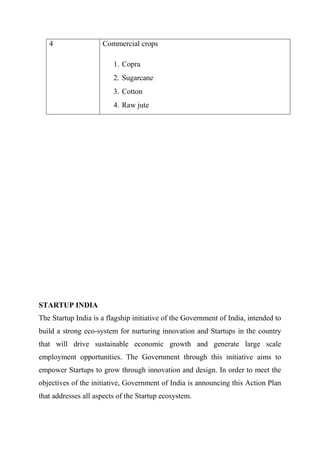
List of 23 Commodities covered under minimum support price
1 Cereals:
1. Paddy
2. Wheat
3. Maize
4. Sorghum
5. Pearl millet
6. Barley
7. Ragi
2 Pulses:
1. Gram
2. Tur
3. Moong
4. Urad
5. Lentil
3 Oilseeds:
1. Groundnut
2. Rapeseed-mustard
3. Soyabean
4. Seasmum
5. Sunflower
6. Safflower
7. Nigerseed
4 Commercial crops
1. Copra
2. Sugarcane
3. Cotton
4. Raw jute
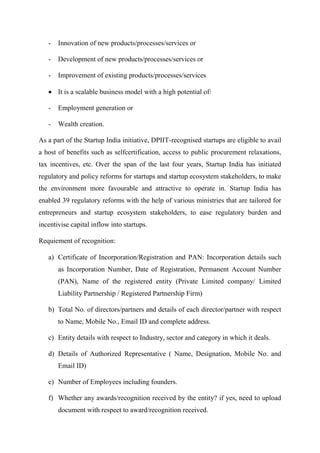
STARTUP INDIA
The Startup India is a flagship initiative of the Government of India, intended to
build a strong eco-system for nurturing innovation and Startups in the country
that will drive sustainable economic growth and generate large scale
employment opportunities. The Government through this initiative aims to
empower Startups to grow through innovation and design. In order to meet the
objectives of the initiative, Government of India is announcing this Action Plan
that addresses all aspects of the Startup ecosystem.
With this Action Plan the Government hopes to accelerate spreading of the
Startup movement:
 From digital/ technology sector to a wide array of sectors including
agriculture, manufacturing, social sector, healthcare, education, etc.; and
 From existing tier 1 cities to tier 2 and tier 3 citites including semi-urban
and rural areas.
The Action Plan is divided across the following areas:
 Simplification and Handholding
 Funding Support and Incentives
 Industry-Academia Partnership and Incubation
Vide G.S.R. 127 (E) DATED 19th February 2019 notified by DPIIT the government
widening the scope of Startup provided that
An entity shall be considered as a startup(meaning of Startup) if it satisfies all the
following conditions:
i. If it is incorporated/registered as any of the followings:
a. Private Limited Company (as defined in Companies Act, 2013).
b. Partnership Firm (registered under Partnership Act, 1932).
c. Limited Liability Partnership (registered under Limited Liability Partnership
Act, 2008).
d. One Person Company (as defined in Companies Act, 2013).
Provided that such entity is not formed by splitting up or reconstruction of a business
already in existence, further it has not completed ten years since
incorporation/registration as above.
ii. Its turnover for any of the financial years has not exceeded INR 100 Crore.
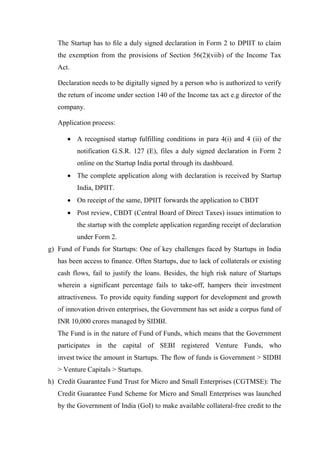
iii. It satisfies any of the following conditions:
 It is working towards:
- Innovation of new products/processes/services or
- Development of new products/processes/services or
- Improvement of existing products/processes/services
 It is a scalable business model with a high potential of:
- Employment generation or
- Wealth creation.
As a part of the Startup India initiative, DPIIT-recognised startups are eligible to avail
a host of benefits such as selfcertification, access to public procurement relaxations,
tax incentives, etc. Over the span of the last four years, Startup India has initiated
regulatory and policy reforms for startups and startup ecosystem stakeholders, to make
the environment more favourable and attractive to operate in. Startup India has
enabled 39 regulatory reforms with the help of various ministries that are tailored for
entrepreneurs and startup ecosystem stakeholders, to ease regulatory burden and
incentivise capital inflow into startups.
Requiement of recognition:
a) Certificate of Incorporation/Registration and PAN: Incorporation details such
as Incorporation Number, Date of Registration, Permanent Account Number
(PAN), Name of the registered entity (Private Limited company/ Limited
Liability Partnership / Registered Partnership Firm)
b) Total No. of directors/partners and details of each director/partner with respect
to Name, Mobile No., Email ID and complete address.
c) Entity details with respect to Industry, sector and category in which it deals.
d) Details of Authorized Representative ( Name, Designation, Mobile No. and
Email ID)
e) Number of Employees including founders.
f) Whether any awards/recognition received by the entity? if yes, need to upload
document with respect to award/recognition received.
g) What is the problem the startup is solving? It needs to be explained in
maximum 250 words.
Brief about the entity with details on the problem solved, solution provided,
uniqueness, and revenue model adopted
h) How does your startup propose to solve above mentioned problem? It needs to
be explained in maximum 250 words.
i) What is the uniqueness of your solution? It needs to be explained in
maximum 250 words.
j) How does your startup generate revenue? It needs to be explained in maximum
250 words.
k) Links or upload additional document to support your application. (eg. Website
link, Videos, Pitch Deck, Patents, etc.). It is mandatory to provide any one.
l) Proof of concept such as pitch deck/ website link/ video (in case of a
validation/ early traction/ scaling stage startup)
A. Benefits for startups after registration/recognition:
a) Various benefits with respect to Intellectual Property Rights (IPR):
Startups are provided following benefits with respect to intellectual property
rights
i) Startups are provided 80% rebate in filing of patent application and 50%
rebate in filing of trademark application.
ii) Speedy examination & disposal of patent application is provided in respect
of startups.
iii) A panel of facilitators are provided to startups to assist in filing of
application for intellectual property rights such as patents and
trademarks. Central Government bears the entire fees of the facilitators for any
number of patents, trademarks or designs, and Startups only bear the cost of the
statuary fees payable.
As per latest data released by government more than 1000 applicants have
received fee benefits and more than 4000 IPR facilitators available to assist
startups in getting IPRs.
b) Relaxation in Public Procurement Norms for Startups: Generally when a
tender is issued by a government entity or public sector undertaking, it has a
requirement of either prior experience or turnover. Generally, startups fail to
meet the criteria to participate in the tender. In order to promote startups in
manufacturing sector at par with well experienced entrepreneurs/companies
having high turnover government has exempted startups from the criteria of
prior experience or turnover. However, no relaxation has been granted with
respect to quality standards or technical parameters.
c) Self-Certification of Compliance with Labour & Environment Laws: In
order to reduce the regulatory burden on Startups, it has been allowed to self-
certify compliances with certain labour & environment laws for a period of three
years from the date of incorporation.
In respect of labour laws no inspection will be carried out unless they receive a
credible& verifiable complaint of violation, filed in writing and approved by at
least one level senior to the inspecting officer.
Relief in following Labour Laws:
o The Building and Other Constructions Workers’ (Regulation of Employment &
Conditions of Service) Act, 1996
o The Inter-State Migrant Workmen (Regulation of Employment & Conditions
of Service) Act, 1979
o The Payment of Gratuity Act, 1972
o The Contract Labour (Regulation and Abolition) Act, 1970
o The Employees’ Provident Funds and Miscellaneous Provisions Act, 1952
o The Employees’ State Insurance Act, 1948
Relief in following Environment Laws:
o The Water (Prevention & Control of Pollution) Act, 1974
o The Water (Prevention & Control of Pollution) Cess (Amendment) Act, 2003
o The Air (Prevention & Control of Pollution) Act, 1981
d) Faster Exit: Due to innovative nature of Startups, unfortunately a significant
percentage of startups fail to succeed.
In the event of a startup failure, it is important to reallocate capital and
resources left to more productive options available and therefore, a swift and
simple winding up process has been set up for Startups.
This will promote entrepreneurs to experiment with new and innovative ideas,
without having the fear of facing a complex and long-drawn exit process where
their capital remain needlessly stuck.
e) Income Tax Exemption under section 80IAC for 3 years: With a view to
stimulate the development of Startups in India and provide them a competitive
platform, tax exemption to recognised startups for 3 years on approval basis has
been allowed.
Startups incorporated on or after 1st April 2016 can apply for income tax
exemption under section 80IAC of the Income Tax Act, 1961.
The Inter-Ministerial Board validates the innovative nature of the business for
granting Income Tax Exemption.
The recognized Startups that are granted an Inter-Ministerial Board Certificate
are exempted from income-tax for a period of 3 consecutive years out of 10
years since incorporation.
f) Income Tax Exemption under section 56(2)(viib) (Angel Tax) on Investments:
What is section 56(2)(viib) ?: Where a company receives any consideration
for issue of shares which exceeds the Fair Market Value (FMV) of such shares,
such excess consideration is taxable in the hands of recipient as Income from
Other Sources.
What is relief to startups given?: To encourage capital investment in startups
a relief has been provided to startups with respect to section 56(2)(viib).
A DPIIT recognized startup is eligible for exemption from the provisions
of section 56(2)(viib) of the Income Tax Act.
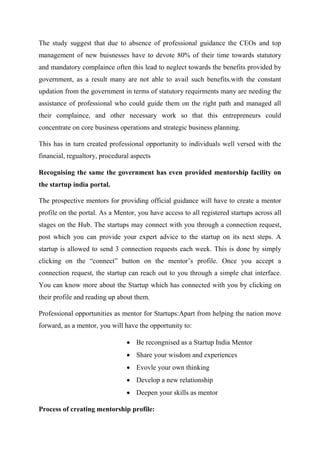
The Startup has to file a duly signed declaration in Form 2 to DPIIT to claim
the exemption from the provisions of Section 56(2)(viib) of the Income Tax
Act.
Declaration needs to be digitally signed by a person who is authorized to verify
the return of income under section 140 of the Income tax act e.g director of the
company.
Application process:
 A recognised startup fulfilling conditions in para 4(i) and 4 (ii) of the
notification G.S.R. 127 (E), files a duly signed declaration in Form 2
online on the Startup India portal through its dashboard.
 The complete application along with declaration is received by Startup
India, DPIIT.
 On receipt of the same, DPIIT forwards the application to CBDT
 Post review, CBDT (Central Board of Direct Taxes) issues intimation to
the startup with the complete application regarding receipt of declaration
under Form 2.
g) Fund of Funds for Startups: One of key challenges faced by Startups in India
has been access to finance. Often Startups, due to lack of collaterals or existing
cash flows, fail to justify the loans. Besides, the high risk nature of Startups
wherein a significant percentage fails to take-off, hampers their investment
attractiveness. To provide equity funding support for development and growth
of innovation driven enterprises, the Government has set aside a corpus fund of
INR 10,000 crores managed by SIDBI.
The Fund is in the nature of Fund of Funds, which means that the Government
participates in the capital of SEBI registered Venture Funds, who
invest twice the amount in Startups. The flow of funds is Government > SIDBI
> Venture Capitals > Startups.
h) Credit Guarantee Fund Trust for Micro and Small Enterprises (CGTMSE): The
Credit Guarantee Fund Scheme for Micro and Small Enterprises was launched
by the Government of India (GoI) to make available collateral-free credit to the
micro and small enterprise sector. Both the existing and the new enterprises are
eligible to be covered under the scheme.
i) Tax Exemptions on Capital Gains with an objective to promote investments
into Startups by mobilizing the capital gains arising from sale of capital assets.
Agricutlure Start-ups Mentor:
Often it has been seen that most of the enterepreneurs are either unaware of available
schemes / facilities or reluctant to avail it’s benefits due to cumbersome application /
approval process, resulting in shut down of their ventures even in the starting few
years.
Therefore, there is a need of proper mentorship and professional assistance to get the
maximum available benefits from the Government schemes.
The study suggest that due to absence of professional guidance the CEOs and top
management of new buisnesses have to devote 80% of their time towards statutory
and mandatory complaince often this lead to neglect towards the benefits provided by
government, as a result many are not able to avail such benefits.with the constant
updation from the government in terms of statutory requirments many are needing the
assistance of professional who could guide them on the right path and managed all
their complaince, and other necessary work so that this entrepreneurs could
concentrate on core business operations and strategic business planning.
This has in turn created professional opportunity to individuals well versed with the
financial, regualtory, procedural aspects
Recognising the same the government has even provided mentorship facility on
the startup india portal.
The prospective mentors for providing official guidance will have to create a mentor
profile on the portal. As a Mentor, you have access to all registered startups across all
stages on the Hub. The startups may connect with you through a connection request,
post which you can provide your expert advice to the startup on its next steps. A
startup is allowed to send 3 connection requests each week. This is done by simply
clicking on the “connect” button on the mentor’s profile. Once you accept a
connection request, the startup can reach out to you through a simple chat interface.
You can know more about the Startup which has connected with you by clicking on
their profile and reading up about them.
Professional opportunities as mentor for Startups:Apart from helping the nation move
forward, as a mentor, you will have the opportunity to:
 Be recongnised as a Startup India Mentor
 Share your wisdom and experiences
 Evovle your own thinking
 Develop a new relationship
 Deepen your skills as mentor
Process of creating mentorship profile:
 Simply click on 'Register'
https://www.startupindia.gov.in/content/sih/en/registration.html and fill in the
details as required in the registration form. An OTP will be sent to your
registered email address, post submitting which your profile will get created.
 You will have an option to select your profile type. Select “Enabler” as your
persona type, post which you’ll be asked to specify what type of enabler you
are. Select mentor / investor in the drop down box depending on your
objective.
 The profile goes under moderations for 24-48 hrs, and once our Quality
assurance team has done a preliminary check on your mentor creds, your
profile is made live
Chartered Accountants Assistance in Agriculture Entrepreneur
Below are some ideas where the CA can assist the budding startups:
1. By assisting start-ups to get recognition through stratup india portal
2. Drafting and creating esssential legal documents such as
a. Trademark
b. Incorporation documents
c. A non-disclosure agreement for dealing between client and investor this
will include certain documents and paper such as
- Employment contract, offer letters etc binding clause
- Confidentiality agreement
- Owning of information
- Obligation with repsect to crucial information
d. Terms and condition of work
e. Company policies etc
3. By laws – definite of working rules and regulations. Security provision etc.
4. Buisness advisor- fund raising options/opportunties, complaince moniterring
other statutory compliance and mandates, periodical check etc.
5. Web portal of buisness-handling online query, improvisation, digital marketing
6. Accounting and finance matter: Taxation and Finance are the key areas
alongwith Secretarial Compliances. Professionals are playing very significant
and crucial role to help smoothen the business operations.
Agriculture loans in India:
An agribusiness loan is nothing but an overdraft facility that can be used as
working capital for activities related to agriculture like farming and cultivation.
Agricultural loans in India are usually low interest loans that can be availed by
farmers. The repayment tenure of an agricultural loan differs from lender to
lender. The loan can be repaid in monthly, half yearly or yearly instalments.
Uses of Agribusiness loans:
1. Purchasing farming and irrigation equipment
2. Buying cattle and livestock
3. Purchase land for agricultural activities
4. Storage and warehousing expenses
5. Marketing expenses
6. Transportation costs
7. Managing day to day operations.
Sources of Agribusiness loans:
In India, financial institutions like government and private banks, co-operative
societies and Non-Banking Financial Companies (NBFC) like Lendingkart
provide convenient agribusiness loans.
Benefits of Agribusiness loans from Lending kart:
1. Convenient and flexible loan
2. Simplified documentation
3. Easy loan repayment terms as per the borrower’s income
4. Zero hidden costs
5. Attractive interest rates
6. Fast processing
Eligibility criteria for an Agriculture Loan:
1. Applicant should be between 18 – 70 years old.
2. Applicant should utilise the loan for cultivation of agricultural land
Documents required to avail an Agriculture Loan:
1. ID proof – PAN card/Aadhar card/Ration card/Driving license/Voter ID
2. Address proof – Bank statement/No more than 3 months old utility
bill/Ration card/Driving license/Passport
3. Land ownership proof.
FUNDING FOR YOUR STARTUPS
It is important that the founder should know the reason as to why they funding. You
may require it for one reason or another some them are listed :
1. Prototype creation
2. Working capital
3. Team hiring
4. Legal and consulting services
5. Marketing and sales
6. Licenses and certification
7. Raw materials and equipments
8. Product development
9. Office spaces expenses
Although there are multiple sources of funding available for startups. The stage of
your startup will have so much impact on the source of fund raising.
A. IDEATION:
This is the stage where the entrepreneur has an idea and is working on bringing it to
life. At this stage, the amount of funds needed is usually small. Additionally, at the
initial stage in the startup lifecycle, there are very limited and mostly informal
channels available for raising funds.
 Bootstrapping/Self-financing: Bootstrapping a startup means growing the
business with little or no venture capital or outside investment. It means relying
on your savings and revenue to operate and expand. This is the first recourse
for most entrepreneurs as there is no pressure to pay back the funds or dilute
control of your startup.
 Friends & Family: This is also a commonly utilized channel of funding by
entrepreneurs still in the early stages. The major benefit of this source of
investment is that there is an inherent level of trust between the entrepreneurs
and the investors
 Business Plan/Pitching Events: This is the prize money/grants/financial
benefits that are provided by institutes or organizations that conduct business
plan competitions and challenges. Even though the quantum of money is not
generally large, it is usually enough at the idea stage. What makes the
difference at these events is having a good business plan.
B. VALIDATION:
A startup will need to conduct field trials, test the product on a few potential
customers, onboard mentors, and build a formal team for which it can explore the
following funding sources:
 Incubators: Incubators are organizations set up with the specific goal of
assisting entrepreneurs with building and launching their startups. Not only do
incubators offer a lot of value-added services (office space, utilities, admin &
legal assistance, etc.), they often also make grants/debt/equity investments.
 Government Loan Schemes: The government has initiated a few loan schemes
to provide collateral-free debt to aspiring entrepreneurs and help them gain
access to low-cost capital such as the Startup India Seed Fund Scheme and
SIDBI Fund of Funds.
 Angel Investors: Angel investors are individuals who invest their money into
high-potential startups in return for equity. Reach out to angel networks such as
Indian Angel Network, Mumbai Angels, Lead Angels, Chennai Angels, etc., or
relevant industrialists for this.
 Crowdfunding: Crowdfunding refers to raising money from a large number of
people who each contribute a relatively small amount. This is typically done
via online crowdfunding platforms.
C. EARLY TRACTION
Funds are raised at this stage to further grow the user base, product offerings, expand
to new geographies, etc. Common funding sources utilized by startups in this stage
are:
 Venture Capital Funds: Venture capital (VC) funds are professionally managed
investment funds that invest exclusively in high-growth startups. Each VC fund
has its investment thesis – preferred sectors, stage of the startup, and funding
amount – which should align with your startup. VCs take startup equity in
return for their investments and actively engage in the mentorship of their
investee startups.
 Banks/Non-Banking Financial Companies (NBFCs): Formal debt can be raised
from banks and NBFCs at this stage as the startup can show market traction
and revenue to validate its ability to finance interest payment obligations. This
is especially applicable for working capital. Some entrepreneurs might prefer
debt over equity as debt funding does not dilute equity stake.
 Venture Debt Funds: Venture Debt funds are private investment funds that
invest money in startups primarily in the form of debt. Debt funds typically
invest along with an angel or VC round.
D. SCALING
Common funding sources utilized by startups in this stage are:
 Venture Capital Funds: VC funds with larger ticket sizes in their investment
thesis provide funding for late-stage startups. It is recommended to approach
these funds only after the startup has generated significant market traction. A
pool of VCs may come together and fund a startup as well.
 Private Equity/Investment Firms: Private equity/Investment firms generally do
not fund startups however, lately some private equity and investment firms
have been providing funds for fast-growing late-stage startups who have
maintained a consistent growth record.
E. EXIST OPTIONS
 Mergers & Acquisitions: The investor may decide to sell the portfolio company
to another company in the market. In essence, it entails one company
combining with another, either by acquiring it (or part of it) or by being
acquired (in whole or in part).
 Initial Public Offering (IPO): IPO refers to the event where a startup lists on the
stock market for the first time. Since the public listing process is elaborate and
replete with statutory formalities, it is generally undertaken by startups with an
impressive track record of profits and who are growing at a steady pace.
 Selling Shares: Investors may sell their equity or shares to other venture capital
or private equity firms.
 Buybacks: Founders of the startup may also buy back their shares from the
fund/investors if they have liquid assets to make the purchase and wish to
regain control of their company.
Steps for Start-up fund raising:
The fund-raising process can be broken down into the following steps:
A. Assessing need for funding:
The startup needs to assess why the funding is required, and the right amount to be
raised. The startup should develop a milestone-based plan with clear timelines
regarding what the startup wishes to do in the next 2, 4, and 10 years. A financial
forecast is a carefully constructed projection of company development over a given
time period, taking into consideration projected sales data, as well as market and
economic indicators. The cost of Production, Prototype Development, Research,
Manufacturing, etc should be planned well. Basis this, the startup can decide what the
next round of investment will be for.
B. Assessing investment readiness:
While it is important to identify the requirement of funding, it is also equally
important to understand if the startup is ready to raise funds. Any investor will take
you seriously if they are convinced about your revenue projections and their returns.
Investors are generally looking for the following in potential investee startups:
 Revenue growth and market position
 Favorable return on investment
 Time to break-even and profitability
 Uniqueness of the startup and competitive advantage
 The entrepreneurs’ vision and future plans
 Reliable, passionate, and talented team
C. Preparation of pitchdeck
A pitchdeck is a detailed presentation about the startup outlining all the important
aspects of the startup. Creating an investor pitch is all about telling a good story. Your
pitch isn’t a series of individual slides but should flow like a story connecting each
element to the other.
D. Investor targeting
 Identify active investors
 Their sector preferences
 Geographic location
 Average ticket size of funding
 Level of engagement and mentorship provided to investee startups
E. Due diligence by interested investors
Angel networks and VCs conduct thorough due diligence of the startup before
finalizing any equity deal. They look at the startup’s past financial decisions and the
team’s credentials as well as background. This is done to ensure that the startup’s
claims regarding the growth and market numbers can be verified as well as to ensure
that the investor can identify any objectionable activities beforehand. If the due
diligence is a success, the funding is finalized and completed on mutually agreeable
terms.
F. Term sheet
A term sheet is a “Non-binding” list of propositions by a venture capital firm at the
early stages of a deal. It summarizes the major points of engagement in the deal
between the investing firm/investor and the startup. A term sheet for a venture capital
transaction in India typically consists of four structural provisions: valuation,
investment structure, management structure, and finally changes to share capital.
 Valuation
Startup valuation is the total worth of the company as estimated by a professional
valuer. There are various methods of valuing a startup company, such as the Cost to
Duplicate approach, Market Multiple approach, Discounted cash flow (DCF) analysis,
and Valuation-by-Stage approach. Investors choose the relevant approach based on
the stage of investment and market maturity of the startup.
 Investment Structure
It defines the mode of the venture capital investment in the startup, whether it is
through equity, debt, or a combination of both.
 Management Structure
The term sheet lays down the management structure of the company which includes a
list for the board of directors, and prescribed appointment and removal procedures.
 Changes to share capital
All investors in startups have their investment timelines, and accordingly they seek
flexibility while analyzing exit options through subsequent rounds of funding. The
term sheet addresses the stakeholders’ rights and obligations for subsequent changes
in the company’s share capital.
KEY FACTORS TO ATTRACT BETTER INVESTMENT FOR YOUR
STARTUPS:
As different investors use different criteria to judge an investment, the importance of
these factors would wary depending on the stage of investment, sector of startup,
management team etc.
Listed below are typical investment criteria used by investors:
1. Market Landscape: This refers to the addressable market which the startup is
catering to.
Factors involved: Market size, obtainable market-share, adoption rate,
historical and forecasted growth rates, macroeconomic drivers, demand supply
2. Scalability and Sustainability: Startups should showcase the potential upscale
in the near future, a sustainable and stable business plan.
Factors involved: Barriers to entry, imitation costs, growth rate, expansion
plans
3. Objective and Problem Solving: The offering of the startup should be
differentiated to solve a unique customer problem or to meet customer need.
Ideas or products that are patented showcase deemed potential in the startups.
4. Customers & Suppliers: Laying out your customers and suppliers, helps
investors understand your business better.
Factors involved: Customer relationships, stickiness to the product, vendor
terms, existing vendors etc.
5. Competitive Analysis: A true picture of competition and other players in the
market working on similar things should be highlighted. There can never be an
apple to apple comparison, but highlighting the service or product offerings of
similar players in the industry is important
Factors involved: Number of players in the market, market share, obtainable
share in the near future, product mapping to highlight similarities or differences
between competitor offerings
6. Sales and Marketing: No matter how good your product or service maybe, but
if does not find any end use, there is no good.
Factors involved: Sales forecast, targeted audiences, marketing plan for the
target, conversion and retention ratio etc.
7. Financial Assessment: A detailed business model that showcases the cash
inflows over the years, investments required, key milestones, break-even point
and growth rates should be made out well. Assumptions used at this stage
should also be reasonable and clearly mentioned.
8. Exit Avenues: A startup showcasing potential future acquirers or alliance
partners becomes a valuable decision parameter for the investor
9. Management and Team: The execution and passion of founder and the
management team to drive the company are equally crucial in addition to the
all the factors mentioned above
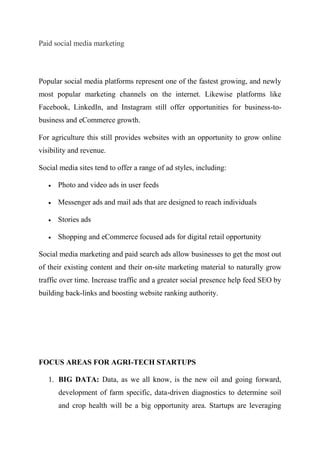
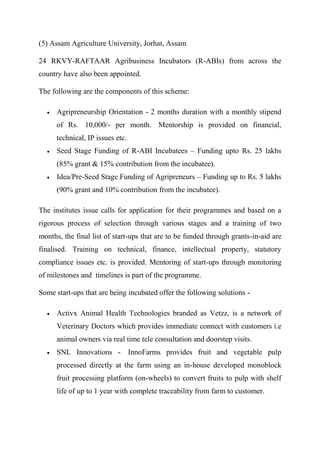
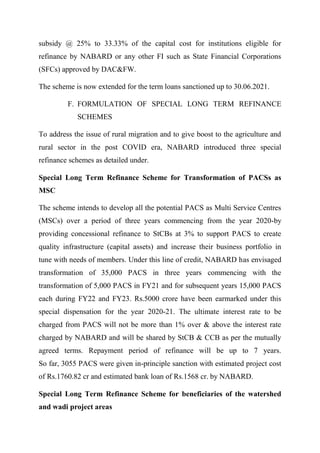
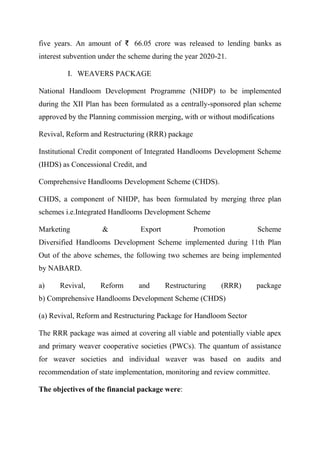
AGRICULTURE BUSINESS IDEAS WITH LESS INVESTMENT
1) Agriculture farm
If you have an empty land suitable for farming, you can start with an
agricultural farm. Items that are demanded locally can be produced on it.
Maintaining good quality can fetch you high profits.
2) Tree farm
A tree farm grows trees and earns money by selling them. The waiting period of
earning money in this business is quite high as the growing of trees requires
considerable time. This is one of the best small farm business ideas to start. This
might need some maintenance cost.
3) Organic fertilizer production
Vermicompost or organic fertilizer production has become a household
business. It does not require much investment and very easy to initiate with a
little know-how of the production process.
4) Business of fertilizer distribution
This business is suitable for people who live in small towns or rural areas. In
this business, you are required to buy fertilizers from big cities and make them
available in rural areas. This could be one of the best small agricultural
business ideas in India to start in small towns.
5) Dry flower business
The business of dry flowers has flourished over the last 10 years. If you have
vacant land, you can grow flowers, make them dry and sell to craft stores or
hobbyists.
6) Mushroom farming
The business of growing mushrooms can fetch you big profits in a short period
of time. It can be started with low investment and it requires less space also.
Mushrooms are in great demand at hotels, restaurants, and households.
7) Poultry farming
The poultry farming business has transformed into a techno-commercial
industry. In the last few decades, it is one of the fastest-growing industries. If
you are looking for small farm income ideas, this could be best fit for you.
8) Hydroponic retail store
Hydroponics is a new plantation technology that does not use soil for growing
plants. A hydroponic retail store deals in hydroponic equipment and also
develops plants to be sold for both commercial and home use.
9) Organic greenhouse
An organic greenhouse business has good potential to grow because the demand
for organically grown products has been increasing consistently. Beforehand,
this business was done on small family-run farms, but with increasing demand
as people are now buying land for making organic greenhouse.
10) Beekeeping
With the increasing awareness for health, the demand for honey is growing day
by day. This way, beekeeping has become a great business opportunity. This
business demands day-to-day monitoring of the bees with close supervision.
11) Fish farming – Commercial fish farming business is a very lucrative
business that can fetch a huge amount of money. With the implementation of
modern techniques, production and quality can be enhanced to a great deal. This
is one of the most lucrative Agro business ideas that require moderate to high
investment to start.
12) Snail farming – Snail farming business is the process of raising land snails
for human consumption. Snails contain a high rate of protein, iron, low fat, and
almost all the amino acids needed for the human body. Keeping their nutrient
value in mind, they are in high demand. This business opportunity demands
discipline and specific knowledge of modern technology.
13) Fruit and Vegetable export – You can initiate the business of exporting
fruit and vegetables in which you have to collect fresh fruits and vegetables
from local farmers and sell them internationally. For this business, you need to
know the import and export policies as well as local markets. This is one of the
best agriculture export business ideas to start.
14) Become a florist – Selling flowers are a very profitable retail business.
Flower arrangement and bouquets are always in high demand for gifting, at
weddings, etc. With some innovation and creativity. You can do wonders in this
business.
15) Broom production – For centuries, the broom has been used for sweeping
up the floor and removing the dirt and dust in and around workplaces and
homes. The process of broom production is quite simple and the project can be
initiated with low capital investment. Maintaining a good quality and
competitive prices can give you good profits in a short span of time.
16) Fruit juice production – The production process of fruit juice is quite
simple and can be initiated with low investment. This business has a huge
market opportunity. Hygiene, taste, and quality of fruit have to be kept in mind
while starting this business.
17) Groundnut processing – If you can procure good quality raw material
(groundnuts) for this business, you can initiate it with moderate capital.
Processed groundnuts have very good market potential all over the world.
18) Quail farming – Quail farming is about raising quails for profitable eggs
and meat. At the global levels, quail farming business is gaining importance as
it fulfills daily family nutrition demand.
19) Tea plantation – With the increasing demand for tea leaves, this business
has huge potential. Tea plants typically required acidic soil and heavy rainfall,
although they can be grown anywhere from sea level to high altitudes. So, if
your demographic situation is suitable for growing tea, you should go in this
business. This is one of the good agriculture business ideas in India that requires
high capital.
20) Grocery shopping portal – With the advent of technology and E-
Commerce, people find it very wasteful to spend hours buying day-to-day
groceries. They prefer ordering groceries to be delivered at their doorsteps so
one can start with an E-shopping portal that delivers groceries.
21) Farming of medicinal herbs – Growing of medicinal herbs at the
commercial level is one of the most profitable agriculture business ideas. If you
possess good knowledge about the herbs and have sufficient land, you can
initiate the farming of medicinal herbs. You may need to take certain licenses
from local government in the case of medicinal herb business.
22) Cactus arrangement – Cactus has been extensively used as a decor item,
either indoor or outdoor. Many cactus plants can coexist happily in the same
container. So, with a touch of creativity, you can make beautiful cactus
arrangements. It is a very profitable and self-rewarding business.
23) Jatropha farming – Jatropha has been used as a raw material for producing
biodiesel. It is one of the most trending money making agriculture business
ideas in India, as very few people know about it. By doing some research and
gaining some knowledge, you can easily start with this business.
24) Corn Farming – Corn or maize has emerged as one of the most versatile
crops that can be grown under varied climatic conditions. Maize is known as
the Queen of cereals as it has the highest genetic potential amongst the family.
By implementing modern technology and good quality seeds, one can obtain a
bumper crop.
25) Potato powder – potato powder is extensively used in the snack food
industry. It can be used in any recipe where mashed potatoes are required. It is
used as a thickener in ready to eat vegetable gravies and soups.
26) Goat Farming – Goat is one of the main meat-producing animals used
globally. For this reason, goat rearing has been flourishing as an economic
industry with good prospects.
27) Soil Testing – Soil testing is a technique used for monitoring the nutrients
present in the soil is well as for making precise fertilizer recommendations for
different crops. Establishing a soil testing laboratory with Government
certification is one of the best small farm business ideas.
28) Agro blogging – If you possess good knowledge about agriculture with a
niche in writing, you can always try for agro-blogging. It contains blogs related
to agriculture and farming. With the advent of the internet in rural areas,
farmers have started using technology to improve their farming skills. They
need fair advice on their agricultural problems. This is one of the best
agricultural related business ideas to start with zero to low investment.
29) Fodder farming Business – The term fodder is used for the food given to
domestic animals for feeding and not the food they graze by themselves. There
are plants grown particularly for this purpose like barley, oats, alfalfa, etc.
Fodder is used to feed animals like cows, goats, pigs, horses, etc. and always in
great demand.
30) Rose farming – Rose is a flower with high commercial value. It is used in
flower arrangements and bouquets on a large scale. If you are interested in
gardening, you can turn it into a profitable business. It can be initiated on a
small piece of land.
31) Rabbit farming – Rearing of rabbits has been started on a commercial
level. Angora rabbits are mainly raised for their wool and well known for
quality. Rabbits are the best producers of wool on per kg body weight basis.
32) Agriculture consultancy – if you are an expert in a specific field of
farming, you can adopt the business of agriculture consultancy. This business is
flourishing day by day as farmers need expert advice at many stages.
33) Dairy farming – Demand for milk and milk products can never go down.
Commercial dairy farming is one of the most profitable agriculture-based
business ideas. Apart from milk, it produces manure in huge quantities. Hygiene
and quality should be always kept in mind while doing this business.
34) Spice processing – Organic spices are in high demand locally as well as
internationally. The processing and packaging methods are not very complex
and can be initiated with moderate capital.
35) Vegetable farming – If you have sufficient land and manpower, you can
start with vegetable farming. Vegetables produced with good quality seeds and
fertilizers yield good crops and give good returns. If you are thinking about
small farm income ideas, you can shortlist this business idea.
36) Soya beans farming – Soya bean is required to produce soya milk, soya
flour, soya sauce, soya bean oil, etc. If you have small vacant land, soya bean
farming can be initiated to convert it into a profitable business.
37) Landscape expert – Landscape expert is the one who has good knowledge
of landscape architecture. It encompasses activities like site analysis, land
planning, planting design, storm water management, construction specification.
They ensure that the plan meets all the current building codes and all the
statutory compliance.
38) Tilapia farming – Tilapia is a kind of fish whose demand is escalating
steadily especially in the USA. You can start this highly profitable business.
39) Horticulture crop farming – Horticulturists produce fruits, plants, and
vegetables, flowers in greenhouses, and nurseries with highly specialized
knowledge. The selection of the crops and method is very important in this
business.
40) Certified seed dealer – Seed certification is a process of quality check
whereby the seeds are inspected and checked with proper process. In simple
words, the system certifies that a box or packet of seed is in accordance with the
requirements of a certification scheme. You can start a business that sells only
certified seed. There are a few formalities to establish this business. You do not
need any land for it. It can be initiated by contract farming.
41) Greenhouse flower export – Many people establish a greenhouse for
producing only export-oriented flowers. It is one of the most profitable business
ideas it requires substantial capital investment and good knowledge about the
process.
42) Potato chip production – It is a small-scale industry based on making
potato chips and french-fries. The demand for potato chips and french-fries as
an FMCG is increasing steadily in the global market. This is one of the most
profitable money making agriculture business ideas in India to start with low to
medium capital
AGRICULTURE MARKETING = DIGITAL MARKETING
Agricultural Marketing is a process which starts with a decision to produce a
saleable farm commodity, and it involves all the aspects of market structure or
system, both functional and institutional, based on technical and economic
considerations, and include pre- and post-harvest operations viz., assembling,
grading, storage, transportation and distribution.
Why digital marketing for Agriculture:
The digital marketing for agriculture and the agribusiness sector provides
businesses with the opportunity to increase visibility and to generate business-
to-business leads more efficiently than ever before. As these industries continue
to grow and continue to modernize, the proportion of operations that take place
online will grow as well.
Digital marketing for agriculture – including search optimization and paid
advertising – gives businesses opportunity for better B2B lead growth as well as
for the digital marketing of agriculture eCommerce products.
Agribusiness and farming businesses tend to rely more on non-digital and
established business growth strategies making digital marketing more of an
accessory. But search engine optimization (SEO) and paid search advertising
offer well-established benefits for long-term business performance and are
proven strategies. They also cater well to agricultural product sales, wholesale
product sales, export/import business and product eCommerce – regardless of
industry.
The potential of digital marketing for agricultural commerce
Search engine optimization as part of digital marketing in the agriculture sector
is ideal for:
 Ensuring long-term business growth and reliable revenue
 Maintaining or growing industry market share
 Promoting brand recognition and building a business’s loyalty base
 Growing traffic to your website across organic, referral, and social
segments
 Gaining authority with improved page-linking and natural backlink
growth
 Improving sales and revenue affordably, without an ad budget
 Generating leads and sales by catching search traffic for customers who
are at the top of the shopping funnel
Paid-ad digital marketing for agriculture
The advantage of this sort of digital marketing in agriculture sectors is that paid
ads provide businesses with more website traffic than organic search alone and
help boost visibility even further.
paid search advertising as a part of digital marketing in agriculture is good for:
 Gaining traffic or revenue during holidays or during short seasonal
periods
 When expanding an agriculture business to a new niche or market
 Rapidly gaining traffic for certain industry keywords
 Quickly gaining visibility to new business sectors and geographical
markets
 Targeting traffic in certain regions, countries, states, or cities
 Generating cash-flow or revenue quickly
 Helping promote farm/agriculture brand recognition or for competing
against a dominate competitor
 Subsidizing a business’s marketing along with SEO content marketing
Paid social media marketing
Popular social media platforms represent one of the fastest growing, and newly
most popular marketing channels on the internet. Likewise platforms like
Facebook, LinkedIn, and Instagram still offer opportunities for business-to-
business and eCommerce growth.
For agriculture this still provides websites with an opportunity to grow online
visibility and revenue.
Social media sites tend to offer a range of ad styles, including:
 Photo and video ads in user feeds
 Messenger ads and mail ads that are designed to reach individuals
 Stories ads
 Shopping and eCommerce focused ads for digital retail opportunity
Social media marketing and paid search ads allow businesses to get the most out
of their existing content and their on-site marketing material to naturally grow
traffic over time. Increase traffic and a greater social presence help feed SEO by
building back-links and boosting website ranking authority.
FOCUS AREAS FOR AGRI-TECH STARTUPS
1. BIG DATA: Data, as we all know, is the new oil and going forward,
development of farm specific, data-driven diagnostics to determine soil
and crop health will be a big opportunity area. Startups are leveraging
drones or tractor-based solutions to get data on field, pertaining to both
weather and agricultural data to determine risk. Growing smartphone
penetration will enable precision decision-making in farming activity to
farmers and help drive increased productivity and revenue while reducing
unit-costs.
Eg.: Agrostar, RML Agtech are investing INR 5 Cr ($776 K) each in
building ground-breaking image recognition technology that enables
farmers to receive real-time data on the pest or disease that has affected a
crop.
2. FARMING-AS-A-SERVICE (FAAS): Agri equipment renting is
another area likely to see market traction. As longer gestation periods are
a typical feature for this sector and modern equipment is expensive and
unaffordable for the average farmer, renting can take the burden of the
input costs away from the farmer.
Eg.: EM3 Agriservices offers farming services and machinery rentals to
farmers on a pay-for-use basis. Other startups include, Goldfarm, Ravgo,
Oxen Farm Solutions and Farmart.
3. MARKET LINKAGE MODELS: Innovations to help farmers with
timely and accurate estimation of sowing and harvesting in sync with
consumer demand patterns.
Eg.: MeraKisan.com helps consumers in India to order fresh food and
goods sourced from local farmers.
4. FINTECH FOR FARMERS: Farm income is mostly in cash and it
presents an opportunity for Fintech startups to digitize payments for
farmers through payment gateways linked to their accounts. Such startups
can also create the credit profile environment for funders and lenders.
5. IOT FOR FARMERS: Smart farming in agricultural business including
concepts like high-precision crop control, data collection, automated
farming techniques will remove inefficiencies and bolster productivity.
Information on crop yields, rainfall patterns, pest infestation and soil
nutrition can be used to improve farming techniques over time.
Eg.: Stellapps leverages cloud computing, data analytics and wearables to
improve agri-supply chain parameters, including milk production,
procurement, cold chain, animal insurance and farmer payments.
Initiative for Development of Entrepreneurs in Agriculture (IDEA)
The scheme intends to promote agri-business ventures in the North-East Region
and assist in establishing agri-business as a profitable venture. It also provides
gainful employment opportunities and makes available supplementary sources
of input supply and services.
Extent and Nature of Assistance
 Composite loan comprising Term Loan and Working Capital.
 Financial assistance will be extended on need basis, depending upon the nature
of the projects and competence of the promoters.
 Maximum project size could be Rs.25 lakhs.
 Term Loan from North Eastern Development Finance Corporation Ltd. =
Maximum upto 75% of the project cost.
 The promoter’s contribution will be at least 25% of the project cost.
Eligibility Criteria
 Graduates and Post graduates in agriculture and allied subjects
 Graduates, Post-graduates from other disciplines having experience and skill to
undertake Agri Business ventures can also be considered.
 The proposed units could be proprietorship, partnership or a company.
 The promoter or their units must not be a defaulter in any government scheme
and /or with any bank or any other agencies.
 The proposed unit for which financial assistance is sought should be located
within any of the eight North-Eastern States.
 How to apply?
 Apply to the Chairman and Managing Director, NEDFi, G.S. Road,
Dispur, Guwahati – 781006 in the prescribed format of NEDFi.
For more details: https://www.nedfi.com/node/97
The Union Government accords very high priority to the agriculture sector. In
order to contribute directly and indirectly to enhancing the income of farmers by
providing opportunites to them and to provide employment to youth, start-ups
are being encouraged. A component, Innovation and Agri-entrepreneurship
Development programme has been launched under Rashtriya Krishi Vikas
Yojana in order to promote innovation and agripreneurship by providing
financial support and nurturing the incubation ecosystem.These start-ups are in
various categories such as agro-processing, artificial intelligence, digital
agriculture, farm mechanisation, waste to wealth, dairy, fisheries etc.
DAC&FW has selected 5 Knowledge Partners (KPs) as Centres of Excellence.
These are -
(1) National Institute of Agricultural Extension Management (MANAGE),
Hyderabad,
(2) National Institute of Agricultural Marketing(NIAM) Jaipur,
(3) Indian Agricultural Research Institute (IARI) Pusa, New Delhi,
(4) University of Agriculture Science , Dharwad, Karnataka and
(5) Assam Agriculture University, Jorhat, Assam
24 RKVY-RAFTAAR Agribusiness Incubators (R-ABIs) from across the
country have also been appointed.
The following are the components of this scheme:
 Agripreneurship Orientation - 2 months duration with a monthly stipend
of Rs. 10,000/- per month. Mentorship is provided on financial,
technical, IP issues etc.
 Seed Stage Funding of R-ABI Incubatees – Funding upto Rs. 25 lakhs
(85% grant & 15% contribution from the incubatee).
 Idea/Pre-Seed Stage Funding of Agripreneurs – Funding up to Rs. 5 lakhs
(90% grant and 10% contribution from the incubatee).
The institutes issue calls for application for their programmes and based on a
rigorous process of selection through various stages and a training of two
months, the final list of start-ups that are to be funded through grants-in-aid are
finalised. Training on technical, finance, intellectual property, statutory
compliance issues etc. is provided. Mentoring of start-ups through monitoring
of milestones and timelines is part of the programme.
Some start-ups that are being incubated offer the following solutions -
 Activx Animal Health Technologies branded as Vetzz, is a network of
Veterinary Doctors which provides immediate connect with customers i.e
animal owners via real time tele consultation and doorstep visits.
 SNL Innovations - InnoFarms provides fruit and vegetable pulp
processed directly at the farm using an in-house developed monoblock
fruit processing platform (on-wheels) to convert fruits to pulp with shelf
life of up to 1 year with complete traceability from farm to customer.
 EF Polymer developed an Eco-Friendly Water Retention Polymer with an
aim to solve the water scarcity crisis for farmers. This startup made a
super absorbent polymer designed to absorb water in the soil, retain it for
a long time, and supply to the crops as required.
 Among the start-ups that have been selected are several start-ups led by
women such as A2P Energy Solution that uses AI to track waste bio-mass
and then works with farmers to collect it. On one side it generates
additional income for farmers and on the other side A2P converts the
collected biomass into Next Gen biofuels like energy pellets, green coal
and bio oil.
 Kyari Innovations is working on mitigating human wildlife conflict pan
India and internationally. They have created an innovative product called
ANIDERS- Animal Intrusion Detection and Repellent System. This
device works like a mechanized scarecrow that can protect farmlands
from animal intrusions.
 Agsmartic Technologies, has a vision to improve crop yield by precise
irrigation and disease management though a data driven approach by
using AI, IoT and computer vision. Their product Croplytics® is a
combination of hardware and software solution that integrates ground
sensor data and satellite imagery to translate data into actionable
information for creating a precise model for irrigation.
Apart from the above mentioned 6 startups, there are many more with
innovative solutions to improve the farming eco system and augment farm
household incomes.
In all, a total of 346 startups in the agriculture and allied sectors are being
funded for a sum of Rs. 3671.75 lakhs in this phase. This fund will be released
in instalments. These start-ups were trained for two months at 29 agribusiness
incubation centres (KPs & RABIs) spread across India. These start-ups will lead
to employment to youth. Besides, they, directly and indirectly, will contribute to
enhancing the income of farmers by providing opportunities to them.
Some government sponsered scheme:
A. CAPITAL INVESTMENT SUBSIDY SCHEME FOR
COMMERCIAL PRODUCTION UNITS FOR ORGANIC/
BIOLOGICAL INPUTS
The scheme is being implemented by the Department of Agriculture,
Cooperation and Farmers’ Welfare (DAC&FW), Ministry of Agriculture &
Farmers’ Welfare, GoI, through National Centre of Organic Farming (NCOF) in
collaboration with NABARD and National Cooperative Development
Corporation (NCDC). NABARD is the subsidy channelising agency for projects
submitted to NABARD.
The increased and indiscriminate use of chemical fertilizers and pesticides and
the deteriorating soil health and productivity is concerning people all over the
world. Growing awareness for safe and healthy food has underlined the
importance of organic farming, which is a holistic system based on the basic
principle of minimising the use of external inputs and avoiding the use of
synthetic fertilizers and pesticides.
In view of these challenges, there is a need in the country to augment the
infrastructure for production of quality organic and biological inputs.
Accordingly, under the National Project on Organic Farming a Capital
Investment Subsidy Scheme for Commercial Production Units for organic/
biological inputs was introduced in 2004-05.
Objectives of the scheme
 To promote organic farming in the country by making available organic
inputs, such as bio fertilisers, bio pesticides as well as fruit and vegetable
market waste compost and thereby generate better return for the produce
 To increase agricultural productivity while maintaining soil health and
environmental safety
 To reduce total dependence on chemical fertilizers and pesticides by
increasing the availability and improving the quality of bio fertilisers, bio
pesticides and composts in the country
 To convert organic waste into plant-nutrient resources
 To prevent pollution and environment degradation by proper conversion
and utilisation of organic waste
 To establish bio fertilisers and bio pesticides production units
 To set up fruit and vegetable waste compost unit
Beneficiaries
 Individuals, group of farmers/growers, proprietary and partnership firms,
co-operatives, fertilizer industry
 Companies, Corporations
 Non-Governmental Organizations (NGOs)
 Agricultural Produce Market Committees (APMCs)
 Municipalities
 Private entrepreneurs Links for downloads
 The confirmation for continuation of the scheme has not been received
from GoI for the year 2021-22.
B. AGRICLINIC AND AGRIBUSINESS CENTRES SCHEME
The ACABC scheme is being implemented by Ministry of Agriculture and
Farmers’ Welfare, Government of India, with NABARD acting as subsidy
channelising agency.
The objectives of the scheme are –
 To supplement efforts of public extension by providing extension and
other services to farmers either on payment basis or free of cost as per
business model of agri-preneur, local needs and affordability of target
group of farmers
 To support agricultural development
 To create gainful self-employment opportunities to unemployed
agricultural graduates, agricultural diploma holders, intermediate in
agriculture and biological science graduates with PG in agri-related
courses.
Agri-Clinics
Agri-Clinics are envisaged to provide expert advice and services to farmers on
various aspects to enhance productivity of crops/animals and increase the
incomes of farmers. Agri-Clinics provide support in the following areas:
 Soil health
 Cropping practices
 Plant protection
 Crop insurancePost-harvest technologyClinical services for animals, feed
and fodder managementPrices of various crops in the market, etc.
Agri-Business Centres
Agri-Business Centres are commercial units of agri-ventures established by
trained agriculture professionals. These ventures may include maintenance and
custom hiring of farm equipment, sale of inputs and other services in agriculture
and allied areas, including post-harvest management and market linkages for
income generation and entrepreneurship development.
The scheme covers full financial support for training and handholding,
provision of loan and credit-linked back-end composite subsidy.
List of Beneficiaries
 Graduates in agriculture and allied subjects from State Agriculture
Universities (SAUs)/Central Agricultural Universities/Universities
recognised by ICAR/UGC. Degree in Agriculture and allied subjects
offered by other agencies are also considered subject to approval of
Department of Agriculture & Cooperation, GoI, on recommendation of
the State Government
 Diploma (with at least 50% marks)/Post Graduate Diploma holders in
Agriculture and allied subjects from State Agricultural Universities, State
Agriculture and Allied Departments and State Department of Technical
Education.
 Diploma in Agriculture and allied subjects offered by other agencies are
also considered subject to approval of Department of Agriculture,
Cooperation & Farmers’ Welfare, GoI on recommendation of the State
Government
 Biological Science Graduates with Post Graduation in Agriculture &
allied subjects
 Degree courses recognised by UGC having more than 60 percent of the
course content in Agriculture and allied subjects
 Diploma/Post Graduate Diploma courses with more than 60 percent of
course content in Agriculture and allied subjects, after B.Sc. with
Biological Sciences, from recognised colleges and universities.
 Agriculture related courses at Intermediate (i.e. plus two) level, with at
least 55% marks.
C. NATIONAL LIVESTOCK MISSION
National Livestock Mission is an initiative of the Ministry of Agriculture and
Farmers’ Welfare. The mission, which commenced from 2014-15, has the
objective of sustainable development of the livestock sector.
NABARD is the subsidy channelising agency for following schemes, under
Entrepreneurship Development & Employment Generation (EDEG) component
of National Livestock Mission.
 Poultry Venture Capital Fund (PVCF)
 Integrated Development of Small Ruminants and Rabbit (IDSRR)
 Pig Development (PD)
 Salvaging and Rearing of Male Buffalo Calves (SRMBC)
 Effective Animal Waste Management
 Construction of Storage Facility for Feed and Fodder
List of Beneficiaries
 Farmers, individual entrepreneurs
 NGOs
 Companies
 Cooperatives
 Groups of organized and unorganized sector which include Self- Help
Groups (SHGs) and Joint Liability Groups (JLGs)
Eligible financial institutions
 Commercial Banks
 Regional Rural Banks
 State Cooperative Banks
 State Cooperative Agriculture and Rural Development Banks
 Other institutions eligible for refinance from NABARD
D. INTEREST SUBVENTION SCHEME
The Honourable Finance Minister in his budget speech (para 49) for 2006-07
announced that the Government had decided to ensure that farmers receive short
term credit at 7% with an upper limit of Rs. 3.00 lakh on the principal amount.
The policy came into force with effect from Kharif 2006-07. The amount of
subvention was to be calculated on the amount of crop loan from the date of
disbursement up to the actual date of repayment of the crop loan by the farmer
or up to the due date of the loan fixed by the banks, whichever is earlier, subject
to a maximum period of one year.
In pursuance of this announcement, the Government of India provided interest
subvention of 2% to Public Sector Banks, Regional Rural Banks (RRBs) and
Co-operative Banks in respect of short-term production credit up to Rs. 3 lakh
provided to farmers out of their own resources, provided that they make
available short-term credit @ 7% p.a. at ground level. Private Sector Banks (in
respect of loans given by their rural and semi urban branches) are also covered
under the scheme from the year 2013-14 with similar terms and conditions.
A. Incentive to farmers on prompt repayments
Since the year 2009-10, the Government of India introduced additional
subvention of 1% to farmers as an incentive for repaying the loans promptly i.e.
on or before the due date or the date fixed by the bank, subject to a maximum
period of one year. It has been increased to 2% for 2010-11 and 3% from 2011-
12.
B. Relief to farmers
To provide relief to farmers affected by natural calamities, Interest Subvention
of 2% has been made available to banks for the first year on restructured
amount of crop loans. Such restructured loans will attract normal rate of interest
from the second year onwards as per the policy laid down by the RBI.
Interest Subvention to Small and Marginal Farmers against Negotiable
Warehouse Receipts
In order to discourage distress sale of produce by farmers and to encourage
them to store their produce in warehouses against warehouse receipts, GoI had
introduced a scheme in 2011-12 for extending concessional loans to the farmers
against negotiable warehouse receipts.
The benefit of 2% interest subvention will be available to banks on their own
funds involved for extending credit support up to Rs 3 lakh at 7% interest per
annum to Small and Marginal farmers (SF/MF) having Kisan Credit Card for a
further period of up to six months post the harvest of the crop against
Negotiable Warehouse Receipts issued on the produce stored in warehouses
accredited with Warehousing Development Regulatory Authority.
SF/MF, who have not availed crop loans through banking system, would not be
eligible.
Interest subvention on working capital to Animal Husbandry and Fisheries
The GoI has extended the Interest subvention Scheme on KCC issued to crop
loan farmers to the KCC issued to Animal Husbandry and Fisheries farmers
from 2018-19. Interest subvention of 2% to banks and 3% to farmers towards
Prompt Repayment incentive is extended on short-term loans up to Rs2 lakh to
animal husbandry and fisheries farmers apart from the existing KCC for crop
loans, provided the loans are extended by banks @7% per annum. In case of
farmers possessing KCC for raising crops and involved in activities related to
Animal Husbandry and/ or Fisheries, the Interest Subvention on short-term loan
is available on an overall limit of Rs.3 lakh per annum.
The Govt of India has issued instruction that Interest Subvention to Banks and
Prompt Repayment Incentive to farmers will be available only against KCCs
from 1 April, 2020.
E. NEW AGRICULTURAL MARKETING
INFRASTRUCTURE(AMI) SUB- SCHEME OF INTEGRATED
SCHEME FOR AGRICULTURAL MARKETING (ISAM)
The Agricultural Marketing Infrastructure (AMI) sub-scheme of ISAM is being
implemented by the Ministry of Agriculture and Farmers’ Welfare, Government
of India.
The AMI sub-scheme of ISAM is applicable for new credit linked projects,
where term loan has been sanctioned by eligible financial institutions from
22.10.2018 to 31.03.2021. NABARD is the channelizing agency for release of
subsidy @ 25% to 33.33% of the capital cost for institutions eligible for
refinance by NABARD or any other FI such as State Financial Corporations
(SFCs) approved by DAC&FW.
The scheme is now extended for the term loans sanctioned up to 30.06.2021.
F. FORMULATION OF SPECIAL LONG TERM REFINANCE
SCHEMES
To address the issue of rural migration and to give boost to the agriculture and
rural sector in the post COVID era, NABARD introduced three special
refinance schemes as detailed under.
Special Long Term Refinance Scheme for Transformation of PACSs as
MSC
The scheme intends to develop all the potential PACS as Multi Service Centres
(MSCs) over a period of three years commencing from the year 2020-by
providing concessional refinance to StCBs at 3% to support PACS to create
quality infrastructure (capital assets) and increase their business portfolio in
tune with needs of members. Under this line of credit, NABARD has envisaged
transformation of 35,000 PACS in three years commencing with the
transformation of 5,000 PACS in FY21 and for subsequent years 15,000 PACS
each during FY22 and FY23. Rs.5000 crore have been earmarked under this
special dispensation for the year 2020-21. The ultimate interest rate to be
charged from PACS will not be more than 1% over & above the interest rate
charged by NABARD and will be shared by StCB & CCB as per the mutually
agreed terms. Repayment period of refinance will be up to 7 years.
So far, 3055 PACS were given in-principle sanction with estimated project cost
of Rs.1760.82 cr and estimated bank loan of Rs.1568 cr. by NABARD.
Special Long Term Refinance Scheme for beneficiaries of the watershed
and wadi project areas
The objectives of the scheme is to promote sustainable economic activities,
livelihood and employment opportunities for the beneficiaries in NABARD
supported watershed and wadi project areas by encouraging banks to lend at
concessional rate to these beneficiaries to address the issue of rural migration
and to give boost to the agriculture and rural sector in the post COVID era.
The refinance will be available to all the eligible banks/FIs at 3% for maximum
5 years. The revised ultimate lending rate to be charged by banks/FIs under the
scheme is revise as 06 months MCLR+1% or EBLR+2.5% whichever is lower.
NABARD has earmarked refinance amount of Rs.5000 crore during 2020-21 to
2022-23.
Regional offices of NABARD are finalizing the Banking Plans in collaboration
with the participating Banks.
Special Long Term Refinance Scheme for promoting Micro Food
Processing Activities.
The objectives of the scheme is to encourage banks to lend micro-food
processing activities and create sustainable livelihood and employment
opportunities for rural youth as well as reverse migrants due to COVID-19
pandemic in the rural areas.
The scheme also envisages modernization and enhancing the competitiveness of
the existing individual micro enterprises and ensure their transition to formal
sector in rural areas. The refinance scheme will give fillip to the recently
launched “PM Scheme for Formalisation of Micro food processing Enterprises
(PM FME)” under Aatmanirbhar Bharat Abhiyan by MoFPI, GoI under which
about Rs.25,000 crore investment is expected in the sector. The concessional
refinance at 4% is available to eligible financial institutions viz., commercial
banks, SFBs, StCBs, RRBs and NABARD subsidiaries.
‘Structured Finance and Partial Guarantee Programme to NBFC-MFIs,’
The National Bank for Agriculture and Rural Development (NABARD) has
introduced a dedicated debt and credit guarantee product to ensure unhindered
flow of credit in rural areas hit by the Covid-19 pandemic. The product-
Structured Finance and Partial Guarantee Programme to NBFC-MFIs -entails
providing partial guarantee on pooled loans extended to small and mid-sized
micro finance institutions (MFIs). “The partially guaranteed loan facility will
catalyse much-needed financing to millions of households, agricultural and
business markets to sustain in the post Covid-19 environment.
It will help facilitate Rs 2,500 crore funding in the initial phase and is expected
to be scaled up. The programme is expected to cover over 1 million households
across 28 states and 650 districts, the release said. The pooled loan issuance
(PLI) structure provides the lending bank adequate comfort through
NABARD’s partial credit protection, reduces cost of capital as the rating of the
loans gets notched up and helps lenders meet priority sector goals. This
structure will pool together the risk of multiple borrowers and add a layer of
partial first loss credit enhancement from a highly rated guarantor.
G. CREDIT LINKED CAPITAL SUBSIDY SCHEME
The Credit Linked Capital Subsidy Scheme (CLCSS) for Technology Up-
gradation of Micro & Small Enterprises was launched by the Government of
India in October 2000. The scheme aims at acilitating technology up-gradation
of SSI units in the specified products/ sub-sectors by way of induction of well-
established and improved technologies approved under the scheme for which
capital subsidy is extended by GoI. NABARD is designated as one of the nodal
agencies for channelizing subsidy under the scheme through Cooperative Banks
and RRBs; and Commercial Banks.
H. DEENDAYAL ANTYODAYA YOJANA – NATIONAL RURAL
LIVELIHOODS MISSION (DAY-NRLM)
The Ministry of Rural Development (MoRD), Government of India launched
the National Rural Livelihood Mission (NRLM) by restructuring Swarnajayanti
Gram Swarojgar Yojana (SGSY) with effect from 01.04.2013 (RBI Circular
No. RBI/2012-13/559 dated 27 June 2013).
NRLM was renamed as DAY-NRLM (Deendayal Antyodaya Yojana - National
Rural Livelihoods Mission) w.e.f. March 29, 2016 and is the flagship program
of Govt. of India for promoting poverty reduction through building strong
institutions of the poor, particularly women, and enabling these institutions to
access a range of financial services and livelihoods services.
NABARD is implementing the Interest Subvention Scheme for Women SHGs
under DAY-NRLM for RRBs and Cooperative Banks in Category-I (250)
districts.
Links to download: RBI Master Circular dated 18 September 2020 &
NABARD Master Circular dated 11 May 2021
Administering Schemes for Sugar Farmers
a. Financial Assistance to Sugar Mills for Augmentation of Ethanol
Production Capacity.
The Government of India introduced this scheme in 2018-19, with a view to
increase production of ethanol and its supply under 'Ethanol Blended Petrol
(EBP)'.The scheme helps in improving the liquidity position of the sugar mills,
especially in the surplus seasons, thereby enabling them to clear cane price
arrears of the farmers and results in saving foreign exchange. NABARD is the
nodal agency for managing the Sugar Ethanol Interest Subvention Scheme of
Department of Food and Public Distribution (DFPD), Government of India.
Interest subvention at 6% per annum or 50% of rate of interest charged by banks
on the loans, whichever is lower, shall be borne by the Central Government for
five years. An amount of ₹ 66.05 crore was released to lending banks as
interest subvention under the scheme during the year 2020-21.
I. WEAVERS PACKAGE
National Handloom Development Programme (NHDP) to be implemented
during the XII Plan has been formulated as a centrally-sponsored plan scheme
approved by the Planning commission merging, with or without modifications
Revival, Reform and Restructuring (RRR) package
Institutional Credit component of Integrated Handlooms Development Scheme
(IHDS) as Concessional Credit, and
Comprehensive Handlooms Development Scheme (CHDS).
CHDS, a component of NHDP, has been formulated by merging three plan
schemes i.e.Integrated Handlooms Development Scheme
Marketing & Export Promotion Scheme
Diversified Handlooms Development Scheme implemented during 11th Plan
Out of the above schemes, the following two schemes are being implemented
by NABARD.
a) Revival, Reform and Restructuring (RRR) package
b) Comprehensive Handlooms Development Scheme (CHDS)
(a) Revival, Reform and Restructuring Package for Handloom Sector
The RRR package was aimed at covering all viable and potentially viable apex
and primary weaver cooperative societies (PWCs). The quantum of assistance
for weaver societies and individual weaver was based on audits and
recommendation of state implementation, monitoring and review committee.
The objectives of the financial package were:
a) Loan waiver and recapitalization of handloom weavers’ cooperative societies
b) Waiver of loans to individual weavers
c) Strengthening of weaver cooperative societies
d) Three percent interest subsidy for fresh loans to be changed to Six percent
subsidy for fresh loans
e) Credit guarantee for fresh loans (administered by SIDBI)
f) Training for the functionaries and
g) Loss assessment exercise
As per the guidelines of RRR package, all viable and potentially viable Apex
and Primary weaver societies (as per the package norms) were to be covered
under the package. The quantum of assistance to be made available to each
weaver society is linked to special audit on the basis of the audited Financial
Statements (Balance sheet & P/L Account).
(b) Under Concessional Credit component NABARD administers following two
sub-components
Interest subsidy: To provide subsidized loan to handloom sector at the interest
rate of 6% for a period of three years, the quantum of interest subsidy to be
borne by the Government of India is for three years and limited to the difference
between the actual rate of interest as applicable and charged by the Banks and
6% to be borne by the borrower. However, the GoI interest subvention is
capped at 7%.
Margin money assistance to a maximum of Rs. 10,000 per weaver is provided,
which enables the handloom weavers, their Self-Help Groups (SHGs) and Joint
Liability Groups (JLGs) to leverage this amount for borrowing loans from the
banks. However, weavers’ cooperative societies, weavers’ producer companies,
etc. are not be eligible for the margin money assistance. In case, the requirement
of margin money for the loan required by the weaver is more, then the
beneficiary or State Government or Implementing Agency or in any
combination thereof will be required to contribute additional amount of margin
money.
MAKE IN INDIA:
The implementation of the Make in India initiative denotes such a wider goal of
government towards nation building by enhancing employment opportunities.
Well creating employment opportunities is perhaps just a fraction among other
wider objects as the initiative has much more to give, in the sense that accessing
ease of doing business, boosting investing, attracting FDI, and enhancing the
global competitiveness of the industrial sector of India.
The initiative led through Department for Promotion of Industry and Internal
Trade will mark its 7th
anniversary on 25th
September. With significant
achievements attained through successful implementation of the various scheme
such as launched under the aegis of Make in India, it presently focuses upon 27
sectors categorized into manufacturing and service sectors listed below. The
manufacturing sector is monitor by the DPIIT, on the other hand, the service
sector by the Department of Commerce:
Manufacturing Sectors
i. Aerospace and Defence
ii. Automotive and Auto Components
iii. Pharmaceuticals and Medical Devices
iv. Bio-Technology
v. Capital Goods
vi. Textile and Apparels
vii. Chemicals and Petrochemicals
viii. Electronics System Design and Manufacturing (ESDM)
ix. Leather & Footwear
x. Food Processing
xi. Gems and Jewellery
xii. Shipping
xiii. Railways
xiv. Construction
xv. New and Renewable Energy
Service Sectors
xvi. Information Technology & Information Technology enabled
Services (IT &ITeS)
xvii. Tourism and Hospitality Services
xviii. Medical Value Travel
xix. Transport and Logistics Services
xx. Accounting and Finance Services
xxi. Audio Visual Services
xxii. Legal Services
xxiii. Communication Services
xxiv. Construction and Related Engineering Services
xxv. Environmental Services
xxvi. Financial Services
xxvii. Education Services
FOOD PROCESSING: India offers the largest diversified production base and
has a growing food industry. India is:
 World’s largest milk producing nation
 World’s largest producer, consumer and exporter of spices
 World’s second largest producer of food grains, fruits and vegetables.
 The total geographical area of India is 328.7 mn ha and the Gross Cropped Area
is 198.4 mn ha with a cropping intensity of 142%.
 An investor facilitation portal known as Nivesh Bandhu, developed by the
Ministry of Food Processing Industries is in place to assist investors in the
investment decisions. 3
 The Ministry of Food Processing Industries, Government of India has notified
253 designated food parks in different states for the purpose of availing
affordable credit from a special fund with NABARD.
 NABARD has already sanctioned a term loan of about INR 490 cr to 11 Mega
Food Park projects as of March 2019. 3
 Loans to food & agro-based processing units & cold chains have been classified
under agriculture activities for Priority Sector Lending (PSL)
Overall statistics of food processing:
Sr. No. Food processing industry in India
1 Contribution to the economy for 2017-18 8.33% and 10.66% of
GVA in Manufacturing
and Agriculture sector
2 Gross value added in 2017-18 USD 25.6 Bn
3 number of registered units/ factories 37,839
4 investment in fixed capital USD 28.17 Bn
5 Employment in manufacturing factories 13.75%
6 Number of person engaged in food
processing sector
17,72,259
7 Value of food processed exports for 2018-
19
USD 35.3 Bn
Investment opportunities:
 Fruits and vegetables: preserved, candied, glazed and crystallized fruits and
vegetables, juices, jams, jellies, purees, soups, powders, dehydrated vegetables,
flakes, shreds and ready-to-eat curries.
 Food preservation by fermentation: wine, beer, vinegar, yeast preparation,
alcoholic beverages. Beverages: fruit-based, cereal-based.
 Dairy: liquid milk, curd, flavored yogurt, processed cheese, cottage cheese,
Swiss cheese, blue cheese, ice cream, milk-based sweets.
 Food additives and nutraceuticals.
 Confectionery and bakery: cookies and crackers, biscuits, bread, cakes and
frozen dough.
 Meat and poultry: eggs, egg powder, cut meats, sausages and other value-added
products. Fish, seafood and fish processing – processing and freezing units.
 Grain processing – oil milling sector, rice, pulse milling and flour milling
sectors.
 Food preservation and packaging: metal cans, aseptic packs.
 Food processing equipment: canning, dairy and food processing, specialty
processing, packaging, frozen food/refrigeration and thermo-processing.
 Consumer food: packaged food, aerated soft drinks and packaged drinking
water. Spice pastes.
 Supply chain infrastructure – this niche has investment potential in food
processing infrastructure, the government’s focus is on supply chain related
infrastructures like cold storage, abattoirs and food parks.
The establishment of food parks – a unique opportunity for entrepreneurs,
including foreign investors to enter in the Food Processing industry in India
Policy reforms:
The Food Processing is recognized as a Special Focus Sector in the
National Manufacturing Policy.
The Food and agro-based processing units can avail loans under Priority
Sector Lending. It will ensure a greater flow of credit to entrepreneurs for
setting up food processing units and attract investment in the industry.
The Government has set up a special fund called "Food Processing Fund"
of approximately USD 265 Mn in National Bank for Agriculture and Rural
Development (NABARD) for extending affordable credit to designated
food parks and the individual food processing units in the designated food
parks.
The Ministry of Food Processing Industries is also keen on developing an
integrated and comprehensive National Food Processing Policy, for which
a draft has already been circulated among the stakeholders to receive
suggestions and recommendations. It aims to build India’s National Food
Grid and National Cold Chain Grid apart from the retail markets at every
nook and corner of the country. The Ministry of Food Processing
Industries (MoFPI) provides a host of financial assistance to food
processing companies in India, under the umbrella scheme of Pradhan
Mantri Kisan Sampada Yojna (PMKSY). The following schemes are
included under PMKSY:
o Mega Food Parks
o Integrated Cold Chain and Value Addition Infrastructure
o Creation/ Expansion of Food Processing/ Preservation
Capacities (Unit Scheme)
o Infrastructure for Agro-processing Clusters
o Creation of Backward and Forward Linkages
o Food Safety and Quality Assurance Infrastructure
o Human Resources and Institutions
o Operation Greens
The Union Cabinet of India has announced a new central sector scheme of
Agriculture Infrastructure Fund. Under the scheme, INR 1 lakh cr will be
provided by banks and financial institutions to feasible projects for post-
harvest management infrastructure and community farming assets. The
financial support will be in the form of medium - long term debt financing
facility and all loans under this financing facility will have interest
subvention of 3% per annum up to a limit of INR 2 cr.
The Cabinet Committee on Economic Affairs of the Government of India
has approved the setting up of Animal Husbandry Infrastructure
Development Fund (AHIDF). AHIDF will incentivize investments in
infrastructure for dairy and meat processing and value addition
infrastructure and establishment of animal feed plant in the private
sector. Farmer Producer Organizations (FPOs), MSMEs, Section 8
companies, private companies and individual entrepreneurs with a
minimum 10% margin money will be the eligible beneficiaries of the
scheme. The remaining 90% would be the loan component which will be
provided by scheduled banks. A total amount of INR 15000 cr. has been
approved for the Animal Husbandry Infrastructure Development Fund
(AHIDF).
Foreign Direct Investment Policy:
The Investment climate in India has improved considerably since the opening
up of the economy in 1991. This is largely attributed to ease in FDI norms
across sectors of the economy. India, today is a part of top 100 club on Ease of
Doing Business (EoDB).
India has attracted total FDI inflow of $76.30 bn during April to March 2021. It
is the highest ever for the first ten months of a financial year and 19% higher as
compared 2019-20 ($62.72 bn). India is the fifth largest recipient of inflows in
the world.
A non-resident entity can invest in India, subject to the FDI Policy except in
those sectors/activities which are prohibited. However, an entity of a country,
which shares a land border with India or where the beneficial owner of
investment into India is situated in or is a citizen of any such country, can invest
only under the Government route. Further, a citizen of Pakistan or an entity
incorporated in Pakistan can invest, only under the Government route, in
sectors/activities other than defense, space, atomic energy and sectors/activities
prohibited for foreign investment.
Entry approval for making FDI:
 Automatic Route: Under the Automatic Route, the non-resident investor
or the Indian company does not require any approval from Government
of India for the investment.
 Government Route: Under the Government Route, prior to investment,
approval from the Government of India is required. Proposals for foreign
direct investment under Government route, are considered by respective
Administrative Ministry/
Prohibited sectors:
1. Lottery Business including Government/private lottery, online
lotteries, etc(Foreign technology collaboration in any form including licensing
for franchise, trademark, brand name, management contract is also prohibited for
Lottery Business and Gambling and Betting activities)
2. Gambling and Betting including casinos (Foreign technology
collaboration in any form including licensing for franchise, trademark,
brand name, management contract is also prohibited for Lottery Business
and Gambling and Betting activities)
3. Chit funds
4. Nidhi company
5. Trading in Transferable Development Rights (TDR)
6. Real Estate Business or Construction of farm houses (Real estate
business shall not include development of town shops, construction of
residential/ commercial premises, roads or bridges and Real Estate
Investment Trusts (REITs) registered and regulated under the SEBI
(REITs) Regulations, 2014)
7. Sectors not open to private sector investment- atomic energy,
railway operations (other than permitted activities mentioned under
the Consolidated FDI policy)
8. Manufacturing of cigars, cheroots, cigarillos and cigarettes, of
tobacco or of tobacco substitutes
FDI in Food Proceesing Sector/Industry
 100% FDI is permitted under the automatic route in Food processing
industries.
 100% FDI is allowed through government approval route for trading,
including through e-commerce in respect of food products manufactured
or produced in India.
India's food ecosystem offers huge opportunities for investments with
stimulating growth in the food retail sector, favourable economic policies and
attractive fiscal incentives. The Food & Grocery market in India is the sixth
largest in the world. Food & Grocery retail market in India further constitutes
almost 65% of the total retail market in India.
 India is World's largest producer of Spices, Milk and Pulses
 India is World's largest processor, producer and consumer of cashew nuts
 India is World's second largest producer of food grains, fruits, and
vegetables
FDI in Food Products Retail Trading:
Entry route through Government Approval however the food products should be
manufactured and/or produced in India.
PROCEDURES FOR GOVERNMENT APPROVAL
 Filing of Application: Proposal for foreign investment, along with
supporting documents to be filed online, on the Foreign Investment
Facilitation Portal, at the following url: www.fifp.gov.in
 Internal Procedure for Approvals: DPIIT will identify the concerned
Ministry/ Department and thereafter, circulate the proposal within 2 days.
In addition, once the proposal is received, the same would also be
circulated online to the RBI within 2 days for comments from FEMA
perspective.
 Proposed investments from Pakistan and Bangladesh would also require
clearance from the Ministry of Home Affairs.
 DPIIT would be required to provide its comments within 4 weeks from
receipt of an online application, & Ministry of Home Affairs (if
applicable) to provide comments within 6 weeks.
 Pursuant to the above, additional information/ clarifications may be asked
from the applicant which is to be provided within 1 week.
 Proposals involving FDI exceeding INR 50bn (approx. $ 775 mn) shall be
placed before the Cabinet Committee of Economic Affairs.
 Final Approval: Once the proposal is complete in all respects, the same
gets approved within 8-10 weeks.
FDI Reporting Requirments:
It will done through submitting particulars in form Foreign Currency - Gross
Provisional Return
 Documents for Form FC-GPR (Foreign Currency - Gross
Provisional Return) SMF
A. CS Certificate
B. Declaration by the Authorized Representative of the Indian
Company/LLP
C. Pre and post shareholding pattern in the Indian company
D. Copy of government approval (if applicable)
E. Copy of the order of the High Court on the scheme of merger/ demerger/
amalgamation (if applicable)
F. RBI approval on the amount of refund with respect to the amount of the
issue (if applicable)
G. Valuation certificate
H. Approval letter (if non-compliant with the guidelines – if applicable)
I. Relevant RBI approvals for an issue of equity shares against funds
payable to the foreign investor
J. FIRC/ Debit statement
K. Know Your Customer (KYC)
L. Board Resolution
As per the RBI notification on “Foreign Investment in India - Reporting in
Single Master Form” of 7th June 2018, now provides for all the extant reporting
structures of various types of foreign investments in India are now provided
under a Single Master Form (SMF) which is required to be filed online.
Agriculture land
Arable land that is used for cultivating permanent crops or pastures is known as
agricultural land. The rules pertaining to the sale of agricultural land allow only
farmers to transact for this property. However, several urban investors are
finding means to invest in this type of property to reap hefty returns on
investment in the long run. The use of agricultural land is limited to farming
activities, and owners need to convert the same to non-agricultural property to
use the property for residential or commercial purposes.
In some states like Telangana, anyone can buy agricultural land, regardless of
whether or not they are farmers. However in other states, like Karnataka, only
registered farmers or those from farming families can buy agricultural land.
Therefore, one should be aware of the rules in the state, prior to buying
agricultural land. For instance in Maharashtra only agriculturist can buy
agriculture land. If either of the person’s parents/grandparents are agriculturist
then such person can also buy and entitled to purchase. If person hold
agriculture land anywhere in India he can stilll be deemed to be agriculturist in
Maharashtra. The Non Residents of India cannot purchase an agricultural land,
plantation property or farmhouse. Since the person cannot directly buy farm
land without meeting some other requirements in maharashtra which are as
below
1. Some relative has to own some farm land somewhere
2. Get permission from collector's office proving your intent to engage in
agricultural activity
3. Get a job as a farm hand and have that farmer give you a letter of
agricultural employment.
According to the law, the Maharashtra Land Revenue Code, 1966 as anybody
can not buy land unless he is farmer or his father or grandfather is farmer.
The buyer can produce the certificate stating that your grandfather was a farmer
to buy agriculture land in Maharashtra.
- Pros and Cons of buying Agricultural Land
Pros of buying Agricultural Land Cons of buying Agricultural Land
The potential for high ROI: As
agricultural land is available in rural
and developing areas, with a future
possibility of upcoming infrastructure
projects such as special economic
zones (SEZ) and highways, the value
of such land might go up
exponentially. This ensures guaranteed
high returns on investment and ideal
resale value.
Only farmers can buy agricultural
land: In most States in India, only an
agriculturalist is permitted to purchase
agricultural land. A non-agriculturalist
can only inherit said land in this
situation by way of gift or property
inheritance through will.
Cost of compensation in case of a
government project: Under the Land
Acquisition Act, 1894, the government
can acquire privately held land for
public development purposes and it
usually acquires farmland for this
purpose. Based on the value of the
land and improvements made to the
land, the government pays adequate
compensation to the landowner, which
is higher in the case of rural land in
comparison to urban areas.
Complex conversion process: The
conversion process of ‘land use’ from
agricultural to residential or vice versa
involves a lot of paperwork and
complicated procedures resulting in
delays. Several States have, however,
adopted the online route for
conversion, bypassing a lot of these
hurdles.
Tax exemption: Rural agricultural
land is not considered a capital asset,
so when you sell this land, it may be
entirely exempt from income tax under
the head Capital Gains. The
compensation received on compulsory
Land Ceiling Act: Land ceiling laws,
varying from State to State, define
certain limits to the amount of land
you can own. If the land is irrigated for
two crops a year, the amount of land,
which can be held, is much lower than
acquisition of this land by the
government is also non-taxable.
if one crop were grown on it
perennially. These laws also prohibit
the amount of agricultural land you
can lease out.
DUE DILIGENCE BEFORE BUYING AGRICULTURALLAND IN
MAHARASHTRA
Agricultural lands are the land which is generally used for farming or
cultivation purposes. In Maharashtra, the agriculture land can be
purchased by an existing farmer only. The farmer may be anywhere from
India. But if you check all the related documents well in advance than you
can avoid all the future problems that usually comes in land transactions.
Below is the list of most common documents that needs to be checked
before buying a land in Maharashtra.
1. 7/12 Extract – This extract contains details such as survey number,
hissa number, gat number, size of the land, full names of the owners,
crops that are grown on the land, loans if any on the land, etc. It can be
obtained from the Local Talathi office or can be easily downloaded
from the website - https://mahabhulekh.maharashtra.gov.in/ . You will
require District name, Taluka, Village name and Gat/Sr number or
Owner’s Name handy while downloading it.
2. 6/12 Extracts – This extract has various mutation entries about
different types of rights that are transferred or created to the legal heirs
or the purchasers of the land. It shows the details of how the land has
been transferred and what other rights or conditions had been added or
modified. Other names of a 6/12 extracts are Fer Far, Mutation extract,
Hakka Patra, D Patrak.
3. 8-A Extract – This extract is in the form of book which shows the
details of the land revenue tax paid on the land, types of crops, names
of the owners, etc. Generally it has to be read with 6/12 and 7/12
extracts.
4. Land Revenue Tax Receipts – The Tahsildar or the officer at Tehsil
office gives the receipt of the tax paid on the revenue generated from
the land.
5. Village Map & Block Plan ( Gaon Nakasha ) – This map is needed
to identify the location of the land in the village. This is to tally the
actual location and location on the document.
6. Access Roads – There has to be a confirmation from the Revenue
office. Also there has to be a record of the approach road in the
Register-26 of the Panchayat office.
7. Soil Testing – If the purpose of buying the land is to grow crops,
then soil testing is very essential. It gives the clarity on which crops are
to be grown in the land. Soil testing can be done from the Government
as well as from the Private Institutions.
8. Reservations or Acquisitions – Scrutiny should be done whether
any part of the land has been acquired by the P.W.D, Panchayat,
Irrigation, State Government or any other authorities.
9. Agricultural Land Ceiling – Categories have to be confirmed of the
land. A No- Objection certificate has to be obtained from the Collector
if required. ( For non – agriculturists , take guidance from the local
advocates ). The size of the land should be in accordance with the Land
Ceiling Act of Maharashtra.
10. Original Title Deed – These should be thoroughly checked by the
legal advisor in order to ensure that the land is clear from all the
litigations and that the title is clear.
11. Public Notice – Notice regarding the purchase of the land should be
given in the minimum of two local newspapers to check the title of the
land with the guidance of your legal advisor.
12. Encumbrances – Bank loans, Private party mortgages, Government
dues or any such charges should be checked and cleared well in
advance of the sale deed.
13. Litigations – All litigations, if any, should be carefully studied
before the sale deed of the land.
14. Demarcation, Boundaries and Survey – DILR and the Circle
Inspectors are the authorized officials to conduct the survey of the land.
15. Disputes relating to boundaries – These types of disputes needs to
be settled well in advance before actually commencing the sale deed.
16. Claims from outsiders – Any boja, isaar, power of attorney or any
claims should be settled before the sale deed.
17. Family disputes – This has to be known and settled well in advance
before the sale deed. All the disputes related to the family, joint-
owners, succession entries, etc. need to be solved before.
18. Cultivators Land – This type of land as listed under the Kul-
holding u/s 32-G is not allowed to sell by the Collector or the Revenue
Tribunal. Hence all the lands of the cultivators should be strictly
avoided.
19. Aadivasi Land – The lands belonging to aadivasis should not be
purchased at any cost.
20. Inami Land – There are many conditions attached to these types of
lands. It is advisable to not involve in these types of lands.
21. Only an agriculturist can acquire an agricultural land. A non-
agriculturist can purchase an agriculture land with the prior consent
from the District Collector.
22. Agreement to sell – This should be drafted and executed from your
legal advisor with all the terms and conditions.
23. Deed of conveyance – This is to be finally, executed and stamp
duty to be paid.
24. Registration of the deed – The conveyance should be duly
registered with the registrar of the sub registrar office with all the
stamp duties paid for legal effect.
25. The names of the new owners should come on the 7/12 extracts
within six months of the registration.
THE RULES AND RESTRICTIONS YOU MUST BE AWARE OF
WHEN PURCHASING AGRICULTURAL LAND
Various states follow different procedures for the purchase of agricultural land
as per the state land revenue codes/acts. In certain states only an agriculturist
can purchase such land whereas there are no restrictions in other states. All over
India, NRIs and PIOscan’t purchase agricultural land/plantation property/farm
houses. They can, however, inherit agricultural lands.
a. Tamil Nadu
There are no restrictions for those looking at investing in
agricultural land. The maximum extent of land that can be
purchased is 59.95 acres and it can be converted into non-
agricultural land by the orders of the district collector, provided
that no agricultural activity has been carried out in the said land
during the last 10 years (prior to the date of conversion).
b. Karnataka
Only an agriculturist can purchase agricultural land. A non-
agriculturist is a person whose income from any source exceeds Rs.
25 lakh per annum (earlier the limit was Rs.2 lakh per annum).
Under Section 109 of Karnataka Land Revenue Act, 1964, social
or industrial organisations can purchase agricultural land with
Government approval.
c. Kerala
Similar to Tamil Nadu, anyone can purchase agricultural land here.
The maximum ceiling limit of land area as per the Kerala Land
Reforms Act, 1963 is as follows:
a) In case of an adult unmarried person or a family consisting of a
sole surviving member, five standard acres and the ceiling limit
shall not be less than six and more than seven-and-a-half acres.
b) For a family consisting of two or more but no more than five
members, 10 standard acres and the ceiling limit shall not be less
than 12 and more than 15 acres.
c) If it’s a family consisting of more than five members, 10
standard acres increased by one standard acre for each member in
excess of five, and the ceiling limit shall not be less than 12 and
more than 20 acres.
d) For any other person, other than a joint family, 10 standard acres
and the ceiling limit shall not be less than 12 and more than 15
acres.
c. Gujarat
Agricultural lands can’t be purchased by a non-agriculturist.
Earlier, only those residing in the State could invest in agricultural
land in Gujarat but in 2012 the Gujarat High Court passed a
judgement that allows any agriculturist in the country to purchase
such land in the State.
d. Madhya Pradesh and Rajasthan
There are no restrictions in these states. Earlier, under Section 17
of the Imposition of Ceiling on Agricultural Holdings Act, 1973,
there were certain ceiling limits on buying agricultural land from
the ‘Khatedars’ in Rajasthan. The provisions of this section were
amended in 2010 and people from other states can now purchase
agricultural land here. One has to, however, apply for conversion
within a year from acquisition and commence the proposed non-
agricultural use within three years from the date of conversion in
Rajasthan.
e. Haryana
Certain areas in the State have been declared ‘controlled areas’ and
for those looking at purchasing agricultural land in these areas for
non-agricultural purposes, they need to obtain a certificate
indicating the change of land use from the Government of Haryana.
f. Himachal Pradesh
Only an agriculturist belonging to the State can purchase
agricultural land here. People from other states require prior
permission of the Government of Himachal Pradesh u/s 118 of HP
Tenancy and Land Reforms Act. The maximum land ceiling limit
in is 160 bighas or 32 acres.
g. West Bengal
As per the West Bengal Land Reforms Act, private ownership of
agricultural land in the State is capped at 17.5 acres for irrigated
areas and 24.5 acres for areas that are only rainfed. In urban areas,
private ownership is capped at 7.5 cottahs or one-eighth of an acre.
Only tea gardens, mills, workshops, livestock breeding firms,
poultry farms, dairies, and townships are exempted from the
restrictions of the Land Reforms Act.
List of agricultural organisations based in India:
1. Abhinav Farmers Club
2. Agricultural Promotion and Investment Corporation of Odisha Limited
3. All India Kisan Sabha (36 Canning Lane)
4. All India Kisan Sabha (Ajoy Bhavan)
5. All India Kisan Sangharsh Coordination Committee
6. All India United Kisan Sabha
7. BAIF Development Research Foundation
8. Bharatiya Kisan Sangh
9. Bharatiya Kisan Union
10.Central Institute of Agricultural Engineering, Bhopal
11.Central Sheep and Wool Research Institute
12.Coconut Development Board
13.Coffee Board of India
14.Commission for Agricultural Costs and Prices
15.Cotton Corporation of India
16.Darjeeling Planters' Club
17.Deccan Development Society
18.Digital Green
19.Dooars Cha Bagan Workers' Union
20.Gene Campaign
21.Haryana Seeds Development Corporation
22.Karnataka Rajya Raitha Sangha
23.KERAFED
24.Kerala Farmers Federation
25.Koyambedu Wholesale Market Complex
26.Manas Rural Development Institute
27.National Bank for Agriculture and Rural Development
28.National Commission on Agriculture
29.National Commission on Farmers
30.National Dairy Development Board
31.National Egg Coordination Committee
32.National Horticulture Mission
33.National Institute of Agricultural Extension Management
34.Navdanya
35.North Eastern Tea Association
36.Rythu Samanvaya Samithi
37.Sheep Research Center (Mannavanur)
38.Surabhi foundation
39.Swabhimani Shetkari Saghtana
40.Tamil Nadu State Agricultural Marketing Board
41.Uzhavar Santhai
List of Agricultural research institute in India:
1. Central Institute for Cotton Research
2. Central Institute of Medicinal and Aromatic Plants
3. Central Research Institute for Dryland Agriculture
4. Central Sheep and Wool Research Institute
5. Central Soil Salinity Research Institute
6. Centre for Sustainable Agriculture
7. Indian Agricultural Research Institute
8. Indian Institute of Food Processing Technology
9. Indian Institute of Horticultural Research
10.Indian Institute of Millets Research
11.Indian Institute of Natural Resins and Gums
12.Indian Institute of Plantation Management
13.Indian Institute of Soil Science
14.Indian Institute of Spices Research
15.International Crops Research Institute for the Semi-Arid Tropics
16.Krishi Vigyan Kendra Kannur
17.National Academy of Agricultural Research Management
18.National Academy of Agricultural Sciences
19.National Dairy Research Institute
20.National Sugar Institute
21.Nimbkar Agricultural Research Institute
22.Regional Research Station
23.Tamil Nadu Rice Research Institute
Relevant websites:
1. AIC of India limited www.aicofindia.com
2 Food and agriculture organisation of UN www.fao.org
3 ministry of agriculture & farmers welfare www.agricoop.nic.in
4 Small farmers’ Agri- business consortium www.sfacindia.com
5. national agriculture infra facility agriinfra.dac.gov.in
6 multi state cooperative societies mscs.dac.gov.in
7 kisanserv www.kisanserv.com
8 rashtriya krishi vikas yojana rkvy.nic.in
9 agriculture insurance company of India limited aicofindia.com
10 department of agriculture research and education (DARE) dare.nic.in
11 department of animal husbandry and fisheries (DAHD) dahd.nic.in
12 infrastructure crop research institute for the semi arid products
(ICRISAT) icrisat.org
13 Farmers Portal farmer.gov.in
14 Mkisan mkisan.gov.in
15 Agriculture skill council of India asci-india.com
16. Agriculture Information portal agrionline.nic.in
17. DBT in Agriculture dbtdacfw.gov.in
18. India Agricultural Outlook Forum 2018 farmer.gov.in
19 Gos Recommendations Monitoring System farmer.gov.in
Other
1. Ministry of Micro Small and Medium Enterprises www.msme.gov.in
2. Ministry of heavy industries and public enterprises:
3. Department of public enterprise www.dep.gov.in
4. Department of heavy industries www.dhi.nic.in
5. Ministry of commerce and industry :
6. Department of Commerce [function is to formulates, implements and
monitors the Foreign Trade Policy (FTP)] www.commerce.gov.in
7. Department For Promotion of Industry and Internal Trade
www.dipp.gov.in
8. World Economic Forum www.weforum.org
9. UN statistical commission https://unstats.un.org/unsd/statcom
10.UN industrial development organisation www.unido.org
More under ministry of MSME
11.Technology Development Fund programme by ministry of defence
executed by DRDO [encourage participation by private/public industries
especially MSMEs] www.tdf.drdo.gov.in
12.development commissioner, ministry of micro small and medium
enterprises [provides wide spectrum of service to the MSME sector]
www.dcmsme.gov.in
13.khadi and village industries commission [functions as to planning,
promotion, organisation and implementation of programs for the
development of Khadi and other village industries in the rural areas]
www.kvic.gov.in
14.coir board www.coirboard.gov.in
15.the national institute for MSME an organisation of ministry of MSME,
Government of India www.nimsme.gov.org
16.national small industries corporation the certified GOI enterprise under
Ministry of MSME working to promote aid, foster development of
MSME in country www.nsic.co.in
17.promoting market transformation for energy efficiency of MSMEs
www.gef5eeslindia.org.in
18.mahatma Gandhi institute for rural industrialization a national institute
under ministry of MSME, GOI www.mgiri.org
19.zero defect, zero effect addressing the quality and ecological needs of
domestic and overseas customers, society, employees, partners,
regulators, and investors. www.zed.org.in
20. government portal for udyam registration of MSME
www.udyamregistration.gov.in
21.initiative my ministry of MSME www.mymsme.gov.in
22.delhi Mumbai industry corridor project www.dmicdc.com
23.small industries development bank of india www.sidbi.in
24.MSME Samadhaan- Delayed payment monitoring system
www.samadhaan.msme.gov.in
25.MSME Samabandh www.sambandh.gov.in
26. MSME Data Bank www.msmedatabank.in
Under department of heavy industry
27.Samarth Udyog Bharat 4.0 initiative by department of heavy industry,
ministry of heavy industry and public enterprise, government of india
www.samarthudyogbharat-i40.in
Under department for promotion of industry and internal trade
28.startup india website www.startupindia.gov.in
29.www.indiainvestmentgrid.gov.in Department for promotion of industry
and trade- Infrastructures projects undertaken by government
30.north east industrial development scheme www.ncog.gov.in
31.Ease of doing business www.dipp.gov.in
32.industrial information system https://iis.ncog.gov.in/parks/login1
33.industrial development scheme for himalayan state www.ncog.gov.in
34.make in india www.makeininida.com
35.digital india www.digitalindia.gov.in
36.AGNIi www.agnii.gov.in
37.ministry of statistical and programme implantation https://mospi.gov.in
various schemes under startup India:
38.Stand-Up India for Financing SC/ST and/or Women Entrepreneurs
https://www.standupmitra.in/
39. Single Point Registration Scheme http://www.nsic.co.in/
40.Dairy Entrepreneurship Development Scheme
https://goo.gl/maps/ZWAHqTGiii92
41. Revamped Scheme of Fund for Regeneration of Traditional Industries
(SFURTI) https://sfurti.msme.gov.in/SFURTI/Home.aspx
42.Assistance to Professional Bodies & Seminars/Symposia
https://serbonline.in/SERB/HomePage
43. Multiplier Grants Scheme https://meity.gov.in
44.Small Business Innovation Research Initiative (SBIRI)
http://www.birac.nic.in/index.php
45. Pradhan Mantri Mudra Yojana https://www.mudra.org.in/ContactUs
46.4E (End to End Energy Efficiency) by Small Industries Development
Bank of India (SIDBI) https://sidbi.in/en
47.Sustainable Finance Scheme by Small Industries Development Bank of
India (SIDBI) https://sidbi.in/en
48.SIDBI MAKE IN INDIA SOFT LOAN FUND FOR MICRO SMALL
AND MEDIUM ENTERPRISES (SMILE) https://sidbi.in/en
49.Promoting Innovations in Individuals, Start-ups and MSMEs (PRISM) by
Department Of Science & Industrial Research
http://www.dsir.gov.in/index.html
50.NewGen Innovation and Entrepreneurship Development Centre by
Department Of Science & Technology (DST)
http://www.dsir.gov.in/index.html
51.Enhancement of Competitiveness in the Indian Capital Goods Sector by
dept of heavy industry https://msme.gov.in/
52. Bridge Loan Against Generation-Based Incentive (GBI) Claims by
Indian Renewable Energy Development Agency (IREDA) https://ireda.in
53. Software Technology Park Scheme Under Ministry of Electronics and
Information Technology https://www.stpi.in/11011#maincontent
54.Self Employement Lending Schemes- Credit Line 2-Term Loan Scheme
http://nmdfc.org/index1.aspx?lsid=190&lev=1&lid=144&langid=1
55.Self Employement Lending Schemes- Credit Line - 1 - Micro Financing
Scheme
http://nmdfc.org/index1.aspx?lsid=190&lev=1&lid=144&langid=1
56. Self Employement Lending Schemes- Credit Line - 1 - Mahila Samridhi
Yojana
http://nmdfc.org/index1.aspx?lsid=190&lev=1&lid=144&langid=1
57.Credit Facilitation Through Bank
http://www.nsic.co.in/Corporate/ContactUs.aspx
58.Raw Material Assistance Scheme by National Small Industries
Corporation (Ministry of Micro, Small and Medium Enterprises)
http://www.nsic.co.in/Corporate/ContactUs.aspx
59.Self employment and talent utilisation (SETU)
https://niti.gov.in/writereaddata/files/TeleDirectory1006
60.Micro Exporters Policy (MEP) ECGC Ltd. (Ministry of Commerce &
Industry) https://www.ecgc.in/contact-us/
61.Export Development & Promotion of Spices by Spices Board (Ministry
of Commerce & Industry) http://www.indianspices.com
62.Marketing Support/Assistance to MSMEs (Bar Code) under Ministry of
Micro, Small and Medium Enterprises
http://www.dcmsme.gov.in/Contacts.htm
63.Financial Support to MSMEs in ZED Certification Scheme under
Ministry of Micro, Small and Medium Enterprises zed@qcin.org
64.The Samridhi Fund by small Industries Development Bank of India
(SIDBI) http://www.sidbiventure.co.in/contact_us.html
65.Interest Subsidy Eligibility Certificate (ISEC) for Khadi Institutions by
Ministry of Micro, Small and Medium Enterprises (KVIC)
kvicecr@gmail.com
66.Rental for Warehousing by Ministry of Textile http://texmin.nic.in/
67.Capital Investment Subsidy Scheme under National Bamboo Mission
https://nbm.nic.in
68. Equipment Finance (North Eastern Development Finance Corporation
Ltd Schemes) by MINISTRY OF DEVELOPMENT OF NORTH
EASTERN REGION https://www.nedfi.com
69.Micro Finance Scheme by (NEDFL Schemes) MINISTRY OF
DEVELOPMENT OF NORTH EASTERN REGION
https://www.nedfi.com/
70.Rupee Term Loan (RTL) by (NEDFL Schemes) MINISTRY OF
DEVELOPMENT OF NORTH EASTERN REGION
https://www.nedfi.com/
State and union territory wise subsidy website:
71.Andhra Pradesh www.ap.gov.in department of industry
www.apindustries.gov.in
72. Assam www.assam.gov.in department of industries
www.industries.gov.in
73.Bihar department of industries www.industries.bih.nic.in
74.Chhattisgarh www.chattisgarh.nic.in
75.Goa www.goa.gov.in department of industries www.ditc.goa.gov.in
76.Gujarat www.gujratindia.gov.in department of industries www.imd-
gujrat.gov.in
77.Haryana www.haryana.gov.in department of industries
www.haryanaindustries.in
78.Himachal Pradesh www.himachal.nic.in department of industries
www.emerginghimachal.hp.gov.in
79. Jharkhand www.jharkhand.gov.in www.jharkhandindustry.gov.in
80.Karnataka www.karanataka.gov.in www.karnatakaindustry.gov.in
81.Kerala www.kerala.gov.in www.industry.kerala.gov.in
82.Madhya Pradesh www.mp.gov.in department of industries
www.mpindustry.gov.in
83.Maharashtra www.maharashtra.gov.in www.industry.maharashtra.gov.in
84.Manipur www.manipura.nic.in www.dcimanipur.gov.in
85.Meghalaya www.meghalaya.gov.in www.megindustry.gov.in
86.Mizoram www.mizoram.gov.in www.industries.mizroam.gov.in
87.Nagaland www.nagaland.gov.in www.industry.nagaland.gov.in
88.Orissa www.odisha.gov.in www.industries.odish.gov.in
89.Punjab www.punjab.gov.in www.pbindustries.gov.in
90.Rajasthan www.rajasthan.gov.in www.industries.rajasthan.gov.in
91.Sikkim www.sikkim.gov.in www.sikkim.gov.in/departments/commerce-
and-industries-department/district-industries
92.Tamil Nadu www.tn.gov.in www.indcom.tn.gov.in
93.Telangana www.telangana.gov.in www.industries.telangana.gov.in
94.Tripura www.tripura.gov.in www.industries.tripura.gov.in
95.Uttarakhand www.uk.gov.in www.doiuk.org
96.Uttarpradesh www.up.gov.in www.updi.in
97.West Bengal www.wb.gov.in www.wbidc.com
98.Andaman & nicorbar islands www.andaman.gov.in
www.andssw1.and.nic.in
99.
Ch
andigarh
100. Dadar and nagar haveli and daman and diu www.dnh.nic.in
www.dnh.nic.in
101. Delhi www.delhi.gov.in www.industries.delhigovt.nic.in
102.
103. Jammu and Kashmir www.jk.gov.in
www.jkindustriescommerce.nic.in
104. Ladakh www.ladakh.nic.in www.ladakh.nic.in
105. Lakshadweep www.lakshwadeep.gov.in
www.lakshwadeep.gov.in/department/
106. Puducherry www.puducherry-dt.gov.in; www.industry.py.gov.in
More websites related to startups:
www.chandigarh.gov.in www.chamberofchandigarhindustries.com
1. www.startupindia.gov.in website by Ministry of commerce and trade
2. www.standupmitra.in list of all schemes by central and state governments
3. www.indiainvestmentgrid.gov.in The Government of India, Ministry of
Commerce and trade, Department for promotion of industry and trade-
Infrastructures projects undertaken by government
4. www.agnii.gov.in AGNIi – Accelerating Growth of New India’s Innovations
– is a programme of the Office of the Principal Scientific Adviser to the
Government of India, and a Mission under the Prime Minister's Science,
Technology, and Innovation Advisory Council (PM-STIAC). AGNIi helps
commercialise Indian technological innovation
5. www.makeinindia.com
6. www.investindia.gov.in
7. www.samadhaan.msme.gov.in
8. www.champions.gov.in Creation of harmonious application of Modern
processes for increasing the output and national strength
9. www.digitalindia.gov.in
10. www.nsic.co.in
11. www.udyamimitra.in
12. www.skillindia.gov.in
13. www.sagarmala.gov.in
14. www.gem.gov.in (Online market place for
15. www.ivca.in (India private equity and venture capital Association)
16. www.mudra.org.in
17. www.cgtmse.in (UDAAN Credit guarantee Fund trust for micro and small
enterprises)
18. www.msme.gov.in
19. www.enam.gov.in e national agriculture market
20. www.nsda.gov.in
21. www.ipindia.nic.in
22. www.dgft.gov.in
23. www.gst.gov.in
24. www.mca.gov.in
25. www.sezindia.nic.in
26. www.mscs.dac.gov.in
27 www.aim.gov.in Attal innovation mission
28. www.smartcities.gov.in
29. www.pmsvanidhi.mohua.gov.in
30. www.sambandh.msme.gov.in
31. www.msmedatabank.in
32. www.ncgtc.in
National Credit Guarantee Trustee Company Ltd [NCGTC] was set up by the
Department of Financial Services, Ministry of Finance, Government of India to,
inter alia, act as a common trustee company to manage and operate various
credit guarantee trust funds.
33. www.msmemart.com
B2B Web Portal for MSMEs offering Infomediary Services which is a one-
stop, one-window bouquet of aids that will provide information on business &
technology and also exhibit the core competence of Indian MSMEs
34. www.scsthub.in The Hub supports existing SC/ST entrepreneurs and
enterprises in technological upgradation and capacity building thereby enabling
them to effectively participate in government. procurement process.
Websites related to export:
1. ministry of commerce and industry: www.commerce.gov.in
2. services export promotion council: www.servicesepc.org
3. indian trade portal: www.indiantradeportal.in
4. federation of indian export organisations (FIEO): www.fieo.org
5. indian institute of foreign trade (IIFT): www.tedu.iift.ac.in
6. indian institution of packaging (IIP): www.iip-in.com
7. export inspection council (EIC): u/s 3 of export (quality control and
inspection) act, 1963
8. indian council of Arbitration: www.icaindia.co.in
9. india trade promotion organisation (ITPO): www.indiatradefair.com
10.chamber of commerce and industry: www.indian.chamber.org
11.federation of indian chamber of commerce & industry
(FICCI): www.ficci.in
12.bureau of indian standards: www.bis.gov.in
13.marine products export development authority
(MPEDA): www.mpeda.gov.in
14.india investment centre set up under ministry of finance GOI
15.directorate general of foreign trade (DGFT): www.dgft.gov.in
16.director general of commercial intelligence statistics
(DGCIS): www.dgciskol.gov.in
17.Indian trade portal- www.indiantradeportal.in
18.Top 25 export markets of India& trade statistics
https://www.indiantradeportal.in/vs.jsp?id=0,25,45,858,859
19.Department for promotion of industry and internal trade-
www.dipp.gov.in
20.Department of commerce- www.commerce.gov.in
21.Ministry of external affairs- www.mea.gov.in
22.World trade organisation DATA- www.data.wto.org
23.United Nations Conference on Trade and Development –
www.unctad.org
24.Organisation of Petroleum exporting countries- www.OPEC.org
25.South Asian Association for Regional Cooperation www.SAARC.Sec.org
26.Association of Southeast Asian Nations www.ASEAN.org
27.European union- www.europa.eu
28.Eurasian economic union http://eaeunion.org/
29.Gulf Cooperation Council- www.gcc-sg.org
30.MERCOSUR- www.mercosur.int
Dr. Rajkumar S Adukia
Global Life and Business Transformation Guru
Author of 300 plus books,
B.Com (Hons.), FCA, FCS, FCMA, LL.B, LLM(Constitution)MBA, MBF, M.Com,
Dip IFRS (UK), DLL&LW, DIPR, Dip in Criminology, Ph.D. IP(IBBI),UNODC
Advanced Anti-corruption: Prevention of Corruption
Mobile: 09820061049
Email:drrajkumarsadukia@gmail.com
Introduction
Dr. Adukia left no stone unturned during his career span expanding to
more than 37 years. He is chairman of Meridian Business Consultants
Private Limited. The company is involved in providing A to Z services
required by any business. Dr. Adukia is a legendary example of seeking
ways to explore new areas of business and profession. He is a pioneer of
many areas of practice which were never thought before by professionals.
His mantra is to provide services to clients that help them in building better
and sustainable businesses. He is a knowledge seeker and believes that
knowledge needs to be ingrained and used for the benefit of society at
large. He strongly believes that professionals have to go beyond the
traditional areas of practice like audit and direct and indirect taxation.
These are least rewarded areas in comparison to the knowledge and
expertise we have as chartered accountants. He feels that one must expand
himself to serve better and not settle for less whether in terms of rewards
or the various kinds of assignments. Being an adherent follower of the
“Science of getting Rich, he believes the pie gets bigger and bigger so that it
can cater to every individual’s need. We contribute in creating abundant
universe by asking for more riches. And he desires better remuneration for
assignments not just for himself but for all his fellow professionals.
He achieves this by mentoring the professionals, handholding them
through various workshops, webinars and lectures he conducts for
professionals who wish to enter into new areas of practice. He has
mentored 1000 professionals for passing the Insolvency Exam and
Valuation Exam.
Professional Areas of Expertise
He has been a well know professional exhibiting expertise and providing
services in the following areas:
 Taxation
 Corporate Advisory & Compliance
 Corporate Insolvency& Bankruptcy
 Civil And Commercial Litigation
 Alternative Dispute Resolution (ADR)
 Intellectual Property Rights
 Anti-trust & Competition
 Real Estate
 Family Law
 Criminal Laws
 Labour &Employment Laws
 Banking & Finance
 Charitable Organizations
 Forensic Services
 Entertainment, Media & Broadcasting
 Pharmaceuticals, Food & Drug
 Antidumping, International Trade Law& WTO
 Telecommunication
 Information Technology
 Infrastructure Projects
 Insurance Law
 Cooperative Sector
 Environment Law
He represents clients at Debt recovery tribunals and has filed applications
under Insolvency and Bankruptcy Code 2016 for recovery of debts through
National Company Law Tribunal (NCLT). He has also represented clients at
various commercial tribunals like The Appellate tribunal under The
Prevention of Money Laundering Act 2002, The National Company Law
Appellate Tribunal for cases under Companies Act 2013 and the
Competition Act 2002, the Telecom Disputes settlement and Appellate
tribunal for cases under the Information Technology Act 2000.
Experience
His vast experience includes training and professional services to banks,
financial institutions, Corporate, Government Departments, and Regulators
and as:
 An eminent Speaker and Business Advisor,
 An expert on Business laws, cyber laws, cyber security, International
Forensic Expert
 Faculty at Insolvency and Bankruptcy Board of India
 Author of more than 300 books on a wide variety of topics ranging
from those dealing with Trade, Taxation, Finance, Real Estate, the
Insolvency & Bankruptcy Code, Intellectual Property Rights, Banking
laws, Emerging technologies like AI and Blockchain to topics relating
to personal and professional growth. He is the winner of National
Book Honor Awards 2018
 He has been conducting seminars and lectures across various
countries.
 Authority on Banking Laws, Insolvency Laws, Insurance Laws,
Intellectual property laws, Indian GAAP, IFRS and Ind-AS.
 Business advisor for various companies on varied subjects
 Travelled across the globe for his professional work and knowledge
sharing. He has widely travelled three fourth of globe addressing
international conferences and seminar on various international
issues like Corporate Social Responsibility, Corporate Governance,
Business Ethics etc.
Education
Having graduated from Sydenham College of Commerce & Economics in
1980 as 5th rank holder in Bombay University and he has also received a
Gold Medal for highest marks in Accountancy & Auditing. He cleared the
Chartered Accountancy Examination with 1st Rank in Intermediate and 6th
Rank in Final. He also secured 3rd Rank in the Final Cost Accountancy
Course. He has been awarded G.P. Kapadia prize for best student of the year
1981. He also holds a Degree in law, PhD in Corporate Governance in
Mutual Funds, MBA, Diploma in IFRS (UK), and Diploma in Labour law and
Labour welfare, Diploma in IPR, Diploma in Criminology.
He has done Master in Business Finance, a one-year post
qualification course by ICAI. He has also done Certificate Courses
conducted by ICAI on
 Arbitration
 Forensic Audit and Fraud prevention
 Concurrent Audit
Significant Professional Achievements:
He is member of International Bar Association. The International Bar
Association, established in 1947, is the world's leading international
organization of legal practitioners, bar associations and law societies. The
IBA influences the development of international law reform and shapes the
future of the legal profession throughout the world.
He served as President of GST Research foundation, a society registered
under Societies Registration Act, 1860.
He is the Chairman of Association of Indian Investors, a Section 8
Company wherein its main thrust is to educate the layman about the
principles of safe investment, the complexity of capital market, changing
rules of market operations, designing and implementing effective Internal
Financial Control framework, the frame work on enhancing the Cyber
security of the organizations and implementation of ISO 27000 framework
and provide Corporate Governance Services.
He is also Vice President of All India Insolvency Professionals.All India
Insolvency professionals is an organization providing services in the field
of insolvency and bankruptcy, corporate restructuring etc. The
Organization is currently having 200 professionals all over India as its
members.
Current& Past Memberships:
 International Financial Reporting Standards (IFRS) Foundation SME
Group
 Insol India National Committee for Regional Affairs.
 Membership of the following committees of International Bar
Association
 Asia Pacific Regional Forum
 Forum for Barristers and Advocates
 Arbitration Committee
 Bar Issues Commission (BIC)
 Member of INSOL India
 CAG Advisory Committee
 Quality Review Board, Government of India
Professional Service
Dr.. Adukia’s service and contribution to the profession
 Chairman of WIRC of ICAI in 1997-98
 International Member of Professional Accountants in Business
Committee (PAIB) of International Federation of Accountants
(IFAC)from 2001 to 2004
 Member of Inspection Panel of Reserve Bank of India
 Member of J.J. Irani committee (which drafted Companies Bill 2008)
 Member of Secretarial Standards Board of ICSI
 Member of Working Group of Competition Commission of India,
National Housing Bank, NABARD, RBI, CBI etc.
 Independent Director of Mutual Fund Company and Asset
Management Company.
 Worked closely with the Ministry of Corporate Affairs on the drafting
of various enactments.
 Served as Independent Director of SBI Funds Management Private
limited and Bank of India asset management co. ltd
 Served as Independent director at ICAI accounting research
foundation section 8 company
 Actively involved with ICAI as a Central Council Member during the
period when the convergence to IFRS was conceptualized in India
and has been instrumental in materializing the idea.
 Address to Insolvency and Bankruptcy Board of India
 Address to Institute of Chartered Accountants of India
 Address to Institute of Company Secretaries of India
 Address to Institute of Cost Accountants of India
 Address to Chamber of Indian Micro Small & Medium Enterprises
 Speaker in IIA’s 2013 International Conference in Orlando on
Green Audit.
 Faculty at Indian Institute of Corporate Affairs for courses on
Insolvency Laws and Corporate laws.
 Faculty Speaker in Workshop on Commodity Risk Management for
Bankers organized by CAFRAL (Centre for Advanced Financial
Research and Learning)
 Faculty at National Institute of Securities Management (NISM)and
Indian Institute of Corporate Affairs (IICA)
 Addressed the Program for Principal Inspecting Officers & Inspecting
Officers by Reserve Bank of India- Department of Non-Banking
Supervision.
 Addressed the National apex Chamber of Commerce and State apex
Chamber of Commerce including his address to ASSOCHAM,
Confederation of Indian Industry (CII), Federation of Indian Chamber
of Commerce and Industry (FICCI), and All India Manufacturers
Organisation (AIMO).
 Addressed the CBI officers, officers of Serious Fraud Investigation
Office (SFIO), and various State Police Academies.
 Addressed the SCOPE- Standing Conference of Public Enterprises
which is an apex professional organization representing the Central
Government Public Enterprises. It has also some State Enterprises,
Banks and other Institutions as its members.
 Addressed the National Academy of Audit and Accounts (NAAA)
He has been a panel member at the following Arbitral
Institutions/Forums:
 International Bar Association
 Bombay High Court
 Indian Council of Arbitration
 The International Centre of Alternate Dispute Resolution
 The Institute of Chartered Accountants of India
 Bombay stock exchange
 National stock exchange
 Western Region - Ministry of corporate Affairs, Government of India
 South Eastern region - Ministry of corporate Affairs, Government of
India
 North Western Region - Ministry of corporate Affairs, Government of
India
 India International ADR Association
 International and Domestic Arbitration Centre India
 ASSOCHAM ICADR
 Mumbai Centre for International Arbitration
 Main Mediation Centre Maharashtra & Goa
 Airports Authority of India (AII)
 Bharat Sanchar Nigam Limited (BSNL)
Global Life and Business Transformation Guru
Dr. Adukia is a motivational speaker, Growth Coach, and Life and business
coach. He has done various Self developments from India and USA. Dr.
Adukia has done a graduate course from Landmark worldwide which is a
personal and professional growth, training and development company
focusing on people achieving success and fulfillment. His exposure to
advanced programs and introduction to leadership programs has made him
the most sought-after trainer in the areas of business development and
personal development. He has been a trainer at many corporates which has
resulted in positive and permanent shifts in the quality and life of people.
He is adherent follower of “Think and Grow Rich” by Napoleon Hill . He is
also trained by Bob Proctor series on “Thinking into results”. His
experience from his international trainings has been penned down in his
various books on self-development. Some of his books on Self-development
are
1. Magical Formula for Success
2. Strike Gold
3. Reinvent your Mind
4. Self-Empowerment
5. Genius is Universal
6. How to be super successful professional
7. Hoe to be super super successful person
8. Zooming your business and profession
9. Time management
10. Stress management
11. Goal setting
Dr. Adukia is very passionate about learning new things and believes self-
improvement is a permanent process. His zeal is infectious to any person
who meets him either for professional growth advise, business growth
advise or for personal growth advise. Dr. Adukia has given solutions of
growth to everyone.
He has done courses on:
 Winner
 Time management
 Stress management
He has mastered programs on:
 Siddha Samadhi Yoga
 Silva mind control
 Alternative therapy
 Think and Grow Rich
 Art of living
 Reiki
Awards and Accolades
He has been felicitated with awards like
 The Jeejeebhoy Cup for proficiency and character,
 State Trainer by the Indian Junior Chamber,
 “Rajasthan Shree” by Rajasthan Udgosh, a noted Social Organization
of Rajasthan and
 Several other awards as a successful leader in various fields.
 National Book Honors Award 2018
Dr. Adukia continuously endeavors to help the clients achieve the desired
results through customized and innovative solutions which involve
focusing on exploring opportunities and leveraging them to enhance the
growth and expansion of his clients.
Sharing the knowledge is enhancing the knowledge. Dr. Adukia encourages
the precise energies in research, training, seminars, and books writing in
the field, the one has passion.
You can reach me on 9820061049 or email me on
drrajkumarsadukia@gmail.com.

Agriculture consultancy

  • 1.
    CA’s SERVICES INAGRICULTURE SECTOR ENHANCING PRODUCTIVITY BENEFIT TO AGRICULTURIST AND NATION
  • 2.
    About the Author: CA(Dr.) Adukia left no stone unturned during his career span expanding to more than 39 years. Having graduated from Sydenham College of Commerce & Economics in 1980 as 5th rank holder in Bombay University and he has also received a Gold Medal for highest marks in Accountancy & Auditing. He cleared the Chartered Accountancy Examination with 1st Rank in Intermediate and 6th Rank in Final. He also secured 3rd Rank in the Final Cost Accountancy Course. He has been awarded G.P. Kapadia prize for best student of the year 1981. He also holds a Degree in law, PhD in Corporate Governance in Mutual Funds, MBA, Diploma in IFRS (UK), and Diploma in Labour law and Labour welfare, Diploma in IPR, Diploma in Criminology. His mantra is to provide services to clients that help them in building better and sustainable businesses. He is a knowledge seeker and believes that knowledge needs to be ingrained and used for the benefit of society at large.
  • 3.
    IGNITE YOUR UNLIMITEDGOALS WITHOUT ANY BOUNDARY AND SHARE YOUR EXPERTISE If success is an engine then passion is fuel to that engine. Have you ever wondered how successful people are better able to stick to their plans and achieve even more success in their life? Well the mantra is PASSION- START- CONSISTENCY-SHARING THE EXPERTISE-GROW WITH ALL As we have said earlier passion tends to drive success, mere passion will not help to achieve everything you want if you don’t start. “Everything is created twice, first in the mind than in reality”  Robin Sharma, The Monk Who Sold His Ferrari: A Fable About Fulfilling Your Dreams And Reaching Your Destiny There is no good time to start than now, things will happen the way you want them to happen only if you start working on it. Mere saying that “I Want” won’t let it happen you need to set your goals and remember there is no limit to your goals. Additionally set goals that motivate you, meaning such goals that make you happy, that are important to you. It is equally important that you are committed to your goal, to maximize the likelihood of success. To make sure this write down all your goals and why they are important to you this will helps you to refresh again whenever you will lose confidence in your ability to make it happen. They say the setting goal is much simpler than being consistent on it, perhaps the power of consistency may be the only factor that separates successful and unsuccessful people. Successful people are successful because they chose to be
  • 4.
    consistent with theirgoals, actions, and passion. Remember there is no shortcut to hard work. If you make it this far let us now discuss how to share your knowledge. See having knowledge and expertise is one thing and sharing them among fellow aspirants is another thing. When you share your knowledge it helps to deepen your knowledge and engrains what you know. Be A Leader- Stand Up – Be Vocal About What You Have To Offer The legendary Greek Philosopher “Aristotle” once said- “Man is by very nature a social animal; Society is something that precedes the individual.” Therefore if we know something it becomes our duty to reach out as success is not just about achieving your goal but to inspire others. We are blessed to be born in the internet age where we can meet 1000s of people on a single digital platform. It helps us to reach out to society that needs our services. Powerful social media tools such as Facebook, Linked-in, Gmail, Youtube, Blogs websites, Twitter, What’s app, Instagram, e- articles, etc. allows us to share our knowledge and expertise and helps connecting people even though they are living miles apart. Collaborating and knowledge sharing: The Internet has been the single biggest achievement of humans in the last 20 years that has removed almost all communication barriers. Social media apps have emerged as collaborating and knowledge-sharing tools that permit individuals to join a community share and collect relevant knowledge. The Facebook group can join 6000 groups, similarly, a person can send over 2000 emails daily, and professional expertise tools such as linked in allows you to be part of 100s of the group. Additionally, a certain platform such as Twitter, blogs, podcasts helps to put our viewpoints.
  • 5.
    Podcast power: Although thereare lots of tools available across the internet for knowledge sharing, audio content is more digestible and absorbable, than is possible through the podcast. For whom podcast is beneficial: Consultant, Advisors, Motivational coach, experts- podcast allows such professionals who have the desire to motivate others and possess valuable knowledge and expertise that they can share with society. Not only this will benefit the end-user but their experience will add to their learning. You may be a legal professional, or a doctor, or a sports person, and there is no code of ethics of profession that will debar you from your knowledge sharing. A doctor will share his health tips, a sportsperson may share his fitness tips and a lawyer may share his knowledge for general legal awareness. Before the digital age, book writing, news articles were such few channels of knowledge sharing, although these are equally important in the present age, with little technological advancement you will reach your fellow learners perhaps much faster. We take this opportunity to invite the knowledge-sharing hub as we feel it is our prime duty to share what we know with society. Let us become members and address the community which needs our services. At this juncture, we find it apt to remember English Historian and Geologist Charles Darwin’s famous quote “In the long history of humankind those who learned to collaborate and improvise most effectively have prevailed.” Introduction:
  • 6.
    Dear esteemed colleague Inpursuance of our government's mission of making India a "10 Trillion Economy" by the year 2034, I would like to invite an active participation from all professionals of chartered accountancy in the economic activities and services rendered by the government through 60 Ministries that are working at a central level in all 28 states and 8 union territories. I strongly believe we possess the full-potential mindset and therefore the vision of a 10 trillion economy can be achieved by the year 2024 itself. With the government's various initiatives and programmes for enhancing the potentials of all types of economic activities whether it be Make in India; Atmanirbhar Bharat; Startups; Schemes for Micro, Small and Medium Enterprises and Agriculture sector, Standup India, I feel that every Chartered Accountant can do miracles by contributing in such initiative and leading the growth of every enterprise, every professional from every corner of 28 states and 8 union territories and ultimately making the job seeker as a job giver. "Be A Leader- Stand Up - Be Vocal About What You Have To Offer" As a mission of transforming profession and transforming great INDIA, we must diversify in more than 50 value added services and use social media extensively. Our excellence in regulatory procedures puts us in an advantageous position that we can utilise in providing technical assistance and guidance to the entrepreneurs who are certainly considered to be fresh blood that keeps the economy healthy and flourishing. I feel that the traditional area of practice like audit, direct and indirect taxation should become a by-product and one must explore new areas as professional opportunities and use it for the benefit of our society. Few of such professional opportunities listed below: 1. Independent director (including woman director ) & corporate governance 2. Arbitration , Mediation , Conciliation 3. Internal control & Risk management 4. MSME, startup 5. Consultant in Recovery Mechanism guidance - under IBC 2016, SARFAESI, criminal Actions, tort etc. 6. Labour law compliance 7. Guidance in preparation for valuation exam and valuers 8. Service of forensic investigations general and also under IBC , NPA , disputes
  • 7.
    9. Guidance inpreparation for IP/ Valuer exam 10. Consultancy advisory in business tribunal practice there are 30 plus tribunals available as referred in the present book 11. Service of drafting of business and other documents 12. Service under RERA and Real estate practice including specialisation in registration of documents and stamping of documents 13. IPR advisory services 14. Guidance in financial crimes and laws like PMLA , BENAMI, fugitive offender law 15. Cooperative sector services 16. Services under Non profit organization, Trusts, Section 8 companies and Societies 17. Service related to Corporate Social Responsibility & sustainability reporting 18. Consultancy, advise in drafting and preparing will , financial planning , power of attorney etc 19. Consultancy and information on Hindu laws , family laws 20. Service related to insolvency & bankruptcy 21. Service related to mergers & amalgamations 22. Service pertaining to NBFC & chit funds 23. Other service such as information technology , private data protection 24. Guidance consultancy in enhancing global trade / services / FEMA 25. Professional speaker on soft skill subjects 26. Motivational coach on topics time management / how to be charged 100% / emotion management / stress management / time management / how to have 96 hours in a day/ how to be no 1 in world in your passionate area 27.Consultancy in available benefits of government initiatives for instance atmanirbhar Bharat projects 28.Providing services of social media use 29.Informative guidance on subsidies schemes of states 30.MSME finance and schemes 31.Professional service in compliance & importance of auditing standards - peer review / disciplinary mechanism / regulator enquiry 32.Coaching to students CA Cs cma law 33.Providing consultancy on finance for non finance executives 34.Advisory on Startups 35.Virtual Entrepreneur Mentor, counsel / CFO / This year I am contesting the ICAI election from western region, expecting your well wishes and support. With the motto of "Together we achieve more" I am humbly seeking your contribution in helping all professionals and every citizen
  • 8.
    and making Indiaa leading economy in the world. At this juncture I am humbly putting my short description as below: Dr. Rajkumar is the most outstanding contributor to the CA profession and other professions, central government, all state governments and society. He has attained 50 degrees and diplomas by securing top rank in many exams and have even authored 300+ books. With the attitude of constant knowledge seeker and a lifetime student he is actively involved in assisting/guiding every person, organisation, CA students and members and also provide services to other professionals and helps them in building better & sustainable business. Additionally he has contributed for improvements in every ministry, state , regulator , ever charming, have also held chairmanship of WIRC and was a council member. As a constant explorer of new areas of learning I believe that our expertise needs to be ingrained and used for the benefit of society at large. I am contesting for central council from western region and can be reached at drrajkumasadukia@gmail.com or 9820061049 kindly give your /first preference/best preference vote for economic independence of each citizen download my books from https://drive.google.com/drive/folders/1RzED5- 821FiwGauXMp0vknyfTOFWWpea?usp=sharing Introduction:
  • 9.
    Do you knowIndia possess the largest arable area in the world followed by United States, Russia, China and Brazil. Responsible in providing livelihood to over 58% of the population and 44% workforce to the country, the sector has remain dominant for the longest time. With the sector’s immense contribution it is often considered to be backbone of the economy. The digital and technical innovations have contributed significantly to the sector’s recent performance. In last few years the sector has been witnessing the rapid rise in technological innovation and mushrooming of Agri-Entrepreneurship, AgriTech Start-ups due to massive influex of investment, thereby enhancing the overall the efficiencies accross the value chain. The factors such policy reforms such as Atmanirbhar Bharat; Rashtriya Krishi Vikas Yojana; Pradhan Mantri Fasal Bima Yojana; New farms laws and advancement of digital technologies have been key drivers of Agricultural Transformation.
  • 10.
    Mentoring the buddingAgri-Entrepreneurs: It is well known that a mentor plays an important role in entrepreneurial development of an individual. He guides entrepreneurs from conception of business to product development and business growth. With added advantage of financial expertise, regulatory and procedural complaince excellency the the Chartered Accountant are well suited for the role of professionals assistance, consultancy and overall mentoring the Agriculture Entrepreneurship. There are several aspects of buisness where the entrepreneur have to give focus to. This entrepreneurs may seek assistance of chartered accountant in terms of guiding through compliance procedure, fianancial management and strategies, attracting investors with well buisness plan , so that they can freely focus upon the core buisness planning. The famous entrepreneur of India Mr. Ratan Tata, respected by everyone once said, “I need MBAs for running my business but Chartered Accountants to teach them how to run the business.” The Chartered Accountant may guide such agriculture enterprises, individual seeking opportunities in the by making them understanding what type of skills entrepreneurs need at each stage of mentoring relationship, that is, initiation, cultivation, separation, and redefinition stage.
  • 11.
    Recent Trends ofAgriculture Sector 1. Digital innovation: The digital innovation in agriculture has applicability in infrastructure development, supply chain management and technology enablement of areas such as quality, traceability, logistics and distribution and other areas of the value chain. 2. Leveraging the Farmer Producer Organisations (FPOs): Potential to monetise the number of farmers getting connected through initiatives such as FPO's. There could be better insurance terms, transit insurance for farm produce, quality assessment infrastructure, precision agriculture solutions for better crop management etc. 3. Foreign Investment in Forestry Sector: Japan International Cooperation Agency (JICA) signed an agreement with the Government of India to provide an Official Development Assistance (ODA) loan of 12,287 million Japanese Yen (approximately INR 750 Crore) for the Project for Sustainable Forest Management Project. 4. Government Support in Forestry Sector: Government of India has notified 50 items in the list of Minor Forest Produce. The Government of India has introduced Van Dhan Vikas Karykram under which the Minor Forest Produce gatherers will be given training in the scientific method of collection of Minor Forest Produces, their processing, value addition etc. 5. Plantation for Sericulture: Assistance is provided to the Assam, Arunachal Pradesh, Bodoland Territorial Council (BTC) and Meghalaya to identify and develop pockets in the forest for intensive plantations of different food plants of the Muga silkworm and to build the population in wild habitat for their use in breeding programmes and replenishment of stocks 6. Startup ecosystem: 2018 saw an inflow of over $1 bn in startups in India in agriculture
  • 12.
    Significance of Agri-Enterpreneurship: Agri-entrepreneurshiphas the prospect of social and economic development, for example, employment generation, poverty reduction, improvements in nutrition, health and overall food security in the national economy especially in rural areas. In the face of growing unemployment and poverty in rural areas, there is urgency of entrepreneurship in agriculture for more productivity and profitability. Agri-entrepreneurship can be used as chief remedy for the solution of this complexity such as lower the burden of agriculture, produce employment opportunities for rural youth, control migration from rural to urban areas, boost national income, sustain industrial development in rural areas and cut down the pressure on urban cities. The feasible opportunities of entrepreneurship in agriculture are: - i) Agro produce processing units – Here no manufacture of any new product done and simply the processing of the agriculture produce occurs Example- rice mills, dal mills, decorticating mills etc. ii) Agro Produce manufacturing units – Here the entirely new products produced based on the agricultural produce as the main raw material. Example- sugar factories, bakery, straw board units etc. iii) Agro-inputs manufacturing units – Here production of goods done either for mechanization of agriculture or for increasing manufacturing plants, Example- fertilizer production units, food processing units, agricultural implements etc. iv) Agro service centres –These comprise the workshops and service centre for repairing and serving the agricultural implement used in agriculture. v) Miscellaneous areas – Moreover, the following areas may be hopeful to establish agri enterprises like setting up of Apiaries ,feed processing units, seed processing units, mushroom production units, commercial
  • 13.
    vermin-compose units, goatrearing farmers club, organic vegetable and fruits retail outlet, bamboo plantation and jatropha cultivation. Why Agri-Entrepreneurship are important: i. Agricultural and Horticultural products are locally available. ii. These small-scale industries do not require huge infrastructure and complex scientific technologies. iii. These small-scale Industries are economically viable and ecologically sustainable too. iv. These enterprises do not require huge expenditure. v. Agri-preneurship development has huge potential of creating new employment opportunities for rural youth. vi. Agripreneurship helps in checking migration of rural youth from villages to urban centers and helps in improving living condition of farmers by providing alternative source of income. vii. Availability of land for agricultural purposes. viii. Requirement of funds for agricultural activities. ix. Requirement of literate and educated population. x. Both backward and forward inducements and linkages of agricultural development for industrial development. WHY AGRI-ENTREPRENEURS NEED PROFESSIONAL GUIDANCE: 1. Most of the farmers, agriculture is largely a means of livelihood. In the lack of adequate information, capital, technology and connectivity with the market, it isdifficult for the uneducated small owner to turn their farming into an enterprise.
  • 14.
    2. Before promotingdiverse services by self-employed people, there is a need to create consciousness among the farmers, who are the customers, about the benefits of these services. 3. For promotion of services, the present performance of providing free service by the Government organizations should be discontinued. In fact, lots of farmers, mainly the politically associated leaders are of the feeling that the government is accountable for providing extension and technical advisory services to the farmers. 4. The self-employed technicians need regular back up services in the form of technical and business information, contact with the marketing agencies, suppliers of critical inputs and equipment and research stations who are involved in the development of modern technologies. 5. There are several legal restrictions and obstacles, which come in the progress of agri- business, promoted by the People’s Organizations and Cooperatives. Private traders engaged in such business tend to ignore these rules and disturb the fair-trade environment. 6. People’s Organizations often hesitate in taking the risk of making heavy investments and adoption of modern technologies, which in turn affect the profitability. With low profitability and outdated technologies, farmer members lose interest in their own enterprises as well as in that of their leaders. Hon’ble Prime Minister Shri Narendra Modi has announced the ‘Atmanirbhar Bharat Abhiyan’ (Self-reliant India Movement) on May 12, 2020 with a special economic & comprehensive package of Rs 20 lakh crores which was aimed towards achieving the mission. The Mission focuses on the importance of promoting local products. The mission is also expected to complement “Make in India” initiative which intends to encourage manufacturing in India including
  • 15.
    agriculture sector whichhave a great potential. Agriculture plays a very crucial role in Aatmanirbhar Bharat. The 11 measures announced favouring agricultural and allied activities include strengthening infrastructure, logistics, governance and administrative reforms. The prime minister highlighted the ability to turn this crisis into an opportunity for the country by ‘going vocal for local’- reinventing the domestic agriculture supply chain to meet local as well as global demand. Some requirements of the industry have been addressed in the financial stimulus package:  The proposed amendment in the Essential Commodities Act and revision of the APMC law will enable farmers to get the best price for their produce, be it local, national, or global markets.  The INR 1 lakh crore agro infrastructure fund will help in strengthening farm gate infrastructure for farmers and benefit both supply and demand.  The provision of INR 50,000 crore for animal husbandry and fishery will enhance the scope for alternate income avenues for rural population.  The INR 10,000 crore scheme for the formalisation of micro food enterprises (MFE) and the cluster-based approach will help in building capacity at regional levels and better supply chain integration.  Extension of Operation Green to all fruits and vegetables will enable farmers to diversify their produce and add much needed quicker cash generation, which comes with shorter sales cycles of fruits and vegetables.  Several additional and emergency working capital funding schemes have been announced to improve the liquidity with the farmers. New Farm Laws:
  • 16.
    The Union governmentenacted two new farm laws for agriculture, and modified the Essential Commodities Act 1951 for agri-food stu-, in September 2020. The new acts have been widely acclaimed as historic, path-breaking, and a “1991 movement” for agriculture. The Farmers’ Produce Trade and Commerce (Promotion and Facilitation) Act 2000 (FPTC Act): The Farmers’ Produce Trade and Commerce (Promotion and Facilitation) Act 2000, enacted by the Central government, gives the freedom to sell and buy farm produce at any place in the country––within APMC mandis or outside them. To promote e-commerce in agriculture, the new law also allows the setting up of an electronic platform for the sale and/or purchase of farm produce. The Act also has a provision to prescribe modalities for the registration of traders and trade transactions in trade areas. Thus, if the new system does not work satisfactorily, then the government can intervene to regulate the system. Due to inadequacies of the APMC markets, more than half of the marketable surplus is sold outside the mandis. Such deals lack transparency and fairness as they are in violation of APMC regulation; due to their underhanded nature, there is also the constant fear of being busted upon by APMC ocials. The new Act legalizes such transactions, which is favourable for farmers. The best part of the new Act is that it allows direct purchase from farmers at their doorstep or farm, as is the case with milk. For the first time, farmers will have the opportunity to quote the price for their produce. Although these changes might appear too good to be true, if reforms are encouraged in the right direction by the states, it won’t take long for farmer producers or their FPOs to become “price dictators” rather than remaining “price takers”. Another relevant question is how smallholders will benefit from the new Act. Our farm size is getting smaller day by day. If we want our farmers to diversify to produce high-value crops, they need price assurance and outlet to sell small
  • 17.
    lots. Crops likefresh vegetables and fruit do not mature on the same day and are thus harvested in small lots over time. This requires a collection facility or sale opportunity near the farm as is the case with dairy production throughout the country. FPTC will facilitate the creation of the required ecosystem for diversification at small farms. Traditional supply chains involve six to seven transactions between the production point and end use (farm to fork). Each transaction involves cost and margin, leading to a large price spread between producers and consumers. FPTC will result in compressing the value chains and eliminating excessive intermediation. In many cases farmers will be able to sell their produce directly to consumers through their groups. The new policy environment will create business opportunities for the rural youth, including farmers’ children, in agriculture trading, as witnessed in denotified crops and the dairy sector. Key provision: Composition: - Total sections: 20 - Total chapters: V - Total definitions: 14 [sections 2(a) to (n)]  Act permits intra-state and inter-state trade of farmers’ produce (section 3) beyond the physical premises of Agricultural Produce Market Committee (APMC) markets and other markets notified under the state APMC Acts  Section 2(e): Inter-State trade: trader of one state buys the farmers produce from the farmer/trader of another state  Section 2 (f): Intra-State trade: trader of one state buys the farmers produce from the farmer/trader of the same state
  • 18.
     Permits theelectronic trading of farmers' produce in the specified trade area.  Facilitate direct and online buying and selling of such produce  Section 2(a): electronic trading and transaction platform- Platform for buying and selling for contract trade and commerce of farmers produce through network of electronic devices and internet application and transaction results in physical delivery of farmers produce.  Section 2(j): scheduled farmers produce: agriculture produce specified under any state APMC Act for regulation.  Trader before trading in schedule farmers’ produce shall have permanent account number under IT act, 1961 or other document as govt may specify  Exemption granted to the farmer producer organisations or agricultural co-operative society with respect to this.  Section 6: prohibition on market fee/cess under any state APMC Act or other state law levied on farmer/trader/electronic trading and transaction.  Chapter III: provisions of dispute resolution mechanism for farmers  Section 8: for dispute with respect to transaction u/s 4 the parties may make an application to Sub-divisional magistrate who then refer dispute to conciliation board  Subsection (2): conciliation board consist of chairman and not less than two or more than four member  Chapter IV: penalties provisions: - Penalty not less than twenty five thousand rupees extending to five lakh rupees for contravention of section 4
  • 19.
    - Penalty notless than fifty thousand rupees extending to ten lakh rupees for contravention of sections 5 and 7  Chapter VI: Miscellaneous provisons; - Section 16 : act will not apply to the Stock Exchanges and Clearing Corporations recognised under the Securities Contracts (Regulation) Act, 1956 and the transactions made there under The Farmers’ Produce Trade and Commerce (Promotion and Facilitation) Rules, 2020 - Enacted by virtue of section 17 of the farmers’ produce trade and commerce (promotion and facilitation) Act, 2020 which empowers central government to make rules Composition:  Total rules: 15  Total chapters: IV  Total forms: 6  Total definitions: 4 [rules 2(a) to (d)]  Rule 3: trader transacting under section 4 of the act shall make payment (subject to condition of delivery receipt ) on same day or within 3 days.  Receipt of delivery contain under form 3  Rule 4: payment by farmer producer organisation or agricultural cooperative society o same day or within 14 days (form 1)  Rule 5: application filed by disputing parties to be as per Form 2 of this rule within 14 days  Rule 8: conciliation proceeding to be complete in 30 days  Rule 9: application (in form 4) by disputing parties to sub-divisional magistrate if conciliation fails
  • 20.
     Rule 10:appeal to appellate authority in form 5 that should be file within 45 days  Rule 14: appeal under rule 12 and 13 to be filed in form 6 within 60 days  Appeal may be allowed in 90 days by appellate authority instead 60 days if deemed fit The Farmers’ Empowerment and Protection Agreement on Price Assurance and Farm Services Act 2000 The Farmers’ Empowerment and Protection Agreement on Price Assurance and Farm Services Act––or the Agreement on Price Assurance and Farm Services (APAFS)––is greatly simplified and an improved version of the Contract Farming Act that has already been adopted by 20 states. The new Act shifts the balance in the favour of farmers. It removes the complicated system of registration/licence, deposits, and various other compliances in contract farming provisions in various states. State governments have been given the power to make rules for carrying out provisions of the Act, such as registration of a farming agreement. The Act keeps scope to remove any diculty in giving e-ect to the provisions of this Act. Key provision: THE FARMERS (EMPOWERMENT AND PROTECTION) AGREEMENT ON PRICE ASSURANCE AND FARM SERVICES ACT, 2020  Act creates a national framework for contract farming through an agreement between a farmer and a buyer before the production or rearing of any farm produce Composition: Total sections: 25
  • 21.
    Total chapters: IV Totaldefinitions: 16 [sections 2(a) to (p)]  Section 3(1): empowers farmer to enter into written agreement in connection with farming produce specifying the terms and conditions of supply of such produce  That includes, the time, quality , grade, price, standards and other matters  Subsection(3): minimum period of such agreement is one crop season/one production cycle of livestock and maximum five years  [If cycle period goes longer than 5 years it can be mutually decided]  Chapter III: dispute resolution provisions  Chapter IV: Miscellaneous provisions - Section 16: central government empower to give directions - Section 21: Act not to apply to stock exchanges and clearing corporations - section 23: central government empower to make rule The amendment brought in the essential commodities act, 1955 by virtue of the essential commodities (amendment) act, 2020 allow certain economic agent to stock food articles freely without the fear of being prosecuted for hoarding. Concern: - unlimited stocking can lead to artificial price fluctuations and low prices for farmers after harvest The Essential Commodities (Amendment) Act, 2020 The Essential Commodities Act has been modified for agriculture and food stu-, including cereals, pulses, potato, onion, edible oilseeds and oils. The modification says that the Central government may regulate the supply of the above commodities only under extraordinary circumstances, which may include
  • 22.
    war, famine, extraordinaryprice rise and natural calamities. The modification lays down a transparent criterion on imposing or regulating stock limit, which is 100% increase in retail price of horticulture produce or 50% increase in retail price of non-perishable agri-food stu- over the price prevailing in the preceding 12 months or average price of last five years, whichever is lower. The Essential commodities Act, 1955:  Prevention of hoarding and black marketing of foodstuffs  Background: - Country was facing scarcity of foodstuff - Due to low levels of food grains production - Country was dependent on imports (such as wheat imported from US under PL-480) to feed the population Composition: Total section: 16 Total schedules: one Total definitions: 6 [sections (ia) to (e)] - Ministry of consumer affairs, food and public distribution implements the act (ministry of agriculture and farmers - Section 2(A) : essential commodity means commodity specified in schedule of act - Act empowers the central government to add or remove a commodity in the schedule [subsection (2) of section 2(A)] - Government can control the production, supply and distribution of the commodity which is declared essential under the act and impose a stock limit. [section 3] The Essential Commodities (Amendment) Act, 2020:
  • 23.
    - Subsection (1A)in section 3 was added - Under this, the supply of certain foodstuffs (cereals, pulses, potato, onions, edible oilseeds and oils) can be regulated only under extraordinary circumstances ( extraordinary price rise, war, famine, natural calamity of severe nature) - Exemption: certain food processors, value chain participants and exporters subject to limited ceiling - The expression "value chain participant", in relation to any agricultural product, means and includes a set of participants, from production of any agricultural produce in the field to final consumption, involving processing, packaging, storage, transport and distribution, where at each stage value is added to the product.’ - Section 3 (1A) (b): to counter extraordinary price rise imposes a stock limit as below-  Hundred per cent. increase in the retail price of horticultural produce  Fifty per cent. increase in the retail price of non-perishable agricultural foodstuffs The amendment brought due to change in the situation. As India has now become an exporter of several agricultural products. Comparison: Production capacity 1955 v 2019 1955 2019 Wheat 10 million ton 100 million ton Rice 25 million ton 110 million ton Pulses 10 million ton 25 million ton
  • 24.
    The changes inthe act seek to free agricultural markets from the limitations imposed by Agriculture Produced Marketing Co-operative (APMC) with respect to license for stalking. The Agriculture Produced Marketing Co-operative (APMC): - A market board established by a state government in India. The purpose was to ensure farmers are safeguarded from exploitation by large retailers, also to ensure that the retail price spread does not reach excessively high levels. - Until 2020, the first sale of agriculture produce could occur only at the market yards (mandis) of APMC - After the Farmers’ Produce Trade and Commerce (Promotion and Facilitation) Act, 2020 came into force it allows farmers to sell outside APMC mandis in India. Reforms have been passed by the Government of India in form of 3 acts, namely 1. The Farmers' Produce Trade and Commerce (Promotion and Facilitation) Act, 2020, 2. Farmers (Empowerment and Protection) Agreement on Price Assurance and Farm Services Act, 2020 and 3. The Essential Commodities Amendment Act, 2020 [All these acts are explained above] These acts look to break the monopoly of middlemen in APMCs and create a free market. Cartelization has been a big problem in these APMCs. But these acts have been met with skepticism by the opposition and the farmers because they fear these laws will lead to degradation of APMCs and eventually Minimum support price [an agricultural product price set by government of India to purchase directly from the farmer] will be diluted.
  • 25.
    List of 23Commodities covered under minimum support price 1 Cereals: 1. Paddy 2. Wheat 3. Maize 4. Sorghum 5. Pearl millet 6. Barley 7. Ragi 2 Pulses: 1. Gram 2. Tur 3. Moong 4. Urad 5. Lentil 3 Oilseeds: 1. Groundnut 2. Rapeseed-mustard 3. Soyabean 4. Seasmum 5. Sunflower 6. Safflower 7. Nigerseed
  • 26.
    4 Commercial crops 1.Copra 2. Sugarcane 3. Cotton 4. Raw jute STARTUP INDIA The Startup India is a flagship initiative of the Government of India, intended to build a strong eco-system for nurturing innovation and Startups in the country that will drive sustainable economic growth and generate large scale employment opportunities. The Government through this initiative aims to empower Startups to grow through innovation and design. In order to meet the objectives of the initiative, Government of India is announcing this Action Plan that addresses all aspects of the Startup ecosystem.
  • 27.
    With this ActionPlan the Government hopes to accelerate spreading of the Startup movement:  From digital/ technology sector to a wide array of sectors including agriculture, manufacturing, social sector, healthcare, education, etc.; and  From existing tier 1 cities to tier 2 and tier 3 citites including semi-urban and rural areas. The Action Plan is divided across the following areas:  Simplification and Handholding  Funding Support and Incentives  Industry-Academia Partnership and Incubation Vide G.S.R. 127 (E) DATED 19th February 2019 notified by DPIIT the government widening the scope of Startup provided that An entity shall be considered as a startup(meaning of Startup) if it satisfies all the following conditions: i. If it is incorporated/registered as any of the followings: a. Private Limited Company (as defined in Companies Act, 2013). b. Partnership Firm (registered under Partnership Act, 1932). c. Limited Liability Partnership (registered under Limited Liability Partnership Act, 2008). d. One Person Company (as defined in Companies Act, 2013). Provided that such entity is not formed by splitting up or reconstruction of a business already in existence, further it has not completed ten years since incorporation/registration as above. ii. Its turnover for any of the financial years has not exceeded INR 100 Crore. iii. It satisfies any of the following conditions:  It is working towards:
  • 28.
    - Innovation ofnew products/processes/services or - Development of new products/processes/services or - Improvement of existing products/processes/services  It is a scalable business model with a high potential of: - Employment generation or - Wealth creation. As a part of the Startup India initiative, DPIIT-recognised startups are eligible to avail a host of benefits such as selfcertification, access to public procurement relaxations, tax incentives, etc. Over the span of the last four years, Startup India has initiated regulatory and policy reforms for startups and startup ecosystem stakeholders, to make the environment more favourable and attractive to operate in. Startup India has enabled 39 regulatory reforms with the help of various ministries that are tailored for entrepreneurs and startup ecosystem stakeholders, to ease regulatory burden and incentivise capital inflow into startups. Requiement of recognition: a) Certificate of Incorporation/Registration and PAN: Incorporation details such as Incorporation Number, Date of Registration, Permanent Account Number (PAN), Name of the registered entity (Private Limited company/ Limited Liability Partnership / Registered Partnership Firm) b) Total No. of directors/partners and details of each director/partner with respect to Name, Mobile No., Email ID and complete address. c) Entity details with respect to Industry, sector and category in which it deals. d) Details of Authorized Representative ( Name, Designation, Mobile No. and Email ID) e) Number of Employees including founders. f) Whether any awards/recognition received by the entity? if yes, need to upload document with respect to award/recognition received.
  • 29.
    g) What isthe problem the startup is solving? It needs to be explained in maximum 250 words. Brief about the entity with details on the problem solved, solution provided, uniqueness, and revenue model adopted h) How does your startup propose to solve above mentioned problem? It needs to be explained in maximum 250 words. i) What is the uniqueness of your solution? It needs to be explained in maximum 250 words. j) How does your startup generate revenue? It needs to be explained in maximum 250 words. k) Links or upload additional document to support your application. (eg. Website link, Videos, Pitch Deck, Patents, etc.). It is mandatory to provide any one. l) Proof of concept such as pitch deck/ website link/ video (in case of a validation/ early traction/ scaling stage startup) A. Benefits for startups after registration/recognition: a) Various benefits with respect to Intellectual Property Rights (IPR): Startups are provided following benefits with respect to intellectual property rights i) Startups are provided 80% rebate in filing of patent application and 50% rebate in filing of trademark application. ii) Speedy examination & disposal of patent application is provided in respect of startups. iii) A panel of facilitators are provided to startups to assist in filing of application for intellectual property rights such as patents and trademarks. Central Government bears the entire fees of the facilitators for any number of patents, trademarks or designs, and Startups only bear the cost of the statuary fees payable.
  • 30.
    As per latestdata released by government more than 1000 applicants have received fee benefits and more than 4000 IPR facilitators available to assist startups in getting IPRs. b) Relaxation in Public Procurement Norms for Startups: Generally when a tender is issued by a government entity or public sector undertaking, it has a requirement of either prior experience or turnover. Generally, startups fail to meet the criteria to participate in the tender. In order to promote startups in manufacturing sector at par with well experienced entrepreneurs/companies having high turnover government has exempted startups from the criteria of prior experience or turnover. However, no relaxation has been granted with respect to quality standards or technical parameters. c) Self-Certification of Compliance with Labour & Environment Laws: In order to reduce the regulatory burden on Startups, it has been allowed to self- certify compliances with certain labour & environment laws for a period of three years from the date of incorporation. In respect of labour laws no inspection will be carried out unless they receive a credible& verifiable complaint of violation, filed in writing and approved by at least one level senior to the inspecting officer. Relief in following Labour Laws: o The Building and Other Constructions Workers’ (Regulation of Employment & Conditions of Service) Act, 1996 o The Inter-State Migrant Workmen (Regulation of Employment & Conditions of Service) Act, 1979 o The Payment of Gratuity Act, 1972 o The Contract Labour (Regulation and Abolition) Act, 1970 o The Employees’ Provident Funds and Miscellaneous Provisions Act, 1952 o The Employees’ State Insurance Act, 1948 Relief in following Environment Laws: o The Water (Prevention & Control of Pollution) Act, 1974 o The Water (Prevention & Control of Pollution) Cess (Amendment) Act, 2003
  • 31.
    o The Air(Prevention & Control of Pollution) Act, 1981 d) Faster Exit: Due to innovative nature of Startups, unfortunately a significant percentage of startups fail to succeed. In the event of a startup failure, it is important to reallocate capital and resources left to more productive options available and therefore, a swift and simple winding up process has been set up for Startups. This will promote entrepreneurs to experiment with new and innovative ideas, without having the fear of facing a complex and long-drawn exit process where their capital remain needlessly stuck. e) Income Tax Exemption under section 80IAC for 3 years: With a view to stimulate the development of Startups in India and provide them a competitive platform, tax exemption to recognised startups for 3 years on approval basis has been allowed. Startups incorporated on or after 1st April 2016 can apply for income tax exemption under section 80IAC of the Income Tax Act, 1961. The Inter-Ministerial Board validates the innovative nature of the business for granting Income Tax Exemption. The recognized Startups that are granted an Inter-Ministerial Board Certificate are exempted from income-tax for a period of 3 consecutive years out of 10 years since incorporation. f) Income Tax Exemption under section 56(2)(viib) (Angel Tax) on Investments: What is section 56(2)(viib) ?: Where a company receives any consideration for issue of shares which exceeds the Fair Market Value (FMV) of such shares, such excess consideration is taxable in the hands of recipient as Income from Other Sources. What is relief to startups given?: To encourage capital investment in startups a relief has been provided to startups with respect to section 56(2)(viib). A DPIIT recognized startup is eligible for exemption from the provisions of section 56(2)(viib) of the Income Tax Act.
  • 32.
    The Startup hasto file a duly signed declaration in Form 2 to DPIIT to claim the exemption from the provisions of Section 56(2)(viib) of the Income Tax Act. Declaration needs to be digitally signed by a person who is authorized to verify the return of income under section 140 of the Income tax act e.g director of the company. Application process:  A recognised startup fulfilling conditions in para 4(i) and 4 (ii) of the notification G.S.R. 127 (E), files a duly signed declaration in Form 2 online on the Startup India portal through its dashboard.  The complete application along with declaration is received by Startup India, DPIIT.  On receipt of the same, DPIIT forwards the application to CBDT  Post review, CBDT (Central Board of Direct Taxes) issues intimation to the startup with the complete application regarding receipt of declaration under Form 2. g) Fund of Funds for Startups: One of key challenges faced by Startups in India has been access to finance. Often Startups, due to lack of collaterals or existing cash flows, fail to justify the loans. Besides, the high risk nature of Startups wherein a significant percentage fails to take-off, hampers their investment attractiveness. To provide equity funding support for development and growth of innovation driven enterprises, the Government has set aside a corpus fund of INR 10,000 crores managed by SIDBI. The Fund is in the nature of Fund of Funds, which means that the Government participates in the capital of SEBI registered Venture Funds, who invest twice the amount in Startups. The flow of funds is Government > SIDBI > Venture Capitals > Startups. h) Credit Guarantee Fund Trust for Micro and Small Enterprises (CGTMSE): The Credit Guarantee Fund Scheme for Micro and Small Enterprises was launched by the Government of India (GoI) to make available collateral-free credit to the
  • 33.
    micro and smallenterprise sector. Both the existing and the new enterprises are eligible to be covered under the scheme. i) Tax Exemptions on Capital Gains with an objective to promote investments into Startups by mobilizing the capital gains arising from sale of capital assets. Agricutlure Start-ups Mentor: Often it has been seen that most of the enterepreneurs are either unaware of available schemes / facilities or reluctant to avail it’s benefits due to cumbersome application / approval process, resulting in shut down of their ventures even in the starting few years. Therefore, there is a need of proper mentorship and professional assistance to get the maximum available benefits from the Government schemes.
  • 34.
    The study suggestthat due to absence of professional guidance the CEOs and top management of new buisnesses have to devote 80% of their time towards statutory and mandatory complaince often this lead to neglect towards the benefits provided by government, as a result many are not able to avail such benefits.with the constant updation from the government in terms of statutory requirments many are needing the assistance of professional who could guide them on the right path and managed all their complaince, and other necessary work so that this entrepreneurs could concentrate on core business operations and strategic business planning. This has in turn created professional opportunity to individuals well versed with the financial, regualtory, procedural aspects Recognising the same the government has even provided mentorship facility on the startup india portal. The prospective mentors for providing official guidance will have to create a mentor profile on the portal. As a Mentor, you have access to all registered startups across all stages on the Hub. The startups may connect with you through a connection request, post which you can provide your expert advice to the startup on its next steps. A startup is allowed to send 3 connection requests each week. This is done by simply clicking on the “connect” button on the mentor’s profile. Once you accept a connection request, the startup can reach out to you through a simple chat interface. You can know more about the Startup which has connected with you by clicking on their profile and reading up about them. Professional opportunities as mentor for Startups:Apart from helping the nation move forward, as a mentor, you will have the opportunity to:  Be recongnised as a Startup India Mentor  Share your wisdom and experiences  Evovle your own thinking  Develop a new relationship  Deepen your skills as mentor Process of creating mentorship profile:
  • 35.
     Simply clickon 'Register' https://www.startupindia.gov.in/content/sih/en/registration.html and fill in the details as required in the registration form. An OTP will be sent to your registered email address, post submitting which your profile will get created.  You will have an option to select your profile type. Select “Enabler” as your persona type, post which you’ll be asked to specify what type of enabler you are. Select mentor / investor in the drop down box depending on your objective.  The profile goes under moderations for 24-48 hrs, and once our Quality assurance team has done a preliminary check on your mentor creds, your profile is made live Chartered Accountants Assistance in Agriculture Entrepreneur Below are some ideas where the CA can assist the budding startups: 1. By assisting start-ups to get recognition through stratup india portal 2. Drafting and creating esssential legal documents such as a. Trademark b. Incorporation documents c. A non-disclosure agreement for dealing between client and investor this will include certain documents and paper such as - Employment contract, offer letters etc binding clause - Confidentiality agreement - Owning of information - Obligation with repsect to crucial information d. Terms and condition of work e. Company policies etc 3. By laws – definite of working rules and regulations. Security provision etc. 4. Buisness advisor- fund raising options/opportunties, complaince moniterring other statutory compliance and mandates, periodical check etc. 5. Web portal of buisness-handling online query, improvisation, digital marketing
  • 36.
    6. Accounting andfinance matter: Taxation and Finance are the key areas alongwith Secretarial Compliances. Professionals are playing very significant and crucial role to help smoothen the business operations. Agriculture loans in India: An agribusiness loan is nothing but an overdraft facility that can be used as working capital for activities related to agriculture like farming and cultivation. Agricultural loans in India are usually low interest loans that can be availed by farmers. The repayment tenure of an agricultural loan differs from lender to lender. The loan can be repaid in monthly, half yearly or yearly instalments. Uses of Agribusiness loans: 1. Purchasing farming and irrigation equipment 2. Buying cattle and livestock 3. Purchase land for agricultural activities 4. Storage and warehousing expenses 5. Marketing expenses
  • 37.
    6. Transportation costs 7.Managing day to day operations. Sources of Agribusiness loans: In India, financial institutions like government and private banks, co-operative societies and Non-Banking Financial Companies (NBFC) like Lendingkart provide convenient agribusiness loans. Benefits of Agribusiness loans from Lending kart: 1. Convenient and flexible loan 2. Simplified documentation 3. Easy loan repayment terms as per the borrower’s income 4. Zero hidden costs 5. Attractive interest rates 6. Fast processing Eligibility criteria for an Agriculture Loan: 1. Applicant should be between 18 – 70 years old. 2. Applicant should utilise the loan for cultivation of agricultural land Documents required to avail an Agriculture Loan: 1. ID proof – PAN card/Aadhar card/Ration card/Driving license/Voter ID 2. Address proof – Bank statement/No more than 3 months old utility bill/Ration card/Driving license/Passport 3. Land ownership proof. FUNDING FOR YOUR STARTUPS It is important that the founder should know the reason as to why they funding. You may require it for one reason or another some them are listed : 1. Prototype creation 2. Working capital 3. Team hiring 4. Legal and consulting services
  • 38.
    5. Marketing andsales 6. Licenses and certification 7. Raw materials and equipments 8. Product development 9. Office spaces expenses Although there are multiple sources of funding available for startups. The stage of your startup will have so much impact on the source of fund raising. A. IDEATION: This is the stage where the entrepreneur has an idea and is working on bringing it to life. At this stage, the amount of funds needed is usually small. Additionally, at the initial stage in the startup lifecycle, there are very limited and mostly informal channels available for raising funds.  Bootstrapping/Self-financing: Bootstrapping a startup means growing the business with little or no venture capital or outside investment. It means relying on your savings and revenue to operate and expand. This is the first recourse for most entrepreneurs as there is no pressure to pay back the funds or dilute control of your startup.  Friends & Family: This is also a commonly utilized channel of funding by entrepreneurs still in the early stages. The major benefit of this source of investment is that there is an inherent level of trust between the entrepreneurs and the investors  Business Plan/Pitching Events: This is the prize money/grants/financial benefits that are provided by institutes or organizations that conduct business plan competitions and challenges. Even though the quantum of money is not generally large, it is usually enough at the idea stage. What makes the difference at these events is having a good business plan. B. VALIDATION:
  • 39.
    A startup willneed to conduct field trials, test the product on a few potential customers, onboard mentors, and build a formal team for which it can explore the following funding sources:  Incubators: Incubators are organizations set up with the specific goal of assisting entrepreneurs with building and launching their startups. Not only do incubators offer a lot of value-added services (office space, utilities, admin & legal assistance, etc.), they often also make grants/debt/equity investments.  Government Loan Schemes: The government has initiated a few loan schemes to provide collateral-free debt to aspiring entrepreneurs and help them gain access to low-cost capital such as the Startup India Seed Fund Scheme and SIDBI Fund of Funds.  Angel Investors: Angel investors are individuals who invest their money into high-potential startups in return for equity. Reach out to angel networks such as Indian Angel Network, Mumbai Angels, Lead Angels, Chennai Angels, etc., or relevant industrialists for this.  Crowdfunding: Crowdfunding refers to raising money from a large number of people who each contribute a relatively small amount. This is typically done via online crowdfunding platforms. C. EARLY TRACTION Funds are raised at this stage to further grow the user base, product offerings, expand to new geographies, etc. Common funding sources utilized by startups in this stage are:  Venture Capital Funds: Venture capital (VC) funds are professionally managed investment funds that invest exclusively in high-growth startups. Each VC fund has its investment thesis – preferred sectors, stage of the startup, and funding amount – which should align with your startup. VCs take startup equity in return for their investments and actively engage in the mentorship of their investee startups.  Banks/Non-Banking Financial Companies (NBFCs): Formal debt can be raised from banks and NBFCs at this stage as the startup can show market traction
  • 40.
    and revenue tovalidate its ability to finance interest payment obligations. This is especially applicable for working capital. Some entrepreneurs might prefer debt over equity as debt funding does not dilute equity stake.  Venture Debt Funds: Venture Debt funds are private investment funds that invest money in startups primarily in the form of debt. Debt funds typically invest along with an angel or VC round. D. SCALING Common funding sources utilized by startups in this stage are:  Venture Capital Funds: VC funds with larger ticket sizes in their investment thesis provide funding for late-stage startups. It is recommended to approach these funds only after the startup has generated significant market traction. A pool of VCs may come together and fund a startup as well.  Private Equity/Investment Firms: Private equity/Investment firms generally do not fund startups however, lately some private equity and investment firms have been providing funds for fast-growing late-stage startups who have maintained a consistent growth record. E. EXIST OPTIONS  Mergers & Acquisitions: The investor may decide to sell the portfolio company to another company in the market. In essence, it entails one company combining with another, either by acquiring it (or part of it) or by being acquired (in whole or in part).  Initial Public Offering (IPO): IPO refers to the event where a startup lists on the stock market for the first time. Since the public listing process is elaborate and replete with statutory formalities, it is generally undertaken by startups with an impressive track record of profits and who are growing at a steady pace.  Selling Shares: Investors may sell their equity or shares to other venture capital or private equity firms.  Buybacks: Founders of the startup may also buy back their shares from the fund/investors if they have liquid assets to make the purchase and wish to regain control of their company.
  • 41.
    Steps for Start-upfund raising: The fund-raising process can be broken down into the following steps: A. Assessing need for funding: The startup needs to assess why the funding is required, and the right amount to be raised. The startup should develop a milestone-based plan with clear timelines regarding what the startup wishes to do in the next 2, 4, and 10 years. A financial forecast is a carefully constructed projection of company development over a given time period, taking into consideration projected sales data, as well as market and economic indicators. The cost of Production, Prototype Development, Research, Manufacturing, etc should be planned well. Basis this, the startup can decide what the next round of investment will be for. B. Assessing investment readiness: While it is important to identify the requirement of funding, it is also equally important to understand if the startup is ready to raise funds. Any investor will take you seriously if they are convinced about your revenue projections and their returns. Investors are generally looking for the following in potential investee startups:  Revenue growth and market position  Favorable return on investment  Time to break-even and profitability  Uniqueness of the startup and competitive advantage  The entrepreneurs’ vision and future plans  Reliable, passionate, and talented team C. Preparation of pitchdeck A pitchdeck is a detailed presentation about the startup outlining all the important aspects of the startup. Creating an investor pitch is all about telling a good story. Your
  • 42.
    pitch isn’t aseries of individual slides but should flow like a story connecting each element to the other. D. Investor targeting  Identify active investors  Their sector preferences  Geographic location  Average ticket size of funding  Level of engagement and mentorship provided to investee startups E. Due diligence by interested investors Angel networks and VCs conduct thorough due diligence of the startup before finalizing any equity deal. They look at the startup’s past financial decisions and the team’s credentials as well as background. This is done to ensure that the startup’s claims regarding the growth and market numbers can be verified as well as to ensure that the investor can identify any objectionable activities beforehand. If the due diligence is a success, the funding is finalized and completed on mutually agreeable terms. F. Term sheet A term sheet is a “Non-binding” list of propositions by a venture capital firm at the early stages of a deal. It summarizes the major points of engagement in the deal between the investing firm/investor and the startup. A term sheet for a venture capital transaction in India typically consists of four structural provisions: valuation, investment structure, management structure, and finally changes to share capital.  Valuation Startup valuation is the total worth of the company as estimated by a professional valuer. There are various methods of valuing a startup company, such as the Cost to Duplicate approach, Market Multiple approach, Discounted cash flow (DCF) analysis,
  • 43.
    and Valuation-by-Stage approach.Investors choose the relevant approach based on the stage of investment and market maturity of the startup.  Investment Structure It defines the mode of the venture capital investment in the startup, whether it is through equity, debt, or a combination of both.  Management Structure The term sheet lays down the management structure of the company which includes a list for the board of directors, and prescribed appointment and removal procedures.  Changes to share capital All investors in startups have their investment timelines, and accordingly they seek flexibility while analyzing exit options through subsequent rounds of funding. The term sheet addresses the stakeholders’ rights and obligations for subsequent changes in the company’s share capital. KEY FACTORS TO ATTRACT BETTER INVESTMENT FOR YOUR STARTUPS: As different investors use different criteria to judge an investment, the importance of these factors would wary depending on the stage of investment, sector of startup, management team etc. Listed below are typical investment criteria used by investors:
  • 44.
    1. Market Landscape:This refers to the addressable market which the startup is catering to. Factors involved: Market size, obtainable market-share, adoption rate, historical and forecasted growth rates, macroeconomic drivers, demand supply 2. Scalability and Sustainability: Startups should showcase the potential upscale in the near future, a sustainable and stable business plan. Factors involved: Barriers to entry, imitation costs, growth rate, expansion plans 3. Objective and Problem Solving: The offering of the startup should be differentiated to solve a unique customer problem or to meet customer need. Ideas or products that are patented showcase deemed potential in the startups. 4. Customers & Suppliers: Laying out your customers and suppliers, helps investors understand your business better. Factors involved: Customer relationships, stickiness to the product, vendor terms, existing vendors etc. 5. Competitive Analysis: A true picture of competition and other players in the market working on similar things should be highlighted. There can never be an apple to apple comparison, but highlighting the service or product offerings of similar players in the industry is important Factors involved: Number of players in the market, market share, obtainable share in the near future, product mapping to highlight similarities or differences between competitor offerings 6. Sales and Marketing: No matter how good your product or service maybe, but if does not find any end use, there is no good. Factors involved: Sales forecast, targeted audiences, marketing plan for the target, conversion and retention ratio etc. 7. Financial Assessment: A detailed business model that showcases the cash inflows over the years, investments required, key milestones, break-even point and growth rates should be made out well. Assumptions used at this stage should also be reasonable and clearly mentioned.
  • 45.
    8. Exit Avenues:A startup showcasing potential future acquirers or alliance partners becomes a valuable decision parameter for the investor 9. Management and Team: The execution and passion of founder and the management team to drive the company are equally crucial in addition to the all the factors mentioned above AGRICULTURE BUSINESS IDEAS WITH LESS INVESTMENT 1) Agriculture farm
  • 46.
    If you havean empty land suitable for farming, you can start with an agricultural farm. Items that are demanded locally can be produced on it. Maintaining good quality can fetch you high profits. 2) Tree farm A tree farm grows trees and earns money by selling them. The waiting period of earning money in this business is quite high as the growing of trees requires considerable time. This is one of the best small farm business ideas to start. This might need some maintenance cost. 3) Organic fertilizer production Vermicompost or organic fertilizer production has become a household business. It does not require much investment and very easy to initiate with a little know-how of the production process. 4) Business of fertilizer distribution This business is suitable for people who live in small towns or rural areas. In this business, you are required to buy fertilizers from big cities and make them available in rural areas. This could be one of the best small agricultural business ideas in India to start in small towns. 5) Dry flower business The business of dry flowers has flourished over the last 10 years. If you have vacant land, you can grow flowers, make them dry and sell to craft stores or hobbyists. 6) Mushroom farming
  • 47.
    The business ofgrowing mushrooms can fetch you big profits in a short period of time. It can be started with low investment and it requires less space also. Mushrooms are in great demand at hotels, restaurants, and households. 7) Poultry farming The poultry farming business has transformed into a techno-commercial industry. In the last few decades, it is one of the fastest-growing industries. If you are looking for small farm income ideas, this could be best fit for you. 8) Hydroponic retail store Hydroponics is a new plantation technology that does not use soil for growing plants. A hydroponic retail store deals in hydroponic equipment and also develops plants to be sold for both commercial and home use. 9) Organic greenhouse An organic greenhouse business has good potential to grow because the demand for organically grown products has been increasing consistently. Beforehand, this business was done on small family-run farms, but with increasing demand as people are now buying land for making organic greenhouse. 10) Beekeeping With the increasing awareness for health, the demand for honey is growing day by day. This way, beekeeping has become a great business opportunity. This business demands day-to-day monitoring of the bees with close supervision. 11) Fish farming – Commercial fish farming business is a very lucrative business that can fetch a huge amount of money. With the implementation of modern techniques, production and quality can be enhanced to a great deal. This is one of the most lucrative Agro business ideas that require moderate to high investment to start. 12) Snail farming – Snail farming business is the process of raising land snails for human consumption. Snails contain a high rate of protein, iron, low fat, and almost all the amino acids needed for the human body. Keeping their nutrient
  • 48.
    value in mind,they are in high demand. This business opportunity demands discipline and specific knowledge of modern technology. 13) Fruit and Vegetable export – You can initiate the business of exporting fruit and vegetables in which you have to collect fresh fruits and vegetables from local farmers and sell them internationally. For this business, you need to know the import and export policies as well as local markets. This is one of the best agriculture export business ideas to start. 14) Become a florist – Selling flowers are a very profitable retail business. Flower arrangement and bouquets are always in high demand for gifting, at weddings, etc. With some innovation and creativity. You can do wonders in this business. 15) Broom production – For centuries, the broom has been used for sweeping up the floor and removing the dirt and dust in and around workplaces and homes. The process of broom production is quite simple and the project can be initiated with low capital investment. Maintaining a good quality and competitive prices can give you good profits in a short span of time. 16) Fruit juice production – The production process of fruit juice is quite simple and can be initiated with low investment. This business has a huge market opportunity. Hygiene, taste, and quality of fruit have to be kept in mind while starting this business. 17) Groundnut processing – If you can procure good quality raw material (groundnuts) for this business, you can initiate it with moderate capital. Processed groundnuts have very good market potential all over the world. 18) Quail farming – Quail farming is about raising quails for profitable eggs and meat. At the global levels, quail farming business is gaining importance as it fulfills daily family nutrition demand. 19) Tea plantation – With the increasing demand for tea leaves, this business has huge potential. Tea plants typically required acidic soil and heavy rainfall, although they can be grown anywhere from sea level to high altitudes. So, if
  • 49.
    your demographic situationis suitable for growing tea, you should go in this business. This is one of the good agriculture business ideas in India that requires high capital. 20) Grocery shopping portal – With the advent of technology and E- Commerce, people find it very wasteful to spend hours buying day-to-day groceries. They prefer ordering groceries to be delivered at their doorsteps so one can start with an E-shopping portal that delivers groceries. 21) Farming of medicinal herbs – Growing of medicinal herbs at the commercial level is one of the most profitable agriculture business ideas. If you possess good knowledge about the herbs and have sufficient land, you can initiate the farming of medicinal herbs. You may need to take certain licenses from local government in the case of medicinal herb business. 22) Cactus arrangement – Cactus has been extensively used as a decor item, either indoor or outdoor. Many cactus plants can coexist happily in the same container. So, with a touch of creativity, you can make beautiful cactus arrangements. It is a very profitable and self-rewarding business. 23) Jatropha farming – Jatropha has been used as a raw material for producing biodiesel. It is one of the most trending money making agriculture business ideas in India, as very few people know about it. By doing some research and gaining some knowledge, you can easily start with this business. 24) Corn Farming – Corn or maize has emerged as one of the most versatile crops that can be grown under varied climatic conditions. Maize is known as the Queen of cereals as it has the highest genetic potential amongst the family. By implementing modern technology and good quality seeds, one can obtain a bumper crop. 25) Potato powder – potato powder is extensively used in the snack food industry. It can be used in any recipe where mashed potatoes are required. It is used as a thickener in ready to eat vegetable gravies and soups.
  • 50.
    26) Goat Farming– Goat is one of the main meat-producing animals used globally. For this reason, goat rearing has been flourishing as an economic industry with good prospects. 27) Soil Testing – Soil testing is a technique used for monitoring the nutrients present in the soil is well as for making precise fertilizer recommendations for different crops. Establishing a soil testing laboratory with Government certification is one of the best small farm business ideas. 28) Agro blogging – If you possess good knowledge about agriculture with a niche in writing, you can always try for agro-blogging. It contains blogs related to agriculture and farming. With the advent of the internet in rural areas, farmers have started using technology to improve their farming skills. They need fair advice on their agricultural problems. This is one of the best agricultural related business ideas to start with zero to low investment. 29) Fodder farming Business – The term fodder is used for the food given to domestic animals for feeding and not the food they graze by themselves. There are plants grown particularly for this purpose like barley, oats, alfalfa, etc. Fodder is used to feed animals like cows, goats, pigs, horses, etc. and always in great demand. 30) Rose farming – Rose is a flower with high commercial value. It is used in flower arrangements and bouquets on a large scale. If you are interested in gardening, you can turn it into a profitable business. It can be initiated on a small piece of land. 31) Rabbit farming – Rearing of rabbits has been started on a commercial level. Angora rabbits are mainly raised for their wool and well known for quality. Rabbits are the best producers of wool on per kg body weight basis. 32) Agriculture consultancy – if you are an expert in a specific field of farming, you can adopt the business of agriculture consultancy. This business is flourishing day by day as farmers need expert advice at many stages.
  • 51.
    33) Dairy farming– Demand for milk and milk products can never go down. Commercial dairy farming is one of the most profitable agriculture-based business ideas. Apart from milk, it produces manure in huge quantities. Hygiene and quality should be always kept in mind while doing this business. 34) Spice processing – Organic spices are in high demand locally as well as internationally. The processing and packaging methods are not very complex and can be initiated with moderate capital. 35) Vegetable farming – If you have sufficient land and manpower, you can start with vegetable farming. Vegetables produced with good quality seeds and fertilizers yield good crops and give good returns. If you are thinking about small farm income ideas, you can shortlist this business idea. 36) Soya beans farming – Soya bean is required to produce soya milk, soya flour, soya sauce, soya bean oil, etc. If you have small vacant land, soya bean farming can be initiated to convert it into a profitable business. 37) Landscape expert – Landscape expert is the one who has good knowledge of landscape architecture. It encompasses activities like site analysis, land planning, planting design, storm water management, construction specification. They ensure that the plan meets all the current building codes and all the statutory compliance. 38) Tilapia farming – Tilapia is a kind of fish whose demand is escalating steadily especially in the USA. You can start this highly profitable business. 39) Horticulture crop farming – Horticulturists produce fruits, plants, and vegetables, flowers in greenhouses, and nurseries with highly specialized knowledge. The selection of the crops and method is very important in this business. 40) Certified seed dealer – Seed certification is a process of quality check whereby the seeds are inspected and checked with proper process. In simple words, the system certifies that a box or packet of seed is in accordance with the requirements of a certification scheme. You can start a business that sells only
  • 52.
    certified seed. Thereare a few formalities to establish this business. You do not need any land for it. It can be initiated by contract farming. 41) Greenhouse flower export – Many people establish a greenhouse for producing only export-oriented flowers. It is one of the most profitable business ideas it requires substantial capital investment and good knowledge about the process. 42) Potato chip production – It is a small-scale industry based on making potato chips and french-fries. The demand for potato chips and french-fries as an FMCG is increasing steadily in the global market. This is one of the most profitable money making agriculture business ideas in India to start with low to medium capital AGRICULTURE MARKETING = DIGITAL MARKETING Agricultural Marketing is a process which starts with a decision to produce a saleable farm commodity, and it involves all the aspects of market structure or system, both functional and institutional, based on technical and economic
  • 53.
    considerations, and includepre- and post-harvest operations viz., assembling, grading, storage, transportation and distribution. Why digital marketing for Agriculture: The digital marketing for agriculture and the agribusiness sector provides businesses with the opportunity to increase visibility and to generate business- to-business leads more efficiently than ever before. As these industries continue to grow and continue to modernize, the proportion of operations that take place online will grow as well. Digital marketing for agriculture – including search optimization and paid advertising – gives businesses opportunity for better B2B lead growth as well as for the digital marketing of agriculture eCommerce products. Agribusiness and farming businesses tend to rely more on non-digital and established business growth strategies making digital marketing more of an accessory. But search engine optimization (SEO) and paid search advertising offer well-established benefits for long-term business performance and are proven strategies. They also cater well to agricultural product sales, wholesale product sales, export/import business and product eCommerce – regardless of industry. The potential of digital marketing for agricultural commerce Search engine optimization as part of digital marketing in the agriculture sector is ideal for:  Ensuring long-term business growth and reliable revenue  Maintaining or growing industry market share  Promoting brand recognition and building a business’s loyalty base
  • 54.
     Growing trafficto your website across organic, referral, and social segments  Gaining authority with improved page-linking and natural backlink growth  Improving sales and revenue affordably, without an ad budget  Generating leads and sales by catching search traffic for customers who are at the top of the shopping funnel Paid-ad digital marketing for agriculture The advantage of this sort of digital marketing in agriculture sectors is that paid ads provide businesses with more website traffic than organic search alone and help boost visibility even further. paid search advertising as a part of digital marketing in agriculture is good for:  Gaining traffic or revenue during holidays or during short seasonal periods  When expanding an agriculture business to a new niche or market  Rapidly gaining traffic for certain industry keywords  Quickly gaining visibility to new business sectors and geographical markets  Targeting traffic in certain regions, countries, states, or cities  Generating cash-flow or revenue quickly  Helping promote farm/agriculture brand recognition or for competing against a dominate competitor  Subsidizing a business’s marketing along with SEO content marketing
  • 55.
    Paid social mediamarketing Popular social media platforms represent one of the fastest growing, and newly most popular marketing channels on the internet. Likewise platforms like Facebook, LinkedIn, and Instagram still offer opportunities for business-to- business and eCommerce growth. For agriculture this still provides websites with an opportunity to grow online visibility and revenue. Social media sites tend to offer a range of ad styles, including:  Photo and video ads in user feeds  Messenger ads and mail ads that are designed to reach individuals  Stories ads  Shopping and eCommerce focused ads for digital retail opportunity Social media marketing and paid search ads allow businesses to get the most out of their existing content and their on-site marketing material to naturally grow traffic over time. Increase traffic and a greater social presence help feed SEO by building back-links and boosting website ranking authority. FOCUS AREAS FOR AGRI-TECH STARTUPS 1. BIG DATA: Data, as we all know, is the new oil and going forward, development of farm specific, data-driven diagnostics to determine soil and crop health will be a big opportunity area. Startups are leveraging
  • 56.
    drones or tractor-basedsolutions to get data on field, pertaining to both weather and agricultural data to determine risk. Growing smartphone penetration will enable precision decision-making in farming activity to farmers and help drive increased productivity and revenue while reducing unit-costs. Eg.: Agrostar, RML Agtech are investing INR 5 Cr ($776 K) each in building ground-breaking image recognition technology that enables farmers to receive real-time data on the pest or disease that has affected a crop. 2. FARMING-AS-A-SERVICE (FAAS): Agri equipment renting is another area likely to see market traction. As longer gestation periods are a typical feature for this sector and modern equipment is expensive and unaffordable for the average farmer, renting can take the burden of the input costs away from the farmer. Eg.: EM3 Agriservices offers farming services and machinery rentals to farmers on a pay-for-use basis. Other startups include, Goldfarm, Ravgo, Oxen Farm Solutions and Farmart. 3. MARKET LINKAGE MODELS: Innovations to help farmers with timely and accurate estimation of sowing and harvesting in sync with consumer demand patterns. Eg.: MeraKisan.com helps consumers in India to order fresh food and goods sourced from local farmers. 4. FINTECH FOR FARMERS: Farm income is mostly in cash and it presents an opportunity for Fintech startups to digitize payments for farmers through payment gateways linked to their accounts. Such startups can also create the credit profile environment for funders and lenders. 5. IOT FOR FARMERS: Smart farming in agricultural business including concepts like high-precision crop control, data collection, automated farming techniques will remove inefficiencies and bolster productivity.
  • 57.
    Information on cropyields, rainfall patterns, pest infestation and soil nutrition can be used to improve farming techniques over time. Eg.: Stellapps leverages cloud computing, data analytics and wearables to improve agri-supply chain parameters, including milk production, procurement, cold chain, animal insurance and farmer payments. Initiative for Development of Entrepreneurs in Agriculture (IDEA) The scheme intends to promote agri-business ventures in the North-East Region and assist in establishing agri-business as a profitable venture. It also provides gainful employment opportunities and makes available supplementary sources of input supply and services. Extent and Nature of Assistance  Composite loan comprising Term Loan and Working Capital.  Financial assistance will be extended on need basis, depending upon the nature of the projects and competence of the promoters.  Maximum project size could be Rs.25 lakhs.  Term Loan from North Eastern Development Finance Corporation Ltd. = Maximum upto 75% of the project cost.  The promoter’s contribution will be at least 25% of the project cost. Eligibility Criteria  Graduates and Post graduates in agriculture and allied subjects  Graduates, Post-graduates from other disciplines having experience and skill to undertake Agri Business ventures can also be considered.
  • 58.
     The proposedunits could be proprietorship, partnership or a company.  The promoter or their units must not be a defaulter in any government scheme and /or with any bank or any other agencies.  The proposed unit for which financial assistance is sought should be located within any of the eight North-Eastern States.  How to apply?  Apply to the Chairman and Managing Director, NEDFi, G.S. Road, Dispur, Guwahati – 781006 in the prescribed format of NEDFi. For more details: https://www.nedfi.com/node/97 The Union Government accords very high priority to the agriculture sector. In order to contribute directly and indirectly to enhancing the income of farmers by providing opportunites to them and to provide employment to youth, start-ups are being encouraged. A component, Innovation and Agri-entrepreneurship Development programme has been launched under Rashtriya Krishi Vikas Yojana in order to promote innovation and agripreneurship by providing financial support and nurturing the incubation ecosystem.These start-ups are in various categories such as agro-processing, artificial intelligence, digital agriculture, farm mechanisation, waste to wealth, dairy, fisheries etc. DAC&FW has selected 5 Knowledge Partners (KPs) as Centres of Excellence. These are - (1) National Institute of Agricultural Extension Management (MANAGE), Hyderabad, (2) National Institute of Agricultural Marketing(NIAM) Jaipur, (3) Indian Agricultural Research Institute (IARI) Pusa, New Delhi, (4) University of Agriculture Science , Dharwad, Karnataka and
  • 59.
    (5) Assam AgricultureUniversity, Jorhat, Assam 24 RKVY-RAFTAAR Agribusiness Incubators (R-ABIs) from across the country have also been appointed. The following are the components of this scheme:  Agripreneurship Orientation - 2 months duration with a monthly stipend of Rs. 10,000/- per month. Mentorship is provided on financial, technical, IP issues etc.  Seed Stage Funding of R-ABI Incubatees – Funding upto Rs. 25 lakhs (85% grant & 15% contribution from the incubatee).  Idea/Pre-Seed Stage Funding of Agripreneurs – Funding up to Rs. 5 lakhs (90% grant and 10% contribution from the incubatee). The institutes issue calls for application for their programmes and based on a rigorous process of selection through various stages and a training of two months, the final list of start-ups that are to be funded through grants-in-aid are finalised. Training on technical, finance, intellectual property, statutory compliance issues etc. is provided. Mentoring of start-ups through monitoring of milestones and timelines is part of the programme. Some start-ups that are being incubated offer the following solutions -  Activx Animal Health Technologies branded as Vetzz, is a network of Veterinary Doctors which provides immediate connect with customers i.e animal owners via real time tele consultation and doorstep visits.  SNL Innovations - InnoFarms provides fruit and vegetable pulp processed directly at the farm using an in-house developed monoblock fruit processing platform (on-wheels) to convert fruits to pulp with shelf life of up to 1 year with complete traceability from farm to customer.
  • 60.
     EF Polymerdeveloped an Eco-Friendly Water Retention Polymer with an aim to solve the water scarcity crisis for farmers. This startup made a super absorbent polymer designed to absorb water in the soil, retain it for a long time, and supply to the crops as required.  Among the start-ups that have been selected are several start-ups led by women such as A2P Energy Solution that uses AI to track waste bio-mass and then works with farmers to collect it. On one side it generates additional income for farmers and on the other side A2P converts the collected biomass into Next Gen biofuels like energy pellets, green coal and bio oil.  Kyari Innovations is working on mitigating human wildlife conflict pan India and internationally. They have created an innovative product called ANIDERS- Animal Intrusion Detection and Repellent System. This device works like a mechanized scarecrow that can protect farmlands from animal intrusions.  Agsmartic Technologies, has a vision to improve crop yield by precise irrigation and disease management though a data driven approach by using AI, IoT and computer vision. Their product Croplytics® is a combination of hardware and software solution that integrates ground sensor data and satellite imagery to translate data into actionable information for creating a precise model for irrigation. Apart from the above mentioned 6 startups, there are many more with innovative solutions to improve the farming eco system and augment farm household incomes. In all, a total of 346 startups in the agriculture and allied sectors are being funded for a sum of Rs. 3671.75 lakhs in this phase. This fund will be released in instalments. These start-ups were trained for two months at 29 agribusiness incubation centres (KPs & RABIs) spread across India. These start-ups will lead
  • 61.
    to employment toyouth. Besides, they, directly and indirectly, will contribute to enhancing the income of farmers by providing opportunities to them. Some government sponsered scheme: A. CAPITAL INVESTMENT SUBSIDY SCHEME FOR COMMERCIAL PRODUCTION UNITS FOR ORGANIC/ BIOLOGICAL INPUTS The scheme is being implemented by the Department of Agriculture, Cooperation and Farmers’ Welfare (DAC&FW), Ministry of Agriculture & Farmers’ Welfare, GoI, through National Centre of Organic Farming (NCOF) in
  • 62.
    collaboration with NABARDand National Cooperative Development Corporation (NCDC). NABARD is the subsidy channelising agency for projects submitted to NABARD. The increased and indiscriminate use of chemical fertilizers and pesticides and the deteriorating soil health and productivity is concerning people all over the world. Growing awareness for safe and healthy food has underlined the importance of organic farming, which is a holistic system based on the basic principle of minimising the use of external inputs and avoiding the use of synthetic fertilizers and pesticides. In view of these challenges, there is a need in the country to augment the infrastructure for production of quality organic and biological inputs. Accordingly, under the National Project on Organic Farming a Capital Investment Subsidy Scheme for Commercial Production Units for organic/ biological inputs was introduced in 2004-05. Objectives of the scheme  To promote organic farming in the country by making available organic inputs, such as bio fertilisers, bio pesticides as well as fruit and vegetable market waste compost and thereby generate better return for the produce  To increase agricultural productivity while maintaining soil health and environmental safety  To reduce total dependence on chemical fertilizers and pesticides by increasing the availability and improving the quality of bio fertilisers, bio pesticides and composts in the country  To convert organic waste into plant-nutrient resources  To prevent pollution and environment degradation by proper conversion and utilisation of organic waste  To establish bio fertilisers and bio pesticides production units
  • 63.
     To setup fruit and vegetable waste compost unit Beneficiaries  Individuals, group of farmers/growers, proprietary and partnership firms, co-operatives, fertilizer industry  Companies, Corporations  Non-Governmental Organizations (NGOs)  Agricultural Produce Market Committees (APMCs)  Municipalities  Private entrepreneurs Links for downloads  The confirmation for continuation of the scheme has not been received from GoI for the year 2021-22. B. AGRICLINIC AND AGRIBUSINESS CENTRES SCHEME The ACABC scheme is being implemented by Ministry of Agriculture and Farmers’ Welfare, Government of India, with NABARD acting as subsidy channelising agency. The objectives of the scheme are –  To supplement efforts of public extension by providing extension and other services to farmers either on payment basis or free of cost as per business model of agri-preneur, local needs and affordability of target group of farmers  To support agricultural development  To create gainful self-employment opportunities to unemployed agricultural graduates, agricultural diploma holders, intermediate in agriculture and biological science graduates with PG in agri-related courses. Agri-Clinics
  • 64.
    Agri-Clinics are envisagedto provide expert advice and services to farmers on various aspects to enhance productivity of crops/animals and increase the incomes of farmers. Agri-Clinics provide support in the following areas:  Soil health  Cropping practices  Plant protection  Crop insurancePost-harvest technologyClinical services for animals, feed and fodder managementPrices of various crops in the market, etc. Agri-Business Centres Agri-Business Centres are commercial units of agri-ventures established by trained agriculture professionals. These ventures may include maintenance and custom hiring of farm equipment, sale of inputs and other services in agriculture and allied areas, including post-harvest management and market linkages for income generation and entrepreneurship development. The scheme covers full financial support for training and handholding, provision of loan and credit-linked back-end composite subsidy. List of Beneficiaries  Graduates in agriculture and allied subjects from State Agriculture Universities (SAUs)/Central Agricultural Universities/Universities recognised by ICAR/UGC. Degree in Agriculture and allied subjects offered by other agencies are also considered subject to approval of Department of Agriculture & Cooperation, GoI, on recommendation of the State Government  Diploma (with at least 50% marks)/Post Graduate Diploma holders in Agriculture and allied subjects from State Agricultural Universities, State
  • 65.
    Agriculture and AlliedDepartments and State Department of Technical Education.  Diploma in Agriculture and allied subjects offered by other agencies are also considered subject to approval of Department of Agriculture, Cooperation & Farmers’ Welfare, GoI on recommendation of the State Government  Biological Science Graduates with Post Graduation in Agriculture & allied subjects  Degree courses recognised by UGC having more than 60 percent of the course content in Agriculture and allied subjects  Diploma/Post Graduate Diploma courses with more than 60 percent of course content in Agriculture and allied subjects, after B.Sc. with Biological Sciences, from recognised colleges and universities.  Agriculture related courses at Intermediate (i.e. plus two) level, with at least 55% marks. C. NATIONAL LIVESTOCK MISSION National Livestock Mission is an initiative of the Ministry of Agriculture and Farmers’ Welfare. The mission, which commenced from 2014-15, has the objective of sustainable development of the livestock sector. NABARD is the subsidy channelising agency for following schemes, under Entrepreneurship Development & Employment Generation (EDEG) component of National Livestock Mission.  Poultry Venture Capital Fund (PVCF)  Integrated Development of Small Ruminants and Rabbit (IDSRR)  Pig Development (PD)  Salvaging and Rearing of Male Buffalo Calves (SRMBC)  Effective Animal Waste Management
  • 66.
     Construction ofStorage Facility for Feed and Fodder List of Beneficiaries  Farmers, individual entrepreneurs  NGOs  Companies  Cooperatives  Groups of organized and unorganized sector which include Self- Help Groups (SHGs) and Joint Liability Groups (JLGs) Eligible financial institutions  Commercial Banks  Regional Rural Banks  State Cooperative Banks  State Cooperative Agriculture and Rural Development Banks  Other institutions eligible for refinance from NABARD D. INTEREST SUBVENTION SCHEME The Honourable Finance Minister in his budget speech (para 49) for 2006-07 announced that the Government had decided to ensure that farmers receive short term credit at 7% with an upper limit of Rs. 3.00 lakh on the principal amount. The policy came into force with effect from Kharif 2006-07. The amount of subvention was to be calculated on the amount of crop loan from the date of disbursement up to the actual date of repayment of the crop loan by the farmer or up to the due date of the loan fixed by the banks, whichever is earlier, subject to a maximum period of one year. In pursuance of this announcement, the Government of India provided interest subvention of 2% to Public Sector Banks, Regional Rural Banks (RRBs) and
  • 67.
    Co-operative Banks inrespect of short-term production credit up to Rs. 3 lakh provided to farmers out of their own resources, provided that they make available short-term credit @ 7% p.a. at ground level. Private Sector Banks (in respect of loans given by their rural and semi urban branches) are also covered under the scheme from the year 2013-14 with similar terms and conditions. A. Incentive to farmers on prompt repayments Since the year 2009-10, the Government of India introduced additional subvention of 1% to farmers as an incentive for repaying the loans promptly i.e. on or before the due date or the date fixed by the bank, subject to a maximum period of one year. It has been increased to 2% for 2010-11 and 3% from 2011- 12. B. Relief to farmers To provide relief to farmers affected by natural calamities, Interest Subvention of 2% has been made available to banks for the first year on restructured amount of crop loans. Such restructured loans will attract normal rate of interest from the second year onwards as per the policy laid down by the RBI. Interest Subvention to Small and Marginal Farmers against Negotiable Warehouse Receipts In order to discourage distress sale of produce by farmers and to encourage them to store their produce in warehouses against warehouse receipts, GoI had introduced a scheme in 2011-12 for extending concessional loans to the farmers against negotiable warehouse receipts. The benefit of 2% interest subvention will be available to banks on their own funds involved for extending credit support up to Rs 3 lakh at 7% interest per annum to Small and Marginal farmers (SF/MF) having Kisan Credit Card for a further period of up to six months post the harvest of the crop against
  • 68.
    Negotiable Warehouse Receiptsissued on the produce stored in warehouses accredited with Warehousing Development Regulatory Authority. SF/MF, who have not availed crop loans through banking system, would not be eligible. Interest subvention on working capital to Animal Husbandry and Fisheries The GoI has extended the Interest subvention Scheme on KCC issued to crop loan farmers to the KCC issued to Animal Husbandry and Fisheries farmers from 2018-19. Interest subvention of 2% to banks and 3% to farmers towards Prompt Repayment incentive is extended on short-term loans up to Rs2 lakh to animal husbandry and fisheries farmers apart from the existing KCC for crop loans, provided the loans are extended by banks @7% per annum. In case of farmers possessing KCC for raising crops and involved in activities related to Animal Husbandry and/ or Fisheries, the Interest Subvention on short-term loan is available on an overall limit of Rs.3 lakh per annum. The Govt of India has issued instruction that Interest Subvention to Banks and Prompt Repayment Incentive to farmers will be available only against KCCs from 1 April, 2020. E. NEW AGRICULTURAL MARKETING INFRASTRUCTURE(AMI) SUB- SCHEME OF INTEGRATED SCHEME FOR AGRICULTURAL MARKETING (ISAM) The Agricultural Marketing Infrastructure (AMI) sub-scheme of ISAM is being implemented by the Ministry of Agriculture and Farmers’ Welfare, Government of India. The AMI sub-scheme of ISAM is applicable for new credit linked projects, where term loan has been sanctioned by eligible financial institutions from 22.10.2018 to 31.03.2021. NABARD is the channelizing agency for release of
  • 69.
    subsidy @ 25%to 33.33% of the capital cost for institutions eligible for refinance by NABARD or any other FI such as State Financial Corporations (SFCs) approved by DAC&FW. The scheme is now extended for the term loans sanctioned up to 30.06.2021. F. FORMULATION OF SPECIAL LONG TERM REFINANCE SCHEMES To address the issue of rural migration and to give boost to the agriculture and rural sector in the post COVID era, NABARD introduced three special refinance schemes as detailed under. Special Long Term Refinance Scheme for Transformation of PACSs as MSC The scheme intends to develop all the potential PACS as Multi Service Centres (MSCs) over a period of three years commencing from the year 2020-by providing concessional refinance to StCBs at 3% to support PACS to create quality infrastructure (capital assets) and increase their business portfolio in tune with needs of members. Under this line of credit, NABARD has envisaged transformation of 35,000 PACS in three years commencing with the transformation of 5,000 PACS in FY21 and for subsequent years 15,000 PACS each during FY22 and FY23. Rs.5000 crore have been earmarked under this special dispensation for the year 2020-21. The ultimate interest rate to be charged from PACS will not be more than 1% over & above the interest rate charged by NABARD and will be shared by StCB & CCB as per the mutually agreed terms. Repayment period of refinance will be up to 7 years. So far, 3055 PACS were given in-principle sanction with estimated project cost of Rs.1760.82 cr and estimated bank loan of Rs.1568 cr. by NABARD. Special Long Term Refinance Scheme for beneficiaries of the watershed and wadi project areas
  • 70.
    The objectives ofthe scheme is to promote sustainable economic activities, livelihood and employment opportunities for the beneficiaries in NABARD supported watershed and wadi project areas by encouraging banks to lend at concessional rate to these beneficiaries to address the issue of rural migration and to give boost to the agriculture and rural sector in the post COVID era. The refinance will be available to all the eligible banks/FIs at 3% for maximum 5 years. The revised ultimate lending rate to be charged by banks/FIs under the scheme is revise as 06 months MCLR+1% or EBLR+2.5% whichever is lower. NABARD has earmarked refinance amount of Rs.5000 crore during 2020-21 to 2022-23. Regional offices of NABARD are finalizing the Banking Plans in collaboration with the participating Banks. Special Long Term Refinance Scheme for promoting Micro Food Processing Activities. The objectives of the scheme is to encourage banks to lend micro-food processing activities and create sustainable livelihood and employment opportunities for rural youth as well as reverse migrants due to COVID-19 pandemic in the rural areas. The scheme also envisages modernization and enhancing the competitiveness of the existing individual micro enterprises and ensure their transition to formal sector in rural areas. The refinance scheme will give fillip to the recently launched “PM Scheme for Formalisation of Micro food processing Enterprises (PM FME)” under Aatmanirbhar Bharat Abhiyan by MoFPI, GoI under which about Rs.25,000 crore investment is expected in the sector. The concessional refinance at 4% is available to eligible financial institutions viz., commercial banks, SFBs, StCBs, RRBs and NABARD subsidiaries. ‘Structured Finance and Partial Guarantee Programme to NBFC-MFIs,’
  • 71.
    The National Bankfor Agriculture and Rural Development (NABARD) has introduced a dedicated debt and credit guarantee product to ensure unhindered flow of credit in rural areas hit by the Covid-19 pandemic. The product- Structured Finance and Partial Guarantee Programme to NBFC-MFIs -entails providing partial guarantee on pooled loans extended to small and mid-sized micro finance institutions (MFIs). “The partially guaranteed loan facility will catalyse much-needed financing to millions of households, agricultural and business markets to sustain in the post Covid-19 environment. It will help facilitate Rs 2,500 crore funding in the initial phase and is expected to be scaled up. The programme is expected to cover over 1 million households across 28 states and 650 districts, the release said. The pooled loan issuance (PLI) structure provides the lending bank adequate comfort through NABARD’s partial credit protection, reduces cost of capital as the rating of the loans gets notched up and helps lenders meet priority sector goals. This structure will pool together the risk of multiple borrowers and add a layer of partial first loss credit enhancement from a highly rated guarantor. G. CREDIT LINKED CAPITAL SUBSIDY SCHEME The Credit Linked Capital Subsidy Scheme (CLCSS) for Technology Up- gradation of Micro & Small Enterprises was launched by the Government of India in October 2000. The scheme aims at acilitating technology up-gradation of SSI units in the specified products/ sub-sectors by way of induction of well- established and improved technologies approved under the scheme for which capital subsidy is extended by GoI. NABARD is designated as one of the nodal agencies for channelizing subsidy under the scheme through Cooperative Banks and RRBs; and Commercial Banks. H. DEENDAYAL ANTYODAYA YOJANA – NATIONAL RURAL LIVELIHOODS MISSION (DAY-NRLM)
  • 72.
    The Ministry ofRural Development (MoRD), Government of India launched the National Rural Livelihood Mission (NRLM) by restructuring Swarnajayanti Gram Swarojgar Yojana (SGSY) with effect from 01.04.2013 (RBI Circular No. RBI/2012-13/559 dated 27 June 2013). NRLM was renamed as DAY-NRLM (Deendayal Antyodaya Yojana - National Rural Livelihoods Mission) w.e.f. March 29, 2016 and is the flagship program of Govt. of India for promoting poverty reduction through building strong institutions of the poor, particularly women, and enabling these institutions to access a range of financial services and livelihoods services. NABARD is implementing the Interest Subvention Scheme for Women SHGs under DAY-NRLM for RRBs and Cooperative Banks in Category-I (250) districts. Links to download: RBI Master Circular dated 18 September 2020 & NABARD Master Circular dated 11 May 2021 Administering Schemes for Sugar Farmers a. Financial Assistance to Sugar Mills for Augmentation of Ethanol Production Capacity. The Government of India introduced this scheme in 2018-19, with a view to increase production of ethanol and its supply under 'Ethanol Blended Petrol (EBP)'.The scheme helps in improving the liquidity position of the sugar mills, especially in the surplus seasons, thereby enabling them to clear cane price arrears of the farmers and results in saving foreign exchange. NABARD is the nodal agency for managing the Sugar Ethanol Interest Subvention Scheme of Department of Food and Public Distribution (DFPD), Government of India. Interest subvention at 6% per annum or 50% of rate of interest charged by banks on the loans, whichever is lower, shall be borne by the Central Government for
  • 73.
    five years. Anamount of ₹ 66.05 crore was released to lending banks as interest subvention under the scheme during the year 2020-21. I. WEAVERS PACKAGE National Handloom Development Programme (NHDP) to be implemented during the XII Plan has been formulated as a centrally-sponsored plan scheme approved by the Planning commission merging, with or without modifications Revival, Reform and Restructuring (RRR) package Institutional Credit component of Integrated Handlooms Development Scheme (IHDS) as Concessional Credit, and Comprehensive Handlooms Development Scheme (CHDS). CHDS, a component of NHDP, has been formulated by merging three plan schemes i.e.Integrated Handlooms Development Scheme Marketing & Export Promotion Scheme Diversified Handlooms Development Scheme implemented during 11th Plan Out of the above schemes, the following two schemes are being implemented by NABARD. a) Revival, Reform and Restructuring (RRR) package b) Comprehensive Handlooms Development Scheme (CHDS) (a) Revival, Reform and Restructuring Package for Handloom Sector The RRR package was aimed at covering all viable and potentially viable apex and primary weaver cooperative societies (PWCs). The quantum of assistance for weaver societies and individual weaver was based on audits and recommendation of state implementation, monitoring and review committee. The objectives of the financial package were:
  • 74.
    a) Loan waiverand recapitalization of handloom weavers’ cooperative societies b) Waiver of loans to individual weavers c) Strengthening of weaver cooperative societies d) Three percent interest subsidy for fresh loans to be changed to Six percent subsidy for fresh loans e) Credit guarantee for fresh loans (administered by SIDBI) f) Training for the functionaries and g) Loss assessment exercise As per the guidelines of RRR package, all viable and potentially viable Apex and Primary weaver societies (as per the package norms) were to be covered under the package. The quantum of assistance to be made available to each weaver society is linked to special audit on the basis of the audited Financial Statements (Balance sheet & P/L Account). (b) Under Concessional Credit component NABARD administers following two sub-components Interest subsidy: To provide subsidized loan to handloom sector at the interest rate of 6% for a period of three years, the quantum of interest subsidy to be borne by the Government of India is for three years and limited to the difference between the actual rate of interest as applicable and charged by the Banks and 6% to be borne by the borrower. However, the GoI interest subvention is capped at 7%. Margin money assistance to a maximum of Rs. 10,000 per weaver is provided, which enables the handloom weavers, their Self-Help Groups (SHGs) and Joint Liability Groups (JLGs) to leverage this amount for borrowing loans from the banks. However, weavers’ cooperative societies, weavers’ producer companies, etc. are not be eligible for the margin money assistance. In case, the requirement of margin money for the loan required by the weaver is more, then the
  • 75.
    beneficiary or StateGovernment or Implementing Agency or in any combination thereof will be required to contribute additional amount of margin money. MAKE IN INDIA: The implementation of the Make in India initiative denotes such a wider goal of government towards nation building by enhancing employment opportunities. Well creating employment opportunities is perhaps just a fraction among other wider objects as the initiative has much more to give, in the sense that accessing
  • 76.
    ease of doingbusiness, boosting investing, attracting FDI, and enhancing the global competitiveness of the industrial sector of India. The initiative led through Department for Promotion of Industry and Internal Trade will mark its 7th anniversary on 25th September. With significant achievements attained through successful implementation of the various scheme such as launched under the aegis of Make in India, it presently focuses upon 27 sectors categorized into manufacturing and service sectors listed below. The manufacturing sector is monitor by the DPIIT, on the other hand, the service sector by the Department of Commerce: Manufacturing Sectors i. Aerospace and Defence ii. Automotive and Auto Components iii. Pharmaceuticals and Medical Devices iv. Bio-Technology v. Capital Goods vi. Textile and Apparels vii. Chemicals and Petrochemicals viii. Electronics System Design and Manufacturing (ESDM) ix. Leather & Footwear x. Food Processing xi. Gems and Jewellery xii. Shipping xiii. Railways xiv. Construction xv. New and Renewable Energy Service Sectors
  • 77.
    xvi. Information Technology& Information Technology enabled Services (IT &ITeS) xvii. Tourism and Hospitality Services xviii. Medical Value Travel xix. Transport and Logistics Services xx. Accounting and Finance Services xxi. Audio Visual Services xxii. Legal Services xxiii. Communication Services xxiv. Construction and Related Engineering Services xxv. Environmental Services xxvi. Financial Services xxvii. Education Services FOOD PROCESSING: India offers the largest diversified production base and has a growing food industry. India is:  World’s largest milk producing nation  World’s largest producer, consumer and exporter of spices  World’s second largest producer of food grains, fruits and vegetables.  The total geographical area of India is 328.7 mn ha and the Gross Cropped Area is 198.4 mn ha with a cropping intensity of 142%.  An investor facilitation portal known as Nivesh Bandhu, developed by the Ministry of Food Processing Industries is in place to assist investors in the investment decisions. 3  The Ministry of Food Processing Industries, Government of India has notified 253 designated food parks in different states for the purpose of availing affordable credit from a special fund with NABARD.
  • 78.
     NABARD hasalready sanctioned a term loan of about INR 490 cr to 11 Mega Food Park projects as of March 2019. 3  Loans to food & agro-based processing units & cold chains have been classified under agriculture activities for Priority Sector Lending (PSL) Overall statistics of food processing: Sr. No. Food processing industry in India 1 Contribution to the economy for 2017-18 8.33% and 10.66% of GVA in Manufacturing and Agriculture sector 2 Gross value added in 2017-18 USD 25.6 Bn 3 number of registered units/ factories 37,839 4 investment in fixed capital USD 28.17 Bn 5 Employment in manufacturing factories 13.75% 6 Number of person engaged in food processing sector 17,72,259 7 Value of food processed exports for 2018- 19 USD 35.3 Bn Investment opportunities:  Fruits and vegetables: preserved, candied, glazed and crystallized fruits and vegetables, juices, jams, jellies, purees, soups, powders, dehydrated vegetables, flakes, shreds and ready-to-eat curries.  Food preservation by fermentation: wine, beer, vinegar, yeast preparation, alcoholic beverages. Beverages: fruit-based, cereal-based.  Dairy: liquid milk, curd, flavored yogurt, processed cheese, cottage cheese, Swiss cheese, blue cheese, ice cream, milk-based sweets.
  • 79.
     Food additivesand nutraceuticals.  Confectionery and bakery: cookies and crackers, biscuits, bread, cakes and frozen dough.  Meat and poultry: eggs, egg powder, cut meats, sausages and other value-added products. Fish, seafood and fish processing – processing and freezing units.  Grain processing – oil milling sector, rice, pulse milling and flour milling sectors.  Food preservation and packaging: metal cans, aseptic packs.  Food processing equipment: canning, dairy and food processing, specialty processing, packaging, frozen food/refrigeration and thermo-processing.  Consumer food: packaged food, aerated soft drinks and packaged drinking water. Spice pastes.  Supply chain infrastructure – this niche has investment potential in food processing infrastructure, the government’s focus is on supply chain related infrastructures like cold storage, abattoirs and food parks. The establishment of food parks – a unique opportunity for entrepreneurs, including foreign investors to enter in the Food Processing industry in India Policy reforms: The Food Processing is recognized as a Special Focus Sector in the National Manufacturing Policy. The Food and agro-based processing units can avail loans under Priority Sector Lending. It will ensure a greater flow of credit to entrepreneurs for setting up food processing units and attract investment in the industry.
  • 80.
    The Government hasset up a special fund called "Food Processing Fund" of approximately USD 265 Mn in National Bank for Agriculture and Rural Development (NABARD) for extending affordable credit to designated food parks and the individual food processing units in the designated food parks. The Ministry of Food Processing Industries is also keen on developing an integrated and comprehensive National Food Processing Policy, for which a draft has already been circulated among the stakeholders to receive suggestions and recommendations. It aims to build India’s National Food Grid and National Cold Chain Grid apart from the retail markets at every nook and corner of the country. The Ministry of Food Processing Industries (MoFPI) provides a host of financial assistance to food processing companies in India, under the umbrella scheme of Pradhan Mantri Kisan Sampada Yojna (PMKSY). The following schemes are included under PMKSY: o Mega Food Parks o Integrated Cold Chain and Value Addition Infrastructure o Creation/ Expansion of Food Processing/ Preservation Capacities (Unit Scheme) o Infrastructure for Agro-processing Clusters o Creation of Backward and Forward Linkages o Food Safety and Quality Assurance Infrastructure o Human Resources and Institutions o Operation Greens
  • 81.
    The Union Cabinetof India has announced a new central sector scheme of Agriculture Infrastructure Fund. Under the scheme, INR 1 lakh cr will be provided by banks and financial institutions to feasible projects for post- harvest management infrastructure and community farming assets. The financial support will be in the form of medium - long term debt financing facility and all loans under this financing facility will have interest subvention of 3% per annum up to a limit of INR 2 cr. The Cabinet Committee on Economic Affairs of the Government of India has approved the setting up of Animal Husbandry Infrastructure Development Fund (AHIDF). AHIDF will incentivize investments in infrastructure for dairy and meat processing and value addition infrastructure and establishment of animal feed plant in the private sector. Farmer Producer Organizations (FPOs), MSMEs, Section 8 companies, private companies and individual entrepreneurs with a minimum 10% margin money will be the eligible beneficiaries of the scheme. The remaining 90% would be the loan component which will be provided by scheduled banks. A total amount of INR 15000 cr. has been approved for the Animal Husbandry Infrastructure Development Fund (AHIDF). Foreign Direct Investment Policy: The Investment climate in India has improved considerably since the opening up of the economy in 1991. This is largely attributed to ease in FDI norms across sectors of the economy. India, today is a part of top 100 club on Ease of Doing Business (EoDB).
  • 82.
    India has attractedtotal FDI inflow of $76.30 bn during April to March 2021. It is the highest ever for the first ten months of a financial year and 19% higher as compared 2019-20 ($62.72 bn). India is the fifth largest recipient of inflows in the world. A non-resident entity can invest in India, subject to the FDI Policy except in those sectors/activities which are prohibited. However, an entity of a country, which shares a land border with India or where the beneficial owner of investment into India is situated in or is a citizen of any such country, can invest only under the Government route. Further, a citizen of Pakistan or an entity incorporated in Pakistan can invest, only under the Government route, in sectors/activities other than defense, space, atomic energy and sectors/activities prohibited for foreign investment. Entry approval for making FDI:  Automatic Route: Under the Automatic Route, the non-resident investor or the Indian company does not require any approval from Government of India for the investment.  Government Route: Under the Government Route, prior to investment, approval from the Government of India is required. Proposals for foreign direct investment under Government route, are considered by respective Administrative Ministry/ Prohibited sectors: 1. Lottery Business including Government/private lottery, online lotteries, etc(Foreign technology collaboration in any form including licensing for franchise, trademark, brand name, management contract is also prohibited for Lottery Business and Gambling and Betting activities)
  • 83.
    2. Gambling andBetting including casinos (Foreign technology collaboration in any form including licensing for franchise, trademark, brand name, management contract is also prohibited for Lottery Business and Gambling and Betting activities) 3. Chit funds 4. Nidhi company 5. Trading in Transferable Development Rights (TDR) 6. Real Estate Business or Construction of farm houses (Real estate business shall not include development of town shops, construction of residential/ commercial premises, roads or bridges and Real Estate Investment Trusts (REITs) registered and regulated under the SEBI (REITs) Regulations, 2014) 7. Sectors not open to private sector investment- atomic energy, railway operations (other than permitted activities mentioned under the Consolidated FDI policy) 8. Manufacturing of cigars, cheroots, cigarillos and cigarettes, of tobacco or of tobacco substitutes FDI in Food Proceesing Sector/Industry  100% FDI is permitted under the automatic route in Food processing industries.  100% FDI is allowed through government approval route for trading, including through e-commerce in respect of food products manufactured or produced in India. India's food ecosystem offers huge opportunities for investments with stimulating growth in the food retail sector, favourable economic policies and attractive fiscal incentives. The Food & Grocery market in India is the sixth largest in the world. Food & Grocery retail market in India further constitutes almost 65% of the total retail market in India.
  • 84.
     India isWorld's largest producer of Spices, Milk and Pulses  India is World's largest processor, producer and consumer of cashew nuts  India is World's second largest producer of food grains, fruits, and vegetables FDI in Food Products Retail Trading: Entry route through Government Approval however the food products should be manufactured and/or produced in India. PROCEDURES FOR GOVERNMENT APPROVAL  Filing of Application: Proposal for foreign investment, along with supporting documents to be filed online, on the Foreign Investment Facilitation Portal, at the following url: www.fifp.gov.in  Internal Procedure for Approvals: DPIIT will identify the concerned Ministry/ Department and thereafter, circulate the proposal within 2 days. In addition, once the proposal is received, the same would also be circulated online to the RBI within 2 days for comments from FEMA perspective.  Proposed investments from Pakistan and Bangladesh would also require clearance from the Ministry of Home Affairs.  DPIIT would be required to provide its comments within 4 weeks from receipt of an online application, & Ministry of Home Affairs (if applicable) to provide comments within 6 weeks.  Pursuant to the above, additional information/ clarifications may be asked from the applicant which is to be provided within 1 week.  Proposals involving FDI exceeding INR 50bn (approx. $ 775 mn) shall be placed before the Cabinet Committee of Economic Affairs.
  • 85.
     Final Approval:Once the proposal is complete in all respects, the same gets approved within 8-10 weeks. FDI Reporting Requirments: It will done through submitting particulars in form Foreign Currency - Gross Provisional Return  Documents for Form FC-GPR (Foreign Currency - Gross Provisional Return) SMF A. CS Certificate B. Declaration by the Authorized Representative of the Indian Company/LLP C. Pre and post shareholding pattern in the Indian company D. Copy of government approval (if applicable) E. Copy of the order of the High Court on the scheme of merger/ demerger/ amalgamation (if applicable) F. RBI approval on the amount of refund with respect to the amount of the issue (if applicable) G. Valuation certificate H. Approval letter (if non-compliant with the guidelines – if applicable) I. Relevant RBI approvals for an issue of equity shares against funds payable to the foreign investor J. FIRC/ Debit statement K. Know Your Customer (KYC) L. Board Resolution As per the RBI notification on “Foreign Investment in India - Reporting in Single Master Form” of 7th June 2018, now provides for all the extant reporting structures of various types of foreign investments in India are now provided under a Single Master Form (SMF) which is required to be filed online.
  • 86.
    Agriculture land Arable landthat is used for cultivating permanent crops or pastures is known as agricultural land. The rules pertaining to the sale of agricultural land allow only farmers to transact for this property. However, several urban investors are finding means to invest in this type of property to reap hefty returns on investment in the long run. The use of agricultural land is limited to farming
  • 87.
    activities, and ownersneed to convert the same to non-agricultural property to use the property for residential or commercial purposes. In some states like Telangana, anyone can buy agricultural land, regardless of whether or not they are farmers. However in other states, like Karnataka, only registered farmers or those from farming families can buy agricultural land. Therefore, one should be aware of the rules in the state, prior to buying agricultural land. For instance in Maharashtra only agriculturist can buy agriculture land. If either of the person’s parents/grandparents are agriculturist then such person can also buy and entitled to purchase. If person hold agriculture land anywhere in India he can stilll be deemed to be agriculturist in Maharashtra. The Non Residents of India cannot purchase an agricultural land, plantation property or farmhouse. Since the person cannot directly buy farm land without meeting some other requirements in maharashtra which are as below 1. Some relative has to own some farm land somewhere 2. Get permission from collector's office proving your intent to engage in agricultural activity 3. Get a job as a farm hand and have that farmer give you a letter of agricultural employment. According to the law, the Maharashtra Land Revenue Code, 1966 as anybody can not buy land unless he is farmer or his father or grandfather is farmer. The buyer can produce the certificate stating that your grandfather was a farmer to buy agriculture land in Maharashtra. - Pros and Cons of buying Agricultural Land Pros of buying Agricultural Land Cons of buying Agricultural Land
  • 88.
    The potential forhigh ROI: As agricultural land is available in rural and developing areas, with a future possibility of upcoming infrastructure projects such as special economic zones (SEZ) and highways, the value of such land might go up exponentially. This ensures guaranteed high returns on investment and ideal resale value. Only farmers can buy agricultural land: In most States in India, only an agriculturalist is permitted to purchase agricultural land. A non-agriculturalist can only inherit said land in this situation by way of gift or property inheritance through will. Cost of compensation in case of a government project: Under the Land Acquisition Act, 1894, the government can acquire privately held land for public development purposes and it usually acquires farmland for this purpose. Based on the value of the land and improvements made to the land, the government pays adequate compensation to the landowner, which is higher in the case of rural land in comparison to urban areas. Complex conversion process: The conversion process of ‘land use’ from agricultural to residential or vice versa involves a lot of paperwork and complicated procedures resulting in delays. Several States have, however, adopted the online route for conversion, bypassing a lot of these hurdles. Tax exemption: Rural agricultural land is not considered a capital asset, so when you sell this land, it may be entirely exempt from income tax under the head Capital Gains. The compensation received on compulsory Land Ceiling Act: Land ceiling laws, varying from State to State, define certain limits to the amount of land you can own. If the land is irrigated for two crops a year, the amount of land, which can be held, is much lower than
  • 89.
    acquisition of thisland by the government is also non-taxable. if one crop were grown on it perennially. These laws also prohibit the amount of agricultural land you can lease out. DUE DILIGENCE BEFORE BUYING AGRICULTURALLAND IN MAHARASHTRA Agricultural lands are the land which is generally used for farming or cultivation purposes. In Maharashtra, the agriculture land can be purchased by an existing farmer only. The farmer may be anywhere from India. But if you check all the related documents well in advance than you can avoid all the future problems that usually comes in land transactions. Below is the list of most common documents that needs to be checked before buying a land in Maharashtra. 1. 7/12 Extract – This extract contains details such as survey number, hissa number, gat number, size of the land, full names of the owners, crops that are grown on the land, loans if any on the land, etc. It can be obtained from the Local Talathi office or can be easily downloaded from the website - https://mahabhulekh.maharashtra.gov.in/ . You will require District name, Taluka, Village name and Gat/Sr number or Owner’s Name handy while downloading it. 2. 6/12 Extracts – This extract has various mutation entries about different types of rights that are transferred or created to the legal heirs or the purchasers of the land. It shows the details of how the land has been transferred and what other rights or conditions had been added or
  • 90.
    modified. Other namesof a 6/12 extracts are Fer Far, Mutation extract, Hakka Patra, D Patrak. 3. 8-A Extract – This extract is in the form of book which shows the details of the land revenue tax paid on the land, types of crops, names of the owners, etc. Generally it has to be read with 6/12 and 7/12 extracts. 4. Land Revenue Tax Receipts – The Tahsildar or the officer at Tehsil office gives the receipt of the tax paid on the revenue generated from the land. 5. Village Map & Block Plan ( Gaon Nakasha ) – This map is needed to identify the location of the land in the village. This is to tally the actual location and location on the document. 6. Access Roads – There has to be a confirmation from the Revenue office. Also there has to be a record of the approach road in the Register-26 of the Panchayat office. 7. Soil Testing – If the purpose of buying the land is to grow crops, then soil testing is very essential. It gives the clarity on which crops are to be grown in the land. Soil testing can be done from the Government as well as from the Private Institutions. 8. Reservations or Acquisitions – Scrutiny should be done whether any part of the land has been acquired by the P.W.D, Panchayat, Irrigation, State Government or any other authorities. 9. Agricultural Land Ceiling – Categories have to be confirmed of the land. A No- Objection certificate has to be obtained from the Collector if required. ( For non – agriculturists , take guidance from the local advocates ). The size of the land should be in accordance with the Land Ceiling Act of Maharashtra.
  • 91.
    10. Original TitleDeed – These should be thoroughly checked by the legal advisor in order to ensure that the land is clear from all the litigations and that the title is clear. 11. Public Notice – Notice regarding the purchase of the land should be given in the minimum of two local newspapers to check the title of the land with the guidance of your legal advisor. 12. Encumbrances – Bank loans, Private party mortgages, Government dues or any such charges should be checked and cleared well in advance of the sale deed. 13. Litigations – All litigations, if any, should be carefully studied before the sale deed of the land. 14. Demarcation, Boundaries and Survey – DILR and the Circle Inspectors are the authorized officials to conduct the survey of the land. 15. Disputes relating to boundaries – These types of disputes needs to be settled well in advance before actually commencing the sale deed. 16. Claims from outsiders – Any boja, isaar, power of attorney or any claims should be settled before the sale deed. 17. Family disputes – This has to be known and settled well in advance before the sale deed. All the disputes related to the family, joint- owners, succession entries, etc. need to be solved before. 18. Cultivators Land – This type of land as listed under the Kul- holding u/s 32-G is not allowed to sell by the Collector or the Revenue Tribunal. Hence all the lands of the cultivators should be strictly avoided. 19. Aadivasi Land – The lands belonging to aadivasis should not be purchased at any cost.
  • 92.
    20. Inami Land– There are many conditions attached to these types of lands. It is advisable to not involve in these types of lands. 21. Only an agriculturist can acquire an agricultural land. A non- agriculturist can purchase an agriculture land with the prior consent from the District Collector. 22. Agreement to sell – This should be drafted and executed from your legal advisor with all the terms and conditions. 23. Deed of conveyance – This is to be finally, executed and stamp duty to be paid. 24. Registration of the deed – The conveyance should be duly registered with the registrar of the sub registrar office with all the stamp duties paid for legal effect. 25. The names of the new owners should come on the 7/12 extracts within six months of the registration. THE RULES AND RESTRICTIONS YOU MUST BE AWARE OF WHEN PURCHASING AGRICULTURAL LAND Various states follow different procedures for the purchase of agricultural land as per the state land revenue codes/acts. In certain states only an agriculturist can purchase such land whereas there are no restrictions in other states. All over India, NRIs and PIOscan’t purchase agricultural land/plantation property/farm houses. They can, however, inherit agricultural lands. a. Tamil Nadu There are no restrictions for those looking at investing in agricultural land. The maximum extent of land that can be purchased is 59.95 acres and it can be converted into non- agricultural land by the orders of the district collector, provided
  • 93.
    that no agriculturalactivity has been carried out in the said land during the last 10 years (prior to the date of conversion). b. Karnataka Only an agriculturist can purchase agricultural land. A non- agriculturist is a person whose income from any source exceeds Rs. 25 lakh per annum (earlier the limit was Rs.2 lakh per annum). Under Section 109 of Karnataka Land Revenue Act, 1964, social or industrial organisations can purchase agricultural land with Government approval. c. Kerala Similar to Tamil Nadu, anyone can purchase agricultural land here. The maximum ceiling limit of land area as per the Kerala Land Reforms Act, 1963 is as follows: a) In case of an adult unmarried person or a family consisting of a sole surviving member, five standard acres and the ceiling limit shall not be less than six and more than seven-and-a-half acres. b) For a family consisting of two or more but no more than five members, 10 standard acres and the ceiling limit shall not be less than 12 and more than 15 acres. c) If it’s a family consisting of more than five members, 10 standard acres increased by one standard acre for each member in excess of five, and the ceiling limit shall not be less than 12 and more than 20 acres. d) For any other person, other than a joint family, 10 standard acres and the ceiling limit shall not be less than 12 and more than 15 acres. c. Gujarat Agricultural lands can’t be purchased by a non-agriculturist. Earlier, only those residing in the State could invest in agricultural
  • 94.
    land in Gujaratbut in 2012 the Gujarat High Court passed a judgement that allows any agriculturist in the country to purchase such land in the State. d. Madhya Pradesh and Rajasthan There are no restrictions in these states. Earlier, under Section 17 of the Imposition of Ceiling on Agricultural Holdings Act, 1973, there were certain ceiling limits on buying agricultural land from the ‘Khatedars’ in Rajasthan. The provisions of this section were amended in 2010 and people from other states can now purchase agricultural land here. One has to, however, apply for conversion within a year from acquisition and commence the proposed non- agricultural use within three years from the date of conversion in Rajasthan. e. Haryana Certain areas in the State have been declared ‘controlled areas’ and for those looking at purchasing agricultural land in these areas for non-agricultural purposes, they need to obtain a certificate indicating the change of land use from the Government of Haryana. f. Himachal Pradesh Only an agriculturist belonging to the State can purchase agricultural land here. People from other states require prior permission of the Government of Himachal Pradesh u/s 118 of HP Tenancy and Land Reforms Act. The maximum land ceiling limit in is 160 bighas or 32 acres. g. West Bengal As per the West Bengal Land Reforms Act, private ownership of agricultural land in the State is capped at 17.5 acres for irrigated areas and 24.5 acres for areas that are only rainfed. In urban areas, private ownership is capped at 7.5 cottahs or one-eighth of an acre.
  • 95.
    Only tea gardens,mills, workshops, livestock breeding firms, poultry farms, dairies, and townships are exempted from the restrictions of the Land Reforms Act. List of agricultural organisations based in India: 1. Abhinav Farmers Club 2. Agricultural Promotion and Investment Corporation of Odisha Limited 3. All India Kisan Sabha (36 Canning Lane) 4. All India Kisan Sabha (Ajoy Bhavan) 5. All India Kisan Sangharsh Coordination Committee 6. All India United Kisan Sabha
  • 96.
    7. BAIF DevelopmentResearch Foundation 8. Bharatiya Kisan Sangh 9. Bharatiya Kisan Union 10.Central Institute of Agricultural Engineering, Bhopal 11.Central Sheep and Wool Research Institute 12.Coconut Development Board 13.Coffee Board of India 14.Commission for Agricultural Costs and Prices 15.Cotton Corporation of India 16.Darjeeling Planters' Club 17.Deccan Development Society 18.Digital Green 19.Dooars Cha Bagan Workers' Union 20.Gene Campaign 21.Haryana Seeds Development Corporation 22.Karnataka Rajya Raitha Sangha 23.KERAFED 24.Kerala Farmers Federation 25.Koyambedu Wholesale Market Complex 26.Manas Rural Development Institute 27.National Bank for Agriculture and Rural Development 28.National Commission on Agriculture 29.National Commission on Farmers 30.National Dairy Development Board 31.National Egg Coordination Committee 32.National Horticulture Mission 33.National Institute of Agricultural Extension Management 34.Navdanya
  • 97.
    35.North Eastern TeaAssociation 36.Rythu Samanvaya Samithi 37.Sheep Research Center (Mannavanur) 38.Surabhi foundation 39.Swabhimani Shetkari Saghtana 40.Tamil Nadu State Agricultural Marketing Board 41.Uzhavar Santhai List of Agricultural research institute in India: 1. Central Institute for Cotton Research 2. Central Institute of Medicinal and Aromatic Plants 3. Central Research Institute for Dryland Agriculture 4. Central Sheep and Wool Research Institute 5. Central Soil Salinity Research Institute 6. Centre for Sustainable Agriculture 7. Indian Agricultural Research Institute 8. Indian Institute of Food Processing Technology 9. Indian Institute of Horticultural Research 10.Indian Institute of Millets Research 11.Indian Institute of Natural Resins and Gums 12.Indian Institute of Plantation Management 13.Indian Institute of Soil Science 14.Indian Institute of Spices Research 15.International Crops Research Institute for the Semi-Arid Tropics 16.Krishi Vigyan Kendra Kannur 17.National Academy of Agricultural Research Management 18.National Academy of Agricultural Sciences
  • 98.
    19.National Dairy ResearchInstitute 20.National Sugar Institute 21.Nimbkar Agricultural Research Institute 22.Regional Research Station 23.Tamil Nadu Rice Research Institute Relevant websites: 1. AIC of India limited www.aicofindia.com 2 Food and agriculture organisation of UN www.fao.org 3 ministry of agriculture & farmers welfare www.agricoop.nic.in 4 Small farmers’ Agri- business consortium www.sfacindia.com 5. national agriculture infra facility agriinfra.dac.gov.in
  • 99.
    6 multi statecooperative societies mscs.dac.gov.in 7 kisanserv www.kisanserv.com 8 rashtriya krishi vikas yojana rkvy.nic.in 9 agriculture insurance company of India limited aicofindia.com 10 department of agriculture research and education (DARE) dare.nic.in 11 department of animal husbandry and fisheries (DAHD) dahd.nic.in 12 infrastructure crop research institute for the semi arid products (ICRISAT) icrisat.org 13 Farmers Portal farmer.gov.in 14 Mkisan mkisan.gov.in 15 Agriculture skill council of India asci-india.com 16. Agriculture Information portal agrionline.nic.in 17. DBT in Agriculture dbtdacfw.gov.in 18. India Agricultural Outlook Forum 2018 farmer.gov.in 19 Gos Recommendations Monitoring System farmer.gov.in Other 1. Ministry of Micro Small and Medium Enterprises www.msme.gov.in 2. Ministry of heavy industries and public enterprises: 3. Department of public enterprise www.dep.gov.in 4. Department of heavy industries www.dhi.nic.in 5. Ministry of commerce and industry : 6. Department of Commerce [function is to formulates, implements and monitors the Foreign Trade Policy (FTP)] www.commerce.gov.in
  • 100.
    7. Department ForPromotion of Industry and Internal Trade www.dipp.gov.in 8. World Economic Forum www.weforum.org 9. UN statistical commission https://unstats.un.org/unsd/statcom 10.UN industrial development organisation www.unido.org More under ministry of MSME 11.Technology Development Fund programme by ministry of defence executed by DRDO [encourage participation by private/public industries especially MSMEs] www.tdf.drdo.gov.in 12.development commissioner, ministry of micro small and medium enterprises [provides wide spectrum of service to the MSME sector] www.dcmsme.gov.in 13.khadi and village industries commission [functions as to planning, promotion, organisation and implementation of programs for the development of Khadi and other village industries in the rural areas] www.kvic.gov.in 14.coir board www.coirboard.gov.in 15.the national institute for MSME an organisation of ministry of MSME, Government of India www.nimsme.gov.org 16.national small industries corporation the certified GOI enterprise under Ministry of MSME working to promote aid, foster development of MSME in country www.nsic.co.in 17.promoting market transformation for energy efficiency of MSMEs www.gef5eeslindia.org.in 18.mahatma Gandhi institute for rural industrialization a national institute under ministry of MSME, GOI www.mgiri.org 19.zero defect, zero effect addressing the quality and ecological needs of domestic and overseas customers, society, employees, partners, regulators, and investors. www.zed.org.in 20. government portal for udyam registration of MSME www.udyamregistration.gov.in
  • 101.
    21.initiative my ministryof MSME www.mymsme.gov.in 22.delhi Mumbai industry corridor project www.dmicdc.com 23.small industries development bank of india www.sidbi.in 24.MSME Samadhaan- Delayed payment monitoring system www.samadhaan.msme.gov.in 25.MSME Samabandh www.sambandh.gov.in 26. MSME Data Bank www.msmedatabank.in Under department of heavy industry 27.Samarth Udyog Bharat 4.0 initiative by department of heavy industry, ministry of heavy industry and public enterprise, government of india www.samarthudyogbharat-i40.in Under department for promotion of industry and internal trade 28.startup india website www.startupindia.gov.in 29.www.indiainvestmentgrid.gov.in Department for promotion of industry and trade- Infrastructures projects undertaken by government 30.north east industrial development scheme www.ncog.gov.in 31.Ease of doing business www.dipp.gov.in 32.industrial information system https://iis.ncog.gov.in/parks/login1 33.industrial development scheme for himalayan state www.ncog.gov.in 34.make in india www.makeininida.com 35.digital india www.digitalindia.gov.in 36.AGNIi www.agnii.gov.in 37.ministry of statistical and programme implantation https://mospi.gov.in various schemes under startup India: 38.Stand-Up India for Financing SC/ST and/or Women Entrepreneurs https://www.standupmitra.in/ 39. Single Point Registration Scheme http://www.nsic.co.in/
  • 102.
    40.Dairy Entrepreneurship DevelopmentScheme https://goo.gl/maps/ZWAHqTGiii92 41. Revamped Scheme of Fund for Regeneration of Traditional Industries (SFURTI) https://sfurti.msme.gov.in/SFURTI/Home.aspx 42.Assistance to Professional Bodies & Seminars/Symposia https://serbonline.in/SERB/HomePage 43. Multiplier Grants Scheme https://meity.gov.in 44.Small Business Innovation Research Initiative (SBIRI) http://www.birac.nic.in/index.php 45. Pradhan Mantri Mudra Yojana https://www.mudra.org.in/ContactUs 46.4E (End to End Energy Efficiency) by Small Industries Development Bank of India (SIDBI) https://sidbi.in/en 47.Sustainable Finance Scheme by Small Industries Development Bank of India (SIDBI) https://sidbi.in/en 48.SIDBI MAKE IN INDIA SOFT LOAN FUND FOR MICRO SMALL AND MEDIUM ENTERPRISES (SMILE) https://sidbi.in/en 49.Promoting Innovations in Individuals, Start-ups and MSMEs (PRISM) by Department Of Science & Industrial Research http://www.dsir.gov.in/index.html 50.NewGen Innovation and Entrepreneurship Development Centre by Department Of Science & Technology (DST) http://www.dsir.gov.in/index.html 51.Enhancement of Competitiveness in the Indian Capital Goods Sector by dept of heavy industry https://msme.gov.in/ 52. Bridge Loan Against Generation-Based Incentive (GBI) Claims by Indian Renewable Energy Development Agency (IREDA) https://ireda.in 53. Software Technology Park Scheme Under Ministry of Electronics and Information Technology https://www.stpi.in/11011#maincontent 54.Self Employement Lending Schemes- Credit Line 2-Term Loan Scheme http://nmdfc.org/index1.aspx?lsid=190&lev=1&lid=144&langid=1 55.Self Employement Lending Schemes- Credit Line - 1 - Micro Financing Scheme http://nmdfc.org/index1.aspx?lsid=190&lev=1&lid=144&langid=1
  • 103.
    56. Self EmployementLending Schemes- Credit Line - 1 - Mahila Samridhi Yojana http://nmdfc.org/index1.aspx?lsid=190&lev=1&lid=144&langid=1 57.Credit Facilitation Through Bank http://www.nsic.co.in/Corporate/ContactUs.aspx 58.Raw Material Assistance Scheme by National Small Industries Corporation (Ministry of Micro, Small and Medium Enterprises) http://www.nsic.co.in/Corporate/ContactUs.aspx 59.Self employment and talent utilisation (SETU) https://niti.gov.in/writereaddata/files/TeleDirectory1006 60.Micro Exporters Policy (MEP) ECGC Ltd. (Ministry of Commerce & Industry) https://www.ecgc.in/contact-us/ 61.Export Development & Promotion of Spices by Spices Board (Ministry of Commerce & Industry) http://www.indianspices.com 62.Marketing Support/Assistance to MSMEs (Bar Code) under Ministry of Micro, Small and Medium Enterprises http://www.dcmsme.gov.in/Contacts.htm 63.Financial Support to MSMEs in ZED Certification Scheme under Ministry of Micro, Small and Medium Enterprises zed@qcin.org 64.The Samridhi Fund by small Industries Development Bank of India (SIDBI) http://www.sidbiventure.co.in/contact_us.html 65.Interest Subsidy Eligibility Certificate (ISEC) for Khadi Institutions by Ministry of Micro, Small and Medium Enterprises (KVIC) kvicecr@gmail.com 66.Rental for Warehousing by Ministry of Textile http://texmin.nic.in/ 67.Capital Investment Subsidy Scheme under National Bamboo Mission https://nbm.nic.in 68. Equipment Finance (North Eastern Development Finance Corporation Ltd Schemes) by MINISTRY OF DEVELOPMENT OF NORTH EASTERN REGION https://www.nedfi.com 69.Micro Finance Scheme by (NEDFL Schemes) MINISTRY OF DEVELOPMENT OF NORTH EASTERN REGION https://www.nedfi.com/
  • 104.
    70.Rupee Term Loan(RTL) by (NEDFL Schemes) MINISTRY OF DEVELOPMENT OF NORTH EASTERN REGION https://www.nedfi.com/ State and union territory wise subsidy website: 71.Andhra Pradesh www.ap.gov.in department of industry www.apindustries.gov.in 72. Assam www.assam.gov.in department of industries www.industries.gov.in 73.Bihar department of industries www.industries.bih.nic.in 74.Chhattisgarh www.chattisgarh.nic.in 75.Goa www.goa.gov.in department of industries www.ditc.goa.gov.in 76.Gujarat www.gujratindia.gov.in department of industries www.imd- gujrat.gov.in 77.Haryana www.haryana.gov.in department of industries www.haryanaindustries.in 78.Himachal Pradesh www.himachal.nic.in department of industries www.emerginghimachal.hp.gov.in 79. Jharkhand www.jharkhand.gov.in www.jharkhandindustry.gov.in 80.Karnataka www.karanataka.gov.in www.karnatakaindustry.gov.in 81.Kerala www.kerala.gov.in www.industry.kerala.gov.in 82.Madhya Pradesh www.mp.gov.in department of industries www.mpindustry.gov.in 83.Maharashtra www.maharashtra.gov.in www.industry.maharashtra.gov.in 84.Manipur www.manipura.nic.in www.dcimanipur.gov.in 85.Meghalaya www.meghalaya.gov.in www.megindustry.gov.in 86.Mizoram www.mizoram.gov.in www.industries.mizroam.gov.in 87.Nagaland www.nagaland.gov.in www.industry.nagaland.gov.in
  • 105.
    88.Orissa www.odisha.gov.in www.industries.odish.gov.in 89.Punjabwww.punjab.gov.in www.pbindustries.gov.in 90.Rajasthan www.rajasthan.gov.in www.industries.rajasthan.gov.in 91.Sikkim www.sikkim.gov.in www.sikkim.gov.in/departments/commerce- and-industries-department/district-industries 92.Tamil Nadu www.tn.gov.in www.indcom.tn.gov.in 93.Telangana www.telangana.gov.in www.industries.telangana.gov.in 94.Tripura www.tripura.gov.in www.industries.tripura.gov.in 95.Uttarakhand www.uk.gov.in www.doiuk.org 96.Uttarpradesh www.up.gov.in www.updi.in 97.West Bengal www.wb.gov.in www.wbidc.com 98.Andaman & nicorbar islands www.andaman.gov.in www.andssw1.and.nic.in 99. Ch andigarh 100. Dadar and nagar haveli and daman and diu www.dnh.nic.in www.dnh.nic.in 101. Delhi www.delhi.gov.in www.industries.delhigovt.nic.in 102. 103. Jammu and Kashmir www.jk.gov.in www.jkindustriescommerce.nic.in 104. Ladakh www.ladakh.nic.in www.ladakh.nic.in 105. Lakshadweep www.lakshwadeep.gov.in www.lakshwadeep.gov.in/department/ 106. Puducherry www.puducherry-dt.gov.in; www.industry.py.gov.in More websites related to startups: www.chandigarh.gov.in www.chamberofchandigarhindustries.com
  • 106.
    1. www.startupindia.gov.in websiteby Ministry of commerce and trade 2. www.standupmitra.in list of all schemes by central and state governments 3. www.indiainvestmentgrid.gov.in The Government of India, Ministry of Commerce and trade, Department for promotion of industry and trade- Infrastructures projects undertaken by government 4. www.agnii.gov.in AGNIi – Accelerating Growth of New India’s Innovations – is a programme of the Office of the Principal Scientific Adviser to the Government of India, and a Mission under the Prime Minister's Science, Technology, and Innovation Advisory Council (PM-STIAC). AGNIi helps commercialise Indian technological innovation 5. www.makeinindia.com 6. www.investindia.gov.in 7. www.samadhaan.msme.gov.in 8. www.champions.gov.in Creation of harmonious application of Modern processes for increasing the output and national strength 9. www.digitalindia.gov.in 10. www.nsic.co.in 11. www.udyamimitra.in 12. www.skillindia.gov.in 13. www.sagarmala.gov.in 14. www.gem.gov.in (Online market place for 15. www.ivca.in (India private equity and venture capital Association) 16. www.mudra.org.in 17. www.cgtmse.in (UDAAN Credit guarantee Fund trust for micro and small enterprises) 18. www.msme.gov.in 19. www.enam.gov.in e national agriculture market 20. www.nsda.gov.in 21. www.ipindia.nic.in 22. www.dgft.gov.in
  • 107.
    23. www.gst.gov.in 24. www.mca.gov.in 25.www.sezindia.nic.in 26. www.mscs.dac.gov.in 27 www.aim.gov.in Attal innovation mission 28. www.smartcities.gov.in 29. www.pmsvanidhi.mohua.gov.in 30. www.sambandh.msme.gov.in 31. www.msmedatabank.in 32. www.ncgtc.in National Credit Guarantee Trustee Company Ltd [NCGTC] was set up by the Department of Financial Services, Ministry of Finance, Government of India to, inter alia, act as a common trustee company to manage and operate various credit guarantee trust funds. 33. www.msmemart.com B2B Web Portal for MSMEs offering Infomediary Services which is a one- stop, one-window bouquet of aids that will provide information on business & technology and also exhibit the core competence of Indian MSMEs 34. www.scsthub.in The Hub supports existing SC/ST entrepreneurs and enterprises in technological upgradation and capacity building thereby enabling them to effectively participate in government. procurement process. Websites related to export: 1. ministry of commerce and industry: www.commerce.gov.in 2. services export promotion council: www.servicesepc.org 3. indian trade portal: www.indiantradeportal.in 4. federation of indian export organisations (FIEO): www.fieo.org 5. indian institute of foreign trade (IIFT): www.tedu.iift.ac.in 6. indian institution of packaging (IIP): www.iip-in.com 7. export inspection council (EIC): u/s 3 of export (quality control and inspection) act, 1963 8. indian council of Arbitration: www.icaindia.co.in 9. india trade promotion organisation (ITPO): www.indiatradefair.com 10.chamber of commerce and industry: www.indian.chamber.org
  • 108.
    11.federation of indianchamber of commerce & industry (FICCI): www.ficci.in 12.bureau of indian standards: www.bis.gov.in 13.marine products export development authority (MPEDA): www.mpeda.gov.in 14.india investment centre set up under ministry of finance GOI 15.directorate general of foreign trade (DGFT): www.dgft.gov.in 16.director general of commercial intelligence statistics (DGCIS): www.dgciskol.gov.in 17.Indian trade portal- www.indiantradeportal.in 18.Top 25 export markets of India& trade statistics https://www.indiantradeportal.in/vs.jsp?id=0,25,45,858,859 19.Department for promotion of industry and internal trade- www.dipp.gov.in 20.Department of commerce- www.commerce.gov.in 21.Ministry of external affairs- www.mea.gov.in 22.World trade organisation DATA- www.data.wto.org 23.United Nations Conference on Trade and Development – www.unctad.org 24.Organisation of Petroleum exporting countries- www.OPEC.org 25.South Asian Association for Regional Cooperation www.SAARC.Sec.org 26.Association of Southeast Asian Nations www.ASEAN.org 27.European union- www.europa.eu 28.Eurasian economic union http://eaeunion.org/ 29.Gulf Cooperation Council- www.gcc-sg.org 30.MERCOSUR- www.mercosur.int Dr. Rajkumar S Adukia
  • 109.
    Dr. Rajkumar SAdukia Global Life and Business Transformation Guru Author of 300 plus books, B.Com (Hons.), FCA, FCS, FCMA, LL.B, LLM(Constitution)MBA, MBF, M.Com, Dip IFRS (UK), DLL&LW, DIPR, Dip in Criminology, Ph.D. IP(IBBI),UNODC Advanced Anti-corruption: Prevention of Corruption Mobile: 09820061049 Email:drrajkumarsadukia@gmail.com Introduction Dr. Adukia left no stone unturned during his career span expanding to more than 37 years. He is chairman of Meridian Business Consultants Private Limited. The company is involved in providing A to Z services required by any business. Dr. Adukia is a legendary example of seeking ways to explore new areas of business and profession. He is a pioneer of many areas of practice which were never thought before by professionals. His mantra is to provide services to clients that help them in building better and sustainable businesses. He is a knowledge seeker and believes that knowledge needs to be ingrained and used for the benefit of society at large. He strongly believes that professionals have to go beyond the traditional areas of practice like audit and direct and indirect taxation. These are least rewarded areas in comparison to the knowledge and expertise we have as chartered accountants. He feels that one must expand himself to serve better and not settle for less whether in terms of rewards
  • 110.
    or the variouskinds of assignments. Being an adherent follower of the “Science of getting Rich, he believes the pie gets bigger and bigger so that it can cater to every individual’s need. We contribute in creating abundant universe by asking for more riches. And he desires better remuneration for assignments not just for himself but for all his fellow professionals. He achieves this by mentoring the professionals, handholding them through various workshops, webinars and lectures he conducts for professionals who wish to enter into new areas of practice. He has mentored 1000 professionals for passing the Insolvency Exam and Valuation Exam. Professional Areas of Expertise He has been a well know professional exhibiting expertise and providing services in the following areas:  Taxation  Corporate Advisory & Compliance  Corporate Insolvency& Bankruptcy  Civil And Commercial Litigation  Alternative Dispute Resolution (ADR)  Intellectual Property Rights  Anti-trust & Competition  Real Estate  Family Law  Criminal Laws
  • 111.
     Labour &EmploymentLaws  Banking & Finance  Charitable Organizations  Forensic Services  Entertainment, Media & Broadcasting  Pharmaceuticals, Food & Drug  Antidumping, International Trade Law& WTO  Telecommunication  Information Technology  Infrastructure Projects  Insurance Law  Cooperative Sector  Environment Law He represents clients at Debt recovery tribunals and has filed applications under Insolvency and Bankruptcy Code 2016 for recovery of debts through National Company Law Tribunal (NCLT). He has also represented clients at various commercial tribunals like The Appellate tribunal under The Prevention of Money Laundering Act 2002, The National Company Law Appellate Tribunal for cases under Companies Act 2013 and the Competition Act 2002, the Telecom Disputes settlement and Appellate tribunal for cases under the Information Technology Act 2000. Experience His vast experience includes training and professional services to banks, financial institutions, Corporate, Government Departments, and Regulators and as:
  • 112.
     An eminentSpeaker and Business Advisor,  An expert on Business laws, cyber laws, cyber security, International Forensic Expert  Faculty at Insolvency and Bankruptcy Board of India  Author of more than 300 books on a wide variety of topics ranging from those dealing with Trade, Taxation, Finance, Real Estate, the Insolvency & Bankruptcy Code, Intellectual Property Rights, Banking laws, Emerging technologies like AI and Blockchain to topics relating to personal and professional growth. He is the winner of National Book Honor Awards 2018  He has been conducting seminars and lectures across various countries.  Authority on Banking Laws, Insolvency Laws, Insurance Laws, Intellectual property laws, Indian GAAP, IFRS and Ind-AS.  Business advisor for various companies on varied subjects  Travelled across the globe for his professional work and knowledge sharing. He has widely travelled three fourth of globe addressing international conferences and seminar on various international issues like Corporate Social Responsibility, Corporate Governance, Business Ethics etc. Education Having graduated from Sydenham College of Commerce & Economics in 1980 as 5th rank holder in Bombay University and he has also received a Gold Medal for highest marks in Accountancy & Auditing. He cleared the Chartered Accountancy Examination with 1st Rank in Intermediate and 6th Rank in Final. He also secured 3rd Rank in the Final Cost Accountancy Course. He has been awarded G.P. Kapadia prize for best student of the year 1981. He also holds a Degree in law, PhD in Corporate Governance in Mutual Funds, MBA, Diploma in IFRS (UK), and Diploma in Labour law and Labour welfare, Diploma in IPR, Diploma in Criminology. He has done Master in Business Finance, a one-year post qualification course by ICAI. He has also done Certificate Courses conducted by ICAI on  Arbitration  Forensic Audit and Fraud prevention  Concurrent Audit
  • 113.
    Significant Professional Achievements: Heis member of International Bar Association. The International Bar Association, established in 1947, is the world's leading international organization of legal practitioners, bar associations and law societies. The IBA influences the development of international law reform and shapes the future of the legal profession throughout the world. He served as President of GST Research foundation, a society registered under Societies Registration Act, 1860. He is the Chairman of Association of Indian Investors, a Section 8 Company wherein its main thrust is to educate the layman about the principles of safe investment, the complexity of capital market, changing rules of market operations, designing and implementing effective Internal Financial Control framework, the frame work on enhancing the Cyber security of the organizations and implementation of ISO 27000 framework and provide Corporate Governance Services. He is also Vice President of All India Insolvency Professionals.All India Insolvency professionals is an organization providing services in the field of insolvency and bankruptcy, corporate restructuring etc. The Organization is currently having 200 professionals all over India as its members. Current& Past Memberships:  International Financial Reporting Standards (IFRS) Foundation SME Group  Insol India National Committee for Regional Affairs.  Membership of the following committees of International Bar Association  Asia Pacific Regional Forum  Forum for Barristers and Advocates  Arbitration Committee  Bar Issues Commission (BIC)  Member of INSOL India  CAG Advisory Committee
  • 114.
     Quality ReviewBoard, Government of India Professional Service Dr.. Adukia’s service and contribution to the profession  Chairman of WIRC of ICAI in 1997-98  International Member of Professional Accountants in Business Committee (PAIB) of International Federation of Accountants (IFAC)from 2001 to 2004  Member of Inspection Panel of Reserve Bank of India  Member of J.J. Irani committee (which drafted Companies Bill 2008)  Member of Secretarial Standards Board of ICSI  Member of Working Group of Competition Commission of India, National Housing Bank, NABARD, RBI, CBI etc.  Independent Director of Mutual Fund Company and Asset Management Company.  Worked closely with the Ministry of Corporate Affairs on the drafting of various enactments.  Served as Independent Director of SBI Funds Management Private limited and Bank of India asset management co. ltd  Served as Independent director at ICAI accounting research foundation section 8 company  Actively involved with ICAI as a Central Council Member during the period when the convergence to IFRS was conceptualized in India and has been instrumental in materializing the idea.  Address to Insolvency and Bankruptcy Board of India  Address to Institute of Chartered Accountants of India  Address to Institute of Company Secretaries of India  Address to Institute of Cost Accountants of India  Address to Chamber of Indian Micro Small & Medium Enterprises  Speaker in IIA’s 2013 International Conference in Orlando on Green Audit.  Faculty at Indian Institute of Corporate Affairs for courses on Insolvency Laws and Corporate laws.  Faculty Speaker in Workshop on Commodity Risk Management for Bankers organized by CAFRAL (Centre for Advanced Financial Research and Learning)
  • 115.
     Faculty atNational Institute of Securities Management (NISM)and Indian Institute of Corporate Affairs (IICA)  Addressed the Program for Principal Inspecting Officers & Inspecting Officers by Reserve Bank of India- Department of Non-Banking Supervision.  Addressed the National apex Chamber of Commerce and State apex Chamber of Commerce including his address to ASSOCHAM, Confederation of Indian Industry (CII), Federation of Indian Chamber of Commerce and Industry (FICCI), and All India Manufacturers Organisation (AIMO).  Addressed the CBI officers, officers of Serious Fraud Investigation Office (SFIO), and various State Police Academies.  Addressed the SCOPE- Standing Conference of Public Enterprises which is an apex professional organization representing the Central Government Public Enterprises. It has also some State Enterprises, Banks and other Institutions as its members.  Addressed the National Academy of Audit and Accounts (NAAA) He has been a panel member at the following Arbitral Institutions/Forums:  International Bar Association  Bombay High Court  Indian Council of Arbitration  The International Centre of Alternate Dispute Resolution  The Institute of Chartered Accountants of India  Bombay stock exchange  National stock exchange  Western Region - Ministry of corporate Affairs, Government of India  South Eastern region - Ministry of corporate Affairs, Government of India  North Western Region - Ministry of corporate Affairs, Government of India  India International ADR Association  International and Domestic Arbitration Centre India  ASSOCHAM ICADR  Mumbai Centre for International Arbitration  Main Mediation Centre Maharashtra & Goa  Airports Authority of India (AII)
  • 116.
     Bharat SancharNigam Limited (BSNL) Global Life and Business Transformation Guru Dr. Adukia is a motivational speaker, Growth Coach, and Life and business coach. He has done various Self developments from India and USA. Dr. Adukia has done a graduate course from Landmark worldwide which is a personal and professional growth, training and development company focusing on people achieving success and fulfillment. His exposure to advanced programs and introduction to leadership programs has made him the most sought-after trainer in the areas of business development and personal development. He has been a trainer at many corporates which has resulted in positive and permanent shifts in the quality and life of people. He is adherent follower of “Think and Grow Rich” by Napoleon Hill . He is also trained by Bob Proctor series on “Thinking into results”. His experience from his international trainings has been penned down in his various books on self-development. Some of his books on Self-development are 1. Magical Formula for Success 2. Strike Gold 3. Reinvent your Mind 4. Self-Empowerment 5. Genius is Universal 6. How to be super successful professional 7. Hoe to be super super successful person 8. Zooming your business and profession 9. Time management 10. Stress management 11. Goal setting Dr. Adukia is very passionate about learning new things and believes self- improvement is a permanent process. His zeal is infectious to any person
  • 117.
    who meets himeither for professional growth advise, business growth advise or for personal growth advise. Dr. Adukia has given solutions of growth to everyone. He has done courses on:  Winner  Time management  Stress management He has mastered programs on:  Siddha Samadhi Yoga  Silva mind control  Alternative therapy  Think and Grow Rich  Art of living  Reiki Awards and Accolades He has been felicitated with awards like  The Jeejeebhoy Cup for proficiency and character,  State Trainer by the Indian Junior Chamber,  “Rajasthan Shree” by Rajasthan Udgosh, a noted Social Organization of Rajasthan and  Several other awards as a successful leader in various fields.  National Book Honors Award 2018 Dr. Adukia continuously endeavors to help the clients achieve the desired results through customized and innovative solutions which involve focusing on exploring opportunities and leveraging them to enhance the growth and expansion of his clients.
  • 118.
    Sharing the knowledgeis enhancing the knowledge. Dr. Adukia encourages the precise energies in research, training, seminars, and books writing in the field, the one has passion. You can reach me on 9820061049 or email me on drrajkumarsadukia@gmail.com.