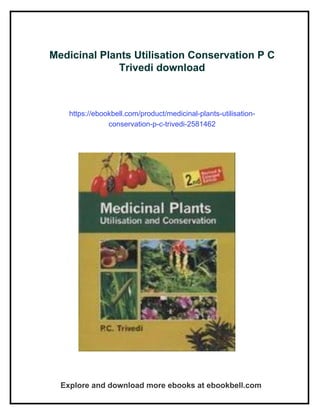
Medicinal Plants Utilisation Conservation P C Trivedi
Medicinal Plants Utilisation Conservation P C Trivedi
Medicinal Plants Utilisation Conservation P C Trivedi
Medicinal Plants Utilisation Conservation P C Trivedi
Medicinal Plants Utilisation Conservation P C Trivedi
1.
Medicinal Plants UtilisationConservation P C
Trivedi download
https://ebookbell.com/product/medicinal-plants-utilisation-
conservation-p-c-trivedi-2581462
Explore and download more ebooks at ebookbell.com
2.
Here are somerecommended products that we believe you will be
interested in. You can click the link to download.
Medicinal Plants Utilisation And Conservation 2nd Ed P C Trivedi
https://ebookbell.com/product/medicinal-plants-utilisation-and-
conservation-2nd-ed-p-c-trivedi-4110580
Conservation And Utilization Of Threatened Medicinal Plants 1st Ed Pe
Rajasekharan
https://ebookbell.com/product/conservation-and-utilization-of-
threatened-medicinal-plants-1st-ed-pe-rajasekharan-22448286
Biotechnological Approaches For Medicinal And Aromatic Plants
Conservation Genetic Improvement And Utilization 1st Ed Nitish Kumar
https://ebookbell.com/product/biotechnological-approaches-for-
medicinal-and-aromatic-plants-conservation-genetic-improvement-and-
utilization-1st-ed-nitish-kumar-7328080
Medicinal Plants And Their Utilization Gennaro Longo Francesco Pizzio
https://ebookbell.com/product/medicinal-plants-and-their-utilization-
gennaro-longo-francesco-pizzio-2265920
3.
Medicinal And AromaticPlants Of The World 1 Scientific Production
Commercial And Utilization Aspects Kos Mth
https://ebookbell.com/product/medicinal-and-aromatic-plants-of-the-
world-1-scientific-production-commercial-and-utilization-aspects-kos-
mth-21889474
Medicinal Plants Of Borneo Simon Gibbons Stephen P Teo
https://ebookbell.com/product/medicinal-plants-of-borneo-simon-
gibbons-stephen-p-teo-46137432
Medicinal Plants Bioprospecting And Pharmacognosy Amit Baran Sharangi
https://ebookbell.com/product/medicinal-plants-bioprospecting-and-
pharmacognosy-amit-baran-sharangi-46173030
Medicinal Plants Of Ecuador Pablo Chong Aguirre Migdalia Miranda
Martnez
https://ebookbell.com/product/medicinal-plants-of-ecuador-pablo-chong-
aguirre-migdalia-miranda-martnez-46653422
Medicinal Plants Their Response To Abiotic Stress Azamal Husen
https://ebookbell.com/product/medicinal-plants-their-response-to-
abiotic-stress-azamal-husen-47523558
6.
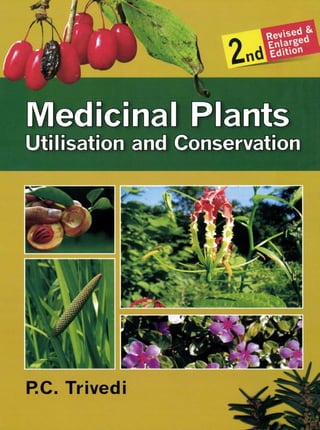
MEDICINAL PLANTS
Utilisation andConservation
2nd
Revised and Enlarged Edition
Editor
Prof. Pravin Chandra Trivedi
Ph.D., Post-Doct. (U.S.A.), F.L.S. (London), F.B.S., F.P.S.i.,
F.N.S.I., F.B.R.S., F.M.A., F.E.S., F.I.A.A.T.
Department of Botany
University of Rajasthan
Jaipur-302 004, India
Aavishkar Publishers, Distributors
Jaipur 302 003 (Raj) India
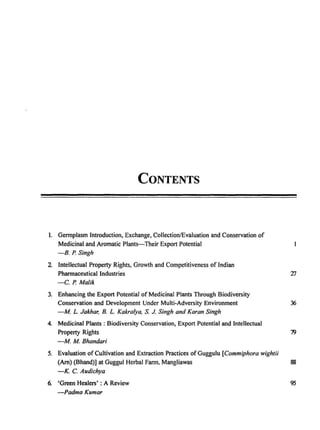
CONTENTS
I. Germplasm Introduction,Exchange, Collection/Evaluation and Conservation of
Medicinal and Aromatic Plants-Their Export Potential
-B. P. Singh
2 Intellectual Property Rights, Growth and Competitiveness of Indian
Pharmaceutical Industries
-C. P. Malik
3. Enhancing the Export Potential of Medicinal Plants Through Biodiversity
Conservation and Development Under Multi-Adversity Environment 36
-M L. Jakhar, B. L. Kakralya, S. J. Singh and Karan Singh
4. Medicinal Plants: Biodiversity Conservation, Export Potential and Intellectual
Property Rights 79
-M M Bhandari
5. Evaluation of Cultivation and Extraction Practices of Guggulu [Commiphora wightii
(Am) (Bhand)] at Guggul Herbal Farm, Mangliawas 88
-K. C. Audichya
6. 'Green Healers' : A Review 95
-Padma Kumar
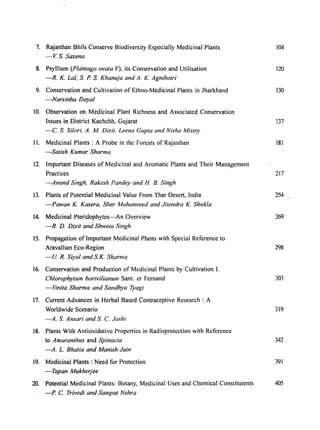
9.
7. Rajasthan BhilsConserve Biodiversity Especially Medicinal Plants 104
- V. S. Saxena
8. Psyllium (Plantago ovata F), its Conservation and Utilisation 120
-R. K. Lal, S P. S Khanuja and A. K. Agnihotri
9. Conservation and Cultivation of Ethno-Medicinal Plants in Jharkhand 130
-Narsinha Dayal
10. Observation on Medicinal Plant Richness and Associated Conservation
Issues in District Kachchh, Gujarat 137
-C S Si/ori, A. M Dixit. Leena Gupta and Nisha Mistry
II. Medicinal Plants: A Probe in the Forests of Rajasthan 181
-Salish Kumar Sharma
12. Important Diseases of Medicinal and Aromatic Plants and Their Management
Practices 217
-Anand Singh, Rakesh Pandey and H. B. Singh
13. Plants of Potential Medicinal Value From Thar Desert, India 254
-Pawan K. Kasera, Sher Mohammed and Jitendra K. Shukla
14. Medicinal Pteridophytes-An Overview 269
-R. D. Dixit and Shweta Singh
15. Propagation of Important Medicinal Plants with Special Reference to
Aravallian Eco-Region 298
-lJ. R. Siyol and SK. Sharma
16. Conservation and Production of Medicinal Plants by Cultivation I.
Chiorophylllm borivilianll/11 Sant. et Fernand 303
-Vinita Sharma and Sandhya Tyagi
17. Current Advances in Herbal Based Contraceptive Research: A
Worldwide Scenario 319
-A. S. Ansari and S C Joshi
18. Plants With Antioxidative, Properties in Radioprotection with Reference
to Amaranthus and Spinacia 342
-A. L. Bhatia and Manish Jain
19. Medicinal Plants: Need for Protection 391
-Tapan Mukherjee
20. Potential Medicinal Plants: Botany, Medicinal Uses and Chemical Constitutents 405
-P. C Trivedi and Sampat Nehra
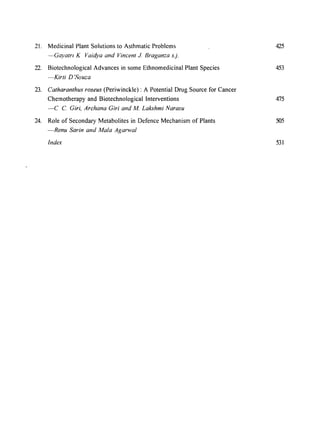
10.
2l. Medicinal PlantSolutions to Asthmatic Problems 425
--Gayatrt K Vaidya and Vincent 1. Braganza s.j.
22. Biotechnological Advances in some Ethnomedicinal Plant Species 453
-Kirti D'Souza
23. Catharanthus roseus (Periwinckle) : A Potential Drug Source for Cancer
Chemotherapy and Biotechnological Interventions 475
-c C. Giri, Archana Giri and M. Lakshmi Narasu
24. Role of Secondary Metabolites in Defence Mechanism of Plants 505
-Renu Sarin and Mala Agarwal
Index 531
11.
GERMPLASM INrRODUCflON, EXCHANGE,
COLLECflONIEVALUATIONAND CONSERVATION
OF MEDICINAL AND AROMATIC PLANrs---
THEIR EXPORT POTENTIAL
B. P. SINGH
THE Indian subcontinent is one of the mega-centres of crop-plant diversity. A wide
spectrum of agro-climatic and regional topography ranging from humid tropical to semi-arid,
temperate to alpine. makes it to grow all types of crop plants. The country also possesses cultural
and ethnic diversity, including 550 tribal communities of 227 ethnic groups, spread over 5,000
forested villages who have further contributed significantly over the millennia to the diversification
of agro-biodiversity. The Indian subcontinent is a centre for domestication and diversification of
plants. India has about 15,000 species of higher plants occurring in 16 major vegetation types.
About 33 per cent ofspecies are endemic. It is a treasure house ofwild economic plants, which are
largely under-utilised, particularly wild edible and medicinal and aromatic plants (Arora, 1996).
Fast erosion ofPGR due to fast-growing population pressure causing excessive collection
and exploitation has depleted the forest wealth, where most ofthe indigenous plant genetic resources
of medicinal and aromatic plants existed/and are still prevalent-therefore there is priority needs
for their exploration, collection, maintenance, evaluation and their conservation for their use for
the present and the future.
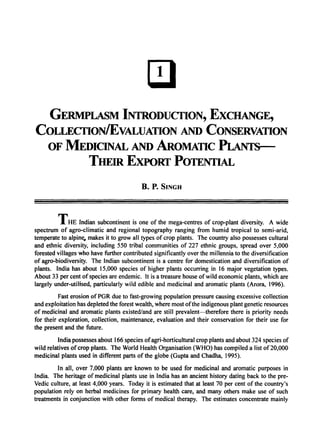
India possesses about 166 species ofagri-horticultural crop plants and about 324 species of
wild relatives ofcrop plants. The World Health Organisation (WHO) has compiled a list of20,000
medicinal plants used in different parts of the globe (Gupta and Chadha, 1995).
In all, over 7,000 plants are known to be used for medicinal and aromatic purposes in
India. The heritage of medicinal plants use in India has an ancient history dating back to the pre-
Vedic culture, at least 4,000 years. Today it is estimated that at least 70 per cent of the country's
population rely on herbal medicines for primary health care, and many others make use of such
treatments in conjunction with other forms of medical therapy. The estimates concentrate mainly
12.
2 GERMPLASM INTRODUCTION,EXCHANGE, COLLECTION/EvALUATION
on well-documented systems such as Ayurveda, Siddha and Unani as well as Homeopathy
and Allopathy.
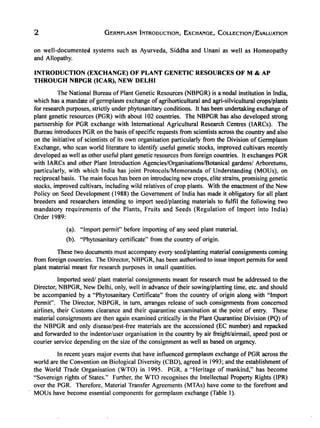
INTRODUCTION (EXCHANGE) OF PLANT GENETIC RESOURCES OF M & AP
THROUGH NBPGR (ICAR), NEW DELHI
The National Bureau of Plant Genetic Resources (NBPGR) is a nodal institution in India,
which has a mandate of germplasm exchange ofagrihorticultural and agri-silvicultural crops/plants
for research purposes, strictly under phytosanitary conditions. It has been undertaking exchange of
plant genetic resources (PGR) with about 102 countries. The NBPGR has also developed strong
partnership for PGR exchange with International Agricultural Research Centres (lARCs). The
Bureau introduces PGR on the basis of specific requests from scientists across the country and also
on the initiative of scientists of its own organisation particularly from the Division of Germplasm
Exchange, who scan world literature to identifY useful genetic stocks, improved cultivars recently
developed as well as other useful plant genetic resources from foreign countries. It exchanges PGR
with IARCs and other Plant Introduction Agencies/Organisations/Botanical gardens/ Arboretums,
particularly, with which India has joint Protocols/Memoranda of Understanding (MOUs), on
reciprocal basis. The main focus has been on introducing new crops, elite strains, promising genetic
stocks, improved cultivars, including wild relatives ofcrop plants. With the enactment ofthe New
Policy on Seed Development (1988) the Government of India has made it obligatory for all plant
breeders and researchers intending to import seed/planting materials to fulfil the following two
mandatory requirements of the Plants, Fruits and Seeds (Regulation of Import into India)
Order 1989:
(a). "Import permit" before importing of any seed plant material.
(b). "Phytosanitary certificate" from the country of origin.
These two documents must accompany every seed/planting material consignments coming
from foreign countries. The Director, NBPGR, has been authorised to issue import permits for seed
plant material meant for research purposes in small quantities.
Imported seed/ plant material consignments meant for research must be addressed to the
Director, NBPGR, New Delhi, only, well in advance of their sowing/planting time, etc. and should
be accompanied by a "Phytosanitary Certificate" from the country of origin along with "Import
Permit". The Director, NBPGR, in tum, arranges release of such consignments from concerned
airlines, their Customs clearance and their quarantine examination at the point of entry. These
material consignments are then again examined critically in the Plant Quarantine Division (PQ) of
the NBPGR and only disease/pest-free materials are the accessioned (EC number) and repacked
and forwarded to the indentor/user organisation in the country by air freight/airmail, speed post or
courier service depending on the size of the consignment as well as based on urgency.
In recent years major events that have influenced germplasm exchange of PGR across the
world are the Convention on Biological Diversity (CBD), agreed in 1993; and the establishment of
the World Trade Organisation (WTO) in 1995. PGR, a "Heritage of mankind," has become
"Sovereign rights of States." Further, the WTO recognises the Intellectual Property Rights (lPR)
over the PGR. Therefore, Material Transfer Agreements (MTAs) have come to the forefront and
MOUs have become essential components for germplasm exchange (Table I).
13.
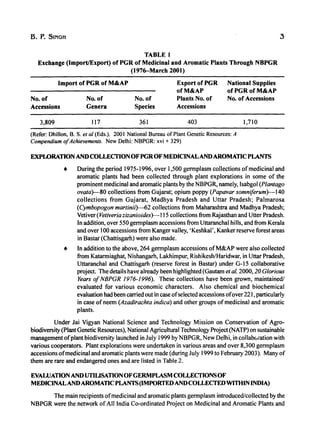
B. P. SINGH
TABLE1
Exchange (Import/Export) of PGR of Medicinal and Aromatic Plants Through NBPGR
(1976-March 2001)
Import of PGR of M&AP Export of PGR National Supplies
ofM&AP of PGR of M&AP
No. of No. of No. of Plants No. of No. of Accessions
Accessions Genera Species Accessions
3,809 117 361 403 1,710
(Refer: Dhillon, B. S. et at (Eds.). 200I National Bureau of Plant Genetic Resources: A
Compendium ofAchievements. New Delhi: NBPGR: xvi + 329)
EXPLORATIONANDCOLLECIlONOFPGROF MEDICINALANDAROMATIC PLANTS
• During the period 1975-1996, over I,SOO germplasm collections ofmedicinal and
aromatic plants had been collected through plant explorations in some of the
prominent medicinal and aromatic plants by the NBPGR, namely, Isabgol (Plantago
ovata}--80 collections from Gujarat; opium poppy (Papavar somniferum}--140
collections from Gujarat, Madhya Pradesh and Uttar Pradesh; Palmarosa
(Cymbopogon martinii}--62 collections from Maharashtra and Madhya Pradesh;
Vetiver (Vetiveria zizanioides}--11S collections from Rajasthan and Utter Pradesh.
In addition, over SSO germplasm accessions from Uttaranchal hills, and from Kerala
and over 100 accessions from Kanger valley, 'Keshkal', Kanker reserve forest areas
in Bastar (Chattisgarh) were also made.
• In addition to the above, 264 germplasm accessions ofM&AP were also collected
from Katarmiaghat, Nishangarh, Lakhimpur, RishikeshiHaridwar, in Uttar Pradesh,
Uttaranchal and Chattisgarh (reserve forest in Bastar) under G-IS collaborative
project. The details have already been highlighted (Gautam et ai, 2000,20Glorious
Years ofNBPGR 1976-1996). These collections have been grown, maintained!
evaluated for various economic characters. Also chemical and biochemical
evaluation had been carried out in case ofselected accessions ofover221, particularly
in case ofneem (Azadirachta indica) and other groups of medicinal and aromatic
plants.
Under Jai Vigyan National Science and Technology Mission on Conservation of Agro-
biodiversity (Plant Genetic Resources), National Agricultural Technology Project (NATP) on sustainable
management ofplant biodiversity launched in July 1999 by NBPGR, New Delhi, in collab(,cation with
various cooperators. Plant explorations were undertaken in various areas and over 8,300 germplasm
accessions ofmedicinal and aromatic plants were made (during July 1999 to February 2003). Many of
them are rare and endangered ones and are listed in Table 2.
EVALUATION AND UTIUSATIONOFGERMPLASM COLLECTIONSOF
MEDICINALANDAROMATIC PLANTS(IMPORTEDANDCOLLECTEDWITHIN INDIA)
The main recipients ofmedicinal and aromatic plants germplasm introduced!collected by the
NBPGR were the network ofAll India Co-ordinated Project on Medicinal and Aromatic Plants and
14.
4 GERMPLASM INTRODUCTION,EXCHANGE, COLLECTION/EvALUATION
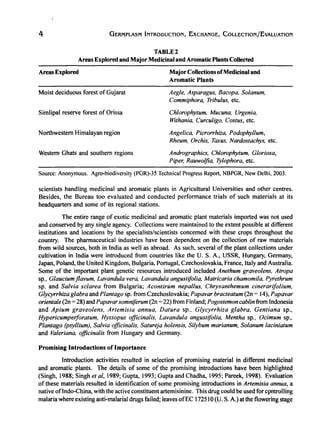
TABLE 2
Areas Explored and Major Medicinal and Aromatic Plants Collected
Areas Explored
Moist deciduous forest of Gujarat
Simlipal reserve forest of Orissa
Northwestern Himalayan region
Western Ghats and southern regions
Major Collections ofMedicinal and
Aromatic Plants
Aegle, Asparagus, Bacopa, Solanum,
Commiphora, Tribulus, etc.
Chlorophytum, Mucuna, Urgenia,
Withania, Curculigo, Costus, etc.
Angelica, Picrorrhiza, Podophyllum,
Rheum, Orchis, Taxus, Nardostachys, etc.
Andrographics, Chlorophytum, Gloriosa,
Piper, Rauwolfia, Tylophora, etc.
Source: Anonymous. Agro-biodiversity (PGR)-35 Technical Progress Report, NBPGR, New Delhi, 2003.
scientists handling medicinal and aromatic plants in Agricultural Universities and other centres.
Besides, the Bureau too evaluated and conducted performance trials of such materials at its
headquarters and some of its regional stations.
The entire range of exotic medicinal and aromatic plant materials imported was not used
and conserved by any single agency. Collections were maintained to the extent possible at different
institutions and locations by the specialists/scientists concerned with these crops throughout the
country. The pharmaceutical industries have been dependent on the collection of raw materials
from wild sources, both in India as well as abroad. As such, several of the plant collections under
cultivation in India were introduced from countries like the U. S. A., USSR, Hungary, Germany,
Japan, Poland, the United Kingdom, Bulgaria, Portugal, Czechoslovakia, France, Italy and Australia.
Some of the important plant genetic resources introduced included Anethum graveolens, Atropa
sp., Glaucium jlavum, Lavandula vera, Lavandula angustifolia, Matricaria chamomila, Pyrethrum
sp. and Salvia sclarea from Bulgaria; Acontirum nepal/us, Chrysanthemum cinerarifolium,
Glycyrrhiza glabra and Plantago sp. from Czechoslovakia; Papavar bracteatum (2n = 14), Papavar
orientale (2n =28) and Papavar somniferum (2n =22) from Finland; Pogostemon cablin from Indonesia
and Apium graveolens, Artemisia annua, Datura sp., Glycyrrhiza glabra, Gentiana sp.,
Hypericumperjoratum, Hyssopus ofjicinalis, Lavandula angustifolia, Mentha sp., Ocimum sp.,
Plantago (psyllium), Salvia ofjicinalis, Satureja holensis, Silybum marianum, Solanum laciniatum
and Valeriana, ofjicinalis from Hungary and Germany.
Promising Introductions of Importance
Introduction activities resulted in selection of promising material in different medicinal
and aromatic plants. The details of some of the promising introductions have been highlighted
(Singh, 1988; Singh et ai, 1989; Gupta, 1993; Gupta and Chadha, 1995; Pareek, 1998). Evaluation
of these materials resulted in identification of some promising introductions in Artemisia annua, a
native ofindo-China, with the active constituent artemisinine. This drug could be used for cpntrolling
malaria where existing anti-malarial drugs failed; leaves ofEC 172510 (U. S. A.) at the flowering stage
15.
B. P. SINGH5
yielded artemisinine content of o. 02 per cent. Artemisine and Arteannium are used for cerebral
thrombosis in China. Catharanthus roseus. G. Don (syn. Vinca rosea), a native ofCaribbean Islands
in the West Indies, and naturalised all over the tropics was found to grow wild along the coastal area
ofTamil Nadu, Andhra Pradesh, Kamataka, Assam and West Bengal. The leaves, rich in vincristine
(VCR) and vincaleuco-blastine (VLB) could be used in the treatment of cancer. Ajmalicine and
serpentine from roots are used for controlling high blood pressure. There are two other constituents,
namely, vindoline and catharanthine in leaves, which could be used in synthesis ofVLB analogues.
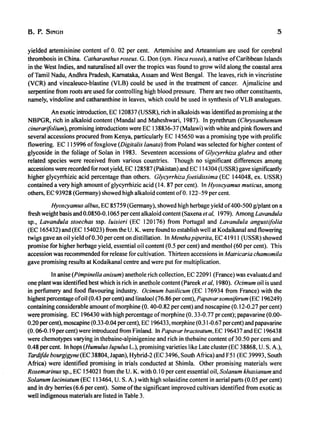
An exotic introduction, EC 120837 (USSR), rich in alkaloids was identified as promising at the
NBPGR, rich in alkaloid content (MandaI and Maheshwari, 1987). In pyrethrum (Chrysanthemum
cinerarifolium), promising introductions were EC 138836-37 (Malawi) with white and pink flowers and
several accessions procured from Kenya, particularly EC 145650 was a promising type with prolific
flowering. EC 115996 offoxglove (Digitalis lanata) from Poland was selected for higher content of
glycoside in the foliage of Solan in 1983. Seventeen accessions of Glycyrrhiza glabra and other
related species were received from various countries. Though no significant differences among
accessions were recorded for root yield, EC 128587 (Pakistan) and EC 114304 (USSR) gave significantly
higher glycyrrhizic acid percentage than others. GlycyrrhizaJoetidissima (EC 144048, ex. USSR)
contained a very high amount ofglycyrrhizic acid (14. 87 per cent). In Hyoscyamus muticus, among
others, EC 93928 (Germany) showed high alkaloid content ofO. 122-59 percent.
Hyoscyamus albus, EC 85759 (Germany), showed high herbage yield of400-500 glplant on a
fresh weight basis and 0.0850-0.1 065 per cent alkaloid content (Saxena et al. 1979). Among Lavandula
sp., Lavandula stoechas ssp. luisieri (EC 120176) from Portugal and Lavandula angustifolia
(EC 165432) and(EC 154023) from the U. K. were found to establish well at Kodaikanal and flowering
twigs gave an oil yield of0.30 per cent on distillation. In Mentha piperita, EC 41911 (USSR) showed
promise for higher herbage yield, essential oil content (0.5 per cent) and menthol (60 per cent). This
accession was recommended for release for cultivation. Thirteen accessions in Matricaria chamomila
gave promising results at Kodaikanal centre and were put for multiplication.
In anise (Pimpinella anisum) anethole rich collection, EC 22091 (France) was evaluatt:.d and
one plant was identified best which is rich in anethole content (Pareek et ai, 1980). Ocimum oil is used
in perfumery and food flavouring industry. Ocimum basilicum (EC 176934 from France) with the
highest percentage ofoil (0.43 per cent) and linalool (76.86 per cent), Papavarsomniferum (EC 196249)
containing considerable amount ofmorphine (0. 40-0.82 per cent) and noscapine (0.12-0.27 per cent)
were promising. EC 196430 with high percentage ofmorphine (0. 33-0.77 pr cent); papavarine (0.00-
0.20 percent), moscapine (0.33-0.04 per cent), EC 196433, morphine (0.31-0.67 per cent) and papavarine
(0.06-0.19 per cent) were introduced from Finland. In Papavar bracteatum, EC 196437 and EC 196438
were chemotypes varying in thebaine-alpinigenine and rich in thebaine content of30.50 per cent and
0.48 per cent. In hops (Humulus lupulus L.), promising varieties like Late cluster (EC 38868, U. S. A.),
Tardifde bourgigyne (EC 38804, Japan), Hybrid-2 (EC 3496, South Africa) and F51 (EC 39993, South
Africa) were identified promising in trials conducted at Shimla. Other promising materials were
Rosemarinus sp., EC 154021 from the U. K. with 0.10 per cent essential oil, Solanum khasianum and
Solanum laciniatum (EC 113464, U. S. A.) with high solasidine content in aerial parts (0.05 per cent)
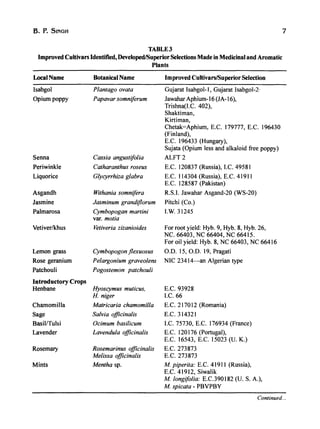
and in dry berries (6.6 per cent). Some ofthe significant improved cultivars identified from exotic as
well indigenous materials are listed in Table 3.
16.
6 GERMPLASM INTRODUCTION,EXCHANGE, COLLECTION/EvALUATION
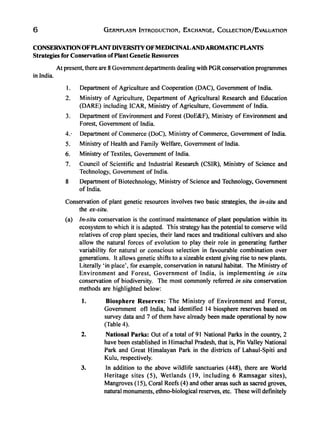
CONSERVATIONOFPLANT DIVERSITYOFMEDICINALAND AROMATIC PLANTS
Strategies for Conservation ofPlant Genetic Resources
At present, there are 8 Government departments dealing with PGRconservation programmes
in India.
I. Department of Agriculture and Cooperation (DAC), Government of India.
2. Ministry of Agriculture, Department of Agricultural Research and Education
(DARE) including ICAR, Ministry of Agriculture, Government of India.
3. Department of Environment and Forest (DoE&F), Ministry of Environment and
Forest, Government of India.
4.· Department of Commerce (DoC), Ministry of Commerce, Government of India.
5. Ministry of Health and Family Welfare, Government of India.
6. Ministry of Textiles, Government of India.
7. Council of Scientific and Industrial Research (CSIR), Ministry of Science and
Technology, Government of India.
8 Department of Biotechnology, Ministry of Science and Technology, Government
of India.
Conservation of plant genetic resources involves two basic strategies, the in-situ and
the ex-situ.
(a) In-situ conservation is the continued maintenance of plant population within its
ecosystem to which it is adapted. This strategy has the potential to conserve wild
relatives of crop plant species, their land races and traditional cultivars and also
allow the natural forces of evolution to play their role in generating further
variability for natural or conscious selection in favourable combination over
generations. It allows genetic shifts to a sizeable extent giving rise to new plants.
Literally 'in place', for example, conservation in natural habitat. The Ministry of
Environment and Forest, Government of India, is implementing in situ
conservation of biodiversity. The most commonly referred in situ conservation
methods are highlighted below:
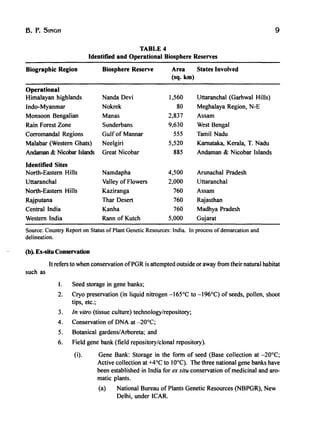
1. Biosphere Reserves: The Ministry of Environment and Forest,
Government oft India, had identified 14 biosphere reserves based on
survey data and 7 ofthem have already been made operational by now
(Table 4).
2. National Parks: Out of a total of 91 National Parks in the country, 2
have been established in Himachal Pradesh, that is, Pin Valley National
Park and Great Himalayan Park in the districts of Lahaul-Spiti and
Kulu, respectively.
3. In addition to the above wildlife sanctuaries (448), there are World
Heritage sites (5), Wetlands (19, including 6 Ramsagar sites),
Mangroves (15), Coral Reefs (4) and other areas such as sacred groves,
natural monuments, ethno-biological reserves, etc. These will definitely
17.
B. P. SINGH
TABLE3
ImprovedCultivars Identified, Developed/SuperiorSelections Made in Medicinal and Aromatic
Plants
Local Name
Isabgol
Opium poppy
Senna
Periwinkle
Liquorice
Asgandh
Jasmine
Palmarosa
Vetiverlkhus
Lemon grass
Rose geranium
Patchouli
Introductory Crops
Henbane
Chamomilla
Sage
Basil/Tulsi
Lavender
Rosemary
Mints
Botanical Name
Plantago ovata
Papavar somniferum
Cassia angustifolia
Catharanthus roseus
Glycyrrhiza glabra
Withania somnifera
Jasminum grandiflorum
Cymbopogan martini
var. mofia
Vetiveria zizanioides
Cymbopogon flexuosus
Pelargonium graveolens
Pogostemon patchouli
Hyoscymus muticus,
H. niger
Matricaria chamomilla
Salvia officinalis
Ocimum basilicum
Lavendula officinalis
Rosemarinus ojJicinalis
Melissa officinalis
Mentha sp.
1mproved CultivarslSuperior Selection
Gujarat Isabgol-I, Gujarat Isabgol-2-
Jawahar Aphium-16 (JA-16),
Trishna(I.C. 402),
Shaktiman,
Kirtiman,
Chetak=Aphium, E.e. 179777, E.e. 196430
(Finland),
E.e. 196433 (Hungary),
Sujata (Opium less and alkaloid free poppy)
ALFT2
E.e. 120837 (Russia), I.C. 49581
E.e. 114304 (Russia), E.e. 41911
E.e. 128587 (Pakistan)
R.S.1. Jawahar Asgand-20 (WS-20)
Pitchi (Co.)
I.w. 31245
For root yield: Hyb. 9, Hyb. 8, Hyb. 26,
NC. 66403, NC 66404, NC 66415.
For oil yield: Hyb. 8, NC 66403, NC 66416
0.0. 15, 0.0. 19, Pragati
NIC 23414-an Algerian type
E.e. 93928
I.e. 66
E.C. 217012 (Romania)
E.C.314321
I.e. 75730, E.e. 176934 (France)
E.e. 120176 (Portugal),
E.C. 16543, E.e. 15023 (U. K.)
E.e. 273873
E.C.273873
M. piperita: E.C. 41911 (Russia),
E.C. 41912, Siwalik
M longifolia: E.e.390182 (U. S. A.),
M. spicata - PBVPBY
7
Continued. __
18.
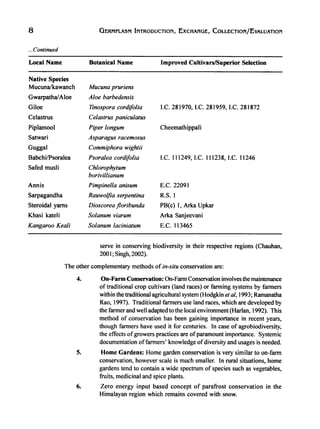
8
...Continued
Local Name
Native Species
Mucunalkawanch
GwarpathalAloe
Giloe
Celastrus
Piplamool
Satwari
Guggal
Babchi/Psoralea
Safedmusli
Annis
Sarpagandha
Steroidal yarns
Khasi kateli
Kangaroo Keali
GERMPLASM INTRODUCTION, EXCHANGE, COLLECTION/EvALUATION
Botanical Name
Mucuna pruriens
Aloe barbedensis
Tinospora cordifolia
Celastrus paniculatus
Piper longum
Asparagus racemosus
Commiphora wightii
Psoralea cordifolia
Chlorophytum
borivillianum
Pimpinella anisum
Rauwolfia serpentina
Dioscorea jloribunda
Solanum viarum
Solanum laciniatum
Improved CultivarslSuperior Selection
I.C. 281970, I.C. 281959, I.e. 281872
Cheemathippali
I.e. 1II249, I.C. II 1238, I.C. II 246
E.C.22091
R.S.I
PB(c) I, Arka Upkar
Arka Sanjeevani
E.C. 113465
serve in conserving biodiversity in their respective regions (Chauhan,
2001; Singh, 2002).
The other complementary methods ofin-situ conservation are:
4. On-Farm Conservation: On-Fann Conservation involves the maintenance
of traditional crop cultivars (land races) or farming systems by farmers
within the traditional agricultural system (Hodgkin et ai, 1993; Ramanatha
Rao, 1997). Traditional farmers use land races, which are developed by
the farmer and well adapted to the local environment (Harlan, 1992). This
method of conservation has been gaining importance in recent years,
though farmers have used it for centuries. In case of agrobiodiversity,
the effects ofgrowers practices are ofparamount importance. Systemic
documentation offarmers' knowledge ofdiversity and usages is needed.
5. Home Gardens: Home garden conservation is very similar to on-farm
conservation, however scale is much smaller. In rural situations, home
gardens tend to contain a wide spectrum of species such as vegetables,
fruits, medicinal and spice plants.
6. Zero energy input based concept of parafrost conservation in the
Himalayan region which remains covered with snow.
19.
B. P. SINGH
TABLE4
Identified and Operational Biosphere Reserves
Biographic Region Biosphere Reserve
Operational
Himalayan highlands Nanda Devi
Indo-Myanmar Nokrek
Monsoon Bengalian Manas
Rain Forest Zone Sunderbans
Corromandal Regions Gulf of Mannar
Malabar (Western Ghats) Neelgiri
Andaman & Nicobar Islands Great Nicobar
Identified Sites
North-Eastern Hills Namdapha
Uttaranchal Valley of Flowers
North-Eastern Hills Kaziranga
Rajputana Thar Desert
Central India Kanha
Western India Rann of Kutch
Area
(sq. km)
1,560
80
2,837
9,630
555
5,520
885
4,500
2,000
760
760
760
5,000
States Involved
Uttaranchal (Garhwal Hills)
Meghalaya Region, N-E
Assam
West Bengal
Tamil Nadu
Kamataka, Kerala, T. Nadu
Andaman & Nicobar Islands
Arunachal Pradesh
Uttaranchal
Assam
Rajasthan
Madhya Pradesh
Gujarat
Source: Country Report on Status of Plant Genetic Resources: India In process of demarcation and
delineation.
(b). Ex-situ Conservation
9
It refers to when conservation ofPGR is attempted outside or away from their natural habitat
such as
I. Seed storage in gene banks;
2. Cryo preservation (in liquid nitrogen -165°C to -196°C) of seeds, pollen, shoot
tips, etc.;
3. In vitro (tissue culture) technology/repository;
4. Conservation of DNA at -20°C;
5. Botanical gardens/Arboreta; and
6. Field gene bank (field repository/clonal repository).
(i). Gene Bank: Storage in the form of seed (Base collection at -20°C;
Active collection at +4°C to lO°C). The three national gene banks have
been established in India for ex situ conservation of medicinal and aro-
matic plants.
(a) National Bureau of Plants Genetic Resources (NBPGR), New
Delhi, under ICAR.
20.
10 GERMPLASM INTRODUCTION,EXCHANGE, COLLECTION/EvALUATION
(b) Central Institute ofMedicinal and Aromatic Plants (CIMAP),
Lucknow, Uttar Pradesh, under the Council ofScientific Indus-
trial Research (CSIR), Ministry ofScience and Technology, Gov-
ernment ofIndia.
(c) Tropical Botanical Gardens Research Institute, (TBGRI), Palode,
Thiruvananthapuram (Kerala).
The conservation of genetic variability of cultivated plants and their wild relatives is the
sole responsibility ofthe National Bureau ofPlant Genetic Resources (NBPGR) that operates under
the Indian Council ofAgricultural Research (ICAR), DepartmentofAgricultural Research and Education
(DARE).
THENATIONALGENE BANK(NGB)ATNBPGR, NEW DELHI
i. Seed Gene Bank
Germplasm conservation in Seed Gene Bank is more economical. The NBPGR, New Delhi,
houses National Gene Bank (NGB) which is primarily responsible for conservation ofgermplasm of
agri-horticultural crops and their wild relatives for long-term seed storage for posterity. These are
referred to as "Base Collection" stored in modules maintained at -20°C. The seeds are dried to attain
4-6 per cent moisture content and hermetically sealed in moisture proofaluminium foil packets. These
stored seeds remain viable for 50 to 100 years. In most crops, seeds samples with more than 85 per
cent seed viability are only processed. The seeds in gene bank are stored preferably as per the gene
bank standards recommended by FAO/IPGRI.
The Indian NGB has 12 modules with a capacity to hold around one million accessions. The
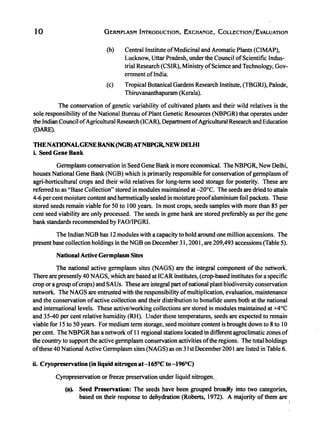
present base collection holdings in the NGB on December 31,200I, are 209,493 accessions (Table 5).
National Active GermpJasm Sites
The national active germplasm sites (NAGS) are the integral component of the network.
There are presently 40 NAGS, which are based at ICAR institutes, (crop-based institutes for a specific
crop or a group ofcrops) and SAUs. These are integral part ofnational plantbiodiversity conservation
network. The NAGS are entrusted with the responsibility ofmultiplication, evaluation, maintenance
and the conservation ofactive collection and their distribution to bonafide users both at the national
and international levels. These active/working collections are stored in modules maintained at +4°C
and 35-40 per cent relative humidity (RH). Under these temperatures, seeds are expected to remain
viable for 15 to 50 years. For medium term storage, seed moisture content is brought down to 8 to 10
per cent. The NBPGR has a network of II regional stations located in different agroclimatic zones of
the country to support the active germplasm conservation activities ofthe regions. The total holdings
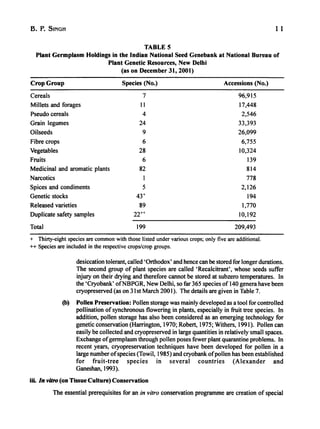
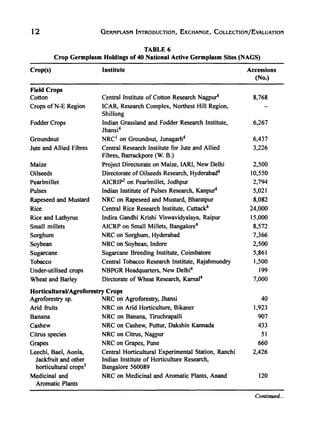
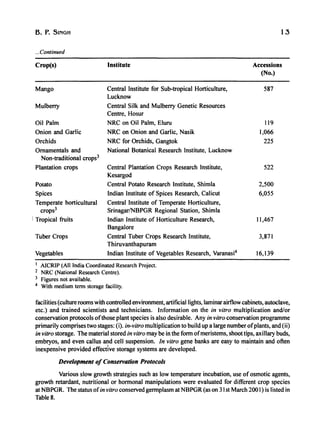
ofthese 40 National Active Germplasm sites (NAGS) as on 31st December 200 I are listed in Table 6.
ii. Cryopreservation (in liquid nitrogen at-165°C to-196°C)
Cyropreservation or freeze preservation under liquid nitrogen..
(a). Seed Preservation: The seeds have been grouped broacHy into two categories,
based on their response to dehydration (Roberts, 1972). A majority ofthem are
I
21.
B. P. SINGHI I
TABLE 5
Plant Germplasm Holdings in the Indian National Seed Genebank at National Bureau of
Plant Genetic Resources, New Delhi
(as on December 31,2001)
Crop Group Species (No.) Accessions (No.)
Cereals 7 96,915
Millets and forages 11 17,448
Pseudo cereals 4 2,546
Grain legumes 24 33,393
Oilseeds 9 26,099
Fibre crops 6 6,755
Vegetables 28 10,324
Fruits 6 139
Medicinal and aromatic plants 82 814
Narcotics 778
Spices and condiments 5 2,126
Genetic stocks 43+ 194
Released varieties 89 1,770
Duplicate safety samples 22++ 10,192
Total 199 209,493
+ Thirty-eight species are common with those listed under various crops; only five are additional.
++ Species are included in the respective crops/crop groups.
desiccation tolerant, called 'Orthodox' and hence can be stored for longer durations.
The second group of plant species are called 'Recalcitrant', whose seeds suffer
injury on their drying and therefore cannot be stored at subzero temperatures. In
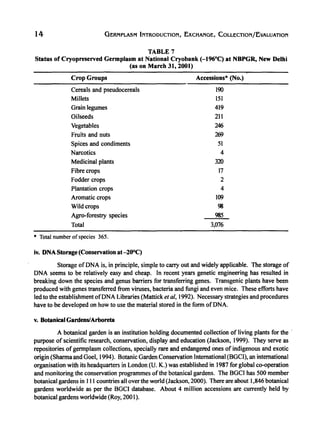
the 'Cl)'obank' ofNBPGR, New Delhi, so far 365 species of 140 genera have been
cl)'opreserved (as on 31st March 2001). The details are given in Table 7.
(b) Pollen Preservation: Pollen storage was mainly developed as a tool for controlled
pollination ofsynchronous flowering in plants, especially in fruit tree species. In
addition, pollen storage has also been considered as an emerging technology for
genetic conservation (Harrington, 1970; Robert, 1975; Withers, 1991). Pollen can
easily be collected and cl)'opreserved in large quantities in relatively small spaces.
Exchange ofgermplasm through pollen poses fewer plant quarantine problems. In
recent years, cl)'opreservation techniques have been developed for pollen in a
large number ofspecies (Towil, 1985) and cl)'obank ofpollen has been established
for fruit-tree species in several countries (Alexander and
Ganeshan,I993).
iii. In vitro (on TissueCulture) Conservation
The essential prerequisites for an in vitro conservation programme are creation of special
22.
12 GERMPLASM INTRODUCTION,EXCHANGE, COLLECTION/EvALUATION
TABLE 6
Crop Germplasm Holdings of 40 National Active Germplasm Sites (NAGS)
Crop(s)
Field Crops
Cotton
Crops ofN-E Region
Fodder Crops
Groundnut
Jute and Allied Fibres
Maize
Oilseeds
Pearlmillet
Pulses
Rapeseed and Mustard
Rice
Rice and Lathyrus
Small millets
Sorghum
Soybean
Sugarcane
Tobacco
Under-utilised crops
Wheat and Barley
Institute
Central Institute of Cotton Research Nagpur4
ICAR, Research Complex, Northest Hill Region,
Shillong
Indian Grassland and Fodder Research Institute,
Jhansi4
NRCI on Groundnut, Junagarh4
Central Research Institute for Jute and Allied
Fibres, Barrackpore (W. 8.)
Project Directorate on Maize, IARI, New Delhi
Directorate ofOilseeds Research, Hyderabad4
AICRIp2 on Pearlmillet, Jodhpur
Indian Institute of Pulses Research, Kanpur4
NRC on Rapeseed and Mustard, Bharatpur
Central Rice Research Institute, Cuttack4
Indira Gandhi Krishi Viswavidyalaya, Raipur
AICRP on Small Millets, Bangalore4
NRC on Sorghum, Hyderabad
NRC on Soybean, Indore
Sugarcane Breeding Institute, Coimbatore
Central Tobacco Research Institute, Rajahmundry
NBPGR Headquarters, New Delhi4
Dirctorate of Wheat Research, Kamal4
HorticulturallAgroforestry Crops
Agroforestry sp. NRC 0!l Agroforestry, Jhansi
Arid fruits NRC on Arid Horticulture, Bikaner
Banana
Cashew
Citrus species
Grapes
Leechi, Bael, Aonla,
Jackfruit and other
horticultural crops3
Medicinal and
Aromatic Plants
NRC on Banana, Tiruchrapalli
NRC on Cashew, Puttur, Dakshin Kannada
NRC on Citrus, Nagpur
NRC on Grapes, Pune
Central Horticultural Experimental Station, Ranchi
Indian Institute of Horticulture Research,
Bangalore 560089
NRC on Medicinal and Aromatic Plants, Anand
Accessions
(No.)
8,768
6,267
6,437
3,226
2,500
10,550
2,794
5,021
8,082
24,000
15,000
8,572
7,366
2,500
5,861
1,500
199
7,000
40
1,923
907
433
51
660
2,426
120
Continued..
23.
B. P. SINGH
...Continued
Crop(s)
Mango
Mulberry
OilPalm
Onion and Garlic
Orchids
Ornamentals and
Non-traditional crops3
Plantation crops
Potato
Spices
Temperate horticultural
crops3
I Tropical fruits
Tuber Crops
Vegetables
Institute
Central Institute for Sub-tropical Horticulture,
Lucknow
Central Silk and Mulberry Genetic Resources
Centre, Hosur
NRC on Oil Palm, Eluru
NRC on Onion and Garlic, Nasik
NRC for Orchids, Gangtok
National Botanical Research Institute, Lucknow
Central Plantation Crops Research Institute,
Kesargod
Central Potato Research Institute, Shimla
Indian Institute of Spices Research, Calicut
Central Institute of Temperate Horticulture,
SrinagarlNBPGR Regional Station, Shimla
Indian Institute of Horticulture Research,
Bangalore
Central Tuber Crops Research Institute,
Thiruvanthapuram
Indian Institute of Vegetables Research, Varanasi4
1 AICRIP (All India Coordinated Research Project.
2 NRC (National Research Centre).
3 Figures not available.
4 With medium term storage facility.
13
Accessions
(No.)
587
119
1,066
225
522
2,500
6,055
11,467
3,871
16,139
facilities (culture rooms with controlled environment, artificial lights, laminar airflow cabinets, autoclave,
etc.) and trained scientists and technicians. Information on the in vitro multiplication and/or
conservation protocols ofthose plant species is also desirable. Any in vitro conservation programme
primarily comprises two stages: (i). in-vitro multiplication to build up a large number ofplants, and (ii)
in vitro storage. The material stored in vitro may be in the form ofmeristems, shoot tips, axillary buds,
embryos, and even callus and cell suspension. In vitro gene banks are easy to maintain and often
inexpensive provided effective storage systems are developed.
Development ofConservation Protocols
Various slow growth strategies such as low temperature incubation, use of osmotic agents,
growth retardant, nutritional or hormonal manipulations were evaluated for different crop species
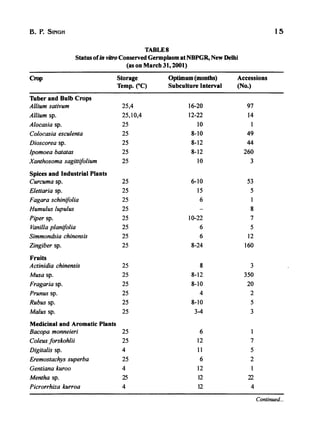
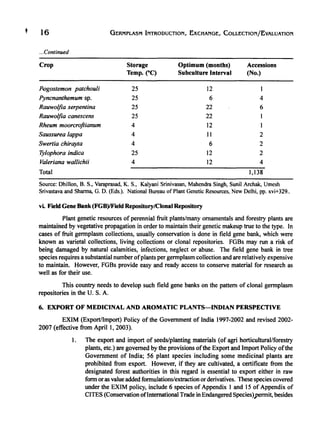
at NBPGR. The status ofin vitro conserved germplasm at NBPGR (as on 31 st March 200 I) is listed in
Table 8.
24.
14 GERMPLASM INTRODUCTION,EXCHANGE, COLLECTION/EvALUATION
TABLE 7
Status of Cryopreserved Germplasm at National Cryobank (-196°C) at NBPGR, New Delhi
(as on March 31, 2001)
Crop Groups
Cereals and pseudocereals
Millets
Grain legumes
Oilseeds
Vegetables
Fruits and nuts
Spices and condiments
Narcotics
Medicinal plants
Fibre crops
Fodder crops
Plantation crops
Aromatic crops
Wild crops
Agro-forestry species
Total
* Total number ofspecies 365.
iv. DNA Storage(Conservation at-20°C)
Accessions· (No.)
190
151
419
211
246
2f>9
51
4
320
17
2
4
109
98
985
3,076
Storage of DNA is, in principle, simple to carry out and widely applicable. The storage of
DNA seems to be relatively easy and cheap. In recent years genetic engineering has resulted in
breaking down the species and genus barriers for transferring genes. Transgenic plants have been
produced with genes transferred from viruses, bacteria and fungi and even mice. These efforts have
led to the establishment ofDNA Libraries (Mattick et ai, 1992). Necessary strategies and procedures
have to be developed on how to use the material stored in the form of DNA.
v. BotanicalGardens!Arboreta
A botanical garden is an institution holding documented collection of living plants for the '
purpose of scientific research, conservation, display and education (Jackson, 1999). They serve as
repositories ofgermplasm collections, specially rare and endangered ones of indigenous and exotic
origin (Sharma and Goel, 1994). Botanic Garden Conservation International (BGCI), an international
organisation with its headquarters in London (U. K.) was established in 1987 for global co-operation
and monitoring the conservation programmes ofthe botanical gardens. The BGCI has 500 member
botanical gardens in III countries all overthe world (Jackson, 2000). There are about 1,846 botanical
gardens worldwide as per the BGCI database. About 4 million accessions are currently held by
botanical gardens worldwide (Roy, 2001).
16 GERMPLASM INTRODUCTION,EXCHANGE, COLLECTION/EvALUATION
...Continued
Crop
P.ogostemon patchouli
Pyncnanthemum sp.
Rauwolfia serpentina
Rauwolfia canescens
Rheum moorcroftianum
Saussurea lappa
Swertia chirayta
Tylophora indica
Valeriana wallichii
Total
Storage
Temp. (0C)
25
25
25
25
4
4
4
25
4
Optimum (months)
Subculture Interval
12
6
22
22
12
11
6
12
12
Accessions
(No.)
4
6
2
2
2
4
1,138
Source: Dhillon, B. S., Varaprasad, K. S., Kalyani Srinivasan, Mahendra Singh, Sunil Archak, Umesh
Srivastava and Sharma, G. D. (Eds.). National Bureau ofPlant Genetic Resources. New Delhi, pp. xvi+329..
vi. Field Gene Bank(FGB)lField Repository/Clonal Repository
Plant genetic resources of perennial fruit plants/many ornamentals and forestry plants are
maintained by vegetative propagation in order to maintain their genetic makeup true to the type. In
cases of fruit germplasm collections, usually conservation is done in field gene bank, which were
known as varietal collections, living collections or clonal repositories. FGBs may run a risk of
being damaged by natural calamities, infections, neglect or abuse. The field gene bank in tree
species requires a substantial number ofplants per germplasm collection and are relatively expensive
to maintain. However, FGBs provide easy and ready access to conserve material for research as
well as for their use.
This country needs to develop such field gene banks on the pattern of clonal germplasm
repositories in the U. S. A.
6. EXPORT OF MEDICINAL AND AROMATIC PLANTS-INDIAN PERSPECTIVE
EXIM (Export/Import) Policy of the Government of India 1997-2002 and revised 2002-
2007 (effective from April 1,2003).
1. The export and import of seeds/planting materials (of agri horticultural/forestry
plants, etc.) are governed by the provisions ofthe Export and Import Policy ofthe
Government of India; 56 plant species including some medicinal plants are
prohibited from export. However, if they are cultivated, a certificate from the
designated forest authorities in this regard is essential to export either in raw
form oras value added formulations/extraction or derivatives. These species covered
under the EXIM policy, include 6 species of Appendix 1 and 15 of Appendix of
CITES (Conservation ofintemational Trade in Endangered Species),pcrmit, besides
27.
B. P. SINGH17
a certificate ofcultivation, origin from the designated forest authorities.
2. The export ofall other species ofwild origin not covered underthe WiIdlife Protection
Act 1992 and EXIM policy is permitted only upon furnishing oflegal procurement
certificate from the designated forest authorities.
• 1995: WTO came into force, quarantine concerns in trade started, sanitary and
Phytosanitary (SPS) agreement ofWTO signed.
• Sanitary and Phytosanitary measures
The phytosanitation aspects of PGR needs to be properly addressed. The National Plant
Quarantine System needs strengthening on a priority basis.
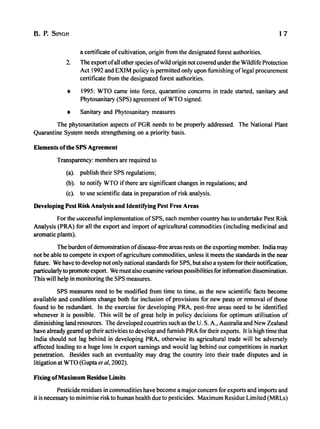
Elements ofthe SPS Agreement
Transparency: members are required to
(a). publish their SPS regulations;
(b). to notifY WTO ifthere are significant changes in regulations; and
(c). to use scientific data in preparation ofrisk analysis.
Developing Pest Risk Analysis and Identifying Pest Free Areas
For the ~uccessful implementation ofSPS, each member country has to undertake Pest Risk
Analysis (PRA) for all the export and import of agricultural commodities (including medicinal and
aromatic plants).
The burden ofdemonstration ofdisease-free areas rests on the exporting member. India may
not be able to compete in export ofagriculture commodities, unless it meets the standards in the near
future. We have to develop not only national standards for SPS, but also a system for their notification,
particularly to promote export. We must also examine various possibilities for information dissemination.
This will help in monitoring the SPS measures.
SPS measures need to be modified from time to time, as the new scientific facts become
available and conditions change both for inclusion of provisions for new pests or removal of those
found to be redundant. In the exercise for developing PRA, pest-free areas need to be identified
whenever it is possible. This will be of great help in policy decisions for optimum utilisation of
diminishing land resources. The developed countries such as the U. S. A., Australia and New Zealand
have already geared up their activities to develop and furnish PRA for their exports. It is high time that
India should not lag behind in developing PRA, otherwise its agricultural trade will be adversely
affected leading to a huge loss in export earnings and would lag behind our competitions in market
penetration. Besides such an eventuality may drag the country into their trade disputes and in
litigation at WTO (Gupta et ai, 2002).
Fixing ofMaximum Residue Limits
Pesticide residues in commodities have become a major concern for exports and imports and
it is necessary to minimise risk to human health due to pesticides. Maximum Residue Limited (MRLs)
28.
18 GERMPLASM INTRODUCTION,EXCHANGE, COLLECTION/EvALUATION
are applied to domestic and imported produce. These residue limits and unauthorised pesticides are
the most common cause of refusal of consignments in the country. The MRLs vary from country to
country. These create impediments to trade. India needs to develop its standards, which should be
based on the extent necessary to protect our plant and animal health based on scientific data and
international standards.
Consideration for Planting Material and Germplasm
SPS measures are supposed to be developed for export and import ofcommodities, and not
for the exchange ofplanting material and/or germplasm. One should be equally vigilant, sometimes
commodities may, intentionally or unintentionally, find their way to agriculture land. We should also
look into the requirements of exchange of germplasm and planting material and the end product of
which may ultimately assume the form ofcommodities.
Networking
There is an urgent need to develop an information network through:
(a). Linkage with codex committees, OlE, IPPC, FAO, WHO, WTO, ISO, etc.;
(b). Coordination mechanism involving planning and network system; and
(c). Dissemination of information on standards and codes ofpractices.
Harmonisation
The Indian SPS measures should be in harmony with international standards and followed
by neighbouring and other countries, which have a similar agricultural system. This can be done only
when we have our well-defined SPS agreement.
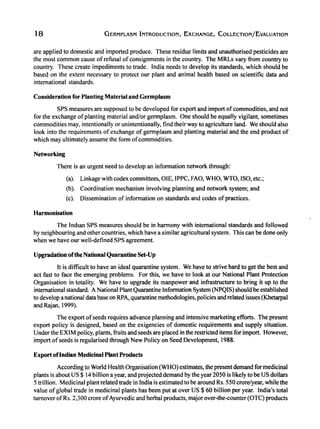
Upgradation ofthe National QuarantineSet-Up
It is difficult to have an ideal quarantine system. We have to strive hard to get the best and
act fast to face the emerging problems. For this, we have to look at our National Plant Protection
Organisation in totality. We have to upgrade its manpower and infrastructure to bring it up to the
international standard. A National Plant Quarantine Information System (NPQIS) should be established
to develop a national data base on RPA, quarantine methodologies, policies and related issues (Khetarpal
and Rajan, 1999).
The export ofseeds requires advance planning and intensive marketing efforts. The present
export policy is designed, based on the exigencies of domestic requirements and supply situation.
Under the EXIM policy, plants, fruits and seeds are placed in the restricted items for import. However,
import ofseeds is regularised through New Policy on Seed Development, 1988.
Export oflndian Medicinal Plant Products
According to World Health Organisation (WHO) estimates, the present demand for medicinal
plants is about US $ 14 bilIion a year, and projected demand by the year 2050 is likely to be US dollars
5 trillion. Medicinal plant related trade in India is estimated to be around Rs. 550 crore/year, while the
value of global trade in medicinal plants has been put at over US $ 60 bilIion per year. India's total
turnover ofRs. 2,300 crore ofAyurvedic and herbal products, major over-the-counter (OTC) products
29.
B. P. SINGH19
contribute around Rs. 1,200 crore. Other formulations fetch around Rs. 650 crore, and classical
Ayurvedic formulations contribute the remaining Rs. 450 crore. With world demand growing at I per
cent annually, the export market for medicinal plants appears to be growing faster than the Indian
domestic market.
According to a UNIDO study, the following constraints are associated with the use of the
traditional medicine sector in developing countries including India.
• Poor agricultural practices.
• Poor harvesting and post-harvest practices.
• Lack of research on development of high-yielding varieties in many medicinal
and aromatic plants.
• Poor propagation methods.
• Inefficient processing techniques leading to low yields and poor quality products.
• Poor quality control procedures.
• High energy losses during processing.
• Lack of current good manufacturing practices.
• Difficulties in marketing.
• Lack of local market for primary processed products.
• Lack of trained personnel and equipment.
• Lack of facilities to fabricate equipment locally.
• Lack of access to latest technological and market information.
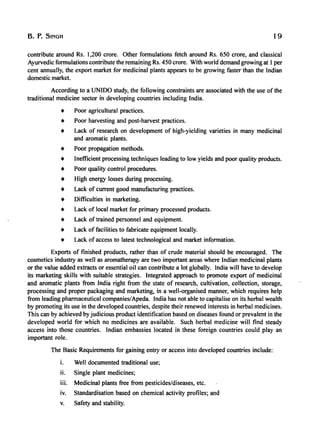
Exports of finished products, rather than of crude material should be encouraged. The
cosmetics industry as well as aromatherapy are two important areas where Indian medicinal plants
or the value added extracts or essential oil can contribute a lot globally. India will have to develop
its marketing skills with suitable strategies. Integrated approach to promote export of medicinal
and aromatic plants from India right from the state of research, cultivation, collection, storage,
processing and proper packaging and marketing, in a well-organised manner, which requires help
from leading pharmaceutical companies/Apeda. India has not able to capitalise on its herbal wealth
by promoting its use in the developed countries, despite their renewed interests in herbal medicines.
This can by achieved by judicious product identification based on diseases found or prevalent in the
developed world for which no medicines are available. Such herbal medicine will find steady
access into those countries. Indian embassies located in these foreign countries could play an
important role.
The Basic Requirements for gaining entry or access into developed countries include:
i. Well documented traditional use;
ii. Single plant medicines;
iii. Medicinal plants free from pesticides/diseases, etc.
iv. Standardisation based on chemical activity profiles; and
v. Safety and stability.
30.
20 GERMPLASM INTRODUCTION,EXCHANGE, COLLECTION/EvALUATION <
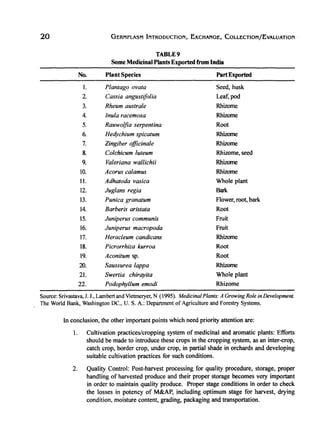
TABLE9
Some Medicinal Plants Exported from India
No. Plant Species PartExported
1. Plantago ovata Seed, husk
2 Cassia angustifolia Leaf, pod
3. Rheum australe Rhizome
4. lnula racemosa Rhizome
5. Rauwolfia serpentina Root
6. Hedychium spicatum Rhizome
7. Zingiber officinale Rhizome
8. Colchicum luteum Rhizome, seed
9. Valeriana wallichii Rhizome
10. Acorus calamus Rhizome
11. Adhatoda vasica Whole plant
12. Juglans regia Bark
13. Punica granatum Flower, root, bark
14. Barberis aristata Root
15. Juniperus communis Fruit
16. Juniperus macropoda Fruit
17. Heracleum candicans Rhizome
18. Picrorrhiza kurroa Root
19. Aconitum sp. Root
20. Saussurea lappa Rhizome
21. Swertia chirayita Whole plant
22. Podophyllum emodi Rhizome
Source: Srivastava, 1. 1., Lambert and Vietmeryer, N (995). Medicinal Plants: A Growing Role in Development.
The World Bank, Washington DC., U. S. A.: Department of Agriculture and Forestry Systems.
In conclusion, the other important points which need priority attention are:
1. Cultivation practices/cropping system of medicinal and aromatic plants: Efforts
should be made to introduce these crops in the cropping system, as an inter-crop,
catch crop, border crop, under crop, in partial shade in orchards and developing
suitable cultivation practices for such conditions.
2. Quality Control: Post-harvest processing for quality procedure, storage, proper
handling of harvested produce and their proper storage becomes very important
in order to maintain quality produce. Proper stage conditions in order to check
the losses in potency of M&AP, including optimum stage for harvest, drying
condition, moisture content, grading, packaging and transportation.
31.
B. P. SINGH21
TABLE )0
Threatened Medicinal Plants ofIndia
No. Name Family Present Status
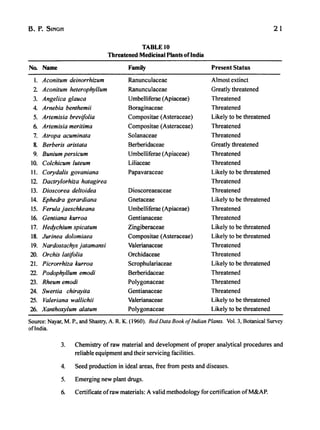
1. Aconitum deinorrhizum Ranunculaceae Almost extinct
2 Aconitum heterophyllum Ranunculaceae Greatly threatened
3. Angelica glauca Umbelliferae (Apiaceae) Threatened
4. Arnebia benthemii Boraginaceae Threatened
5. Artemisia brevi/olia Compositae (Asteraceae) Likely to be threatened
6. Artemisia meritima Compositae (Asteraceae) Threatened
7. Atropa acuminata Solanaceae Threatened
8. Berberis aristata Berberidaceae Greatly threatened
9. Bunium persicum Umbelliferae (Apiaceae) Threatened
10. Colchicum luteum Liliaceae Threatened
11. Corydalis govaniana Papavaraceae Likely to be threatened
12. Dactrylorhiza hatagirea Threatened
13. Dioscorea deltoidea Dioscoreaeaceae Threatened
14. Ephedra gerardiana Gnetaceae Likely to be threatened
15. Ferula jaeschkeana Umbelliferae (Apiaceae) Threatened
16. Gentiana kurroa Gentianaceae Threatened
17. Hedychium spicatum Zingiberaceae Likely to be threatened
18. Jurinea dolomiaea Compositae (Asteraceae) Likely to be threatened
19. Nardostachys jatamansi Valerianaceae Threatened
20. Orchis lati/olia Orchidaceae Threatened
21. Picrorrhiza kurroa Scrophulariaceae Likely to be threatened
22. Podophyllum emodi Berberidaceae Threatened
23. Rheum emodi Polygonaceae Threatened
24. Swertia chirayita Gentianaceae Threatened
25. Valeriana wallichii Valerianaceae Likely to be threatened
26. Xanthoxylum a/atum Polygonaceae Likely to be threatened
Source: Nayar, M. P., and Shastry, A. R. K. (1960). Red Data Book ofIndian Plants. Vol. 3, Botanical Survey
oflndia.
3. Chemistry of raw material and development of proper analytical procedures and
reliable equipment and their servicing facilities.
4. Seed production in ideal areas, free from pests and diseases.
5. Emerging new plant drugs.
6. Certificate ofraw materials: A valid methodology for certification ofM&AP.
B. P. SINGH23
...Continued
No. Botanical Name Common Name
32. a. Premna integrifolia Agnimanth
b. Premna micronata Agnimanth
33. Saraca indica Ashoka
34. Saussurea lappa Kushtha
35. Senecio cinerraria Dusti Miller
36. Smilax china Chobchini
37. Stereospermum suaveolens Patola
38. Swertiya chirayita Chirayatha
39. Terminalia arjuna Arjuna
40. Tinospora sinensis Guduchi
41. Uraria picta Prishnipami
42. Valeriana jatamansi Tagar
43. Viburnum opulus Grandberry Highbush
44. Viola serens Banafsha
45. Zizyphus sativa Unnab
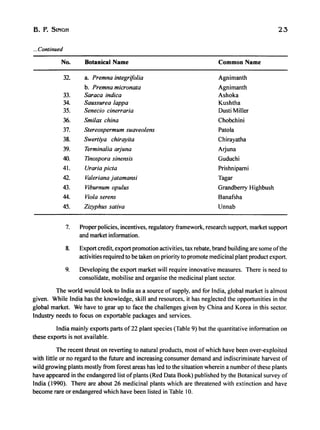
7. Proper policies, incentives, regulatory framework, research support, market support
and market information.
8. Export credit, export promotion activities, tax rebate, brand building are some ofthe
activities required to be taken on priority to promote medicinal plant product export.
9. Developing the export market will require innovative measures. There is need to
consolidate, mobilise and organise the medicinal plant sector.
The world would look to India as a source of supply, and for India, global market is almost
given. While India has the knowledge, skill and resources, it has neglected the opportunities in the
global market. We have to gear up to face the challenges given by China and Korea in this sector.
Industry needs to focus on exportable packages and services.
India mainly exports parts of22 plant species (Table 9) but the quantitative information on
these exports is not available.
The recent thrust on reverting to natural products, most of which have been over-exploited
with little or no regard to the future and increasing consumer demand and indiscriminate harvest of
wild growing plants mostly from forest areas has led to the situation wherein a number of these plants
have appeared in the endangered list ofplants (Red Data Book) published by the Botanical survey of
India (1990). There are about 26 medicinal plants which are threatened with extinction and have
become rare or endangered which have been listed in Table 10.
34.
24 GERMPLASM INTRODUCTION,EXChANGE, COLLECTION/EvALUATION
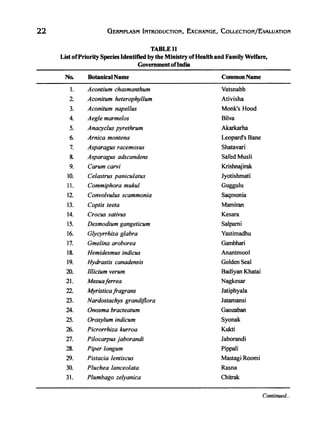
The Department ofindian System of Medicine and Homeopathy ofthe Ministry of Health
and Family Welfare, Government ofIndia, has a Central Scheme for the Cultivation and Development
of Medicinal Plants in which 45 species of medicinal plants (enumerated in Table 11) have been
identified for promoting their cultivation in order to reduce pressure on their natural habitat and to
meet the shortage in their demand by the industry involved in producing the ISM and Homeopathy
medicines.
REFERENCES
Alexander, M. P. and Ganeshan, S. 'Pollen storage'. In: Advances in Horticulture. Vol. I. Fruit Crops-part I.
(Eds.). Chadha, K. L. and Pareek, O. P. New Delhi: Malhotra Publishing House, pp. 481-
496,1993.
Anonymous. Agro Biodiversity (PGR). 35th Technical Progress Report, NBPGR, New Delhi, 2003.
Arora, R. K. 'Indian region provides treasure house of wild plant resources'. Diversity 12(3): 22-23, 1996.
Chauhan, N. S. 'Genetic diversity ofmedicinal and aromatic plants of Himalayan region (Himachal Pradesh)
and its conservation'. Indian J. Plant Genet Resour. 14(2): 318-322, 2001.
Dhillon, B. S., Varaprasad, K. S., Srinivasan, Kalyani; Singh, Mahendra; Archak, Sunil; Srivastava, Umesh and
Sharma, G. D. (Eds.). A Compendium of Achievements. New Delhi: National Bureau of Plant
Genetic Resources, pp. xxi, 329, 2001.
Gautam, P. L., Sharma, G. D., Umesh Srivastava; Singh, B. M., Kumar, Ashok; Saxena, R. K. and Srinivasan,
Kal)'ani (Eds.). 20 Glorious Years ofNBPGR (I 976-1996}. New Delhi: NBPGR, 2000.
GlJpta, Kavita; Pandey, B. M. and Khetrapal, 'Pest risk analysis and its significance in India under WTO
regime'. Seed Tech. News 32(2 & 3): 266-269, 2002.
Gupta, R. 'Medicinal and aromatic plants in India'. In: Proceedings ofthe Regional Expert Consultation on
Breedingand Improvement ofMedicinal andAromatic Plants in Asia. (Eds.). Chom-ChaIow, Norong
and Henie, Hans V. Bangkok: FAO Regional Office for Asia Pacific (RAPA), pp. 117-
130, 1993.
Gupta, R. and Chadha, K. L. 'Medicinal and aromatic plants in India'. In: Advances in Horticulture, vol. II,
Medicinal andAromatic Plants. (Eds.). Chadha, K. L. and Gupta, R. New Delhi: Malhotra Publishing
House, pp. 199-222, 1995.
Harlan, J. R. Crops and Man 1992. Madison, U. S. A.: American Society of Agronomy and Crop Science
Society of America, 1993.
Harrington, J. F. 'Seed and pollen storage for conservation ofplant genetic resources'. In: Genetic Resources
in Plants. Their Exploration and Conservation. (Eds.). Frankel, O. H. and Bennet, E. Edinburgh, U.
K: Blackwell, pp. 501-521, 1970.
Harrington, 1. F. 'Seed storage and longevity'. In: Seed Biology. vol. 13. (Ed.). Koslowski, T. T. Academic
Press, pp. 145-245, 1972.
Hodgkin, T. H., Rao, V. Ramanatha and Riley, K. W. 'Current issues in conserving crop land races'. Presented
at the FAO-IBPGR On-Farm Conservation Workshop, 6-8 December, 1993, Bogor,
Indonesia, 1993.
35.
B. P. SINGH25
Jackson, W. P. 'Launch of the new international agenda for botanic gardens, Asheville'. BGCI News 23-
25,2000.
Jackson, W. P. 'Plenary address, BGCI. 4th International Congress on Education in Botanic Gardens held in
Thiruvanthapuram, Kerala, 1999.
MandaI, S. and Maheshwari, M. L. 'High pressure liquid chromatic determination ofvindoline, catharanthene
vinca-Ieukoblastine and vincristine in periwinkle leaf'. Indian J. Pharm. Sci. 49(6): 205-
209,1989.
Mattick, J. S., Alben, E. M. and Edmonson, D. L. 'The gene library-preservation and analysis of genetic
diversity in Australia'. In: Conservation 0/Plant Genes. DNA Banking and In-situ Biotechnology.
(Eds.). Adams, R. P. and Adams, J. E. San Diego, U. S. A.: Academic Press, pp. 15-35, 1972.
Pareek, S. K. 'Medicinal plants in India: Present status and future prospects'. In: Prospects 0/Medicinal
Plants. (Eds.). Gautam, P. L., Raina, R., Srivastava, Umesh; Rai Choudhari, S. P. and Singh,
B. B. New Delhi: Indian Society of Plant Genetic Resources, pp. 1-4, 1998.
Pareek, S. K., Maheshwari, M. L. and Gupta, R. 'Domestication studies on Ocimum sanctum oil and eugenol
content'. Indian Perfumer 24(2): 93-100, 1980.
Pareek, S. K., Singh S., Srivastava, V. K., MandaI, S., Maheshwari, M. L. and Gupta, R. 'Effect of nitrogen
application and age on yield and alkaloid content ofperiwinkle'. Proc. National Seminar on Medicinal
and Aromatic Plants, Tamilnadu Agriculture University, Coimbatore. (Ed.). Muthukrishnan, C. R.,
pp. 40-44, 1982.
Ramanatha Rao, V. 'Complementary conservation strategy presented to IPGRI-ICAR-UTFANET Regional
Training Course on the conservation and use ofgermplasm of tropical fruits in Asia, held at IIHR,
Bangalore, 18-31 May, 1997.
Roberts, E. H. 'Problems oflong-term storage and seed and pollen ofgenetic resources conservation'. In: Crop
Genetic Resources/or Today and Tomorrow. (Eds.). Frankel, O. H. and Hawks, J. G. Cambridge, U.
K.: Cambridge University Press, pp. 226-296, 1975.
Roberts, E. H. Viability o/Seeds. London: Chapman and Hall, 1972.
Roy, R. K. 'Ex-situ conservation and sustainable utilisation of plant genetic resources of India: The role of
botanic gardens in the new millennium'. IndianJ. Plant Genet. Resour. 14: 316-318, 2001.
Saxena, R. K., Kidwai, M. A. and Hardas, M. W. 'Plant introduction experiments with henbane-new raw
material for Indian drug industry'. Indian Drugs 16(5): 102-104, 1979.
Sharma, S. C. and Goel, A. K. 'Role of botanic gardens in modern times'. Indian J. Forestry 17: 230-
238,1994.
Singh, A. K. 'Management ofplant genetic resources: An Indian perspective'. Science Letters, 25(3 & 4): 74-
87,2002.
Singh, B. P. 'Germplasm exchange: Priorities, achievements and problems'. In: Plant Genetic Resources-
Indian Perspective. (Eds.). Paroda, R. S., Arora, R. K. and Chandel, K. P. S. New Delhi: National
Bureau of Plant Genetic Resources, pp. 95-120, 1998.
36.
26 GERMPLASM INTRODUCTION,EXCHANGE, COLLECTION/EvALUATION
Singh, B. P., Deep Chand, Singh, R. V. and Saxena, R. K. 'Introduction and collection ofplant genetic resources
ofmedicinal and aromatic plants and their utilisation'. Indian J. Plant Genet. Resour. 2(1): 91-94,
1989.
Towill, L. E. 'Genetic considerations for germplasm preservation of clonal materials'. Hort. Sci. 23: 91-
97, 1998.
Towill, L. E. 'Low temperature and freeze/vacuum-drying preservation of pollen'. In: Cryopreservation of
Plant Cells and Organs. (Ed.). Kartha, K. K. Boca Raton, Florida, U. S. A.: CRC Press, Pl'. 171-
198,1985.
Withers, L. A. 'Biotechnology and plant genetic resources conservation'. In: Plant Genetic Resources
Conservation and Management. (Eds.). Paroda, R. S. and Arora, R. K. New Delhi: IBPGR Regional
Office, pp. 273-297, 1991.
-oo(O)o~
37.
INTELLECTUAL PROPERTY RIGHTS,
GROWTHAND COMPETITIVENESS OF
INDIAN PHARMACEUTICAL INDUSTRIES
c. P. MALIK
I T is generally stated that 'necessity is the mother ofinvention' and most human endeavour
results in monetary gain, which can be converted into material possessions. In brief, man works
hard, uses his inventiveness and ingenuity and talent to convert them into money. The State(s) has
devised various ways to evolve methods to protect and reward inventors. Some States award exclusive
rights to the artisan. It was in 1474 when the first law on patents was passed in Venice, which
awarded monopoly rights to artisans for their inventions. Subsequently, the House of Commons in
the United Kingdom, in 1623, passed the Act ofProprietorship. The condition was that the invention
is useful to society. In India, novel techniques and inventions were retained within the family, for
example, craftsmanship, carving, artisans.
In any case, no system was available to protect talent. Based on the British Law of 1852, the
then Government of India introduced the Act of Protection of Invention in 1883 and subsequently
changed it to the Inventions and Designs Act in 1888. And on August 15, 1947, Indian patents and
designs came to be managed by the Controller ofPatents and Designs. In 1970, the Indian Patents Act
was passed. Over the years, sublime and novel ideas, a design or an invention or a manuscript were
defined as 'intellectual property'. But in any case, these properties led to useful products/applications.
The tragedy is that most intellectual properties can be copied or imitated, thus lowering returns to the
original inventor. The above account recognises the right of an inventor to accrue economic gains
from his inventions. This right is called Intellectual Property Right (lPR). The stipulation is that the
inventions are not detrimental to society.
The IPR is protected in several ways: trade secrets, patents, plant breeders' right and
copyright. It may be stated that patents have only territorial validity, are expensive and time
consuming. Further, IPR protection in different countries necessitates patents to be secured in
those countries. This involves high cost and long periods for approval since patent laws vary from
38.
28 IPR, GROWTHAND COMPETITIVENESS- OF INDIAN PHARMACEUTICAL INDUSTRIES
country to country. Of late, developed countries are endeavouring to harmonise the patent laws of
different countries. The Paris Convention (1983) established equal protection ofindustriallPR. This
stipulated that inventions claim priority in all member States by filing a patent application in one
member country. This convention had 100 members initially and Indiajoined it in December 1998. In
1978, the European Patent Convention came into being and had 17 member States. Incidentally,
provisions for biotechnology inventions were introduced. In January 1995, the Trade Related Intellectual
Property Rights (TRIPs) agreement,'pertinent to IPR, came into force. This is enforced and administered
by the World Trade Organisation (WTO), Geneva. Each member country has the option to frame its
patent laws as defined in the GATT agreement.
On a complaint by the U. s. A. in 1997, India is required to modify its patent laws by 2004.
Incidentally, biotechnological inventions demand huge financial inputs and, therefore,
developed countries have a superior position to register high technology patents. Consequently,
most patents have been registered from Europe, Japan and the U. s. A. from where nearly 90 per cent
ofthe applications for patents were filed. The Indian scenario is slightly different where only 3,500
applications were filed during 1974-94, which went up to 5,000 in 1995. Most patents weft: filed by
CIBA, Colgate, Hindustan Lever, Pfizer and Lucas. Recently, Dr. Reddy's Lab, Ranbaxy and Lupin
Lab, BASF, Englehart and Eli Lily have also filed patents.
It appears India needs to undertake several drastic changes rapidly in order to withstand the
economic stringency imposed by the changing IPR scenario.
The management oflPR and the benefits accruing from it are numerous. The former includes
transfer of IPR, establishment of collaborative linkages and monitoring non-compliance ofthe IPR
renewal.
Renewal ofpatents needs attention periodically as well as quantitative evaluation of such
factors as R&D investment to economic ratio. There are several benefits from the IPR regime, for
example, it encourages and safeguards intellectual and artisan creations, helps in spreading new
ideas, encourages added investment in R&D and furnishes consumers with data' on new creations.
The fast alterations in the IPR scenario in India have taken the scientific community and
technologists by surprise. This is partly due to the fact that Indians believe in heritage, tradition and
benefits to society at the cost ofindividual interest. In the expanding domain of IPR, it is essential to
make systematic and continued efforts for survival.
A news item (The Hindustan TImes, July 7, 2003) highlights recent relaxation announced by
the U. S. A.. FDA in the generic segment. Consequently, Indian pharma majors are in for a big
bonanza. For instance, several blockbuster drugs are going off patent and this will help Indian
companies to venture into the world's biggest lucrative market. In recent years, Indian companies
have built world class facilities and have inherent cost advantages, a large pool of human resources
and superior process engineering skills. So the time needed for approval ofgeneric drugs will be less.
Some companies have made a good beginning in biopharma and blockbuster drugs, which have a
market of$ 82 billion.
In this article, IPR and the growth and competitiveness ofthe Indian pharmaceutical industry
have been evaluated.
39.
C. P. MALIK29
Intellectual Property Rights (lPR) is a very vital issue for India's future and for the future of
the developing world. How protection of IPR can promote economic growth, provide incentives for
innovation and attract investment that will ultimately create new jobs and opportunities for India
demands careful analysis.
Everyone is eagerly looking forward to the day when India fully exploits its incredible potential
and occupies its rightful place in the global economy. Hence, India's own interest and the well being
ofthe Indian people are at stake. Reacting to the challenges ofdevelopment will benefit India and set
an example of leadership for other developing economies of the world. The Indian and foreign
governments and the private sectors ofthese countries, working together, can help India initiate the
steps it requires to leap forward and exploit its full economic potential.
In a democratic set up, all sectors must make an effort to create ripples. It is especially
desired of forward-looking sectors having a vision of the future and are endeavouring to make that
vision a reality. In fact, Intellectual Property Protection (lPP) is the key to such a vision.
Amongst the developing countries, India has the building blocks in order to raise a vibrant,
knowledge-based economy. But firm action is required to raise a legal system, infrastructure and
enforcement systems to glue those building blocks together so that they may be used to their greatest
advantage.
In 2002, the Indian Parliament amended IP protection and took a positive lead. This was done
for the second time, the first being the 1970 Patent Law. However, more is desired to bring Indian IPP
to the world class level, by initiating steps for economic growth across all facets of the knowledge-
based economy.
In this context, it will be helpful to recall and discuss the Jordanian experience.
A strong IPR regime can affect economic development. Some years ago, the Kingdom of
Jordan had a pharmaceutical sector which created generic drugs at low prices employing reverse
engineering. However, these generic companies had to compete with several generics throughout the
developing world, as well as those in the developed world. Facing severe economic adversity, the
Jordanian Government enforced an economic development plan implementing strong Intellectual
Property Rights to promote research, development and expansion ofthe knowledge-based economy.
The Jordanian Government evolved a world class patent system through legislation,
infrastructure development and strict enforcement. The outcome was a dramatic increase in foreign
investments from major pharmaceutical companies who have now opened offices or expanded their
commercial and research activities in Jordan. Consequently, Jordanian exports of pharmaceuticals
jumped from $ 150 million (1999) to $ 200 million (200 I), a significant increase for a country with a
population ofjust five million.
The most significant fear, however, is that the concern for a strong Patent Protection regime
would increase drug prices have been unfounded. In fact, prices for new, patent-protected medicines
have not exceeded pre-patent prices and have actually come down in the market. The generic
industry has also gained from patenting, since foreign investment has increased and R&D trebled
in Japan and Mexico after they improved their patent laws. On the other hand, several developing
countries lacking strong IPR regimes remain trapped in economic stagnation and have suffered the
40.
30 IPR, GROWTHAND COMPETITIVENESS OF INDIAN PHARMACEUTICAL INDUSTRIES
negative effect of 'brain drain'. Talented scientists, engineers, entrepreneurs and inventors leave
their countries where work is unprotected and migrate to those countries where it is.
INDlA-A GLOBAL PLAYER
It is satisi)'ing that India is the fourth leading supplier of bulk pharmaceutical drugs and
active ingredients globally. Having some $ 2 billion in exports, India's pharmaceutical industry is
recognised as a global player. It is impressive that India has the world's third largest pool of
scientifically and technically trained personnel. Even though we lack pharmaceutical patent
protection, a small research and development sector is emerging.
One may note that Indian pharmaceutical companies have started benefiting from IPP on
their products. Further, a strong product patent protection protocol will encourage this development.
Ranbaxy, an Indian company, which has developed a new drug delivery system (DDS) for
ciprofloxacin and has licensed it to Bayer for $ 65 million plus royalties, is a glaring instance.
Other Indian research-based companies have also earned nearly $ 70 million from milestone
R&D payments.
For increased benefits, the following three steps are essential:
STEP ONE: LEGISLATION
With product patent protection, imagine how strong the pharmaceutical industry could be.
Due to lack ofpatent protection, India's highly trained scientists have not been able to employ their
skills in India and this has drastically suppressed the incentive for India's best scientific minds to
remain in the country. According to one study, it is estimated that more than 15 per cent of the
scientists engaged in pharmaceutical R&D in the U. S. A. are of Indian origin. Had their creative
work been adequately protected in India, these scientists would not have emigrated. In tum, this
would have led to a more innovative pharmaceutical sector, opening up morejobs and more products
for export.
The second amendment to the 1970 Patent Law, which was passed in May 2002, includes
extension of pharmaceutical patent protection from seven to 20 years. This is a positive step and
fulfils part of India's commitment to the international community on protecting intellectual property.
However, there are some glaring concerns and these are:
• Transition to a Product Patent regime has been excluded until 2005.
•. The Bill envisages a broad, ambiguous allowance for compulsory licensing.
• It is ambiguous regarding patent protection for imports.
The Indian pharmaceutical industry will gain the most from patent legislation and should
it realise its resources and press for the passage of the Product Patent legislation before the 2005
deadline. India is a strong democratic society, and hence the people engaged in day-to-day economic
activity, must make their voice heard by those who regulate and monitor that activity.
The former Commerce Minister, while introducing the Patent Bill in Parliament, said:
"The Indian pharma industry i~ emerging as the new leader of the knowledge-based drug industry
in the world, following software and IT. Now is the time for the rest of the industry to come out of
41.
c. P. MALIK31
its reverse engineering mode and move forward into the era of innovative R&D mode, clinching the
opportunities."
STEP TWO: DATA EXCLUSIVITY
It has been repeatedly found that data exclusivity is the key to the protection of public
health and the pharmaceutical sector's hard work. And it is pertinent to the foreign investment in
the pharma sector. Protection of test data is the key to company decisions on location of clinical
trials. According to the U. S. National Institute of Health (NIH), the lack of data exclusivity in
India is the major factor why it ranks ninth (compared to China which ranks second), in funding
given by the NIH outside the U. S. A. American pharmaceutical companies spent $ 30 billion on
R&D last year. If only a fraction of that amount was channelled into India, it would broaden U. S.-
Indian scientific ties, increase the demand for Indian scientists and ultimately benefit the health
and lives ofmillions ofpeople. Indian pharmaceutical companies and researchers, especially in the
biotechnological sector, would benefit enormously from the enhanced diffusion of knowledge that
flows from international partnerships and increased integration.
It may be remembered that data exclusivity is an administrative protection which can be
enforced without the intervention ofParliament. One ofthe effective methods ofproviding protection
for the creative work of scientists, while legislators draft laws to complete the legal IP framework,
requires the Government to treat data as the exclusive property of the firm that generated it for a
specific time. Data exclusivity requires each company to fully test its products. Reverse engineered
drugs do not always compare with the original, since different manufacturing processes can alter
the drug and impact public health. Relying on another company's data is not only business
malpractice, but it also discourages R&D investment and poses potential public health dangers.
Some of the arguments against patent legislation and data exclusivity anticipate price
increase and depriving the poor from the availability of essential drugs. While introducing the
Patents Bill, the former Commerce Minister pointed out that not a single drug in the Indian essential
drug list is patented and hence prices of these drugs will be unaffected. Further, Product Patent
protection will apply to new drugs introduced after the law is enacted; a small percentage of the
total market-estimated to peak at 20-22 per cent of the total market, 10 years from now.
STEP THREE: IMPROVING IPR INFRASTRUCTURE AND ENFORCEMENT
Knowledge-based industries will help in creating thousands of jobs for Indian workers,
generate enormous revenues for the Government and lead to substantial increase in India's exports.
But to harness these benefits, IPR must be enforced seriously. This calls for political will from the
top and additional resources to improve the institutions and train the personnel required to carry
out IPR protection. The Government of the day must designate this as a priority area. A clos~
linkage between industry, Government and the law enforcement officials is essential. Concomitantly,
industry must make its needs explicit in order to cause an impetus for a change.
The Indian Patent Office is faced with a growing backing of approximately 5,000
unexamined patent applications in its Delhi, Mumbai and Kolkata offices. Enforcement of IP
protection is seriously lacking. Judicial delays mean that cases can take up to 10 years to see
resolution and payment of damages on IPR violations. In Japan, 400,000 cases are cleared every
year. In China, 40 per cent cases are cleared annually. Familiarity with new IPR laws is also an
42.
32 WR, GROWTHAND COMPETITIVENESS OF INDIAN PHARMACEUTICAL INDUSTRIES
important issue for lawyers, the courts and the police. The Indian Government is fast responding to
the need for the development oflPR infrastructure.
RESULTSAND BENEFITS
A strong pharmaceutical patent regime would strengthen India's research and development
sector, will attract more foreign investments and provide a basis for Indian pharmaceutical firms to
begin tackling diseases that have a serious effect on the Indian population. Local pharmaceutical
companies have the high advantage of being acquainted with prevalent disease patterns especially
indigenous communicable diseases and hence can develop drugs by exploiting local Rand D. Diseases
such as tuberculosis, malaria, leprosy, plague and dengue fever continue to pose serious health
problems in India and take millions oflives each year. Talented Indian scientists, attracted by adequate
patent laws, are urgently needed in the country to conquer these endemic diseases.
As India's knowledge based economy grows, it will benefit not only India, but the rest ofthe
world as well, especially the developing world. This is India's big challenge, and one in which
developed countries, for example, the U. S. A., would like to co-operate. With Indo-U.S. relations
improving with strides Indian business is becoming increasingly global. It is high time for 'new link'
to prevail in the IPR debate.
I strongly believe that if a country wishes to increase its wealth she must enact a strong
patent system. Shall I say that patent systems are actually one of the good inventions of the new
world. However, they are viewed over time with different perspectives. Currently, patent systems are
popular in the U. S. A., Europe and most interestingly even in Japan.
The Japanese view that it is in their own interest to have a strong patent system. Interestingly,
their educational system pertaining to law and technology in relation with IP is being revamped.
Concomitantly, they are revamping their judicial system as well. Most significantly, they plan to
award and contemplating to award real damages for IPR violations.
India should have adopted a strong patent system long back. Even then, it is not too late
now to enact these laws. Let us accept that mistakes have already been committed. In India, the worst
mistake is by way of self-inflicted wounds. One such blunder was the amendment of the patent
system in 1970, where the decision was intended to drop Products Patent. Now the time has come that
decision should be undone because an international quality patent regime is in the larger interest of
India. A strong patent regime contemplates a system that will provide full protection to inventions
across the range of technologies in this country.
NOPATENTPROTECI10N,NONEWINVENTIONS
A patent system in place is essential because without it capitalism does not work. Capitalism
permits copying ofother people's intellectual creations and in a free market, copying is easy. Such a
step will discourage inventors who have a potential for developing a new product. The derogatory
steps will preclude new creations. This, thus necessitated, a patent system to stop exploitation of
weakness in the developed world. In a way, IPR seems to be a great invention and it is one ofthe few
governmental interventions which tends to improve situations. It is proposed to raise wealth and
permit everyone to have a fair share of it.
43.
c. P. MALIK33
In the U. S. A., a patent system exists for all technologies in all the industries. It implies that
industries cannot afford to copy the creations or inventions of others. Indeed, the creator of the
newly invented product is protected for the next two decades or so against copyinglplagiarisng and
has the exclusive right to do business from it. At the end oftwo decades, the next generation and the
generations thereafter are awarded the right free of charge. That is an enormous gift to the future
generations. For instance, antibiotics are great inventions-they keep millions of people alive and
without the supporting patent system, many of us would be travelling to the next world.
Clearly everyone in this country is a beneficiary ofthe Patent system and those Antibiotics.
Take, for instance, all the patents on semi-synthetic penicillin, developed in the United Kingdom; the
technology was superb and involved some vital key discoveries. With the advent oftime, all that is
in the public domain. Consequently, we all use it.
Another drug, Cipro, that will hit the public domain in the U. So> A. next year is one of the
greatest antibiotics discovered totally by chance. Unbelievable story, pure luck led to its discovery.
The chemist who was developing this molecule felt failure ofits working. Under extreme stress ofhis
work, he had a heart attack and this led to the discovery ofCiprofloxin.
Cipro has kept the Bayer Company going up and strong but concomitantly saved several
precious lives and has kept many people alive. It is a great antibiotic. It is a fine example of the
equality in the system. The patent system encourages creations and inventions and helps exploitation
of inventions as well. Somebody actually owns it and has the commercial incentive to develop the
technology at great investment. It encourages industry to innovate, invest money in new inventions
and thus serve humanity.
It is highly desirable to evolve a positive patent system. Unfortunately, India even now does
not have one. Even though she has the technical manpower to run a functional patent office which is
a vital part ofthe whole procedure. Let me argue that India is far ahead ofChina in judicial systems.
So we need to develop the patent offices and train officials to evoke a positive patent regime.
Let us not forget that by 2006 India has to comply with their WTO-TRIPs agreement for
product production in the area ofpharmaceuticals. So this country has to do much more about patent
protection especially for biotech products. There is another controversy over data exclusivity in
India. It is an entirely separate issue and should not be confused with patent issues. Let us assume
that somebody does clinical studies in India at enormous cost and produces tremendous amount of
crucial data. This clinical data has to be submitted to the health regulatory authority to secure
permission to market the antibiotic. It may be noted that the investor company's competitor in the
trade can use this exclusive data.
The competitor, after access to the data can manufacture a competitive product that has legal
sanctions and is cheaper because having spent nothing on the invention or clinical trials. This is
absolutely unfair to the inventor under the garb ofproviding vital drugs at cheaper price.
There is a general agreement of five and 10 years as a fair period for data protection. The
U. S. A. has agreed for five years, because the pharmaceutical company which turns over the
information to the U. S. authorities has to be provided data exclusivity protection. India must come
forward with an assurance for data exclusivity and invite the big MNCs to contract local
pharmaceutical companies for clinical trials.
44.
34 IPR, GROWTHAND COMPETITIVENESS OF INDIAN PHARMACEUTICAL INDUSTRIES
By strengthening the patent regime, Indian scientists and Indian pharmaceutical manufacturers
are absolute gainers without losing anything. Seemingly, it is a win-win situation for the people and
the country as a whole.
INDIA'S MEAGRE R& DBUDGET
India's total R&D budget is 3.5 billion dollars, which is nearly haIfthan Pfizer's (5.5 billion
dollars). The latter is less than that of General Motors which is 9 billion dollars. Even with such
financial constraints, India has several scientific achievements to her credit. For instance, India has
demonstrated the capability to design, fabricate and launch our own satellites. Furthermore, we
launch not only our satellites but those of Germany and Korea as well.
In Genomics, we have the unique advantage to work and understand the vast and diverse
Indian genetic pool. This provides a unique opportunity to discover functional significance ofhuman
genome sequence of hitherto unknown functions through analysis. Interestingly, Nicholas Piramal
and CSIR have forged the partnership and have created Genomate in Centre for Biochemical Technology
at Delhi. It is named as Institute ofGenomics and Integrated Biology. The emergence ofthis will set
an interesting example for the future in terms of fast results and new vistas.
COMPARABLEADVANTAGE
Two things are vital. One was to identitY the areas where our comparative advantage lies
basically, for example, the human genetic diversity and second, to build a close relationship with
industry and academic institutions. This is in contrast to previous functioning where public institutions
existed on their own resources and manpower. In the context of changing scenario, functional
plasmodesmatallinks between academicia, industry and research institutions is desired. The point to
note is Genomate, which is actually an enterprise ofSwati Piramal, has established strong links within
the heart ofCSIR laboratory. Such type ofmutual trust and confidence are beneficial economically
and will take India on the road to economic prosperity.
In the post-Genomic era, 0 f late, the BT industries arepartly depending for the growth on the
traditional development and production ofrecombinant proteins in microbial, animal and plant sectors
to more areas oftherapeutic modalities, including gene therapy and customised product development
based on Pharmacogenomics and Proteconomics. The potential to target specific genes for drugs
thus assisting the development oftailor made therapies. The recent developments ofSMPs and DNA
chip technology have made it possible to detect errors in gene expression and genetic disorders in
individuals, groups of individuals or families and a whole new field of regenerative medicine is
opening up.
At a point in time when we were ill we took antibiotic, it was curative. When we wanted to
protect ourselves from getting a disease, we had preventive medicine, which was vaccination, and
now we are talking in terms of predictive medicine. When one develops schizophrenia, a drop of
blood can be tested and predicted as to whether a cure is possible or not. Then corrective medicine
is possible through gene therapy. Scientists are actively engaged in regenerating organs.
That means, now BT has moved from being curative to preventive to predictive and corrective to
regenerative process.
45.
c. P. MALIK.35
There are several vital issues that impinge on the future ofcell research which are not only
scientific or technical in nature, but are pertinent to ethical and moral issues on the use of human
embryonic or adult cells, IPR and the sharing ofthe accompanying reward systems.
Ultimately, when it comes to manufacturing the drugs for the poor, modem Biotechnology
is going to be a key factor and India is going to playa major role backed by the wherewithal that we
have in this country.
REFERENCES
Ganguli, P. 'Patenting innovation: New demands in emerging contents'. Curr. Sci. 75:433-439, 1998.
Ganguli, P. Gearing up for Patents-The Indian Scenario. Hyderabad: University Press, 1998.
Gupta, P. K. 'Transgenic plants: Some current issues'. Current Sci. 70: 654-660, 1996.
Mashelkar, R. A. 'Biotechnology-Solution to India's future'. Intellectual Capital I: 1-3,2002.
Mashelkar, R. A. 'Intellectual property rights and the Third World'. Curr. Sci. 81 :955-965, 200I.
Narayan, P. Patent Law. 2nd edn. Kolkata: Eastern Law House Pvt. Ltd., 1985.
Sahai, S. 'India's plant variety protection and farmer's rights Act, 2001 '. Current Sci. 84: 407, 2003.
~o(O)oo-
46.
ENHANCING THE EXPORTPOTENTIAL OF
MEDICINAL PLANTs THROUGH BIODIVERSITY
CONSERVATION AND DEVELOPMENT UNDER
MULTI-ADVERSITY ENVIRONMENT
M. L. JAKHAR, B. L. KAKRALYA, S. J. SINGH AND KARAN SINGH
ANY plant which harbours curative elements or properties in one or more of its organs
may be termed as medicinal plant and plant-based medicaments have been employed since the
dawn of civilisation for prolonging the life of man by combating various ailments (Singh and
Kumar, 1984; Kumar, 1986; Padulosi et ai, 2002). Ancient ethnic communities around the world
have learnt to utilise their neighbourhood herbal wealth for curative as well as offensive purposes.
Amongst the ancient civilisations, India has been known to be a rich repository ofmedicinal plants.
The Rig Veda (5,000 BC) mentioned 67 medicinal plants, the Yajur Veda 81 and the Atharva Veda
(4,500-2,500 BC), 290 species. Later on, the Charaka Samhita (700 BC) and the Sushruta Samhita
(200 BC) described the properties and uses of 1,100 and 1,270 plants respectively, in compounding of
drugs and these are still used in classical formulations in the Ayurvedic system ofmedicine.
The World Health Organisation (WHO) has compiled a list of20,000 medicinal plants used in
different parts of the globe. A large number ofthese species have local uses within the country or
spread over several countries in a region. Amongst these over 100 botanicals are reported to have
consistently large demand and are traded in major drug markets in the world. The medicinal virtues of
these raw materials including chemical contents and composition of these species have been well
worked out to have merited inclusion in National Pharmacopoeias and official formularies in different
countries (Govil et ai, 2002).
In the present context of 'back to nature' in health care, it is very relevant that these
valuable plant species should not only be preserved but also their cultivation should be developed in
order to meet the entire demand ofthe domestic industries as also to exploit the bright prospects for
export and providing higher returns to the farmers. Shift from collection to cultivation ofmedicinal
and aromatic plants will ensure purity, authenticity and sustainable supply ofraw materials required
for herbal drugs. The international market of medicinal plants is over US$ 60 billion per year,
47.
M. L. JAKHAR,B. L. KAKRALYA, S. J. SINGH AND KARAN SINGH 37
which is growing at the rate of7 per cent. India at present exports herbal material and medicines to
the tune ofRs. 446.3 crores only which can be raised to Rs. 3,000 crores by 2005. China and India
are two great producers of medicinal plants having more than 40 per cent of global biodiversity.
China besides meeting its domestic requirement is earning US$ 5 billion per year from herbal trade.
There is, thus, an enormous scope for India also to emerge as a major player in the global herbal
product based medicines. However, this requires a grand strategic plan, which takes a holistic view
of the entire situation to boost the export of Rs. 10,000 crores by 2010 and minimising the import
(Anonymous, 2000).
The biological variation in nature over time and space constitutes the basis of organic
evolution. This biodiversity constitutes the foundation ofdevelopment ofdifferent taxonomic groups
of plants and animals both in micro-organisms and higher forms of life. Hence, this biodiversity
has attracted the attention of not only the scientific community but also politicians, planners and
administrators (Conner, 200 I). Our awareness of conservation and further development of
biodiversity has rapidly increased during the recent past. One of the most important reasons for
such an awareness has been the new emerging threats to quantitative and qualitative spectra of
biodiversity (Edwards and Hilbek, 2001). India is rich in medicinal plant diversity. All known
types of agroclimatic, ecological and edaphic conditions are met within India. The biogeographic
position of India is so unique that all known types ofecosystems ranging from the coldest place like
the Nubra valley with -57°C, dry cold deserts of Ladakh, temperate and alpine and subtropical
regions of North-West and trans-Himalayas, rain forests with the world's highest rainfall in
Cheerapunji in Meghalaya, wet evergreen humid tropics of Western Ghats, arid and semi-arid
conditions ofpeninsular India, dry desert conditions ofRajasthan and Gujarat to the tidal mangroves
of the Sunderbans, India is rich in all the three levels of medicinal biodiversity such as species
diversity, genetic diversity and habitat diversity. There are about 426 biomes representing different
habitat diversities that give rise to one ofthe richest centres in the world for plant genetic resources.
The total number of flowering plant species, although only 17,000, the intra-specific variability
found in them make it one of the highest in the world (Janick, 200 I).
However, experiences have amply demonstrated that in a densely populated developing
country like India, where a sizeable population is living in close proximity to forests, declaring
protected areas will not entirely be sufficient to ensure conservation on the fast eroding biological
diversity. The success of any conservation programme vests solely on the efficient management of
protected areas. The involvement of local communities in conservation activities has now been
increasingly realised. A people-nature oriented approach thus, becomes highly imperative. This
will help to generate a sense ofresponsibility among the local people about the values ofbiodiversity
and the need to use it in a sustainable manner. for their own prosperity and the maintenance of
ecosystem resilience (Anonymous, 2000).
Plant biodiversity is vital to the development and welfare of human society. Plant genetic
resources constitute enormously valuable assets for achieving global objectives of food security,
poverty alleviation, environment protection and subsequently, sustainable development. The
International Plant Genetic Resources Institute Rome, Italy (lPGRI), has been the pivotal organisation
for making equilibrated and scientific efforts for plant biodiversity conservation at the global level.
Concerted efforts in this regard have focused on eight priority areas ofwork, namely, strengthening
the national systems or programmes, promoting regional crop and thematic networks, improving
conservation and strategies and technologies, increasing the use ofplant genetic resources, managing
48.
EXPORT POTENTIAL OFMEDICINAL PLANTS
and communicating the relevant information, addressing socio-economic and policy issues, conserving
and using specific crops and also conserving and judiciously utilising the forest resources
(Anonymous, 2000). Recently IPORI has focused its attention on in situ conservation of agro
biodiversity, giving appropriate weightage to farmers participation in such efforts (Nosberger et ai,
200 I; Deb, 2002). This focus ofIPORI is based on the fact that in situ conservation ofplant genetic
resources has the advantage ofcontinuing evolution and adaptation ofgenetic material and conserving
the wider range ofbiodiversity and development. It is imperative to pinpoint some basic aspects of
plant biodiversity.
DISTRIBUTION OF MEDICINAL FLORA
Medicinal plants are distributed across diverse habitats and landscape. Around 70 per
cent of India's medicinal plants are found in tropical areas mostly in the various forest types spread
across the Western and Eastern ghats, the Vindhyas, Chhota Nagpur plateau, Aravallis and Himalayas.
Although less than 30 per cent of the medicinal plants are found in the temperate and alpine areas
and higher altitudes they include species of high medicinal value. Macro studies show that a larger
percentage of the known medicinal plants occur in the dry and moist deciduous vegetation as
compared to the evergreen or temperate habitats. Analysis of habits of medicinal plants indicate
that they are distributed across various habitats. One third are trees and an equal portion includes
shrubs and the remaining one third are herbs, grasses and climbers (Table 1). Of the 386 families
and 2,200 genera in which medicinal plants are recorded, the families like Asteraceae, Euphorbiaceae,
Lamiaceae, Fabaceae and Rubiaceae share the larger proportion ofmedicinal plant species with the
highest number ofspecies (419) falling under Asteraceae (Table 2). About 90 per cent ofmedicinal
plants used by the industries are collected from the wild. While over 800 species are used in drug
production by industry, less than 20 species of plants are under commercial cultivation. Over 70
per cent ofthe plant collections involve destructive harvesting because ofthe use ofparts like roots,
bark, wood, stem and the whole plant in the case of herbs (Table 3).
TYPES OF BIODIVERSITY
1. Generic Diversity
This includes variability in different genera of the same family. For example, family
Leguminosae has great biodiversity and three sub-families (now elevated to the rank of families)
Papilionaceae (Fabaceae), Mimosaceae and Caesalpiniaceae have genera ofherbs, shrubs, tree climber
and tree habit. In Papilionaceae, Glycyrrhiza glabra is a perennial herb, kulthi (Dolichos biflorus) is
TABLE 1
Distribution of Medicinal Plants by Habits
No. Plant Type Share
1. Trees 33%
2. Shrubs 20%
3. Climbers 12%
4. Herbs 32%
5. Others 3%
49.
'lM. L. JAKHAR,B. L. KAKRALYA, S. J. SINGH AND KARAN SINGH 39
TABLE 2
Distribution of Medicinal Plants by Families
No. Family Genera
1. Asteraceae 419
2. Euphorbiaceae 214
3. Lamiaceae 214
4. Fabaceae 214
5. Rubiaceae 208
6. Poaceae 168
7. Acanthaceae 141
8. Rosaceae 129
9. Apiaceae 118
TABLE 3
Breakup of Medicinal Plants by Their Parts Utilised
No. Plant Part Share
1. Root 29%
2. Stem 6%
3. Flower 5%
4. Fruit 10"10
5. Leaf 6%
6. Seed 7%
7. Bark 14%
8. Wood 3%
9. Rhizome 4%
10. Whole part 16%
a herb whereas several medicinal plants ofthis family are trees. Similar biodiversity exists in other
families ofmedicinal plants.
2. Species Diversity
This is the diversity existing in different species ofthe same genus. This variation may be
due to phytogeographical distribution ofsome genera. For example, Pinus genus have 100 species,
a great diversity exists in respect of growth habit (Tables 4 and 5). This biodiversity is reflected in
growth habit, phenology, reproductive behaviour, distribution and wild species of cultivated plants
which are good source of such biodiversity and are immensely valuable for scientific exploration
and exploitation of plants.
50.
TABLE4 ~
Important MedicinalPlants from Indian Forests Showing Biodiversityat Species Level
0
No. BotanicalName FamHy Part Used Uses
1. Acontium sp. (24 species) Ranunculaceae Roots Astringent, Stomachic, debility combater
A. nepellus
A. deinorrhizum
A·ferox
A. heterophyllum
A.palmatum
A. violaceum
2 Asparagus sp. (6 species) Liliaceae Root Diarrhoea, dysentery, general debility
A. adscendus
A. gonoclodus
A. officinalis
A.plumosus
A. racemosus
A. sarmentosus ~
A. sprengeri ~
~
3. Berberis sp (13 species) Berbidaceae Root,bark Opthalmic problems
~
B. aristata :z
B. vulgaris
~
B. asiatica 0
B.lycium "'Il
3:
['11
4. Cephaelis ipecacuha Rubiaceae Roots Emetic, diuretic, amoebic dystentery. Now 0
B
= Jpecae ipecacuha cultivated in India :z
>
r
5. Colchicum luteum Liliaceae Corns Carminative, laxative, aphrodisiac '"I:l
~
Continued... Ul
51.
...Continued 3:
No. BotanicalName Family PartUsed Uses r
c...
6. Discorea sp. (8 species) Dioscoreaceae Roots, tubers Detoxication, steroids (diosgenis) >
:;:I':
D. alala
::z:
>
D. bulbifera ?J
D. deldloidia 01
D. hookeri r
D. pentaphylla
~
D.prazeri :;:I':
D. tometosa ~
~
7. Glycirrhiza glabra Papilionaceae Roots Tonic, expectorant :-
~
8. Rauwolfia serpentina Rubiaceae Roots Blood pressure c...
9. Allonia scholaris Apocynaceae Bark Tonic (JJ
:z
10. Cassia sp. (15 species) Caesalpiniaceae Variable effects
0
::z:
C. absus >
:2
C. alata c
C. anguslifolia Leaves, fiuts ~
C. obtusifolia=C tora ~
C. occidentalis
:2
(JJ
C. artemissoiden :z
C auriculata 0
::z:
Cftstula
C. grandis
C.javanica
C. nodos
C renigera
C. sophera
C suratensis
~
Continued... -
52.
...Continued.. ~
~
No. BotanicalName Family Part Used Uses
11. Ephedra (6 species) Ephedraceae Wood Source ofephedrine, a very useful alkaloid
for cough, asthma, fever, etc.
E./oliata
E. genordiano
E. intermedia
E.major
12. Atropa Solanaceae Leaves Eye trouble
A. accuminata
A. pelladon
13. Datura (4 species) Solanaceae Leaves, seeds In smal doses for bronchial problems
flowring tops
D. innoxia
D. alba=D. metel
D. stramonium
D. suavaolus
14. Swertia chirato Gentianaceae Dried plants Tonia, stomachic, bronchial ashtma ~
~
15. Artemisia (4 species) Flowers Stimulant, vermifuge, etc. ~
A. brevifolia Compositae Flowers, leaves Stimulant, vermifuge, etc. '"'a
A. maritima ~
A. absinthium ~
A. vulgaris ~
0
"'l
16. Aegle marmelos Rutaceae Fruit, pulp Digestive problems :s:
r'I
17. Withania somnifera Solanaceae Leaves, fruits, Many ailments, anti-inflammatory, 0
?5
roots anti-tumour, anti-stress, antioxidants, 5!
>
immunomodulatory, homoeopathic, t""
revuvenating nervous system, '"'a
~
cardiopulmonary
53.
M. L. JAKHAR,B. L. KAKRALYA, S. J. SINGH AND KARAN SINGH 43
TABLE 5
Species Biodiversity in Pinus Genus
No. Species Common Name Uses
I. Pinus edulis Mutpine Treatment of syphilis
2. Pinus elliotii Slash pine Treatment of gonorrhea, chronic
inflammation
3. Pinus palustris Pitch pine Tapeworm, colic
4. Pinus roxburghii Chir Cure and chronic bronchitis
5. Pinus silvestris Pine Rheumatism and gout
6. Pinus strobes Black pine Skin diseases
7. Pinus wallichiana Kail Sizing paper and cloth
3. Ecosystem Diversity
Depending upon abiotic component of an ecosystem, the biotic components exhibit great
diversity. This is evident from the study of fauna and flora of forest, crop land, aquatic and desert
ecosystems ofthe world. Amongst forests, tropical, sub-tropical and temperate forests are having a
great deal of plant biodiversity due to variability of ecological niche. In India, ample biodiversity
prevails in medicinal plants component offorests. The records of ICFRE, Dehradun, enunciate this
situation (Table 6).
4. Agro Biodiversity
When wild plants are brought under cultivation, tremendous biodiversity is depicted and
developed in varieties, hybrids, clones and wild relatives. Among agroecosystem, cropland, forage
land, orchard, ornamental ecosystems are important. Cassman (2001) emphasised that research
priorities for scientific exploitation ofplant genetic resources in these ecosystems will depend upon
several factors. However, the research-derived technologies to increase productivity of such
ecosystems must be investigated with long-term effects on wild life habitat, biodiversity and social
conservation (Wilkings, 200I), Oag and Rao (2001) with agroforestry ecosystem, Edwards and Hilbeck
(2001) with cropland ecosystems and Janick (200 I) with potential of domestication of new crop
species have also advocated on the conservation of biodiversity keeping in view the sustainability
concept. Development ofagro biodiversity by new varieties is well exemplified in Withania somnifera,
Papavar somniferum, Plantago ovata, Ocimum sanctum, Cassia angustifolia, Cephaelis ipecacuanha,
Glycirrhiza glabra, Eucalyptus species, Cinchona, Dioscorea, etc. Similar biodiversity also exists in
herbs collected from different ecosystems in terms ofactive principles (Table 7).
LEVELS OF BIODIVERSITY
With a broader perspective, biodiversity is also studied at various levels:
I. Global Biodiversity
Over 5-30 million species of living form exist but only 1.5 million have been identified so
far (Nosberger et ai, 2001). Out of these, about 300,000 are green plants and fungi, 800,000 are
54.
TABLE6 ~
Medicinal Plantsofindian Forests' Ecosystem
~
Botanical Name Common or Family Parts Used Complaints Against Which Used
TradeName
Abroma augusta Sterculiaceae Root,bark Emmen., uterine tonic, in dysmen.
Abrus precatorius Beadtree, Leguminosae Seed Purg., emetic, tonic, aphrodis.
Indian liquorice Root Emetic, aIexiteric.
Abutilon indicum Indian mallow Malvaceae Leaf Demulc.
Bark Astrin., diru.
Seed Aphrodis. laxt., demulc.
Acacia nilotica Babul Leguminosae Bark Astrin., demulc.
sp. indica
Acacia catechu Catechu Leguminosae Bark Astrin.
Acacia concinna Shigakai Leguminosae Pod Aper., expect., emetic,
Leaf Cath.
~
Acorus calamus Sweet flag Araceae Rhizome Emetic, stomch., nervice tonic in snake bite. a
~
Adansonia digitata Baobtree Bombacaceae Fruit pulp Aper., demulc., astrin.
~
Leaf Diaphor.
3
Adhatoda vasica Acanthaceae Leaf Cough, chr. broncht., insecticidal, rheumatism ~
Root Ashtma, phthisis. 0
.."
Aegle marmelos Bael Rutaceae Pulp ofripe Arom., cooling, laxt. 3:
r1l
wit ~
Halfripe fit. Astrin., digest., stomch. :2
>
Root bark Intermittent fever, fish.
~
"'tI
s:
Continued... :z
ul
me! and Ifear, too, on Ella’s account. Only yesterday Dr
Allenby told her that she must carefully avoid any shock.”
“But she must know the truth to-morrow,” I observed.
“Will you break the dreadful news to her?” she urged. “As
her betrothed, you, perhaps, can tell her better than anyone
else.”
“Unfortunately I shall be unable,” I said. “This evening I
received a very urgent telegram which recalls me to town,
and having now lost my last train, I must go by the 6:30 in
the morning. I cannot get back before late in the evening,
or it may be next day. But as soon as possible I will return
straight here, and render you whatever assistance is in my
power.”
“Thanks. But is your business so very urgent?” she asked.
“Of greatest importance. Poor Dudley’s tragic end has
delayed me, and even this brief delay may be of most
serious consequence.”
“Ah! you men in the Foreign Office are always full of deep
schemes and clever diplomacy,” she smiled, toying with her
mass of rings.
I laughed, but did not reply.
“Is it on Foreign Office business that you are compelled to
leave us?” she persisted, glancing at me keenly, I thought,
as if intent upon ascertaining the purport of the telegram I
had received.
“Yes,” I replied, in wonder that she should thus evince such
a strong desire to glean the nature of my business. But next
instant it occurred to me that possibly she might suspect
57.
me of beingimplicated in some mysterious manner with my
friend’s sudden end, and that, believing I desired to escape,
was determined at least to know where I was going, and
upon what errand.
At that moment Beck crossed to us, saying,—
“This affair is certainly most distressing, Mrs Laing. Dudley
was such an excellent fellow that we must each one of us
regret his loss very deeply indeed. I have just been
discussing the matter with the doctor; but, of course, he
can at present form no conjecture as to the cause of death.”
“Natural causes, no doubt,” chimed in the medical man, in a
dry, business-like tone. “I think we may at once dismiss all
idea that violence was used.”
“You think so?” inquired Mrs Laing, with eagerness. “You
don’t believe, then, he has been a victim of foul play?”
“Not at all. Beyond the slight bruise on the forehead,
evidently caused by the fall upon the gravel, there is no
mark whatever,” the doctor answered. “Until I have made a
thorough examination I cannot, of course, determine the
nature of the fatal cause. By noon to-morrow we shall, I
hope, know the truth.”
“He must have fallen and expired within ten minutes of
leaving the house,” Beck exclaimed. “Yet when he shook
hands with us he was in the highest possible spirits. How
terribly sudden his end was.”
“Terrible!” I exclaimed, myself dazed by the peculiarly tragic
and mysterious affair. “When he wished us adieu he could
not have dreamed that his life had so nearly run its course.”
58.
“He complained ofno pain during the evening, I suppose?”
the doctor inquired.
“Not to my knowledge,” Beck answered, and this statement
I was compelled to endorse.
“He dined here?” Dr Allenby exclaimed, turning to Mrs
Laing.
“Yes.”
“There are some remains of the food left, I presume?”
“No doubt,” she answered quickly. “But—but what do you
suspect! Are the symptoms those of poisoning?” she
gasped.
“I suspect nothing,” replied the doctor, with hesitation. “The
fact that the hands are tightly clenched suggests a final
paroxysm of pain which might possibly accrue from poison.
The remains of the dinner may be required for analysis,
therefore it would be advisable to keep them.”
“Very well,” she answered, a shadow of annoyance upon her
face. “I’ll give orders to that effect. But surely, doctor, you
do not think poor Dudley can have been poisoned in my
house. If anything we had for dinner had been deleterious,
all of us must have suffered.”
“No, pardon me for disagreeing,” he answered politely. “In
many cases known to toxicologists, families have eaten of
the same meal, and one person only has been seized with
sudden illness that has proved fatal. By analysis we may
obtain some clue as to the cause of Mr Ogle’s unfortunate
end.”
59.
Mrs Laing’s thinlips moved, but no sound escaped them. At
last, turning suddenly, she covered her face with her hands,
as if to shut out from her gaze the white, haggard
countenance she had so recently looked upon.
“Come,” exclaimed the doctor, sympathetically, laying his
hand upon her arm. “You are trembling. This unfortunate
occurrence has no doubt upset you, but you must bear up.
Immediately I get home I shall send you a draught that will
brace up your nerves. Take care how the sad news is broken
to Miss Ella. The slightest undue excitement may affect her
very seriously.”
“I have not forgotten your words yesterday, doctor,” she
replied. “You are very kind. Good-night!”
They shook hands, and Dr Allenby, taking up his hat, left—
an example Beck and I soon afterwards followed, passing
the night at the Angel Hotel.
Throughout the dark, breathless hours sleep came not to
my eyes, so full was my mind of the tragic discovery. As I
lay awake, hour after hour, listening to the chiming bells,
and watching the dawn struggling in between the curtains, I
reflected deeply upon the strange events of that evening,
and the more I pondered, the more mysterious appeared
the circumstances. Foremost in my mind was the strange,
inviolable secret that I felt convinced existed between Ella
and Beck. Although strenuously denied by her, she had
nevertheless admitted her unworthiness of my love. Yet I
adored her. No woman had ever stirred my soul as she had;
no woman had so completely held me under her spell. I
remembered how she had seemed a trifle wan and
distressed; yet that look enhanced rather than detracted
from her refined beauty. Her steady refusal to enlighten me
regarding the subject of her earnest conversation with Beck
60.
when I hadwatched them in the garden, and the significant
glances she had exchanged with him across the dinner-
table, had aroused within me a suspicion that,
notwithstanding her declaration, she loved Beck. Again, the
tone of her letter was, I now saw distinctly, such as a
woman would write if she desired to break off her
engagement. Yet had I not a right to demand full
explanation of her extraordinary statement? had I not a
right to seek the truth of her relations with this loud-spoken
parvenu? Nevertheless, as I pondered, I felt half inclined to
believe that my estimate of Beck was a distorted one, for
his regret at the death of Dudley, and his sympathy for Mrs
Laing were, I felt assured, deep, heartfelt and genuine.
When at last I carefully analysed my feelings towards him, I
was bound to admit within myself that jealousy was now
the only cause of my bitter antipathy.
Again, other incidents increased the mystery. Mrs Laing’s
dread that Ella should know of Dudley’s death was very
curious, and her exclamations and inquiries of the doctor
regarding his conjecture of poison seemed to point to the
fact that she entertained certain suspicions, or was aware of
certain facts. But, after fully reviewing the tragic affair in all
its phases, I arrived at the conclusion that Dr Allenby did
not anticipate for one moment finding poison at the post-
mortem. On the contrary, from the words he had let drop,
he undoubtedly believed death due to heart-disease. I could
not, however, rid myself of a vague suspicion that Ella’s
mother feared analysis of the remains of the dinner, and
that the presence of the police unnerved her, as it invariably
does those who are guilty.
Until the sun shone out, casting a long bright beam across
the dingy carpet, I pondered over these curious facts in
their sequence, unable to elucidate the deep mystery
underlying them. After a dismal, sleepless night, haunted by
61.
a nameless spectralfear, that ray of sunshine brought back
hope and banished despair I found myself at last reflecting
that, after all, Dudley had expired suddenly from a cause to
which any of us might be liable, and it was probable that I
had been scenting mystery and tragedy where there were
none.
I rose, and actually smiled at the weird and horrible nature
of the thoughts that throughout the wearying night had held
me spellbound in indescribable dread and terror.
62.
Chapter Four.
The Clickof the Telegraph.
When at noon, in accordance with the urgent and strangely-
worded telegram I had received from the Earl of Warnham,
I alighted at Horsham Station, in Sussex, I found one of the
carriages from the Hall awaiting me. As I entered it, I was
followed by a man I knew slightly, Superintendent Frayling,
chief of the Criminal Investigation Department at Scotland
Yard, who had apparently travelled down by the same train
from Victoria.
Greeting me, he took the place beside me, and a moment
later the footman sprang upon the box and we sped away
towards the open country. To my question as to his business
with the Earl, he made an evasive reply, merely stating that
he had received a telegram requesting an immediate
interview.
“This summons is rather unusual,” he added, smiling. “Has
anything serious occurred, do you know?”
“Not that I’m aware of. Perhaps there’s been a burglary at
the Hall?” I suggested.
“Hardly that, I think,” he replied, with a knowing look,
stroking his pointed brown beard. “If burglars had visited
the place, he would have asked for a clever officer or two,
not for a personal interview with me.” With this view I was
compelled to agree, then, lighting cigarettes, we sat back
calmly contemplating the beautiful, fertile country through
which we were driving. The road, leaving the quaint old
town, descended sharply for a short distance, then wound
uphill through cornfields lined by high hedges of hawthorn
63.
and holly. On,past a quaint old water-mill we skirted
Warnham Pond, whereon Shelley in his youthful days sailed
paper boats, then half-a-mile further entered the handsome
lodge-gates of Warnham Park. Through a fine avenue, with
a broad sweep of park on either side well stocked with deer,
emus and many zoological specimens, we ascended, until at
last, after negotiating the long, winding drive in front of the
Hall, the carriage pulled up with a sudden jerk before its
handsome portico.
As I alighted, old Stanford, the white-haired butler, came
forward hurriedly, saying,—
“His Lordship is in the library awaiting you, sir. He told me
to bring you to him the moment you arrived.”
“Very well,” I said, and the aged retainer, leading the way
along a spacious but rather cheerless corridor, stopped
before the door of the great library, and throwing it
suddenly open, announced me.
“At last, Deedes,” I heard the Earl exclaim in a tone that
showed him to be in no amiable mood; and as I entered the
long, handsome chamber, lined from floor to ceiling with
books, I did not at first notice him until he rose slowly from
a large writing-table, behind which he had been hidden. His
face, usually wizened and pale, was absolutely bloodless.
Its appearance startled me.
“I wired you last night, and expected you by the 9:18 this
morning, Why did you not come?” was his first question,
uttered in a sharp tone of annoyance.
“The sudden death of a friend caused me to lose the train I
intended to catch,” I explained.
64.
“Death!” he snapped,in the manner habitual to him when
impatient. “Is the death of a friend any account when the
interests of the country are at stake? On the night my wife
was dying I was compelled to leave her bedside to travel to
Balmoral to have audience of Her Majesty regarding a
document I had sent for the Royal assent. When I returned,
Lady Warnham had been dead fourteen hours. In the
successful diplomat there must be no sentiment—none.”
“The five minutes I lost when I discovered my friend dead
caused me to miss my train from Staines to London,” I
explained.
“But you received my telegram, and should have strictly
regarded its urgency,” he answered, with an air of extreme
dissatisfaction. “The fact of its being in cipher was sufficient
to show its importance.”
“I was out dining, and my man brought it along to me,” I
said.
“Why did he do so?” he inquired quickly.
“Because he thought it might be urgent.”
“Did he open it?”
“No. Even if he had it was in cipher.”
“Is your man absolutely trustworthy?” he asked.
“He has been in the service of my family for fifteen years.
He was my father’s valet at the Hague.”
“Is his name Juckes?” he inquired.
“Yes.”
65.
“Ah! I knowhim. He is absolutely trustworthy; a most
excellent man.”
The Earl’s manner surprised me. His face, usually calm,
sphinx-like and expressionless, betrayed the most intense
anxiety and suspicion. That my delay had caused him great
annoyance was apparent, but the anxious expression upon
his ashen, almost haggard face was such, that even in
moments of extreme perplexity, when dealing with one or
other of the many complex questions of foreign policy, it
had never been so intense.
Standing with his back to one of the great bay windows that
commanded extensive views of the picturesque park, he
was silent for a moment, then turning his keen, grey eyes
upon me, he suddenly exclaimed, in a tone of extreme
gravity,—
“Since yesterday, Deedes, a catastrophe has occurred.”
“You briefly hinted at it in your telegram,” I answered.
“What is its nature?”
“The most serious that has happened during the whole of
my administration,” he said in a voice that plainly betrayed
his agitation. “The clauses of the secret defensive alliance
which Hammerton brought from Berlin yesterday are known
in St Petersburg.”
“What!” I cried in alarm, remembering the Earl’s words, and
his elaborate precautions to preserve its secrecy. “Surely
they cannot be already known?”
“We have been tricked by spies, Deedes,” he answered
sternly. “Read this,” and he handed me a telegram in the
private cipher known only to the Minister himself. Its
transcript was written beneath, and at a glance I saw it was
66.
from a Russianofficial in the Foreign Office at St
Petersburg, who acted as our secret agent there and
received a large sum yearly for his services. The dispatch,
which showed that it had been handed in at Hamburg at six
o’clock on the previous evening—all secret messages being
sent in the first instance to that city—and re-transmitted—
read as follows:—
“Greatest excitement caused here by receipt by telegraph
an hour ago of verbatim copy of secret defensive alliance
between England and Germany. Have seen telegram, which
was handed in at 369, Strand, London, at 3:30. Just called
at Embassy and informed Lord Strathavon. Council of
Ministers has been summoned.”
“It is amazing,” I gasped, when I had read the dispatch.
“How could our enemies have learned the truth?”
Without replying he took from his writing-table another
message, which read:—
“From Strathavon, St Petersburg. To the Earl of Warnham,
London.—Defensive alliance known here. Hostilities feared.
French ambassador has had audience at Winter Palace, and
telegraphed to Paris for instruction. Shall wire hourly.”
One by one he took up the telegraphic dispatches which,
during the night, had been re-transmitted from the Foreign
Office over the private wire to the instrument that stood
upon a small table opposite us. As I read each of them
eagerly, I saw plainly that Russia and France were in
complete accord, and that we were on the verge of a
national disaster, sudden and terrible. With such secrecy
and rapidity were negotiations being carried on between
Paris and St Petersburg, that in Berlin, a city always well-
67.
informed in allmatters of diplomacy, nothing unusual was
suspected.
A further telegram from our secret agent in the Russian
Foreign Office, received an hour before my arrival at
Warnham, read:—
“The secret is gradually leaking out. The Novosti has just
issued a special edition hinting at the possibility of war with
England, and this has caused the most intense excitement
everywhere. The journal, evidently inspired, gives no
authority for its statement, nor does it give any reason for
the startling rumour.”
I laid down the dispatch in silence, and as I raised my head
the Minister’s keen, penetrating eyes met mine.
“Well,” he exclaimed, in a dry, harsh tone. “What is is your
explanation, sir?”
“My explanation?” I cried, in amazement, noticing his
determined demeanour. “I know nothing of the affair except
the telegrams you have shown me.”
“Upon you alone the responsibility of this catastrophe rests,”
he said angrily. “It is useless to deny all knowledge of it and
only aggravates your offence. Because you come of a
diplomatic family I have trusted you implicitly, but it is
evident that my confidence has been utterly misplaced.”
“I deny that I have ever, for a single instant, betrayed the
trust you have placed in me,” I replied hotly. “I know
nothing of the means by which the Tzar’s army of spies
have obtained knowledge of our secret.”
He snapped his bony fingers impatiently, saying,—
68.
“It is notto be expected that you will acknowledge yourself
a traitor to your country, sir; therefore we must prove your
guilt.”
“You are at liberty, of course, to act in what manner you
please,” I answered. “I tell you frankly, however, that this
terrible charge you bring against me is as startling as the
information I have just read. I can only say I am entirely
innocent.”
“Bah!” he cried, turning on his heel with a gesture of
disgust. Then, facing me again, his eyes flashing with anger,
he added, “If you are innocent, tell me why you were so
long absent yesterday when registering the dispatch; tell
me why, when such an important document was in your
possession, you did not remain in the office instead of being
absent over an hour?”
“I went out to lunch,” I said.
“With the document in your pocket?”
“Yes. But surely you do not suspect me of being a spy?” I
cried.
“I do not suspect you, sir. I have positive proof of it.”
“Proof!” I gasped. “Show it to me.”
“It is here,” he answered, his thin, nervous hands turning
over the mass of papers littering his writing-table, and
taking from among them an official envelope. In an instant I
recognised it as the one containing the treaty.
“This remains exactly as I took it from the safe with my own
hands and cut it open.”
69.
With trembling fingersI drew the document from its
envelope and opened it.
The paper was blank!
I glanced at him in abject dismay, unable to utter a word.
“That is what you handed me on my return from the
Cabinet Council,” he said, with knit brows. “Now, what
explanation have you to offer?”
“What can I offer?” I cried. “The envelope I gave you was
the same that you handed to me. I could swear to it.”
“No, it was not,” he replied quickly. “Glance at the seal.”
Taking it to the light I examined the seal carefully, but failed
to detect anything unusual. It bore in black wax the
Warnham coat of arms impressed by the large, beautifully-
cut amethyst which the Earl wore attached to the piece of
rusty silk ribbon that served him as watch chain.
“I can see nothing wrong with this,” I said, glancing up at
him.
“I admit that the imitation is so carefully executed that it is
calculated to deceive any eye except my own.” Then,
putting on his pince-nez, he made an impression in wax
with his own seal and pointed out a slight flaw which, in the
impression upon the envelope, did not exist.
“And your endorsement. Is it not in your own hand?” he
inquired.
I turned over the envelope and looked. It bore the
designation “B27,893,” just as I had written it, and the
writing was either my own or such a marvellously accurate
70.
imitation that Iwas compelled to confess my inability to
point out any discrepancy.
“Then the writing is yours, eh?” the Earl asked abruptly. “If
it is, you must be aware who forged the seal.”
“The writing certainly contains all the characteristics of
mine, but I am not absolutely sure it is not a forgery. In any
case, I am confident that the document you gave me I
handed back to you.” Then I explained carefully, and in
detail, the events which occurred from the time he gave the
treaty into my possession, up to the moment I handed it
back to him.
“But how can you account for giving back to me a blank
sheet of paper in an envelope secured by a forged seal?” he
asked, regarding me with undisguised suspicion. “You do
not admit even taking it from your pocket, neither have you
any suspicion of the friend with whom you lunched. I should
like to hear his independent version.”
“That is impossible,” I answered.
“Why?” he asked, pricking up his ears and scenting a
mystery.
“Because he is dead.”
At that moment our conversation was interrupted by the
sharp ringing of the bell of the telegraph instrument near
us, and an instant later the telegraphist in charge entered,
and seated himself at the table.
Click, click, click—click—click began the needle, and next
moment the clerk, turning to the Earl, exclaimed,—
“An important message from St Petersburg, your Lordship.”
71.
“Read it asit comes through,” the Earl replied breathlessly,
walking towards the instrument and bending eagerly over it.
Then, as the rapid metallic click again broke the silence, the
clerk, in monotonous tones, exclaimed,—
“From Lobetski, St Petersburg, via Hamburg. To Earl of
Warnham.—A proclamation signed by the Tzar declaring
war against England has just been received at the Foreign
Office, but it is as yet kept secret. It will probably be posted
in the streets this evening. Greatest activity prevails at the
War Office and Admiralty. Regiments in the military districts
of Charkoff, Odessa, Warsaw and Kieff have received orders
to complete their cadres of officers to war strength,
recalling to the colours all officers on the retired list and on
leave. This is a preliminary step to the complete
mobilisation of the Russian forces. All cipher messages now
refused.”
The Earl, with frantic effort, grasped at the edge of the
table, then staggered unevenly, and sank back into a chair,
rigid and speechless.
72.
Chapter Five.
Lord Warnham’sAdmission.
“Anything further?” inquired the great statesman in a low,
mechanical tone, his gaze fixed straight before him as he
sat.
“Nothing further, your Lordship,” answered the telegraphist.
The Earl of Warnham sighed deeply, his thin hands twitching
with a nervous excitement he strove in vain to suppress.
“Ask if Lord Maybury is in town,” he said hoarsely, suddenly
rousing himself.
Again the instrument clicked, and a few moments later the
telegraphist, turning to the Foreign Minister, said,—
“The Premier is in town, your Lordship.”
The Earl glanced at his watch a few seconds in silence, then
exclaimed,—
“Tell Gaysford to inform Lord Maybury at once of the
contents of this last dispatch from St Petersburg, and say
that I will meet the Premier at 5:30 at the Foreign Office.”
The telegraphist touched the key, and in a few moments the
Minister’s orders were obeyed. Then, taking a sheet of note-
paper and a pencil, he wrote in a private cipher a telegram,
which he addressed to Her Majesty at Osborne. This, too,
the clerk dispatched at once over the wire, followed by
urgent messages to members of the Cabinet Council and to
Lord Kingsbury, Commander-in-Chief of the British Army,
73.
asking them tomeet informally at six o’clock that evening
at the Foreign Office.
When all these messages had been transmitted with a
rapidity that was astonishing, the telegraphist turned in his
chair and asked,—
“Anything more, your lordship?”
“Nothing for the present,” he answered. “Leave us.” Then,
when he had gone, the Earl rose slowly, and with bent
head, and hands clasped behind his back, he strode up and
down the library in silent contemplation. Suddenly he halted
before me where I stood, and abruptly asked,—
“What did you say was the name of that friend who lunched
with you yesterday?”
“Ogle,” I answered. “Dudley Ogle.”
“And his profession?”
“He had none. His father left him with enough to live upon
comfortably.”
“Who was his father?” he inquired, with a sharp look of
doubt.
“A landowner.”
“Where?”
“I don’t know.”
The Earl slightly raised his shaggy grey brows, then
continued,—
“How long have you known this friend?”
74.
“Several years.”
“You toldme that he has died since yesterday,” his lordship
said. “Is not that a rather curious fact—if true?”
“True!” I cried. “You apparently doubt me. A telegram to the
police at Staines will confirm my statement.”
“Yes, I never disguise my doubts, Deedes,” the Earl
snapped, fixing his grey eyes upon mine. “I suspect very
strongly that you have sold the secret to our enemies; you
have, to put it plainly, betrayed your country.”
“I deny it!” I replied, with fierce anger. “I care not for any of
your alleged proofs. True, the man who was with me during
the whole time I was absent is dead. Nevertheless I am
prepared to meet and refute all the accusations you may
bring against me.”
“Well, we shall see. We shall see,” he answered dryly,
snapping his fingers, and again commencing to pace the
great library from end to end with steps a trifle more
hurried than before. “We have—nay, I, personally have been
the victim of dastardly spies, but I will not rest until I clear
up the mystery and bring upon the guilty one the
punishment he deserves. Think,” he cried. “Think what this
means! England’s prestige is ruined, her power is
challenged; and ere long the great armies of Russia and
France will be swarming upon our shores. In the fights at
sea and the fights on land with modern armaments the
results must be too terrible to contemplate. The disaster
that we must face will, I fear, be crushing and complete. I
am not, I have never been, one of those over-confident
idiots who believe our island impregnable; but am old-
fashioned enough to incline towards Napoleon’s opinion. We
are apt to rely upon our naval strength, a strength that
75.
may, or maynot, be up to the standard of power we
believe. If it is a rotten reed, what remains? England must
be trodden beneath the iron heel of the invader, and the
Russian eagle will float beside the tricolour in Whitehall.”
“But can diplomacy do nothing to avert the catastrophe?” I
suggested.
“Not when it is defeated by the devilish machinations of
spies,” he replied meaningly, flashing a glance at me, the
fierceness of which I did not fail to observe.
“But Russia dare not take the initiative,” I blurted forth.
“Permit me, sir, to express my own opinion upon our
relations with St Petersburg,” he roared. “I tell you that for
years Russia has held herself in readiness to attack us at
the moment when she received sufficient provocation, and
for that very object she contracted an alliance with France.
The Tzar’s recent visit to England was a mere farce to
disarm suspicion, a proceeding in which, thank Heaven! I
refused to play any part whatever. The blow that I have
long anticipated, and have sought to ward off all these long
years of my administration as Premier and as Foreign
Secretary, has fallen. To-day is the most sorry day that
England has ever known. The death-knell of her power is
ringing,” and he walked down the room towards me, pale-
faced and bent, his countenance wearing an expression of
unutterable gloominess. He was, I knew, a patriot who
would have sacrificed his life for his country’s honour, and
every word he had uttered came straight from his heart.
“How the secret agents of the Tzar obtained knowledge of
the treaty surpasses comprehension,” I exclaimed.
“The catastrophe is due to you—to you alone!” he cried.
“You knew of what vital importance to our honour it was
76.
that the contentsof that document should be kept
absolutely secret. I told you with my own lips. You have no
excuse whatever—none. Your conduct is culpable in the
highest degree, and you deserve, sir, instant dismissal and
the publication in the Gazette of a statement that you have
been discharged from Her Majesty’s service because you
were a thief and a spy!”
“I am neither,” I shouted in a frenzy of rage, interrupting
him. “If you were a younger man, I’d—by Heaven! I’d knock
you down. But I respect your age, Lord Warnham, and I am
not forgetful of the fact that to you I owe more than I can
ever repay. My family have faithfully served their country
through generations, and I will never allow a false
accusation to be brought upon it, even though you, Her
Majesty’s Foreign Secretary, may choose to make it.” He
halted, glancing at me with an expression of unfeigned
surprise.
“You forget yourself, sir,” he answered, with that calm,
unruffled dignity that he could assume at will. “I repeat my
accusation, and it is for you to refute it.”
“I can! I will!” I cried.
“Then explain the reason you handed me a sheet of blank
paper in exchange for the instrument.”
“I cannot, I—”
He laughed a hard, cynical laugh, and, turning upon his
heel, paced towards the opposite window.
“All I know is that the envelope I gave you was the same
that you handed to me,” I protested.
77.
“It’s a deliberatelie,” he cried, as he turned in anger to face
me again. “I opened the dispatch, read it through to
ascertain there was no mistake, and, after sealing it with
my own hands, gave it to you. Yet, in return, you hand me
this!” and he took from the table the ingeniously-forged
duplicate envelope and held it up.
Then, casting it down again passionately, he added,—
“The document I handed to you was exchanged for that
dummy, and an hour later the whole thing was telegraphed
in extenso to Russia. The original was in your possession,
and even if you are not actually in the pay of our enemies,
you were so negligent of your duty towards your Queen and
country that you are undeserving the name of Englishman.”
“But does not London swarm with Russian agents?” I said.
“Have we not had ample evidence of that lately?”
“I admit it,” he answered. “But what proof is there to show
that you yourself did not hand the original document to one
of these enterprising gentlemen who take such a keen
interest in our affairs?”
“There is no proof that I am a spy,” I cried hotly. “There
never will be; for I am entirely innocent of this disgraceful
charge. You overlook the fact that after it had been
deposited in the safe it may have been tampered with.”
“I have overlooked no detail,” he answered, with calmness.
“Your suggestion is an admirable form of excuse, but,
unfortunately for you, it will not hold water. First, because,
as you must be aware, there is but one key to that safe,
and that never leaves my person; secondly, no one but you
and I are possessed of the secret whereby the safe may be
opened or closed; thirdly, the packet you gave me did not
remain in the safe. In order that you should believe that the
78.
document was depositedthere, I put it in in your presence,
but when you left my room I took it out again, and carried it
home with me to Berkeley Square, intending to show it to
Lord Maybury. The Premier did not call as he had promised,
but I kept the document in my pocket the whole time, and
at six o’clock returned to the Foreign Office and deposited it
again in the safe. Almost next moment—I had not left the
room, remember—some thought prompted me to reopen
the envelope and reassure myself of the wording of one of
the clauses. Walking to the safe, I took out the envelope
and cut it open, only to discover that I had been tricked.
The paper was blank!”
“It might have been stolen while in your possession just as
easily as while in mine!” I exclaimed, experiencing some
satisfaction at being thus able to turn his own arguments
against himself.
“Knowing its vital importance, I took the most elaborate
precautions that such circumstances were rendered
absolutely impossible.”
“From your words, when Hammerton arrived from Berlin, it
was plain that you suspected treachery. On what ground
were your suspicions founded?”
Upon his sphinx-like face there rested a heavy frown of
displeasure as he replied,—
“I refuse to submit to any cross-examination, sir. That I
entertained certain suspicions is enough.”
“And you actually accuse me without the slightest
foundation?” I cried with warmth.
“You are in error,” he retorted very calmly, returning to his
writing-table and taking up some papers. “I have here the
79.
original of thetelegram handed in at the branch post-office
in the Strand yesterday afternoon.”
“Well?”
“It has been examined by the calligraphic expert employed
by the police, and declared to be in your handwriting.”
“What?” I gasped, almost snatching the yellow telegraph
form from his hand in my eagerness to examine the
mysterious jumble of letters and figures composing the
cypher. My heart sank within me when next instant I
recognised they were in a hand so nearly resembling my
own that I could scarcely detect any difference whatever.
As I stood gazing at this marvellous forgery, open-mouthed
in abject dismay, there broke upon my ear a short, harsh
laugh—a laugh of triumph.
Raising my head, the Earl’s penetrating gaze met mine.
“Now,” he exclaimed, “come, acknowledge the truth. It is
useless to prevaricate.”
“I have told the truth,” I answered. “I never wrote this.”
For an instant his steely eyes flashed as his blanched face
assumed an expression of unutterable hatred and disgust.
Then he shouted,—
“You are a thief, a spy and a liar, sir! Leave me instantly.
Even in the face of such evidence as this you protest
innocence with childish simplicity. You have betrayed your
country into the hands of her enemies, and are, even now,
seeking to throw blame and suspicion upon myself. You—”
“I have not done so. I merely suggested that the document
might have been exchanged while in your possession.
80.
Surely—”
“And you actuallycome to me with a lame, absurd tale that
the only man who can clear you is dead! The whole defence
is too absurd,” he thundered. “You have sold your country’s
honour and the lives of your fellow-men for Russian roubles.
Go! Never let me see you again, except in a felon’s dock.”
“But surely I may be permitted to clear myself?” I cried.
“Your masters in St Petersburg will no doubt arrange for
your future. In London we require your faithless services no
longer,” the Earl answered, with intense bitterness. “Go!”
81.
Welcome to ourwebsite – the perfect destination for book lovers and
knowledge seekers. We believe that every book holds a new world,
offering opportunities for learning, discovery, and personal growth.
That’s why we are dedicated to bringing you a diverse collection of
books, ranging from classic literature and specialized publications to
self-development guides and children's books.
More than just a book-buying platform, we strive to be a bridge
connecting you with timeless cultural and intellectual values. With an
elegant, user-friendly interface and a smart search system, you can
quickly find the books that best suit your interests. Additionally,
our special promotions and home delivery services help you save time
and fully enjoy the joy of reading.
Join us on a journey of knowledge exploration, passion nurturing, and
personal growth every day!
ebookbell.com