


Introduction to Production and  Resource Use Chapter 6
Topics of Discussion Conditions of perfect competition Classification of inputs Important production relationships (assume  one variable input  in this chapter) Assessing short run business costs Economics of short run decisions
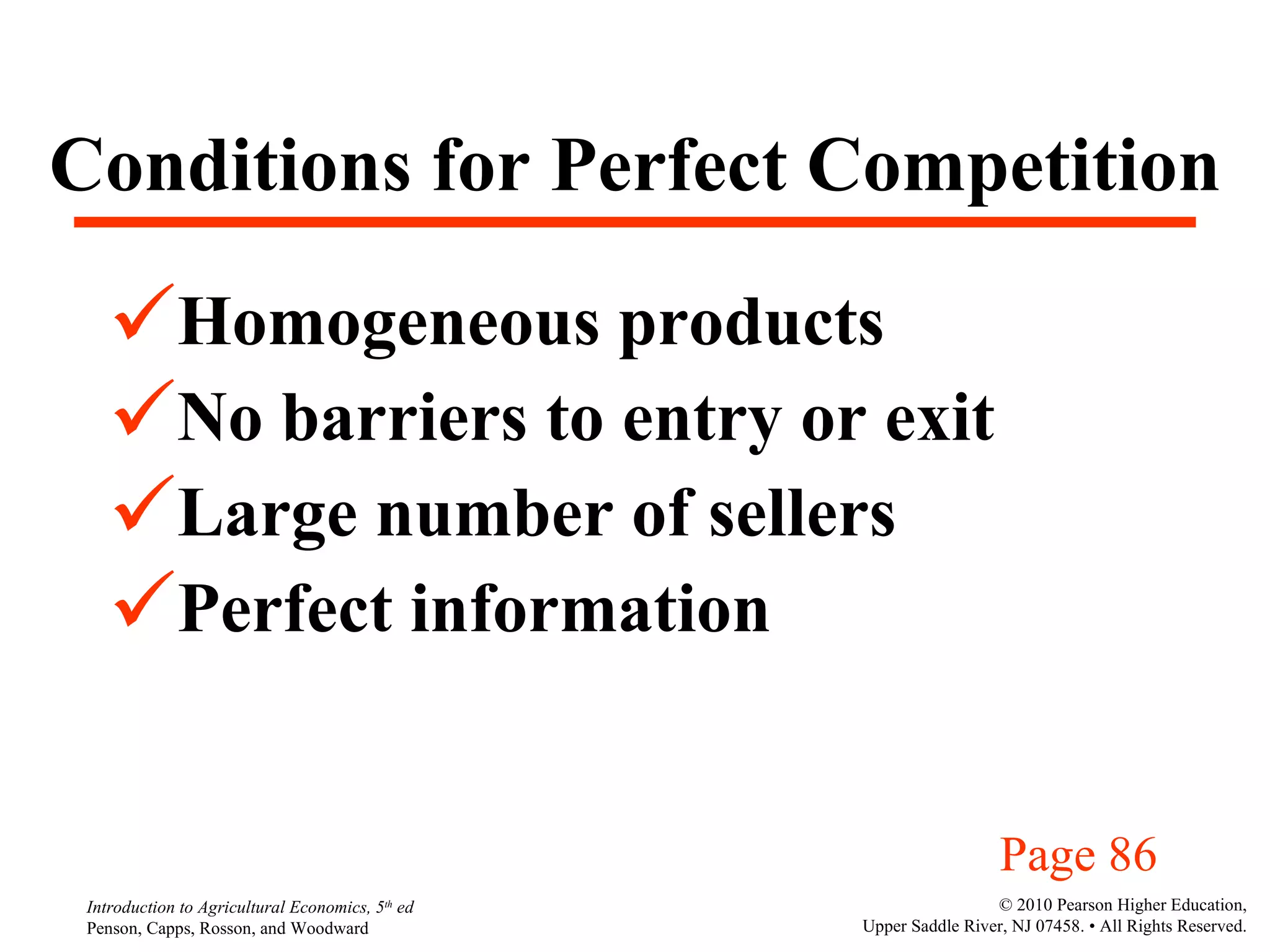
Conditions for Perfect Competition Homogeneous products No barriers to entry or exit Large number of sellers Perfect information Page 86
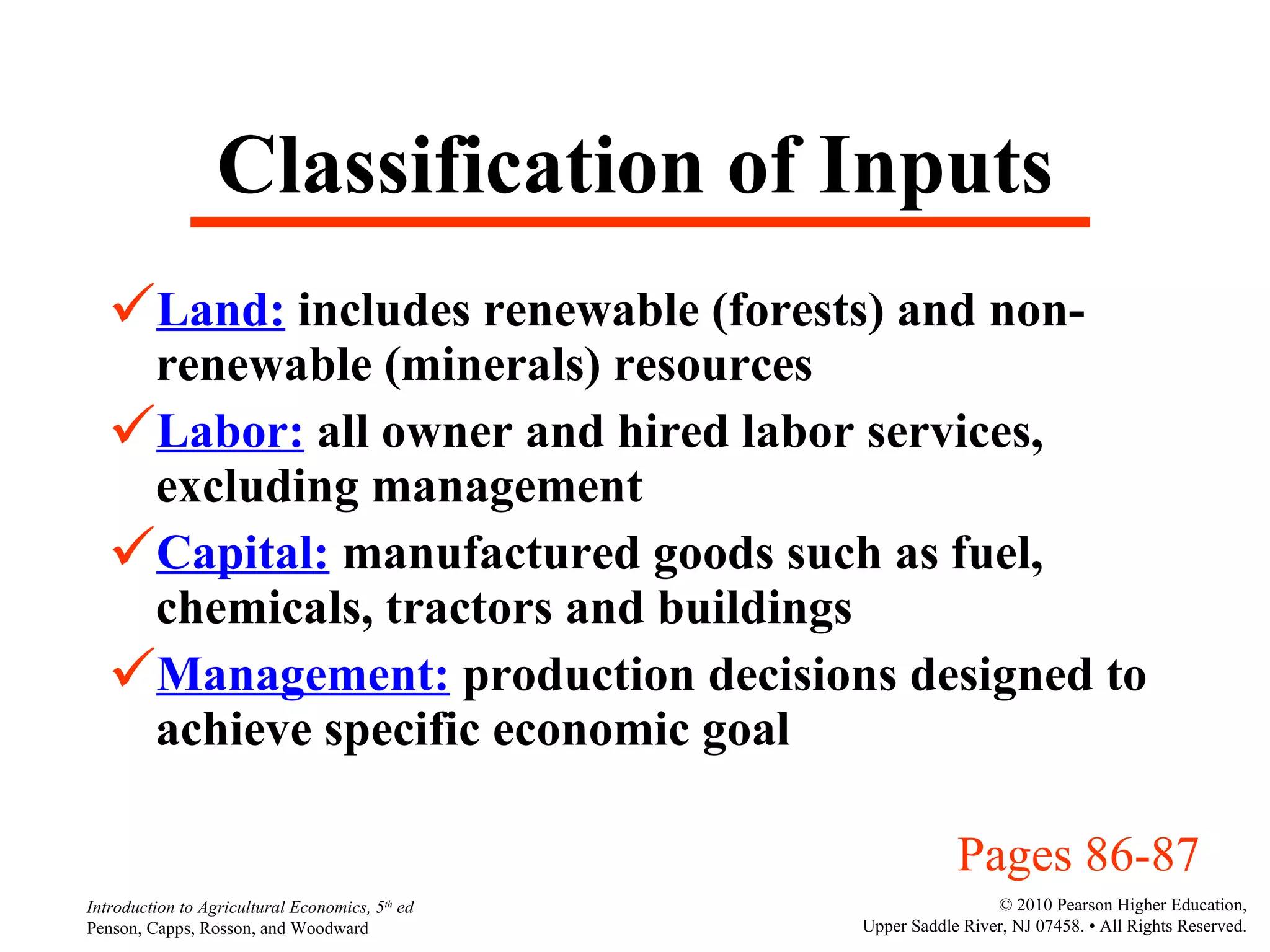
Classification of Inputs Land:  includes renewable (forests) and non-renewable (minerals) resources Labor:  all owner and hired labor services, excluding management Capital:  manufactured goods such as fuel, chemicals, tractors and buildings Management:  production decisions designed to achieve specific economic goal Pages 86-87
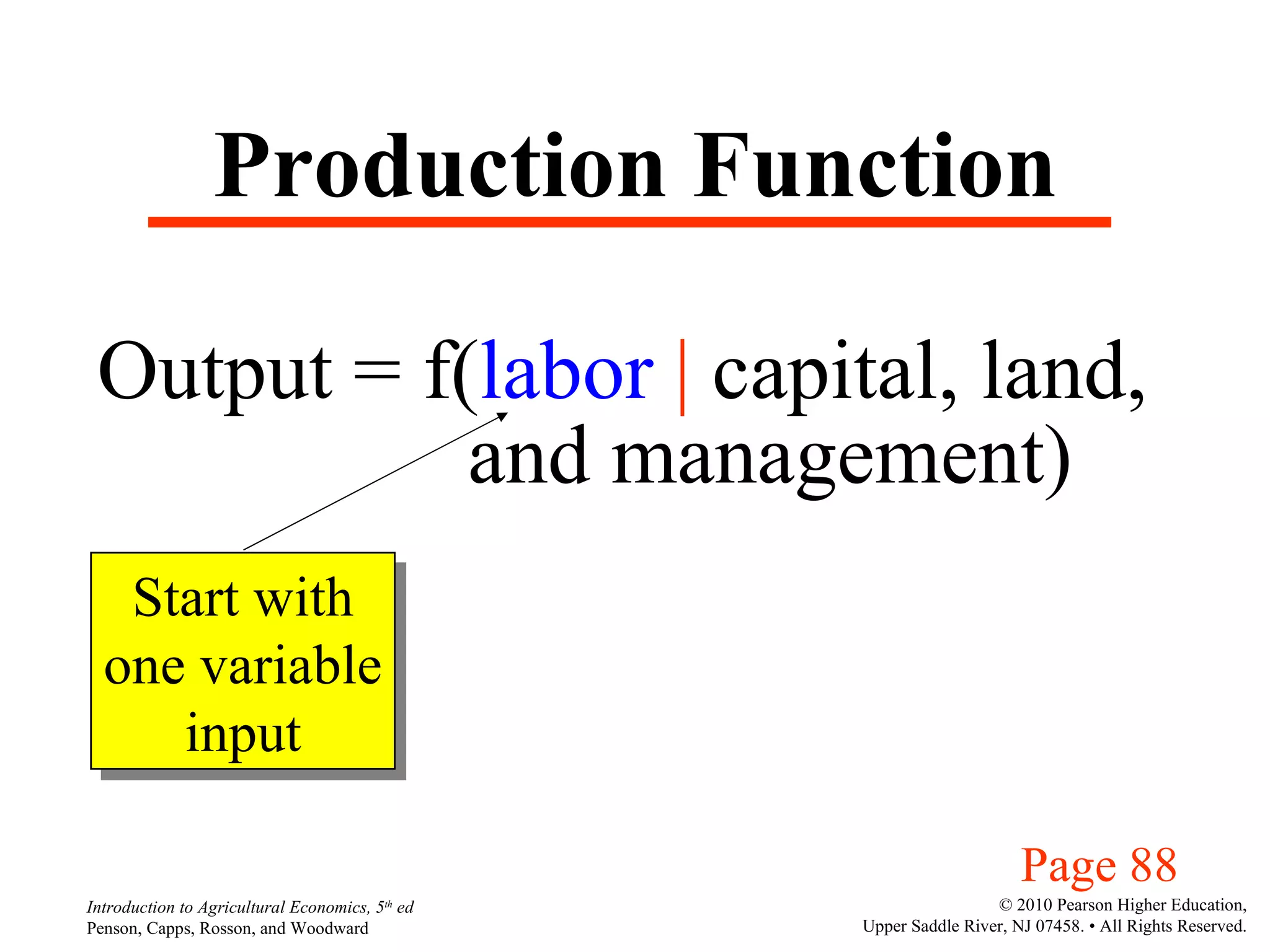
Production Function Output = f( labor   |   capital, land,  and management) Start with one variable input Page 88
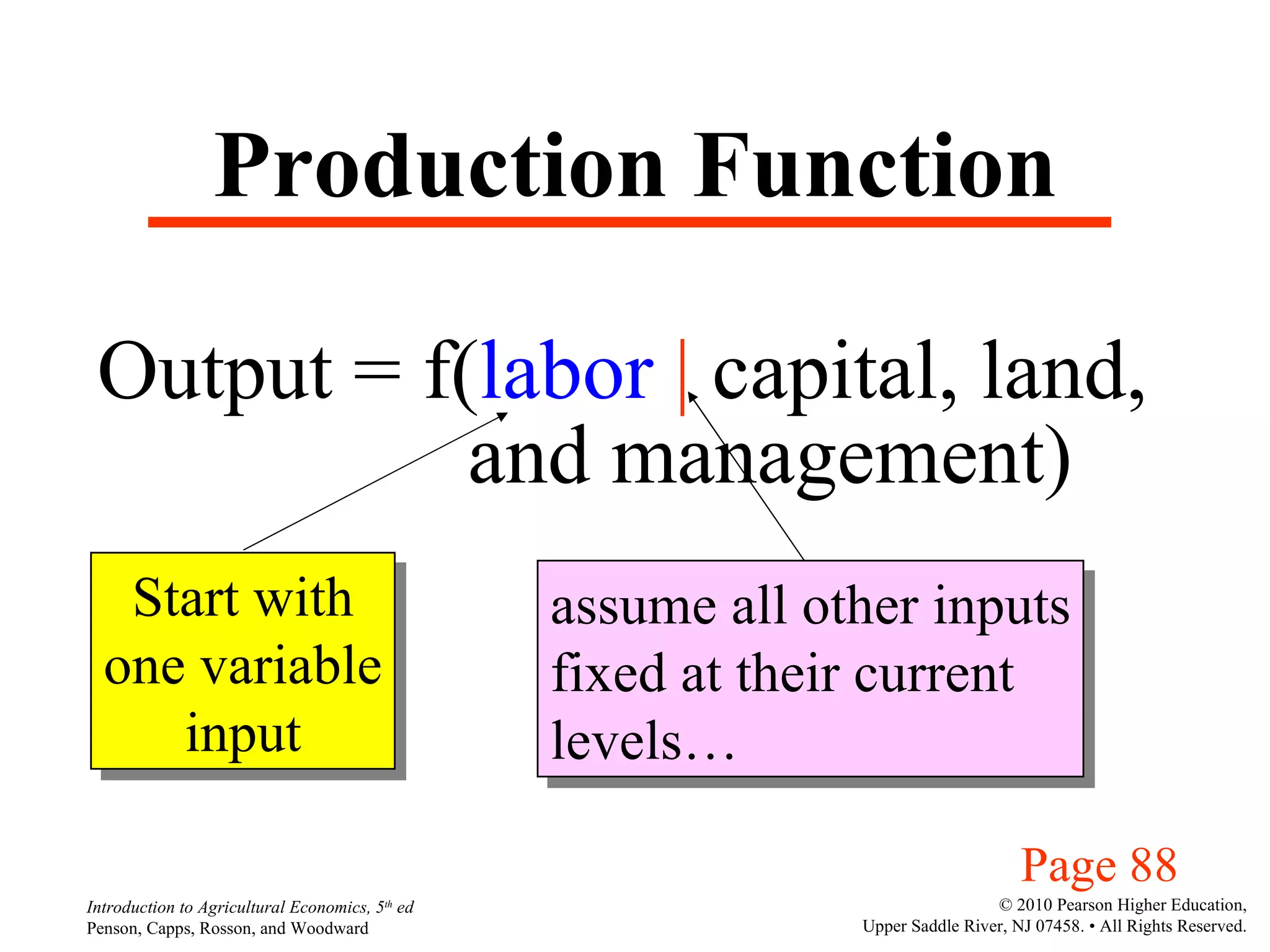
Production Function Output = f( labor   |   capital, land,  and management) Start with one variable input assume all other inputs fixed at their current levels… Page 88
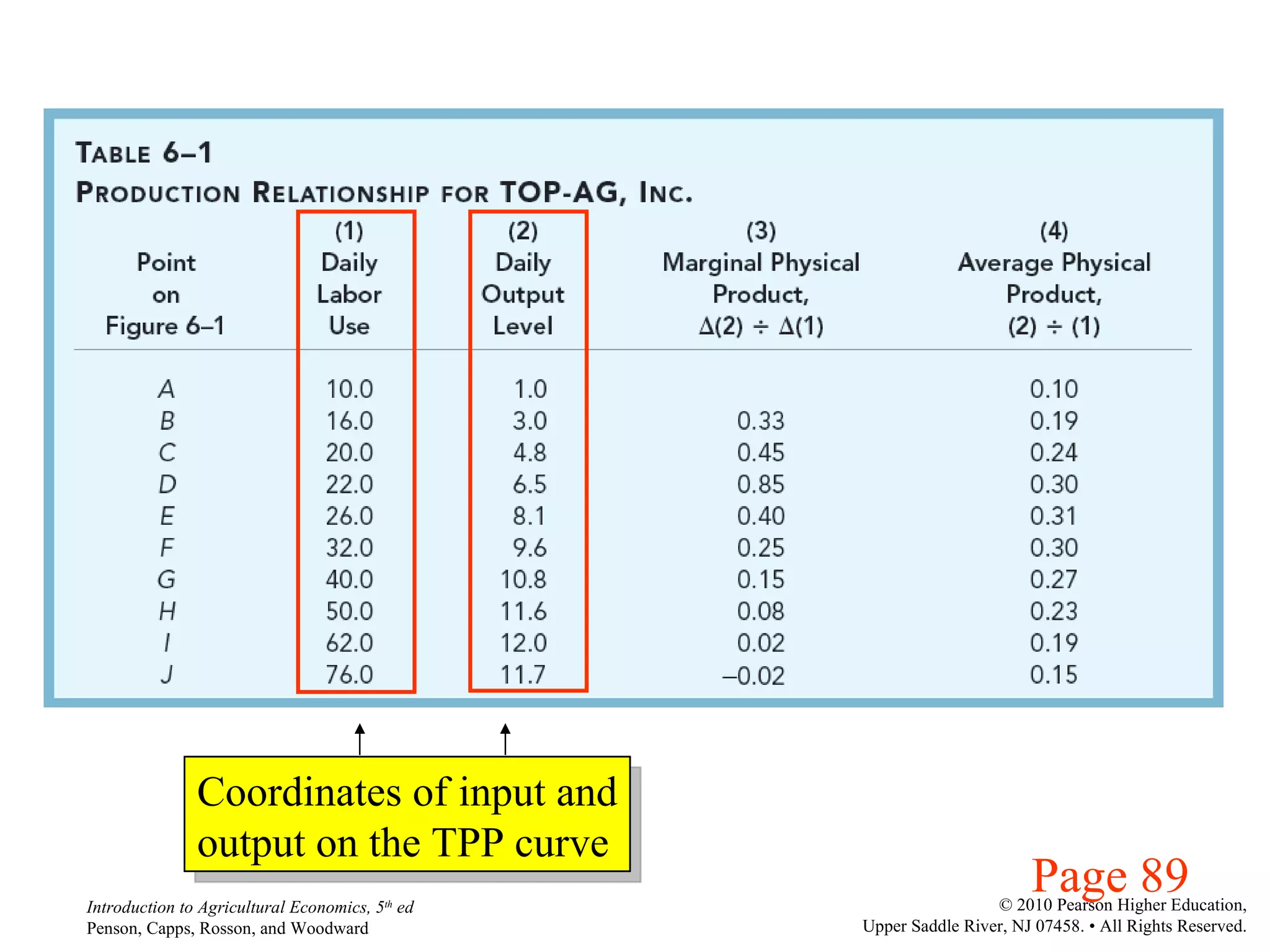
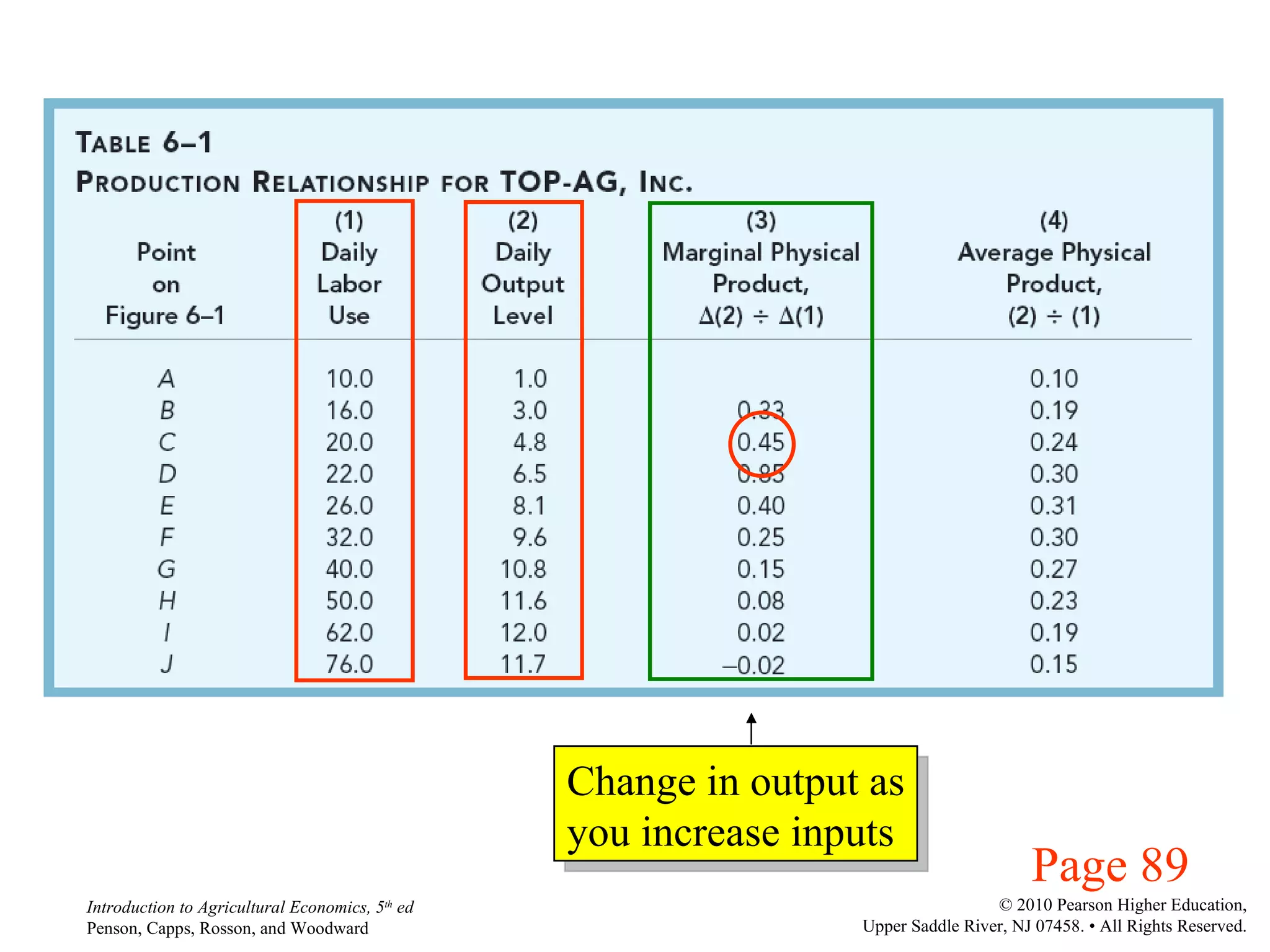
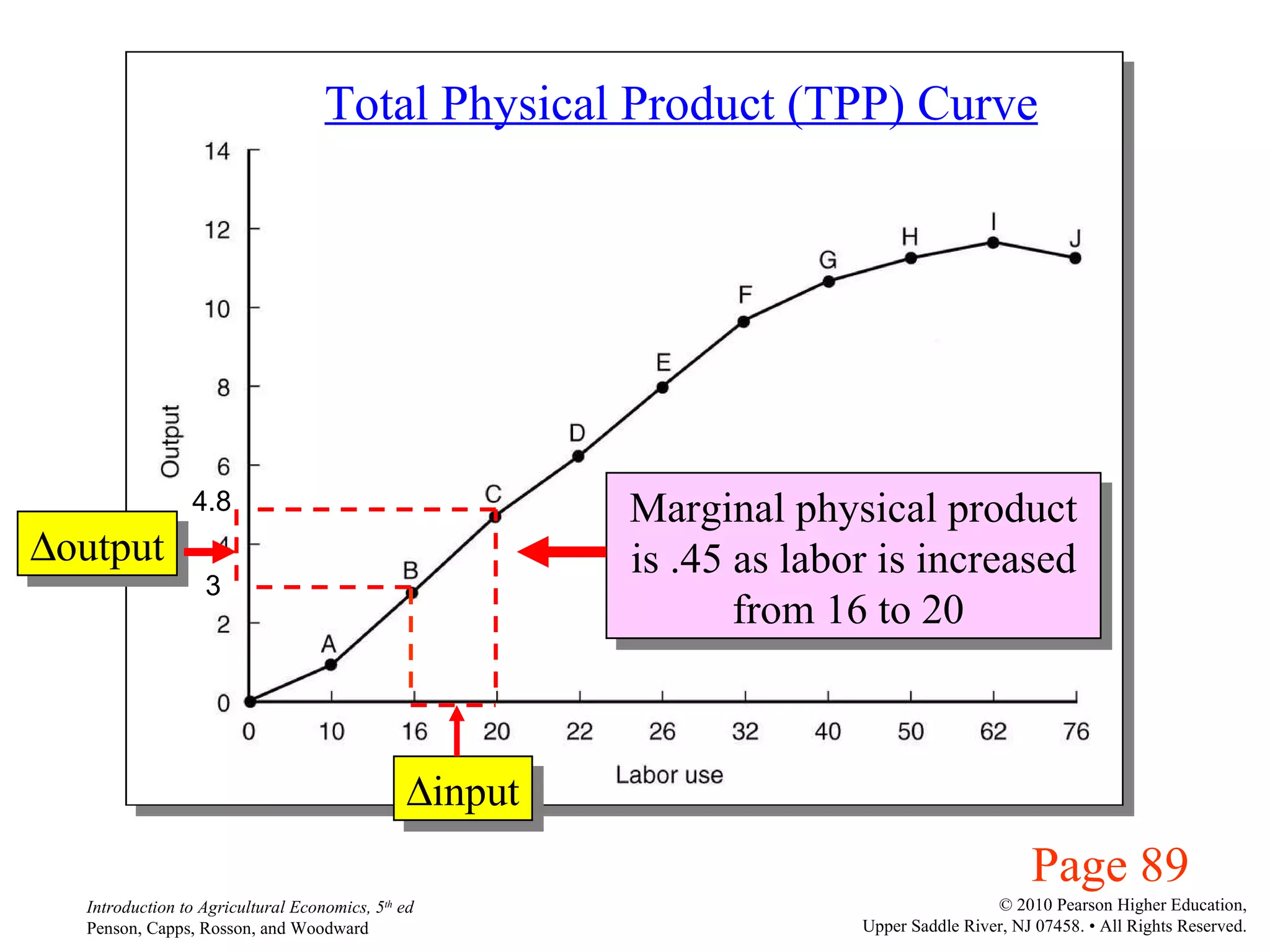
Coordinates of input and output on the TPP curve Page 89
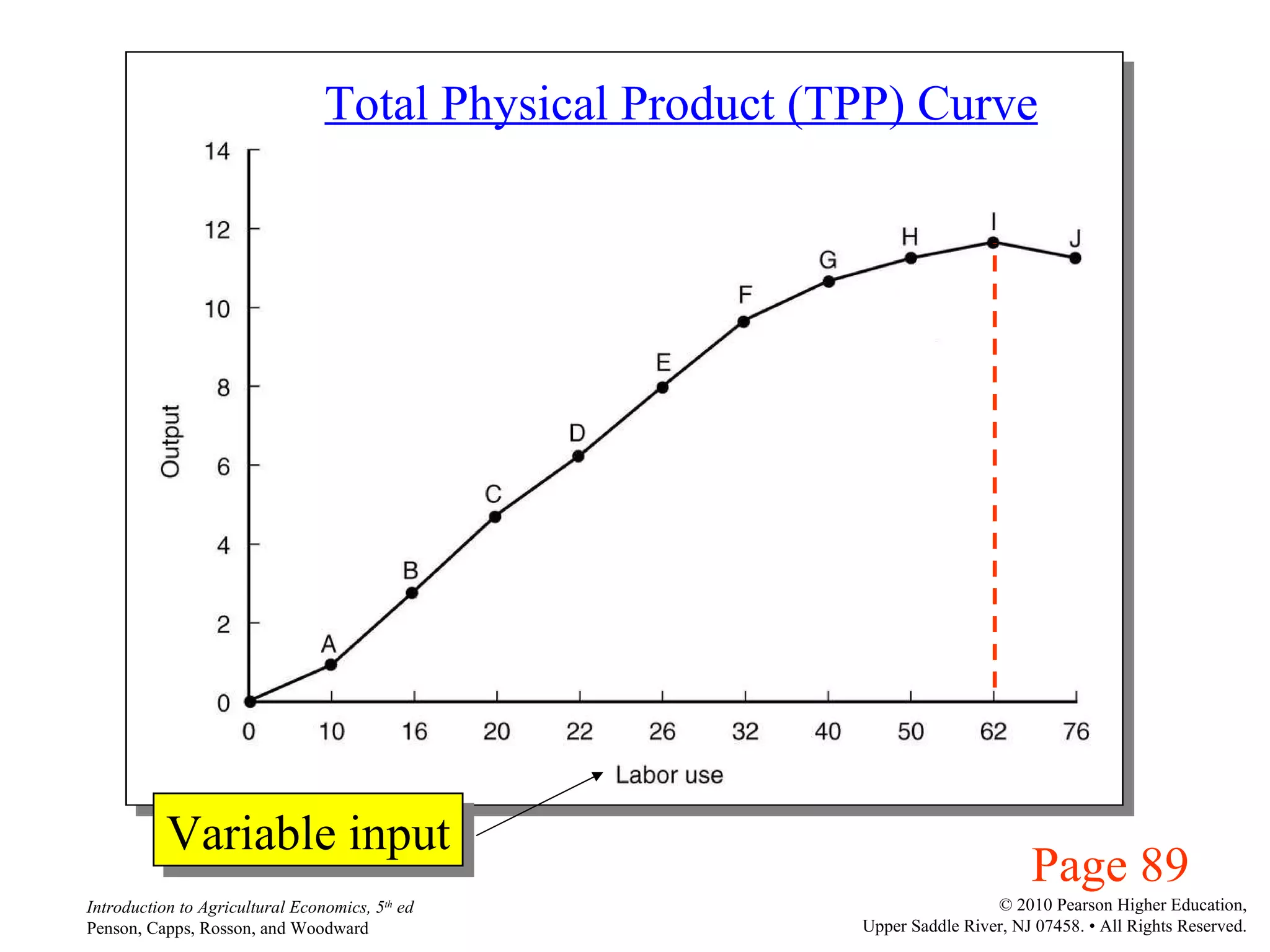
Page 89 Total Physical Product (TPP) Curve Variable input
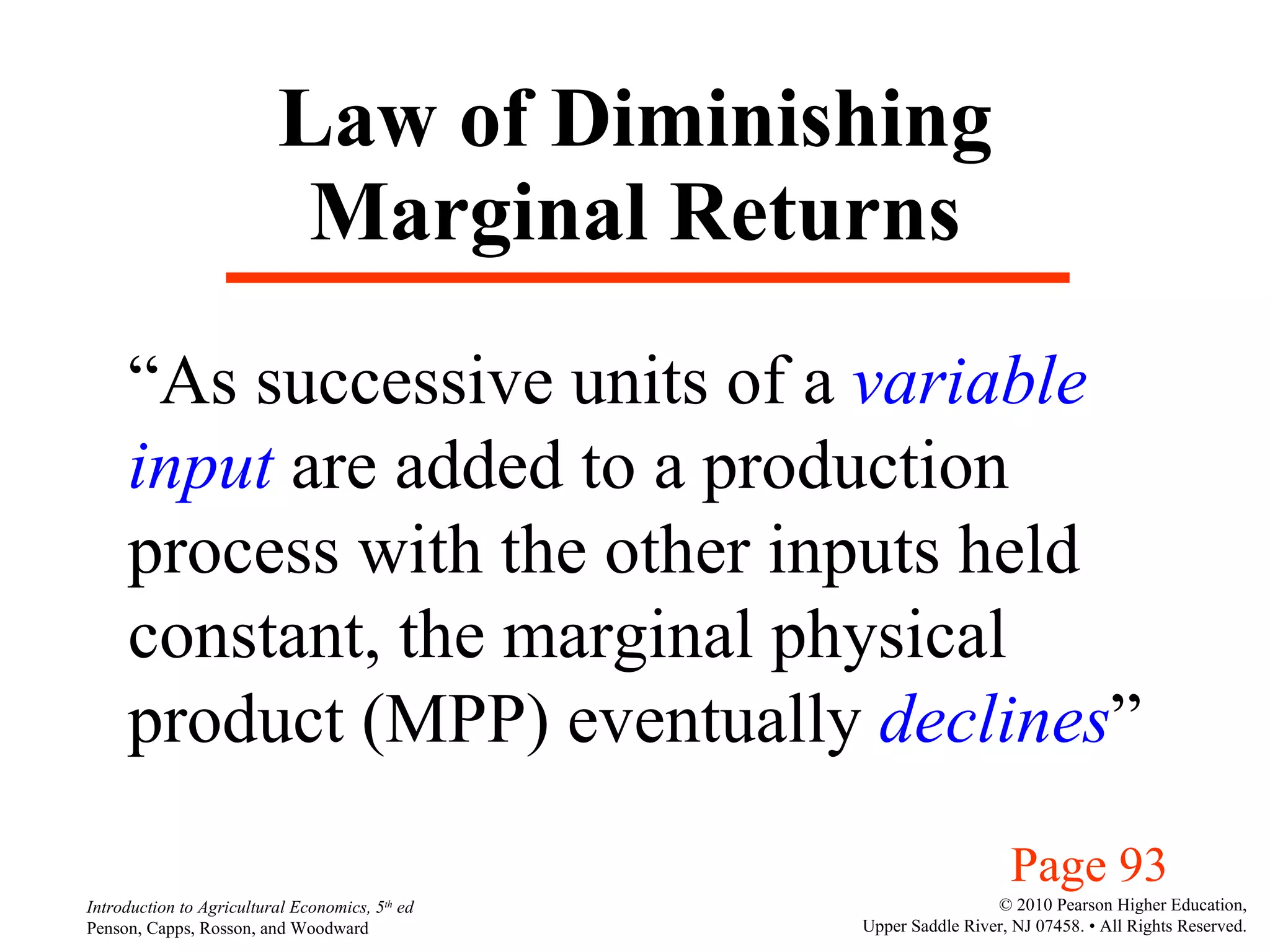
Law of Diminishing Marginal Returns “ As successive units of a  variable input  are added to a production  process with the other inputs held constant, the marginal physical product (MPP) eventually  declines ” Page 93
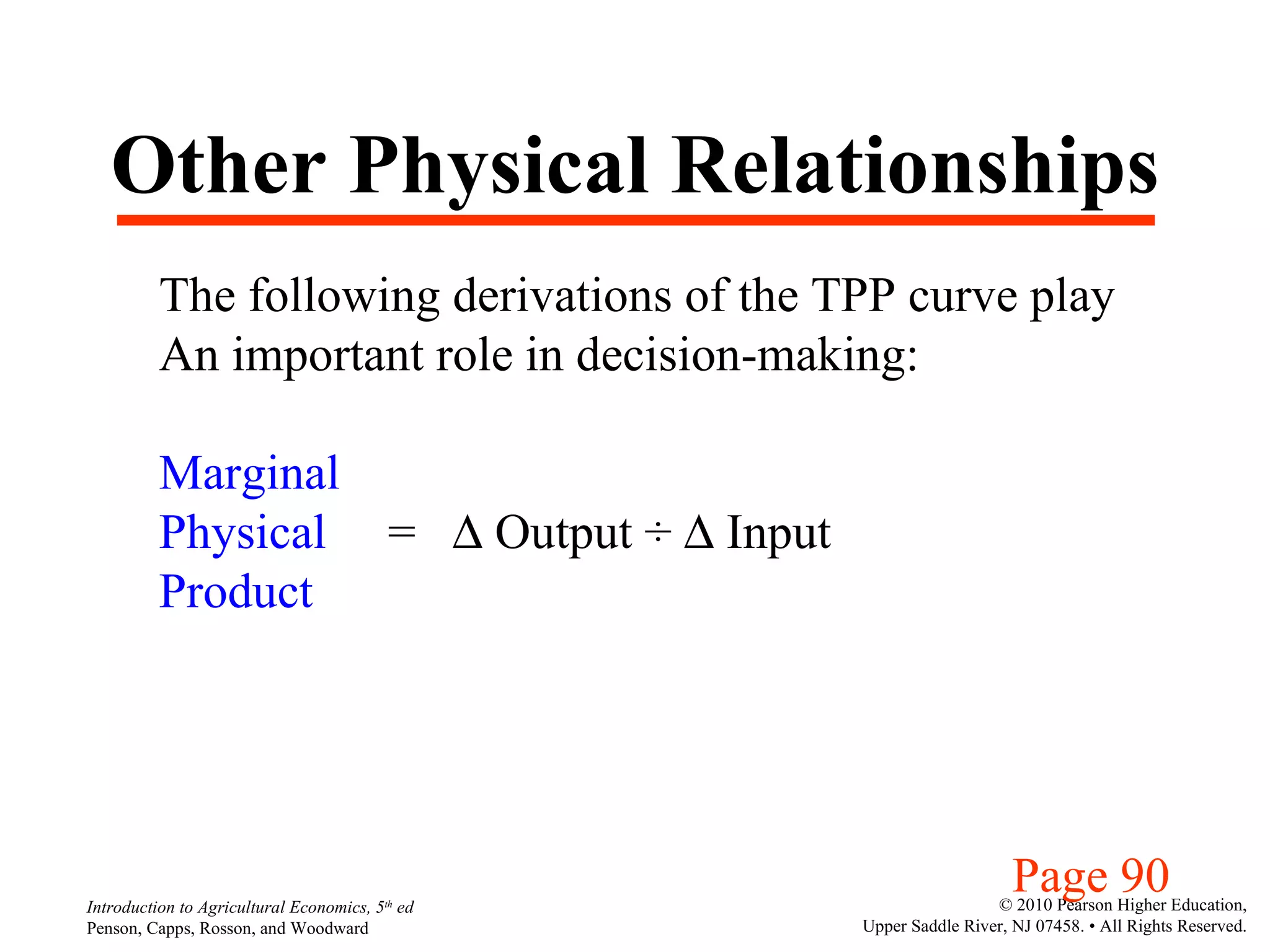
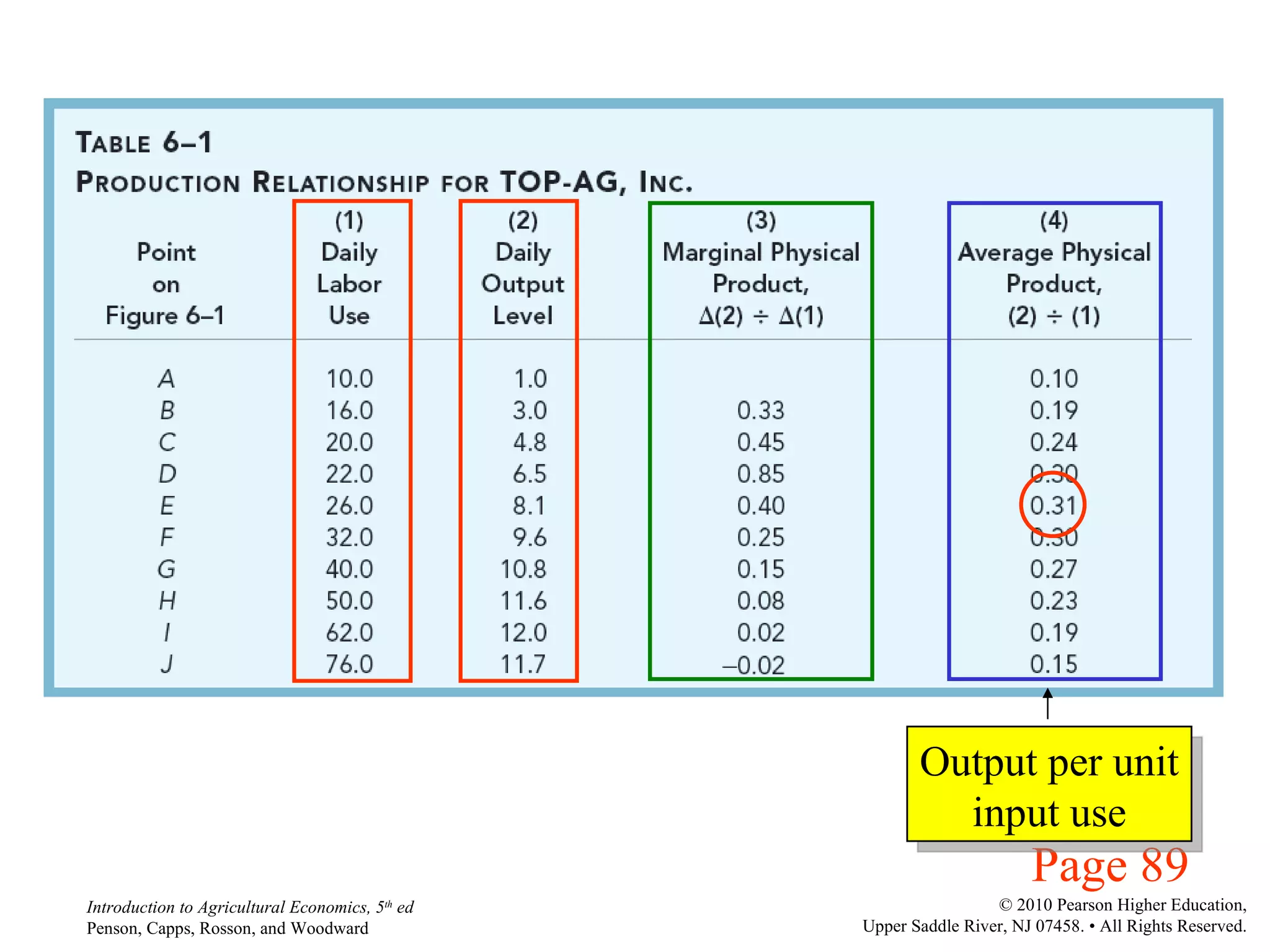
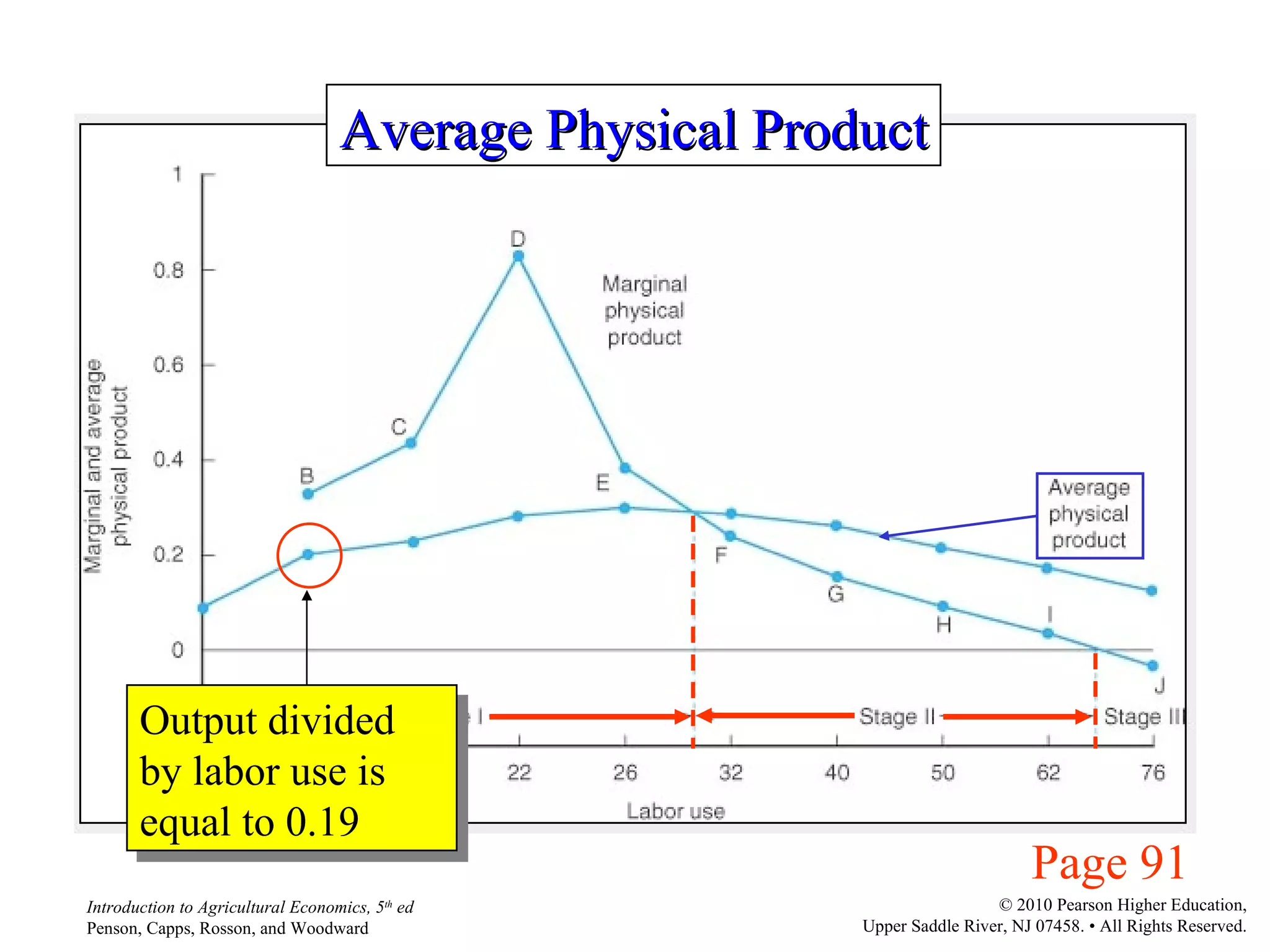
Other Physical Relationships The following derivations of the TPP curve play An important role in decision-making: Marginal Physical   =    Output  ÷    Input Product  Page 90
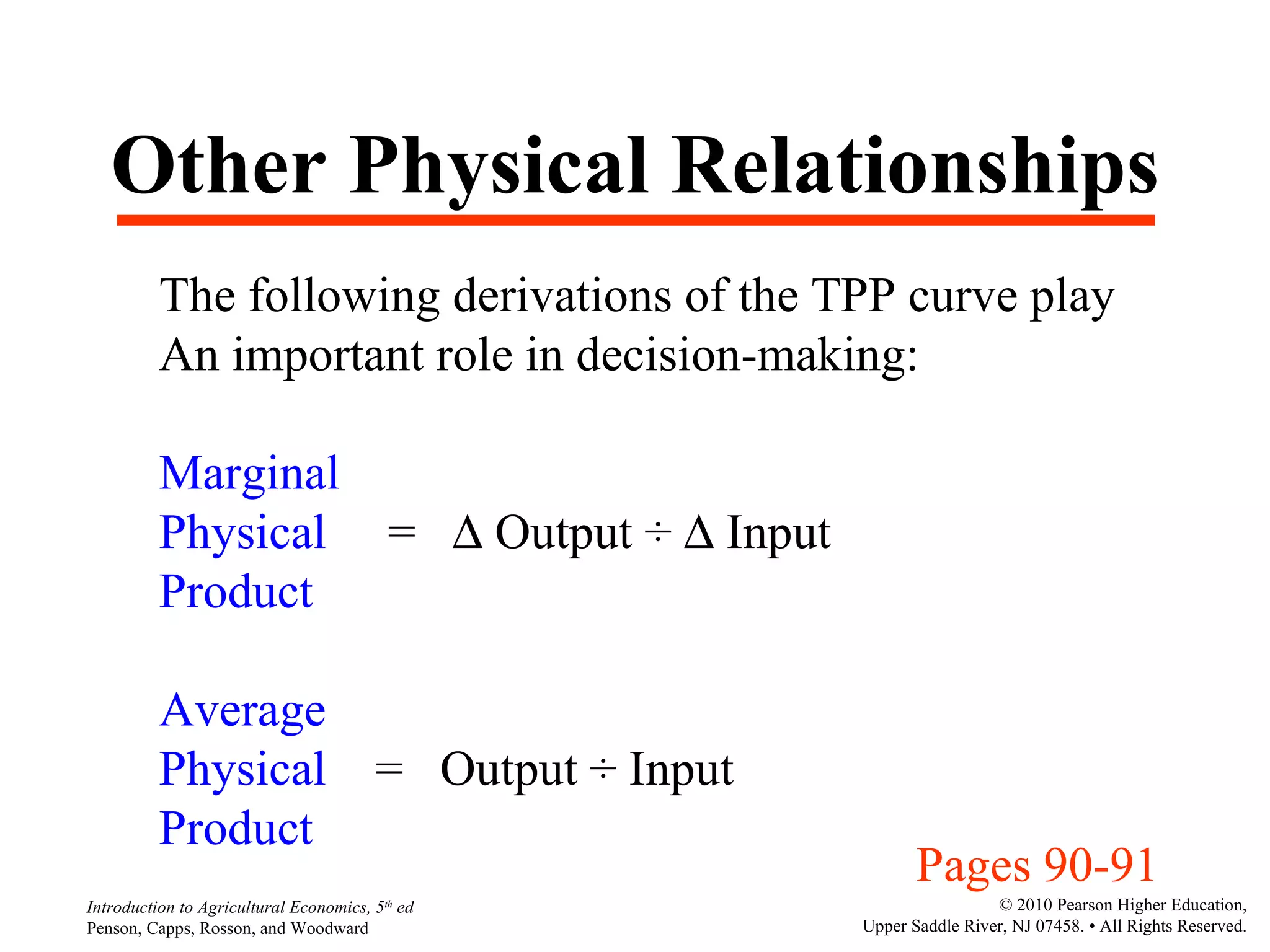
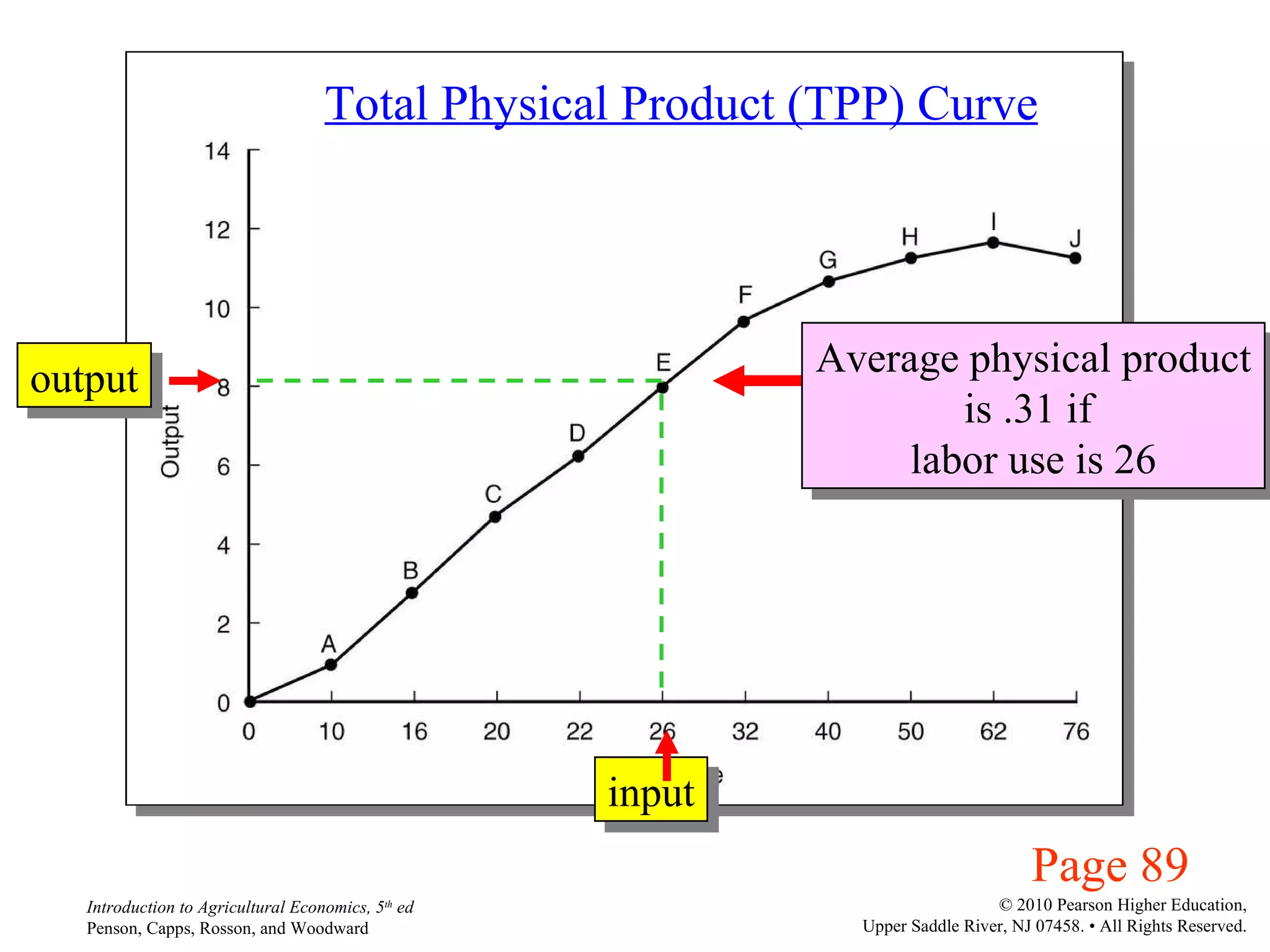
Other Physical Relationships The following derivations of the TPP curve play An important role in decision-making: Marginal Physical   =    Output  ÷    Input Product  Average Physical   =  Output  ÷  Input Product  Pages 90-91
Change in output as you increase inputs Page 89
Page 89 Total Physical Product (TPP) Curve  output  input Marginal physical product is .45 as labor is increased from 16 to 20  4.8 3
Page 89 Output per unit input use
Page 89 Total Physical Product (TPP) Curve output input Average physical product is .31 if  labor use is 26
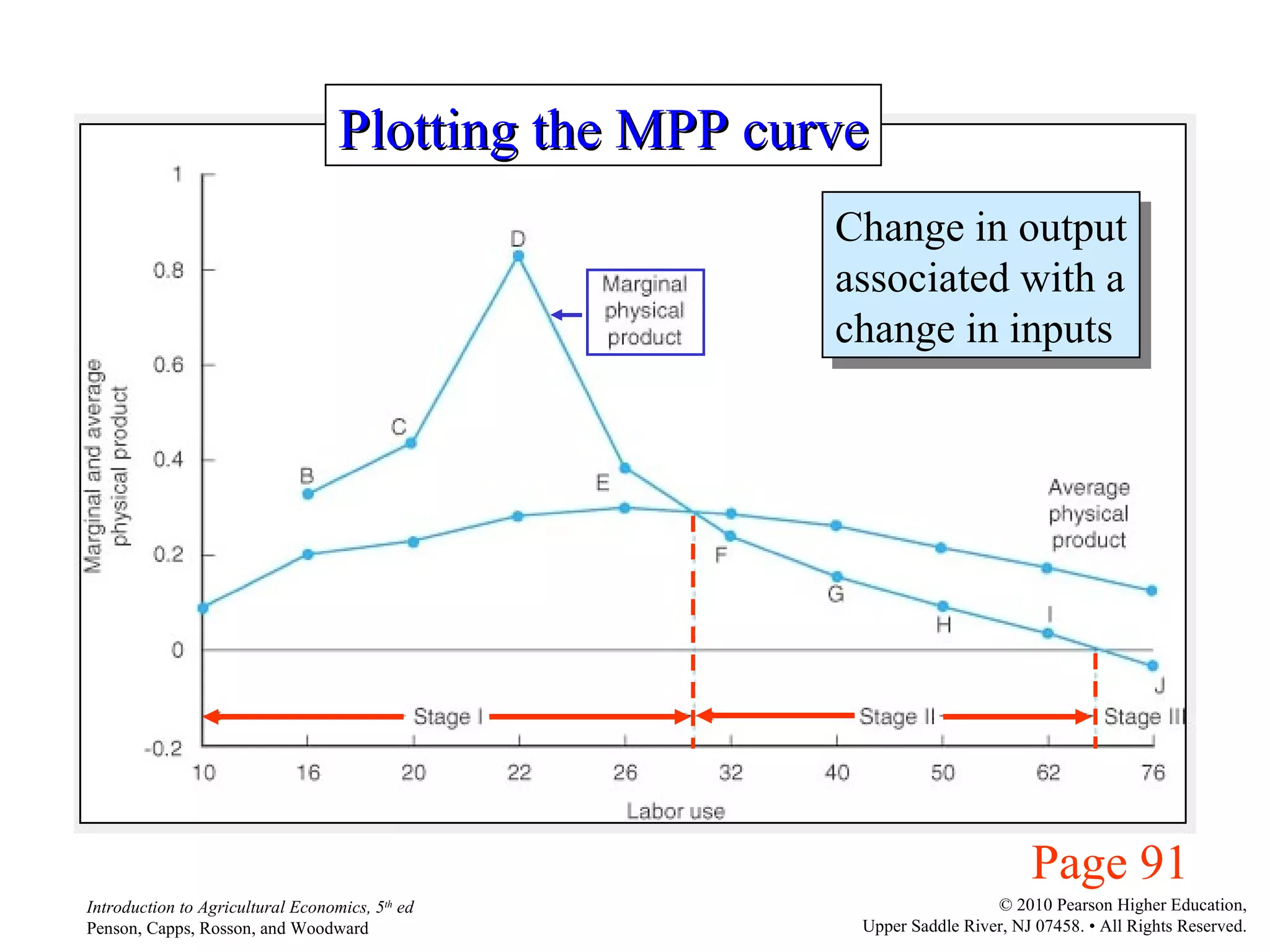
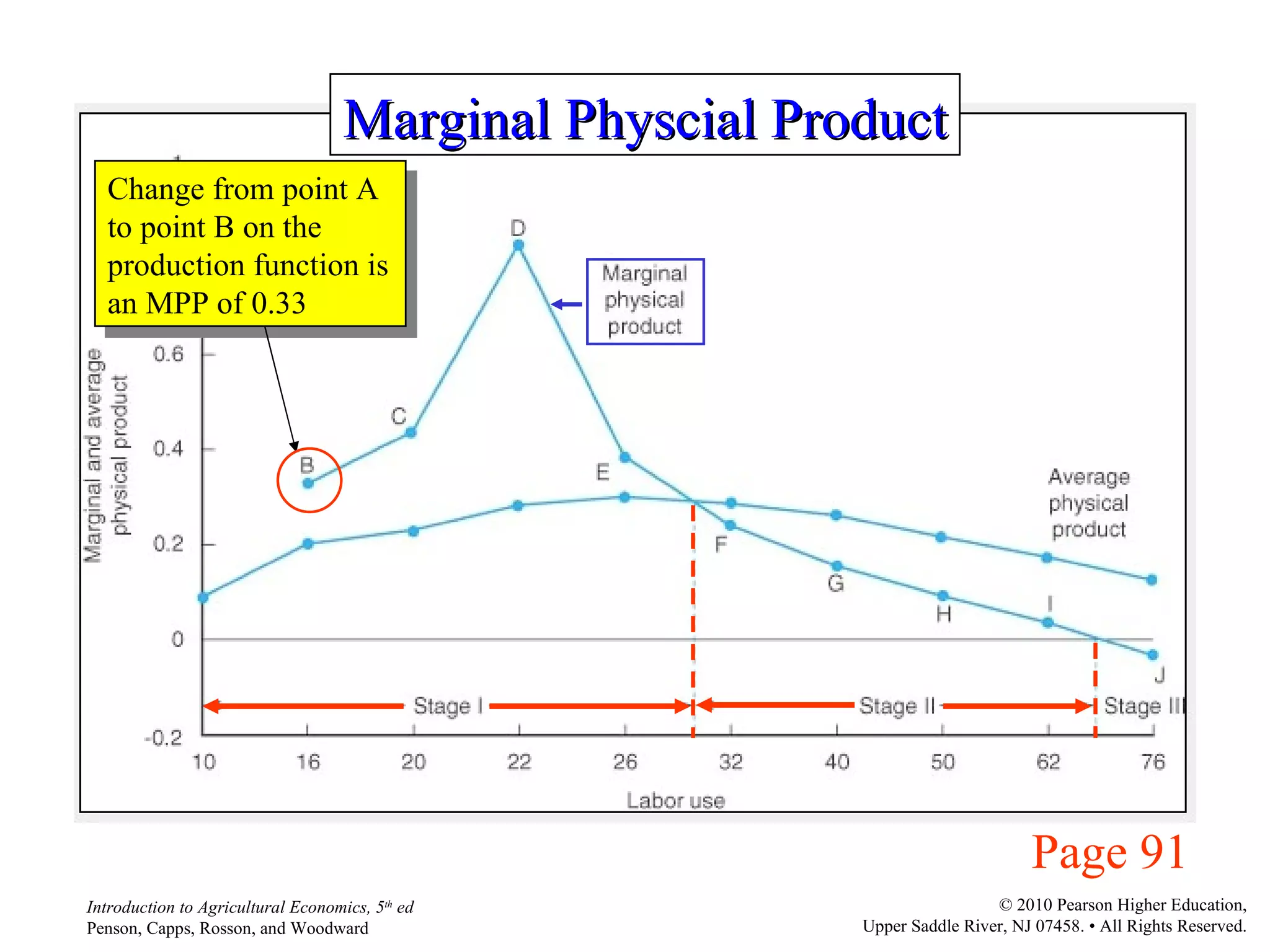
Plotting the MPP curve Page 91 Change in output associated with a change in inputs
Marginal Physcial Product Page 91 Change from point A to point B on the production function is an MPP of 0.33
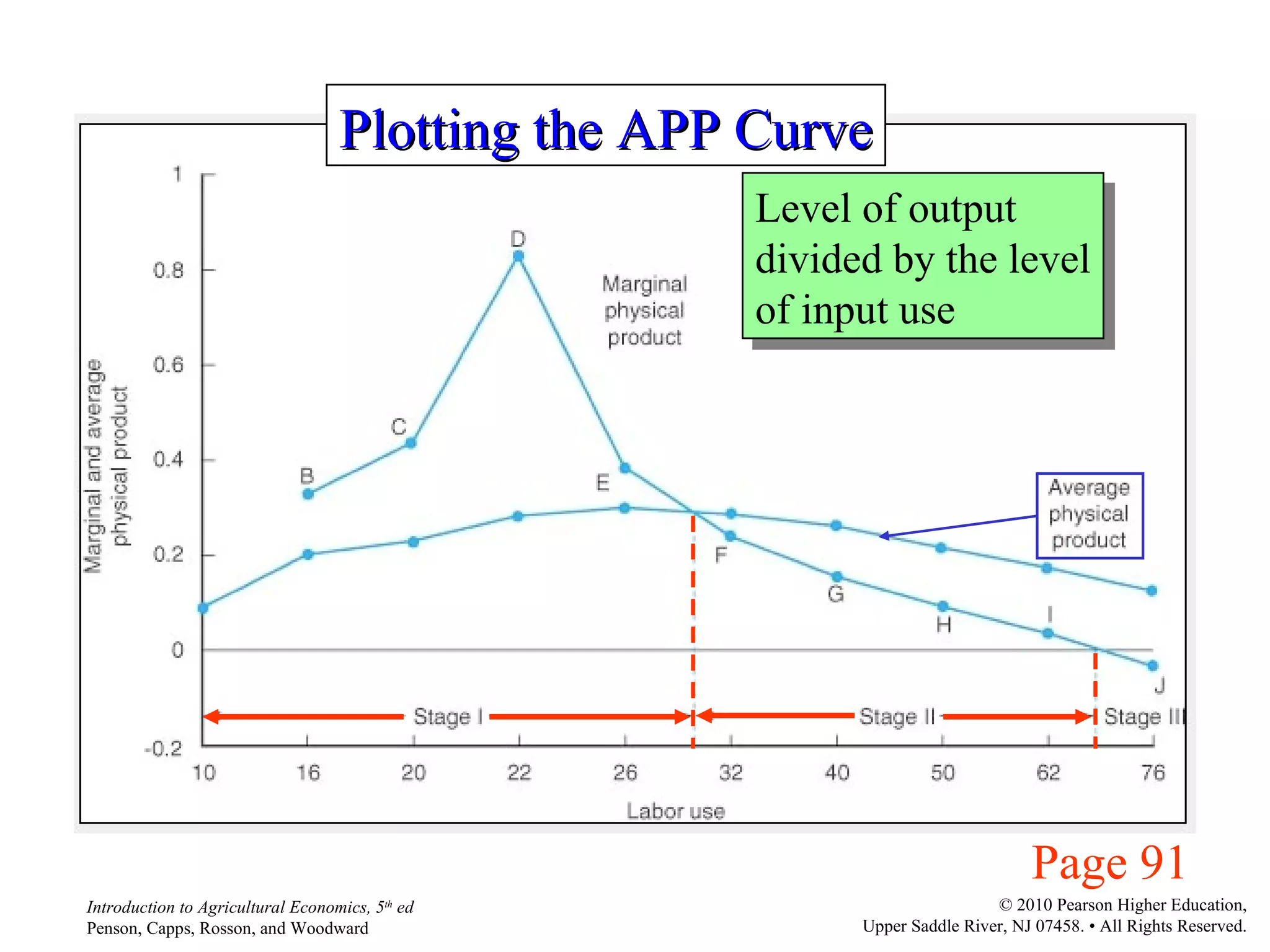
Page 91 Plotting the APP Curve Level of output divided by the level of input use
Page 91 Average Physical Product Output divided by labor use is equal to 0.19
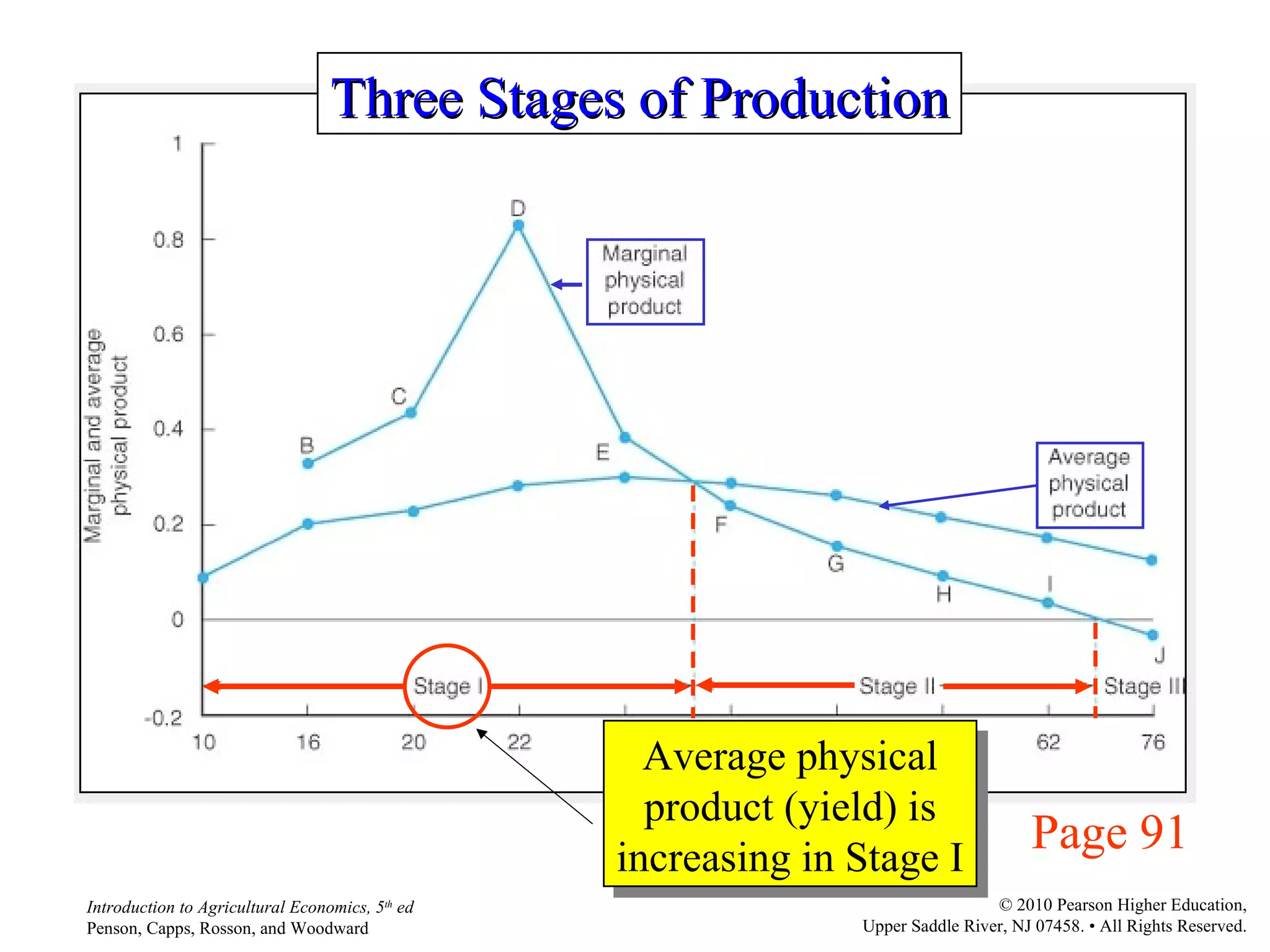
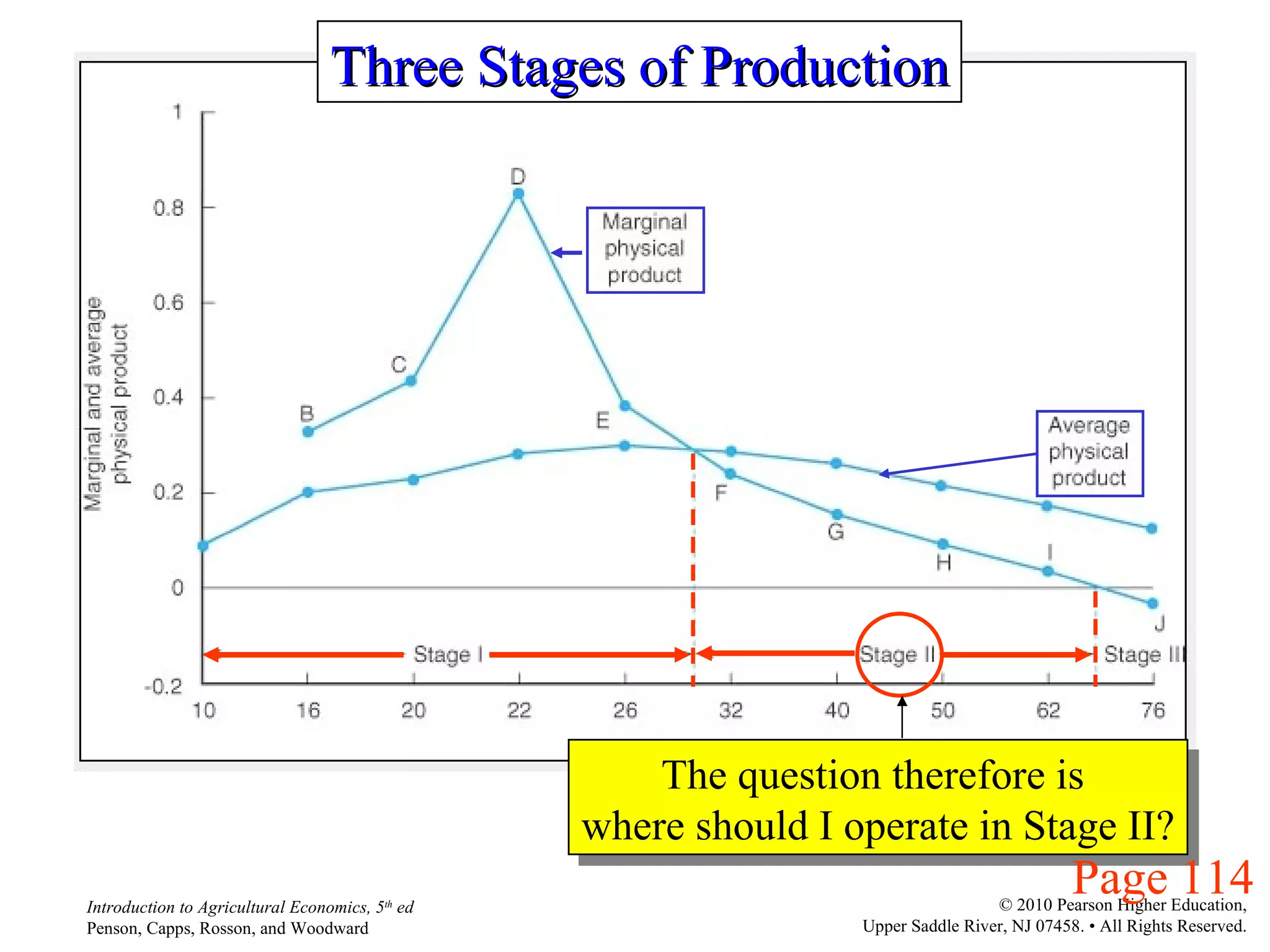
Page 91 Three Stages of Production Average physical product (yield) is increasing in Stage I
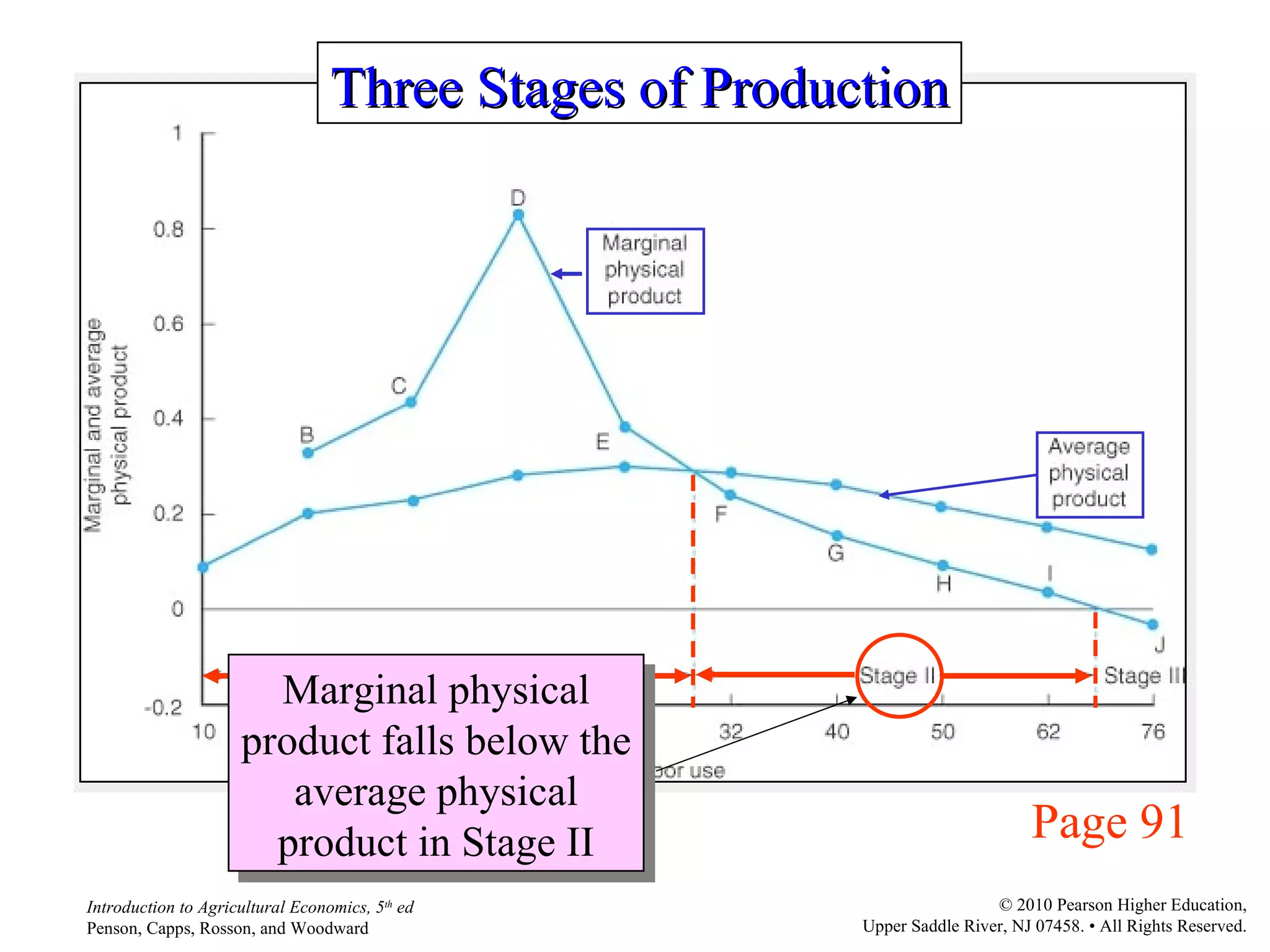
Page 91 Three Stages of Production Marginal physical product falls below the average physical product in Stage II
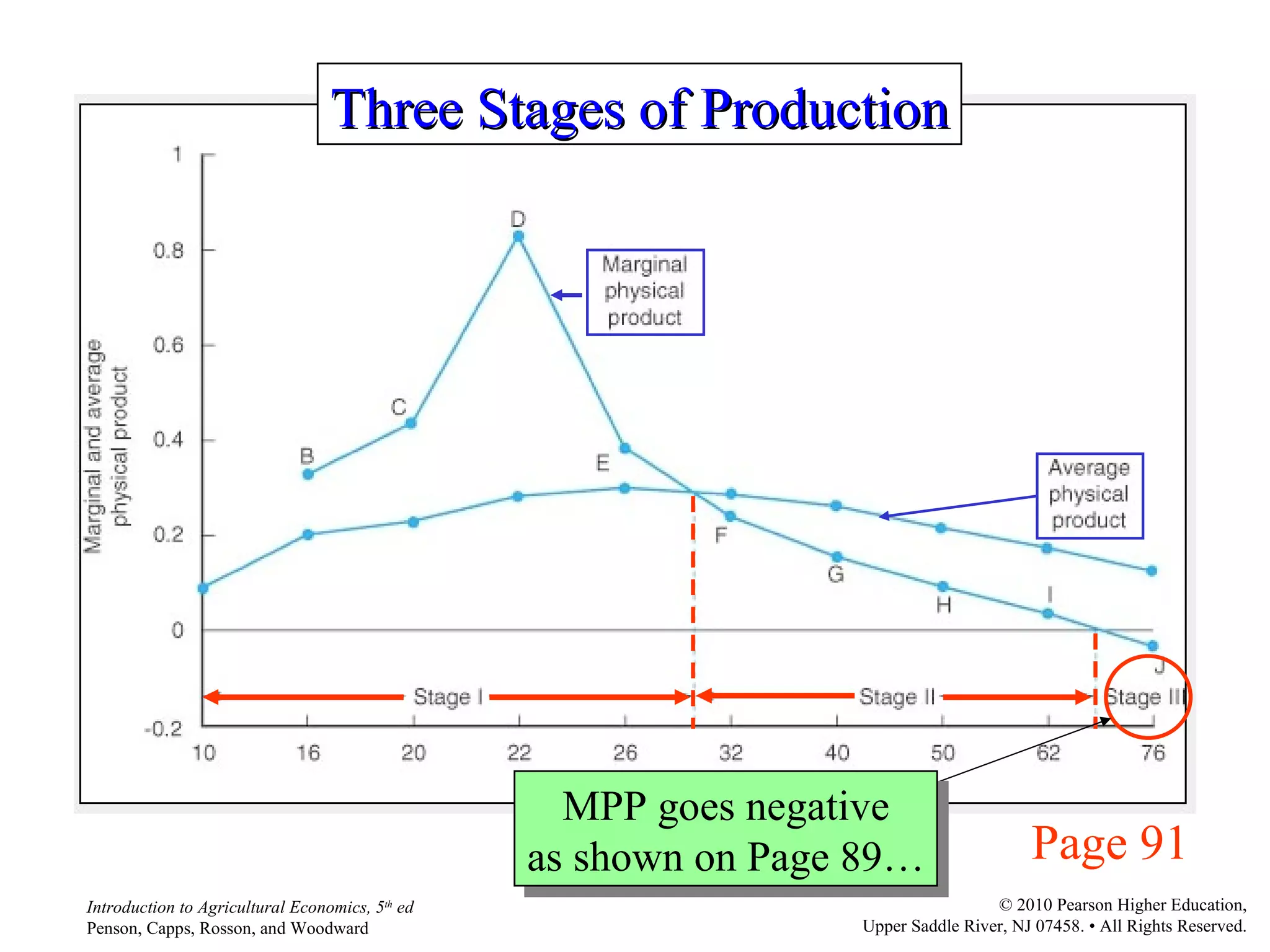
Page 91 Three Stages of Production MPP goes negative as shown on Page 89…
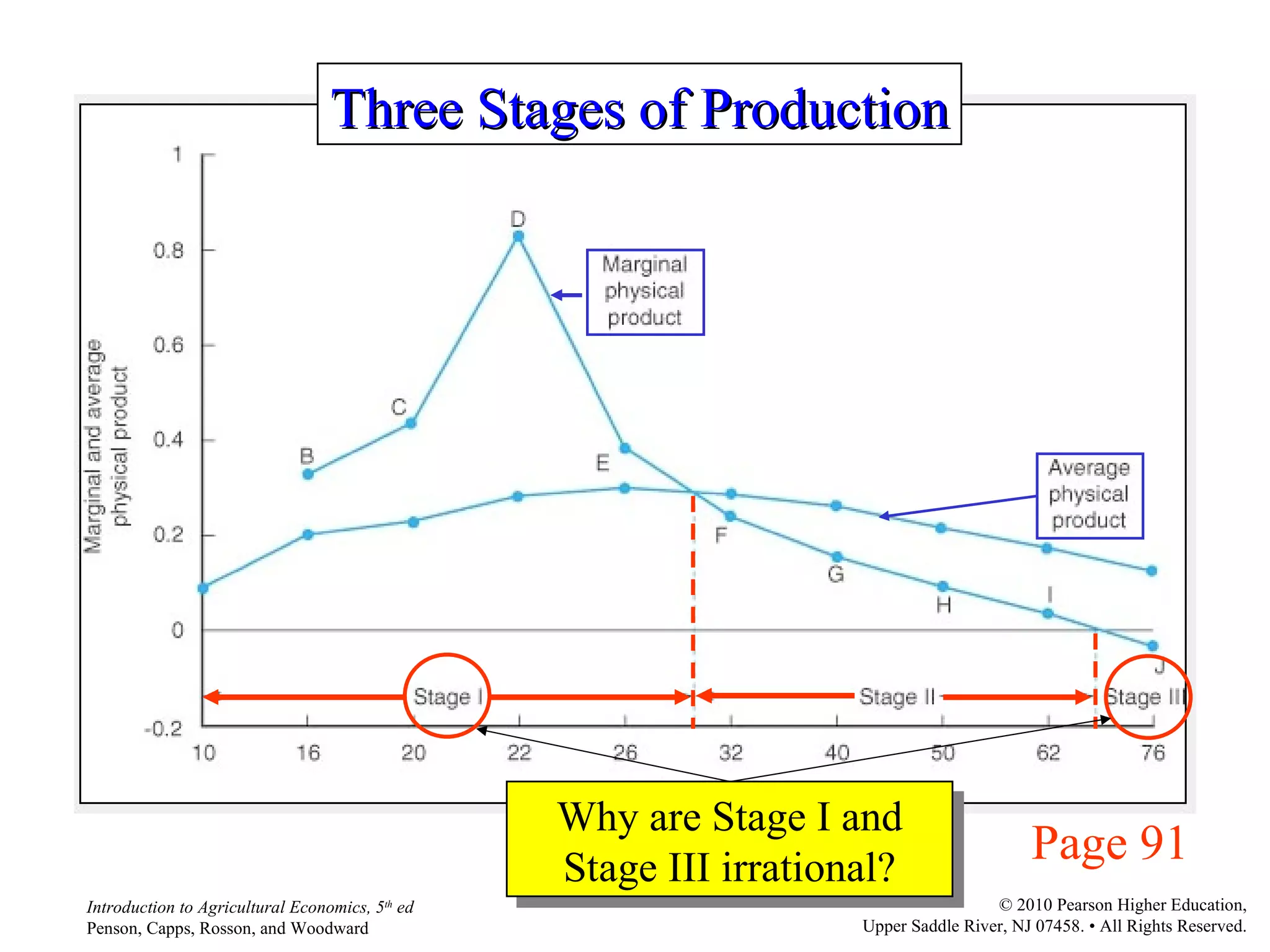
Page 91 Three Stages of Production Why are Stage I and Stage III irrational?
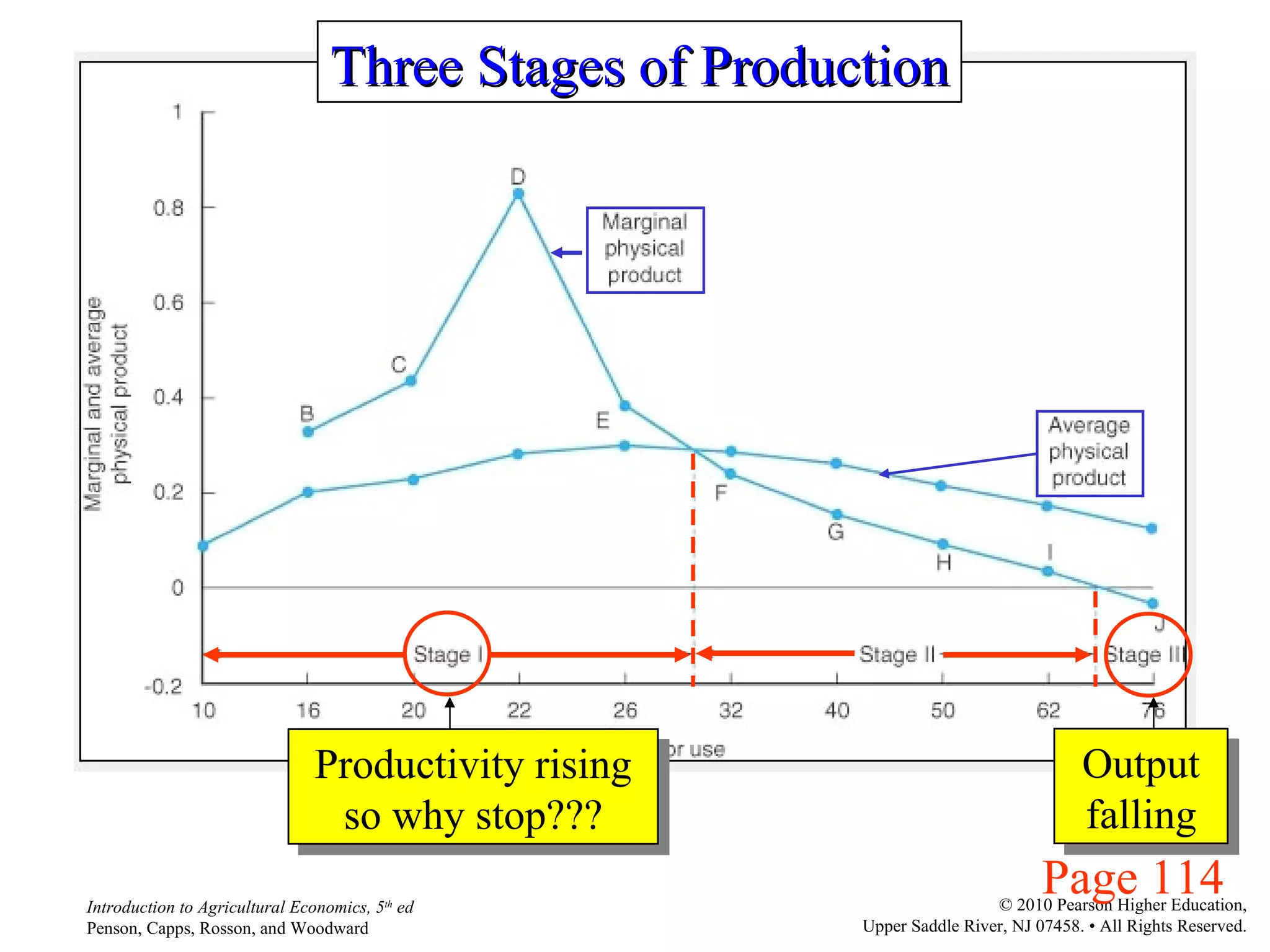
Page 114 Three Stages of Production Productivity rising so why stop??? Output falling
Three Stages of Production The question therefore is  where should I operate in Stage II? Page 114
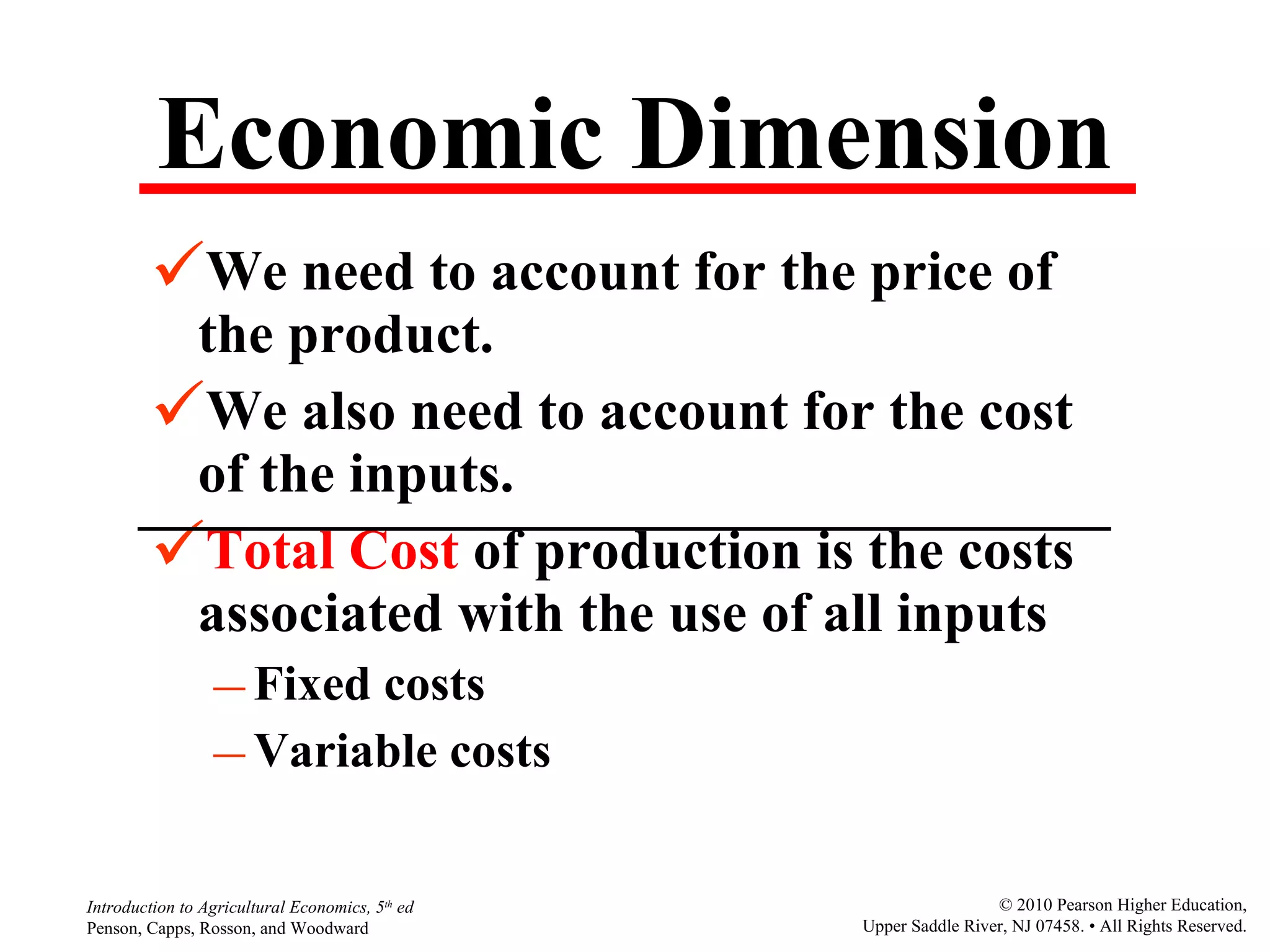
Economic Dimension We need to account for the price of the product. We also need to account for the cost of the inputs. Total Cost  of production is the costs associated with the use of all inputs  Fixed costs Variable costs
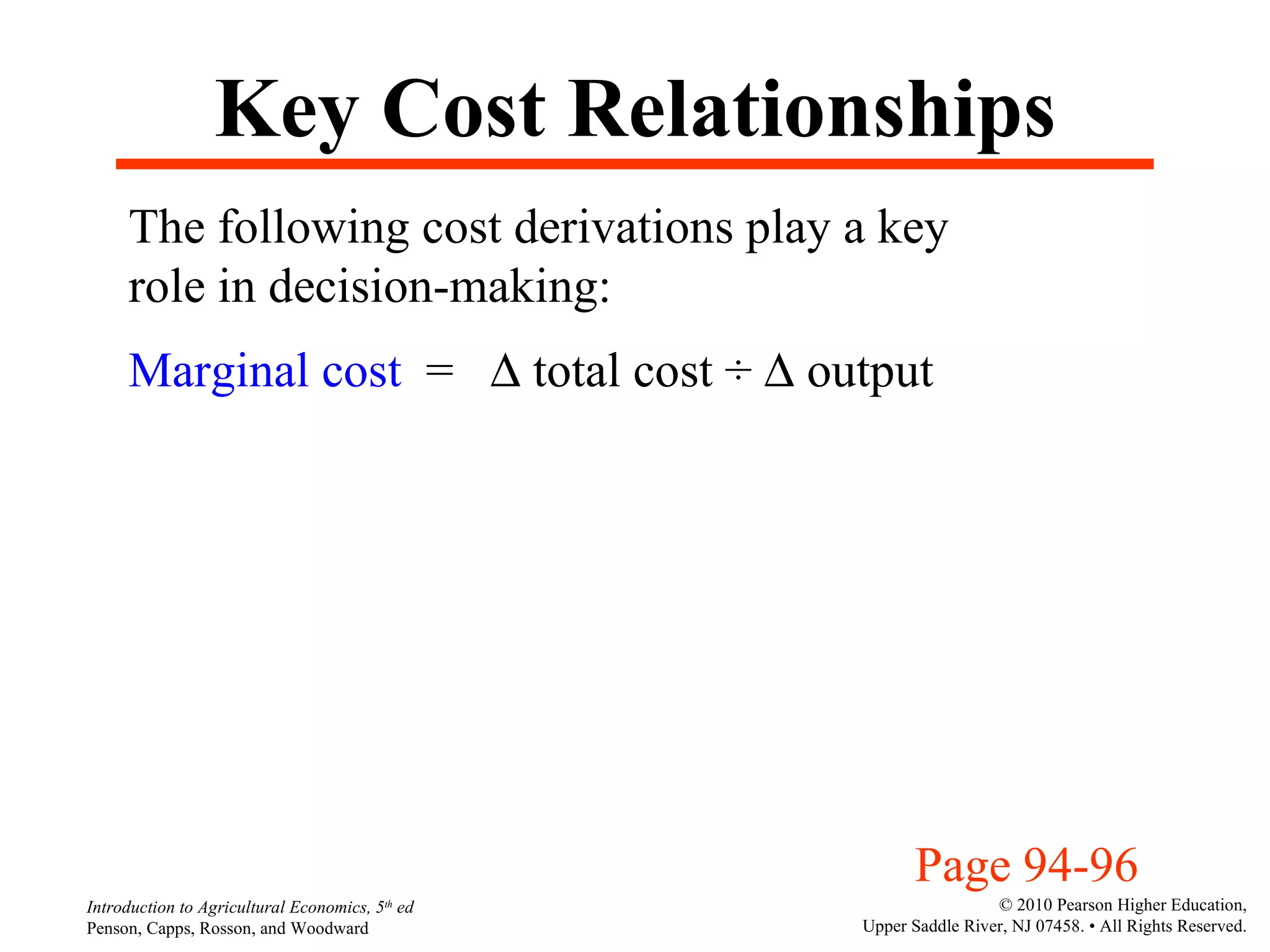
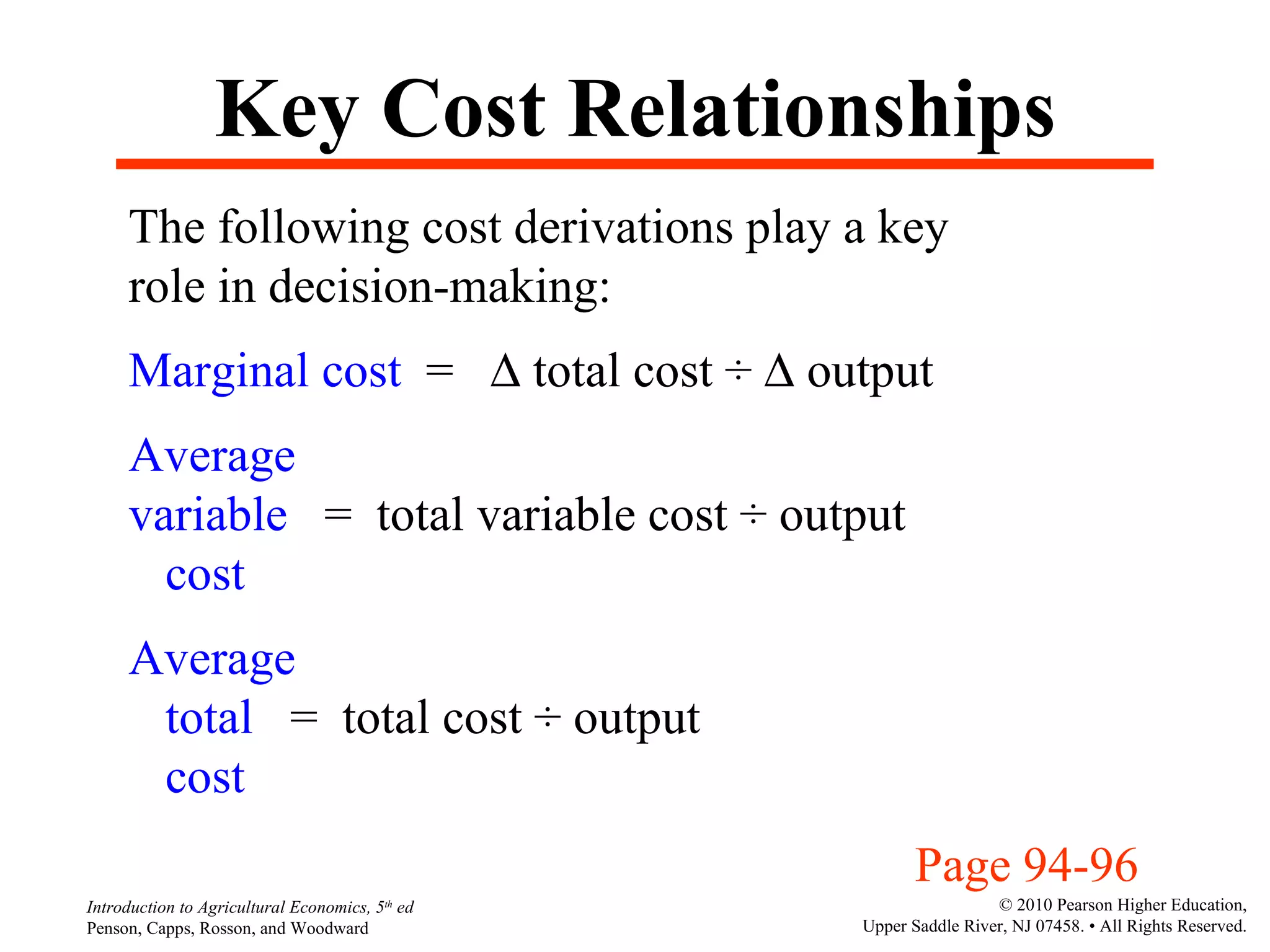
Key Cost Relationships The following cost derivations play a key role in decision-making: Marginal cost   =    total cost  ÷    output Page 94-96
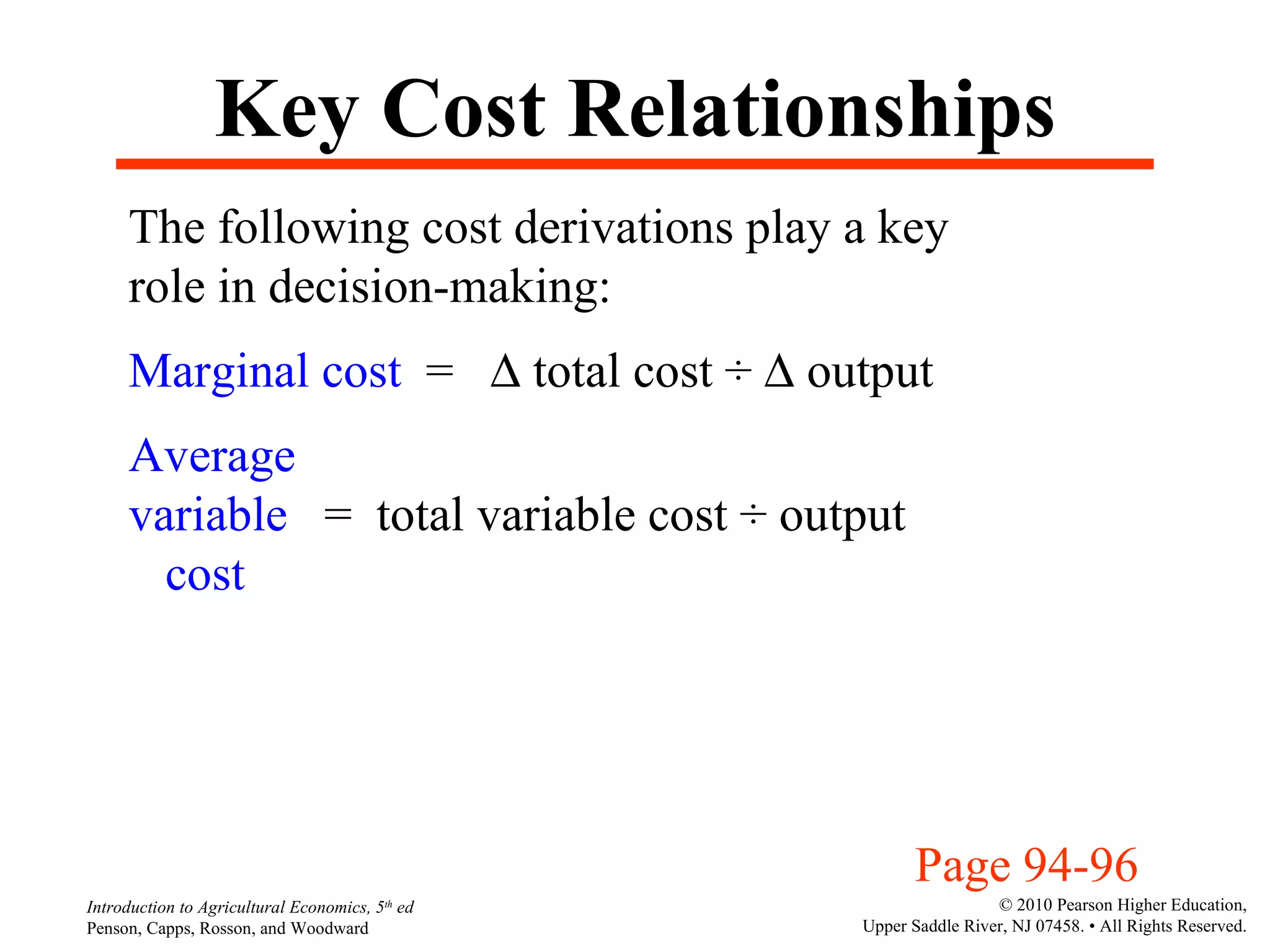
Key Cost Relationships The following cost derivations play a key role in decision-making: Marginal cost   =    total cost  ÷    output Average variable  =  total variable cost  ÷  output cost  Page 94-96
Key Cost Relationships The following cost derivations play a key role in decision-making: Marginal cost   =    total cost  ÷    output Average variable  =  total variable cost  ÷  output cost  Average total  =  total cost  ÷  output cost  Page 94-96
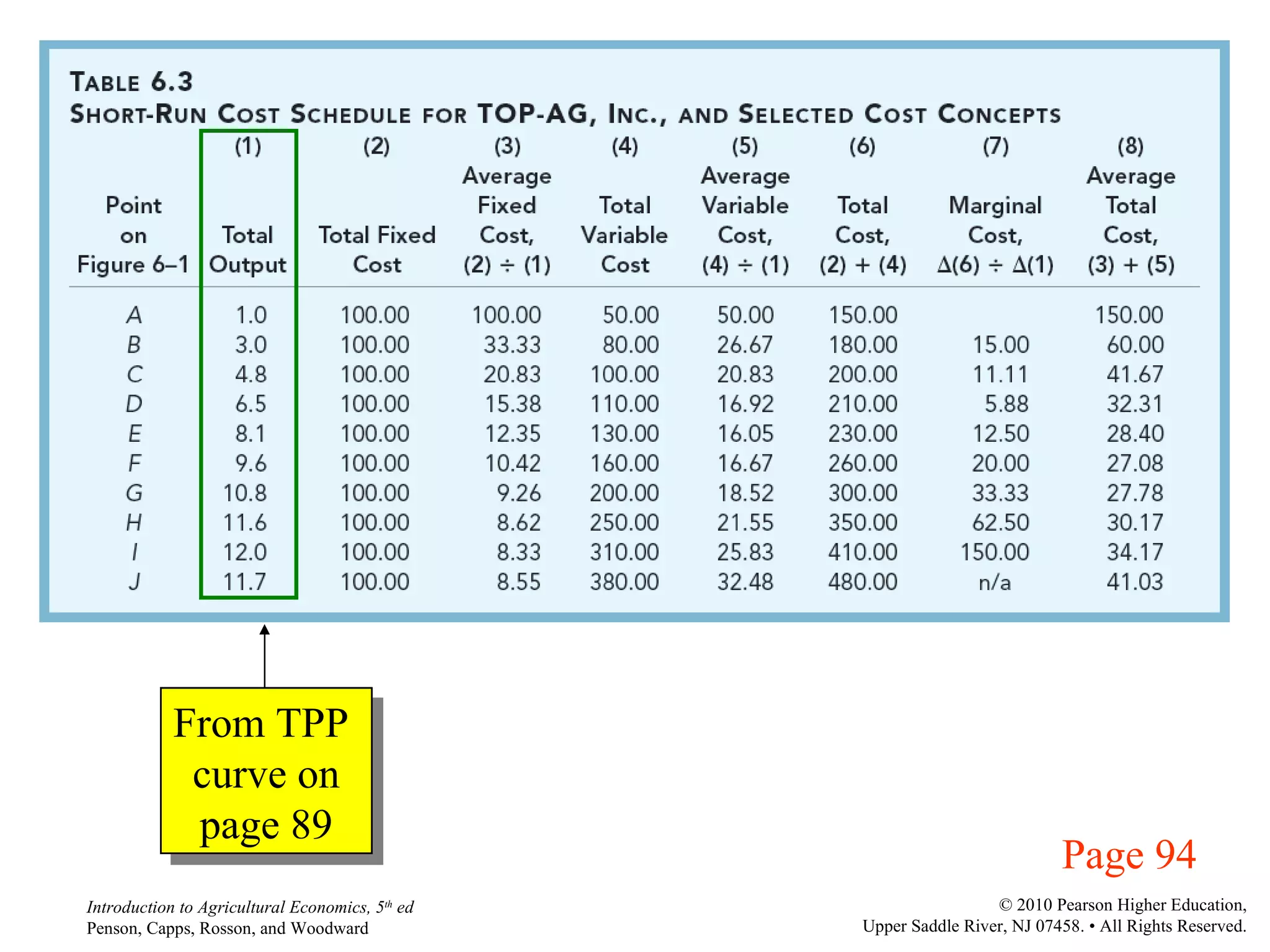
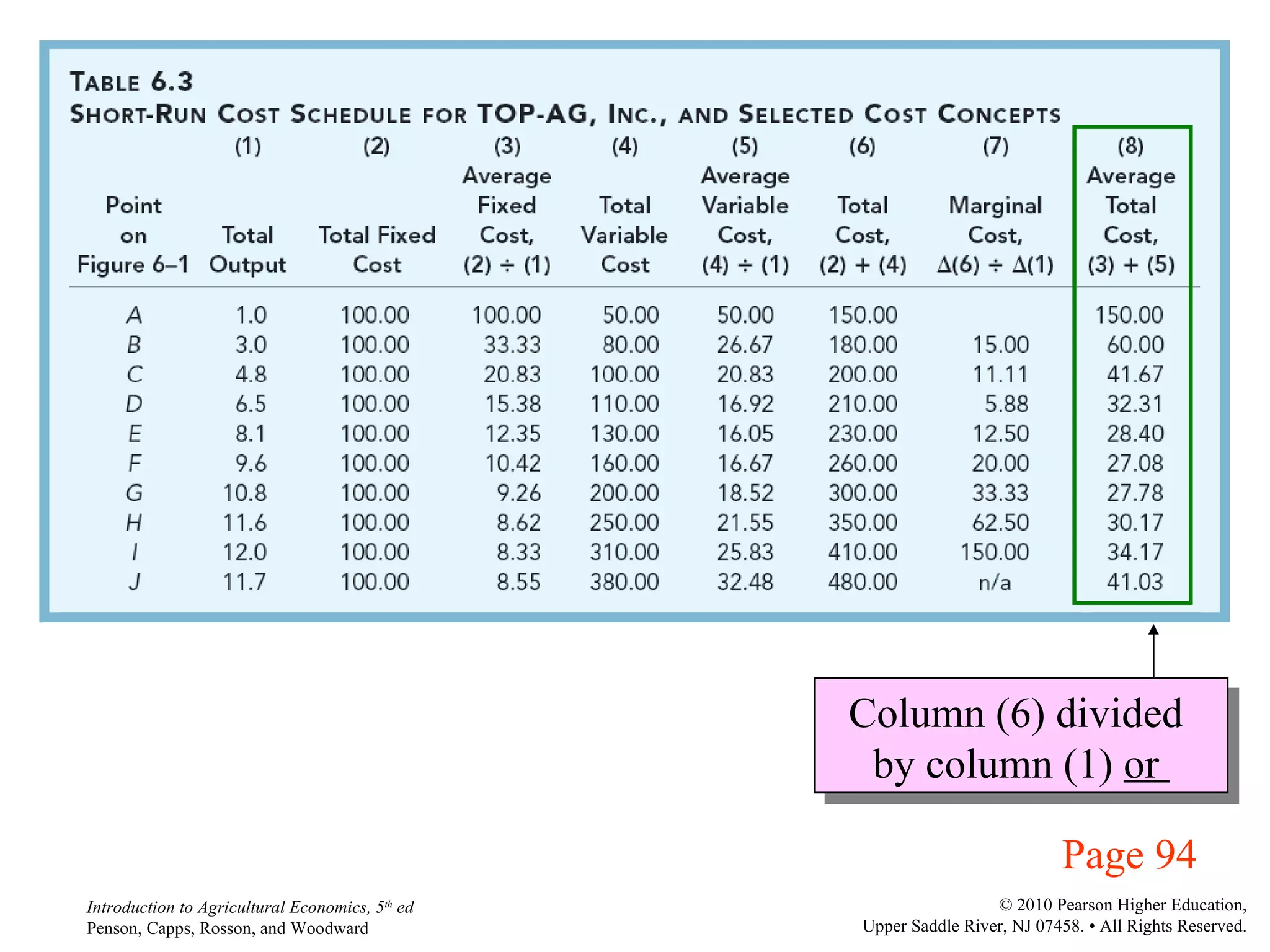
From TPP  curve on page 89 Page 94
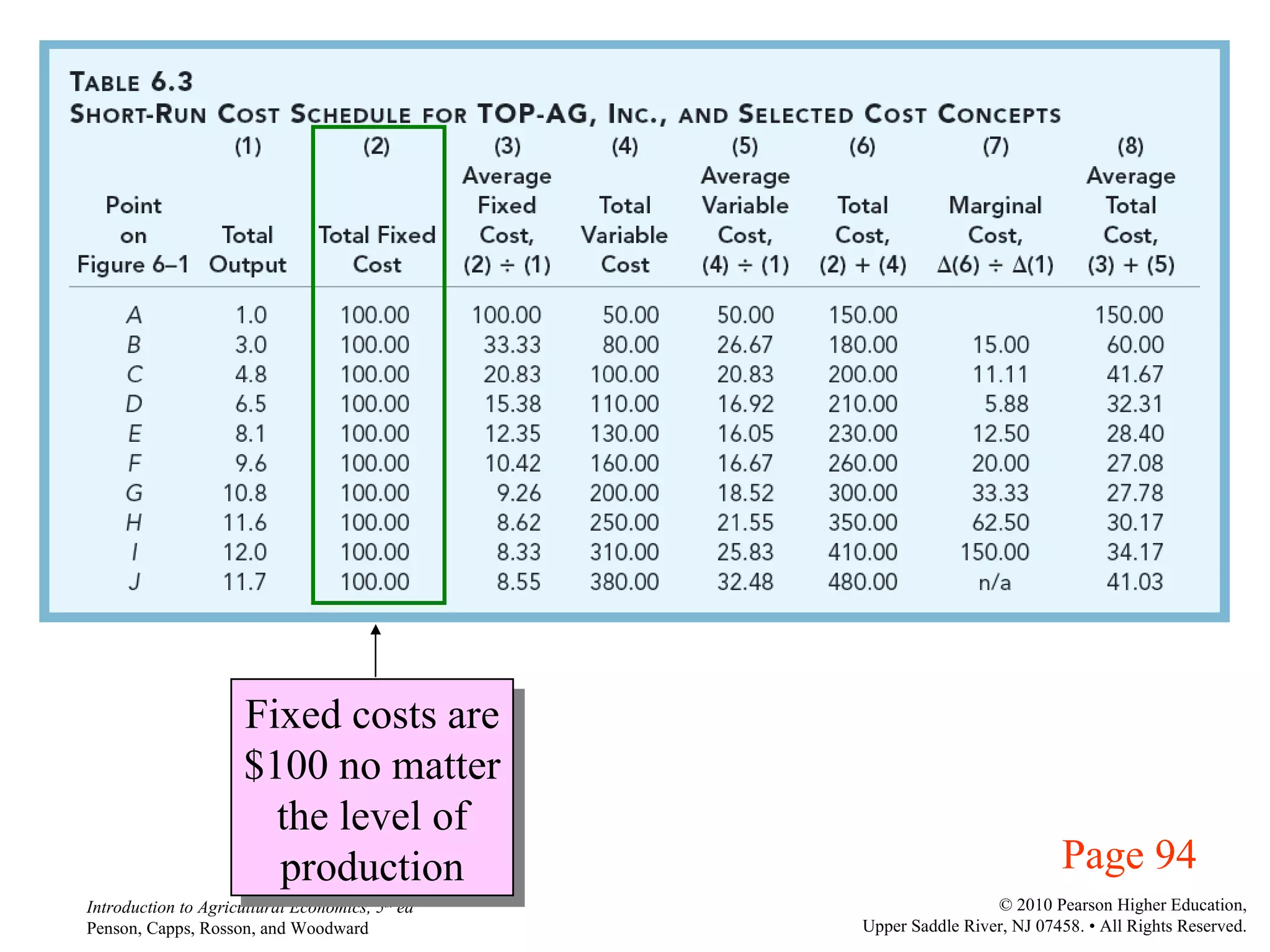
Fixed costs are $100 no matter the level of production Page 94
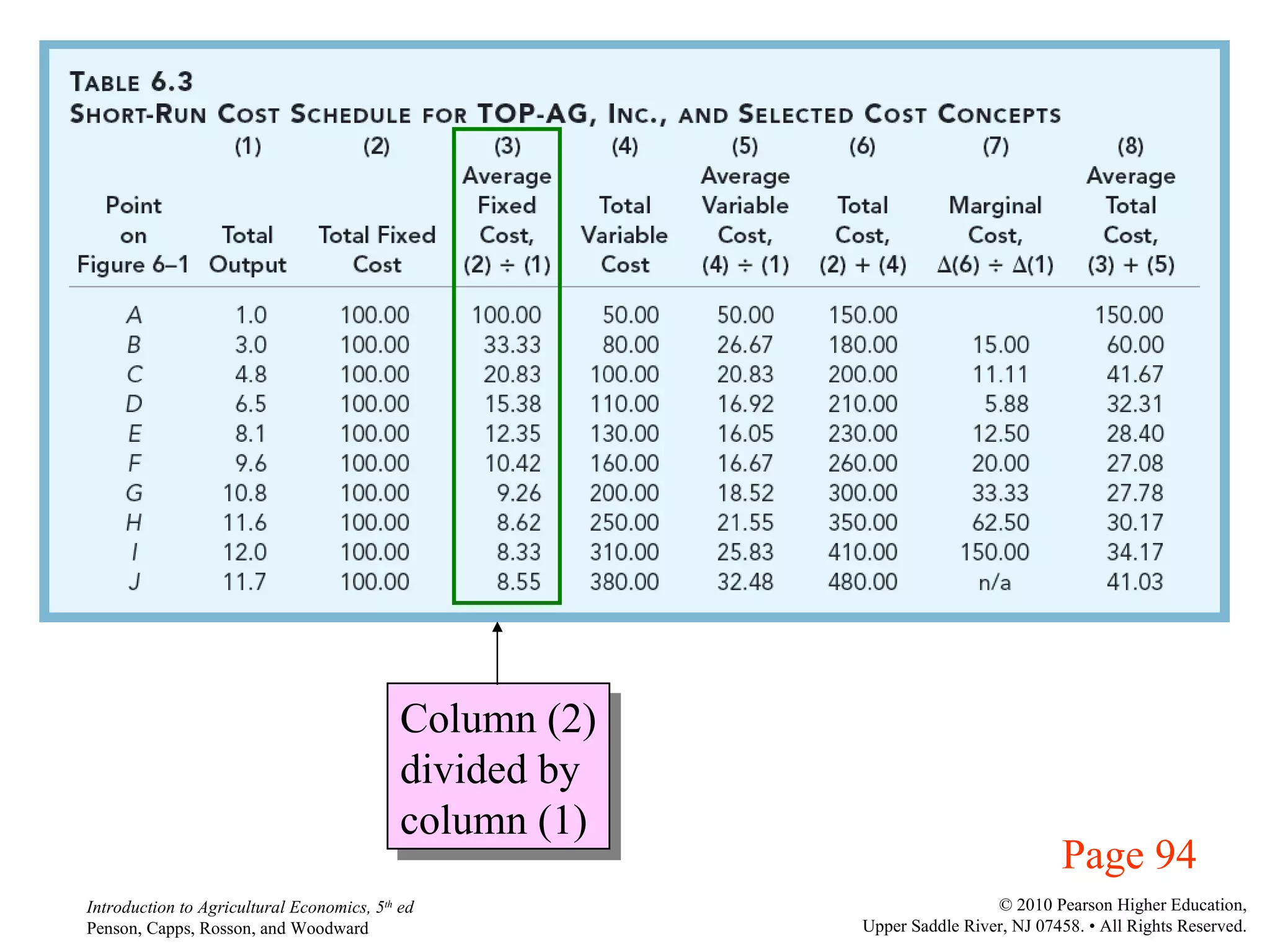
Column (2) divided by column (1) Page 94
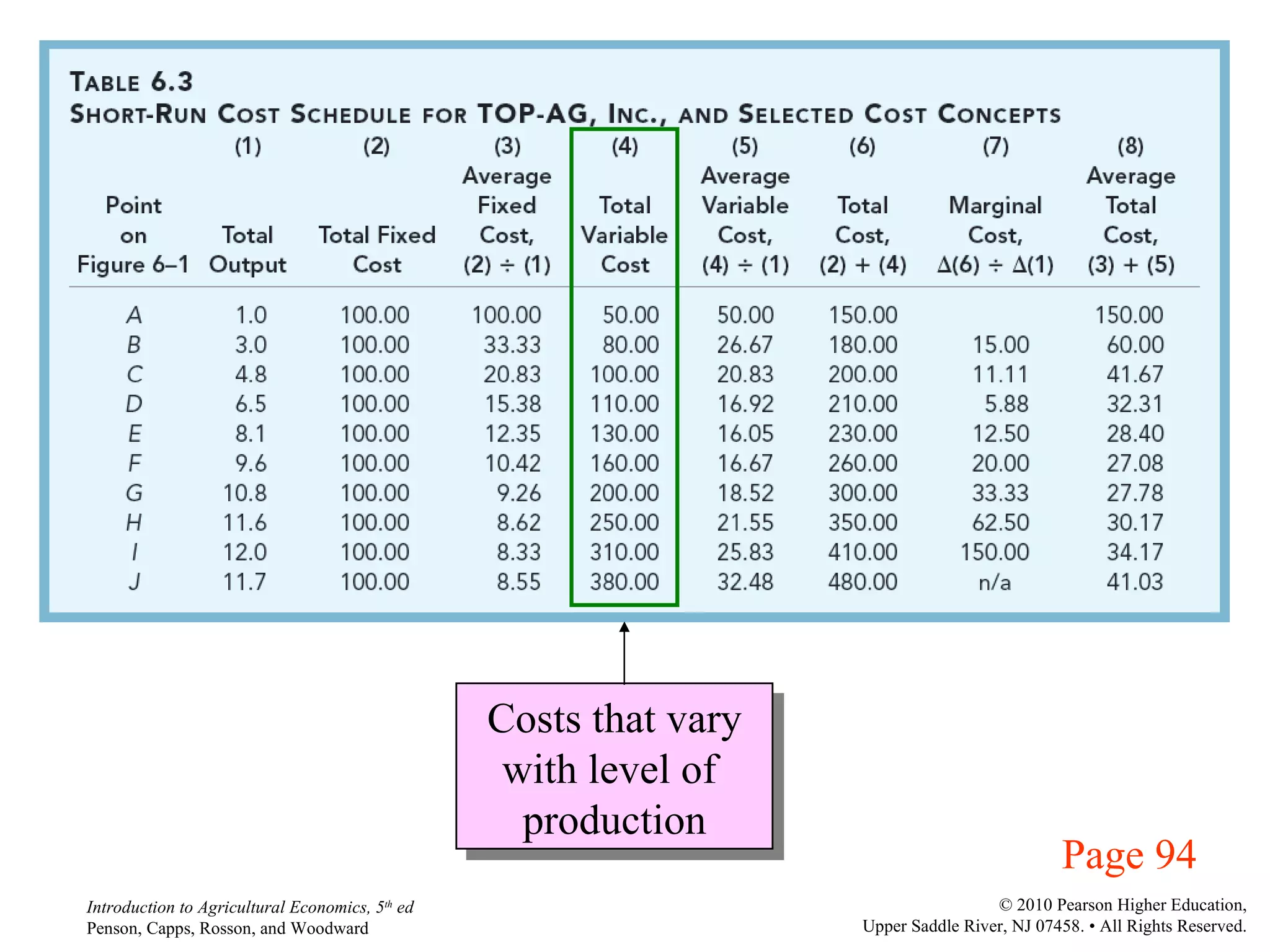
Page 94 Costs that vary with level of  production
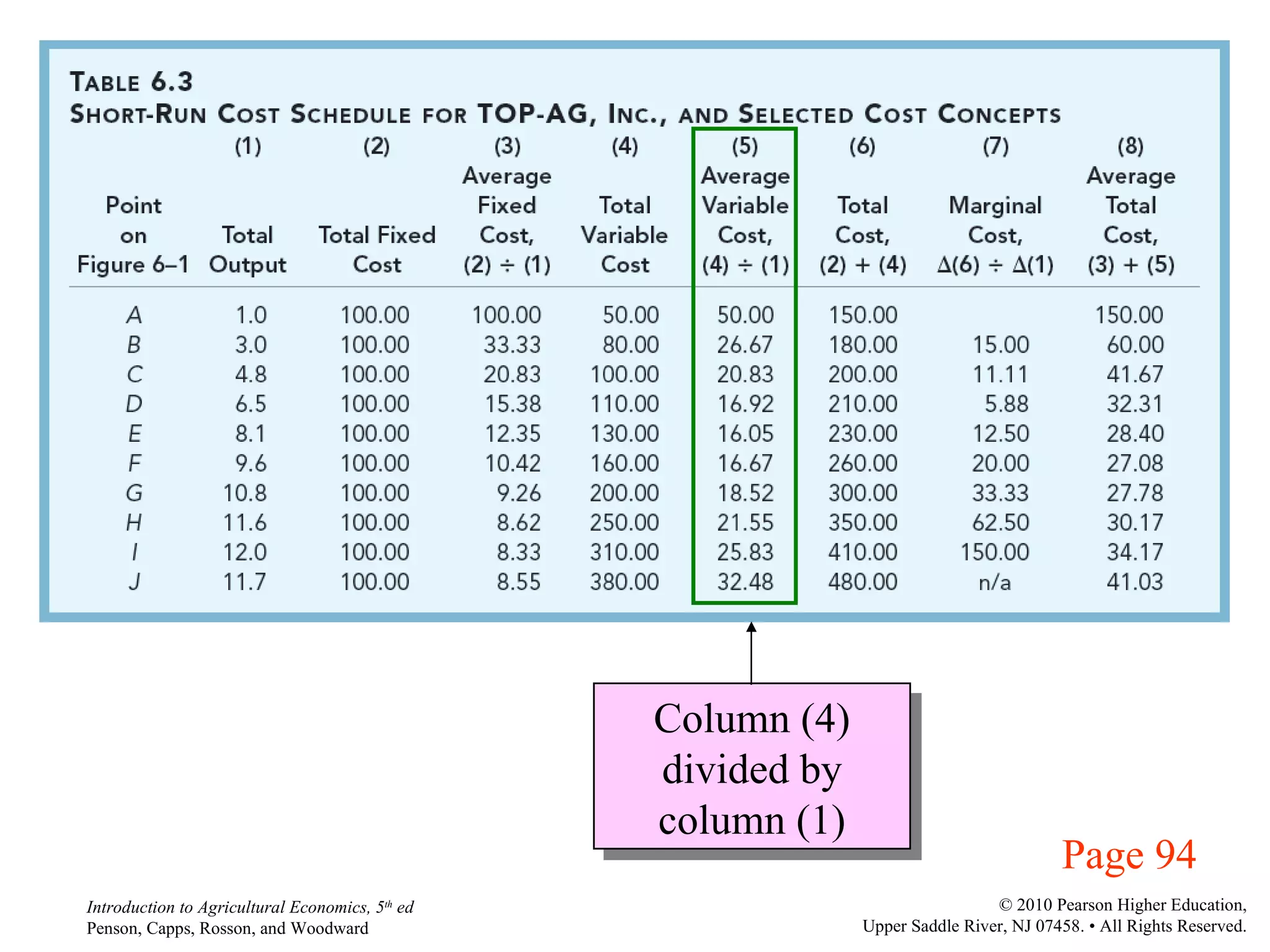
Page 94 Column (4) divided by column (1)
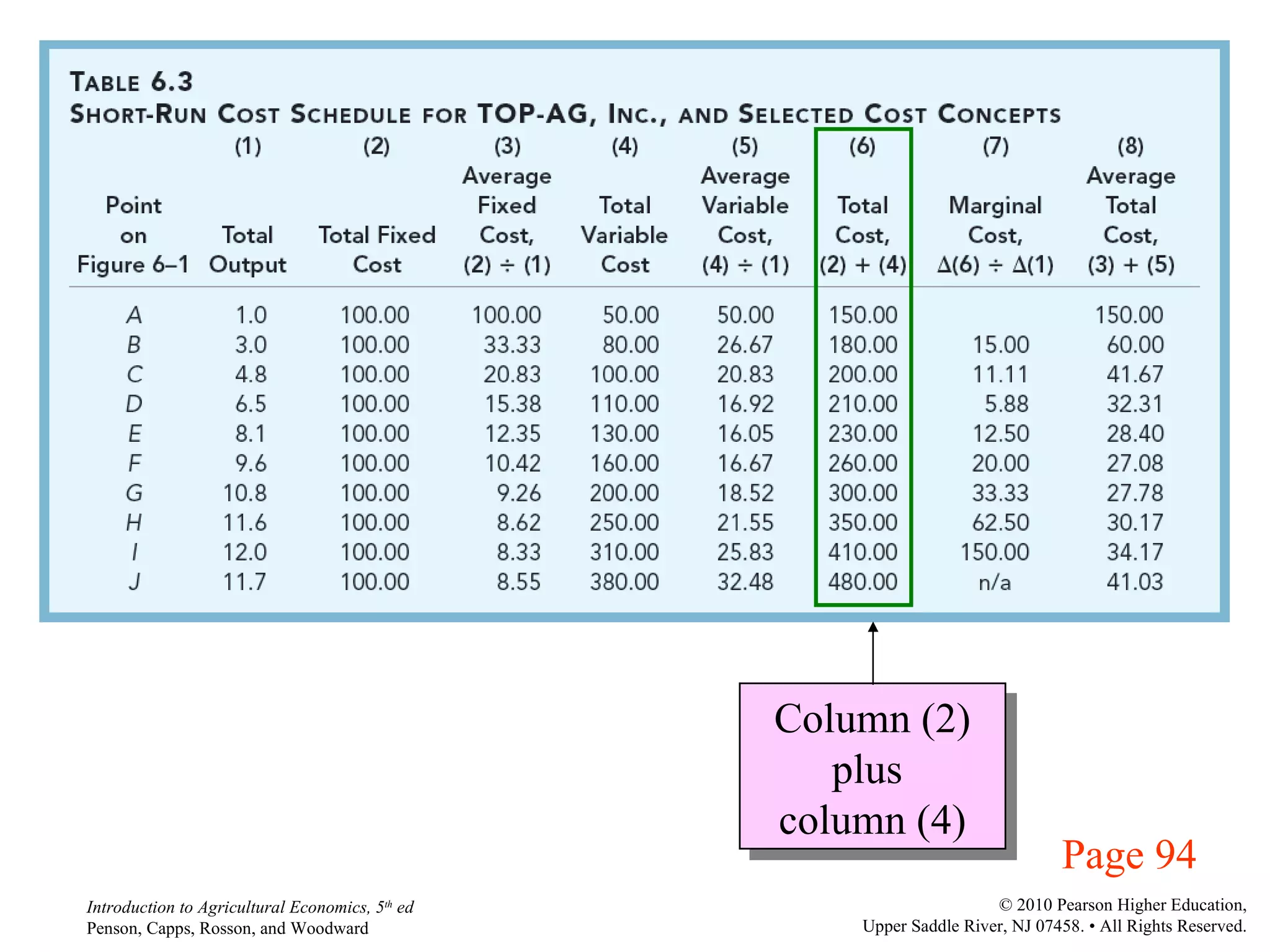
Page 94 Column (2) plus  column (4)
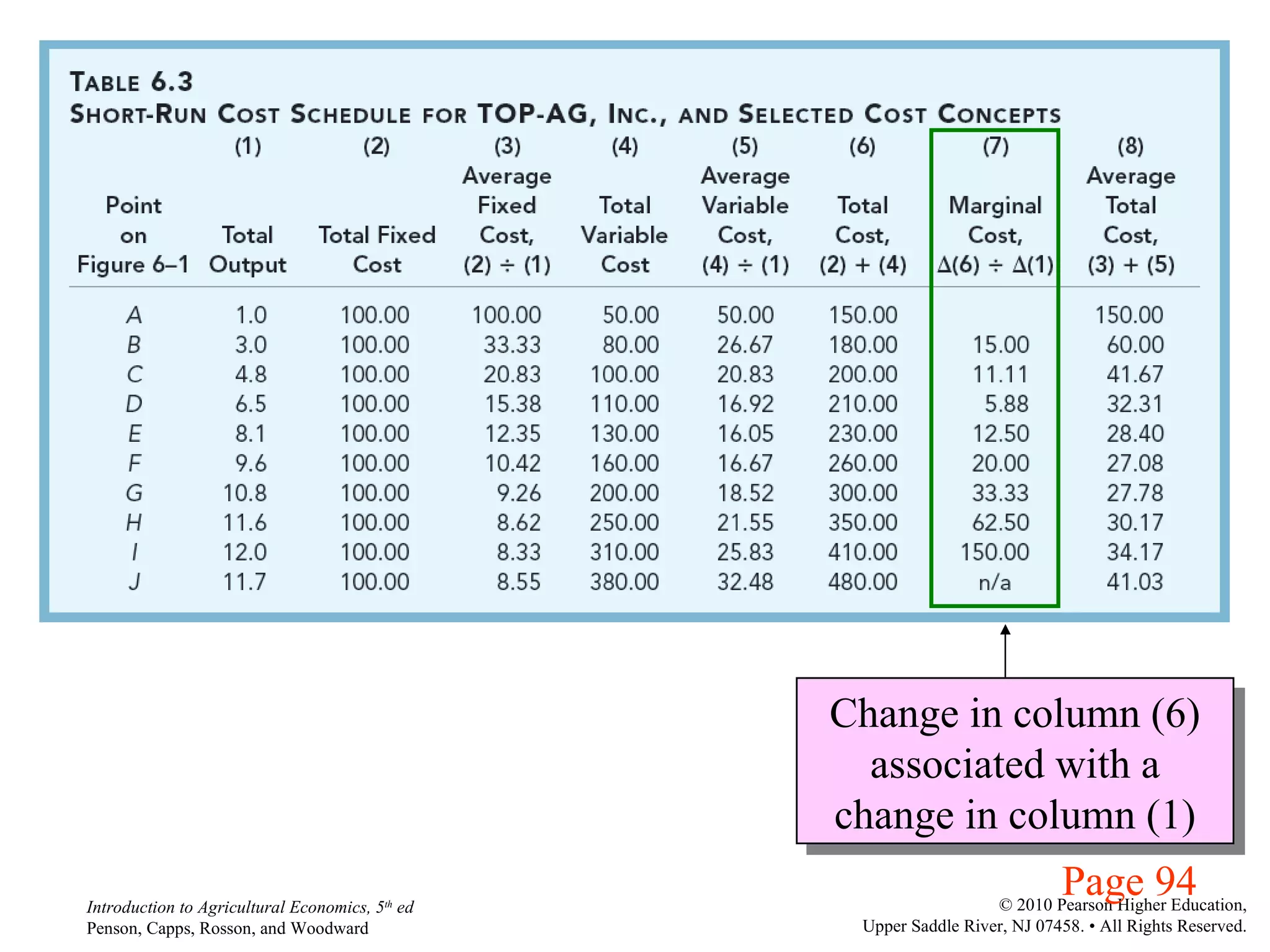
Page 94 Change in column (6) associated with a change in column (1)
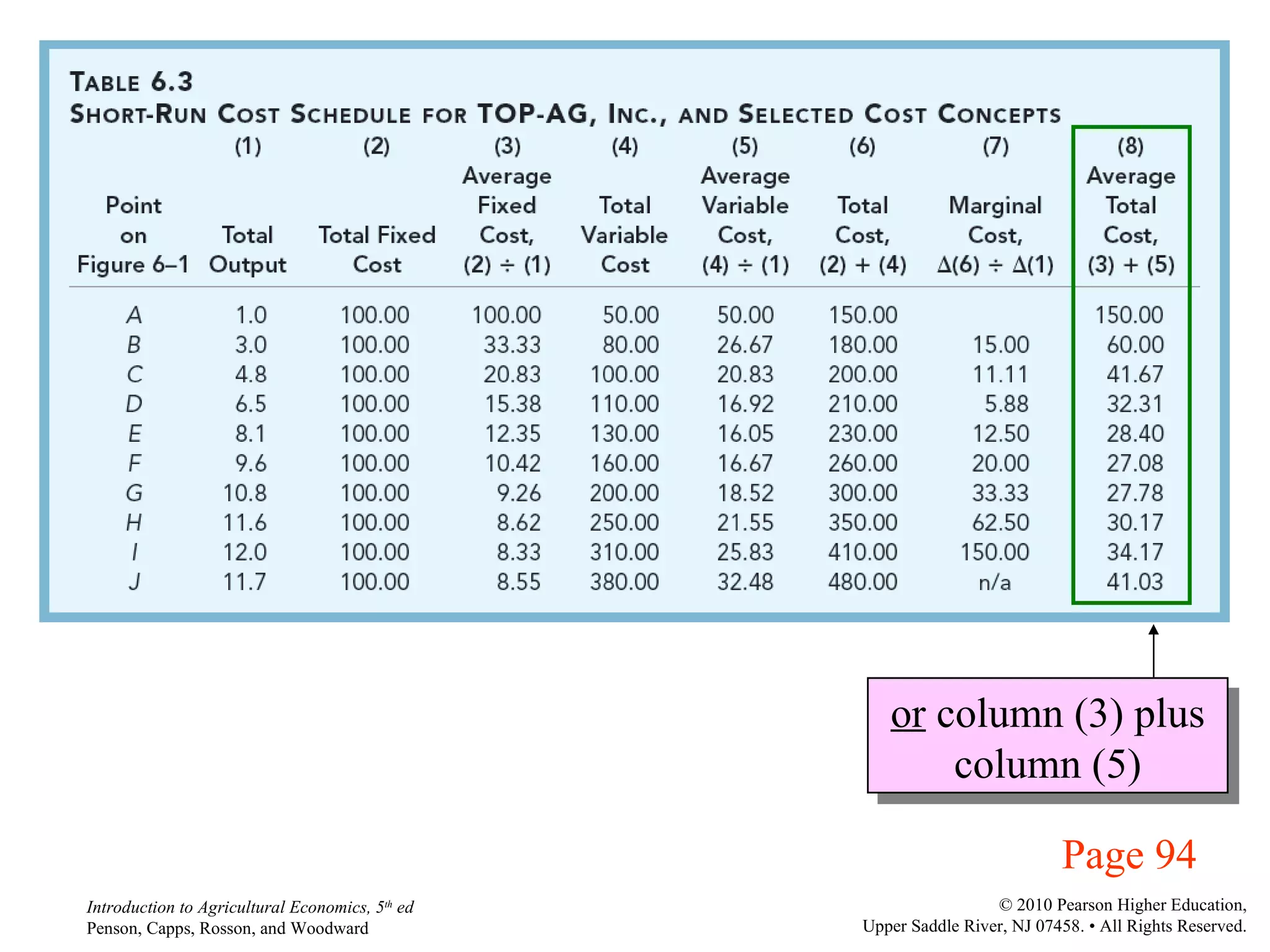
Page 94 Column (6) divided  by column (1)  or
Page 94 or  column (3) plus column (5)
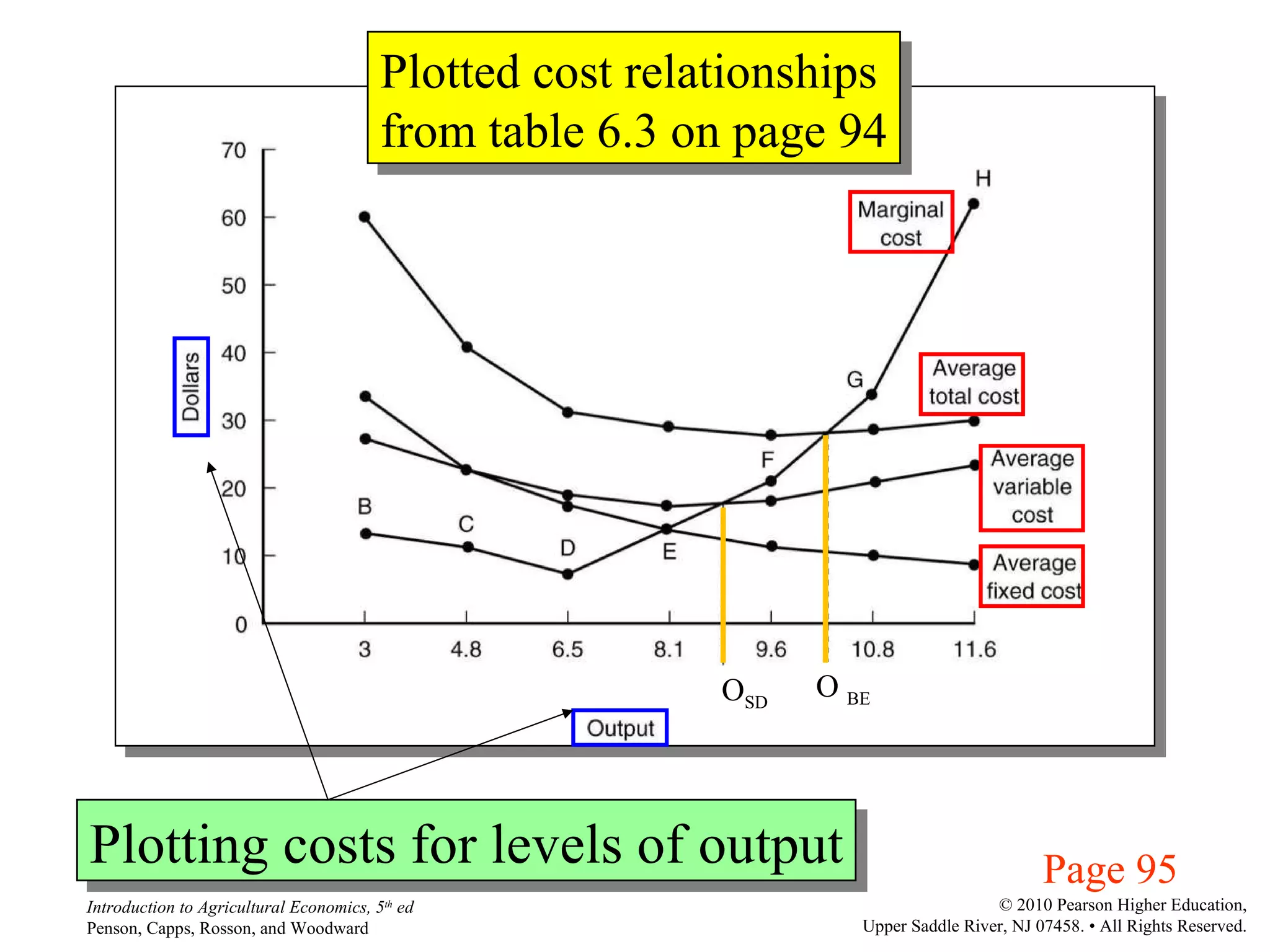
Let’s graph the cost series in this table
Plotted cost relationships from table 6.3 on page 94 Page 95 O SD O  BE Plotting costs for levels of output
Marginal and Average Revenue Marginal revenue =  ∆ total revenue ÷  ∆ output
Now let’s assume this firm can sell its product for $45/unit
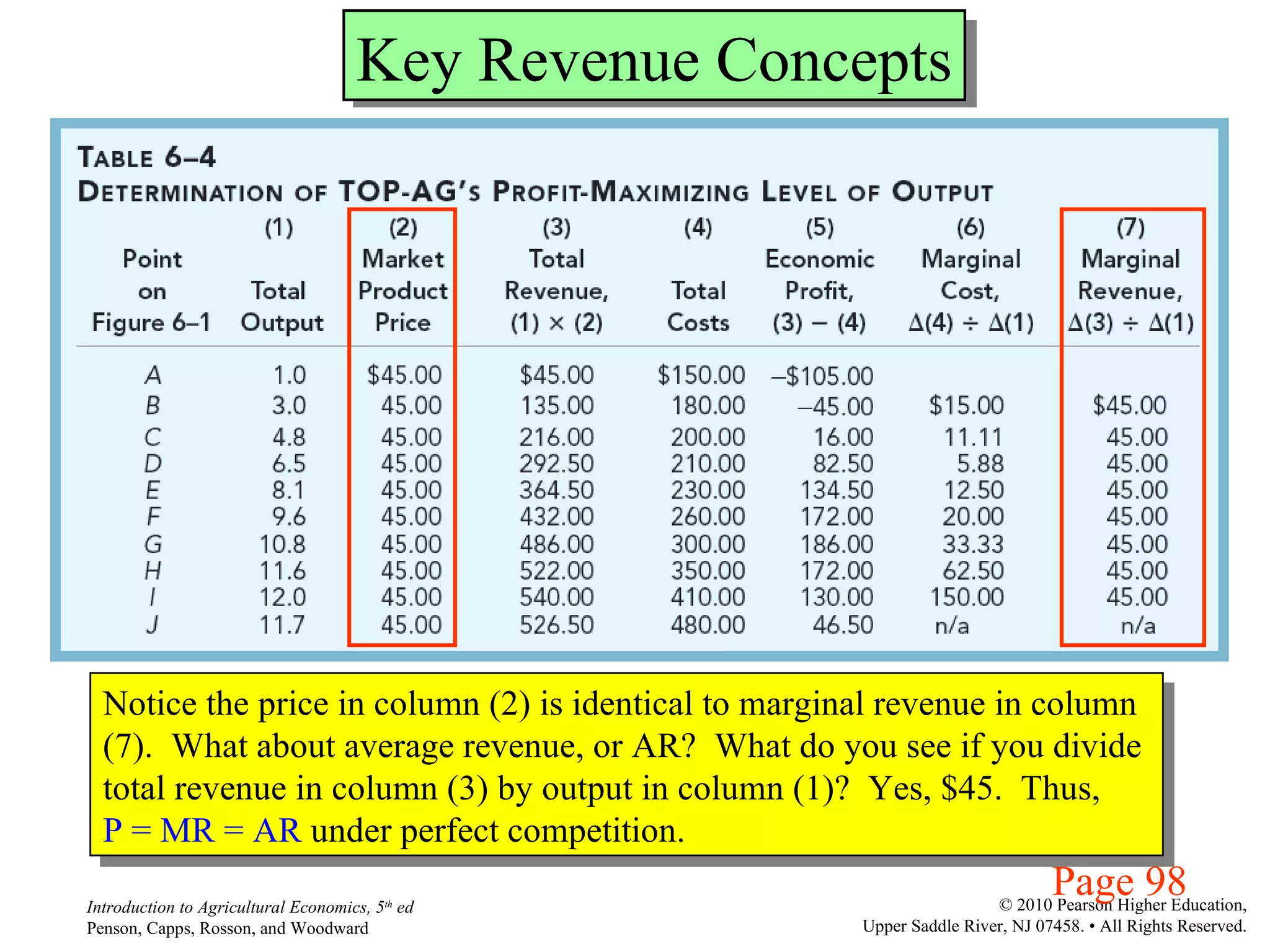
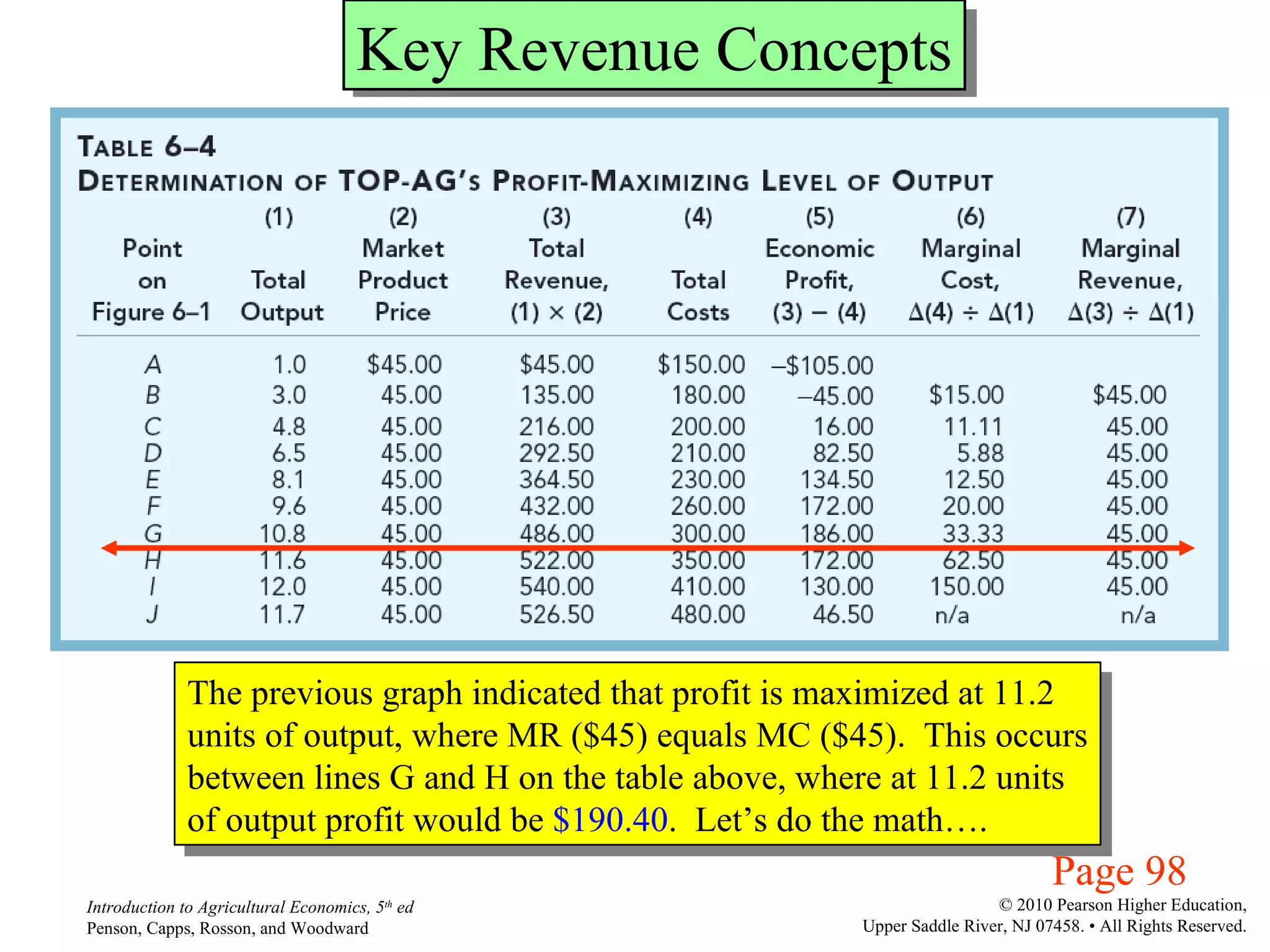
Key Revenue Concepts Notice the price in column (2) is identical to marginal revenue in column (7).  What about average revenue, or AR?  What do you see if you divide  total revenue in column (3) by output in column (1)?  Yes, $45.  Thus,  P = MR = AR  under perfect competition. Page 98
Let’s see this in  graphical form
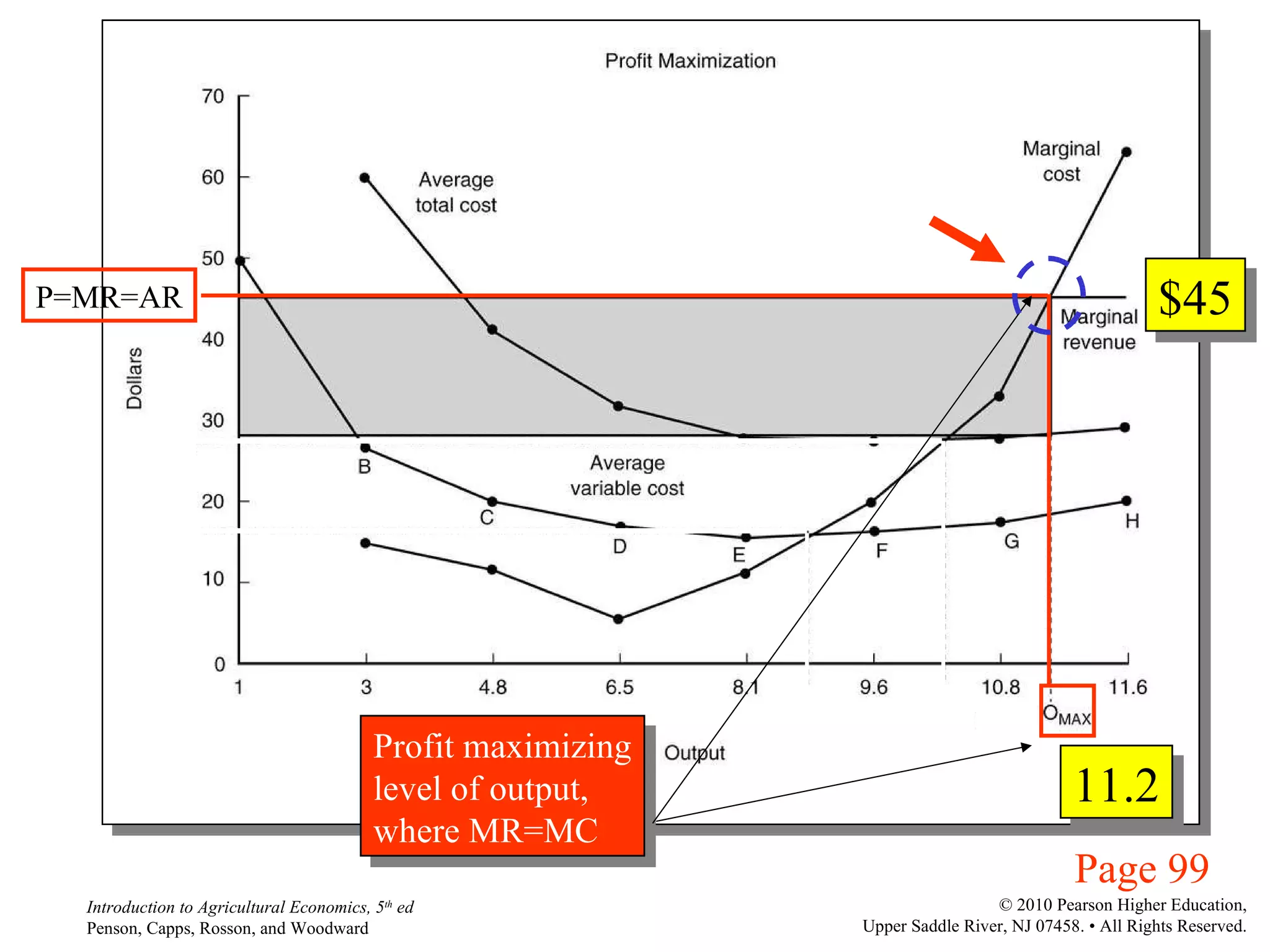
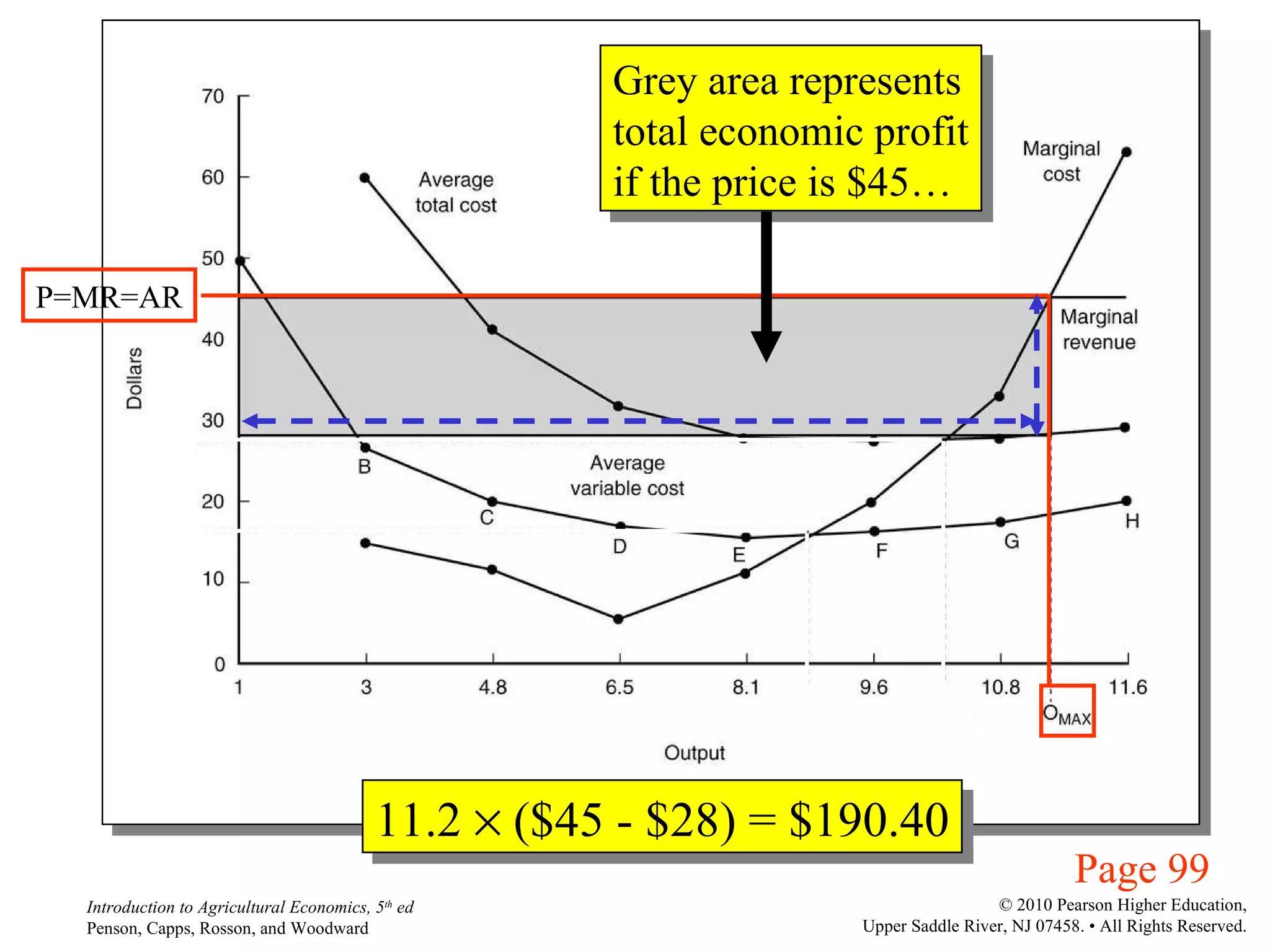
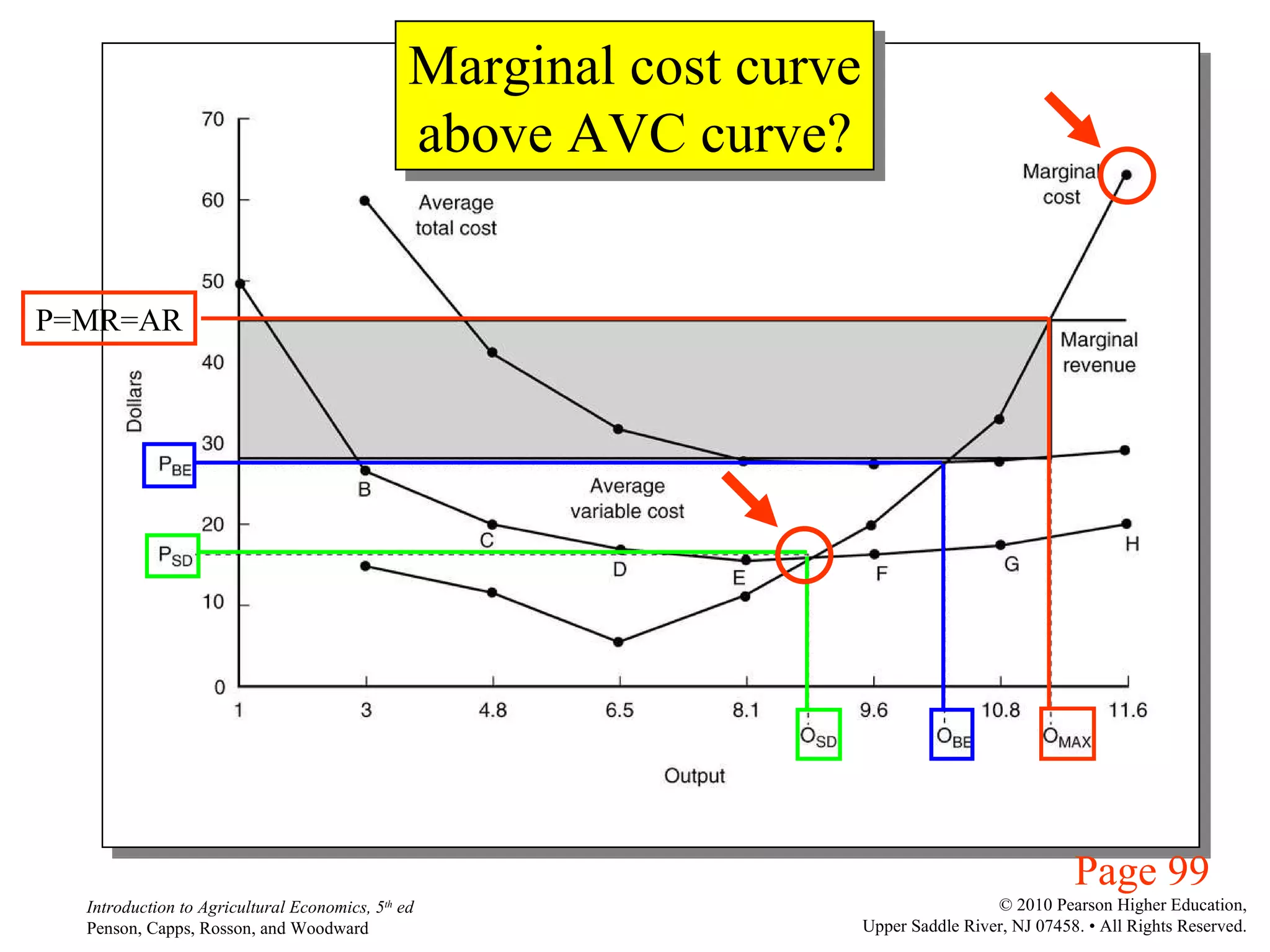
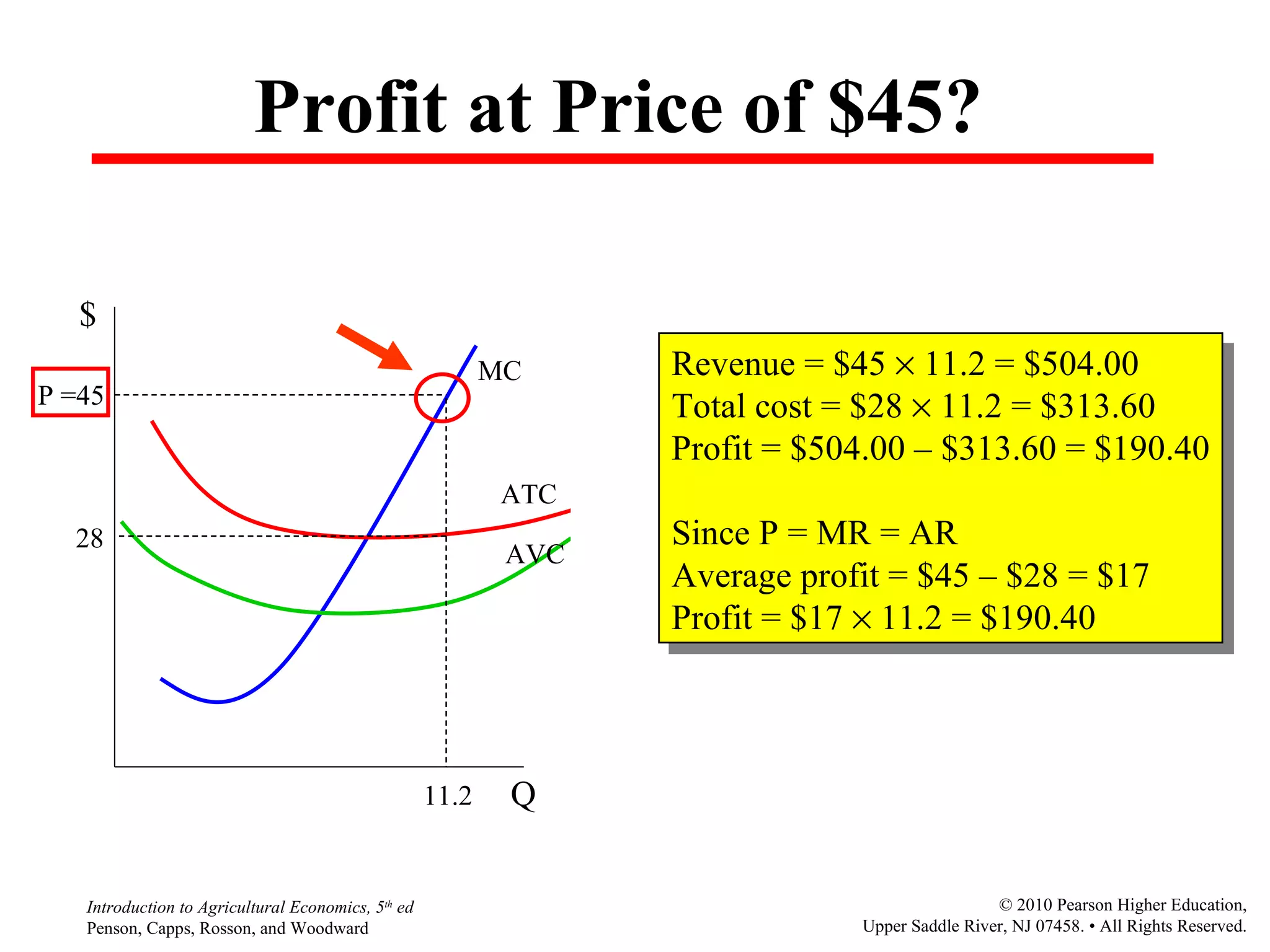
Page 99 Profit maximizing level of output, where MR=MC P=MR=AR $45 11.2
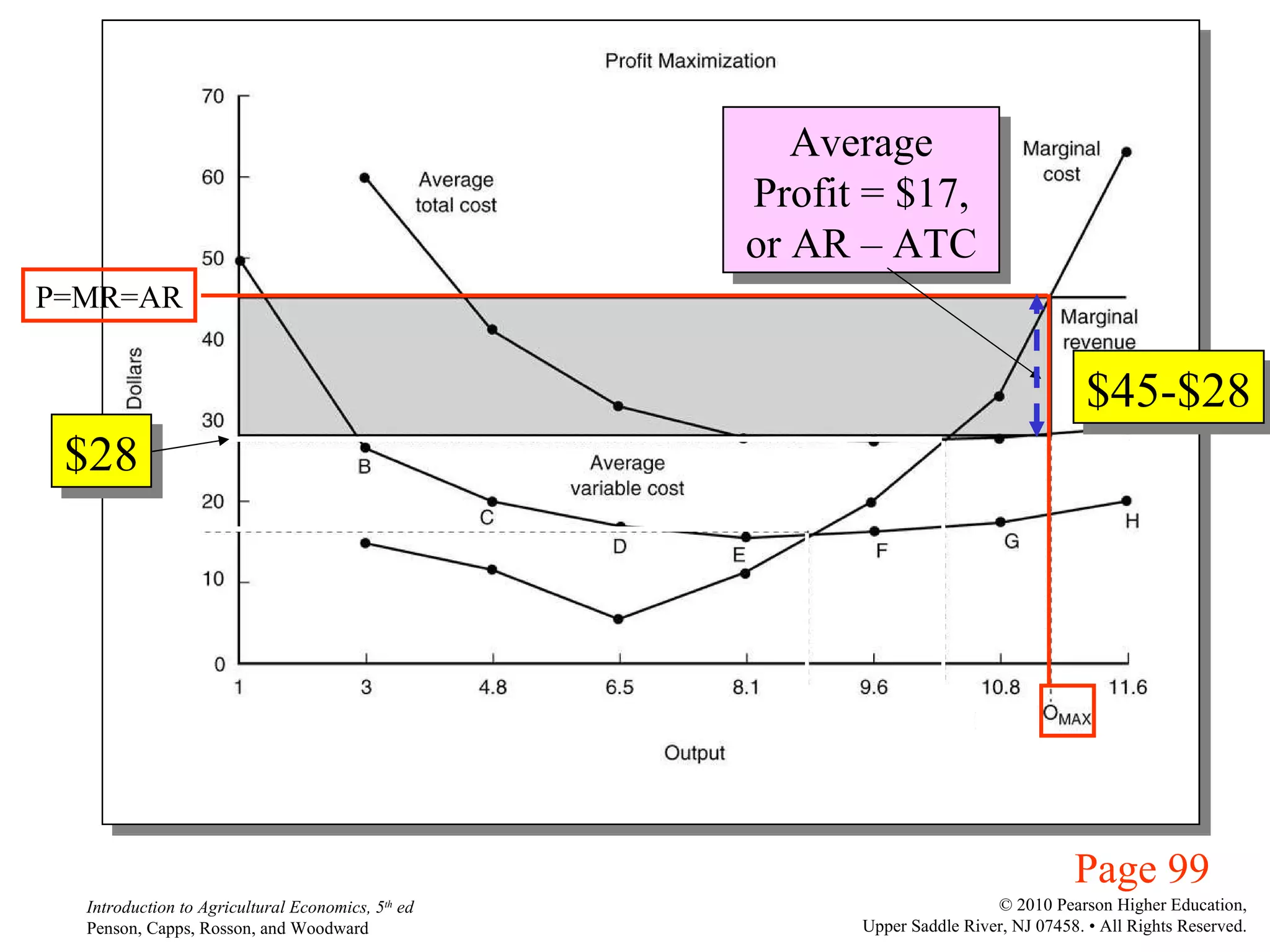
Page 99 Average Profit = $17, or AR – ATC P=MR=AR $45-$28 $28
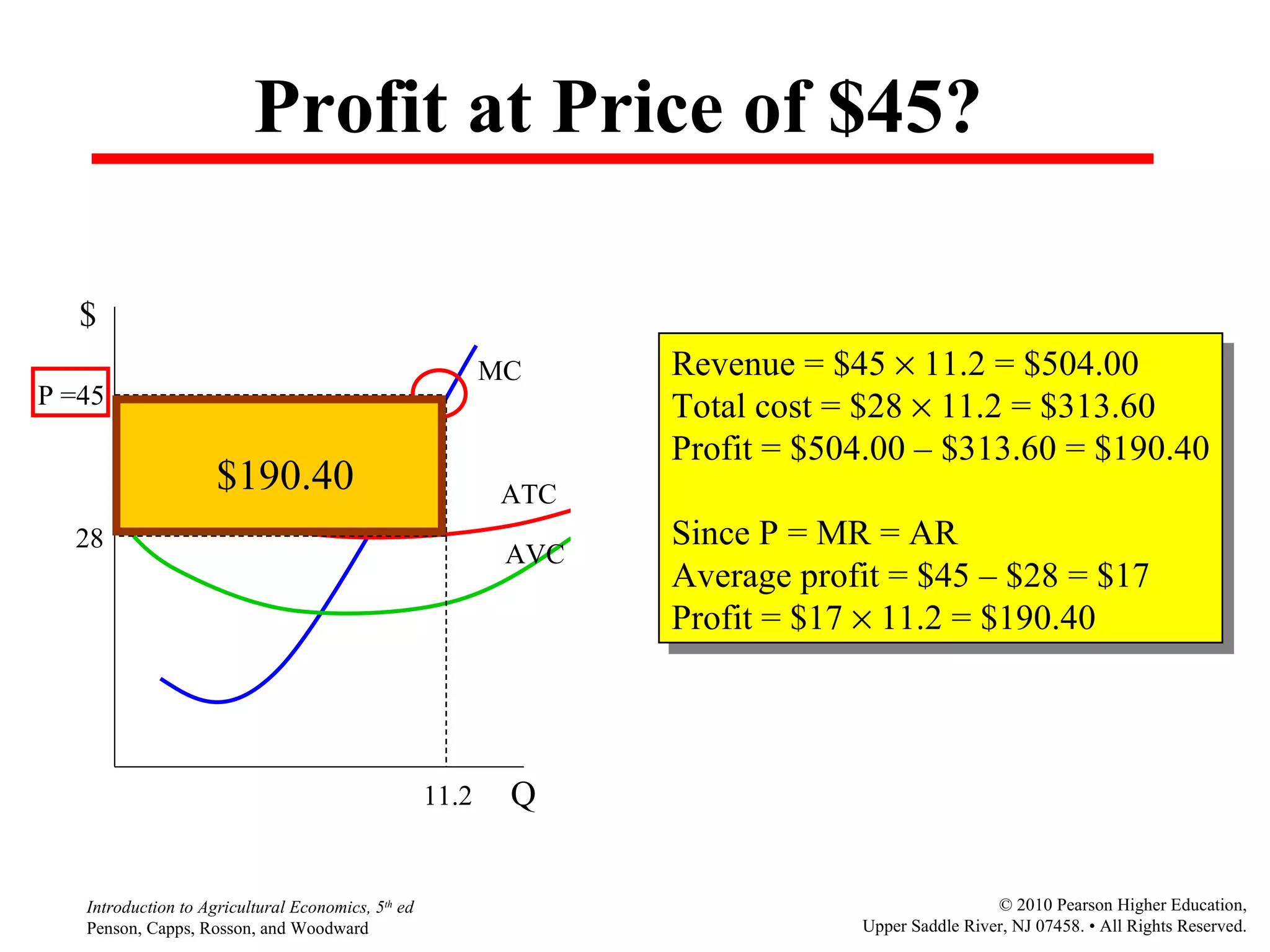
Grey area represents total economic profit if the price is $45… Page 99 P=MR=AR 11.2    ($45 - $28) = $190.40
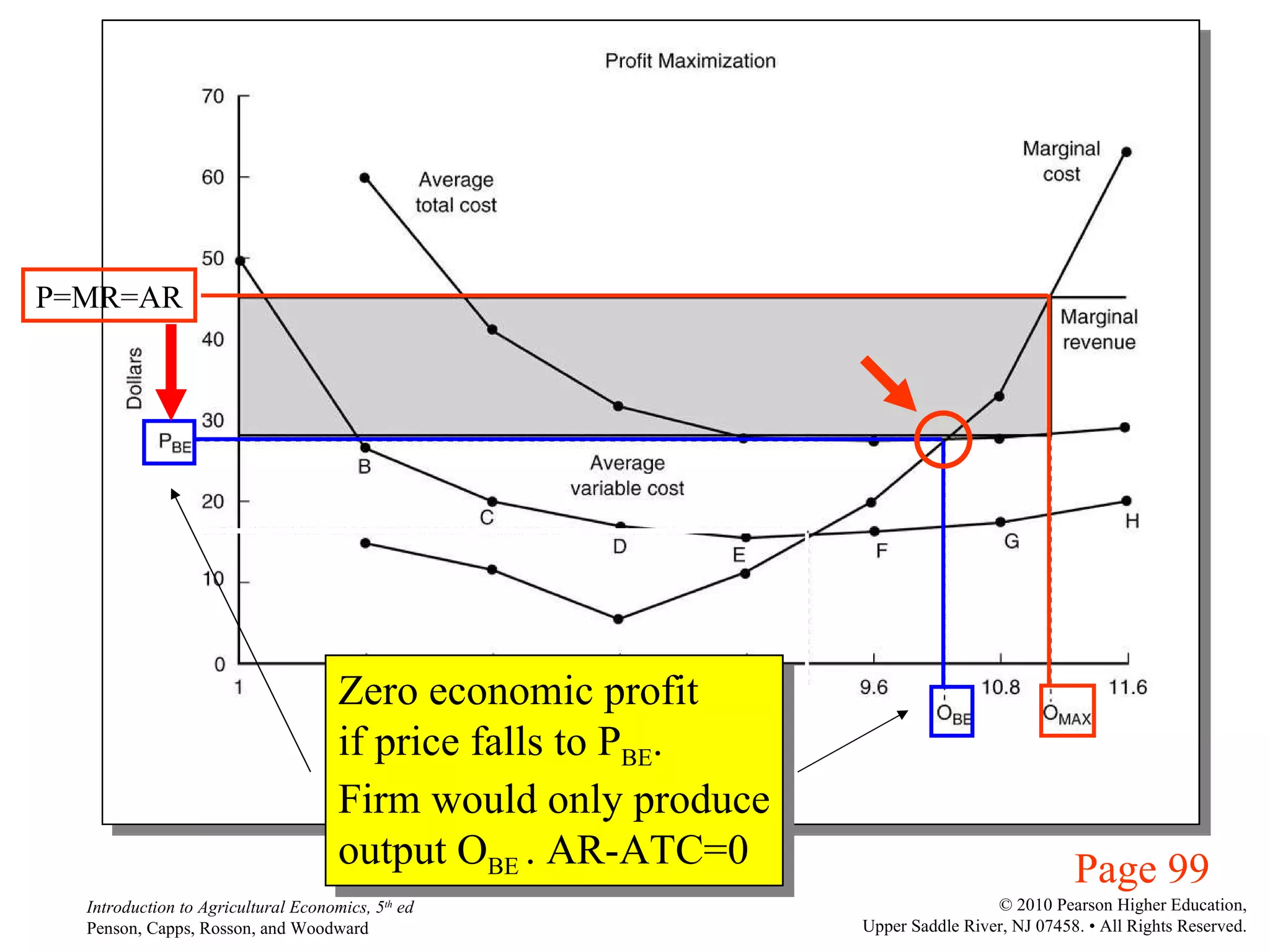
Zero economic profit if price falls to P BE . Firm would only produce output O BE  . AR-ATC=0 Page 99 P=MR=AR
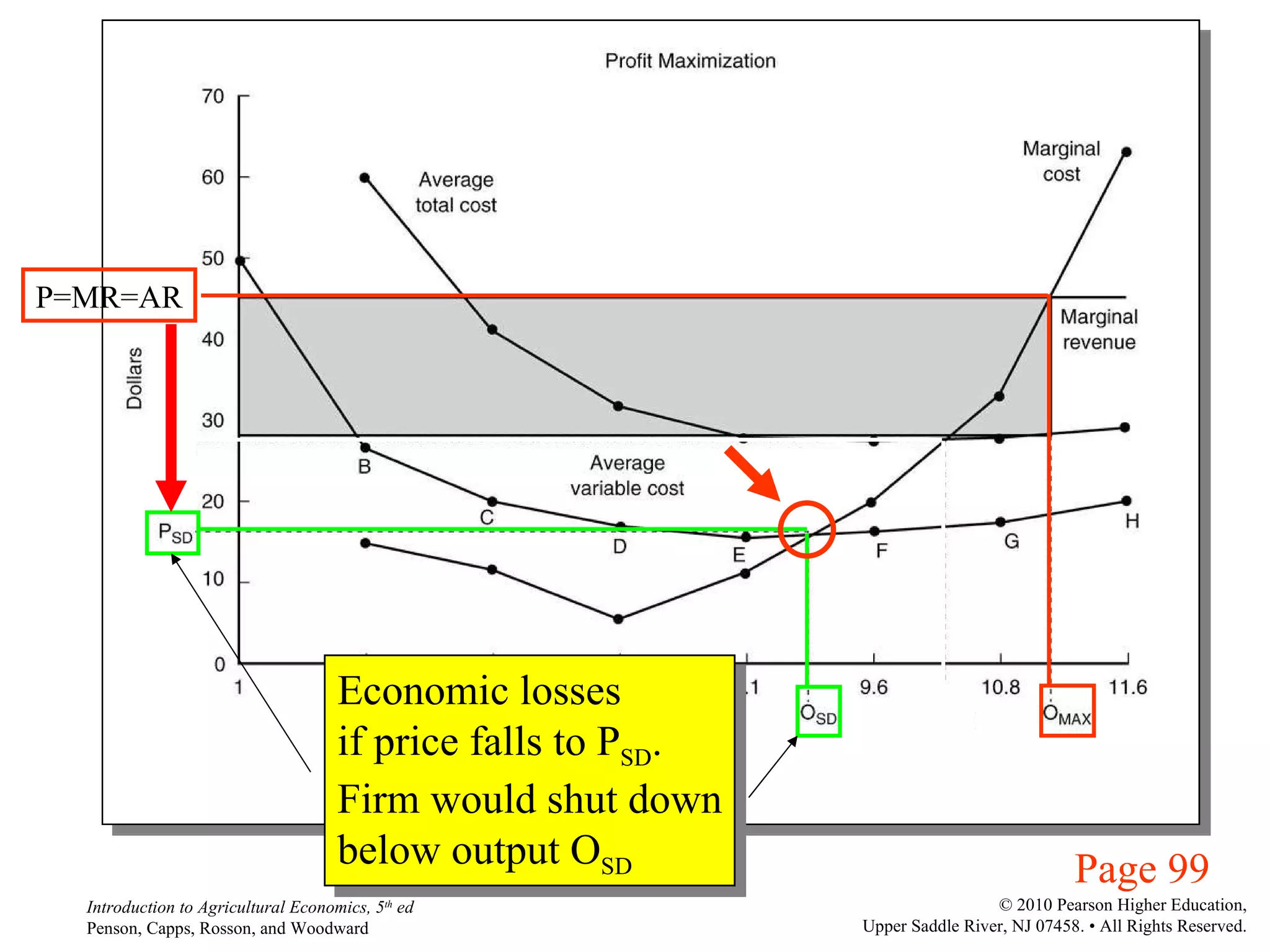
Economic losses if price falls to P SD . Firm would shut down below output O SD Page 99 P=MR=AR
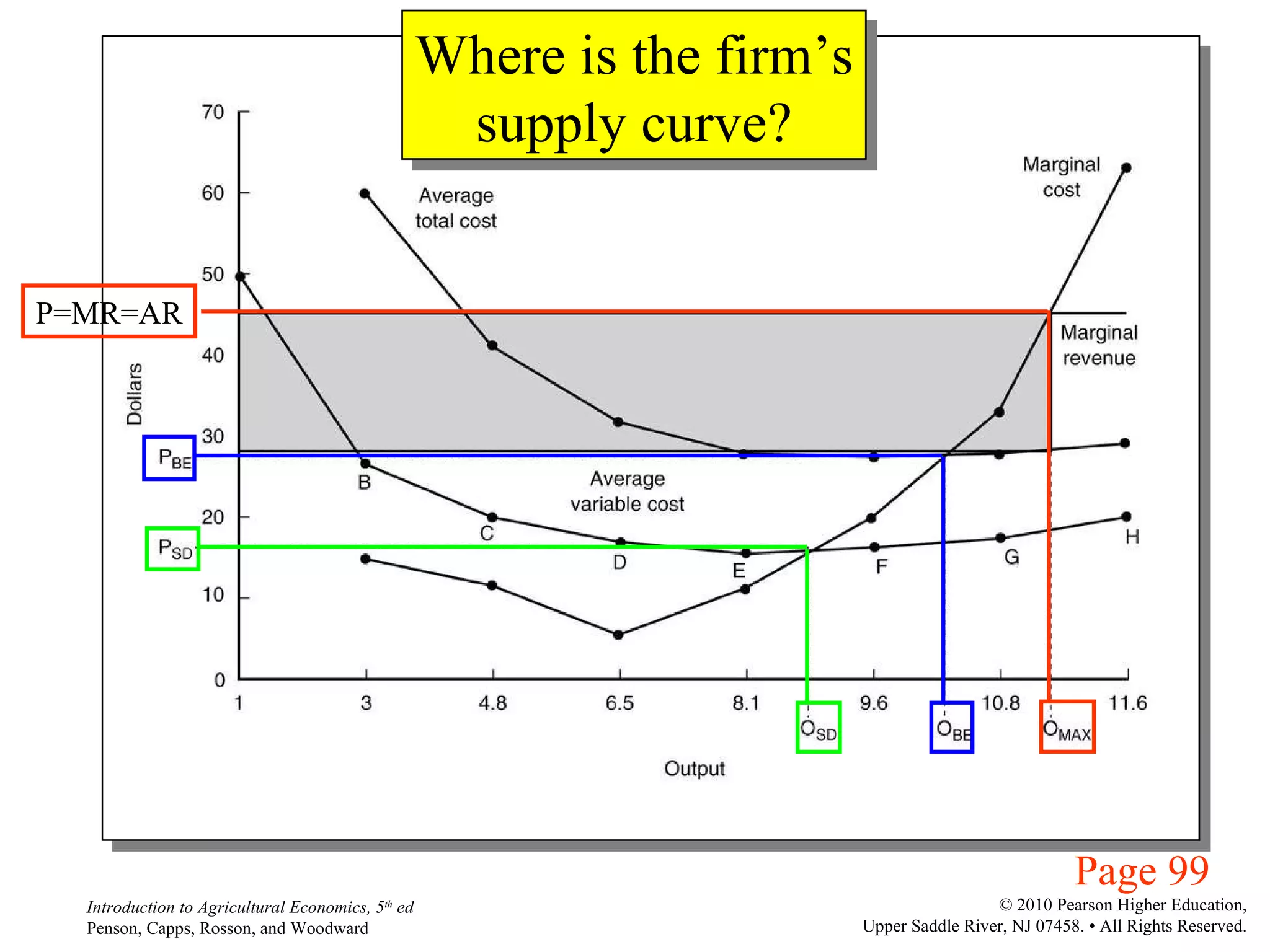
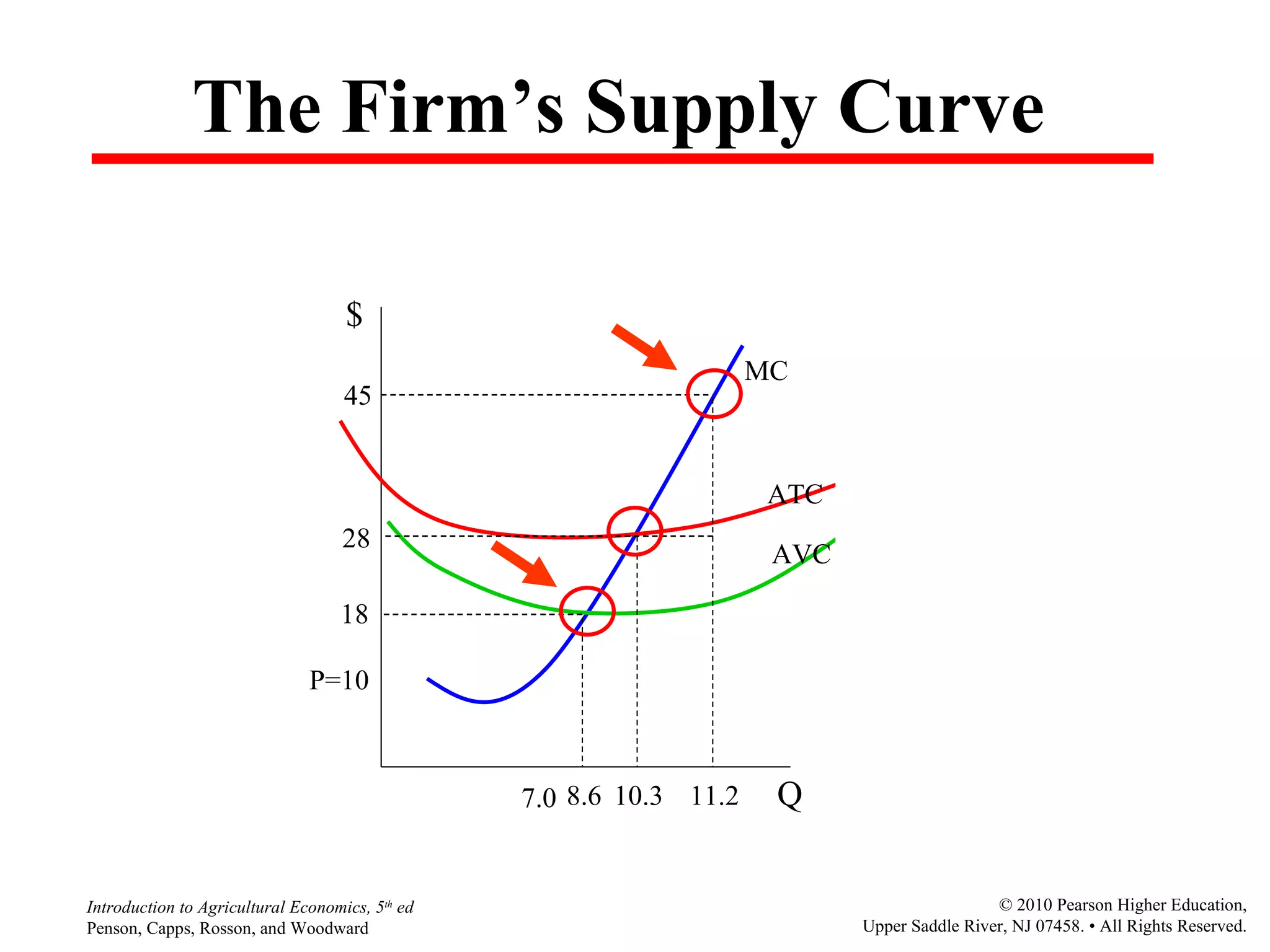
Where is the firm’s supply curve? Page 99 P=MR=AR
Page 99 P=MR=AR Marginal cost curve above AVC curve?
Key Revenue Concepts Page 98 The previous graph indicated that profit is maximized at 11.2 units of output, where MR ($45) equals MC ($45).  This occurs between lines G and H on the table above, where at 11.2 units of output profit would be  $190.40 .  Let’s do the math….
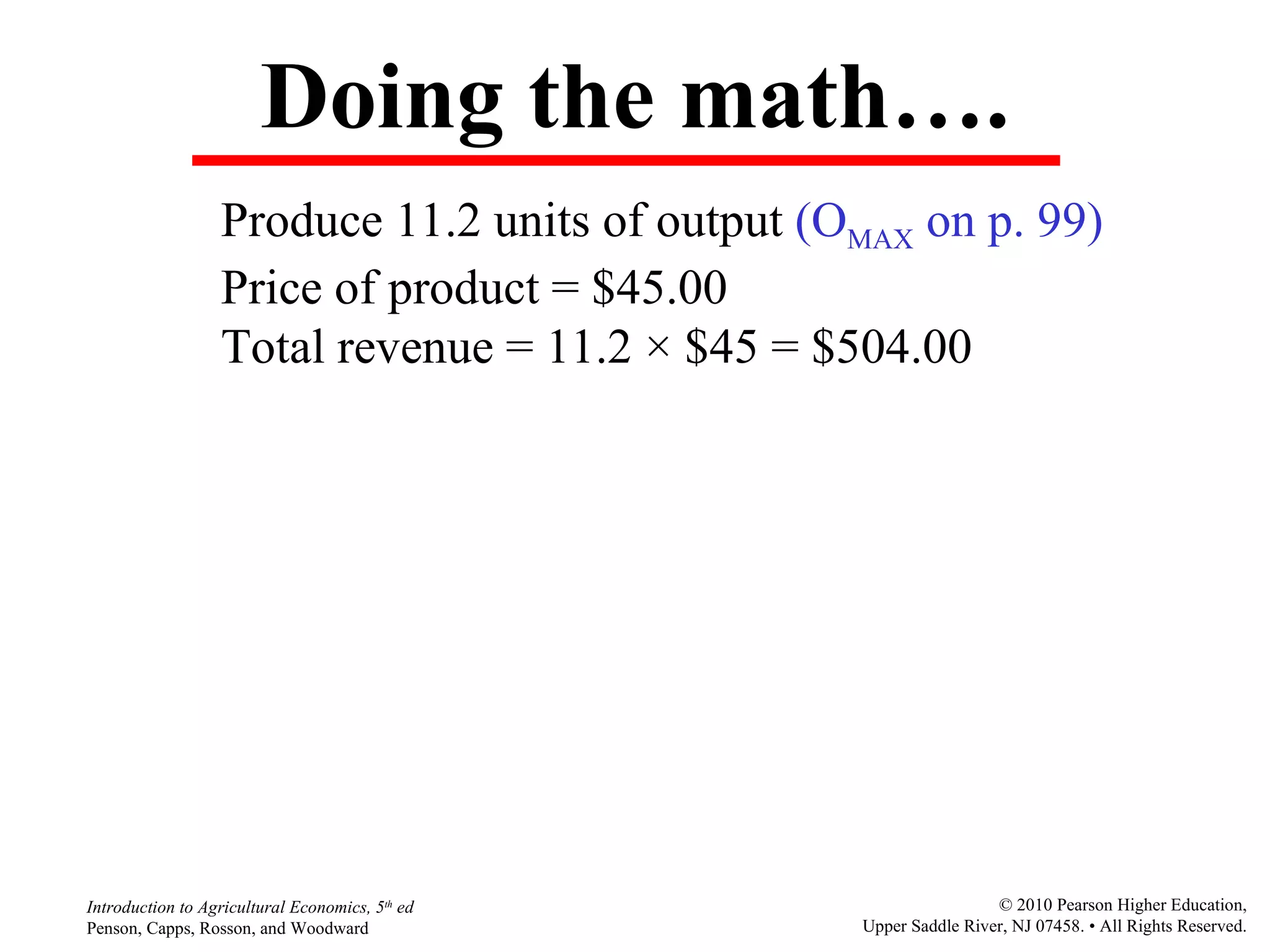
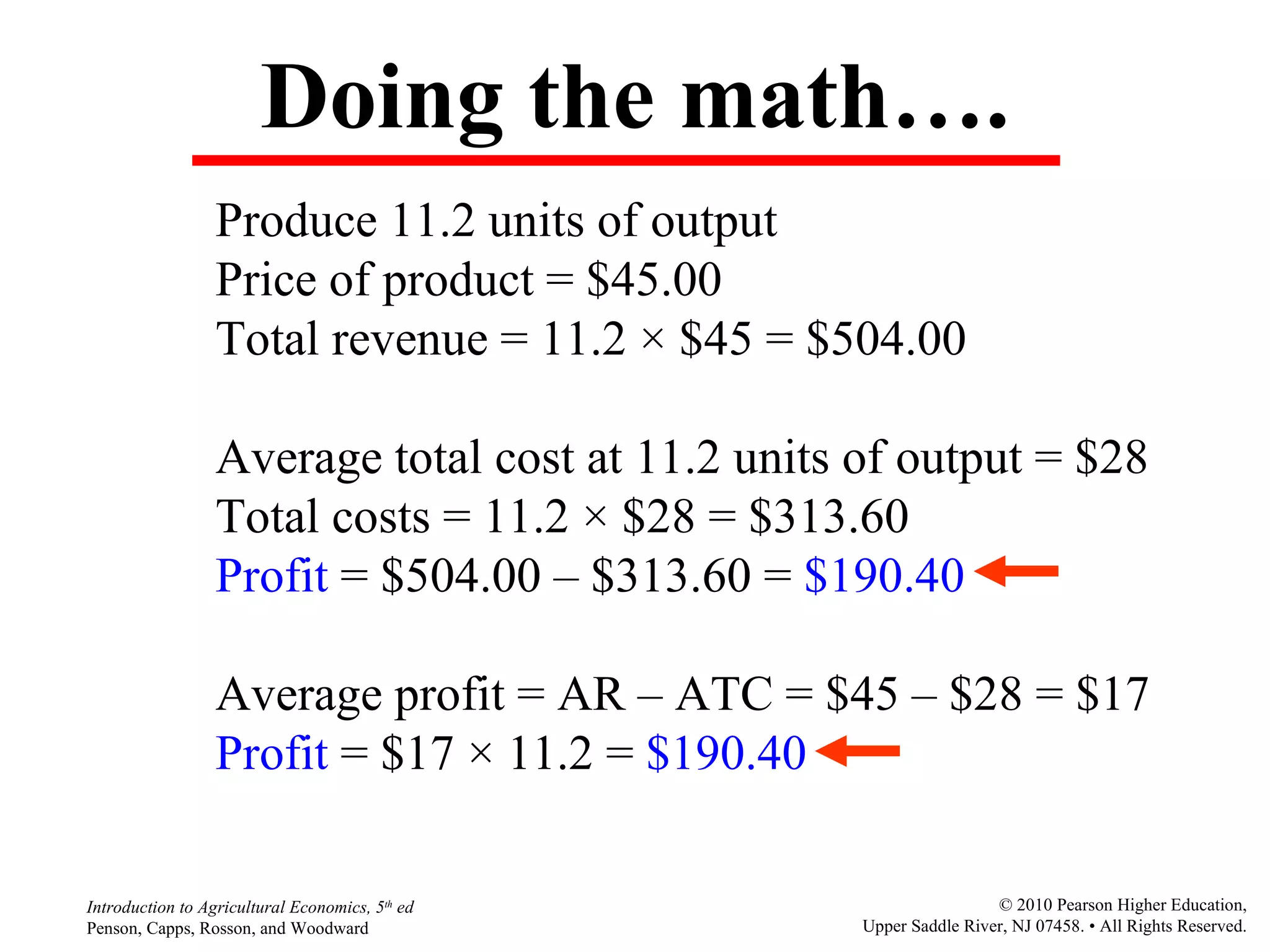
Doing the math…. Produce 11.2 units of output  (O MAX  on p. 99) Price of product = $45.00 Total revenue = 11.2  ×  $45 = $504.00
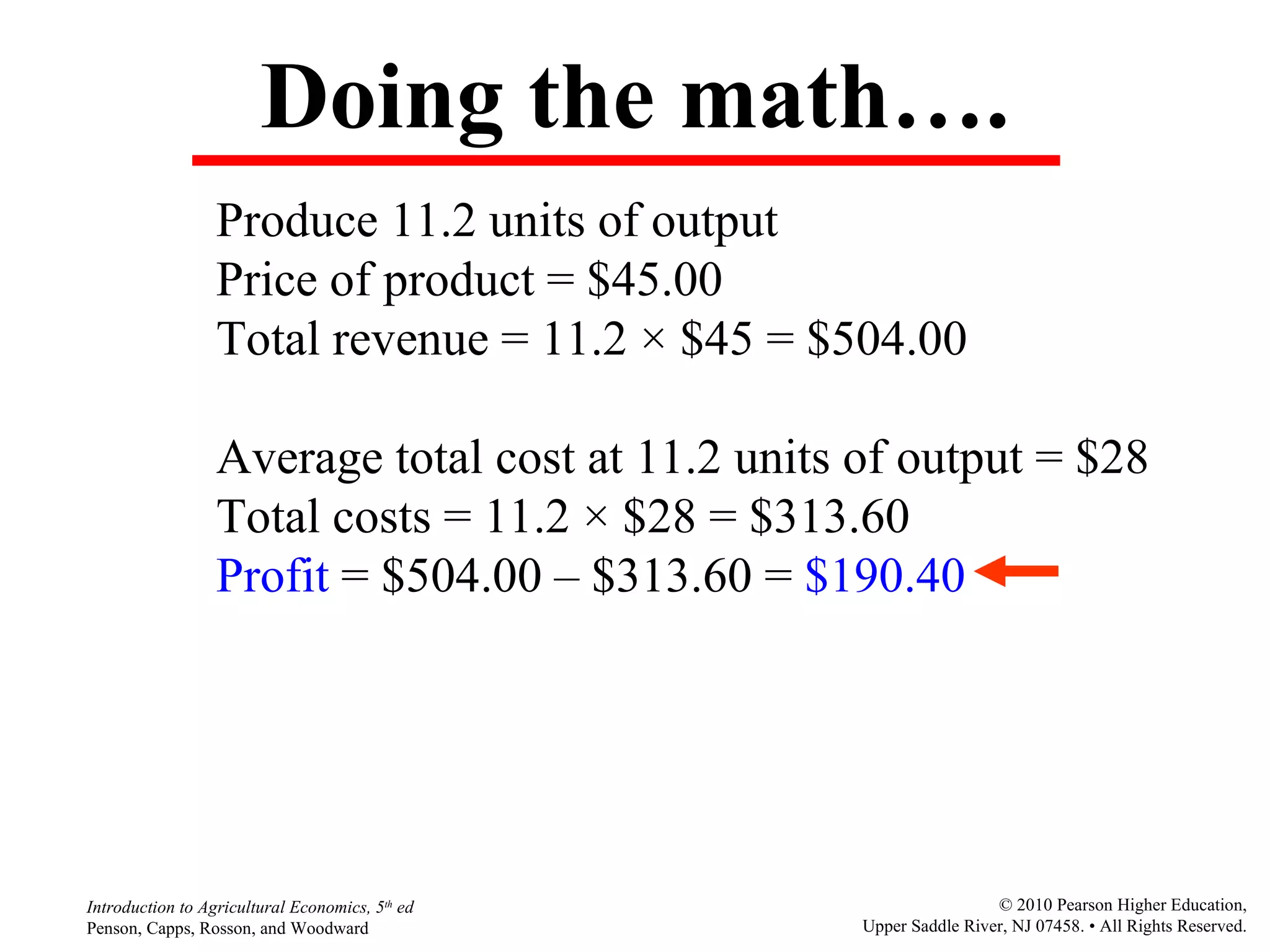
Doing the math…. Produce 11.2 units of output Price of product = $45.00 Total revenue = 11.2  ×  $45 = $504.00 Average total cost at 11.2 units of output = $28 Total costs = 11.2  ×  $28 = $313.60 Profit  = $504.00  –  $313.60 =  $190.40
Doing the math…. Produce 11.2 units of output Price of product = $45.00 Total revenue = 11.2  ×  $45 = $504.00 Average total cost at 11.2 units of output = $28 Total costs = 11.2  ×  $28 = $313.60 Profit  = $504.00  –  $313.60 =  $190.40 Average profit = AR – ATC = $45  –  $28 = $17 Profit  = $17  ×  11.2 =  $190.40
Profit at Price of $45? 28 P =45 $ Q 11.2 MC ATC AVC Revenue = $45    11.2 = $504.00 Total cost = $28    11.2 = $313.60 Profit = $504.00  –  $313.60 = $190.40 Since P = MR = AR Average profit = $45  –  $28 = $17 Profit = $17    11.2 = $190.40
Profit at Price of $45? 28 P =45 $ Q 11.2 MC ATC AVC Revenue = $45    11.2 = $504.00 Total cost = $28    11.2 = $313.60 Profit = $504.00  –  $313.60 = $190.40 Since P = MR = AR Average profit = $45  –  $28 = $17 Profit = $17    11.2 = $190.40 $190.40
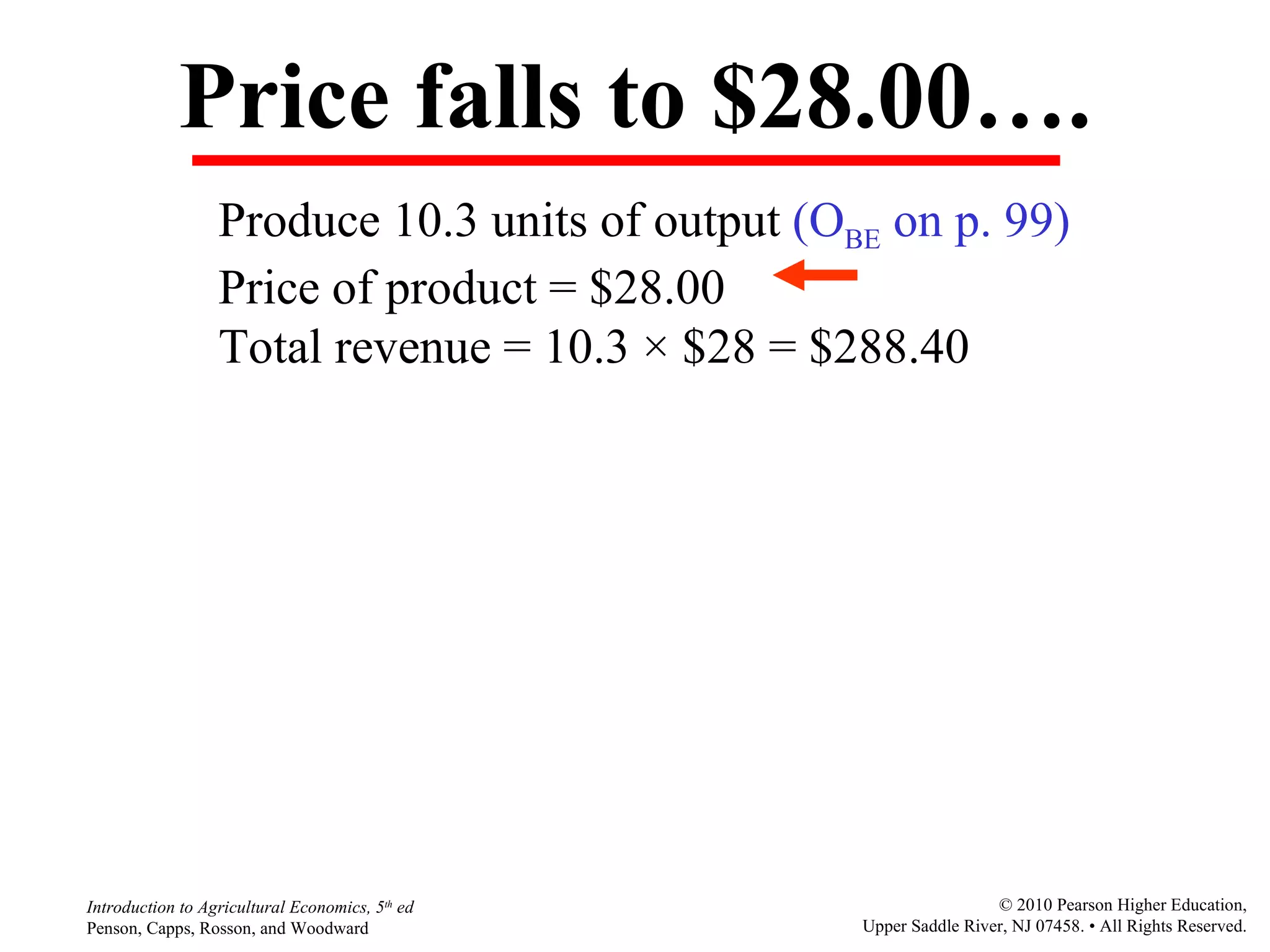
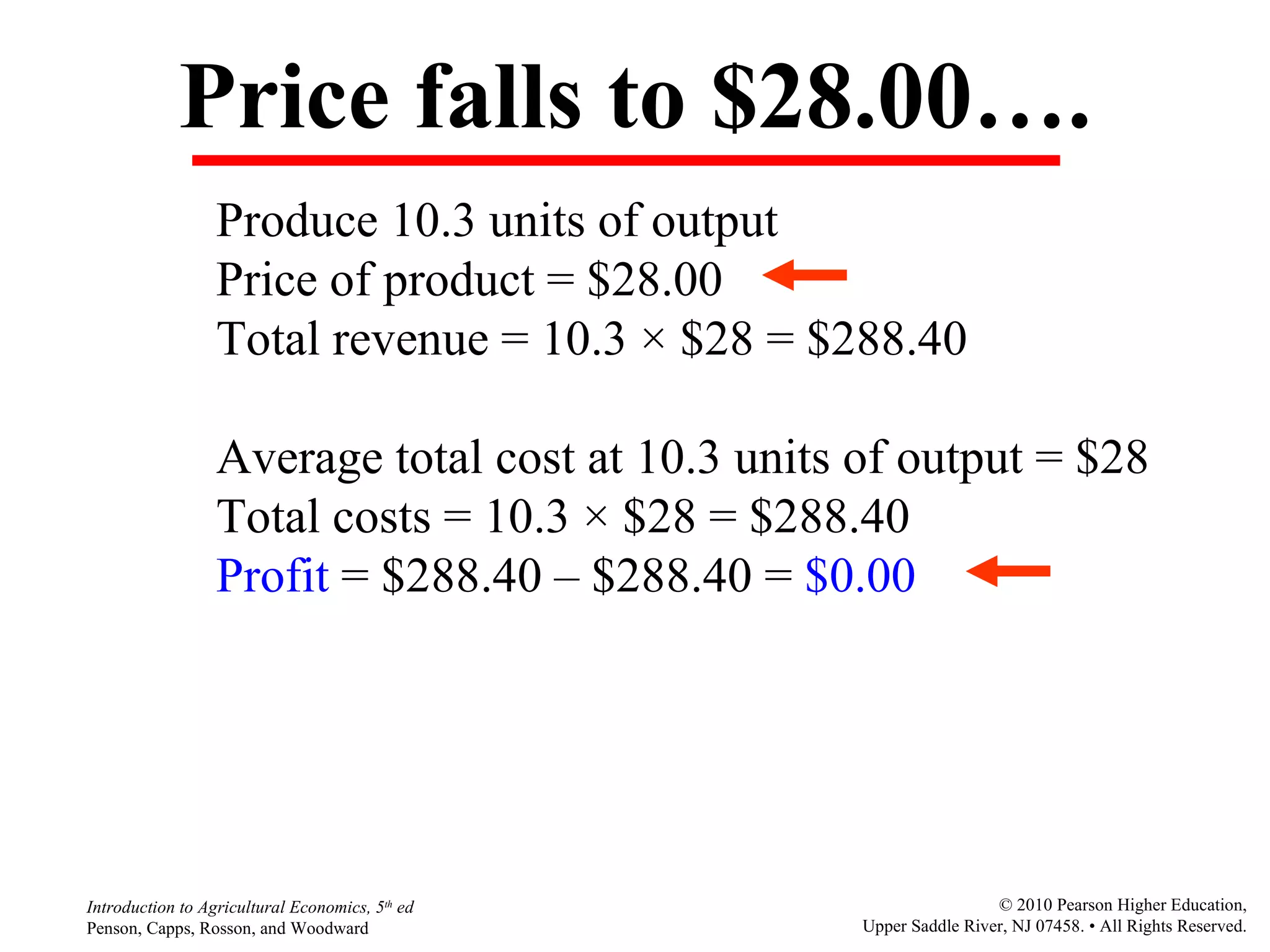
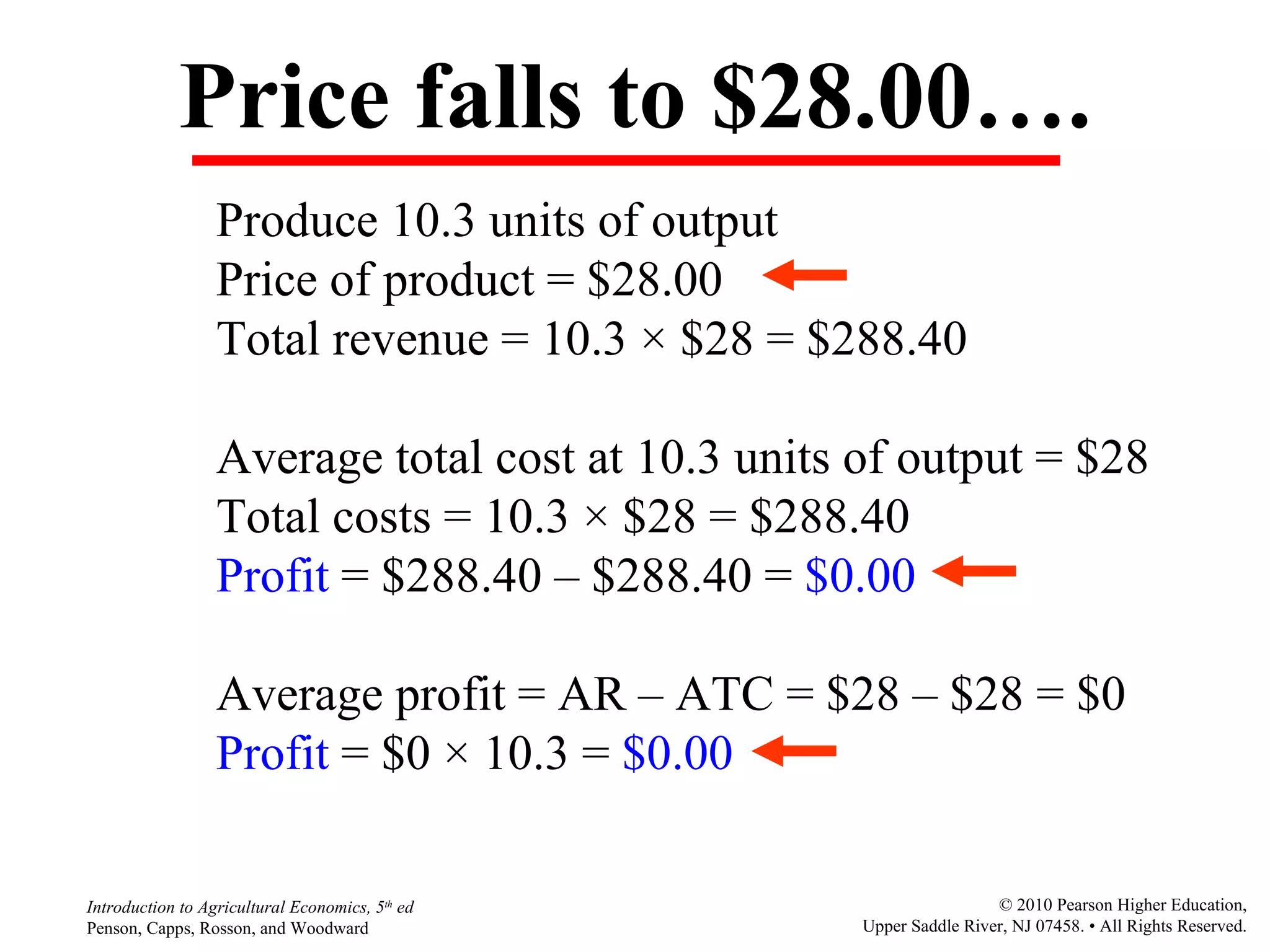
Price falls to $28.00…. Produce 10.3 units of output  (O BE  on p. 99) Price of product = $28.00 Total revenue = 10.3  ×  $28 = $288.40
Price falls to $28.00…. Produce 10.3 units of output  Price of product = $28.00 Total revenue = 10.3  ×  $28 = $288.40 Average total cost at 10.3 units of output = $28 Total costs = 10.3  ×  $28 = $288.40 Profit  = $288.40  –  $288.40 =  $0.00
Price falls to $28.00…. Produce 10.3 units of output Price of product = $28.00 Total revenue = 10.3  ×  $28 = $288.40 Average total cost at 10.3 units of output = $28 Total costs = 10.3  ×  $28 = $288.40 Profit  = $288.40  –  $288.40 =  $0.00 Average profit = AR – ATC = $28  –  $28 = $0 Profit  = $0  ×  10.3 =  $0.00
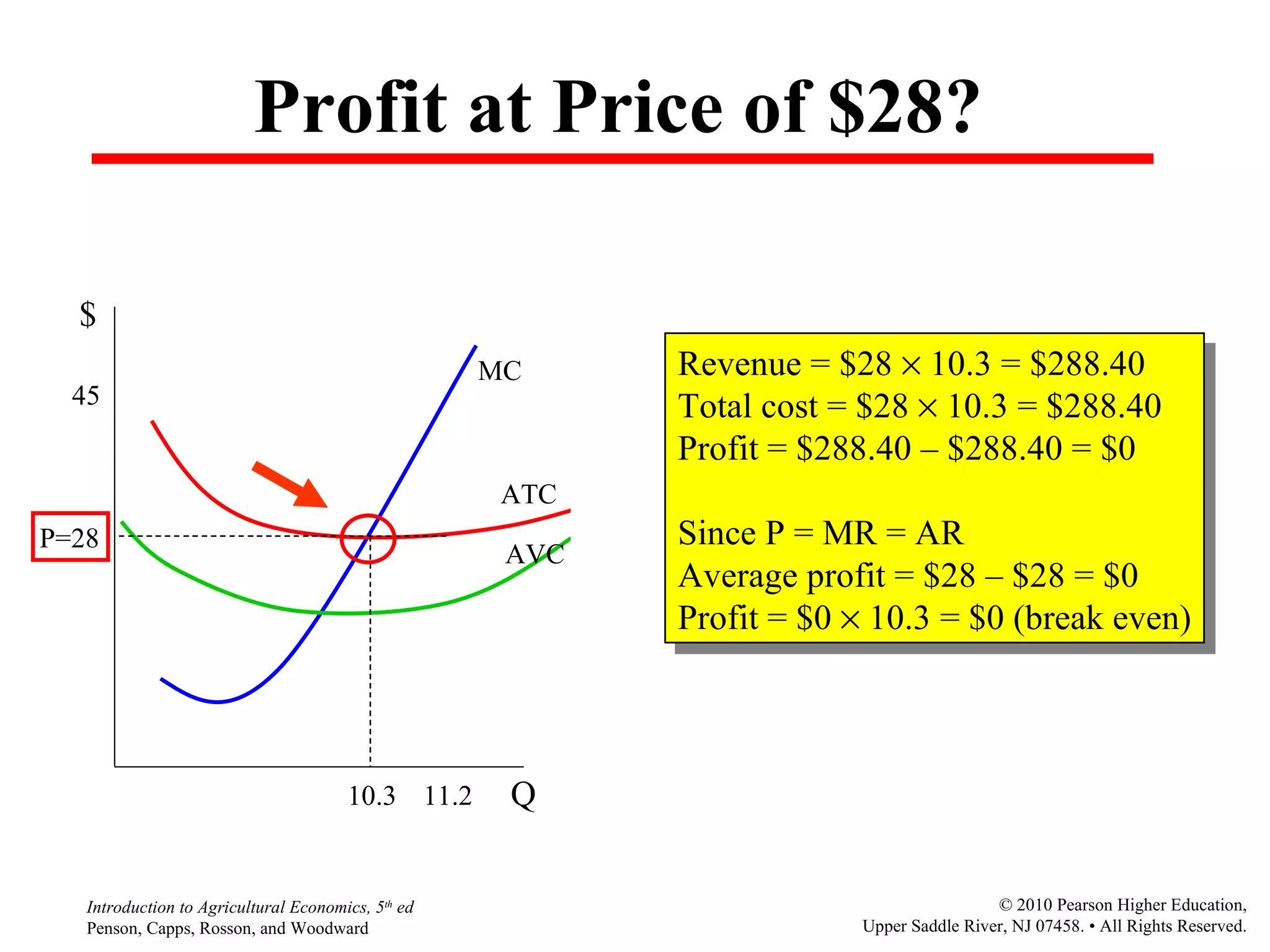
Profit at Price of $28? P=28 45 $ Q 11.2 10.3 MC ATC AVC Revenue = $28    10.3 = $288.40 Total cost = $28    10.3 = $288.40 Profit = $288.40  –  $288.40 = $0 Since P = MR = AR Average profit = $28  –  $28 = $0 Profit = $0    10.3 = $0 (break even)
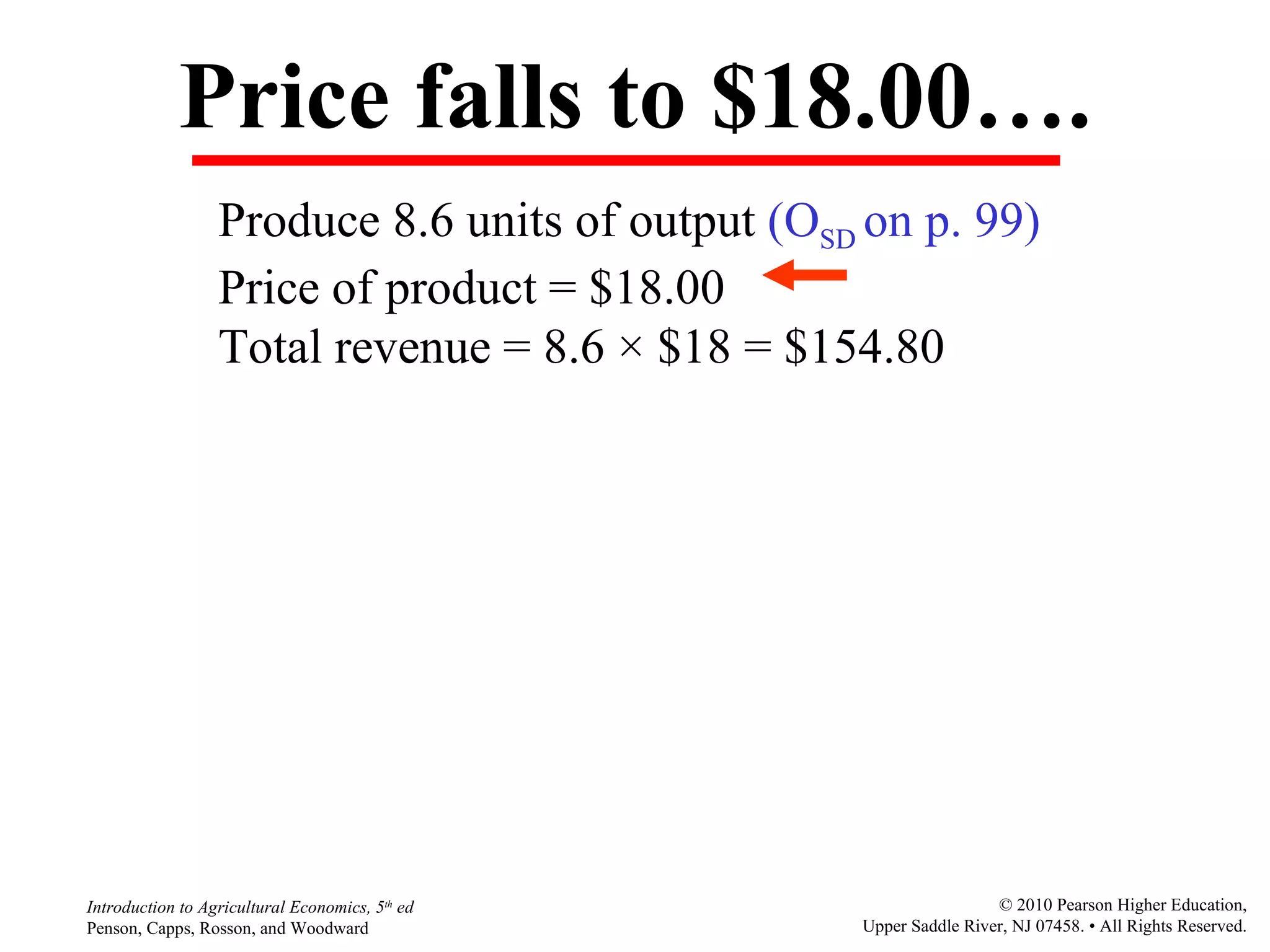
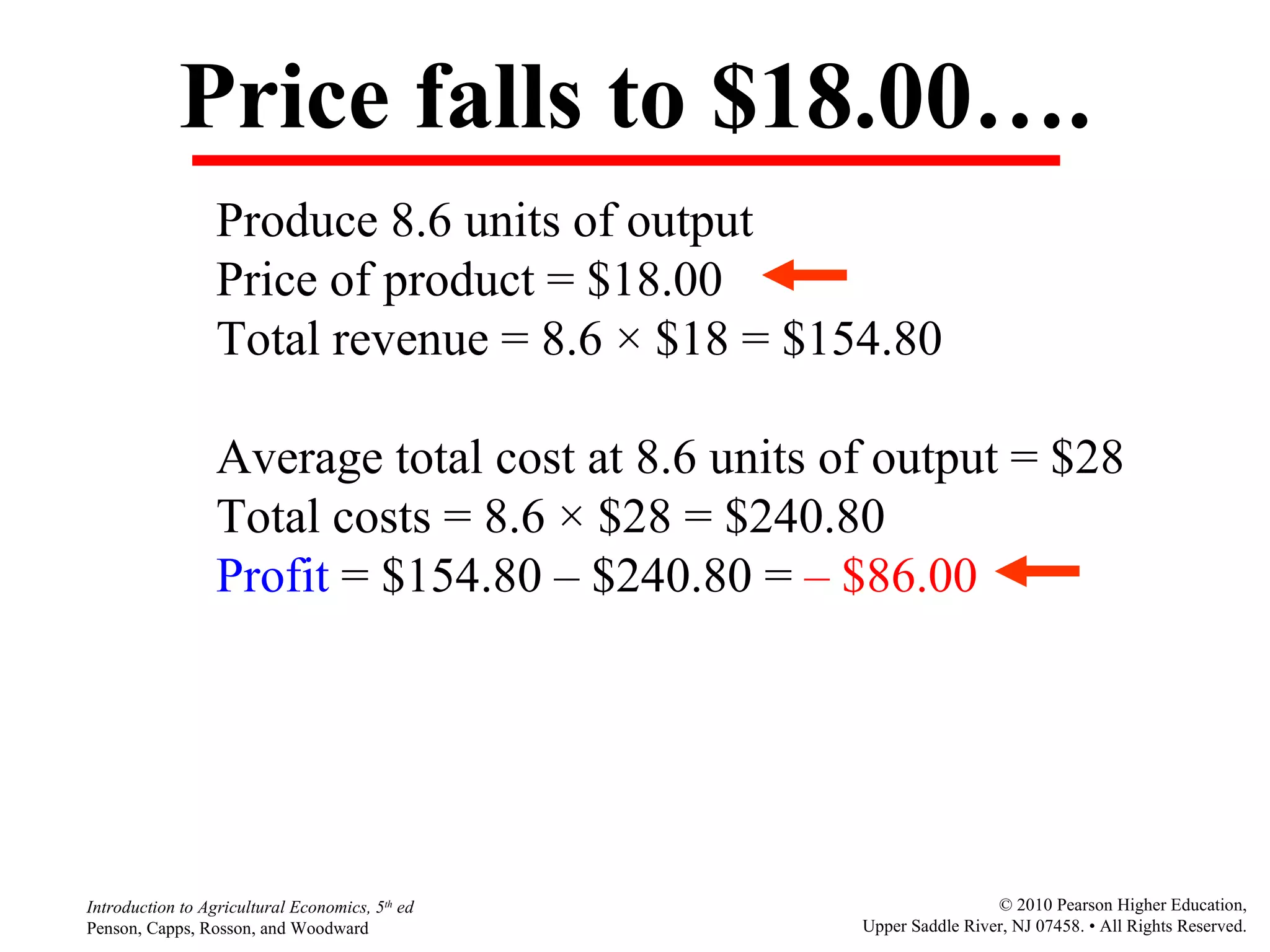
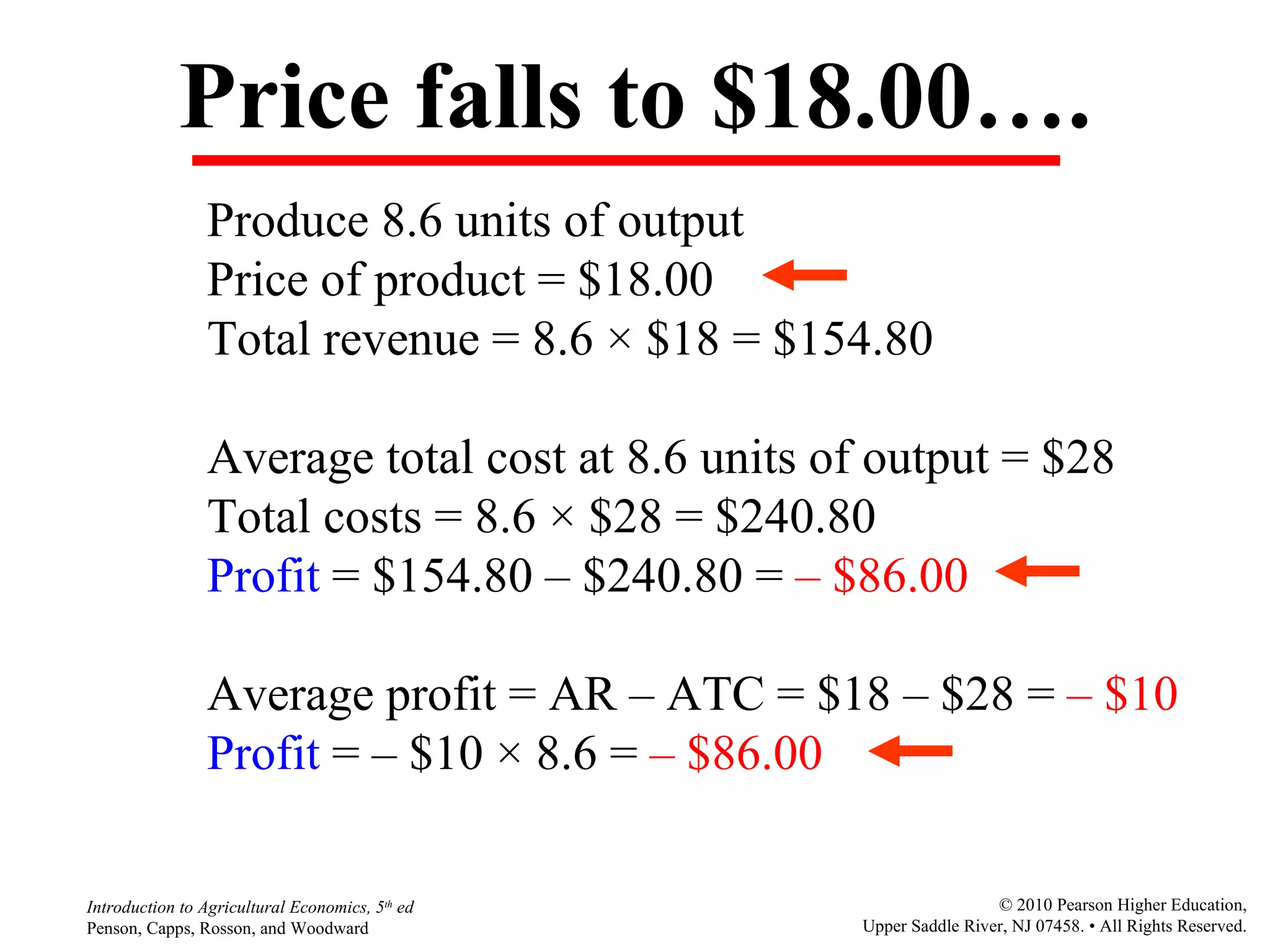
Price falls to $18.00…. Produce 8.6 units of output  (O SD  on p. 99) Price of product = $18.00 Total revenue = 8.6  ×  $18 = $154.80
Price falls to $18.00…. Produce 8.6 units of output Price of product = $18.00 Total revenue = 8.6  ×  $18 = $154.80 Average total cost at 8.6 units of output = $28 Total costs = 8.6  ×  $28 = $240.80 Profit  = $154.80  –  $240.80 =  –  $86.00
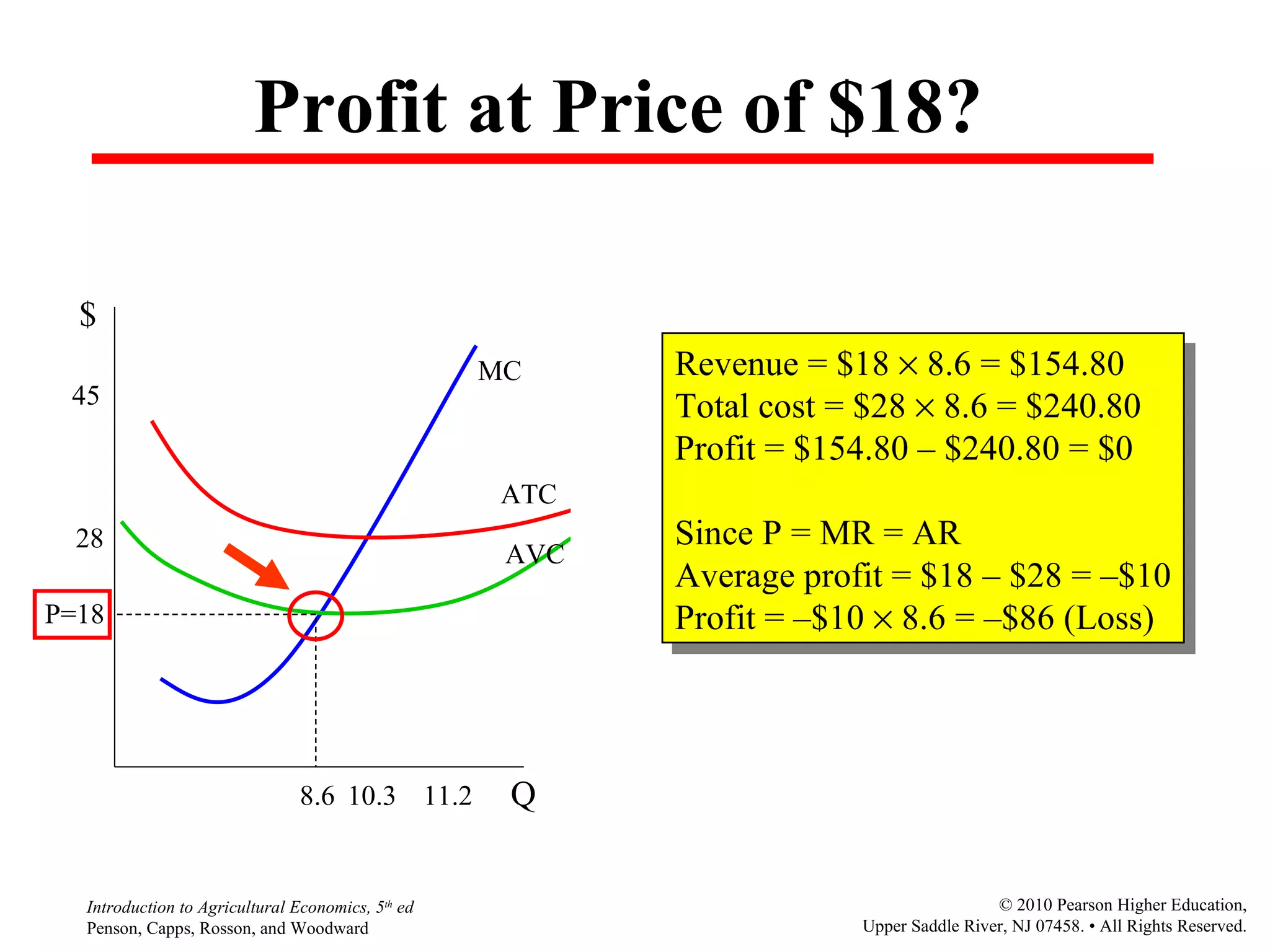
Price falls to $18.00…. Produce 8.6 units of output Price of product = $18.00 Total revenue = 8.6  ×  $18 = $154.80 Average total cost at 8.6 units of output = $28 Total costs = 8.6  ×  $28 = $240.80 Profit  = $154.80  –  $240.80 =  –  $86.00 Average profit = AR – ATC = $18  –  $28 =  –  $10 Profit  =  –  $10  ×  8.6 =  –  $86.00
Profit at Price of $18? 28 P=18 45 $ Q 11.2 10.3 8.6 MC ATC AVC Revenue = $18    8.6 = $154.80 Total cost = $28    8.6 = $240.80 Profit = $154.80  –  $240.80 = $0 Since P = MR = AR Average profit = $18  –  $28 =  – $10 Profit =  – $10    8.6 =  – $86 (Loss)
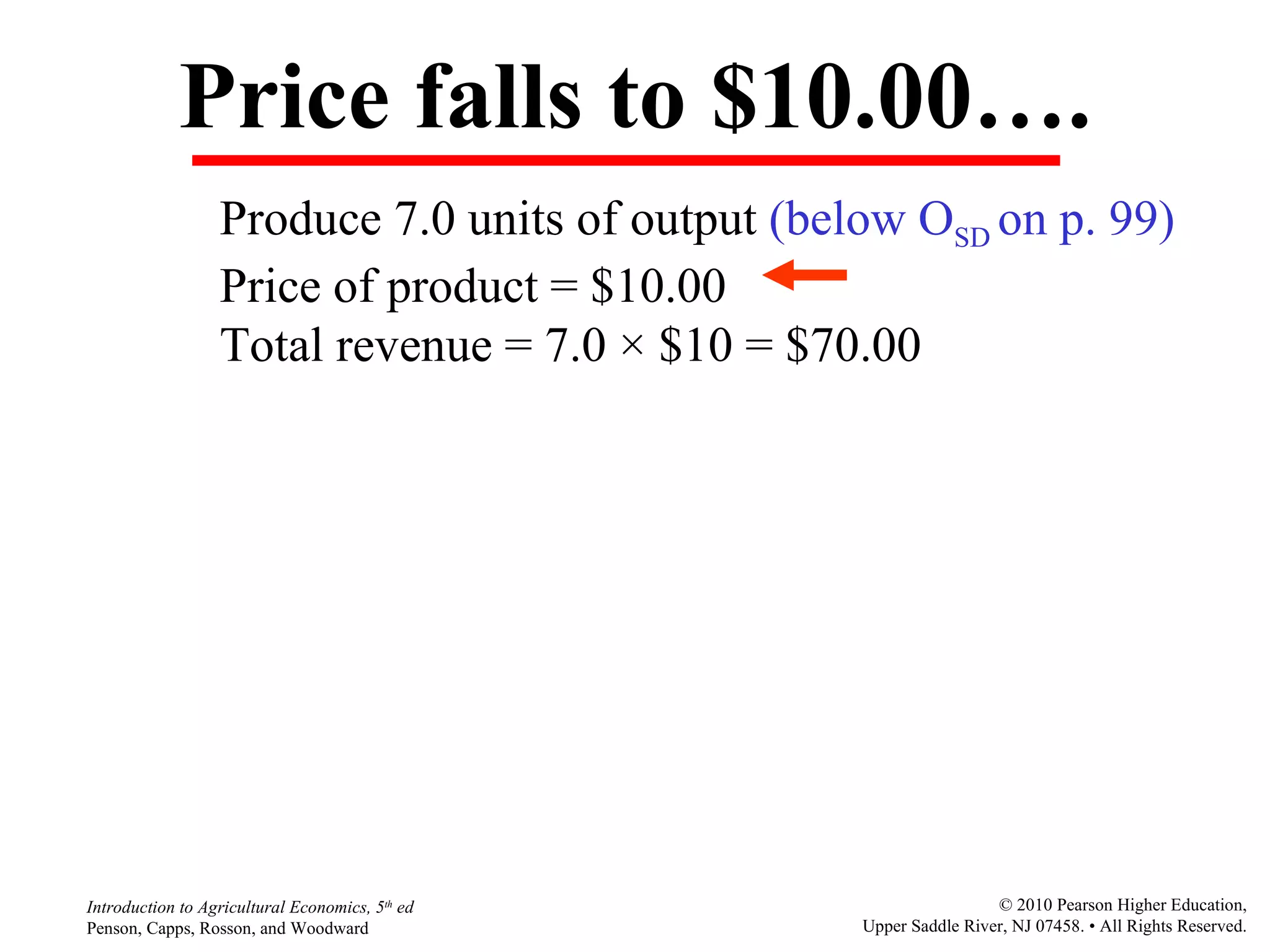
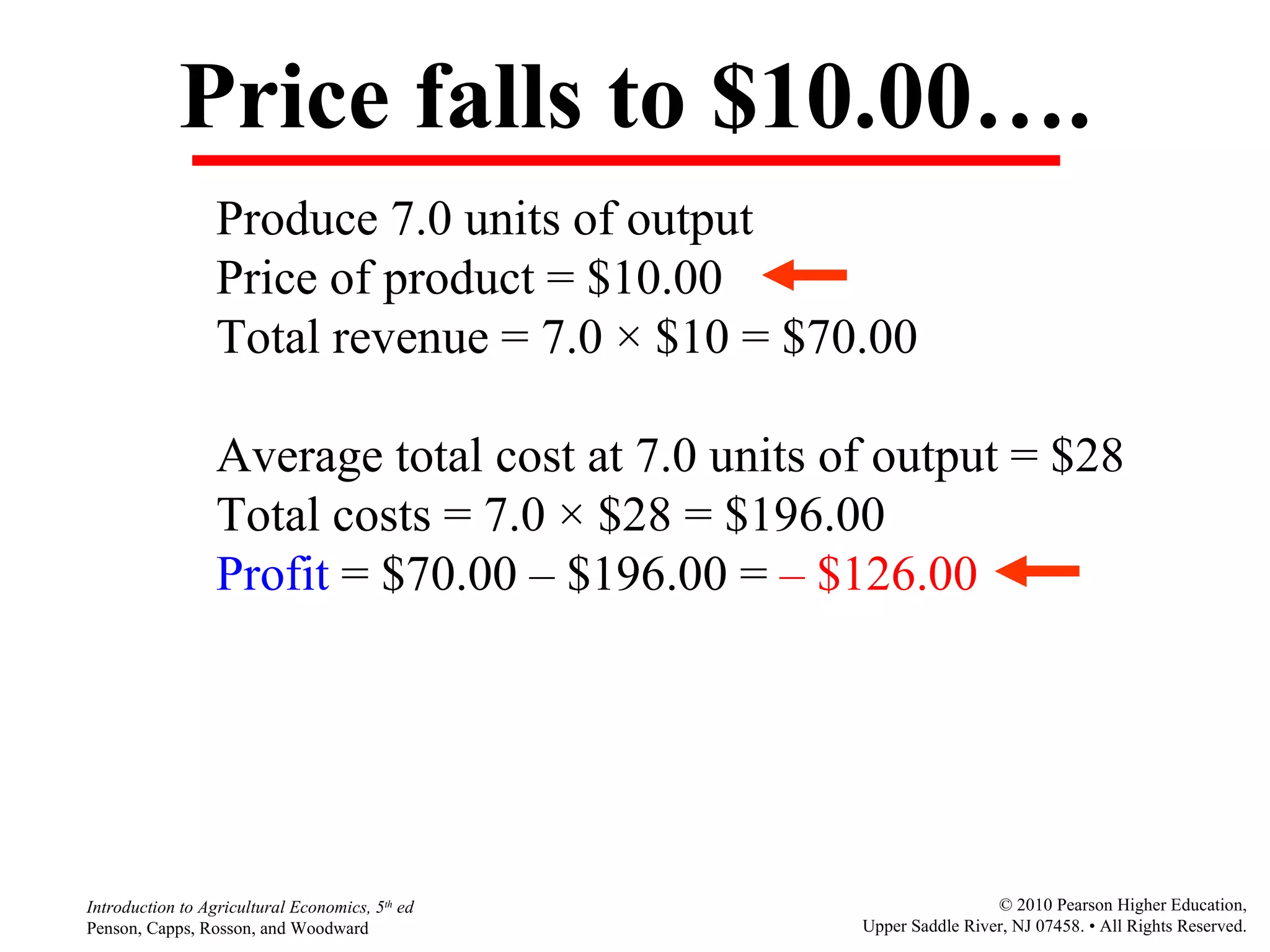
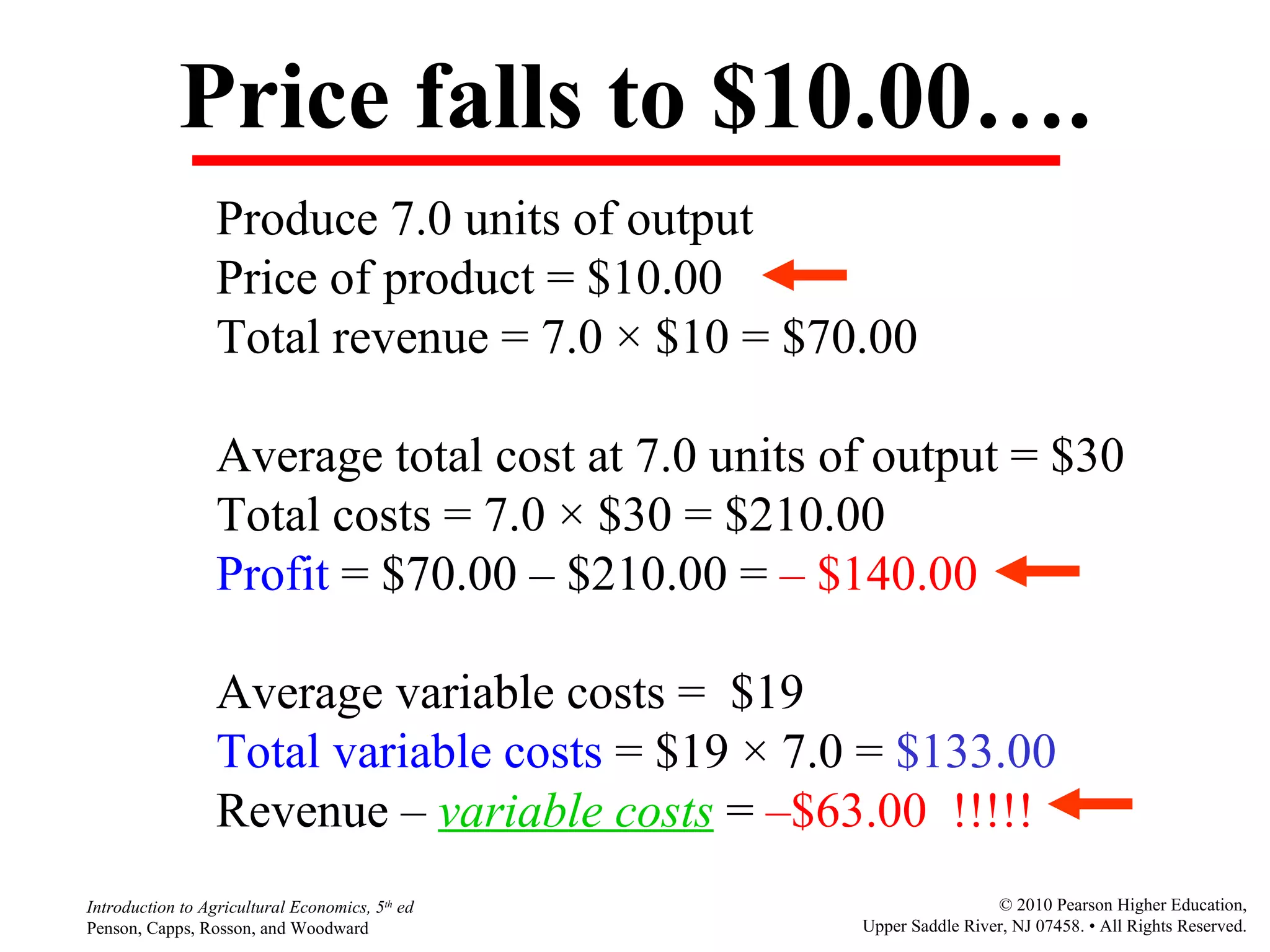
Price falls to $10.00…. Produce 7.0 units of output  (below O SD  on p. 99) Price of product = $10.00 Total revenue = 7.0  ×  $10 = $70.00
Price falls to $10.00…. Produce 7.0 units of output  Price of product = $10.00 Total revenue = 7.0  ×  $10 = $70.00 Average total cost at 7.0 units of output = $28 Total costs = 7.0  ×  $28 = $196.00 Profit  = $70.00  –  $196.00 =  –  $126.00
Price falls to $10.00…. Produce 7.0 units of output  Price of product = $10.00 Total revenue = 7.0  ×  $10 = $70.00 Average total cost at 7.0 units of output = $30 Total costs = 7.0  ×  $30 = $210.00 Profit  = $70.00  –  $210.00 =  –  $140.00 Average variable costs =  $19  Total variable costs  = $19  ×  7.0 =  $133.00   Revenue  –   variable costs  =  –$63.00  !!!!!
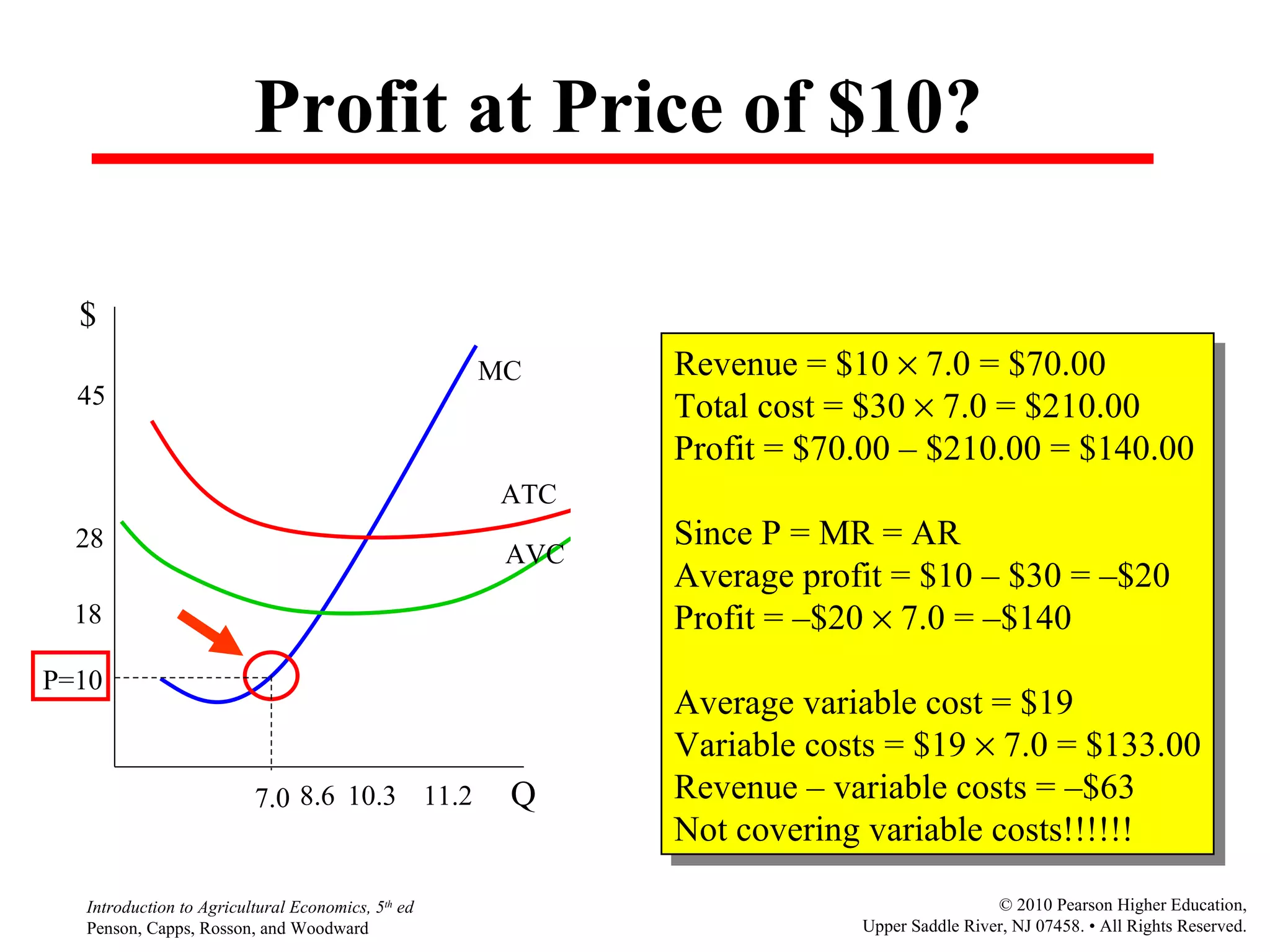
Profit at Price of $10? 28 P=10 18 45 $ Q 11.2 10.3 8.6 MC ATC AVC 7.0 Revenue = $10    7.0 = $70.00 Total cost = $30    7.0 = $210.00 Profit = $70.00  –  $210.00 = $140.00 Since P = MR = AR Average profit = $10  –  $30 =  – $20 Profit =  – $20    7.0 =  – $140 Average variable cost = $19 Variable costs = $19    7.0 = $133.00 Revenue – variable costs =  – $63 Not covering variable costs!!!!!!
The Firm’s Supply Curve 28 P=10 18 45 $ Q 11.2 10.3 8.6 MC ATC AVC 7.0
Now let’s look at the demand for a single input: Labor
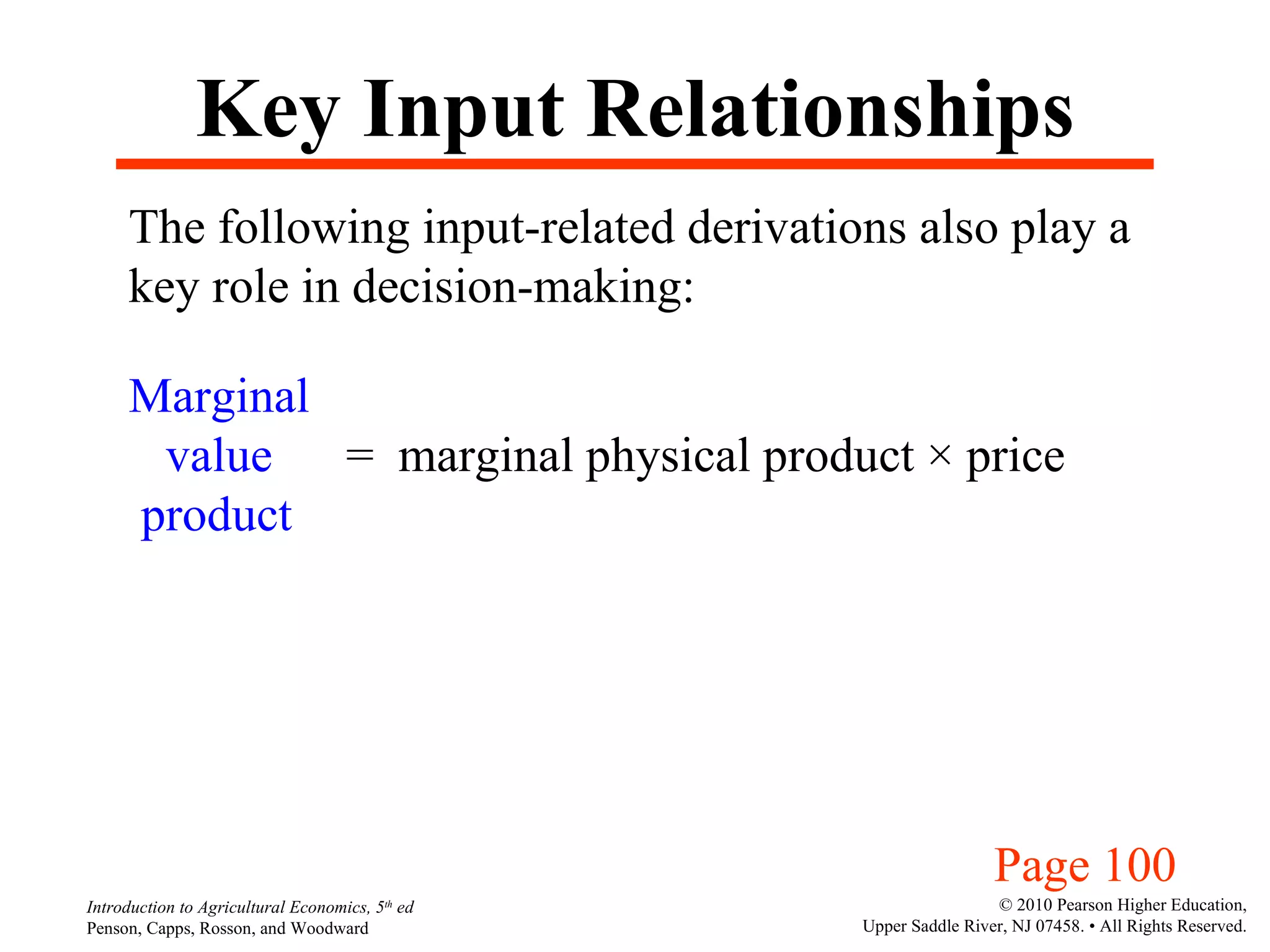
Key Input Relationships The following input-related derivations also play a key role in decision-making: Marginal value  =  marginal physical product  ×  price product  Page 100
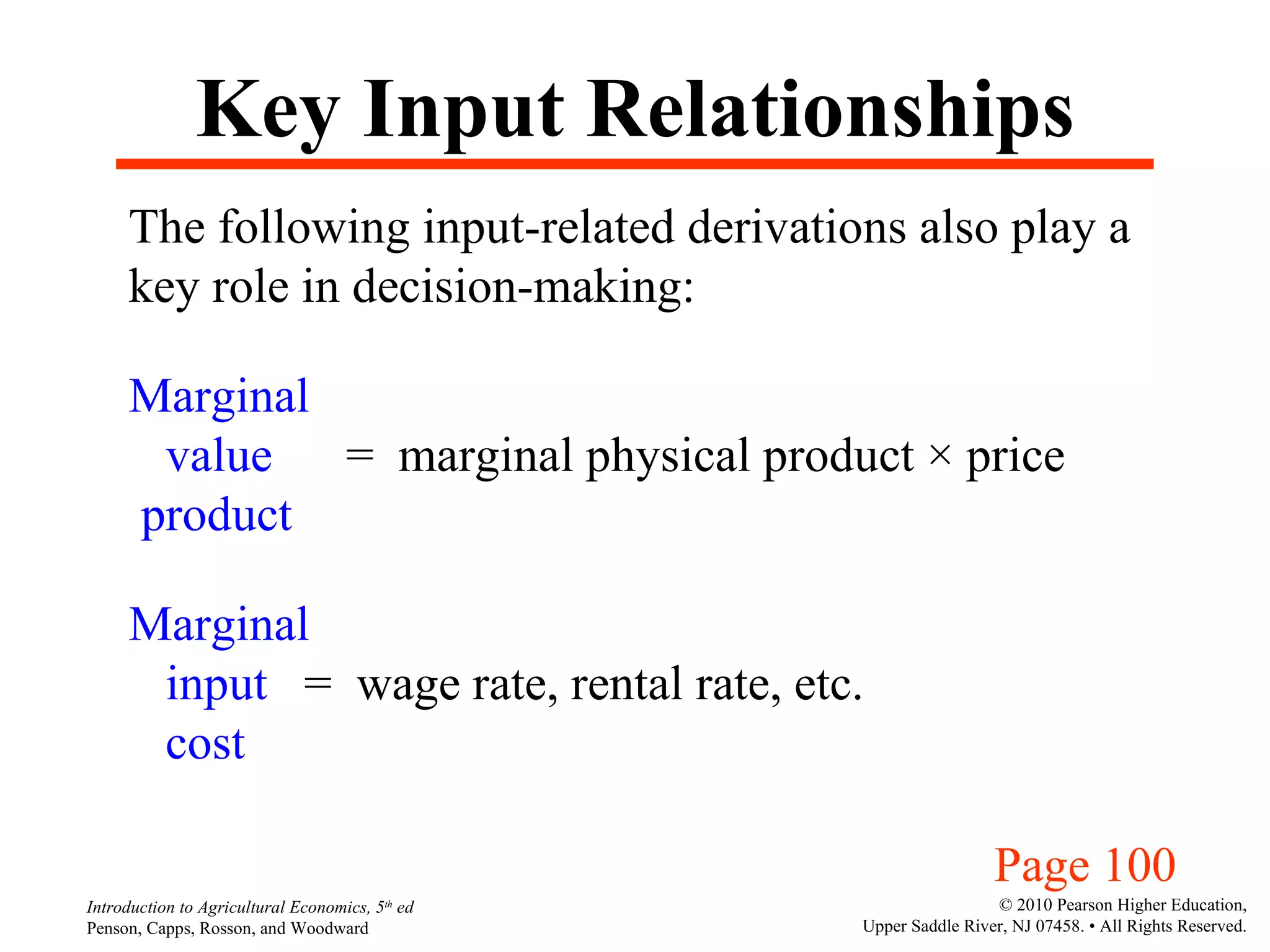
Key Input Relationships The following input-related derivations also play a key role in decision-making: Marginal value  =  marginal physical product  ×  price product  Marginal input  =  wage rate, rental rate, etc. cost  Page 100
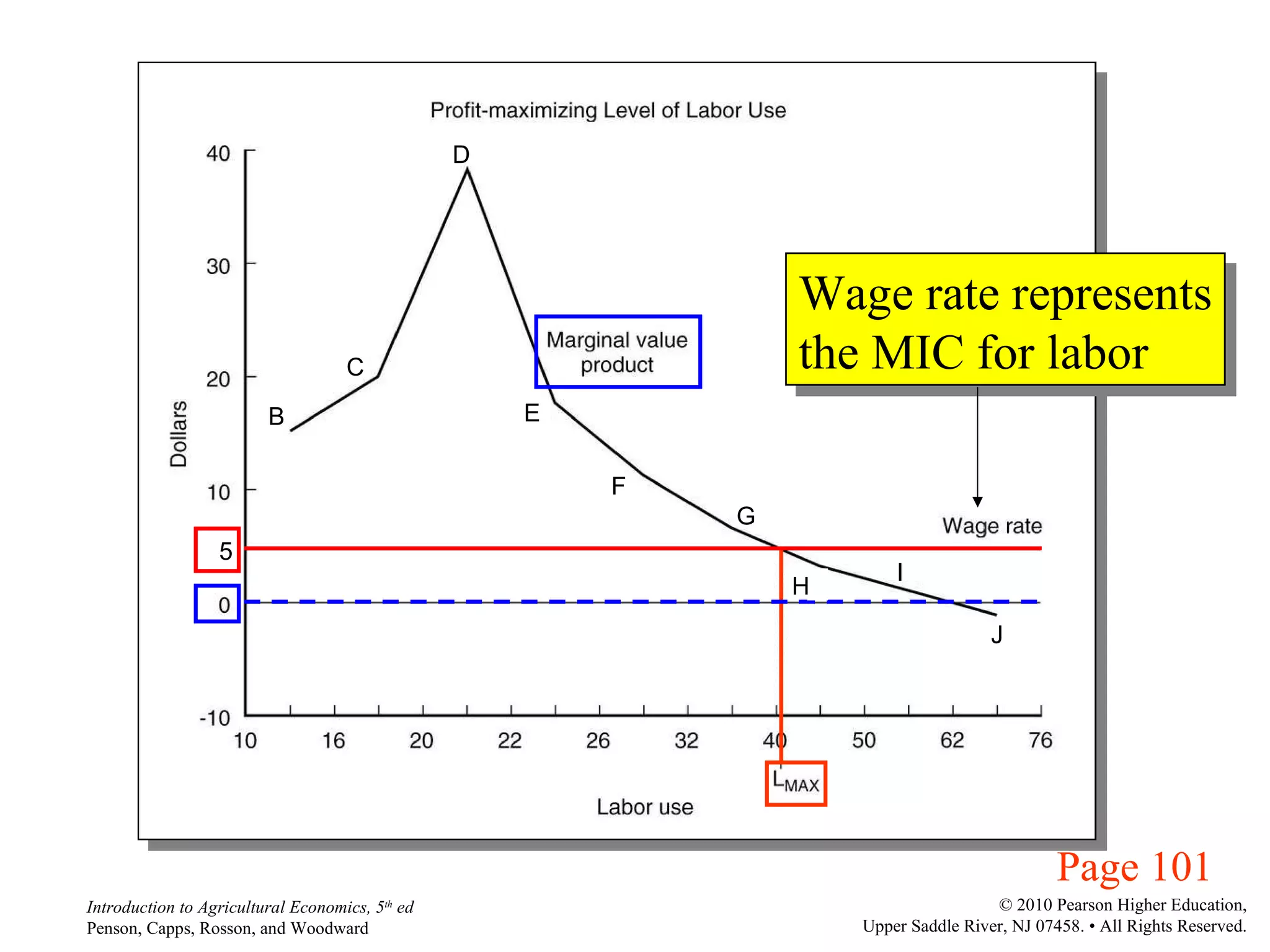
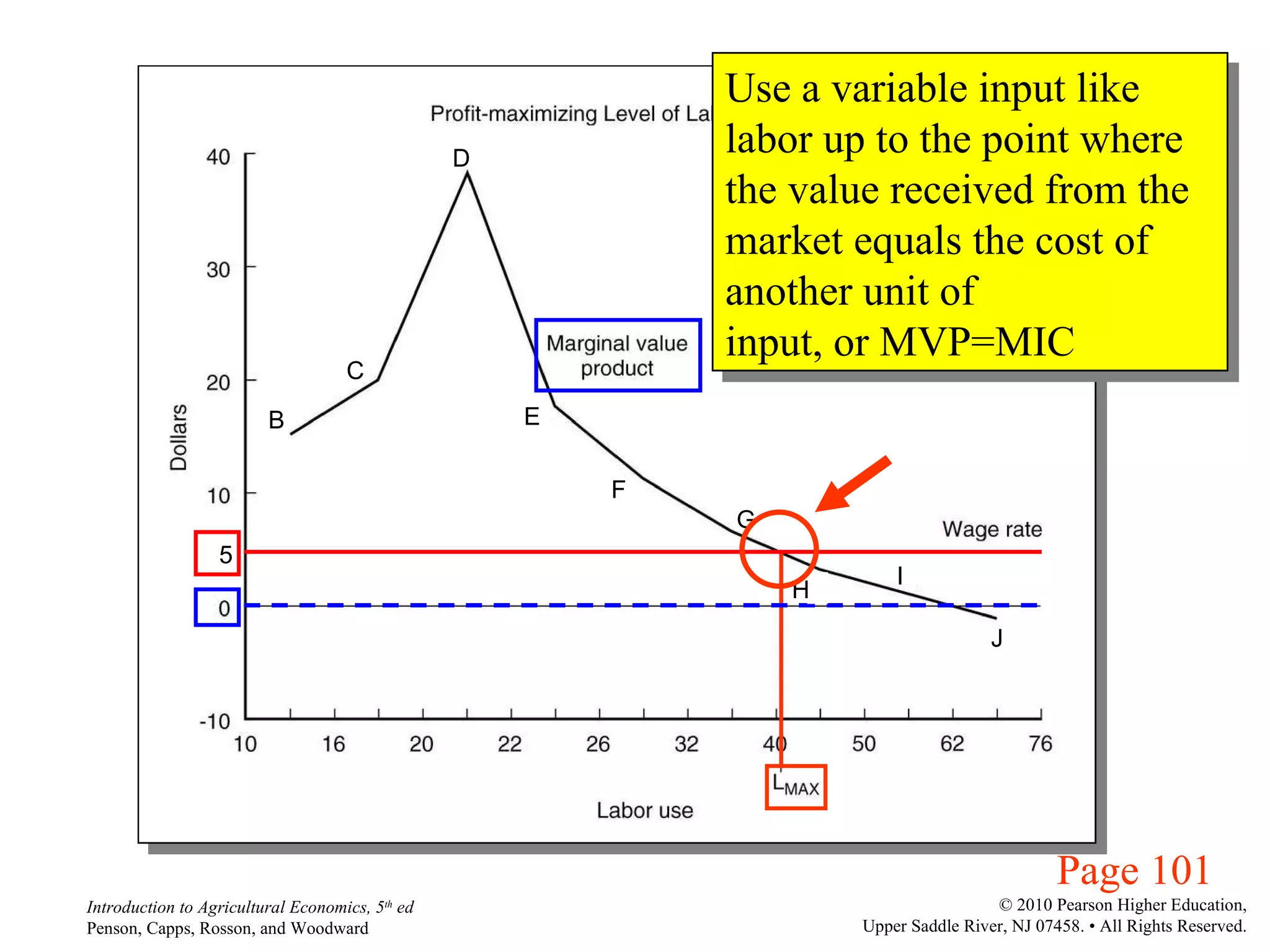
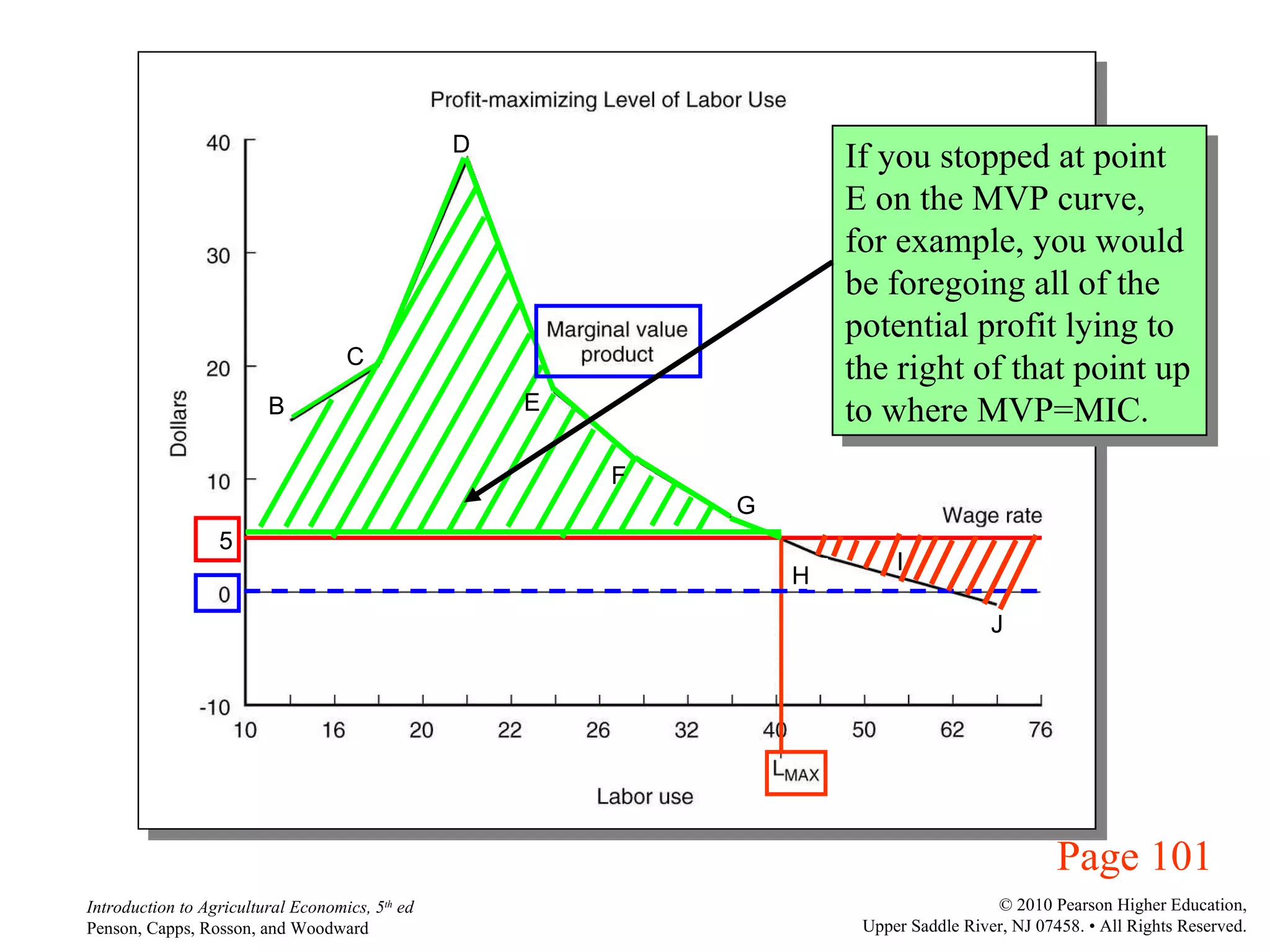
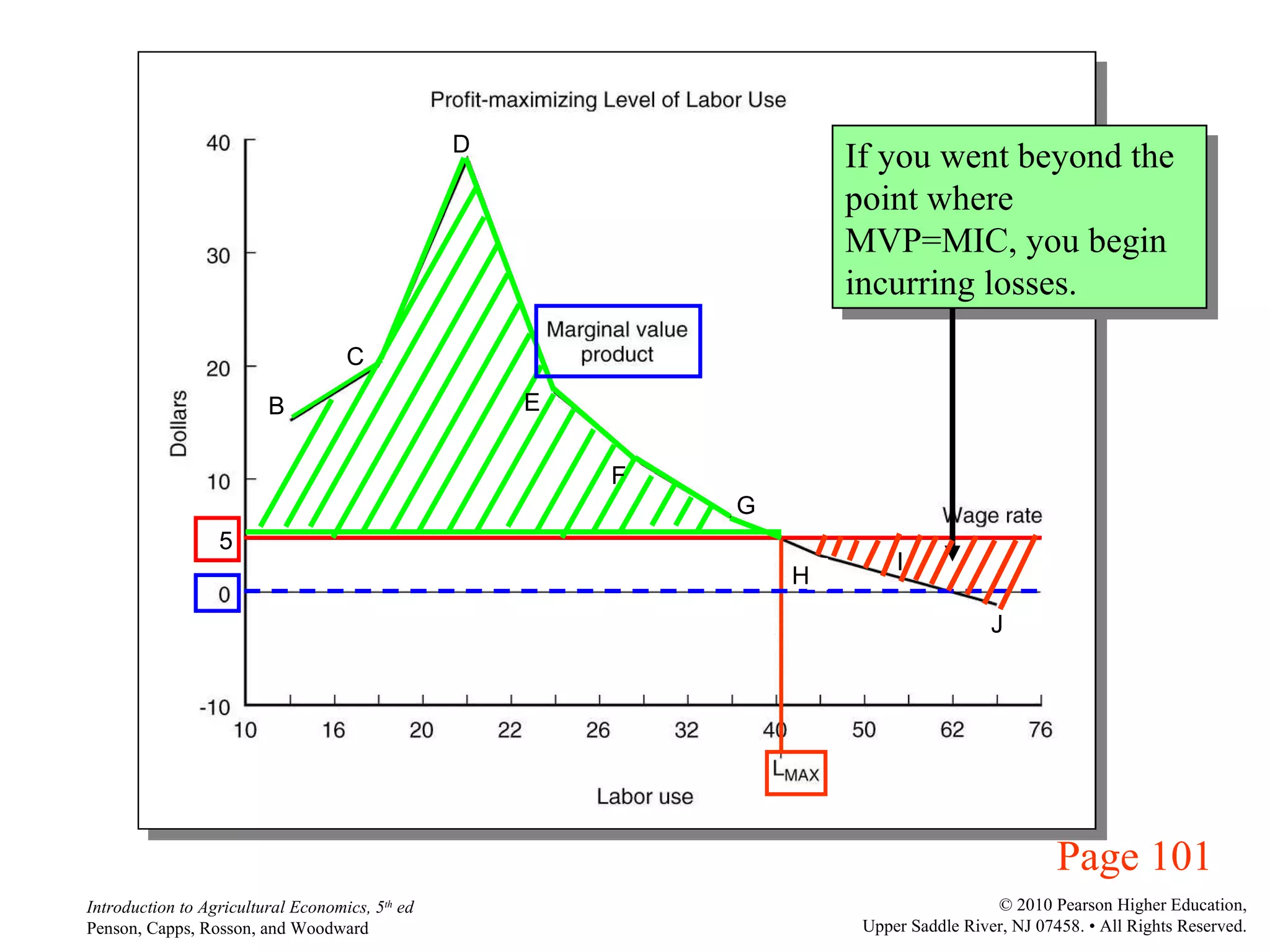
Page 101 5 B C D E F G H I J Wage rate represents the MIC for labor
Page 101 5 B C D E F G H I J Use a variable input like labor up to the point where the value received from the market equals the cost of another unit of  input, or MVP=MIC
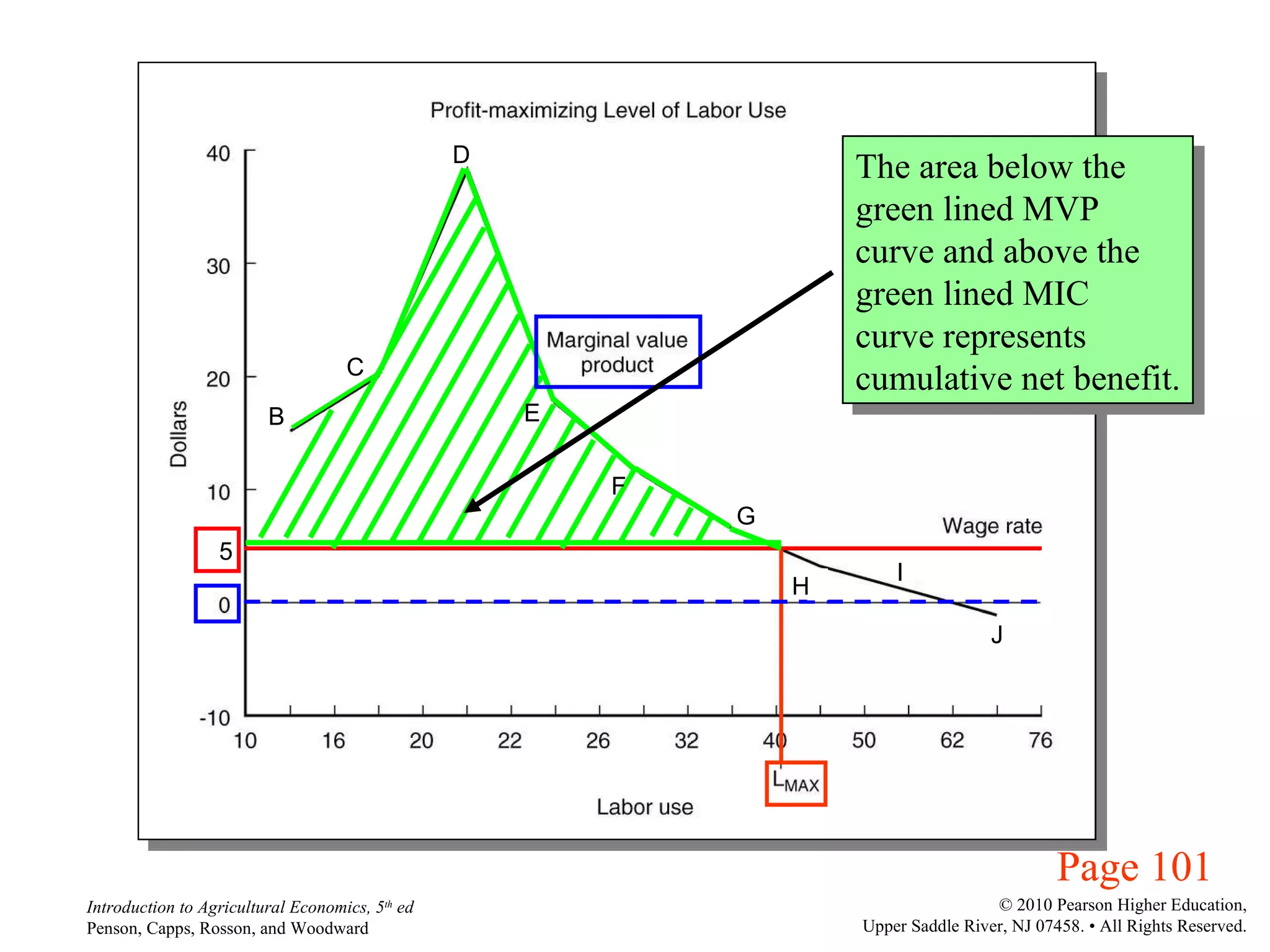
Page 101 5 The area below the green lined MVP curve and above the green lined MIC curve represents cumulative net benefit. B C D E F G H I J
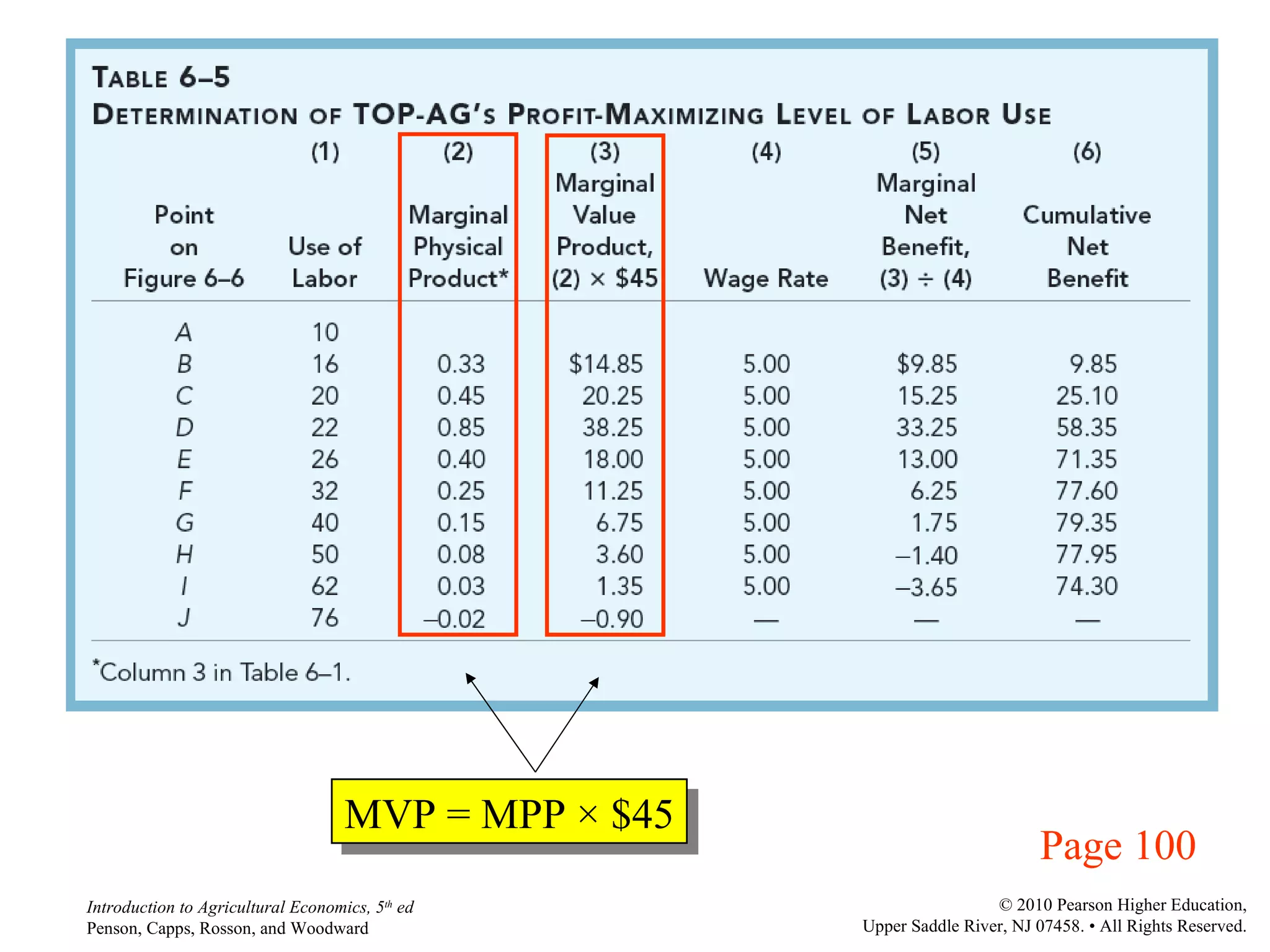
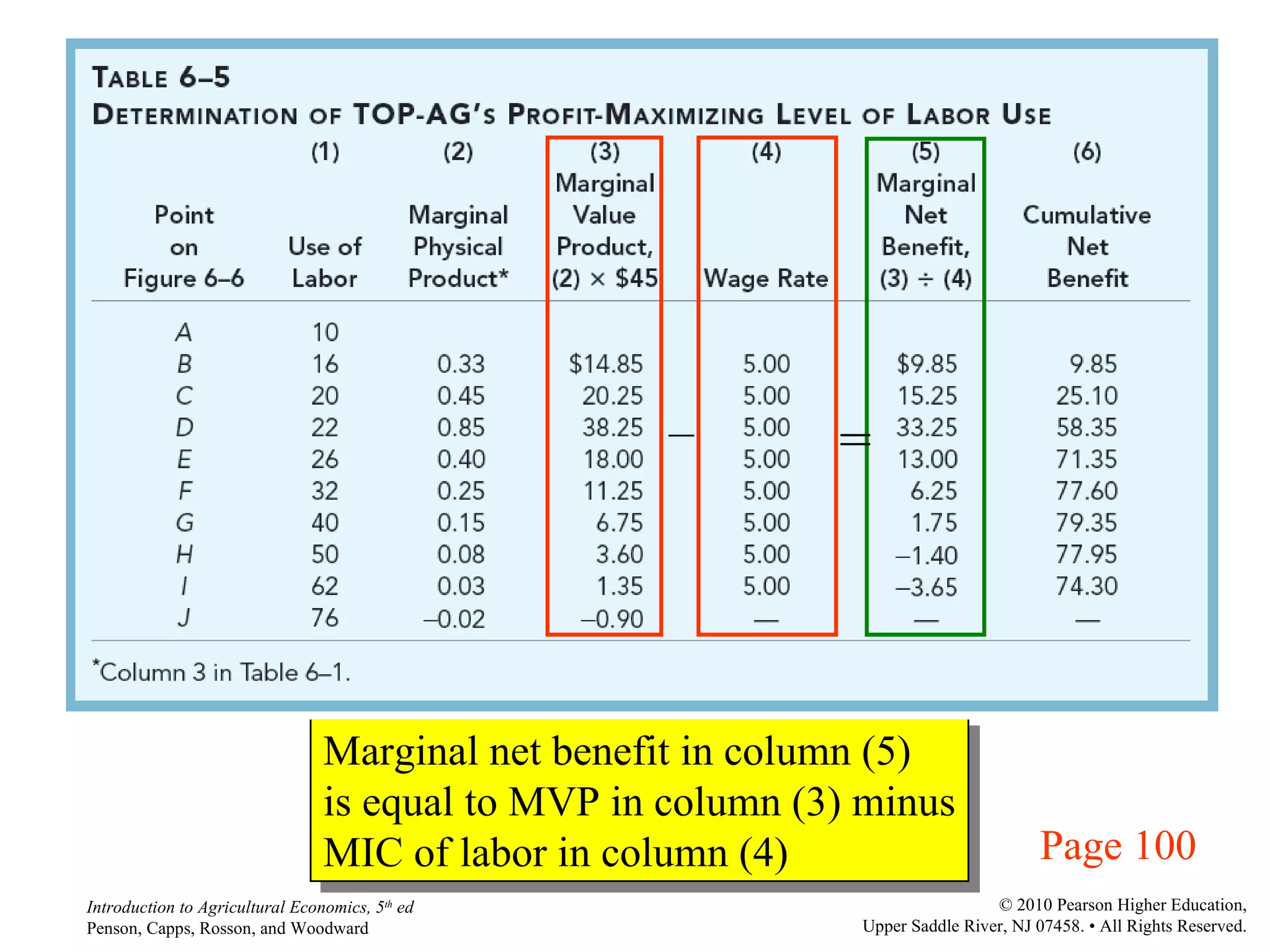
Page 100 MVP = MPP  ×  $45
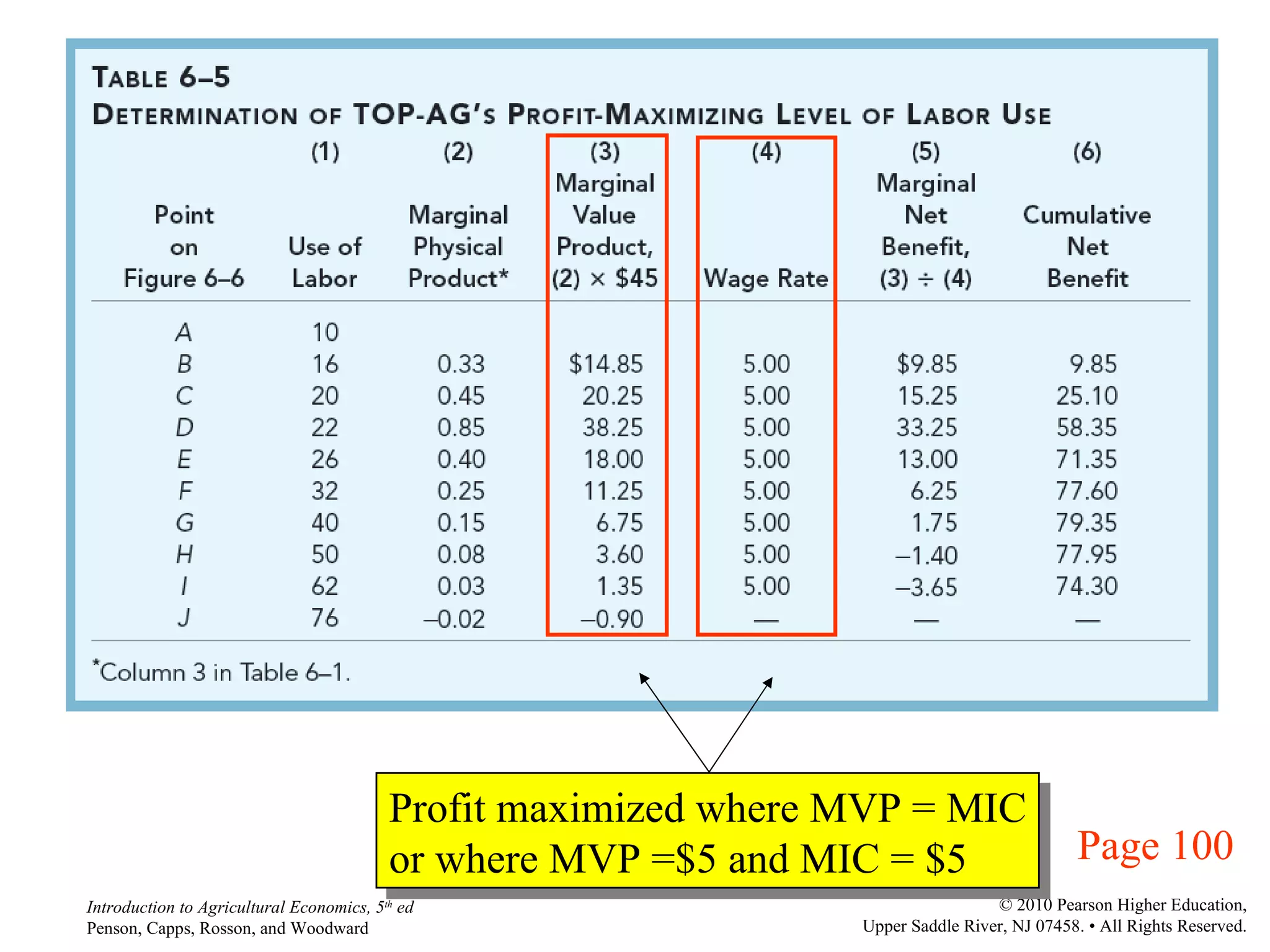
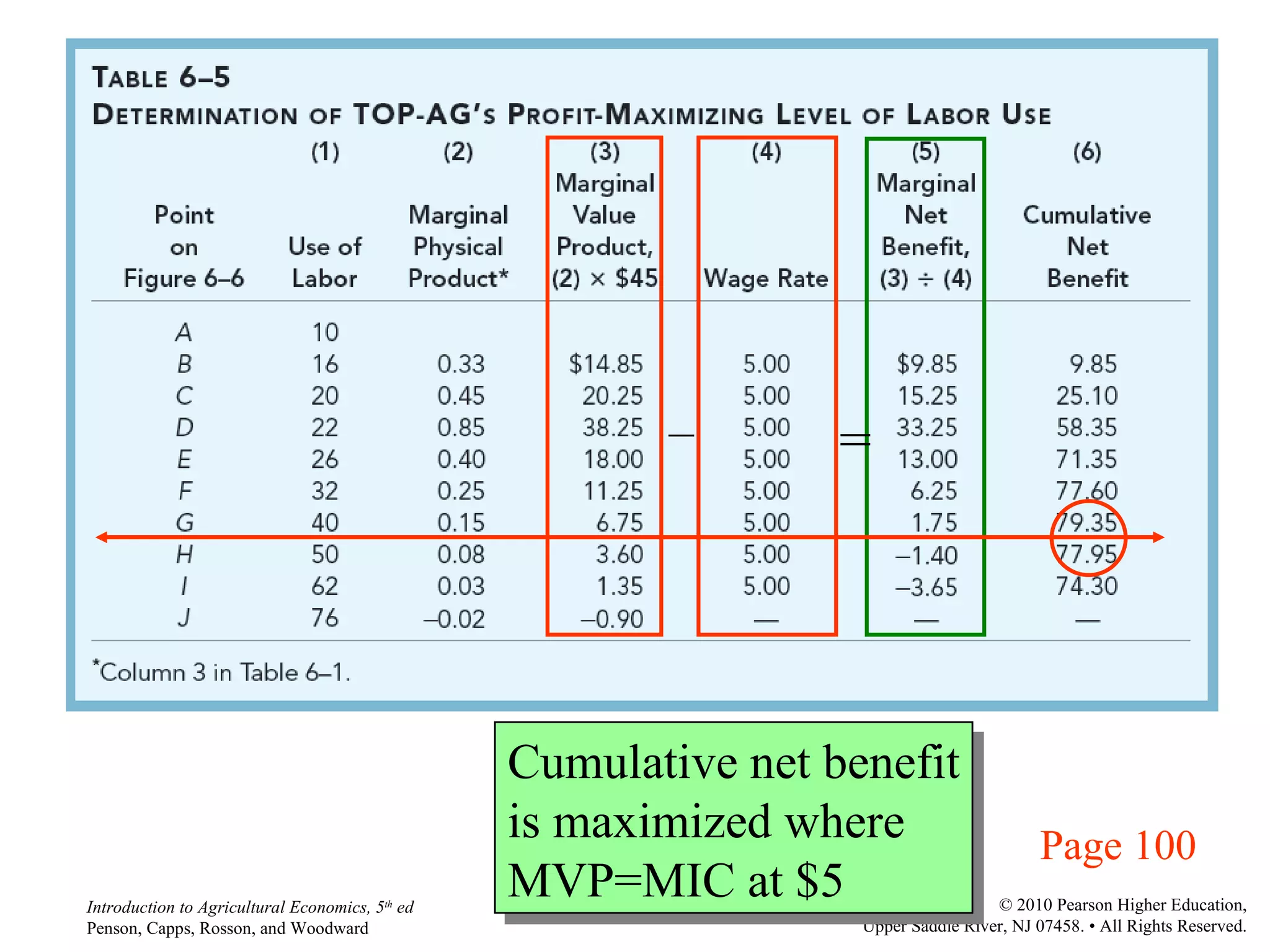
Page 100 Profit maximized where MVP = MIC or where MVP =$5 and MIC = $5
Page 100 Marginal net benefit in column (5) is equal to MVP in column (3) minus MIC of labor in column (4) = –
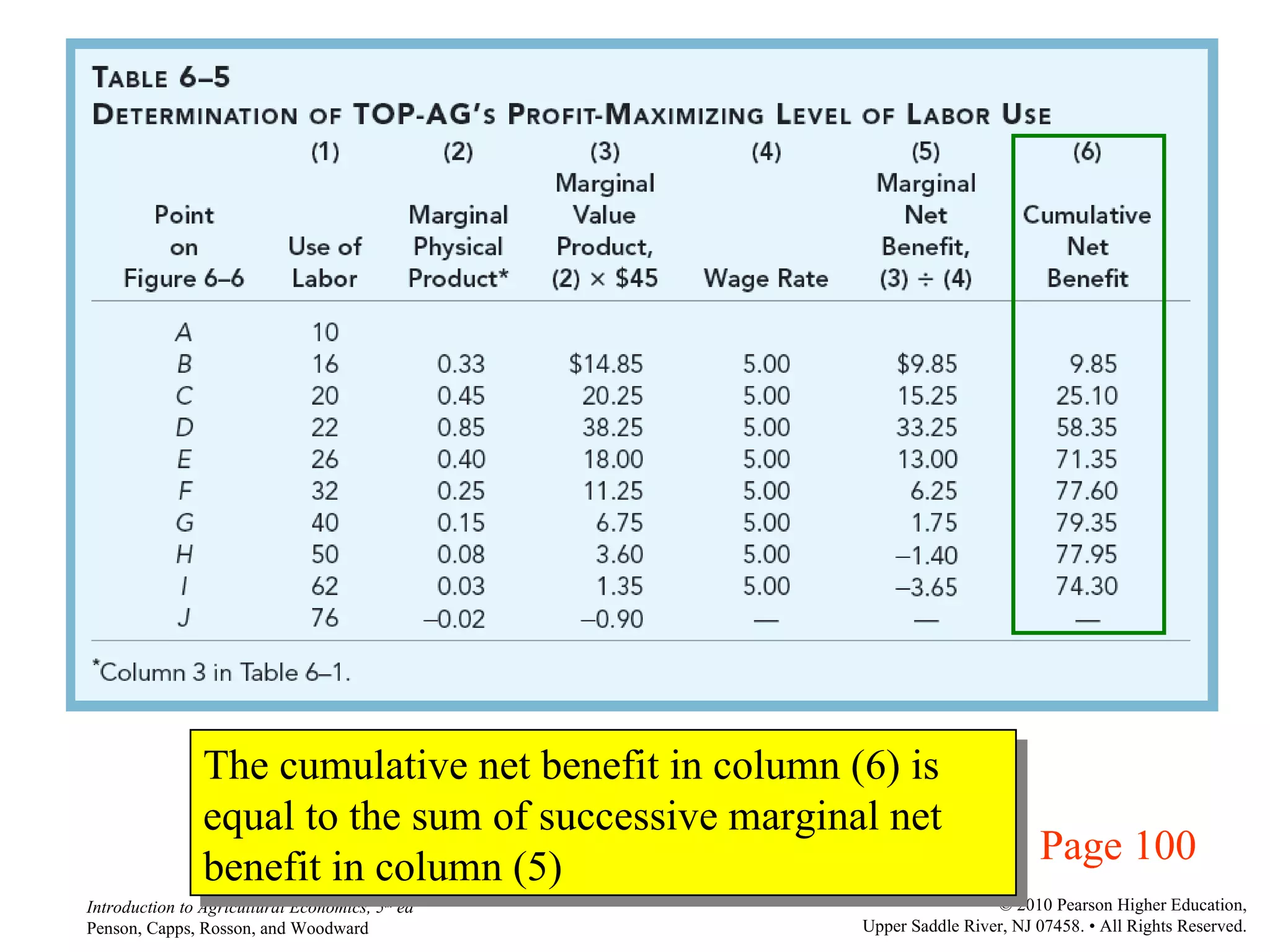
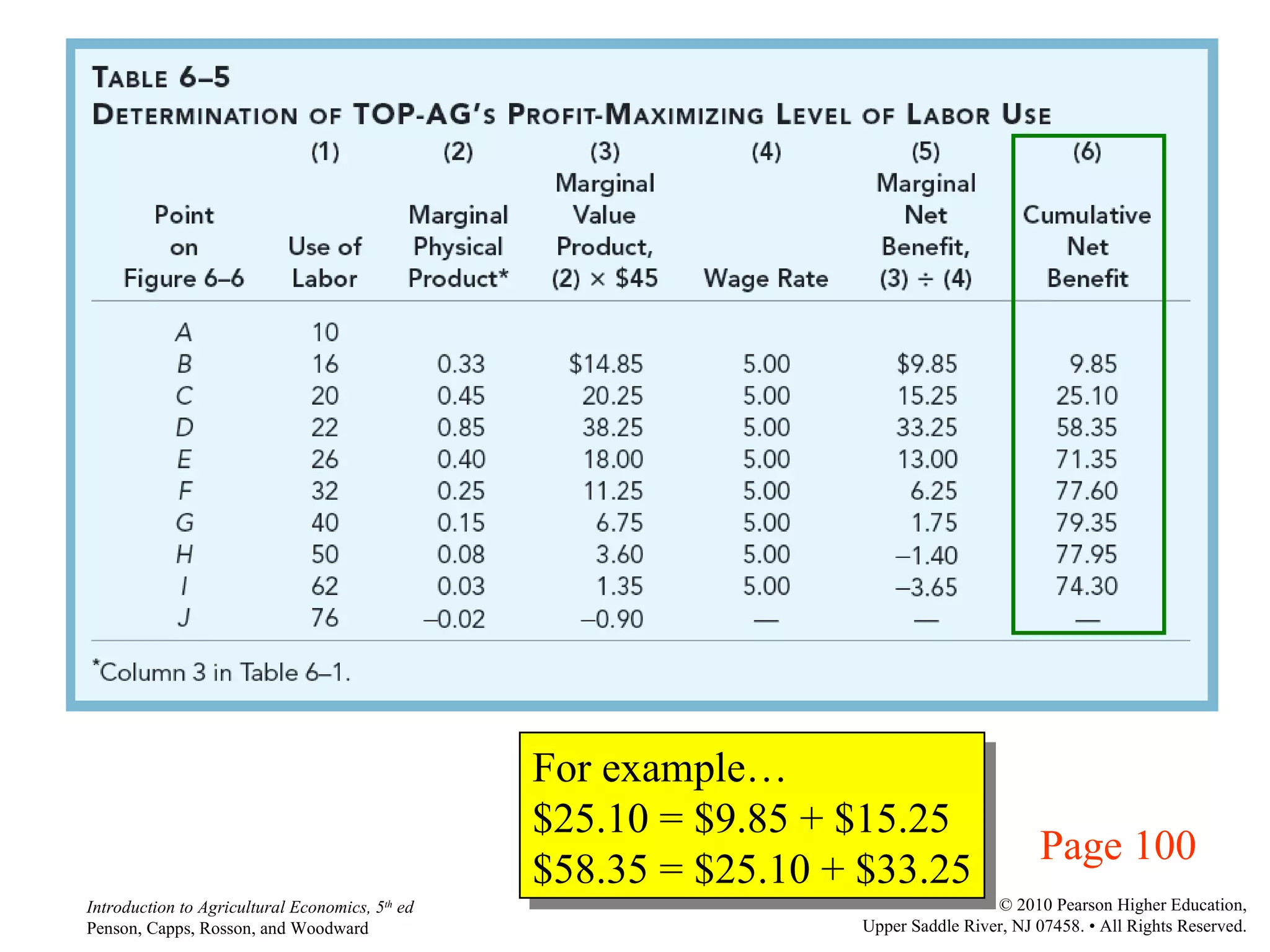
Page 100 The cumulative net benefit in column (6) is equal to the sum of successive marginal net benefit in column (5)
Page 100 For example… $25.10 = $9.85 + $15.25 $58.35 = $25.10 + $33.25
Page 100 = – Cumulative net benefit is maximized where MVP=MIC at $5
Page 101 5 If you stopped at point E on the MVP curve, for example, you would be foregoing all of the potential profit lying to the right of that point up to where MVP=MIC. B C D E F G H I J
Page 101 5 If you went beyond the point where MVP=MIC, you begin incurring losses. B C D E F G H I J
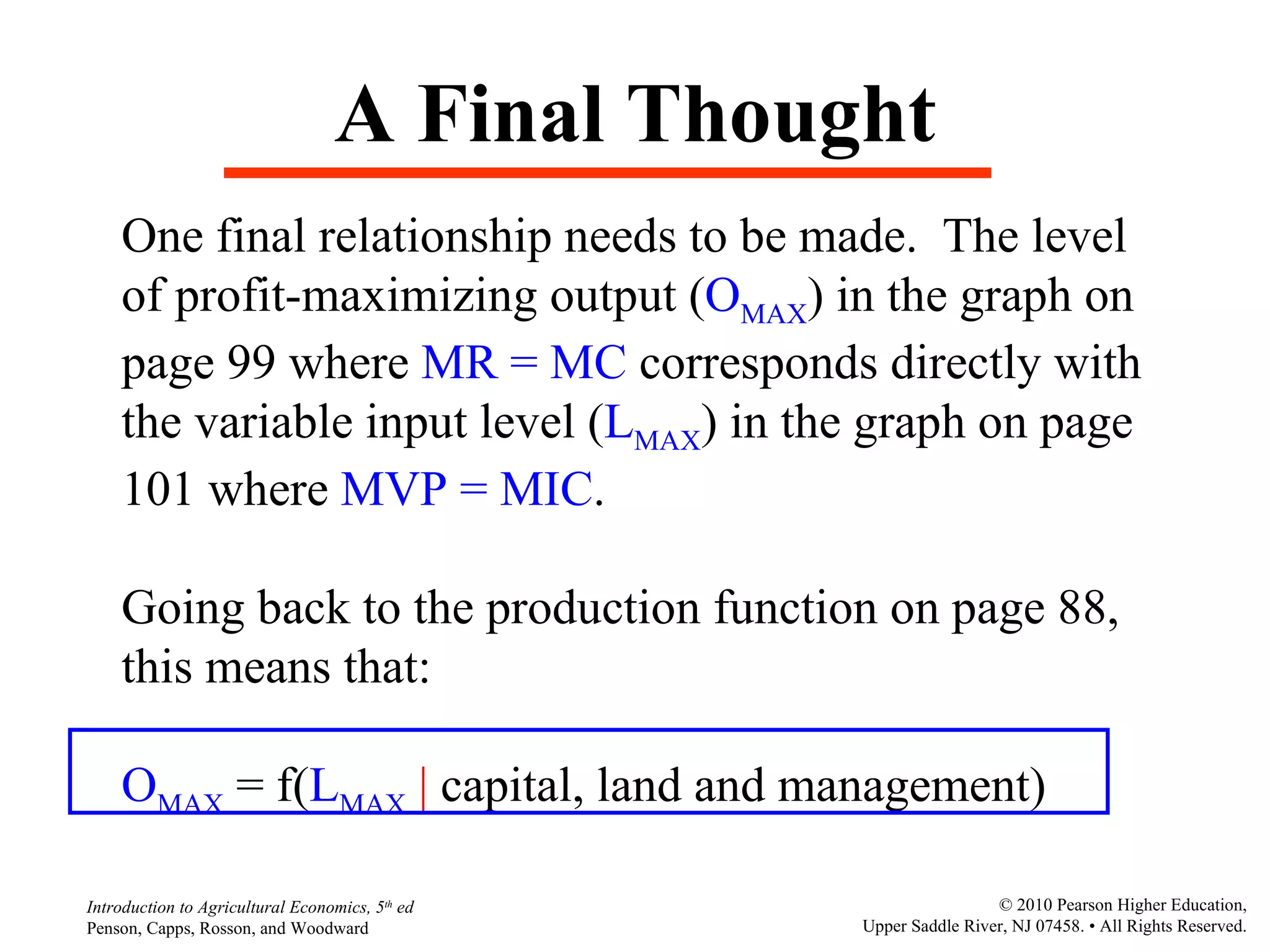
A Final Thought One final relationship needs to be made.  The level of profit-maximizing output ( O MAX ) in the graph on  page 99 where  MR = MC  corresponds directly with the variable input level ( L MAX ) in the graph on page  101 where  MVP = MIC .  Going back to the production function on page 88, this means that: O MAX  = f( L MAX   |  capital, land and management)
In Summary… Features of perfect competition Factors of production (Land, Labor, Capital and Management) Key decision rule:  Profit maximized at output  MR=MC Key decision rule:  Profit maximized where  MVP=MIC
Chapter 7 focuses on  the choice of inputs to use  and  products to produce ….

Agri 2312 chapter 6 introduction to production and resource use

  • 1.
    Introduction to Productionand Resource Use Chapter 6
  • 2.
    Topics of DiscussionConditions of perfect competition Classification of inputs Important production relationships (assume one variable input in this chapter) Assessing short run business costs Economics of short run decisions
  • 3.
    Conditions for PerfectCompetition Homogeneous products No barriers to entry or exit Large number of sellers Perfect information Page 86
  • 4.
    Classification of InputsLand: includes renewable (forests) and non-renewable (minerals) resources Labor: all owner and hired labor services, excluding management Capital: manufactured goods such as fuel, chemicals, tractors and buildings Management: production decisions designed to achieve specific economic goal Pages 86-87
  • 5.
    Production Function Output= f( labor | capital, land, and management) Start with one variable input Page 88
  • 6.
    Production Function Output= f( labor | capital, land, and management) Start with one variable input assume all other inputs fixed at their current levels… Page 88
  • 7.
    Coordinates of inputand output on the TPP curve Page 89
  • 8.
    Page 89 TotalPhysical Product (TPP) Curve Variable input
  • 9.
    Law of DiminishingMarginal Returns “ As successive units of a variable input are added to a production process with the other inputs held constant, the marginal physical product (MPP) eventually declines ” Page 93
  • 10.
    Other Physical RelationshipsThe following derivations of the TPP curve play An important role in decision-making: Marginal Physical =  Output ÷  Input Product Page 90
  • 11.
    Other Physical RelationshipsThe following derivations of the TPP curve play An important role in decision-making: Marginal Physical =  Output ÷  Input Product Average Physical = Output ÷ Input Product Pages 90-91
  • 12.
    Change in outputas you increase inputs Page 89
  • 13.
    Page 89 TotalPhysical Product (TPP) Curve  output  input Marginal physical product is .45 as labor is increased from 16 to 20 4.8 3
  • 14.
    Page 89 Outputper unit input use
  • 15.
    Page 89 TotalPhysical Product (TPP) Curve output input Average physical product is .31 if labor use is 26
  • 16.
    Plotting the MPPcurve Page 91 Change in output associated with a change in inputs
  • 17.
    Marginal Physcial ProductPage 91 Change from point A to point B on the production function is an MPP of 0.33
  • 18.
    Page 91 Plottingthe APP Curve Level of output divided by the level of input use
  • 19.
    Page 91 AveragePhysical Product Output divided by labor use is equal to 0.19
  • 20.
    Page 91 ThreeStages of Production Average physical product (yield) is increasing in Stage I
  • 21.
    Page 91 ThreeStages of Production Marginal physical product falls below the average physical product in Stage II
  • 22.
    Page 91 ThreeStages of Production MPP goes negative as shown on Page 89…
  • 23.
    Page 91 ThreeStages of Production Why are Stage I and Stage III irrational?
  • 24.
    Page 114 ThreeStages of Production Productivity rising so why stop??? Output falling
  • 25.
    Three Stages ofProduction The question therefore is where should I operate in Stage II? Page 114
  • 26.
    Economic Dimension Weneed to account for the price of the product. We also need to account for the cost of the inputs. Total Cost of production is the costs associated with the use of all inputs Fixed costs Variable costs
  • 27.
    Key Cost RelationshipsThe following cost derivations play a key role in decision-making: Marginal cost =  total cost ÷  output Page 94-96
  • 28.
    Key Cost RelationshipsThe following cost derivations play a key role in decision-making: Marginal cost =  total cost ÷  output Average variable = total variable cost ÷ output cost Page 94-96
  • 29.
    Key Cost RelationshipsThe following cost derivations play a key role in decision-making: Marginal cost =  total cost ÷  output Average variable = total variable cost ÷ output cost Average total = total cost ÷ output cost Page 94-96
  • 30.
    From TPP curve on page 89 Page 94
  • 31.
    Fixed costs are$100 no matter the level of production Page 94
  • 32.
    Column (2) dividedby column (1) Page 94
  • 33.
    Page 94 Coststhat vary with level of production
  • 34.
    Page 94 Column(4) divided by column (1)
  • 35.
    Page 94 Column(2) plus column (4)
  • 36.
    Page 94 Changein column (6) associated with a change in column (1)
  • 37.
    Page 94 Column(6) divided by column (1) or
  • 38.
    Page 94 or column (3) plus column (5)
  • 39.
    Let’s graph thecost series in this table
  • 40.
    Plotted cost relationshipsfrom table 6.3 on page 94 Page 95 O SD O BE Plotting costs for levels of output
  • 41.
    Marginal and AverageRevenue Marginal revenue = ∆ total revenue ÷ ∆ output
  • 42.
    Now let’s assumethis firm can sell its product for $45/unit
  • 43.
    Key Revenue ConceptsNotice the price in column (2) is identical to marginal revenue in column (7). What about average revenue, or AR? What do you see if you divide total revenue in column (3) by output in column (1)? Yes, $45. Thus, P = MR = AR under perfect competition. Page 98
  • 44.
    Let’s see thisin graphical form
  • 45.
    Page 99 Profitmaximizing level of output, where MR=MC P=MR=AR $45 11.2
  • 46.
    Page 99 AverageProfit = $17, or AR – ATC P=MR=AR $45-$28 $28
  • 47.
    Grey area representstotal economic profit if the price is $45… Page 99 P=MR=AR 11.2  ($45 - $28) = $190.40
  • 48.
    Zero economic profitif price falls to P BE . Firm would only produce output O BE . AR-ATC=0 Page 99 P=MR=AR
  • 49.
    Economic losses ifprice falls to P SD . Firm would shut down below output O SD Page 99 P=MR=AR
  • 50.
    Where is thefirm’s supply curve? Page 99 P=MR=AR
  • 51.
    Page 99 P=MR=ARMarginal cost curve above AVC curve?
  • 52.
    Key Revenue ConceptsPage 98 The previous graph indicated that profit is maximized at 11.2 units of output, where MR ($45) equals MC ($45). This occurs between lines G and H on the table above, where at 11.2 units of output profit would be $190.40 . Let’s do the math….
  • 53.
    Doing the math….Produce 11.2 units of output (O MAX on p. 99) Price of product = $45.00 Total revenue = 11.2 × $45 = $504.00
  • 54.
    Doing the math….Produce 11.2 units of output Price of product = $45.00 Total revenue = 11.2 × $45 = $504.00 Average total cost at 11.2 units of output = $28 Total costs = 11.2 × $28 = $313.60 Profit = $504.00 – $313.60 = $190.40
  • 55.
    Doing the math….Produce 11.2 units of output Price of product = $45.00 Total revenue = 11.2 × $45 = $504.00 Average total cost at 11.2 units of output = $28 Total costs = 11.2 × $28 = $313.60 Profit = $504.00 – $313.60 = $190.40 Average profit = AR – ATC = $45 – $28 = $17 Profit = $17 × 11.2 = $190.40
  • 56.
    Profit at Priceof $45? 28 P =45 $ Q 11.2 MC ATC AVC Revenue = $45  11.2 = $504.00 Total cost = $28  11.2 = $313.60 Profit = $504.00 – $313.60 = $190.40 Since P = MR = AR Average profit = $45 – $28 = $17 Profit = $17  11.2 = $190.40
  • 57.
    Profit at Priceof $45? 28 P =45 $ Q 11.2 MC ATC AVC Revenue = $45  11.2 = $504.00 Total cost = $28  11.2 = $313.60 Profit = $504.00 – $313.60 = $190.40 Since P = MR = AR Average profit = $45 – $28 = $17 Profit = $17  11.2 = $190.40 $190.40
  • 58.
    Price falls to$28.00…. Produce 10.3 units of output (O BE on p. 99) Price of product = $28.00 Total revenue = 10.3 × $28 = $288.40
  • 59.
    Price falls to$28.00…. Produce 10.3 units of output Price of product = $28.00 Total revenue = 10.3 × $28 = $288.40 Average total cost at 10.3 units of output = $28 Total costs = 10.3 × $28 = $288.40 Profit = $288.40 – $288.40 = $0.00
  • 60.
    Price falls to$28.00…. Produce 10.3 units of output Price of product = $28.00 Total revenue = 10.3 × $28 = $288.40 Average total cost at 10.3 units of output = $28 Total costs = 10.3 × $28 = $288.40 Profit = $288.40 – $288.40 = $0.00 Average profit = AR – ATC = $28 – $28 = $0 Profit = $0 × 10.3 = $0.00
  • 61.
    Profit at Priceof $28? P=28 45 $ Q 11.2 10.3 MC ATC AVC Revenue = $28  10.3 = $288.40 Total cost = $28  10.3 = $288.40 Profit = $288.40 – $288.40 = $0 Since P = MR = AR Average profit = $28 – $28 = $0 Profit = $0  10.3 = $0 (break even)
  • 62.
    Price falls to$18.00…. Produce 8.6 units of output (O SD on p. 99) Price of product = $18.00 Total revenue = 8.6 × $18 = $154.80
  • 63.
    Price falls to$18.00…. Produce 8.6 units of output Price of product = $18.00 Total revenue = 8.6 × $18 = $154.80 Average total cost at 8.6 units of output = $28 Total costs = 8.6 × $28 = $240.80 Profit = $154.80 – $240.80 = – $86.00
  • 64.
    Price falls to$18.00…. Produce 8.6 units of output Price of product = $18.00 Total revenue = 8.6 × $18 = $154.80 Average total cost at 8.6 units of output = $28 Total costs = 8.6 × $28 = $240.80 Profit = $154.80 – $240.80 = – $86.00 Average profit = AR – ATC = $18 – $28 = – $10 Profit = – $10 × 8.6 = – $86.00
  • 65.
    Profit at Priceof $18? 28 P=18 45 $ Q 11.2 10.3 8.6 MC ATC AVC Revenue = $18  8.6 = $154.80 Total cost = $28  8.6 = $240.80 Profit = $154.80 – $240.80 = $0 Since P = MR = AR Average profit = $18 – $28 = – $10 Profit = – $10  8.6 = – $86 (Loss)
  • 66.
    Price falls to$10.00…. Produce 7.0 units of output (below O SD on p. 99) Price of product = $10.00 Total revenue = 7.0 × $10 = $70.00
  • 67.
    Price falls to$10.00…. Produce 7.0 units of output Price of product = $10.00 Total revenue = 7.0 × $10 = $70.00 Average total cost at 7.0 units of output = $28 Total costs = 7.0 × $28 = $196.00 Profit = $70.00 – $196.00 = – $126.00
  • 68.
    Price falls to$10.00…. Produce 7.0 units of output Price of product = $10.00 Total revenue = 7.0 × $10 = $70.00 Average total cost at 7.0 units of output = $30 Total costs = 7.0 × $30 = $210.00 Profit = $70.00 – $210.00 = – $140.00 Average variable costs = $19 Total variable costs = $19 × 7.0 = $133.00 Revenue – variable costs = –$63.00 !!!!!
  • 69.
    Profit at Priceof $10? 28 P=10 18 45 $ Q 11.2 10.3 8.6 MC ATC AVC 7.0 Revenue = $10  7.0 = $70.00 Total cost = $30  7.0 = $210.00 Profit = $70.00 – $210.00 = $140.00 Since P = MR = AR Average profit = $10 – $30 = – $20 Profit = – $20  7.0 = – $140 Average variable cost = $19 Variable costs = $19  7.0 = $133.00 Revenue – variable costs = – $63 Not covering variable costs!!!!!!
  • 70.
    The Firm’s SupplyCurve 28 P=10 18 45 $ Q 11.2 10.3 8.6 MC ATC AVC 7.0
  • 71.
    Now let’s lookat the demand for a single input: Labor
  • 72.
    Key Input RelationshipsThe following input-related derivations also play a key role in decision-making: Marginal value = marginal physical product × price product Page 100
  • 73.
    Key Input RelationshipsThe following input-related derivations also play a key role in decision-making: Marginal value = marginal physical product × price product Marginal input = wage rate, rental rate, etc. cost Page 100
  • 74.
    Page 101 5B C D E F G H I J Wage rate represents the MIC for labor
  • 75.
    Page 101 5B C D E F G H I J Use a variable input like labor up to the point where the value received from the market equals the cost of another unit of input, or MVP=MIC
  • 76.
    Page 101 5The area below the green lined MVP curve and above the green lined MIC curve represents cumulative net benefit. B C D E F G H I J
  • 77.
    Page 100 MVP= MPP × $45
  • 78.
    Page 100 Profitmaximized where MVP = MIC or where MVP =$5 and MIC = $5
  • 79.
    Page 100 Marginalnet benefit in column (5) is equal to MVP in column (3) minus MIC of labor in column (4) = –
  • 80.
    Page 100 Thecumulative net benefit in column (6) is equal to the sum of successive marginal net benefit in column (5)
  • 81.
    Page 100 Forexample… $25.10 = $9.85 + $15.25 $58.35 = $25.10 + $33.25
  • 82.
    Page 100 =– Cumulative net benefit is maximized where MVP=MIC at $5
  • 83.
    Page 101 5If you stopped at point E on the MVP curve, for example, you would be foregoing all of the potential profit lying to the right of that point up to where MVP=MIC. B C D E F G H I J
  • 84.
    Page 101 5If you went beyond the point where MVP=MIC, you begin incurring losses. B C D E F G H I J
  • 85.
    A Final ThoughtOne final relationship needs to be made. The level of profit-maximizing output ( O MAX ) in the graph on page 99 where MR = MC corresponds directly with the variable input level ( L MAX ) in the graph on page 101 where MVP = MIC . Going back to the production function on page 88, this means that: O MAX = f( L MAX | capital, land and management)
  • 86.
    In Summary… Featuresof perfect competition Factors of production (Land, Labor, Capital and Management) Key decision rule: Profit maximized at output MR=MC Key decision rule: Profit maximized where MVP=MIC
  • 87.
    Chapter 7 focuseson the choice of inputs to use and products to produce ….