Artificial General
Intelligence (AGI)
Name: K. Koyal
Branch: CSE-1
Roll no: 2102L16
Reg. No. : 2121287039
Page no | 01
Content
1. Definition of AGI
2. AI vs AGI
3. Technologies used in the development of AGI
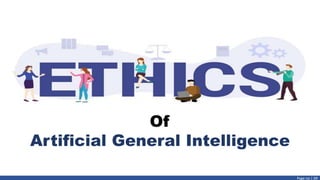
4. Ethics of AGI
5. Distinguishing Feature
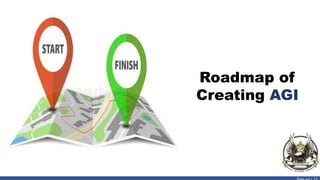
6. Roadmap of creating AGI
7. Development in the field of AGI so far
8. Limitations
9. Jarvis – Ironman
10. Conclusion
11. References
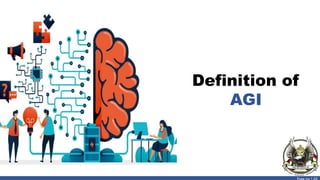
Definition of
AGI
Page no | 03
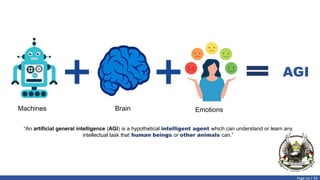
AGI
Machines Brain Emotions
“An artificial general intelligence (AGI) is a hypothetical intelligent agent which can understand or learn any
intellectual task that human beings or other animals can.”
Page no | 05
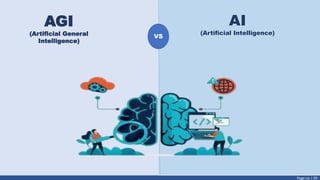
VS
AGI
(Artificial General
Intelligence)
AI
(Artificial Intelligence)
Page no | 06
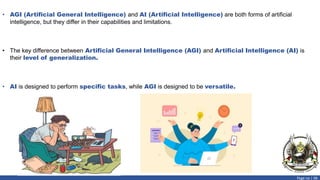
• AGI (Artificial General Intelligence) and AI (Artificial Intelligence) are both forms of artificial
intelligence, but they differ in their capabilities and limitations.
• The key difference between Artificial General Intelligence (AGI) and Artificial Intelligence (AI) is
their level of generalization.
• AI is designed to perform specific tasks, while AGI is designed to be versatile.
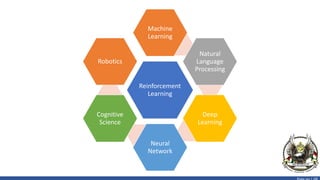
Technologies used
in the development
of AGI
Reinforcement
Learning
Machine
Learning
Natural
Language
Processing
Deep
Learning
Neural
Network
Cognitive
Science
Robotics
Page no | 09
Of
Artificial General Intelligence
Page no | 10
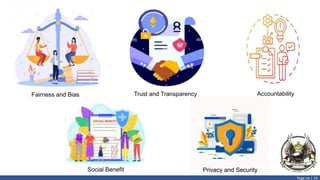
Fairness and Bias Trust and Transparency Accountability
Social Benefit Privacy and Security
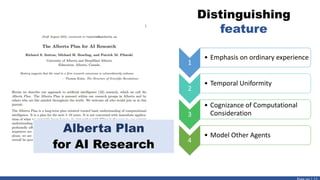
Alberta Plan
for AI Research
1
• Emphasis on ordinary experience
2
• Temporal Uniformity
3
• Cognizance of Computational
Consideration
4
• Model Other Agents
Distinguishing
feature
Roadmap of
Creating AGI
Page no | 13
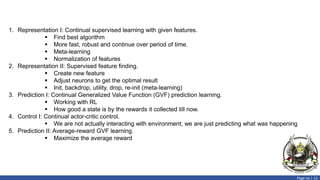
1. Representation I: Continual supervised learning with given features.
 Find best algorithm
 More fast, robust and continue over period of time.
 Meta-learning
 Normalization of features
2. Representation II: Supervised feature finding.
 Create new feature
 Adjust neurons to get the optimal result
 Init, backdrop, utility, drop, re-init (meta-learning)
3. Prediction I: Continual Generalized Value Function (GVF) prediction learning.
 Working with RL
 How good a state is by the rewards it collected till now.
4. Control I: Continual actor-critic control.
 We are not actually interacting with environment, we are just predicting what was happening
5. Prediction II: Average-reward GVF learning.
 Maximize the average reward
Page no | 14
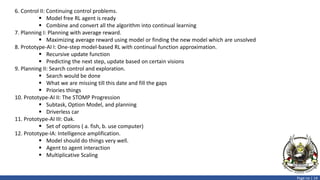
6. Control II: Continuing control problems.
 Model free RL agent is ready
 Combine and convert all the algorithm into continual learning
7. Planning I: Planning with average reward.
 Maximizing average reward using model or finding the new model which are unsolved
8. Prototype-AI I: One-step model-based RL with continual function approximation.
 Recursive update function
 Predicting the next step, update based on certain visions
9. Planning II: Search control and exploration.
 Search would be done
 What we are missing till this date and fill the gaps
 Priories things
10. Prototype-AI II: The STOMP Progression
 Subtask, Option Model, and planning
 Driverless car
11. Prototype-AI III: Oak.
 Set of options ( a. fish, b. use computer)
12. Prototype-IA: Intelligence amplification.
 Model should do things very well.
 Agent to agent interaction
 Multiplicative Scaling
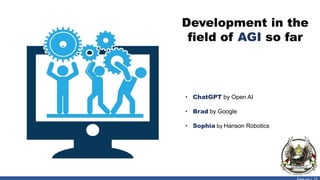
Development in the
field of AGI so far
• ChatGPT by Open AI
• Brad by Google
• Sophia by Hanson Robotics
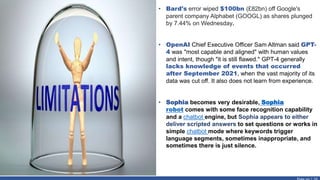
• Bard's error wiped $100bn (£82bn) off Google's
parent company Alphabet (GOOGL) as shares plunged
by 7.44% on Wednesday.
• OpenAI Chief Executive Officer Sam Altman said GPT-
4 was "most capable and aligned" with human values
and intent, though "it is still flawed." GPT-4 generally
lacks knowledge of events that occurred
after September 2021, when the vast majority of its
data was cut off. It also does not learn from experience.
• Sophia becomes very desirable, Sophia
robot comes with some face recognition capability
and a chatbot engine, but Sophia appears to either
deliver scripted answers to set questions or works in
simple chatbot mode where keywords trigger
language segments, sometimes inappropriate, and
sometimes there is just silence.
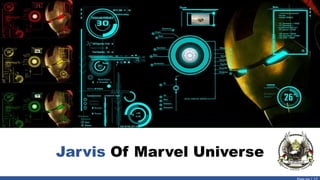
Jarvis Of Marvel Universe
Conclusion
Is AGI really Possible ?
Well as of now, it seem difficult but it is possible as Elon
Musk has said in one of his interview that AGI is our future
and we can’t ignore it.
AGI main focus is to replicate human brain and do things
like human or even better but human’s brain is composed
of around 100 billion neurons and each neuron can
generate technically up to 5-50 messages each and
processes it at the same time.
It is very hard to replicate human brain and even if we
start to do it would require a large amount of
computational power and storage and even if simulated
brain is built it is much slower than actual ones.
But achieving true AGI would be the most defining
moment in the history of humankind and that moment is
closer each day.
References
• https://www.youtube.com/watch?v=PvJ14d0r3CM
• https://arxiv.org/abs/2208.11173
• https://www.youtube.com/watch?v=Y2d1AU7_JvM&list=WL&index=4
• https://www.youtube.com/watch?v=Y2d1AU7_JvM&list=WL&index=4&t=4s
• https://en.wikipedia.org/wiki/J.A.R.V.I.S.#:~:text=Iron%20Man%203.,J.A.R.V.I.S.,A%20Rather%20Very%20Inte
lligent%20System%22.
• https://openai.com/product/gpt-4
• https://bard.google.com/
• https://www.ibm.com/in-en/topics/strong-ai
• https://www.online-sciences.com/robotics/sophia-robot-review-features-use-advantages-disadvantages/
AGI.pptx

AGI.pptx

  • 1.
    Artificial General Intelligence (AGI) Name:K. Koyal Branch: CSE-1 Roll no: 2102L16 Reg. No. : 2121287039
  • 2.
    Page no |01 Content 1. Definition of AGI 2. AI vs AGI 3. Technologies used in the development of AGI 4. Ethics of AGI 5. Distinguishing Feature 6. Roadmap of creating AGI 7. Development in the field of AGI so far 8. Limitations 9. Jarvis – Ironman 10. Conclusion 11. References
  • 3.
  • 4.
    Page no |03 AGI Machines Brain Emotions “An artificial general intelligence (AGI) is a hypothetical intelligent agent which can understand or learn any intellectual task that human beings or other animals can.”
  • 6.
    Page no |05 VS AGI (Artificial General Intelligence) AI (Artificial Intelligence)
  • 7.
    Page no |06 • AGI (Artificial General Intelligence) and AI (Artificial Intelligence) are both forms of artificial intelligence, but they differ in their capabilities and limitations. • The key difference between Artificial General Intelligence (AGI) and Artificial Intelligence (AI) is their level of generalization. • AI is designed to perform specific tasks, while AGI is designed to be versatile.
  • 8.
    Technologies used in thedevelopment of AGI
  • 9.
  • 10.
    Page no |09 Of Artificial General Intelligence
  • 11.
    Page no |10 Fairness and Bias Trust and Transparency Accountability Social Benefit Privacy and Security
  • 12.
    Alberta Plan for AIResearch 1 • Emphasis on ordinary experience 2 • Temporal Uniformity 3 • Cognizance of Computational Consideration 4 • Model Other Agents Distinguishing feature
  • 13.
  • 14.
    Page no |13 1. Representation I: Continual supervised learning with given features.  Find best algorithm  More fast, robust and continue over period of time.  Meta-learning  Normalization of features 2. Representation II: Supervised feature finding.  Create new feature  Adjust neurons to get the optimal result  Init, backdrop, utility, drop, re-init (meta-learning) 3. Prediction I: Continual Generalized Value Function (GVF) prediction learning.  Working with RL  How good a state is by the rewards it collected till now. 4. Control I: Continual actor-critic control.  We are not actually interacting with environment, we are just predicting what was happening 5. Prediction II: Average-reward GVF learning.  Maximize the average reward
  • 15.
    Page no |14 6. Control II: Continuing control problems.  Model free RL agent is ready  Combine and convert all the algorithm into continual learning 7. Planning I: Planning with average reward.  Maximizing average reward using model or finding the new model which are unsolved 8. Prototype-AI I: One-step model-based RL with continual function approximation.  Recursive update function  Predicting the next step, update based on certain visions 9. Planning II: Search control and exploration.  Search would be done  What we are missing till this date and fill the gaps  Priories things 10. Prototype-AI II: The STOMP Progression  Subtask, Option Model, and planning  Driverless car 11. Prototype-AI III: Oak.  Set of options ( a. fish, b. use computer) 12. Prototype-IA: Intelligence amplification.  Model should do things very well.  Agent to agent interaction  Multiplicative Scaling
  • 16.
    Development in the fieldof AGI so far • ChatGPT by Open AI • Brad by Google • Sophia by Hanson Robotics
  • 17.
    • Bard's errorwiped $100bn (£82bn) off Google's parent company Alphabet (GOOGL) as shares plunged by 7.44% on Wednesday. • OpenAI Chief Executive Officer Sam Altman said GPT- 4 was "most capable and aligned" with human values and intent, though "it is still flawed." GPT-4 generally lacks knowledge of events that occurred after September 2021, when the vast majority of its data was cut off. It also does not learn from experience. • Sophia becomes very desirable, Sophia robot comes with some face recognition capability and a chatbot engine, but Sophia appears to either deliver scripted answers to set questions or works in simple chatbot mode where keywords trigger language segments, sometimes inappropriate, and sometimes there is just silence.
  • 18.
  • 19.
    Conclusion Is AGI reallyPossible ? Well as of now, it seem difficult but it is possible as Elon Musk has said in one of his interview that AGI is our future and we can’t ignore it. AGI main focus is to replicate human brain and do things like human or even better but human’s brain is composed of around 100 billion neurons and each neuron can generate technically up to 5-50 messages each and processes it at the same time. It is very hard to replicate human brain and even if we start to do it would require a large amount of computational power and storage and even if simulated brain is built it is much slower than actual ones. But achieving true AGI would be the most defining moment in the history of humankind and that moment is closer each day.
  • 20.
    References • https://www.youtube.com/watch?v=PvJ14d0r3CM • https://arxiv.org/abs/2208.11173 •https://www.youtube.com/watch?v=Y2d1AU7_JvM&list=WL&index=4 • https://www.youtube.com/watch?v=Y2d1AU7_JvM&list=WL&index=4&t=4s • https://en.wikipedia.org/wiki/J.A.R.V.I.S.#:~:text=Iron%20Man%203.,J.A.R.V.I.S.,A%20Rather%20Very%20Inte lligent%20System%22. • https://openai.com/product/gpt-4 • https://bard.google.com/ • https://www.ibm.com/in-en/topics/strong-ai • https://www.online-sciences.com/robotics/sophia-robot-review-features-use-advantages-disadvantages/