Agility In DevOps
Why DevOps?
• Faster time to market
• Continuous Delivery
• Increased in ROI
• Collaboration that’s reduce miscommunication
• Get Best out of team (none of team member will be idle)
• Stable System
• To minimize cost of maintenance
Introduction to DevOps
• DevOps is the best practice of streamlining the development
process through better collaboration, standardization, and
automation. An application, its infrastructure, and the
teams(including business team) behind it are considered closely
aligned, rather than separate, entities . Organizations gain a
competitive advantage by balancing their developers’ need to
release rapidly with the ability of operations to deliver stability and
security.
• DevOps is a method, rather than a technology. DevOps is more
influential to an organization’s culture. However, technology can
help simplify a DevOps environment
DevOps Cont’d..
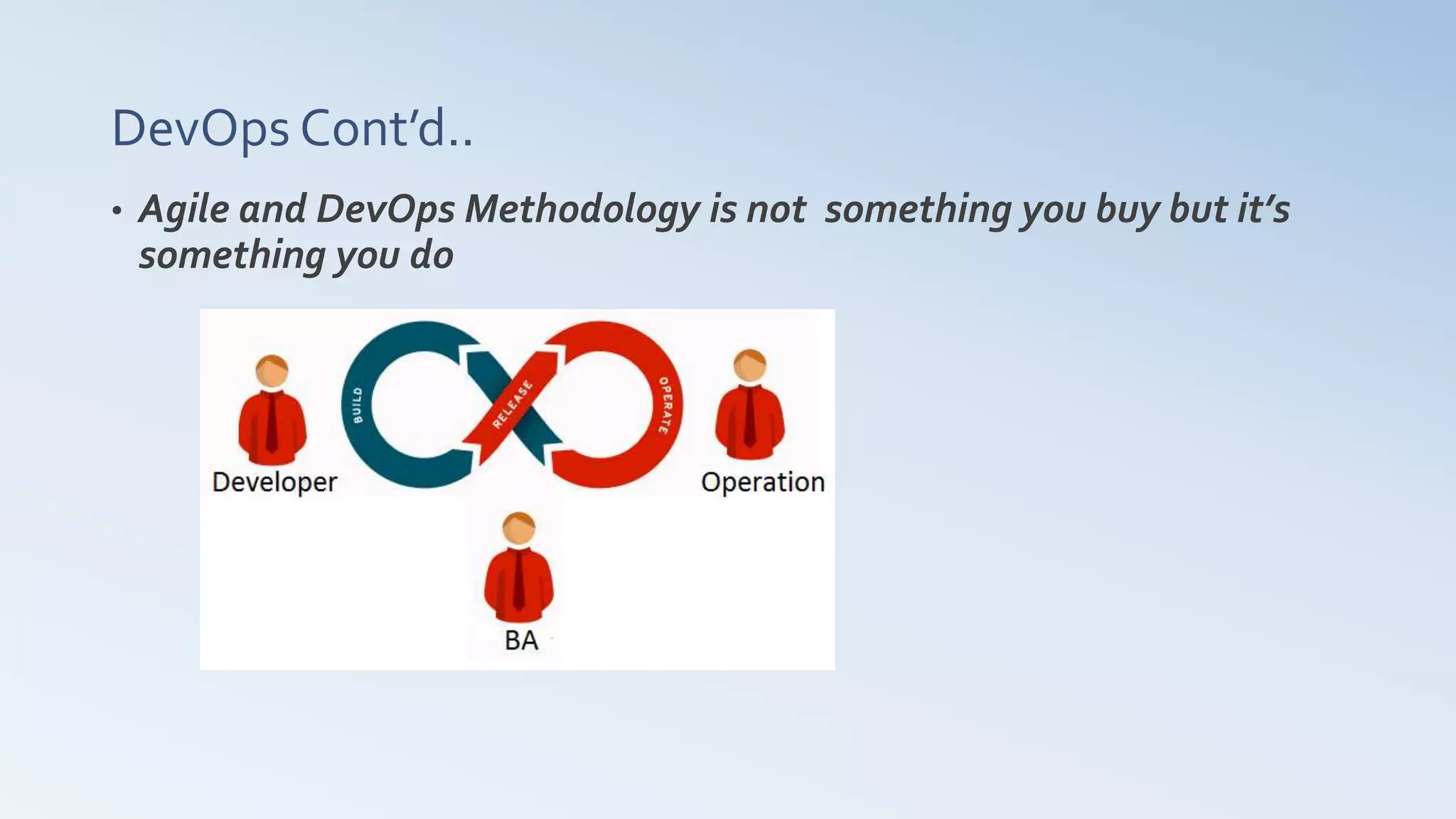
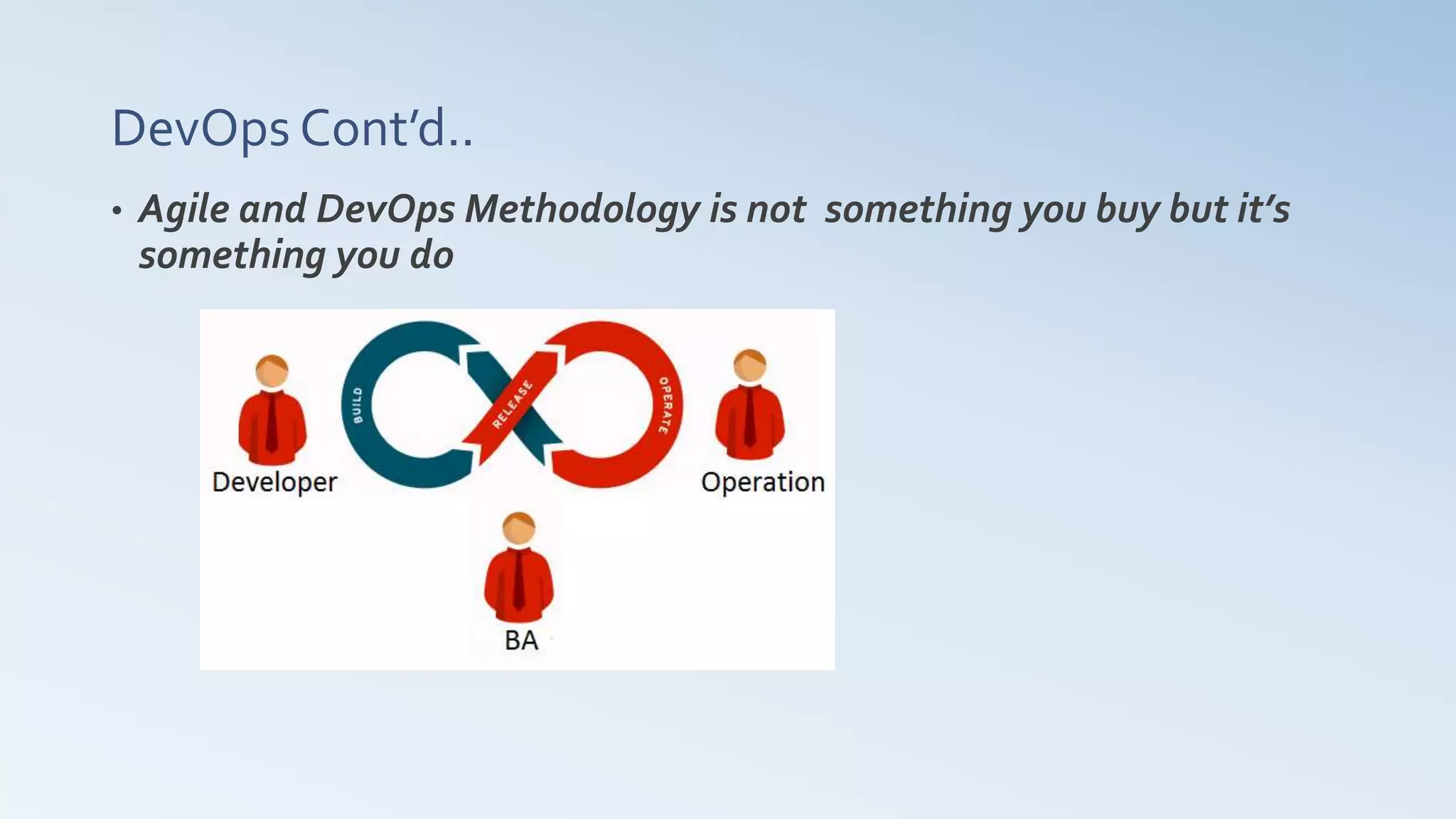
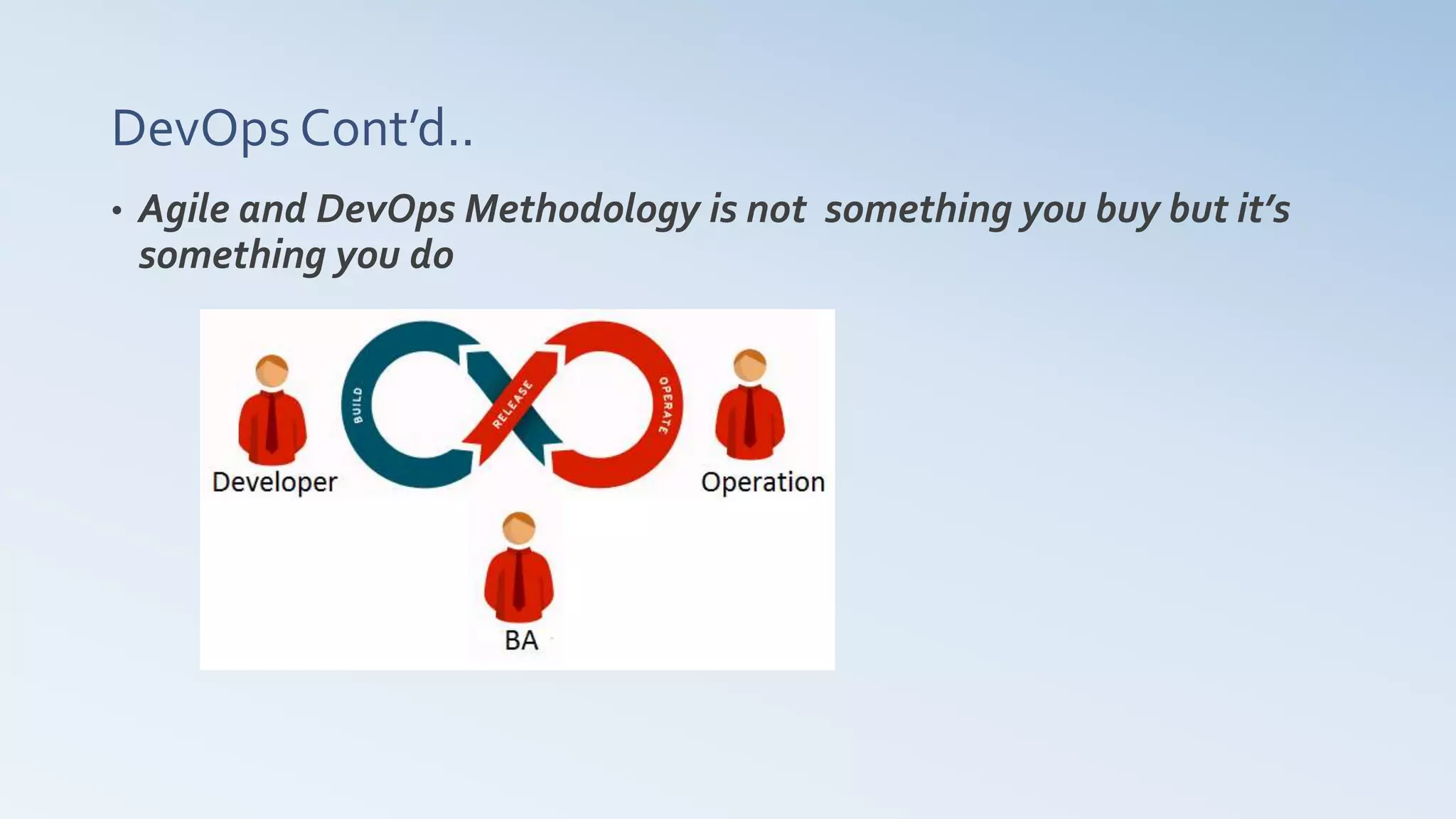
• Agile and DevOps Methodology is not something you buy but it’s
something you do
DevOps Cont’d..
• Agile and DevOps Methodology is not something you buy but it’s
something you do
DevOps Cont’d..
• Agile and DevOps Methodology is not something you buy but it’s
something you do
What is Continuous Integration (CI)?
• Continuous Integration is based on Pull request
• For example:
• Suppose we have product which already in production and today
market is moving very fast and team understand some of feature is in
queue that’s need to develop
What is Continuous Deployment (CD)?
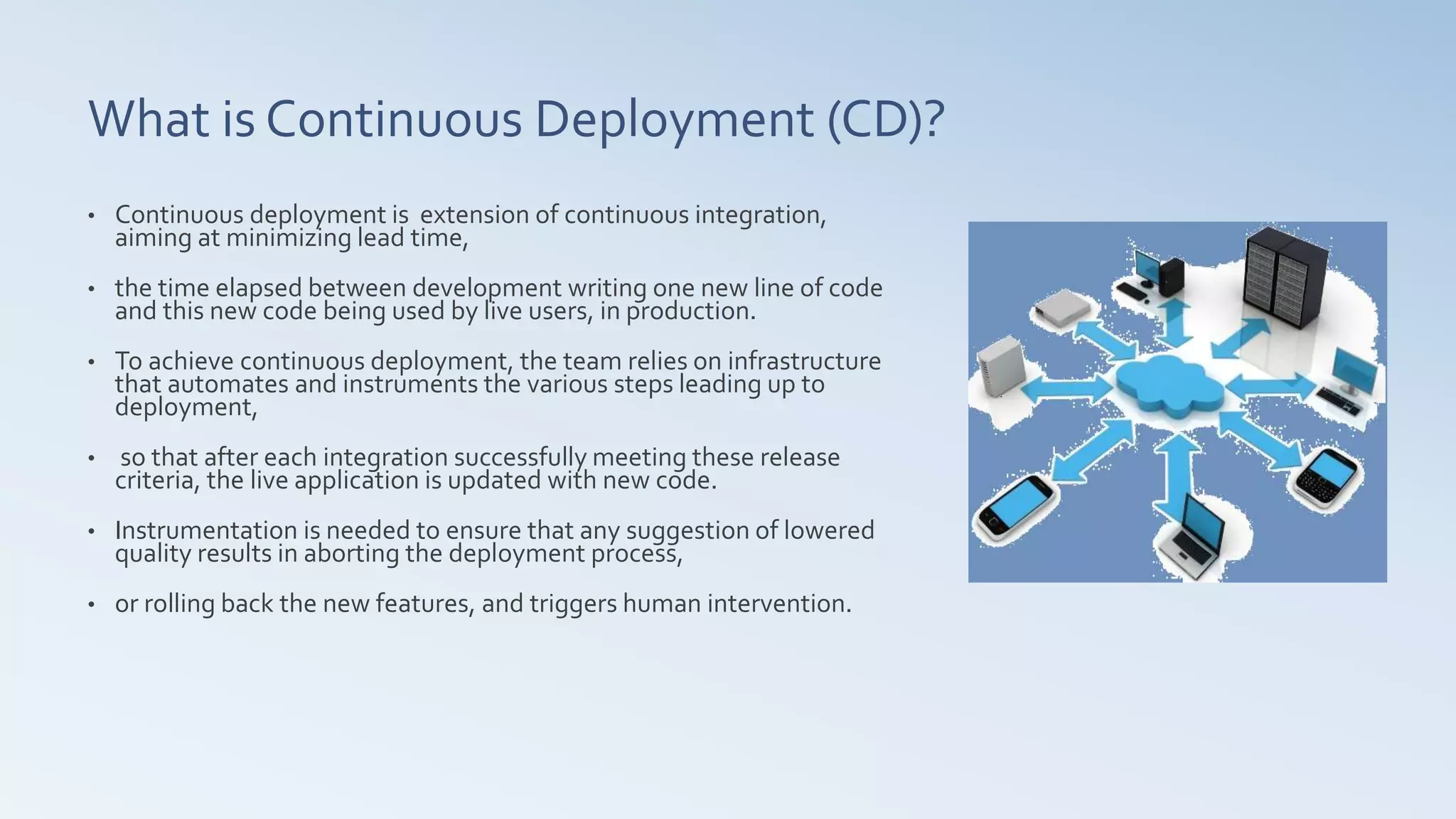
• Continuous deployment is extension of continuous integration,
aiming at minimizing lead time,
• the time elapsed between development writing one new line of code
and this new code being used by live users, in production.
• To achieve continuous deployment, the team relies on infrastructure
that automates and instruments the various steps leading up to
deployment,
• so that after each integration successfully meeting these release
criteria, the live application is updated with new code.
• Instrumentation is needed to ensure that any suggestion of lowered
quality results in aborting the deployment process,
• or rolling back the new features, and triggers human intervention.
What is Continuous Delivery (CD)
How to start in DevOps?
Applying Agile framework in DevOps
What are the challenges in adopting Agile in DevOps?
What are tools that can help?
How to work with distributed teams.?
How to evaluate performance?
Keep Exploring

Agility in DevOPS

  • 1.
  • 2.
    Why DevOps? • Fastertime to market • Continuous Delivery • Increased in ROI • Collaboration that’s reduce miscommunication • Get Best out of team (none of team member will be idle) • Stable System • To minimize cost of maintenance
  • 3.
    Introduction to DevOps •DevOps is the best practice of streamlining the development process through better collaboration, standardization, and automation. An application, its infrastructure, and the teams(including business team) behind it are considered closely aligned, rather than separate, entities . Organizations gain a competitive advantage by balancing their developers’ need to release rapidly with the ability of operations to deliver stability and security. • DevOps is a method, rather than a technology. DevOps is more influential to an organization’s culture. However, technology can help simplify a DevOps environment
  • 4.
    DevOps Cont’d.. • Agileand DevOps Methodology is not something you buy but it’s something you do
  • 5.
    DevOps Cont’d.. • Agileand DevOps Methodology is not something you buy but it’s something you do
  • 6.
    DevOps Cont’d.. • Agileand DevOps Methodology is not something you buy but it’s something you do
  • 7.
    What is ContinuousIntegration (CI)? • Continuous Integration is based on Pull request • For example: • Suppose we have product which already in production and today market is moving very fast and team understand some of feature is in queue that’s need to develop
  • 8.
    What is ContinuousDeployment (CD)? • Continuous deployment is extension of continuous integration, aiming at minimizing lead time, • the time elapsed between development writing one new line of code and this new code being used by live users, in production. • To achieve continuous deployment, the team relies on infrastructure that automates and instruments the various steps leading up to deployment, • so that after each integration successfully meeting these release criteria, the live application is updated with new code. • Instrumentation is needed to ensure that any suggestion of lowered quality results in aborting the deployment process, • or rolling back the new features, and triggers human intervention.
  • 9.
    What is ContinuousDelivery (CD)
  • 10.
    How to startin DevOps?
  • 11.
  • 12.
    What are thechallenges in adopting Agile in DevOps?
  • 13.
    What are toolsthat can help?
  • 14.
    How to workwith distributed teams.?
  • 15.
    How to evaluateperformance?
  • 16.